EP0441361A2 - Process for producing foreign protein in escherichia coli - Google Patents
Process for producing foreign protein in escherichia coli Download PDFInfo
- Publication number
- EP0441361A2 EP0441361A2 EP91101634A EP91101634A EP0441361A2 EP 0441361 A2 EP0441361 A2 EP 0441361A2 EP 91101634 A EP91101634 A EP 91101634A EP 91101634 A EP91101634 A EP 91101634A EP 0441361 A2 EP0441361 A2 EP 0441361A2
- Authority
- EP
- European Patent Office
- Prior art keywords
- phage
- initiation signal
- foreign protein
- mutant
- process according
- Prior art date
- Legal status (The legal status is an assumption and is not a legal conclusion. Google has not performed a legal analysis and makes no representation as to the accuracy of the status listed.)
- Granted
Links
- 108090000623 proteins and genes Proteins 0.000 title claims abstract description 85
- 102000004169 proteins and genes Human genes 0.000 title claims abstract description 50
- 241000588724 Escherichia coli Species 0.000 title claims abstract description 39
- 238000000034 method Methods 0.000 title claims description 39
- 239000013612 plasmid Substances 0.000 claims abstract description 35
- 239000012634 fragment Substances 0.000 claims abstract description 30
- 101100389323 Enterobacteria phage T4 denB gene Proteins 0.000 claims abstract description 20
- 230000005026 transcription initiation Effects 0.000 claims abstract description 18
- 230000014621 translational initiation Effects 0.000 claims abstract description 18
- 238000012258 culturing Methods 0.000 claims abstract description 5
- 208000015181 infectious disease Diseases 0.000 claims description 23
- 108091005804 Peptidases Proteins 0.000 claims description 8
- 239000004365 Protease Substances 0.000 claims description 8
- 102100037486 Reverse transcriptase/ribonuclease H Human genes 0.000 claims description 6
- 101150096740 uvsY gene Proteins 0.000 claims description 6
- 230000001131 transforming effect Effects 0.000 claims description 4
- 238000003306 harvesting Methods 0.000 claims description 3
- 230000002062 proliferating effect Effects 0.000 claims description 3
- 102000013602 Cardiac Myosins Human genes 0.000 claims 2
- 108010051609 Cardiac Myosins Proteins 0.000 claims 2
- 238000010420 art technique Methods 0.000 abstract description 5
- 108020004414 DNA Proteins 0.000 description 51
- 235000018102 proteins Nutrition 0.000 description 40
- 108010051583 Ventricular Myosins Proteins 0.000 description 14
- 230000000747 cardiac effect Effects 0.000 description 14
- 101100323029 Neurospora crassa (strain ATCC 24698 / 74-OR23-1A / CBS 708.71 / DSM 1257 / FGSC 987) alc-1 gene Proteins 0.000 description 12
- 101150104410 alc gene Proteins 0.000 description 12
- 239000002609 medium Substances 0.000 description 12
- 108091008146 restriction endonucleases Proteins 0.000 description 9
- 230000014509 gene expression Effects 0.000 description 8
- 108700026244 Open Reading Frames Proteins 0.000 description 7
- OPTASPLRGRRNAP-UHFFFAOYSA-N cytosine Chemical compound NC=1C=CNC(=O)N=1 OPTASPLRGRRNAP-UHFFFAOYSA-N 0.000 description 6
- MJEQLGCFPLHMNV-UHFFFAOYSA-N 4-amino-1-(hydroxymethyl)pyrimidin-2-one Chemical compound NC=1C=CN(CO)C(=O)N=1 MJEQLGCFPLHMNV-UHFFFAOYSA-N 0.000 description 5
- 102000012410 DNA Ligases Human genes 0.000 description 5
- 108010061982 DNA Ligases Proteins 0.000 description 5
- 108020004511 Recombinant DNA Proteins 0.000 description 5
- 239000013604 expression vector Substances 0.000 description 5
- 239000000126 substance Substances 0.000 description 5
- 238000012270 DNA recombination Methods 0.000 description 4
- 229960000723 ampicillin Drugs 0.000 description 4
- AVKUERGKIZMTKX-NJBDSQKTSA-N ampicillin Chemical compound C1([C@@H](N)C(=O)N[C@H]2[C@H]3SC([C@@H](N3C2=O)C(O)=O)(C)C)=CC=CC=C1 AVKUERGKIZMTKX-NJBDSQKTSA-N 0.000 description 4
- 108020004999 messenger RNA Proteins 0.000 description 4
- YBYRMVIVWMBXKQ-UHFFFAOYSA-N phenylmethanesulfonyl fluoride Chemical compound FS(=O)(=O)CC1=CC=CC=C1 YBYRMVIVWMBXKQ-UHFFFAOYSA-N 0.000 description 4
- 238000011160 research Methods 0.000 description 4
- 241001288713 Escherichia coli MC1061 Species 0.000 description 3
- 108010021757 Polynucleotide 5'-Hydroxyl-Kinase Proteins 0.000 description 3
- 102000008422 Polynucleotide 5'-hydroxyl-kinase Human genes 0.000 description 3
- 238000000246 agarose gel electrophoresis Methods 0.000 description 3
- 238000003776 cleavage reaction Methods 0.000 description 3
- 229940104302 cytosine Drugs 0.000 description 3
- 238000004519 manufacturing process Methods 0.000 description 3
- 238000010369 molecular cloning Methods 0.000 description 3
- 230000035772 mutation Effects 0.000 description 3
- 108090000765 processed proteins & peptides Proteins 0.000 description 3
- 230000007017 scission Effects 0.000 description 3
- 230000035897 transcription Effects 0.000 description 3
- 238000013518 transcription Methods 0.000 description 3
- IJGRMHOSHXDMSA-UHFFFAOYSA-N Atomic nitrogen Chemical compound N#N IJGRMHOSHXDMSA-UHFFFAOYSA-N 0.000 description 2
- 101100048967 Enterobacteria phage T4 uvsY gene Proteins 0.000 description 2
- 241000701533 Escherichia virus T4 Species 0.000 description 2
- CSNNHWWHGAXBCP-UHFFFAOYSA-L Magnesium sulfate Chemical compound [Mg+2].[O-][S+2]([O-])([O-])[O-] CSNNHWWHGAXBCP-UHFFFAOYSA-L 0.000 description 2
- 102000035195 Peptidases Human genes 0.000 description 2
- 229940124158 Protease/peptidase inhibitor Drugs 0.000 description 2
- FAPWRFPIFSIZLT-UHFFFAOYSA-M Sodium chloride Chemical compound [Na+].[Cl-] FAPWRFPIFSIZLT-UHFFFAOYSA-M 0.000 description 2
- 239000004098 Tetracycline Substances 0.000 description 2
- 230000002159 abnormal effect Effects 0.000 description 2
- 238000005273 aeration Methods 0.000 description 2
- 150000001413 amino acids Chemical group 0.000 description 2
- 238000005119 centrifugation Methods 0.000 description 2
- 238000006243 chemical reaction Methods 0.000 description 2
- 238000007796 conventional method Methods 0.000 description 2
- 230000009089 cytolysis Effects 0.000 description 2
- 230000007423 decrease Effects 0.000 description 2
- 230000002950 deficient Effects 0.000 description 2
- 101150041280 denB gene Proteins 0.000 description 2
- 230000008021 deposition Effects 0.000 description 2
- 238000011161 development Methods 0.000 description 2
- 238000005516 engineering process Methods 0.000 description 2
- 238000002474 experimental method Methods 0.000 description 2
- 238000000855 fermentation Methods 0.000 description 2
- 230000004151 fermentation Effects 0.000 description 2
- 239000003112 inhibitor Substances 0.000 description 2
- 230000010355 oscillation Effects 0.000 description 2
- 239000000137 peptide hydrolase inhibitor Substances 0.000 description 2
- 238000002360 preparation method Methods 0.000 description 2
- 239000000047 product Substances 0.000 description 2
- 230000035755 proliferation Effects 0.000 description 2
- 238000003756 stirring Methods 0.000 description 2
- 229960002180 tetracycline Drugs 0.000 description 2
- 229930101283 tetracycline Natural products 0.000 description 2
- 235000019364 tetracycline Nutrition 0.000 description 2
- 150000003522 tetracyclines Chemical class 0.000 description 2
- 230000009466 transformation Effects 0.000 description 2
- DGVVWUTYPXICAM-UHFFFAOYSA-N β‐Mercaptoethanol Chemical compound OCCS DGVVWUTYPXICAM-UHFFFAOYSA-N 0.000 description 2
- QKNYBSVHEMOAJP-UHFFFAOYSA-N 2-amino-2-(hydroxymethyl)propane-1,3-diol;hydron;chloride Chemical compound Cl.OCC(N)(CO)CO QKNYBSVHEMOAJP-UHFFFAOYSA-N 0.000 description 1
- NLXLAEXVIDQMFP-UHFFFAOYSA-N Ammonia chloride Chemical compound [NH4+].[Cl-] NLXLAEXVIDQMFP-UHFFFAOYSA-N 0.000 description 1
- 241000894006 Bacteria Species 0.000 description 1
- UXVMQQNJUSDDNG-UHFFFAOYSA-L Calcium chloride Chemical compound [Cl-].[Cl-].[Ca+2] UXVMQQNJUSDDNG-UHFFFAOYSA-L 0.000 description 1
- OKTJSMMVPCPJKN-UHFFFAOYSA-N Carbon Chemical compound [C] OKTJSMMVPCPJKN-UHFFFAOYSA-N 0.000 description 1
- 102000053602 DNA Human genes 0.000 description 1
- 108010036364 Deoxyribonuclease IV (Phage T4-Induced) Proteins 0.000 description 1
- KCXVZYZYPLLWCC-UHFFFAOYSA-N EDTA Chemical compound OC(=O)CN(CC(O)=O)CCN(CC(O)=O)CC(O)=O KCXVZYZYPLLWCC-UHFFFAOYSA-N 0.000 description 1
- 241000196324 Embryophyta Species 0.000 description 1
- 102100031780 Endonuclease Human genes 0.000 description 1
- 101100108548 Enterobacteria phage T4 alc gene Proteins 0.000 description 1
- 241001646716 Escherichia coli K-12 Species 0.000 description 1
- WQZGKKKJIJFFOK-GASJEMHNSA-N Glucose Natural products OC[C@H]1OC(O)[C@H](O)[C@@H](O)[C@@H]1O WQZGKKKJIJFFOK-GASJEMHNSA-N 0.000 description 1
- 101710119407 Host protease inhibitor Proteins 0.000 description 1
- QNAYBMKLOCPYGJ-REOHCLBHSA-N L-alanine Chemical compound C[C@H](N)C(O)=O QNAYBMKLOCPYGJ-REOHCLBHSA-N 0.000 description 1
- 241001465754 Metazoa Species 0.000 description 1
- 108060008487 Myosin Proteins 0.000 description 1
- 102000003505 Myosin Human genes 0.000 description 1
- 108091028043 Nucleic acid sequence Proteins 0.000 description 1
- 108010092799 RNA-directed DNA polymerase Proteins 0.000 description 1
- 101150104425 T4 gene Proteins 0.000 description 1
- 239000002253 acid Substances 0.000 description 1
- 235000004279 alanine Nutrition 0.000 description 1
- 235000001014 amino acid Nutrition 0.000 description 1
- 235000019270 ammonium chloride Nutrition 0.000 description 1
- 238000004458 analytical method Methods 0.000 description 1
- 238000000137 annealing Methods 0.000 description 1
- 230000009286 beneficial effect Effects 0.000 description 1
- 230000003115 biocidal effect Effects 0.000 description 1
- 239000001110 calcium chloride Substances 0.000 description 1
- 229910001628 calcium chloride Inorganic materials 0.000 description 1
- 229910052799 carbon Inorganic materials 0.000 description 1
- 230000015556 catabolic process Effects 0.000 description 1
- 238000010367 cloning Methods 0.000 description 1
- 239000013599 cloning vector Substances 0.000 description 1
- 239000002299 complementary DNA Substances 0.000 description 1
- 238000010276 construction Methods 0.000 description 1
- 230000003247 decreasing effect Effects 0.000 description 1
- 238000006731 degradation reaction Methods 0.000 description 1
- 230000000694 effects Effects 0.000 description 1
- 230000002708 enhancing effect Effects 0.000 description 1
- 238000012869 ethanol precipitation Methods 0.000 description 1
- 239000000499 gel Substances 0.000 description 1
- 238000001502 gel electrophoresis Methods 0.000 description 1
- 238000002523 gelfiltration Methods 0.000 description 1
- 238000010353 genetic engineering Methods 0.000 description 1
- 239000008103 glucose Substances 0.000 description 1
- 238000009396 hybridization Methods 0.000 description 1
- 238000001727 in vivo Methods 0.000 description 1
- 238000011534 incubation Methods 0.000 description 1
- 230000006698 induction Effects 0.000 description 1
- 230000005764 inhibitory process Effects 0.000 description 1
- 238000011835 investigation Methods 0.000 description 1
- 238000004255 ion exchange chromatography Methods 0.000 description 1
- 229910052943 magnesium sulfate Inorganic materials 0.000 description 1
- 235000019341 magnesium sulphate Nutrition 0.000 description 1
- 244000005700 microbiome Species 0.000 description 1
- 229910052757 nitrogen Inorganic materials 0.000 description 1
- 239000002773 nucleotide Substances 0.000 description 1
- 125000003729 nucleotide group Chemical group 0.000 description 1
- 235000015097 nutrients Nutrition 0.000 description 1
- 230000026731 phosphorylation Effects 0.000 description 1
- 238000006366 phosphorylation reaction Methods 0.000 description 1
- 229920002401 polyacrylamide Polymers 0.000 description 1
- 102000004196 processed proteins & peptides Human genes 0.000 description 1
- 238000002731 protein assay Methods 0.000 description 1
- 238000000746 purification Methods 0.000 description 1
- 238000005215 recombination Methods 0.000 description 1
- 230000006798 recombination Effects 0.000 description 1
- 238000009877 rendering Methods 0.000 description 1
- 230000003362 replicative effect Effects 0.000 description 1
- 239000011780 sodium chloride Substances 0.000 description 1
- 239000012134 supernatant fraction Substances 0.000 description 1
- 239000000725 suspension Substances 0.000 description 1
- 238000013519 translation Methods 0.000 description 1
- 239000007160 ty medium Substances 0.000 description 1
- 241001515965 unidentified phage Species 0.000 description 1
- 239000013598 vector Substances 0.000 description 1
Images

Classifications
-
- C—CHEMISTRY; METALLURGY
- C12—BIOCHEMISTRY; BEER; SPIRITS; WINE; VINEGAR; MICROBIOLOGY; ENZYMOLOGY; MUTATION OR GENETIC ENGINEERING
- C12N—MICROORGANISMS OR ENZYMES; COMPOSITIONS THEREOF; PROPAGATING, PRESERVING, OR MAINTAINING MICROORGANISMS; MUTATION OR GENETIC ENGINEERING; CULTURE MEDIA
- C12N15/00—Mutation or genetic engineering; DNA or RNA concerning genetic engineering, vectors, e.g. plasmids, or their isolation, preparation or purification; Use of hosts therefor
- C12N15/09—Recombinant DNA-technology
- C12N15/63—Introduction of foreign genetic material using vectors; Vectors; Use of hosts therefor; Regulation of expression
- C12N15/70—Vectors or expression systems specially adapted for E. coli
Definitions
- the present invention relates to a process for producing a foreign protein in Escherichia coli as a host by recombinant DNA technique.
- T4 phage is one of virulent phages, a host of which is E . coli , and has an excellent ability of producing, e.g., an inhibitor on host protease(s) which are involved in degradation of abnormal proteins [Simon et al., Nature, 275 , 424 (1978)]. For this reason, it is extremely beneficial from an industrial viewpoint to apply various functions of T4 phage, especially the ability to produce an inhibitor on host protease(s) to the production of useful substances by recombinant DNA technique using E . coli as a host.
- a suitable T4 phage promoter ligated with the gene encoding a foreign protein to be expressed can be introduced into phage genome, thus at least succeeding to render T4 phage itself an expression vector [Casna et al., Gene, 37 , 31 (1985), Noguchi et al., Japanese Patent Application Laid-Open No. 62-232384].
- T4 phage carries hydroxymethylcytosine (HMC), which is an abnormal base, in its DNA strand instead of normal cytosine (C).
- HMC hydroxymethylcytosine
- C normal cytosine
- T4dC phage Such a multiple mutant is generally called T4dC phage. Since T4dC phage is deficient in denB gene(endonuclease IV-deficient), the phage has an extremely high frequency of DNA recombination with a plasmid as compared to a wild type phage.
- T4dC phage After the infection of T4dC phage, DNA recombination with a plasmid is caused to construct recombinant T4dC phage [Noguchi et al., Gene, 44 , 133 (1986)].
- T4dC phage is a multiple mutant so that its proliferation ability is poor as compared to a wild type phage and its productivity of an expressed product also decreases.
- HMC recombinant phage In order to express the desired foreign protein in a high quantity, in the prior art technique it was thus necessary to construct HMC recombinant phage by further hybridization of the recombinant T4dC phage with a wild type phage.
- T4 phage itself an expression vector, including preparation of a hybrid plasmid. Furthermore, an amount of the desired foreign protein to be expressed was not sufficiently satisfactory [Noguchi et al., Japanese Patent Application Laid-Open No. 62-232384, Casna et al., Gene, 37 , 31 (1986)].
- the present inventors have made various investigations to develop a simpler process unlike the prior art technique involving conversion of T4 phage itself into an expression vector and as a result, have found that by infecting T4 phage denB and/or alc mutant at a low m.o.i. (multiplicity of infection) to E . coli transformed with a plasmid carrying a fused DNA having a DNA fragment encoding a desired foreign protein to be expressed downstream of a transcription initiation signal and a translation initiation signal derived from an appropriate T4 gene, the desired foreign protein can be produced in an extremely high yield, as compared to the prior art technique.
- the present invention has thus been accomplished.
- the present invention is directed to a process for producing a foreign protein in Escherichia coli comprising the steps of:
- Fig. 1 shows construction of pHB-VLC28.
- transcription initiation signal and translation initiation signal refers to a DNA fragment containing a specific nucleotide sequence required for transcription from template DNA to messenger RNA (mRNA) and translation of information on mRNA into a protein.
- mRNA messenger RNA
- the nucleotide sequences of DNAs corresponding to the transcription initiation signal and translation initiation signal in T4 phage and in E . coli , which is a host of T4 phage, are somewhat different from each other [Rabussay, in "Bacteriophage T4", edited by Mathews et al., American Society for Microbiology, Washington, D.C., 167-173 (1983)].
- genes containing the transcription initiation signal and translation initiation signal derived from T4 phage gene which can be used in the present invention include an early or middle T4 phage gene such as uvsY gene and a late T4 phage gene such as gene 18 and gene 22 .
- DNA fragment encoding a foreign protein refers to a DNA fragment encoding a protein or peptide used for the purpose of producing a desired substance.
- the DNA fragment encoding a foreign protein which can be used in the process of the present invention is not restricted to its kind, origin, source, or the like and may be any one of DNA fragments obtained from natural matters such as animals, plants, microorganisms, etc.; DNA fragments obtained by acting a reverse transcriptase, etc. on mRNAs obtained from the natural matters described above; chemically synthesized DNA fragments, and the like.
- plasmid refers to a plasmid having a site which will be cleaved with a specific restriction enzyme and capable of replicating in E . coli .
- any plasmid can be used so long as it meets the requirements described above.
- Preferred examples are plasmids of ColE1 type, pMB9 type, pBR322 type, pSC101 type, R6K type, etc.
- m.o.i multiplicity of infection refers to the number of phage infected per cell.
- the process of the present invention is characterized by the following steps (A) through (E).
- a technique for ligation of a DNA fragment containing the transcription initiation signal and translation initiation signal derived from T4 phage gene and a DNA fragment encoding the foreign protein and a technique for inserting the fused DNA into a plasmid in step A are well known to the skilled in the art, especially, in the fields of biochemistry, molecular biology and genetic engineering. More specifically, these procedures may be carried out according to the methods described in, e.g., "Molecular Cloning” [edited by Maniatis et al., Cold Spring Harbor, Cold Spring Harbor Laboratory, New York (1982)].
- Step B
- E . coli used in step B is not particularly limited to kind of its strain as long as it is highly safe and easily handled. Where T4dC phage is used to infect, however, a restriction-deificient strain is desirable as E . coli strain. More specifically, there may be used JM105, JM109 [Messing et al., Methods in Enzymology, 101 , 20 (1983)], MC1061 [Casadaban and Cohen, J. Mol. Biol., 138 , 179 (1980)], etc. which are often used in recombinant DNA experiments.
- E . coli For transformation of E . coli , there may be used a conventional manner such as treatment of E . coli with calcium chloride at a low temperature to transduce a plasmid into the cells [Mandel et al., J. Mol. Biol., 53 , 159 (1970)], etc.
- the transformant may be cultured in a medium containing nutrient sources required for proliferation of E . coli such as carbon sources, nitrogen sources, etc. in a conventional manner.
- a medium as used for culturing E . coli such as 2xYT medium [Messing et al., Methods in Enzymology, 100 , 20 (1983)]
- LB medium, M9CA medium edited by Maniatis et al., Molecular Cloning, supra
- chemicals e.g., an appropriate antibiotic (ampicillin, tetracycline, etc.) to prevent the falling off of plasmid, etc.
- the transformant may be cultured at 20 to 40°C, if necessary and desired, with aeration and under stirring.
- the transformant is infected with T4 denB and/or alc mutant at a low m.o.i., preferably in a range from 0.01 to 1.0.
- T4 phage mutant to be used for the infection, where the desired foreign gene is expressed at the early stage or middle stage of T4 phage development using the transcription initiation signal and translation initiation signal derived from an early or middle T4 phage gene, it is preferable to use T4 alc mutant.
- transcription from plasmid DNA containing normal cytosine is inhibited [Snyder, L., et al., Proc. Natl. Acad. Sci.
- T4 denB ⁇ mutant where the foreign gene is expressed at the later stage of phage development using the transcription initiation signal and translation initiation signal derived from a T4 late gene, it is desired to use T4 denB ⁇ mutant.
- the denB gene is expressed at the early denB ⁇ stage of infection and its product degrades DNA containing normal cytosine [Warner, H.R. and Snustad, D.P., Bacteriophage T4, edited by Mathews, C.K., et al., American Society for Microbiology, Washington, D.C., 1983, pp. 103-109].
- T4dC phage which has mutation in genes denB and alc , and the like. Further for enhancing the productivity of the foreign protein, it may be effective to utilize lysis inhibition phenomenon ("Experimental Method for Bacteriophage", Junichi Tominaga, May 30, 1970, published by Iwanami Publishing Co.); in this case, it is preferred to use rII + phage.
- the cultivation of the transformant is conducted for several hours.
- the phage-infected bacteria may be cultured at the temperature of 20 to 40°C for about 0.5 to about 10 hours. It is also desired to culture with sufficient aeration and under stirring.
- Step E
- the desired protein may be harvested from the cells by suitably applying a conventional manner.
- the recovered cells are suspended in an appropriate buffer, the cells are disrupted in a conventional manner such as ultrasonic oscillation, etc. and the desired protein is extracted.
- the desired protein may be purified by ion exchange chromatography, gel filtration, etc.
- the process of the present invention comprises ligating operably the DNA fragment encoding the foreign protein downstream of the transcription initiation signal and translation initiation signal derived from an appropriate T4 phage gene, without the necessity of rendering T4 phage itself an expression vector as required in the prior art, and inserting the ligated DNA fragment into a plasmid replicable in E . coli to construct a hybrid plasmid (step A), transforming E . coli with the hybrid plasmid (step B), infecting the transformant with T4 phage denB and/or alc mutant at a low m.o.i. (step C) and expressing and recovering the desired foreign protein (steps D and E).
- the foreign protein sensitive especially to E .
- coli protease which had a poor productivity in E . coli according to conventional methods, can be produced in E . coli in a high quantity, utilizing T4 phage capable of producing a protease inhibitor.
- the expression system used in the process of the present invention can be constructed extremely easily and can enhance the productivity of the foreign protein due to infection of T4 phage denB and/or alc mutant at a low m.o.i.
- the present invention provides, for the first time, a practical process for producing useful substances (proteins or peptides especially unstable in E . coli cells) by recombinant DNA technique using E . coli as a host, utilizing the protease inhibitor produced by T4 phage.
- the synthesized two DNAs were phosphorylated at the 5'-ends using T4 polynucleotide kinase. After annealing, the double strand DNA was ligated with the previously obtained DNA fragments of 201 bp and 389 bp using T4 DNA ligase. After the ligation, DNA was recovered by ethanol precipitation and cleaved with restriction enzyme Bam HI. The thus obtained human cardiac ventricular myosin L chain ORF DNA of 627 bp was cloned at the Bam HI site of cloning vector pUC18, according to the method of Messing et al. [Methods in Enzymology, 101 , 20 (1983)] to construct a plasmid pUC-VLC28.
- E . coli C600 strain has been deposited in the Fermentation Research Institute of the Agency of Industrial Science & Technology of Japan (FERM P-8038) as E . coli K12 strain TNC101] was cleaved with restriction enzyme Hin dIII, a 1.4 Kb DNA fragment spanning T4 uvsY gene and gene 25 was isolated and purified by agarose gel electrophoresis. DNA obtained from the cleavage of plasmid pBR322 with restriction enzyme Hin dIII was ligated with this 1.4 Kb DNA fragment using T4 DNA ligase. E . coli C600 (FERM P-8037) was transformed with the resulting DNA.
- Plasmid pHB5 carries gene 25 and uvsY gene and has an unique Bgl II site immediately downstream of uvsY promoter.
- pUC-VLC28 DNA was cleaved with restriction enzyme Bam HI and a 627 bp DNA fragment was isolated and purified by agarose gel electrophoresis. This 627 bp DNA fragment was ligated with pHB5 previously cleaved with Bgl II using T4 DNA ligase.
- E . coli MC1061 [Casadaban and Cohen, J. Mol. Biol., 138 , 179 (1980)] was transformed with the resulting reaction solution. From the obtained ampicillin-resistant transformants, a plasmid pHB-VLC28 was selected.
- human cardiac ventricular myosin L chain ORF has been inserted downstream of T4 uvsY promoter along with the direction of transcription and its amino acid sequence is somewhat different from the original one.
- the second alanine from the N-end has been substituted with 4 amino acids (arginine-leucine-glutamic acid-aspartic acid).
- E . coli MC1061 carrying pHB-VLC28 (FERM BP-3206) was cultured at 37°C in 100 ml of M9CA medium [0.18% NaH2PO4.12H2O, 0.3% NaCl, 0.05% NH4Cl, 0.5% glucose, 0.5% Casamino acid (Difco Co.), 1 mM MgSO4 (pH 7.2)] supplemented with 30 ⁇ g/ml of ampicillin.
- M9CA medium [0.18% NaH2PO4.12H2O, 0.3% NaCl, 0.05% NH4Cl, 0.5% glucose, 0.5% Casamino acid (Difco Co.), 1 mM MgSO4 (pH 7.2)] supplemented with 30 ⁇ g/ml of ampicillin.
- T4dC phage GT7 denB ⁇ , alc ⁇
- human cardiac ventricular myosin L chain was quantitatively determined according to the method of Yazaki et al. (Japanese Patent Application Laid-Open No. 61-286752). Furthermore, the protein concentration in the sample was determined using Protein Assay Kit (manufactured by Bio-Rad Laboratories). For control, human cardiac ventricular myosin L chain was produced in the expression system (Japanese Patent Application Laid-Open No. 1-240197) using tac promoter [Boer et al., Proc. Natl. Acad. USA, 80 , 21 (1983)].
- human cardiac ventricular myosin L chain was extremely unstable in E . coli cells so that its productivity was as low as 0.28 ⁇ g/mg protein in the conventional method.
- human cardiac ventricular myosin L chain had the productivity of about 12 ⁇ g/mg protein due to the phage infection.
- T4dC phage GT7 was used for the infection at a variety of m.o.i., using M9CA medium to analyze the productivity of human cardiac ventricular myosin L chain.
- Table 2 shows the amount of myosin L chain produced per medium at 3 hours after the phage infection.
- the present invention makes it possible to produce the foreign protein in a large quantity in E . coli , utilizing the substance productivity of T4 phage, in particular, host protease inhibitor productivity.
- T4dC phage GT7 can be prepared from T4 phage (ATCC 11303-B4) in a conventional manner [Snyder, et al., Proc. Natl. Acad. Sci. (USA), 73 , 2098 (1976), Wilson, et al., Nature, 280 , 80 (1979)].
Landscapes
- Genetics & Genomics (AREA)
- Health & Medical Sciences (AREA)
- Engineering & Computer Science (AREA)
- Life Sciences & Earth Sciences (AREA)
- Chemical & Material Sciences (AREA)
- Wood Science & Technology (AREA)
- Organic Chemistry (AREA)
- Biotechnology (AREA)
- General Engineering & Computer Science (AREA)
- Biomedical Technology (AREA)
- Zoology (AREA)
- Bioinformatics & Cheminformatics (AREA)
- Molecular Biology (AREA)
- Microbiology (AREA)
- Plant Pathology (AREA)
- Physics & Mathematics (AREA)
- Biochemistry (AREA)
- General Health & Medical Sciences (AREA)
- Biophysics (AREA)
- Preparation Of Compounds By Using Micro-Organisms (AREA)
- Micro-Organisms Or Cultivation Processes Thereof (AREA)
- Peptides Or Proteins (AREA)
Abstract
Description
- The present invention relates to a process for producing a foreign protein in Escherichia coli as a host by recombinant DNA technique.
- Where a foreign protein is produced in E. coli by recombinant DNA technique, not a few foreign proteins are highly sensitive to proteases in E. coli and their productivity is therefore extremely poor in an ordinary expression system. Even though foreign proteins are not highly sensitive to protease in E. coli, many proteins are somehow affected by proteases so that their yield decreases.
- T4 phage is one of virulent phages, a host of which is E. coli, and has an excellent ability of producing, e.g., an inhibitor on host protease(s) which are involved in degradation of abnormal proteins [Simon et al., Nature, 275, 424 (1978)]. For this reason, it is extremely beneficial from an industrial viewpoint to apply various functions of T4 phage, especially the ability to produce an inhibitor on host protease(s) to the production of useful substances by recombinant DNA technique using E. coli as a host.
- For the purpose of directly utilizing the functions of T4 phage, researches have been heretofore made to clone a DNA fragment encoding a foreign protein to T4 phage genome to convert T4 phage itself into an expression vector [Casna et al., Gene, 18, 297 (1982), Noguchi et al., Gene, 44, 133 (1986), Mattson et al., Japanese National Publication No. 60-502187]. All of these researches utilize DNA recombination activity of T4 phage, based on which there are caused replacement type of DNA recombination in vivo of T4 phage DNA cloned in a plasmid with the genome of T4 phage infected to a host due to their DNA homology, thereby to introduce the DNA fragment encoding a foreign protein into phage genome. According to this technique, a suitable T4 phage promoter ligated with the gene encoding a foreign protein to be expressed can be introduced into phage genome, thus at least succeeding to render T4 phage itself an expression vector [Casna et al., Gene, 37, 31 (1985), Noguchi et al., Japanese Patent Application Laid-Open No. 62-232384].
- T4 phage carries hydroxymethylcytosine (HMC), which is an abnormal base, in its DNA strand instead of normal cytosine (C). When mutations are introduced into genes 42, 56, denB and alc, however, the HMC is completely substituted with normal C [Snyder et al., Proc. Natl. Acad. Sci. (USA), 73, 2098 (1976)]. Such a multiple mutant is generally called T4dC phage. Since T4dC phage is deficient in denB gene(endonuclease IV-deficient), the phage has an extremely high frequency of DNA recombination with a plasmid as compared to a wild type phage. Therefore, in the prior art technique, after the infection of T4dC phage, DNA recombination with a plasmid is caused to construct recombinant T4dC phage [Noguchi et al., Gene, 44, 133 (1986)]. However, T4dC phage is a multiple mutant so that its proliferation ability is poor as compared to a wild type phage and its productivity of an expressed product also decreases. In order to express the desired foreign protein in a high quantity, in the prior art technique it was thus necessary to construct HMC recombinant phage by further hybridization of the recombinant T4dC phage with a wild type phage.
- As stated above, it was very complicated to render T4 phage itself an expression vector, including preparation of a hybrid plasmid. Furthermore, an amount of the desired foreign protein to be expressed was not sufficiently satisfactory [Noguchi et al., Japanese Patent Application Laid-Open No. 62-232384, Casna et al., Gene, 37, 31 (1986)].
- The present inventors have made various investigations to develop a simpler process unlike the prior art technique involving conversion of T4 phage itself into an expression vector and as a result, have found that by infecting T4 phage denB and/or alc mutant at a low m.o.i. (multiplicity of infection) to E. coli transformed with a plasmid carrying a fused DNA having a DNA fragment encoding a desired foreign protein to be expressed downstream of a transcription initiation signal and a translation initiation signal derived from an appropriate T4 gene, the desired foreign protein can be produced in an extremely high yield, as compared to the prior art technique. The present invention has thus been accomplished.
- That is, the present invention is directed to a process for producing a foreign protein in Escherichia coli comprising the steps of:
- (A) ligating operably a DNA fragment encoding the foreign protein downstream of a transcription initiation signal and a translation initiation signal derived from a T4 phage gene and inserting the DNA fragment into a plasmid replicable in E. coli to construct a hybrid plasmid;
- (B) transforming E. coli with the hybrid plasmid obtained in step A;
- (C) proliferating the transformant obtained in step B in a medium in which said transformant can proliferate and infecting the transformant with a T4 phage denB and/or alc mutant at a low multiplicity of infection (m.o.i.);
- (D) culturing the phage-infected transformant obtained in step C to express the foreign protein; and,
- (E) recovering the cultured transformants in step D to harvest the desired foreign protein.
- Fig. 1 shows construction of pHB-VLC28.
- In the specification, the following terms are used to mean as defined below.
- The term "transcription initiation signal and translation initiation signal" refers to a DNA fragment containing a specific nucleotide sequence required for transcription from template DNA to messenger RNA (mRNA) and translation of information on mRNA into a protein. The nucleotide sequences of DNAs corresponding to the transcription initiation signal and translation initiation signal in T4 phage and in E. coli, which is a host of T4 phage, are somewhat different from each other [Rabussay, in "Bacteriophage T4", edited by Mathews et al., American Society for Microbiology, Washington, D.C., 167-173 (1983)]. After the infection of T4 phage, the host gene expression is therefore completely shut off and only the phage gene is expressed. For this reason, those derived from T4 phage gene or synthetic DNA fragments having the same function as in those derived from T4 phage gene are used in the process of the present invention as the transcription initiation signal and translation initiation signal. Specific examples of genes containing the transcription initiation signal and translation initiation signal derived from T4 phage gene which can be used in the present invention include an early or middle T4 phage gene such as uvsY gene and a late T4 phage gene such as gene 18 and gene 22.
- The term "DNA fragment encoding a foreign protein" refers to a DNA fragment encoding a protein or peptide used for the purpose of producing a desired substance. The DNA fragment encoding a foreign protein which can be used in the process of the present invention is not restricted to its kind, origin, source, or the like and may be any one of DNA fragments obtained from natural matters such as animals, plants, microorganisms, etc.; DNA fragments obtained by acting a reverse transcriptase, etc. on mRNAs obtained from the natural matters described above; chemically synthesized DNA fragments, and the like.
- The term "plasmid" refers to a plasmid having a site which will be cleaved with a specific restriction enzyme and capable of replicating in E. coli. In the process of the present invention, any plasmid can be used so long as it meets the requirements described above. In order to enhance an amount of the desired protein or peptide produced, it is desired to use a plasmid having a high copy number in the cells. Preferred examples are plasmids of ColE1 type, pMB9 type, pBR322 type, pSC101 type, R6K type, etc. Specific examples include pBR322 [Boliver et al., Gene, 2, 95 (1975)], pUC18, pUC19 [Messing et al., Methods in Enzymology, 101, 20 (1983)], etc.
- The term "m.o.i." (multiplicity of infection) refers to the number of phage infected per cell.
- The process of the present invention is characterized by the following steps (A) through (E).
- (A) step of ligating operably a DNA fragment encoding the foreign protein downstream of a transcription initiation signal and a translation initiation signal derived from a T4 phage gene and inserting the DNA fragment into a plasmid replicable in E. coli to construct a hybrid plasmid;
- (B) step of transforming E. coli with the hybrid plasmid obtained in step A;
- (C) step of proliferating the transformant obtained in step B in a medium in which said transformant can proliferate and infecting the transformant with a T4 phage denB and/or alc mutant at a low multiplicity of infection (m.o.i.);
- (D) step of culturing the phage-infected transformant obtained in step C to express the foreign protein; and,
- (E) step of recovering the cultured transformants in step D to harvest the desired foreign protein.
- A technique for ligation of a DNA fragment containing the transcription initiation signal and translation initiation signal derived from T4 phage gene and a DNA fragment encoding the foreign protein and a technique for inserting the fused DNA into a plasmid in step A are well known to the skilled in the art, especially, in the fields of biochemistry, molecular biology and genetic engineering. More specifically, these procedures may be carried out according to the methods described in, e.g., "Molecular Cloning" [edited by Maniatis et al., Cold Spring Harbor, Cold Spring Harbor Laboratory, New York (1982)].
- E. coli used in step B is not particularly limited to kind of its strain as long as it is highly safe and easily handled. Where T4dC phage is used to infect, however, a restriction-deificient strain is desirable as E. coli strain. More specifically, there may be used JM105, JM109 [Messing et al., Methods in Enzymology, 101, 20 (1983)], MC1061 [Casadaban and Cohen, J. Mol. Biol., 138, 179 (1980)], etc. which are often used in recombinant DNA experiments.
- For transformation of E. coli, there may be used a conventional manner such as treatment of E. coli with calcium chloride at a low temperature to transduce a plasmid into the cells [Mandel et al., J. Mol. Biol., 53, 159 (1970)], etc.
- The transformant may be cultured in a medium containing nutrient sources required for proliferation of E. coli such as carbon sources, nitrogen sources, etc. in a conventional manner. Using a medium as used for culturing E. coli such as 2xYT medium [Messing et al., Methods in Enzymology, 100, 20 (1983)], LB medium, M9CA medium (edited by Maniatis et al., Molecular Cloning, supra), etc., which is supplemented with chemicals, e.g., an appropriate antibiotic (ampicillin, tetracycline, etc.) to prevent the falling off of plasmid, etc., the transformant may be cultured at 20 to 40°C, if necessary and desired, with aeration and under stirring.
- In order to induce expression of the foreign protein, the transformant is infected with T4 denB and/or alc mutant at a low m.o.i., preferably in a range from 0.01 to 1.0. As the T4 phage mutant to be used for the infection, where the desired foreign gene is expressed at the early stage or middle stage of T4 phage development using the transcription initiation signal and translation initiation signal derived from an early or middle T4 phage gene, it is preferable to use T4 alc mutant. In the infection of alc⁺ phage, transcription from plasmid DNA containing normal cytosine is inhibited [Snyder, L., et al., Proc. Natl. Acad. Sci. USA, 73, 2093 (1976), Kutter, E.M., et al., J. Virol., 40, 822 (1981)]. On the other hand, where the foreign gene is expressed at the later stage of phage development using the transcription initiation signal and translation initiation signal derived from a T4 late gene, it is desired to use T4 denB⁻ mutant. The denB gene is expressed at the early denB⁻ stage of infection and its product degrades DNA containing normal cytosine [Warner, H.R. and Snustad, D.P., Bacteriophage T4, edited by Mathews, C.K., et al., American Society for Microbiology, Washington, D.C., 1983, pp. 103-109]. Therefore, in the infection of denB⁺ phage, expression from the T4 late promoter in plasmid at the later stage of infection is extremely decreased. Recombination occurs between plasmid carrying transcription initiation signal and translation initiation signal derived from the late T4 phage gene and infected phage genome due to their homology and the plasmid is replicated as DNA containing HMC [Mattson, T., et al., J. Mol. Biol., 170, 357 (1983)] so that alc mutation is unnecessary in this case. From a standpoint of productivity, however, it is preferred to use both denB and alc genes-mutated phage (denB and alc mutant). Specific examples include T4dC phage which has mutation in genes denB and alc, and the like. Further for enhancing the productivity of the foreign protein, it may be effective to utilize lysis inhibition phenomenon ("Experimental Method for Bacteriophage", Junichi Tominaga, May 30, 1970, published by Iwanami Publishing Co.); in this case, it is preferred to use rII⁺ phage.
- Even after the phage infection, the cultivation of the transformant is conducted for several hours. Specifically, the phage-infected bacteria may be cultured at the temperature of 20 to 40°C for about 0.5 to about 10 hours. It is also desired to culture with sufficient aeration and under stirring.
- After the cultivation, the desired protein may be harvested from the cells by suitably applying a conventional manner. For example, the recovered cells are suspended in an appropriate buffer, the cells are disrupted in a conventional manner such as ultrasonic oscillation, etc. and the desired protein is extracted. After the cell debris is removed by centrifugation, the desired protein may be purified by ion exchange chromatography, gel filtration, etc.
- The process of the present invention comprises ligating operably the DNA fragment encoding the foreign protein downstream of the transcription initiation signal and translation initiation signal derived from an appropriate T4 phage gene, without the necessity of rendering T4 phage itself an expression vector as required in the prior art, and inserting the ligated DNA fragment into a plasmid replicable in E. coli to construct a hybrid plasmid (step A), transforming E. coli with the hybrid plasmid (step B), infecting the transformant with T4 phage denB and/or alc mutant at a low m.o.i. (step C) and expressing and recovering the desired foreign protein (steps D and E). In such an extremely simple manner, the foreign protein sensitive especially to E. coli protease, which had a poor productivity in E. coli according to conventional methods, can be produced in E. coli in a high quantity, utilizing T4 phage capable of producing a protease inhibitor. In addition, the expression system used in the process of the present invention can be constructed extremely easily and can enhance the productivity of the foreign protein due to infection of T4 phage denB and/or alc mutant at a low m.o.i.
- That is, the present invention provides, for the first time, a practical process for producing useful substances (proteins or peptides especially unstable in E. coli cells) by recombinant DNA technique using E. coli as a host, utilizing the protease inhibitor produced by T4 phage.
- Production of human cardiac ventricular myosin L chain being extremely sensitive to E. coli protease is shown as examples.
- In the examples, purification of DNA, cleavage with restriction enzymes, phosphorylation with T4 polynucleotide kinase, ligation of DNA with T4 DNA ligase and transformation of E. coli were all performed according to the methods described in "Molecular Cloning" [edited by Maniatis et al., Cold Spring Harbor, Cold Spring Harbor Laboratory, New York (1982)]. Various restriction enzymes, T4 polynucleotide kinase and T4 DNA ligase, and cloning vectors pUC18 and pBR322 were all commercially obtained from Takara Shuzo Co., Ltd.
- After the cleavage of plasmid pDR-VLC4 DNA containing cDNA encoding human cardiac ventricular myosin L chain (cf. Japanese Patent Application Laid-Open No. 1-240197) with restriction enzyme BamHI, a 640 bp DNA fragment encoding human cardiac ventricular myosin L chain ORF was isolated and purified by agarose gel electrophoresis. This DNA was cleaved with restriction enzyme FokI and the resulting DNA fragments of 201 bp and 389 bp were isolated and purified by gel electrophoresis on 10% polyacrylamide gel, respectively.
- In order for the 5'-region of human cardiac ventricular myosin L chain ORF to be ligated in frame to T4 phage uvsY gene, the following two DNAs were synthesized using DNA Synthesizer (manufactured by Pharmacia, Gene Assembler Plus).

- The synthesized two DNAs were phosphorylated at the 5'-ends using T4 polynucleotide kinase. After annealing, the double strand DNA was ligated with the previously obtained DNA fragments of 201 bp and 389 bp using T4 DNA ligase. After the ligation, DNA was recovered by ethanol precipitation and cleaved with restriction enzyme BamHI. The thus obtained human cardiac ventricular myosin L chain ORF DNA of 627 bp was cloned at the BamHI site of cloning vector pUC18, according to the method of Messing et al. [Methods in Enzymology, 101, 20 (1983)] to construct a plasmid pUC-VLC28.
- After pHTL8 DNA [Takahashi et al., Virology, 120, 122 (1982), pHTL8-inserted E. coli C600 strain has been deposited in the Fermentation Research Institute of the Agency of Industrial Science & Technology of Japan (FERM P-8038) as E. coli K12 strain TNC101] was cleaved with restriction enzyme HindIII, a 1.4 Kb DNA fragment spanning T4 uvsY gene and gene 25 was isolated and purified by agarose gel electrophoresis. DNA obtained from the cleavage of plasmid pBR322 with restriction enzyme HindIII was ligated with this 1.4 Kb DNA fragment using T4 DNA ligase. E. coli C600 (FERM P-8037) was transformed with the resulting DNA.
- From the ampicillin-resistant and tetracycline-sensitive transformants, pHB5 in which the 1.4 Kb DNA fragment had been inserted into the HindIII site, was selected.
- Plasmid pHB5 carries gene 25 and uvsY gene and has an unique BglII site immediately downstream of uvsY promoter.
- Next, pUC-VLC28 DNA was cleaved with restriction enzyme BamHI and a 627 bp DNA fragment was isolated and purified by agarose gel electrophoresis. This 627 bp DNA fragment was ligated with pHB5 previously cleaved with BglII using T4 DNA ligase. E. coli MC1061 [Casadaban and Cohen, J. Mol. Biol., 138, 179 (1980)] was transformed with the resulting reaction solution. From the obtained ampicillin-resistant transformants, a plasmid pHB-VLC28 was selected.
- In pHB-VLC28, human cardiac ventricular myosin L chain ORF has been inserted downstream of T4 uvsY promoter along with the direction of transcription and its amino acid sequence is somewhat different from the original one. In detail, the second alanine from the N-end has been substituted with 4 amino acids (arginine-leucine-glutamic acid-aspartic acid).
- E. coli MC1061 carrying pHB-VLC28 (FERM BP-3206) was cultured at 37°C in 100 ml of M9CA medium [0.18% NaH₂PO₄.12H₂O, 0.3% NaCl, 0.05% NH₄Cl, 0.5% glucose, 0.5% Casamino acid (Difco Co.), 1 mM MgSO₄ (pH 7.2)] supplemented with 30 µg/ml of ampicillin. At the point when the density reached at 2 x 10⁸ cells/ml, T4dC phage GT7 (denB⁻, alc⁻) [Wilson et al., Nature, 280, 80 (1979)] was infected at m.o.i. of 0.1. After the infection, incubation was continued at 37°C for further 3 hours and the culture broth was centrifuged at 8000 x g for 10 minutes to collect the cells. The resulting cells were suspended in 10 ml of buffer [50 mM Trishydrochloride buffer (pH 7.8) containing 20 mM EDTA, 1 mM phenylmethanesulfonyl fluoride (PMSF) and 50 µM 2-mercaptoethanol]. The suspension was homogenized by ultrasonic oscillation to lyze the cells.
- Next, centrifugation was carried out at 10000 x g for 10 minutes to remove the cell debris. Using the supernatant fraction as a sample, human cardiac ventricular myosin L chain was quantitatively determined according to the method of Yazaki et al. (Japanese Patent Application Laid-Open No. 61-286752). Furthermore, the protein concentration in the sample was determined using Protein Assay Kit (manufactured by Bio-Rad Laboratories). For control, human cardiac ventricular myosin L chain was produced in the expression system (Japanese Patent Application Laid-Open No. 1-240197) using tac promoter [Boer et al., Proc. Natl. Acad. USA, 80, 21 (1983)].
- The results are shown in Table 1.

- As shown in Table 1, human cardiac ventricular myosin L chain was extremely unstable in E. coli cells so that its productivity was as low as 0.28 µg/mg protein in the conventional method. On the other hand, in the expression system of the present invention, human cardiac ventricular myosin L chain had the productivity of about 12 µg/mg protein due to the phage infection.
- Where a wild type T4 phage, which fell under denB⁺ strain, was used for the infection instead of T4dC phage GT7, any enhanced production as achieved in the present system was not recognized at all.
- Next, T4dC phage GT7 was used for the infection at a variety of m.o.i., using M9CA medium to analyze the productivity of human cardiac ventricular myosin L chain. Table 2 shows the amount of myosin L chain produced per medium at 3 hours after the phage infection.
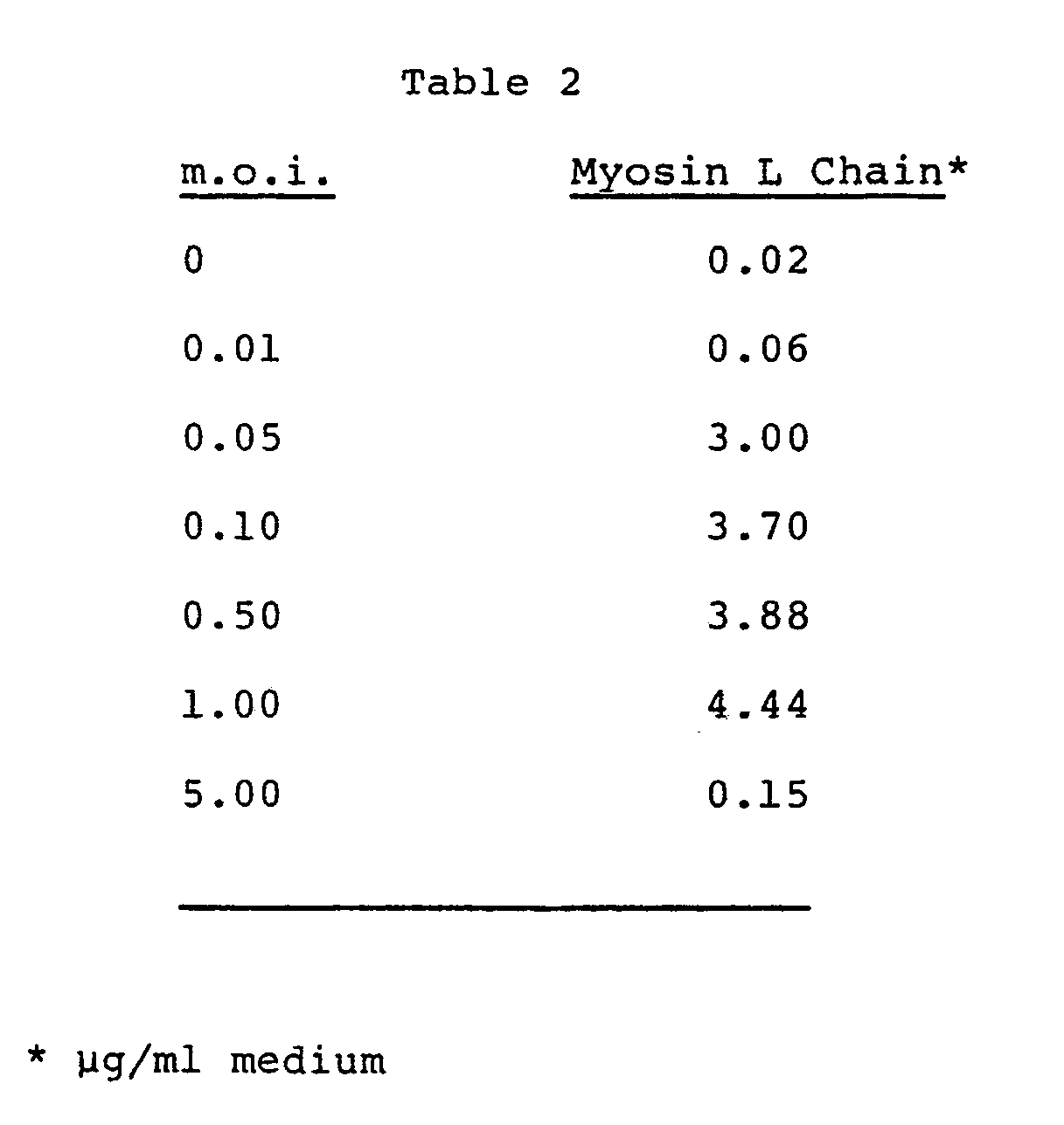
- As shown in Table 2, at high m.o.i. infection (e.g., m.o.i. = 5.00), lysis occurs immediately after the infection and the productivity was extremely poor as compared to the system at low m.o.i.
- Further analysis on the medium used as well as the productivity indicates that the productivity of 15 µg/ml medium was obtained in 2 x TY medium (supra) at 6 hours after the infection.
- As shown above, the present invention makes it possible to produce the foreign protein in a large quantity in E. coli, utilizing the substance productivity of T4 phage, in particular, host protease inhibitor productivity.
- E. coli MC1061 carrying pHB-VLC28 was deposited in the Fermentation Research Institute of the Agency of Industrial Science & Technology of Japan on January 19, 1990 and given FERM P-11198 as an Accession Number. Thereafter, the deposition was transferred to an international deposition under the Budapest Treaty on December 17, 1990, and given FERM BP-3206 as an Acesssion Number. T4dC phage GT7 can be prepared from T4 phage (ATCC 11303-B4) in a conventional manner [Snyder, et al., Proc. Natl. Acad. Sci. (USA), 73, 2098 (1976), Wilson, et al., Nature, 280, 80 (1979)].
Claims (12)
- A process for producing a foreign protein in Escherichia coli comprising the steps of:(A) ligating operably a DNA fragment encoding the foreign protein downstream of a transcription initiation signal and a translation initiation signal derived from a T4 phage gene and inserting the DNA fragment into a plasmid replicable in E. coli to construct a hybrid plasmid;(B) transforming E. coli with the hybrid plasmid obtained in step A;(C) proliferating the transformant obtained in step B in a medium in which said transformant can proliferate and infecting the transformant with a T4 phage denB and/or alc mutant at a low multiplicity of infection (m.o.i.);(D) culturing the phage-infected transformant obtained in step C to express the foreign protein; and,(E) recovering the cultured transformants in step D to harvest the desired foreign protein.
- A process according to Claim 1, wherein the foreign protein is highly sensitive to a protease in E. coli.
- A process according to Claim 2, wherein the foreign protein is a human cardiac myosin.
- A process according to Claim 2, wherein the foreign protein is a human cardiac myosin light chain.
- A process according to Claim 1, wherein the T4 phage denB and/or alc mutant is T4dC phage.
- A process according to Claim 1, wherein the transformant is infected with the T4 phage denB and/or alc mutant at a m.o.i. of 0.01 to 1.0.
- A process according to Claim 1, wherein the transcription initiation signal and translation initiation signal are derived from an early or middle T4 phage gene, and the transformant is infected with the alc mutant.
- A process according to Claim 7, wherein T4 phage uvsY gene is used as the transcription initiation signal and translation initiation signal.
- A process according to Claim 7, wherein the alc mutant is T4dC phage.
- A process according to Claim 1, wherein the transcription initiation signal and translation initiation signal are derived from a late T4 phage gene, and the transformant is infected with the denB mutant or with the denB and alc mutant.
- A process according to Claim 10, wherein T4 phage gene 22 or gene 18 is used as the transcription initiation signal and translation initiation signal.
- A process according to Claim 10, wherein the denB mutant or the denB and alc mutant is T4dC phage.
Applications Claiming Priority (2)
| Application Number | Priority Date | Filing Date | Title |
|---|---|---|---|
| JP31123/90 | 1990-02-09 | ||
| JP2031123A JP2988951B2 (en) | 1990-02-09 | 1990-02-09 | Production of heterologous proteins in Escherichia coli |
Publications (3)
| Publication Number | Publication Date |
|---|---|
| EP0441361A2 true EP0441361A2 (en) | 1991-08-14 |
| EP0441361A3 EP0441361A3 (en) | 1991-09-18 |
| EP0441361B1 EP0441361B1 (en) | 1994-12-14 |
Family
ID=12322642
Family Applications (1)
| Application Number | Title | Priority Date | Filing Date |
|---|---|---|---|
| EP91101634A Expired - Lifetime EP0441361B1 (en) | 1990-02-09 | 1991-02-06 | Process for producing foreign protein in escherichia coli |
Country Status (6)
| Country | Link |
|---|---|
| US (1) | US5304471A (en) |
| EP (1) | EP0441361B1 (en) |
| JP (1) | JP2988951B2 (en) |
| AT (1) | ATE115626T1 (en) |
| CA (1) | CA2035750A1 (en) |
| DE (1) | DE69105768T2 (en) |
Cited By (1)
| Publication number | Priority date | Publication date | Assignee | Title |
|---|---|---|---|---|
| WO2009011259A1 (en) | 2007-07-13 | 2009-01-22 | Japan Agency For Marine-Earth Science And Technology | Novel dna fragment, recombinant vector containing the same, transformant transformed therewith and utilization of the same |
Families Citing this family (1)
| Publication number | Priority date | Publication date | Assignee | Title |
|---|---|---|---|---|
| US7762960B2 (en) | 2005-05-13 | 2010-07-27 | Boston Scientific Scimed, Inc. | Biopsy forceps assemblies |
Family Cites Families (2)
| Publication number | Priority date | Publication date | Assignee | Title |
|---|---|---|---|---|
| DE3483549D1 (en) * | 1983-08-01 | 1990-12-13 | Univ New York State Res Found | STABILIZATION OF FOREIGN PROTEINS AND PLASMIDES TO USE HERE. |
| US4845031A (en) * | 1983-08-01 | 1989-07-04 | The Research Foundation Of State University Of New York | Recombinant DNA process for producing useful polypeptides |
-
1990
- 1990-02-09 JP JP2031123A patent/JP2988951B2/en not_active Expired - Lifetime
-
1991
- 1991-02-06 DE DE69105768T patent/DE69105768T2/en not_active Expired - Fee Related
- 1991-02-06 AT AT91101634T patent/ATE115626T1/en not_active IP Right Cessation
- 1991-02-06 EP EP91101634A patent/EP0441361B1/en not_active Expired - Lifetime
- 1991-02-06 CA CA002035750A patent/CA2035750A1/en not_active Abandoned
- 1991-02-08 US US07/653,225 patent/US5304471A/en not_active Expired - Fee Related
Cited By (1)
| Publication number | Priority date | Publication date | Assignee | Title |
|---|---|---|---|---|
| WO2009011259A1 (en) | 2007-07-13 | 2009-01-22 | Japan Agency For Marine-Earth Science And Technology | Novel dna fragment, recombinant vector containing the same, transformant transformed therewith and utilization of the same |
Also Published As
| Publication number | Publication date |
|---|---|
| JP2988951B2 (en) | 1999-12-13 |
| DE69105768D1 (en) | 1995-01-26 |
| ATE115626T1 (en) | 1994-12-15 |
| DE69105768T2 (en) | 1995-04-27 |
| EP0441361B1 (en) | 1994-12-14 |
| EP0441361A3 (en) | 1991-09-18 |
| US5304471A (en) | 1994-04-19 |
| JPH03236789A (en) | 1991-10-22 |
| CA2035750A1 (en) | 1991-08-10 |
Similar Documents
| Publication | Publication Date | Title |
|---|---|---|
| US4758512A (en) | Hosts and methods for producing recombinant products in high yields | |
| Bhatnagar et al. | Studies on the mutator gene, mutT of Escherichia coli. Molecular cloning of the gene, purification of the gene product, and identification of a novel nucleoside triphosphatase. | |
| EP0080848A2 (en) | Stabilizing & selecting cells | |
| JPH0838176A (en) | Improved recombination dna molecule | |
| Ghysen et al. | Mischarging single and double mutants of Escherichia coli sup3 tyrosine transfer RNA | |
| US4767708A (en) | Enzyme amplification and purification | |
| JP2544710B2 (en) | β-lactamase manufacturing method | |
| EP0528686A2 (en) | Process for producing peptides | |
| EP0317096A2 (en) | Recombinant DNA expression vectors and DNA compounds that encode isopenicillin N synthetase from streptomyces lipmanii | |
| US5888766A (en) | Method for producing recombinant human myoglobin | |
| EP0441361B1 (en) | Process for producing foreign protein in escherichia coli | |
| EP0300459A2 (en) | Human pancreatic secretory trypsin inhibitor | |
| US4477571A (en) | Chimeric plasmids that replicate in bacteria and yeast and microorganisms transformed therewith | |
| CA1338900C (en) | Escherichia coli plasmid vector with lipoprotein promoter and modified shine-dalgarno sequence | |
| EP0170266A2 (en) | Process for producing protein, and vector, recombinant DNA and transformant used therefor | |
| EP0307171A1 (en) | Recombinant dna expression vectors and dna compounds that encode insopenicillin n synthetase from aspergillus nidulans | |
| US6017745A (en) | Enzyme amplification and purification process for producing DNA polymerase | |
| US5234829A (en) | Purification method for materials having nick translation ability | |
| EP0232845A2 (en) | Inducible heat shock and amplification system | |
| US4845031A (en) | Recombinant DNA process for producing useful polypeptides | |
| JP2022546709A (en) | Recombinant strains based on E. coli and methods of construction and uses thereof | |
| JPS63102684A (en) | Gene and use thereof | |
| Kornitzer et al. | Genetic analysis of the cIII gene of bacteriophage HK022 | |
| JP3023008B2 (en) | Proteaze inhibitor gene | |
| EP0458437B1 (en) | Process for production of human nerve growth factor by genetic engineering |
Legal Events
| Date | Code | Title | Description |
|---|---|---|---|
| PUAI | Public reference made under article 153(3) epc to a published international application that has entered the european phase |
Free format text: ORIGINAL CODE: 0009012 |
|
| PUAL | Search report despatched |
Free format text: ORIGINAL CODE: 0009013 |
|
| AK | Designated contracting states |
Kind code of ref document: A2 Designated state(s): AT BE CH DE DK ES FR GB GR IT LI LU NL SE |
|
| AK | Designated contracting states |
Kind code of ref document: A3 Designated state(s): AT BE CH DE DK ES FR GB GR IT LI LU NL SE |
|
| 17P | Request for examination filed |
Effective date: 19911104 |
|
| 17Q | First examination report despatched |
Effective date: 19930713 |
|
| GRAA | (expected) grant |
Free format text: ORIGINAL CODE: 0009210 |
|
| AK | Designated contracting states |
Kind code of ref document: B1 Designated state(s): AT BE CH DE DK ES FR GB GR IT LI LU NL SE |
|
| PG25 | Lapsed in a contracting state [announced via postgrant information from national office to epo] |
Ref country code: IT Free format text: LAPSE BECAUSE OF FAILURE TO SUBMIT A TRANSLATION OF THE DESCRIPTION OR TO PAY THE FEE WITHIN THE PRE;WARNING: LAPSES OF ITALIAN PATENTS WITH EFFECTIVE DATE BEFORE 2007 MAY HAVE OCCURRED AT ANY TIME BEFORE 2007. THE CORRECT EFFECTIVE DATE MAY BE DIFFERENT FROM THE ONE RECORDED.SCRIBED TIME-LIMIT Effective date: 19941214 Ref country code: AT Effective date: 19941214 Ref country code: LI Effective date: 19941214 Ref country code: GR Free format text: LAPSE BECAUSE OF FAILURE TO SUBMIT A TRANSLATION OF THE DESCRIPTION OR TO PAY THE FEE WITHIN THE PRESCRIBED TIME-LIMIT Effective date: 19941214 Ref country code: NL Effective date: 19941214 Ref country code: DK Effective date: 19941214 Ref country code: BE Effective date: 19941214 Ref country code: ES Free format text: THE PATENT HAS BEEN ANNULLED BY A DECISION OF A NATIONAL AUTHORITY Effective date: 19941214 Ref country code: CH Effective date: 19941214 |
|
| REF | Corresponds to: |
Ref document number: 115626 Country of ref document: AT Date of ref document: 19941215 Kind code of ref document: T |
|
| REF | Corresponds to: |
Ref document number: 69105768 Country of ref document: DE Date of ref document: 19950126 |
|
| EAL | Se: european patent in force in sweden |
Ref document number: 91101634.3 |
|
| ET | Fr: translation filed | ||
| PG25 | Lapsed in a contracting state [announced via postgrant information from national office to epo] |
Ref country code: LU Free format text: LAPSE BECAUSE OF NON-PAYMENT OF DUE FEES Effective date: 19950228 |
|
| REG | Reference to a national code |
Ref country code: CH Ref legal event code: PL |
|
| NLV1 | Nl: lapsed or annulled due to failure to fulfill the requirements of art. 29p and 29m of the patents act | ||
| PLBE | No opposition filed within time limit |
Free format text: ORIGINAL CODE: 0009261 |
|
| STAA | Information on the status of an ep patent application or granted ep patent |
Free format text: STATUS: NO OPPOSITION FILED WITHIN TIME LIMIT |
|
| 26N | No opposition filed | ||
| PGFP | Annual fee paid to national office [announced via postgrant information from national office to epo] |
Ref country code: FR Payment date: 19960125 Year of fee payment: 6 |
|
| PGFP | Annual fee paid to national office [announced via postgrant information from national office to epo] |
Ref country code: GB Payment date: 19960129 Year of fee payment: 6 |
|
| PGFP | Annual fee paid to national office [announced via postgrant information from national office to epo] |
Ref country code: DE Payment date: 19960215 Year of fee payment: 6 Ref country code: SE Payment date: 19960215 Year of fee payment: 6 |
|
| PG25 | Lapsed in a contracting state [announced via postgrant information from national office to epo] |
Ref country code: GB Effective date: 19970206 |
|
| PG25 | Lapsed in a contracting state [announced via postgrant information from national office to epo] |
Ref country code: SE Effective date: 19970207 |
|
| GBPC | Gb: european patent ceased through non-payment of renewal fee |
Effective date: 19970206 |
|
| PG25 | Lapsed in a contracting state [announced via postgrant information from national office to epo] |
Ref country code: FR Effective date: 19971030 |
|
| PG25 | Lapsed in a contracting state [announced via postgrant information from national office to epo] |
Ref country code: DE Effective date: 19971101 |
|
| EUG | Se: european patent has lapsed |
Ref document number: 91101634.3 |
|
| REG | Reference to a national code |
Ref country code: FR Ref legal event code: ST |