EP0441412B1 - Verbindung von Trocknerfilz - Google Patents
Verbindung von Trocknerfilz Download PDFInfo
- Publication number
- EP0441412B1 EP0441412B1 EP91104708A EP91104708A EP0441412B1 EP 0441412 B1 EP0441412 B1 EP 0441412B1 EP 91104708 A EP91104708 A EP 91104708A EP 91104708 A EP91104708 A EP 91104708A EP 0441412 B1 EP0441412 B1 EP 0441412B1
- Authority
- EP
- European Patent Office
- Prior art keywords
- fastening means
- temporary fastening
- belt
- formations
- complementary parts
- Prior art date
- Legal status (The legal status is an assumption and is not a legal conclusion. Google has not performed a legal analysis and makes no representation as to the accuracy of the status listed.)
- Expired - Lifetime
Links
- 239000004744 fabric Substances 0.000 title claims abstract description 39
- 238000004826 seaming Methods 0.000 title claims description 11
- 230000015572 biosynthetic process Effects 0.000 claims abstract description 37
- 238000005755 formation reaction Methods 0.000 claims abstract description 37
- 230000000295 complement effect Effects 0.000 claims abstract description 31
- 238000000034 method Methods 0.000 claims description 6
- 239000000463 material Substances 0.000 claims description 5
- 238000004519 manufacturing process Methods 0.000 abstract 1
- 238000010276 construction Methods 0.000 description 2
- 238000001035 drying Methods 0.000 description 2
- 238000000926 separation method Methods 0.000 description 2
- 238000003780 insertion Methods 0.000 description 1
- 230000037431 insertion Effects 0.000 description 1
- 230000002265 prevention Effects 0.000 description 1
- 238000009958 sewing Methods 0.000 description 1
Images


Classifications
-
- F—MECHANICAL ENGINEERING; LIGHTING; HEATING; WEAPONS; BLASTING
- F16—ENGINEERING ELEMENTS AND UNITS; GENERAL MEASURES FOR PRODUCING AND MAINTAINING EFFECTIVE FUNCTIONING OF MACHINES OR INSTALLATIONS; THERMAL INSULATION IN GENERAL
- F16G—BELTS, CABLES, OR ROPES, PREDOMINANTLY USED FOR DRIVING PURPOSES; CHAINS; FITTINGS PREDOMINANTLY USED THEREFOR
- F16G3/00—Belt fastenings, e.g. for conveyor belts
- F16G3/02—Belt fastenings, e.g. for conveyor belts with series of eyes or the like, interposed and linked by a pin to form a hinge
-
- D—TEXTILES; PAPER
- D21—PAPER-MAKING; PRODUCTION OF CELLULOSE
- D21F—PAPER-MAKING MACHINES; METHODS OF PRODUCING PAPER THEREON
- D21F1/00—Wet end of machines for making continuous webs of paper
- D21F1/0027—Screen-cloths
- D21F1/0054—Seams thereof
Definitions
- This invention relates to the joining together of the two ends of a papermaking dryer fabric to form an endless belt.
- Such dryer fabrics may be from two to ten metres wide and from fifteen to over a hundred metres long and the making of a satisfactory seam quickly and easily is essential for the efficient operation of a dryer.
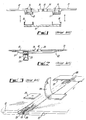
- the free ends of the web (Fig. 1 or 2) are each provided with complementary interdigitating formations such as loops 19, 20 and/or hooks which, when in engagement, define a through passage through which a keeper such as a pintle wire 18 can be passed.
- a keeper formed joint has proved of great practical value because of its simplicity and flexibility.
- there is one major disadvantage in this type of joint The ends of the web to be joined must be drawn towards each other carefully and the two rows of formations aligned accurately before the keeper can be inserted.
- a first solution involves attaching a pair of battens 10, 11 to belt ends 12, 13 by fasteners such as nails 14, and providing, at the joint positions, a rigid receiving structure 15 which includes a pair of accurately spaced and sized channels 16.
- a rigid receiving structure 15 which includes a pair of accurately spaced and sized channels 16.
- the face of the belt from which joining must be effected is determined. This can be a severe diadvantage, because, when a new belt is placed on a paper dryer, the exact position of the joint cannot be accurately determined. Even if a preferred face of the belt has been selected for making the seam, the seam may, after the new fabric has been loaded, be found to be too close to a dryer structure to enable seaming to be effected from the selected face. It would be ideal in this situation to make the seam from the other face. However, with the batten arrangement this is not possible, and so such a condition would, with the battens, require that the entire belt be inched to a position in which the seam in accessible from the selectable face. Such a procedure is time consuming and difficult in a dryer, which has large components of high inertia.
- the full length closed nature of the sliding clasp fastener does not allow an individual part of the seam to be adjusted without unfastening from one end or the other.
- To open from the end not yet threaded means loss of alignment.
- To open from the threaded end means that the belt ends pull apart and grip the pintle wire, prevention or hindering further threading.
- the arrangement is one-faced, in that it only allows seaming to be carried out from one face of the belt. Further, the straps and pads are spaced apart along the seam at such spacings 'S' that seam irregularities can arise between adjacent pairs of fasteners. If this does happen, the fasteners 27, 28 simply cannot be adjusted to counteract any such misalignment.
- Another disadvantageous result of the spacing of the fastener pairs 27/28 is the fact that the spacing imposes considerable loads on pads 27 and straps 28. This load is well within the surface-to-surface load range of the fasteners, but does require that the pads and straps be very securely attached, as by sewing, to ends 12, 13. This means that removal of the fasteners after seaming, and before dryer operation, requires some time and effort.
- a still further disadvantage of this known seaming arrangement is that the pads 27 and straps 28 are attached very close to formations 19, 20, which means that the tension application points are only just behind formations 19, 20. This means that formations 19 and 20 cannot be so easily manoeuvred in directions at right angles to the belt plane. Interestingly, this is a step backwards compared with the structures of Figs. 1 and 2, both of which apply belt tension at positions spaced away from the fastening formations to leave a small band of belt along each belt end substantially free from tension, thus facilitating manipulation of formations 19, 20.
- EP 0196686 describes a device for joining the ends of a papermaking drying sheet to form a continuous strip.
- the device comprises a support bar having grooves therein which extend over the entire length of the bar. Bars having a complementary shape to that of the grooves are fixed to the ends of the drying sheet. The bars are received in the grooves during the jointing operation. This design does not facilitate adjustment of the spacing of the ends of the sheet.
- the invention provides a flat woven papermakers' dryer fabric having, at each end (12,13), a respective row of interdigitable formations (19,20) capable of union by a pintle wire (18) to form a flexible joint and further including at the said fabric ends (12,13), a respective one (part 31,32 and 34,34) of the complementary parts (31,32,34,34 and 33) of a temporary fastening means adapted for cooperation, in a relative disposition of the fabric ends (12,13) consistent with engagement of the interdigitating formations (19,20) to maintain such interdigitation, wherein said one part of the complementary parts of said temporary fastening means (31,32,34,34) is arranged to extend transversely of the belt adjacent each end (12,13) of the belt and on each face thereof; and in that the other part (33) of said complementary parts of said temporary fastening means is dimensioned materially to overlie the opposed fabric ends (12,13) in the aforesaid disposition of said ends (12,13) and said complementary parts (31,32 or
- the invention also provides a method of seaming a flat woven papermakers' dryer fabric having, at each fabric end (12,13) a respective row of interdigitable formations (19,20) capable of union by a pintle wire (18) to form a flexible joint, and further including, at said fabric ends, (12,13) a respective one (31,32 and 34,34) of the complementary parts (31,32,34,34,33) of a temporary fastening means adapted for cooperation, in a relative disposition of the fabric ends (12,13) consistent with engagement of the interdigitation formations (19,20) to maintain such interdigitation, the method of including the steps of:
- a flat woven dryer felt is made endless in conventional manner by interdigitating loop formations 19, 20 each formed as continuous helices provided at the respective fabric ends and inserting a pintle wire into the tunnel formed by and between said formations 19,20.
- each fabric end 12, 13 has secured to each face thereof, parallel to but spaced a distance from formations 19, 20, strips 31, 32, 34, 34 of a material which constitute the respective one parts of releasable temporary fastening means by having an outer surface which defines a fastener surface capable of releasable attachment to a complementary fastener surface.
- a second part of releasable temporary fastening means in the form of a band 33 of length equal to or greater than the length of the seam and just wider than the separation of strips 31, 32, 34, 34 in the interdigitated disposition of the loop formations 19 20.
- Band 33 is of flexible sheet material and its free surface is a fastener surface complementary to the fastener surfaces of strips 31, 32.
- the fastener surfaces are hook and/or loop surfaces, the strips 31, 32, 34, 34 and band 33 being respectively loop and hook fabric, although alternative forms of fastener surface may be provided.
- band 33 By applying band 33 to a strip 31, 32 at one fabric end, that band can exist as a flap securely attached to the fabric end, which flap can be engaged with the strip existing at the other fabric end to hold the loop elements of the seam in engagement.
- Fig. 7 illustrates how the band 33 can be applied to unite the whole seam whilst leaving spaced upstanding loops 33a, b, c. If it happens that seam separation occurs beneath the band 33, a portion 35 can be lifted and access had to the relevant part of the seam without disturbing the rest of the temporary joint.
Landscapes
- Engineering & Computer Science (AREA)
- General Engineering & Computer Science (AREA)
- Mechanical Engineering (AREA)
- Paper (AREA)
- Drying Of Solid Materials (AREA)
- Filtering Materials (AREA)
- Treatment Of Fiber Materials (AREA)
- Solid-Sorbent Or Filter-Aiding Compositions (AREA)
Claims (5)
- Flachgewebtes Papiermachergewebe zur Trocknung, das an jedem Ende (12, 13) jeweils eine Reihe zum Ineinandergreifen bestimmter Glieder (19, 20) aufweist, die zur Bildung einer Gelenkverbindung durch einen Gelenkdraht (18) zu verbinden sind, und das ferner an den Gewebeenden (12, 13) jeweils einen (Teil 31, 32 und 34, 34) der Komplementärteile (31, 32, 34, 34 und 33) von temporären Befestigungsmitteln aufweist, die derart ausgebildet sind, daß sie bei Anordnung der Gewebeenden (12, 13) relativ zueinander, bei der die zum Ineinandergreifen bestimmten Glieder (19, 20) ineinandergreifen, zur Aufrechterhaltung dieses Ineinandergreifens miteinander zusammenwirken, wobei der eine Teil der Komplementärteile der temporären Befestigungsmittel (31, 32, 34, 34) derart angeordnet ist, daß er sich nahe jedem Ende (12, 13) und auf jeder Seite des Bandes quer zu dem Band erstreckt; der andere Teil (33) der Komplementärteile der temporären Befestigungsmittel ist so bemessen, daß er die gegenüberliegenden Gewebeenden (12, 13) in der beschriebenen Anordnung der Enden (12, 13) und die Komplementärteile (31, 32 oder 34, 34) der temporären Befestigungsmittel auf der einen oder anderen Seite des Bandes im wesentlichen überlagert,
dadurch gekennzeichnet, daß der andere Teil (33) der Komplementärteile der temporären Befestigungsmittel über die Länge der Verbindungsnaht von dem einen Teil (31, 32 oder 34, 34) abschnittsweise zu trennen ist. - Papiermachergewebe nach Anspruch 1,
dadurch gekennzeichnet, daß die Komplementärteile aus einem Haken-Schlingen-Gewebe gebildet sind. - Papiermachergewebe nach Anspruch 1 oder 2,
dadurch gekennzeichnet, daß der andere Teil der temporären Befestigungsmittel aus einem Materialstreifen (33) gebildet oder an einem solchen angebracht ist, der so bemessen ist, daß er sich über die Länge des Saumes erstreckt. - Verfahren zum Herstellen einer Verbindungsnaht eines flachgewebten Papiermachergewebes, das an jedem Gewebeende (12, 13) jeweils eine Reihe zum Ineinandergreifen bestimmter Glieder (19, 20) aufweist, die zur Bildung einer Gelenkverbindung durch einen Gelenkdraht (18) zu verbinden sind, und das ferner an den Gewebeenden (12, 13) jeweils einen (31, 32 und 34, 34) der Komplementärteile (31, 32, 34, 34, 33) von temporären Befestigungsmitteln aufweist, die derart ausgebildet sind, daß sie bei einer relativen Anordnung der Gewebeenden (12, 13), bei der die zum Ineinandergreifen bestimmten Glieder (19, 20) ineinandergreifen, zur Aufrechterhaltung dieses Ineinandergreifens miteinander zusammenwirken, mit den Verfahrensschritten:(a) Anordnen des einen Teiles (31, 32 oder 34, 34) der Komplementärteile der temporären Befestigungsmittel derart, daß er sich nahe jedem Ende (12, 13) und auf jeder Seite des Bandes quer zu dem Band erstreckt;(b) Auswählen der einen oder anderen Seite des Bandes, an der die Verbindungsnaht herzustellen ist;(c) Aufbringen des anderen Teiles (33) der Komplementärteile der temporären Befestigungsmittel, so daß er den einen Teil (31, 32 oder 34, 34) auf der gewählten Seite des Bandes überlagert;(d) Ineingriffbringen der Komplementärteile der Befestigungsmittel [(31, 32 und 33) oder (34, 34 und 33)], so daß die Glieder zur Aufnahme eines Gelenkdrahtes (18) miteinander in Eingriff bleiben;(e) Einsetzen eines Gelenkdrahtes, so daß er zur Bildung einer Gelenkverbindung mit den ineinandergreifenden Gliedern (19, 20) in Eingriff tritt;(f) Entfernen des anderen Teiles (33) der temporären Befestigungsmittel; und(g) Entfernen des einen Teiles der temporären Befestigungsmittel (31, 32 und 34, 34) von der jeweiligen Seite des Bandes,dadurch gekennzeichnet, daß während des Verfahrensschrittes (e) ein ausgewählter Teilbereich der entstehenden Verbindungsnaht dadurch freigelegt wird, daß ein ausgewählter Teilbereich der Komplementärteile (31, 32 und 33 oder 34, 34 und 33) der temporären Befestigungsmittel abgelöst wird, daß sodann Teile der Bandenden (12, 13) in dem ausgewählten Teilbereich der Naht ausgerichtet werden, um den Grad des Ineinandergreifens der Glieder (19, 20) so zu verändern, daß der Gelenkdraht (18) leichter hindurchzuführen ist, und daß schließlich die Komplementärteile der temporären Befestigungsmittel wieder miteinander in Eingriff gebracht werden.
- Verfahren nach Anspruch 4,
dadurch gekennzeichnet, daß stehende Schlaufen eines Materialstreifens (33), der den anderen Teil der temporären Befestigungsmittel enthält oder bildet, entlang des Materialstreifens (33) vorgesehen sind, und daß das Freilegen des ausgewählten Teilbereiches der Naht dadurch erfolgt, daß jeweils eine der Schlaufen entlang der Naht in die gewählte Position verlagert wird.
Applications Claiming Priority (3)
| Application Number | Priority Date | Filing Date | Title |
|---|---|---|---|
| GB8630243 | 1986-12-18 | ||
| GB868630243A GB8630243D0 (en) | 1986-12-18 | 1986-12-18 | Dryer fabric seaming |
| EP87310922A EP0274244B1 (de) | 1986-12-18 | 1987-12-11 | Verbindung von Trocknerfilz |
Related Parent Applications (2)
| Application Number | Title | Priority Date | Filing Date |
|---|---|---|---|
| EP87310922.7 Division | 1987-12-11 | ||
| EP87310922A Division-Into EP0274244B1 (de) | 1986-12-18 | 1987-12-11 | Verbindung von Trocknerfilz |
Publications (3)
| Publication Number | Publication Date |
|---|---|
| EP0441412A2 EP0441412A2 (de) | 1991-08-14 |
| EP0441412A3 EP0441412A3 (en) | 1991-11-27 |
| EP0441412B1 true EP0441412B1 (de) | 1994-08-10 |
Family
ID=10609209
Family Applications (2)
| Application Number | Title | Priority Date | Filing Date |
|---|---|---|---|
| EP87310922A Expired - Lifetime EP0274244B1 (de) | 1986-12-18 | 1987-12-11 | Verbindung von Trocknerfilz |
| EP91104708A Expired - Lifetime EP0441412B1 (de) | 1986-12-18 | 1987-12-11 | Verbindung von Trocknerfilz |
Family Applications Before (1)
| Application Number | Title | Priority Date | Filing Date |
|---|---|---|---|
| EP87310922A Expired - Lifetime EP0274244B1 (de) | 1986-12-18 | 1987-12-11 | Verbindung von Trocknerfilz |
Country Status (6)
| Country | Link |
|---|---|
| EP (2) | EP0274244B1 (de) |
| AT (2) | ATE109843T1 (de) |
| DE (2) | DE3750375T2 (de) |
| ES (2) | ES2062589T3 (de) |
| FI (1) | FI90677C (de) |
| GB (2) | GB8630243D0 (de) |
Families Citing this family (10)
| Publication number | Priority date | Publication date | Assignee | Title |
|---|---|---|---|---|
| GB8825870D0 (en) * | 1988-11-04 | 1988-12-07 | Scapa Group Plc | Jointing of fabric ends |
| GB9109827D0 (en) * | 1991-05-07 | 1991-06-26 | Courtaulds Advanced Materials | Belt joint |
| GB9112071D0 (en) * | 1991-06-05 | 1991-07-24 | Scapa Group Plc | Belt seaming |
| GB9508573D0 (en) * | 1995-04-27 | 1995-06-14 | Scapa Group Plc | Papermakers fabric seaming |
| GB9519837D0 (en) * | 1995-09-29 | 1995-11-29 | Scapa Group Plc | Dryer fabric seaming |
| US6516943B2 (en) * | 2001-04-12 | 2003-02-11 | 3M Innovative Properties Company | Conveyor belt splice cover, and methods |
| US7273074B2 (en) * | 2002-07-24 | 2007-09-25 | Albany International Corp. | On-machine-seamable industrial fabric having seam-reinforcing rings |
| US7086128B2 (en) * | 2002-12-27 | 2006-08-08 | Albany International Corp. | Seam assist attachment device |
| CN104179059B (zh) * | 2014-07-14 | 2016-04-06 | 四川环龙技术织物有限公司 | 接缝造纸毛毯的基网划线成环工艺 |
| DE102015213104A1 (de) * | 2015-07-13 | 2016-08-04 | Voith Patent Gmbh | Papiermaschinenbespannung |
Family Cites Families (4)
| Publication number | Priority date | Publication date | Assignee | Title |
|---|---|---|---|---|
| US3281905A (en) * | 1964-10-14 | 1966-11-01 | Huyck Corp | Belt construction and method of forming the same |
| FR2469599A1 (fr) * | 1979-11-12 | 1981-05-22 | Muller Sa Manufacture Joseph | Procede et dispositif de jonctionnement de deux extremites de bande |
| SE435740B (sv) * | 1983-03-01 | 1984-10-15 | Nordiskafilt Ab | Anordning for hopfogning av band |
| FR2578868B1 (fr) * | 1985-03-15 | 1988-09-16 | Asten Fabrique Feutres Papeter | Dispositif de jonction d'extremites de toile pour former une bande continue. |
-
1986
- 1986-12-18 GB GB868630243A patent/GB8630243D0/en active Pending
-
1987
- 1987-12-11 GB GB8728999A patent/GB2200589B/en not_active Expired - Lifetime
- 1987-12-11 ES ES91104708T patent/ES2062589T3/es not_active Expired - Lifetime
- 1987-12-11 DE DE3750375T patent/DE3750375T2/de not_active Expired - Fee Related
- 1987-12-11 EP EP87310922A patent/EP0274244B1/de not_active Expired - Lifetime
- 1987-12-11 AT AT91104708T patent/ATE109843T1/de not_active IP Right Cessation
- 1987-12-11 ES ES198787310922T patent/ES2030744T3/es not_active Expired - Lifetime
- 1987-12-11 EP EP91104708A patent/EP0441412B1/de not_active Expired - Lifetime
- 1987-12-11 DE DE8787310922T patent/DE3777597D1/de not_active Expired - Lifetime
- 1987-12-11 AT AT87310922T patent/ATE73878T1/de active
- 1987-12-17 FI FI875574A patent/FI90677C/fi not_active IP Right Cessation
Also Published As
| Publication number | Publication date |
|---|---|
| GB2200589A (en) | 1988-08-10 |
| FI90677C (fi) | 1994-03-10 |
| DE3750375D1 (de) | 1994-09-15 |
| FI90677B (fi) | 1993-11-30 |
| EP0441412A3 (en) | 1991-11-27 |
| GB2200589B (en) | 1990-06-13 |
| EP0274244A1 (de) | 1988-07-13 |
| DE3777597D1 (de) | 1992-04-23 |
| ATE73878T1 (de) | 1992-04-15 |
| GB8630243D0 (en) | 1987-01-28 |
| EP0441412A2 (de) | 1991-08-14 |
| FI875574A0 (fi) | 1987-12-17 |
| EP0274244B1 (de) | 1992-03-18 |
| FI875574A7 (fi) | 1988-06-19 |
| ES2062589T3 (es) | 1994-12-16 |
| ES2030744T3 (es) | 1992-11-16 |
| ATE109843T1 (de) | 1994-08-15 |
| DE3750375T2 (de) | 1995-03-23 |
| GB8728999D0 (en) | 1988-01-27 |
Similar Documents
| Publication | Publication Date | Title |
|---|---|---|
| EP0441412A2 (de) | Verbindung von Trocknerfilz | |
| US5349991A (en) | Woven surface fastener construction | |
| US4827579A (en) | Jointing of fabric ends | |
| US4539730A (en) | Seaming means and a tool for forming the seam | |
| US4806208A (en) | Method of seaming a seamed felt on a papermaking machine with oppositely tapered pintle elements | |
| US6001443A (en) | Dryer fabric seaming | |
| EP0518494B1 (de) | Verbinder von Riemen | |
| JP4153205B2 (ja) | 抄紙機に布地を架設するための装置 | |
| FI70279B (fi) | Anordning foer hopfogning av band | |
| KR860002378Y1 (ko) | 슬라이드 파스너 | |
| US4649619A (en) | Method of forming a locked seam | |
| US4945612A (en) | System and a method for joining the ends of a band-shaped elongate element | |
| FI107394B (fi) | Työkalu kankaan päihin kiinnitettyjen kierukkasilmukoiden limittämiseksi jatkuvan viiran muodostamiseksi |
Legal Events
| Date | Code | Title | Description |
|---|---|---|---|
| PUAI | Public reference made under article 153(3) epc to a published international application that has entered the european phase |
Free format text: ORIGINAL CODE: 0009012 |
|
| 17P | Request for examination filed |
Effective date: 19910410 |
|
| AC | Divisional application: reference to earlier application |
Ref document number: 274244 Country of ref document: EP |
|
| AK | Designated contracting states |
Kind code of ref document: A2 Designated state(s): BE CH DE ES FR IT LI NL SE |
|
| RBV | Designated contracting states (corrected) |
Designated state(s): BE CH DE ES FR GB IT LI NL SE |
|
| PUAL | Search report despatched |
Free format text: ORIGINAL CODE: 0009013 |
|
| AK | Designated contracting states |
Kind code of ref document: A3 Designated state(s): BE CH DE ES FR IT LI NL SE |
|
| RBV | Designated contracting states (corrected) |
Designated state(s): BE CH DE ES FR GB IT LI NL SE |
|
| 17Q | First examination report despatched |
Effective date: 19930618 |
|
| GRAA | (expected) grant |
Free format text: ORIGINAL CODE: 0009210 |
|
| AC | Divisional application: reference to earlier application |
Ref document number: 274244 Country of ref document: EP |
|
| AK | Designated contracting states |
Kind code of ref document: B1 Designated state(s): AT BE CH DE ES FR GB IT LI NL SE |
|
| REF | Corresponds to: |
Ref document number: 109843 Country of ref document: AT Date of ref document: 19940815 Kind code of ref document: T |
|
| REF | Corresponds to: |
Ref document number: 3750375 Country of ref document: DE Date of ref document: 19940915 |
|
| ITF | It: translation for a ep patent filed | ||
| ET | Fr: translation filed | ||
| PG25 | Lapsed in a contracting state [announced via postgrant information from national office to epo] |
Ref country code: GB Effective date: 19941211 Ref country code: AT Effective date: 19941211 |
|
| PG25 | Lapsed in a contracting state [announced via postgrant information from national office to epo] |
Ref country code: SE Effective date: 19941212 Ref country code: ES Free format text: LAPSE BECAUSE OF THE APPLICANT RENOUNCES Effective date: 19941212 |
|
| REG | Reference to a national code |
Ref country code: ES Ref legal event code: FG2A Ref document number: 2062589 Country of ref document: ES Kind code of ref document: T3 |
|
| PG25 | Lapsed in a contracting state [announced via postgrant information from national office to epo] |
Ref country code: LI Effective date: 19941231 Ref country code: CH Effective date: 19941231 Ref country code: BE Effective date: 19941231 |
|
| EAL | Se: european patent in force in sweden |
Ref document number: 91104708.2 |
|
| PLBE | No opposition filed within time limit |
Free format text: ORIGINAL CODE: 0009261 |
|
| STAA | Information on the status of an ep patent application or granted ep patent |
Free format text: STATUS: NO OPPOSITION FILED WITHIN TIME LIMIT |
|
| BERE | Be: lapsed |
Owner name: SCAPA-PORRITT LTD Effective date: 19941231 |
|
| PG25 | Lapsed in a contracting state [announced via postgrant information from national office to epo] |
Ref country code: NL Effective date: 19950701 |
|
| 26N | No opposition filed | ||
| GBPC | Gb: european patent ceased through non-payment of renewal fee |
Effective date: 19941211 |
|
| PG25 | Lapsed in a contracting state [announced via postgrant information from national office to epo] |
Ref country code: FR Effective date: 19950831 |
|
| REG | Reference to a national code |
Ref country code: CH Ref legal event code: PL |
|
| NLV4 | Nl: lapsed or anulled due to non-payment of the annual fee |
Effective date: 19950701 |
|
| PG25 | Lapsed in a contracting state [announced via postgrant information from national office to epo] |
Ref country code: DE Effective date: 19950901 |
|
| EUG | Se: european patent has lapsed |
Ref document number: 91104708.2 |
|
| REG | Reference to a national code |
Ref country code: FR Ref legal event code: ST |
|
| REG | Reference to a national code |
Ref country code: ES Ref legal event code: FD2A Effective date: 20010402 |
|
| PG25 | Lapsed in a contracting state [announced via postgrant information from national office to epo] |
Ref country code: IT Free format text: LAPSE BECAUSE OF NON-PAYMENT OF DUE FEES;WARNING: LAPSES OF ITALIAN PATENTS WITH EFFECTIVE DATE BEFORE 2007 MAY HAVE OCCURRED AT ANY TIME BEFORE 2007. THE CORRECT EFFECTIVE DATE MAY BE DIFFERENT FROM THE ONE RECORDED. Effective date: 20051211 |