EP0441487A1 - Filter dryer - Google Patents
Filter dryer Download PDFInfo
- Publication number
- EP0441487A1 EP0441487A1 EP91300365A EP91300365A EP0441487A1 EP 0441487 A1 EP0441487 A1 EP 0441487A1 EP 91300365 A EP91300365 A EP 91300365A EP 91300365 A EP91300365 A EP 91300365A EP 0441487 A1 EP0441487 A1 EP 0441487A1
- Authority
- EP
- European Patent Office
- Prior art keywords
- filter
- housing
- air
- dispersion
- air flow
- Prior art date
- Legal status (The legal status is an assumption and is not a legal conclusion. Google has not performed a legal analysis and makes no representation as to the accuracy of the status listed.)
- Withdrawn
Links
- 239000006185 dispersion Substances 0.000 claims abstract description 21
- VYPSYNLAJGMNEJ-UHFFFAOYSA-N Silicium dioxide Chemical compound O=[Si]=O VYPSYNLAJGMNEJ-UHFFFAOYSA-N 0.000 claims abstract description 9
- 239000000356 contaminant Substances 0.000 claims abstract description 8
- 239000002274 desiccant Substances 0.000 claims description 17
- 239000000463 material Substances 0.000 claims description 17
- 229910000906 Bronze Inorganic materials 0.000 claims description 4
- 229920000742 Cotton Polymers 0.000 claims description 4
- 230000002745 absorbent Effects 0.000 claims description 4
- 239000002250 absorbent Substances 0.000 claims description 4
- 239000010974 bronze Substances 0.000 claims description 4
- 239000010941 cobalt Substances 0.000 claims description 4
- 229910017052 cobalt Inorganic materials 0.000 claims description 4
- GUTLYIVDDKVIGB-UHFFFAOYSA-N cobalt atom Chemical group [Co] GUTLYIVDDKVIGB-UHFFFAOYSA-N 0.000 claims description 4
- KUNSUQLRTQLHQQ-UHFFFAOYSA-N copper tin Chemical compound [Cu].[Sn] KUNSUQLRTQLHQQ-UHFFFAOYSA-N 0.000 claims description 4
- 239000000428 dust Substances 0.000 claims description 4
- 239000007788 liquid Substances 0.000 claims description 4
- 239000002245 particle Substances 0.000 claims description 2
- 239000011344 liquid material Substances 0.000 claims 1
- 239000000741 silica gel Substances 0.000 claims 1
- 229910002027 silica gel Inorganic materials 0.000 claims 1
- 235000012773 waffles Nutrition 0.000 claims 1
- XLYOFNOQVPJJNP-UHFFFAOYSA-N water Chemical compound O XLYOFNOQVPJJNP-UHFFFAOYSA-N 0.000 description 6
- 229920003023 plastic Polymers 0.000 description 5
- 238000009434 installation Methods 0.000 description 4
- 239000003463 adsorbent Substances 0.000 description 3
- 238000010521 absorption reaction Methods 0.000 description 2
- 238000001816 cooling Methods 0.000 description 2
- 238000001914 filtration Methods 0.000 description 2
- 238000000034 method Methods 0.000 description 2
- 238000012986 modification Methods 0.000 description 2
- 230000004048 modification Effects 0.000 description 2
- 229920004738 ULTEM® Polymers 0.000 description 1
- 239000000853 adhesive Substances 0.000 description 1
- 230000001070 adhesive effect Effects 0.000 description 1
- 230000002411 adverse Effects 0.000 description 1
- 230000000295 complement effect Effects 0.000 description 1
- 238000009833 condensation Methods 0.000 description 1
- 230000005494 condensation Effects 0.000 description 1
- 230000007797 corrosion Effects 0.000 description 1
- 238000005260 corrosion Methods 0.000 description 1
- 230000006735 deficit Effects 0.000 description 1
- 238000009826 distribution Methods 0.000 description 1
- 238000010410 dusting Methods 0.000 description 1
- 230000006872 improvement Effects 0.000 description 1
- 239000012535 impurity Substances 0.000 description 1
- 238000005304 joining Methods 0.000 description 1
- 238000004519 manufacturing process Methods 0.000 description 1
- 230000013011 mating Effects 0.000 description 1
- 239000000203 mixture Substances 0.000 description 1
- 230000008520 organization Effects 0.000 description 1
- 239000013618 particulate matter Substances 0.000 description 1
- 230000008569 process Effects 0.000 description 1
- 238000005057 refrigeration Methods 0.000 description 1
- 238000007789 sealing Methods 0.000 description 1
- 239000012780 transparent material Substances 0.000 description 1
Images
Classifications
-
- B—PERFORMING OPERATIONS; TRANSPORTING
- B01—PHYSICAL OR CHEMICAL PROCESSES OR APPARATUS IN GENERAL
- B01D—SEPARATION
- B01D53/00—Separation of gases or vapours; Recovering vapours of volatile solvents from gases; Chemical or biological purification of waste gases, e.g. engine exhaust gases, smoke, fumes, flue gases, aerosols
- B01D53/26—Drying gases or vapours
-
- B—PERFORMING OPERATIONS; TRANSPORTING
- B01—PHYSICAL OR CHEMICAL PROCESSES OR APPARATUS IN GENERAL
- B01D—SEPARATION
- B01D53/00—Separation of gases or vapours; Recovering vapours of volatile solvents from gases; Chemical or biological purification of waste gases, e.g. engine exhaust gases, smoke, fumes, flue gases, aerosols
- B01D53/26—Drying gases or vapours
- B01D53/261—Drying gases or vapours by adsorption
Definitions
- the present invention is directed generally to air dryers, and more particularly to an air filter dryer for use in a compressed air systems for filtering oil particles and for removing moisture from a stream of compressed air.
- Compressed air systems with which the invention might be utilized may be found in a variety of manufacturing and assembly plants.
- such systems are used with pneumatically operated tools and pneumatically controlled machines. These tools and machines are subject to substantial impairment in the event of corrosion caused by the presence of moisture in the compressed air system.
- such compressed air systems are used in the operation of sensitive pneumatic instruments and controls, which may be materially adversely affected by excessive moisture in the compressed air stream.
- the compressed air stream may also contain impurities and contaminants such as oil, dust, pipe scale and other particulate matter, which can and do produce harmful results upon condensation of the water vapor.
- a refrigerated air dryer In this type of dryer, the hot compressed air is brought into contact with a refrigeration coil to lower air temperature and cause the water vapor to condense. The condensate is then collected in a moisture separator. While this type of air dryer has been found to be quite effective for removing moisture from compressed air, there still remains room for improvement. For example, this type of system requires a two-stage process. First, the air must be cooled, then the vapor produced from cooling the air must be separated. The cooling unit and the moisture separator are usually connected by lengths of tubing, which requires that the compressed air travel some distance to the separator. Consequently, some of the water vapor is often re-evaporated into the cooled air. As a result, at least some of the moisture remains in the air which is utilized by the pneumatically controlled machinery. This, of course, is undesirable.
- filter dryer is the adsorbent type of air dryer which employs a large tank or chamber within which a desiccant is stored.
- the compressed air is passed through the tank prior to being supplied to the air supply line for the tools or instruments, such that the desiccant adsorbs a considerable amount of vapor.
- the desiccant eventually reaches a saturation point, at which time the filter-dryer is no longer useful. Therefore, the operating and recharging costs of this type of filter are often high.
- Another object of this invention is to provide an improved type of adsorbent air filter which is sufficiently economical to be provided as a disposable unit.
- the present invention firstly comprises a housing portion adapted to be inserted in line with system piping and having an inlet for receiving a compressed air flow and an outlet for distributing a pure, unsaturated air back into the system piping.
- the invention further comprises a series of filters for purifying the compressed air stream.
- the filters include a centrally disposed desiccant filter portion which adsorbs any water vapor present in the compressed air stream.
- the housing is double-ended and oil and particulate filtration means are symmetrically disposed at either end of the desiccant.
- the filter dryer can be installed to handle air flowing in either direction and the same results will be achieved.
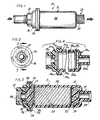
- a filter dryer 10 having a housing 11, and respective inlet and outlet fittings 12, 14 for directing incoming and outgoing air flow, as indicated by the large arrows in Fig. 1.
- Both the inlet and outlet fittings 12, 14 are designed so as to make the filter dryer 10 easily installable directly in-line with the piping of a conventional pneumatic air system.
- the filters (to be described hereinbelow) found inside of the housing 11 are symmetrically disposed with respect to the inlet and the outlet 14.
- the terms inlet and outlet 14 are interchangeable such that the filter may be used in either direction of air flow.
- a dispersion filter 16 This filter 16, as shown in Fig. 3, is composed of absorbent sponge material 17.
- the sponge material 17 collects moisture in the air flow.
- the absorbent material 17 disperses the air flow evenly across the inside of the housing element 11.
- This filter 20 is a relatively thin paper wafer or waffle-type filter, and acts to remove any oil contaminants from the air flow.
- the air flow then reaches a silica gel desiccant 24, which is cobalt-treated and is blue in color.
- the housing 11, as shown in Fig. 3, is of a clear plastic material; which allows the silica gel desiccant 24 to be seen by the user.
- the desiccant 24 adsorbs any moisture in the air flow and lowers the dew point of the air, preferably to on the order of 10°F.
- the air then passes through a second oil removal filter 22 and a second dispersion filter 18.
- the second oil removal filter 22 and the second dispersion filter 18 insure that desiccant dusting and other particulate will not escape during the life of the filter 10.
- the air flow will then exit through the outlet fitting 14.
- the dispersion filters 16, 18 and the oil removal filters 20, 22 are disposed symmetrically at either end of the filter dryer 10. Moreover, by having the filters organized in this arrangement, the filter dryer can work in either direction of air flow; such that the designations "inlet” and "outlet” are by way of example, only, and can be reversed.
- a further aspect of this filter dryer 10 is the easy installation into a pneumatic piping system.
- the inlet and outlet fittings 12, 14, are provided with standard pipe threads 26, 28 such that installation into a piping system is made easily accessible.
- the assembly procedure of the filter dryer 10 has been greatly simplified to help make the present invention more economical to produce.
- the filter dryer housing 11 is made up of two primary parts: a smaller cap-like portion 30, which also defines the inlet fitting 12; and a larger cylinder-like portion 32 which comprises a major portion of an outer shell for the filter assembly and the fitting 14.
- the two portions 30, 32 are preferaby plastic and are fitted together such that a sonic weld 34 is all that is needed to hold the entire assembly together.
- This weld 34 is formed in an area where respective radially outwardly directed flanges 36, 38 of the housing portions 30, 32 meet.
- These radially directed flanges 36, 38 are substantially identical and are preferably provided with mating locking and sealing means, such as a complementary annular raised rib and annular recess 40, 42.
- mating locking and sealing means such as a complementary annular raised rib and annular recess 40, 42.
- Other forms of joining such as adhesives or the like, might also be used in place of the sonic weld, without departing from the invention.
- the housing element 11 is made of a translucent plastic material which allows the silica gel desiccant 24 to be seen by the user.
- the housing is a clear, transparent material.
- the silica gel desiccant 24 at the time of installation, is blue in color due to the cobalt treatment it receives. However, as it adsorbs water, and its moisture saturation point is reached, it will turn pink in color. It is at this time that the filter dryer 10 must be replaced.
- Fig. 4 an alternate embodiment of the structure of Fig. 3 is illustrated.
- the like parts and components are identified by like reference numerals with the suffix a .
- the respective dispersion filters 16a, 18a and oil removal filters 20a, 22a are arranged in the same symmetrical fashion as in the embodiment of Fig. 3.
- the compositions of the filters, as well as of the housing 11 are somewhat different from that described above with respect to Fig. 3.
- the dispersion filters 16a, 18a are preferably formed of a sintered bronze material for yet further improved air distribution across the filter and improved dirt collection.
- the sintered bronze filter members 16a and 18a will be seen to be somewhat thinner than the sponge material dispersion filters 16, 18 of Fig. 3.
- the oil removal filters 20a, 22a are somewhat thicker than the paper material illustrated with Fig. 3.
- the oil removal filters 20a, 22a of Fig. 4 are preferably cotton filter elements, rather than the paper wafer design of the filter elements in the embodiment of Fig. 3. Again, this permits somewhat improved liquid moisture absorption, oil vapor collection and desiccant dust removal.
- the desiccant bed 24a in Fig. 4 is of the same material as in Fig. 3.
- the housing 11a is preferably formed of a tinted translucent plastic material, preferably of a highly chemically resistant, high strength plastic available from General Electric under the tradename "ULTEM". This material is translucent with an off-brown tint. Accordingly, the desiccant appearance through this material is generally dark or black when dry and generally transparent when the total water absorption is complete.
Landscapes
- Chemical & Material Sciences (AREA)
- Engineering & Computer Science (AREA)
- Analytical Chemistry (AREA)
- General Chemical & Material Sciences (AREA)
- Oil, Petroleum & Natural Gas (AREA)
- Chemical Kinetics & Catalysis (AREA)
- Drying Of Gases (AREA)
- Drying Of Solid Materials (AREA)
Abstract
An air filter dryer 10 for absorbing moisture from an air flow of the type typically found in a pneumatic power system comprises a housing 11 having an inlet fitting 12 and an outlet fitting 14 arranged such that the filter dryer 10 can be installed directly in line with system piping. The filter dryer 10 also includes a series of filters arranged symmetrically at each end of the housing 11. Included in the series of filters are dispersion filters 16, 18 which collect moisture in the air flow and also disperse the air evenly across the housing 11. An oil removal filter 20, 22 is located adjacent each dispersion filter 16, 18 in the filter arrangement, and acts to remove any oil contaminants from the air flow. This filter dryer 10 further includes a silica gel desiccant 24, located between the respective oil removal filters 20, 22, which absorbs moisture from the air stream. The air then passes through the second symmetrically arranged series of filters, and exits through the outlet fitting 14.
Description
- The present invention is directed generally to air dryers, and more particularly to an air filter dryer for use in a compressed air systems for filtering oil particles and for removing moisture from a stream of compressed air.
- Compressed air systems with which the invention might be utilized may be found in a variety of manufacturing and assembly plants. For example, such systems are used with pneumatically operated tools and pneumatically controlled machines. These tools and machines are subject to substantial impairment in the event of corrosion caused by the presence of moisture in the compressed air system. As a further example, such compressed air systems are used in the operation of sensitive pneumatic instruments and controls, which may be materially adversely affected by excessive moisture in the compressed air stream. In addition to moisture, the compressed air stream may also contain impurities and contaminants such as oil, dust, pipe scale and other particulate matter, which can and do produce harmful results upon condensation of the water vapor.
- Numerous forms of air dryers have been proposed and are presently in use. One example is a refrigerated air dryer. In this type of dryer, the hot compressed air is brought into contact with a refrigeration coil to lower air temperature and cause the water vapor to condense. The condensate is then collected in a moisture separator. While this type of air dryer has been found to be quite effective for removing moisture from compressed air, there still remains room for improvement. For example, this type of system requires a two-stage process. First, the air must be cooled, then the vapor produced from cooling the air must be separated. The cooling unit and the moisture separator are usually connected by lengths of tubing, which requires that the compressed air travel some distance to the separator. Consequently, some of the water vapor is often re-evaporated into the cooled air. As a result, at least some of the moisture remains in the air which is utilized by the pneumatically controlled machinery. This, of course, is undesirable.
- Another form of filter dryer is the adsorbent type of air dryer which employs a large tank or chamber within which a desiccant is stored. The compressed air is passed through the tank prior to being supplied to the air supply line for the tools or instruments, such that the desiccant adsorbs a considerable amount of vapor. However, the desiccant eventually reaches a saturation point, at which time the filter-dryer is no longer useful. Therefore, the operating and recharging costs of this type of filter are often high.
- It is therefore an object of the present invention to provide a new and improved air dryer system.
- It is a more particular object of the present invention to provide an air filter dryer which is highly effective in removing both moisture and contaminants from compressed air to be utilized by pneumatically controlled and operated instruments and/or machinery, and yet is surprisingly economical.
- It is still a further object of this invention to provide a new and improved adsorbent type of air filter dryer which is less expensive and easier to operate than presently known types.
- Another object of this invention is to provide an improved type of adsorbent air filter which is sufficiently economical to be provided as a disposable unit. Briefly stated, the present invention firstly comprises a housing portion adapted to be inserted in line with system piping and having an inlet for receiving a compressed air flow and an outlet for distributing a pure, unsaturated air back into the system piping. The invention further comprises a series of filters for purifying the compressed air stream.
- The filters include a centrally disposed desiccant filter portion which adsorbs any water vapor present in the compressed air stream. The housing is double-ended and oil and particulate filtration means are symmetrically disposed at either end of the desiccant. Thus the filter dryer can be installed to handle air flowing in either direction and the same results will be achieved.
- The features of the present invention which are believed to be novel are set forth with particularity in the appended claims. The organization and manner of operation of the invention, together with further objects and advantages thereof, may best be understood by reference to the following description taken in connection with the accompanying drawings in which like reference numerals identify like elements, and in which:
- Fig. 1 is a side elevation of a filter dryer in accordance with one example of the invention;
- Fig. 2 is an end view taken from the left end of Fig. 1;
- Fig. 3 is a cross-sectional view taken generally along line 3-3 of Fig. 2; and
- Fig. 4 is a cross-sectional view similar to Fig. 3, showing a second embodiment of the invention.
- Referring now to the drawings, and initially to Fig. 1, there is shown a filter dryer 10 having a housing 11, and respective inlet and
outlet fittings outlet fittings outlet 14. Thus the terms inlet andoutlet 14 are interchangeable such that the filter may be used in either direction of air flow. - Since the
inlet 12 andoutlet 14 of the housing 11 are conventional fittings, installation and removal for replacement of the filter dryer is greatly facilitated. - Inside the housing 11 there is a series of filters which is best viewed in Fig. 3. Immediately after passing through the
inlet 12 of the housing 11 the air flow encounters adispersion filter 16. Thisfilter 16, as shown in Fig. 3, is composed ofabsorbent sponge material 17. Thesponge material 17 collects moisture in the air flow. Moreover, theabsorbent material 17 disperses the air flow evenly across the inside of the housing element 11. - Once the air flow passes through the
dispersion filter 16, it is evenly dispersed across anoil removal filter 20. Thisfilter 20, as shown in Fig. 3, is a relatively thin paper wafer or waffle-type filter, and acts to remove any oil contaminants from the air flow. The air flow then reaches a silica gel desiccant 24, which is cobalt-treated and is blue in color. The housing 11, as shown in Fig. 3, is of a clear plastic material; which allows the silica gel desiccant 24 to be seen by the user. The desiccant 24 adsorbs any moisture in the air flow and lowers the dew point of the air, preferably to on the order of 10°F. - In the embodiment of Fig. 3, the air then passes through a second
oil removal filter 22 and asecond dispersion filter 18. The secondoil removal filter 22 and thesecond dispersion filter 18 insure that desiccant dusting and other particulate will not escape during the life of the filter 10. The air flow will then exit through the outlet fitting 14. - Still referring to Fig. 3, it can be seen that the
dispersion filters oil removal filters - A further aspect of this filter dryer 10 is the easy installation into a pneumatic piping system. The inlet and
outlet fittings standard pipe threads - The filter dryer housing 11, is made up of two primary parts: a smaller cap-
like portion 30, which also defines theinlet fitting 12; and a larger cylinder-like portion 32 which comprises a major portion of an outer shell for the filter assembly and thefitting 14. The twoportions - This weld 34 is formed in an area where respective radially outwardly directed
flanges housing portions flanges - In accordance with a further aspect of the invention, the housing element 11 is made of a translucent plastic material which allows the
silica gel desiccant 24 to be seen by the user. In Fig. 3, the housing is a clear, transparent material. As previously discussed, thesilica gel desiccant 24, at the time of installation, is blue in color due to the cobalt treatment it receives. However, as it adsorbs water, and its moisture saturation point is reached, it will turn pink in color. It is at this time that the filter dryer 10 must be replaced. - Referring now to Fig. 4, an alternate embodiment of the structure of Fig. 3 is illustrated. In Fig. 4, the like parts and components are identified by like reference numerals with the suffix a. In the embodiment of Fig. 4, the respective dispersion filters 16a, 18a and oil removal filters 20a, 22a are arranged in the same symmetrical fashion as in the embodiment of Fig. 3. However, in the embodiment of Fig. 4, the compositions of the filters, as well as of the housing 11 are somewhat different from that described above with respect to Fig. 3.
- In the embodiment of Fig. 4, the dispersion filters 16a, 18a are preferably formed of a sintered bronze material for yet further improved air distribution across the filter and improved dirt collection. The sintered bronze filter members 16a and 18a will be seen to be somewhat thinner than the sponge material dispersion filters 16, 18 of Fig. 3. On the other hand, the oil removal filters 20a, 22a are somewhat thicker than the paper material illustrated with Fig. 3. The oil removal filters 20a, 22a of Fig. 4 are preferably cotton filter elements, rather than the paper wafer design of the filter elements in the embodiment of Fig. 3. Again, this permits somewhat improved liquid moisture absorption, oil vapor collection and desiccant dust removal.
- The desiccant bed 24a in Fig. 4 is of the same material as in Fig. 3. However, in the embodiment of Fig. 4, the housing 11a is preferably formed of a tinted translucent plastic material, preferably of a highly chemically resistant, high strength plastic available from General Electric under the tradename "ULTEM". This material is translucent with an off-brown tint. Accordingly, the desiccant appearance through this material is generally dark or black when dry and generally transparent when the total water absorption is complete.
- While the invention has been illustrated and described hereinabove with reference to the preferred embodiment, the invention is not limited thereto. Those skilled in the art may devise alternatives, changes and modifications upon reading the foregoing description. Accordingly, the invention includes such alternatives, changes and modifications, insofar as they fall within the spirit and scope of the appended claims.
Claims (13)
- A filter dryer comprising: housing means; an absorbent dispersion filter mounted within said housing means for collecting any liquid material in the entering air flow and for dispersing air evening across said housing; an oil removal filter mounted within said housing for receiving air from said dispersion filter and removing oil contaminants from the air; a quantity of desiccant contained within said housing for receiving air from said oil removal filter for absorbing the moisture and lowering the dewpoint of the air; and further filter means mounted within said housing for receiving air from said desiccant and prior to exiting the housing, to insure that desiccant dust and other particles do not exit said housing with the exiting air.
- A filter dryer according to claim 1, in which the respective filters are symmetrically disposed and the housing means is provided with respective end fittings for permitting said filter dryer to be used for either direction of air flow.
- A filter dryer according to claim 1 or 2, in which the dispersion filter comprises absorbent sponge material for collecting any liquid in the air flow.
- A filter dryer according to claim 1, 2, or 3, in which the oil removal filter is a waffle filter following the dispersion filter for removing oil contaminants from the air flow.
- A filter dryer according to any one of the above claims, in which the housing means is made of a translucent material to permit viewing of the desiccant.
- A filter dryer according to any one of the above claims, in which said further filter means comprise a second oil removal filter and a second dispersion filter which are arranged in the housing means in a substantially symmetrical manner, with the first oil removal and dispersion filters for allowing the filter dryer to be used in either direction of air flow.
- A filter dryer according to any one of the above claims, in which the desiccant is a cobalt treated silica gel which is blue in color, used to absorb any moisture in the air flow passing through.
- A filter dryer according to claim 1 or 2, in which the dispersion filter comprises sintered bronze material for collecting any liquid in the air flow.
- A filter dryer according to claim 1, 2 or 8, in which the oil removal filter is a cotton filter following the dispersion filter for removing oil contaminants from the air flow.
- A filter dryer comprising:
a double-ended housing;
a dispersion filter comprising sintered bronze material for collecting any liquid entering the housing means and for dispersing the air evenly across the inside area of the housing;
An oil removal cotton filter following the dispersion filter with respect to the direction of air flow for removing any oil contaminants from the air;
a silica gel desiccant following the oil removal cotton filter for absorbing moisture in the air;
a second oil removal filter and a second dispersion filter following the silica gel desiccant to insure that desiccant dust or other particulate will not escape said housing. - A filter dryer according to claim 10, in which the silica gel desiccant is cobalt treated and blue in color, and turns pink in color when the moisture saturation is at substantially about a 10°F dewpoint.
- A filter dryer according to claim 10 or 11, in which the housing is made of translucent material and the desiccant is visible through the housing.
- A filter dryer according to claim 10, 11, or 12, in which the housing is provided with respective pipe fittings at its ends.
Applications Claiming Priority (2)
| Application Number | Priority Date | Filing Date | Title |
|---|---|---|---|
| US47724190A | 1990-02-08 | 1990-02-08 | |
| US477241 | 1990-02-08 |
Publications (1)
| Publication Number | Publication Date |
|---|---|
| EP0441487A1 true EP0441487A1 (en) | 1991-08-14 |
Family
ID=23895113
Family Applications (1)
| Application Number | Title | Priority Date | Filing Date |
|---|---|---|---|
| EP91300365A Withdrawn EP0441487A1 (en) | 1990-02-08 | 1991-01-17 | Filter dryer |
Country Status (3)
| Country | Link |
|---|---|
| EP (1) | EP0441487A1 (en) |
| KR (1) | KR910021255A (en) |
| CA (1) | CA2034657C (en) |
Families Citing this family (2)
| Publication number | Priority date | Publication date | Assignee | Title |
|---|---|---|---|---|
| KR100900614B1 (en) * | 2002-12-12 | 2009-06-02 | 주식회사 포스코 | By-product Gas Analysis System of Steel Mill |
| CN112672800A (en) * | 2018-09-11 | 2021-04-16 | 曼·胡默尔有限公司 | Drying system, dryer cartridge and use of a dryer cartridge |
Citations (3)
| Publication number | Priority date | Publication date | Assignee | Title |
|---|---|---|---|---|
| US3464186A (en) * | 1967-02-10 | 1969-09-02 | Hankison Corp | Dryer for compressed fluid systems |
| GB1218736A (en) * | 1967-01-07 | 1971-01-13 | Domnick Hunter Eng | Air dryer/filtration unit |
| US4811571A (en) * | 1988-03-28 | 1989-03-14 | Thermo King Corporation | Refrigerant drier |
-
1991
- 1991-01-17 EP EP91300365A patent/EP0441487A1/en not_active Withdrawn
- 1991-01-21 CA CA002034657A patent/CA2034657C/en not_active Expired - Lifetime
- 1991-01-29 KR KR1019910001453A patent/KR910021255A/en not_active Ceased
Patent Citations (3)
| Publication number | Priority date | Publication date | Assignee | Title |
|---|---|---|---|---|
| GB1218736A (en) * | 1967-01-07 | 1971-01-13 | Domnick Hunter Eng | Air dryer/filtration unit |
| US3464186A (en) * | 1967-02-10 | 1969-09-02 | Hankison Corp | Dryer for compressed fluid systems |
| US4811571A (en) * | 1988-03-28 | 1989-03-14 | Thermo King Corporation | Refrigerant drier |
Also Published As
| Publication number | Publication date |
|---|---|
| CA2034657C (en) | 1999-01-26 |
| KR910021255A (en) | 1991-12-20 |
| CA2034657A1 (en) | 1991-08-09 |
Similar Documents
| Publication | Publication Date | Title |
|---|---|---|
| US5110330A (en) | Filter dryer | |
| US3841490A (en) | Refrigerant filter-drier | |
| AU751392B2 (en) | Vacuum cleaner having a dual filter assembly | |
| US7291205B2 (en) | Air cleaner | |
| KR960010375B1 (en) | Carbon Monoxide Filters for Compressed Air Piping | |
| KR20040004928A (en) | Fresh air duct and apparatus for supplying air to clean room system | |
| CN105561687A (en) | Automobile air conditioner filter convenient to replace | |
| US5549720A (en) | Filter | |
| EP0441487A1 (en) | Filter dryer | |
| CN206778714U (en) | The four permanent air conditioner fresh air machine dedusting mechanisms for caravan | |
| US6849108B2 (en) | Vacuum cleaner | |
| CN219089141U (en) | Base station and cleaning robot | |
| KR20180025348A (en) | Roll screen filter apparatus having cleaning function | |
| KR20170097466A (en) | Dust inflow preventing apparatus | |
| CN209622986U (en) | A kind of air purifying unit of central air conditioner | |
| CA1272141A (en) | Air purification system | |
| KR0133840B1 (en) | Mask | |
| CN108870567A (en) | A kind of air cleaning unit and method | |
| CN215850653U (en) | Three proofings new trend system with self-cleaning function | |
| CN211106874U (en) | Automobile air conditioner filtering device | |
| KR20180021370A (en) | Dust inflow preventing apparatus | |
| KR100610502B1 (en) | Air cleaning filter | |
| CN105383266A (en) | Automobile air conditioner filter | |
| CN208579388U (en) | A kind of interior dust pelletizing system | |
| KR20020097444A (en) | Wet type dust collector |
Legal Events
| Date | Code | Title | Description |
|---|---|---|---|
| PUAI | Public reference made under article 153(3) epc to a published international application that has entered the european phase |
Free format text: ORIGINAL CODE: 0009012 |
|
| AK | Designated contracting states |
Kind code of ref document: A1 Designated state(s): DE FR GB IT |
|
| 17P | Request for examination filed |
Effective date: 19910904 |
|
| 17Q | First examination report despatched |
Effective date: 19930607 |
|
| STAA | Information on the status of an ep patent application or granted ep patent |
Free format text: STATUS: THE APPLICATION IS DEEMED TO BE WITHDRAWN |
|
| 18D | Application deemed to be withdrawn |
Effective date: 19940425 |