EP0441589B1 - Hohe Energiedichte aufweisende Lithiumzelle mit nicht-wässrigem Elektrolyt, die über einen weiten Temeperaturbereich einsatzbereit ist - Google Patents
Hohe Energiedichte aufweisende Lithiumzelle mit nicht-wässrigem Elektrolyt, die über einen weiten Temeperaturbereich einsatzbereit ist Download PDFInfo
- Publication number
- EP0441589B1 EP0441589B1 EP91300927A EP91300927A EP0441589B1 EP 0441589 B1 EP0441589 B1 EP 0441589B1 EP 91300927 A EP91300927 A EP 91300927A EP 91300927 A EP91300927 A EP 91300927A EP 0441589 B1 EP0441589 B1 EP 0441589B1
- Authority
- EP
- European Patent Office
- Prior art keywords
- cell
- lithium
- cathode
- anode
- current collector
- Prior art date
- Legal status (The legal status is an assumption and is not a legal conclusion. Google has not performed a legal analysis and makes no representation as to the accuracy of the status listed.)
- Expired - Lifetime
Links
Images


Classifications
-
- H—ELECTRICITY
- H01—ELECTRIC ELEMENTS
- H01M—PROCESSES OR MEANS, e.g. BATTERIES, FOR THE DIRECT CONVERSION OF CHEMICAL ENERGY INTO ELECTRICAL ENERGY
- H01M6/00—Primary cells; Manufacture thereof
- H01M6/14—Cells with non-aqueous electrolyte
- H01M6/16—Cells with non-aqueous electrolyte with organic electrolyte
-
- H—ELECTRICITY
- H01—ELECTRIC ELEMENTS
- H01M—PROCESSES OR MEANS, e.g. BATTERIES, FOR THE DIRECT CONVERSION OF CHEMICAL ENERGY INTO ELECTRICAL ENERGY
- H01M4/00—Electrodes
- H01M4/02—Electrodes composed of, or comprising, active material
- H01M4/64—Carriers or collectors
- H01M4/66—Selection of materials
- H01M4/661—Metal or alloys, e.g. alloy coatings
-
- H—ELECTRICITY
- H01—ELECTRIC ELEMENTS
- H01M—PROCESSES OR MEANS, e.g. BATTERIES, FOR THE DIRECT CONVERSION OF CHEMICAL ENERGY INTO ELECTRICAL ENERGY
- H01M4/00—Electrodes
- H01M4/02—Electrodes composed of, or comprising, active material
- H01M4/64—Carriers or collectors
- H01M4/66—Selection of materials
- H01M4/663—Selection of materials containing carbon or carbonaceous materials as conductive part, e.g. graphite, carbon fibres
-
- H—ELECTRICITY
- H01—ELECTRIC ELEMENTS
- H01M—PROCESSES OR MEANS, e.g. BATTERIES, FOR THE DIRECT CONVERSION OF CHEMICAL ENERGY INTO ELECTRICAL ENERGY
- H01M4/00—Electrodes
- H01M4/02—Electrodes composed of, or comprising, active material
- H01M4/64—Carriers or collectors
- H01M4/66—Selection of materials
- H01M4/669—Steels
-
- H—ELECTRICITY
- H01—ELECTRIC ELEMENTS
- H01M—PROCESSES OR MEANS, e.g. BATTERIES, FOR THE DIRECT CONVERSION OF CHEMICAL ENERGY INTO ELECTRICAL ENERGY
- H01M50/00—Constructional details or processes of manufacture of the non-active parts of electrochemical cells other than fuel cells, e.g. hybrid cells
- H01M50/40—Separators; Membranes; Diaphragms; Spacing elements inside cells
- H01M50/409—Separators, membranes or diaphragms characterised by the material
- H01M50/431—Inorganic material
- H01M50/434—Ceramics
- H01M50/437—Glass
-
- H—ELECTRICITY
- H01—ELECTRIC ELEMENTS
- H01M—PROCESSES OR MEANS, e.g. BATTERIES, FOR THE DIRECT CONVERSION OF CHEMICAL ENERGY INTO ELECTRICAL ENERGY
- H01M50/00—Constructional details or processes of manufacture of the non-active parts of electrochemical cells other than fuel cells, e.g. hybrid cells
- H01M50/40—Separators; Membranes; Diaphragms; Spacing elements inside cells
- H01M50/409—Separators, membranes or diaphragms characterised by the material
- H01M50/44—Fibrous material
-
- H—ELECTRICITY
- H01—ELECTRIC ELEMENTS
- H01M—PROCESSES OR MEANS, e.g. BATTERIES, FOR THE DIRECT CONVERSION OF CHEMICAL ENERGY INTO ELECTRICAL ENERGY
- H01M2300/00—Electrolytes
- H01M2300/0017—Non-aqueous electrolytes
- H01M2300/0025—Organic electrolyte
Definitions
- This invention relates generally to the art of lithium batteries, and more particularly to a new and improved solid cathode, high boiling non-aqueous electrolyte lithium cell exhibiting characteristics of both a high energy density and consistent operational performance over a wide temperature range.
- the zinc silver oxide battery exhibits a good operating temperature range from about room temperature to approximately 180°C.
- the cell is of low energy density as compared to lithium and delivers only about 1 to 1-1/2 volts. Consequently, those using this cell in the industry incur high costs in terms of the number of cells required in the battery and increased space requirements for these large number of cells.
- batteries designed for use in high temperature (over 150°C) industrial applications include the lithium/oxyhalide batteries and the lithium/copper oxyphosphate battery.
- these batteries may be of limited use since they work well at high temperatures but may not work well at low temperatures (25°C and lower) as does the cell of the present invention.
- the primary object of the present invention is to provide an electrochemical cell of high energy density and consistent operational performance over a wide temperature range.
- Another object of the present invention is to provide such an electrochemical cell for industrial applications such as the "down hole” pressure measurement market.
- Another object of the present invention is to provide such an electrochemical cell having an energy density for a "C" cell of from about 0.25 watt hrs/cc to about 0.6 watt hrs./cc and an open circuit voltage output of from about 3.0 volts to about 3.5 volts.
- Another object of the present invention is to provide such an electrochemical cell exhibiting consistent operational performance over a temperature range of from -20°C to 180°C.
- the electrochemical cell of the present invention exhibits a high energy density for a "C" cell of from about 0.25 watt hrs.cm -3 to about 0.6 watt hrs.cm -3 and an open circuit voltage output of about 3.0 volts to about 3.5 volts.
- the electrochemical cell further exhibits consistent operational performance over a temperature range of from -20°C to 180°C.
- an electrochemical cell having a metallic anode comprising: a Group IA, IIA or IIIB element or alloy thereof; a solid cathode of electronically conductive material; an ionic conductive non-aqueous electrolyte solution operatively associated and in direct contact with said anode and said cathode, said non-aqueous electrolyte solution comprising a first component consisting of a high boiling aprotic solvent, or combinations thereof; and a second component consisting of at least one lithium salt; a cathode current collector grid of non-corroding highly alloyed ferritic stainless steel; and an hermetic enclosure for said cell, said enclosure including a metal casing and a glass-to-metal seal; said cell demonstrating an energy density of up to about 0.6 watt hrs.cm -3 and exhibiting consistent operational performance over an operational temperature range of from -20°C to 180°C.
- the metallic anode comprises a lithium-aluminum alloy.
- the aluminum preferably comprises from about 0% to about 50% by weight of the alloy.
- the solid cathode comprises a fluorinated carbon such as polycarbon monofluoride (CF x ) wherein x ranges from 0.5 to 1.2, a metal oxide or a metal oxide bronze such as silver vanadium oxide.
- the cathode preferably further comprises a suitable binder material which may be polytetrafluoroethylene.
- the non-aqueous electrolyte solution preferably comprises a first component consisting of a high boiling aprotic solvent or combinations thereof, and a second component consisting of at least one lithium salt.
- a secondary salt containing perchlorate anion may be present in the aqueous electrolyte solution.
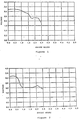
- Fig. 1 discloses a graph showing discharge at 180°C under 301 ohm load of a cell having a graphite coating baked on a titanium current collector at a temperature of 300°C.
- Fig. 2 discloses a graph showing discharge at 180°C under 301 ohm load of a cell having a graphite coating baked on a titanium current collector at a temperature of 150°C.
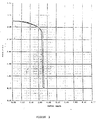
- Fig. 3 discloses a graph showing discharge at 180°C under 301 ohm load of the cell of the present invention having a cathode current collector comprised of the highly alloyed ferritic stainless steel material SUPERFERRIT.
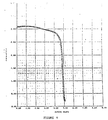
- Fig. 4 discloses a graph showing discharge at 180°C under 56 ohm load of the cell of the present invention having a cathode current collector comprised of the highly alloyed ferritic stainless steel material SUPPERFERRIT.
- Fig. 5 discloses a graph showing discharge of the cell of the present invention as a function of temperature.
- Fig. 6 discloses a graph showing discharge of the cell of the present invention by capacity versus temperature characteristics.
- Fig. 7 discloses a graph showing the running voltage versus the test temperature characteristic curve of the cell of the present invention.
- Fig. 8 discloses a graph showing the longevity of operation of two zinc/silver oxide C cells connected in series to a single cell of the present invention.
- the cell of the present invention demonstrates an energy density of from about 0.25 watt hrs./cm -3 to about 0.6 watt hrs./cm -3 to 2V under a nominal load of from about 3 ohm to 1K ohm and at a temperature of from about -20°C to 180°C.
- the cell of the present invention exhibits consistent operational performance over a temperature range of from -20°C to 180°C with an operating life at 180°C of about eighteen days.
- the cell provides an open circuit voltage output of from about 3.0 volts to about 3.5 volts.
- Other characteristics for a "C size" cell of the present invention include stability at temperatures as high as 200°C, nominal current capacity of 4.0Ah, a continuous discharge rate to 250mA, and an estimate self discharge rate of less than 2% per year. The cell will not rupture or leak when subjected to short circuit at room temperature.
- the cell of the present invention comprises an anode selected from group IA, IIA or IIIB metals, and their alloys.
- the preferred anode comprises lithium, and the more preferred anode comprises a lithium alloy, the preferred lithium alloy being lithium aluminum.
- the aluminum comprises from about 0% to about 50% by weight of the alloy. The greater the amount of aluminum present by weight in the alloy the lower the energy density of the cell.
- the form of the anode may vary, but preferably is a thin metal sheet or foil of the anode metal, pressed or rolled on a metallic anode current collector to form an anode strip.
- the anode strip has an extended tab or lead of the same material as the current collector or integrally formed therewith welded to the current collector and contacted by weld to a cell case of conductive metal in a case-negative electrical configuration.
- the anode may be formed in some other geometry, such as a bobbin shape, cylinder or pellet to allow an alternate low surface area cell design.
- the cell of the present invention further comprises a solid cathode of an electronically conductive composite material which serves as the other electrode of the cell.
- the solid cathode material may comprise a fluorinated carbon, a metal oxide or metal oxide bronze.
- the solid cathode exhibits excellent thermal stability and is generally safer and less reactive than a non-solid cathode.
- the solid cathode material preferably comprises a fluorinated carbon, and more pyeferably comprises polycarbon monofluoride (CF x ), a conductive agent such as a carbon black or graphite, and a binder such as polytetrafluoroethylene (PTFE).
- Polycarbon monofluoride (CF x ) is preferably present in an amount wherein "x" is in the range of from about 0.5 to about 1.2, and most preferably about 1.
- x is in the range of from about 0.5 to about 1.2, and most preferably about 1.
- the solid cathode material may comprise a metal oxide bronze.
- the cathode material can be constructed by the chemical addition, reaction or otherwise intimate contact of various metal oxides and/or metal elements during thermo treatment in mixed states.
- the cathode material may be the product of a thermo treatment of a single metal oxide.
- the materials thereby produced contain metals an oxides of the Group IB, IIB, IIIB, IVB, VB, VIB, VIIB and VIIIB which includes the noble metals and/or their oxide compounds.
- Decomposable compounds consisting of metals from Groups IB, IIB, IIIB, IVB, VB, VIB and VIIB as well as similarly decomposable compounds from Group VIIIB are thermally treated so as to effect the rapid preparation of the oxides or the respective metal elements themselves to be utilized further in the preparation of suitable cathode materials.
- Such readily decomposable materials include, but are not limited to, those classes of compounds known as nitrates, nitrites, carbonates and/or ammonium salts. These precursor materials may be decomposed in a combined state or individually decomposed and thereafter combined in an oxide-decomposable metal salt compound and subsequently decomposed to form the cathode composite matrix.
- the metal oxide bronze cathode material reference is made to U.S. Pat. No. 4,391,729.
- the solid cathode material may comprise a metal oxide.
- metal oxides for use as the cathode material in the cell of the present invention, reference is made to U.S. Pat. No. 3,945,848 which discloses the use of cobalt (III) oxide, U.S. Pat. No. 4,158,722 which discloses the use of chromium oxide and U.S. Pat. No. 3,423,242 which discloses the use of vanadium pentoxide.
- the cathode current collector grid is of a corrosion resistant highly alloyed ferritic stainless steels such as 30-2 SHOMAC, ALLEGHENY-LUDLUM 29-4-2 and 29-4-C, and SUPERFERRIT (REMANIT 4575).
- the metallic grid may or may not be annealed.
- a comparative cathode current collector is formed from a grade of chemically pure titanium coated with a conductive graphite such as ACHESON ELECTRODAG 158. Current coating technology provides for baking the graphite coating on the current collector at temperatures of around 150°C.
- FIG. 1 shows a typical discharge curve which represents the comparative cell having the graphite baked on the titanium current collector at 300°C.
- Figure 2 shows a typical discharge curve which represents the comparative cell having the graphite baked on the titanium current collector at 150°C.
- the cells shown in Figures 1 and 2 were discharged at 180°C under a 301 ohm load. If the coating is baked at a temperature of 300°C as opposed to 150°C reduced corrosion is noted resulting in a more stable cell having better performance. It was concluded that when the graphite coating is baked on the titanium current collector at a temperature of 200°C or lower the effect will be decreased cell performance.
- the cathode current collector for use in accordance with the cell of the present invention comprises one of the class of highly alloyed ferritic stainless steels. With reference to Figures 3 and 4, there is shown discharge curves at 180°C and 301ohm and 56ohm loads, respectively, showing the performance of a cell of the present invention using SUPERFERRIT material as the cathode current collector. Of course, the self discharge competes with the cell capacity and is dependent on load and time. It has been discovered that this cell using the SUPPERFERRIT cathode current collector exhibits better cell performance than the cell using the titanium cathode current collector having the graphite baked thereon as shown in Figures 1 and 2. Using highly alloyed ferritic stainless steels has never been applied to batteries operational at high temperatures over 100°C.
- a cathode current collector comprising a highly alloyed ferritic stainless steel does not need a graphite coating as described above for use at high temperatures.
- the cathode current collector used in the cell of the present invention may be fabricated by any of the following techniques: mechanical expansion; chemical machining, etching or milling; electrolytic etching; woven fabric; perforation or foil with vapor deposited bonding layer.
- the cathode current collector is in contact with the positive terminal pin via a lead of the same material as the current collector which is welded to both the current collector and the positive terminal pin for electrical contact.
- highly alloyed ferritic stainless steel cathode current collector refer to related United States patent no 5,114,810 issued 19th May 1992.
- the cell of the present invention further comprises a high boiling non-aqueous electrolyte solution operatively associated with the anode and the cathode.
- the preferred non-aqueous electrolyte comprises single high boiling aprotic solvents, or combinations thereof, including (gamma)-butyrolactone, propylene carbonate, diglyme, tetraglyme, dimethyl sulfite, dimethyl sulfoxide, sulfolane, (gamma)-valerolactone and ethylene carbonate.
- the non-aqueous electrolyte comprises (gamma)-butyrolactone.
- the non-aqueous electrolyte solution comprises a lithium salt with a suitably stable anion.
- lithium salts include lithium tetrafluoroborate, lithium hexafluoroarsenate, lithium trifluoromethane sulfonate, hexafluorophosphate and lithium perchlorate alone or in combination with an optional secondary salt containing the perchlorate anion such as lithium perchlorate and tetrabutyl ammonium perchlorate.
- the most preferred lithium salt is lithium tetrafluoroborate.
- the purpose of the perchlorate secondary salt is to change the corrosion characteristics of the cathode polarity metallic components, such as the current collector and cathode lead, thereby increasing discharge longevity to over two weeks at high temperatures such as 180°C.
- a separator can be employed to provide physical separation between the anode and the cathode current collectors.
- the separator is of electrically insulative material to prevent an internal electrical short circuit in the cell between the anode and the cathode current collectors.
- the separator material also must be chemically unreactive with both the materials of the anode and the cathode current collectors and the non-aqueous electrolyte solution.
- the separator providesphysical separation between the anode and the cathode current collectors.
- the separator is of electrically insulative material to prevent an internal electrical short circuit in the cell between the anode and the cathode current collectors.
- the separator material also must be chemically unreactive with both the materials of the anode and the cathode current collectors and the non-aqueous electrolyte solution.
- the separator material must have a degree of porosity sufficient to allow flow therethrough of the electrolyte solution during the electrochemical reaction of the cell.
- separator materials include nonwoven glass, porous TEFLON, glass fiber material, ceramics and materials commercially available under the trademarks ZITEX (Chemplast Inc.), CELLGARD (Celanese Plastic Co. Inc.) and DEXIGLAS (C.H. Dexter Div. Dexter Corp.).
- the form of the separator typically is a sheet which is placed between the anode and cathode of the cell in a manner preventing physical contact between the anode and cathode, and such contact is prevented when the combination is rolled or otherwise formed into a cylindrical configuration.
- the assembly of the cell described herein is preferably in the form of a wound element cell. That is, the fabricated cathode, anode and separator are wound together in a "jelly roll” end type configuration or “wound element cell stack" such that the anode is on the outside of the roll to make electrical contact with the cell case.
- the wound cell stack is inserted into a metallic case of a suitable size dimension.
- the metallic case may be comprised of materials such as stainless steel, mild steel, nickel-plated mild steel, titanium or aluminum, but not limited thereto so long as the metallic material is compatible for use with the components of the cell.
- the cell header comprises a metallic disc-shaped body with a first hole to accommodate a glass to metal seal/terminal pin feedthrough and a hole for electrolyte filling.
- the glass used is of a corrosion resistant type having from about 0% to about 50% by weight silicon such as CABAL 12, TA 23 or FUSITE 425 or 435.
- the positive terminal pin feedthrough preferably comprises molybdenum, titanium, nickel alloy, or stainless steel material.
- the cell header comprises elements having compatibility with the other components of lithium batteries and is for resistance to corrosion.
- the cathode lead is welded to the positive terminal pin in the glass to metal peal.
- the header is welded to the case containing the electrode stack.
- the cell is thereafter filled with the electrolyte solution described hereinabove and hermetically sealed such as by close-welding a stainless steel ball over the fill hole, but not limited thereto.
- This above assembly describes a case negative cell which is the preferred construction of the cell of the present invention.
- the electrochemical cell disclosed herein operates in the following manner.
- the ionic conductive electrolyte solution becomes operatively associated with the anode and cathode of the cell, an electrical potential difference is developed between terminals operatively connected to the anode and cathode.
- the electrochemical reaction of the anode includes oxidation to form metal ions during discharge of the cell.
- the electrochemical reaction of the cathode involves conversion of ions which migrate from the anode to the cathode into reduced molecular forms.
- the cell is provided with a fuse to insure cell safety under excessive discharge rates or inadvertent short circuit. A temperature safety margin of up to 200°C has been tested without incident.
- the cell of the present invention exhibits a high energy density and consistent operational performance over a wide temperature range, and this will become more apparent with reference to the following examples.
- C size dimension cells having a case height of 45 mm (1.77 inches) and inside diameter of 24.3mm (0.957 inches) were constructed.
- the cathode material weighed 8.0 grams and comprised, by total weight percent, 87% polycarbon monofluoride, 8% carbon black and 5% PTFE.
- the cathode was fabricated by sheeting the material on a SUPERFERRIT cathode current collector to form a flexible cathode strip 101.6mm (4.0 inches) in length and 38.1mm (1.5 inches) in width.
- the anode material weighed 1.51 grams and comprised, by total weight percent, 85% lithium and 15% aluminum.
- the lithium aluminum alloy was pressed on a nickel anode current collector to form an anode strip by sandwiching the anode current collector between two pieces of lithium aluminum alloy, one piece 133.3mm (5.25 inches) and the second piece 63.5mm (2.5 inches) in length and 33.02mm (1.30 inches) in width, with a lead welded thereto.
- Separator material, KAOWOOL glass mat paper, of 0.5mm (0.02 inches) in thickness was cut to dimensions of 285.75mm (11.25 inches) in length and 41.4mm (1.63 inches) in width and was placed between the anode and cathode.
- the anode, cathode and separator were rolled together into a wound element cell stack wherein the anode material was on the outside of the cell to make electrical contact with the cell case.
- top and bottom insulators of FEP TEFLON and top and bottom pads of KAO-WOOL 0.5mm (0.02") the cell stack was inserted into a stainless steel case of C size dimensions as noted above.
- the cathode lead is fed through the top insulator and pad so as to make contact with the terminal pin.
- the cell header comprised a stainless steel disc shaped body with a hole to accommodate the glass to metal seal terminal pin feedthrough and a hole for electrolyte filling.
- the FUSITE 435 glass used was of a corrosion resistant type.
- the positive terminal pin feedthrough comprised E-BRITE stainless steel.
- the cathode lead was welded to the positive terminal pin in the glass to metal seal.
- the header was welded to the case containing the wound element cell stack.
- An amount of 12.0 grams of the electrolyte solution comprising one molar lithium tetrafloroborate (LiBF 4 ) in gamma butyrolactone was added to each of the cells.
- the cells were then hermetically sealed by close-welding a stainless steel ball over the fill hole.
- the cells have a nominal capacity of 4.5AH and an open circuit potential of about 3.2 to about 3.6 volts.
- the cell has demonstrated energy density of 0.28wh/g (0.6wh.cm -3 at 180°C.
- Example 1 A cell was prepared as in Example 1 and the discharge behavior was observed.
- the discharge behavior is represented by the discharge curve shown in Fig. 5 as a function of temperature, and by the capacity versus temperature characteristics curve shown in Fig. 6. It is observed that to a 2V cutoff under a 56 ohm load, more than half of the maximum achievable capacity is still available at temperatures as low as -20°C.
- a cell was prepared as in Example 1 and the 56ohm running voltage, i.e. the voltage at 1/2 capacity, versus test temperature was observed.
- the characteristic curve is shown in Fig. 7.
- a single cell was prepared as in Example 1, except that the cathode current collector was comprised of titanium.
- This cell was compared to two Zn/Ag 2 O "C" cells connected in series which are commercially available and used in "down hole applications” under a discharge regime which was as close to a realistic worst case as possible under laboratory conditions.
- the cells were discharged at low rates (301 ohm loads, or approximately 10 mA) while being randomly cycled between 100°C and 180°C which represents a typical range of temperatures for "downhole” applications.
- Fig. 8 shows that a series of two Zn/Ag 2 O cells cannot match the performance of a single cell prepared as described above in longevity of operation. Accordingly, the latter is a significant improvement over the Zn/Ag 2 O cell. It is noted that a cell prepared as described above except using a highly alloyed ferritic stainless steel as the cathode current collector material should exhibit still better performance than the cell using titanium as the cathode current collector.
Landscapes
- Chemical & Material Sciences (AREA)
- General Chemical & Material Sciences (AREA)
- Chemical Kinetics & Catalysis (AREA)
- Electrochemistry (AREA)
- Engineering & Computer Science (AREA)
- Materials Engineering (AREA)
- Inorganic Chemistry (AREA)
- Ceramic Engineering (AREA)
- Manufacturing & Machinery (AREA)
- Primary Cells (AREA)
- Cell Electrode Carriers And Collectors (AREA)
- Battery Electrode And Active Subsutance (AREA)
- Secondary Cells (AREA)
Claims (18)
- Elektrochemische Zelle mit einer Metallanode, die folgende Merkmale aufweist: ein Element aus den Gruppen IA, IIA oder IIIB oder eine Legierung daraus, eine Festkathode aus elektrisch leitfähigem Material, eine ionische, leitfähige, nichtwäßrige Elektrolytlösung, die mit der Anode und der Kathode im Betriebszustand in Verbindung und in direktem Kontakt steht, wobei die nichtwäßrige Elektrolytlösung eine erste Komponente aufweist, die aus einem hochsiedenden aprotischen Lösungsmittel oder Kombinationen davon besteht, sowie eine zweite Komponente umfaßt, welche aus mindestens einem Lithiumsalz besteht, ein Kathodenstromkollektorgitter aus nichtkorrodierendem, hochlegiertem ferritischem Edelstahl sowie eine hermetische Einkapselung für diese Zelle, wobei die Einkapselung ein Metallgehäuse sowie eine Glas-auf-Metall-Versiegelung mit einschließt und die Zelle eine Energiedichte von bis zu etwa 0,6 Wattstunden·cm-3 aufweist und eine gleichmäßige Betriebsleistung über einen Betriebstemperaturbereich von -20 °C bis 180 °C aufbringt.
- Zelle nach Anspruch 1, worin die Anode eine Lithiumaluminiumlegierung darstellt.
- Zelle nach Anspruch 2, worin die Lithiumaluminiumlegierung etwa 0 Gew.-% bis etwa 50 Gew.-% Aluminium aufweist.
- Zelle nach einem der Ansprüche 1 bis 3, worin die Festkathode aus einem fluorierten Kohlenstoff, einem Metalloxid oder einer Metalloxidbronze ausgewählt ist.
- Zelle nach Anspruch 4, worin der fluorierte Kohlenstoff ein Polykohlenstoffmonofluorid ist (CFx), worin x von 0,5 bis etwa 1,2 variiert.
- Zelle nach Anspruch 4, worin die Metalloxidbronze aus Silbervanadiumoxid gebildet ist.
- Zelle nach einem der vorstehenden Ansprüche, worin die Kathode zusätzlich noch ein geeignetes Bindemittel aufweist.
- Zelle nach Anspruch 7, worin das Bindemittel aus Polytetrafluorethylen gebildet ist.
- Zelle nach einem der Ansprüche 1 bis 8, worin das Kathodenstromkollektorgitter aus einem der Stähle aus der Klasse hochlegierter ferritischer Edelstähle gebildet ist.
- Zelle nach Anspruch 9, worin der hochlegierte ferritische Edelstahl aus SUPERFERRIT gebildet ist.
- Zelle nach einem der Ansprüche 1 bis 10, worin der Kathodenstromkollektor in der Weise hergestellt wird, daß eine Technik aus der aus mechanischer Expansion, chemisch spanabhebender Formgebung, Ätzen oder Vermahlen, elektrolytischem Ätzen, gewebten Textilbahnen, Perforierung und Folien mit unter Dampf abgeschiedenen Bindeschichten bestehenden Gruppe ausgewählt wird.
- Zelle nach einem der Ansprüche 1 bis 11, worin das hochsiedende aprotische Lösungsmittel aus der aus γ-Butyrolacton, Propylencarbonat, Diglyme, Tetraglyme, Dimethylsulfit, Dimethylsulfoxid, Sulfolan, γ-Valerolacton, Ethylencarbonat und deren Kombinationen bestehenden Gruppe ausgewählt ist.
- Zelle nach einem der Ansprüche 1 bis 12, worin das Lithiumsalz aus der aus Lithiumtetrafluorborat, Lithiumhexafluorarsenat, Lithiumtrifluormethansulfonat, Lithiumhexafluorphosphat und Lithiumperchlorat bestehenden Gruppe ausgewählt ist.
- Zelle nach einem der Ansprüche 1 bis 13, worin die Elektrolytlösung zusätzlich noch ein Salz mit einem Gehalt an dem Perchloratanion aufweist.
- Zelle nach Anspruch 14, worin das Salz aus der aus Perchlorat, Tetraalkylammoniumperchlorat und Lithiumtetrafluorborat bestehenden Gruppe ausgewählt ist.
- Zelle nach einem der Ansprüche 1 bis 15, worin die Zelle zusätzlich noch einen Anodenstromkollektor und ein Separatormaterial mit einschließt, das zwischen den Anoden- und Kathodenstromkollektoren angeordnet ist.
- Zelle nach Anspruch 16, worin das Separatormaterial aus der aus KAOWOOL, Glasfasern und porösen Fluorpolymeren bestehenden Gruppe ausgewählt ist.
- Zelle nach einem der vorstehenden Ansprüche, worin die Anodengeometrie die Form einer Spule, eines Zylinders, eines Streifens oder von Pellets mit einschließt.
Applications Claiming Priority (2)
| Application Number | Priority Date | Filing Date | Title |
|---|---|---|---|
| US07/475,410 US5114811A (en) | 1990-02-05 | 1990-02-05 | High energy density non-aqueous electrolyte lithium cell operational over a wide temperature range |
| US475410 | 1990-02-05 |
Publications (2)
| Publication Number | Publication Date |
|---|---|
| EP0441589A1 EP0441589A1 (de) | 1991-08-14 |
| EP0441589B1 true EP0441589B1 (de) | 1996-06-26 |
Family
ID=23887450
Family Applications (1)
| Application Number | Title | Priority Date | Filing Date |
|---|---|---|---|
| EP91300927A Expired - Lifetime EP0441589B1 (de) | 1990-02-05 | 1991-02-05 | Hohe Energiedichte aufweisende Lithiumzelle mit nicht-wässrigem Elektrolyt, die über einen weiten Temeperaturbereich einsatzbereit ist |
Country Status (4)
| Country | Link |
|---|---|
| US (1) | US5114811A (de) |
| EP (1) | EP0441589B1 (de) |
| AT (1) | ATE139868T1 (de) |
| DE (1) | DE69120434T2 (de) |
Families Citing this family (67)
| Publication number | Priority date | Publication date | Assignee | Title |
|---|---|---|---|---|
| AU665575B2 (en) * | 1991-09-30 | 1996-01-11 | Wilson Greatbatch Ltd. | Autoclavable electrochemical cell |
| FR2685129B1 (fr) * | 1991-12-13 | 1994-03-25 | Centre Nal Etudes Spatiales | Utilisation de bronzes d'oxyde de vanadium au fer et/ou a l'aluminium comme materiau cathodique dans des generateurs electrochimiques. |
| US5620810A (en) * | 1992-07-22 | 1997-04-15 | Valence Technology, Inc. | Solid, solvent-containing electrolytes and electrolytic cells produced therefrom |
| JP3195475B2 (ja) * | 1992-11-26 | 2001-08-06 | セイコーインスツルメンツ株式会社 | 電気化学セル |
| JPH07142067A (ja) * | 1993-07-12 | 1995-06-02 | Wilson Greatbatch Ltd | 電気化学電池用カソードおよびその調製方法、並びに電気化学電池 |
| US5580683A (en) * | 1993-11-01 | 1996-12-03 | Wilson Greatbatch Ltd. | high pulse power cell |
| US5458997A (en) * | 1994-08-19 | 1995-10-17 | Medtronic, Inc. | Rebalancing of lithium/silver vandium oxide (Li/SVO) cells for improved performance |
| AU4253796A (en) * | 1994-12-09 | 1996-06-26 | Danionics A/S | A non-aqueous electrolyte system for use in batteries, capacitors or electrochromic devices and a method for the preparation thereof |
| US5656392A (en) * | 1995-03-20 | 1997-08-12 | Matsushita Electric Industrial Co., Ltd. | Organic electrolyte batteries |
| US5514492A (en) * | 1995-06-02 | 1996-05-07 | Pacesetter, Inc. | Cathode material for use in an electrochemical cell and method for preparation thereof |
| US5558962A (en) * | 1995-06-02 | 1996-09-24 | Pacesetter, Inc. | Aluminum current collector for an electrochemical cell having a solid cathode |
| US5716728A (en) * | 1996-11-04 | 1998-02-10 | Wilson Greatbatch Ltd. | Alkali metal electrochemical cell with improved energy density |
| US6017656A (en) * | 1996-11-27 | 2000-01-25 | Medtronic, Inc. | Electrolyte for electrochemical cells having cathodes containing silver vanadium oxide |
| CA2199446A1 (fr) * | 1997-03-07 | 1998-09-07 | Yves Choquette | Generateurs a electrolyte polymere possedant un sel de potassium permettant de stabiliser les performances et la vie utile de la batterie |
| USRE37805E1 (en) * | 1997-03-12 | 2002-07-23 | Hydro-Quebec | Polymer electrolyte lithium battery containing a potassium salt |
| US6114069A (en) * | 1997-03-12 | 2000-09-05 | Hydro Quebec | Polymer electrolyte lithium battery containing a potassium salt |
| EP0872261B1 (de) * | 1997-04-16 | 2004-05-06 | LITRONIK Batterietechnologie GmbH & Co. | Implantierbares medizinisches Mehrfunktionsgerät |
| US6165641A (en) * | 1997-05-09 | 2000-12-26 | The United States Of America As Represented By The United States Department Of Energy | Nanodisperse transition metal electrodes (NTME) for electrochemical cells |
| US6150053A (en) * | 1997-06-06 | 2000-11-21 | Matsushita Electric Industrial Co., Ltd. | Non-aqueous electrolyte secondary battery |
| US6045941A (en) * | 1997-07-08 | 2000-04-04 | Schlumberger Technology Corporation | Method to determine the state of charge and remaining life of lithium batteries used in oilfield services applications |
| US6017654A (en) * | 1997-08-04 | 2000-01-25 | Carnegie Mellon University | Cathode materials for lithium-ion secondary cells |
| CN1134083C (zh) * | 1997-09-19 | 2004-01-07 | 三菱化学株式会社 | 非水系电解液电池 |
| US6403256B1 (en) | 1999-01-25 | 2002-06-11 | Wilson Greatbatch Ltd. | Alkali metal electrochemical cell activated with a nonaqueous electrolyte having a sulfite additive |
| JP4423699B2 (ja) | 1999-05-27 | 2010-03-03 | ソニー株式会社 | 半導体レーザ素子及びその作製方法 |
| US6635130B2 (en) * | 1999-10-09 | 2003-10-21 | Diehl Munitionssysteme Gmbh & Co. Kg | Pyrotechnic composition for producing IR-radiation |
| US6653016B2 (en) | 2000-04-25 | 2003-11-25 | Rayovac Corporation | Extended temperature operating range electrochemical cells |
| JP2002334703A (ja) * | 2001-03-06 | 2002-11-22 | Sanyo Electric Co Ltd | リチウム電池 |
| US20030113622A1 (en) * | 2001-12-14 | 2003-06-19 | Blasi Jane A. | Electrolyte additive for non-aqueous electrochemical cells |
| US6706823B2 (en) | 2001-12-31 | 2004-03-16 | Bridgestone Corporation | Conductive gels |
| US6677076B2 (en) * | 2002-01-15 | 2004-01-13 | Quallion Llc | Electric storage battery construction and method of manufacture |
| US6670071B2 (en) | 2002-01-15 | 2003-12-30 | Quallion Llc | Electric storage battery construction and method of manufacture |
| JP3995484B2 (ja) * | 2002-01-24 | 2007-10-24 | 三洋電機株式会社 | リチウム一次電池 |
| US20030162099A1 (en) | 2002-02-28 | 2003-08-28 | Bowden William L. | Non-aqueous electrochemical cell |
| US6849360B2 (en) | 2002-06-05 | 2005-02-01 | Eveready Battery Company, Inc. | Nonaqueous electrochemical cell with improved energy density |
| EP1576678A2 (de) * | 2002-09-10 | 2005-09-21 | California Institute Of Technology | Nanostrukturiertes silizium mit hoher kapazität und lithiumlegierungen dafür |
| WO2005091403A1 (en) * | 2003-01-15 | 2005-09-29 | Quallion Llc | Battery |
| US7722992B1 (en) | 2003-06-17 | 2010-05-25 | Greatbatch Ltd. | Self-centering current collector for an electrochemical cell |
| US20040256640A1 (en) * | 2003-06-17 | 2004-12-23 | Zayatz Robert A. | Self-centering current collector for an electrochemical cell |
| US7537682B2 (en) * | 2004-03-17 | 2009-05-26 | California Institute Of Technology | Methods for purifying carbon materials |
| US8080329B1 (en) | 2004-03-25 | 2011-12-20 | Quallion Llc | Uniformly wound battery |
| US7781102B2 (en) * | 2004-04-22 | 2010-08-24 | California Institute Of Technology | High-capacity nanostructured germanium-containing materials and lithium alloys thereof |
| US7285356B2 (en) * | 2004-07-23 | 2007-10-23 | The Gillette Company | Non-aqueous electrochemical cells |
| US7667942B2 (en) * | 2004-12-13 | 2010-02-23 | Schlumberger Technology Corporation | Battery switch for downhole tools |
| US7479348B2 (en) * | 2005-04-08 | 2009-01-20 | The Gillette Company | Non-aqueous electrochemical cells |
| US8377586B2 (en) | 2005-10-05 | 2013-02-19 | California Institute Of Technology | Fluoride ion electrochemical cell |
| US20100221603A1 (en) * | 2006-03-03 | 2010-09-02 | Rachid Yazami | Lithium ion fluoride battery |
| US8232007B2 (en) | 2005-10-05 | 2012-07-31 | California Institute Of Technology | Electrochemistry of carbon subfluorides |
| WO2007040547A1 (en) * | 2005-10-05 | 2007-04-12 | California Institute Of Technology | Subfluorinated graphite fluorides as electrode materials |
| US7794880B2 (en) | 2005-11-16 | 2010-09-14 | California Institute Of Technology | Fluorination of multi-layered carbon nanomaterials |
| US20070218364A1 (en) * | 2005-10-05 | 2007-09-20 | Whitacre Jay F | Low temperature electrochemical cell |
| US7563542B2 (en) * | 2005-10-05 | 2009-07-21 | California Institute Of Technology | Subfluorinated graphite fluorides as electrode materials |
| US20070266554A1 (en) * | 2006-05-16 | 2007-11-22 | Bruce Gregg C | Electrochemical cell with moderate-rate discharging capability and method of production |
| US8658309B2 (en) * | 2006-08-11 | 2014-02-25 | California Institute Of Technology | Dissociating agents, formulations and methods providing enhanced solubility of fluorides |
| WO2008113023A1 (en) * | 2007-03-14 | 2008-09-18 | California Institute Of Technology | High discharge rate batteries |
| WO2009014845A2 (en) * | 2007-06-28 | 2009-01-29 | Ultralife Corporation | High capacity and high rate lithium cells with cfx-mno2 hybrid cathode |
| US8513361B2 (en) * | 2007-12-28 | 2013-08-20 | Bridgestone Corporation | Interpolymers containing isobutylene and diene mer units |
| US20100068609A1 (en) * | 2008-09-15 | 2010-03-18 | Ultralife Corportion | Hybrid cell construction for improved performance |
| US20100141211A1 (en) * | 2008-11-04 | 2010-06-10 | Rachid Yazami | Hybrid electrochemical generator with a soluble anode |
| US8961833B2 (en) * | 2010-11-24 | 2015-02-24 | The United States Of America As Represented By The Secretary Of The Army | Fluorinated carbon composite cathode for a high-energy lithium battery |
| US20130236756A1 (en) * | 2012-03-09 | 2013-09-12 | Ultralife Corporation | Lithium bobbin cell with cathode using wrapped metal grid as current collector |
| US20140093754A1 (en) * | 2012-10-03 | 2014-04-03 | Robert J. Hamers | High-Temperature Resistant Carbon Monofluoride Batteries Having Lithiated Anode |
| US9882243B2 (en) | 2013-09-26 | 2018-01-30 | Eaglepicher Technologies, Llc | Lithium-sulfur battery and methods of reducing insoluble solid lithium-polysulfide depositions |
| US9455447B2 (en) | 2013-09-26 | 2016-09-27 | Eaglepicher Technologies, Llc | Lithium-sulfur battery and methods of preventing insoluble solid lithium-polysulfide deposition |
| US9991493B2 (en) | 2013-10-15 | 2018-06-05 | Eaglepicher Technologies, Llc | High energy density non-aqueous electrochemical cell with extended operating temperature window |
| US10038220B2 (en) | 2015-12-30 | 2018-07-31 | Greatbatch Ltd. | Nonaqueous electrolyte for lithium battery safety |
| CN110088941B (zh) | 2016-12-16 | 2023-01-31 | 美敦力公司 | 锂离子电池和灭菌方法 |
| EP3987602A4 (de) | 2019-06-20 | 2023-06-28 | Unifrax I LLC | Leichte vliesfasermatten |
Family Cites Families (18)
| Publication number | Priority date | Publication date | Assignee | Title |
|---|---|---|---|---|
| US3301711A (en) * | 1964-09-25 | 1967-01-31 | Jr Burnham W King | Al-si-mn-li anode for high temperature galvanic cell |
| US3484296A (en) * | 1967-08-30 | 1969-12-16 | Standard Oil Co | Low temperature battery |
| IT500094A (de) * | 1968-04-12 | |||
| JPS4825566B1 (de) * | 1968-04-17 | 1973-07-30 | ||
| US3514337A (en) * | 1968-06-06 | 1970-05-26 | Us Navy | High energy density battery |
| FR2191288B1 (de) * | 1972-07-06 | 1976-01-16 | Etat Francais Fr | |
| US3897264A (en) * | 1972-11-13 | 1975-07-29 | Gte Laboratories Inc | Electrochemical cells with inorganic oxyhalide or thiohalide solvent |
| US3947289A (en) * | 1973-11-23 | 1976-03-30 | P. R. Mallory & Co., Inc. | Mixed solvents for high and low temperature organic electrolyte batteries |
| DE2726380C2 (de) * | 1977-06-10 | 1984-03-08 | Varta Batterie Ag, 3000 Hannover | Elektrochemische Stromquelle hoher Energiedichte |
| JPS549730A (en) * | 1977-06-24 | 1979-01-24 | Matsushita Electric Industrial Co Ltd | Active material on positive electrode of battery |
| US4246327A (en) * | 1979-10-01 | 1981-01-20 | Medtronic, Inc. | High energy-density battery system |
| US4391729A (en) * | 1979-12-17 | 1983-07-05 | Wilson Greatbatch Ltd. | Metal oxide composite cathode material for high energy density batteries |
| US4310609A (en) * | 1979-12-17 | 1982-01-12 | Wilson Greatbatch Ltd. | Metal oxide composite cathode material for high energy density batteries |
| JPS6139368A (ja) * | 1984-06-29 | 1986-02-25 | Daikin Ind Ltd | 電池 |
| US4585715A (en) * | 1984-06-29 | 1986-04-29 | Union Carbide Corporation | Metal cathode collector having a protective surface layer of a metal oxide |
| FR2576712B1 (fr) * | 1985-01-30 | 1988-07-08 | Accumulateurs Fixes | Generateur electrochimique a electrolyte non aqueux |
| US4830940A (en) * | 1986-01-14 | 1989-05-16 | Wilson Greatbatch Ltd. | Non-agueous lithium battery |
| US4803137A (en) * | 1987-05-19 | 1989-02-07 | Bridgestone Corporation | Non-aqueous electrolyte secondary cell |
-
1990
- 1990-02-05 US US07/475,410 patent/US5114811A/en not_active Expired - Lifetime
-
1991
- 1991-02-05 DE DE69120434T patent/DE69120434T2/de not_active Expired - Fee Related
- 1991-02-05 EP EP91300927A patent/EP0441589B1/de not_active Expired - Lifetime
- 1991-02-05 AT AT91300927T patent/ATE139868T1/de not_active IP Right Cessation
Non-Patent Citations (1)
| Title |
|---|
| CHEMIE IN UNSERER ZEIT, vol. 24,(1990),no. 1, pp. 32-36; and no. 2, pp. 90-96, Weinheim (DE); G. EICHINGER and G. Semrau: "Lithiumbatterien I" and "Lithiumbatterien II" * |
Also Published As
| Publication number | Publication date |
|---|---|
| US5114811A (en) | 1992-05-19 |
| DE69120434T2 (de) | 1996-10-31 |
| DE69120434D1 (de) | 1996-08-01 |
| ATE139868T1 (de) | 1996-07-15 |
| EP0441589A1 (de) | 1991-08-14 |
Similar Documents
| Publication | Publication Date | Title |
|---|---|---|
| EP0441589B1 (de) | Hohe Energiedichte aufweisende Lithiumzelle mit nicht-wässrigem Elektrolyt, die über einen weiten Temeperaturbereich einsatzbereit ist | |
| US5506068A (en) | Non-aqueous safe secondary cell | |
| US5716728A (en) | Alkali metal electrochemical cell with improved energy density | |
| EP0777915B1 (de) | Zusatz für trockene elektrolyten zur verminderung der spannungsverzögerung in alkali-metallelektrochemischer zelle | |
| US6544691B1 (en) | Batteries using molten salt electrolyte | |
| US6511772B2 (en) | Electrochemical cell having an electrode with a phosphate additive in the electrode active mixture | |
| US6537698B2 (en) | Electrochemical cell having an electrode with a phosphonate additive in the electrode active mixture | |
| US4375501A (en) | Electrochemical cell | |
| US12113177B2 (en) | Lithium oxyhalide electrochemical cell design for high-rate discharge | |
| EP0862231A1 (de) | Lithiumsekundärbatterie mit Thermischerschalter | |
| US5658688A (en) | Lithium-silver oxide battery and lithium-mercuric oxide battery | |
| GB2093629A (en) | Electrochemical cell and method of manufacture | |
| US20020136951A1 (en) | Electrochemical cell having an electrode with a carbonate additive in the electrode active mixture | |
| US6306544B1 (en) | Cobalt-based alloys as positive electrode current collectors in nonaqueous electrochemical cells | |
| US4664989A (en) | Liquid cathode cell system employing a coiled electrode assembly | |
| CA2415181A1 (en) | Svo/cfx parallel cell design within the same casing | |
| US6586135B2 (en) | Electrochemical cell having an electrode with a dicarbonate additive in the electrode active mixture | |
| US4403020A (en) | Electrochemical cell | |
| GB2056752A (en) | Electrochemical cell having electrolyte comprising halogens and interhalogens | |
| EP0077169B1 (de) | Feststoffbatterie | |
| US10109846B2 (en) | Mixed cathode material with high energy density | |
| IL45105A (en) | Thermal battery and molten metal anode therefor | |
| IE51895B1 (en) | Metal oxide composite cathode material for high density batteries |
Legal Events
| Date | Code | Title | Description |
|---|---|---|---|
| PUAI | Public reference made under article 153(3) epc to a published international application that has entered the european phase |
Free format text: ORIGINAL CODE: 0009012 |
|
| AK | Designated contracting states |
Kind code of ref document: A1 Designated state(s): AT BE CH DE DK ES FR GB GR IT LI LU NL SE |
|
| 17P | Request for examination filed |
Effective date: 19920131 |
|
| 17Q | First examination report despatched |
Effective date: 19930830 |
|
| GRAH | Despatch of communication of intention to grant a patent |
Free format text: ORIGINAL CODE: EPIDOS IGRA |
|
| GRAH | Despatch of communication of intention to grant a patent |
Free format text: ORIGINAL CODE: EPIDOS IGRA |
|
| GRAA | (expected) grant |
Free format text: ORIGINAL CODE: 0009210 |
|
| AK | Designated contracting states |
Kind code of ref document: B1 Designated state(s): AT BE CH DE DK ES FR GB GR IT LI LU NL SE |
|
| PG25 | Lapsed in a contracting state [announced via postgrant information from national office to epo] |
Ref country code: IT Free format text: LAPSE BECAUSE OF FAILURE TO SUBMIT A TRANSLATION OF THE DESCRIPTION OR TO PAY THE FEE WITHIN THE PRE;WARNING: LAPSES OF ITALIAN PATENTS WITH EFFECTIVE DATE BEFORE 2007 MAY HAVE OCCURRED AT ANY TIME BEFORE 2007. THE CORRECT EFFECTIVE DATE MAY BE DIFFERENT FROM THE ONE RECORDED.SCRIBED TIME-LIMIT Effective date: 19960626 Ref country code: NL Free format text: LAPSE BECAUSE OF FAILURE TO SUBMIT A TRANSLATION OF THE DESCRIPTION OR TO PAY THE FEE WITHIN THE PRESCRIBED TIME-LIMIT Effective date: 19960626 Ref country code: DK Effective date: 19960626 Ref country code: ES Free format text: THE PATENT HAS BEEN ANNULLED BY A DECISION OF A NATIONAL AUTHORITY Effective date: 19960626 Ref country code: AT Effective date: 19960626 Ref country code: BE Effective date: 19960626 Ref country code: GR Free format text: LAPSE BECAUSE OF FAILURE TO SUBMIT A TRANSLATION OF THE DESCRIPTION OR TO PAY THE FEE WITHIN THE PRESCRIBED TIME-LIMIT Effective date: 19960626 |
|
| REF | Corresponds to: |
Ref document number: 139868 Country of ref document: AT Date of ref document: 19960715 Kind code of ref document: T |
|
| REG | Reference to a national code |
Ref country code: CH Ref legal event code: NV Representative=s name: ISLER & PEDRAZZINI AG |
|
| REF | Corresponds to: |
Ref document number: 69120434 Country of ref document: DE Date of ref document: 19960801 |
|
| PG25 | Lapsed in a contracting state [announced via postgrant information from national office to epo] |
Ref country code: SE Effective date: 19960926 |
|
| ET | Fr: translation filed | ||
| NLV1 | Nl: lapsed or annulled due to failure to fulfill the requirements of art. 29p and 29m of the patents act | ||
| PG25 | Lapsed in a contracting state [announced via postgrant information from national office to epo] |
Ref country code: CH Effective date: 19970228 Ref country code: LI Effective date: 19970228 Ref country code: LU Free format text: LAPSE BECAUSE OF NON-PAYMENT OF DUE FEES Effective date: 19970228 |
|
| PLBE | No opposition filed within time limit |
Free format text: ORIGINAL CODE: 0009261 |
|
| 26N | No opposition filed | ||
| REG | Reference to a national code |
Ref country code: CH Ref legal event code: PL |
|
| REG | Reference to a national code |
Ref country code: GB Ref legal event code: IF02 |
|
| PGFP | Annual fee paid to national office [announced via postgrant information from national office to epo] |
Ref country code: GB Payment date: 20060223 Year of fee payment: 16 |
|
| GBPC | Gb: european patent ceased through non-payment of renewal fee |
Effective date: 20070205 |
|
| PG25 | Lapsed in a contracting state [announced via postgrant information from national office to epo] |
Ref country code: GB Free format text: LAPSE BECAUSE OF NON-PAYMENT OF DUE FEES Effective date: 20070205 |
|
| PGFP | Annual fee paid to national office [announced via postgrant information from national office to epo] |
Ref country code: FR Payment date: 20080218 Year of fee payment: 18 Ref country code: DE Payment date: 20080331 Year of fee payment: 18 |
|
| REG | Reference to a national code |
Ref country code: FR Ref legal event code: ST Effective date: 20091030 |
|
| PG25 | Lapsed in a contracting state [announced via postgrant information from national office to epo] |
Ref country code: DE Free format text: LAPSE BECAUSE OF NON-PAYMENT OF DUE FEES Effective date: 20090901 |
|
| PG25 | Lapsed in a contracting state [announced via postgrant information from national office to epo] |
Ref country code: FR Free format text: LAPSE BECAUSE OF NON-PAYMENT OF DUE FEES Effective date: 20090302 |