EP0441708A1 - Process for the preparation of terpene ketones - Google Patents
Process for the preparation of terpene ketones Download PDFInfo
- Publication number
- EP0441708A1 EP0441708A1 EP91400293A EP91400293A EP0441708A1 EP 0441708 A1 EP0441708 A1 EP 0441708A1 EP 91400293 A EP91400293 A EP 91400293A EP 91400293 A EP91400293 A EP 91400293A EP 0441708 A1 EP0441708 A1 EP 0441708A1
- Authority
- EP
- European Patent Office
- Prior art keywords
- reaction
- ketoester
- carried out
- geranylacetone
- water
- Prior art date
- Legal status (The legal status is an assumption and is not a legal conclusion. Google has not performed a legal analysis and makes no representation as to the accuracy of the status listed.)
- Granted
Links
Classifications
-
- C—CHEMISTRY; METALLURGY
- C07—ORGANIC CHEMISTRY
- C07C—ACYCLIC OR CARBOCYCLIC COMPOUNDS
- C07C45/00—Preparation of compounds having >C = O groups bound only to carbon or hydrogen atoms; Preparation of chelates of such compounds
- C07C45/61—Preparation of compounds having >C = O groups bound only to carbon or hydrogen atoms; Preparation of chelates of such compounds by reactions not involving the formation of >C = O groups
- C07C45/67—Preparation of compounds having >C = O groups bound only to carbon or hydrogen atoms; Preparation of chelates of such compounds by reactions not involving the formation of >C = O groups by isomerisation; by change of size of the carbon skeleton
- C07C45/673—Preparation of compounds having >C = O groups bound only to carbon or hydrogen atoms; Preparation of chelates of such compounds by reactions not involving the formation of >C = O groups by isomerisation; by change of size of the carbon skeleton by change of size of the carbon skeleton
- C07C45/676—Preparation of compounds having >C = O groups bound only to carbon or hydrogen atoms; Preparation of chelates of such compounds by reactions not involving the formation of >C = O groups by isomerisation; by change of size of the carbon skeleton by change of size of the carbon skeleton by elimination of carboxyl groups
-
- C—CHEMISTRY; METALLURGY
- C07—ORGANIC CHEMISTRY
- C07C—ACYCLIC OR CARBOCYCLIC COMPOUNDS
- C07C67/00—Preparation of carboxylic acid esters
- C07C67/30—Preparation of carboxylic acid esters by modifying the acid moiety of the ester, such modification not being an introduction of an ester group
- C07C67/333—Preparation of carboxylic acid esters by modifying the acid moiety of the ester, such modification not being an introduction of an ester group by isomerisation; by change of size of the carbon skeleton
- C07C67/343—Preparation of carboxylic acid esters by modifying the acid moiety of the ester, such modification not being an introduction of an ester group by isomerisation; by change of size of the carbon skeleton by increase in the number of carbon atoms
- C07C67/347—Preparation of carboxylic acid esters by modifying the acid moiety of the ester, such modification not being an introduction of an ester group by isomerisation; by change of size of the carbon skeleton by increase in the number of carbon atoms by addition to unsaturated carbon-to-carbon bonds
Definitions
- the present invention relates to a process for the preparation of terpene ketones. It more particularly relates to the preparation of terpene ketones from 1,3-butadiene optionally substituted on carbon 2 by a hydrocarbon chain, in particular polyene and preferably isoprene.
- Polyene terpene ketones have the following general formula: in which n is an integer between 1 and 4.
- the present invention has made it possible to achieve this objective. Its subject is a process for the preparation of terpene ketones in which a polyene derived from 1,3-butadiene of the formula: in which R represents a methyl, polyene and preferably polyisoprenic radical with an alkyl acetoacetate on which decarboalkoxylation is carried out by water vapor.
- the 1,3 butadiene compound preferably corresponds to the following formula (I): in which m is equal to an integer equal to or greater than 0 and less than or equal to 3.
- alkyl acetoacetate corresponds to the following formula (II): CH3-CO-CH2-CO2-R1 in which R1 represents a hydrocarbon radical containing 1 to 12 carbon atoms preferably in the form of a linear or branched alkyl or alkenyl chain or of an optionally substituted aromatic radical.
- the process according to the invention is preferably carried out using at least one phosphine of formula (III) in which Ar1, Ar2 and Ar3 identical or different each represent a phenylene radical.
- a phosphine soluble in an aqueous medium is used in which the SO3M groups are in the meta position on the benzene nucleus.
- M is chosen from the group comprising cations derived from metals Na, K, Ca, Ba, NH4+ ions and quaternary ammonium such as tetramethylammonium, tetrapropylammonium and tetrabutylammonium ions.
- n1, n2 and n3 are preferably equal to 1.
- the rhodium derivative is chosen from the group comprising inorganic and organic salts and rhodium complexes such as, for example, Rh Cl3, Rh Br3, Rh2O, Rh2O3, Rh (NO3) 3 , Rh (CH3COO) 3, Rh (CH3 COCHCOCH3) 3, [Rh Cl (1,5-cyclooctadiene)] 2, [Rh Cl (CO) 2] 2, Rh Cl3 (C2H5NH2) 3, Rh2 (SO4) 3.
- Rh Cl3, Rh Br3, Rh2O, Rh2O3, Rh (NO3) 3 Rh (CH3COO) 3, Rh (CH3 COCHCOCH3) 3, [Rh Cl (1,5-cyclooctadiene)] 2, [Rh Cl (CO) 2] 2, Rh Cl3 (C2H5NH2) 3, Rh2 (SO4) 3.
- Rh Cl3 and [Rh Cl (1,5-cyclooctadiene)] 2.
- An amount of rhodium or of rhodium compound is used such that the number of gram atoms of elementary rhodium per liter of reaction solution is between approximately 10-4 and approximately 1. Preferably it is between 0.001 and 0.5 approximately.
- the quantity of phosphine is chosen such that the number of gram atoms of trivalent phosphorus relative to one gram atom of rhodium is between about 0.1 and about 200. Preferably, this number is between approximately 3 and approximately 100.
- the addition reaction can be diagrammed as follows:
- the ester used to carry out the decarboalkoxylation reaction can be an isolated purified product or the crude product directly obtained in the condensation step between the ⁇ -ketoester and the butadiene derivative.
- Decarboalkoxylation can advantageously be carried out in the same reactor as the addition reaction.
- the decarboalkoxylation reaction is carried out in the vapor phase or in the liquid phase at a temperature between 130 ° C. and 500 ° C.
- the temperature is preferably between 300 and 500 ° C. and even more preferably between 350 and 400 ° C.
- the reaction is carried out in the liquid phase, it is preferred to use a temperature between 180 and 220 ° C.
- the reaction can also be carried out in a trickle phase on a bed of non-reactive solid material such as quartz.
- the decarboalkoxylation reaction can be carried out at atmospheric pressure, under lower pressure or under higher pressure. However, it is preferred to work at a pressure below 100 bar and very particularly at a pressure between 1 and 20 bar.
- the temperature and pressure conditions will be adapted by those skilled in the art to the raw material used.
- the polyene ketone derivatives obtained are important synthesis intermediates in the vitamin and perfume industry.
- the two-phase mixture (pale yellow organic phase and orange-red aqueous phase) is engaged in the decarboxylation step in the same autoclave, it is heated for 3 hours at 180 ° C., until the end of the pressure rise due to the evolution of gas. The pressure reaches 25 bar for a 750 ml reactor. Cool, degas. Analysis by thin layer gas chromatography and 1 H NMR after extraction from the biphasic system gives a complete transformation rate of ⁇ -ketoesters (Ia). An organic phase is isolated essentially containing the two isomers of geranylacetone IIa (exo and endo): 40.3 g. Distillation allows the isolation of pure geranylacetone (2 isomers): 33 g (Eb1 around 82 ° C). The yield of distilled geranylacetone compared to the committed myrcene is 67.4%.
- the final orange-yellow aqueous phase contains 0.54 g / l of homogeneous soluble rhodium.
- the two-phase mixture (pale yellow organic phase and orange-red aqueous phase) is engaged in the decarboxylation step in the same autoclave, it is heated for 3 hours at 180 ° C., until the end of the pressure rise due to the evolution of gas. Cool, degas. Analysis by thin layer chromatography (TLC), gas (CPV) and 1 H NMR after extraction from the biphasic system gives a complete transformation rate of ⁇ -ketoesters (Ia). An organic phase is isolated essentially containing the two isomers of geranylacetone (IIa) (exo and endo): 48.7 g.
- Distillation makes it possible to isolate a first fraction (Eb1 about 25-30 ° C) containing the inert C10 hydrocarbons contained in technical myrcene (9.4 g) and a second fraction corresponding to pure geranylacetone (2 isomers): 30, 6 g (Eb1 around 82 ° C).
- the yield of distilled geranylacetone is 63%.
- the final orange-yellow aqueous phase contains homogeneous soluble rhodium.
- Example 3 With the apparatus described in Example 3, the operation is carried out at 400 ° C. under a stream of nitrogen (3.5 lh ⁇ 1 in CNTP). Using a syringe pump, the ⁇ -ketoester (Ia) is injected (purity 96% - mixture of the two endo isomers: 55 / exo 45) at a liquid flow rate of 10 mlh ⁇ 1 (36.5 millimoles h ⁇ 1 ) and simultaneously the permuted water by means of a second syringe pump at 2.4 mlh ⁇ 1 (133.3 millimoles h ⁇ 1 or 3.65 equivalent) corresponding to an average contact time of 4.6 seconds.
- a syringe pump the ⁇ -ketoester (Ia) is injected (purity 96% - mixture of the two endo isomers: 55 / exo 45) at a liquid flow rate of 10 mlh ⁇ 1 (36.5 millimoles h ⁇ 1 ) and simultaneously the permuted water
- Example 6 With the apparatus described in Example 3, but operating at 450 ° C., after 35 minutes of reaction, a biphasic condensate is obtained (1.2 ml of colorless aqueous phase and 4.38 g of yellow organic phase whose CCM, CPV and 1 H NMR analysis shows the formation of geranylacetone (IIa) with a transformation rate of the ⁇ -ketoester (Ia) of approximately 63% and a selectivity to geranylacetone of 73%.
- Example 6 is reproduced at 400 ° C., but by modifying the injection rate of ⁇ -keto ester to 4.95 mlh ⁇ 1 (18.2 millimole h ⁇ 1), all being equal, ie a ratio of 7.3 water equivalents compared to ⁇ -ketoester and an average contact time of 4.8 seconds. After 1 hour 05 of reaction, a two-phase condensate is obtained containing 2.2 ml of colorless aqueous lower phase and 3.52 g of organic phase (after removal of the light products with rotavap).
- Example 4 is repeated but the reaction is carried out in a 300 ml SOTELEM autoclave in stainless steel equipped with a RUCHTON turbine allowing excellent transfer, at atmospheric pressure, heated to 200 ° C. with injection of water into the reaction mass by means of a RAZEL syringe pump, methanol is collected in a trap after distillation and a precision hydraulic gas meter is used to account for the volume of CO2 released.
- the 24 ml colorless distillate mainly contains methanol (controlled by CPV) and excess water, which allows easy recovery of methanol by simple distillation.
- Example 11 The procedure is as in Example 11 but at a variable temperature.
- Example 12 of patent FR 2,486,525 of the applicant for addition to ethyl acetylacetate is used, but the ⁇ -ketoester (Id) is not isolated and the decarboethoxylation is directly linked in the same autoclave. which allows a "one pot" of isoprene with methylheptenone without isolating the intermediates.
- the apparatus consists of a 100 ml three-necked flask with magnetic stirring, vigorous one-piece column, receiving flask connected to a water tank surmounted by a graduated cylinder to measure the volume of CO2 released, RAZEL syringe pump with stainless steel plunging needle for the introduction of water and heating by regulated oil bath.
- the reaction product which is in the organic phase is then isolated by separating the latter from the aqueous phase containing the catalyst by decantation and optionally by extraction using a suitable solvent.
- the aqueous solution can be recycled to the reactor to catalyze a new reaction.
- the aqueous solution can also remain in the reactor, the organic products then being drawn off after decantation.
- the organic phase thus collected constitutes the crude ⁇ -ketoester and contains (starting from a technical myrcene with 78.2% purity in myrcene) 71.2% of ⁇ -ketoester, mainly accompanied by the inerts of technical myrcene (such as limonene), excess methyl acetoacetate and approximately 1% water.
- distillate contains the inerts of technical myrcene (limonene: Eb760 about 172 ° C), the excess of methyl acetoacetate in addition to the methanol formed.
Landscapes
- Chemical & Material Sciences (AREA)
- Organic Chemistry (AREA)
- Chemical Kinetics & Catalysis (AREA)
- Organic Low-Molecular-Weight Compounds And Preparation Thereof (AREA)
- Low-Molecular Organic Synthesis Reactions Using Catalysts (AREA)
- Cephalosporin Compounds (AREA)
Abstract
La présente invention concerne un procédé de préparation de cétones terpéniques gui consiste à faire réagir un dérivé du butadiène avec un β-cétoester puis à effectuer une décarboalcoxylation.The present invention relates to a process for the preparation of terpene ketones which consists in reacting a butadiene derivative with a β-ketoester and then in carrying out a decarboalkoxylation.
Description
La présente invention a pour objet un procédé de préparation de cétones terpéniques. Elle a plus particulièrement pour objet la préparation de cétones terpéniques à partir de butadiène-1,3 substitué éventuellement sur le carbone 2 par une chaîne hydrocarbonée notamment polyénique et de préférence isoprénique.The present invention relates to a process for the preparation of terpene ketones. It more particularly relates to the preparation of terpene ketones from 1,3-butadiene optionally substituted on carbon 2 by a hydrocarbon chain, in particular polyene and preferably isoprene.
Les cétones terpéniques polyéniques répondent à la formule générale suivante :

dans laquelle n est un nombre entier compris entre 1 et 4.Polyene terpene ketones have the following general formula:
in which n is an integer between 1 and 4.
Il est connu par exemple selon le brevet EP 44 771 un procédé d'addition sur des diènes conjugués substitués, de préférence des butadiènes-1,3 substitués sur le carbone 2 par une chaîne hydrocarbonée, d'un composé ayant un atome de carbone activé. Les composés ayant un atome de carbone activé sont choisis à titre d'exemple parmi les aldéhydes, les cétones, les esters, les esters sulfoniques, les dérivés nitrés, les dérivés cyanés, les amides. Lors de la condensation de ces composés, ayant un atome de carbone activé, sur le butadiène substitué, on obtenait en fin de réaction un aldéhyde, une cétone, un ester, un dérivé nitré, un dérivé cyané ou une amide substitué par le radical butadiène qui sert de précurseur à des intermédiaires des vitamines A et E ou de parfums.It is known, for example, according to patent EP 44,771, a method of addition on substituted conjugated dienes, preferably 1,3-butadienes substituted on carbon 2 by a hydrocarbon chain, of a compound having an activated carbon atom . The compounds having an activated carbon atom are chosen, for example, from aldehydes, ketones, esters, sulfonic esters, nitro derivatives, cyan derivatives, amides. During the condensation of these compounds, having an activated carbon atom, on the substituted butadiene, at the end of the reaction, an aldehyde, a ketone, an ester, a nitro derivative, a cyan derivative or an amide substituted by the butadiene radical were obtained. which serves as a precursor to intermediates of vitamins A and E or perfumes.
La décarboxylation des βcétoesters est décrite par exemple dans l'article de KRAPCHO et al, J. Org. Chem.,43, p. 143 et sequ. (1978) à l'aide d'un milieu composé d'eau et de diméthylsulfoxide. Cet article ne décrit pas la décarboxylation des β-cétoesters substitués par un groupe terpénique tel que l'isoprène. Il décrit l'utilisation d'un solvant tel que le diméthylsulfoxide que l'industrie cherche à éviter, car il est onéreux et dangereux.The decarboxylation of β-ketoesters is described for example in the article by KRAPCHO et al, J. Org. Chem., 43 , p. 143 and sequ. (1978) using a medium composed of water and dimethylsulfoxide. This article does not describe the decarboxylation of β-ketoesters substituted by a terpene group such as isoprene. It describes the use of a solvent such as dimethylsulfoxide which the industry seeks to avoid, because it is expensive and dangerous.
Il est également connu selon l'article de J.M. DERFER et MM. DERFER (Kirk Othmer, 22, p. 731) de préparer la géranylacétone, cétone terpénique, par transestérification du linalol avec l'acétoacétate d'éthyle selon la réaction connu sous le nom de Caroll avec élimination de dioxyde de carbone. Cette réaction est spécifique du linalol. Le linalol étant une matière première onéreuse l'industrie cherche depuis longtemps un moyen d'accès aux vitamines évitant l'utilisation de ce composé.It is also known according to the article by JM DERFER and MM. DERFER (Kirk Othmer, 22 , p. 731) to prepare geranylacetone, terpene ketone, by transesterification of linalool with ethyl acetoacetate according to the reaction known as Caroll with elimination of carbon dioxide. This reaction is specific to linalool. Linalool being an expensive raw material, the industry has been looking for a long time for a means of access to vitamins avoiding the use of this compound.
La présente invention a permis d'atteindre cet objectif. Elle a pour objet un procédé de préparation de cétones terpéniques dans lequel on met en présence un polyène dérivé du butadiène-1,3 de formule:

dans laquelle R représente un radical méthyl, polyénique et de préférence polyisoprénique avec un acétoacétate d'alkyle sur lequel on réalise une décarboalcoxylation par la vapeur d'eau.The present invention has made it possible to achieve this objective. Its subject is a process for the preparation of terpene ketones in which a polyene derived from 1,3-butadiene of the formula:
in which R represents a methyl, polyene and preferably polyisoprenic radical with an alkyl acetoacetate on which decarboalkoxylation is carried out by water vapor.
Le composé du butadiène 1,3 répond de préférence à la formule (I) suivante :
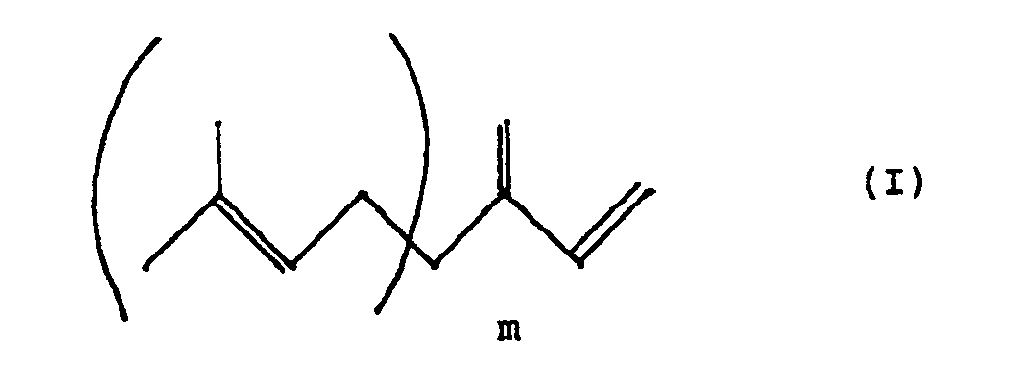
dans laquelle m est égal à un nombre entier égal ou supérieur à 0 et inférieur ou égal à 3.The 1,3 butadiene compound preferably corresponds to the following formula (I):
in which m is equal to an integer equal to or greater than 0 and less than or equal to 3.
On préfère parmi les composés de formule (I) utiliser:
- le myrcène
- l'isoprène
- le βfarnésène.
- myrcene
- isoprene
- βfarnesene.
L'acétoacétate d'alkyle répond à la formule (II) suivante: 
dans laquelle R₁ représente un radical hydrocarboné contenant 1 à 12 atomes de carbone de préférence sous forme d'une chaîne alkyle ou alkényle linéaire ou ramifiée ou d'un radical aromatique éventuellement substitué.The alkyl acetoacetate corresponds to the following formula (II):
in which R₁ represents a hydrocarbon radical containing 1 to 12 carbon atoms preferably in the form of a linear or branched alkyl or alkenyl chain or of an optionally substituted aromatic radical.
On préfère parmi l'ensemble des dérivés de formule (II) ceux pour lesquels R₁ représente un groupe alkyle contenant 1 à 4 atomes de carbone et tout particulièrement l'acétoacétate de méthyle.Among all the derivatives of formula (II), those for which R₁ represents an alkyl group containing 1 to 4 carbon atoms and very particularly methyl acetoacetate are preferred.
La réaction de condensation est réalisée en présence d'un catalyseur à base de rhodium. Ce catalyseur est choisi parmi les sels, les oxydes, les complexes du rhodium en présence éventuellement d'un ligand. Parmi les agents ligands on peut citer les phosphines de formule (III) :

dans laquelle :
- Ar₁, Ar₂ et Ar₃ identiques ou différents représentent chacun un radical choisi parmi le groupe comprenant les radicaux phénylène et les radicaux naphtylène, ces radicaux étant éventuellement substitués.
- M est un reste cationique d'origine minérale ou organique choisi de manière que la phosphine de formule (III) soit soluble dans l'eau.
- n₁, n₂ et n₃ identiques ou différents sont des nombres entiers supérieurs ou égaux à 0 et inférieurs ou égaux à 3, l'un au moins étant supérieur ou égal à 1.
in which :
- Ar₁, Ar₂ and Ar₃, identical or different, each represent a radical chosen from the group comprising phenylene radicals and naphthylene radicals, these radicals being optionally substituted.
- M is a cationic residue of mineral or organic origin chosen so that the phosphine of formula (III) is soluble in water.
- n₁, n₂ and n₃ identical or different are whole numbers greater than or equal to 0 and less than or equal to 3, at least one being greater than or equal to 1.
Le procédé selon l'invention est de préférence mis en oeuvre en utilisant au moins une phosphine de formule (III) dans laquelle Ar₁, Ar₂ et Ar₃ identiques ou différents représentent chacun un radical phénylène.The process according to the invention is preferably carried out using at least one phosphine of formula (III) in which Ar₁, Ar₂ and Ar₃ identical or different each represent a phenylene radical.
Encore plus préférentiellement, on utilise une phosphine soluble en milieu aqueux dans laquelle les groupements SO₃M sont en position méta sur le noyau benzénique.Even more preferably, a phosphine soluble in an aqueous medium is used in which the SO₃M groups are in the meta position on the benzene nucleus.
De préférence M est choisi parmi le groupe comprenant les cations dérivés des métaux Na, K, Ca, Ba, les ions NH₄⁺ et ammonium quaternaire comme les ions tetraméthylammonium, tétrapropylammonium et tétrabutylammonium.Preferably M is chosen from the group comprising cations derived from metals Na, K, Ca, Ba, NH₄⁺ ions and quaternary ammonium such as tetramethylammonium, tetrapropylammonium and tetrabutylammonium ions.
n₁, n₂ et n₃ sont de préférence égaux à 1.n₁, n₂ and n₃ are preferably equal to 1.
On préfère utiliser la triphénylphosphine métatrisulfonée.It is preferred to use the metatrisulfonated triphenylphosphine.
Selon un mode préférentiel de réalisation du procédé de l'invention le dérivé du rhodium est choisi parmi le groupe comprenant les sels inorganiques, organiques et les complexes du rhodium comme par exemple Rh Cl₃, Rh Br₃, Rh₂O, Rh₂O₃, Rh(NO₃)₃, Rh(CH₃COO)₃, Rh(CH₃ COCHCOCH₃)₃, [Rh Cl(cyclooctadiène-1,5)]₂, [Rh Cl(CO)₂]₂, Rh Cl₃(C₂H₅NH₂)₃, Rh₂(SO₄)₃.According to a preferred embodiment of the process of the invention, the rhodium derivative is chosen from the group comprising inorganic and organic salts and rhodium complexes such as, for example, Rh Cl₃, Rh Br₃, Rh₂O, Rh₂O₃, Rh (NO₃) ₃ , Rh (CH₃COO) ₃, Rh (CH₃ COCHCOCH₃) ₃, [Rh Cl (1,5-cyclooctadiene)] ₂, [Rh Cl (CO) ₂] ₂, Rh Cl₃ (C₂H₅NH₂) ₃, Rh₂ (SO₄) ₃.
On préfère tout particulièrement utiliser Rh Cl₃ et [Rh Cl(cyclooctadiène-1,5)]₂.It is particularly preferred to use Rh Cl₃ and [Rh Cl (1,5-cyclooctadiene)] ₂.
On utilise une quantité de rhodium ou de composé du rhodium telle que le nombre d'atome gramme de rhodium élémentaire par litre de solution réactionnelle soit compris entre 10-⁴ environ et 1 environ. De préférence il est compris entre 0,001 et 0,5 environ.An amount of rhodium or of rhodium compound is used such that the number of gram atoms of elementary rhodium per liter of reaction solution is between approximately 10-⁴ and approximately 1. Preferably it is between 0.001 and 0.5 approximately.
Pour une bonne mise en oeuvre du procédé, la quantité de phosphine est choisie de telle sorte que le nombre d'atomes gramme de phosphore trivalent rapporté à un atome gramme de rhodium soit compris entre 0,1 environ et 200 environ. De préférence, ce nombre est compris entre 3 environ et 100 environ.For a good implementation of the process, the quantity of phosphine is chosen such that the number of gram atoms of trivalent phosphorus relative to one gram atom of rhodium is between about 0.1 and about 200. Preferably, this number is between approximately 3 and approximately 100.
La réaction d'addition peut être schématisée de la façon suivante :

L'ester est mis en contact avec de l'eau de façon à effectuer une décarboalcoxylation. Il est tout à fait étonnant qu'en présence de composés de cette nature c'est à dire de βcétoester polyénique il ne soit pas nécessaire d'adjoindre de solvant ou d'agent de décarboalcoxylation et que l'eau seule permette cette réaction en l'absence d'un quelconque catalyseur. Cela présente sur le plan industriel un avantage économique considérable, il n'y a production d'aucun produit secondaire difficile à éliminer. Les seuls sous produits de réaction sont le dioxyde de carbone et l'alcool de formule ROH qui sont faciles à éliminer.The ester is brought into contact with water so as to effect a decarboalkoxylation. It is completely astonishing that in the presence of compounds of this nature, that is to say of polyene β-ketoester, it is not necessary to add any solvent or decarboalkoxylation agent and that water alone allows this reaction in absence of any catalyst. This presents a considerable economic advantage on the industrial level, there is no production of any secondary product which is difficult to eliminate. The only reaction byproducts are carbon dioxide and alcohol of formula ROH which are easy to remove.
L'ester utilisé pour effectuer la réaction de décarboalcoxylation peut être un produit purifié isolé ou le produit brut directement obtenu à l'étape de condensation entre le β-cétoester et le dérivé du butadiène. La décarboalcoxylation peut avantageusement être effectuée dans le même réacteur que la réaction d'addition.The ester used to carry out the decarboalkoxylation reaction can be an isolated purified product or the crude product directly obtained in the condensation step between the β-ketoester and the butadiene derivative. Decarboalkoxylation can advantageously be carried out in the same reactor as the addition reaction.
La réaction de décarboalcoxylation est effectuée en phase vapeur ou en phase liquide à une température comprise entre 130°C et 500°C. Lorsque la réaction est effectuée en phase vapeur, la température est comprise de préférence entre 300 et 500°C et encore plus préférentiellement entre 350 et 400°C. Lorsque la réaction est réalisée en phase liquide, on préfère utiliser une température comprise entre 180 et 220°C. La réaction peut aussi être réalisée en phase ruisselante sur un lit de matériau solide non réactif tel que le quartz.The decarboalkoxylation reaction is carried out in the vapor phase or in the liquid phase at a temperature between 130 ° C. and 500 ° C. When the reaction is carried out in the vapor phase, the temperature is preferably between 300 and 500 ° C. and even more preferably between 350 and 400 ° C. When the reaction is carried out in the liquid phase, it is preferred to use a temperature between 180 and 220 ° C. The reaction can also be carried out in a trickle phase on a bed of non-reactive solid material such as quartz.
La réaction de décarboalcoxylation peut être effectuée à la pression atmosphérique, sous une pression inférieure ou sous une pression supérieure. On préfère néammoins travailler à une pression inférieure à 100bar et tout particulièrement à une pression comprise entre 1 et 20 bars. Les conditions de température et de pression seront adaptées par l'homme de l'art à la matière première utilisée.The decarboalkoxylation reaction can be carried out at atmospheric pressure, under lower pressure or under higher pressure. However, it is preferred to work at a pressure below 100 bar and very particularly at a pressure between 1 and 20 bar. The temperature and pressure conditions will be adapted by those skilled in the art to the raw material used.
Les dérivés cétoniques polyéniques obtenus sont des intermédiaires de synthèse important dans l'industrie des vitamines et des parfums.The polyene ketone derivatives obtained are important synthesis intermediates in the vitamin and perfume industry.
On peut citer parmi ces composés :
- la géranylacétone,
- la méthylhepténone,
- la farnésylacétone.
- geranylacetone,
- methylheptenone,
- farnesylacetone.
La présente invention sera plus complètement décrite à l'aide des exemples suivants qui ne doivent pas être considérés comme limitatifs de l'invention.The present invention will be more fully described with the aid of the following examples which should not be considered as limiting the invention.
Dans les exemples suivants, les formules (I) et (II) représentent les composés suivants :

R = CH₃- R′ = CH₃ (Ib) méthylhepténone (IIb)


Dans un autoclave en acier inoxydable préalablement purgé à l'azote , on introduit 150 mg de [RhCl(cyclooctadiène-1,5)]₂ (0,615 milliatome-gramme de rhodium), 4,2 g de triphénylphosphine trisulfonée sodique (6,2 milliatome-gramme de P³⁺) 0,1 g de Na₂CO₃ (≈1millimole) et 70 ml d'eau.150 mg of [RhCl (cyclooctadiene-1.5)] ₂ (0.615 milliatome-gram of rhodium), 4.2 g of triphenylphosphine sodium trisulfonate (6.2 mg) are introduced into a stainless steel autoclave previously purged with nitrogen. milliatome-gram of P³⁺) 0.1 g of Na₂CO₃ (≈1millimole) and 70 ml of water.
On introduit ensuite 250 mmoles de myrcène à 99 % de pureté (34 g) et 300 millimoles d'acétylacétate de méthyle (34,8 g).250 mmoles of myrcene at 99% purity (34 g) and 300 millimoles of methyl acetylacetate (34.8 g) are then introduced.
On chauffe sous agitation à 85°C durant 17 heures. Par chromatographie couche mince, on obtient un taux de transformation d'environ 100 % avec formation des β-cétoester (Ia) [mélange équimoléculaire (RMN¹H) exo-endo].Heated with stirring at 85 ° C for 17 hours. By thin layer chromatography, a conversion rate of approximately 100% is obtained with the formation of β-keto esters (Ia) [exo-endo equimolecular mixture (1 H NMR).
Le mélange biphasique (phase organique jaune pâle et phase aqueuse rouge orangée) est engagé dans l'étape de décarboxylation dans le même autoclave, on chauffe 3heures à 180°C, jusqu'à la fin de la montée en pression dûe au dégagement gazeux. La pression atteint 25 bar pour un réacteur de 750 ml. On refroidit, dégaze. L'analyse par chromatographie couche mince, gazeuse et RMN¹H après extraction du système biphasique donne un taux de transformation complet des β-cétoesters (Ia). On isole une phase organique contenant essentiellement les deux isomères de la géranylacétone IIa (exo et endo) : 40,3 g. La distillation permet d'isoler la géranylacétone (2 isomères) pure: 33 g (Eb₁ environ 82°C). Le rendement en géranylacétone distillée par rapport au myrcène engagé est de 67,4 %.The two-phase mixture (pale yellow organic phase and orange-red aqueous phase) is engaged in the decarboxylation step in the same autoclave, it is heated for 3 hours at 180 ° C., until the end of the pressure rise due to the evolution of gas. The pressure reaches 25 bar for a 750 ml reactor. Cool, degas. Analysis by thin layer gas chromatography and 1 H NMR after extraction from the biphasic system gives a complete transformation rate of β-ketoesters (Ia). An organic phase is isolated essentially containing the two isomers of geranylacetone IIa (exo and endo): 40.3 g. Distillation allows the isolation of pure geranylacetone (2 isomers): 33 g (Eb₁ around 82 ° C). The yield of distilled geranylacetone compared to the committed myrcene is 67.4%.
La phase aqueuse finale jaune orangée contient 0,54 g/l de rhodium soluble homogéne.The final orange-yellow aqueous phase contains 0.54 g / l of homogeneous soluble rhodium.
Dans un autoclave en acier inoxydable préalablement purgé à l'azote , on introduit 150 mg de [RhCl(cyclooctadiène-1,5)]₂ (0,615 milliatome-gramme de rhodium), 8,4 g de triphénylphosphine trisulfonée sodique (12,4 milliatome-gramme de P³⁺) 0,1 g de Na₂CO₃ (≈1millimole) et 80 ml d'eau.150 mg of [RhCl (cyclooctadiene-1.5)] ₂ (0.615 milliatome-gram of rhodium), 8.4 g of triphenylphosphine sodium trisulfonate (12.4) are introduced into a stainless steel autoclave previously purged with nitrogen. milliatome-gram of P³⁺) 0.1 g of Na₂CO₃ (≈1millimole) and 80 ml of water.
On introduit ensuite 250 mmoles de myrcène à 78 % de pureté (43,5 g) et 300 millimoles d'acétylacétate de méthyle (34,8 g).250 mmoles of myrcene at 78% purity (43.5 g) and 300 millimoles of methyl acetylacetate (34.8 g) are then introduced.
On chauffe sous agitation à 91°C durant 17 heures. Par chromatographie couche mince de la phase organique, on obtient un taux de transformation d'environ 100 % sur le myrcène, avec formation des β-cétoester (Ia) [mélange équimoléculaire (RMN¹H) endo,exo].Heated with stirring at 91 ° C for 17 hours. By thin layer chromatography of the organic phase, a transformation rate of approximately 100% is obtained on the myrcene, with the formation of β-ketoester (Ia) [endo, exo equimolecular mixture (NMR).
Le mélange biphasique (phase organique jaune pâle et phase aqueuse rouge orangée) est engagé dans l'étape de décarboxylation dans le même autoclave, on chauffe 3heures à 180°C, jusqu'à la fin de la montée en pression dûe au dégagement gazeux. On refroidit, dégaze. L'analyse par chromatographie couche mince (CCM), gazeuse (CPV) et RMN¹H après extraction du système biphasique donne un taux de transformation complet des β-cétoesters (Ia). On isole une phase organique contenant essentiellement les deux isomères de la géranylacétone (IIa) (exo et endo): 48,7 g. La distillation permet d'isoler une première fraction (Eb₁ environ 25-30°C) contenant les hydrocarbures C10 inertes contenus dans le myrcène technique (9,4 g) et une deuxième fraction correspondant à la géranylacétone (2 isomères) pure: 30,6 g (Eb₁ environ 82°C). Le rendement en géranylacétone distillée est de 63 %.The two-phase mixture (pale yellow organic phase and orange-red aqueous phase) is engaged in the decarboxylation step in the same autoclave, it is heated for 3 hours at 180 ° C., until the end of the pressure rise due to the evolution of gas. Cool, degas. Analysis by thin layer chromatography (TLC), gas (CPV) and 1 H NMR after extraction from the biphasic system gives a complete transformation rate of β-ketoesters (Ia). An organic phase is isolated essentially containing the two isomers of geranylacetone (IIa) (exo and endo): 48.7 g. Distillation makes it possible to isolate a first fraction (Eb₁ about 25-30 ° C) containing the inert C10 hydrocarbons contained in technical myrcene (9.4 g) and a second fraction corresponding to pure geranylacetone (2 isomers): 30, 6 g (Eb₁ around 82 ° C). The yield of distilled geranylacetone is 63%.
La phase aqueuse finale jaune orangée contient le rhodium soluble homogéne.The final orange-yellow aqueous phase contains homogeneous soluble rhodium.
Dans un réacteur tubulaire de 18 mm de diamètre, on dispose 10 ml de poudre de quartz que l'on préchauffe 30 mn à 350°C sous courant d'azote (3,5 l/h). Au moyen d'un pousse seringue, on injecte alors le β-cétoester Ia (mélange des 2 isomères pureté de 95 %) à un débit liquide de 10mlh⁻¹ et l'eau permutée par un deuxième pousse seringue à 3,5mlh⁻¹ (environ 5 équivalents par rapport au β-cétoester) soit un temps de contact moyen de 3,8 secondes. Après 35 minutes de réaction en phase vapeur, l'analyse du condensat biphasique (phase aqueuse incolore, phase organique jaune) par chromatographie couche mince, gazeuse et RMN¹H montre la formation de géranylacétone avec un taux de transformation du β-cétoester de 70 %, une sélectivité en géranylacétone de 85 % et une productivité de 1,1kgh⁻¹l⁻¹.In a tubular reactor 18 mm in diameter, 10 ml of quartz powder are placed which are preheated for 30 min at 350 ° C. under a stream of nitrogen (3.5 l / h). By means of a syringe pump, the β-ketoester Ia (mixture of the 2 isomers 95% purity) is then injected at a liquid flow rate of 10 mlh⁻¹ and the water permuted by a second syringe pump at 3.5 mlh⁻¹ (approximately 5 equivalents compared to β-ketoester), ie an average contact time of 3.8 seconds. After 35 minutes of reaction in the vapor phase, the analysis of the biphasic condensate (colorless aqueous phase, yellow organic phase) by thin layer gas and 1 H NMR chromatography shows the formation of geranylacetone with a transformation rate of the β-ketoester of 70%, a selectivity in geranylacetone of 85% and a productivity of 1,1kgh⁻¹l⁻¹.
Dans un tricol de 100ml, surmonté d'une colonne de distillation et muni d'un thermomètre, on charge sous azote 10 g du β-cétoester (Ia) (45 % endo et 55 % exo), chauffe rapidement la masse réactionnelle sous agitation magnétique à 170-180°C et introduit alors, à l'aide d'un pousse seringue à raison de 1,2ml/h l'eau dans la masse réactionnelle. On suit l'évolution de la réaction par chromatographie en phase gazeuse sur des aliquots et par dégagement de CO₂. Après 1 h 30 de réaction, on observe un taux de transformation complet et un rendement en géranylacétone de 92 % après distillation.10 g of β-ketoester (Ia) (45% endo and 55% exo) are quickly loaded into a 100 ml three-necked flask, surmounted by a distillation column and provided with a thermometer, rapidly heating the reaction mass with stirring magnetic at 170-180 ° C and then introduced, using a syringe pump at the rate of 1.2 ml / h of water into the reaction mass. The progress of the reaction is followed by gas chromatography on aliquots and by COagement release. After 1 h 30 of reaction, a complete conversion rate and a geranylacetone yield of 92% are observed after distillation.
Dans l'appareillage décrit à l'exemple 4, on charge sous azote 10 g du β-cétoester (Ib) (40 % endo et 60 % exo) et sur la masse réactionnelle, portée à 180°C, on injecte en 2 heures, 2,5 ml d'eau permutée. On obtient un taux de transformation complet analysé par chromatographie phase gazeuse et RMN¹H et après distillation (point d'ébullition à 15 mm de mercure 69°C) on recueille 6,1 g de méthylhepténone (IIb) (rendement = 89,7 %) identifiée par chromatographie phase gazeuse, RMN¹ et infrarouge.In the apparatus described in Example 4, 10 g of β-ketoester (Ib) (40% endo and 60% exo) are loaded under nitrogen and on the reaction mass, brought to 180 ° C., is injected in 2 hours 2.5 ml of deionized water. A complete conversion rate is obtained, analyzed by gas phase chromatography and 1 H NMR and after distillation (boiling point at 15 mm of mercury 69 ° C) 6.1 g of methylheptenone (IIb) are collected (yield = 89.7%) identified by gas chromatography, NMR¹ and infrared.
Avec l'appareillage décrit dans l'exemple 3, on opère à 400°C sous courant d'azote (3,5 lh⁻¹ en CNTP). Au moyen d'un pousse seringue, on injecte le β-cétoester (Ia) (pureté 96 % - mélange des deux isomères endo : 55/exo 45) à un débit liquide de 10 mlh⁻¹ (36,5 millimoles h⁻¹) et simultanément l'eau permutée au moyen d'un deuxième pousse seringue à 2,4 mlh⁻¹ (133,3 millimoles h⁻¹ soit 3,65 équivalents) correspondant à un temps de contact moyen de 4,6 secondes. Après 40 mn de réaction en phase vapeur, l'analyse du condensat biphasique (1,3 ml de phase aqueuse incolore et 3,90 g de phase organique jaune après élimination des légers au rotavap) montre par CCM, CPV et RMN¹H la formation de géranylacétone (IIa) avec un taux de transformation du β-cétoester (Ia) d'environ 84 % et une sélectivité en géranylacétone de 85 %.With the apparatus described in Example 3, the operation is carried out at 400 ° C. under a stream of nitrogen (3.5 lh⁻¹ in CNTP). Using a syringe pump, the β-ketoester (Ia) is injected (purity 96% - mixture of the two endo isomers: 55 / exo 45) at a liquid flow rate of 10 mlh⁻¹ (36.5 millimoles h⁻¹ ) and simultaneously the permuted water by means of a second syringe pump at 2.4 mlh⁻¹ (133.3 millimoles h⁻¹ or 3.65 equivalent) corresponding to an average contact time of 4.6 seconds. After 40 min of reaction in vapor phase, the analysis of the biphasic condensate (1.3 ml of colorless aqueous phase and 3.90 g of yellow organic phase after elimination of the light ones with rotavap) shows by TLC, CPV and 1 H NMR the formation of geranylacetone (IIa) with a transformation rate of β-ketoester (Ia) of around 84% and a selectivity to geranylacetone of 85%.
Selon l'exemple 6, avec l'appareillage décrit dans l'exemple 3, mais en opérant à 450°C, on obtient après 35 mn de réaction un condensat biphasique (1,2 ml de phase aqueuse incolore et 4,38 g de phase organique jaune dont l'analyse CCM, CPV et RMN¹H montre la formation de géranylacétone (IIa) avec un taux de transformation du β-cétoester (Ia) d'environ 63 % et une sélectivité en géranylacétone de 73 %.According to Example 6, with the apparatus described in Example 3, but operating at 450 ° C., after 35 minutes of reaction, a biphasic condensate is obtained (1.2 ml of colorless aqueous phase and 4.38 g of yellow organic phase whose CCM, CPV and 1 H NMR analysis shows the formation of geranylacetone (IIa) with a transformation rate of the β-ketoester (Ia) of approximately 63% and a selectivity to geranylacetone of 73%.
On reproduit l'exemple 6, à 400°C, mais en modifiant le débit d'injection de β-cétoester à 4,95 mlh⁻¹ (18,2 millimole h⁻¹) tout étant égal par ailleurs, soit un rapport de 7,3 équivalents d'eau par rapport au β-cétoester et un temps de contact moyen de 4,8 secondes. Après 1 heure 05 de réaction, on obtient un condensat biphasique contenant 2,2 ml de phase inférieure aqueuse incolore et 3,52 g de phase organique (après élimination des légers au rotavap). L'analyse de cette phase organique (CCM, CPV et RMN¹H) indique un taux de transformation complet sur le β-cétoester (Ia) et formation de la géranylcétone (IIa) avec une sélectivité de 75 % et une productivité de 500 g/l de réacteur et par heure.Example 6 is reproduced at 400 ° C., but by modifying the injection rate of β-keto ester to 4.95 mlh⁻¹ (18.2 millimole h⁻¹), all being equal, ie a ratio of 7.3 water equivalents compared to β-ketoester and an average contact time of 4.8 seconds. After 1 hour 05 of reaction, a two-phase condensate is obtained containing 2.2 ml of colorless aqueous lower phase and 3.52 g of organic phase (after removal of the light products with rotavap). Analysis of this organic phase (TLC, CPV and 1 H NMR) indicates a complete transformation rate on the β-ketoester (Ia) and formation of geranyl ketone (IIa) with a selectivity of 75% and a productivity of 500 g / l of reactor per hour.
Avec l'appareillage décrit dans l'exemple 3, mais à 250°C, on opère alors selon la technique du lit fixe ruisselant (cf. Technique de l'Ingénieur, Vol. J4, "Génie Chimique", 1965, paragraphe 2-4).With the apparatus described in example 3, but at 250 ° C., one then operates according to the trickling fixed bed technique (cf. Engineering technique, Vol. J4, "Chemical Engineering", 1965, paragraph 2- 4).
On injecte sous azote à 3,5 lh⁻¹, le β-cétoester (Ia) de l'exemple 6 à un débit liquide de 4,95 mlh⁻¹ (18,2 millimoles h⁻¹) et simultanément l'eau permutée au moyen d'un deuxième pousse seringue à 2,4 mlh⁻¹ liquide (133,3 millimoles soit 7,3 équivalents).Is injected under nitrogen at 3.5 lh⁻¹, the β-keto ester (Ia) of Example 6 at a liquid flow rate of 4.95 mlh⁻¹ (18.2 millimoles h⁻¹) and simultaneously the permuted water by means of a second syringe pump with 2.4 mlh⁻¹ liquid (133.3 millimoles or 7.3 equivalents).
Après 55 mn de réaction, on recueille un condensat biphasique avec 1,9 ml de phase aqueuse incolore et 3,93 g de phase organique jaune pale (après élimination des légers au rotavap) dont l'analyse CCM, CPV et RMN¹H indique un taux de transformation du β-cétoester d'environ 25 % et formation de la géranylacétone (IIa) avec une sélectivité de 88 %.After 55 min of reaction, a two-phase condensate is collected with 1.9 ml of colorless aqueous phase and 3.93 g of pale yellow organic phase (after elimination of the light ones with rotavap), the TLC, CPV and 1 H NMR analysis of which indicates a rate transformation of the β-keto ester of approximately 25% and formation of geranylacetone (IIa) with a selectivity of 88%.
On reproduit l'exemple 4 mais on effectue la réaction dans un autoclave en acier inox, SOTELEM de 300 ml équipé d'une turbine de RUCHTON permettant un excellent transfert, à pression atmosphérique, chauffé à 200°C avec injection de l'eau dans la masse réactionnelle au moyen d'un pousse seringue RAZEL, on recueille le méthanol dans un piège après distillation et utilise un compteur à gaz hydraulique de précision pour comptabiliser le volume de CO₂ dégagé.Example 4 is repeated but the reaction is carried out in a 300 ml SOTELEM autoclave in stainless steel equipped with a RUCHTON turbine allowing excellent transfer, at atmospheric pressure, heated to 200 ° C. with injection of water into the reaction mass by means of a RAZEL syringe pump, methanol is collected in a trap after distillation and a precision hydraulic gas meter is used to account for the volume of CO₂ released.
Sous azote, on charge 131,25 g (0,5 mole) de β-cétoester de l'exemple 6 (96 % de pureté), on chauffe à 200°C en agitant à 2000 tours/mn et injecte alors l'eau permutée à 1 mlh⁻¹ et contrôle l'avancement de la réaction par le volume de CO₂ dégagé.Under nitrogen, 131.25 g (0.5 mole) of β-ketoester from Example 6 (96% purity) are charged, the mixture is heated to 200 ° C. with stirring at 2000 rpm and then the water is injected permuted to 1 mlh⁻¹ and controls the progress of the reaction by the volume of CO₂ released.
Après 1 heure 05, on a injecté 15,5 ml d'eau (1,72 équivalent par rapport au β-cétoester introduit) et dégagé 11,5 l de CO₂ lorsque ce dégagement cesse. Après refroidissement, on isole 97,2 g (115 ml) de masse réactionnelle dont l'analyse (CCM, CPV et RMN¹H) indique un taux de transformation complet du β-cétoester (Ia) en rendement en géranylacétone (IIa) de 94 % et une pureté sur le brut de 95 %.After 1 hour 05, 15.5 ml of water were injected (1.72 equivalent relative to the introduced β-keto ester) and 11.5 l of CO dég were released when this release ceased. After cooling, 97.2 g (115 ml) of reaction mass are isolated, the analysis of which (TLC, CPV and 1 H NMR) indicates a complete conversion rate of the β-ketoester (Ia) into a yield of geranylacetone (IIa) of 94%. and a purity on the crude of 95%.
Le distillat incolore de 24 ml contient majoritairement le méthanol (contrôlé par CPV) et l'eau excédentaire ce qui permet par simple distillation une récupération aisée du méthanol.The 24 ml colorless distillate mainly contains methanol (controlled by CPV) and excess water, which allows easy recovery of methanol by simple distillation.
Dans un autoclave en acier inoxydable de 125 ml préalablement purgé à l'azote, on introduit 38,1 millimoles de β-cétoester Ia (10 g - pureté 96 %), 111,1 millimoles d'eau (2 g) c'est-à-dire 2,92 équivalents par rapport au β-cétoester. On chauffe alors à 220°C, sous agitation, jusqu'à la fin de la montée en pression due au dégagement gazeux c'est-à-dire 0,5 heure et la pression atteint 24 bar.38.1 millimoles of β-ketoester Ia (10 g - 96% purity) are introduced into a 125 ml stainless steel autoclave previously purged with nitrogen. 111.1 millimoles of water (2 g) are that is to say 2.92 equivalents with respect to the β-ketoester. It is then heated to 220 ° C., with stirring, until the end of the pressure rise due to the evolution of gas, that is to say 0.5 hour, and the pressure reaches 24 bar.
On refroidit, dégaze et l'analyse après décantation du système biphasique donne par CCM, CPV et RMN¹H un taux de transformation complet sur le β-cétoester et une phase organique contenant essentiellement les deux isomères de la géranylacétone (IIa) obtenus avec un rendement de 91 % et une pureté de 93 %.Cooling, degassing and analysis after decantation of the biphasic system gives by CCM, CPV and 1 H NMR a complete transformation rate on the β-ketoester and an organic phase containing essentially the two isomers of geranylacetone (IIa) obtained with a yield of 91% and a purity of 93%.
On opère comme dans l'exemple 11 mais à une température variable.

Dans un autoclave en acier inoxydable de 125 ml, préalablement purgé à l'azote, on introduit 21,5 millimoles de β-cétoester suivant:

(6,8 g - Pureté environ 90 %) et 3 équivalents d'eau par rapport au β-cétoester. On chauffe alors à 180°C durant 3 heures 30 (fin de la montée en pression). Après refroidissement et dégazage, l'analyse après décantation du système biphasique donne par CPV, CCM et RMN¹H, un taux de transformation de 97 % sur le β-cétoester allylique (Ic) et formation de la géranylacétone (IIa) avec un rendement de 89 % et une pureté de 91 %.In a 125 ml stainless steel autoclave, previously purged with nitrogen, 21.5 millimoles of the following β-ketoester are introduced:
(6.8 g - Purity about 90%) and 3 equivalents of water compared to the β-ketoester. Then heated to 180 ° C for 3 hours 30 (end of pressure build-up). After cooling and degassing, the analysis after decantation of the biphasic system gives by CPV, TLC and 1 H NMR, a conversion rate of 97% on the allyl β-ketoester (Ic) and formation of geranylacetone (IIa) with a yield of 89 % and a purity of 91%.
On reprend l'exemple 12 du brevet FR 2.486.525 de la demanderesse d'addition sur l'isoprène de l'acétylacétate d'éthyle mais on isole pas le β-cétoester (Id) et on enchaîne directement la décarboéthoxylation dans le même autoclave ce qui permet un "one pot" d'isoprène à la méthylhepténone sans isoler les intermédiaires.Example 12 of patent FR 2,486,525 of the applicant for addition to ethyl acetylacetate is used, but the β-ketoester (Id) is not isolated and the decarboethoxylation is directly linked in the same autoclave. which allows a "one pot" of isoprene with methylheptenone without isolating the intermediates.
De manière plus précise, dans un autoclave en acier inoxydable de 125 ml, préalablement purgé à l'argon, on introduit 34 mg de [Rh Cl(cyclooctadiène-1,5)]₂ (0,14 milliatome-gramme de rhodium), 0,3 g de triphénylphosphine trisulfonée sodique (0,44 milliatome-gramme de P³⁺), 80 mg de Na₂CO₃ (0,73 millimole) et 30 cm³ d'eau. On introduit ensuite 102 millimoles d'isoprène (6,9 g) et 125 millimoles d'acétylacétate d'éthyle (16,2 g). On chauffe sous agitation à 100°C pendant 4 heures puis enchaîne directement par 3 heures à 220°C (la pression s'élève à 37 bar). Après refroidissement, dégazage et décantation du système biphasique, l'analyse (CPV, CCM et RMN¹H) de la phase organique donne : un taux de transformation complet sur l'isoprène et formation de méthylhepténone (I9 Ib) avec un rendement de 71 % (ex : isoprène).More precisely, in a 125 ml stainless steel autoclave, previously purged with argon, 34 mg of [Rh Cl (cyclooctadiene-1.5)] ₂ (0.14 milliatome-grams of rhodium) are introduced, 0.3 g of sodium trisulfonated triphenylphosphine (0.44 milliatome-gram of P³⁺), 80 mg of Na₂CO₃ (0.73 millimole) and 30 cm³ of water. 102 millimoles of isoprene (6.9 g) and 125 millimoles of ethyl acetylacetate (16.2 g) are then introduced. The mixture is heated with stirring at 100 ° C for 4 hours and then continues directly for 3 hours at 220 ° C (the pressure rises to 37 bar). After cooling, degassing and decanting of the two-phase system, the analysis (CPV, TLC and 1 H NMR) of the organic phase gives: a complete conversion rate on isoprene and formation of methylheptenone (I9 Ib) with a yield of 71% ( ex: isoprene).
L'appareillage est constitué d'un ballon tricol de 100 ml avec agitation magnétique, colonne monobloc vigreux, ballon récepteur relié à une cuve à eau surmontée d'une éprouvette graduée pour mesurer le volume de CO₂ dégagé, pousse seringue RAZEL avec aiguille plongeante inox pour l'introduction d'eau et chauffage par bain d'huile régulé.The apparatus consists of a 100 ml three-necked flask with magnetic stirring, vigorous one-piece column, receiving flask connected to a water tank surmounted by a graduated cylinder to measure the volume of CO₂ released, RAZEL syringe pump with stainless steel plunging needle for the introduction of water and heating by regulated oil bath.
On charge, sous azote, dans le ballon 38,1 millimoles de β-cétoester Ia (10 g - pureté 96 %), chauffe rapidement la masse réactionnelle sous agitation magnétique à 160°C et introduit alors à l'aide d'un pousse seringue à raison de 1,2 mlh⁻¹ l'eau permutée dans la masse réactionelle. On suit l'évolution de la réaction par dégagement du CO₂. Après 1 heure 30, 600 ml de CO₂ sont formés et on note par analyse CPV, RMN¹H et CCM un taux de transformation de 60 % sur le β-cétoester et formation de la géranylacétone avec un rendement de 95 %.38.1 millimoles of β-ketoester Ia (10 g - purity 96%) are loaded under nitrogen into the flask, the reaction mass is rapidly heated with magnetic stirring to 160 ° C. and then introduced using a pusher syringe at a rate of 1.2 mlh⁻¹ the permuted water in the reaction mass. The evolution of the reaction is followed by release of CO₂. After 1 hour 30 minutes, 600 ml of CO₂ are formed and a transformation rate of 60% on the β-ketoester and formation of geranylacetone with a yield of 95% is noted by CPV analysis, 1 H NMR and TLC.
On opère comme dans l'exemple 19 mais à température variable. Le tableau ci-dessous résume les résultats :

L'exemple suivant illustre comment le procédé peut être mis en oeuvre avantageusement pour produire la géranylacétone au départ de matières premières commerciales comme le Myrcène Technique (Pureté environ 75 à 80 %). A la fin de l'étape de condensation de l'acétoacétate de méthyle sur le myrcène technique selon le brevet FR 2.486.525 de la demanderesse, on peut, au lieu de décarbométhoxyler (directement) comme illustré dans l'exemple 4, opérer de la manière suivante:The following example illustrates how the process can be implemented advantageously to produce geranylacetone from commercial raw materials such as Technical Myrcene (Purity about 75 to 80%). At the end of the stage of condensation of methyl acetoacetate on the technical myrcene according to patent FR 2,486,525 of the applicant, one can, instead of decarbomethoxyler (directly) as illustrated in example 4, operate from as follows:
Après arrêt de la réaction, on refroidit à température ambiante. Le contenu du réacteur est soutiré et on isole ensuite le produit de la réaction qui est en phase organique en séparant cette dernière de la phase aqueuse contenant le catalyseur par décantation et éventuellement par une extraction à l'aide d'un solvant convenable. La solution aqueuse peut être recyclée dans le réacteur pour catalyser une nouvelle réaction. La solution aqueuse peut aussi rester dans le réacteur, les produits organiques étant alors soutirés après décantation.After stopping the reaction, it is cooled to ambient temperature. The contents of the reactor are drawn off and the reaction product which is in the organic phase is then isolated by separating the latter from the aqueous phase containing the catalyst by decantation and optionally by extraction using a suitable solvent. The aqueous solution can be recycled to the reactor to catalyze a new reaction. The aqueous solution can also remain in the reactor, the organic products then being drawn off after decantation.
La phase organique ainsi recueillie constitue le β-cétoester brut et contient (au départ d'un myrcène technique à 78,2 % de pureté en myrcène) 71,2 % de β-cétoester, accompagné essentiellement des inertes du myrcène technique (comme le limonène), de l'excès d'acétoacétate de méthyle et d'environ 1 % d'eau.The organic phase thus collected constitutes the crude β-ketoester and contains (starting from a technical myrcene with 78.2% purity in myrcene) 71.2% of β-ketoester, mainly accompanied by the inerts of technical myrcene (such as limonene), excess methyl acetoacetate and approximately 1% water.
On opère comme dans l'exemple 4 mais en chargeant 10 g de β-cétoester brut à 71,2 % en pureté en β-cétoester (soit 28,25 millimoles). Après 1 heure de réaction à 210°C, le dégagement de CO₂ cesse.The procedure is as in Example 4, but loading 10 g of raw β-keto ester at 71.2% purity in β-keto ester (ie 28.25 millimoles). After 1 hour of reaction at 210 ° C., the evolution of CO₂ ceases.
L'analyse du brut réactionnel indique un taux de transformation complet sur le β-cétoester et un rendement en géranylacétone de 92 % et une pureté de 79 %.Analysis of the reaction crude indicates a complete conversion rate on the β-keto ester and a geranylacetone yield of 92% and a purity of 79%.
On note que le distillat contient les inertes du myrcène technique (limonène : Eb₇₆₀ environ 172°C), l'excès d'acétoacétate de méthyle en plus du méthanol formé.It is noted that the distillate contains the inerts of technical myrcene (limonene: Eb₇₆₀ about 172 ° C), the excess of methyl acetoacetate in addition to the methanol formed.
Claims (6)


Applications Claiming Priority (2)
| Application Number | Priority Date | Filing Date | Title |
|---|---|---|---|
| FR9001441 | 1990-02-08 | ||
| FR9001441A FR2657871B1 (en) | 1990-02-08 | 1990-02-08 | PROCESS FOR THE PREPARATION OF TERPENIC KETONES. |
Publications (2)
| Publication Number | Publication Date |
|---|---|
| EP0441708A1 true EP0441708A1 (en) | 1991-08-14 |
| EP0441708B1 EP0441708B1 (en) | 1994-08-03 |
Family
ID=9393485
Family Applications (1)
| Application Number | Title | Priority Date | Filing Date |
|---|---|---|---|
| EP91400293A Expired - Lifetime EP0441708B1 (en) | 1990-02-08 | 1991-02-07 | Process for the preparation of terpene ketones |
Country Status (10)
| Country | Link |
|---|---|
| US (1) | US5874636A (en) |
| EP (1) | EP0441708B1 (en) |
| JP (1) | JP2509393B2 (en) |
| AT (1) | ATE109446T1 (en) |
| CA (1) | CA2035943A1 (en) |
| DE (1) | DE69103175T2 (en) |
| DK (1) | DK0441708T3 (en) |
| ES (1) | ES2057792T3 (en) |
| FR (1) | FR2657871B1 (en) |
| IE (1) | IE65799B1 (en) |
Cited By (3)
| Publication number | Priority date | Publication date | Assignee | Title |
|---|---|---|---|---|
| WO1999003811A1 (en) * | 1997-07-17 | 1999-01-28 | Degussa-Hüls Aktiengesellschaft | Method for producing 6,10 and 6,9-dimethyl-5,10-undecadienyl-2-ones |
| CN106458819A (en) * | 2014-04-30 | 2017-02-22 | 巴斯夫欧洲公司 | Method of producing farnesyl acetone |
| WO2019121134A1 (en) | 2017-12-20 | 2019-06-27 | Dsm Ip Assets B.V. | Synthesis of alkyl 2-acetyl-5,9,13-trimethyltetradeca-4,8,12-trienoates and derivatives by a non-continuous production process |
Families Citing this family (4)
| Publication number | Priority date | Publication date | Assignee | Title |
|---|---|---|---|---|
| CN105859534A (en) * | 2016-04-07 | 2016-08-17 | 能特科技有限公司 | Method for synthesizing ketone compounds by continuous cyclic catalytic reaction |
| ES2925229T3 (en) | 2017-09-04 | 2022-10-14 | Dsm Ip Assets Bv | 6-chromanol derivatives and their synthesis |
| CN112010744A (en) * | 2019-05-29 | 2020-12-01 | 武汉臻智生物科技有限公司 | Farnesyl acetone and preparation method thereof |
| CN114436793B (en) * | 2022-01-25 | 2023-12-26 | 赣南医学院 | A mild synthesis method of α,α′-diaryl ketones |
Citations (3)
| Publication number | Priority date | Publication date | Assignee | Title |
|---|---|---|---|---|
| DE2350194A1 (en) * | 1972-10-05 | 1974-04-11 | Takasago Perfumery Co Ltd | PROCESS FOR THE PREPARATION OF 2-ACETYL5-METHYL-4-HEXICARBON ACID ESTERS |
| EP0044771A1 (en) * | 1980-07-10 | 1982-01-27 | Rhone-Poulenc Sante | Process for the selective addition of a compound having an activated carbon atom to a substituted conjugated diene |
| EP0118354A1 (en) * | 1983-02-24 | 1984-09-12 | Rhone-Poulenc Sante | Chemical process for the purification of a mixture of isoprene trimers |
Family Cites Families (11)
| Publication number | Priority date | Publication date | Assignee | Title |
|---|---|---|---|---|
| US2658911A (en) * | 1953-11-10 | Z-trimethyl-propen-z-yl j-oxobtj- | ||
| FR1132659A (en) * | 1955-10-04 | 1957-03-14 | Roure Bertrand Dupont Sa | Process for the preparation of gamma-ethylenic ketones and dienones |
| NL131181C (en) * | 1965-01-22 | |||
| DE1768099A1 (en) * | 1968-03-30 | 1971-02-11 | Basf Ag | Process for the preparation of alk-1-en-5-ones and alk-1-en-5-alene |
| US3723500A (en) * | 1970-09-21 | 1973-03-27 | Du Pont | Bis(2,3-dimethylenebutyl)-cyanomethane compounds and their preparation |
| US3998872A (en) * | 1970-10-05 | 1976-12-21 | Universal Oil Products Company | Preparation of unsaturated carbonyl compounds |
| US4092362A (en) * | 1971-09-01 | 1978-05-30 | Charles Celli | Process for the preparation of 2-n-pentyl-3-(2-oxopropyl)-1-cyclopentanone |
| US3981891A (en) * | 1972-01-18 | 1976-09-21 | Societe Anonyme Roure Bertrand Dupont | Cyclopentanone derivatives, odoriferous compositions containing them and process of preparation thereof |
| JPS5259114A (en) * | 1975-11-11 | 1977-05-16 | Takasago Corp | Process for preparation of terpene type acetoacetate |
| JPS58192846A (en) * | 1982-05-04 | 1983-11-10 | Nippon Zeon Co Ltd | Method for producing α,β-unsaturated ketones |
| US4575570A (en) * | 1983-08-02 | 1986-03-11 | Nippon Zeon Co., Ltd. | Process for producing alpha, beta-unsaturated ketones |
-
1990
- 1990-02-08 FR FR9001441A patent/FR2657871B1/en not_active Expired - Lifetime
-
1991
- 1991-02-06 IE IE39991A patent/IE65799B1/en not_active IP Right Cessation
- 1991-02-07 DK DK91400293.6T patent/DK0441708T3/en active
- 1991-02-07 DE DE69103175T patent/DE69103175T2/en not_active Expired - Fee Related
- 1991-02-07 ES ES91400293T patent/ES2057792T3/en not_active Expired - Lifetime
- 1991-02-07 CA CA002035943A patent/CA2035943A1/en not_active Abandoned
- 1991-02-07 EP EP91400293A patent/EP0441708B1/en not_active Expired - Lifetime
- 1991-02-07 AT AT91400293T patent/ATE109446T1/en not_active IP Right Cessation
- 1991-02-08 JP JP3039379A patent/JP2509393B2/en not_active Expired - Lifetime
-
1992
- 1992-04-06 US US07/864,385 patent/US5874636A/en not_active Expired - Fee Related
Patent Citations (3)
| Publication number | Priority date | Publication date | Assignee | Title |
|---|---|---|---|---|
| DE2350194A1 (en) * | 1972-10-05 | 1974-04-11 | Takasago Perfumery Co Ltd | PROCESS FOR THE PREPARATION OF 2-ACETYL5-METHYL-4-HEXICARBON ACID ESTERS |
| EP0044771A1 (en) * | 1980-07-10 | 1982-01-27 | Rhone-Poulenc Sante | Process for the selective addition of a compound having an activated carbon atom to a substituted conjugated diene |
| EP0118354A1 (en) * | 1983-02-24 | 1984-09-12 | Rhone-Poulenc Sante | Chemical process for the purification of a mixture of isoprene trimers |
Non-Patent Citations (3)
| Title |
|---|
| CAN. J. CHEM., vol. 51, 1973, pages 848-849; S. WATANABE et al.: "The new synthesis of 5,6-dimethyl-5-hepten-2-one from 2,3-dimethyl-1,3-butadiene" * |
| CHEMICAL ABSTRACTS, vol. 88, 1978, page 571, colonne 2, résumé no. 121457e, Columbus, Ohio, US; & JP-A-77 59 114 (TAKASAGO PERFUMERY CO., LTD) 16-05-1977 * |
| TETRAHEDRON LETTERS, no. 38, 1978, pages 3575-3578; R. BAKER et al.: "Reactions of active methylene and carbonyl compounds with myrcene catalysed by palladium and nickel complexes" * |
Cited By (4)
| Publication number | Priority date | Publication date | Assignee | Title |
|---|---|---|---|---|
| WO1999003811A1 (en) * | 1997-07-17 | 1999-01-28 | Degussa-Hüls Aktiengesellschaft | Method for producing 6,10 and 6,9-dimethyl-5,10-undecadienyl-2-ones |
| CN106458819A (en) * | 2014-04-30 | 2017-02-22 | 巴斯夫欧洲公司 | Method of producing farnesyl acetone |
| US10093606B2 (en) | 2014-04-30 | 2018-10-09 | Basf Se (Reitstötter, Kinzebach & Partner) | Method of producing farnesyl acetone |
| WO2019121134A1 (en) | 2017-12-20 | 2019-06-27 | Dsm Ip Assets B.V. | Synthesis of alkyl 2-acetyl-5,9,13-trimethyltetradeca-4,8,12-trienoates and derivatives by a non-continuous production process |
Also Published As
| Publication number | Publication date |
|---|---|
| JP2509393B2 (en) | 1996-06-19 |
| IE65799B1 (en) | 1995-11-15 |
| DE69103175T2 (en) | 1994-12-08 |
| ES2057792T3 (en) | 1994-10-16 |
| FR2657871B1 (en) | 1993-02-05 |
| EP0441708B1 (en) | 1994-08-03 |
| JPH0741451A (en) | 1995-02-10 |
| FR2657871A1 (en) | 1991-08-09 |
| DK0441708T3 (en) | 1994-09-05 |
| DE69103175D1 (en) | 1994-09-08 |
| ATE109446T1 (en) | 1994-08-15 |
| IE910399A1 (en) | 1991-08-14 |
| CA2035943A1 (en) | 1991-08-09 |
| US5874636A (en) | 1999-02-23 |
Similar Documents
| Publication | Publication Date | Title |
|---|---|---|
| EP0000315B1 (en) | Process for preparing optically active citronellal | |
| EP0441708B1 (en) | Process for the preparation of terpene ketones | |
| EP0044771A1 (en) | Process for the selective addition of a compound having an activated carbon atom to a substituted conjugated diene | |
| EP0161132B1 (en) | Process for the selective c-alkylation of phenols | |
| EP0118354B1 (en) | Chemical process for the purification of a mixture of isoprene trimers | |
| EP0407256B1 (en) | Process for obtaining nucleophilic substitutions | |
| EP0320339B1 (en) | Process for the preparation of unsaturated alcohols | |
| FR2583745A1 (en) | PROCESS FOR THE PREPARATION OF AROMATIC ALDEHYDES | |
| EP0145555B1 (en) | Unsaturated compounds, their preparation and use | |
| CA1312625C (en) | Process for the preparation of aromatic aldehydes | |
| EP0318394B1 (en) | Process for the alkylthiolation of phenols and its application in the synthesis of 4-acyl-2-alkylthiophenols | |
| EP0152324B1 (en) | Tetraene, its preparation and its use | |
| EP0077279A1 (en) | Process for the preparation of orthohydroxybenzaldehydes | |
| EP0009429B1 (en) | Functionalized undecadiene compounds comprising a methylene-type substituant and their method of preparation | |
| EP0362037A2 (en) | Process for the preparation of saturated aldehydes by the hydrogenation of alpha-beta-unsaturated aldehydes | |
| EP0146439B1 (en) | Process for the preparation of acetylenic derivatives, acetylenic compounds thus obtained and their use | |
| EP1150987A1 (en) | Tris (1h,1h, 2h,2h-perfluoroalkyl) aryl]phosphites and catalytic uses thereof | |
| EP0176398A1 (en) | Amination process for conjugated dienes | |
| CA2269451A1 (en) | Preparation of unsaturated aldehydes from propargyl alcohol and conjugated diolefins | |
| FR2862639A1 (en) | Allylation of phenols with allyl alcohols or their derivatives in an aqueous medium in the presence of a Group VIII metal compound and a water-soluble phosphine comprises controlling the pH of the aqueous phase | |
| FR2559154A1 (en) | Peroxide complexes of group VIII metals, process for their preparation and their employment as oxidation reactants and catalysts | |
| EP1210310A1 (en) | Method for preparing acid chlorides and benzene aldehydes |
Legal Events
| Date | Code | Title | Description |
|---|---|---|---|
| PUAI | Public reference made under article 153(3) epc to a published international application that has entered the european phase |
Free format text: ORIGINAL CODE: 0009012 |
|
| AK | Designated contracting states |
Kind code of ref document: A1 Designated state(s): AT BE CH DE DK ES FR GB GR IT LI LU NL SE |
|
| 17P | Request for examination filed |
Effective date: 19920211 |
|
| 17Q | First examination report despatched |
Effective date: 19930721 |
|
| GRAA | (expected) grant |
Free format text: ORIGINAL CODE: 0009210 |
|
| ITF | It: translation for a ep patent filed | ||
| AK | Designated contracting states |
Kind code of ref document: B1 Designated state(s): AT BE CH DE DK ES FR GB GR IT LI LU NL SE |
|
| REF | Corresponds to: |
Ref document number: 109446 Country of ref document: AT Date of ref document: 19940815 Kind code of ref document: T |
|
| REG | Reference to a national code |
Ref country code: DK Ref legal event code: T3 |
|
| GBT | Gb: translation of ep patent filed (gb section 77(6)(a)/1977) |
Effective date: 19940810 |
|
| REF | Corresponds to: |
Ref document number: 69103175 Country of ref document: DE Date of ref document: 19940908 |
|
| REG | Reference to a national code |
Ref country code: ES Ref legal event code: FG2A Ref document number: 2057792 Country of ref document: ES Kind code of ref document: T3 |
|
| REG | Reference to a national code |
Ref country code: GR Ref legal event code: FG4A Free format text: 3012839 |
|
| EAL | Se: european patent in force in sweden |
Ref document number: 91400293.6 |
|
| PLBE | No opposition filed within time limit |
Free format text: ORIGINAL CODE: 0009261 |
|
| STAA | Information on the status of an ep patent application or granted ep patent |
Free format text: STATUS: NO OPPOSITION FILED WITHIN TIME LIMIT |
|
| 26N | No opposition filed | ||
| PGFP | Annual fee paid to national office [announced via postgrant information from national office to epo] |
Ref country code: FR Payment date: 19980123 Year of fee payment: 8 |
|
| PGFP | Annual fee paid to national office [announced via postgrant information from national office to epo] |
Ref country code: LU Payment date: 19980205 Year of fee payment: 8 |
|
| PGFP | Annual fee paid to national office [announced via postgrant information from national office to epo] |
Ref country code: GR Payment date: 19980209 Year of fee payment: 8 |
|
| PGFP | Annual fee paid to national office [announced via postgrant information from national office to epo] |
Ref country code: ES Payment date: 19980211 Year of fee payment: 8 |
|
| PGFP | Annual fee paid to national office [announced via postgrant information from national office to epo] |
Ref country code: DK Payment date: 19980212 Year of fee payment: 8 |
|
| PGFP | Annual fee paid to national office [announced via postgrant information from national office to epo] |
Ref country code: SE Payment date: 19980219 Year of fee payment: 8 Ref country code: AT Payment date: 19980219 Year of fee payment: 8 |
|
| PGFP | Annual fee paid to national office [announced via postgrant information from national office to epo] |
Ref country code: NL Payment date: 19980228 Year of fee payment: 8 |
|
| PGFP | Annual fee paid to national office [announced via postgrant information from national office to epo] |
Ref country code: BE Payment date: 19980304 Year of fee payment: 8 |
|
| PGFP | Annual fee paid to national office [announced via postgrant information from national office to epo] |
Ref country code: DE Payment date: 19980326 Year of fee payment: 8 |
|
| PGFP | Annual fee paid to national office [announced via postgrant information from national office to epo] |
Ref country code: CH Payment date: 19980526 Year of fee payment: 8 |
|
| PG25 | Lapsed in a contracting state [announced via postgrant information from national office to epo] |
Ref country code: LU Free format text: LAPSE BECAUSE OF NON-PAYMENT OF DUE FEES Effective date: 19990207 Ref country code: AT Free format text: LAPSE BECAUSE OF NON-PAYMENT OF DUE FEES Effective date: 19990207 |
|
| PG25 | Lapsed in a contracting state [announced via postgrant information from national office to epo] |
Ref country code: SE Free format text: LAPSE BECAUSE OF NON-PAYMENT OF DUE FEES Effective date: 19990208 Ref country code: ES Free format text: LAPSE BECAUSE OF NON-PAYMENT OF DUE FEES Effective date: 19990208 |
|
| PGFP | Annual fee paid to national office [announced via postgrant information from national office to epo] |
Ref country code: GB Payment date: 19990211 Year of fee payment: 9 |
|
| PG25 | Lapsed in a contracting state [announced via postgrant information from national office to epo] |
Ref country code: LI Free format text: LAPSE BECAUSE OF NON-PAYMENT OF DUE FEES Effective date: 19990228 Ref country code: GR Free format text: LAPSE BECAUSE OF NON-PAYMENT OF DUE FEES Effective date: 19990228 Ref country code: CH Free format text: LAPSE BECAUSE OF NON-PAYMENT OF DUE FEES Effective date: 19990228 Ref country code: BE Free format text: LAPSE BECAUSE OF NON-PAYMENT OF DUE FEES Effective date: 19990228 |
|
| PG25 | Lapsed in a contracting state [announced via postgrant information from national office to epo] |
Ref country code: DK Free format text: LAPSE BECAUSE OF NON-PAYMENT OF DUE FEES Effective date: 19990301 |
|
| BERE | Be: lapsed |
Owner name: RHONE-POULENC NUTRITION ANIMALE Effective date: 19990228 |
|
| PG25 | Lapsed in a contracting state [announced via postgrant information from national office to epo] |
Ref country code: NL Free format text: LAPSE BECAUSE OF NON-PAYMENT OF DUE FEES Effective date: 19990901 |
|
| REG | Reference to a national code |
Ref country code: CH Ref legal event code: PL |
|
| PG25 | Lapsed in a contracting state [announced via postgrant information from national office to epo] |
Ref country code: FR Free format text: LAPSE BECAUSE OF NON-PAYMENT OF DUE FEES Effective date: 19991029 |
|
| EUG | Se: european patent has lapsed |
Ref document number: 91400293.6 |
|
| PG25 | Lapsed in a contracting state [announced via postgrant information from national office to epo] |
Ref country code: DE Free format text: LAPSE BECAUSE OF NON-PAYMENT OF DUE FEES Effective date: 19991201 |
|
| REG | Reference to a national code |
Ref country code: FR Ref legal event code: ST |
|
| PG25 | Lapsed in a contracting state [announced via postgrant information from national office to epo] |
Ref country code: GB Free format text: LAPSE BECAUSE OF NON-PAYMENT OF DUE FEES Effective date: 20000207 |
|
| REG | Reference to a national code |
Ref country code: DK Ref legal event code: EBP |
|
| GBPC | Gb: european patent ceased through non-payment of renewal fee |
Effective date: 20000207 |
|
| REG | Reference to a national code |
Ref country code: ES Ref legal event code: FD2A Effective date: 20010503 |
|
| PG25 | Lapsed in a contracting state [announced via postgrant information from national office to epo] |
Ref country code: IT Free format text: LAPSE BECAUSE OF NON-PAYMENT OF DUE FEES;WARNING: LAPSES OF ITALIAN PATENTS WITH EFFECTIVE DATE BEFORE 2007 MAY HAVE OCCURRED AT ANY TIME BEFORE 2007. THE CORRECT EFFECTIVE DATE MAY BE DIFFERENT FROM THE ONE RECORDED. Effective date: 20050207 |