EP0441724A2 - Stromleitende Vorrichtung - Google Patents
Stromleitende Vorrichtung Download PDFInfo
- Publication number
- EP0441724A2 EP0441724A2 EP91420036A EP91420036A EP0441724A2 EP 0441724 A2 EP0441724 A2 EP 0441724A2 EP 91420036 A EP91420036 A EP 91420036A EP 91420036 A EP91420036 A EP 91420036A EP 0441724 A2 EP0441724 A2 EP 0441724A2
- Authority
- EP
- European Patent Office
- Prior art keywords
- further characterized
- article according
- hafnia
- layer
- support
- Prior art date
- Legal status (The legal status is an assumption and is not a legal conclusion. Google has not performed a legal analysis and makes no representation as to the accuracy of the status listed.)
- Ceased
Links
Images
Classifications
-
- H—ELECTRICITY
- H10—SEMICONDUCTOR DEVICES; ELECTRIC SOLID-STATE DEVICES NOT OTHERWISE PROVIDED FOR
- H10N—ELECTRIC SOLID-STATE DEVICES NOT OTHERWISE PROVIDED FOR
- H10N60/00—Superconducting devices
- H10N60/01—Manufacture or treatment
- H10N60/0268—Manufacture or treatment of devices comprising copper oxide
- H10N60/0296—Processes for depositing or forming copper oxide superconductor layers
- H10N60/0576—Processes for depositing or forming copper oxide superconductor layers characterised by the substrate
- H10N60/0632—Intermediate layers, e.g. for growth control
-
- Y—GENERAL TAGGING OF NEW TECHNOLOGICAL DEVELOPMENTS; GENERAL TAGGING OF CROSS-SECTIONAL TECHNOLOGIES SPANNING OVER SEVERAL SECTIONS OF THE IPC; TECHNICAL SUBJECTS COVERED BY FORMER USPC CROSS-REFERENCE ART COLLECTIONS [XRACs] AND DIGESTS
- Y10—TECHNICAL SUBJECTS COVERED BY FORMER USPC
- Y10S—TECHNICAL SUBJECTS COVERED BY FORMER USPC CROSS-REFERENCE ART COLLECTIONS [XRACs] AND DIGESTS
- Y10S428/00—Stock material or miscellaneous articles
- Y10S428/901—Printed circuit
-
- Y—GENERAL TAGGING OF NEW TECHNOLOGICAL DEVELOPMENTS; GENERAL TAGGING OF CROSS-SECTIONAL TECHNOLOGIES SPANNING OVER SEVERAL SECTIONS OF THE IPC; TECHNICAL SUBJECTS COVERED BY FORMER USPC CROSS-REFERENCE ART COLLECTIONS [XRACs] AND DIGESTS
- Y10—TECHNICAL SUBJECTS COVERED BY FORMER USPC
- Y10T—TECHNICAL SUBJECTS COVERED BY FORMER US CLASSIFICATION
- Y10T428/00—Stock material or miscellaneous articles
- Y10T428/29—Coated or structually defined flake, particle, cell, strand, strand portion, rod, filament, macroscopic fiber or mass thereof
-
- Y—GENERAL TAGGING OF NEW TECHNOLOGICAL DEVELOPMENTS; GENERAL TAGGING OF CROSS-SECTIONAL TECHNOLOGIES SPANNING OVER SEVERAL SECTIONS OF THE IPC; TECHNICAL SUBJECTS COVERED BY FORMER USPC CROSS-REFERENCE ART COLLECTIONS [XRACs] AND DIGESTS
- Y10—TECHNICAL SUBJECTS COVERED BY FORMER USPC
- Y10T—TECHNICAL SUBJECTS COVERED BY FORMER US CLASSIFICATION
- Y10T428/00—Stock material or miscellaneous articles
- Y10T428/31504—Composite [nonstructural laminate]
- Y10T428/31678—Of metal
Definitions
- the invention relates to electrically conductive articles.
- the invention relates to electrically conductive articles that exhibit a relatively high superconducting onset transition temperature.
- this invention relates to articles that exhibit superconductivity at relatively high temperatures.
- high superconducting onset transition temperature, high critical temperature and high T c are employed interchangeably to indicate a material having a superconducting onset transition temperature of greater than 80°C.
- the articles exhibit high critical temperatures and superconductivity when the substrate presents a perovskite crystal structure as a coating surface (e.g. a strontium titanate coating surface) or a magnesia or alumina coating surface.
- a coating surface e.g. a strontium titanate coating surface
- magnesia or alumina coating surface e.g. a strontium titanate coating surface
- Agostinelli et al proposes the use of barrier layers between the crystalline superconductive oxide layer and the substrate. Suggested barriers include magnesia, a group 4 metal oxide or silicide (particularly zirconia), silver, gold or a platinum metal.
- this invention is directed to an article comprised of a support, a barrier and an electrically conductive heavy pnictide mixed alkaline earth copper oxide crystalline coating, characterized in that the support is comprised of an austenitic alloy of chromium and one or more group VIII period 4 metals and the barrier is comprised of a high density hafnia layer.
- the substrate and the barrier materials electrically conductive articles are achieved using alloys of the non-precious metals, which are economically attractive and have the capability of fabrication in varied structural forms.
- the selected substrate materials particularly lend themselves to the fabrication of flexible articles, such as conductive tapes and wire.
- barrier and conductive cuprate layer selections have shown themselves to be uniquely suited for use together and capable of achieving high superconducting onset transition temperatures not realized with varied selections of materials.
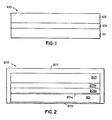
- the article 200 consists of an austenitic metal alloy support 201, which has thin oxide layers 201a and 201b formed on its opposite faces during heating to temperatures required to crystallize the electrically conductive heavy pnictide mixed alkaline earth copper oxide coating 205. Interposed between the conductive coating and the support are layers 203a and 203b.
- the layer 203a is a high density hafnia barrier layer.
- the layer 203b can be an auxiliary barrier layer or a layer having as its purpose to facilitate crystallization of the conductive layer.
- An external coating 207 cooperates with the support to surround the electrically conductive crystalline layer to protect it against ambient contaminants, such as moisture.
- the austenitic alloys resist oxidation by reacting slowly, if at all, with oxygen from ambient air.
- oxidation resistance can be attributed directly to a low initial and continued rate of oxidation of elemental metal.
- the formation of a thin surface oxide layer seldom more than about a 1000 ⁇ in thickness, acts as a passivant retarding or preventing further oxidation.
- the supports exhibit thin surface oxide layers corresponding to layers 201a and 201b, described above.
- Oxidation resistant austenitic alloys have the common feature of containing chromium in combination with one or more group VIII period 4 metals ⁇ that is, at least one of iron, nickel and cobalt. Chromium concentrations range from about 5 to 30 percent. (Except as otherwise stated, all percentages are to be understood as being percent by weight, based on total weight.) Austenitic stainless steels typically contain from about 16 to 25 percent chromium and up to about 20 percent nickel, the balance being accounted for principally by iron with minor proportions of optional modifying metals often also being present. By displacing all or part of the iron with nickel, cobalt or a mixture of both, austenitic alloys can be formed known as superalloys.
- suitable austenitic stainless steels are listed in the Metals Handbook , American Society for Metals, 1985, Table 3 at page 15-2 and Table 1 at page 16-2.
- suitable austenitic superalloys are listed in the Metals Handbook , cited above, in Table 2, page 61-7.
- the austenitic alloys offer the advantage of being much more economical to use than the platinum metals, silver and gold. Further, the austenitic alloys permit supports to be fabricated that are both flexible and strong.
- the article supports can, for example, readily be fabricated in the forms of tapes or wires, allowing curved configurations, such as those required in winding and spooling, both before and after article fabrication. While the austenitic alloy supports can be of any thickness convenient for their intended application, for use in flexible form, such as a tape, support thicknesses in the range of from about 5 to 500 ⁇ m, preferably 50 to 300 ⁇ m, are contemplated.
- a barrier layer between the austenitic alloy support and the electrically conductive crystalline oxide layer. It is a surprising discovery of this invention that high density hafnia is capable of forming an effective barrier to prevent austenitic alloy contamination of the electrically conductive crystalline oxide layer, whereas zirconia, a commonly used barrier material, is ineffective. This divergence in utility is all the more surprising when it is considered that zirconium and hafnium are members of the same group of the Periodic Table of elements, exhibit virtually identical atomic diameters, and exhibit virtually identical chemical reaction characteristics.
- hafnia because of the close chemical and physical similarities of hafnia and zirconia, it is appreciated that some small amounts of zirconia are always present in hafnia.
- Optical grade hafnia the purest form of hafnia commercially available, contains 3 X 10 ⁇ 4 mole of zirconia per mole of hafnia while reagent grade hafnia, acceptable for the overwhelming majority of applications requiring hafnia, usually contains slightly less than 2 X 10 ⁇ 2 mole of zirconia per mole of hafnia.
- hafnia contemplates the presence of minor amounts of zirconia.
- hafnia is relatively more expensive than zirconia, it is specifically contemplated to substitute minor amounts of zirconia for hafnia.
- Hafnia compositions are contemplated that satisfy the relationship (I) Hf 1-z Zr z O2 where z ranges from the impurity levels noted above up to 0.3, most preferably to 0.2, and optimally to 0.1.
- hafnia barrier layers exhibit high density.
- high density it is meant that hafnia exhibits a density that is at least 90 percent, preferably at least 99 percent, of its theoretical density.
- the theoretical density of a hafnia layer is that which results when the entire displacement volume of the layer, the product of the length, width and thickness dimensions of the layer, is occupied by hafnia. Any pores, cracks or other discontinuities in the hafnia layer dramatically reduce its observed density, based on displacement volume.
- the high density hafnia barrier layer can be deposited in any convenient thickness capable of providing a continuous coating. For ideally smooth support coating surfaces thicknesses of at least about 2000 ⁇ are necessary to achieve a continuous layer. In practice, the surface roughness of the support can significantly increase the thickness of the high density hafnia layer required to insure separation of the support and the electrically conductive crystalline oxide coating. For an unpolished austenitic alloy support surface a barrier layer thickness of about 1 ⁇ m is preferred to insure reliable separation of the support and conductive crystalline oxide coating.
- PAA′C oxide heavy pnictide mixed alkaline earth copper oxide
- PAA′C oxides are one class of a variety of cuprate oxides observed to exhibit relatively high T c and superconductivity characteristics, including rare earth alkaline earth copper (RAC) oxides, including those exhibiting K2NiF4, 1-2-3 (that is, R1A2C3) and 1-2-4 (that is, R1A2C4) crystal structures as well as thallium mixed alkaline earth copper (TAA′C) oxides, such as 2-2-2-3 thallium calcium barium copper oxide, reported to have a T c of 125°C, the highest reproducible T c reported to this date.
- RAC rare earth alkaline earth copper
- TAA′C thallium mixed alkaline earth copper
- PAA′C oxides satisfy the requirements of this invention by reason of their ability to crystallize to electrically conductive forms in air at temperatures beginning at about 800°C. This avoids or minimizes the risk of oxidizing the austenitic alloy forming the support, leading to reduction of its flexibility and ductility as well as minimizing any risk of unwanted interactions between the support and crystalline oxide layer.
- crystallization of RAC oxides are typically in the range of from about 900 to 1100°C.
- the TAA′C oxides typically require heating in the temperature range of 850 to 900°C.
- the PAA′C oxides are also advantageous in that they require no special post-crystallization annealing or oxygen enrichment to achieve desirable high T c and superconductive properties. Generally crystallizations in air without resorting to any particular temperature ramping or atmosphere control on cooling are acceptable to achieve satisfactory conductivity characteristics.
- PAA′C oxides it is preferred to form those which exhibit 2-2-1-2 and 2-2-2-3 crystal structures.
- the latter exhibit the art recognized advantage of higher superconducting onset transition temperatures, but the former are often preferred in practice, since the 2-2-1-2 crystal structure is more stable and can therefore be prepared over a wider range of conditions and on a greater variety of substrate materials.
- the 2-2-1-2 crystalline forms of PAA′C oxides are preferred, since crystallizations can be effected with less thermal energy, reflected in somewhat lower temperatures, heating times or a combination of both.
- PAA′C oxides P represents an atom of a heavy pnictide, typically bismuth and, optionally, less than 10 mole percent (preferably less than 5 mole percent) antimony. Lead has been suggested as a possible replacement for a minor amount of bismuth or antimony.
- a in the PAA′C oxide acronym typically represents strontium while A′ typically represents calcium. Magnesium has been employed as a replacement for calcium, but is not preferred, since it reduces superconducting onset transition temperatures. At least a minor amount of strontium is sometimes replaced by barium.
- the alkaline earth metals are to a limited extent interchangeable in the crystalline lattice without adversely affecting electrical conductivity or superconductivity.
- PAA′C oxides are those that exhibit a crystal structure corresponding to that of superconductive 2-2-1-2 barium strontium calcium copper oxide.
- Preferred molar metal ratios of oxide compositions capable of forming the 2-2-1-2 crystal structure are defined by the formula: (II) P2A 3-y A′ y C where y is 0.5 to 1.5 and P, A, A′ and C are as noted above.
- Crystalline PAA′C oxide layer thicknesses are contemplated to be at least about 0.3 ⁇ m, preferably at least about 0.5 ⁇ m.
- the conductive crystalline oxide coatings be limited to less than about 10 ⁇ m in thickness, preferably less than 5 ⁇ m in thickness, and optimally less than 1 ⁇ m in thickness.
- auxiliary barrier layer can be employed in combination with the high density hafnia.
- the auxiliary barrier layer can take the form of a thin layer of another known barrier material.
- An auxiliary barrier layer can act as a filler for any random pores, cracks or other discontinuities in the high density hafnia layer.
- auxiliary barrier layer materials are preferably chosen to facilitate the intended crystallization of the overlying PAA′C oxide coating.
- auxiliary barrier materials such as magnesia (MgO), strontium titanate (SiTiO3), lanthanum aluminate (LaAlO3), zirconia (ZrO2), potassium tantalate (KTaO3) and similar oxide coatings are specifically contemplated.
- MgO magnesia
- SiTiO3 strontium titanate
- LaAlO3 lanthanum aluminate
- ZrO2 zirconia
- potassium tantalate (KTaO3) potassium tantalate
- similar oxide coatings are specifically contemplated.
- These auxiliary barrier layer materials can be coated by any convenient conventional technique.
- Auxiliary barrier layer coatings having the lowest attainable level of discontinuities are favored. However, even if discontinuities in the auxiliary layer are relatively high in comparison to discontinuities in the high density hafnia layer, there is a very low probability of discontinuities in both layers occurring at exactly the same location.
- the combined thickness of the high density hafnia layer and the auxiliary barrier layer should not exceed 3 ⁇ m, preferably 2 ⁇ m when the flexible conductive articles are being formed.
- the thickness of the auxiliary barrier layer is preferably kept to a minimum compatible with achieving a continuous coating, typically in the range of from about 1000 to 3000 ⁇ .
- crystal growth promoting agents Lithium and sodium are both recognized to act as crystal growth promoting agents. These alkali metals in the form of thermally decomposable salts, preferably including an anionic portion that can be volatilized below crystallization temperatures, such as a carboxylate, halide, nitrate or the like, are contemplated.
- the crystal growth promoting agent can be incorporated in the PAA′C oxide layer as it is initially coated or coated over the high density hafnia prior to forming the PAA′C oxide coating. Even if coated initially as a separate layer, no separate crystal growth promoting agent layer remains in the article after heating to crystallization temperatures.
- an alkali metal salt as a crystal growth promoting agent
- Silver accelerates crystal growth. It is believed that the silver provides nucleation sites for crystal formation on heating. Acceleration of crystal growth can be observed with silver coatings as thin 100 ⁇ . However, it is generally preferred to employ silver coatings in thicknesses ranging from about 0.1 to 1 ⁇ m in thickness. Upon the completion of crystallization no continuous silver layer can be found at the interface of the high density hafnia layer and the crystallized conductive PAA′C oxide layer.
- the advantage of employing crystal growth promoting agents is that larger crystal sizes can be realized with less thermal energy input. This reduces the risk of oxidation of the austenitic alloy support and unwanted interactions between the support and the crystalline conductive oxide layer being formed.
- PAA′C oxide conductive layers are less susceptible to degradation on keeping in ambient air than RAC oxide superconductive coatings
- the articles of this invention can nevertheless benefit by protecting the crystalline PAA′C oxide conductive layer from contact with contaminants, particularly the moisture in ambient air.
- One technique for achieving the desired protection is to mount the article in a hermetically sealed housing.
- Another technique is to encapsulate the crystalline PAA′C oxide layer by coating or molding a plastic encapsulant around the article, such as illustrated by external coating 207 in Figure 2.
- Polyester ionomers are polyesters which contain at least one ionic moiety.
- Such ionic moieties can be provided by either ionic diol recurring units or ionic dicarboxylic acid recurring units, but preferably by the latter. Such ionic moieties can be anionic or cationic in nature, but preferably, they are anionic. Exemplary ionic groups include carboxylic acid, sulfonic acid, quaternary ammonium, disulfonylimino groups, and their salts.
- the amorphous polyesters comprise from about 2 to about 25 mole percent, based on total moles of dicarboxylic acid recurring units, of ionic dicarboxylic acid recurring units.
- Ionic dicarboxylic acids found to be particularly useful are those having units represented by the formula: wherein each of m and n is 0 or 1 and the sum of m and n is 1; each X is carbonyl; Q has the formula: Q′ has the formula: Y is a divalent aromatic radical, such as arylene (e.g. phenylene, naphthalene, xylylene, etc.) or arylidyne (e.g. phenenyl, naphthylidyne, etc.); Y′ is a monovalent aromatic radical, such as aryl, aralkyl or alkaryl (e.g.
- Exemplary preferred dicarboxylic acids and functional equivalents from which such ionic recurring units are derived are 3,3′-[(sodioimino)disulfonyl]dibenzoic acid; 3,3′-[(potassioimino)disulfonyl]dibenzoic acid; 3,3′-[(lithioimino)disulfonyl]dibenzoic acid; 4,4′-[(lithioimino)disulfonyl]dibenzoic acid; 4,4′-[(sodioimino)disulfonyl]dibenzoic acid; 4,4′-[(potassioimino)disulfonyl]dibenzoic acid; 3,4′-[(lithioimino)disulfonyl]dibenzoic acid; 3,4′-[(sodioimino)disulfonyl]dibenzoic
- Ionic dicarboxylic acid recurring units can also be derived from 5-sodiosulfobenzene-1,3-dicarboxylic acid, 5-sodiosulfocyclohexane-1,3-dicarboxylic acid, 5-(4-sodiosulfophenoxy)benzene-1,3-dicarboxylic acid, 5-(4-sodiosulfophenoxy)cyclohexane-1,3-dicarboxylic acid, similar compounds and functional equivalents thereof and others described in U.K. Patent Specification No. 1,470,059 (published April 14, 1977).
- the amorphous polyesters preferably comprise from about 75 to about 98 mole percent, based on total moles of dicarboxylic acid recurring units, of dicarboxylic acid recurring units which are nonionic in nature.
- Such nonionic units can be derived from any suitable dicarboxylic acid or functional equivalent which will condense with a diol as long as the resulting polyester is substantially amorphous.
- such units have the formula: wherein R is a saturated or unsaturated divalent hydrocarbon.
- R is alkylene of 2 to 20 carbon atoms, (e.g.
- R is alkylene of 2 to 20 carbon atoms.
- Such recurring units are derived from, for example, phthalic acid, isophthalic acid, terephthalic acid, malonic acid, succinic acid, glutaric acid, adipic acid, suberic acid, and 1,3-cyclohexane dicarboxylic acid and functional equivalents thereof.
- Dicarboxylic acids which have moieties that are sensitive to actinic radiation are also useful.
- Exemplary radiation sensitive dicarboxylic acids or functional equivalents thereof are described in Arcesi et al U.S. Patent No. 3,929,489.
- the dicarboxylic acid recurring units are linked in a polyester by recurring units derived from difunctional compounds capable of condensing with a dicarboxylic acid or a functional equivalent thereof.
- difunctional compounds include diols of the formula HO-R1-OH wherein R1 is a divalent aliphatic, alicyclic or aromatic radical of from 2 to 12 carbon atoms and includes hydrogen, carbon, and, optionally, ether oxygen atoms.
- Such aliphatic, alicyclic, and aromatic radicals include alkylene, cycloalkylene, arylene, alkylenearylene, alkylenecycloalkylene, alkylenebisarylene, cycloalkylenebisalkylene, arylenebisalkylene, alkylene-oxyalkylene, alkylene-oxy-arylene-oxy-alkylene, arylene-oxy-alkylene, alkylene-oxy-cycloalkylene-oxy-alkylene, etc.
- R1 contains an ether linkage, such as in cycloalkyleneoxy-alkylene or alkylene-oxy-alkylene.
- Exemplary diols include ethylene glycol, diethylene glycol, triethylene glycol, 1,3-propanediol, 1,4-butanediol, 2-methyl-1,5-pentanediol, neopentyl glycol, 1,4-cyclohexanedimethanol, 1,4-bis( ⁇ -hydroxyethoxy)-cyclohexane, quinitol, norcamphanediols, 2,2,4,4-tetraalkylcyclobutane-1,3-diols, p-xylene diol and Bisphenol A.
- the substantially amorphous polyesters described herein comprise diol recurring units of either of the formulae wherein p is an integer from 1 to 4. Such recurring units are present in the polyesters in an amount of at least 50 mole percent, and most preferably from about 50 to 100 mole percent, based on total moles of diol recurring units.
- Particularly useful amorphous polyesters include
- polyester ionomers are disclosed by Noonan et al U.S. Patents 4,097,282, 4,291,153, 4,395,475 and 4,419,437 as well as Merrill et al U.S Patent 4,252,921.
- alkyl cellulose polymers are also effective to stabilize the superconductive ceramic oxides.
- any soluble alkyl cellulose can be employed.
- Preferred alkyl cellulose polymers are those in which the alkyl moiety contains from 1 to 10 carbon atoms, optimally from about 1 to 6 carbon atoms. These polymers are generally recognized to be soluble in most common organic solvents.
- Specific preferred examples of useful alkyl cellulose are methyl cellulose, ethyl cellulose, n -propyl cellulose, isobutyl cellulose, and n -hexyl cellulose.
- Austenitic stainless steel UNS number S30100 commonly referred to as 301, was employed as a starting material for forming the support of the article.
- the 301 stainless steel contained 0.15% carbon, 2.00% manganese, 1.00% silicon, 16-18% chromium, 6.0-8.0% nickel, 0.045% phosphorus and 0.03% sulfur, with the balance of the composition being iron.
- a flexible foil of the 301 stainless steel approximately 50 ⁇ m in thickness was formed by cold rolling a starting sample. Surface irregularities of the flexible foil were substantially limited to a height of less than 1 ⁇ m.
- the flexible foil was degreased using acetone followed by rinsing with deionized water, dried and loaded into an evacuated hafnia coating chamber maintained at a pressure of about 1 to 2 X 10 ⁇ 6 torr. To assure a clean deposition surface the flexible foil was lightly etched with an ion beam.
- a general description of the coating procedure employed is provided by J. J. Cuomo and S. M. Rossnazol, Nucl. Instr. and Meth. , B19/20, 903 (1987).
- the hafnia layer as initially deposited was in a tetragonal crystal structure and was transformed into a monoclinic crystal structure by annealing at 600°C for one hour. Scanning electron microscopy revealed a high density hafnia layer devoid of microcracks or other visible discontinuities.
- a 2-2-1-2 crystal structure Bi2Sr2CaCu2O8+ (where 8+ indicates more than 8 but less than 9 oxygen atoms ⁇ i.e., a slight stoichiometric excess) conductive layer was prepared by the following procedure:
- a precursor composition containing the conductive oxide coating metals in the required proportions was prepared by mixing the organic precursor compounds bismuth 2-ethylhexanoate, strontium cyclohexanebutyrate, calcium 2-ethylhexanoate and copper 2-ethylhexanoate.
- the bismuth precursor was prepared as described in EPO 0 334 093, cited above, but with a somewhat varied rotary evaporator treatment that gave a bismuth concentration of 20.8 percent as determined by gravimetric analysis.
- the strontium cyclohexanebutyrate and calcium 2-ethylhexanoate were purchased from commercial sources and were received with an assay indicating a metal concentration of 19.4 and 5 percent, respectively.
- the precursor with a copper concentration of 6.31 percent was made by mixing 2.0 g of copper acetate with 8.0 g of 2-ethylhexanoic acid. The individual precursors were mixed in a weight ratio of 6:2.7:2.4:6.04 and dissolved in 2-ethylhexanoic acid by heating to boiling until no solids remained.
- the precursor composition had a copper concentration of 3.8 X 10 ⁇ 4 mole per gram of solution.
- To enhance grain growth on crystallization a soluble sodium salt was added to the precursor composition to give a final sodium concentration of 2.3 to 3.4 X 10 ⁇ 5 mole per gram of solution. Rosin (kodak 2315TM) was added as a film forming agent, and the precursor composition was heated slightly until the rosin went into solution.
- the precursor composition was spin coated on the high density hafnia layer on the support at 4000 rpm for 20 seconds and then thermally ramped from room temperature to 550°C in 10 minutes. After 5 minutes of annealing at 550°C, the sample was cooled to room temperature. This process was then repeated 6 times to produce a total of 7 layers, each having a thickness of approximately 0.4 ⁇ m.
- the sample was further heat treated at 845°C for 5 to 10 minutes to convert the layers to the desired superconducting 2-2-1-2 crystal structure.
- X-ray diffraction analysis revealed a highly oriented crystalline film with the crystal c-axes oriented normal to the substrate.
- the sheet resistance of the conductive oxide coating was about 4 ohms/square at room temperature.
- Below ambient temperature resistance measurements revealed excellent electrical characteristics.
- the superconducting onset transition temperature T c was in the vicinity of 85°K, with T o being about 70 to 73°K.
- the critical current density at 4°K was about 1 X 10³ A/cm2.
- Example 1 was repeated, except that zirconia was substituted for hafnia.
- the crystalline oxide coating produced was nonconducting. Neither a superconducting onset transition temperature nor superconductivity was observed. Failure was attributed to cracking of the zirconia layers at the elevated temperatures required to form the crystalline oxide film.
- Example 1 was repeated, except that magnesia was substituted for hafnia.
- a useful coated article could not be produced.
- the bismuth strontium calcium copper oxide coating peeled from the support on heating to crytallization temperatures. This was attributed to a thermal expansion mismatch between the magnesia and the cuprate layers.
- Example 1 was repeated, except that the step of forming the hafnia barrier layer was omitted.
- the crystalline oxide coating produced was nonconducting. Neither a superconducting onset transition temperature nor superconductivity was observed. Failure was attributed to contamination of the crystalline oxide coating by the austenitic alloy support.
Landscapes
- Engineering & Computer Science (AREA)
- Manufacturing & Machinery (AREA)
- Superconductors And Manufacturing Methods Therefor (AREA)
- Inorganic Compounds Of Heavy Metals (AREA)
- Crystals, And After-Treatments Of Crystals (AREA)
Applications Claiming Priority (2)
| Application Number | Priority Date | Filing Date | Title |
|---|---|---|---|
| US475527 | 1983-03-15 | ||
| US07/475,527 US5086035A (en) | 1990-02-06 | 1990-02-06 | Electrically conductive article (i) |
Publications (2)
| Publication Number | Publication Date |
|---|---|
| EP0441724A2 true EP0441724A2 (de) | 1991-08-14 |
| EP0441724A3 EP0441724A3 (en) | 1991-10-23 |
Family
ID=23887968
Family Applications (1)
| Application Number | Title | Priority Date | Filing Date |
|---|---|---|---|
| EP19910420036 Ceased EP0441724A3 (en) | 1990-02-06 | 1991-02-04 | Electrically conductive article |
Country Status (4)
| Country | Link |
|---|---|
| US (1) | US5086035A (de) |
| EP (1) | EP0441724A3 (de) |
| JP (1) | JPH0570132A (de) |
| CA (1) | CA2035739C (de) |
Cited By (4)
| Publication number | Priority date | Publication date | Assignee | Title |
|---|---|---|---|---|
| EP0507539A3 (en) * | 1991-04-01 | 1993-01-27 | General Electric Company | Method of making oriented dielectric films on metal substrates and articles formed thereby |
| EP1122799A1 (de) * | 2000-02-01 | 2001-08-08 | Zentrum für Funktionswerkstoffe, Gemeinnützige Gesellschaft mbH | Substrat aus rostfreiem Stahl für Supraleiterschichten |
| EP2485222A4 (de) * | 2009-09-29 | 2013-07-24 | Furukawa Electric Co Ltd | Substrat für eine supraleitende verkabelung, supraleitende verkabelung und herstellungsverfahren dafür |
| EP3282493A1 (de) * | 2016-08-10 | 2018-02-14 | Theva Dünnschichttechnik GmbH | Hochtemperatur-supraleiter-bandleiter mit edelstahl-substrat |
Families Citing this family (9)
| Publication number | Priority date | Publication date | Assignee | Title |
|---|---|---|---|---|
| CA2076279A1 (en) * | 1991-09-06 | 1993-03-07 | Liang-Sun Hung | Superconductive layer on monocrystalline substrate and process for its preparation |
| CA2076277A1 (en) * | 1991-09-06 | 1993-03-07 | Liang-Sun Hung | Increased grain size superconductive thin films and process for their preparation |
| US6652004B1 (en) * | 1999-08-03 | 2003-11-25 | Michael R. Lam | Item made from combination of rare and common materials and method of making the same |
| US6866958B2 (en) * | 2002-06-05 | 2005-03-15 | General Motors Corporation | Ultra-low loadings of Au for stainless steel bipolar plates |
| US20050100774A1 (en) * | 2003-11-07 | 2005-05-12 | Abd Elhamid Mahmoud H. | Novel electrical contact element for a fuel cell |
| US8101319B2 (en) * | 2004-05-20 | 2012-01-24 | GM Global Technology Operations LLC | Approach to make a high performance membrane electrode assembly (MEA) for a PEM fuel cell |
| US7759017B2 (en) | 2005-05-18 | 2010-07-20 | Gm Global Technology Operations, Inc. | Membrane electrode assembly (MEA) architecture for improved durability for a PEM fuel cell |
| US8455155B2 (en) * | 2006-11-22 | 2013-06-04 | GM Global Technology Operations LLC | Inexpensive approach for coating bipolar plates for PEM fuel cells |
| US9972423B2 (en) | 2013-06-19 | 2018-05-15 | Sumitomo Electric Industries, Ltd. | Reinforced superconducting wire and method for manufacturing the same |
Family Cites Families (5)
| Publication number | Priority date | Publication date | Assignee | Title |
|---|---|---|---|---|
| CA1326976C (en) * | 1987-05-26 | 1994-02-15 | Satoshi Takano | Superconducting member |
| CA1303252C (en) * | 1987-08-13 | 1992-06-09 | John A. Agostinelli | Circuit element with barrier layer for protecting crystalline oxide conductive layer |
| US4994435A (en) * | 1987-10-16 | 1991-02-19 | The Furukawa Electric Co., Ltd. | Laminated layers of a substrate, noble metal, and interlayer underneath an oxide superconductor |
| EP0334093A3 (de) * | 1988-03-25 | 1990-12-27 | EASTMAN KODAK COMPANY (a New Jersey corporation) | Halbzeug mit leitender Schicht und Verfahren zu seiner Herstellung |
| JP2508208B2 (ja) * | 1988-08-10 | 1996-06-19 | ヤマハ株式会社 | 自動演奏ピアノの弱音装置 |
-
1990
- 1990-02-06 US US07/475,527 patent/US5086035A/en not_active Expired - Lifetime
-
1991
- 1991-02-04 EP EP19910420036 patent/EP0441724A3/en not_active Ceased
- 1991-02-05 CA CA002035739A patent/CA2035739C/en not_active Expired - Fee Related
- 1991-02-06 JP JP91216691A patent/JPH0570132A/ja active Pending
Cited By (6)
| Publication number | Priority date | Publication date | Assignee | Title |
|---|---|---|---|---|
| EP0507539A3 (en) * | 1991-04-01 | 1993-01-27 | General Electric Company | Method of making oriented dielectric films on metal substrates and articles formed thereby |
| EP1122799A1 (de) * | 2000-02-01 | 2001-08-08 | Zentrum für Funktionswerkstoffe, Gemeinnützige Gesellschaft mbH | Substrat aus rostfreiem Stahl für Supraleiterschichten |
| EP1143532A1 (de) * | 2000-02-01 | 2001-10-10 | Zentrum für Funktionswerkstoffe, Gemeinnützige Gesellschaft mbH | Supraleiterbauelement |
| US6541121B2 (en) | 2000-02-01 | 2003-04-01 | Zentrum Fuer Funktionswerkstoffe Gemeinnuetzige Gesellschaft Mbh | Superconducting element |
| EP2485222A4 (de) * | 2009-09-29 | 2013-07-24 | Furukawa Electric Co Ltd | Substrat für eine supraleitende verkabelung, supraleitende verkabelung und herstellungsverfahren dafür |
| EP3282493A1 (de) * | 2016-08-10 | 2018-02-14 | Theva Dünnschichttechnik GmbH | Hochtemperatur-supraleiter-bandleiter mit edelstahl-substrat |
Also Published As
| Publication number | Publication date |
|---|---|
| CA2035739C (en) | 1995-06-13 |
| JPH0570132A (ja) | 1993-03-23 |
| US5086035A (en) | 1992-02-04 |
| EP0441724A3 (en) | 1991-10-23 |
Similar Documents
| Publication | Publication Date | Title |
|---|---|---|
| US5073537A (en) | Electrically conductive article | |
| US5086035A (en) | Electrically conductive article (i) | |
| AU607994B2 (en) | Conductive articles and processes for their preparation | |
| US4921833A (en) | Superconducting member | |
| EP0312015A2 (de) | Körper mit supraleitendem Oxid und dessen Herstellungsverfahren | |
| US4988674A (en) | Electrically conductive articles and processes for their fabrication | |
| EP0301646B1 (de) | Superleitende Dünnschicht | |
| WO2003044836A2 (en) | High temperature superconducting composite conductors | |
| US6541121B2 (en) | Superconducting element | |
| US4956335A (en) | Conductive articles and processes for their preparation | |
| US4629662A (en) | Bonding metal to ceramic like materials | |
| KR880014017A (ko) | 박막 초전도 산화물 필림의 제조방법 | |
| EP0446789B1 (de) | Verfahren zur Herstellung einer Schicht aus supraleitendem Oxyd | |
| US4950643A (en) | Metalorganic deposition process for preparing heavy pnictide superconducting oxide films | |
| EP0636714A1 (de) | Material aus Metalloxydgemischen | |
| JP3103608B2 (ja) | ニッケルを基材とする、セラミック超伝導体用の基板 | |
| EP0336505B1 (de) | Anordnung und Verfahren zum Herstellen einer Anordnung | |
| US4968664A (en) | Single-crystal wafer having a superconductive ceramic thin film formed thereon | |
| Lieberman et al. | Reactively sputtered oxide films | |
| US5096881A (en) | Preparation of a superconducting Tl2 Ca2 Ba2 Cu3 O.sub.x2 O3 vapor | |
| JPH01221810A (ja) | 酸化物超電導成形体及びその製造方法 | |
| LANGER et al. | Arrangements in Thin Film Technology | |
| EP0389086B1 (de) | Einkristalline supraleitende Faser-Zusammensetzung und Verfahren zu ihrer Herstellung | |
| EP0333513B1 (de) | Oxid-Supraleiter | |
| JP2699216B2 (ja) | 酸化物超電導体の製造方法 |
Legal Events
| Date | Code | Title | Description |
|---|---|---|---|
| PUAI | Public reference made under article 153(3) epc to a published international application that has entered the european phase |
Free format text: ORIGINAL CODE: 0009012 |
|
| AK | Designated contracting states |
Kind code of ref document: A2 Designated state(s): AT BE CH DE DK ES FR GB GR IT LI LU NL SE |
|
| PUAL | Search report despatched |
Free format text: ORIGINAL CODE: 0009013 |
|
| AK | Designated contracting states |
Kind code of ref document: A3 Designated state(s): AT BE CH DE DK ES FR GB GR IT LI LU NL SE |
|
| 17P | Request for examination filed |
Effective date: 19920331 |
|
| 17Q | First examination report despatched |
Effective date: 19940601 |
|
| STAA | Information on the status of an ep patent application or granted ep patent |
Free format text: STATUS: THE APPLICATION HAS BEEN REFUSED |
|
| 18R | Application refused |
Effective date: 19950611 |