EP0441736A2 - New 1,4-dihydropyridine derivatives, a process for their preparation and their use for influencing the blood flow - Google Patents
New 1,4-dihydropyridine derivatives, a process for their preparation and their use for influencing the blood flow Download PDFInfo
- Publication number
- EP0441736A2 EP0441736A2 EP19910500012 EP91500012A EP0441736A2 EP 0441736 A2 EP0441736 A2 EP 0441736A2 EP 19910500012 EP19910500012 EP 19910500012 EP 91500012 A EP91500012 A EP 91500012A EP 0441736 A2 EP0441736 A2 EP 0441736A2
- Authority
- EP
- European Patent Office
- Prior art keywords
- benzisothiazolyl
- dioxide
- general formula
- compound
- dihydropyridine
- Prior art date
- Legal status (The legal status is an assumption and is not a legal conclusion. Google has not performed a legal analysis and makes no representation as to the accuracy of the status listed.)
- Withdrawn
Links
- YNGDWRXWKFWCJY-UHFFFAOYSA-N 1,4-Dihydropyridine Chemical class C1C=CNC=C1 YNGDWRXWKFWCJY-UHFFFAOYSA-N 0.000 title claims abstract description 10
- 238000002360 preparation method Methods 0.000 title claims description 8
- 238000000034 method Methods 0.000 title claims description 7
- 230000008569 process Effects 0.000 title claims description 6
- 230000017531 blood circulation Effects 0.000 title description 3
- 150000001875 compounds Chemical class 0.000 claims abstract description 65
- 206010020772 Hypertension Diseases 0.000 claims abstract description 7
- 208000001953 Hypotension Diseases 0.000 claims abstract 2
- 230000036543 hypotension Effects 0.000 claims abstract 2
- -1 2-methyltetrahydropyranyl Chemical group 0.000 claims description 49
- 239000008194 pharmaceutical composition Substances 0.000 claims description 10
- KCIBIAFYYVAYEO-UHFFFAOYSA-N 4-(2,3-dichlorophenyl)-5-ethoxycarbonyl-2,6-dimethyl-1,4-dihydropyridine-3-carboxylic acid Chemical compound CCOC(=O)C1=C(C)NC(C)=C(C(O)=O)C1C1=CC=CC(Cl)=C1Cl KCIBIAFYYVAYEO-UHFFFAOYSA-N 0.000 claims description 4
- LHAOQTPGTBGTIG-UHFFFAOYSA-N 4-(2,3-dichlorophenyl)-5-methoxycarbonyl-2,6-dimethyl-1,4-dihydropyridine-3-carboxylic acid Chemical compound COC(=O)C1=C(C)NC(C)=C(C(O)=O)C1C1=CC=CC(Cl)=C1Cl LHAOQTPGTBGTIG-UHFFFAOYSA-N 0.000 claims description 4
- QGZKDVFQNNGYKY-UHFFFAOYSA-N Ammonia Chemical compound N QGZKDVFQNNGYKY-UHFFFAOYSA-N 0.000 claims description 4
- FTIMWXRLTFYOFL-UHFFFAOYSA-N CC(C)OC(=O)C1=C(C)NC(C)=C(C(O)=O)C1C1=CC=CC=C1C(F)(F)F Chemical compound CC(C)OC(=O)C1=C(C)NC(C)=C(C(O)=O)C1C1=CC=CC=C1C(F)(F)F FTIMWXRLTFYOFL-UHFFFAOYSA-N 0.000 claims description 4
- 125000001495 ethyl group Chemical group [H]C([H])([H])C([H])([H])* 0.000 claims description 4
- 125000002496 methyl group Chemical group [H]C([H])([H])* 0.000 claims description 4
- MGKIILPLEOSHBL-UHFFFAOYSA-N 5-ethoxycarbonyl-2,6-dimethyl-4-[2-(trifluoromethyl)phenyl]-1,4-dihydropyridine-3-carboxylic acid Chemical compound CCOC(=O)C1=C(C)NC(C)=C(C(O)=O)C1C1=CC=CC=C1C(F)(F)F MGKIILPLEOSHBL-UHFFFAOYSA-N 0.000 claims description 3
- TXOXRZWLHHCDSZ-UHFFFAOYSA-N CC=1NC(C)=C(C(O)=O)C(C=2C=C(C=CC=2)[N+]([O-])=O)C=1C(=O)OCC1CCCCO1 Chemical compound CC=1NC(C)=C(C(O)=O)C(C=2C=C(C=CC=2)[N+]([O-])=O)C=1C(=O)OCC1CCCCO1 TXOXRZWLHHCDSZ-UHFFFAOYSA-N 0.000 claims description 3
- 125000006273 (C1-C3) alkyl group Chemical group 0.000 claims description 2
- 125000004209 (C1-C8) alkyl group Chemical group 0.000 claims description 2
- 229910021529 ammonia Inorganic materials 0.000 claims description 2
- 235000017168 chlorine Nutrition 0.000 claims 2
- 230000002265 prevention Effects 0.000 claims 2
- ZAMOUSCENKQFHK-UHFFFAOYSA-N Chlorine atom Chemical group [Cl] ZAMOUSCENKQFHK-UHFFFAOYSA-N 0.000 claims 1
- 206010047139 Vasoconstriction Diseases 0.000 claims 1
- 239000000460 chlorine Chemical group 0.000 claims 1
- 229910052801 chlorine Inorganic materials 0.000 claims 1
- 125000001309 chloro group Chemical class Cl* 0.000 claims 1
- 125000000449 nitro group Chemical group [O-][N+](*)=O 0.000 claims 1
- XMVJITFPVVRMHC-UHFFFAOYSA-N roxarsone Chemical group OC1=CC=C([As](O)(O)=O)C=C1[N+]([O-])=O XMVJITFPVVRMHC-UHFFFAOYSA-N 0.000 claims 1
- 125000002023 trifluoromethyl group Chemical group FC(F)(F)* 0.000 claims 1
- 230000025033 vasoconstriction Effects 0.000 claims 1
- 230000003639 vasoconstrictive effect Effects 0.000 abstract description 4
- 230000000304 vasodilatating effect Effects 0.000 abstract description 4
- LFQSCWFLJHTTHZ-UHFFFAOYSA-N Ethanol Chemical compound CCO LFQSCWFLJHTTHZ-UHFFFAOYSA-N 0.000 description 134
- XEKOWRVHYACXOJ-UHFFFAOYSA-N Ethyl acetate Chemical compound CCOC(C)=O XEKOWRVHYACXOJ-UHFFFAOYSA-N 0.000 description 117
- 239000000203 mixture Substances 0.000 description 69
- 239000007787 solid Substances 0.000 description 69
- 238000002844 melting Methods 0.000 description 66
- 230000008018 melting Effects 0.000 description 66
- 238000010992 reflux Methods 0.000 description 55
- 239000011541 reaction mixture Substances 0.000 description 44
- KFZMGEQAYNKOFK-UHFFFAOYSA-N Isopropanol Chemical compound CC(C)O KFZMGEQAYNKOFK-UHFFFAOYSA-N 0.000 description 37
- 238000009835 boiling Methods 0.000 description 25
- 125000000218 acetic acid group Chemical group C(C)(=O)* 0.000 description 23
- QTBSBXVTEAMEQO-UHFFFAOYSA-N Acetic acid Chemical compound CC(O)=O QTBSBXVTEAMEQO-UHFFFAOYSA-N 0.000 description 22
- NQRYJNQNLNOLGT-UHFFFAOYSA-N Piperidine Chemical compound C1CCNCC1 NQRYJNQNLNOLGT-UHFFFAOYSA-N 0.000 description 22
- 239000000047 product Substances 0.000 description 20
- 230000008023 solidification Effects 0.000 description 20
- 238000007711 solidification Methods 0.000 description 20
- 241000283973 Oryctolagus cuniculus Species 0.000 description 13
- OKKJLVBELUTLKV-UHFFFAOYSA-N Methanol Chemical compound OC OKKJLVBELUTLKV-UHFFFAOYSA-N 0.000 description 12
- 239000002904 solvent Substances 0.000 description 12
- XJOLYWNYMOPRKQ-WAYWQWQTSA-N 2-methoxyethyl (z)-3-aminobut-2-enoate Chemical compound COCCOC(=O)\C=C(\C)N XJOLYWNYMOPRKQ-WAYWQWQTSA-N 0.000 description 11
- 229960000583 acetic acid Drugs 0.000 description 11
- 210000000709 aorta Anatomy 0.000 description 11
- 239000012362 glacial acetic acid Substances 0.000 description 11
- XKORCTIIRYKLLG-ARJAWSKDSA-N methyl (z)-3-aminobut-2-enoate Chemical compound COC(=O)\C=C(\C)N XKORCTIIRYKLLG-ARJAWSKDSA-N 0.000 description 11
- ZETIVVHRRQLWFW-UHFFFAOYSA-N 3-nitrobenzaldehyde Chemical compound [O-][N+](=O)C1=CC=CC(C=O)=C1 ZETIVVHRRQLWFW-UHFFFAOYSA-N 0.000 description 10
- 238000004821 distillation Methods 0.000 description 10
- YPMPTULBFPFSEQ-PLNGDYQASA-N ethyl (z)-3-aminobut-2-enoate Chemical compound CCOC(=O)\C=C(\C)N YPMPTULBFPFSEQ-PLNGDYQASA-N 0.000 description 10
- 239000007788 liquid Substances 0.000 description 10
- 239000006228 supernatant Substances 0.000 description 10
- YCKAGGHNUHZKCL-XQRVVYSFSA-N propan-2-yl (z)-3-aminobut-2-enoate Chemical compound CC(C)OC(=O)\C=C(\C)N YCKAGGHNUHZKCL-XQRVVYSFSA-N 0.000 description 9
- 238000003756 stirring Methods 0.000 description 9
- OYPRJOBELJOOCE-UHFFFAOYSA-N Calcium Chemical compound [Ca] OYPRJOBELJOOCE-UHFFFAOYSA-N 0.000 description 8
- 239000011575 calcium Substances 0.000 description 8
- 229910052791 calcium Inorganic materials 0.000 description 8
- 230000008602 contraction Effects 0.000 description 8
- 239000000725 suspension Substances 0.000 description 8
- LLMLNAVBOAMOEE-UHFFFAOYSA-N 2,3-dichlorobenzaldehyde Chemical compound ClC1=CC=CC(C=O)=C1Cl LLMLNAVBOAMOEE-UHFFFAOYSA-N 0.000 description 6
- NKSXDMWAVIOSTD-PLNGDYQASA-N methyl (z)-3-aminopent-2-enoate Chemical compound CC\C(N)=C\C(=O)OC NKSXDMWAVIOSTD-PLNGDYQASA-N 0.000 description 6
- FDCJOQNCHBIAOV-WAYWQWQTSA-N tert-butyl (z)-3-aminobut-2-enoate Chemical compound C\C(N)=C\C(=O)OC(C)(C)C FDCJOQNCHBIAOV-WAYWQWQTSA-N 0.000 description 6
- 230000002792 vascular Effects 0.000 description 5
- CMWKITSNTDAEDT-UHFFFAOYSA-N 2-nitrobenzaldehyde Chemical compound [O-][N+](=O)C1=CC=CC=C1C=O CMWKITSNTDAEDT-UHFFFAOYSA-N 0.000 description 4
- RMUXPFNYFJGORU-UHFFFAOYSA-N 4-(2-chlorophenyl)-5-ethoxycarbonyl-2,6-dimethyl-1,4-dihydropyridine-3-carboxylic acid Chemical compound CCOC(=O)C1=C(C)NC(C)=C(C(O)=O)C1C1=CC=CC=C1Cl RMUXPFNYFJGORU-UHFFFAOYSA-N 0.000 description 4
- IGTNUCYFOBDUEF-UHFFFAOYSA-N 5-methoxycarbonyl-2,6-dimethyl-4-(2-nitrophenyl)-1,4-dihydropyridine-3-carboxylic acid Chemical compound COC(=O)C1=C(C)NC(C)=C(C(O)=O)C1C1=CC=CC=C1[N+]([O-])=O IGTNUCYFOBDUEF-UHFFFAOYSA-N 0.000 description 4
- 230000036772 blood pressure Effects 0.000 description 4
- 230000000694 effects Effects 0.000 description 4
- 238000012360 testing method Methods 0.000 description 4
- QQEOWRHUXVDVJC-UHFFFAOYSA-N 2,6-dimethyl-4-(3-nitrophenyl)-5-propan-2-yloxycarbonyl-1,4-dihydropyridine-3-carboxylic acid Chemical compound CC(C)OC(=O)C1=C(C)NC(C)=C(C(O)=O)C1C1=CC=CC([N+]([O-])=O)=C1 QQEOWRHUXVDVJC-UHFFFAOYSA-N 0.000 description 3
- MTLIBDLYSVXMIM-UHFFFAOYSA-N 5-(2-methoxyethoxycarbonyl)-2,6-dimethyl-4-(3-nitrophenyl)-1,4-dihydropyridine-3-carboxylic acid Chemical compound COCCOC(=O)C1=C(C)NC(C)=C(C(O)=O)C1C1=CC=CC([N+]([O-])=O)=C1 MTLIBDLYSVXMIM-UHFFFAOYSA-N 0.000 description 3
- MPOOHAOWKYTUQT-UHFFFAOYSA-N 5-ethoxycarbonyl-2,6-dimethyl-4-(3-nitrophenyl)-1,4-dihydropyridine-3-carboxylic acid Chemical compound CCOC(=O)C1=C(C)NC(C)=C(C(O)=O)C1C1=CC=CC([N+]([O-])=O)=C1 MPOOHAOWKYTUQT-UHFFFAOYSA-N 0.000 description 3
- JPXPPUOCSLMCHK-UHFFFAOYSA-N 5-methoxycarbonyl-2,6-dimethyl-4-(3-nitrophenyl)-1,4-dihydropyridine-3-carboxylic acid Chemical compound COC(=O)C1=C(C)NC(C)=C(C(O)=O)C1C1=CC=CC([N+]([O-])=O)=C1 JPXPPUOCSLMCHK-UHFFFAOYSA-N 0.000 description 3
- JKVATFJARWKNJA-UHFFFAOYSA-N 6-ethyl-5-methoxycarbonyl-2-methyl-4-(3-nitrophenyl)-1,4-dihydropyridine-3-carboxylic acid Chemical compound OC(=O)C1=C(C)NC(CC)=C(C(=O)OC)C1C1=CC=CC([N+]([O-])=O)=C1 JKVATFJARWKNJA-UHFFFAOYSA-N 0.000 description 3
- FNSBIOFIDXJUTL-UHFFFAOYSA-N COCCOC(=O)C1=C(C)NC(C)=C(C(O)=O)C1C1=CC=CC=C1C(F)(F)F Chemical compound COCCOC(=O)C1=C(C)NC(C)=C(C(O)=O)C1C1=CC=CC=C1C(F)(F)F FNSBIOFIDXJUTL-UHFFFAOYSA-N 0.000 description 3
- 241001465754 Metazoa Species 0.000 description 3
- 230000000747 cardiac effect Effects 0.000 description 3
- 238000001816 cooling Methods 0.000 description 3
- 210000002837 heart atrium Anatomy 0.000 description 3
- 230000003389 potentiating effect Effects 0.000 description 3
- 238000011699 spontaneously hypertensive rat Methods 0.000 description 3
- 239000000126 substance Substances 0.000 description 3
- 230000035488 systolic blood pressure Effects 0.000 description 3
- LFYNCQUCMUWQGH-UHFFFAOYSA-N 2,6-dimethyl-4-(2-nitrophenyl)-5-propan-2-yloxycarbonyl-1,4-dihydropyridine-3-carboxylic acid Chemical compound CC(C)OC(=O)C1=C(C)NC(C)=C(C(O)=O)C1C1=CC=CC=C1[N+]([O-])=O LFYNCQUCMUWQGH-UHFFFAOYSA-N 0.000 description 2
- ZDVRPKUWYQVVDX-UHFFFAOYSA-N 2-(trifluoromethyl)benzaldehyde Chemical compound FC(F)(F)C1=CC=CC=C1C=O ZDVRPKUWYQVVDX-UHFFFAOYSA-N 0.000 description 2
- FPYUJUBAXZAQNL-UHFFFAOYSA-N 2-chlorobenzaldehyde Chemical compound ClC1=CC=CC=C1C=O FPYUJUBAXZAQNL-UHFFFAOYSA-N 0.000 description 2
- HSSRMHPFYDXBPP-UHFFFAOYSA-N 4-(2,3-dichlorophenyl)-2,6-dimethyl-5-propan-2-yloxycarbonyl-1,4-dihydropyridine-3-carboxylic acid Chemical compound CC(C)OC(=O)C1=C(C)NC(C)=C(C(O)=O)C1C1=CC=CC(Cl)=C1Cl HSSRMHPFYDXBPP-UHFFFAOYSA-N 0.000 description 2
- ZBSMXPUYMAMDRQ-UHFFFAOYSA-N 4-(2,3-dichlorophenyl)-5-(2-methoxyethoxycarbonyl)-2,6-dimethyl-1,4-dihydropyridine-3-carboxylic acid Chemical compound COCCOC(=O)C1=C(C)NC(C)=C(C(O)=O)C1C1=CC=CC(Cl)=C1Cl ZBSMXPUYMAMDRQ-UHFFFAOYSA-N 0.000 description 2
- WWJLWGIHZONDAK-UHFFFAOYSA-N 4-(2-chlorophenyl)-2,6-dimethyl-5-propan-2-yloxycarbonyl-1,4-dihydropyridine-3-carboxylic acid Chemical compound CC(C)OC(=O)C1=C(C)NC(C)=C(C(O)=O)C1C1=CC=CC=C1Cl WWJLWGIHZONDAK-UHFFFAOYSA-N 0.000 description 2
- QIDHWSHIAHAUHM-UHFFFAOYSA-N 4-(2-chlorophenyl)-5-(2-methoxyethoxycarbonyl)-2,6-dimethyl-1,4-dihydropyridine-3-carboxylic acid Chemical compound COCCOC(=O)C1=C(C)NC(C)=C(C(O)=O)C1C1=CC=CC=C1Cl QIDHWSHIAHAUHM-UHFFFAOYSA-N 0.000 description 2
- NHRMWWGBQZBLMW-UHFFFAOYSA-N 4-(2-chlorophenyl)-5-methoxycarbonyl-2,6-dimethyl-1,4-dihydropyridine-3-carboxylic acid Chemical compound COC(=O)C1=C(C)NC(C)=C(C(O)=O)C1C1=CC=CC=C1Cl NHRMWWGBQZBLMW-UHFFFAOYSA-N 0.000 description 2
- VNBIHYKGEFLWDP-UHFFFAOYSA-N 5-(2-methoxyethoxycarbonyl)-2,6-dimethyl-4-(2-nitrophenyl)-1,4-dihydropyridine-3-carboxylic acid Chemical compound COCCOC(=O)C1=C(C)NC(C)=C(C(O)=O)C1C1=CC=CC=C1[N+]([O-])=O VNBIHYKGEFLWDP-UHFFFAOYSA-N 0.000 description 2
- 206010002383 Angina Pectoris Diseases 0.000 description 2
- 239000004480 active ingredient Substances 0.000 description 2
- 230000003276 anti-hypertensive effect Effects 0.000 description 2
- 238000006243 chemical reaction Methods 0.000 description 2
- 210000000038 chest Anatomy 0.000 description 2
- 238000002474 experimental method Methods 0.000 description 2
- 230000001631 hypertensive effect Effects 0.000 description 2
- 239000013067 intermediate product Substances 0.000 description 2
- 238000005259 measurement Methods 0.000 description 2
- 230000004048 modification Effects 0.000 description 2
- 238000012986 modification Methods 0.000 description 2
- VLKZOEOYAKHREP-UHFFFAOYSA-N n-Hexane Chemical compound CCCCCC VLKZOEOYAKHREP-UHFFFAOYSA-N 0.000 description 2
- HYIMSNHJOBLJNT-UHFFFAOYSA-N nifedipine Chemical compound COC(=O)C1=C(C)NC(C)=C(C(=O)OC)C1C1=CC=CC=C1[N+]([O-])=O HYIMSNHJOBLJNT-UHFFFAOYSA-N 0.000 description 2
- 210000000056 organ Anatomy 0.000 description 2
- 230000036513 peripheral conductance Effects 0.000 description 2
- 230000000144 pharmacologic effect Effects 0.000 description 2
- 238000001953 recrystallisation Methods 0.000 description 2
- 230000001225 therapeutic effect Effects 0.000 description 2
- QRUVFDRQPRHMKQ-UHFFFAOYSA-N 5-ethoxycarbonyl-2,6-dimethyl-4-(2-nitrophenyl)-1,4-dihydropyridine-3-carboxylic acid Chemical compound CCOC(=O)C1=C(C)NC(C)=C(C(O)=O)C1C1=CC=CC=C1[N+]([O-])=O QRUVFDRQPRHMKQ-UHFFFAOYSA-N 0.000 description 1
- PWJWRLAXTHBMSR-UHFFFAOYSA-N 5-methoxycarbonyl-2,6-dimethyl-4-[2-(trifluoromethyl)phenyl]-1,4-dihydropyridine-3-carboxylic acid Chemical compound COC(=O)C1=C(C)NC(C)=C(C(O)=O)C1C1=CC=CC=C1C(F)(F)F PWJWRLAXTHBMSR-UHFFFAOYSA-N 0.000 description 1
- WEIDWBAPDBJGMM-UHFFFAOYSA-N 6-ethyl-5-methoxycarbonyl-2-methyl-4-[2-(trifluoromethyl)phenyl]-1,4-dihydropyridine-3-carboxylic acid Chemical compound C(C)C1=C(C(C(=C(N1)C)C(=O)O)C1=C(C=CC=C1)C(F)(F)F)C(=O)OC WEIDWBAPDBJGMM-UHFFFAOYSA-N 0.000 description 1
- HBAQYPYDRFILMT-UHFFFAOYSA-N 8-[3-(1-cyclopropylpyrazol-4-yl)-1H-pyrazolo[4,3-d]pyrimidin-5-yl]-3-methyl-3,8-diazabicyclo[3.2.1]octan-2-one Chemical class C1(CC1)N1N=CC(=C1)C1=NNC2=C1N=C(N=C2)N1C2C(N(CC1CC2)C)=O HBAQYPYDRFILMT-UHFFFAOYSA-N 0.000 description 1
- 206010067484 Adverse reaction Diseases 0.000 description 1
- 0 C*(C1C2*1)Sc1c2cccc1 Chemical compound C*(C1C2*1)Sc1c2cccc1 0.000 description 1
- 229940127291 Calcium channel antagonist Drugs 0.000 description 1
- JMQUMJWNAOSSQY-UHFFFAOYSA-N ClC1=C(C=CC=C1Cl)C1C(=C(NC(=C1C(=O)OC)CC)C)C(=O)O Chemical compound ClC1=C(C=CC=C1Cl)C1C(=C(NC(=C1C(=O)OC)CC)C)C(=O)O JMQUMJWNAOSSQY-UHFFFAOYSA-N 0.000 description 1
- ZAFNJMIOTHYJRJ-UHFFFAOYSA-N Diisopropyl ether Chemical compound CC(C)OC(C)C ZAFNJMIOTHYJRJ-UHFFFAOYSA-N 0.000 description 1
- 206010019233 Headaches Diseases 0.000 description 1
- SPCDGNDLGDTMOZ-UHFFFAOYSA-N OC(=O)C1=C(C)NC(CC)=C(C(=O)OC)C1C1=CC=CC=C1Cl Chemical compound OC(=O)C1=C(C)NC(CC)=C(C(=O)OC)C1C1=CC=CC=C1Cl SPCDGNDLGDTMOZ-UHFFFAOYSA-N 0.000 description 1
- 206010030113 Oedema Diseases 0.000 description 1
- 241000283977 Oryctolagus Species 0.000 description 1
- 229920002565 Polyethylene Glycol 400 Polymers 0.000 description 1
- ZLMJMSJWJFRBEC-UHFFFAOYSA-N Potassium Chemical compound [K] ZLMJMSJWJFRBEC-UHFFFAOYSA-N 0.000 description 1
- 241000700159 Rattus Species 0.000 description 1
- 102100028255 Renin Human genes 0.000 description 1
- 108090000783 Renin Proteins 0.000 description 1
- 208000001871 Tachycardia Diseases 0.000 description 1
- IMWKQEWFNHNDFH-UHFFFAOYSA-N acetyl 3-(3-nitrophenyl)prop-2-enoate Chemical compound CC(=O)OC(=O)C=CC1=CC=CC([N+]([O-])=O)=C1 IMWKQEWFNHNDFH-UHFFFAOYSA-N 0.000 description 1
- 239000013543 active substance Substances 0.000 description 1
- 239000000654 additive Substances 0.000 description 1
- 230000006838 adverse reaction Effects 0.000 description 1
- IYABWNGZIDDRAK-UHFFFAOYSA-N allene Chemical group C=C=C IYABWNGZIDDRAK-UHFFFAOYSA-N 0.000 description 1
- 230000004075 alteration Effects 0.000 description 1
- 210000002376 aorta thoracic Anatomy 0.000 description 1
- 206010003119 arrhythmia Diseases 0.000 description 1
- 230000006793 arrhythmia Effects 0.000 description 1
- 230000008901 benefit Effects 0.000 description 1
- 239000002876 beta blocker Substances 0.000 description 1
- 229940097320 beta blocking agent Drugs 0.000 description 1
- 230000000903 blocking effect Effects 0.000 description 1
- 125000000484 butyl group Chemical group [H]C([*])([H])C([H])([H])C([H])([H])C([H])([H])[H] 0.000 description 1
- 239000000801 calcium channel stimulating agent Substances 0.000 description 1
- 239000002775 capsule Substances 0.000 description 1
- 230000003684 cardiac depression Effects 0.000 description 1
- 230000036459 cardiodepression Effects 0.000 description 1
- 239000000969 carrier Substances 0.000 description 1
- 230000008859 change Effects 0.000 description 1
- 239000003153 chemical reaction reagent Substances 0.000 description 1
- 239000003795 chemical substances by application Substances 0.000 description 1
- 238000004587 chromatography analysis Methods 0.000 description 1
- 230000001684 chronic effect Effects 0.000 description 1
- 230000000052 comparative effect Effects 0.000 description 1
- 229940126545 compound 53 Drugs 0.000 description 1
- 230000037020 contractile activity Effects 0.000 description 1
- 238000000354 decomposition reaction Methods 0.000 description 1
- 230000002999 depolarising effect Effects 0.000 description 1
- 239000002934 diuretic Substances 0.000 description 1
- 229940030606 diuretics Drugs 0.000 description 1
- 231100000673 dose–response relationship Toxicity 0.000 description 1
- 229940079593 drug Drugs 0.000 description 1
- 239000003814 drug Substances 0.000 description 1
- 238000011067 equilibration Methods 0.000 description 1
- 125000004494 ethyl ester group Chemical group 0.000 description 1
- 239000000706 filtrate Substances 0.000 description 1
- 239000012530 fluid Substances 0.000 description 1
- 238000001640 fractional crystallisation Methods 0.000 description 1
- 235000011389 fruit/vegetable juice Nutrition 0.000 description 1
- 230000002496 gastric effect Effects 0.000 description 1
- 231100000869 headache Toxicity 0.000 description 1
- 238000010438 heat treatment Methods 0.000 description 1
- 230000000004 hemodynamic effect Effects 0.000 description 1
- 238000000338 in vitro Methods 0.000 description 1
- 238000001727 in vivo Methods 0.000 description 1
- 239000005414 inactive ingredient Substances 0.000 description 1
- 125000001449 isopropyl group Chemical group [H]C([H])([H])C([H])(*)C([H])([H])[H] 0.000 description 1
- 230000028161 membrane depolarization Effects 0.000 description 1
- ZFLWDHHVRRZMEI-UHFFFAOYSA-N methyl 2,6-dimethyl-5-nitro-4-[2-(trifluoromethyl)phenyl]-1,4-dihydropyridine-3-carboxylate Chemical compound COC(=O)C1=C(C)NC(C)=C([N+]([O-])=O)C1C1=CC=CC=C1C(F)(F)F ZFLWDHHVRRZMEI-UHFFFAOYSA-N 0.000 description 1
- 229920000609 methyl cellulose Polymers 0.000 description 1
- 239000001923 methylcellulose Substances 0.000 description 1
- 235000010981 methylcellulose Nutrition 0.000 description 1
- 244000005700 microbiome Species 0.000 description 1
- 238000012544 monitoring process Methods 0.000 description 1
- 125000004108 n-butyl group Chemical group [H]C([H])([H])C([H])([H])C([H])([H])C([H])([H])* 0.000 description 1
- 125000004123 n-propyl group Chemical group [H]C([H])([H])C([H])([H])C([H])([H])* 0.000 description 1
- 229960001597 nifedipine Drugs 0.000 description 1
- LGPBWDGNWLDWNO-VURMDHGXSA-N oxan-2-ylmethyl (z)-3-aminobut-2-enoate Chemical compound C\C(N)=C\C(=O)OCC1CCCCO1 LGPBWDGNWLDWNO-VURMDHGXSA-N 0.000 description 1
- 239000002245 particle Substances 0.000 description 1
- 239000011591 potassium Substances 0.000 description 1
- 229910052700 potassium Inorganic materials 0.000 description 1
- 239000002244 precipitate Substances 0.000 description 1
- 125000001436 propyl group Chemical group [H]C([*])([H])C([H])([H])C([H])([H])[H] 0.000 description 1
- QQONPFPTGQHPMA-UHFFFAOYSA-N propylene Natural products CC=C QQONPFPTGQHPMA-UHFFFAOYSA-N 0.000 description 1
- 125000004805 propylene group Chemical group [H]C([H])([H])C([H])([*:1])C([H])([H])[*:2] 0.000 description 1
- 238000000746 purification Methods 0.000 description 1
- 238000011084 recovery Methods 0.000 description 1
- 230000009467 reduction Effects 0.000 description 1
- 230000011514 reflex Effects 0.000 description 1
- 230000001105 regulatory effect Effects 0.000 description 1
- FDBYIYFVSAHJLY-UHFFFAOYSA-N resmetirom Chemical compound N1C(=O)C(C(C)C)=CC(OC=2C(=CC(=CC=2Cl)N2C(NC(=O)C(C#N)=N2)=O)Cl)=N1 FDBYIYFVSAHJLY-UHFFFAOYSA-N 0.000 description 1
- 150000003839 salts Chemical class 0.000 description 1
- 229920006395 saturated elastomer Polymers 0.000 description 1
- 239000007858 starting material Substances 0.000 description 1
- 230000000638 stimulation Effects 0.000 description 1
- 239000000829 suppository Substances 0.000 description 1
- 235000020357 syrup Nutrition 0.000 description 1
- 239000006188 syrup Substances 0.000 description 1
- 239000003826 tablet Substances 0.000 description 1
- 239000005526 vasoconstrictor agent Substances 0.000 description 1
- 229940124549 vasodilator Drugs 0.000 description 1
- 239000003071 vasodilator agent Substances 0.000 description 1
Classifications
-
- C—CHEMISTRY; METALLURGY
- C07—ORGANIC CHEMISTRY
- C07D—HETEROCYCLIC COMPOUNDS
- C07D417/00—Heterocyclic compounds containing two or more hetero rings, at least one ring having nitrogen and sulfur atoms as the only ring hetero atoms, not provided for by group C07D415/00
- C07D417/02—Heterocyclic compounds containing two or more hetero rings, at least one ring having nitrogen and sulfur atoms as the only ring hetero atoms, not provided for by group C07D415/00 containing two hetero rings
- C07D417/12—Heterocyclic compounds containing two or more hetero rings, at least one ring having nitrogen and sulfur atoms as the only ring hetero atoms, not provided for by group C07D415/00 containing two hetero rings linked by a chain containing hetero atoms as chain links
-
- A—HUMAN NECESSITIES
- A61—MEDICAL OR VETERINARY SCIENCE; HYGIENE
- A61P—SPECIFIC THERAPEUTIC ACTIVITY OF CHEMICAL COMPOUNDS OR MEDICINAL PREPARATIONS
- A61P9/00—Drugs for disorders of the cardiovascular system
- A61P9/08—Vasodilators for multiple indications
-
- A—HUMAN NECESSITIES
- A61—MEDICAL OR VETERINARY SCIENCE; HYGIENE
- A61P—SPECIFIC THERAPEUTIC ACTIVITY OF CHEMICAL COMPOUNDS OR MEDICINAL PREPARATIONS
- A61P9/00—Drugs for disorders of the cardiovascular system
- A61P9/12—Antihypertensives
-
- C—CHEMISTRY; METALLURGY
- C07—ORGANIC CHEMISTRY
- C07D—HETEROCYCLIC COMPOUNDS
- C07D417/00—Heterocyclic compounds containing two or more hetero rings, at least one ring having nitrogen and sulfur atoms as the only ring hetero atoms, not provided for by group C07D415/00
- C07D417/14—Heterocyclic compounds containing two or more hetero rings, at least one ring having nitrogen and sulfur atoms as the only ring hetero atoms, not provided for by group C07D415/00 containing three or more hetero rings
Definitions
- the present invention relates to new 1,4-dihydropyridine derivatives, a process for their preparation and their use as pharmaceutical compositions, in particular for regulating blood pressure and acting on blood flow.
- 1,4-dihydropyridine derivatives possess interesting pharmacological properties as coronary and antihypertensive active agents. They have vasodilatory effects and cause an increase in the blood flow in various regions of the vascular system; see F Bossert and W Vater, Naturwissenschaften Vol. 58 (1971), p. 578. On the other hand, compounds which are vasoconstrictors and antihypotonics could be obtained by the structural modification of such 1,4-dihydropyridines; see DE-A-27 52 820.
- a new compound for a potential pharmaceutical composition should therefore avoid a high level of cardiac depression and the negative inotropy must therefore be established either in vitro or in vivo.
- the invention therefore relates to new 1,4-dihydropyridine derivatives according to claims 1 and 2.
- the compounds of the invention have a potent and long vasodilatory effect, show a higher vascular than cardiac selectivity and hardly have any side effects.
- the compound in example 53 has vasoconstrictory properties.
- R2 in the compounds of formula I under the meaning of saturated, branchless or branched C1-C8-alkyl are methyl, ethyl, n-propyl, isopropyl, n-butyl and tert. butyl.
- R2 is a group of the formula W-O-Z in which W is branchless C1-C3-alkylene such as methylene, ethylene or propylene and Z is branchless C1-C3-alkyl, for example methyl, ethyl or propyl.
- the compounds of the invention can be prepared according to methods known per se, for example, by reacting
- the invention further relates to the separate steps of the preparation of the compounds, for example the steps which start from an intermediate product which is obtained in one of the processes of preparation described above, and the steps of the process which give rise to said intermediate products. Furthermore the invention relates to the salts of the intermediate and final products.
- the starting compounds are known or can be obtained by processes known per se in the case that they are new.
- the compounds of the invention can be formed as pharmaceutical compositions for oral or rectal administration.
- the compounds of formula I are combined with physiologically acceptable carriers, inactive ingredients and additives. Consequently the pharmaceutical compositions according to claims 4 to 6 are also subject-matter of the present application.
- suitable pharmaceutical forms are tablets, coated tablets, capsules and suppositories as well as fluid forms such as syrups and juices.
- the quantity of the active ingredient is normally in the range of 0.1 to 99 weight percent of the preparation, preferably from 20 to 50 weight percent in the case of orally administered preparations.
- the daily dosage of the active ingredient depends on the mode of administration. In general, 50 to 100 mg per day is administered orally.
- a mixture of 15 g (0.05 M) of acetyl acetic acid-N-(1,2-benzisothiazolyl-3(2H)one-1,1-dioxide)-methylester, 6.52 g (0.05 M) of 3-amino crotonic acid ethylester and 7.62 g (0.05 M) of 3-nitrobenzaldehyde is heated at reflux and stirred in 50 ml of absolute ethanol for 8 hours. Cooling of the reaction mixture to -10°C for 12 hours and subsequent stirring at room temperature gives a yellow solid having a melting point of 186 to 188°C (recrystallized from ethanol). The yield is 40 %.
- reaction mixture is cooled to -10°C, the solvent decanted and the residue in the form of oil is first subjected to heat treatment with 200 ml of a 1:1 mixture of ethyl acetate and n-hexane and then maintained at room temperature with stirring until solidification of the product is completed to give a yellow solid having a melting point of 126 to 128°C.
- the yield is 51 %.
- a mixture of 15 g (0.05 M) of acetyl acetic acid-N-(1,2-benzisothiazolyl-3(2H)one-1,1-dioxide)-methylester, 8.03 g (0.05 M) of 3-amino crotonic acid-2-methoxyethylester and 8.83 g (0.05 M) of 2,3-dichlorobenzaldehyde is heated at reflux and stirred in 50 ml of absolute ethanol for 10 hours. After that time the reaction mixture is cooled to -10°C, the supernatant liquid decanted and the residue in the form of oil dissolved in 15 ml of boiling ethyl acetate.
- reaction mixture is maintained overnight at -10°C to give a very dense oil which is separated by decanting and dissolved in 15 ml of boiling ethyl acetate. Finally the resulting solution is stirred at room temperature until solidification of the product is completed to give a white solid having a melting point of 104 to 105°C. The yield is 76 %.
- vasodilatory effects are tested as follows: an isolated aorta of the thorax of white New Zealand rabbits is secured in an organ bath. The contractile activity of the helical throacic aorta strip is recorded after depolarization with Krebs solution without calcium (35 mM potassium) and addition of external calcium pulses (1.5 mM). The compounds are added in increasing concentrations before calcium is reintroduced. The IC50 values (negative logarithm of the molar concentration required to block by 50% the calcium-induced contraction of K+-depolarized rabbit aorta) are calculated by interpolation of the corresponding curves.
- the tissue selectivity is measured from the ratio between the IC50 value, the molar concentration required to depress contraction in the left stimulated isolated rabbit atrium by 50%, and the IC50 value which is obtained in the K+-depolarized rabbit aorta.
- the left rabbit atrium is isolated and secured in an organ bath at a tension of 1g in Krebs solution gassed with 95% O2 and 5% CO2 at 30 to 32°C.
- the electrical stimulation is fixed at 1 Hz.
- the percentage contraction is set at 100%, increased concentrations of the compounds are added to the bath every 15 minutes and the changes in the contractile force are recorded.
- the IC50 values are calculated by interpolation from the concentration-effect relationship determined in each of the experiments.
- the antihypertensive activity of the compounds of the invention is tested in spontaneously hypertensive rats (SHR) of Okamoto strain.
- Systolic blood pressure is monitored by tail plethysmography.
- the animals are trained for two weeks for the monitoring process.
- On the day of the experiment the rats are placed in an oven for two hours at 31 ⁇ 1°C and blood pressure is recorded graphically. The measurement recorded is the average of five measurements taken in each case. Only animals with basic values of systolic blood pressure over 170 mm Hg are considered hypertensive.
- the duration of effect is recorded in the isolated rabbit aorta of the thorax. After contraction of the depolarized rabbit aorta strips caused by the readdition of calcium has been blocked by the compounds (10 ⁇ 7M), the preparation is repeatedly washed every 30 minutes for up to 4 hours with subsequent calcium induced pulses. The percentage recovery of the initial contraction is recorded (table 3).
- Nifedipine (2,6-dimethyl-4-(2-nitrophenyl)-1,4-dihydropyridine-3,5-dicarboxylic acid 3,5-dimethylester) is used as a comparative compound.
- vasoconstrictory effects are measured at low depolarizing conditions in rabbit aorta strips. 10 mM K+ is used to obtain a low starting concentration. Subsequently, increasing concentrations of the test compound are added in order to achieve an increase in contraction.
- the EC50 (negative logarithm of the molar concentration required to increase the calcium induced contraction of low K+ depolarized rabbit aorta by 50%) is analysed by interpolation of the corresponding concentration-response curves (table 4).
- vasoconstrictory properties of the compound 53 are compared with those of the known calcium channel activator 2,6-dimethyl-3-nitro-4-(2-trifluoromethylphenyl)-1,4-dihydropyridine-5-carboxylic acid methylester (BayK-8644).
Landscapes
- Organic Chemistry (AREA)
- Chemical & Material Sciences (AREA)
- Health & Medical Sciences (AREA)
- Engineering & Computer Science (AREA)
- Bioinformatics & Cheminformatics (AREA)
- Cardiology (AREA)
- Chemical Kinetics & Catalysis (AREA)
- General Chemical & Material Sciences (AREA)
- Nuclear Medicine, Radiotherapy & Molecular Imaging (AREA)
- Medicinal Chemistry (AREA)
- Life Sciences & Earth Sciences (AREA)
- Pharmacology & Pharmacy (AREA)
- Heart & Thoracic Surgery (AREA)
- Animal Behavior & Ethology (AREA)
- General Health & Medical Sciences (AREA)
- Public Health (AREA)
- Veterinary Medicine (AREA)
- Pharmaceuticals Containing Other Organic And Inorganic Compounds (AREA)
- Plural Heterocyclic Compounds (AREA)
- Thiazole And Isothizaole Compounds (AREA)
Abstract
Description
- The present invention relates to new 1,4-dihydropyridine derivatives, a process for their preparation and their use as pharmaceutical compositions, in particular for regulating blood pressure and acting on blood flow.
- Certain 1,4-dihydropyridine derivatives possess interesting pharmacological properties as coronary and antihypertensive active agents. They have vasodilatory effects and cause an increase in the blood flow in various regions of the vascular system; see F Bossert and W Vater, Naturwissenschaften Vol. 58 (1971), p. 578. On the other hand, compounds which are vasoconstrictors and antihypotonics could be obtained by the structural modification of such 1,4-dihydropyridines; see DE-A-27 52 820.
- The search for new 1,4-dihydropyridines with a more potent and longer effectiveness and without the undesirable side effects and for new ways of therapeutic application of such compounds is still under way. A modification of the chemical structure can lead to an alteration in the physico-chemical properties of the dihydropyridine system and at the same time modify properties such as duration of effectiveness and selectivity.
- A large number of patients suffering from angina pectoris or arrhythmias and changes in the blood pressure could be treated successfully with diuretics and/or β-blockers. These pharmaceutical compositions have the disadvantage, however, that they cannot fully correct the basic hemodynamic disturbance, i.e. the increased peripheral vascular resistance. On the other hand, presently developed 1,4-dihydropyridine derivatives are able to reduce peripheral vascular resistance as potent vasodilators.
- The need still exists to avoid the reflex reactions of such agents which could wipe out the benefit of blood pressure reduction, namely angina pectoris due to an increased heart rate.
- A new compound for a potential pharmaceutical composition should therefore avoid a high level of cardiac depression and the negative inotropy must therefore be established either in vitro or in vivo.
- Various authors claim an increased use of these pharmaceutical compositions for the treatment of hypertension on the basis of their greater vascular than cardiac selectivity and their relatively few side effects. Their effectiveness in the case of young hypertension patients with a high plasma renin level is therefore limited and they often produce headaches, edema, reflex tachycardia and cardio-depression; see J G Lewis, "Adverse reactions to calcium antagonists", Drugs, Vol. 25 (1983), p. 196 to 222.
- Furthermore, chronic treatment of hypertension is accompanied by poor compliance, especially in elderly people, a situation which is aggravated by the multiple daily dosage with the pharmaceutical compositions presently available.
- It is therefore the object of the invention to provide new compounds which have a higher vascular than cardiac selectivity and a longer effectiveness and therefore allow a once-a-day therapeutic application. This object is achieved by the invention.
- The invention therefore relates to new 1,4-dihydropyridine derivatives according to claims 1 and 2.
- The compounds of the invention have a potent and long vasodilatory effect, show a higher vascular than cardiac selectivity and hardly have any side effects. The compound in example 53 has vasoconstrictory properties.
- Particular examples of group R² in the compounds of formula I under the meaning of saturated, branchless or branched C₁-C₈-alkyl are methyl, ethyl, n-propyl, isopropyl, n-butyl and tert. butyl. Furthermore R² is a group of the formula W-O-Z in which W is branchless C₁-C₃-alkylene such as methylene, ethylene or propylene and Z is branchless C₁-C₃-alkyl, for example methyl, ethyl or propyl.
- The compounds of the invention can be prepared according to methods known per se, for example, by reacting
- a) a compound of the general formula (II)


- b) a compound of the general formula (IV)


- c) a compound of the general formula (VI)


- d) a compound of the general formula (VIII)

- e) a compound of the general formula (VI) in which R² and R³ are defined as above with a compound of the general formula (VIII) in which n is defined as above and with a compound of the general formula (VII) in which R¹ is defined as above in the presence of ammonia to form a compound of the general formula (I).
- The invention further relates to the separate steps of the preparation of the compounds, for example the steps which start from an intermediate product which is obtained in one of the processes of preparation described above, and the steps of the process which give rise to said intermediate products. Furthermore the invention relates to the salts of the intermediate and final products.
- Should mixtures of diastereoisomers or enantiomers be obtained these can be separated in a manner known per se on the basis of the various physico-chemical properties of the components, for example by fractional crystallization and/or chromatography, by reaction with asymmetric reagents or by using microorganisms.
- The starting compounds are known or can be obtained by processes known per se in the case that they are new.
- The compounds of the invention can be formed as pharmaceutical compositions for oral or rectal administration. For this, the compounds of formula I are combined with physiologically acceptable carriers, inactive ingredients and additives. Consequently the pharmaceutical compositions according to claims 4 to 6 are also subject-matter of the present application. Examples of suitable pharmaceutical forms are tablets, coated tablets, capsules and suppositories as well as fluid forms such as syrups and juices. The quantity of the active ingredient is normally in the range of 0.1 to 99 weight percent of the preparation, preferably from 20 to 50 weight percent in the case of orally administered preparations.
- The daily dosage of the active ingredient depends on the mode of administration. In general, 50 to 100 mg per day is administered orally.
- The examples illustrate the invention without limiting it. The tests on the pharmacological activity of the compounds can be found after the examples.
- 2,6-Dimethyl-5-methoxycarbonyl-4-(3-nitrophenyl)-1,4-dihydropyridine-3-carboxylic acid-2-[N-(1,2-benzisothiazolyl-3(2H)one-1,1-dioxide)]-ethylester
- A mixture of 15 g (0.05 M) of acetyl acetic acid-2-[N-(1,2-benzisothiazolyl-3(2H)one-1,1-dioxide)]-ethylester, 5.55 g (0.05 M) of 3-amino crotonic acid methylester and 7.28 g (0.05 M) of nitrobenzaldehyde is heated at reflux and stirred in 50 ml of absolute ethanol for 10 hours. Cooling of the resulting solution to room temperature gives a yellow solid having a melting point of 179 to 182°C (recrystallized from ethanol). The yield is 67 %.
- 2,6-Dimethyl-5-ethoxycarbonyl-4-(3-nitrophenyl)-1,4-dihydropyridine-3-carboxylic acid-2-[N-(1,2-benzisothiazolyl-3(2H)one-1,1-dioxide)]-ethylester
- A mixture of 15 g (0.05 M) of acetyl acetic acid-2-[N-(1,2-benzisothiazolyl)-3(2H)one-1,1-dioxide)]-ethylester, 6.22 g (0.05 M) of 3-amino crotonic acid ethylester and 7.28 g (0.05 M) of 3-nitrobenzaldehyde is heated at reflux and stirred in 50 ml of absolute ethanol for 10 hours. Removal of 40 ml of solvent by distillation under reduced pressure gives a yellow solid having a melting point of 89 to 91°C. The yield is 87 %.
- 2,6-Dimethyl-5-isopropoxycarbonyl-4-(3-nitrophenyl)-1,4-dihydropyridine-3-carboxylic acid-2-[N-(1,2-benzisothiazolyl-3(2H)one-1,1-dioxide)]-ethylester
- A) 2-(3-Nitrobenzylidene)-acetyl acetic acid-2-[N-[1,2-benzisothiazolyl-3(2H)one-1,1-dioxide)]-ethylester
- A mixture of 500 g (1.61 M) of acetyl acetic acid-2-[N-(1,2-benzisothiazolyl-3 ( 2H) one-1,1-dioxide)]-ethylester, 242.72 g (1.61 M) of 3-nitrobenzaldehyde, 7.3 ml of piperidine and 19.5 ml of glacial acetic acid is kept in 1.5 l of anhydrous isopropanol at 40°C for 1 hour with stirring, then at room temperature for 16 hours and finally at 0°C for 2 hours. After that time the resulting suspension is cooled overnight to -10°C to give a yellow solid having a melting point of 145 to 147°C (recrystallized from ethyl acetate). The yield is 85 %.
- B) 2,6-Dimethyl-5-isopropoxycarbonyl-4-(3-nitrophenyl)-1,4-dihydropyridine-3-carboxylic acid-2-[N-(1,2-benzisothiazolyl-3(2H)one-1,1-dioxide)]-ethylester
- A mixture of 15 g (0.03 M) of 2-(3-nitrobenzylidene)-acetyl acetate acid-2-[N-(1,2-benzisothiazolyl-3(2H)one-1,1-dioxide)]-ethylester and 4.85 g (0.03 M) of 3-amino crotonic acid isopropylester is heated at reflux and stirred in 35 ml of absolute ethanol for 10 hours. After that time the resulting solution is cooled to 0°C and the solvent decanted. This results in a product which is dissolved in 10 ml of boiling ethyl acetate and then maintained at room temperature with stirring until solidification is completed to give a crystalline yellow solid in the form of prisms having a melting point of 121 to 123°C (recrystallized from methanol). The yield is 70 %.
- 2,6-Dimethyl-5-ethoxycarbonyl-4-(3-nitrophenyl)-1,4-dihydropyridine-3-carboxylic acid-N-(1,2-benzisothiazolyl-3(2H)one-1,1-dioxide)-methylester
- A mixture of 15 g (0.05 M) of acetyl acetic acid-N-(1,2-benzisothiazolyl-3(2H)one-1,1-dioxide)-methylester, 6.52 g (0.05 M) of 3-amino crotonic acid ethylester and 7.62 g (0.05 M) of 3-nitrobenzaldehyde is heated at reflux and stirred in 50 ml of absolute ethanol for 8 hours. Cooling of the reaction mixture to -10°C for 12 hours and subsequent stirring at room temperature gives a yellow solid having a melting point of 186 to 188°C (recrystallized from ethanol). The yield is 40 %.
- 2,6-Dimethyl-5-methoxycarbonyl-4-(2-nitrophenyl)-1,4-dihydropyridine-3-carboxylic acid-N-(1,2-benzisothiazolyl-3(2H)one-1,1-dioxide)-methylester
- A)2-(2-Nitrobenzylidene)-acetyl acetic acid-N-(1,2-benzisothiazolyl-3(2H)one-1,1-dioxide)-methylester
- A mixture of 50 g (0.33 M) of 2-nitrobenzaldehyde, 98.36 g (0.33 M) of acetyl acetic acid-N-(1,2-benzisothiazolyl-3(2H)one-1,1-dioxide)-methylester, 1.5 ml of piperidine and 4 ml of glacial acetic acid in 620 ml of anhydrous isopropanol is maintained at 50°C for 10 hours with stirring vigorously. After that time the resulting suspension is cooled overnight to -10°C to give a yellow solid having a melting point of 140 to 141°C (recrystallized from ethyl acetate). The yield is 65 %.
- B) 2,6-Dimethyl-5-methoxycarbonyl-4-(2-nitrophenyl)-1,4-dihydropyridine-3-carboxylic acid-N-(1,2-benzisothiazolyl-3(2H)one-1,1-dioxide)-methylester
- A mixture of 15 g (0.03 M) of 2-(2-nitrobenzylidene)-acetyl acetic acid-N-(1,2-benzisothiazolyl-3(2H)one-1,1-dioxide)-methylester (obtained as described in paragraph A above) and 4.91 g (0.03 M) of 3-amino crotonic acid methylester is heated at reflux and stirred in 40 ml of absolute ethanol for 10 hours. After that time the solvent is removed by distillation under reduced pressure and the residue dissolved in 20 ml of boiling ethyl acetate and allowed to cool down slowly to give a yellow solid having a melting point of 242 to 244 °C (recrystallized from ethyl acetate). The yield is 75 %.
- 2,6-Dimethyl-5-(2-methoxyethoxycarbonyl)-4-(2-nitrophenyl)-1,4-dihydropyridine-3-carboxylic acid-N-(1,2-benzisothiazolyl-3(2H)one-1,1-dioxide)-methylester
- A mixture of 15 g (0.03 M) of 2-(2-nitrobenzylidene)-acetyl acetic acid-N-(1,2-benzisothiazolyl)-3(2H)one-1,1-dioxide)-methylester (obtained as described in Example 5) and 5.55 g (0.03 M) of 3-amino crotonic acid-2-methoxyethylester is heated at reflux and stirred in 40 ml of absolute ethanol for 10 hours. After that time the reaction mixture is slowly cooled to room temperature to give a yellow solid having a melting point of 180 to 182°C (recrystallized from ethyl acetate). The yield is 67 %.
- 2,6-Dimethyl-5-(2-methoxyethoxycarbonyl)-4-(3-nitrophenyl)-1,4-dihydropyridine-3-carboxylic acid-N-(1,2-benzisothiazolyl-3(2H)one-1,1-dioxide)-methylester
- A mixture of 15 g (0.05 M) of acetyl acetic acid-N-(1,2-benzisothiazolyl-3(2H)one-1,1-dioxide)-methylester, 8.03 g (0.05 M) of 3-amino crotonic acid-2-methoxyethylester and 7.62 g (0.05 M) of 3-nitrobenzaldehyde is heated at reflux and stirred in 50 ml of isopropanol for 16 hours. After that time the reaction mixture is cooled to room temperature to give a yellow solid having a melting point of 164 to 165°C (recrystallized from ethyl acetate). The yield is 76 %.
- 4-(2,3-Dichlorophenyl)-2,6-dimethyl-5-methoxycarbonyl-1,4-dihydropyridine-3-carboxylic acid-2-[N-(1,1-benzisothiazolyl-3(2H)-one-1,1-dioxide)]-ethylester
- A mixture of 15 g (0.05 M) of acetyl acetic acid-2-[N-(1,2-benzisothiazolyl-3(2H)one-1,1-dioxide)]-ethylester, 5.55 g (0.05 M) of 3-amino crotonic acid methylester and 8.43 g (0.05 M) of 2,3-dichlorobenzaldehyde is heated at reflux and stirred in 50 ml of absolute ethanol for 10 hours. After that time the mixture is cooled to 0°C and maintained at that temperature for 5 hours with stirring to give a yellow solid having a melting point of 172 to 175°C (recrystallized from ethanol). The yield is 66 %.
- 2,6-Dimethyl-5-(2-methoxyethoxycarbonyl)-4-(3-nitrophenyl)-1,4-dihydropyridine-3-carboxylic acid-2-[N-(1,2-benzisothiazolyl-3(2H)one-1,1-dioxide)]-ethylester
- A mixture of 15 g (0.03 M) of 2-(3-nitrobenzylidene)-acetyl acetic acid-2-[N-(1,2-benzisothiazolyl-3(2H)one-1,1-dioxide)]-ethylester (obtained as described in Example 3) and 5.37 g (0.03 M) of 3-amino crotonic acid-2-methoxyethylester is heated at reflux and stirred in 40 ml of absolute ethanol for 10 hours. After that time the reaction mixture is cooled to -10°C, the solvent decanted and the residue in the form of oil is first subjected to heat treatment with 200 ml of a 1:1 mixture of ethyl acetate and n-hexane and then maintained at room temperature with stirring until solidification of the product is completed to give a yellow solid having a melting point of 126 to 128°C. The yield is 51 %.
- 2,6-Dimethyl-5-methoxycarbonyl-4-(3-nitrophenyl)-1,4-dihydropyridine-3-carboxylic acid-N-(1,2-benzisothiazolyl-3(2H)one-1,1-dioxide)-methylester
- A mixture of 15 g (0.05 M) of acetyl acetic acid-N-(1,2-benzisothiazolyl-3(2H)one-1,1-dioxide)-methylester, 5.81 g (0.05 M) of 3-amino crotonic acid methylester and 7.62 g (0.05 M) of 3-nitrobenzaldehyde is heated at reflux and stirred in 50 ml of absolute ethanol for 10 hours. After that time the reaction mixture is stirred at room temperature for 4 hours and then the resulting solid dissolved in 600 ml of boiling ethanol. Thereafter the resulting solution is cooled to room temperature, the precipitated solid filtered off and the filtrate concentrated to 1/3 of its volume to give a yellow solid having a melting point of 187 to 188 °C (recrystallized from ethanol). The yield is 43 %.
- 4-(2,3-Dichlorophenyl)-2,6-dimethyl-5-(2-methoxyethoxycarbonyl)-1,4-dihydropyridine-3-carboxylic acid-N-(1,2-benzisothiazolyl-3(2H)one-1,1-dioxide)-methylester
- A mixture of 15 g (0.05 M) of acetyl acetic acid-N-(1,2-benzisothiazolyl-3(2H)one-1,1-dioxide)-methylester, 8.03 g (0.05 M) of 3-amino crotonic acid-2-methoxyethylester and 8.83 g (0.05 M) of 2,3-dichlorobenzaldehyde is heated at reflux and stirred in 50 ml of absolute ethanol for 10 hours. After that time the reaction mixture is cooled to -10°C, the supernatant liquid decanted and the residue in the form of oil dissolved in 15 ml of boiling ethyl acetate.
- Finally the solution is stirred at room temperature until solidification of the product is completed to give a yellow solid having a melting point of 166 to 167°C (recrystallized from ethyl acetate). The yield is 68 %.
- 2,6-Dimethyl-5-isopropoxycarbonyl-4-(2-nitrophenyl)-1,4-dihydropyridine-3-carboxylic acid-N-(1,2-benzisothiazolyl-3(2H)one-1,1-dioxide)-methylester
- A mixture of 15 g (0.03 M) of 2-(2-nitrobenzylidene)-acetyl acetic acid-N-(1,2-benzisothiazolyl-3(2H)one-1,1-dioxide)-methylester (obtained as described in Example 5) and 4.99 g (0.03 M) of 3-amino crotonic acid isopropylester is heated at reflux and stirred in 40 ml of absolute ethanol for 10 hours. After that time the reaction mixture is slowly cooled to room temperature to give a yellow solid having a melting point of 176 to 178°C (recrystallized from ethanol). The yield is 79 %.
- 4-(2,3-Dichlorophenyl)-2,6-dimethyl-5-methoxycarbonyl-1,4-dihydropyridine-3-carboxylic acid-N-(1,2-benzisothiazolyl-3(2H)one-1,1-dioxide)-methylester
- A mixture of 15 g (0.05 M) of acetyl acetic acid-N-(1,2-benzisothiazolyl-3(2H)one-1,1-dioxide)-methylester, 5.81 g (0.05 M) of 3-amino crotonic acid methylester and 8.83 g (0.05 M) of 2,3-dichlorobenzaldehyde is heated at reflux and stirred in 50 ml of absolute ethanol for 12 hours. After that time the reaction mixture is cooled to -10 °C, the liquid supernatant decanted and the residue dissolved in 10 ml of boiling methanol. Finally the resulting solution is stirred at room temperature until solidification of the product is completed to give a solid having a melting point of 204 to 206°C which crystallizes with half a molecule of ethanol upon recrystallization from ethanol. The yield is 70 %.
- 2,6-Dimethyl-5-(2-methoxyethoxycarbonyl)-4-(2-trifluoromethylphenyl)-1,4-dihydropyridine-3-carboxylic acid-2-[N-(1,2-benzisothiazolyl-3(2H)one-1,1-dioxide)]-ethylester
- A) 2-(2-Trifluoromethylbenzylidene)-acetyl acetic acid-2-[N-(1,2-benzisothiazolyl-3(2H)one-1,1-dioxide)]-ethylester
- A mixture of 50 ml (66 g; 0.38 M) of 2-trifluoromethylbenzaldehyde, 118 g (0.38 M) of acetyl acetic acid-2-[N-(1,2-benzisothiazolyl-3(2H)one-1,1-dioxide)]-ethylester, 1.7 ml of piperidine and 4.6 ml of glacial acetic acid is kept in 355 ml of anhydrous isopropanol at 40°C for 1 hour with stirring, then at room temperature for 16 hours and finally at 0°C for 2 hours. After that time the resulting suspension is cooled overnight to -10°C to give a yellow solid having a melting point of 135 to 137°C (recrystallized from ethanol). The yield is 87 %.
- B) 2,6-Dimethyl-5-(2-methoxyethoxycarbonyl)-4-(2-trifluoromethylphenyl)-1,4-dihydropyridine-3-carboxylic acid-2-[N-(1,2-benzisothiazolyl-3(2H)one-1,1-dioxide)]-ethylester
- A mixture of 15 g (0.03 M) of 2-(2-trifluoromethylbenzylidene)-acetyl acetic acid-2-[N-(1,2-benzisothiazolyl-3(2H)one-1,1-dioxide)]-ethylester and 5.27 g (0.03 M) of 3-amino crotonic acid-2-methoxyethylester is heated at reflux and stirred in 35 ml of absolute ethanol for 24 hours. After that time the reaction mixture is cooled to 0°C to give a yellow solid having a melting point of 140 to 142°C (recrystallized from ethanol). The yield is 81 %.
- 4-(2,3-Dichlorophenyl)-2,6-dimethyl-5-ethoxycarbonyl-1,4-dihydropyridine-3-carboxylic acid-2-[N-(1,2-benzisothiazolyl-3(2H)one-1,1-dioxide)]-ethylester
- A) 2-(2,3-Dichlorobenzylidene)-acetyl acetic acid-2-[N-(1,2-benzisothiazolyl-3(2H)one-1,1-dioxide)]-ethylester
- A mixture of 50 g (0.29 M) of 2,3-dichlorobenzaldehyde, 88.94 g (0.29 M) of acetyl acetic acid-2-[N-(1,2-benzisothiazolyl-3(2H)one-1,1-dioxide)]-ethylester, 1.3 ml of piperidine and 3.5 ml of glacial acetic acid is kept in 270 ml of anhydrous isopropanol at 40°C for 1 hour with stirring, then at room temperature for 16 hours and finally at 0°C for 2 hours. After that time the resulting suspension is cooled overnight to -10°C to give a yellow solid having a melting point of 114 to 116°C. The yield is 95 %.
- B) 4-(2,3-Dichlorophenyl)-2,6-dimethyl-5-ethoxycarbonyl-1,1-dihydropyridine-3-carboxylic acid-2-[N-(1,2-benzisothiazolyl-3(2H)one-1,1-dioxide)]-ethylester
- A mixture of 15 g (0.03 M) of 2-(2,3-dichlorobenzylidene)-acetyl acetic acid-2-[N-(1,2-benzisothiazolyl-3(2H)one-1,1-dioxide)]-ethylester and 4.14 g (0.03 M) of 3-amino crotonic acid ethylester is heated at reflux and stirred in 35 ml of absolute ethanol for 24 hours. After that time the reaction mixture is slowly cooled to room temperature to give a pale yellow solid having a melting point of 177 to 178°C (recrystallized from ethanol). The yield is 79 %.
- 4-(2,3-Dichlorophenyl)-2,6-dimethyl-5-isopropoxycarbonyl-1,4-dihydropyridine-3-carboxylic acid-2-[N-(1,2-benzisothiazolyl-3(2H)one-1,1-dioxide)]-ethylester
- A mixture of 7.9 g (0.02 M) of 2-(2,3-dichlorobenzylidene)-acetyl acetic acid-2[N-(1,2-benzisothiazolyl-3(2H)one-1,1-dioxide)]-ethylester (obtained as described in Example 15) and 2.42 g (0.02 M) of 3-amino crotonic acid isopropylester is heated at reflux and stirred in 20 ml of absolute ethanol for 20 minutes. After that time the reaction mixture is slowly cooled to room temperature to give a pale yellow solid having a melting point of 194 to 195°C (recrystallized from ethanol). The yield is 79 %.
- 2,6-Dimethyl-5-ethoxycarbonyl-4-(2-trifluoromethylphenyl)-1,4-dihydropyridine-3-carboxylic acid-2-[N-(1,2-benzisothiazolyl-3(2H)one-1,1-dioxide)]-ethylester
- A mixture of 15 g (0.03 M) of 2-(2-trifluoromethylbenzylidene)-acetyl acetic acid-2-[N-(1,2-benzisothiazolyl-3(2H)one-1,1-dioxide)]-ethylester (obtained as described in Example 14) and 4.14 g (0.03 M) of 3-amino crotonic acid ethylester is heated at reflux and stirred in 70 ml of anhydrous isopropanol for 20 hours. After that time the reaction mixture is cooled to -10°C, the supernatant liquid decanted and the residue in the form of oil dissolved in 15 ml of boiling ethyl acetate. Finally the resulting solution is stirred at room temperature until solidification of the product is completed to give a pale yellow solid having a melting point of 147 to 148°C (recrystallized from ethanol). The yield is 76 %.
- 2,6-Dimethyl-5-isopropoxycarbonyl-4-(2-trifluoromethylphenyl)-1,4-dihydropyridine-3-carboxylic acid-2-[N-(1,2-benzisothiazolyl-3(2H)one-1,1-dioxide)]-ethylester
- A mixture of 15 g (0.03 M) of 2-(2-trifluoromethylbenzylidene)-acetyl acetic acid-2-[N-(1,2-benzisothiazolyl-3(2H)one-1,1-dioxide)]-ethylester ( obtained as described in Example 14) and 4.6 g (0.03 M) of 3-amino crotonic acid isopropylester is heated at reflux and stirred in 35 ml of absolute ethanol for 20 hours. After that time 15 ml of solvent are removed by distillation under reduced pressure and the resulting solution is cooled overnight to -10°C to give a white solid having a melting point of 146 to 147 °C (recrystallized from ethyl acetate). The yield is 77 %.
- 4-(2-Chlorophenyl)-2,6-dimethyl-5-ethoxycarbonyl-1,4-dihydropyridine-3-carboxylic acid-2-[N-(1,2-benzisothiazolyl-3(2H)one-1,1-dioxide)]-ethylester
- A) 2-(2-Chlorobenzylidene)-acetyl acetic acid-2-[N-(1,2-benzisothiazolyl-3(2H)one-1,1-dioxide)]-ethylester
- A mixture of 60 ml (74.88 g; 0.53 M) of 2-chlorobenzaldehyde, 165.83 g (0.53 M) of acetyl acetic acid-2-[N-(1,2-benzisothiazolyl-3(2H)one-1,1-dioxide)]-ethylester, 2.4 ml of piperidine and 6.4 ml of glacial acetic acid is stirred in 500 ml of anhydrous isopropyl alcohol at 40°C for 1 hour, then at room temperature for 16 hours and finally at 0°C for 2 hours. After that time the resulting suspension is cooled overnight to -10°C to give a light yellow solid having a melting point of 163 to 165°C. The yield is 92 %.
- B) 4-(2-Chlorophenyl)-2,6-dimethyl-5-ethoxycarbonyl-1,4-dihydropyridine-3-carboxylic acid-2-[N-(1,2-benzisothiazolyl-3(2H)one-1,1-dioxide)]-ethylester
- A mixture of 15 g (0.03 M) of 2-(2-chlorobenzylidene)-acetyl acetic acid-2-[N-(1,2-benzisothiazolyl-3(2H)one-1,1-dioxide)]-ethylester and 4.47 g (0.03 M) of 3-amino crotonic acid ethylester is heated at reflux and stirred in 35 ml of anhydrous isopropanol for 24 hours. After that time the reaction mixture is cooled to room temperature to give a yellow solid having a melting point of 168 to 170°C (recrystallized from ethanol). The yield is 65 %.
- 2,6-Dimethyl-5-methoxycarbonyl-4-(2-trifluoromethylphenyl)-1,4-dihydropyridine-3-carboxylic acid-2-[N-(1,2-benzisothiazolyl-3(2H)one-1,1-dioxide)]-ethylester
- A mixture of 15 g (0.03 M) of 2-(2-trifluoromethylbenzylidene)-acetyl acetic acid-2-[N-(1,2-benzisothiazolyl-3(2H)one-1,1-dioxide)]-ethylester (obtained as described in Example 14) and 3.69 g (0.03 M) of 3-amino crotonic acid methylester is heated at reflux and stirred in 35 ml of absolute ethanol for 20 hours. After that time the reaction mixture is slowly cooled to room temperature to give a yellow solid having a melting point of 195 to 197°C (recrystallized from ethanol). The yield is 78 %.
- 4-(2-Chlorophenyl)-2,6-dimethyl-5-(2-methoxyethoxycarbonyl)-1,4-dihydropyridine-3-carboxylic acid-2-[N-(1,2-benzisothiazolyl-3(2H)-one-1,1-dioxide)]-ethylester
- A mixture of 15 g (0.03 M) of 2-(2-chlorobenzylidene)-acetyl acetic acid-2-[N-(1,2-benzisothiazolyl-3(2H)-one-1,1-dioxide)]-ethylester (obtained as described in Example 19) and 5.5 g (0.03 M) of 3-amino crotonic acid-2-methoxyethylester is heated at reflux and stirred in 40 ml of absolute ethanol for 24 hours. After that time the solvent is removed by distillation under reduced pressure and the resulting residue dissolved in 10 ml of boiling ethyl acetate. Finally the resulting solution is stirred at room temperature until solidification of the product is completed to give a yellowish solid having a melting point of 128 to 130°C (recrystallized from ethanol). The yield is 60 %.
- 4-(2,3-Dichlorophenyl)-2,6-dimethyl-5-(2-methoxyethoxycarbonyl)-1,4-dihydropyridine-3-carboxylic acid-2-[N-(1,2-benzisothiazolyl-3(2H)one-1,1-dioxide)]-ethylester
- A mixture of 10 g (0.02 M) of 2-(2,3-dichlorobenzylidene)-acetyl acetic acid-2[N-(1,2-benzisothiazolyl)-3(2H)one-1,1-dioxide)]-ethylester (obtained as described in Example 15) and 3.4 g (0.02 M) of 3-amino crotonic acid-2-methoxyethylester is heated at reflux and stirred in 25 ml of absolute ethanol for 20 hours. After that time the reaction mixture is cooled to -10°C, the liquid supernatant decanted and the residue dissolved in 15 ml of boiling ethyl acetate. Finally the resulting solution is cooled to 5°C to give a solid having a melting point of 153 to 156°C (recrystallized from ethanol). The yield is 46 %.
- 4-(2-Chlorophenyl)-2,6-dimethyl-5-isopropoxycarbonyl-1,4-dihydropyridine-3-carboxylic acid-2-[N-(1,2-benzisothiazolyl-3(2H)one-1,1-dioxide)]-ethylester
- A mixture of 15 g (0.03 M) of 2-(2-chlorobenzylidene)-acetyl acetic acid-2-[N-(1,2-benzisothiazolyl-3(2H)one-1,1-dioxide)]-ethylester (obtained as described in Example 19) and 4.95 g (0.03 M) of 3-amino crotonic acid isopropylester is heated at reflux and stirred in 160 ml of absolute ethanol for 24 hours. After that time the reaction mixture is cooled to room temperature to give a yellow solid having a melting point of 186 to 187°C (recrystallized from ethyl acetate). The yield is 75 %.
- 4-(2-Chlorophenyl)-2,6-dimethyl-5-methoxycarbonyl-1,4-dihydropyridine-3-carboxylic acid-2-[N-(1,2-benzisothiazolyl-3(2H)one-1,1-dioxide)]-ethylester
- A mixture of 15 g (0.03 M) of 2-(2-chlorobenzylidene)-acetyl acetic acid-2-[N-(1,2-benzisothiazolyl-3(2H)one-1,1-dioxide)]-ethylester (obtained as described in Example 19) and 3.98 g (0.03 M) of 3-amino crotonic acid methylester is heated at reflux and stirred in 80 ml of absolute ethanol for 24 hours. After that time the reaction mixture is first cooled overnight to -10°C and then stirred at room temperature until solidification of the product is completed to give a solid having a melting point of 160 to 162°C (recrystallized from ethyl acetate). The yield is 67%.
- 2,6-Dimethyl-5-isopropoxycarbonyl-4-(3-nitrophenyl)-1,4-dihydropyridine-3-carboxylic acid-3-[N-(1,2-benzisothiazolyl-3(2H)one-1,1-dioxide)]-propylester
- A mixture of 15 g (0.05 M) of acetyl acetic acid-3-[N-(1,2-benzisothiazolyl-3(2H)one-1,1-dioxide)]-propylester, 6.97 g (0.05 M) of 3-nitrobenzaldehyde and 6.6 g (0.05 M) of 3-amino crotonic aicd isopropylester is heated at reflux and stirred in 50 ml of absolute ethanol for 8 hours. After that time the reaction mixture is cooled to room temperature to give a yellow solid having a melting point of 181 to 183°C (recrystallized from ethyl acetate). The yield is 64 %.
- 2,6-Dimethyl-5-ethoxycarbonyl-4-(3-nitrophenyl)-1,4-dihydropyridine-3-carboxylic acid-3-[N-(1,2-benzisothiazolyl-3(2H)one-1,1-dioxide)]-propylester
- A mixture of 15 g (0.05 M) of acetyl acetic acid-3-[N-(1,2-benzisothiazolyl-3(2H)one-1,1-dioxide)]-propylester, 6.97 g (0.05 Mol) of 3-nitrobenzaldehyde and 6 g (0.05 M) of 3-amino crotonic acid ethylester is heated at reflux and stirred in 50 ml of absolute ethanol for 8 hours. After that time the reaction mixture is cooled to 0°C and stirred at this temperature until solidification of the product is completed to give a yellow solid having a melting point of 143 to 145°C (recrystallized from ethanol). The yield is 55 %.
- 2,6-Dimethyl-5-methoxycarbonyl-4-(3-nitrophenyl)-1,4-dihydropyridine-3-carboxylic acid-3-[N-(1,2-benzisothiazolyl-3(2H)one-1,1-dioxide)]-propylester
- A mixture of 15 g (0.05 M) of acetyl acetic acid-3-[N-1,2-benzisothiazolyl-3(2H)one-1,1-dioxide)]-propylester, 6.97 g (0.05 M) of 3-nitrobenzaldehyde and 5.31 g (0.05 M) of 3-amino crotonic acid methylester is heated at reflux and stirred in 50 ml of absolute ethanol for 8 hours. After that time the reaction mixture is cooled to room temperature to give a yellow solid having a melting point of 185 to 188°C which crystallizes with half a molecule of ethanol upon recrystallization from ethanol. The yield is 70 %.
- 2,6-Dimethyl-5-(2-methoxyethoxycarbonyl)-4-(3-nitrophenyl)-1,4-dihydropyridine-3-carboxylic acid-3-[N-(1,2-benzisothiazolyl-3(2H)one-1,1-dioxide)]-propylester
- A mixture of 15 g (0.05 M) of acetyl acetic acid-3-[N-(1,2-benzisothiazolyl-3(2H)one-1,1-dioxide)]-propylester, 6.97 g (0.05 M) of 3-nitrobenzaldehyde and 7.34 g (0.05 M) of 3-amino crotonic acid-2-methoxyethylester is heated at reflux and stirred in 50 ml of absolute ethanol for 8 hours. After that time the reaction mixture is cooled to -10°C, the supernatant liquid decanted and the residue dissolved in 15 ml of boiling ethyl acetate. Finally the resulting solution is stirred at room temperature until solidification of the product is completed to give a yellow solid having a melting point of 133 to 135°C (recrystallized from ethyl acetate). The yield is 64 %.
- 4-(2,3-Dichlorophenyl)-2,6-dimethyl-5-methoxycarbonyl-1,4-dihydropyridine-3-carboxylic acid-3-[N-(1,2-benzisothiazolyl-3(2H)one-1,1-dioxide)]-propylester
- A mixture of 15 g (0.05 M) of acetyl acetic acid-3-[N-(1,2-benzisothiazolyl-3(2H)one-1,1-dioxide)]-propylester, 8.07 g (0.05 M) of 2,3-dichlorobenzaldehyde and 5.31 g (0.05 M) of 3-amino crotonic acid methylester is heated at reflux and stirred in 50 ml of absolute ethanol for 18 hours. After that time the reaction mixture is cooled to -10°C, the supernatant liquid decanted and the oily residue dissolved in 15 ml of boiling ethyl acetate. Finally the resulting solution is stirred at room temperature until solidification is completed to give a white solid having a melting point of 173 bis 177°C (recrystallized from ethanol). The yield is 66 %.
- 6-Ethyl-2-methyl-5-methoxycarbonyl-4-(3-nitrophenyl)-1,4-dihydropyridine-3-carboxylic acid-2-[N-(1,2-benzisothiazolyl-3(2H)one-1,1-dioxide)]-ethylester
- A mixture of 15 g (0.03 M) of 2-(3-nitrobenzylidene)-ethyl acetate-2-[N-(1,2-benzisothiazolyl-3(2H)one-1,1-dioxide)]ethylester (obtained as described in Example 3) and 4.36 g (0.03 M) of 3-amino-4-methyl crotonic acid methylester is heated at reflux and stirred in 35 ml of absolute ethanol for 8 hours. After that time the reaction mixture is cooled to -10°C, the supernatant liquid decanted and the oily residue dissolved in 10 ml of boiling ethyl acetate. Finally the resulting solution is stirred at room temperature until solidification of the product is completed to give a yellow solid having a melting point of 145 to 147°C (recrystallized from ethanol). The yield is 81 %.
- 6-Ethyl-2-methyl-5-methoxycarbonyl-4-(2-trifluoromethylphenyl)-1,4-dihydropyridine-3-carboxylic acid-2-[N-(1,2-benzisothiazolyl)-3(2H)one-1,1-dioxide)]-ethylester
- A mixture of 15 g (0.03 M) of 2-(2-trifluoromethylbenzylidene)-acetyl acetic acid-2-[N-(1,2-benzisothiazolyl-3(2H)one-1,1-dioxide)]-ethylester (obtained as described in Example 14) and 4.14 g (0.03 M) of 3-amino-4-methyl crotonic acid methylester is heated at reflux and stirred in 35 ml of absolute ethanol for 14 hours. After that time the reaction mixture is cooled to -10°C to give a yellow solid having a melting point of 137 to 138°C (recrystallized from ethyl acetate). The yield is 49 %.
- 4-(2-Chlorophenyl)-2,6-dimethyl-5-ethoxycarbonyl-1,4-dihydropyridine-3-carboxylic acid-3-[N-(1,2-benzisothiazolyl-3(2H)one-1,1-dioxide)]-propylester
- A) 2-(2-Chlorobenzylidene)-acetyl acetic acid-3-[N-(1,2-benzisothiazolyl-3(2H)one-1,1-dioxide)]-propylester
- A mixture of 25 g (0.08 M) of acetyl acetic acid-3-[N-(1,2-benzisothiazolyl-3(2H)one-1,1-dioxide)]-propylester, 8.7 ml (10.8 g; 0.08 M) of 2-chlorobenzaldehyde, 0.27 ml of glacial acetic acid and 0.44 ml of piperidine in 50 ml of anhydrous isopropanol is stirred at 40°C for 1 hour, then at room temperature for 16 hours and finally at 0°C for 2 hours. Cooling of the resulting reaction mixture overnight to -10°C gives a yellow-orange solid having a melting point of 66 to 68°C. The yield is 77 %.
- B) 4-(2-Chlorophenyl)-2,6-dimethyl-5-ethoxycarbonyl-1,4-dihydropyridine-3-carboxylic acid-3-[N-(1,2-benzisothiazolyl-3(2H)one-1,1-dioxide)]-propylester
- A mixture of 12 g (0.03 M) of 2-(2-chlorobenzylidene)-acetyl acetic acid-3-[N-(1,2-benzisothiazolyl-3(2H)one-1,1-dioxide)]-propylester and 3.5 g (0.03 M) of 3-amino crotonic acid ethylester is heated at reflux and stirred for 24 hours in 90 ml of absolute ethanol. After that time the reaction mixture is cooled to room temperature to give a yellowish solid having a melting point 171 to 172°C (recrystallized from ethanol). The yield is 65 %.
- 2,6-Dimethyl-5-isopropoxycarbonyl-4-(2-trifluoromethylphenyl)-1,4-dihydropyridine-3-carboxylic acid-3-[N-(1,2-benzisothiazolyl-3(2H)one-1,1-dioxide)]-propylester
- A) 2-(2-Trifluoromethylbenzylidene)-acetyl acetic acid-3-[N-(1,2-benzisothiazolyl-3(2H)one-1,1-dioxide)]-propylester
- A mixture of 25 g (0.08 M) of acetyl acetic acid-3-[N-(1,2-benzisothiazolyl-3(2H)one-1,1-dioxide)]-propylester, 10.1 ml (13.38 g; 0.08 M) of 2-trifluoromethylbenzaldehyde, 0.27 ml of glacial acetic acid and 0.44 ml of piperidine in 50 ml of anhydrous isopropanol is stirred at 40°C for 1 hour, then at room temperature for 16 hours and finally at 0°C for 2 hours. After that time the reaction mixture is maintained overnight at -10°C to give a very dense oil which is separated by decanting and dissolved in 15 ml of boiling ethyl acetate. Finally the resulting solution is stirred at room temperature until solidification of the product is completed to give a white solid having a melting point of 104 to 105°C. The yield is 76 %.
- B) 2,6-Dimethyl-5-isopropoxycarbonyl-4-(2-trifluoromethylphenyl)-1,4-dihydropyridine-3-carboxylic acid-3-[N-(1,2-benzisothiazolyl-3(2H)one-1,1-dioxide)]-propylester
- A mixture of 15 g (0.03 M) of 2-(2-trifluoromethylbenzylidene)-acetyl acetic acid-(3-[N-(1,2-benzisothiazolyl-3(2H)one-1,1-dioxide)]-propylester and 4.5 g (0.03 M) of 3-amino crotonic acid isopropylester is heated at reflux and stirred in 35 ml of absolute ethanol for 18 hours. After that time the reaction mixture is cooled to -10°C to give a pale yellow solid having a melting point of 175 to 176°C (recrystallized from ethanol). The yield is 80 %.
- 4-(2-Chlorophenyl)-2,6-dimethyl-5-methoxycarbonyl-1,4-dihydropyridine-3-carboxylic acid-3-[N-(1,2-benzisothiazolyl-3(2H)one-1,1-dioxide)]-propylester
- A mixture of 12 g (0.03 M) of 2-(2-chlorobenzylidene)-acetyl acetic acid-3-[N-(1,2-benzisothiazolyl-3(2H)one-1,1-dioxide)]-propylester (obtained as described in Example 32) and 3.1 g (0.03 M) of 3-amino crotonic acid methylester is heated at reflux and stirred in 60 ml of absolute ethanol for 24 hours. After that time the reaction mixture is cooled to room temperature to give a yellow solid having a melting point of 170 to 171°C (recrystallized from ethanol). The yield is 66 %.
- 4-(2,3-Dichlorophenyl)-6-ethyl-2-methyl-5-methoxycarbonyl-1,4-dihydropyridine-3-carboxylic acid-2-[N-(1,2-benzisothiazolyl-3(2H)one-1,1-dioxide)]-ethylester
- A mixture of 15 g (0.03 M) of 2-(2,3-dichlorobenzylidene)-acetyl acetic acid-2[N-(1,2-benzisothiazolyl-3(2H)one-1,1-dioxide)]-ethylester (obtained as described in Example 15) and 4.14 g (0.03 M) of 3-amino-4-methyl crotonic acid methylester is heated at reflux and stirred in 35 ml of absolute ethanol for 18 hours. After that time the reaction mixture is cooled to -10°C. The precipitate is a very dense oil which is separated by decanting and dissolved in 15 ml of boiling ethyl acetate. Finally the resulting solution is stirred at room temperature until solidification of the product is completed to give a crystalline yellow solid in the form of aciculae having a melting point of 173 to 175°C (recrystallized from ethanol). The yield is 50 %.
- 4-(2-Chlorophenyl)-6-ethyl-2-methyl-5-methoxycarbonyl-1,4-dihydropyridine-3-carboxylic acid-2-[N-(1,2-benzisothiazolyl-3(2H)one-1,1-dioxide)]-ethylester
- A mixture of 15 g (0.03 M) of 2-(2-chlorobenzylidene)-acetyl acetic acid-2-[N-(1,2-benzisothiazolyl-3(2H)one-1,1-dioxide)]-ethylester (obtained as described in Example 19) and 4.47 g (0.03 M) of 3-amino-4-methyl crotonic acid methylester is heated at reflux and stirred in 70 ml of absolute ethanol for 24 hours. After that time the solvent is removed by distillation under reduced pressure and the resulting oily residue dissolved in 15 ml of boiling ethyl acetate. Finally the resulting solution is stirred at room temperature until solidification of the product is completed to give a white solid having a melting point of 195 to 196°C (recrystallized from ethanol). The yield is 68 %.
- 2,6-Dimethyl-5-methoxycarbonyl-4-(2-nitrophenyl)-1,4-dihydropyridine-3-carboxylic acid-3-[N-(1,2-benzisothiazolyl-3(2H)one-1,1-dioxide)]-propylester
- A) 2-(2-Nitrobenzylidene)-acetyl acetic acid-3-[N-(1,2-benzisothiazolyl-3(2H)one-1,1-dioxide))-propylester
- A mixture of 50 g (0.15 M) of acetyl acetic acid-3-[N-(1,2-benzisothiazolyl-3(2H)one-1,1-dioxide)]-propylester, 23.22 g (0.15 M) of 2-nitrobenzaldehyde, 0.8 ml of piperidine and 0.5 ml of glacial acetic acid in 100 ml of anhydrous isopropanol is stirred at 60°C for 3 hours, then at room temperature for 20 hours and finally at 0°C for 2 hours. Thereafter the resulting suspension is stirred at room temperature for 3 hours to give a yellowish solid having a melting point of 112 to 113°C (recrystallized from ethanol). The yield is 75 %.
- B) 2,6-Dimethyl-5-methoxycarbonyl-4-(2-nitrophenyl)-1,4-dihydropyridine-3-carboxylic acid-3-[N-(1,2-benzisothiazolyl-3(2H)one-1,1-dioxide)]-propylester
- A mixture of 15 g (0.03 M) of 2-(2-nitrobenzylidene)-acetyl acetic acid-3-[N-(1,2-benzisothiazolyl-3(2H)one-1,1-dioxide)]-propylester and 3.77 g (0.03 M) of 3-amino crotonic acid methylester is heated at reflux and stirred in 35 ml of anhydrous isopropanol for 10 hours. After that time the reaction mixture is cooled to room temperature to give a yellow solid having a melting point of 191 to 193°C (recrystallized from ethanol). The yield is 62 %.
- 2,6-Dimethyl-5-(2-methoxyethoxycarbonyl)-4-(2-nitrophenyl)-1,4-dihydropyridine-3-carboxylic acid-3-[N-(1,2-benzisothiazolyl-3(2H)one-1,1-dioxide)]-propylester
- A mixture of 15 g (0.03 M) of 2-(2-nitrobenzylidene)-acetyl acetic acid-3-[N-(1,2-benzisothiazolyl-3(2H)one-1,1-dioxide)]-propylester (obtained as described in Example 37) and 5.21 g (0.03 M) of 3-amino crotonic acid-2-methoxyethylester is heated at reflux and stirred in 35 ml of absolute ethanol for 18 hours. After that time the reaction mixture is cooled to room temperature to give a very dense oil which is separated by decanting and dissolved in 10 ml of boiling ethyl acetate. Finally the resulting solution is stirred at room temperature until solidification of the product is completed to give a yellow solid having a melting point of 146 to 150°C with decomposition (recrystallized from ethanol and ethyl acetate). The yield is 22 %.
- 2,6-Dimethyl-5-isopropoxycarbonyl-4-(2-nitrophenyl)-1,4-dihydropyridine-3-carboxylic acid-3-[N-(1,2-benzisothiazolyl-3(2H)one-1,1-dioxide)]-propylester
- A mixture of 15 g (0.03 M) of 2-(2-nitrobenzylidene)-acetyl acetic acid-3-[N-(1,2-benzisothiazolyl-3(2H)one-1,1-dioxide)]-propylester (obtained as described in Example 37) and 4.69 g (0.03 M) of 3-amino crotonic acid isopropylester is heated at reflux and stirred in 70 ml of isopropanol for 12 hours. After that time the reaction mixture is cooled to room temperature to give a yellow solid having a melting point of 177 to 179°C (recrystallized from ethyl acetate). The yield is 60 %.
- 4-(2,3-Dichlorophenyl)-2,6-dimethyl-5-ethoxycarbonyl-1,4-dihydropyridine-3-carboxylic acid-3-[N-(1,2-benzisothiazolyl-3(2H)one-1,1-dioxide)]-propylester
- A) 2-(2,3-Dichlorobenzylidene)-acetyl acetic acid-3-[N-(1,2-benzisothiazolyl-3(2H)one-1,1-dioxide)]-propylester
- A mixture of 100 g (0.31 M) of ethyl acetate-3-[N-(1,2-benzisothiazolyl-3(2H)one-1,1-dioxide)]-propylester, 53.8 g (0.31 M) of 2,3-dichlorobenzaldehyde, 1.76 ml of piperidine and 1.1 ml of glacial acetic acid in 200 ml of isopropanol is stirred at 60°C for 2 hours, then at room temperature for 24 hours and finally at 0°C for 2 hours. After that time the resulting suspension is allowed to stand overnight at -10°C to give a yellow solid having a melting point of 116 to 118°C (recrystallized from ethanol). The yield is 89 %.
- B) 4-(2,3-Dichlorophenyl)-2,6-dimethyl-5-ethoxycarbonyl-1,4-dihydropyridine-3-carboxylic acid-3-[N-(1,2-benzisothiazolyl-3(2H)one-1,1-dioxide)]-propylester
- A mixture of 15 g (0.03 M) of 2-(2,3-dichlorobenzylidene)-acetyl acetic acid-3-[N-(1,2-benzisothiazolyl-3(2H)one-1,1-dioxide)]-propylester and 4.15 g (0.03 M) of 3-amino crotonic acid ethylester is heated at reflux and stirred in 35 ml of anhydrous ethanol for 24 hours. After that time the reaction mixture is cooled to -10°C to give a very dense oil which is obtained by decanting and dissolved in 15 ml of boiling ethyl acetate. Finally the resulting solution is stirred at room temperature for 3 hours to give a yellow solid having a melting point of 172 to 174°C (recrystallized from ethyl acetate). The yield is 41 %.
- 2,6-Dimethyl-5-ethoxycarbonyl-4-(2-nitrophenyl)-1,4-dihydropyridine-3-carboxylic acid-3-[N-(1,2-benzisothiazolyl-3(2H)one-1,1-dioxide)]-propylester
- A mixture of 15 g (0.03 M) of 2-(2-nitrobenzylidene)-acetyl acetic acid-3-[N-(1,2-benzisothiazolyl-3-(2H)one-1,1-dioxide)]-propylester (obtained as described in Example 37) and 4.23 g (0.03 M) of 3-amino crotonic acid ethylester is heated at reflux and stirred in 35 ml of anhydrous isopropanol for 16 hours. After that time the reaction mixture is cooled to room temperature to give a crystalline yellow solid having a melting point of 166 to 168°C (recrystallized from ethanol). The yield is 60 %.
- 4-(2,3-Dichlorophenyl)-2,6-dimethyl-5-isopropoxycarbonyl-1,4-dihydropyridine-3-carboxylic acid-3-[N-(1,2-benzisothiazolyl-3(2H)one-1,1-dioxide)]-propylester
- A mixture of 15 g (0.03 M) of 2-(2,3-dichlorobenzylidene)-acetyl acetic acid-3-[N-(1,2-benzisothiazolyl-3(2H)one-1,1-dioxide)]-propylester (obtained as described in Example 40) and 4.61 g (0.03 M) of 3-amino crotonic acid isopropylester is heated at reflux and stirred in 35 ml of anhydrous isopropanol for 24 hours. After that time the reaction mixture is cooled to -10°C to give a very dense oil which is separated by decanting and dissolved in 15 ml of boiling ethyl acetate. Finally the resulting solution is stirred at room temperature until solidification of the product is completed to give a pale yellow solid in the form of crystalline particles having a melting point of 165 to 167°C (recrystallized from ethanol). The yield is 70 %.
- 2,6-Dimethyl-5-ethoxycarbonyl-4-(2-trifluoromethylphenyl)-1,4-dihydropyridine-3-carboxylic acid-3-[N-(1,2-benzisothiazolyl-3(2H)one-1,1-dioxide)]-propylester
- A mixture of 15 g (0.03 M) of 2-(2-trifluoromethylbenzylidene)-acetyl acetic acid-3-[N-(1,2-benzisothiazolyl-3(2H)one-1,1-dioxide)]-propylester (obtained as described in Example 33) and 4.02 g (0.03 M) of 3-amino crotonic acid ethylester is heated at reflux and stirred in 35 ml of absolute ethanol for 20 hours. After that time the reaction mixture is cooled to room temperature to give a yellow solid having a melting point of 153 to 155°C (recrystallized from ethanol). The yield is 78 %.
- 2,6-Dimethyl-4-(3-nitrophenyl)-5-[(2-tetrahydropyranyl)-methoxycarbonyl]-1,4-dihydropyridine-3-carboxylic acid-2-[N-(1,2-benzisothiazolyl-3(2H)one-1,1-dioxide)]-ethylester
- A mixture of 30 g (0.07 M) of 2-(3-nitrobenzylidene)-acetyl acetic acid-2-[N-(1,2-benzisothiazolyl-3(2H)one-1,1-dioxide)]-ethylester (obtained as described in Example 3) and 13.45 g (0.07 M) of 3-amino crotonic acid-(2-tetrahydropyranyl)-methylester is heated at reflux and stirred in 70 ml of absolute ethanol for 8 hours. After that time the reaction mixture is maintained overnight at room temperature to give a yellow solid having a melting point of 189 to 191°C (recrystallized from ethyl acetate). The yield is 79 %.
- 2,6-Dimethyl-5-(2-methoxyethoxycarbonyl)-4-(2-trifluoromethylphenyl)-1,4-dihydropyridine-3-carboxylic acid-3-[N-(1,2-benzisothiazolyl-3(2H)one-1,1-dioxide)]-propylester
- A mixture of 15 g (0.03 M) of 2-(2-trifluoromethylbenzylidene)-acetyl acetic acid-3-(N-(1,2-benzisothiazolyl-3(2H)one-1,1-dioxide)]-propylester (obtained as described in Example 33) and 4.96 g (0.03 M) of 3-amino crotonic acid-2-methoxyethylester is heated at reflux and stirred in 35 ml of absolute ethanol for 20 hours. After that time the reaction mixture is cooled to -10°C, the supernatant liquid decanted and the residue dissolved in 10 ml of boiling ethyl acetate. Finally the resulting solution is cooled to 5°C to give a yellow solid having a melting point of 124 to 126°C (recrystallized in ethanol). The yield is 35 %.
- 6-Ethyl-2-methyl-5-methoxycarbonyl-4-(2-trifluoromethylphenyl)-1,4-dihydropyridine-3-carboxylic acid-3-[N-(1,2-benzisothiazolyl-3(2H)one-1,1-dioxide)]-propylester
- A mixture of 15 g (0.03 M) of 2-(2-trifluoromethylbenzylidene)-acetyl acetic acid-3-[N-(1,2-benzisothiazolyl-3(2H)one-1,1-dioxide)]-propylester (obtained as described in Example 33) and 4.02 g (0.03 M) of 3-amino-4-methyl crotonic acid methylester is heated at reflux and stirred in 35 ml of absolute ethanol for 20 hours. After that time the solvent is removed by distillation under reduced pressure and the resulting residue dissolved in 10 ml of boiling ethyl acetate. Finally the resulting solution is cooled to 5°C to give a yellow solid having a melting point of 144 to 147°C (recrystallized from ethyl acetate). The yield is 35 %.
- 6-Ethyl-2-methyl-5-methoxycarbonyl-4-(3-nitrophenyl)-1,4-dihydropyridine-3-carboxylic acid-N-(1,2-benzisothiazolyl-3(2H)one-1,1-dioxide)-methylester
- A) 2-(3-Nitrobenzylidene)-acetyl acetic acid-N-(1,2-benzisothiazolyl-3(2H)one-1,1-dioxide)-methylester
- A mixture of 50 g (0.33 M) of 3-nitrobenzaldehyde, 98.36 g (0.33 M) of acetyl acetic acid-N-(1,2-benzisothiazolyl-3(2H)one-1,1-dioxide)-methylester, 1.9 ml of piperidine and 1.16 ml of glacial acetic acid in 215 ml of anhydrous isopropanol is stirred at 60°C for 4 hours, then at room temperature for 24 hours and finally at 0°C for 3 hours. After that time the resulting suspension is cooled overnight to -10°C, then the supernatant liquid decanted and the resulting residue dissolved in 20 ml of boiling ethyl acetate. Finally the resulting solution is stirred at room temperature until solidification of the product is completed to give a pale yellow solid having a melting point of 175 to 177°C which is used in the next step without further purification. The yield is 65 %.
- B) 6-Ethyl-2-methyl-5-methoxycarbonyl-4-(3-nitrophenyl)-1,4-dihydropyridine-3-carboxylic acid-N-(1,2-benzisothiazolyl-3(2H)one-1,1-dioxide)-methylester
- A mixture of 15 g (0.035 M) of 2-(3-nitrobenzylidene)-acetyl acetic acid-N-(1,2-benzisothiazolyl-3(2H)one-1,1-dioxide)-methylester and 4.5 g (0.035 M) of 3-amino-4-methyl crotonic acid methylester is heated at reflux and stirred in 35 ml of absolute ethanol for 12 hours. After that time the reaction mixture is cooled to 5°C to give a yellow solid having a melting point of 176 to 178°C (recrystallized from ethanol). The yield is 47 %.
- 4-(2-Chlorophenyl)-2,6-dimethyl-5-(2-methoxyethoxycarbonyl)-1,4-dihydropyridine-3-carboxylic acid-3-[N-(1,2-benzisothiazolyl-3(2H)one-1,1-dioxide)]-propylester
- A mixture of 15 g (0.03 M) of 2-(2-chlorobenzylidene)-acetyl acetic acid-3-[N-(1,2-benzisothiazolyl-3(2H)one-1,1-dioxide)]-propylester (obtained as described in Example 32) and 5.33 g (0.03 M) of 3-amino crotonic acid-2-methoxyethylester is heated at reflux and stirred in 35 ml of absolute ethanol for 24 hours. After that time the solvent is removed by distillation under reduced pressure and the resulting residue dissolved in 15 ml of boiling diisopropylether. Finally the resulting solution is cooled overnight to -10°C to give a yellow solid having a melting point of 99 to 101°C (recrystallized from ethanol). The yield is 63 %.
- 5-Tert.-butoxycarbonyl-4-(2-chlorophenyl)-2,6-dimethyl-1,4-dihydropyridine-3-carboxylic acid-2-[N-(1,2-benzisothiazolyl-3(2H)one-1,1-dioxide)]-ethylester
- A mixture of 13.47 g (0.03 M) of 2-(2-chlorobenzylidene)-acetyl acetic acid-2-[N-(1,2-benzisothiazolyl-3(2H)one-1,1-dioxide)]-ethylester (obtained as described in Example 19) and 4.88 g (0.03 M) of 3-amino crotonic acid-tert. butylester is heated at reflux and stirred in 40 ml of absolute ethanol for 15 hours. After that time the reaction mixture is cooled to room temperature to give a white solid having a melting point of 173 to 175°C (recrystallized from ethanol). The yield is 66 %.
- 5-Tert.-butoxycarbonyl-4-(2,3-dichlorophenyl)-2,6-dimethyl-1,4-dihydropyridine-3-carboxylic acid-3-[N-(1,2-benzisothiazolyl-3(2H)one-1,1-dioxide)]-propylester
- A mixture of 15 g (0.03 M) of 2-(2,3-dichlorobenzylidene)-acetyl acetic acid-3-[N-(1,2-benzisothiazolyl-3(2H)one-1,1-dioxide)]-propylester (obtained as described in Example 40) and 5.06 g (0.03 M) of 3-amino crotonic acid-tert.-butylester is heated at reflux and stirred in 40 ml of absolute ethanol for 20 hours. After that time the reaction mixture is cooled to room temperature to give a yellow solid having a melting point of 201 to 203°C (recrystallized from ethanol). The yield is 58 %.
- 5-Tert.-butoxycarbonyl-2,6-dimethyl-4-(3-nitrophenyl)-1,4-dihydropyridine-3-carboxylic acid-2-[N-1,2-benzisothiazolyl-3(2H)one-1,1-dioxide)]-ethylester
- A mixture of 15 g (0.03 M) of 2-(3-nitrobenzylidene)-acetyl acetic acid-2-N-(1,2-benzisothiazolyl-3(2H)one-1,1-dioxide)]-ethylester (obtained as described in Example 3) and 5.31 g (0.03 M) of 3-amino crotonic acid-tert.-butylester is heated at reflux and stirred in 40 ml of absolute ethanol for 12 hours. After that time the solvent is removed by distillation under reduced pressure and the resulting residue dissolved in 10 ml of boiling methanol. Finally the resulting solution is stirred at room temperature until solidification of the product is completed to give a yellow solid in the form of prisms having a melting point of 153 to 155°C (recrystallized from ethanol). The yield is 74 %.
- 4-(2-Chlorophenyl)-2,6-dimethyl-5-isopropoxycarbonyl-1,4-dihydropyridine-3-carboxylic acid-3-[N-(1,2-benzisothiazolyl-3(2H)one-1,1-dioxide)]-propylester
- A mixture of 15 g (0.03 M) of 2-(2-chlorobenzylidene)-acetyl acetic acid-3-[N-(1,2-benzisothiazolyl-3(2H)one-1,1-dioxide)]-propylester (obtained as described in Example 32) and 4.8 g (0.03 M) of 3-amino crotonic acid-isopropylester is heated at reflux and stirred in 35 ml of absolute ethanol for 24 hours. After that time 20 ml of solvent are removed by distillation under reduced pressure and the resulting solution is cooled overnight to -10°C to give a yellow solid having a melting point of 142 to 145°C (recrystallized from ethanol). The yield is 87 %.
- 5-Tert.-butoxycarbonyl-2,6-dimethyl-4-(3-nitrophenyl)-1,4-dihydropyridine-3-carboxylic acid-N-(1,2-benzisothiazolyl-3(2H)one-1,1-dioxide)-methylester
- A mixture of 15 g (0.03 M) of 2-(3-nitrobenzylidene)-acetyl acetic acid-N-1,2-benzisothiazolyl-3(2H)one-1,1-dioxide)-methylester (obtained as described in Example 47) and 5.48 g (0.03 M) of 3-amino crotonic acid-tert.-butylester is heated at reflux and stirred in 80 ml of anhydrous ethanol for 12 hours. After that time the reaction mixture is cooled to room temperature to give a crystalline yellow solid in the form of prisms having a melting point of 207 to 209°C (recrystallized from ethanol). The yield is 70 %.
- 5-Tert.-butoxycarbonyl-2,6-dimethyl-4-(2-nitrophenyl)-1,4-dihydropyridine-3-carboxylic acid-2-[N-(1,2-benzisothiazolyl-3(2H)one-1,1-dioxide)]-ethylester
- A) 2-(2-Nitrobenzylidene)-acetyl acetic acid-2-[N-(1,2-benzisothiazolyl-3(2H)one-1,1-dioxide)]-ethylester
- A mixture of 100 g (0.66 M) of 2-nitrobenzaldehyde, 206 g (0.66 M) of acetyl acetic acid-2-[N-(1,2-benzisothiazolyl-3(2H)one-1,1-dioxide)]-ethylester, 3 ml of piperidine and 8 ml of glacial acetic acid in 620 ml of anhydrous isopropanol is maintained at 40°C for 0.5 hours with stirring, then at room temperature for 16 hours and finally at 0°C for 1 hour. Thereafter the resulting solid is filtered off and washed with boiling methanol to give a pale yellow solid having a melting point of 161 to 163°C. The yield is 85 %.
- B) 5-Tert.-butoxycarbonyl-2,6-dimethyl-4-(2-nitrophenyl)-1,4-dihydropyridine-3-carboxylic acid-2-[N-(1,2-benzisothiazolyl-3(2H)one-1,1-dioxide)]-ethylester
- A mixture of 15 g (0.03 M) of 2-(2-nitrobenzylidene)-acetyl acetic acid-2-[N-(1,2-benzisothiazolyl-3(2H)one-1,1-dioxide)]-ethylester and 5.31 g (0.03 M) of 3-amino crotonic acid-tert.-butylester is heated at reflux and stirred in 40 ml of absolute ethanol for 12 hours. After that time the reaction mixture is cooled overnight to -10°C, the supernatant liquid decanted and the resulting residue dissolved in 15 ml of boiling ethyl acetate. Finally the resulting solution is stirred at room temperature until solidification of the product is completed to give a yellow solid having a melting point of 164 to 165°C (recrystallized from ethanol). The yield is 57 %.
- 5-Tert.-butoxycarbonyl-4-(2,3-dichlorophenyl)-2,6-dimethyl-1,4-dihydropyridine-3-carboxylic acid-2-[N-(1,2-benzisothiazolyl-3(2H)one-1,1-dioxide)]-ethylester
- A mixture of 15 g (0.03 M) of 2-(2,3-dichlorobenzylidene)-acetyl acetic acid-2[N-(1,2-benzisothiazolyl-3(2H)one-1,1-dioxide)]-ethylester (obtained as described in Example 15) and 5.04 g (0.03 M) of 3-amino crotonic acid-tert.-butylester is heated at reflux and stirred in 40 ml of absolute ethanol for 14 hours. After that time the solvent is removed by distillation under reduced pressure and the resulting residue dissolved in 15 ml of boiling ethyl acetate. Finally the resulting solution is stirred at room temperature until solidification of the product is completed to give a yellow solid having a melting point of 160 to 163°C (recrystallized from ethyl acetate). The yield is 80 %.
- The vasodilatory effects are tested as follows: an isolated aorta of the thorax of white New Zealand rabbits is secured in an organ bath. The contractile activity of the helical throacic aorta strip is recorded after depolarization with Krebs solution without calcium (35 mM potassium) and addition of external calcium pulses (1.5 mM). The compounds are added in increasing concentrations before calcium is reintroduced. The IC₅₀ values (negative logarithm of the molar concentration required to block by 50% the calcium-induced contraction of K⁺-depolarized rabbit aorta) are calculated by interpolation of the corresponding curves.
- The tissue selectivity is measured from the ratio between the IC₅₀ value, the molar concentration required to depress contraction in the left stimulated isolated rabbit atrium by 50%, and the IC₅₀ value which is obtained in the K⁺-depolarized rabbit aorta.
- The left rabbit atrium is isolated and secured in an organ bath at a tension of 1g in Krebs solution gassed with 95% O₂ and 5% CO₂ at 30 to 32°C. The electrical stimulation is fixed at 1 Hz. After one hour equilibration the percentage contraction is set at 100%, increased concentrations of the compounds are added to the bath every 15 minutes and the changes in the contractile force are recorded. The IC₅₀ values are calculated by interpolation from the concentration-effect relationship determined in each of the experiments.
- The antihypertensive activity of the compounds of the invention is tested in spontaneously hypertensive rats (SHR) of Okamoto strain. Systolic blood pressure is monitored by tail plethysmography. The animals are trained for two weeks for the monitoring process. On the day of the experiment the rats are placed in an oven for two hours at 31 ± 1°C and blood pressure is recorded graphically. The measurement recorded is the average of five measurements taken in each case. Only animals with basic values of systolic blood pressure over 170 mm Hg are considered hypertensive. After 24 hours fasting the compound to be tested (20 mg/kg) and/or a carrier (20% PEG 400 in 0.5% aqueous methyl cellulose (10 ml/kg)) is orally administered to the selected hypertensive animals by means of a gastric cannula. The values are expressed in percentage variation 2 hours after treatment. The results are shown in table 2.
- The duration of effect is recorded in the isolated rabbit aorta of the thorax. After contraction of the depolarized rabbit aorta strips caused by the readdition of calcium has been blocked by the compounds (10⁻⁷M), the preparation is repeatedly washed every 30 minutes for up to 4 hours with subsequent calcium induced pulses. The percentage recovery of the initial contraction is recorded (table 3).
- Nifedipine (2,6-dimethyl-4-(2-nitrophenyl)-1,4-dihydropyridine-3,5-dicarboxylic acid 3,5-dimethylester) is used as a comparative compound.
- The vasoconstrictory effects are measured at low depolarizing conditions in rabbit aorta strips. 10 mM K⁺ is used to obtain a low starting concentration. Subsequently, increasing concentrations of the test compound are added in order to achieve an increase in contraction.
- The EC₅₀ (negative logarithm of the molar concentration required to increase the calcium induced contraction of low K⁺ depolarized rabbit aorta by 50%) is analysed by interpolation of the corresponding concentration-response curves (table 4).
- The vasoconstrictory properties of the compound 53 are compared with those of the known calcium channel activator 2,6-dimethyl-3-nitro-4-(2-trifluoromethylphenyl)-1,4-dihydropyridine-5-carboxylic acid methylester (BayK-8644).
- IC₅₀ values of compounds of different examples obtained in rabbit aorta strips predepolarized with high calcium doses and vascular selectivity indices calculated from the ratio of the corresponding IC₅₀ values obtained in left stimulated rabbit atrium and in rabbit aorta.

- Percentage change in systolic blood pressure after single oral dose (20 mg/kg) of compounds to SHR.

- Duration of the blocking effect of 10⁻⁷M of the compound on the contractions of the rabbit thoracic aorta strips.

- EC₅₀ values for a test compound obtained in rabbit aorta strips predepolarized with 10 mM K⁺.
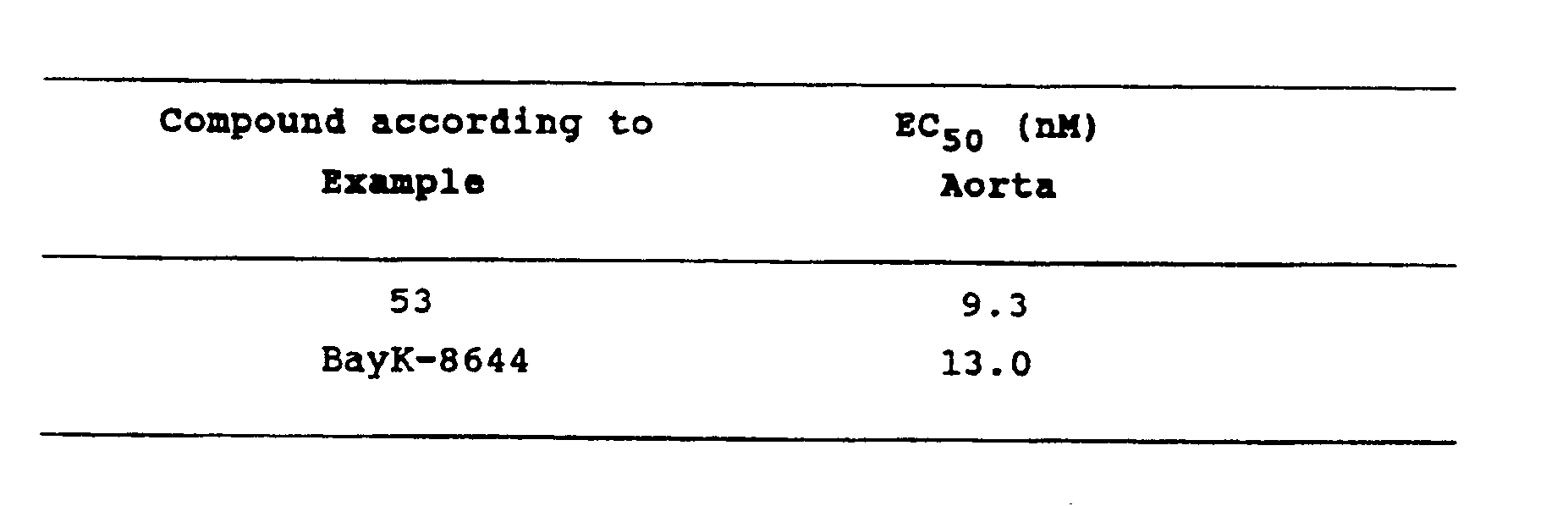
Claims (6)
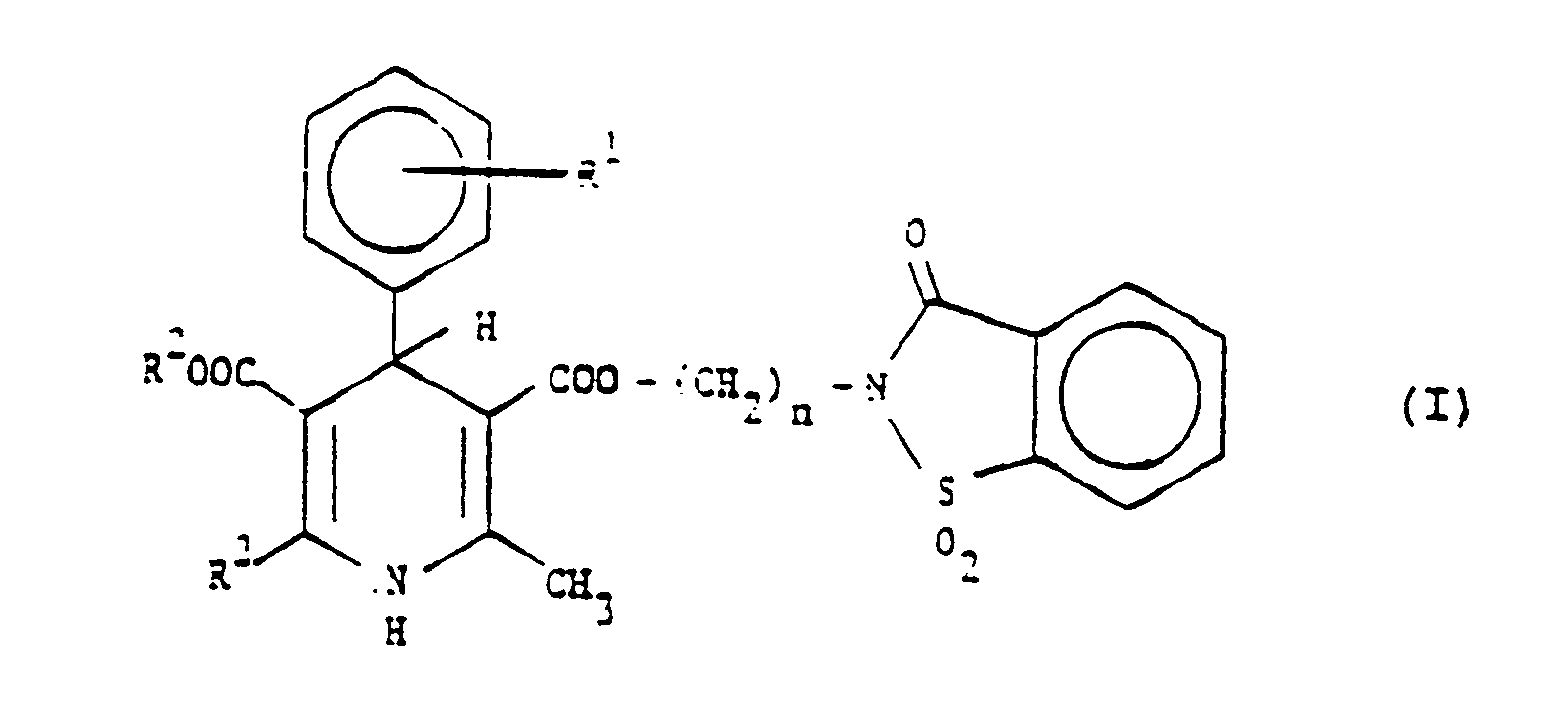
in which
2,6-dimethyl-5-isopropoxycarbonyl-4-(2-trifluoromethylphenyl)-1,4-dihydropyridine-3-carboxylic acid-2-[N-(1,2-benzisothiazolyl-3(2H)one-1,1-dioxide)]-ethylester,
4-(2,3-dichlorophenyl)-2,6-dimethyl-5-methoxycarbonyl-1,4-dihydropyridine-3-carboxylic acid-3-[N-(1,2-benzisothiazolyl-3(2H)one-1,1-dioxide)]-propylester,
4-(2,3-dichlorophenyl)-2,6-dimethyl-5-ethoxycarbonyl-1,4-dihydropyridine-3-carboxylic acid-3-[N-(1,2-benzisothiazolyl-3(2H)one-1,1-dioxide)]-propylester,
2,6-dimethyl-4-(3-nitrophenyl)-5-[(2-tetrahydropyranyl)-methoxycarbonyl]-1,4-dihydropyridine-3-carboxylic acid-2-[N-(1,2-benzisothiazolyl-3(2H)one-1,1-dioxide)]-ethylester,
5-tert.-butoxycarbonyl-2,6-dimethyl-4-(2-nitrophenyl)-1,4-dihydropyridine-3-carboxylic acid-2-[N-(1,2-benzisothiazolyl-3(2H)one-1,1-dioxide)]-ethylester,
5-tert.-butoxycarbonyl-4-(2,3-dichlorophenyl)-2,6-dimethyl-1,4-dihydropyridine-3-carboxylic acid-2-[N-(1,2-benzisothiazolyl-3(2H)one-1,1-dioxide)]-ethylester.

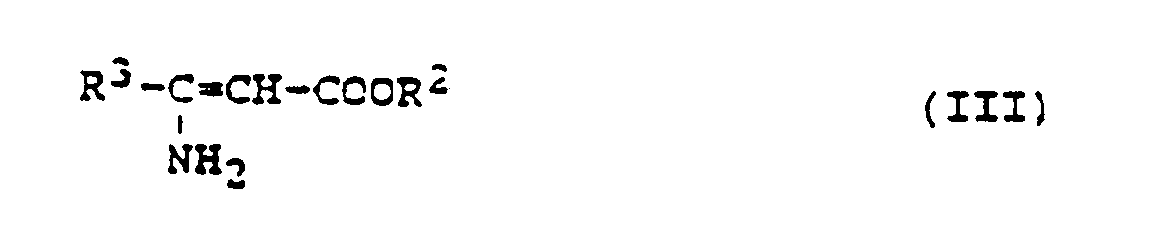


Applications Claiming Priority (3)
| Application Number | Priority Date | Filing Date | Title |
|---|---|---|---|
| DE4003541A DE4003541C1 (en) | 1990-02-06 | 1990-02-06 | |
| DE4003541 | 1990-02-06 | ||
| US08/396,214 US5691361A (en) | 1990-02-06 | 1995-02-28 | 1,4-dihydropyridine derivatives, a process for their preparation and their use for influencing the blood flow |
Publications (2)
| Publication Number | Publication Date |
|---|---|
| EP0441736A2 true EP0441736A2 (en) | 1991-08-14 |
| EP0441736A3 EP0441736A3 (en) | 1992-04-22 |
Family
ID=25889822
Family Applications (1)
| Application Number | Title | Priority Date | Filing Date |
|---|---|---|---|
| EP19910500012 Withdrawn EP0441736A3 (en) | 1990-02-06 | 1991-02-05 | New 1,4-dihydropyridine derivatives, a process for their preparation and their use for influencing the blood flow |
Country Status (7)
| Country | Link |
|---|---|
| US (1) | US5691361A (en) |
| EP (1) | EP0441736A3 (en) |
| JP (1) | JPH0714931B2 (en) |
| CA (1) | CA2035704A1 (en) |
| DE (1) | DE4003541C1 (en) |
| HU (1) | HU211090B (en) |
| RU (1) | RU2081869C1 (en) |
Cited By (3)
| Publication number | Priority date | Publication date | Assignee | Title |
|---|---|---|---|---|
| EP0550111A1 (en) * | 1991-12-30 | 1993-07-07 | Sterling Winthrop Inc. | 2-Saccharinylmethyl heterocyclic carboxylates useful as proteolytic enzyme inhibitors and pharmaceutical compositions containing them |
| WO1994021618A1 (en) * | 1993-03-16 | 1994-09-29 | Cermol S.A. | Nitric 1,2-benzo-isothiazolyl-3(2h)one-1,1-dioxide esters, preparation method therefor and drugs containing same |
| WO1995014018A1 (en) * | 1993-11-19 | 1995-05-26 | Laboratorios Alter, S.A. | New 1,4-dihidropyridine derivatives, process for their preparation and utilization as therapeutic agents |
Families Citing this family (2)
| Publication number | Priority date | Publication date | Assignee | Title |
|---|---|---|---|---|
| WO2001096308A1 (en) | 2000-06-12 | 2001-12-20 | Eisai Co., Ltd. | 1,2-dihydropyridine compounds, process for preparation of the same and use thereof |
| CN108707096B (en) * | 2018-05-07 | 2021-03-19 | 上海科技大学 | Process for preparing aminoalcohol derivatives |
Family Cites Families (5)
| Publication number | Priority date | Publication date | Assignee | Title |
|---|---|---|---|---|
| US4757071A (en) * | 1984-12-14 | 1988-07-12 | Nisshin Flour Milling Co., Ltd. | 1,4-dihydropyridine derivatives, and pharmaceutical compositions containing same, useful for treating cardiovascular diseases |
| US4652573A (en) * | 1985-03-14 | 1987-03-24 | Nelson Research & Development Co. | Calcium antagonist N-hetero ester 1,4-dihydropyridines |
| US4748182A (en) * | 1986-03-05 | 1988-05-31 | Merrell Dow Pharmaceuticals Inc. | Aromatic 2-aminoalkyl-1,2-benzoisothiazol-3(2H)one-1,1-dioxide derivatives and their use as anti-hypertensive and anxiolytic agents |
| DE3617976A1 (en) * | 1986-05-28 | 1988-01-14 | Alter Sa | 1,4-DIHYDROPYRIDINE, METHOD FOR THE PRODUCTION THEREOF AND THEIR USE IN ANTITHROMBOTIC MEDICATIONS |
| DE3821334A1 (en) * | 1988-06-24 | 1989-12-28 | Bayer Ag | 1,4-DIHYDROPYRIDINE-THREONINE DERIVATIVES, METHOD FOR THE PRODUCTION THEREOF, INTERMEDIATE PRODUCTS AND THEIR USE AS MEDICINAL PRODUCTS |
-
1990
- 1990-02-06 DE DE4003541A patent/DE4003541C1/de not_active Expired - Fee Related
-
1991
- 1991-02-05 HU HU91387A patent/HU211090B/en not_active IP Right Cessation
- 1991-02-05 RU SU914894623A patent/RU2081869C1/en active
- 1991-02-05 EP EP19910500012 patent/EP0441736A3/en not_active Withdrawn
- 1991-02-05 CA CA002035704A patent/CA2035704A1/en not_active Abandoned
- 1991-02-06 JP JP3037914A patent/JPH0714931B2/en not_active Expired - Lifetime
-
1995
- 1995-02-28 US US08/396,214 patent/US5691361A/en not_active Expired - Fee Related
Cited By (5)
| Publication number | Priority date | Publication date | Assignee | Title |
|---|---|---|---|---|
| EP0550111A1 (en) * | 1991-12-30 | 1993-07-07 | Sterling Winthrop Inc. | 2-Saccharinylmethyl heterocyclic carboxylates useful as proteolytic enzyme inhibitors and pharmaceutical compositions containing them |
| US5376653A (en) * | 1991-12-30 | 1994-12-27 | Sterling Winthrop Inc. | 2-saccharinylmethyl heterocyclic carboxylates useful as proteolytic enzyme inhibitors |
| US5488062A (en) * | 1991-12-30 | 1996-01-30 | Sterling Winthrop Inc. | 2-saccharinylmethyl heterocyclic carboxylates useful as proteolytic enzyme inhibitors and compositions and method of use thereof |
| WO1994021618A1 (en) * | 1993-03-16 | 1994-09-29 | Cermol S.A. | Nitric 1,2-benzo-isothiazolyl-3(2h)one-1,1-dioxide esters, preparation method therefor and drugs containing same |
| WO1995014018A1 (en) * | 1993-11-19 | 1995-05-26 | Laboratorios Alter, S.A. | New 1,4-dihidropyridine derivatives, process for their preparation and utilization as therapeutic agents |
Also Published As
| Publication number | Publication date |
|---|---|
| RU2081869C1 (en) | 1997-06-20 |
| JPH04211080A (en) | 1992-08-03 |
| HU211090B (en) | 1995-10-30 |
| DE4003541C1 (en) | 1991-08-08 |
| EP0441736A3 (en) | 1992-04-22 |
| CA2035704A1 (en) | 1991-08-07 |
| US5691361A (en) | 1997-11-25 |
| HU910387D0 (en) | 1991-08-28 |
| HUT60737A (en) | 1992-10-28 |
| JPH0714931B2 (en) | 1995-02-22 |
Similar Documents
| Publication | Publication Date | Title |
|---|---|---|
| EP0071819A1 (en) | Dihydropyridines with a positive inotropic activity, their use in pharmaceutical preparations, and processes for their preparation | |
| HU194171B (en) | Process for preparing asymmetric diesters of 1,4-dihydro-2,6-dimethyl-pyridine-3,5-dicarboxylic acid and pharmaceuticals comprising such compounds | |
| RU2036922C1 (en) | 1,4-dihydropyridine derivatives or their hydrochlorides showing antagonistic properties with respect to calcium ions | |
| WO2002079158A1 (en) | Novel amlodipine camsylate and method for preparing thereof | |
| AU2002243069A1 (en) | Novel amlodipine camsylate and method for preparing thereof | |
| CZ281597B6 (en) | Enantiomers of 1,4-dihydropyridine, process of their preparation and pharmaceutical compositions prepared therefrom | |
| CA2525700C (en) | S-(-)-amlodipine nicotinate and process for the preparation thereof | |
| EP0197488A2 (en) | 1,4-Dihydropyiridine derivative, a process for preparing the same, a pharmaceutical composition as well as the use thereof | |
| US5691361A (en) | 1,4-dihydropyridine derivatives, a process for their preparation and their use for influencing the blood flow | |
| HU184434B (en) | Process for preparing 1,4-dihydro-pyridine derivatives containing different substituents in position 2. and 6. and pharmaceutical compositions containing such compounds as active substances | |
| EP0220653B1 (en) | 3-aminocarbonyl-1,4-dihydropyridine-5-carboxylic acid compounds, process for preparation and use thereof, and pharmaceutical composition containing the same | |
| WO2009092301A1 (en) | Dihydropyridine calcium antagonist compounds, preparation methods and medical uses thereof | |
| FR2528431A1 (en) | NOVEL 1,4-DIHYDROPYRIDINE DERIVATIVES, THEIR PREPARATION AND THEIR USE AS MEDICAMENTS | |
| JPH0379359B2 (en) | ||
| IE43984B1 (en) | A 1,4-dihydropyridine-3 5-dicarboxylic acid di-ester derivative, several processes for its preparation,and its use as a coronary therapeutic agent | |
| JPS6289662A (en) | 1,4-dihydropyridine derivative | |
| EP0220917B1 (en) | 1,4-dihydropyridine pharmaceutical derivatives and their salts, and the preparation thereof | |
| JPS58210063A (en) | Novel dihydropyridines | |
| JPH0155268B2 (en) | ||
| EP0216542B1 (en) | Dihydropyridine derivatives | |
| CA2278223C (en) | 1,4-dihydropyridin derivatives and their use in therapy | |
| JPH0480026B2 (en) | ||
| JPH0465073B2 (en) | ||
| JPH054396B2 (en) | ||
| SE442298B (en) | 2, 3-dimethyl-4-(2, 3-dichlorphenyl)-1, 4-dihydropyridin-3, 5-dicarboxioxygen-3-methylester-5-ethylester in optically active form. |
Legal Events
| Date | Code | Title | Description |
|---|---|---|---|
| PUAI | Public reference made under article 153(3) epc to a published international application that has entered the european phase |
Free format text: ORIGINAL CODE: 0009012 |
|
| AK | Designated contracting states |
Kind code of ref document: A2 Designated state(s): AT BE CH DK ES FR GB GR IT LI LU NL SE |
|
| RIN1 | Information on inventor provided before grant (corrected) |
Inventor name: ALONSO, SALVADOR Inventor name: PRIEGO, JAIME Inventor name: FAU DE CASA-JUANA, MIGUEL Inventor name: GARCIA, ANTONIO Inventor name: SUNKEL, CARLOS Inventor name: SANTOS, LUIS |
|
| PUAL | Search report despatched |
Free format text: ORIGINAL CODE: 0009013 |
|
| AK | Designated contracting states |
Kind code of ref document: A3 Designated state(s): AT BE CH DK ES FR GB GR IT LI LU NL SE |
|
| 17P | Request for examination filed |
Effective date: 19920616 |
|
| 17Q | First examination report despatched |
Effective date: 19940629 |
|
| GRAG | Despatch of communication of intention to grant |
Free format text: ORIGINAL CODE: EPIDOS AGRA |
|
| GRAH | Despatch of communication of intention to grant a patent |
Free format text: ORIGINAL CODE: EPIDOS IGRA |
|
| GRAH | Despatch of communication of intention to grant a patent |
Free format text: ORIGINAL CODE: EPIDOS IGRA |
|
| STAA | Information on the status of an ep patent application or granted ep patent |
Free format text: STATUS: THE APPLICATION HAS BEEN WITHDRAWN |
|
| 18W | Application withdrawn |
Withdrawal date: 19970312 |