EP0442097A2 - Poly(arylenevinylene siloxanes) - Google Patents
Poly(arylenevinylene siloxanes) Download PDFInfo
- Publication number
- EP0442097A2 EP0442097A2 EP90124497A EP90124497A EP0442097A2 EP 0442097 A2 EP0442097 A2 EP 0442097A2 EP 90124497 A EP90124497 A EP 90124497A EP 90124497 A EP90124497 A EP 90124497A EP 0442097 A2 EP0442097 A2 EP 0442097A2
- Authority
- EP
- European Patent Office
- Prior art keywords
- poly
- siloxanes
- radicals
- arylenevinylene
- mol
- Prior art date
- Legal status (The legal status is an assumption and is not a legal conclusion. Google has not performed a legal analysis and makes no representation as to the accuracy of the status listed.)
- Granted
Links
Classifications
-
- G—PHYSICS
- G03—PHOTOGRAPHY; CINEMATOGRAPHY; ANALOGOUS TECHNIQUES USING WAVES OTHER THAN OPTICAL WAVES; ELECTROGRAPHY; HOLOGRAPHY
- G03F—PHOTOMECHANICAL PRODUCTION OF TEXTURED OR PATTERNED SURFACES, e.g. FOR PRINTING, FOR PROCESSING OF SEMICONDUCTOR DEVICES; MATERIALS THEREFOR; ORIGINALS THEREFOR; APPARATUS SPECIALLY ADAPTED THEREFOR
- G03F7/00—Photomechanical, e.g. photolithographic, production of textured or patterned surfaces, e.g. printing surfaces; Materials therefor, e.g. comprising photoresists; Apparatus specially adapted therefor
- G03F7/004—Photosensitive materials
- G03F7/075—Silicon-containing compounds
- G03F7/0757—Macromolecular compounds containing Si-O, Si-C or Si-N bonds
-
- C—CHEMISTRY; METALLURGY
- C08—ORGANIC MACROMOLECULAR COMPOUNDS; THEIR PREPARATION OR CHEMICAL WORKING-UP; COMPOSITIONS BASED THEREON
- C08G—MACROMOLECULAR COMPOUNDS OBTAINED OTHERWISE THAN BY REACTIONS ONLY INVOLVING UNSATURATED CARBON-TO-CARBON BONDS
- C08G77/00—Macromolecular compounds obtained by reactions forming a linkage containing silicon with or without sulfur, nitrogen, oxygen or carbon in the main chain of the macromolecule
- C08G77/48—Macromolecular compounds obtained by reactions forming a linkage containing silicon with or without sulfur, nitrogen, oxygen or carbon in the main chain of the macromolecule in which at least two but not all the silicon atoms are connected by linkages other than oxygen atoms
- C08G77/50—Macromolecular compounds obtained by reactions forming a linkage containing silicon with or without sulfur, nitrogen, oxygen or carbon in the main chain of the macromolecule in which at least two but not all the silicon atoms are connected by linkages other than oxygen atoms by carbon linkages
- C08G77/52—Macromolecular compounds obtained by reactions forming a linkage containing silicon with or without sulfur, nitrogen, oxygen or carbon in the main chain of the macromolecule in which at least two but not all the silicon atoms are connected by linkages other than oxygen atoms by carbon linkages containing aromatic rings
-
- C—CHEMISTRY; METALLURGY
- C08—ORGANIC MACROMOLECULAR COMPOUNDS; THEIR PREPARATION OR CHEMICAL WORKING-UP; COMPOSITIONS BASED THEREON
- C08G—MACROMOLECULAR COMPOUNDS OBTAINED OTHERWISE THAN BY REACTIONS ONLY INVOLVING UNSATURATED CARBON-TO-CARBON BONDS
- C08G77/00—Macromolecular compounds obtained by reactions forming a linkage containing silicon with or without sulfur, nitrogen, oxygen or carbon in the main chain of the macromolecule
- C08G77/60—Macromolecular compounds obtained by reactions forming a linkage containing silicon with or without sulfur, nitrogen, oxygen or carbon in the main chain of the macromolecule in which all the silicon atoms are connected by linkages other than oxygen atoms
-
- C—CHEMISTRY; METALLURGY
- C09—DYES; PAINTS; POLISHES; NATURAL RESINS; ADHESIVES; COMPOSITIONS NOT OTHERWISE PROVIDED FOR; APPLICATIONS OF MATERIALS NOT OTHERWISE PROVIDED FOR
- C09K—MATERIALS FOR MISCELLANEOUS APPLICATIONS, NOT PROVIDED FOR ELSEWHERE
- C09K19/00—Liquid crystal materials
- C09K19/04—Liquid crystal materials characterised by the chemical structure of the liquid crystal components, e.g. by a specific unit
- C09K19/40—Liquid crystal materials characterised by the chemical structure of the liquid crystal components, e.g. by a specific unit containing elements other than carbon, hydrogen, halogen, oxygen, nitrogen or sulfur, e.g. silicon, metals
- C09K19/406—Liquid crystal materials characterised by the chemical structure of the liquid crystal components, e.g. by a specific unit containing elements other than carbon, hydrogen, halogen, oxygen, nitrogen or sulfur, e.g. silicon, metals containing silicon
- C09K19/408—Polysiloxanes
Definitions
- the invention relates to poly (arylenevinylene siloxanes), processes for their preparation and their use.
- poly (arylene vinylene siloxane) is also intended to include the polymers which contain silanes or silcarbanes as the silicon-functional unit.
- Organopolysiloxanes are of great interest because they have a high thermo-oxidative resistance and extreme cold flexibility as well as a low temperature dependence of their physical constants. In terms of their mechanical properties, such as their tensile, tear and peel strength, they are usually inferior to organic polymers. In order to avoid this disadvantage, attempts have been made to modify organopolysiloxanes with organic compounds.
- the organic compounds are, in particular, those compounds which contain aromatic or heterocyclic structural elements or have functional groups such as ester and amide radicals. For example, see DE-PS 14 45 357 (RL Merker, Dow Corning Corp .; issued February 6, 1969) and RL Merker, MJ Scott, GG Haberland, J. Polym.
- Patent 4,147,711 (issued April 3, 1979), U.S. Patent 4,213,914 (issued May 23, 1987). July 1980) and US Pat. No. 4,275,184 (issued June 23, 1981), H. Kuckertz, Makromol. Chem. 98 (1966) 101-8 may be mentioned here as an example of poly (imidosiloxanes) V. Percec, J. Polym. Sci .: Part A 26 (1988) 2047-76, siloxane polymers with stilbenes as side groups, and numerous other attempts to modify polysiloxanes with organic compounds are known.
- the object was to provide thermoplastic siloxane elastomers. This object is achieved by the invention.
- the invention relates to poly (arylenevinylene siloxanes), processes for their preparation and their use.
- Preferred radicals R are hydrocarbon radicals having 1 to 12 carbon atoms, which are optionally substituted by halogen atoms, ether groups, ester groups, epoxy groups or cyano groups.
- hydrocarbon radicals R are alkyl radicals, such as the methyl, ethyl, n-propyl, iso-propyl, 1-n-butyl, 2-n-butyl, iso-butyl, tert-butyl, n Pentyl, iso-pentyl, neo-pentyl, tert-pentyl, hexyl, such as the n-hexyl, heptyl, such as the n-heptyl, octyl, such as the n-octyl and iso-octyl, such as the second , 2,4-trimethylpentyl radical, nonyl radicals, such as the n-nonyl radical, decyl radicals, such as the n-decyl radical, dodecyl radicals, such as the n-dodecyl radical; Cycloalkyl radicals, such as cyclopent
- substituted hydrocarbon radicals R are cyanalkyl radicals, such as the ⁇ -cyanoethyl radical, and halogenated hydrocarbon radicals, for example haloalkyl radicals, such as the 3,3,3-trifluoro-n-propyl radical, the 2,2,2,2 ', 2', 2 ' -Hexafluoroisopropyl radical, the heptafluoroisopropyl radical, and haloaryl radicals, such as the o-, m- and p-chlorophenyl radical.
- haloalkyl radicals such as the 3,3,3-trifluoro-n-propyl radical, the 2,2,2,2 ', 2', 2 ' -Hexafluoroisopropyl radical, the heptafluoroisopropyl radical
- haloaryl radicals such as the o-, m- and p-chlorophenyl radical.
- the radicals R are particularly preferably the methyl, ethyl-3,3,3-trifluoro-n-propyl and the phenyl radical.
- Preferred radicals R 1 are hydrogen atom, halogen atom, nitro group, cyano group, alkoxy, alkoxycarbonyl and acyloxy groups and hydrocarbon radicals having 1 to 12 carbon atoms, which can optionally be substituted by halogen atoms.
- radical R1 examples include the radicals mentioned above as examples of radical R and alkoxy groups, such as methoxy, ethoxy or n-propyloxy groups, alkoxycarbonyl groups, such as methoxycarbonyl, ethoxycarbonyl or n-propyloxycarbonyl groups, and acyloxy groups, such as acetoxy or benzoyloxy groups.
- radicals R 1 are hydrogen atom, methyl, phenyl, methoxy, methoxycarbonyl, acetoxy and benzoyloxy groups as well as fluorine and chlorine.
- Preferred radicals R 2 are divalent, optionally substituted hydrocarbon radicals having 1 to 20 carbon atoms, which can be substituted by ether oxygen atoms.
- radicals R2 are alkylene radicals, such as methylene, ethylene, n-propylene, iso-propylene, 1-n-butylene, 2-n-butylene, iso-butylene, tert-butylene, n-pentylene, iso-pentylene, neo-pentylene, tert-pentylene, hexylene, such as the n-hexylene, heptylene, such as the n-heptylene, octylene, such as the n-octylene and iso-octylene, such as 2,2,4-trimethylpentylene radical, nonylene radicals such as the n-nonylene radical, decylene radicals such as the n-decylene radical, dodecylene radicals such as the n-dodecylene radical, octadecylene radicals such as the n-octadec
- substituted radicals R2 are cyanalkylene radicals, such as the ⁇ -cyanethylene radical, and halogenated hydrocarbon radicals, for example haloalkylene radicals, such as the 3,3,3-trifluoro-n-propylene radical, the 2,2,2,2 ', 2', 2 ' -Hexafluoroisopropylene, and haloarylene, such as the o-, m-, and p-chlorophenylene.
- cyanalkylene radicals such as the ⁇ -cyanethylene radical
- halogenated hydrocarbon radicals for example haloalkylene radicals, such as the 3,3,3-trifluoro-n-propylene radical, the 2,2,2,2 ', 2', 2 ' -Hexafluoroisopropylene, and haloarylene, such as the o-, m-, and p-chlorophenylene.
- the R3 radicals are particularly preferably oxygen atoms.
- R3 radical is a divalent SiC-bonded radical
- hydrocarbon radicals having 1 to 30 carbon atoms which may be substituted by ether oxygen atoms, such as, for example, oligooxymethylene or oligooxyethylene groups are preferred.
- the vinylene groups contained in the poly (arylene vinylene siloxanes) according to the invention can have the cis or trans configuration, poly (arylene vinylene siloxanes) with trans-configured vinylene groups being preferred.
- the arylene groups - (C6R14) - can in the poly (arylenevinylene siloxanes) according to the invention with the vinylene groups or the -O w -R2 groups, where R1, R2 and w have the meaning given above, relative to that with the respective arylene group still linked vinylene or arylene group in the 1,2- (ortho-), 1,3- (meta-) or 1,4- (para) positions, the link being via the 1.4 -Positions is preferred.
- the recurring arylene vinylene siloxane units according to formula (I) can be the same or different.
- up to 50 percent of the hydrogen atoms of the vinylene groups can be replaced by alkyl groups, in particular by methyl groups.
- the poly (arylenevinylene siloxanes) according to the invention can be prepared by processes known per se.
- the poly (arylenevinylene siloxanes) according to the invention are preferably prepared by reacting ⁇ , ⁇ -dialkenylarylenevinylene with an organosilicon compound having two Si-bonded hydrogen atoms in the presence of a catalyst which promotes the addition of Si-bonded hydrogen to an aliphatic multiple bond.
- Preferred radicals R4 are monovalent, optionally substituted hydrocarbon radicals having 1 to 20 carbon atoms which have a terminal aliphatic carbon-carbon double bond.
- radical R4 examples are the vinyl radical, allyl radical, n-but-3-enyl radical, n-hex-5-enyl radical, n-undec-10-enyl radical and the n-undec-10-enoyl radical.
- up to 50 percent of the hydrogen atoms of the vinylene groups can be replaced by alkyl groups, preferably by methyl groups.
- the ⁇ , ⁇ -dialkenylarylenevinylene used according to the invention can be a single type of ⁇ , ⁇ -dialkenylarylenevinylene. However, it can also be a mixture of at least two different types of such ⁇ , ⁇ -dialkenylarylenevinylenes.
- the reaction of phosphonate with aldehyde to produce the ⁇ , ⁇ -dialkenylarylene vinyl used in the process according to the invention is advantageously carried out in a solvent which is inert with respect to the reactants, such as aromatic hydrocarbons such as benzene, toluene, xylene and ethylbenzene, phenol ethers such as anisole and 1 , 2-dimethoxybenzene, aliphatic ethers, such as diethyl ether, tert-butyl methyl ether, 1,2-dimethoxyethane, tetrahydrofuran, dioxane, or carboxamides, such as N, H-dimethylformamide, N, N-dimethylacetamide or N-methylpyrrolidone, with toluene, Anisole and tetrahydrofuran are preferred.
- aromatic hydrocarbons such as benzene, toluene, xylene and eth
- the reaction of phosphonate with aldehyde is preferably carried out at a temperature between -10 and 160 ° C and at a pressure of 900 to 3000 hPa.
- the phosphonates of the formula (III) used in the preparation of the ⁇ , ⁇ -dialkenylarylene vinyls used in the process according to the invention can be prepared by processes known per se. For example, see U.S. Patent 4,371,475 (Showa Kagaku Kogyo, issued February 1, 1983), U.S. Patent 4,108,887 (Sandoz AG, issued August 22, 1978) and GB-OS 1,247,934 (K. Weber; Ciba Ltd .) referenced.
- the phosphonates of the formula (III) are preferably prepared from the corresponding bromine or chlorine compounds by reaction with trialkyl phosphite, both trialkyl phosphite and the abovementioned bromine or chlorine compounds being commercially available or can be prepared by methods customary in organic chemistry.
- aldehydes according to formula (V) are 4-allyloxybenzaldehyde, 4-allyloxy-3-methoxy-benzaldehyde, 4- (3-butenyl) benzaldehyde and 4- (10-undecenoyloxy) benzaldehyde, 4-allyloxy-3-methoxy-benzaldehyde and 4- (3-butenyl) benzaldehyde are particularly preferred.
- aldehydes used to prepare the ⁇ , ⁇ -dialkenylarylene vinyl used in the process according to the invention can be prepared by processes known per se, such as, for example, etherification of p-hydroxybenzaldehyde with corresponding alkenyl halides or tosylates.
- processes known per se such as, for example, etherification of p-hydroxybenzaldehyde with corresponding alkenyl halides or tosylates.
- aldehydes according to formula (V) are prepared by Grignard reaction of 4-alkenyl-1-chlorobenzene, which is obtained from the corresponding alkenylmagnesium chloride and 4-chlorobenzyl chloride, with N, N-dimethylformamide.
- reaction conditions of this reaction can be the same as in the above-described reaction of phosphonate according to formula (III) with aldehyde according to formula (IV), with the difference that two moles of phosphonate and two moles of base are used per mole of aldehyde In the case of potassium carbonate, 3 mol are preferably used as the base.
- phosphonates are preferred as phosphonates according to formula (VI) 4-allyloxybenzylphosphonate 4-allyloxy-3-methoxybenzylphosphonate, 4-allyloxy-3-methylbenzylphosphonate and 4-but-3-enylbenzylphosphonate.
- the phosphonates of the formula (VI) can also be prepared from the corresponding bromine or chlorine compounds with trialkyl phosphite, the abovementioned bromine or chlorine compounds and trialkyl phosphite being commercially available or can be prepared by methods which are common in organic chemistry.
- 4-butenylbenzyl chloride can be prepared from allyl magnesium chloride and 1,4-bis (chloromethyl) benzene.
- Preferred dialdehydes are Terephthalaldehyde, 4,4'-biphenyldialdehyde, 4,4'-stilbenedialdehyde and 1,4-bis (4-formylstyryl) benzene.
- dialdehydes according to formula (VII) can be prepared by processes known per se. For example, reference is made to EP-OS 229 592 (Ciba-Geigy AG; issued July 22, 1987).
- Monomeric arylenevinylenes according to formula (II), in particular distyrylbenzene and bisstilbene derivatives, are widely used as fluorescent dyes, for example as optical brighteners in the textile industry, and as laser dyes.
- the organosilicon compound which has two Si-bonded hydrogen atoms and is used in the process according to the invention is preferably of the formula wherein R, R3 and x have one of the meanings given above.
- organosilicon compound having two Si-bonded hydrogen atoms used in the process according to the invention are H- [Si (CH3) 2-O] 4-Si (CH3) 2-H H- [Si (CH3) 2-O] 9-Si (CH3) 2-H H-Si (CH3) 2-O- [Si (CH3) (C6H5) -O] 15-Si (CH3) 2-H H-Si (CH3) 2-O- [Si (CH3) (C8H17) -O] 18-Si (CH3) 2-H H-Si (CH3) 2-O- [Si (C2H5) 2-O] 10-Si (CH3) 2-H H-Si (CH3) 2-O - ([Si (CH3) 2-O] [Si (CH3) (C6H5) -O]) 8-Si (CH3) 2-H where CH3 is methyl, C2H5 ethyl, C6H5 phenyl and C8H17 isooctyl.
- the viscosity of the organosilicon compound containing two Si-bonded hydrogen atoms used in the process according to the invention is preferably between 0.7 and 200 mm2 / s, particularly preferably between 1 and 50 mm2 / s.
- an organosilicon compound having two Si-bonded hydrogen atoms are ⁇ , ⁇ -dihydrogendiorgano (poly) siloxanes, in particular ⁇ , ⁇ -dihydrogendimethyl (poly) siloxanes, with 3 to 20 silicon atoms.
- organosilicon compounds used according to the invention with two Si-bonded hydrogen atoms are commercially available products or can be prepared by methods customary in silicon chemistry. For this, see, for example, W. Noll, "Chemistry and Technology of Silicones", Academic Press, Orlando, 1968, page 191 ff and M. Wick, G. Kreis, F.-H.dorfer, "Silicone”, in “Ullmann's Encyclopedia of Technical Chemistry”, Verlag Chemie, Weinheim, 4th ed., 1982, vol. 21, page 511 ff.
- Longer chain ⁇ , ⁇ -Dihydrogensiloxane may be prepared by cohydrolysis of Chlordiorganosiloxanen and Dichlordiorganosiloxanen, by cationic polymerization of Octaorganocyclotetrasiloxanen in the presence of 1,3-Dihydrogentetraalkyldisiloxan or by equilibration of long-chain OH-terminated diorganopolysiloxanes or Octaorganocyclotetrasiloxanen, with 1,3-Dihydrogentetraalkyldisiloxan acid in the presence of catalysts such as PNCl2, or acidic ion exchangers, such as Amberlyst 15 or Amberlyst XN-1010 (in each case anhydrous form).
- catalysts such as PNCl2
- acidic ion exchangers such as Amberlyst 15 or Amberlyst XN-1010 (in each case anhydrous form).
- the organosilicon compound which has two Si-bonded hydrogen atoms and is used according to the invention can be a single type of organosilicon compound which has two Si-bonded hydrogen atoms. However, it can also be a mixture of at least two different types of such organosilicon compounds.
- the molar ratio of ⁇ , ⁇ -dialkenylarylenevinylene to organosilicon compound with two Si-bonded hydrogen atoms in the reaction mass is preferably between 1: 0.7 and 1: 1.3, particularly preferably at 1: 1. If the molar ratio of ⁇ , ⁇ -dialkenylarylenevinylene to organosilicon compound with two Si-bonded hydrogen atoms deviates significantly from 1: 1, for example 1: 0.7 or 1: 1.3, so-called prepolymers are obtained, which each have only the end groups in the Have excess component used.
- the catalysts used can be the same ones which have hitherto also been used for the attachment of Si-bonded hydrogen atoms to aliphatic multiple bonds.
- These are mainly metals from subgroup 8 and their inorganic and organic compounds, with platinum and its compounds being preferred.
- catalysts are on an inert support, such as activated carbon, SiO2 or Al2O3, deposited, finely divided elemental platinum according to US Pat. No. 2,970,150 (DL Bailey, Union Carbide Corporation; issued January 31, 1961), hexachloroplatinic acid according to US Pat. No. 2,823,218 ( JL Speier, Dow Corning Corporation; issued February 11, 1958) and derived chloroplatinates, platinum complexes of the type L ⁇ PtCl2, where L is a linear or cyclic monoolefin such as ethene, propene and cyclohexene, according to US Pat. Nos. 3,159,601 and US -PS 3,159,662 (Bruce A.
- platinum complexes of the type L ⁇ PtCl2, where L is a cyclic di- or polyolefin, in particular dicyclopentadiene-platinum dichloride, are particularly preferably used because of their high effectiveness.
- the catalyst used according to the invention can be a single type of catalyst as well as a mixture of at least two different types of such catalysts.
- the amounts of catalyst used in the process according to the invention can be the same as in the previously known processes for attaching Si-bonded hydrogen to aliphatic multiple bonds in the presence of catalyst. These are preferably 0.1 to 1000 ppm by weight, particularly preferably 5 to 150 ppm by weight, each calculated as elemental platinum, based on the total weight of the reaction mass. In platinum complexes of the type L ⁇ PtCl2, where L is a cyclic di- or polyolefin, in particular dicyclopentadiene-platinum dichloride, as a catalyst, concentrations between 20 and 100 ppm by weight, calculated as elemental platinum, based on the total weight of the reaction mass, are completely sufficient.
- the process according to the invention can be carried out in the presence or in the absence of solvent, the term solvent not meaning that all Reaction components in these must solve.
- the reaction can also be carried out in emulsion or suspension of one or more reactants.
- organic solvent which is inert with respect to the reaction mass, in particular such solvent in which at least part, preferably completely, of the poly (arylene vinylene siloxane) prepared according to the invention dissolves.
- solvents examples include alcohols, such as methanol, ethanol, n-propanol, isopropanol, n-, sec- and tert-butanol and 2-butanol; Esters such as methyl acetate, ethyl acetate, n- and iso-propyl acetate, n-, sec- and tert-butyl acetate, ethyl formate and diethyl carbonate; Ethers such as dioxane, tetrahydrofuran, diethyl ether, di-n-propyl ether, diisopropyl ether, di-n-butyl ether, 1,2-dimethoxybenzene and anisole; chlorinated hydrocarbons such as dichloromethane, trichloromethane, carbon tetrachloride, 1,2-dichloroethane, 1,1,1-trichloroethane, trichlorethylene, tetrachlorethylene
- solvents are used in amounts of preferably 20 to 99 percent by weight, particularly preferably 50 to 95 percent by weight, in each case based on the total weight of the reaction mass.
- temperatures and pressures used in the process according to the invention can be the same as in the previously known processes for adding Si-bonded hydrogen to an aliphatic multiple bond in the presence of a catalyst. These are preferably temperatures between 0 and 180 ° C and pressures between 900 and 1100 hPa, temperatures between 80 and 150 ° C being particularly preferred. If desired, higher or lower pressures can also be used.
- ⁇ , ⁇ -dialkenylarylene vinylene, two Si-bonded hydrogen atoms containing organosilicon compound, catalyst and optionally solvent are mixed in any manner known per se.
- the reaction mass in addition to ⁇ , ⁇ -dialkenylarylene vinylene, organosilicon compound with two Si-bonded hydrogen atoms, catalyst and optionally solvent, can also be used for other substances, for example selected from the group comprising the addition of Si -bonded hydrogen to aliphatic multiple bond retarding agents, chain limiting agents and crosslinking agents.
- Si-bonded hydrogen examples include benzotriazole and 2-methyl-3-butyn-2-ol.
- chain limiting agents are compounds with an Si-bonded hydrogen atom, such as trimethyl, triethyl and diethylmethylsilane, and compounds with an aliphatic carbon-carbon multiple bond, such as Trimethylvinylsilane, triethylvinylsilane, styrene, allylbenzene and N-allylphthalimide.
- crosslinkers are trifunctional compounds, such as triallyl isocyanurate, glycerol triallyl ether, 1,3,5-triallylbenzyl tricarboxylate and 1,3,5-triallylbenzene, and polyfunctional compounds, such as linear or cyclic methylvinyl or methylhydrogen (poly) siloxanes, which in addition to the methylvinyl or methylhydrosiloxane units can also have dimethylsiloxane units.
- trifunctional compounds such as triallyl isocyanurate, glycerol triallyl ether, 1,3,5-triallylbenzyl tricarboxylate and 1,3,5-triallylbenzene
- polyfunctional compounds such as linear or cyclic methylvinyl or methylhydrogen (poly) siloxanes, which in addition to the methylvinyl or methylhydrosiloxane units can also have dimethylsiloxane units.
- the process according to the invention can be carried out in continuous, semi-continuous and discontinuous operation.
- a reaction participant for example the organosilicon compound having two Si-bonded hydrogen atoms, optionally in a mixture with solvent, is added dropwise to a mixture containing the other reaction participant, for example a mixture of ⁇ , ⁇ -dialkenylarylenevinylene, catalyst and, if appropriate, solvent and further components, with stirring .
- the reaction mass is by conventional methods such as distillation, filtration and reprecipitation , worked up.
- the poly (arylenevinylene-siloxane) according to the invention is obtained with a yield of generally more than 70%, based on ⁇ , ⁇ -dialkenylarylenevinylene and two Si-bonded organosilicon compounds containing hydrogen atoms.
- the poly (arylene vinylene siloxanes) produced by the process according to the invention preferably have an average molecular weight (weight average) M w between 5,000 and 500,000, particularly preferably between 15,000 and 150,000.
- the proportion of siloxane that is to say the proportion by weight of the organosilicon compound in the poly (arylenevinylene-siloxane) produced according to the invention, is preferably between 20 and 95 percent by weight, particularly preferably between 35 and 80 percent by weight.
- the poly (arylene vinylene siloxanes) according to the invention have a stable fluorescent inherent color and the property profile of thermoplastic elastomers with very good mechanical properties.
- the poly (arylenevinylene siloxanes) according to the invention are notable for very high thermooxidative resistance. With a few exceptions, almost all poly (arylene vinylene siloxanes), especially those with trans-configured vinylene groups and with siloxane components of 35 to 80 percent by weight, show liquid-crystalline behavior, the mesophases of the poly (arylene vinylene siloxanes) generally extending over large temperature ranges . The clearing point and the glass point are generally lower, the higher the siloxane content.
- polystyrene siloxanes There are numerous possible uses for the poly (arylene vinylene siloxanes) according to the invention. For example, they are suitable for the production of molding compounds using thermoplastic processing methods such as injection molding or extrusion.
- the poly (arylene vinylene siloxane) according to the invention such as fillers, pigments, processing aids and fluorescence quenchers.
- the poly (arylene vinylene siloxanes) according to the invention can be added to other polymers in order to impart fluorescence properties to them.
- the poly (arylenevinylene siloxanes) according to the invention can be crosslinked to form thermosets.
- the poly (arylenevinylsiloxanes) according to the invention in particular those of the formula (I) where R 1 is hydrogen and y is 1, can be crosslinked in a relatively simple manner by means of photochemical (2 + 2) cycloaddition when irradiation occurs in the region of their absorption band.
- the thermosets obtained are generally colorless transparent and have very good mechanical properties.
- the poly (arylene vinylene siloxanes) according to the invention can also be used in the field of optical information storage and for laser-optical applications, such as for storing holograms.
- the poly (arylene vinylene siloxanes) according to the invention can be used for photoresist materials with high resolution.
- the average molecular weight M w and the average degree of polymerization P w were determined by gel permeation chromatography relative to polystyrene standards with the aid of a high-pressure liquid chromatograph using polystyrene gel columns and tetrahydrofuran as eluent.
- Thermoanalytical measurements were carried out at a heating rate of 10 ° / min.
- the glass point T g and clearing point T i were taken from the 2nd run of the differential thermal analysis (DTA) curve and the decomposition temperature - 5% weight loss - from the thermogravimetry (TG) curve.
- DTA differential thermal analysis
- TG thermogravimetry
- the layer spacing d was determined by small-angle X-ray diffraction experiments.
- the filtrate consists of an equilibrate, from which low-molecular components are removed by distillation at a temperature of 50 ° C. and a pressure of 13 hPa.
- the residue thus obtained (110.7 g) consists of an ⁇ , ⁇ -dihydrogendimethyl (poly) siloxane mixture with an average chain length of 12 siloxane units.
- This ⁇ , ⁇ -dihydrogendimethyl (poly) siloxane mixture can be used directly in the method according to the invention.
- Dicyclopentadiene-platinum dichloride (dicpPtCl2) according to US Pat. No. 4,276,252 (G. Kreis, Wacker-Chemie GmbH; issued June 30, 1981) is produced by methods known from the literature (J.Chatt, LMVallarino, LMVenanzi, J.Chem.Soc. (London) (1957) 2496-505 and HCClark, LEManzer, J. Organometal. Chem. 59 (1973) 411-28).
- the poly (arylene vinylene siloxane) according to the invention has an inherent viscosity of 0.28 dl / g, a glass point Tg at 105 ° C, a decomposition temperature at 350 ° C in air and at 405 ° C under nitrogen and below the clearing point at 136 ° C a smectic-C layer structure, the layer spacing being 2.9 nm.
- the organic phase is separated off and the aqueous phase is extracted three times with tert-butyl methyl ether (commercially available under the name "Diveron S” from Chemische Werke Hüls AG, D-4370 Marl).
- the combined organic phases are washed neutral, dried over sodium sulfate and the solvent removed in vacuo. After distilling the residue in vacuo, 377.5 g of a colorless oil remain, which corresponds to a yield of 98%.
- the boiling point is at a pressure of 0.1 Torr between 112 and 115 ° C.
- the 1,4-bis (4-allyloxy-3-methoxystyryl) benzene thus obtained shows signals in 3.93 (s, 6H, 2 CH3- in CDCl3 in the 200 MHz 1H-NMR spectrum with TMS as the internal standard.
- a further 3.35 g of the ⁇ , ⁇ -dihydrogen tetradecamethylheptasiloxane specified above in a mixture with 0.6 ml of the dicyclopentadienylplatinum dichloride solution specified above are then added dropwise over a period of 2 hours and, after the addition has ended, the mixture is heated under reflux to 110 ° C. for one hour.
- the mixture thus obtained is suction filtered through a 5 cm high layer of silica gel (commercially available under the name Kieselgel 60, E. Merck, D-6100 Darmstadt) and the filtrate is concentrated in vacuo.
- the poly (arylene vinylene siloxane) according to the invention has an inherent viscosity of 0.50 dl / g, a glass point T g at 8 ° C, a decomposition temperature at 365 ° C in air and 385 ° C under nitrogen and below the clearing point at 38 ° C a smectic-C layer structure, the layer spacing being 3.6 nm.
- the solid formed is filtered off, washed with water and tert-butyl methyl ether and dried in vacuo at 70 ° C. 24.6 g of a yellow powder remain, which corresponds to a yield of 66%.
- the melting point which is also the decomposition point, is 320 ° c.
- the mixture thus obtained is suctioned off to remove the platinum residues through a 5 cm high layer of silica gel (commercially available under the name Kieselgel 60, E. Merck, D-6100 Darmstadt) and then concentrated to a volume of 50 ml in vacuo .
- the remaining solution is poured onto 250 ml of ethanol with stirring, the poly (arylene vinylene siloxane) according to the invention precipitating out.
- the precipitate is filtered off and dried at a temperature of 70 ° C and a pressure of 10 torr.
- the poly (arylene vinylene siloxane) according to the invention has an inherent viscosity of 0.49 dl / g, a glass point T g at -54 ° C, a decomposition temperature at 370 ° C in air and at 405 ° C under nitrogen and below the clearing point at 177 ° C a smectic-C layer structure, the layer spacing being 4.4 nm.
- the poly (arylenevinylene siloxane) according to the invention has an inherent viscosity of 0.22 dl / g, a glass point T g at -3 ° C, a decomposition temperature of 345 ° C in air and 380 ° C under nitrogen and below the clearing point at 194 ° C a smectic-C layer structure, the layer spacing being 4.3 nm.
- the 4, 4'-bis (4-allyloxy-3-methoxystyryl) stilbene thus obtained shows significant bands in the infrared spectrum (KBr compact) at 1590 (w), 1517 (s), 1422 (w), 1283 (m ), 1270 (m), 1250 (s), 1230 (m), 1135 (s) and 966 (m) cm ⁇ 1 .
- the poly (arylene vinylene siloxane) according to the invention has an inherent viscosity of 0.19 dl / g, two glass points at -94 and + 14 ° C, a decomposition temperature at 352 ° C in air and 380 ° C under nitrogen and below the clearing point at 220 ° C a smectic-C layer structure, the layer spacing being 4.4 nm.
- Example 1 The procedure described in Example 1 is repeated with the modification that, instead of the ⁇ , ⁇ -dihydrogendodecamethylhexasiloxane, a siloxane of the formula prepared according to procedure A where x has the meaning given in Table 1, is used.
- Poly (arylene vinylene siloxanes) are obtained with the yields given in Table 1, M w , M w / M n , P w , T g , T i and d.
- Example 2 The procedure described in Example 2 is repeated with the modification that instead of the ⁇ , ⁇ -dihydrogentetradecamethylheptasiloxane, a siloxane according to formula (IX) prepared according to procedure A is used, where x has the meaning given in Table 2.
- Poly (arylene vinylene siloxanes) are obtained with the yields given in Table 2, M w , M w / M n , P w , T g , T i and d.
- Example 3 The procedure described in Example 3 is repeated with the modification that instead of the ⁇ , ⁇ -dihydrogeneicosamethyldecasiloxane, a siloxane according to formula (IX) prepared according to procedure A is used, where x has the meaning given in Table 3.
- Poly (arylene vinylene siloxanes) are obtained with the yields given in Table 3, M w , M w / M n , P w , T g , T i and d.
- Example 4 The procedure described in Example 4 is repeated with the modification that instead of the ⁇ , ⁇ -dihydrogeneicosomethyldecasiloxane, a siloxane according to formula (IX) prepared according to procedure A is used, where x has the meaning given in Table 4.
- Poly (arylene vinylene siloxanes) are obtained with the yields given in Table 4, M w , M w / M n , P w , T g , T i and d.
- Example 1 The procedure described in Example 1 is repeated with the modification that, instead of the ⁇ , ⁇ -dihydrogendodecamethylhexasiloxane, an ⁇ , ⁇ -dihydrogendimethyl (poly) siloxane mixture prepared according to procedure B with an average chain length of x m siloxane units, where x m in each case has the meaning given in Table 5, is used.
- Poly (arylene vinylene siloxanes) are obtained with the yields given in Table 5, M w , M w / M n , P w , T g , T i and d.
Landscapes
- Chemical & Material Sciences (AREA)
- Organic Chemistry (AREA)
- Physics & Mathematics (AREA)
- Health & Medical Sciences (AREA)
- Chemical Kinetics & Catalysis (AREA)
- Medicinal Chemistry (AREA)
- Polymers & Plastics (AREA)
- Materials Engineering (AREA)
- Engineering & Computer Science (AREA)
- Crystallography & Structural Chemistry (AREA)
- Spectroscopy & Molecular Physics (AREA)
- General Physics & Mathematics (AREA)
- Silicon Polymers (AREA)
- Low-Molecular Organic Synthesis Reactions Using Catalysts (AREA)
Abstract
Poly(arylenvinylen-siloxane) und Verfahren zu deren Herstellung, wobei α,ω-Dialkenylarylenvinylen mit zwei Si-gebundene Wasserstoffatome aufweisender Organosiliciumverbindung in Gegenwart eines die Anlagerung von Si-gebundenem Wasserstoff an aliphatische Mehrfachbindung fördernden Katalysators umgesetzt wird.Poly (arylene vinylene siloxanes) and process for their preparation, wherein .alpha.,. Omega.-dialkenylarylene vinylene is reacted with an organosilicon compound having two Si-bonded hydrogen atoms in the presence of a catalyst which promotes the addition of Si-bonded hydrogen onto an aliphatic multiple bond.
Description
Die Erfindung betrifft Poly(arylenvinylen-siloxane), Verfahren zu ihrer Herstellung sowie deren Verwendung. Der Begriff Poly(arylenvinylen-siloxan) soll der Einfachheit halber auch die Polymere umfassen, die als Silicium-funktionelle Einheit Silane oder Silcarbane enthalten.The invention relates to poly (arylenevinylene siloxanes), processes for their preparation and their use. For the sake of simplicity, the term poly (arylene vinylene siloxane) is also intended to include the polymers which contain silanes or silcarbanes as the silicon-functional unit.
Organopolysiloxane sind von großem Interesse, da sie eine hohe thermooxidative Beständigkeit und extreme Kälteflexibilität sowie eine geringe Temperaturabhängigkeit ihrer physikalischen Konstanten aufweisen. In ihren mechanischen Eigenschaften, wie der Zug-, Weiterreiß- und Abziehfestigkeit sind sie meist jedoch organischen Polymeren unterlegen. Um diesen Nachteil zu vermeiden, wurden Versuche unternommen, Organopolysiloxane mit organischen Verbindungen zu modifizieren. Bei den organischen Verbindungen handelt es sich dabei insbesondere um solche Verbindungen, die aromatische oder heterozyklische Strukturelemente enthalten oder über funktionelle Gruppen, wie Ester- und Amidreste verfügen. Hierzu sei beispielsweise auf DE-PS 14 45 357 (R.L. Merker, Dow Corning Corp.; ausgegeben am 6. Februar 1969) und R.L. Merker, M.J. Scott, G.G. Haberland, J. Polym. Sci.: Part A 2 (1964) 31 verwiesen, wo Dimethylsiloxan-Phenylen-Copolymere beschrieben werden. Copolymere aus Siloxan- und aliphatischen sowie aromatischen Kohlenwasserstoffblöcken sind aus US-PS 3,051,684 (H. Morten und A. Rembaum, The Board of Directors of The University of Akron; ausgegeben am 28. August 1962) und US-PS 3,483,270 (E. E. Bostick, General Electric Co; ausgegeben am 9. Dezember 1969) bekannt, während Siloxancopolymere mit aromatischen Ester- und Amidgruppen in DE-PS 25 43 919 (M. Bargain, Rhone-Poulenc Ind.; ausgegeben am 27. Mai 1987 bzw. den entsprechenden US-PS 4,088,670 (ausgegeben am 9. Mai 1987), US-PS 4,147,711 (ausgegeben am 3. April 1979), US-PS 4,213,914 (ausgegeben am 23. Juli 1980) und US-PS 4,275,184 (ausgegeben am 23. Juni 1981) offenbart sind. Beispielhaft für Poly(imid-siloxane) sei hier H. Kuckertz, Makromol. Chem. 98 (1966) 101-8 genannt. Darüber hinaus sind in V. Percec, J. Polym. Sci.: Part A 26 (1988) 2047-76 Siloxanpolymere mit Stilbenen als Seitengruppen beschrieben. Zahlreiche weitere Versuche zur Modifikation von Polysiloxanen mit organischen Verbindungen sind bekannt. Hierzu sei des weiteren M. Wick, G. Kreis und F.-H. Kreuzer in Ullmanns Encyklopädie der technischen Chemie, Verlag Chemie, Weinheim, 4. Aufl., 1982, Bd. 21, Seite 532 ff genannt.Organopolysiloxanes are of great interest because they have a high thermo-oxidative resistance and extreme cold flexibility as well as a low temperature dependence of their physical constants. In terms of their mechanical properties, such as their tensile, tear and peel strength, they are usually inferior to organic polymers. In order to avoid this disadvantage, attempts have been made to modify organopolysiloxanes with organic compounds. The organic compounds are, in particular, those compounds which contain aromatic or heterocyclic structural elements or have functional groups such as ester and amide radicals. For example, see DE-PS 14 45 357 (RL Merker, Dow Corning Corp .; issued February 6, 1969) and RL Merker, MJ Scott, GG Haberland, J. Polym. Sci .: Part A 2 (1964) 31, where dimethylsiloxane-phenylene copolymers are described. Copolymers of siloxane and aliphatic as well as aromatic hydrocarbon blocks are known from US Pat. No. 3,051,684 (H. Morten and A. Rembaum, The Board of Directors of The University of Akron; issued August 28, 1962) and U.S. Patent 3,483,270 (EE Bostick, General Electric Co; issued December 9, 1969), while siloxane copolymers with aromatic ester and amide groups are disclosed in DE-PS 25 43 919 (M. Bargain, Rhone -Poulenc Ind .; issued May 27, 1987 and the corresponding U.S. Patent 4,088,670 (issued May 9, 1987), U.S. Patent 4,147,711 (issued April 3, 1979), U.S. Patent 4,213,914 (issued May 23, 1987). July 1980) and US Pat. No. 4,275,184 (issued June 23, 1981), H. Kuckertz, Makromol. Chem. 98 (1966) 101-8 may be mentioned here as an example of poly (imidosiloxanes) V. Percec, J. Polym. Sci .: Part A 26 (1988) 2047-76, siloxane polymers with stilbenes as side groups, and numerous other attempts to modify polysiloxanes with organic compounds are known. Kreis and F.-H. Kreuzer in Ullmann's Encyclopedia of Technical Chemistry, Verlag Chemie, Weinheim, 4th ed., 1982, Vol. 2 1, page 532 ff.
Es bestand die Aufgabe, thermoplastische Siloxanelastomere bereitzustellen. Diese Aufgabe wird durch die Erfindung gelöst.The object was to provide thermoplastic siloxane elastomers. This object is achieved by the invention.
Gegenstand der Erfindung sind Poly(arylenvinylen-siloxane), Verfahren zu deren Herstellung sowie deren Verwendung.The invention relates to poly (arylenevinylene siloxanes), processes for their preparation and their use.
Vorzugsweise handelt es sich bei den erfindungsgemäßen Poly(arylenvinylen-siloxanen) um solche aus Einheiten der allgemeinen Formel
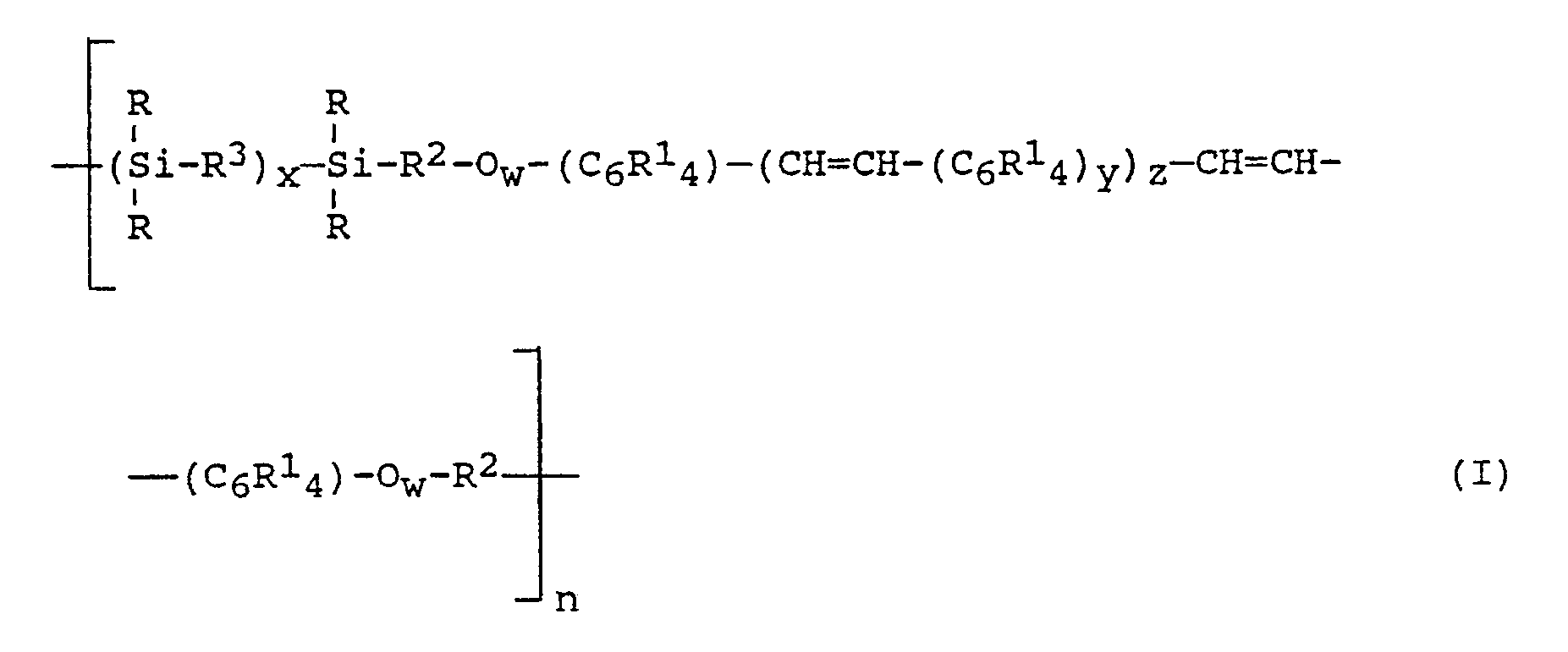
worin
- R
- gleich oder verschieden sein kann und einwertige, gegebenenfalls substituierte, von aliphatischer Mehrfachbindung freie, SiC-gebundene organische Reste bedeutet,
- R¹
- gleich oder verschieden sein kann und Wasserstoffatom, Halogenatom, Nitrogruppe, Cyanogruppe oder einwertige, von aliphatischer Mehrfachbindung freie organische Reste, die gegebenenfalls substituiert sein können, bedeutet,
- R²
- gleich oder verschieden sein kann und zweiwertige, gegebenenfalls substituierte organische Reste bedeutet,
- R³
- gleich oder verschieden sein kann und Sauerstoffatom oder zweiwertige, gegebenenfalls substituierte, von aliphatischer Mehrfachbindung freie SiC-gebundene organische Reste bedeutet,
- n
- eine Zahl von 2 bis 500, bevorzugt 10 bis 100,
- w
- 0 oder 1, bevorzugt 1,
- x
- eine Zahl von 1 bis 100, bevorzugt 2 bis 50, besonders bevorzugt 3 bis 20,
- y
- 1 oder 2 und
- z
- eine Zahl von 1 bis 3, bevorzugt 1,
bedeutet, mit der Maßgabe, daß y gleich 1 ist, wenn z größer als 1 ist.The poly (arylene vinylene siloxanes) according to the invention are preferably those of units of the general formula
wherein
- R
- can be the same or different and means monovalent, optionally substituted, SiC-bonded organic radicals free of aliphatic multiple bond,
- R¹
- may be the same or different and denotes hydrogen atom, halogen atom, nitro group, cyano group or monovalent organic radicals which are free from aliphatic multiple bond and which may be substituted,
- R²
- can be identical or different and means divalent, optionally substituted organic radicals,
- R³
- can be identical or different and means oxygen atom or divalent, optionally substituted, SiC-bonded organic radicals free of aliphatic multiple bond,
- n
- a number from 2 to 500, preferably 10 to 100,
- w
- 0 or 1, preferably 1,
- x
- a number from 1 to 100, preferably 2 to 50, particularly preferably 3 to 20,
- y
- 1 or 2 and
- e.g.
- a number from 1 to 3, preferably 1,
means that y is 1 when z is greater than 1.
Bevorzugt als Reste R sind Kohlenwasserstoffreste mit 1 bis 12 Kohlenstoffatomen, die gegebenenfalls durch Halogenatome, Ethergruppen, Estergruppen, Epoxygruppen oder Cyanogruppen substituiert sind.Preferred radicals R are hydrocarbon radicals having 1 to 12 carbon atoms, which are optionally substituted by halogen atoms, ether groups, ester groups, epoxy groups or cyano groups.
Beispiele für Kohlenwasserstoffreste R sind Alkylreste, wie der Methyl-, Ethyl-, n-Propyl-, iso-Propyl-, 1-n-Butyl, 2-n-Butyl-, iso-Butyl-, tert.-Butyl-, n-Pentyl-, iso-Pentyl-, neo-Pentyl-, tert.-Pentylrest, Hexylreste, wie der n-Hexylrest, Heptylreste, wie der n-Heptylrest, Octylreste, wie der n-Octylrest und iso-Octylreste, wie der 2,2,4-Trimethylpentylrest, Nonylreste, wie der n-Nonylrest, Decylreste, wie der n-Decylrest, Dodecylreste, wie der n-Dodecylrest; Cycloalkylreste, wie Cyclopentyl-, Cyclohexyl-, Cycloheptylreste und Methylcyclohexylreste; Arylreste, wie der Phenyl- und der Naphthylrest; Alkarylreste, wie o-, m-, p-Tolylreste, Xylylreste und Ethylphenylreste und Aralkylreste, wie der Benzylrest, der α- und der β-Phenylethylrest.Examples of hydrocarbon radicals R are alkyl radicals, such as the methyl, ethyl, n-propyl, iso-propyl, 1-n-butyl, 2-n-butyl, iso-butyl, tert-butyl, n Pentyl, iso-pentyl, neo-pentyl, tert-pentyl, hexyl, such as the n-hexyl, heptyl, such as the n-heptyl, octyl, such as the n-octyl and iso-octyl, such as the second , 2,4-trimethylpentyl radical, nonyl radicals, such as the n-nonyl radical, decyl radicals, such as the n-decyl radical, dodecyl radicals, such as the n-dodecyl radical; Cycloalkyl radicals, such as cyclopentyl, cyclohexyl, cycloheptyl radicals and methylcyclohexyl radicals; Aryl radicals such as the phenyl and naphthyl radicals; Alkaryl radicals, such as o-, m-, p-tolyl radicals, xylyl radicals and ethylphenyl radicals and aralkyl radicals, such as the benzyl radical, the α- and the β-phenylethyl radical.
Beispiele für substituierte Kohlenwasserstoffreste R sind Cyanalkylreste, wie der β-Cyanethylrest, und halogenierte Kohlenwasserstoffreste, beispielsweise Halogenalkylreste, wie der 3,3,3-Trifluor-n-propylrest, der 2,2,2,2',2',2'-Hexafluorisopropylrest, der Heptafluorisopropylrest, und Halogenarylreste, wie der o-, m-, und p-Chlorphenylrest.Examples of substituted hydrocarbon radicals R are cyanalkyl radicals, such as the β-cyanoethyl radical, and halogenated hydrocarbon radicals, for example haloalkyl radicals, such as the 3,3,3-trifluoro-n-propyl radical, the 2,2,2,2 ', 2', 2 ' -Hexafluoroisopropyl radical, the heptafluoroisopropyl radical, and haloaryl radicals, such as the o-, m- and p-chlorophenyl radical.
Besonders bevorzugt als Reste R sind der Methyl-, Ethyl-3,3,3-Trifluor-n-propyl- und der Phenylrest.The radicals R are particularly preferably the methyl, ethyl-3,3,3-trifluoro-n-propyl and the phenyl radical.
Bevorzugt als Reste R¹ sind Wasserstoffatom, Halogenatom, Nitrogruppe, Cyanogruppe, Alkoxy-, Alkoxycarbonyl- sowie Acyloxygruppen und Kohlenwasserstoffreste mit 1 bis 12 Kohlenstoffatomen, die gegebenenfalls mit Halogenatomen substituiert sein können.Preferred radicals R 1 are hydrogen atom, halogen atom, nitro group, cyano group, alkoxy, alkoxycarbonyl and acyloxy groups and hydrocarbon radicals having 1 to 12 carbon atoms, which can optionally be substituted by halogen atoms.
Beispiele für Rest R¹ sind die als Beispiele für Rest R oben genannten Reste sowie Alkoxygruppen, wie Methoxy-, Ethoxy- oder n-Propyloxygruppen, Alkoxycarbonylgruppen, wie Methoxycarbonyl-, Ethoxycarbonyl- oder n-Propyloxycarbonylgruppen, und Acyloxygruppen, wie Acetoxy- oder Benzoyloxygruppen.Examples of radical R¹ are the radicals mentioned above as examples of radical R and alkoxy groups, such as methoxy, ethoxy or n-propyloxy groups, alkoxycarbonyl groups, such as methoxycarbonyl, ethoxycarbonyl or n-propyloxycarbonyl groups, and acyloxy groups, such as acetoxy or benzoyloxy groups.
Besonders bevorzugt als Reste R¹ sind Wasserstoffatom, Methyl-, Phenyl-, Methoxy-, Methoxycarbonyl-, Acetoxy- und Benzoyloxygruppen sowie Fluor und Chlor.Particularly preferred radicals R 1 are hydrogen atom, methyl, phenyl, methoxy, methoxycarbonyl, acetoxy and benzoyloxy groups as well as fluorine and chlorine.
Bevorzugt als Reste R² sind zweiwertige, gegebenenfalls substituierte Kohlenwasserstoffreste mit 1 bis 20 Kohlenstoffatomen, die durch Ethersauerstoffatome substituiert sein können.Preferred radicals R 2 are divalent, optionally substituted hydrocarbon radicals having 1 to 20 carbon atoms, which can be substituted by ether oxygen atoms.
Beispiele für Reste R² sind Alkylenreste, wie der Methylen-, Ethylen-, n-Propylen-, iso-Propylen-, 1-n-Butylen-, 2-n-Butylen-, iso-Butylen-, tert.-Butylen-, n-Pentylen-, iso-Pentylen-, neo-Pentylen-, tert.-Pentylenrest, Hexylenreste, wie der n-Hexylenrest, Heptylenreste, wie der n-Heptylenrest, Octylenreste, wie der n-Octylenrest und iso-Octylenreste, wie der 2,2,4-Trimethylpentylenrest, Nonylenreste, wie der n-Nonylenrest, Decylenreste, wie der n-Decylenrest, Dodecylenreste, wie der n-Dodecylenrest, Octadecylenreste, wie der n-Octadecylenrest; Cycloalkylenreste, wie Cyclopentylen-, Cyclohexylen-, Cycloheptylenreste und Methylcyclohexylenreste.Examples of radicals R² are alkylene radicals, such as methylene, ethylene, n-propylene, iso-propylene, 1-n-butylene, 2-n-butylene, iso-butylene, tert-butylene, n-pentylene, iso-pentylene, neo-pentylene, tert-pentylene, hexylene, such as the n-hexylene, heptylene, such as the n-heptylene, octylene, such as the n-octylene and iso-octylene, such as 2,2,4-trimethylpentylene radical, nonylene radicals such as the n-nonylene radical, decylene radicals such as the n-decylene radical, dodecylene radicals such as the n-dodecylene radical, octadecylene radicals such as the n-octadecylene radical; Cycloalkylene residues, such as cyclopentylene, cyclohexylene, cycloheptylene residues and methylcyclohexylene residues.
Beispiele für substituierte Reste R² sind Cyanalkylenreste, wie der β-Cyanethylenrest, und halogenierte Kohlenwasserstoffreste, beispielsweise Halogenalkylenreste, wie der 3,3,3-Trifluor-n-propylenrest, der 2,2,2,2',2',2'-Hexafluorisopropylenrest, und Halogenarylenreste, wie der o-, m-, und p-Chlorphenylenrest.Examples of substituted radicals R² are cyanalkylene radicals, such as the β-cyanethylene radical, and halogenated hydrocarbon radicals, for example haloalkylene radicals, such as the 3,3,3-trifluoro-n-propylene radical, the 2,2,2,2 ', 2', 2 ' -Hexafluoroisopropylene, and haloarylene, such as the o-, m-, and p-chlorophenylene.
Besonders bevorzugt als Reste R² sind lineare Alkylenreste mit 2 bis 6 Kohlenstoffatomen, insbesondere der Propylen- und Butylenrest.Linear alkylene radicals having 2 to 6 carbon atoms, in particular the propylene and butylene radical, are particularly preferred as radicals R 2.
Bei den Resten R³ handelt es sich besonders bevorzugt um Sauerstoffatom.The R³ radicals are particularly preferably oxygen atoms.
Handelt es sich bei dem Rest R³ aber um zweiwertige SiC-gebundene Reste, dann sind Kohlenwasserstoffreste mit 1 bis 30 Kohlenstoffatom(en), die durch Ethersauerstoffatome substituiert sein können, wie beispielsweise Oligooxymethylen- oder Oligooxyethylengruppen, bevorzugt.However, if the R³ radical is a divalent SiC-bonded radical, then hydrocarbon radicals having 1 to 30 carbon atoms which may be substituted by ether oxygen atoms, such as, for example, oligooxymethylene or oligooxyethylene groups, are preferred.
Die in den erfindungsgemäßen Poly(arylenvinylen-siloxanen) enthaltenen Vinylengruppen können die cis- oder trans-Konfiguration besitzen, wobei Poly(arylenvinylen-siloxane) mit trans-konfigurierten Vinylengruppen bevorzugt sind.The vinylene groups contained in the poly (arylene vinylene siloxanes) according to the invention can have the cis or trans configuration, poly (arylene vinylene siloxanes) with trans-configured vinylene groups being preferred.
Die Arylengruppen -(C₆R¹₄)- können in den erfindungsgemäßen Poly(arylenvinylen-siloxanen) mit den Vinylengruppen bzw. den -Ow-R²-Gruppen, wobei R¹, R² und w die jeweils oben dafür angegebene Bedeutung haben, relativ zu der mit der jeweiligen Arylengruppe noch verknüpften Vinylen- bzw. Arylengruppe, in den 1,2-(ortho-), 1,3-(meta-) oder 1,4-(para-) Positionen verknüpft sein, wobei die Verknüpfung über die 1,4-Positionen bevorzugt ist.The arylene groups - (C₆R¹₄) - can in the poly (arylenevinylene siloxanes) according to the invention with the vinylene groups or the -O w -R² groups, where R¹, R² and w have the meaning given above, relative to that with the respective arylene group still linked vinylene or arylene group in the 1,2- (ortho-), 1,3- (meta-) or 1,4- (para) positions, the link being via the 1.4 -Positions is preferred.
Bei den erfindungsgemäßen Poly(arylenvinylen-siloxanen) können die wiederkehrenden Arylenvinylen-siloxan-einheiten gemäß Formel (I) gleich oder verschieden sein.In the poly (arylene vinylene siloxanes) according to the invention, the recurring arylene vinylene siloxane units according to formula (I) can be the same or different.
Obwohl in Formel (I) nicht angegeben, können bis zu 20 Prozent der Diorganosiloxaneinheiten durch R₃SiO1/2-, RSiO3/2- und SiO4/2-Einheiten ersetzt sein, wobei R die vorstehend dafür angegebene Bedeutung hat.Although not indicated in formula (I), up to 20 percent of the diorganosiloxane units can be replaced by R₃SiO 1/2 -, RSiO 3/2 - and SiO 4/2 units, where R has the meaning given above.
Obwohl in Formel (I) nicht angegeben, können bis zu 50 Prozent der Wasserstoffatome der Vinylengruppen durch Alkylgruppen, insbesondere durch Methylgruppen, ersetzt sein.Although not stated in formula (I), up to 50 percent of the hydrogen atoms of the vinylene groups can be replaced by alkyl groups, in particular by methyl groups.
Die erfindungsgemäßen Poly(arylenvinylen-siloxane) lassen sich nach an sich bekannten Verfahren herstellen. Vorzugsweise werden die erfindungsgemäßen Poly(arylenvinylen-siloxane) durch Umsetzung von α,ω-Dialkenylarylenvinylen mit zwei Si-gebundene Wasserstoffatome aufweisender Organosiliciumverbindung in Gegenwart eines die Anlagerung von Si-gebundenem Wasserstoff an aliphatische Mehrfachbindung fördernden Katalysators hergestellt.The poly (arylenevinylene siloxanes) according to the invention can be prepared by processes known per se. The poly (arylenevinylene siloxanes) according to the invention are preferably prepared by reacting α, ω-dialkenylarylenevinylene with an organosilicon compound having two Si-bonded hydrogen atoms in the presence of a catalyst which promotes the addition of Si-bonded hydrogen to an aliphatic multiple bond.
Bei den im erfindungsgemäßen Verfahren eingesetzten α,ω-Dialkenylarylenvinylenen handelt es sich vorzugsweise um solche der Formel
R⁴-Ow-(C₆R¹₄)-(CH=CH-(C₆R¹₄)y)z-CH=CH-(C₆R¹₄)-OwR⁴, (II)
wobei
R¹, w, y und z eine der obengenannten Bedeutungen haben und R⁴ gleich oder verschieden sein kann und einen einwertigen, gegebenenfalls substituierten organischen Rest mit endständiger Kohlenstoff-Kohlenstoff-Doppelbindung bedeutet, mit der Maßgabe, daß y gleich 1 ist, wenn z größer als 1 ist.The α, ω-dialkenylarylene vinylenes used in the process according to the invention are preferably those of the formula
R⁴-O w - (C₆R¹₄) - (CH = CH- (C₆R¹₄) y ) z -CH = CH- (C₆R¹₄) -O w R⁴, (II)
in which
R¹, w, y and z have one of the meanings mentioned above and R⁴ can be the same or different and is a monovalent, optionally substituted organic radical with a carbon-carbon double bond, with the proviso that y is 1 if z is greater than 1 is.
Bevorzugt sind als Rest R⁴ einwertige, gegebenenfalls substituierte Kohlenwasserstoffreste mit 1 bis 20 Kohlenstoffatomen, die eine endständige aliphatische Kohlenstoff-Kohlenstoff-Doppelbindung aufweisen.Preferred radicals R⁴ are monovalent, optionally substituted hydrocarbon radicals having 1 to 20 carbon atoms which have a terminal aliphatic carbon-carbon double bond.
Beispiele für Rest R⁴ sind der Vinylrest, Allylrest, n-But-3-enylrest, n-Hex-5-enylrest, n-Undec-10-enylrest und der n-Undec-10-enoylrest.Examples of radical R⁴ are the vinyl radical, allyl radical, n-but-3-enyl radical, n-hex-5-enyl radical, n-undec-10-enyl radical and the n-undec-10-enoyl radical.
Obwohl in Formel (II) nicht angegeben, können bis zu 50 Prozent der Wasserstoffatome der Vinylengruppen durch Alkylgruppen, vorzugsweise durch Methylgruppen, ersetzt sein.Although not indicated in formula (II), up to 50 percent of the hydrogen atoms of the vinylene groups can be replaced by alkyl groups, preferably by methyl groups.
Beispiele für die im erfindungsgemäßen Verfahren eingesetzten α,ω-Dialkenylarylenvinylene sind


Bei dem erfindungsgemäß eingesetzten α,ω-Dialkenylarylenvinylen kann es sich um eine einzelne Art von α,ω-Dialkenylarylenvinylen handeln. Es kann sich aber auch um ein Gemisch aus mindestens zwei verschiedenen Arten derartiger α,ω-Dialkenylarylenvinylene handeln.The α, ω-dialkenylarylenevinylene used according to the invention can be a single type of α, ω-dialkenylarylenevinylene. However, it can also be a mixture of at least two different types of such α, ω-dialkenylarylenevinylenes.
Die im erfindungsgemäßen Verfahren eingesetzten α,ω-Dialkenylarylenvinylene können nach an sich bekannten Verfahren hergestellt werden. Beispielsweise können α,ω-Dialkenylarylenvinylene gemäß Formel (II) durch Umsetzung von Phosphonaten, wie beispielsweise solchen der Formel

worin
- R¹
- eine der oben angegebenen Bedeutung hat,
- R⁵
- gleich oder verschieden sein kann und einen Alkylrest mit 1 bis 10 Kohlenstoffatomen, insbesondere Ethylrest, bedeutet,
- s
- 1 oder 2 und
- t
- 0,1 oder 2 ist,
mit der Maßgabe, daß s gleich 1 ist, wenn t größer 0 ist, mit aromatischen Aldehyden, wie beispielsweise solchen der Formel
R⁴-Ow-(C₆R¹₄)-CHO (IV)
worin
R1, R⁴ und w eine der oben angegebenen Bedeutungen hat,
in Anwesenheit einer Base, wie beispielsweise Kaliumcarbonat, Kaliumhydroxid, Natriumhydroxid, Natriumhydrid, Natriummethylat, Kalium-tert.-butylat oder Lithiumdiisopropylamid, sowie gegebenenfalls in Anwesenheit eines Katalysators, hergestellt werden.The α, ω-dialkenylarylenevinylenes used in the process according to the invention can be prepared by processes known per se. For example, α, ω-dialkenylarylenevinylenes according to formula (II) by reacting phosphonates, such as those of the formula
wherein
- R¹
- has one of the meanings given above,
- R⁵
- can be the same or different and means an alkyl radical with 1 to 10 carbon atoms, in particular ethyl radical,
- s
- 1 or 2 and
- t
- Is 0.1 or 2,
with the proviso that s is 1 if t is greater than 0, with aromatic aldehydes, such as those of the formula
R⁴-O w - (C₆R¹₄) -CHO (IV)
wherein
R1, R⁴ and w has one of the meanings given above,
in the presence of a base such as potassium carbonate, potassium hydroxide, sodium hydroxide, sodium hydride, sodium methylate, potassium tert-butoxide or lithium diisopropylamide, and optionally in the presence of a catalyst.
In dieser dem Fachmann als Wittig-Horner-Emmons-Reaktion bekannten Umsetzung von Phosphonaten mit Aldehyden werden die Eduktmoleküle unter Bildung einer Kohlenstoff-Kohlenstoff-Doppelbindung verknüpft, wobei nahezu ausschließlich transkonfigurierte Doppelbindungen erhalten werden.In this reaction of phosphonates with aldehydes, known to the person skilled in the art as the Wittig-Horner-Emmons reaction, the reactant molecules are linked to form a carbon-carbon double bond, with almost exclusively transconfigured double bonds being obtained.
Vorteilhafterweise wird die Umsetzung von Phosphonat mit Aldehyd zur Herstellung des im erfindungsgemäßen Verfahren eingesetzten α,ω-Dialkenylarylenvinylens in einem in Bezug auf die Reaktionteilnehmer inerten Lösungsmittel, wie beispielsweise aromatische Kohlenwasserstoffe, wie Benzol, Toluol, Xylol und Ethylbenzol, Phenolether, wie Anisol und 1,2-Dimethoxybenzol, aliphatische Ether, wie Diethylether, tert.-Butylmethylether, 1,2-Dimethoxyethan, Tetrahydrofuran, Dioxan, oder Carbonsäureamide, wie N,H-Dimethylformamid, N,N-Dimethylacetamid oder N-Methylpyrrolidon durchgeführt, wobei Toluol, Anisol und Tetrahydrofuran bevorzugt sind.The reaction of phosphonate with aldehyde to produce the α, ω-dialkenylarylene vinyl used in the process according to the invention is advantageously carried out in a solvent which is inert with respect to the reactants, such as aromatic hydrocarbons such as benzene, toluene, xylene and ethylbenzene, phenol ethers such as anisole and 1 , 2-dimethoxybenzene, aliphatic ethers, such as diethyl ether, tert-butyl methyl ether, 1,2-dimethoxyethane, tetrahydrofuran, dioxane, or carboxamides, such as N, H-dimethylformamide, N, N-dimethylacetamide or N-methylpyrrolidone, with toluene, Anisole and tetrahydrofuran are preferred.
Vorzugsweise werden bei der Umsetzung von Phosphonat mit Aldehyd zur Herstellung des im erfindungsgemäßen Verfahren eingesetzten α,ω-Dialkenylarylenvinylens pro Mol Phosphonat zwei Mol Aldehyd sowie zwei Mol Base eingesetzt, wobei im Fall von Kaliumcarbonat als Base bevorzugt 3 Mol eingesetzt werden.Preferably, in the reaction of phosphonate with aldehyde to produce the α, ω-dialkenylarylene vinylene used per mole of phosphonate two moles of aldehyde and two moles of base are used, preferably 3 moles being used as base in the case of potassium carbonate.
Vorzugsweise wird die Umsetzung von Phosphonat mit Aldehyd bei einer Temperatur zwischen -10 und 160°C und bei einem Druck von 900 bis 3000 hPa durchgeführt.The reaction of phosphonate with aldehyde is preferably carried out at a temperature between -10 and 160 ° C and at a pressure of 900 to 3000 hPa.
Besonders bevorzugt wird die Umsetzung von Phosphonat gemäß Formel (III) und Aldehyd gemäß Formel (IV) mit Kaliumcarbonat, Kaliumhydroxid oder Kalium-tert.-butylat als Base, Toluol oder Anisol als Lösungsmittel und 18-Krone-6 sowie Kaliumiodid als Katalysator durchgeführt.The reaction of phosphonate according to formula (III) and aldehyde according to formula (IV) with potassium carbonate, potassium hydroxide or potassium tert-butoxide as base, toluene or anisole as solvent and 18-crown-6 and potassium iodide as catalyst is particularly preferably carried out.
Beispiele für Phosphonate gemäß Formel (III) sind

wobei R⁵ eine der oben angegebenen Bedeutung hat.Examples of phosphonates according to formula (III) are
where R⁵ has one of the meanings given above.
Bevorzugt werden zur Herstellung des im erfindungsgemäßen Verfahren eingesetzten α,ω-Dialkenylarylenvinylens als Phosphonat

Die zur Herstellung des im erfindungsgemäßen Verfahren eingesetzten α,ω-Dialkenylarylenvinylens verwendeten Phosphonate gemäß Formel (III) können nach an sich bekannten Verfahren hergestellt werden. Hierzu sei beispielsweise auf US-PS 4,371,475 (Showa Kagaku Kogyo, ausgegeben am 1. Februar 1983), US-PS 4,108,887 (Sandoz AG, ausgegeben am 22. August 1978) und GB-OS 1 247 934 (K. Weber; Ciba Ltd.) verwiesen.The phosphonates of the formula (III) used in the preparation of the α, ω-dialkenylarylene vinyls used in the process according to the invention can be prepared by processes known per se. For example, see U.S. Patent 4,371,475 (Showa Kagaku Kogyo, issued February 1, 1983), U.S. Patent 4,108,887 (Sandoz AG, issued August 22, 1978) and GB-OS 1,247,934 (K. Weber; Ciba Ltd .) referenced.
Vorzugsweise werden die Phosphonate gemäß Formel (III) aus den entsprechenden Brom- bzw. Chlorverbindungen durch Umsetzung mit Trialkylphosphit hergestellt, wobei sowohl Trialkylphosphit als auch die obengenannten Brom- bzw. Chlorverbindungen käuflich erhältlich bzw. nach in der organischen Chemie gängigen Methoden herstellbar sind.The phosphonates of the formula (III) are preferably prepared from the corresponding bromine or chlorine compounds by reaction with trialkyl phosphite, both trialkyl phosphite and the abovementioned bromine or chlorine compounds being commercially available or can be prepared by methods customary in organic chemistry.
Bevorzugt wird zur Herstellung des im erfindungsgemäßen Verfahren eingesetzten α,ω-Dialkenylarylenvinylens als Aldehyd solche der Formel
CH₂=CH -(CH₂)v-Ow-(C₆R¹₄)-CHO (V)
verwendet, wobei
w und R¹ die oben dafür angegebene Bedeutung haben und v eine ganze Zahl von 0 bis 4 ist.Preference is given to producing the α, ω-dialkenylarylene vinyl used as aldehyde in the process according to the invention with the formula
CH₂ = CH - (CH₂) v -O w - (C₆R¹₄) -CHO (V)
used, where
w and R¹ are as defined above and v is an integer from 0 to 4.
Beispiele für Aldehyde gemäß Formel (V) sind
4-Allyloxybenzaldehyd,
4-Allyloxy-3-methoxy-benzaldehyd,
4-(3-Butenyl)-benzaldehyd und
4-(10-Undecenoyloxy)-benzaldehyd,
wobei 4-Allyloxy-3-methoxy-benzaldehyd und 4-(3-Butenyl)-benzaldehyd besonders bevorzugt sind.Examples of aldehydes according to formula (V) are
4-allyloxybenzaldehyde,
4-allyloxy-3-methoxy-benzaldehyde,
4- (3-butenyl) benzaldehyde and
4- (10-undecenoyloxy) benzaldehyde,
4-allyloxy-3-methoxy-benzaldehyde and 4- (3-butenyl) benzaldehyde are particularly preferred.
Die zur Herstellung des im erfindungsgemäßen Verfahren eingesetzten α,ω-Dialkenylarylenvinylens verwendeten Aldehyde lassen sich nach an sich bekannten Verfahren, wie beispielsweise Veretherung von p-Hydroxybenzaldehyd mit entsprechenden Alkenylhalogeniden oder -tosylaten, herstellen. Hierzu sei beispielsweise auf H. Meerwein in Houben-Weyl, "Methoden der Organischen Chemie", Georg Thieme Verlag, Stuttgart, 4. Auflage, Bd. VI/3, 1965, Seite 49-84, verwiesen.The aldehydes used to prepare the α, ω-dialkenylarylene vinyl used in the process according to the invention can be prepared by processes known per se, such as, for example, etherification of p-hydroxybenzaldehyde with corresponding alkenyl halides or tosylates. For this, reference is made, for example, to H. Meerwein in Houben-Weyl, "Methods of Organic Chemistry", Georg Thieme Verlag, Stuttgart, 4th Edition, Vol. VI / 3, 1965, pages 49-84.
Beispielsweise werden Aldehyde gemäß Formel (V) durch Grignard-Reaktion von 4-Alkenyl-1-chlorbenzol, welches aus dem entsprechenden Alkenylmagnesiumchlorid und 4-Chlorbenzylchlorid erhalten wird, mit N,N-Dimethylformamid hergestellt.For example, aldehydes according to formula (V) are prepared by Grignard reaction of 4-alkenyl-1-chlorobenzene, which is obtained from the corresponding alkenylmagnesium chloride and 4-chlorobenzyl chloride, with N, N-dimethylformamide.
Selbstverständlich eignen sich auch andere Reaktionen zur Herstellung des im erfindungsgemäßen Verfahren eingesetzten α,ω-Dialkenylarylenvinylens. Beispielsweise kommen statt der oben beschriebenen Umsetzung von Phosphonat und Aldehyd auch die Wittig-Reaktion von Phosphanalkylenen mit Aldehyden, oder etwa Reaktionen von Grignard-Reagenzien mit Aldehyden und anschließender Dehydratisierung der entstandenen Alkohole, oder etwa die als Heck-Reaktion bekannte, palladiumkatalysierte Reaktion von Vinylaromaten mit Halogenaromaten in Frage.Of course, other reactions are also suitable for the preparation of the α, ω-dialkenylarylene vinyl used in the process according to the invention. For example, instead of the reaction of phosphonate and aldehyde described above, there is also the Wittig reaction of phosphanalkylenes with aldehydes, or, for example, reactions of Grignard reagents with aldehydes and subsequent dehydration of the alcohols formed, or for example the palladium-catalyzed reaction of vinylaromatics known as the Heck reaction with halogen aromatics in question.
Beispielsweise können die im erfindungsgemäßen Verfahren eingesetzten Arylenvinylene gemäß Formel (II) auch durch Umsetzung von Phosphonaten gemäß der Formel

CHO-(C₆R¹₄)s-(CH=CH-(C₆R¹₄))t-CHO (VII)
in Anwesenheit einer Base sowie gegebenenfalls in Anwesenheit eines Katalysators hergestellt werden, wobei R¹' R⁴, R⁵, s, t und w eine der oben dafür angegebenen Bedeutungen haben, mit der Maßgabe, daß s gleich 1 ist, wenn t größer 0 ist. Die Reaktionsbedingungen dieser Umsetzung können dabei die gleichen sein wie bei der oben beschriebenen Umsetzung von Phosphonat gemäß Formel (III) mit Aldehyd gemäß Formel (IV), mit dem Unterschied, daß pro Mol Aldehyd zwei Mol Phosphonat und zwei Mol Base eingesetzt werden, wobei im Fall von Kaliumcarbonat als Base bevorzugt 3 Mol eingesetzt werden.For example, the arylenevinylenes according to formula (II) used in the process according to the invention can also be reacted with phosphonates according to the formula
CHO- (C₆R¹₄) s - (CH = CH- (C₆R¹₄)) t -CHO (VII)
be prepared in the presence of a base and optionally in the presence of a catalyst, where R¹ 'R¹, R⁵, s, t and w have one of the meanings given above, with the proviso that s is 1 if t is greater than 0. The reaction conditions of this reaction can be the same as in the above-described reaction of phosphonate according to formula (III) with aldehyde according to formula (IV), with the difference that two moles of phosphonate and two moles of base are used per mole of aldehyde In the case of potassium carbonate, 3 mol are preferably used as the base.
Bevorzugt als Phosphonate gemäß Formel (VI) werden
4-Allyloxybenzylphosphonat
4-Allyloxy-3-methoxybenzylphosphonat,
4-Allyloxy-3-methylbenzylphosphonat und
4-But-3-enylbenzylphosphonat.Are preferred as phosphonates according to formula (VI)
4-allyloxybenzylphosphonate
4-allyloxy-3-methoxybenzylphosphonate,
4-allyloxy-3-methylbenzylphosphonate and
4-but-3-enylbenzylphosphonate.
Die Phosphonate gemäß Formel (VI) können ebenfalls aus den entsprechenden Brom- bzw. Chlorverbindungen mit Trialkylphosphit hergestellt werden, wobei die obengenannten Brom- bzw. Chlorverbindungen sowie Trialkylphosphit käuflich erhältlich bzw. nach in der organischen Chemie gängigen Methoden herstellbar sind.The phosphonates of the formula (VI) can also be prepared from the corresponding bromine or chlorine compounds with trialkyl phosphite, the abovementioned bromine or chlorine compounds and trialkyl phosphite being commercially available or can be prepared by methods which are common in organic chemistry.
So kann beispielsweise 4-Butenylbenzylchlorid aus Allylmagnesiumchlorid und 1,4-Bis-(chlormethyl)-benzol hergestellt werden.For example, 4-butenylbenzyl chloride can be prepared from allyl magnesium chloride and 1,4-bis (chloromethyl) benzene.
Bevorzugte Dialdehyde sind
Terephthaldialdehyd,
4,4'-Biphenyldialdehyd,
4,4'-Stilbendialdehyd und
1,4-Bis-(4-formylstyryl)-benzol.Preferred dialdehydes are
Terephthalaldehyde,
4,4'-biphenyldialdehyde,
4,4'-stilbenedialdehyde and
1,4-bis (4-formylstyryl) benzene.
Die Dialdehyde gemäß Formel (VII) können nach an sich bekannten Verfahren hergestellt werden. Hierzu sei beispielsweise auf EP-OS 229 592 (Ciba-Geigy AG; ausgegeben am 22. Juli 1987) verwiesen.The dialdehydes according to formula (VII) can be prepared by processes known per se. For example, reference is made to EP-OS 229 592 (Ciba-Geigy AG; issued July 22, 1987).
Monomere Arylenvinylene gemäß Formel (II), insbesondere Distyrylbenzol- und Bistilbenderivate, finden breite Anwendung als Fluoreszenzfarbstoffe, beispielsweise als optische Aufheller in der Textilindustrie, sowie als Laserfarbstoffe.Monomeric arylenevinylenes according to formula (II), in particular distyrylbenzene and bisstilbene derivatives, are widely used as fluorescent dyes, for example as optical brighteners in the textile industry, and as laser dyes.
Bei der im erfindungsgemäßen Verfahren eingesetzten zwei Si-gebundene Wasserstoffatome aufweisenden Organosiliciumverbindung handelt es sich vorzugsweise um solche der Formel

worin
R, R³ und x eine der oben dafür angegebene Bedeutung haben.The organosilicon compound which has two Si-bonded hydrogen atoms and is used in the process according to the invention is preferably of the formula
wherein
R, R³ and x have one of the meanings given above.
Obwohl in Formel (VIII) nicht angegeben, können bis zu 20 Prozent der Diorganosiloxaneinheiten durch R₃SiO1/2-, RSiO3/2- und SiO4/2-Einheiten ersetzt sein, wobei R die vorstehend dafür angegebene Bedeutung hat.Although not indicated in formula (VIII), up to 20 percent of the diorganosiloxane units can be replaced by R₃SiO 1/2 -, RSiO 3/2 - and SiO 4/2 units, where R has the meaning given above.
Beispiele für die im erfindungsgemäßen Verfahren eingesetzten zwei Si-gebundene Wasserstoffatome aufweisenden Organosiliciumverbindung sind
H-[Si(CH₃)₂-O]₄-Si(CH₃)₂-H
H-[Si(CH₃)₂-O]₉-Si(CH₃)₂-H
H-Si(CH₃)₂-O-[Si(CH₃)(C₆H₅)-O]₁₅-Si(CH₃)₂-H
H-Si(CH₃)₂-O-[Si(CH₃)(C₈H₁₇)-O]₁₈-Si(CH₃)₂-H
H-Si(CH₃)₂-O-[Si(C₂H₅)₂-O]₁₀-Si(CH₃)₂-H
H-Si(CH₃)₂-O-([Si(CH₃)₂-O][Si(CH₃)(C₆H₅)-O])₈-Si(CH₃)₂-H
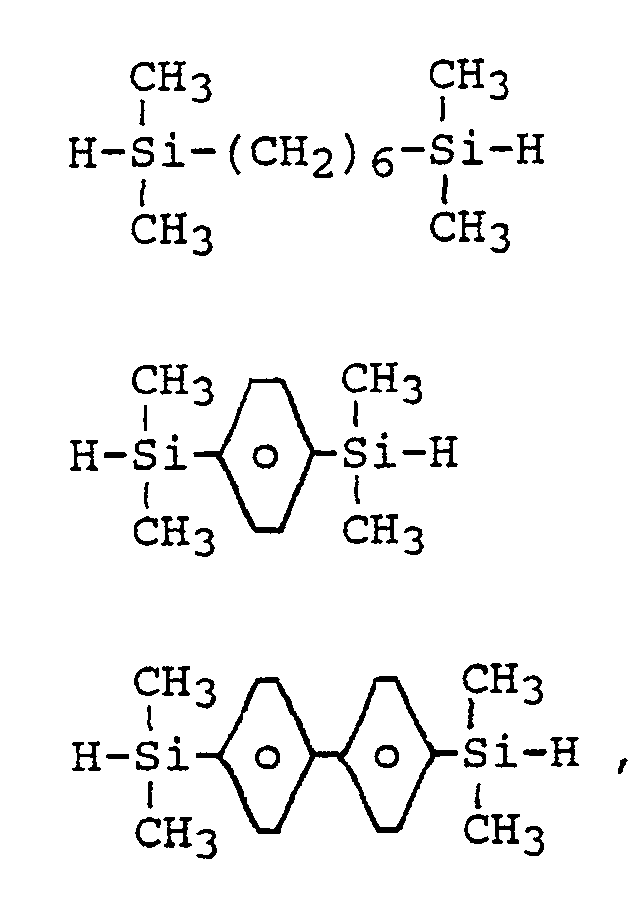
wobei CH₃ Methyl-, C₂H₅ Ethyl-, C₆H₅ Phenyl- und C₈H₁₇ Isooctylrest bedeutet.Examples of the organosilicon compound having two Si-bonded hydrogen atoms used in the process according to the invention are
H- [Si (CH₃) ₂-O] ₄-Si (CH₃) ₂-H
H- [Si (CH₃) ₂-O] ₉-Si (CH₃) ₂-H
H-Si (CH₃) ₂-O- [Si (CH₃) (C₆H₅) -O] ₁₅-Si (CH₃) ₂-H
H-Si (CH₃) ₂-O- [Si (CH₃) (C₈H₁₇) -O] ₁₈-Si (CH₃) ₂-H
H-Si (CH₃) ₂-O- [Si (C₂H₅) ₂-O] ₁₀-Si (CH₃) ₂-H
H-Si (CH₃) ₂-O - ([Si (CH₃) ₂-O] [Si (CH₃) (C₆H₅) -O]) ₈-Si (CH₃) ₂-H
where CH₃ is methyl, C₂H₅ ethyl, C₆H₅ phenyl and C₈H₁₇ isooctyl.
Die Viskosität der im erfindungsgemäßen Verfahren eingesetzten zwei Si-gebundene Wasserstoffatome aufweisenden Organosiliciumverbindung liegt vorzugsweise zwischen 0,7 und 200 mm²/s, besonders bevorzugt zwischen 1 und 50 mm²/s.The viscosity of the organosilicon compound containing two Si-bonded hydrogen atoms used in the process according to the invention is preferably between 0.7 and 200 mm² / s, particularly preferably between 1 and 50 mm² / s.
Besonders bevorzugt werden bei dem erfindungsgemäßen Verfahren als Organosiliciumverbindung mit zwei Si-gebundenen Wasserstoffatomen α,ω-Dihydrogendiorgano(poly)siloxane, insbesondere α,ω-Dihydrogendimethyl(poly)siloxane, mit 3 bis 20 Siliciumatomen eingesetzt.Particularly preferred in the process according to the invention as an organosilicon compound having two Si-bonded hydrogen atoms are α, ω-dihydrogendiorgano (poly) siloxanes, in particular α, ω-dihydrogendimethyl (poly) siloxanes, with 3 to 20 silicon atoms.
Die erfindungsgemäß eingesetzten Organosiliciumverbindungen mit zwei Si-gebundenen Wasserstoffatomen sind handelsübliche Produkte bzw. nach in der Siliciumchemie gängigen Methoden herstellbar. Hierzu sei zum Beispiel auf W. Noll, "Chemistry and Technology of Silicones", Academic Press, Orlando, 1968, Seite 191 ff und M. Wick, G. Kreis, F.-H. Kreuzer, "Silicone", in "Ullmanns Encyklopädie der technischen Chemie", Verlag Chemie, Weinheim, 4. Aufl., 1982, Bd. 21, Seite 511 ff verwiesen.The organosilicon compounds used according to the invention with two Si-bonded hydrogen atoms are commercially available products or can be prepared by methods customary in silicon chemistry. For this, see, for example, W. Noll, "Chemistry and Technology of Silicones", Academic Press, Orlando, 1968, page 191 ff and M. Wick, G. Kreis, F.-H. Kreuzer, "Silicone", in "Ullmann's Encyclopedia of Technical Chemistry", Verlag Chemie, Weinheim, 4th ed., 1982, vol. 21, page 511 ff.
Längerkettige α,ω-Dihydrogensiloxane können durch Cohydrolyse von Chlordiorganosiloxanen und Dichlordiorganosiloxanen, durch kationische Polymerisation von Octaorganocyclotetrasiloxanen in Gegenwart von 1,3-Dihydrogentetraalkyldisiloxan oder durch Äquilibrierung von langkettingen OH-terminierten Diorganopolysiloxanen, oder Octaorganocyclotetrasiloxanen, mit 1,3-Dihydrogentetraalkyldisiloxan in Gegenwart saurer Katalysatoren wie PNCl₂, oder saurer Ionenaustauscher, wie Amberlyst 15 oder Amberlyst XN-1010 (jeweils wasserfreie Form), hergestellt werden.Longer chain α, ω-Dihydrogensiloxane may be prepared by cohydrolysis of Chlordiorganosiloxanen and Dichlordiorganosiloxanen, by cationic polymerization of Octaorganocyclotetrasiloxanen in the presence of 1,3-Dihydrogentetraalkyldisiloxan or by equilibration of long-chain OH-terminated diorganopolysiloxanes or Octaorganocyclotetrasiloxanen, with 1,3-Dihydrogentetraalkyldisiloxan acid in the presence of catalysts such as PNCl₂, or acidic ion exchangers, such as Amberlyst 15 or Amberlyst XN-1010 (in each case anhydrous form).
Bei der erfindungsgemäß eingesetzten zwei Si-gebundene Wasserstoffatome aufweisenden Organosiliciumverbindung kann es sich um eine einzelne Art von zwei Si-gebundene Wasserstoffatome aufweisender Organosiliciumverbindung handeln. Es kann sich aber auch um ein Gemisch aus mindestens zwei verschiedenen Arten derartiger Organosiliciumverbindungen handeln.The organosilicon compound which has two Si-bonded hydrogen atoms and is used according to the invention can be a single type of organosilicon compound which has two Si-bonded hydrogen atoms. However, it can also be a mixture of at least two different types of such organosilicon compounds.
Bei dem erfindungsgemäßen Verfahren liegt das Molverhältnis von α,ω-Dialkenylarylenvinylen zu Organosiliciumverbindung mit zwei Si-gebundenen Wasserstoffatomen in der Reaktionsmasse vorzugsweise zwischen 1:0,7 und 1:1,3, besonders bevorzugt bei 1:1. Weicht das Molverhältnis von α,ω-Dialkenylarylenvinylen zu Organosiliciumverbindung mit zwei Si-gebundenen Wasserstoffatomen deutlich von 1:1 ab, wie beispielsweise 1:0,7 oder 1:1,3, werden sogenannte Präpolymere erhalten, die als Endgruppen jeweils nur die im Überschuß eingesetzte Komponente aufweisen.In the process according to the invention, the molar ratio of α, ω-dialkenylarylenevinylene to organosilicon compound with two Si-bonded hydrogen atoms in the reaction mass is preferably between 1: 0.7 and 1: 1.3, particularly preferably at 1: 1. If the molar ratio of α, ω-dialkenylarylenevinylene to organosilicon compound with two Si-bonded hydrogen atoms deviates significantly from 1: 1, for example 1: 0.7 or 1: 1.3, so-called prepolymers are obtained, which each have only the end groups in the Have excess component used.
Die eingesetzten Katalysatoren können im Rahmen des erfindungsgemäßen Verfahrens die gleichen sein, die auch bisher zum Anlagern von Si-gebundenen Wasserstoffatomen an aliphatische Mehrfachbindungen eingesetzt wurden. Es handelt sich dabei hauptsächlich um Metalle der 8. Nebengruppe und um deren anorganische und organische Verbindungen, wobei Platin und dessen Verbindungen bevorzugt werden.In the process according to the invention, the catalysts used can be the same ones which have hitherto also been used for the attachment of Si-bonded hydrogen atoms to aliphatic multiple bonds. These are mainly metals from subgroup 8 and their inorganic and organic compounds, with platinum and its compounds being preferred.
Beispiele für solche Katalysatoren sind auf einem inerten Träger, wie Aktivkohle, SiO₂ oder Al₂O₃, abgeschiedenes, feinverteiltes elementares Platin gemäß US-PS 2,970,150 (D.L. Bailey, Union Carbide Corporation; ausgegeben am 31. Januar 1961), Hexachloroplatinsäure gemäß US-PS 2,823,218 (J.L. Speier, Dow Corning Corporation; ausgegeben am 11. Februar 1958) und davon abgeleitete Chloroplatinate, Platinkomplexe des Typs L·PtCl₂, wobei L ein lineares oder cyclisches Monoolefin, wie Ethen, Propen und Cyclohexen, bedeutet, gemäß US-PS 3,159,601 und US-PS 3,159,662 (Bruce A. Ashby , General Electric Company; jeweils ausgegeben am 1. Dezember 1964), Platinkomplexe des Typs L·PtCl₂, wobei L ein cyclisches Diolefin, wie 1,5-Cyclooctadien, Norbornadien und Cyclopentadien, bedeutet, gemäß JP-OS 79/76,529 und JP-OS 79/76,530 (Masatoshi Arai, Shin-Etsu Chemical Industry Co., Ltd.; jeweils ausgegeben am 19. Juni 1979) und US-PS 4,276,252 (G. Kreis, Wacker-Chemie GmbH, ausgegeben am 30. Juni 1981) oder ein cyclisches Polyolefin bedeutet gemäß der deutschen Anmeldung mit dem Aktenzeichen P 39 06 514.6 (G. Wenski, Consortium für elektrochemische Industrie GmbH; angemeldet am 1. März 1989), Platinvinylsiloxankomplexe gemäß US-PS 3,814,730 (B.D. Karstedt, General Electric Company; ausgegeben am 4. Juni 1974) und Acetylacetonatkomplexe des Platins gemäß US-PS 4,177,341 (G. Kreis, Consortium für elektrochemische Industrie GmbH; ausgegeben am 4. Dezember 1979).Examples of such catalysts are on an inert support, such as activated carbon, SiO₂ or Al₂O₃, deposited, finely divided elemental platinum according to US Pat. No. 2,970,150 (DL Bailey, Union Carbide Corporation; issued January 31, 1961), hexachloroplatinic acid according to US Pat. No. 2,823,218 ( JL Speier, Dow Corning Corporation; issued February 11, 1958) and derived chloroplatinates, platinum complexes of the type L · PtCl₂, where L is a linear or cyclic monoolefin such as ethene, propene and cyclohexene, according to US Pat. Nos. 3,159,601 and US -PS 3,159,662 (Bruce A. Ashby, General Electric Company; each issued December 1, 1964), platinum complexes of the type L · PtCl₂, where L is a cyclic diolefin, such as 1,5-cyclooctadiene, norbornadiene and cyclopentadiene, according to JP -OS 79 / 76,529 and JP-OS 79 / 76,530 (Masatoshi Arai, Shin-Etsu Chemical Industry Co., Ltd .; each issued on June 19, 1979) and US Pat. No. 4,276,252 (G. Kreis, Wacker-Chemie GmbH, issued a m June 30, 1981) or a cyclic polyolefin means according to the German application with the file number P 39 06 514.6 (G. Wenski, Consortium for Electrochemical Industry GmbH; Registered on March 1, 1989), platinum vinylsiloxane complexes according to US Pat. No. 3,814,730 (BD Karstedt, General Electric Company; issued June 4, 1974) and acetylacetonate complexes of platinum according to US Pat. No. 4,177,341 (G. Kreis, Consortium für elektrochemische Industrie GmbH; issued on 4th December 1979).
Bei dem erfindungsgemäßen Verfahren werden wegen deren hohen Wirksamkeit besonders bevorzugt Platinkomplexe des Typs L·PtCl₂, wobei L ein cyclisches Di- oder Polyolefin bedeutet, insbesondere Dicyclopentadien-Platindichlorid, eingesetzt.In the process according to the invention, platinum complexes of the type L · PtCl₂, where L is a cyclic di- or polyolefin, in particular dicyclopentadiene-platinum dichloride, are particularly preferably used because of their high effectiveness.
Bei dem erfindungsgemäß eingesetzten Katalysator kann es sich um eine einzelne Art von Katalysator wie auch um ein Gemisch aus mindestens zwei verschiedenen Arten derartiger Katalysatoren handeln.The catalyst used according to the invention can be a single type of catalyst as well as a mixture of at least two different types of such catalysts.
Die im Rahmen des erfindungsgemäßen Verfahrens eingesetzten Mengen an Katalysator können die gleichen sein wie bei den bisher bekannten Verfahren zum Anlagern von Si-gebundenem Wasserstoff an aliphatische Mehrfachbindung in Gegenwart von Katalysator. Es sind dies vorzugsweise 0,1 bis 1000 Gewichts-ppm, besonders bevorzugt 5 bis 150 Gewichts-ppm, jeweils berechnet als elementares Platin, bezogen auf das Gesamtgewicht der Reaktionsmasse. Bei Platinkomplexen des Typs L·PtCl₂, wobei L ein cyclisches Di- oder Polyolefin bedeutet, insbesondere Dicyclopentadien-Platindichlorid, als Katalysator sind Konzentrationen zwischen 20 und 100 Gewichts-ppm, berechnet als elementares Platin, bezogen auf das Gesamtgewicht der Reaktionsmasse, völlig ausreichend.The amounts of catalyst used in the process according to the invention can be the same as in the previously known processes for attaching Si-bonded hydrogen to aliphatic multiple bonds in the presence of catalyst. These are preferably 0.1 to 1000 ppm by weight, particularly preferably 5 to 150 ppm by weight, each calculated as elemental platinum, based on the total weight of the reaction mass. In platinum complexes of the type L · PtCl₂, where L is a cyclic di- or polyolefin, in particular dicyclopentadiene-platinum dichloride, as a catalyst, concentrations between 20 and 100 ppm by weight, calculated as elemental platinum, based on the total weight of the reaction mass, are completely sufficient.
Das erfindungsgemäße Verfahren kann in Anwesenheit oder in Abwesenheit von Lösungsmittel durchgeführt werden, wobei die Bezeichnung Lösungsmittel nicht bedeutet, daß sich alle Reaktionskomponenten in diesen lösen müssen. Die Reaktion kann auch in Emulsion oder Suspension eines oder mehrerer Reaktionspartner durchgeführt werden.The process according to the invention can be carried out in the presence or in the absence of solvent, the term solvent not meaning that all Reaction components in these must solve. The reaction can also be carried out in emulsion or suspension of one or more reactants.
Bei dem erfindungsgemäßen Verfahren ist die Verwendung von in bezug auf die Reaktionsmasse inertem organischen Lösungsmittel, insbesondere von solchem Lösungsmittel, in welchem sich das erfindungsgemäß hergestellte Poly(arylenvinylen-siloxan) mindestens zu einem Teil, bevorzugt vollständig, löst, bevorzugt.In the process according to the invention, preference is given to using organic solvent which is inert with respect to the reaction mass, in particular such solvent in which at least part, preferably completely, of the poly (arylene vinylene siloxane) prepared according to the invention dissolves.
Beispiele für Lösungsmittel sind Alkohole, wie Methanol, Ethanol, n-Propanol, iso-Propanol, n-, sec.- und tert.-Butanol und 2-Butanol; Ester, wie Methylacetat, Ethylacetat, n- und iso-Propylacetat, n-, sec.- und tert.-Butylacetat, Ethylformiat und Diethylcarbonat; Ether, wie Dioxan, Tetrahydrofuran, Diethylether, Di-n-propylether, Diisopropylether, Di-n-butylether, 1,2-Dimethoxybenzol und Anisol; chlorierte Kohlenwasserstoffe, wie Dichlormethan, Trichlormethan, Tetrachlormethan, 1,2-Dichlorethan, 1,1,1-Trichlorethan, Trichlorethylen, Tetrachlorethylen und Chlorbenzol; Kohlenwasserstoffe, wie Pentan, n-Hexan, Hexan-Isomerengemische, Cyclohexan, Heptan, Octan, Waschbenzin, Petrolether, Benzol, Ethylbenzol, Toluol, Xylole und Ketone, wie Aceton, Methylethylketon, Methylisobutylketon, oder Gemische dieser Lösungsmittel, wobei Toluol, Anisol, Chlorbenzol, 4-Methylbenzoesäuremethylester, 3-Chlorbenzoesäuremethylester und Phthalsäuredimethylester, insbesondere Toluol und Anisol, besonders bevorzugt eingesetzt werden.Examples of solvents are alcohols, such as methanol, ethanol, n-propanol, isopropanol, n-, sec- and tert-butanol and 2-butanol; Esters such as methyl acetate, ethyl acetate, n- and iso-propyl acetate, n-, sec- and tert-butyl acetate, ethyl formate and diethyl carbonate; Ethers such as dioxane, tetrahydrofuran, diethyl ether, di-n-propyl ether, diisopropyl ether, di-n-butyl ether, 1,2-dimethoxybenzene and anisole; chlorinated hydrocarbons such as dichloromethane, trichloromethane, carbon tetrachloride, 1,2-dichloroethane, 1,1,1-trichloroethane, trichlorethylene, tetrachlorethylene and chlorobenzene; Hydrocarbons, such as pentane, n-hexane, hexane isomer mixtures, cyclohexane, heptane, octane, benzine, petroleum ether, benzene, ethylbenzene, toluene, xylenes and ketones, such as acetone, methyl ethyl ketone, methyl isobutyl ketone, or mixtures of these solvents, toluene, anisole, Chlorobenzene, 4-methylbenzoic acid methyl ester, 3-chlorobenzoic acid methyl ester and dimethyl phthalate, in particular toluene and anisole, are particularly preferably used.
Bei dem erfindungsgemäßen Verfahren wird Lösungsmittel in Mengen von vorzugsweise 20 bis 99 Gewichtsprozent, besonders bevorzugt 50 bis 95 Gewichtsprozent, jeweils bezogen auf das Gesamtgewicht der Reaktionsmasse, eingesetzt.In the process according to the invention, solvents are used in amounts of preferably 20 to 99 percent by weight, particularly preferably 50 to 95 percent by weight, in each case based on the total weight of the reaction mass.
Die im Rahmen des erfindungsgemäßen Verfahrens angewandten Temperaturen und Drücke können die gleichen sein wie bei den bisher bekannten Verfahren zum Anlagern von Si-gebundenem Wasserstoff an aliphatische Mehrfachbindung in Gegenwart von Katalysator. Es sind dies vorzugsweise Temperaturen zwischen 0 und 180°C und Drücke zwischen 900 und 1100 hPa, wobei Temperaturen zwischen 80 und 150°C besonders bevorzugt sind. Falls erwünscht, können auch höhere oder niedrigere Drücke angewendet werden.The temperatures and pressures used in the process according to the invention can be the same as in the previously known processes for adding Si-bonded hydrogen to an aliphatic multiple bond in the presence of a catalyst. These are preferably temperatures between 0 and 180 ° C and pressures between 900 and 1100 hPa, temperatures between 80 and 150 ° C being particularly preferred. If desired, higher or lower pressures can also be used.
Bei dem erfindungsgemäßen Verfahren werden α,ω-Dialkenylarylenvinylen, zwei Si-gebundene Wasserstoffatome aufweisende Organosiliciumverbindung, Katalysator und gegebenenfalls Lösungsmittel auf beliebige und an sich bekannte Weise vermischt.In the process according to the invention, α, ω-dialkenylarylene vinylene, two Si-bonded hydrogen atoms containing organosilicon compound, catalyst and optionally solvent are mixed in any manner known per se.
Selbstverständlich kann bei dem erfindungsgemäßen Verfahren zur Herstellung von Poly(arylenvinylen-siloxanen) die Reaktionsmasse außer α,ω-Dialkenylarylenvinylen, Organosiliciumverbindung mit zwei Si-gebundenen Wasserstoffatomen, Katalysator und gegebenenfalls Lösungsmittel noch weitere Stoffe, beispielsweise ausgewählt aus der Gruppe der die Anlagerung von Si-gebundenem Wasserstoff an aliphatische Mehrfachbindung verzögernden Mittel, Kettenbegrenzungsmittel und Vernetzer, enthalten.Of course, in the process according to the invention for the production of poly (arylene vinylene siloxanes), the reaction mass, in addition to α, ω-dialkenylarylene vinylene, organosilicon compound with two Si-bonded hydrogen atoms, catalyst and optionally solvent, can also be used for other substances, for example selected from the group comprising the addition of Si -bonded hydrogen to aliphatic multiple bond retarding agents, chain limiting agents and crosslinking agents.
Beispiele für die Anlagerung von Si-gebundenem Wasserstoff an aliphatische Mehrfachbindung verzögernde Mittel sind Benzotriazol und 2-Methyl-3-butin-2-ol.Examples of the addition of Si-bonded hydrogen to aliphatic multiple bond retarding agents are benzotriazole and 2-methyl-3-butyn-2-ol.
Beispiele für Kettenbegrenzungsmittel sind Verbindungen mit einem Si-gebundenen Wasserstoffatom, wie Trimethyl-, Triethyl- und Diethylmethylsilan, und Verbindungen mit einer aliphatischen Kohlenstoff-Kohlenstoff-Mehrfachbindung, wie Trimethylvinylsilan, Triethylvinylsilan, Styrol, Allylbenzol und N-Allylphthalimid.Examples of chain limiting agents are compounds with an Si-bonded hydrogen atom, such as trimethyl, triethyl and diethylmethylsilane, and compounds with an aliphatic carbon-carbon multiple bond, such as Trimethylvinylsilane, triethylvinylsilane, styrene, allylbenzene and N-allylphthalimide.
Beispiele für Vernetzer sind trifunktionelle Verbindungen, wie Triallylisocyanurat, Glycerintriallylether, 1,3,5-Triallylbenzyltricarboxylat und 1,3,5-Triallylbenzol sowie polyfunktionelle Verbindungen, wie lineare oder cyclische Methylvinyl- bzw. Methylhydrogen(poly)siloxane, die neben den Methylvinyl- bzw. Methylhydrogensiloxaneinheiten auch Dimethylsiloxaneinheiten aufweisen können.Examples of crosslinkers are trifunctional compounds, such as triallyl isocyanurate, glycerol triallyl ether, 1,3,5-triallylbenzyl tricarboxylate and 1,3,5-triallylbenzene, and polyfunctional compounds, such as linear or cyclic methylvinyl or methylhydrogen (poly) siloxanes, which in addition to the methylvinyl or methylhydrosiloxane units can also have dimethylsiloxane units.
Das erfindungsgemäße Verfahren kann bei kontinuierlichem, semikontinuierlichem und diskontinuierlichem Betrieb durchgeführt werden. Vorzugsweise wird ein Reaktionsteilnehmer, beispielsweise die zwei Si-gebundene Wasserstoffatome aufweisende Organosiliciumverbindung, gegebenenfalls im Gemisch mit Lösungsmittel, einem den anderen Reaktionsteilnehmer enthaltenden Gemisch, wie beispielsweise einem Gemisch aus α,ω-Dialkenylarylenvinylen, Katalysator und gegebenenfalls Lösungsmittel sowie weitere Komponenten, unter Rühren zugetropft.The process according to the invention can be carried out in continuous, semi-continuous and discontinuous operation. A reaction participant, for example the organosilicon compound having two Si-bonded hydrogen atoms, optionally in a mixture with solvent, is added dropwise to a mixture containing the other reaction participant, for example a mixture of α, ω-dialkenylarylenevinylene, catalyst and, if appropriate, solvent and further components, with stirring .
Nach Beendigung der erfindungsgemäßen Umsetzung von α,ω-Dialkenylarylenvinylen mit zwei Si-gebundene Wasserstoffatome aufweisender Organosiliciumverbindung in Gegenwart eines die Anlagerung von Si-gebundenem Wasserstoff an aliphatische Mehrfachbindung fördernden Katalysators wird die Reaktionsmasse nach an sich bekannten Verfahren, wie beispielweise Destillation, Filtration und Umfällen, aufgearbeitet. Das erfindungsgemäße Poly(arylenvinylen-siloxan) wird mit einer Ausbeute von im allgemeinen mehr als 70 %, bezogen auf α,ω-Dialkenylarylenvinylen und zwei Si-gebundene Wasserstoffatome aufweisender Organosiliciumverbindung, erhalten.After completion of the reaction according to the invention of α, ω-dialkenylarylenevinylene with two Si-bonded hydrogen atoms organosilicon compound in the presence of a catalyst promoting the addition of Si-bonded hydrogen to aliphatic multiple bond, the reaction mass is by conventional methods such as distillation, filtration and reprecipitation , worked up. The poly (arylenevinylene-siloxane) according to the invention is obtained with a yield of generally more than 70%, based on α, ω-dialkenylarylenevinylene and two Si-bonded organosilicon compounds containing hydrogen atoms.
Die nach dem erfindungsgemäßen Verfahren hergestellten Poly(arylenvinylen-siloxane) weisen vorzugsweise ein durchschnittliches Molekulargewicht (Gewichtsmittel) Mw zwischen 5 000 und 500 000, besonders bevorzugt zwischen 15 000 und 150 000, auf. Der Siloxananteil, das heißt der Gewichtsanteil der Organosiliciumverbindung im erfindungsgemäß hergestellten Poly(arylenvinylen-siloxan), liegt dabei vorzugsweise zwischen 20 und 95 Gewichtsprozent, besonders bevorzugt zwischen 35 und 80 Gewichtsprozent.The poly (arylene vinylene siloxanes) produced by the process according to the invention preferably have an average molecular weight (weight average) M w between 5,000 and 500,000, particularly preferably between 15,000 and 150,000. The proportion of siloxane, that is to say the proportion by weight of the organosilicon compound in the poly (arylenevinylene-siloxane) produced according to the invention, is preferably between 20 and 95 percent by weight, particularly preferably between 35 and 80 percent by weight.
Die erfindungesgemäßen Poly(arylenvinylen-siloxane) besitzen eine beständige fluoreszierende Eigenfarbe sowie das Eigenschaftsbild thermoplastischer Elastomere mit sehr guten mechanischen Eigenschaften. Darüberhinaus zeichnen sich die erfindungsgemäßen Poly(arylenvinylen-siloxane) durch eine sehr hohe thermooxidative Beständigkeit aus.
is auf wenige Ausnahmen zeigen fast alle Poly(arylenvinylen-siloxane), insbesondere solche mit trans-konfigurierten Vinylengruppen und mit Siloxananteilen von 35 bis 80 Gewichtsprozent, flüssigkristallines Verhalten, wobei sich die Mesophasen der Poly(arylenvinylen-siloxane) im allgemeinen über große Temperaturbereiche erstrecken. Der Klärpunkt sowie der Glaspunkt liegen dabei in der Regel umso niedriger, je höher der Siloxananteil ist.The poly (arylene vinylene siloxanes) according to the invention have a stable fluorescent inherent color and the property profile of thermoplastic elastomers with very good mechanical properties. In addition, the poly (arylenevinylene siloxanes) according to the invention are notable for very high thermooxidative resistance.
With a few exceptions, almost all poly (arylene vinylene siloxanes), especially those with trans-configured vinylene groups and with siloxane components of 35 to 80 percent by weight, show liquid-crystalline behavior, the mesophases of the poly (arylene vinylene siloxanes) generally extending over large temperature ranges . The clearing point and the glass point are generally lower, the higher the siloxane content.
Für die erfindungsgemäßen Poly(arylenvinylen-siloxane) bestehen zahlreiche Anwendungsmöglichkeiten. So eignen sie sich beispielsweise zur Herstellung von Formmassen nach thermoplastischen Verarbeitungsverfahren, wie Spritzgießen oder Extrudieren.There are numerous possible uses for the poly (arylene vinylene siloxanes) according to the invention. For example, they are suitable for the production of molding compounds using thermoplastic processing methods such as injection molding or extrusion.
Der jeweiligen Anwendung entsprechend können dem erfindungsgemäßen Poly(arylenvinylen-siloxan) dabei die üblichen Zusatzstoffe, wie Füllstoffe, Pigmente, Verarbeitungshilfsmittel und Fluoreszenzlöscher, zugesetzt werden. Darüber hinaus können die erfindungsgemäßen Poly(arylenvinylen-siloxane) anderen Polymeren zugesetzt werden, um diesen Fluoreszenzeigenschaften zu verleihen.Depending on the particular application, the usual additives, the poly (arylene vinylene siloxane) according to the invention, such as fillers, pigments, processing aids and fluorescence quenchers. In addition, the poly (arylene vinylene siloxanes) according to the invention can be added to other polymers in order to impart fluorescence properties to them.
Des weiteren können die erfindungsgemäßen Poly(arylenvinylen-siloxane) zu Duromeren vernetzt werden. So lassen sich beispielsweise die erfindungsgemäßen Poly(arylenvinylensiloxane), insbesondere solche gemäß Formel (I) mit R¹ gleich Wasserstoffatom und y gleich 1, auf relativ einfache Weise durch photochemische (2+2)-Cycloaddition quervernetzen, wenn im Bereich ihrer Absorptionsbande eingestrahlt wird. Die erhaltenen Duromere sind im allgemeinen farblos transparent und besitzen sehr gute mechanische Eigenschaften.Furthermore, the poly (arylenevinylene siloxanes) according to the invention can be crosslinked to form thermosets. For example, the poly (arylenevinylsiloxanes) according to the invention, in particular those of the formula (I) where R 1 is hydrogen and y is 1, can be crosslinked in a relatively simple manner by means of photochemical (2 + 2) cycloaddition when irradiation occurs in the region of their absorption band. The thermosets obtained are generally colorless transparent and have very good mechanical properties.
Die erfindungsgemäßen Poly(arylenvinylen-siloxane) können ferner auf dem Gebiet der optischen Informationsspeicherung und für laseroptische Anwendungen, wie z.B. zur Speicherung von Hologrammen, eingesetzt werden. Darüberhinaus lassen sich die erfindungsgemäßen Poly(arylenvinylen-siloxane) für Photoresistmaterialien mit hohem Auflösungsvermögen verwenden.The poly (arylene vinylene siloxanes) according to the invention can also be used in the field of optical information storage and for laser-optical applications, such as for storing holograms. In addition, the poly (arylene vinylene siloxanes) according to the invention can be used for photoresist materials with high resolution.
In den nachstehend beschriebenen Beispielen beziehen sich alle Angaben von Teilen und Prozentsätzen, falls nicht anders angegeben, auf das Gewicht. Sofern nicht anders angegeben, werden die nachstehenden Beispiele bei einem Druck der umgebenden Atmosphäre, also etwa bei 1000 hPa, und bei Raumtemperatur, also bei etwa 23°C, bzw. bei einer Temperatur, die sich beim Zusammengeben der Reaktanden bei Raumtemperatur ohne zusätzliche Heizung oder Kühlung einstellt, durchgeführt.In the examples described below, all parts and percentages are by weight unless otherwise stated. Unless otherwise stated, the examples below are carried out at a pressure of the surrounding atmosphere, that is to say at about 1000 hPa, and at room temperature, that is to say at about 23 ° C., or at a temperature which occurs when the reactants are combined at room temperature without additional heating or sets cooling.
Die Bestimmung des mittleren Molekulargewichts Mw und des mittleren Polymerisationsgrades Pw erfolgte gelpermeationschromatographisch relativ zu Polystyrol-Standards mit Hilfe eines Hochdruck-Flüssigkeitschromatographen unter Verwendung von Polystyrolgel-Säulen und Tetrahydrofuran als Laufmittel.The average molecular weight M w and the average degree of polymerization P w were determined by gel permeation chromatography relative to polystyrene standards with the aid of a high-pressure liquid chromatograph using polystyrene gel columns and tetrahydrofuran as eluent.
Die Messung der Inhärentviskositäten wurde an einem Ubbelohde-Kapillarviskosimeter bei einer Temperatur von 25°C in Tetrahydrofuran bei Konzentrationen von C = 0,2 g/dl (1 dl = 100 cm³) durchgeführt. Die Inhärentviskosität ηinh ist definiert durch die Gleichung ηinh = ln ηrel/C, wobei die relative Viskosität ηrel den Quotienten der Laufzeit der Polymerlösung und des reinen Lösungsmittels im Kapillarviskosimeter darstellt.The inherent viscosities were measured on an Ubbelohde capillary viscometer at a temperature of 25 ° C. in tetrahydrofuran at concentrations of C = 0.2 g / dl (1 dl = 100 cm³). The inherent viscosity η inh is defined by the equation η inh = ln η rel / C, the relative viscosity η rel representing the quotient of the transit time of the polymer solution and the pure solvent in the capillary viscometer.
Thermoanalytische Messungen wurden bei einer Aufheizrate von 10°/min durchgeführt. Der Glaspunkt Tg und Klärpunkt Ti wurden dem 2. Lauf der Differentialthermoanalyse-(DTA-)Kurve entnommen und die Zersetzungstemperatur - 5 % Gewichtsverlust - der Thermogravimetrie-(TG-)Kurve.Thermoanalytical measurements were carried out at a heating rate of 10 ° / min. The glass point T g and clearing point T i were taken from the 2nd run of the differential thermal analysis (DTA) curve and the decomposition temperature - 5% weight loss - from the thermogravimetry (TG) curve.
Die Bestimmung der Schichtabstände d erfolgte durch Röntgenkleinwinkel-Beugungsexperimente.The layer spacing d was determined by small-angle X-ray diffraction experiments.
1250 ml (6,98 mol) 1,3-Dihydrogentetramethyldisiloxan (käuflich erhältlich unter der Bezeichnung "HSi2" bei der Wacker-Chemie GmbH, D-8000 München) werden in einer 5 l-Enghalsflasche vorgelegt und unter Rühren mit 1875 g α,ω-Dihydroxydimethylpolysiloxan (käuflich erhältlich bei der ABCR GmbH & Co., D-7500 Karlsruhe 21, unter der Bezeichnung "Polydimethylsiloxane, Silanol-Terminated, PS 345.5") portionsweise versetzt. In dieses Gemisch werden 25,1 ml einer PNCl₂-Lösung (15 prozentig in CHCl₃; käuflich erhältlich bei der Aldrich-Chemie GmbH & Co. KG, D-7924 Steinheim, unter der Bezeichnung "Phosphornitrilchlorid, trimer".) und anschließend weitere 938 g des oben näher bezeichneten α,ω-Dihydroxydimethylpolysiloxans gegeben. Die so erhaltene Mischung läßt man bis zur vollständigen Homogenisierung (ca. 6 Stunden) rühren, wäscht dann mit insgesamt 6 l Wasser, trocknet über Natriumsulfat und destilliert im Vakuum.1250 ml (6.98 mol) of 1,3-dihydrogen tetramethyldisiloxane (commercially available under the name "HSi2" from Wacker-Chemie GmbH, D-8000 Munich) are placed in a 5 liter narrow-neck bottle and stirred with 1875 g of α, ω-Dihydroxydimethylpolysiloxane (commercially available from ABCR GmbH & Co., D-7500 Karlsruhe 21, under the name "Polydimethylsiloxane, Silanol-Terminated, PS 345.5") in portions transferred. In this mixture 25.1 ml of a PNCl₂ solution (15 percent in CHCl₃; commercially available from Aldrich-Chemie GmbH & Co. KG, D-7924 Steinheim, under the name "Phosphonitrile chloride, trimer") and then another 938 g of the α, ω-dihydroxydimethylpolysiloxane specified above. The mixture thus obtained is allowed to stir until completely homogenized (about 6 hours), then washed with a total of 6 l of water, dried over sodium sulfate and distilled in vacuo.
Es werden die folgenden Fraktionen erhalten, wobei der zu dem jeweiligen Siedepunkt (Kp) gehörende Druck in Torr angegeben ist.

92,5 g (0,31 mol) Octamethylcyclotetrasiloxan (käuflich erhältlich bei Aldrich-Chemie GmbH & Co. KG, D-7924 Steinheim) und 20,9 g (0,16 mol) 1,3-Dihydrogentetramethyldisiloxan (käuflich erhältlich unter der Bezeichnung "HSi2" bei der Wacker-Chemie GmbH, D-8000 München) werden mit 20 g Ionenaustauscher Amberlyst XN-1010 in der wasserfreien Form (käuflich erhältlich bei Aldrich-Chemie GmbH & Co. KG, D-7924 Steinheim) versetzt und langsam auf 100° C erhitzt. Nach dem Abkühlen wird der Ionenaustauscher abfiltriert.92.5 g (0.31 mol) octamethylcyclotetrasiloxane (commercially available from Aldrich-Chemie GmbH & Co. KG, D-7924 Steinheim) and 20.9 g (0.16 mol) 1,3-dihydrogen tetramethyldisiloxane (commercially available under the The designation "HSi2" at Wacker-Chemie GmbH, D-8000 Munich) is mixed with 20 g of Amberlyst XN-1010 ion exchanger in the anhydrous form (commercially available from Aldrich-Chemie GmbH & Co. KG, D-7924 Steinheim) and slowly heated to 100 ° C. After cooling, the ion exchanger is filtered off.
Das Filtrat besteht aus einem Äquilibrat, aus dem durch Andestillieren bei einer Temperatur von 50°C und einem Druck von 13 hPa niedermolekulare Bestandteile entfernt werden. Der so erhaltene Rückstand (110.7 g) besteht aus einem α,ω-Dihydrogendimethyl(poly)siloxan-Gemisch mit einer mittleren Kettenlänge von 12 Siloxaneinheiten. Dieses α,ω-Dihydrogendimethyl(poly)siloxan-Gemisch kann bei dem erfindungsgemäßen Verfahren direkt eingesetzt werden.The filtrate consists of an equilibrate, from which low-molecular components are removed by distillation at a temperature of 50 ° C. and a pressure of 13 hPa. The residue thus obtained (110.7 g) consists of an α, ω-dihydrogendimethyl (poly) siloxane mixture with an average chain length of 12 siloxane units. This α, ω-dihydrogendimethyl (poly) siloxane mixture can be used directly in the method according to the invention.
Zu einer Lösung von 332,6 g (1,90 mol) 1,4-Bis-(chlormethyl)benzol (käuflich erhältlich unter der Bezeichnung α,α'-Dichlor-p-xylol bei Aldrich-Chemie GmbH & Co. KG, D-7924 Steinheim) in 1 000 ml wasserfreiem Tetrahydrofuran wird bei einer Temperatur um 15°C eine Lösung von 1,49 mol Allylmagnesiumchlorid (käuflich erhältlich bei Aldrich Chemie GmbH & Co. KG, D-7924 Steinheim) in 2 000 ml Tetrahydrofuran langsam zugetropft. Nach üblicher Aufarbeitung und Kristallisation von nicht umgesetztem 1,4-Bis-(chlormethyl)-benzol aus Heptan verbleiben 234,2 g eines Produktes, welches nach gaschromatographischen Untersuchungen 83% 1-(3-Butenyl)-4-chlormethylbenzol, 11% 1,4-Bis-(3-butenyl)-benzol sowie noch 6% 1,4-Bis-(chlormethyl)-benzol enthält.To a solution of 332.6 g (1.90 mol) of 1,4-bis (chloromethyl) benzene (commercially available under the name α, α'-dichloro-p-xylene from Aldrich-Chemie GmbH & Co. KG, D-7924 Steinheim) in 1,000 ml of anhydrous tetrahydrofuran, a solution of 1.49 mol of allyl magnesium chloride (commercially available from Aldrich Chemie GmbH & Co. KG, D-7924 Steinheim) in 2,000 ml of tetrahydrofuran slowly becomes at a temperature around 15 ° C dripped. After the usual work-up and crystallization of unreacted 1,4-bis (chloromethyl) benzene from heptane, 234.2 g of a product remain which, according to gas chromatographic studies, 83% 1- (3-butenyl) -4-chloromethylbenzene, 11% 1 , 4-bis (3-butenyl) benzene and 6% 1,4-bis (chloromethyl) benzene.
Das so erhaltene 1-(3-Butenyl)-4-chlormethylbenzol zeigt in CDCl₃ im 200 MHz-¹H-NMR-Spektrum mit TMS als innerem Standard Signale bei 2,35 (dt, J=7; 7Hz, 2H, -CH₂-CH=CH₂), 2,70 (t, J=7Hz, 2H, Ar-CH₂-CH₂-CH=CH₂), 4,55 (s, 2H, Ar-CH₂-Cl), 4,98 (dd, J=10; 2Hz, 1H, -CH=CHa H b), 5,04 (dd, J=16; 2Hz, 1H, -CH=CH aHb), 5,84 (ddt, J=16; 10; 7Hz, 1H -CH=CH₂) und 7,24 (AA'BB'-Spektrum; 4H, -Ar-) ppm, wobei Ar Aromat bedeutet.The 1- (3-butenyl) -4-chloromethylbenzene thus obtained shows signals in CDCl₃ in the 200 MHz ¹H-NMR spectrum with TMS as the internal standard signals at 2.35 (dt, J = 7; 7Hz, 2H, -C H ₂-CH = CH₂), 2.70 (t, J = 7Hz, 2H, Ar-C H ₂-CH₂-CH = CH₂), 4.55 (s, 2H, Ar-CH₂-Cl), 4.98 (dd, J = 10; 2Hz, 1H, -CH = CH a H b ), 5.04 (dd, J = 16; 2Hz, 1H, -CH = C H a H b ), 5.84 (ddt, J = 16; 10; 7Hz, 1H -C H = CH₂) and 7.24 (AA'BB 'spectrum; 4H, -Ar-) ppm, where Ar means aromatic.
Zu 294 ml (1,71 mol) Triethylphosphit (käuflich erhältlich unter der Bezeichnung Phosphorigsäuretriaethylester bei Aldrich-Chemie GmbH & Co. KG, D-7924 Steinheim) werden bei einer Temperatur von 90°C langsam 281,4 g (83 %ig entsprechend 1,56 mol) des oben unter a) beschriebenen 1-(3-Butenyl)-4-chlormethylbenzols getropft. Man erhitzt diese Mischung 5 Stunden lang auf eine Temperatur von 150°C und rührt bei dieser Temperatur bis zum Ende der Gasentwicklung. Nach Destillation über eine 15 cm-Vigreux-Kolonne werden als Hauptfraktion 325,9 g 4-(3-Butenyl)-benzylphosphonsäurediethylester erhalten, was einer Ausbeute von 89 % entspricht. Der Siedepunkt liegt bei einem Druck von 0,01 Torr zwischen 125 und 132°C.To 294 ml (1.71 mol) of triethyl phosphite (commercially available under the name Phosphorigsäuretriaethylester from Aldrich-Chemie GmbH & Co. KG, D-7924 Steinheim) 281.4 g (83%) corresponding slowly at a temperature of 90 ° C. 1.56 mol) of the 1- (3-butenyl) -4-chloromethylbenzene described above under a) was added dropwise. This mixture is heated to a temperature of 150 ° C. for 5 hours and stirred at this temperature until the evolution of gas has ended. After distillation through a 15 cm Vigreux column, 325.9 g of diethyl 4- (3-butenyl) benzylphosphonate are obtained as the main fraction, which corresponds to a yield of 89%. The boiling point is between 125 and 132 ° C at a pressure of 0.01 Torr.
Der so erhaltene 4-(3-Butenyl)-benzylphosphonsäurediethylester zeigt in CDCl₃ im 80 MHz-¹H-NMR-Spektrum mit TMS als innerem Standard Signale bei 1,23 (t, J=7Hz; 6H, P(OCH₂-CH₃)₂), 2,30 (dt, J=6; 7Hz, 2H, H₂C=CH-CH₂-), 2,64 (t, J=7Hz, 2H, Ar-CH₂-CH₂-), 3,08 (d, J=21Hz, 2H, Ar-CH₂-P), 3,97 (dq, J=7; 7Hz, 4H, P(OCH₂-CH₃)₂), 4,93 (ddt, J=10; 2; 2Hz, 1H, Ha H bC=CH-CH₂-), 4,96 (ddt, J=16; 2; 2Hz, 1H, H aHbC=CH-CH₂-), 5,79 (ddt, J=16; 10; 6Hz, 1H, H₂C=CH-CH₂-) und 7,12 (AA'BB'-Spektrum; 4H, -Ar-) ppm, wobei Ar Aromat bedeutet.The 4- (3-butenyl) -benzylphosphonic acid diethyl ester thus obtained shows signals in CDCl₃ in the 80 MHz ¹H-NMR spectrum with TMS as the internal standard signals at 1.23 (t, J = 7Hz; 6H, P (OCH₂-C H ₃ ) ₂), 2.30 (dt, J = 6; 7Hz, 2H, H₂C = CH-C H ₂-), 2.64 (t, J = 7Hz, 2H, Ar-C H ₂-CH₂-), 3.08 (d, J = 21Hz, 2H, Ar-CH₂-P), 3.97 (dq, J = 7; 7Hz, 4H, P (OC H ₂-CH₃) ₂), 4.93 (ddt, J = 10; 2; 2Hz, 1H, H a H b C = CH-CH₂-), 4.96 (ddt, J = 16; 2Hz, 1H, H a H b C = CH-CH₂-), 5.79 (ddt, J = 16; 10; 6Hz, 1H, H₂C = C H -CH₂-) and 7.12 (AA'BB 'spectrum; 4H, -Ar-) ppm, where Ar means aromatic.
In einem 4 1-Dreihalskolben werden 117,5 g (1,05 mol) Kalium-tert.-butylat (käuflich erhältlich bei Aldrich-Chemie GmbH & Co. KG, D-7924 Steinheim), 2,4 g (15 mmol) Kaliumjodid und 9,8 g (37 mmol) 18-Krone-6 in 1 000 ml Toluol vorgelegt und unter Rühren und unter Kochsalz/Eis-Kühlung eine Lösung von 59,1 g (0,44 mol) Terephthaldialdehyd (käuflich erhältlich bei Aldrich-Chemie GmbH & Co. KG, D-7924 Steinheim) und 249,0 g (0,88 mol) des oben unter b) beschriebenen 4-(3-Butenyl)-benzylphosphonsäurediethylesters in 500 ml Toluol zugetropft. Anschließend läßt man bei Raumtemperatur ca. 8 Stunden weiterrühren. Der entstandene gelbe Niederschlag wird abgesaugt, mit heißem Ethanol gewaschen und im Vakuum getrocknet. Es verbleiben 172,2 g gelber Kristallisats, was einer Ausbeute von 82 % entspricht.In a 4 1 three-necked flask, 117.5 g (1.05 mol) of potassium tert-butoxide (commercially available from Aldrich-Chemie GmbH & Co. KG, D-7924 Steinheim), 2.4 g (15 mmol) Potassium iodide and 9.8 g (37 mmol) of 18-crown-6 in 1 000 ml of toluene and with stirring and with salt / ice cooling Solution of 59.1 g (0.44 mol) of terephthalaldehyde (commercially available from Aldrich-Chemie GmbH & Co. KG, D-7924 Steinheim) and 249.0 g (0.88 mol) of the 4- described above under b) (3-butenyl) benzylphosphonic acid diethyl ester in 500 ml of toluene was added dropwise. Then allowed to stir at room temperature for about 8 hours. The resulting yellow precipitate is filtered off, washed with hot ethanol and dried in vacuo. 172.2 g of yellow crystals remain, which corresponds to a yield of 82%.
Das so erhaltene 1,4-Bis(4-(3-butenyl)-styryl)-benzol zeigt in CDCl₃ im 200 MHz-¹H-NMR-Spektrum mit TMS als innerem Standard Signale bei 2,40 (dt, J=7; 7Hz, 4H, 2x H₂C=CH-CH₂-), 2,72 (t, J=7Hz, 4H, 2x Ar-CH₂-CH₂-), 5,00 (ddt, J=10; 2; 2Hz, 2H, 2x H aHbC=CH-CH₂-), 5,06 (ddt, J=16; 2Hz, 2H, 2x H aHbC=CH-CH₂-), 5,87 (ddt, J=16; 10; 7Hz, 2H, 2x H₂C=CH-CH₂-), 7,08 (m, schmal, 4H, -Ar-CH=CH-Ar-), 7,31 (AA'BB'-Spektrum; 8H, 2x -H₂C-Ar-CH=) und 7,48 (m, schmal, 4H, 2x =HC-Ar-CH=) ppm, wobei Ar Aromat bedeutet,
im Infrarotspektrum (KBr-Preßling) signifikante Banden bei 1640 (m), 1520 (m), 1450 (m), 1420 (m), 995 (m), 970 (s), 910 (s) und 550 (s) cm-1 sowie
im UV-Spektrum mit CH₂Cl₂ als Lösungsmittel
λmax (lg ε) = 361 nm (5,68).The 1,4-bis (4- (3-butenyl) styryl) benzene obtained in this way shows signals in CDCl₃ in the 200 MHz 1 H-NMR spectrum with TMS as the internal standard at 2.40 (dt, J = 7; 7Hz, 4H, 2x H₂C = CH-C H ₂-), 2.72 (t, J = 7Hz, 4H, 2x Ar-C H ₂-CH₂-), 5.00 (ddt, J = 10; 2; 2Hz, 2H, 2x H a H b C = CH-CH₂-), 5.06 (ddt, J = 16; 2Hz, 2H, 2x H a H b C = CH-CH₂-), 5.87 (ddt, J = 16; 10; 7Hz, 2H, 2x H₂C = C H -CH₂-), 7.08 (m, narrow, 4H, -Ar-C H = C H -Ar-), 7.31 (AA'BB 'Spectrum; 8H, 2x -H₂C- Ar -CH =) and 7.48 (m, narrow, 4H, 2x = HC- Ar -CH =) ppm, where Ar means aromatics,
significant bands in the infrared spectrum (KBr compact) at 1640 (m), 1520 (m), 1450 (m), 1420 (m), 995 (m), 970 (s), 910 (s) and 550 (s) cm -1 as well
in the UV spectrum with CH₂Cl₂ as a solvent
λ max (lg ε) = 361 nm (5.68).
Dicyclopentadien-Platindichlorid (dicpPtCl₂) gemäß US-PS 4,276,252 (G. Kreis, Wacker-Chemie GmbH; ausgegeben am 30. Juni 1981) wird nach literaturbekannten Verfahren (J.Chatt, L.M.Vallarino, L.M.Venanzi, J.Chem.Soc.(London) (1957) 2496-505 und H.C.Clark, L.E.Manzer, J.Organometal.Chem. 59 (1973) 411-28) hergestellt. 7,00 g (0,0169 mol) K₂PtCl₄ werden in 120 ml Wasser gelöst und mit 90 ml n-Propanol, 11,50 g (0,0870 mol) Dicyclopentadien sowie 60 mg wasserfeiem SnCl₂ versetzt. Der nach zweitägigem Rühren bei Raumtemperatur ausgefallene, voluminöse Niederschlag wird abfiltriert und mit Wasser, wenig Ethanol und anschließend n-Hexan gewaschen. Der Niederschlag wird in Dichlormethan gelöst und anschließend bei einer Temperatur von -80 °C unter Zugabe von n-Hexan gefällt. Nach Filtration und Trocknen verbleiben 5,70 g (0,0143 mol) dicpPtCl₂ als helles Pulver, welches laut Elementaranalyse 49,0 Gewichtsprozent Platin enthält. Die Ausbeute, bezogen auf elementares Platin, beträgt 85 %.Dicyclopentadiene-platinum dichloride (dicpPtCl₂) according to US Pat. No. 4,276,252 (G. Kreis, Wacker-Chemie GmbH; issued June 30, 1981) is produced by methods known from the literature (J.Chatt, LMVallarino, LMVenanzi, J.Chem.Soc. (London) (1957) 2496-505 and HCClark, LEManzer, J. Organometal. Chem. 59 (1973) 411-28). 7.00 g (0.0169 mol) K₂PtCl₄ are dissolved in 120 ml of water and mixed with 90 ml of n-propanol, 11.50 g (0.0870 mol) of dicyclopentadiene and 60 mg of anhydrous SnCl₂. The voluminous precipitate which precipitated out after stirring for two days at room temperature is filtered off and washed with water, a little ethanol and then n-hexane. The precipitate is dissolved in dichloromethane and then precipitated at a temperature of -80 ° C with the addition of n-hexane. After filtration and drying, 5.70 g (0.0143 mol) of dicpPtCl₂ remain as a light powder, which according to elemental analysis contains 49.0 percent by weight of platinum. The yield, based on elemental platinum, is 85%.
15,3 g (39,2 mmol) des oben unter c) beschriebenen 1,4-Bis-(4-(3-butenyl)-styryl)-benzols und 18,3 g (39,2 mmol) des oben unter A beschriebenen α,ω-Dihydrogendodecamethylhexasiloxans werden unter Rühren und unter einer Argon-Atmosphäre in 1 200 ml Toluol auf eine Temperatur von 100°C erhitzt. Anschließend werden 1,54 ml einer 1,27·10⁻3 molaren Lösung von Dicyclopentadienylplatindichlorid, dessen Herstellung oben unter d) beschrieben ist, in Chloroform zugetropft und dann etwa eine Stunde unter Rückfluß auf 110°C erhitzt. Nach dem Abkühlen wird das so erhaltene Gemisch auf die Hälfte des ursprünglichen Volumens im Vakuum eingeengt. Die verbleibende Lösung wird unter Rühren auf 2,5 l Ethanol gegossen, wobei das erfindungsgemäße Poly(arylenvinylen-siloxan) ausfällt. Der Niederschlag wird abgesaugt und bei einer Temperatur von 70°C und einem Druck von 10 Torr getrocknet. Es verbleiben 25,8 g eines gelbgrünen Pulvers, was einer Ausbeute von 80 % entspricht, mit einem mittleren Molekulargewicht (Gewichtsmittel) Mw von 25 000, einem Verhältnis von Gewichtsmittel Mw zu numerischem Mittel Mn von 2,38, einem mittleren Polymerisationsgrad Pw von 30 mit folgender Wiederholungseinheit
Das erfindungsgemäße Poly(arylenvinylen-siloxan) hat eine Inhärentviskosität von 0,28 dl/g, einen Glaspunkt Tg bei 105°C, eine Zersetzungstemperatur bei 350°C unter Luft und bei 405°C unter Stickstoff und unterhalb des Klärpunktes bei 136°C eine smektisch-C-Schichtstruktur, wobei der Schichtabstand 2,9 nm beträgt.The poly (arylene vinylene siloxane) according to the invention has an inherent viscosity of 0.28 dl / g, a glass point Tg at 105 ° C, a decomposition temperature at 350 ° C in air and at 405 ° C under nitrogen and below the clearing point at 136 ° C a smectic-C layer structure, the layer spacing being 2.9 nm.
Das erfindungsgemäße Poly(arylenvinylen-siloxan) zeigt in CDCl₃ im 200 MHz-¹H-NMR-Spektrum mit TMS als innerem Standard Signale bei 0,04 (s, 12H, -CH₂-Si(CH₃)₂-O-), 0,08 (2s, 24H, -O-Si(CH₃)₂-O-), 0,59 (m, -Si-CH₂-), 1,40 (m, 4H, -Si-CH₂-CH₂-), 1,65 (tt, J=7; 7Hz, 4H, -Si-CH₂-CH₂-CH₂-), 2,62 (t, J=7Hz, 4H, -CH₂-Ar-), 7,09 (s, 4H, -Ar-CH=CH-Ar-CH=CH-Ar-), 7,31 (AA'BB'-Spektrum; 8H, 2x -CH₂-Ar-CH=) und 7,49 (s, 4H, =HC-Ar-CH=) ppm, wobei Ar Aromat bedeutet,
im Infrarotspektrum (KBr-Preßling) signifikante Banden bei 3020 (w), 2960 (m), 2920 (m), 2855 (w), 2130 (w), 1520 (m), 1420 (m), 1260 (s), 1100-1000 (s), 965 (m), 910 (w), 840 (s), 800 (s), 700 (w) und 545 (m) cm⁻1 sowie im
UV-Spektrum mit Tetrahydrofuran als Lösungsmittel
λmax (lg ε) = 323 nm (4,48).The poly (arylenevinylene siloxane) according to the invention shows signals in CDCl₃ in the 200 MHz ¹H-NMR spectrum with TMS as the internal standard signals at 0.04 (s, 12H, -CH₂-Si (C H ₃) ₂-O-), 0.08 (2s, 24H, -O-Si (C H ₃) ₂-O-), 0.59 (m, -Si-CH₂-), 1.40 (m, 4H, -Si-CH₂-C H ₂-), 1.65 (tt, J = 7; 7Hz, 4H, -Si-CH₂-CH₂-C H ₂-), 2.62 (t, J = 7Hz, 4H, -CH₂-Ar-) , 7.09 (s, 4H, -Ar-CH = CH-Ar-CH = CH-Ar-), 7.31 (AA'BB 'spectrum; 8H, 2x -CH₂- Ar -CH =) and 7 , 49 (s, 4H, = HC- Ar -CH =) ppm, where Ar is aromatic,
Significant bands in the infrared spectrum (KBr compact) at 3020 (w), 2960 (m), 2920 (m), 2855 (w), 2130 (w), 1520 (m), 1420 (m), 1260 (s), 1100-1000 (s), 965 (m), 910 (w), 840 (s), 800 (s), 700 (w) and 545 (m) cm⁻ 1 as well as in
UV spectrum with tetrahydrofuran as solvent
λ max (lg ε) = 323 nm (4.48).
Zu einer Schmelze von 100 g (0,57 mol) 1,4-Bis-(chlormethyl)-benzol (käuflich erhältlich bei Aldrich-Chemie GmbH & Co. KG, D-7924 Steinheim) werden bei 110°C 205,6 ml Triethylphosphit (käuflich erhältlich bei Aldrich Chemie GmbH & Co. KG, D-7924 Steinheim) getropft. Man läßt noch 14 Stunden bei 130 bis 150°C rühren und gießt die 80 bis 100°C heiße Lösung auf n-Heptan. Die ausgefallenen weißen Kristalle werden abgesaugt und im Vakuum bei 30°C getrocknet. Es verbleiben 205,6 g eines weißen Pulvers, was einer Ausbeute von 95% entspricht.To a melt of 100 g (0.57 mol) of 1,4-bis (chloromethyl) benzene (commercially available from Aldrich-Chemie GmbH & Co. KG, D-7924 Steinheim), 205.6 ml are added at 110 ° C Triethyl phosphite (commercially available from Aldrich Chemie GmbH & Co. KG, D-7924 Steinheim). The mixture is stirred for a further 14 hours at 130 to 150 ° C. and the hot solution at 80 to 100 ° C. is poured onto n-heptane. The precipitated white crystals are filtered off and dried in vacuo at 30 ° C. 205.6 g of a white powder remain, which corresponds to a yield of 95%.
Der so erhaltene Benzol-1,4-bis-(methylenphosphonsäure)-tetraethylester zeigt in CDCl₃ im 200 MHz-¹H-NMR-Spektrum mit TMS als innerem Standard Signale bei 1,23 (t, J=7Hz, 12H, 4x -CH₃), 3,13 (d, J=20Hz, 4H, 2x Ar-CH₂-P), 4,00 (dg, J=7; 7Hz, 8H, 2x P(OCH₂CH₃)₂) und 7,25 (s, -Ar-) ppm, wobei Ar Aromat bedeutet.The benzene-1,4-bis (methylenephosphonic acid) tetraethyl ester thus obtained shows in CDCl₃ in the 200 MHz ¹H-NMR spectrum with TMS as the internal standard signals at 1.23 (t, J = 7Hz, 12H, 4x -CH₃ ), 3.13 (d, J = 20Hz, 4H, 2x Ar-CH₂-P), 4.00 (dg, J = 7; 7Hz, 8H, 2x P (OC H ₂CH₃) ₂) and 7.25 ( s, -Ar-) ppm, where Ar means aromatic.
388,2 g (2,0 mol) Vanillin (käuflich erhältlich bei Aldrich-Chemie GmbH & Co. KG, D-7924 Steinheim) und 80 g (2,0 mol) NaOH werden in 740 ml Wasser 20 min bei 60°C gerührt. Anschließend werden bei 60 bis 70°C langsam 168 ml (2,0 mol) Allylchlorid zugetropft. Es wird noch 12 Stunden unter Rückfluß auf 100°C erhitzt. Während dieser Zeit werden weitere 40 g (1 mol) NaOH, gelöst in 180 ml Wasser, und 84 ml (1 mol) des oben näher bezeichneten Allylchlorids in 2 Portionen zugetropft, dergestalt, daß der pH-Wert des Reaktionsgemisches stets größer als 7 bleibt.388.2 g (2.0 mol) vanillin (commercially available from Aldrich-Chemie GmbH & Co. KG, D-7924 Steinheim) and 80 g (2.0 mol) NaOH in 740 ml water for 20 min at 60 ° C touched. 168 ml (2.0 mol) of allyl chloride are then slowly added dropwise at 60 to 70 ° C. The mixture is heated at 100 ° C. under reflux for a further 12 hours. During this time, a further 40 g (1 mol) of NaOH, dissolved in 180 ml of water, and 84 ml (1 mol) of the allyl chloride described in more detail above are added dropwise in such a way that the pH of the reaction mixture always remains greater than 7 .
Die organische Phase wird abgetrennt und die wässrige Phase dreimal mit tert.-Butylmethylether (käuflich erhältlich unter der Bezeichnung "Diveron S" bei den Chemischen Werken Hüls AG, D-4370 Marl) extrahiert. Die vereinigten organischen Phasen werden neutral gewaschen, über Natriumsulfat getrocknet und das Lösungsmittel im Vakuum abgezogen. Nach Destillation des Rückstandes im Vakuum verbleiben 377,5 g eines farblosen Öls, was einer Ausbeute von 98 % entspricht. Der Siedepunkt liegt bei einem Druck von 0,1 Torr zwischen 112 und 115°C.The organic phase is separated off and the aqueous phase is extracted three times with tert-butyl methyl ether (commercially available under the name "Diveron S" from Chemische Werke Hüls AG, D-4370 Marl). The combined organic phases are washed neutral, dried over sodium sulfate and the solvent removed in vacuo. After distilling the residue in vacuo, 377.5 g of a colorless oil remain, which corresponds to a yield of 98%. The boiling point is at a pressure of 0.1 Torr between 112 and 115 ° C.
Der so erhaltene 4-Allyloxy-3-methyoxybenzaldehyd zeigt in CDCl₃ im 200 MHz-¹H-NMR-Spektrum mit TMS als innerem Standard Signale bei 3,92 (s, 3H, -OCH₃), 4,71 (d, J=6Hz, 2H, -O-CH₂-), 5,35 (dd, J=10; 2Hz, 1H, Ha H bC=CH-CH₂-), 5,46 (dd, J=16; 2Hz, 1H, H aHbC=CH-CH₂-), 6,10 (ddd, J=16; 10; 6Hz, 1H, H₂C=CH-CH₂-), 6,98 (d, J=8Hz, 1H, 5-H), 7,41 (d, J=1Hz, 1H, 2-H) und 7,42 (dd, J=8Hz, 1H, 6-H) ppm.The 4-allyloxy-3-methoxybenzaldehyde thus obtained shows signals in CDCl₃ in the 200 MHz ¹H-NMR spectrum with TMS as the internal standard signals at 3.92 (s, 3H, -OCH₃), 4.71 (d, J = 6Hz , 2H, -O-CH₂-), 5.35 (dd, J = 10; 2Hz, 1H, H a H b C = CH-CH₂-), 5.46 (dd, J = 16; 2Hz, 1H, H a H b C = CH-CH₂-), 6.10 (ddd, J = 16; 10; 6Hz, 1H, H₂C = C H -CH₂-), 6.98 (d, J = 8Hz, 1H, 5th -H), 7.41 (d, J = 1Hz, 1H, 2-H) and 7.42 (dd, J = 8Hz, 1H, 6-H) ppm.
Zu einem Gemisch aus 61,7 g (0,55 mol) Kalium-tert.-butylat, 4,8 g (18,3 mmol) 18-Krone-6, 1,14 g (6,9 mmol) Kaliumiodid und 1 000 ml Toluol werden bei einer Temperatur zwischen 0 und 10°C 89,1 g (0,44 mol) des oben unter b) beschriebenen 4-Allyloxy-3-methoxybenzaldehyds und 83,2 g (0,22 mol) des oben unter a) beschriebenen Benzol-1,4-bis-(methylenphosphonsäure)-tetraethylesters, gelöst in 500 ml Toluol, innerhalb von drei Stunden getropft. Anschließend wird noch 16 Stunden bei Raumtemperatur gerührt. Der entstandene Niederschlag wird abgesaugt, mit Wasser und Ethanol gewaschen und bei einem Druck von 10 Torr und 70°C getrocknet. Es verbleiben 87,1 g orangefarbener Kristalle mit einem Schmelzpunkt von 223°C (Toluol), was einer Ausbeute von 87 % entspricht.To a mixture of 61.7 g (0.55 mol) of potassium tert-butoxide, 4.8 g (18.3 mmol) of 18-crown-6, 1.14 g (6.9 mmol) of potassium iodide and 1 000 ml of toluene at a temperature between 0 and 10 ° C 89.1 g (0.44 mol) of the 4-allyloxy-3-methoxybenzaldehyde described above under b) and 83.2 g (0.22 mol) of the above a) described benzene-1,4-bis (methylenephosphonic acid) tetraethyl ester, dissolved in 500 ml of toluene, added dropwise within three hours. The mixture is then stirred at room temperature for a further 16 hours. The resulting precipitate is filtered off, washed with water and ethanol and dried at a pressure of 10 torr and 70 ° C. There remain 87.1 g of orange crystals with a Melting point of 223 ° C (toluene), which corresponds to a yield of 87%.
Das so erhaltene 1,4-Bis-(4-allyloxy-3-methoxystyryl)-benzol zeigt in CDCl₃ im 200 MHz-¹H-NMR-Spektrum mit TMS als innerem Standard Signale bei 3,94 (s, 6H, 2 CH₃-O-), 4,65 (d, J=5Hz, 4H, 2 H₂C=CH-CH₂-O-), 5,31 (dd, J=10; 2Hz, 2H, Ha H bC=CH-CH₂-), 5,43 (dd, J=16; 2Hz, 2H, H aHbC=CH-CH₂-), 6,10 (ddd, J=16; 10; 5Hz, 2H, HaHbC=CH-CH₂-), 6,87 (d, J=8Hz, 2H, H⁵), 6,98 (d, J=16Hz, 2H, H² oder H2'), 7,03 (dd, J=8; 2Hz, 2H, H⁴), 7,05 (d, J=16Hz, 2H, H2' oder H²), 7,08 (d, J=2Hz, 2H, H³) und 7,48 (s, 4H, H¹) ppm, wobei sich folgende Struktureinheit ergibt:

Das so erhaltene 1,4-Bis-(4-allyloxy-3-methoxystyryl)-benzol zeigt im Infrarotspektrum (KBr-Preßling) signifikante Banden bei 1650 (w), 1630 (w), 1596 (m), 1580 (m), 1520 (s), 1425 (s), 1280 (s), 1250 (s), 1230 (s), 1135 (s), 1010 (s) und 970 (s) cm⁻1, sowie im
UV-Spektrum mit CH₂Cl₂ als Lösungsmittel
λmax (lg ε) = 373 nm (5,82).The 1,4-bis (4-allyloxy-3-methoxystyryl) benzene obtained in this way shows significant bands in the infrared spectrum (KBr compact) at 1650 (w), 1630 (w), 1596 (m), 1580 (m) , 1520 (s), 1425 (s), 1280 (s), 1250 (s), 1230 (s), 1135 (s), 1010 (s) and 970 (s) cm⁻ 1 , as well as in
UV spectrum with CH₂Cl₂ as a solvent
λ max (lg ε) = 373 nm (5.82).
5,0 g (11 mmol) des oben unter c) hergestellten 1,4-Bis-(4-allyloxy-3-methoxystyryl)-benzols und 3,35 g (5,75 mmol) 87%iges α,ω-Dihydrogentetradecamethylheptasiloxan, dessen Herstellung oben unter A beschrieben ist, werden in 100 ml Toluol auf 110°C erhitzt und mit 0,6 ml einer 1,27·10⁻3 molaren Lösung von Dicyclopentadienylplatindichlorid, dessen Herstellung in Beispiel 1 unter d) beschrieben ist, in Trichlormethan versetzt. Anschließend werden während einer Zeitspanne von 2 Stunden weitere 3,35 g des oben näher bezeichneten α,ω-Dihydrogentetradecamethylheptasiloxans im Gemisch mit 0,6 ml der oben näher bezeichneten Dicyclopentadienylplatindichloridlösung zugetropft und nach beendeter Zugabe eine Stunde unter Rückfluß auf 110°C erhitzt. Zur Abtrennung der Platinrückstände wird das so erhaltene Gemisch über eine 5 cm hohe Kieselgel-Schicht (käuflich erhältlich unter der Bezeichnung Kieselgel 60, E. Merck, D-6100 Darmstadt) abgesaugt und das Filtrat im Vakuum eingeengt. Die verbleibende Lösung wird unter Rühren auf 300 ml Ethanol gegossen, wobei das erfindungsgemäße Poly(arylenvinylen-siloxan) ausfällt. Der Niederschlag wird abgesaugt und bei einer Temperatur von 70°C und einem Druck von 10 Torr getrocknet. Es verbleiben 8,5 g eines gelbgrünen Pulvers, was einer Ausbeute von 81 % entspricht, mit einem mittleren Molekulargewicht (Gewichtsmittel) Mw von 43 500, einem Verhältnis von Gewichtsmittel zu numerischem Mittel Mn von 2,36, einem mittleren Polymerisationsgrad von 45,3 und folgender Wiederholungseinheit

Das erfindungsgemäße Poly(arylenvinylen-siloxan) hat eine Inhärentviskosität von 0,50 dl/g, einen Glaspunkt Tg bei 8°C, eine Zersetzungstemperatur bei 365°C unter Luft und 385°C unter Stickstoff und unterhalb des Klärpunktes bei 38°C eine smektisch-C-Schichtstruktur, wobei der Schichtabstand 3,6 nm beträgt.The poly (arylene vinylene siloxane) according to the invention has an inherent viscosity of 0.50 dl / g, a glass point T g at 8 ° C, a decomposition temperature at 365 ° C in air and 385 ° C under nitrogen and below the clearing point at 38 ° C a smectic-C layer structure, the layer spacing being 3.6 nm.
Das erfindungsgemäße Poly(arylenvinylen-siloxan) zeigt in CDCl₃ im 200 MHz-¹H-NMR-Spektrum mit TMS als innerem Standard Signale bei 0,13 (m, 42H, 14x Si-CH₃), 0,68 (m, 4H, Si-CH₂-), 1,92 (m, 4H, Si-CH₂-CH₂-), 3,96 (s, 6H, 2x -OCH₃), 4,03 (t, J=7Hz, 4H, Si-CH₂-CH₂-CH₂-O-), 6,88 (d, J=8Hz, 2H, H⁵), 7,00 (d, J=16Hz, 2H, H² oder H2'), 7,04 (dd, J=8; 2Hz, 2H, H⁴), 7,06 (d, J=16Hz, 2H, H² oder H2'), 7,10 (d, J=2Hz, 2H, H³) und 7,49 (s, 4H, H¹) ppm, wobei sich folgende Struktureinheit ergibt:

Das Infrarotspektrum (Film) zeigt signifikante Banden bei 1600 (m), 1580 (m), 1515 (s), 1465 (m), 1450 (m), 1420 (m), 1258 (s), 1080 (s), 1025 (s), 960 (m), 917 (m) und 800 (s) cm⁻1.
und im UV-Spektrum mit Tetrahydrofuran als Lösungsmittel
λmax (lg ε) = 351 nm (4,52).The infrared spectrum (film) shows significant bands at 1600 (m), 1580 (m), 1515 (s), 1465 (m), 1450 (m), 1420 (m), 1258 (s), 1080 (s), 1025 (s), 960 (m), 917 (m) and 800 (s) cm -1 .
and in the UV spectrum with tetrahydrofuran as the solvent
λ max (lg ε) = 351 nm (4.52).
Zu 85,1 g (3,5 mol) Magnesiumspänen in 1,0 l wasserfreiem Tetrahydrofuran werden unter starkem Rühren während 4 Stunden 119,6 ml (1,45 mol) Allylchlorid, gelöst in 500 ml wasserfreiem Tetrahydrofuran, getropft. Anschließend wird die magnesiumorganische Verbindung in einen Tropftrichter gegeben und unter Eiskühlung zu einer Lösung von 198,1 g (1,20 mol) 4-Chlorbenzylchlorid in 400 ml wasserfreiem Tetrahydrofuran getropft. Nach üblicher Aufarbeitung verbleiben 197,7 g eines farblosen Öls, was einer Ausbeute von 98 % entspricht. Gemäß gaschromatischer Untersuchung beträgt der Reinheitsgrad 99 %.To 85.1 g (3.5 mol) of magnesium shavings in 1.0 l of anhydrous Tetrahydrofuran is added dropwise with vigorous stirring for 4 hours to 119.6 ml (1.45 mol) of allyl chloride, dissolved in 500 ml of anhydrous tetrahydrofuran. The organomagnesium compound is then placed in a dropping funnel and, while cooling with ice, added dropwise to a solution of 198.1 g (1.20 mol) of 4-chlorobenzyl chloride in 400 ml of anhydrous tetrahydrofuran. After the usual work-up, 197.7 g of a colorless oil remain, which corresponds to a yield of 98%. According to gas chromatographic analysis, the degree of purity is 99%.
Das so erhaltene 1-(3-Butenyl)-4-chlorbenzol zeigt in CDCl₃ im 200 MHz-¹H-NMR-Spektrum mit TMS als innerem Standard Signale bei 2,33 (dt, J=7; 7Hz, 2H, H₂C=CH-CH₂-), 2,67 (t, J=7Hz, 2H, -Ar-CH₂-), 4,98 (dd, J=10; 2Hz, 1H, Ha H bC=CH-CH₂-), 5,01 (dd, J=16; 2Hz, 1H, H aHbC=CH-CH₂-), 5,82 (ddt, J=16; 10; 7Hz, 1H, H₂C=CH-CH₂-) und 7,17 (AA'BB'-Spektrum; 4H, -Ar-) ppm, wobei Ar Aromat bedeutet.The 1- (3-butenyl) -4-chlorobenzene thus obtained shows in CDCl₃ in the 200 MHz ¹H-NMR spectrum with TMS as the internal standard signals at 2.33 (dt, J = 7; 7Hz, 2H, H₂C = CH -C H ₂-), 2.67 (t, J = 7Hz, 2H, -Ar-CH₂-), 4.98 (dd, J = 10; 2Hz, 1H, H a H b C = CH-CH₂- ), 5.01 (dd, J = 16; 2Hz, 1H, H a H b C = CH-CH₂-), 5.82 (ddt, J = 16; 10; 7Hz, 1H, H₂C = C H -CH₂ -) and 7.17 (AA'BB 'spectrum; 4H, -Ar-) ppm, where Ar means aromatic.
Zu 10,9 g (0,45 mol) mit Jod angeätzten Magnesiumspänen in 50 ml wasserfreiem Tetrahydrofuran wird nach dem Zusatz von 0,5 ml Ethylbromid innerhalb von 2,5 Stunden bei 65°C eine Lösung von 50 g (0,30 mol) des oben unter a) beschriebenen 1-(3-Butenyl)-4-chlorbenzols in 50 ml wasserfreiem Tetrahydrofuran getropft. Anschließend läßt man noch 4,5 Stunden bei 70°C rühren. Die so erhaltene Lösung wird vom überschüssigen Magnesium abdekantiert, in einen Tropftrichter gegeben und bei 0 bis 5°C zu einer Lösung von 29 ml (0,375 mol) N,N-Dimethylformamid in 450 ml wasserfreiem Tetrahydrofuran getropft. Nach üblicher Aufarbeitung verbleiben 43,3 g eines farblosen Öls, was einer Ausbeute von 90 % entspricht. Gemäß gaschromatographischer Untersuchungen beträgt der Reinheitsgrad 83 %. Nach Destillation über eine 30 cm lange Füllkörperkolonne erhält man 30,3 g eines farblosen Öles, welches bei einem Druck von 2,25 Torr einen Siedepunkt zwischen 99 und 100°C aufweist.A solution of 50 g (0.30 mol.) Is added to 10.9 g (0.45 mol) of magnesium shavings etched with iodine in 50 ml of anhydrous tetrahydrofuran after the addition of 0.5 ml of ethyl bromide within 2.5 hours at 65 ° C. ) of 1- (3-butenyl) -4-chlorobenzene described above under a) in 50 ml of anhydrous tetrahydrofuran. Then allowed to stir at 70 ° C for 4.5 hours. The solution obtained in this way is decanted from the excess magnesium, placed in a dropping funnel and added dropwise at 0 to 5 ° C. to a solution of 29 ml (0.375 mol) of N, N-dimethylformamide in 450 ml of anhydrous tetrahydrofuran. After the usual work-up, 43.3 g of a colorless oil remain, which corresponds to a yield of 90%. According to gas chromatographic investigations, the degree of purity is 83%. After distillation over a 30 cm packed column 30.3 g of a colorless oil are obtained, which has a boiling point between 99 and 100 ° C. at a pressure of 2.25 torr.
Der so erhaltene 4-(3-butenyl)-benzaldehyd zeigt in CDCl₂ im 200 MHz-¹H-NMR-Spektrum mit TMS als innerem Standard Signale bei 2,38 (dt, J=7; 7Hz, 2H, H₂C=CH-CH₂-), 2,76 (t, J=7Hz, 2H, -Ar-CH₂-), 4,99 (dd, J=10; 2Hz, 1H, Ha H bC=CH-CH₂-), 5,03 (dd, J=16; 2Hz, 1H, H aHbC=CH-CH₂-), 5,82 (ddt, J=16; 10; 7Hz, 1H, H₂C=CH-CH₂-) und 7,54 (AA'BB'-Spektrum; 4H, -Ar-) ppm, wobei Ar Aromat bedeutet.The 4- (3-butenyl) benzaldehyde thus obtained shows signals in CDCl₂ in the 200 MHz ¹H-NMR spectrum with TMS as the internal standard at 2.38 (dt, J = 7; 7Hz, 2H, H₂C = CH-C H ₂-), 2.76 (t, J = 7Hz, 2H, -Ar-CH₂-), 4.99 (dd, J = 10; 2Hz, 1H, H a H b C = CH-CH₂-), 5.03 (dd, J = 16; 2Hz, 1H, H a H b C = CH-CH₂-), 5.82 (ddt, J = 16; 10Hz, 1H, H₂C = C H -CH₂-) and 7.54 (AA'BB 'spectrum; 4H, -Ar-) ppm, where Ar is aromatic.
Zu 700 ml (4 mol) Triethylphosphit werden unter Rühren bei 135°C langsam 645 g (4 mol) 4-Chlorbenzylchlorid getropft, wobei das entstehende Chlorethan in einer gekühlten Vorlage kondensiert wird. Nach beendeter Zugabe des 4-Chlorbenzylchlorids wird noch 5 Stunden auf 140°C erhitzt. Anschließend wird im Ölpumpenvakuum fraktioniert destilliert. Es verbleiben 843 g eines farblosen Öls, was einer Ausbeute von 80 % entspricht. Der Siedepunkt liegt bei einem Druck von 0,7 Torr bei 155°C.645 g (4 mol) of 4-chlorobenzyl chloride are slowly added dropwise to 700 ml (4 mol) of triethyl phosphite with stirring at 135 ° C., the resulting chloroethane being condensed in a cooled receiver. After the addition of the 4-chlorobenzyl chloride has ended, the mixture is heated at 140 ° C. for a further 5 hours. It is then fractionally distilled in an oil pump vacuum. There remain 843 g of a colorless oil, which corresponds to a yield of 80%. The boiling point is at a pressure of 0.7 Torr at 155 ° C.
Der so erhaltene 4-Chlorbenzylphosphonsäurediethylester zeigt in CDCl₃ im 200 MHz-¹H-NMR-Spektrum mit TMS als innerem Standard Signale bei 1,25 (t, J=7Hz, 6H, 2x -CH₃), 3,08 (d, J=22Hz, 2H, P-CH₂-Ar), 4,00 (dq, J=7; 7Hz, 4H, 2x P-O-CH₂-CH₃) und 7,21 (m, schmal; 4H, -Ar-) ppm, wobei Ar Aromat bedeutet.The diethyl 4-chlorobenzylphosphonate thus obtained shows in CDCl₃ in the 200 MHz ¹H-NMR spectrum with TMS as the internal standard signals at 1.25 (t, J = 7Hz, 6H, 2x -CH₃), 3.08 (d, J = 22Hz, 2H, P-CH₂-Ar), 4.00 (dq, J = 7; 7Hz, 4H, 2x POC H ₂-CH₃) and 7.21 (m, narrow; 4H, -Ar-) ppm, whereby Ar means aromat.
Analog einer Vorschrift von J. Colon und D.R. Kelsey, J.Org.Chem. 51 (1986) 2627, werden 327 g (5,0 mol) Zink-Granulat (30 mesh) 38,6 g (0,188 mol) Natriumbromid, 16,2 g (0,125 mol) Nickelchlorid, 320 g (1,25 mol) Triphenylphosphan und 7,03 g (0,62 mol) 2,2'-Bipyridyl in 1200 ml wasserfreiem N,N-Dimethylformamid während 2 Stunden auf 60°C erhitzt, wobei sich die Reaktionsmischung rotbraun verfärbt. Dann werden 656,5 g (2,5 mol) des oben unter c) beschriebenen 4-Chlorbenzylphosphonsäurediethylesters, gelöst in 250 ml N,N-Dimethylformamid, bei 60-90°C während 2 Stunden zugetropft und anschließend 2 Stunden bei 80°C gerührt. Nach dem Abkühlen wird die so erhaltene Lösung über eine 2 cm hohe Tonsil-Schicht (käuflich erhältlich bei der Süd-Chemie AG, D-8000 München) filtriert und das Filtrat im Vakuum eingeengt. Der Rückstand wird in 1 l Toluol aufgenommen, mit 3 %iger Salzsäure eine Stunde lang extrahiert und dann mit Wasser neutral gewaschen. Nach dem Trocknen über Na₂SO₄, Abkühlen und Absaugen verbleiben 318,3 g weißer Kristalle, was einer Ausbeute von 56 % entspricht. Der Schmelzpunkt liegt bei 112°C.Analogous to a regulation by J. Colon and DR Kelsey, J.Org.Chem. 51 (1986) 2627, 327 g (5.0 mol) of zinc granules (30 mesh) 38.6 g (0.188 mol) sodium bromide, 16.2 g (0.125 mol) nickel chloride, 320 g (1.25 mol) Triphenylphosphine and 7.03 g (0.62 mol) of 2,2'-bipyridyl in 1200 ml of anhydrous N, N-dimethylformamide heated to 60 ° C. for 2 hours, the reaction mixture turning reddish brown. Then 656.5 g (2.5 mol) of the 4-chlorobenzylphosphonic acid diethyl ester described in c) above, dissolved in 250 ml of N, N-dimethylformamide, are added dropwise at 60-90 ° C. for 2 hours and then at 80 ° C. for 2 hours touched. After cooling, the solution thus obtained is filtered through a 2 cm high Tonsil layer (commercially available from Süd-Chemie AG, D-8000 Munich) and the filtrate is concentrated in vacuo. The residue is taken up in 1 l of toluene, extracted with 3% hydrochloric acid for one hour and then washed neutral with water. After drying over Na₂SO₄, cooling and suction, 318.3 g of white crystals remain, which corresponds to a yield of 56%. The melting point is 112 ° C.
Der so erhaltene Biphenyl-4,4'-bis-(methylenphosphonsäure)-tetraethylester zeigt in CDCl₃ im 200 MHz-¹H-NMR-Spektrum mit TMS als innerem Standard Signale bei 1,25 (t, J=7Hz, 12H, 4x -CH₃), 3,20 (d, J=22Hz, 4H, 2x P-CH₂-Ar-), 4,05 (dq, J=7; 7Hz, 8H, 4x P-O-CH₂-CH₃), 7,38 (dd, J=8; 2Hz, 4H, Ar-3,3',5,5'-H) und 7,56 (d, J=8Hz, 4H, Ar-2,2',6,6'-H) ppm, wobei Ar Aromat bedeutet.The biphenyl-4,4'-bis (methylenephosphonic acid) tetraethyl ester thus obtained shows signals in CDCl₃ in the 200 MHz ¹H-NMR spectrum with TMS as the internal standard signals at 1.25 (t, J = 7Hz, 12H, 4x - CH₃), 3.20 (d, J = 22Hz, 4H, 2x P-CH₂-Ar-), 4.05 (dq, J = 7; 7Hz, 8H, 4x PO- C H₂-CH₃), 7.38 (dd, J = 8; 2Hz, 4H, Ar-3,3 ', 5,5'-H) and 7.56 (d, J = 8Hz, 4H, Ar-2.2', 6.6'- H) ppm, where Ar means aromatic.
Zu einer Suspension von 19 g (167 mmol) Kalium-tert.-butylat und einer Spatelspitze 18-Krone-6 in 200 ml Anisol wird unter Rühren und bei einer Temperatur von 10 bis 20°C eine Lösung von 36,5 g (79 mmol) des oben unter d) beschriebenen Biphenyl-4,4'-bis-(methylenphosphonsäure)-tetraethylesters und 25,8 g (159 mmol) des oben unter b) beschriebenen 4-(3-Butenyl)-benzaldehyds in 400 ml Anisol getropft und anschließend 1 Stunde bei 50°C gerührt. Nach dem Abkühlen auf Raumtemperatur wird der entstandene Feststoff abgesaugt, mit Wasser und tert.-Butylmethylether gewaschen und im Vakuum bei 70°C getrocknet. Es verbleiben 24,6 g eines gelben Pulvers, was einer Ausbeute von 66 % entspricht. Der Schmelzpunkt, der zugleich Zersetzungspunkt ist, liegt bei 320°c.To a suspension of 19 g (167 mmol) of potassium tert-butoxide and a spatula tip of 18-crown-6 in 200 ml of anisole is added a solution of 36.5 g (79%) with stirring and at a temperature of 10 to 20 ° C mmol) of the biphenyl-4,4'-bis (methylenephosphonic acid) tetraethyl ester described above under d) and 25.8 g (159 mmol) of the 4- (3-butenyl) benzaldehyde described in b) above in 400 ml anisole added dropwise and then stirred at 50 ° C for 1 hour. After cooling to room temperature, the solid formed is filtered off, washed with water and tert-butyl methyl ether and dried in vacuo at 70 ° C. 24.6 g of a yellow powder remain, which corresponds to a yield of 66%. The melting point, which is also the decomposition point, is 320 ° c.
Das so erhaltene 4,4'-Bis-(4-(3-butenyl)-styryl)-biphenyl zeigt in CDCl₃ im 200 MHz-¹H-NMR-Spektrum mit TMS als innerem Standard Signale bei 2,39 (dt, J=6; 7Hz, 4H, 2x =CH-CH₂-CH₂-), 2,73 (t, J=7Hz, 4H, 2x -Ar-CH₂-), 5,00 (dd, J=10; 2Hz, 2H, 2x Ha H bC=CH-CH₂-), 5,06 (dd, J=16Hz, 2H, 2x H aHb C=CH-CH₂-), 5,88 (ddd, J=16; 10; 6Hz, 2H, 2x H₂C=CH₋CH₂₋), 7,15 (s, 4H, 2x Ar-CH=CH-Ar), 7,34 (AA'BB'-Spektrum; 8H, 2x -CH₂-Ar-CH=) und 7,62 (AA'BB'-Spektrum; 8H, -Ar-Ar-) ppm, wobei Ar Aromat bedeutet.The 4,4'-bis (4- (3-butenyl) styryl) biphenyl thus obtained shows signals in CDCl₃ in the 200 MHz ¹H-NMR spectrum with TMS as the internal standard at 2.39 (dt, J = 6; 7Hz, 4H, 2x = CH-C H ₂-CH₂-), 2.73 (t, J = 7Hz, 4H, 2x -Ar-CH₂-), 5.00 (dd, J = 10; 2Hz, 2H, 2x H a H b C = CH-CH₂-), 5.06 (dd, J = 16Hz, 2H, 2x H a H b C = CH-CH₂-), 5.88 (ddd, J = 16; 10; 6Hz, 2H, 2x H₂C = C H ₋CH₂₋), 7.15 (s, 4H, 2x Ar-C H = C H -Ar), 7.34 (AA'BB 'spectrum; 8H, 2x -CH₂- Ar -CH =) and 7.62 (AA'BB 'spectrum; 8H, -Ar-Ar-) ppm, where Ar is aromatic.
4,8 g (10 mmol) des oben unter e) beschriebenen 4,4'-Bis-(4-(3-butenyl)-styryl)-biphenyls und 7,0 g (10 mmol) des oben unter A beschriebenen α,ω-Dihydrogeneicosamethyldecasiloxans werden in 100 ml Toluol unter Rühren auf eine Temperatur von 110°C erhitzt und anschließend mit 0,08 ml einer 1,27·10⁻3 molaren Lösung von Dicyclopentadienylplatindichlorid, dessen Herstellung in Beispiel 1 unter d) beschrieben ist, in Chloroform versetzt und dann etwa 2 Stunden unter Rückfluß auf 110°C erhitzt. Nach dem Abkühlen wird das so erhaltene Gemisch zur Abtrennung der Platinrückstände über eine 5 cm hohe Kieselgel-Schicht (käuflich erhältlich unter der Bezeichnung Kieselgel 60, E. Merck, D-6100 Darmstadt) abgesaugt und anschließend auf ein Volumen von 50 ml im Vakuum eingeengt. Die verbleibende Lösung wird unter Rühren auf 250 ml Ethanol gegossen, wobei das erfindungsgemäße Poly(arylenvinylen-siloxan) ausfällt. Der Niederschlag wird abgesaugt und bei einer Temperatur von 70°C und einem Druck von 10 Torr getrocknet. Es verbleiben 7,6 g eines gelben Pulvers, was einer Ausbeute von 64 % entspricht mit einem mittleren Molekulargewicht (Gewichtsmittel) Mw von 32 040, einem Verhältnis von Gewichtsmittel Mw zu numerischem Mittel Mn von 3,09, einem mittleren Polymerisationsgrad Pw von 26,8 mit folgender Wiederholungseinheit

Das erfindungsgemäße Poly(arylenvinylen-siloxan) hat eine Inhärentviskosität von 0,49 dl/g, einen Glaspunkt Tg bei -54°C, eine Zersetzungstemperatur bei 370°C unter Luft und bei 405°C unter Stickstoff und unterhalb des Klärpunktes bei 177°C eine smektisch-C-Schichtstruktur, wobei der Schichtabstand 4,4 nm beträgt.The poly (arylene vinylene siloxane) according to the invention has an inherent viscosity of 0.49 dl / g, a glass point T g at -54 ° C, a decomposition temperature at 370 ° C in air and at 405 ° C under nitrogen and below the clearing point at 177 ° C a smectic-C layer structure, the layer spacing being 4.4 nm.
Das erfindungsgemäße Poly(arylenvinylen-siloxan) zeigt in CDCl₃ im 200 MHz-¹H-NMR-Spektrum mit TMS als innerem Standard Signale bei 0,13 (m, 60H, 20x Si-CH₃), 0,65 (m, 4H, 2x Si-CH₂), 1,45 (tt, J=7; 7Hz, 4H, 2x Si-CH₂-CH₂-), 1,71 (tt, J=8; 8Hz, 4H, 2x Si-CH₂-CH₂-CH₂-), 2,67 (t, J=7Hz, 4H, 2x Si-CH₂-CH₂-CH₂-CH₂-Ar), 7,18 (s, 4H, 2x -CH=CH-), 7,36 (AA'BB'-Spektrum; 8H, -CH₂-Ar-CH=) und 7,65 (AA'BB'-Spektrum; 8H, -Ar-Ar-) ppm, wobei Ar Aromat bedeutet,
im Infrarotspektrum (KBr-Preßling) signifikante Banden bei 1512 (w), 1493 (w), 1415 (w), 1260 (s), 1095 (s), 1025 (s) und 800 (s) cm⁻¹ sowie
im UV-Spektrum in Tetrahydrofuran als Lösungsmittel
λmax (lgε) = 350 nm (4,63).The poly (arylenevinylene siloxane) according to the invention shows in CDCl₃ in the 200 MHz ¹H-NMR spectrum with TMS as the internal standard signals at 0.13 (m, 60H, 20x Si-CH₃), 0.65 (m, 4H, 2x Si-CH₂), 1.45 (tt, J = 7; 7Hz, 4H, 2x Si-CH₂-C H ₂-), 1.71 (tt, J = 8; 8Hz, 4H, 2x Si-CH₂-CH₂ -C H ₂-), 2.67 (t, J = 7Hz, 4H, 2x Si-CH₂-CH₂-CH₂-C H ₂-Ar), 7.18 (s, 4H, 2x -CH = CH-), 7.36 (AA'BB 'spectrum; 8H, -CH₂- Ar - CH =) and 7.65 (AA'BB 'spectrum; 8H, -Ar-Ar-) ppm, where Ar is aromatic,
significant bands in the infrared spectrum (KBr compact) at 1512 (w), 1493 (w), 1415 (w), 1260 (s), 1095 (s), 1025 (s) and 800 (s) cm⁻¹ as well
in the UV spectrum in tetrahydrofuran as a solvent
λ max (lgε) = 350 nm (4.63).
Zu einer Suspension von 56 g (0,49 mol) Kalium-tert.-butylat und einer Spatelspitze 18-Krone-6 in 1500 ml Anisol wird unter Rühren und bei einer Temperatur von 10 bis 20°C eine Lösung von 101 g (0,22 mol) des in Beispiel 3 unter d) beschriebenen Biphenyl-4,4'-bis-(methylenphosphonsäure)-tetraethylesters und 92,6 g (0,44 mol) des in Beispiel 2 unter b) beschriebenen 4-Allyloxy-3-methoxybenzaldehyds in 600 ml Anisol getropft und anschließend 1 Stunde bei 50°C gerührt. Nach dem Abkühlen auf Raumtemperatur wird der entstandene Feststoff abgesaugt, mit Wasser und tert.-Butylmethylether gewaschen und im Vakuum bei 70°C getrocknet. Es verbleiben 84,7 g eines gelben Pulvers mit einem Schmelzpunkt von 250°C (N,N-Dimethylformamid), was einer Ausbeute von 73 % entspricht.To a suspension of 56 g (0.49 mol) of potassium tert-butoxide and a spatula tip of 18-crown-6 in 1500 ml of anisole, a solution of 101 g (0 , 22 mol) of the biphenyl-4,4'-bis (methylenephosphonic acid) tetraethyl ester described in Example 3 under d) and 92.6 g (0.44 mol) of the 4-allyloxy-3 described in Example 2 under b) drop methoxybenzaldehyde in 600 ml of anisole and then stirred at 50 ° C for 1 hour. After cooling to room temperature, the solid formed is filtered off, washed with water and tert-butyl methyl ether and dried in vacuo at 70 ° C. There remain 84.7 g of a yellow powder with a melting point of 250 ° C (N, N-dimethylformamide), which corresponds to a yield of 73%.
Das so erhaltene 4,4'-Bis-(4-allyloxy-3-methoxystyryl)-biphenyl zeigt in CDCl₃ im 200 MHz-¹H-NMR-Spektrum mit TMS als innerem Standard Signale bei 3,95 (s, 6H, -OCH₃), 4,66 (d, J=6Hz, 4H, -Ar-O-CH₂-), 5,31 (dd, J=10; 2Hz, 2H, 2x Ha H bC=CH-CH₂-), 5,42 (dd, J=16; 2Hz, 2H, 2x H aHbC=CH-CH₂), 6,12 (ddd, J=16; 10; 6Hz, 2H, 2x H₂C=CH₂-CH₂-), 6,89 (d, J=8Hz, H⁵), 7,01 (d, J=16Hz, 2H, H² oder H²'), 7,06 (dd, J=8; 2Hz, 2H, H⁴), 7,10 (d, J=16Hz, 2H, H²' oder H²), 7,10 (d, J=2Hz, 2H, H³) und 7,61 (AA'BB'-Spektrum; 8H, -Ar-Ar-) ppm mit Ar gleich Aromat und wobei sich folgende Struktureinheit ergibt

10,6 g (20 mmol) des oben unter a) beschriebenen 4,4'-Bis-(4-allyloxy-3-methoxystyryl)-biphenyls und 15,5 g (20 mmol) des oben unter A beschriebenen α,ω-Dihydrogeneicosamethyldecasiloxans werden in 120 ml Anisol unter Rühren und unter einer Argon-Atmosphäre auf 120°C erhitzt und anschließend mit 0,8 mg (2·10⁻⁶ mol) des in Beispiel 1 unter d) beschriebenen Dicyclopentadienylplatindichlorids versetzt und dann etwa 3 Stunden auf 150°C erhitzt. Nach dem Abkühlen wird das so erhaltene Gemisch zur Abtrennung der Platinrückstände über eine 5 cm hohe Kieselgel-Schicht (käuflich erhältlich unter der Bezeichnung Kieselgel 60, E. Merck, D-6100 Darmstadt) filtriert, das Filtrat im Vakuum weitgehend eingeengt und mit 200 ml Petrolether versetzt. Vom ausgefallenen Niederschlag wird abfiltriert und das Filtrat im Vakuum bis zur Trockene eingeengt. Dieser Rückstand wird in 100 ml Petrolether aufgenommen und dann auf 350 ml Ethanol gegossen. Der ausgefallene Niederschlag wird abgesaugt und im Vakuum bei 70°C getrocknet. Es verbleiben 16,8 g eines gelben Pulvers, was einer Ausbeute von 67 % mit einem mittleren Molekulargewicht (Gewichtsmittel) Mw von 16 000, einem Verhältnis von Gewichtsmittel Mw zu numerischem Mittel Mn von 1,88, einem mittleren Polymerisationsgrad Pw von 12,7 mit folgender Wiederholungseinheit

Das erfindungsgemäße Poly(arylenvinylen-siloxan) hat eine Inhärentviskosität von 0,22 dl/g, einen Glaspunkt Tg bei -3°C, eine Zersetzungstemperatur von 345°C unter Luft und 380°C unter Stickstoff und unterhalb des Klärpunktes bei 194°C eine smektisch-C-Schichtstruktur, wobei der Schichtabstand 4,3 nm beträgt.The poly (arylenevinylene siloxane) according to the invention has an inherent viscosity of 0.22 dl / g, a glass point T g at -3 ° C, a decomposition temperature of 345 ° C in air and 380 ° C under nitrogen and below the clearing point at 194 ° C a smectic-C layer structure, the layer spacing being 4.3 nm.
Das erfindungsgemäße Poly(arylenvinylen-siloxan) zeigt in CDCl₃ im 200 MHz-¹H-NMR-Spektrum mit TMS als innerem Standard Signale bei 0,13 (m, 60H, 20x Si-CH₃), 0,73 (m, 4H, 2x Si-CH₂), 1,97 (m, 4H, 2x Si-CH₂-CH₂-), 4,00 (s, 6H, 2x OCH₃), 4,08 (t, J=7Hz, 4H, 2x Si-CH₂-CH₂-CH₂-O-), 6,93 (d, J=8Hz, 2H, H⁵), 7,06 (d, J=16Hz, 2H, H² oder H²'), 7,11 (dd, J=8; 2Hz, 2H, H⁴), 7,15 (d, J=2Hz, 2H, H³), 7,17 (d, J=16Hz, 2H, H²' oder H²) und 7,66 (AA'BB'-Spektrum; 8H, -Ar-Ar) ppm mit Ar gleich Aromat, wobei sich folgende Struktureinheit ergibt

im Infrarotspektrum (KBr-Preßling) signifikante Banden bei 1595 (w), 1512 (m), 1465 (w), 1417 (w), 1260 (s), 1090 (s), 1025 (s) und 800 (s) cm⁻1 sowie
im UV-Spektrum in Tetrahydrofuran als Lösungsmittel
λmax (lg ε) = 365 nm (5,79).The poly (arylenevinylene siloxane) according to the invention shows in CDCl₃ in the 200 MHz ¹H-NMR spectrum with TMS as the internal standard signals at 0.13 (m, 60H, 20x Si-CH₃), 0.73 (m, 4H, 2x Si-CH₂), 1.97 (m, 4H, 2x Si-CH₂-C H ₂-), 4.00 (s, 6H, 2x OCH₃), 4.08 (t, J = 7Hz, 4H, 2x Si -CH₂-CH₂-C H ₂-O-), 6.93 (d, J = 8Hz, 2H, H⁵), 7.06 (d, J = 16Hz, 2H, H² or H² '), 7.11 ( dd, J = 8; 2Hz, 2H, H⁴), 7.15 (d, J = 2Hz, 2H, H³), 7.17 (d, J = 16Hz, 2H, H² 'or H²) and 7.66 ( AA'BB 'spectrum; 8H, -Ar-Ar) ppm with Ar equal to aromatic, resulting in the following structural unit
Significant bands in the infrared spectrum (KBr compact) at 1595 (w), 1512 (m), 1465 (w), 1417 (w), 1260 (s), 1090 (s), 1025 (s) and 800 (s) cm ⁻ 1 as well
in the UV spectrum in tetrahydrofuran as a solvent
λ max (lg ε) = 365 nm (5.79).
Zu einer Suspension von 239,7 g (2,13 mol) Kalium-tert.-butylat, 16,2 g (61 mmol) 18-Krone-6 und 4,6 g (28 mmol) Kaliumiodid in 2,5 l Toluol wird bei 0 bis 10° C unter Rühren eine Lösung von 432 g (1,78 mol) 4-Methylbenzylphophonsäurediethylester und 210 ml (1,78 mol) Toluolaldehyd in 1 l Toluol getropft. Die ausfallenden Kristalle werden abgesaugt, mit Wasser gewaschen und aus Ethanol umkristallisiert. Es verbleiben 312,3 g heller, nadelförmiger Kristalle mit einem Schmelzpunkt zwischen 184 und 186° C, was einer Ausbeute von 85 % entspricht.To a suspension of 239.7 g (2.13 mol) of potassium tert-butoxide, 16.2 g (61 mmol) of 18-crown-6 and 4.6 g (28 mmol) of potassium iodide in 2.5 l of toluene a solution of 432 g (1.78 mol) of 4-methylbenzylphophonic acid diethyl ester and 210 ml (1.78 mol) of toluene aldehyde in 1 l of toluene is added dropwise at 0 to 10 ° C. with stirring. The crystals which precipitate are filtered off, washed with water and recrystallized from ethanol. There remain 312.3 g of bright, needle-shaped crystals with a melting point between 184 and 186 ° C, which corresponds to a yield of 85%.
Das so erhaltene 4,4'-Dimethyl-trans-stilben zeigt in CDCl₃ im 200 MHz-¹H-NMR-Spektrum mit TMS als innerem Standard Signale bei 2,35 (s, 6H, 2x-CH₃), 7,05 (s, 2H, -CH=CH-), 7,28 (AA'BB'-Spektrum; 8H, 2x-Ar-) ppm, wobei Ar Aromat bedeutet.The 4,4'-dimethyl-trans-stilbene thus obtained shows in CDCl₃ in the 200 MHz ¹H-NMR spectrum with TMS as the internal standard signals at 2.35 (s, 6H, 2x-CH₃), 7.05 (s , 2H, -CH = CH-), 7.28 (AA'BB 'spectrum; 8H, 2x-Ar-) ppm, where Ar means aromatic.
162,8 g (0,78 mol) des oben unter a) beschriebenen 4,4'-Dimethylstilbens, 320 g (1,79 mol) N-Bromsuccinimid und 6,5 g Azobisisobutyronitril wurden 6 Stunden in 1,5 l Tetrachlorkohlenstoff unter Rückfluß erhitzt. Der erhaltene Feststoff wird abgesaugt, mit heißem Ethanol gewaschen und im Vakuum getrocknet. Es verbleiben 189,4 g hellgelber Kristalle mit einem Schmelzpunkt zwischen 182 und 184° C, was einer Ausbeute von 60% entspricht.162.8 g (0.78 mol) of the 4,4'-dimethylstilbene described above under a), 320 g (1.79 mol) of N-bromosuccinimide and 6.5 g of azobisisobutyronitrile were placed in 1.5 l of carbon tetrachloride for 6 hours Heated to reflux. The solid obtained is filtered off with suction, washed with hot ethanol and dried in vacuo. There remain 189.4 g of light yellow crystals with a melting point between 182 and 184 ° C, which corresponds to a yield of 60%.
Das so erhaltene 4,4'-Bis-(brommethyl)-stilben zeigt in CDCl₃ im 200 MHz-¹H-NMR-Spektrum mit TMS als innerem Standard Signale bei 4,53 (s, 4H, 2x Ar-CH₂-Br), 7,11 (s, 2H, - CH=CH-) und 7,43 (AA'BB'-Spektrum; 8H, 2x-Ar-) ppm, wobei Ar Aromat bedeutet.The 4,4'-bis (bromomethyl) stilbene thus obtained shows signals in CDCl₃ in the 200 MHz ¹H-NMR spectrum with TMS as the internal standard at 4.53 (s, 4H, 2x Ar-CH₂-Br), 7.11 (s, 2H, - CH = CH-) and 7.43 (AA'BB 'spectrum; 8H, 2x-Ar-) ppm, where Ar is aromatic.
Analog zu den in Beispiel 2 a) beschriebenen Arbeitsweise werden 356,6 g (0,95 mol) des oben unter b) beschriebenen 4,4'-Bis-(brommethyl)-stilbens mit 356,1 g (2,10 mol) Triethylphosphit umgesetzt. Es verbleiben 445,4 g gelber Kristalle mit einem Schmelzpunkt zwischen 141 und 143° C, was einer Ausbeute von 97 % entspricht.Analogous to the procedure described in Example 2a), 356.6 g (0.95 mol) of the 4,4'-bis (bromomethyl) stilbene described under b) above are mixed with 356.1 g (2.10 mol) Triethyl phosphite implemented. There remain 445.4 g of yellow crystals with a melting point between 141 and 143 ° C, which corresponds to a yield of 97%.
Der so erhaltene Stilben-4,4'-bis-(methylenphosphonsäure)-tetraethylester zeigt in CDCl₃ im 200 MHz-¹H-NMR-Spektrum mit TMS als innerem Standard Signale bei 1,25 (t, J=7Hz, 12H, 4x-CH₃), 3,18 (d, J=22Hz; 4H, 2x-Ar-CH₂-P), 4,03 (dq, J= 7; 7Hz; 8H, 2x P(O-CH₂-CH₃)₂), 7,07 (s, 2H, -CH=CH-), 7,29 (dd, J=8; 2Hz, 4H, -Ar-, 2,2' ,5,5'-H) und 7,46 (d, J=8Hz, 4 H, -Ar-, 2,2',6,6'-H) ppm, wobei Ar Aromat bedeutet.The stilbene-4,4'-bis (methylenephosphonic acid) tetraethyl ester thus obtained shows signals in CDCl₃ in the 200 MHz ¹H-NMR spectrum with TMS as the internal standard at 1.25 (t, J = 7Hz, 12H, 4x- CH₃), 3.18 (d, J = 22Hz; 4H, 2x-Ar-CH₂-P), 4.03 (dq, J = 7; 7Hz; 8H, 2x P (OC H ₂-CH₃) ₂), 7.07 (s, 2H, -CH = CH-), 7.29 (dd, J = 8; 2Hz, 4H, -Ar-, 2.2 ', 5.5'-H) and 7.46 ( d, J = 8Hz, 4 H, -Ar-, 2,2 ', 6,6'-H) ppm, where Ar means aromatics.
Zu einer Suspension von 94,4 g (841 mmol) Kalium-tert.-butylat, 6,1 g (23 mmol) 18-Krone-6 und 1,75 g (10 mmol) Kaliumiodid in 1300 ml Anisol wird unter Rühren und bei einer Temperatur von 0 bis 10° C eine Lösung von 147,0 g (306 mmol) des oben unter c) beschriebenen Stilben-4,4'-bis-(methylenphosphonsäure)-tetraethylesters und 129,4 g (673 mmol) des in Beispiel 2 unter b) beschriebenen 4-Allyloxy-3-methoxybenzaldehyds in 900 ml Anisol getropft und anschließend noch 1 Stunde bei Raumtemperatur und dann noch 3 Stunden bei 110° C gerührt. Nach dem Abkühlen auf Raumtemperatur wird der entstandene Feststoff abgesaugt und erst aus Dimethylsulfoxid und dann aus Veratrol (1,2-Dimethoxybenzol) umkristallisiert. Es verbleiben 119,5 g gelber Kristalle, was einer Ausbeute von 73 % entspricht.A suspension of 94.4 g (841 mmol) of potassium tert-butoxide, 6.1 g (23 mmol) of 18-crown-6 and 1.75 g (10 mmol) of potassium iodide in 1300 ml of anisole is stirred and at a temperature of 0 to 10 ° C a solution of 147.0 g (306 mmol) of the stilbene-4,4'-bis (methylenephosphonic acid) tetraethyl ester described above under c) and 129.4 g (673 mmol) of 4-Allyloxy-3-methoxybenzaldehyde described in Example 2 under b) was added dropwise in 900 ml of anisole and then stirred for a further 1 hour at room temperature and then for a further 3 hours at 110.degree. After cooling to room temperature, the solid formed is filtered off with suction and recrystallized first from dimethyl sulfoxide and then from veratrol (1,2-dimethoxybenzene). 119.5 g of yellow crystals remain, which corresponds to a yield of 73%.
Das so erhaltene 4,4'-Bis-(4-allyloxy-3-methoxystyryl)-stilben zeigt in einem CDCl₃/DMSO-d₆ (9 : 1)-Lösungsmittelgemisch im 200 MHz-¹H-NMR-Spektrum mit TMS als innerem Standard Signale bei 3,95 (s, 6H, -OCH₃), 4,64 (d, J=6Hz, 4H, -Ar-O-CH₂-), 5,31 ("d", J=10Hz, 2H, 2 x Ha H bC=CH-CH₂-), 5,44 ("d", J=16Hz, 2H, H aHbC=CH-CH₂-), 6,10 (ddd, J=16; 10; 6 Hz, 2H, H₂C=CH-CH₂-), 6,91 ("d", J=8 Hz, 2H, H⁵), 7,01 (d, J=16 Hz, 2H, H² oder H²), 7,12 (d, J=16 Hz, 2H, H²' oder H²), 7,13 ("d", J=8 Hz, 2H, H⁴), 7,16 ("s", 2H, H³), 7,16 ("s", 2H, -CH=CH-) und 7,54 (m, schmal, 8H, -Ar-CH=CH-Ar-) ppm, wobei Ar Aromat bedeutet und sich folgende Struktureinheit ergibt:

Das so erhaltene 4, 4'-Bis-(4-allyloxy-3-methoxystyryl)-stilben zeigt im Infrarotspektrum (KBr-Preßling) signifikante Banden bei 1590 (w), 1517 (s), 1422 (w), 1283 (m), 1270 (m), 1250 (s), 1230 (m), 1135 (s) und 966 (m) cm⁻1.The 4, 4'-bis (4-allyloxy-3-methoxystyryl) stilbene thus obtained shows significant bands in the infrared spectrum (KBr compact) at 1590 (w), 1517 (s), 1422 (w), 1283 (m ), 1270 (m), 1250 (s), 1230 (m), 1135 (s) and 966 (m) cm⁻ 1 .
2,0 g (3,7 mmol) des oben unter d) hergestellten 4,4'-Bis-(4-allyloxy-3-methoxystyryl)-stilbens und 2,5 g (3,4 mmol) α,ω-Dihydrogeneicosamethyldecasiloxan, dessen Herstellung oben unter A beschrieben ist, werden in 300 ml wasserfreiem Anisol auf 150°C erhitzt und mit 0,4 ml einer 1,27·10⁻3 molaren Lösung von Dicyclopentadienylplatindichlorid, dessen Herstellung in Beispiel 1 unter d) beschrieben ist, in Trichlormethan versetzt. Anschließend werden während einer Zeitspanne von 30 Minuten weitere 0,9 g (1,2 mmol) des oben näher bezeichneten α,ω-Dihydrogeneicosamethyldecasiloxans zugetropft und nach beendeter Zugabe 3,5 Stunden unter Rückfluß auf 154°C erhitzt. Nach dem Abkühlen auf Raumtemperatur wird die Reaktionslösung unter Rühren auf 2000 ml Ethanol gegossen, wobei das erfindungsgemäße Poly(arylenvinylen-siloxan) ausfällt. Der Niederschlag wird abgesaugt, erneut aus THF/Methanol umgefällt, abgesaugt und bei einer Temperatur von 70°C und einem Druck von 10 Torr getrocknet. Es verbleiben 3,13 g eines gelbgrünen Pulvers, was einer Ausbeute von 66% entspricht, mit einem mittleren Molekulargewicht (Gewichtsmittel) Mw von 16 800, einem Verhältnis von Gewichtsmittel Mw zu numerischem Mittel Mn von 1,93, einem mittleren Polymerisationsgrad von 13,3 und folgender Wiederholungseinheit:
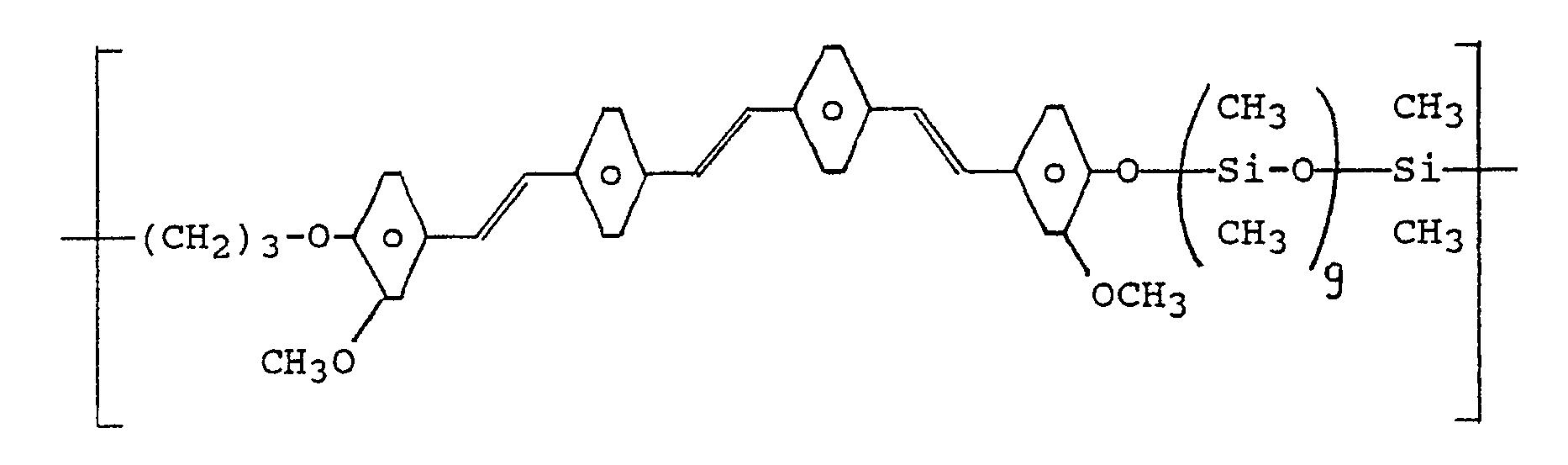
Das erfindungsgemäße Poly(arylenvinylen-siloxan) hat eine Inhärentviskosität von 0,19 dl/g, zwei Glaspunkte bei -94 und +14°C, eine Zersetzungstemperatur bei 352°C unter Luft und 380°C unter Stickstoff und unterhalb des Klärpunktes bei 220°C eine smektisch-C-Schichtstruktur, wobei der Schichtabstand 4,4 nm beträgt.The poly (arylene vinylene siloxane) according to the invention has an inherent viscosity of 0.19 dl / g, two glass points at -94 and + 14 ° C, a decomposition temperature at 352 ° C in air and 380 ° C under nitrogen and below the clearing point at 220 ° C a smectic-C layer structure, the layer spacing being 4.4 nm.
Das erfindungsgemäße Poly(arylenvinylen-siloxan) zeigt in CDCl₃ im 300 MHz-¹H-NMR-Spektrum mit TMS als innerem Standard Signale bei 0,08 (m, 6OH, 20x Si-CH₃), 0.65 (m, 4H, 2x Si-CH₂-), 1,89 (m, 4H, 2x Si-CH₂-CH₂-), 3,93 (s, 6H, 2x OCH₃), 3,99 (t, J=7Hz, 4H, 2x Si-CH₂-CH₂-CH₂-O-), 6,83 - 7,45 (Multipletts, 12H,(-O-)₂C₆H₃-CH=CH-, -CH=CH-) und 7,48 (m, schmal, 8H, -Ar-CH=CH-Ar-) ppm, wobei Ar Aromat bedeutet, und
im Infrarotspektrum (KBr-Preßling) signifikante Banden bei 1516 (m), 1260 (s), 1090 (s), 1025 (s) und 800 (s) cm⁻1 sowie
im UV-Spektrum in Tetrahydrofuran als Lösungsmittel
λmax (lgε) = 395 nm (4,91).The poly (arylenevinylene siloxane) according to the invention shows signals in CDCl₃ in the 300 MHz 1 H-NMR spectrum with TMS as the internal standard signals at 0.08 (m, 6OH, 20x Si-CH₃), 0.65 (m, 4H, 2x Si CH₂-), 1.89 (m, 4H, 2x Si-CH₂-C H ₂-), 3.93 (s, 6H, 2x OCH₃), 3.99 (t, J = 7Hz, 4H, 2x Si CH₂-CH₂-C H ₂-O-), 6.83 - 7.45 (multiplets, 12H, (- O-) ₂C₆H₃-CH = CH-, -CH = CH-) and 7.48 (m, narrow , 8H, - Ar -CH = CH- Ar -) ppm, where Ar is aromatic, and
significant bands in the infrared spectrum (KBr compact) at 1516 (m), 1260 (s), 1090 (s), 1025 (s) and 800 (s) cm -1 as well
in the UV spectrum in tetrahydrofuran as a solvent
λ max (lgε) = 395 nm (4.91).
Die in Beispiel 1 beschriebene Verfahrensweise wird wiederholt mit der Abänderung, daß anstelle des α,ω-Dihydrogendodecamethylhexasiloxans ein nach Arbeitsweise A hergestelltes Siloxan der Formel

worin x jeweils die in Tabelle 1 angegebene Bedeutung hat, eingesetzt wird. Es werden Poly(arylenvinylen-siloxane) mit den in Tabelle 1 angegebenen Ausbeuten, Mw, Mw/Mn, Pw, Tg, Ti und d erhalten.

where x has the meaning given in Table 1, is used. Poly (arylene vinylene siloxanes) are obtained with the yields given in Table 1, M w , M w / M n , P w , T g , T i and d.
Die in Beispiel 2 beschriebene Verfahrensweise wird wiederholt mit der Abänderung, daß anstelle des α,ω-Dihydrogentetradecamethylheptasiloxans ein nach Arbeitsweise A hergestelltes Siloxan gemäß Formel (IX) eingesetzt wird, worin x jeweils die in Tabelle 2 angegebene Bedeutung hat. Es werden Poly(arylenvinylen-siloxane) mit den in Tabelle 2 angegebenen Ausbeuten, Mw, Mw/Mn, Pw, Tg, Ti und d erhalten.
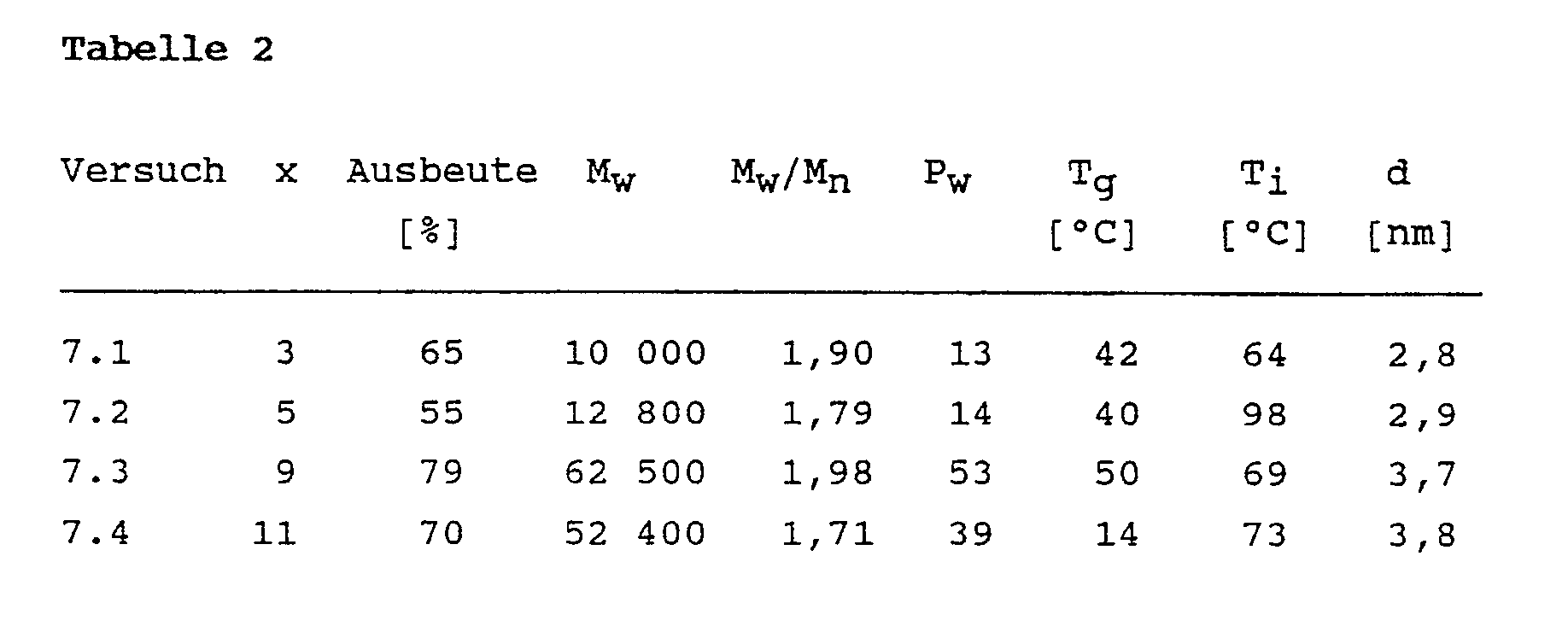
Die in Beispiel 3 beschriebene Verfahrensweise wird wiederholt mit der Abänderung, daß anstelle des α,ω-Dihydrogeneicosamethyldecasiloxans ein nach Arbeitsweise A hergestellte Siloxan gemäß Formel (IX) eingesetzt wird, worin x jeweils die in Tabelle 3 angegebene Bedeutung hat. Es werden Poly(arylenvinylen-siloxane) mit den in Tabelle 3 angegebenen Ausbeuten, Mw, Mw/Mn, Pw, Tg, Ti und d erhalten.

Die in Beispiel 4 beschriebene Verfahrensweise wird wiederholt mit der Abänderung, daß anstelle des α,ω-Dihydrogeneicosomethyldecasiloxans ein nach Arbeitsweise A hergestelltes Siloxan gemäß Formel (IX) eingesetzt wird, worin x jeweils die in Tabelle 4 angegebene Bedeutung hat. Es werden Poly(arylenvinylen-siloxane) mit den in Tabelle 4 angegebenen Ausbeuten, Mw, Mw/Mn, Pw, Tg, Ti und d erhalten.

Die in Beispiel 1 beschriebene Verfahrensweise wird wiederholt mit der Abänderung, daß anstelle des α,ω-Dihydrogendodecamethylhexasiloxans ein nach Arbeitsweise B hergestelltes α,ω-Dihydrogendimethyl(poly)siloxan-Gemisch mit einer mittleren Kettenlänge von xm Siloxaneinheiten, wobei xm jeweils die in Tabelle 5 angegebene Bedeutung hat, eingesetzt wird. Es werden Poly(arylenvinylen-siloxane) mit den in Tabelle 5 angegebenen Ausbeuten, Mw, Mw/Mn, Pw, Tg, Ti und d erhalten.

Claims (10)
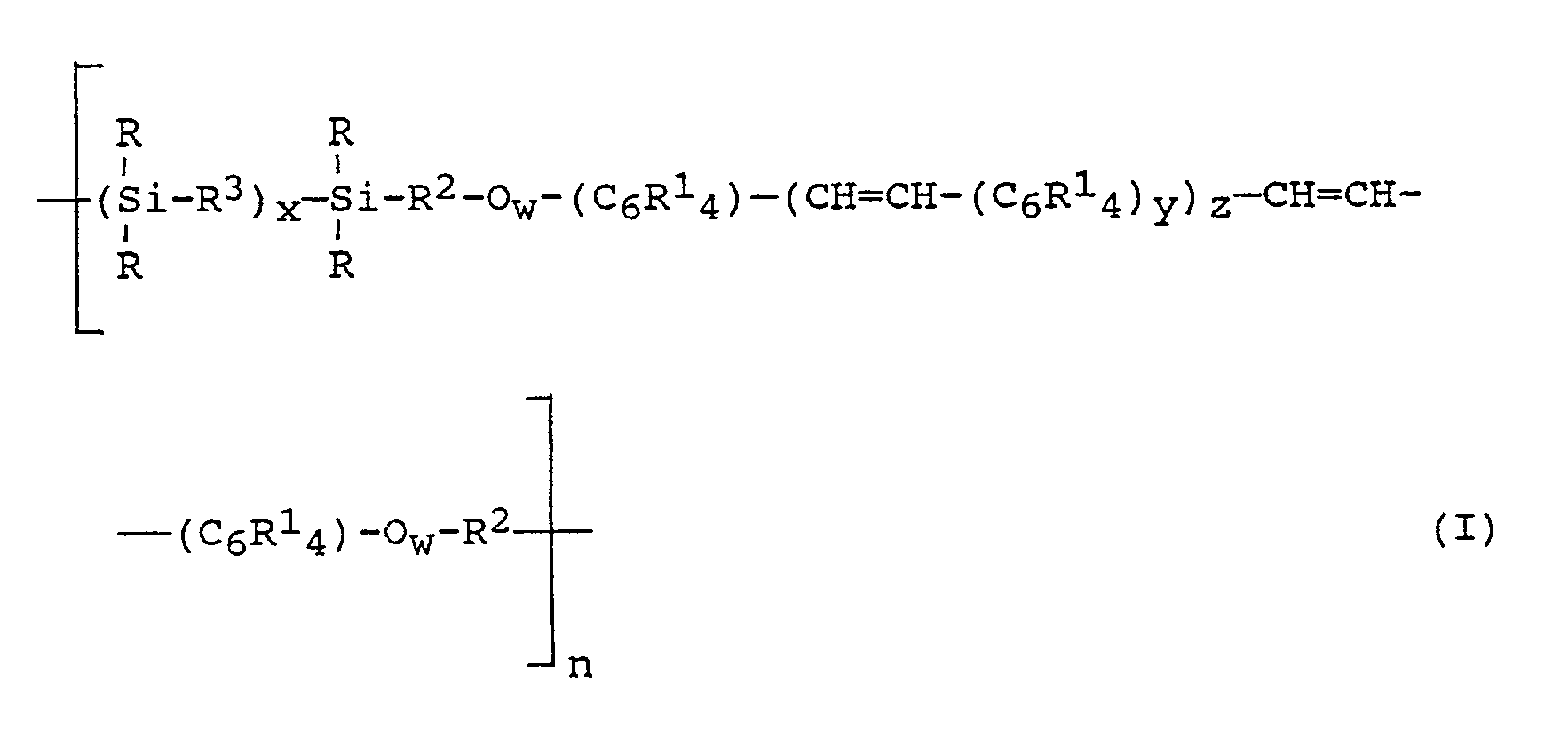
R gleich oder verschieden sein kann und einwertige, gegebenenfalls substituierte, von aliphatischer Mehrfachbindung freie, SiC-gebundene organische Reste bedeutet,
R¹ gleich oder verschieden sein kann und Wasserstoffatom, Halogenatom, Nitrogruppe, Cyanogruppe oder einwertige, von aliphatischer Mehrfachbindung freie organische Reste, die gegebenenfalls substituiert sein können, bedeutet,
R² gleich oder verschieden sein kann und zweiwertige, gegebenenfalls substituierte organische Reste bedeutet,
R³ gleich oder verschieden sein kann und Sauerstoffatom oder zweiwertige, gegebenenfalls substituierte, von aliphatischer Mehrfachbindung freie SiC-gebundene organische Reste bedeutet,
n eine Zahl von 2 bis 500,
w 0 oder 1,
x eine Zahl von 1 bis 100,
y 1 oder 2 und
z eine Zahl von 1 bis 3
bedeutet, mit der Maßgabe, daß y gleich 1 ist, wenn z größer als 1 ist.Poly (arylenevinylene siloxanes) according to claim 1 from units of the general formula
R can be the same or different and means monovalent, optionally substituted, aliphatic multiple bond-free, SiC-bonded organic radicals,
R 1 may be the same or different and denotes hydrogen atom, halogen atom, nitro group, cyano group or monovalent organic radicals which are free from aliphatic multiple bond and which may be substituted,
R² can be the same or different and means divalent, optionally substituted organic radicals,
R³ can be the same or different and means oxygen atom or divalent, optionally substituted, aliphatic multiple bond-free SiC-bonded organic radicals,
n is a number from 2 to 500,
w 0 or 1,
x is a number from 1 to 100,
y 1 or 2 and
z is a number from 1 to 3
means that y is 1 when z is greater than 1.
R⁴-Ow-(C₆R¹₄)-(CH=CH-(C₆R¹₄)y)z-CH=CH-(C₆R¹₄)-Ow-R⁴ (II)
eingesetzt werden, wobei
R¹, w, y und z eine der obengenannten Bedeutung haben und R⁴ gleich oder verschieden sein kann und einen einwertigen, gegebenenfalls substituierten organischen Rest mit Kohlenstoff-Kohlenstoff-Doppelbindung bedeutet, mit der Maßgabe, daß y gleich 1 ist, wenn z größer als 1 ist.A method according to claim 5, characterized in that as the α, ω-dialkenylarylenevinylene those of the formula
R⁴-O w - (C₆R¹₄) - (CH = CH- (C₆R¹₄) y ) z -CH = CH- (C₆R¹₄) -O w -R⁴ (II)
are used, whereby
R¹, w, y and z have one of the abovementioned meanings and R⁴ can be identical or different and denotes a monovalent, optionally substituted organic radical with a carbon-carbon double bond, with the proviso that y is 1 if z is greater than 1 is.

Applications Claiming Priority (2)
| Application Number | Priority Date | Filing Date | Title |
|---|---|---|---|
| DE4004944A DE4004944A1 (en) | 1990-02-16 | 1990-02-16 | POLY (ARYLENE VINYLENE SILOXANES) |
| DE4004944 | 1990-02-16 |
Publications (3)
| Publication Number | Publication Date |
|---|---|
| EP0442097A2 true EP0442097A2 (en) | 1991-08-21 |
| EP0442097A3 EP0442097A3 (en) | 1993-02-17 |
| EP0442097B1 EP0442097B1 (en) | 1996-10-09 |
Family
ID=6400359
Family Applications (1)
| Application Number | Title | Priority Date | Filing Date |
|---|---|---|---|
| EP90124497A Expired - Lifetime EP0442097B1 (en) | 1990-02-16 | 1990-12-18 | Poly(arylenevinylene siloxanes) |
Country Status (5)
| Country | Link |
|---|---|
| US (1) | US5185419A (en) |
| EP (1) | EP0442097B1 (en) |
| JP (1) | JPH0737531B2 (en) |
| CA (1) | CA2035680C (en) |
| DE (2) | DE4004944A1 (en) |
Cited By (2)
| Publication number | Priority date | Publication date | Assignee | Title |
|---|---|---|---|---|
| EP0661287A1 (en) * | 1993-12-23 | 1995-07-05 | Consortium für elektrochemische Industrie GmbH | Polymerizable liquid-crystalline organosiloxanes |
| EP0670298A1 (en) * | 1994-02-18 | 1995-09-06 | Consortium für elektrochemische Industrie GmbH | Stilbene-based materials, their preparation and use |
Families Citing this family (5)
| Publication number | Priority date | Publication date | Assignee | Title |
|---|---|---|---|---|
| TW386106B (en) * | 1996-03-28 | 2000-04-01 | Chisso Corp | Alkenyl compounds, liquid crystal compositions, and liquid crystal display devices |
| US20070251870A1 (en) * | 2006-05-01 | 2007-11-01 | Agilent Technologies, Inc. | Chromatographic stationary phase |
| JP6677122B2 (en) * | 2015-08-20 | 2020-04-08 | Jnc株式会社 | Compound having alkenyl at both ends, liquid crystal composition and liquid crystal display device |
| US11912846B2 (en) | 2021-03-10 | 2024-02-27 | 3D Systems, Inc. | Additives for build materials and associated printed 3D articles |
| WO2022192330A1 (en) | 2021-03-10 | 2022-09-15 | 3D Systems, Inc. | Flame resistant build materials and associated printed 3d articles |
Family Cites Families (6)
| Publication number | Priority date | Publication date | Assignee | Title |
|---|---|---|---|---|
| US3051684A (en) * | 1959-03-26 | 1962-08-28 | Directors Of The University Of | Organosiloxane polymers containing polydiene blocks |
| GB8405731D0 (en) * | 1984-03-05 | 1984-04-11 | Dow Corning Ltd | Preparation of organosiloxanes |
| FR2575085B1 (en) * | 1984-12-20 | 1987-02-20 | Rhone Poulenc Spec Chim | PLATINUM-TRIENE COMPLEX AS HYDROSILYLATION REACTION CATALYST AND PREPARATION METHOD THEREOF |
| GB8615527D0 (en) * | 1986-06-25 | 1986-07-30 | Secr Defence | Liquid crystal polymers |
| JPH0772799B2 (en) * | 1986-08-13 | 1995-08-02 | ソニー株式会社 | Resist material |
| DE3914896A1 (en) * | 1989-05-05 | 1990-11-22 | Wacker Chemie Gmbh | ENOXY-FUNCTIONAL ORGANOSILICIUM COMPOUNDS, THEIR PRODUCTION AND USE |
-
1990
- 1990-02-16 DE DE4004944A patent/DE4004944A1/en not_active Withdrawn
- 1990-12-18 DE DE59010532T patent/DE59010532D1/en not_active Expired - Fee Related
- 1990-12-18 EP EP90124497A patent/EP0442097B1/en not_active Expired - Lifetime
-
1991
- 1991-02-05 CA CA002035680A patent/CA2035680C/en not_active Expired - Fee Related
- 1991-02-11 US US07/653,385 patent/US5185419A/en not_active Expired - Fee Related
- 1991-02-14 JP JP3020871A patent/JPH0737531B2/en not_active Expired - Lifetime
Cited By (5)
| Publication number | Priority date | Publication date | Assignee | Title |
|---|---|---|---|---|
| EP0661287A1 (en) * | 1993-12-23 | 1995-07-05 | Consortium für elektrochemische Industrie GmbH | Polymerizable liquid-crystalline organosiloxanes |
| US5605649A (en) * | 1993-12-23 | 1997-02-25 | Consortium Fur Elektrochemische Industrie Gmbh | Polymerizable liquid-crystalline siloxanes |
| CN1061079C (en) * | 1993-12-23 | 2001-01-24 | 电化学工业有限公司(国际) | Polymerizable liquid-crvstalline siloxanes |
| EP0670298A1 (en) * | 1994-02-18 | 1995-09-06 | Consortium für elektrochemische Industrie GmbH | Stilbene-based materials, their preparation and use |
| US5563298A (en) * | 1994-02-18 | 1996-10-08 | Consortium f ur elektrochemische Industrie GmbH | Stilbene-based materials, their preparation and use |
Also Published As
| Publication number | Publication date |
|---|---|
| JPH059297A (en) | 1993-01-19 |
| US5185419A (en) | 1993-02-09 |
| EP0442097A3 (en) | 1993-02-17 |
| CA2035680C (en) | 1996-05-21 |
| EP0442097B1 (en) | 1996-10-09 |
| JPH0737531B2 (en) | 1995-04-26 |
| CA2035680A1 (en) | 1991-08-17 |
| DE4004944A1 (en) | 1991-08-22 |
| DE59010532D1 (en) | 1996-11-14 |
Similar Documents
| Publication | Publication Date | Title |
|---|---|---|
| EP0396130B1 (en) | Alkenyloxy-functional organosilicon compounds, their preparation and use | |
| DE3830592A1 (en) | (METH) ACRYLOXY GROUPS CONTAINING LIQUID CRYSTALLINE POLYORGANOSILOXANES | |
| DE2901514A1 (en) | CRYSTALLINE ORGANOPOLYSILOXANE COPOLYMERS WITH A VARIETY OF SEQUENCES AND METHODS FOR THEIR PRODUCTION | |
| DE69427275T2 (en) | Silicon containing polymer, method of manufacture and monomer | |
| EP0661287B1 (en) | Polymerizable liquid-crystalline organosiloxanes | |
| EP0442097B1 (en) | Poly(arylenevinylene siloxanes) | |
| EP0545409B1 (en) | Liquid crystals with end groups containing more than one silane group | |
| EP0424959B1 (en) | Organosilylalkyl-aromatic compounds | |
| EP0466183B1 (en) | Cyclosiloxanes with mesogenic side groups | |
| EP0639206B1 (en) | Siloxane copolymers having vinyloxy groups, their preparation and use | |
| DE60014129T2 (en) | FLUORO-CYL SUBSTITUTED TRICYCLOSILOXANES, THEIR USE IN THE MANUFACTURE OF NEW POLYMERS AND NEW POLYMERS | |
| US4604477A (en) | Method for making silylaroylhalides and reaction products | |
| EP0690062B1 (en) | Organosilicon compounds having furanyl groups | |
| EP0503668B1 (en) | Alkenyl groups containing organosilicum compounds, a process for their preparation and their use | |
| DE2809875A1 (en) | PROCESS FOR ADDING SI-BONDED HYDROGEN TO ALIPHATIC MULTIPLE BONDING | |
| DE4022218A1 (en) | ORGANOPOLYSILOXANE POLYMERS AND METHOD FOR THE PRODUCTION THEREOF | |
| DE60120147T2 (en) | HARDENABLE SILICONE RESIN COMPOSITION AND REACTIVE SILICON COMPOUNDS | |
| DE69800221T2 (en) | Photoluminescent silacyclobutenes monomers and polymers | |
| DE69423954T2 (en) | Hard bear silicon-containing polymer and curable composition based on this polymer | |
| DE2007967A1 (en) | Fluoroaromatic silicone compounds | |
| DE4023931A1 (en) | Ethynyl-silane-siloxane copolymers and mfr. - by base catalysed ring opening of cyclic siloxane and cyclic silyl:ethynyl polymers | |
| JPH06256526A (en) | Organic polymer containing silicon in main chain and its production | |
| EP0582615B1 (en) | Polyimide siloxanes which also include ester and/or amide groups | |
| DE69605754T2 (en) | Derivatives of bridged cyclopentadienyl compounds and process for their preparation | |
| DE863943C (en) | Process for the production of polymeric organosilicones |
Legal Events
| Date | Code | Title | Description |
|---|---|---|---|
| PUAI | Public reference made under article 153(3) epc to a published international application that has entered the european phase |
Free format text: ORIGINAL CODE: 0009012 |
|
| 17P | Request for examination filed |
Effective date: 19901218 |
|
| AK | Designated contracting states |
Kind code of ref document: A2 Designated state(s): BE CH DE FR GB IT LI NL |
|
| PUAL | Search report despatched |
Free format text: ORIGINAL CODE: 0009013 |
|
| AK | Designated contracting states |
Kind code of ref document: A3 Designated state(s): BE CH DE FR GB IT LI NL |
|
| 17Q | First examination report despatched |
Effective date: 19941115 |
|
| GRAG | Despatch of communication of intention to grant |
Free format text: ORIGINAL CODE: EPIDOS AGRA |
|
| GRAH | Despatch of communication of intention to grant a patent |
Free format text: ORIGINAL CODE: EPIDOS IGRA |
|
| GRAH | Despatch of communication of intention to grant a patent |
Free format text: ORIGINAL CODE: EPIDOS IGRA |
|
| GRAA | (expected) grant |
Free format text: ORIGINAL CODE: 0009210 |
|
| AK | Designated contracting states |
Kind code of ref document: B1 Designated state(s): BE CH DE FR GB IT LI NL |
|
| ITF | It: translation for a ep patent filed | ||
| ET | Fr: translation filed | ||
| ET | Fr: translation filed | ||
| REF | Corresponds to: |
Ref document number: 59010532 Country of ref document: DE Date of ref document: 19961114 |
|
| GBT | Gb: translation of ep patent filed (gb section 77(6)(a)/1977) |
Effective date: 19961108 |
|
| PLBE | No opposition filed within time limit |
Free format text: ORIGINAL CODE: 0009261 |
|
| 26N | No opposition filed | ||
| PGFP | Annual fee paid to national office [announced via postgrant information from national office to epo] |
Ref country code: DE Payment date: 19991202 Year of fee payment: 10 |
|
| PGFP | Annual fee paid to national office [announced via postgrant information from national office to epo] |
Ref country code: GB Payment date: 19991203 Year of fee payment: 10 Ref country code: FR Payment date: 19991203 Year of fee payment: 10 |
|
| PGFP | Annual fee paid to national office [announced via postgrant information from national office to epo] |
Ref country code: CH Payment date: 19991206 Year of fee payment: 10 |
|
| PGFP | Annual fee paid to national office [announced via postgrant information from national office to epo] |
Ref country code: NL Payment date: 19991213 Year of fee payment: 10 |
|
| PGFP | Annual fee paid to national office [announced via postgrant information from national office to epo] |
Ref country code: BE Payment date: 19991224 Year of fee payment: 10 |
|
| PG25 | Lapsed in a contracting state [announced via postgrant information from national office to epo] |
Ref country code: GB Free format text: LAPSE BECAUSE OF NON-PAYMENT OF DUE FEES Effective date: 20001218 |
|
| PG25 | Lapsed in a contracting state [announced via postgrant information from national office to epo] |
Ref country code: LI Free format text: LAPSE BECAUSE OF NON-PAYMENT OF DUE FEES Effective date: 20001231 Ref country code: CH Free format text: LAPSE BECAUSE OF NON-PAYMENT OF DUE FEES Effective date: 20001231 Ref country code: BE Free format text: LAPSE BECAUSE OF NON-PAYMENT OF DUE FEES Effective date: 20001231 |
|
| BERE | Be: lapsed |
Owner name: CONSORTIUM FUR ELEKTROCHEMISCHE INDUSTRIE G.M.B.H Effective date: 20001231 |
|
| PG25 | Lapsed in a contracting state [announced via postgrant information from national office to epo] |
Ref country code: NL Free format text: LAPSE BECAUSE OF NON-PAYMENT OF DUE FEES Effective date: 20010701 |
|
| GBPC | Gb: european patent ceased through non-payment of renewal fee |
Effective date: 20001218 |
|
| REG | Reference to a national code |
Ref country code: CH Ref legal event code: PL |
|
| PG25 | Lapsed in a contracting state [announced via postgrant information from national office to epo] |
Ref country code: FR Free format text: LAPSE BECAUSE OF NON-PAYMENT OF DUE FEES Effective date: 20010831 |
|
| NLV4 | Nl: lapsed or anulled due to non-payment of the annual fee |
Effective date: 20010701 |
|
| REG | Reference to a national code |
Ref country code: FR Ref legal event code: ST |
|
| PG25 | Lapsed in a contracting state [announced via postgrant information from national office to epo] |
Ref country code: DE Free format text: LAPSE BECAUSE OF NON-PAYMENT OF DUE FEES Effective date: 20011002 |
|
| PG25 | Lapsed in a contracting state [announced via postgrant information from national office to epo] |
Ref country code: IT Free format text: LAPSE BECAUSE OF NON-PAYMENT OF DUE FEES;WARNING: LAPSES OF ITALIAN PATENTS WITH EFFECTIVE DATE BEFORE 2007 MAY HAVE OCCURRED AT ANY TIME BEFORE 2007. THE CORRECT EFFECTIVE DATE MAY BE DIFFERENT FROM THE ONE RECORDED. Effective date: 20051218 |