EP0442219B1 - Plaque chauffante à chauffage rapide, uniforme et à haute efficacité - Google Patents
Plaque chauffante à chauffage rapide, uniforme et à haute efficacité Download PDFInfo
- Publication number
- EP0442219B1 EP0442219B1 EP90314054A EP90314054A EP0442219B1 EP 0442219 B1 EP0442219 B1 EP 0442219B1 EP 90314054 A EP90314054 A EP 90314054A EP 90314054 A EP90314054 A EP 90314054A EP 0442219 B1 EP0442219 B1 EP 0442219B1
- Authority
- EP
- European Patent Office
- Prior art keywords
- griddle
- magnetically permeable
- plate
- plates
- layer
- Prior art date
- Legal status (The legal status is an assumption and is not a legal conclusion. Google has not performed a legal analysis and makes no representation as to the accuracy of the status listed.)
- Expired - Lifetime
Links
- 238000010438 heat treatment Methods 0.000 title description 9
- 239000000463 material Substances 0.000 claims abstract description 35
- 238000010411 cooking Methods 0.000 claims abstract description 33
- 230000006698 induction Effects 0.000 claims abstract description 24
- 230000005291 magnetic effect Effects 0.000 claims description 23
- 230000004907 flux Effects 0.000 claims description 10
- 229910045601 alloy Inorganic materials 0.000 claims description 8
- 239000000956 alloy Substances 0.000 claims description 8
- 235000013305 food Nutrition 0.000 claims description 8
- RYGMFSIKBFXOCR-UHFFFAOYSA-N Copper Chemical compound [Cu] RYGMFSIKBFXOCR-UHFFFAOYSA-N 0.000 claims description 4
- 229910052802 copper Inorganic materials 0.000 claims description 4
- 239000010949 copper Substances 0.000 claims description 4
- 229910001220 stainless steel Inorganic materials 0.000 claims description 4
- 239000004020 conductor Substances 0.000 claims description 3
- 239000010935 stainless steel Substances 0.000 claims description 3
- 230000008878 coupling Effects 0.000 claims description 2
- 238000010168 coupling process Methods 0.000 claims description 2
- 238000005859 coupling reaction Methods 0.000 claims description 2
- 238000004804 winding Methods 0.000 claims 6
- 229910001030 Iron–nickel alloy Inorganic materials 0.000 claims 1
- 229910052782 aluminium Inorganic materials 0.000 claims 1
- XAGFODPZIPBFFR-UHFFFAOYSA-N aluminium Chemical compound [Al] XAGFODPZIPBFFR-UHFFFAOYSA-N 0.000 claims 1
- 239000011810 insulating material Substances 0.000 claims 1
- 239000012212 insulator Substances 0.000 abstract description 7
- 230000005294 ferromagnetic effect Effects 0.000 description 5
- 230000033228 biological regulation Effects 0.000 description 4
- 229910000859 α-Fe Inorganic materials 0.000 description 4
- 239000004519 grease Substances 0.000 description 3
- 239000000696 magnetic material Substances 0.000 description 3
- VYPSYNLAJGMNEJ-UHFFFAOYSA-N Silicium dioxide Chemical compound O=[Si]=O VYPSYNLAJGMNEJ-UHFFFAOYSA-N 0.000 description 2
- 230000008859 change Effects 0.000 description 2
- 238000004140 cleaning Methods 0.000 description 2
- 238000010276 construction Methods 0.000 description 2
- 238000010586 diagram Methods 0.000 description 2
- 239000011521 glass Substances 0.000 description 2
- 238000009413 insulation Methods 0.000 description 2
- 230000035699 permeability Effects 0.000 description 2
- 239000004033 plastic Substances 0.000 description 2
- 229920003023 plastic Polymers 0.000 description 2
- 230000005855 radiation Effects 0.000 description 2
- 230000004044 response Effects 0.000 description 2
- 108010063955 thrombin receptor peptide (42-47) Proteins 0.000 description 2
- 239000010963 304 stainless steel Substances 0.000 description 1
- 229910000952 Be alloy Inorganic materials 0.000 description 1
- 229910000640 Fe alloy Inorganic materials 0.000 description 1
- 229920000106 Liquid crystal polymer Polymers 0.000 description 1
- 239000004977 Liquid-crystal polymers (LCPs) Substances 0.000 description 1
- 229910000589 SAE 304 stainless steel Inorganic materials 0.000 description 1
- 238000010521 absorption reaction Methods 0.000 description 1
- PNEYBMLMFCGWSK-UHFFFAOYSA-N aluminium oxide Inorganic materials [O-2].[O-2].[O-2].[Al+3].[Al+3] PNEYBMLMFCGWSK-UHFFFAOYSA-N 0.000 description 1
- 239000012080 ambient air Substances 0.000 description 1
- 238000013459 approach Methods 0.000 description 1
- 239000000919 ceramic Substances 0.000 description 1
- 230000005670 electromagnetic radiation Effects 0.000 description 1
- 238000005516 engineering process Methods 0.000 description 1
- 235000013410 fast food Nutrition 0.000 description 1
- 230000005293 ferrimagnetic effect Effects 0.000 description 1
- 239000003302 ferromagnetic material Substances 0.000 description 1
- 239000000835 fiber Substances 0.000 description 1
- 239000012765 fibrous filler Substances 0.000 description 1
- 239000011491 glass wool Substances 0.000 description 1
- UGKDIUIOSMUOAW-UHFFFAOYSA-N iron nickel Chemical compound [Fe].[Ni] UGKDIUIOSMUOAW-UHFFFAOYSA-N 0.000 description 1
- 238000005259 measurement Methods 0.000 description 1
- 229910052751 metal Inorganic materials 0.000 description 1
- 239000002184 metal Substances 0.000 description 1
- 150000002739 metals Chemical class 0.000 description 1
- 229920000642 polymer Polymers 0.000 description 1
- 230000001105 regulatory effect Effects 0.000 description 1
- 229920005989 resin Polymers 0.000 description 1
- 239000011347 resin Substances 0.000 description 1
- 230000000284 resting effect Effects 0.000 description 1
- 239000000377 silicon dioxide Substances 0.000 description 1
- 239000002904 solvent Substances 0.000 description 1
- 239000000126 substance Substances 0.000 description 1
- XLYOFNOQVPJJNP-UHFFFAOYSA-N water Substances O XLYOFNOQVPJJNP-UHFFFAOYSA-N 0.000 description 1
Images

Classifications
-
- H—ELECTRICITY
- H05—ELECTRIC TECHNIQUES NOT OTHERWISE PROVIDED FOR
- H05B—ELECTRIC HEATING; ELECTRIC LIGHT SOURCES NOT OTHERWISE PROVIDED FOR; CIRCUIT ARRANGEMENTS FOR ELECTRIC LIGHT SOURCES, IN GENERAL
- H05B6/00—Heating by electric, magnetic or electromagnetic fields
- H05B6/02—Induction heating
- H05B6/10—Induction heating apparatus, other than furnaces, for specific applications
- H05B6/12—Cooking devices
- H05B6/1209—Cooking devices induction cooking plates or the like and devices to be used in combination with them
- H05B6/1245—Cooking devices induction cooking plates or the like and devices to be used in combination with them with special coil arrangements
- H05B6/1254—Cooking devices induction cooking plates or the like and devices to be used in combination with them with special coil arrangements using conductive pieces to direct the induced magnetic field
-
- H—ELECTRICITY
- H05—ELECTRIC TECHNIQUES NOT OTHERWISE PROVIDED FOR
- H05B—ELECTRIC HEATING; ELECTRIC LIGHT SOURCES NOT OTHERWISE PROVIDED FOR; CIRCUIT ARRANGEMENTS FOR ELECTRIC LIGHT SOURCES, IN GENERAL
- H05B6/00—Heating by electric, magnetic or electromagnetic fields
- H05B6/02—Induction heating
- H05B6/10—Induction heating apparatus, other than furnaces, for specific applications
- H05B6/12—Cooking devices
- H05B6/1209—Cooking devices induction cooking plates or the like and devices to be used in combination with them
- H05B6/1245—Cooking devices induction cooking plates or the like and devices to be used in combination with them with special coil arrangements
- H05B6/1272—Cooking devices induction cooking plates or the like and devices to be used in combination with them with special coil arrangements with more than one coil or coil segment per heating zone
-
- Y—GENERAL TAGGING OF NEW TECHNOLOGICAL DEVELOPMENTS; GENERAL TAGGING OF CROSS-SECTIONAL TECHNOLOGIES SPANNING OVER SEVERAL SECTIONS OF THE IPC; TECHNICAL SUBJECTS COVERED BY FORMER USPC CROSS-REFERENCE ART COLLECTIONS [XRACs] AND DIGESTS
- Y02—TECHNOLOGIES OR APPLICATIONS FOR MITIGATION OR ADAPTATION AGAINST CLIMATE CHANGE
- Y02B—CLIMATE CHANGE MITIGATION TECHNOLOGIES RELATED TO BUILDINGS, e.g. HOUSING, HOUSE APPLIANCES OR RELATED END-USER APPLICATIONS
- Y02B40/00—Technologies aiming at improving the efficiency of home appliances, e.g. induction cooking or efficient technologies for refrigerators, freezers or dish washers
-
- Y—GENERAL TAGGING OF NEW TECHNOLOGICAL DEVELOPMENTS; GENERAL TAGGING OF CROSS-SECTIONAL TECHNOLOGIES SPANNING OVER SEVERAL SECTIONS OF THE IPC; TECHNICAL SUBJECTS COVERED BY FORMER USPC CROSS-REFERENCE ART COLLECTIONS [XRACs] AND DIGESTS
- Y10—TECHNICAL SUBJECTS COVERED BY FORMER USPC
- Y10S—TECHNICAL SUBJECTS COVERED BY FORMER USPC CROSS-REFERENCE ART COLLECTIONS [XRACs] AND DIGESTS
- Y10S99/00—Foods and beverages: apparatus
- Y10S99/14—Induction heating
Definitions
- the present invention relates essentially to commercial griddles and more particularly to griddles employing magnetically permeable griddle plates heated by induction coils to their Curie temperatures which may vary from plate to plate or from one surface of the griddle plate to the other.
- Griddles are one of the major cooking appliances in commercial kitchens, particularly in a majority of the fast food and full service chain restaurants.
- the prior art griddles are either gas or electric powered and typically have one heating element, one thermocouple and one thermostat per 30 cm (linear foot) thus permitting wide temperature variations between heating elements. Literally power is pushed into the food.
- Yet another object of the present invention is to provide a griddle plate or plates each of which can provide at least two different cooking temperatures.
- Still another object of the present invention is to provide a highly efficient griddle structure employing heat insulation for under the griddle plates and a cover that may be used during non-cooking intervals so that the plates are maintained essentially at about effective Curie temperature with the expenditure of little energy.
- a system for providing a cooking surface which is heatable to a predetermined temperature for cooking food comprises a plate including a first layer of magnetically permeable material having a first Curie temperature and a second layer, and an induction coil for generating a magnetic field, the magnetically permeable material being selected to produce the predetermined temperature on the cooking surface when the magnetically permeable material is heated to its Curie temperature upon exposure to the magnetic field characterised in that the plate is formed as a griddle plate with the cooking surface formed as a surface of the griddle plate, the second layer of the griddle plate being for use as the cooking surface and in that the induction coil is, in use in cooking food, positioned adjacent the griddle plate, whereby a substantially uniform temperature is maintained across the cooking surface of the griddle plate.
- a plurality of interchangeable griddle plates incorporating magnetically permeable, that is, high mu material such as Alloy 34, Alloy 36 and the like are subjected to an essentially uniform alternating magnetic field by induction coils to heat the griddle plates to their effective Curie temperatures at which temperature the plates become essentially non-magnetic and heating is materially reduced. The temperature falls and the plates reacquire their magnetic properties and start heating again whereby the plates maintain a quite constant temperature at about their effective Curie temperatures.
- Uniformity of temperature across the plates is ensured by a specific design of the induction coils and related structure that maintains a magnetic field across the griddle plates such that each region of the plates responds uniformly to a change in load at that region. Measurements of temperature across the plates showed variations of about ⁇ 5°C ( ⁇ 10°F). These small variations result from the fact that the plates respond incrementally to changes in load. Thus if batter is placed on an area of a plate, that area has its temperature reduced, it becomes highly magnetic and generates heat at a fast rate whereas immediately adjacent areas unaffected by changes in load continue to idle; that is, cycle over a short range about the effective Curie temperature.
- Griddle plates of different Curie temperatures may be used concurrently.
- a griddle having several different closely controlled temperatures at the same time is provided.
- Each griddle plate is fabricated so as to prevent unnecessary stray radiation and by covering different regions of a griddle plate with different high mu materials one plate can provide multiple temperatures.
- many different cooking temperatures may be provided.
- half size plates it is possible to provide six different highly regulated cooking temperatures at the same time or by using different high mu materials on both surfaces of the plate, three full size plates can provide six different temperatures.
- the griddle plates take about five minutes to reach maximum temperature from a cold start. This maximum temperature can be maintained at little cost of energy by placing a cover over all areas not being used. Heat loss is minimized particularly if a poor heat conductive material is employed for the cover or covers. Further an insulating pad may be disposed between the coils and the griddle plates to, among other things, reduce heat loss from the griddle plates. The combination of these two features provide an unusually efficient system, the insulating pad reducing heat loss at all times and the cover during non-cooking intervals.
- the induction coils are supplied with a constant alternating current to maintain uniform response to the energy input.
- the griddle plates are considered to reflect resistance into the coils and under these circumstances the regulation is governed by the equation ⁇
- the term "effective Curie temperature” is the temperature at which a material becomes, for purposes of this invention, essentially non-magnetic. Such temperature may be as little as 1°C. or as much as 100°C. less than absolute Curie temperature depending upon the material employed.
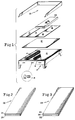
- a griddle system comprising a stand 2 which in the embodiment illustrated supports three induction coils 4 identical in construction.
- the stand has a grease trap 6 along its front horizontal surface and on the vertical front surface has controls 8, one for each coil 4.
- a coil insulator 11 that serves several functions; it insulates the coil from extreme temperatures, it minimizes heat loss from the griddle plates to be described, and it has sound absorption properties that helps reduce noise often associated with magnetic induction systems.
- the insulator 11 is a refractory fiber blanket formed from very pure alumina, silica or other refractory oxides. The material presently being employed is a non-woven glass.
- a griddle surface 10 Disposed above and in contact with the insulator 11 is a griddle surface 10 fabricated from glass or a light weight, high temperature polymer.
- the griddle surface 10 serves to deflect grease into the grease trap 6 and prevent it from falling on the coils 4.
- griddle plates 12, 14, 16 and 18 Disposed above and resting on the griddle surface 10 are removable griddle plates 12, 14, 16 and 18 which are fabricated from high mu materials. All four of the plates may have the same Curie temperature, different temperatures or any combination in between depending upon what foods are to be cooked on the plates.
- a removable splash guard 20 is disposed about the back and two sides of the top surface of the stand 2. In the particular embodiment discussed herein a full size griddle plate is about 30-60 cm (1 foot by 2 feet).
- the power supply (not illustrated) is held in the base of the stand 2 under the coils. It supplies 1300 watts per square foot of constant alternating current at 22 KHz or more but preferably under 50 KHz.
- the power work unit employed was a power supply taken from a Sanyo induction cooker Model No. 564.4498511.
- the Sanyo control board is replaced by the circuitry described below relative to Fig. 7.
- each plate 22 is quite thin and is made of a sheet of stainless steel 24 that, in this instance, is 0.3175 cm (0.125 inch) thick with a bottom layer of high mu material 26 about 0.089 cm (0.035 inch) thick.
- the plates are easily cleaned.
- the use of an alloy layer that is 0.089 cm (0.035 inch) thick (about 5 skin depths) at 26 MHz permits the plate to accept all available power of the power unit and causes the plate to achieve its effective Curie temperature. Since the plates and for that matter the griddle surface 10 carry no electrical components they may be immersed in water for cleaning.
- the thickness of the magnetic material on the griddle plates should be such as to take all of the energy from its coil that is available and essentially isolate the surrounding area from the magnetic flux.
- the magnetic material on the plate is 0.089 cm (35 thousandths of an inch), this being approximately five skin depths at the frequency employed. See U.S. Patents No. 4,256,945 and 4,701,587, the subjects matter thereof relating to skin depth and copper clad ferromagnetic materials being incorporated herein by reference.
- a tri-clad plate 28 is employed.
- the upper surface 30 is 304 stainless steel at 0.12 cm (0.048 inch) thickness
- a bottom surface 32 is a nickel-iron, high mu material at a thickness of 0.089 cm (0.035 inch) and sandwiched between is a copper 101 plate 34 at a thickness of 0.191 cm (0.075 inch).
- the total plate thickness is 0.389 cm (0.153 inch) thus presenting little thermal inertia but providing adequate magnetic shielding.
- the plate of Fig. 3 may have both lower and upper surfaces of high mu materials of different Curie temperatures.
- each of the plates of Fig. 1 may be a tri-clad plate with two high mu surfaces to provide as many as eight cooking temperatures with four plates.
- the lower surface shields the upper surface from appreciable flux so that the lower magnetic surface controls temperature.
- the number of griddle plates is indefinite being restricted only by the number of different cooking temperatures desired.
- magnetic stainless steels their Curie temperatures are quite high and therefor when a two sided magnetic griddle plate is employed both surfaces usually are iron alloys as follows: These temperatures are approximate and should not be considered to be precise.
- Examples of tri-clad construction are Stainless 304, cu 101 and selected alloy and Stainless 400 series, cu 101 and selected alloy.
- the 400 series stainless provides increased shielding over the 304 stainless.
- two temperatures in one plate can be alloy, cu 101 and alloy.
- a bi-clad plate can be stainless and alloy.
- Coil 42 is fabricated from Litz wire 36 and non-conductive rubber or plastic spacing material 38.
- the spacing between the turns of the Litz wire are non-uniform going from a spacing of 0.64 cm (0.25 inch) in the center of the coil to no spacing at the edges.
- the Litz wire is 0.25 cm (0.10 inch) in diameter.
- the coil length is 1.15 m (37 feet 10 inches) with the first 60 cm (two feet) having a spacing of 0.64 cm (0.25 inch) between turns, the next 0.82 m (27 feet) having 0.32 cm (0.125 inch) between turns, the next 0.15 m (five feet) having 0.26 cm (0.103 inch) between turns and the last 0.12 m (three feet 10 inches) having no spacing between turns except for the insulation over the wire.
- ferrite bars 40 are located as illustrated in Fig. 5 below the coils 42.
- the coils are rectangular, 28 cm by 25 cm (eleven inches by ten inches).
- Each coil has associated with it 8 ferrite bars, 6.4 cm (2-1/2 inches) long 1.9 cm (3/4 inch) wide and 0.048 cm (.0187 inch) thick. These sizes are approximate.
- the bars 40 are located at each end of the horizontal and vertical centerlines of the rectangle and at each end of two lines at approximately 35° on both sides of the vertical centerline, all as illustrated in Fig. 5.
- these bars 40 are two-fold. First, the bars reduce the flux concentration under the coil 42 and increases it over the coil so as to increase the flux coupling to the magnetic material. By reducing the flux under the coils the bars assist in preventing leakage of electromagnetic radiation. A second use of the bars is to assist the coil structure in providing uniformity of temperature across a griddle plate. In most prior art griddles it is assumed that application of heat must be heavily concentrated about the edges because there is no heat source outside of the edges of the griddle whereas the center of the griddle is surrounded by heated material.
- a cover 44 that may be used with the griddle system of the present invention.
- the cover 44 has inner and outer layers 46 and 48 fabricated from a heat resistant, poor heat conducting material and is a hollow structure.
- the outer materials used may be a liquid crystal polymer or stainless steel.
- Central region 50 of the cover 44 may be empty or may have a poor heat conducting fibrous filler 46 of glasswool or ceramic.
- the surface of the plate- is reasonably isolated from the ambient air and loss of heat is maintained quite low.
- the plate does not overheat because its temperature will not rise above its effective Curie temperature and thus the temperature of the griddle plate 30 cycles slowly about its effective Curie temperature and little energy is expended.
- a further feature that enhances the efficiency of the apparatus is the insulator 11.
- the insulator 11 as described above reduces heat loss at all times.
- the cover 44 is used in conjunction with the insulator, the covered griddle plate is greatly isolated from the ambient and effective Curie temperature is maintained with relatively little expenditure of energy.
- a control circuit for the Sanyo unit includes the Sanyo inverter 60 feeding the griddle coil 62.
- the inverter 60 feeds a low power signal over lead 64 to a control circuit 66 which in turn supplies an on/off signal to the inverter 60.
- control is two fold, first to make available full power to the coil if a griddle plate is present and to provide low level pulses to the coil if the griddle plate is not present or a light load is present in the form of a pan or other small cooking vessel or utensil. Specifically, if the power being supplied to the load by inverter 60 indicates a griddle plate is present the inverter 60 delivers some power all the time, the level depending upon the load. If the griddle plate is not present, a low power indication is supplied to control circuit 66 which goes into a low duty cycle pulsing mode causing the delivery of only small amounts of power to the coil 62. If now a griddle plate is replaced the power absorbed rises above a predetermined threshold and the full power is again available.
- a thermal switch (not illustrated) is located adjacent a griddle plate to sense coil temperature. Such over temperature can occur if the power supply allows the current to rise as effective Curie temperature is achieved. In the event the value of the left side of the equation on page 4 hereof exceeds the value of the right side thereof, a run-away condition can prevail. The temperature sensing switch in such event would shut the system down.
- the present invention is disclosed as a griddle for cooking food such a system has many applications outside of the food industry such as in laboratories, particularly chemical and plastics laboratories, driving off moisture and solvents from various articles, heat treatment of metals, curing of resins and in any application that requires carefully controlled temperatures of a heated surface.
Landscapes
- Physics & Mathematics (AREA)
- Electromagnetism (AREA)
- Baking, Grill, Roasting (AREA)
- Cookers (AREA)
- Constitution Of High-Frequency Heating (AREA)
- Heating, Cooling, Or Curing Plastics Or The Like In General (AREA)
Claims (19)
- Système pour fournir une surface de cuisson qui est chauffable à une température prédéterminée pour cuire un aliment, comprenant une plaque (22, 28) comprenant une première couche (26, 32) de matériau perméable magnétiquement, ayant un premier point de Curie et une deuxième couche (24, 30) et une bobine d'induction (4, 42) pour produire un champ magnétique, le matériau perméable magnétiquement étant sélectionné pour produire la température prédéterminée sur la surface de cuisson, lorsque le matériau perméable magnétiquement est chauffé à son point de Curie lors de l'exposition au champ magnétique, caractérisé en ce que la plaque (22, 28) est formée comme une plaque de grille (12 à 18, 22, 28), la surface de cuisson étant réalisée comme une surface de la plaque de grille (12 à 18, 22, 28), la deuxième couche (24, 30) de la plaque de grille devant être utilisée comme surface de cuisson et en ce que la bobine d'induction (4, 42) est, en utilisation lors d'une cuisson d'aliment, placée adjacente à la plaque de grille (12 à 18, 22, 28), de manière à maintenir une température sensiblement uniforme sur la surface de cuisson (10) de la plaque de grille (12 à 18).
- Système selon la revendication 1, dans lequel la bobine d'induction (42) a une distribution d'enroulement pour coupler une majorité du flux produit par la bobine à une périphérie extérieure du matériau perméable magnétiquement.
- Système selon la revendication 1 ou la revendication 2, dans lequel la bobine d'induction (42) comprend une pluralité d'enroulements adjacents, la bobine d'induction ayant des enroulements intérieurs et extérieurs, les enroulements adjacents de la bobine d'induction (42) étant plus largement espacés aux enroulements les plus intérieurs qu'aux enroulements les plus extérieurs.
- Système selon l'une quelconque des revendications précédentes, dans lequel au moins une autre plaque de grille (12 à 18) est placée adjacente à la bobine d'induction (4, 42), la plaque de grille (12 à 18) comprenant une couche de matériau perméable magnétiquement ayant un point de Curie qui est différent du premier point de Curie.
- Système selon la revendication 4, dans lequel la bobine d'induction (4) comprend une bobine d'induction placée adjacente à chaque plaque de grille (12 à 18).
- Système selon l'une quelconque des revendications précédentes, dans lequel les première et deuxième couches (24, 26, 30, 32) sont toutes deux constituées de matériau perméable magnétiquement.
- Système selon l'une quelconque des revendications précédentes, dans lequel le matériau perméable magnétiquement est un alliage nickel-fer.
- Système selon l'une quelconque des revendications precédentes, dans lequel les première et deuxième couches (24, 26, 30, 32) sont constituées du même matériau perméable magnétiquement.
- Système selon l'une quelconque des revendications 1 à 7, dans lequel les première et deuxième couches (24, 26, 30, 32) sont constituées de matériaux perméables magnétiquement différents.
- Système selon l'une quelconque des revendications 1 à 7 ou 9, dans lequel la deuxième couche (24, 30) est en acier inoxydable.
- Système selon l'une quelconque des revendications précédentes, dans lequel une couche isolante thermique (11) est située entre le matériau perméable magnétiquement et la bobine d'induction (4, 42).
- Système selon l'une quelconque des revendications précédentes, dans lequel la première couche (26, 32) est placée plus près de la bobine d'induction (4, 42) que de la deuxième couche (24, 30), la première couche (26, 32) ayant une épaisseur inférieure ou égale à 0,9 mm (0,035 pouce).
- Système selon l'une quelconque des revendications précédentes, dans lequel la plaque de grille (28) comprend en outre une troisième couche (34) de matériau placée entre les première et deuxième couches (30, 32).
- Système selon la revendication 13, dans lequel les première, deuxième et troisième couches (30, 32, 34) ont des épaisseurs différentes.
- Système selon la revendication 13 ou la revendication 14, dans lequel la troisième couche (34) est formée en cuivre, en aluminium ou en leurs alliages.
- Système selon l'une quelconque des revendications précédentes, dans lequel un couvercle en matériau à faible conductivité thermique est placé sur une zone de la surface de cuisson, pour placer cette zone à l'état hors service.
- Système selon la revendication 16, dans lequel le couvercle comprend un organe formant capot ayant des surfaces parallèles espacées en matériau isolant thermiquement.
- Système selon l'une quelconque des revendications précédentes, dans lequel la plaque de grille (12 à 18) est planaire.
- Système selon l'une quelconque des revendications précédentes, comprenant une pluralité de corps (40) en matériau perméable magnétiquement, disposés adjacents à la bobine (42).
Applications Claiming Priority (2)
| Application Number | Priority Date | Filing Date | Title |
|---|---|---|---|
| US07/480,895 US5134265A (en) | 1990-02-16 | 1990-02-16 | Rapid heating, uniform, highly efficient griddle |
| US480895 | 1990-02-16 |
Publications (2)
| Publication Number | Publication Date |
|---|---|
| EP0442219A1 EP0442219A1 (fr) | 1991-08-21 |
| EP0442219B1 true EP0442219B1 (fr) | 1995-09-27 |
Family
ID=23909786
Family Applications (1)
| Application Number | Title | Priority Date | Filing Date |
|---|---|---|---|
| EP90314054A Expired - Lifetime EP0442219B1 (fr) | 1990-02-16 | 1990-12-20 | Plaque chauffante à chauffage rapide, uniforme et à haute efficacité |
Country Status (6)
| Country | Link |
|---|---|
| US (1) | US5134265A (fr) |
| EP (1) | EP0442219B1 (fr) |
| JP (1) | JPH03246880A (fr) |
| AT (1) | ATE128594T1 (fr) |
| CA (1) | CA2032183C (fr) |
| DE (1) | DE69022713T2 (fr) |
Families Citing this family (45)
| Publication number | Priority date | Publication date | Assignee | Title |
|---|---|---|---|---|
| US5227597A (en) * | 1990-02-16 | 1993-07-13 | Electric Power Research Institute | Rapid heating, uniform, highly efficient griddle |
| US5844212A (en) * | 1991-10-23 | 1998-12-01 | Gas Research Institute | Dual surface heaters |
| CA2096725C (fr) * | 1991-10-23 | 1998-04-07 | David M. Dickens | Rechauffeurs a deux surfaces |
| US5528020A (en) * | 1991-10-23 | 1996-06-18 | Gas Research Institute | Dual surface heaters |
| DE4208252A1 (de) * | 1992-03-14 | 1993-09-16 | Ego Elektro Blanc & Fischer | Induktive kochstellenbeheizung |
| EP0565186A3 (fr) * | 1992-04-10 | 1993-11-03 | Balay, S.A. | Plan de cuisson électrique à chauffage par induction |
| US5304767A (en) * | 1992-11-13 | 1994-04-19 | Gas Research Institute | Low emission induction heating coil |
| DE9406148U1 (de) * | 1994-04-13 | 1994-06-09 | Electrolux Therma Gmbh, 22047 Hamburg | Induktionsbeheizte Kochstelle |
| CH689063A5 (de) | 1994-10-09 | 1998-08-31 | Wuest Ernst Menu System | Kochgeraet. |
| FR2726149B1 (fr) * | 1994-10-21 | 1996-12-27 | Seb Sa | Appareil electrique de cuisson pour griller des aliments |
| US5911898A (en) * | 1995-05-25 | 1999-06-15 | Electric Power Research Institute | Method and apparatus for providing multiple autoregulated temperatures |
| FR2750562B1 (fr) * | 1996-06-28 | 2006-09-08 | Cepem | Procede d'optimisation d'inducteurs de cuisson par induction et inducteurs ainsi optimises |
| US20090127253A1 (en) * | 1997-06-06 | 2009-05-21 | Philip Stark | Temperature-controlled induction heating of polymeric materials |
| US6939477B2 (en) | 1997-06-06 | 2005-09-06 | Ashland, Inc. | Temperature-controlled induction heating of polymeric materials |
| US6138554A (en) * | 1999-03-12 | 2000-10-31 | Gas Research Institute | Multi-layer griddle |
| FR2792158B1 (fr) * | 1999-04-09 | 2001-05-18 | Jaeger Regulation | Foyer de cuisson par induction modulable a rayonnement reduit et procede de realisation |
| US6483089B1 (en) | 1999-05-26 | 2002-11-19 | Aladdin Temp-Rite, Llc | Heat retentive food storage/delivery container and system |
| AU5446300A (en) | 1999-05-26 | 2001-04-23 | Aladdin Temp-Rite Llc | Heat retentive food storage/delivery container and system |
| US6384387B1 (en) | 2000-02-15 | 2002-05-07 | Vesture Corporation | Apparatus and method for heated food delivery |
| DE10127051C2 (de) * | 2001-06-02 | 2003-06-26 | Schott Glas | Kochfeld |
| US7495196B2 (en) * | 2001-12-14 | 2009-02-24 | All-Clad Metalcrafters Llc | Food cooking or warming apparatus with self-regulating inductor |
| EP1404155B1 (fr) * | 2002-09-26 | 2005-12-14 | MTECH Holding AB | Plaque de cuisson à induction |
| US6953919B2 (en) | 2003-01-30 | 2005-10-11 | Thermal Solutions, Inc. | RFID-controlled smart range and method of cooking and heating |
| US7573005B2 (en) * | 2004-04-22 | 2009-08-11 | Thermal Solutions, Inc. | Boil detection method and computer program |
| FR2895638B1 (fr) * | 2005-12-27 | 2008-04-18 | Brandt Ind Sas | Dispositif inducteur a bobinages individuels multiples pour foyer de cuisson par induction |
| JP4989339B2 (ja) * | 2007-07-06 | 2012-08-01 | 株式会社フジマック | 電磁調理器 |
| US7989012B2 (en) * | 2007-09-26 | 2011-08-02 | Kellogg Company | Induction cooking structure and system and method of using the same |
| US9226343B2 (en) | 2007-11-30 | 2015-12-29 | Nuwave, Llc | Apparatus, system, method and computer program product for precise multistage programmable induction cooktop |
| US8065999B2 (en) * | 2008-07-14 | 2011-11-29 | W.C. Bradley Co. | Adjustable cooking grate for barbeque grills |
| IT1392906B1 (it) * | 2008-09-11 | 2012-04-02 | Whirlpool Co | Forno elettrico ad induzione |
| DE102009019765A1 (de) * | 2009-04-28 | 2010-11-04 | Vr Vision Research Gmbh | Grillvorrichtung für ein Induktionskochfeld |
| USD632925S1 (en) * | 2010-09-24 | 2011-02-22 | Magellan Group Ltd. | Griddle |
| US9833101B2 (en) | 2011-04-01 | 2017-12-05 | Nuwave, Llc | Pan and method for making |
| US9585202B2 (en) | 2011-05-20 | 2017-02-28 | Cooktek Induction Systems, Llc | Induction-based food holding/warming system and method |
| US9640318B2 (en) * | 2013-12-07 | 2017-05-02 | Intel Corporation | Non-uniform spacing in wireless resonator coil |
| EP2893854B1 (fr) * | 2014-01-10 | 2016-11-30 | Electrolux Appliances Aktiebolag | Appareil de cuisson à induction |
| US20160309941A1 (en) * | 2015-04-23 | 2016-10-27 | Carrier Commericial Refrigeration, Inc. | Cooking apparatus with modular cooking surfaces |
| US10356853B2 (en) | 2016-08-29 | 2019-07-16 | Cooktek Induction Systems, Llc | Infrared temperature sensing in induction cooking systems |
| US11665790B2 (en) * | 2016-12-22 | 2023-05-30 | Whirlpool Corporation | Induction burner element having a plurality of single piece frames |
| ES2682522B1 (es) * | 2017-03-20 | 2019-07-29 | Bsh Electrodomesticos Espana Sa | Dispositivo de aparato domestico |
| ES2736073A1 (es) * | 2018-06-21 | 2019-12-23 | Bsh Electrodomesticos Espana Sa | Dispositivo de aparato de cocción |
| CN112890616A (zh) * | 2021-02-04 | 2021-06-04 | 宁波嘉乐智能科技股份有限公司 | 一种空气炸锅的低温幅控制方法 |
| USD1102806S1 (en) | 2024-10-09 | 2025-11-25 | Solo Brands, Llc | Cooking appliance |
| USD1102807S1 (en) | 2024-10-09 | 2025-11-25 | Solo Brands, Llc | Cooking system |
| USD1108197S1 (en) | 2024-10-09 | 2026-01-06 | Solo Brands, Llc | Cooking appliance |
Family Cites Families (21)
| Publication number | Priority date | Publication date | Assignee | Title |
|---|---|---|---|---|
| GB444003A (en) * | 1934-09-11 | 1936-03-10 | Oskar Neiss | Improvements in and relating to electro-inductively heated appliances |
| GB1157711A (en) * | 1966-10-24 | 1969-07-09 | Electricity Council | Improvements in or relating to Electrical Cooking apparatus and Utensils for use therewith |
| US3684853A (en) * | 1971-10-18 | 1972-08-15 | Gen Electric | Induction surface heating unit system |
| US3966426A (en) * | 1972-03-24 | 1976-06-29 | White-Westinghouse Corporation | Cooking vessel for use with induction heating cooking unit |
| GB1436221A (en) * | 1972-05-02 | 1976-05-19 | Mitsubishi Electric Corp | Induction heating apparatus |
| US3843857A (en) * | 1972-05-26 | 1974-10-22 | R Cunningham | Induction heating system primarily intended for cooking use |
| JPS5217572B2 (fr) * | 1972-08-18 | 1977-05-17 | ||
| US3989410A (en) * | 1974-11-27 | 1976-11-02 | General Electric Company | Labyrinth seal system |
| JPS5193450A (fr) * | 1975-02-14 | 1976-08-16 | ||
| US4277667A (en) * | 1978-06-23 | 1981-07-07 | Matsushita Electric Industrial Co., Ltd. | Induction heating apparatus with negative feedback controlled pulse generation |
| JPS55144796U (fr) * | 1979-04-04 | 1980-10-17 | ||
| US4256945A (en) * | 1979-08-31 | 1981-03-17 | Iris Associates | Alternating current electrically resistive heating element having intrinsic temperature control |
| US4701587A (en) * | 1979-08-31 | 1987-10-20 | Metcal, Inc. | Shielded heating element having intrinsic temperature control |
| FR2527916B1 (fr) * | 1982-06-08 | 1986-02-07 | Thomson Brandt | Ustensile de cuisine a thermostat |
| US4695713A (en) * | 1982-09-30 | 1987-09-22 | Metcal, Inc. | Autoregulating, electrically shielded heater |
| US4752673A (en) * | 1982-12-01 | 1988-06-21 | Metcal, Inc. | Autoregulating heater |
| US4629843A (en) * | 1984-04-11 | 1986-12-16 | Tdk Corporation | Induction cooking apparatus having a ferrite coil support |
| JPS6116615A (ja) * | 1984-07-02 | 1986-01-24 | Mitsubishi Electric Corp | 位相同期回路 |
| US4646935A (en) * | 1985-01-18 | 1987-03-03 | Clad Metals, Inc. | Induction cooking utensils |
| FR2609533B1 (fr) * | 1987-01-13 | 1990-05-25 | Cableco Sa | Plan de cuisson electrique a chauffage a induction |
| US4922079A (en) * | 1988-03-18 | 1990-05-01 | Raytheon Company | Combination cooking cartridge |
-
1990
- 1990-02-16 US US07/480,895 patent/US5134265A/en not_active Expired - Lifetime
- 1990-11-21 JP JP2317477A patent/JPH03246880A/ja active Pending
- 1990-12-13 CA CA002032183A patent/CA2032183C/fr not_active Expired - Fee Related
- 1990-12-20 AT AT90314054T patent/ATE128594T1/de not_active IP Right Cessation
- 1990-12-20 DE DE69022713T patent/DE69022713T2/de not_active Expired - Fee Related
- 1990-12-20 EP EP90314054A patent/EP0442219B1/fr not_active Expired - Lifetime
Also Published As
| Publication number | Publication date |
|---|---|
| US5134265A (en) | 1992-07-28 |
| ATE128594T1 (de) | 1995-10-15 |
| CA2032183A1 (fr) | 1991-08-17 |
| CA2032183C (fr) | 2000-08-29 |
| EP0442219A1 (fr) | 1991-08-21 |
| DE69022713T2 (de) | 1996-05-02 |
| DE69022713D1 (de) | 1995-11-02 |
| JPH03246880A (ja) | 1991-11-05 |
Similar Documents
| Publication | Publication Date | Title |
|---|---|---|
| CA2032183C (fr) | Gril a chauffe rapide et uniforme, et a efficacite energetique elevee | |
| US5227597A (en) | Rapid heating, uniform, highly efficient griddle | |
| US4453067A (en) | Induction heating coil | |
| US3684853A (en) | Induction surface heating unit system | |
| US3530499A (en) | Electrically heated appliance unit | |
| US7963215B2 (en) | Electromagnetic induction heating grill toaster | |
| US3307008A (en) | Electromagnetic heating unit | |
| US20040245244A1 (en) | Induction heating device | |
| JPH05326126A (ja) | 電磁誘導加熱調理器 | |
| US3742175A (en) | Induction cooking appliance including temperature sensing of food in inductively heated vessel with immersion-type temperature sensing means | |
| JP2909979B2 (ja) | 高周波誘導加熱調理器 | |
| CN102484902B (zh) | 感应加热装置 | |
| KR101307594B1 (ko) | 유도가열 히터가 구비된 전기 조리기기 | |
| EP0748577B1 (fr) | Element chauffant par induction | |
| CN110351916A (zh) | 感应加热和烹饪 | |
| JPH06235527A (ja) | 加熱調理装置 | |
| CN120113337A (zh) | 感应式烤架 | |
| JP3103566B2 (ja) | 電気炊飯器 | |
| JPH1012367A (ja) | 電磁誘導加熱による熱放射加熱調理器 | |
| JPH06163152A (ja) | 加熱調理装置 | |
| JPH06221575A (ja) | 加熱調理装置 | |
| JPS59123186A (ja) | 電磁調理器を用いる高温調理方法およびその装置 | |
| JPH07102172B2 (ja) | 誘導加熱炊飯器 | |
| JP3772659B2 (ja) | 誘導加熱調理器 | |
| JPH10234588A (ja) | 電磁誘導加熱装置 |
Legal Events
| Date | Code | Title | Description |
|---|---|---|---|
| PUAI | Public reference made under article 153(3) epc to a published international application that has entered the european phase |
Free format text: ORIGINAL CODE: 0009012 |
|
| AK | Designated contracting states |
Kind code of ref document: A1 Designated state(s): AT BE CH DE FR GB IT LI NL SE |
|
| 17P | Request for examination filed |
Effective date: 19920121 |
|
| 17Q | First examination report despatched |
Effective date: 19930625 |
|
| GRAA | (expected) grant |
Free format text: ORIGINAL CODE: 0009210 |
|
| AK | Designated contracting states |
Kind code of ref document: B1 Designated state(s): AT BE CH DE FR GB IT LI NL SE |
|
| PG25 | Lapsed in a contracting state [announced via postgrant information from national office to epo] |
Ref country code: IT Free format text: LAPSE BECAUSE OF FAILURE TO SUBMIT A TRANSLATION OF THE DESCRIPTION OR TO PAY THE FEE WITHIN THE PRE;WARNING: LAPSES OF ITALIAN PATENTS WITH EFFECTIVE DATE BEFORE 2007 MAY HAVE OCCURRED AT ANY TIME BEFORE 2007. THE CORRECT EFFECTIVE DATE MAY BE DIFFERENT FROM THE ONE RECORDED.SCRIBED TIME-LIMIT Effective date: 19950927 Ref country code: AT Effective date: 19950927 Ref country code: BE Effective date: 19950927 Ref country code: NL Free format text: LAPSE BECAUSE OF NON-PAYMENT OF DUE FEES Effective date: 19950927 |
|
| REF | Corresponds to: |
Ref document number: 128594 Country of ref document: AT Date of ref document: 19951015 Kind code of ref document: T |
|
| ET | Fr: translation filed | ||
| REF | Corresponds to: |
Ref document number: 69022713 Country of ref document: DE Date of ref document: 19951102 |
|
| PG25 | Lapsed in a contracting state [announced via postgrant information from national office to epo] |
Ref country code: SE Effective date: 19951227 |
|
| PGFP | Annual fee paid to national office [announced via postgrant information from national office to epo] |
Ref country code: CH Payment date: 19951231 Year of fee payment: 6 |
|
| NLV1 | Nl: lapsed or annulled due to failure to fulfill the requirements of art. 29p and 29m of the patents act | ||
| REG | Reference to a national code |
Ref country code: CH Ref legal event code: PL |
|
| PLBE | No opposition filed within time limit |
Free format text: ORIGINAL CODE: 0009261 |
|
| STAA | Information on the status of an ep patent application or granted ep patent |
Free format text: STATUS: NO OPPOSITION FILED WITHIN TIME LIMIT |
|
| 26N | No opposition filed | ||
| PG25 | Lapsed in a contracting state [announced via postgrant information from national office to epo] |
Ref country code: LI Free format text: LAPSE BECAUSE OF FAILURE TO SUBMIT A TRANSLATION OF THE DESCRIPTION OR TO PAY THE FEE WITHIN THE PRESCRIBED TIME-LIMIT Effective date: 19961231 Ref country code: CH Free format text: LAPSE BECAUSE OF FAILURE TO SUBMIT A TRANSLATION OF THE DESCRIPTION OR TO PAY THE FEE WITHIN THE PRESCRIBED TIME-LIMIT Effective date: 19961231 |
|
| PGFP | Annual fee paid to national office [announced via postgrant information from national office to epo] |
Ref country code: DE Payment date: 20001211 Year of fee payment: 11 |
|
| PGFP | Annual fee paid to national office [announced via postgrant information from national office to epo] |
Ref country code: FR Payment date: 20001212 Year of fee payment: 11 |
|
| PGFP | Annual fee paid to national office [announced via postgrant information from national office to epo] |
Ref country code: GB Payment date: 20001220 Year of fee payment: 11 |
|
| PG25 | Lapsed in a contracting state [announced via postgrant information from national office to epo] |
Ref country code: GB Free format text: LAPSE BECAUSE OF NON-PAYMENT OF DUE FEES Effective date: 20011220 |
|
| REG | Reference to a national code |
Ref country code: GB Ref legal event code: IF02 |
|
| PG25 | Lapsed in a contracting state [announced via postgrant information from national office to epo] |
Ref country code: DE Free format text: LAPSE BECAUSE OF NON-PAYMENT OF DUE FEES Effective date: 20020702 |
|
| GBPC | Gb: european patent ceased through non-payment of renewal fee |
Effective date: 20011220 |
|
| PG25 | Lapsed in a contracting state [announced via postgrant information from national office to epo] |
Ref country code: FR Free format text: LAPSE BECAUSE OF NON-PAYMENT OF DUE FEES Effective date: 20020830 |
|
| REG | Reference to a national code |
Ref country code: FR Ref legal event code: ST |