EP0442306B1 - Dérivés de (4E-cyclohéxyl)-3-buténylphényle - Google Patents
Dérivés de (4E-cyclohéxyl)-3-buténylphényle Download PDFInfo
- Publication number
- EP0442306B1 EP0442306B1 EP91100965A EP91100965A EP0442306B1 EP 0442306 B1 EP0442306 B1 EP 0442306B1 EP 91100965 A EP91100965 A EP 91100965A EP 91100965 A EP91100965 A EP 91100965A EP 0442306 B1 EP0442306 B1 EP 0442306B1
- Authority
- EP
- European Patent Office
- Prior art keywords
- trans
- diyl
- butenyl
- cyano
- halogen
- Prior art date
- Legal status (The legal status is an assumption and is not a legal conclusion. Google has not performed a legal analysis and makes no representation as to the accuracy of the status listed.)
- Expired - Lifetime
Links
Classifications
-
- C—CHEMISTRY; METALLURGY
- C07—ORGANIC CHEMISTRY
- C07C—ACYCLIC OR CARBOCYCLIC COMPOUNDS
- C07C43/00—Ethers; Compounds having groups, groups or groups
- C07C43/02—Ethers
- C07C43/20—Ethers having an ether-oxygen atom bound to a carbon atom of a six-membered aromatic ring
- C07C43/215—Ethers having an ether-oxygen atom bound to a carbon atom of a six-membered aromatic ring having unsaturation outside the six-membered aromatic rings
-
- C—CHEMISTRY; METALLURGY
- C07—ORGANIC CHEMISTRY
- C07C—ACYCLIC OR CARBOCYCLIC COMPOUNDS
- C07C69/00—Esters of carboxylic acids; Esters of carbonic or haloformic acids
- C07C69/62—Halogen-containing esters
- C07C69/65—Halogen-containing esters of unsaturated acids
- C07C69/653—Acrylic acid esters; Methacrylic acid esters; Haloacrylic acid esters; Halomethacrylic acid esters
-
- C—CHEMISTRY; METALLURGY
- C07—ORGANIC CHEMISTRY
- C07C—ACYCLIC OR CARBOCYCLIC COMPOUNDS
- C07C13/00—Cyclic hydrocarbons containing rings other than, or in addition to, six-membered aromatic rings
- C07C13/28—Polycyclic hydrocarbons or acyclic hydrocarbon derivatives thereof
-
- C—CHEMISTRY; METALLURGY
- C07—ORGANIC CHEMISTRY
- C07C—ACYCLIC OR CARBOCYCLIC COMPOUNDS
- C07C25/00—Compounds containing at least one halogen atom bound to a six-membered aromatic ring
- C07C25/24—Halogenated aromatic hydrocarbons with unsaturated side chains
-
- C—CHEMISTRY; METALLURGY
- C07—ORGANIC CHEMISTRY
- C07C—ACYCLIC OR CARBOCYCLIC COMPOUNDS
- C07C255/00—Carboxylic acid nitriles
- C07C255/49—Carboxylic acid nitriles having cyano groups bound to carbon atoms of six-membered aromatic rings of a carbon skeleton
- C07C255/50—Carboxylic acid nitriles having cyano groups bound to carbon atoms of six-membered aromatic rings of a carbon skeleton to carbon atoms of non-condensed six-membered aromatic rings
-
- C—CHEMISTRY; METALLURGY
- C07—ORGANIC CHEMISTRY
- C07C—ACYCLIC OR CARBOCYCLIC COMPOUNDS
- C07C43/00—Ethers; Compounds having groups, groups or groups
- C07C43/02—Ethers
- C07C43/20—Ethers having an ether-oxygen atom bound to a carbon atom of a six-membered aromatic ring
- C07C43/225—Ethers having an ether-oxygen atom bound to a carbon atom of a six-membered aromatic ring containing halogen
-
- C—CHEMISTRY; METALLURGY
- C07—ORGANIC CHEMISTRY
- C07C—ACYCLIC OR CARBOCYCLIC COMPOUNDS
- C07C69/00—Esters of carboxylic acids; Esters of carbonic or haloformic acids
- C07C69/017—Esters of hydroxy compounds having the esterified hydroxy group bound to a carbon atom of a six-membered aromatic ring
-
- C—CHEMISTRY; METALLURGY
- C07—ORGANIC CHEMISTRY
- C07C—ACYCLIC OR CARBOCYCLIC COMPOUNDS
- C07C69/00—Esters of carboxylic acids; Esters of carbonic or haloformic acids
- C07C69/76—Esters of carboxylic acids having a carboxyl group bound to a carbon atom of a six-membered aromatic ring
- C07C69/84—Esters of carboxylic acids having a carboxyl group bound to a carbon atom of a six-membered aromatic ring of monocyclic hydroxy carboxylic acids, the hydroxy groups and the carboxyl groups of which are bound to carbon atoms of a six-membered aromatic ring
- C07C69/92—Esters of carboxylic acids having a carboxyl group bound to a carbon atom of a six-membered aromatic ring of monocyclic hydroxy carboxylic acids, the hydroxy groups and the carboxyl groups of which are bound to carbon atoms of a six-membered aromatic ring with etherified hydroxyl groups
-
- C—CHEMISTRY; METALLURGY
- C07—ORGANIC CHEMISTRY
- C07D—HETEROCYCLIC COMPOUNDS
- C07D319/00—Heterocyclic compounds containing six-membered rings having two oxygen atoms as the only ring hetero atoms
- C07D319/04—1,3-Dioxanes; Hydrogenated 1,3-dioxanes
- C07D319/06—1,3-Dioxanes; Hydrogenated 1,3-dioxanes not condensed with other rings
-
- C—CHEMISTRY; METALLURGY
- C09—DYES; PAINTS; POLISHES; NATURAL RESINS; ADHESIVES; COMPOSITIONS NOT OTHERWISE PROVIDED FOR; APPLICATIONS OF MATERIALS NOT OTHERWISE PROVIDED FOR
- C09K—MATERIALS FOR MISCELLANEOUS APPLICATIONS, NOT PROVIDED FOR ELSEWHERE
- C09K19/00—Liquid crystal materials
- C09K19/04—Liquid crystal materials characterised by the chemical structure of the liquid crystal components, e.g. by a specific unit
- C09K19/06—Non-steroidal liquid crystal compounds
- C09K19/08—Non-steroidal liquid crystal compounds containing at least two non-condensed rings
- C09K19/30—Non-steroidal liquid crystal compounds containing at least two non-condensed rings containing saturated or unsaturated non-aromatic rings, e.g. cyclohexane rings
- C09K19/3001—Cyclohexane rings
- C09K19/3048—Cyclohexane rings in which at least two rings are linked by a carbon chain containing carbon to carbon double bonds
-
- C—CHEMISTRY; METALLURGY
- C09—DYES; PAINTS; POLISHES; NATURAL RESINS; ADHESIVES; COMPOSITIONS NOT OTHERWISE PROVIDED FOR; APPLICATIONS OF MATERIALS NOT OTHERWISE PROVIDED FOR
- C09K—MATERIALS FOR MISCELLANEOUS APPLICATIONS, NOT PROVIDED FOR ELSEWHERE
- C09K19/00—Liquid crystal materials
- C09K19/04—Liquid crystal materials characterised by the chemical structure of the liquid crystal components, e.g. by a specific unit
- C09K19/06—Non-steroidal liquid crystal compounds
- C09K19/08—Non-steroidal liquid crystal compounds containing at least two non-condensed rings
- C09K19/30—Non-steroidal liquid crystal compounds containing at least two non-condensed rings containing saturated or unsaturated non-aromatic rings, e.g. cyclohexane rings
- C09K19/3001—Cyclohexane rings
- C09K19/3066—Cyclohexane rings in which the rings are linked by a chain containing carbon and oxygen atoms, e.g. esters or ethers
-
- C—CHEMISTRY; METALLURGY
- C09—DYES; PAINTS; POLISHES; NATURAL RESINS; ADHESIVES; COMPOSITIONS NOT OTHERWISE PROVIDED FOR; APPLICATIONS OF MATERIALS NOT OTHERWISE PROVIDED FOR
- C09K—MATERIALS FOR MISCELLANEOUS APPLICATIONS, NOT PROVIDED FOR ELSEWHERE
- C09K19/00—Liquid crystal materials
- C09K19/04—Liquid crystal materials characterised by the chemical structure of the liquid crystal components, e.g. by a specific unit
- C09K19/06—Non-steroidal liquid crystal compounds
- C09K19/08—Non-steroidal liquid crystal compounds containing at least two non-condensed rings
- C09K19/30—Non-steroidal liquid crystal compounds containing at least two non-condensed rings containing saturated or unsaturated non-aromatic rings, e.g. cyclohexane rings
- C09K19/3001—Cyclohexane rings
- C09K19/3066—Cyclohexane rings in which the rings are linked by a chain containing carbon and oxygen atoms, e.g. esters or ethers
- C09K19/3068—Cyclohexane rings in which the rings are linked by a chain containing carbon and oxygen atoms, e.g. esters or ethers chain containing -COO- or -OCO- groups
-
- C—CHEMISTRY; METALLURGY
- C09—DYES; PAINTS; POLISHES; NATURAL RESINS; ADHESIVES; COMPOSITIONS NOT OTHERWISE PROVIDED FOR; APPLICATIONS OF MATERIALS NOT OTHERWISE PROVIDED FOR
- C09K—MATERIALS FOR MISCELLANEOUS APPLICATIONS, NOT PROVIDED FOR ELSEWHERE
- C09K19/00—Liquid crystal materials
- C09K19/04—Liquid crystal materials characterised by the chemical structure of the liquid crystal components, e.g. by a specific unit
- C09K19/06—Non-steroidal liquid crystal compounds
- C09K19/32—Non-steroidal liquid crystal compounds containing condensed ring systems, i.e. fused, bridged or spiro ring systems
- C09K19/321—Compounds containing a bicyclo [2,2,2] octane ring
-
- C—CHEMISTRY; METALLURGY
- C09—DYES; PAINTS; POLISHES; NATURAL RESINS; ADHESIVES; COMPOSITIONS NOT OTHERWISE PROVIDED FOR; APPLICATIONS OF MATERIALS NOT OTHERWISE PROVIDED FOR
- C09K—MATERIALS FOR MISCELLANEOUS APPLICATIONS, NOT PROVIDED FOR ELSEWHERE
- C09K19/00—Liquid crystal materials
- C09K19/04—Liquid crystal materials characterised by the chemical structure of the liquid crystal components, e.g. by a specific unit
- C09K19/06—Non-steroidal liquid crystal compounds
- C09K19/32—Non-steroidal liquid crystal compounds containing condensed ring systems, i.e. fused, bridged or spiro ring systems
- C09K19/322—Compounds containing a naphthalene ring or a completely or partially hydrogenated naphthalene ring
-
- C—CHEMISTRY; METALLURGY
- C09—DYES; PAINTS; POLISHES; NATURAL RESINS; ADHESIVES; COMPOSITIONS NOT OTHERWISE PROVIDED FOR; APPLICATIONS OF MATERIALS NOT OTHERWISE PROVIDED FOR
- C09K—MATERIALS FOR MISCELLANEOUS APPLICATIONS, NOT PROVIDED FOR ELSEWHERE
- C09K19/00—Liquid crystal materials
- C09K19/04—Liquid crystal materials characterised by the chemical structure of the liquid crystal components, e.g. by a specific unit
- C09K19/06—Non-steroidal liquid crystal compounds
- C09K19/34—Non-steroidal liquid crystal compounds containing at least one heterocyclic ring
- C09K19/3441—Non-steroidal liquid crystal compounds containing at least one heterocyclic ring having nitrogen as hetero atom
-
- C—CHEMISTRY; METALLURGY
- C07—ORGANIC CHEMISTRY
- C07C—ACYCLIC OR CARBOCYCLIC COMPOUNDS
- C07C2601/00—Systems containing only non-condensed rings
- C07C2601/12—Systems containing only non-condensed rings with a six-membered ring
- C07C2601/14—The ring being saturated
-
- C—CHEMISTRY; METALLURGY
- C09—DYES; PAINTS; POLISHES; NATURAL RESINS; ADHESIVES; COMPOSITIONS NOT OTHERWISE PROVIDED FOR; APPLICATIONS OF MATERIALS NOT OTHERWISE PROVIDED FOR
- C09K—MATERIALS FOR MISCELLANEOUS APPLICATIONS, NOT PROVIDED FOR ELSEWHERE
- C09K19/00—Liquid crystal materials
- C09K19/04—Liquid crystal materials characterised by the chemical structure of the liquid crystal components, e.g. by a specific unit
- C09K19/06—Non-steroidal liquid crystal compounds
- C09K19/32—Non-steroidal liquid crystal compounds containing condensed ring systems, i.e. fused, bridged or spiro ring systems
- C09K19/322—Compounds containing a naphthalene ring or a completely or partially hydrogenated naphthalene ring
- C09K2019/325—Compounds containing a naphthalene ring or a completely or partially hydrogenated naphthalene ring containing a tetrahydronaphthalene, e.g. -2,6-diyl (tetralin)
-
- C—CHEMISTRY; METALLURGY
- C09—DYES; PAINTS; POLISHES; NATURAL RESINS; ADHESIVES; COMPOSITIONS NOT OTHERWISE PROVIDED FOR; APPLICATIONS OF MATERIALS NOT OTHERWISE PROVIDED FOR
- C09K—MATERIALS FOR MISCELLANEOUS APPLICATIONS, NOT PROVIDED FOR ELSEWHERE
- C09K19/00—Liquid crystal materials
- C09K19/04—Liquid crystal materials characterised by the chemical structure of the liquid crystal components, e.g. by a specific unit
- C09K19/06—Non-steroidal liquid crystal compounds
- C09K19/32—Non-steroidal liquid crystal compounds containing condensed ring systems, i.e. fused, bridged or spiro ring systems
- C09K19/322—Compounds containing a naphthalene ring or a completely or partially hydrogenated naphthalene ring
- C09K2019/326—Compounds containing a naphthalene ring or a completely or partially hydrogenated naphthalene ring containing a decahydronaphthalene, e.g. -2,6-diyl (decalin)
Definitions
- the present invention relates to new (4E-cyclohexyl-3-butenyl) aryl derivatives, liquid-crystalline mixtures which contain such compounds and the use for electro-optical purposes.
- Liquid crystals are mainly used as dielectrics in display devices, since the optical properties of such substances can be influenced by an applied voltage.
- Electro-optical devices based on liquid crystals are well known to the person skilled in the art and can be based on various effects. Examples of such devices are cells with dynamic scattering, DAP cells (deformation of aligned phases), guest / host cells, TN cells ("twisted nematic") and STN cells ("super-twisted nematic”) with a twisted nematic structure, SBE cells (“super birefringence effect”), phase change cells with a cholesteric-nematic phase transition and OMI cells (“optical mode interference").
- Suitable tilted smectic phases are, for example, smectic C, F, G, H, I and K phases. In general, smectic C phases are preferred, which enable particularly high response speeds.
- the chirally tilted phases are usually referred to as S C * , S F * etc., the asterisk indicating the chirality.
- the liquid crystal materials must have good chemical and thermal stability and high stability to electric fields and electromagnetic radiation. Furthermore, the liquid crystal materials should have a low viscosity and result in short response times, low threshold voltages and a high contrast in the cells. Furthermore, they should have a suitable mesophase at normal operating temperatures, for example a nematic, cholesteric or chirally tilted smectic phase. Other properties, such as electrical conductivity, dielectric anisotropy and optical anisotropy, must meet different requirements depending on the cell type and area of application. For example, materials for cells with a twisted nematic structure should have positive dielectric anisotropy and the lowest possible electrical conductivity.
- Liquid crystals are usually used as mixtures of several components to optimize their properties. It is therefore important that the components can be mixed well with one another. Cholesteric mixtures may preferably consist of one or more optically active dopants and a nematic liquid crystal material, and ferroelectric liquid crystals may preferably consist of one or more optically active dopants and a liquid crystal material with a tilted smectic phase.
- the present invention relates to the compounds of the general formula where n is the number O or 1;
- R1 denotes a group R3 or R3-A3-Z2- and R2 denotes a group R4 or R4-A4-Z3-;
- Ring A1 is unsubstituted or substituted with halogen, cyano and / or methyl 1,4-phenylene, in which 1 or 2 CH groups are optionally replaced by nitrogen;
- A3, A4 and ring A2 independently of one another unsubstituted or substituted with halogen, cyano and / or methyl 1,4-phenylene, in which 1 or 2 CH groups are optionally replaced by nitrogen, or trans-1,4-cyclohexylene, trans 1,3-dioxane-2,5-diyl, 1-cyano-trans-1,4-cyclohexylene, bicyclo [2.2.2] octane-1,4-diyl, naphthalene-2,6-
- the compounds of the formula I which have a butene bridging group between a cyclohexane ring and an aromatic ring A 1, despite the high flexibility of the bridging group, have a pronounced tendency to form liquid-crystalline phases.
- the optically inactive compounds of the formula I usually have a nematic, a smectic A and / or a tilted smectic (especially S C ) phase, and the optically active compounds of the formula I usually have a cholesteric, a smectic A and / or a chiral tilted smectic (especially S C *) phase.
- mesophase types are particularly suitable for the education of nematic, cholesteric or chirally tilted smectic phases in liquid crystal mixtures.
- Compounds of the formula I which have a higher-order smectic phase, for example a smectic B phase, are, however, also readily miscible with conventional liquid crystal materials.
- the present invention thus offers a wide range of new components and mixtures for the further optimization and modification of liquid crystal materials.
- the compounds of formula I have a high chemical stability and a high stability against electric and magnetic fields. They are colorless, easy to prepare and readily soluble with one another and in known liquid crystal materials. They also have low viscosities and give short response times in display devices.
- the properties of the compounds of the formula I can be varied within wide limits depending on the number and meaning of the rings and the substituents.
- aromatic rings lead to higher and saturated rings to lower values of the optical anisotropy.
- An increase in the clearing point can be achieved, for example, by introducing one or more additional rings.
- Polar end groups such as cyano, halogen, -NCS, -CF3 or -OCF3, and rings such as pyrimidine-2,5-diyl, trans-1,3-dioxane-2,5-diyl etc.
- rings such as Pyridazin-3,6-diyl, 1-cyano-trans-1,4-cyclohexylene, 2,3-dicyano-1,4-phenylene etc. reduce the dielectric anisotropy and lateral halogen and cyano substituents contribute to the dielectric constant both in parallel and also perpendicular to the longitudinal axis of the molecule, which, depending on the substitution pattern, can be used to increase or decrease the dielectric anisotropy.
- the mesophase ranges can be modified by lateral substituents on one or more rings, any tendency towards the formation of highly ordered smectic phases can be largely suppressed and the solubility can often also be improved.
- the compounds according to the invention therefore enable a further optimization of the liquid crystal mixtures and a modification of the electro-optical properties in a wide range depending on the desired properties.
- halogen in the context of the present invention denotes fluorine, chlorine, bromine or iodine, in particular fluorine or chlorine.
- unsubstituted or substituted with halogen, cyano and / or methyl 1,4-phenylene, in which 1 or 2 CH groups are optionally replaced by nitrogen includes groups such as 1,4-phenylene, 2-fluoro-1, 4-phenylene, 2,3-difluoro-1,4-phenylene, 2-chloro-1,4-phenylene, 2-bromo-1,4-phenylene, 2-cyano-1,4-phenylene, 2,3- Dicyano-1,4-phenylene, 2-methyl-1,4-phenylene, pyridine-2,5-diyl, pyrazine-2,5-diyl, pyrimidine-2,5-diyl, pyridazine-3,6-diyl and the like.
- Preferred groups are 1,4-phenylene, 2-fluoro-1,4-phenylene, 2,3-difluoro-1,4-phenylene, pyridine-2,5-diyl, pyrazine-2,5-diyl and pyrimidine-2 , 5-diyl.
- tetralin-2,6-diyl denotes 1,2,3,4-tetrahydronaphthalene-2,6-diyl.
- trans-decalin-2,6-diyl embraces 2,6-disubstituted groups derived from trans-decahydronaphthalene, especially (4a ⁇ H, 8a ⁇ H) -decahydronaphthalene-2 ⁇ , 6 ⁇ -diyl.
- alkyl in which a> CH-CH ⁇ is optionally replaced by> C C ⁇ and / or optionally one or two non-adjacent methylene groups are replaced by -O-, -COO- and / or -OOC- and / or optionally a methylene group is replaced by -CHX-, "comprises straight-chain and branched (optionally chiral) radicals such as alkyl, 1E-alkenyl, 3E-alkenyl, 4-alkenyl, alkenyl with a terminal double bond, alkoxy, 2E-alkenyloxy, 3-alkenyloxy, alkenyloxy with terminal double bond, alkoxyalkyl, alkenyloxyalkyl, alkoxycarbonyl, alkoxycarbonylalkoxy, alkanoyloxy, 1-haloalkyl, 2-haloalkyl, 2-haloalkoxy, 2-haloalkoxycarbonyl, 1-cyanoalkyl
- radicals are methyl, ethyl, propyl, butyl, pentyl, hexyl, heptyl, octyl, nonyl, decyl, undecyl, dodecyl, 1-methylpropyl, 1-methylheptyl, 2-methylbutyl, 3-methylpentyl, vinyl, 1E-propenyl, 1E-butenyl, 1E-pentenyl, 1E-hexenyl, 1E-heptenyl, 3-butenyl, 3E-pentenyl, 3E-hexenyl, 3E-heptenyl, 4-pentenyl, 4Z-hexenyl, 4Z-heptenyl, 5-hexenyl, 6- Heptenyl, 7-octenyl, 8-nonenyl, 9-decenyl, 10-undecenyl, 11-dodecenyl, methoxy, e
- Preferred compounds of the formula I are the compounds of the general formulas wherein n, R1, R2, Z1 and ring A2 have the above meanings and X1 and X2 independently denote hydrogen, halogen, cyano or methyl.
- ring A 2 preferably represents 1,4-phenylene which is unsubstituted or monosubstituted or substituted with halogen, cyano and / or methyl, for trans-1,4-cyclohexylene, trans-1,3-dioxane-2,5-diyl, 1-cyano-trans-1,4-cyclohexylene, bicyclo [2.2.2] octane-1,4-diyl, naphthalene-2,6-diyl, tetralin -2,6-diyl, trans-decalin-2,6-diyl or in formulas I and I-1 also for pyridine-2,5-diyl, pyrimidine-2,5-diyl or pyrazine-2,5-diyl .
- A3 and A4 independently of one another preferably represent trans-1,4-cyclohexylene or unsubstituted or 1,4-phenylene or substituted by halogen, cyano and / or methyl, in particular trans-1,4-cyclohexylene.
- Preferred base materials for liquid-crystalline mixtures are the bicyclic and the tricyclic compounds of the formulas I and I-1 to I-6.
- n stands for the number 0, R1 for R3 and R2 for R4.
- n stands for the number 1, R1 for R3 and R2 for R4 or n for the number O, R1 for R3-A3-Z2- and R2 for R4 or n for the number O, R1 for R3 and R2 for R4-A4-Z3-.
- Compounds with 4 or 5 rings are preferred, however, when high clearing points are desired (eg for use as a dopant for Increase in clearing point or as a stationary phase in gas chromatography).
- R3 and R4 have the above meanings;
- X1, X2, X3 and X4 independently denote hydrogen, halogen, cyano or methyl;
- Z4 is a simple covalent bond, -COO-, -OOC- or -C ⁇ C-;
- compounds of the formula I are without lateral substituents or with lateral fluorine substituents (preferably at most one or two lateral fluorine substituents) preferred, ie in formulas I-1, I-7 to I-11, I-13 and I-15 above, the substituents X1, X2, X3 and X4 preferably represent hydrogen or fluorine, especially for hydrogen or 1 or 2 of the substituents X1, X2, X3 and X4 also for fluorine.
- halogen substituents in particular chlorine
- the solubility can often be improved by lateral methyl substitution or a stronger lateral dipole moment can be generated by cyano substituents.
- an optionally present pyridine ring, pyrimidine ring, pyrazine ring or 1,3-dioxane ring can in each case be linked to the benzene ring in the 2-position or in the 5-position.
- R3 and R4 are halogen, cyano, -NCS, -CF3 or -OCF3, i.e.
- a terminal halogen radical and the group -NCS are preferably on an aromatic ring, in particular a benzene, pyridine, pyrimidine or pyrazine ring.
- R3 and R4 in the above formulas I and I-1 to I-16 preferably have at most about 18, in particular at most about 12 carbon atoms.
- residues R3 and R4 are generally preferred, and preferably one of the residues can also be halogen, cyano, -NCS, -CF3 or -OCF3.
- R3 radicals are alkyl, alkenyl, alkoxy, alkenyloxy, alkoxycarbonyl, alkenyloxycarbonyl, alkanoyloxy and alkenoyloxy, in particular alkyl and alkenyl.
- radicals R 3 having up to 12 carbon atoms are particularly preferred.
- radicals R4 are alkyl, alkenyl, alkoxy, alkenyloxy, alkoxycarbonyl, alkenyloxycarbonyl, alkanoyloxy and alkenoyloxy (in particular alkyl, alkenyl, alkoxy and alkenyloxy) and halogen (in particular fluorine and chlorine), cyano, -NCS, -CF3 and -OCF3.
- radicals R4 with up to 12 carbon atoms are particularly preferred.
- radicals R3 or R4 are generally preferred.
- one or both of the radicals R3 and R4 can preferably be branched-chain chiral and / or a group -CHX-, where X is halogen (preferably fluorine or chlorine), Cyano or methyl means instead of a methylene group.
- the chirality center ie the chain branch or the halogen, methyl or cyano substituent
- the chirality center should preferably be close to the ring system, for example in the 1- or 2-position of the radical R3 or R4.
- the tendency towards the formation of liquid crystalline phases remains in principle if 1 or 2 non-adjacent methylene groups are replaced by -O-, -COO- and / or -OOC-, which among other things for the production of chiral residues from natural, optically active acids, alcohols etc can be used (eg 2-alkoxycarbonylethoxy from lactic acid).
- the effect is known in principle, for example from Mol. Cryst. Liq. Cryst. 122 , 241 (1985), 131 , 109 (1985) and 148 , 123 (1987).
- radicals which have the double bond in the 1-position (in particular the E isomer), in the 3 position (in particular the E isomer) or in the 4 position (in particular the Z isomer) of the chain including any heteroatoms, such as 1E- Alkenyl, 3E-alkenyl, 4Z-alkenyl, 2E-alkenyloxy, 3Z-alkenyloxy and the like.
- the double bond can preferably also be in the terminal position, in particular in the case of compounds for smectic applications.
- Examples of preferred radicals with a terminal position of the double bond are 6-heptenyl, 7-octenyl, 8-nonenyl, 9-decenyl, 10-undecenyl, 11-dodecenyl, 5-hexenyloxy, 6-heptenyloxy, 7-octenyloxy, 8-nonenyloxy, 9 -Decenyloxy, 10-undecenyloxy, 11-dodecenyloxy and the like.
- the starting materials of the formulas II, III, VIII, IX X, XIII and XVIII are known or analogs of known compounds and can be prepared by known methods. Such compounds have already been described as liquid crystals or intermediates for liquid crystals.
- the preparation of the Grignard reagents of the formula VII and the phosphonium salts of the formula LII from the corresponding bromides is also familiar to the person skilled in the art.
- the propionaldehyde of the formula X can also be reacted by the Wittig reaction with the phosphonium salt of the formula LII and the resulting cis / trans mixture can be isomerized with benzenesulfinic acid to give the compound of the formula I, as illustrated in Scheme 4 .
- esterification of the compound of formula V can be carried out in a manner known per se, for example with pivalic acid in the presence of 4- (dimethylamino) pyridine and N, N'-dicyclohexylcarbodiimide or with pivaloyl chloride in the presence of pyridine.
- the conversion of the aldehyde of formula IX to the homologous aldehyde of formula X can be carried out by customary methods.
- one methylene group can be successively introduced by Wittig reaction of the aldehyde with methoxymethyl-triphenylphosphonium chloride and subsequent hydrolysis of the enol ether obtained (e.g. with dilute hydrochloric acid).
- Direct chain extension by two methylene groups can be achieved using the method illustrated in Scheme 4 if there are no easily hydrogenable groups in the molecule.
- aldehydes can be converted into homologous aldehydes with a chain that is in principle arbitrarily extended, which can be used to produce a wide variety of derivatives.
- the aldehyde of the formula LIV optionally after conversion into the suitable homologous aldehyde, can be converted into an alkenyl derivative or a compound with a further butene-bridging group by means of a Wittig reaction or by reaction with 2-R2-1,3-propanediol in dioxane derivatives are transferred in which the dioxane ring is linked to ring A1 directly or via - (CH2) 2- or- (CH2) 4-.
- the compounds of formula I can be used in the form of mixtures with one another and / or with other liquid crystal components.
- suitable liquid crystal components are known to the person skilled in the art, e.g. from D. Demus et al., Liquid Crystals in Tables, VEB Deutscher Verlag für Grundstoffindustrie, Leipzig, Volumes I and II, and many of them are also commercially available.
- the invention therefore also relates to a liquid-crystalline mixture with at least 2 components, which is characterized in that at least one component is a compound of the formula I (in particular one of the compounds mentioned as preferred).
- the proportion of compounds of the formula I in the mixtures according to the invention can vary within a wide range and can be approximately 0.1 to 100% by weight.
- the mixture can consist of compounds of the formula I.
- chiral dopants often only in relatively small amounts e.g. about 0.1 to 10% by weight.
- the proportion of compounds of the formula I in the mixtures according to the invention is about 1-60% by weight. A range of about 5-30% by weight is generally preferred.
- the mixtures according to the invention for nematic or cholesteric applications contain one or several compounds of formula I preferably one or more compounds from the group of compounds of general formulas wherein R6 is alkyl, 3E-alkenyl or 4-alkenyl; R7 represents cyano or fluorine; R8 and R9 denote alkyl or alkoxy; R10 and R17 are independently alkyl, 1E-alkenyl, 3E-alkenyl or 4-alkenyl; R11 denotes cyano, -NCS, alkyl, 3E-alkenyl, 4-alkenyl, alkoxy, 2E-alkenyloxy or 3-alkenyloxy; R12 is alkoxy, 2E-alkenyloxy or 3-alkenyloxy; p represents the number O or 1; Z6 represents a simple covalent bond or -CH2CH2-; R13 is cyano, alkyl, 1E-alkenyl, 3E-alkenyl or 4-alken
- the radicals R6 and R8-R18 preferably have at most 12 carbon atoms, in particular at most 7 carbon atoms. Straight chain residues are generally preferred.
- the mixtures according to the invention for smectic applications preferably contain, in addition to one or more compounds of the formula I, one or more compounds from the group of compounds of the general formulas wherein R19 and R20 denote alkyl, alkoxy, alkenyloxy, alkanoyloxy or alkoxycarbonyl having up to 18 carbon atoms; r and s are independently 1 or 2; R21 and R22 denote alkyl, alkoxy or alkenyloxy having up to 18 carbon atoms; Ring B unsubstituted or with Represents halogen and / or methyl substituted 1,4-phenylene; Ring C represents trans-1,4-cyclohexylene or unsubstituted or substituted with halogen and / or methyl 1,4-phenylene; p and q independently of one another represent the number O or 1; R23 and R24 independently denote an unsubsti
- liquid-crystalline mixtures and the electro-optical devices can be produced in a manner known per se.
- magnesium shavings 0.12 g were introduced and covered with 5 ml of absolute diethyl ether while gassing with nitrogen, and then, after addition of an iodine crystal, a solution of 1.3 g of 4- (trifluoromethoxy) benzyl bromide in 25 ml of diethyl ether was added. After the addition was complete, the mixture was heated to reflux for a further 30 minutes.
- reaction mixture was transferred to a dropping funnel and then at 0 ° C and with nitrogen gas to a solution of 0.9 g of pivalic acid 3E- [trans-4- (trans-4- [1E-propenyl] cyclohexyl) cyclohexyl] allyl ester, 0.03 g of copper ( I) chloride and 25 ml of absolute diethyl ether were added dropwise. After the addition had ended, the reaction mixture was stirred for a further 30 minutes at room temperature, then 20 ml of 25% hydrochloric acid were added and the organic phase was separated off. The aqueous phase was extracted three times with 50 ml of diethyl ether.
- the 4- [4E- (trans-4-pentylcyclohexyl) -3-butenyl] benzaldehyde used as the starting material was prepared as follows: A solution of 10 g of 4- [4E- (trans-4-pentylcyclohexyl) -3-butenyl] benzonitrile in 200 ml of absolute dichloromethane was stirred at -78 ° C and with nitrogen gas with 50 ml of a solution of diisobutylaluminum hydride in hexane (Vol. 20 %) offset.
- reaction mixture was stirred for a further 8 hours at room temperature and then mixed with 200 ml of water and extracted three times with 100 ml of dichloromethane each time. The combined organic phases were washed twice with 500 ml of water each time, dried over magnesium sulfate, filtered and concentrated. This gave 7.5 g of 4- [4E- (trans-4-pentylcyclohexyl) -3-butenyl] benzaldehyde.
- the 4- [4E- (trans-4-pentylcyclohexyl) -3-butenyl] benzoic acid used as the starting material was prepared as follows: A solution of 4 g of 4- [4E- (trans-4-pentylcyclohexyl) -3-butenyl] benzaldehyde (prepared according to Example 5) in 100 ml of acetone was added dropwise with 10 ml of Jones' reagent. The mixture was stirred at room temperature for 1 hour and then poured onto 100 ml of water. The resulting precipitate was filtered off, washed in portions with water and dried in vacuo. The crude product was recrystallized from ethanol and gave 2.5 g of pure 4- [4E- (trans-4-pentylcyclohexyl) -3-butenyl] benzoic acid.
Landscapes
- Chemical & Material Sciences (AREA)
- Organic Chemistry (AREA)
- Crystallography & Structural Chemistry (AREA)
- Engineering & Computer Science (AREA)
- Materials Engineering (AREA)
- Organic Low-Molecular-Weight Compounds And Preparation Thereof (AREA)
- Liquid Crystal Substances (AREA)
- Heterocyclic Compounds That Contain Two Or More Ring Oxygen Atoms (AREA)
- Pyridine Compounds (AREA)
Claims (13)
- Composés de formule

- Composés selon la revendication 1, caractérisés par la formule générale
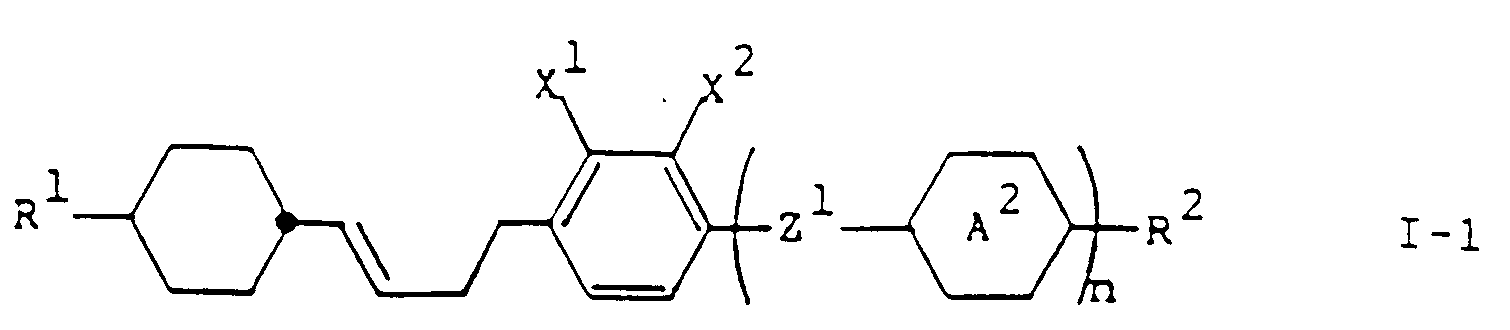
- Composés selon la revendication 1 ou 2, caractérisés en ce que A³ et A⁴ représentent indépendamment l'un de l'autre un trans-1,4-cyclohexylène ou un 1,4-phénylène non substitué ou substitué par un halogène, cyano et/ou méthyle.
- Composés selon l'une des revendications 1 à 3, caractérisés en ce que le cycle A² représente un 1,4-phénylène non substitué ou monosubstitué ou 2,3-disubstitué par un halogène, cyano et/ou méthyle, ou représente un trans-1,4-cyclohexylène, trans-1,3-dioxane-2,5-diyle, 1-cyano-trans-1,4-cyclohexylène, bicyclo [2.2.2]octane-1,4-diyle, naphtalène-2,6-diyle tétralin-2,6-diyle, trans-décalin-2,6-diyle, pyridine-2,5-diyle, pyrimidine-2,5-diyle ou pyrazine-2,5-diyle.
- Composés selon l'une des revendications 1 à 4, caractérisés en ce que Z¹, Z² et Z³ représentent chacun une liaison simple de covalence ou l'un des groupes Z¹, Z² et Z³ représente aussi -COO-, -OOC, -CH₂O-, -OCH₂-, -CH₂CH₂-, -C≡C-, -(CH₂)₃O-, -O(CH₂)₃-, ((CH₂)₄- ou la forme trans de -CH=CH-CH₂-CH₂-, -CH₂CH₂-CH=CH-, -CH=CH-CH₂O ou -OCH₂-CH=CH-.
- Composés selon l'une des revendications 1 à 5, caractérisés par les formules générales:

- Composés selon la revendication 2 ou 6, caractérisés en ce que X¹, X², X³ et X⁴ représentent indépendamment l'un de l'autre l'hydrogène ou le fluor.
- Composés selon l'une des revendications 1 à 7, caractérisés en ce que R³ et R⁴ indépendamment l'un de l'autre représentent un alkyle, dans lequel le cas échéant un >CH-CH< est remplacé par >C=C< et/ou le cas échéant un ou deux groupes méthylènes non voisins sont remplacés par -O-, -COO- et/ou -OOC- et/ou le cas échéant un groupe méthylène est remplacé par -CHX-, ou R⁴ représente aussi un halogène, cyano, -NCS, CF₃ ou -OCF₃.
- Composés selon l'une des revendications 1 à 8, caractérisés en ce que R³ et R⁴ présentent au plus chacun 18, de préférence au plus chacun 12 atomes de carbone.
- Composés selon l'une des revendications 1 à 9, caractérisés en ce que R³ représente un alkyle, alcényle, alcoxy, alcényloxy, alcoxycarbonyle, alcényloxycarbonyle, alcanoyloxy ou alcénoyloxy, de préférence alkyle ou alcényle.
- Composés selon l'une des revendications 1 à 10, caractérisés en ce que R⁴ représente un alkyle, alcényle, alcoxy, alcényloxy, alcoxycarbonyle, alcényloxycarbonyle, alcanoyloxy, alcénoyloxy, halogène, cyano, -NCS, -CF₃ ou -OCF₃.
- Mélange de cristaux liquides avec au moins deux composants, caractérisé en ce qu'au moins un composant est un composé de la formule I définie à la revendication 1.
- Utilisation de composés de formule I définie à la revendication 1 pour des utilisations électro-optiques.
Applications Claiming Priority (2)
| Application Number | Priority Date | Filing Date | Title |
|---|---|---|---|
| CH326/90 | 1990-02-01 | ||
| CH32690 | 1990-02-01 |
Publications (3)
| Publication Number | Publication Date |
|---|---|
| EP0442306A2 EP0442306A2 (fr) | 1991-08-21 |
| EP0442306A3 EP0442306A3 (en) | 1992-08-19 |
| EP0442306B1 true EP0442306B1 (fr) | 1995-04-12 |
Family
ID=4184468
Family Applications (1)
| Application Number | Title | Priority Date | Filing Date |
|---|---|---|---|
| EP91100965A Expired - Lifetime EP0442306B1 (fr) | 1990-02-01 | 1991-01-25 | Dérivés de (4E-cyclohéxyl)-3-buténylphényle |
Country Status (5)
| Country | Link |
|---|---|
| US (1) | US5204018A (fr) |
| EP (1) | EP0442306B1 (fr) |
| JP (1) | JPH04330019A (fr) |
| KR (1) | KR910021362A (fr) |
| DE (1) | DE59105136D1 (fr) |
Families Citing this family (15)
| Publication number | Priority date | Publication date | Assignee | Title |
|---|---|---|---|---|
| JP3134473B2 (ja) * | 1992-04-03 | 2001-02-13 | チッソ株式会社 | シス−1,4−置換2−ブテン誘導体 |
| EP0727406B1 (fr) * | 1995-02-16 | 2001-09-05 | MERCK PATENT GmbH | Composés du vinylène et milieu cristal liquide |
| EP0834490A4 (fr) * | 1995-06-15 | 2001-09-26 | Chisso Corp | Composes presentant des groupes alcenylene a substitution alkyle et composition de cristaux liquides |
| AU1619797A (en) * | 1996-02-23 | 1997-09-10 | Chisso Corporation | Vinylene compounds and liquid-crystal composition |
| KR20020054611A (ko) * | 2000-12-28 | 2002-07-08 | 구본준, 론 위라하디락사 | 액정 표시 장치 |
| JP2004256791A (ja) * | 2003-02-03 | 2004-09-16 | Chisso Corp | 液晶組成物および液晶表示素子 |
| JP5680381B2 (ja) * | 2010-11-19 | 2015-03-04 | Agcセイミケミカル株式会社 | 液晶化合物、その製造方法、液晶組成物および液晶電気光学素子 |
| JP5680380B2 (ja) * | 2010-11-19 | 2015-03-04 | Agcセイミケミカル株式会社 | 液晶化合物、その製造方法、液晶組成物および液晶電気光学素子 |
| JP5849664B2 (ja) | 2011-01-31 | 2016-02-03 | Jnc株式会社 | 液晶性化合物、液晶組成物および液晶表示素子 |
| US10203536B2 (en) * | 2014-06-05 | 2019-02-12 | East China University Of Science And Technology | Photo-tunable liquid crystal composition and methods for their fabrication and use |
| JP6467807B2 (ja) | 2014-08-08 | 2019-02-13 | Jnc株式会社 | ブテン結合基を有する液晶性化合物、液晶組成物および液晶表示素子 |
| JP6690114B2 (ja) * | 2014-09-25 | 2020-04-28 | Jnc株式会社 | 液晶組成物および液晶表示素子 |
| EP3246330A1 (fr) | 2016-05-18 | 2017-11-22 | Istituto Europeo di Oncologia S.r.l. | Imidazoles comme inhibiteurs de histone demethylase |
| ES2986559T3 (es) | 2017-08-18 | 2024-11-11 | St Europeo Di Oncologia S R L | Derivados de indol como inhibidores de la histona desmetilasa |
| CN113717735B (zh) * | 2021-08-12 | 2023-08-08 | 烟台显华科技集团股份有限公司 | 正介电各向异性液晶化合物、液晶组合物及液晶显示器件 |
Family Cites Families (9)
| Publication number | Priority date | Publication date | Assignee | Title |
|---|---|---|---|---|
| GB1551043A (en) * | 1975-04-22 | 1979-08-22 | Secr Defence | Biphenyl compounds containing a cyano group and liquid crystal materials and devices containing such compounds |
| DE3225290A1 (de) * | 1982-07-07 | 1984-01-12 | Merck Patent Gmbh | Ringverbindungen |
| JPS60118789A (ja) * | 1983-11-30 | 1985-06-26 | Canon Inc | 液晶素子 |
| DE3509170C2 (de) * | 1985-03-14 | 1995-01-05 | Merck Patent Gmbh | trans-Ethenylenverbindungen |
| DE3632410A1 (de) * | 1986-09-24 | 1988-03-31 | Merck Patent Gmbh | Verfahren zur herstellung von alkylen- bzw. ringverknuepften verbindungen |
| FR2612182B1 (fr) * | 1987-03-12 | 1989-06-23 | Centre Nat Rech Scient | Esters phenyliques substitues utilisables comme cristaux liquides ferroelectriques, leur preparation et leur utilisation dans un dispositif de visualisation electro-optique |
| US5238600A (en) * | 1988-06-01 | 1993-08-24 | Hoffmann-La Roche Inc. | Ibimethylenoxy containing liquid crystal compounds |
| JP2696557B2 (ja) * | 1989-03-07 | 1998-01-14 | チッソ株式会社 | トリフルオロベンゼン誘導体 |
| ES2069089T3 (es) * | 1989-09-06 | 1995-05-01 | Merck Patent Gmbh | Derivados de fluorobenceno y medio fluidocristalino. |
-
1991
- 1991-01-22 US US07/643,965 patent/US5204018A/en not_active Expired - Fee Related
- 1991-01-25 EP EP91100965A patent/EP0442306B1/fr not_active Expired - Lifetime
- 1991-01-25 DE DE59105136T patent/DE59105136D1/de not_active Expired - Fee Related
- 1991-01-31 KR KR1019910001666A patent/KR910021362A/ko not_active Ceased
- 1991-02-01 JP JP3031389A patent/JPH04330019A/ja active Pending
Also Published As
| Publication number | Publication date |
|---|---|
| JPH04330019A (ja) | 1992-11-18 |
| DE59105136D1 (de) | 1995-05-18 |
| EP0442306A2 (fr) | 1991-08-21 |
| KR910021362A (ko) | 1991-12-20 |
| US5204018A (en) | 1993-04-20 |
| EP0442306A3 (en) | 1992-08-19 |
Similar Documents
| Publication | Publication Date | Title |
|---|---|---|
| EP0257048B1 (fr) | Composes optiquement actifs | |
| EP0144013B1 (fr) | Dérivés de thiénothiophène | |
| DE19980536B4 (de) | Vinylenverbindungen und deren Verwendung in flüssigkristallinen Medien und in elektrooptischen Anzeigeelementen | |
| DE3437935A1 (de) | Heterocyclische verbindungen | |
| EP0247466B1 (fr) | Dérivés de benzoates phényliques sous forme de cristaux liquides | |
| EP0442306A2 (fr) | Dérivés de (4E-cyclohéxyl)-3-buténylphényle | |
| EP0344557B1 (fr) | Composants de cristaux liquides avec un groupe triméthylèneoxy | |
| EP0501268B1 (fr) | Composés cristaux liquides avec un groupe alkinyl-1 en bout de chaîne | |
| EP0391203B1 (fr) | Phényl-2 pyridines | |
| EP0242716B1 (fr) | Dérivés liquides cristallins de la pyridine | |
| EP0355552B1 (fr) | Cyclohexanes alkoxyméthyls et alcényloxyméthyls | |
| EP0441213B1 (fr) | Dioxolannes chiraux | |
| EP0589331B1 (fr) | Dérivés de l'acétylène et mélanges de cristaux liquides les contenant | |
| EP0410233B1 (fr) | Dérivés d'(aryl-4 butyl) cyclohexane | |
| EP0475273B1 (fr) | Mélange de cristaux liquides contenant des composés alcényl halogénés | |
| DE69208351T2 (de) | Halovinylderivate | |
| EP0464648B1 (fr) | Esters de 4-cyano-3-fluorophényl | |
| EP0393501B1 (fr) | Constituants de cristal liquide avec un groupe trans-3-cyclohexylallyloxy | |
| EP0361157B1 (fr) | Phénylpyridines | |
| EP0534258B1 (fr) | Oxazolines chirales comme agents dopants pour des mélanges de cristaux liquides | |
| US5346647A (en) | Cyclohexane compounds used in liquid crystalline mixtures | |
| EP0471287B1 (fr) | Dérivés d'alkoxypropènes | |
| EP0343487B1 (fr) | Esters de cyclohexyle d'acides alpha fluoro carboxyliques | |
| EP0497176B1 (fr) | Composés à quatre cycles et mélanges de cristaux liquides les contenant | |
| EP0457105B1 (fr) | Dioxanes chiraux comme composants de mélanges de cristaux liquides |
Legal Events
| Date | Code | Title | Description |
|---|---|---|---|
| PUAI | Public reference made under article 153(3) epc to a published international application that has entered the european phase |
Free format text: ORIGINAL CODE: 0009012 |
|
| 17P | Request for examination filed |
Effective date: 19910125 |
|
| AK | Designated contracting states |
Kind code of ref document: A2 Designated state(s): CH DE FR GB IT LI NL |
|
| PUAL | Search report despatched |
Free format text: ORIGINAL CODE: 0009013 |
|
| AK | Designated contracting states |
Kind code of ref document: A3 Designated state(s): CH DE FR GB IT LI NL |
|
| 17Q | First examination report despatched |
Effective date: 19940419 |
|
| GRAA | (expected) grant |
Free format text: ORIGINAL CODE: 0009210 |
|
| AK | Designated contracting states |
Kind code of ref document: B1 Designated state(s): CH DE FR GB IT LI NL |
|
| RAP2 | Party data changed (patent owner data changed or rights of a patent transferred) |
Owner name: F. HOFFMANN-LA ROCHE AG |
|
| RAP2 | Party data changed (patent owner data changed or rights of a patent transferred) |
Owner name: F. HOFFMANN-LA ROCHE AG |
|
| REF | Corresponds to: |
Ref document number: 59105136 Country of ref document: DE Date of ref document: 19950518 |
|
| ITF | It: translation for a ep patent filed | ||
| ET | Fr: translation filed | ||
| GBT | Gb: translation of ep patent filed (gb section 77(6)(a)/1977) |
Effective date: 19950707 |
|
| PGFP | Annual fee paid to national office [announced via postgrant information from national office to epo] |
Ref country code: GB Payment date: 19951215 Year of fee payment: 6 |
|
| PGFP | Annual fee paid to national office [announced via postgrant information from national office to epo] |
Ref country code: FR Payment date: 19960112 Year of fee payment: 6 |
|
| PGFP | Annual fee paid to national office [announced via postgrant information from national office to epo] |
Ref country code: CH Payment date: 19960117 Year of fee payment: 6 |
|
| PGFP | Annual fee paid to national office [announced via postgrant information from national office to epo] |
Ref country code: NL Payment date: 19960131 Year of fee payment: 6 |
|
| PLBE | No opposition filed within time limit |
Free format text: ORIGINAL CODE: 0009261 |
|
| STAA | Information on the status of an ep patent application or granted ep patent |
Free format text: STATUS: NO OPPOSITION FILED WITHIN TIME LIMIT |
|
| 26N | No opposition filed | ||
| PG25 | Lapsed in a contracting state [announced via postgrant information from national office to epo] |
Ref country code: GB Effective date: 19970125 |
|
| PG25 | Lapsed in a contracting state [announced via postgrant information from national office to epo] |
Ref country code: LI Effective date: 19970131 Ref country code: CH Effective date: 19970131 |
|
| PG25 | Lapsed in a contracting state [announced via postgrant information from national office to epo] |
Ref country code: NL Effective date: 19970801 |
|
| REG | Reference to a national code |
Ref country code: CH Ref legal event code: PL |
|
| GBPC | Gb: european patent ceased through non-payment of renewal fee |
Effective date: 19970125 |
|
| PG25 | Lapsed in a contracting state [announced via postgrant information from national office to epo] |
Ref country code: FR Effective date: 19970930 |
|
| NLV4 | Nl: lapsed or anulled due to non-payment of the annual fee |
Effective date: 19970801 |
|
| REG | Reference to a national code |
Ref country code: FR Ref legal event code: ST |
|
| PGFP | Annual fee paid to national office [announced via postgrant information from national office to epo] |
Ref country code: DE Payment date: 20050120 Year of fee payment: 15 |
|
| PG25 | Lapsed in a contracting state [announced via postgrant information from national office to epo] |
Ref country code: IT Free format text: LAPSE BECAUSE OF NON-PAYMENT OF DUE FEES;WARNING: LAPSES OF ITALIAN PATENTS WITH EFFECTIVE DATE BEFORE 2007 MAY HAVE OCCURRED AT ANY TIME BEFORE 2007. THE CORRECT EFFECTIVE DATE MAY BE DIFFERENT FROM THE ONE RECORDED. Effective date: 20050125 |
|
| PG25 | Lapsed in a contracting state [announced via postgrant information from national office to epo] |
Ref country code: DE Free format text: LAPSE BECAUSE OF NON-PAYMENT OF DUE FEES Effective date: 20060801 |