EP0442370B1 - Use of aqueous polymer dispersions - Google Patents
Use of aqueous polymer dispersions Download PDFInfo
- Publication number
- EP0442370B1 EP0442370B1 EP91101650A EP91101650A EP0442370B1 EP 0442370 B1 EP0442370 B1 EP 0442370B1 EP 91101650 A EP91101650 A EP 91101650A EP 91101650 A EP91101650 A EP 91101650A EP 0442370 B1 EP0442370 B1 EP 0442370B1
- Authority
- EP
- European Patent Office
- Prior art keywords
- weight
- polymer
- dispersion
- monomers
- von
- Prior art date
- Legal status (The legal status is an assumption and is not a legal conclusion. Google has not performed a legal analysis and makes no representation as to the accuracy of the status listed.)
- Expired - Lifetime
Links
- 239000006185 dispersion Substances 0.000 title claims description 114
- 229920000642 polymer Polymers 0.000 title claims description 51
- XLYOFNOQVPJJNP-UHFFFAOYSA-N water Substances O XLYOFNOQVPJJNP-UHFFFAOYSA-N 0.000 claims description 123
- 239000000178 monomer Substances 0.000 claims description 85
- XLOMVQKBTHCTTD-UHFFFAOYSA-N Zinc monoxide Chemical compound [Zn]=O XLOMVQKBTHCTTD-UHFFFAOYSA-N 0.000 claims description 62
- CERQOIWHTDAKMF-UHFFFAOYSA-N Methacrylic acid Chemical compound CC(=C)C(O)=O CERQOIWHTDAKMF-UHFFFAOYSA-N 0.000 claims description 50
- 239000000203 mixture Substances 0.000 claims description 36
- 239000011787 zinc oxide Substances 0.000 claims description 31
- 239000011230 binding agent Substances 0.000 claims description 28
- PPBRXRYQALVLMV-UHFFFAOYSA-N Styrene Chemical compound C=CC1=CC=CC=C1 PPBRXRYQALVLMV-UHFFFAOYSA-N 0.000 claims description 21
- 239000002253 acid Substances 0.000 claims description 12
- 239000004815 dispersion polymer Substances 0.000 claims description 12
- 229910052751 metal Inorganic materials 0.000 claims description 12
- 239000002184 metal Substances 0.000 claims description 12
- SMZOUWXMTYCWNB-UHFFFAOYSA-N 2-(2-methoxy-5-methylphenyl)ethanamine Chemical compound COC1=CC=C(C)C=C1CCN SMZOUWXMTYCWNB-UHFFFAOYSA-N 0.000 claims description 10
- 239000003995 emulsifying agent Substances 0.000 claims description 10
- 230000009477 glass transition Effects 0.000 claims description 10
- KAKZBPTYRLMSJV-UHFFFAOYSA-N Butadiene Chemical compound C=CC=C KAKZBPTYRLMSJV-UHFFFAOYSA-N 0.000 claims description 9
- 229920003987 resole Polymers 0.000 claims description 9
- 239000011701 zinc Substances 0.000 claims description 9
- 150000001447 alkali salts Chemical class 0.000 claims description 8
- 229910052725 zinc Inorganic materials 0.000 claims description 8
- HCHKCACWOHOZIP-UHFFFAOYSA-N Zinc Chemical compound [Zn] HCHKCACWOHOZIP-UHFFFAOYSA-N 0.000 claims description 7
- 150000002739 metals Chemical class 0.000 claims description 7
- 150000007513 acids Chemical class 0.000 claims description 6
- XLYOFNOQVPJJNP-UHFFFAOYSA-M hydroxide Chemical compound [OH-] XLYOFNOQVPJJNP-UHFFFAOYSA-M 0.000 claims description 6
- 239000002245 particle Substances 0.000 claims description 6
- OYPRJOBELJOOCE-UHFFFAOYSA-N Calcium Chemical compound [Ca] OYPRJOBELJOOCE-UHFFFAOYSA-N 0.000 claims description 5
- FYYHWMGAXLPEAU-UHFFFAOYSA-N Magnesium Chemical compound [Mg] FYYHWMGAXLPEAU-UHFFFAOYSA-N 0.000 claims description 5
- XTXRWKRVRITETP-UHFFFAOYSA-N Vinyl acetate Chemical compound CC(=O)OC=C XTXRWKRVRITETP-UHFFFAOYSA-N 0.000 claims description 5
- 239000011575 calcium Substances 0.000 claims description 5
- 229910052791 calcium Inorganic materials 0.000 claims description 5
- 125000004432 carbon atom Chemical group C* 0.000 claims description 5
- 239000011777 magnesium Substances 0.000 claims description 5
- 229910052749 magnesium Inorganic materials 0.000 claims description 5
- BVKZGUZCCUSVTD-UHFFFAOYSA-M Bicarbonate Chemical compound OC([O-])=O BVKZGUZCCUSVTD-UHFFFAOYSA-M 0.000 claims description 4
- BVKZGUZCCUSVTD-UHFFFAOYSA-L Carbonate Chemical compound [O-]C([O-])=O BVKZGUZCCUSVTD-UHFFFAOYSA-L 0.000 claims description 4
- 239000010426 asphalt Substances 0.000 claims description 4
- DNIAPMSPPWPWGF-GSVOUGTGSA-N (R)-(-)-Propylene glycol Chemical compound C[C@@H](O)CO DNIAPMSPPWPWGF-GSVOUGTGSA-N 0.000 claims description 3
- VGGSQFUCUMXWEO-UHFFFAOYSA-N Ethene Chemical compound C=C VGGSQFUCUMXWEO-UHFFFAOYSA-N 0.000 claims description 3
- 239000005977 Ethylene Substances 0.000 claims description 3
- 150000008064 anhydrides Chemical class 0.000 claims description 3
- 150000002148 esters Chemical class 0.000 claims description 3
- UIWXSTHGICQLQT-UHFFFAOYSA-N ethenyl propanoate Chemical compound CCC(=O)OC=C UIWXSTHGICQLQT-UHFFFAOYSA-N 0.000 claims description 3
- 238000009835 boiling Methods 0.000 claims description 2
- 239000000463 material Substances 0.000 claims 4
- 150000001991 dicarboxylic acids Chemical class 0.000 claims 1
- 150000002763 monocarboxylic acids Chemical class 0.000 claims 1
- 239000000243 solution Substances 0.000 description 89
- 239000007864 aqueous solution Substances 0.000 description 65
- CQEYYJKEWSMYFG-UHFFFAOYSA-N butyl acrylate Chemical group CCCCOC(=O)C=C CQEYYJKEWSMYFG-UHFFFAOYSA-N 0.000 description 45
- 239000000839 emulsion Substances 0.000 description 44
- 238000006116 polymerization reaction Methods 0.000 description 40
- NLHHRLWOUZZQLW-UHFFFAOYSA-N Acrylonitrile Chemical compound C=CC#N NLHHRLWOUZZQLW-UHFFFAOYSA-N 0.000 description 34
- 239000007787 solid Substances 0.000 description 33
- CHQMHPLRPQMAMX-UHFFFAOYSA-L sodium persulfate Chemical compound [Na+].[Na+].[O-]S(=O)(=O)OOS([O-])(=O)=O CHQMHPLRPQMAMX-UHFFFAOYSA-L 0.000 description 29
- 239000003999 initiator Substances 0.000 description 26
- 239000011541 reaction mixture Substances 0.000 description 25
- BWYYYTVSBPRQCN-UHFFFAOYSA-M sodium;ethenesulfonate Chemical compound [Na+].[O-]S(=O)(=O)C=C BWYYYTVSBPRQCN-UHFFFAOYSA-M 0.000 description 24
- 239000004745 nonwoven fabric Substances 0.000 description 22
- -1 2-ethylhexyl esters Chemical class 0.000 description 18
- 239000013049 sediment Substances 0.000 description 16
- 238000003756 stirring Methods 0.000 description 16
- AYFACLKQYVTXNS-UHFFFAOYSA-M sodium;tetradecane-1-sulfonate Chemical compound [Na+].CCCCCCCCCCCCCCS([O-])(=O)=O AYFACLKQYVTXNS-UHFFFAOYSA-M 0.000 description 15
- WSFSSNUMVMOOMR-UHFFFAOYSA-N Formaldehyde Chemical compound O=C WSFSSNUMVMOOMR-UHFFFAOYSA-N 0.000 description 14
- VVQNEPGJFQJSBK-UHFFFAOYSA-N Methyl methacrylate Chemical compound COC(=O)C(C)=C VVQNEPGJFQJSBK-UHFFFAOYSA-N 0.000 description 12
- DNTMQTKDNSEIFO-UHFFFAOYSA-N n-(hydroxymethyl)-2-methylprop-2-enamide Chemical compound CC(=C)C(=O)NCO DNTMQTKDNSEIFO-UHFFFAOYSA-N 0.000 description 12
- HLZKNKRTKFSKGZ-UHFFFAOYSA-N tetradecan-1-ol Chemical compound CCCCCCCCCCCCCCO HLZKNKRTKFSKGZ-UHFFFAOYSA-N 0.000 description 12
- 238000000034 method Methods 0.000 description 11
- 238000012360 testing method Methods 0.000 description 10
- 239000012528 membrane Substances 0.000 description 9
- IISBACLAFKSPIT-UHFFFAOYSA-N bisphenol A Chemical compound C=1C=C(O)C=CC=1C(C)(C)C1=CC=C(O)C=C1 IISBACLAFKSPIT-UHFFFAOYSA-N 0.000 description 8
- 159000000000 sodium salts Chemical class 0.000 description 8
- 229920003002 synthetic resin Polymers 0.000 description 8
- 239000000057 synthetic resin Substances 0.000 description 8
- NEYTXADIGVEHQD-UHFFFAOYSA-N 2-hydroxy-2-(prop-2-enoylamino)acetic acid Chemical compound OC(=O)C(O)NC(=O)C=C NEYTXADIGVEHQD-UHFFFAOYSA-N 0.000 description 7
- 239000011734 sodium Substances 0.000 description 7
- NIXOWILDQLNWCW-UHFFFAOYSA-N 2-Propenoic acid Natural products OC(=O)C=C NIXOWILDQLNWCW-UHFFFAOYSA-N 0.000 description 6
- DGAQECJNVWCQMB-PUAWFVPOSA-M Ilexoside XXIX Chemical compound C[C@@H]1CC[C@@]2(CC[C@@]3(C(=CC[C@H]4[C@]3(CC[C@@H]5[C@@]4(CC[C@@H](C5(C)C)OS(=O)(=O)[O-])C)C)[C@@H]2[C@]1(C)O)C)C(=O)O[C@H]6[C@@H]([C@H]([C@@H]([C@H](O6)CO)O)O)O.[Na+] DGAQECJNVWCQMB-PUAWFVPOSA-M 0.000 description 6
- 238000004519 manufacturing process Methods 0.000 description 6
- 238000007720 emulsion polymerization reaction Methods 0.000 description 5
- FQPSGWSUVKBHSU-UHFFFAOYSA-N methacrylamide Chemical compound CC(=C)C(N)=O FQPSGWSUVKBHSU-UHFFFAOYSA-N 0.000 description 5
- 229910052708 sodium Inorganic materials 0.000 description 5
- 101001062854 Rattus norvegicus Fatty acid-binding protein 5 Proteins 0.000 description 4
- 229910052783 alkali metal Inorganic materials 0.000 description 4
- 229920003180 amino resin Polymers 0.000 description 4
- 150000003819 basic metal compounds Chemical class 0.000 description 4
- 235000014113 dietary fatty acids Nutrition 0.000 description 4
- 238000001035 drying Methods 0.000 description 4
- 239000000194 fatty acid Substances 0.000 description 4
- 229930195729 fatty acid Natural products 0.000 description 4
- 150000004665 fatty acids Chemical class 0.000 description 4
- 238000005470 impregnation Methods 0.000 description 4
- 239000002002 slurry Substances 0.000 description 4
- 239000000126 substance Substances 0.000 description 4
- BMCSBVHAGWUAQR-UHFFFAOYSA-N 2-hydroxy-2-(2-methylprop-2-enoylamino)acetic acid Chemical compound CC(=C)C(=O)NC(O)C(O)=O BMCSBVHAGWUAQR-UHFFFAOYSA-N 0.000 description 3
- CSCPPACGZOOCGX-UHFFFAOYSA-N Acetone Chemical compound CC(C)=O CSCPPACGZOOCGX-UHFFFAOYSA-N 0.000 description 3
- BAPJBEWLBFYGME-UHFFFAOYSA-N Methyl acrylate Chemical compound COC(=O)C=C BAPJBEWLBFYGME-UHFFFAOYSA-N 0.000 description 3
- CNCOEDDPFOAUMB-UHFFFAOYSA-N N-Methylolacrylamide Chemical compound OCNC(=O)C=C CNCOEDDPFOAUMB-UHFFFAOYSA-N 0.000 description 3
- XSQUKJJJFZCRTK-UHFFFAOYSA-N Urea Natural products NC(N)=O XSQUKJJJFZCRTK-UHFFFAOYSA-N 0.000 description 3
- 230000015572 biosynthetic process Effects 0.000 description 3
- ZTQSAGDEMFDKMZ-UHFFFAOYSA-N butyric aldehyde Natural products CCCC=O ZTQSAGDEMFDKMZ-UHFFFAOYSA-N 0.000 description 3
- 239000001913 cellulose Substances 0.000 description 3
- 229920002678 cellulose Polymers 0.000 description 3
- 230000000052 comparative effect Effects 0.000 description 3
- 229920001577 copolymer Polymers 0.000 description 3
- 150000002170 ethers Chemical class 0.000 description 3
- 239000004744 fabric Substances 0.000 description 3
- 238000010348 incorporation Methods 0.000 description 3
- CPLXHLVBOLITMK-UHFFFAOYSA-N magnesium oxide Inorganic materials [Mg]=O CPLXHLVBOLITMK-UHFFFAOYSA-N 0.000 description 3
- 150000002736 metal compounds Chemical class 0.000 description 3
- 229920000728 polyester Polymers 0.000 description 3
- 239000003505 polymerization initiator Substances 0.000 description 3
- 150000003839 salts Chemical class 0.000 description 3
- BDHFUVZGWQCTTF-UHFFFAOYSA-M sulfonate Chemical compound [O-]S(=O)=O BDHFUVZGWQCTTF-UHFFFAOYSA-M 0.000 description 3
- YAJYJWXEWKRTPO-UHFFFAOYSA-N 2,3,3,4,4,5-hexamethylhexane-2-thiol Chemical compound CC(C)C(C)(C)C(C)(C)C(C)(C)S YAJYJWXEWKRTPO-UHFFFAOYSA-N 0.000 description 2
- JAHNSTQSQJOJLO-UHFFFAOYSA-N 2-(3-fluorophenyl)-1h-imidazole Chemical compound FC1=CC=CC(C=2NC=CN=2)=C1 JAHNSTQSQJOJLO-UHFFFAOYSA-N 0.000 description 2
- QTBSBXVTEAMEQO-UHFFFAOYSA-M Acetate Chemical compound CC([O-])=O QTBSBXVTEAMEQO-UHFFFAOYSA-M 0.000 description 2
- HRPVXLWXLXDGHG-UHFFFAOYSA-N Acrylamide Chemical compound NC(=O)C=C HRPVXLWXLXDGHG-UHFFFAOYSA-N 0.000 description 2
- QGZKDVFQNNGYKY-UHFFFAOYSA-N Ammonia Chemical compound N QGZKDVFQNNGYKY-UHFFFAOYSA-N 0.000 description 2
- VZCYOOQTPOCHFL-OWOJBTEDSA-N Fumaric acid Chemical compound OC(=O)\C=C\C(O)=O VZCYOOQTPOCHFL-OWOJBTEDSA-N 0.000 description 2
- ZRALSGWEFCBTJO-UHFFFAOYSA-N Guanidine Chemical compound NC(N)=N ZRALSGWEFCBTJO-UHFFFAOYSA-N 0.000 description 2
- AMIMRNSIRUDHCM-UHFFFAOYSA-N Isopropylaldehyde Chemical compound CC(C)C=O AMIMRNSIRUDHCM-UHFFFAOYSA-N 0.000 description 2
- OFOBLEOULBTSOW-UHFFFAOYSA-N Malonic acid Chemical compound OC(=O)CC(O)=O OFOBLEOULBTSOW-UHFFFAOYSA-N 0.000 description 2
- 229920000877 Melamine resin Polymers 0.000 description 2
- GYCMBHHDWRMZGG-UHFFFAOYSA-N Methylacrylonitrile Chemical compound CC(=C)C#N GYCMBHHDWRMZGG-UHFFFAOYSA-N 0.000 description 2
- ISWSIDIOOBJBQZ-UHFFFAOYSA-N Phenol Chemical compound OC1=CC=CC=C1 ISWSIDIOOBJBQZ-UHFFFAOYSA-N 0.000 description 2
- NBBJYMSMWIIQGU-UHFFFAOYSA-N Propionic aldehyde Chemical compound CCC=O NBBJYMSMWIIQGU-UHFFFAOYSA-N 0.000 description 2
- ROOXNKNUYICQNP-UHFFFAOYSA-N ammonium persulfate Chemical compound [NH4+].[NH4+].[O-]S(=O)(=O)OOS([O-])(=O)=O ROOXNKNUYICQNP-UHFFFAOYSA-N 0.000 description 2
- 125000000129 anionic group Chemical group 0.000 description 2
- 239000002585 base Substances 0.000 description 2
- 239000000292 calcium oxide Substances 0.000 description 2
- ODINCKMPIJJUCX-UHFFFAOYSA-N calcium oxide Inorganic materials [Ca]=O ODINCKMPIJJUCX-UHFFFAOYSA-N 0.000 description 2
- 150000001728 carbonyl compounds Chemical class 0.000 description 2
- 125000003178 carboxy group Chemical group [H]OC(*)=O 0.000 description 2
- 150000001735 carboxylic acids Chemical class 0.000 description 2
- 239000003795 chemical substances by application Substances 0.000 description 2
- 150000001875 compounds Chemical class 0.000 description 2
- 238000009833 condensation Methods 0.000 description 2
- 230000005494 condensation Effects 0.000 description 2
- 238000010790 dilution Methods 0.000 description 2
- 239000012895 dilution Substances 0.000 description 2
- 238000002296 dynamic light scattering Methods 0.000 description 2
- 238000005516 engineering process Methods 0.000 description 2
- 238000001914 filtration Methods 0.000 description 2
- 229920001519 homopolymer Polymers 0.000 description 2
- 150000004679 hydroxides Chemical class 0.000 description 2
- 239000000395 magnesium oxide Substances 0.000 description 2
- JDSHMPZPIAZGSV-UHFFFAOYSA-N melamine Chemical compound NC1=NC(N)=NC(N)=N1 JDSHMPZPIAZGSV-UHFFFAOYSA-N 0.000 description 2
- LVHBHZANLOWSRM-UHFFFAOYSA-N methylenebutanedioic acid Natural products OC(=O)CC(=C)C(O)=O LVHBHZANLOWSRM-UHFFFAOYSA-N 0.000 description 2
- 239000000047 product Substances 0.000 description 2
- FQENQNTWSFEDLI-UHFFFAOYSA-J sodium diphosphate Chemical compound [Na+].[Na+].[Na+].[Na+].[O-]P([O-])(=O)OP([O-])([O-])=O FQENQNTWSFEDLI-UHFFFAOYSA-J 0.000 description 2
- 229940048086 sodium pyrophosphate Drugs 0.000 description 2
- 238000003860 storage Methods 0.000 description 2
- 235000019818 tetrasodium diphosphate Nutrition 0.000 description 2
- 239000001577 tetrasodium phosphonato phosphate Substances 0.000 description 2
- UMGDCJDMYOKAJW-UHFFFAOYSA-N thiourea Chemical compound NC(N)=S UMGDCJDMYOKAJW-UHFFFAOYSA-N 0.000 description 2
- VZCYOOQTPOCHFL-UHFFFAOYSA-N trans-butenedioic acid Natural products OC(=O)C=CC(O)=O VZCYOOQTPOCHFL-UHFFFAOYSA-N 0.000 description 2
- 239000000080 wetting agent Substances 0.000 description 2
- OEPOKWHJYJXUGD-UHFFFAOYSA-N 2-(3-phenylmethoxyphenyl)-1,3-thiazole-4-carbaldehyde Chemical compound O=CC1=CSC(C=2C=C(OCC=3C=CC=CC=3)C=CC=2)=N1 OEPOKWHJYJXUGD-UHFFFAOYSA-N 0.000 description 1
- MVRPPTGLVPEMPI-UHFFFAOYSA-N 2-cyclohexylphenol Chemical compound OC1=CC=CC=C1C1CCCCC1 MVRPPTGLVPEMPI-UHFFFAOYSA-N 0.000 description 1
- CYEJMVLDXAUOPN-UHFFFAOYSA-N 2-dodecylphenol Chemical compound CCCCCCCCCCCCC1=CC=CC=C1O CYEJMVLDXAUOPN-UHFFFAOYSA-N 0.000 description 1
- OMIGHNLMNHATMP-UHFFFAOYSA-N 2-hydroxyethyl prop-2-enoate Chemical compound OCCOC(=O)C=C OMIGHNLMNHATMP-UHFFFAOYSA-N 0.000 description 1
- MEEKGULDSDXFCN-UHFFFAOYSA-N 2-pentylphenol Chemical compound CCCCCC1=CC=CC=C1O MEEKGULDSDXFCN-UHFFFAOYSA-N 0.000 description 1
- QZPSOSOOLFHYRR-UHFFFAOYSA-N 3-hydroxypropyl prop-2-enoate Chemical compound OCCCOC(=O)C=C QZPSOSOOLFHYRR-UHFFFAOYSA-N 0.000 description 1
- HVXRCAWUNAOCTA-UHFFFAOYSA-N 4-(6-methylheptyl)phenol Chemical compound CC(C)CCCCCC1=CC=C(O)C=C1 HVXRCAWUNAOCTA-UHFFFAOYSA-N 0.000 description 1
- JSFITYFUKSFPBZ-UHFFFAOYSA-N 4-(7-methyloctyl)phenol Chemical compound CC(C)CCCCCCC1=CC=C(O)C=C1 JSFITYFUKSFPBZ-UHFFFAOYSA-N 0.000 description 1
- LSNNMFCWUKXFEE-UHFFFAOYSA-M Bisulfite Chemical compound OS([O-])=O LSNNMFCWUKXFEE-UHFFFAOYSA-M 0.000 description 1
- 235000019492 Cashew oil Nutrition 0.000 description 1
- 229920000742 Cotton Polymers 0.000 description 1
- XZMCDFZZKTWFGF-UHFFFAOYSA-N Cyanamide Chemical compound NC#N XZMCDFZZKTWFGF-UHFFFAOYSA-N 0.000 description 1
- CHJJGSNFBQVOTG-UHFFFAOYSA-N N-methyl-guanidine Natural products CNC(N)=N CHJJGSNFBQVOTG-UHFFFAOYSA-N 0.000 description 1
- 229920000459 Nitrile rubber Polymers 0.000 description 1
- 239000004698 Polyethylene Substances 0.000 description 1
- ZLMJMSJWJFRBEC-UHFFFAOYSA-N Potassium Chemical compound [K] ZLMJMSJWJFRBEC-UHFFFAOYSA-N 0.000 description 1
- DBMJMQXJHONAFJ-UHFFFAOYSA-M Sodium laurylsulphate Chemical compound [Na+].CCCCCCCCCCCCOS([O-])(=O)=O DBMJMQXJHONAFJ-UHFFFAOYSA-M 0.000 description 1
- 235000021355 Stearic acid Nutrition 0.000 description 1
- 238000006887 Ullmann reaction Methods 0.000 description 1
- 229920001807 Urea-formaldehyde Polymers 0.000 description 1
- BZHJMEDXRYGGRV-UHFFFAOYSA-N Vinyl chloride Chemical compound ClC=C BZHJMEDXRYGGRV-UHFFFAOYSA-N 0.000 description 1
- IKHGUXGNUITLKF-XPULMUKRSA-N acetaldehyde Chemical compound [14CH]([14CH3])=O IKHGUXGNUITLKF-XPULMUKRSA-N 0.000 description 1
- 150000001242 acetic acid derivatives Chemical class 0.000 description 1
- 125000005396 acrylic acid ester group Chemical group 0.000 description 1
- 239000003513 alkali Substances 0.000 description 1
- 125000005907 alkyl ester group Chemical group 0.000 description 1
- 150000001408 amides Chemical class 0.000 description 1
- 229910021529 ammonia Inorganic materials 0.000 description 1
- 229910001870 ammonium persulfate Inorganic materials 0.000 description 1
- 235000019395 ammonium persulphate Nutrition 0.000 description 1
- 150000001450 anions Chemical class 0.000 description 1
- 238000010923 batch production Methods 0.000 description 1
- YXVFYQXJAXKLAK-UHFFFAOYSA-N biphenyl-4-ol Chemical compound C1=CC(O)=CC=C1C1=CC=CC=C1 YXVFYQXJAXKLAK-UHFFFAOYSA-N 0.000 description 1
- 230000003139 buffering effect Effects 0.000 description 1
- 244000309464 bull Species 0.000 description 1
- IRLQAJPIHBZROB-UHFFFAOYSA-N buta-2,3-dienenitrile Chemical compound C=C=CC#N IRLQAJPIHBZROB-UHFFFAOYSA-N 0.000 description 1
- BRPQOXSCLDDYGP-UHFFFAOYSA-N calcium oxide Chemical compound [O-2].[Ca+2] BRPQOXSCLDDYGP-UHFFFAOYSA-N 0.000 description 1
- 238000004364 calculation method Methods 0.000 description 1
- 239000004202 carbamide Substances 0.000 description 1
- 229910052799 carbon Inorganic materials 0.000 description 1
- BVKZGUZCCUSVTD-UHFFFAOYSA-N carbonic acid Chemical class OC(O)=O BVKZGUZCCUSVTD-UHFFFAOYSA-N 0.000 description 1
- 150000004649 carbonic acid derivatives Chemical class 0.000 description 1
- 125000002915 carbonyl group Chemical group [*:2]C([*:1])=O 0.000 description 1
- 150000001732 carboxylic acid derivatives Chemical class 0.000 description 1
- 229940059459 cashew oil Drugs 0.000 description 1
- 239000010467 cashew oil Substances 0.000 description 1
- 125000002091 cationic group Chemical group 0.000 description 1
- 230000000536 complexating effect Effects 0.000 description 1
- 239000007859 condensation product Substances 0.000 description 1
- 239000000470 constituent Substances 0.000 description 1
- 238000010276 construction Methods 0.000 description 1
- 238000007334 copolymerization reaction Methods 0.000 description 1
- LDHQCZJRKDOVOX-NSCUHMNNSA-N crotonic acid Chemical compound C\C=C\C(O)=O LDHQCZJRKDOVOX-NSCUHMNNSA-N 0.000 description 1
- SWSQBOPZIKWTGO-UHFFFAOYSA-N dimethylaminoamidine Natural products CN(C)C(N)=N SWSQBOPZIKWTGO-UHFFFAOYSA-N 0.000 description 1
- 238000006073 displacement reaction Methods 0.000 description 1
- 238000009826 distribution Methods 0.000 description 1
- GVGUFUZHNYFZLC-UHFFFAOYSA-N dodecyl benzenesulfonate;sodium Chemical compound [Na].CCCCCCCCCCCCOS(=O)(=O)C1=CC=CC=C1 GVGUFUZHNYFZLC-UHFFFAOYSA-N 0.000 description 1
- NLVXSWCKKBEXTG-UHFFFAOYSA-M ethenesulfonate Chemical compound [O-]S(=O)(=O)C=C NLVXSWCKKBEXTG-UHFFFAOYSA-M 0.000 description 1
- 238000007046 ethoxylation reaction Methods 0.000 description 1
- 125000001495 ethyl group Chemical group [H]C([H])([H])C([H])([H])* 0.000 description 1
- 150000002191 fatty alcohols Chemical class 0.000 description 1
- 239000000835 fiber Substances 0.000 description 1
- 239000002657 fibrous material Substances 0.000 description 1
- 239000006260 foam Substances 0.000 description 1
- 239000001530 fumaric acid Substances 0.000 description 1
- 239000011521 glass Substances 0.000 description 1
- 239000003365 glass fiber Substances 0.000 description 1
- 239000008187 granular material Substances 0.000 description 1
- 229930195733 hydrocarbon Natural products 0.000 description 1
- 150000002430 hydrocarbons Chemical class 0.000 description 1
- 230000001771 impaired effect Effects 0.000 description 1
- 239000011256 inorganic filler Substances 0.000 description 1
- 229910003475 inorganic filler Inorganic materials 0.000 description 1
- 125000000959 isobutyl group Chemical group [H]C([H])([H])C([H])(C([H])([H])[H])C([H])([H])* 0.000 description 1
- 125000001449 isopropyl group Chemical group [H]C([H])([H])C([H])(*)C([H])([H])[H] 0.000 description 1
- AXZKOIWUVFPNLO-UHFFFAOYSA-N magnesium;oxygen(2-) Chemical compound [O-2].[Mg+2] AXZKOIWUVFPNLO-UHFFFAOYSA-N 0.000 description 1
- VZCYOOQTPOCHFL-UPHRSURJSA-N maleic acid Chemical compound OC(=O)\C=C/C(O)=O VZCYOOQTPOCHFL-UPHRSURJSA-N 0.000 description 1
- 239000011976 maleic acid Substances 0.000 description 1
- 238000005259 measurement Methods 0.000 description 1
- 238000000691 measurement method Methods 0.000 description 1
- 125000005397 methacrylic acid ester group Chemical group 0.000 description 1
- 125000002496 methyl group Chemical group [H]C([H])([H])* 0.000 description 1
- 238000002156 mixing Methods 0.000 description 1
- 150000002762 monocarboxylic acid derivatives Chemical class 0.000 description 1
- 125000001280 n-hexyl group Chemical group C(CCCCC)* 0.000 description 1
- 150000002825 nitriles Chemical class 0.000 description 1
- QIQXTHQIDYTFRH-UHFFFAOYSA-N octadecanoic acid Chemical class CCCCCCCCCCCCCCCCCC(O)=O QIQXTHQIDYTFRH-UHFFFAOYSA-N 0.000 description 1
- 210000003254 palate Anatomy 0.000 description 1
- 150000002978 peroxides Chemical class 0.000 description 1
- 150000004976 peroxydisulfates Chemical class 0.000 description 1
- 150000003009 phosphonic acids Chemical class 0.000 description 1
- 229920000573 polyethylene Polymers 0.000 description 1
- 229920000139 polyethylene terephthalate Polymers 0.000 description 1
- 239000005020 polyethylene terephthalate Substances 0.000 description 1
- 239000011591 potassium Substances 0.000 description 1
- 235000019394 potassium persulphate Nutrition 0.000 description 1
- 238000002360 preparation method Methods 0.000 description 1
- 238000007639 printing Methods 0.000 description 1
- 229910052938 sodium sulfate Inorganic materials 0.000 description 1
- 235000011152 sodium sulphate Nutrition 0.000 description 1
- ZIGVUIYVPLQEAL-UHFFFAOYSA-M sodium;2-tetradecylbenzenesulfonate Chemical compound [Na+].CCCCCCCCCCCCCCC1=CC=CC=C1S([O-])(=O)=O ZIGVUIYVPLQEAL-UHFFFAOYSA-M 0.000 description 1
- DAJSVUQLFFJUSX-UHFFFAOYSA-M sodium;dodecane-1-sulfonate Chemical compound [Na+].CCCCCCCCCCCCS([O-])(=O)=O DAJSVUQLFFJUSX-UHFFFAOYSA-M 0.000 description 1
- YIVJSMIYMAOVSJ-UHFFFAOYSA-N sodium;phosphono dihydrogen phosphate Chemical compound [Na+].OP(O)(=O)OP(O)(O)=O YIVJSMIYMAOVSJ-UHFFFAOYSA-N 0.000 description 1
- 238000005507 spraying Methods 0.000 description 1
- 229920003048 styrene butadiene rubber Polymers 0.000 description 1
- NVBFHJWHLNUMCV-UHFFFAOYSA-N sulfamide Chemical compound NS(N)(=O)=O NVBFHJWHLNUMCV-UHFFFAOYSA-N 0.000 description 1
- 150000003460 sulfonic acids Chemical class 0.000 description 1
- 239000004094 surface-active agent Substances 0.000 description 1
- 238000010998 test method Methods 0.000 description 1
- LDHQCZJRKDOVOX-UHFFFAOYSA-N trans-crotonic acid Natural products CC=CC(O)=O LDHQCZJRKDOVOX-UHFFFAOYSA-N 0.000 description 1
- 238000002834 transmittance Methods 0.000 description 1
- HFFLGKNGCAIQMO-UHFFFAOYSA-N trichloroacetaldehyde Chemical compound ClC(Cl)(Cl)C=O HFFLGKNGCAIQMO-UHFFFAOYSA-N 0.000 description 1
- 150000003673 urethanes Chemical class 0.000 description 1
- 229920001567 vinyl ester resin Polymers 0.000 description 1
- 125000000391 vinyl group Chemical group [H]C([*])=C([H])[H] 0.000 description 1
- 150000003751 zinc Chemical class 0.000 description 1
Classifications
-
- D—TEXTILES; PAPER
- D06—TREATMENT OF TEXTILES OR THE LIKE; LAUNDERING; FLEXIBLE MATERIALS NOT OTHERWISE PROVIDED FOR
- D06N—WALL, FLOOR, OR LIKE COVERING MATERIALS, e.g. LINOLEUM, OILCLOTH, ARTIFICIAL LEATHER, ROOFING FELT, CONSISTING OF A FIBROUS WEB COATED WITH A LAYER OF MACROMOLECULAR MATERIAL; FLEXIBLE SHEET MATERIAL NOT OTHERWISE PROVIDED FOR
- D06N5/00—Roofing materials comprising a fibrous web coated with bitumen or another polymer, e.g. pitch
-
- C—CHEMISTRY; METALLURGY
- C08—ORGANIC MACROMOLECULAR COMPOUNDS; THEIR PREPARATION OR CHEMICAL WORKING-UP; COMPOSITIONS BASED THEREON
- C08F—MACROMOLECULAR COMPOUNDS OBTAINED BY REACTIONS ONLY INVOLVING CARBON-TO-CARBON UNSATURATED BONDS
- C08F8/00—Chemical modification by after-treatment
- C08F8/44—Preparation of metal salts or ammonium salts
-
- C—CHEMISTRY; METALLURGY
- C08—ORGANIC MACROMOLECULAR COMPOUNDS; THEIR PREPARATION OR CHEMICAL WORKING-UP; COMPOSITIONS BASED THEREON
- C08J—WORKING-UP; GENERAL PROCESSES OF COMPOUNDING; AFTER-TREATMENT NOT COVERED BY SUBCLASSES C08B, C08C, C08F, C08G or C08H
- C08J3/00—Processes of treating or compounding macromolecular substances
- C08J3/02—Making solutions, dispersions, lattices or gels by other methods than by solution, emulsion or suspension polymerisation techniques
- C08J3/03—Making solutions, dispersions, lattices or gels by other methods than by solution, emulsion or suspension polymerisation techniques in aqueous media
-
- C—CHEMISTRY; METALLURGY
- C08—ORGANIC MACROMOLECULAR COMPOUNDS; THEIR PREPARATION OR CHEMICAL WORKING-UP; COMPOSITIONS BASED THEREON
- C08K—Use of inorganic or non-macromolecular organic substances as compounding ingredients
- C08K3/00—Use of inorganic substances as compounding ingredients
- C08K3/18—Oxygen-containing compounds, e.g. metal carbonyls
- C08K3/20—Oxides; Hydroxides
- C08K3/22—Oxides; Hydroxides of metals
Definitions
- the invention also relates to binders for nonwoven roofing membrane and bituminized roofing membranes based on nonwovens, which are bound with these binders.
- DE-B 10 51 436 describes aqueous polymer dispersions with a polymer content of 1 to 60% by weight, the polymer being a copolymer which consists of at least one lower alkyl ester of acrylic or Methacrylic acid and 0.25 to 25 mol% is made up of acrylic, methacrylic or itaconic acid, and additionally contain a basic metal compound from the group of oxides, hydroxides or other basic salts, for example acetates, of polyvalent metals, the The amount of the basic metal compound is such that it neutralizes 0.25 to 25 mol% of the carboxyl groups of the copolymer.
- aqueous synthetic resin dispersions are recommended for films which should have increased internal strength
- the polymer dispersions containing a relatively readily water-soluble metal compound e.g. an acetate
- those polymer dispersions which contain a basic metal compound with less pronounced water solubility e.g. an oxide or a hydroxide
- a basic metal compound with less pronounced water solubility e.g. an oxide or a hydroxide
- a disadvantage of the synthetic resin dispersions which contain a relatively readily water-soluble metal compound is that the anions which cause the good water solubility of the metal compound, for example the acetate anion, generally do not behave inertly on the one hand and are not constituents of the water on the other hand, so that in in general, the properties of the synthetic resin dispersions are impaired or the synthetic resin dispersions do not meet the purity requirements.
- aqueous polymer dispersions containing polyvalent metals are disadvantageous, which contain the metal, for example in the form of an oxide or hydroxide, but to avoid coagulum and sediment formation and to ensure clear filming with high internal strength, with the use of non-inert auxiliary systems.
- examples of such dispersions include DE-A-18 11 247, in which, for example, ammonia is used as an auxiliary system which is capable of complexing the metallic components in aqueous solution.
- Dispersions crosslinked with metal salts are also known from EP-A-373 918, which has not been previously published.
- the present invention had for its object to provide aqueous polymer dispersions for filming with high internal strength, which are free of the disadvantages mentioned, in particular even with an increased solids content.
- binders should be provided for nonwovens, which can be used, for example, for bituminized roofing membranes with good performance properties such as high heat resistance.
- polymer A is composed of 10 to 25% by weight a) and 75 to 90% by weight b).
- Suitable monomers a include Acrylic acid, methacrylic acid, maleic acid, fumaric acid, crotonic acid and itaconic acid. Acrylic and methacrylic acid are preferably used, the copolymerization of methacrylic acid being particularly advantageous.
- Suitable monomers b are advantageously esters of acrylic or methacrylic acid with an aliphatic alcohol containing 1 to 10 carbon atoms, the methyl, ethyl, isopropyl, n and isobutyl, n-hexyl and 2-ethylhexyl esters are preferred.
- a particularly preferred acrylic acid ester is n-butyl acrylate, which is advantageously polymerized in amounts of more than 50% by weight, based on the total amount of the monomers. Good results are achieved with 2 ethylhexyl esters.
- aromatic vinyl compounds such as styrene, vinyl esters of lower alkane carboxylic acids such as vinyl acetate and vinyl propionate, vinyl chloride, vinylidene chloride, nitriles of lower ⁇ , ⁇ -monoethylenically unsaturated carboxylic acids such as acrylonitrile and methacrylonitrile and the amides of these carboxylic acids, acrylic acid or methacrylic acid esters with lower polyvalent esters Alcohols, unsaturated sulfonic and phosphonic acids and their alkali metal salts such as sodium vinyl sulfonate, but also lower mono- or polyunsaturated hydrocarbons such as ethylene and butadiene.
- aromatic vinyl compounds such as styrene, vinyl esters of lower alkane carboxylic acids such as vinyl acetate and vinyl propionate, vinyl chloride, vinylidene chloride, nitriles of lower ⁇ , ⁇ -monoethylenically unsaturated carboxylic acids such
- alkali metal salts of monoethylenically unsaturated acids are used as monomers b, their proportion by weight, based on the total amount of monomers, should not be more than 1% by weight.
- Methacrylonitrile, acrylamide, methacrylamide, hydroxyethyl acrylate, hydroxypropyl acrylate and / or in particular acrylonitrile are preferably polymerized in amounts of 4 to 15% by weight, based on the total amount of the monomers.
- Groups of polymers A with good performance properties have the following monomer compositions in copolymerized form:
- Group I compositions are particularly preferred.
- Groups IV to VI of polymers A with particularly good water resistance have the following monomer compositions in copolymerized form: IV) 3 to 44.5, preferably 6 to 20% by weight of monomers a, 55 to 96.5, preferably 60 to 90% by weight of at least one ester of acrylic or methacrylic acid with an aliphatic alcohol containing 1 to 10 carbon atoms, 0.5 to 5, preferably 0.9 to 4% by weight of N-methylolacrylamide, N-methylolmethacrylamide, acrylamidoglycolic acid or methacrylamidoglycolic acid 0 to 40% by weight other copolymerizable monomers V) 3 to 30, preferably 10 to 25% by weight of monomers a, 35 to 48% by weight Styrene, 35 to 45% by weight Butadiene and 0.5 to 5, preferably 0.9 to 4% by weight of N-methylolacrylamide, N-methylolmethacrylamide, acrylamidoglycolic acid or methacrylamidoglycolic acid VI) 5 to 20, preferably
- compositions I to VI each relate to the total amount of the monomers.
- N-methylol (meth) acrylamide is preferred over (meth) acrylamidoglycolic acid.
- compositions of group IV give good results.
- the proportions by weight of the monomers involved in the construction of a polymer A are preferably chosen so that the polymer A has a glass transition temperature of from -40 to 60, preferably from -30 to 20.degree.
- the glass transition temperature can be measured in a known manner in accordance with ASTM 3418/82 (so-called "midpoint temperature").
- X 1 , X 2 ..., X n the mass fractions of the monomers 1, 2 ..., n and Tg 1 , Tg 2 , ..., Tg n the glass transition temperatures of each of only one of the monomers 1, 2 , ... or n built polymers in degrees Kelvin.
- the glass transition temperatures of these homopolymers of the monomers listed above are essentially known and are described, for example, in J. Brandrup, EH Immergut, Polymer Handbook 1 st Ed. J. Wiley, New York, 1966, 2 nd Ed. J. Wiley, New York, 1975.
- Primary dispersions are preferably used as aqueous starting dispersions. These are dispersions which are produced by free-radical polymerization of the respective monomers a and b in an aqueous medium under the known conditions of emulsion polymerization in the presence of water-soluble free-radical initiators and emulsifiers. Preferred starting dispersions therefore consist of polymer A, emulsifier B and water as a residual amount.
- inorganic peroxides are suitable as water-soluble emulsion polymerization initiators, among which the peroxydisulfates such as sodium, potassium or ammonium peroxydisulfate are particularly preferred.
- Anionic, cationic and nonionic emulsifiers are suitable as emulsifiers, the use, in particular the sole use Use of anionic emulsifiers is preferred.
- Ethoxylated alkylphenols (EO grade: 3 to 30, alkyl radical: C 8 to C 10 ), ethoxylated fatty alcohols (EO grade: 5 to 50, alkyl radical: C 8 to C 25 ), the alkali metal salts of the sulfated ones have proven particularly useful as emulsifiers
- the desired average particle size d ⁇ the disperse phase 20 to 400, preferably 20 to 300 nm (determined by the method of dynamic light scattering, see, for example, E. Lüddecke and D. Horn, Chem. Ing. Tech. 54 (1982), 266 or H. Auweter and D. Horn, J. Coll. And Int. Sci.
- emulsifier 105 (1985), 399 can be controlled in a manner known per se by the amount and type of emulsifiers used, the polymer particles becoming larger the smaller the amount of emulsifier used 0.3 to 4, preferably 0.4 to 3.5% by weight of emulsifiers are generally used in the amount of the monomers used, which usually gives aqueous starting dispersions whose light transmittance (LD value) after dilution a solids content of 0.01% by weight, measured with a commercially available photometer (at a wavelength of 0.546 ⁇ m) and a layer thickness of 25 mm relative to water (to which an LD value of 100 is arbitrarily assigned), 25 to 98, is preferably 65 to 95.
- LD value light transmittance
- the value of an aqueous polymer dispersion is a qualitative measure of the average particle size of the disperse phase.
- the emulsion polymerization temperature and the amount of polymerization initiators used is measured in a manner known per se so that a weight-average molecular weight M ⁇ w of the dispersed polymer A from 5 ⁇ 10 3 to 5 ⁇ 10 6 , preferably from 10 5 to 2 ⁇ 10 6 , is obtained.
- substances which regulate the molecular weight such as tert-dodecyl mercaptan, can also be used.
- Other possible auxiliary substances are substances with a buffering effect, such as sodium pyrophosphate.
- the emulsion polymerization temperature is generally 25 to 100, preferably 60 to 95 ° C. and the polymerization initiators are usually used in amounts, based on the monomers, of 0.1 to 3% by weight.
- the emulsion polymerization for the preparation of polymer A can be carried out either as a batch process or in the form of a feed process, in which case polymerization can also be carried out in stages.
- the feed process in which part of the polymerization batch is initially charged, is preferably heated to the polymerization temperature and then the rest is fed continuously in separate feeds, one of which contains the monomers in pure or in emulsified form.
- the supply of the monomers as an aqueous emulsion is preferred.
- the solids content of the starting dispersion is preferably 40 to 55% by weight.
- the oxides are of particular interest.
- Zinc is advantageously used as the metallic component, since this brings about a particularly high internal strength of the films of the aqueous synthetic resin dispersions according to the invention and, remarkably, leads to polymer dispersions with advantageous flow behavior, in particular at high solids contents.
- the basic salts are generally incorporated in fine granules by stirring into the starting dispersion for 2 to 3 hours, the pH of which is preferably less than 3. Increased stirring temperatures favor the incorporation of the basic salts.
- the preferred grain sizes have a BET surface area determined by the method of Brunauer, Emmet and Teller (see PW Atkins, Physical Chemistry, VCH-Verlag, D-6940 Weinheim, 1987, page 799ff) of 2 to 5 m 2 / g.
- the finely divided basic salts are pre-moistened, e.g. by stirring a paste containing 10-80, preferably 20-70% by weight solids from the finely divided salt with the addition of water, which paste is then incorporated into the starting dispersion. If necessary, small amounts of wetting agents can also be incorporated when preparing the paste, the same surfactants as in the emulsion polymerization being expediently used to prepare the starting dispersion.
- one anhydride group being counted as two acid groups 30 to 55 and particularly preferably 40 to 55 mol% of at least one of the divalent metals magnesium, calcium or zinc are advantageously in the form its oxide, hydroxide, carbonate or bicarbonate incorporated into the starting dispersion.
- the incorporation temperature is preferably 20 ° C. or more above the glass transition temperature of polymer A.
- the aqueous polymer dispersions generally do not tend to form sediments when standing and their production is hardly accompanied by coagulum formation. Your films are usually clear and have increased internal strength. The latter manifests itself in particular in the form of high elasticity modules, even at temperatures of up to 200 ° C, and in increased values for the tensile strength. The water resistance also achieved good values.
- the aqueous synthetic resin dispersions according to the invention containing zinc as divalent metal have increased frost stability.
- aqueous synthetic resin dispersions are particularly suitable as binders in nonwovens for the production of roofing membranes in which the nonwovens are exposed to a bitumen bath at about 180 to 200 ° C.
- Preferred binders in nonwovens for the production of roofing membranes are aqueous polymer dispersions whose polymers A have a monomer composition of group I and whose glass transition temperature is -30 to 20.degree.
- the polymer dispersions When used as binders in nonwovens, the polymer dispersions are expediently used in the diluted state, generally with a total solids content of 10 to 20% by weight.
- nonwovens are produced by consolidating nonwovens. Spunbonded, doubled, reinforced with thread, needled, rolled and / or shrunk can be used as nonwovens.
- the binders can be applied to the nonwovens in a conventional manner, by impregnation, foam impregnation, spraying, splashing or printing. After treating the nonwovens with the binders and removing excess binders, e.g. by squeezing, the impregnated fleece is generally dried and then tempered. Drying can take place, for example, at 100 to 200 ° C. in the course of 1 to 15 minutes.
- binders are also used in such an amount that the content of polymer in the consolidated nonwoven is 10 to 60% by weight, based on the amount of the fiber material.
- Binders with particularly good wet strengths are obtained if the polymer dispersions according to the invention, preferably those of the compositions II and III, in particular that of composition I, are mixed with 0.5 to 20, preferably 2 to 10 parts by weight, based on 100 parts by weight of the polymer of the aqueous polymer dispersion, of a resol or aminoplast containing methylol groups. These binders are used with advantage for nonwovens for the production of roofing membranes. The parts by weight are based on the dry weight of the polymer of the dispersion according to DIN 53 189.
- Resoles and aminoplasts are very generally condensation products based on carbonyl compounds such as formaldehyde with certain compounds containing OH or NH groups.
- Aminoplasts such as melamine or urea resins are generally known, for example from the Encyclopedia of Polymer Science and Technology. Interscience Publishers 1965 Vol. 2 page 1 ff. Or Ullmann's Encyclopedia of Industrial Chemistry, Verlag Chemie, 4th edition, volume 7, pp. 403 to 423. Acetaldehyde, propionaldehyde, n-butyraldehyde, isobutyraldehyde, chloral are usually used as the carbonyl compound , Acetone and especially formaldehyde used.
- Carboxylic acid amides, urethanes, sulfonic acid amides, thiourea, guanidine, sulfuryl amide, cyanamide, dicyanamide, guanamines and in particular urea and melamine are suitable as the NH group-containing component.
- the condensation is carried out in a known manner, acid or base catalyzed, usually between 50 and 100 ° C. Preference is given to water-soluble products which have a number average molecular weight of less than 3000, preferably 400 to 1000, and contain free methylol groups.
- Resoles are preferred. They are also generally known from Encyclopedia of Polymer Science and Technology, Interscience Publishers 1969, Vol. 10, pages 1 ff and Ullmanns Encyclopedia of Technical Chemistry, Verlag Chemie, Volume 18, 4th Edition, pages 245 to 257. The carbonyl components are above in question.
- OH-containing compounds are phenol, which can be substituted by C 1 - to C 18 -alkyl groups, such as pt-butylphenol, p-isooctylphenol, p-phenylphenol, p-isononylphenol, amylphenol, cyclohexylphenol, dodecylphenol, cashew oil and especially bisphenol A
- the condensation is usually catalyzed with bases or salts and is carried out up to a number average molecular weight of not more than 3000, preferably 400 to 1000, so that free methylol groups are present.
- a resol of bisphenol A and formaldehyde in a ratio of 1: 2 to 1: 4 with about 3 to 4 methylol groups per molecule is particularly preferably used in the form of an aqueous solution.
- the incorporation of the resoles or aminoplasts can be carried out by methods known to the person skilled in the art.
- the substances are preferably mixed as aqueous solutions with the aqueous dispersion. It may be appropriate to adjust the viscosities of the dispersion and solution by adding water to simplify mixing.
- the resulting mixture preferably has a pH of 6 to 8, in particular 6.7 to 7.7.
- Bituminized roofing membranes based on nonwovens, which are made with the binders, have good usage properties such as high heat resistance.
- nonwovens such as spunbonded nonwovens based on polyesters, for example polyethylene terephthalate, and also glass fiber nonwovens with a weight of 120 to 250 g / m 2 are impregnated with the binder, so that after the drying to 100 parts by weight of the nonwoven generally 10 to 25 parts by weight of the binder.
- the nonwoven treated in this way is usually treated with bitumen at about 180 to 200 ° C.
- bituminized roofing membrane with a weight between 2 and 8, especially 3 - 6 kg / m2 is created.
- Table 1 gives an overview of the essential characteristics of the initial dispersions DA1 to DA15 as well as DAV1 and DAV2.
- the determination of the average particle size d ⁇ the respective disperse phase using the dynamic light scattering method was analyzed using an Autosizer IIC from Malvern Instruments Ltd. Spring Lane South, Worcestershire WR 14 1AQ, England.
- the abbreviation FG stands for solids content and Tg for glass temperature.
- the Tg values were calculated according to Fox in all cases.
- the Tg values of the homopolymers of Na vinyl sulfonate and N-methylol methacrylamide were 0 ° C for the purpose of calculation.
- An aqueous ZnO paste was prepared by stirring 375 g of water in 625 g of ZnO (quality red seal from Metall und Farbwerke GmbH Grillo Werke AG, D-3380 Goslar, BET surface area 3 to 5 m 2 ) was added and stirred into these starting dispersions at certain temperatures over different periods of time.
- Coagulate formed when the ZnO paste was stirred in was then separated off by filtration (diameter of the openings: 1.2 ⁇ 10 -4 m), dried at 60 ° C. and determined gravimetrically. The dispersion thus obtained was then left to stand for 1 week and then visually checked for sediment and filmed.
- Dispersion DE1 did not form a sediment after standing for one week and gave clear films when filming.
- DE2 Initial dispersion: 136.6 g DA2 ZnO paste: 6.5 g Temperature: 25 ° C Duration of stirring: 2 h Coagulate: 0.0054 g
- Dispersion DE4 did not form a sediment after standing for one week and gave clear films when filming.
- DE5 Initial dispersion: 130.8 g DA6 ZnO paste: 5.2 g Temperature: 70 ° C Duration of stirring: 2 h Coagulate: 0.0010 g
- the dispersion DEV5 showed sediment after standing for one week and formed cloudy films.
- DEV6 Initial dispersion: 124.0 g DA7 ZnO paste: 5.0 g Temperature: 25 ° C Duration of stirring: 4 h Coagulate: 0.0078 g
- the dispersion DEV6 showed sediment after standing for one week and formed cloudy films.
- the viscosity was determined in accordance with DIN 53019 using a rotary viscometer (Contraves - rheometer 7978 STV FCN, Contraves AG Zurich).
- dispersion 400 g are filled into 500 ml polyethylene bottles. Then the dispersion is frozen in a freezer at -50 ° C for 8 h. It is then thawed for 16 hours and the dispersion is assessed. A maximum of three cycles are run through.
- dispersion DA1 (without metal) coagulates after the 1st cycle.
- the polymer dispersion was applied to a mechanically pre-consolidated polyester spunbonded fabric with a basis weight of 200 g / m 2 , which is suitable as a raw nonwoven for bituminized roofing membranes, and then the excess binder was separated between two counter-rotating rollers and the binder-containing raw nonwoven was heated for 10 minutes at a temperature exposed from 170 to 200 ° C.
- the back pressure of the rollers was chosen so that the resulting nonwoven fabric, from which rectangular test strips with a length of 320 mm and a width of 50 mm were subsequently cut out, contained 40 g dry matter of binder per m 2 .
- test strips were clamped on their narrow sides (50 mm) between two opposing clamps, one of which was fixed and the other movable.
- a displacement sensor was attached to the movably arranged clamp and a weight of 8 kg was attached via a deflection roller.
- test strips clamped in this way were exposed to a temperature of 176 ° C for 3 min and the elongation (final length - initial length) and the step-in (width of the test strips at the narrowest point), each in mm, were determined as a measure of the internal strength.
- the water resistance or wet strength of a nonwoven means the tensile strength of the wet nonwoven after a defined water storage.
- Non-woven pieces of approx. 30 cm by 22 cm were placed on a circumferential polyester carrier fabric and passed with the carrier fabric through a flat impregnation trough containing the binder liquor. The excess impregnation liquor was then sucked out of the fleece piece via a suction slit.
- the liquor concentration and the negative pressure at the suction slit were chosen so that, after drying, a binder application of about 50% by weight, based on the fiber weight, was achieved.
- the drying temperature was 170 ° C.
- Strips of 140 mm by 50 mm were punched out of the dried nonwovens. The strips were placed in room temperature water containing 1% wetting agent. After one hour of water storage, the tensile strength of the wet fleece strips was measured.
- Table 2 below lists the wet tensile strengths which were obtained with various binders on the nonwoven fabric made of cellulose and cellulose.
- Table 2 binder Wet tensile strength N / 5 cm width DE 6 15 DE 7 15 DE 8 26 DE 9 33 DE 10 23 DE 11 42
Landscapes
- Chemical & Material Sciences (AREA)
- Polymers & Plastics (AREA)
- Organic Chemistry (AREA)
- Health & Medical Sciences (AREA)
- Chemical Kinetics & Catalysis (AREA)
- Medicinal Chemistry (AREA)
- Dispersion Chemistry (AREA)
- Engineering & Computer Science (AREA)
- Textile Engineering (AREA)
- General Chemical & Material Sciences (AREA)
- Compositions Of Macromolecular Compounds (AREA)
- Treatments For Attaching Organic Compounds To Fibrous Goods (AREA)
- Nonwoven Fabrics (AREA)
- Addition Polymer Or Copolymer, Post-Treatments, Or Chemical Modifications (AREA)
- Adhesives Or Adhesive Processes (AREA)
Description
Die vorliegende Erfindung betrifft die Verwendung von wäßrigen Polymerisatdispersionen, welche dadurch erhältlich sind, daß man in eine wäßrige Ausgangsdispersion, enthaltend
- A) 25 bis 60 Gew.-%, bezogen auf die Ausgangsdispersion, eines als disperse Phase vorliegenden Polymerisats A, das aus
- a) 3 bis 55 Gew.-% wenigstens einer 3 bis 5 C-Atome enthaltenden α,β-monoethylenisch ungesättigten Mono- oder Dicarbonsäure, eines Anhydrids dieser Säuren oder eines Gemisches dieser Monomeren (Monomere a) und
- b) 45 bis 97 Gew.-% wenigstens eines sonstigen copolymerisierbaren Monomeren (Monomere b)
- B) wirksamen Mengen an Emulgatoren und
- C) Wasser als Restmenge,
- A) 25 to 60% by weight, based on the starting dispersion, of a polymer A present as a disperse phase which consists of
- a) 3 to 55 wt .-% of at least one 3 to 5 carbon atoms containing α, β-monoethylenically unsaturated mono- or dicarboxylic acid, an anhydride of these acids or a mixture of these monomers (monomers a) and
- b) 45 to 97% by weight of at least one other copolymerizable monomer (monomers b)
- B) effective amounts of emulsifiers and
- C) residual water,
bei einer Temperatur, die unterhalb des Siedepunktes von reinem Wasser und oberhalb der Glasübergangstemperatur des Polymerisates A liegt, bezogen auf die Molzahl der in Form der Monomeren a einpolymerisierten Säure-funktionen des Polymerisates A, 5 bis 60 mol-% wenigstens eines der zweiwertigen Metalle Magnesium, Calcium oder Zink in Form seines Oxids, Hydroxids, Carbonats oder Hydrogencarbonats oder in Form eines Gemisches dieser basischen Salze einarbeitet, als Bindemittel für Vliessstoffe.at a temperature which is below the boiling point of pure water and above the glass transition temperature of the polymer A, based on the number of moles of the acid functions of the polymer A copolymerized in the form of the monomers a, 5 to 60 mol% of at least one of the divalent metals magnesium , Calcium or zinc in the form of its oxide, hydroxide, carbonate or hydrogen carbonate or in the form of a mixture of these basic salts, as a binder for nonwovens.
Außerdem betrifft die Erfindung Bindemittel für Dachbahnvliese und bituminierte Dachbahnen auf Basis von Vliesstoffen, die mit diesen Bindemitteln gebunden sind.The invention also relates to binders for nonwoven roofing membrane and bituminized roofing membranes based on nonwovens, which are bound with these binders.
Die DE-B 10 51 436 beschreibt wäßrige Polymerisatdispersionen eines Polymerisatgehaltes von 1 bis 60 Gew.-%, die als Polymerisat ein Mischpolymerisat, das aus wenigstens einem niederen Alkylester der Acryl- oder Methacrylsäure und zu 0,25 bis 25 mol-% aus Acryl-, Methacryl- oder Itaconsäure aufgebaut ist, und zusätzlich eine basische Metallverbindung aus der Gruppe der Oxide, Hydroxide oder anderer basischer Salze, z.B. der Acetate, von mehrwertigen Metallen enthalten, wobei die Menge der basischen Metallverbindung so bemessen ist, daß sie 0,25 bis 25 mol-% der Carboxylgruppen des Mischpolymerisats neutralisiert. Diese wäßrigen Kunstharzdispersionen werden für Verfilmungen empfohlen, die eine erhöhte innere Festigkeit aufweisen sollen, wobei die Polymerisatdispersionen, die eine relativ gut wasserlösliche Metallverbindung, z.B. ein Acetat, enthalten, gegenüber jenen Polymerisatdispersionen, die eine basische Metallverbindung mit weniger ausgeprägter Wasserlöslichkeit, z.B. ein Oxid oder ein Hydroxid, enthalten, als bevorzugt empfohlen werden, da sich bei einer Verwendung dieser weniger wasserlöslichen basischen Metallverbindungen Kunstharzdispersionen ergeben, die beim Stehen zur Bildung von Bodensätzen neigen und deren Verfilmungen im allgemeinen trüb sind sowie bezüglich ihrer inneren Festigkeit nicht voll zu befriedigen vermögen. Nachteilig an den Kunstharzdispersionen, die eine relativ gut wasserlösliche Metallverbindung enthalten, ist jedoch, daß die die gute Wasserlöslichkeit der Metallverbindung bedingenden Anionen, z.B. das Acetat-Anion, sich in der Regel einerseits nicht inert verhalten und andererseits keine Konstituenten des Wasser sind, wodurch im allgemeinen die Eigenschaften der Kunstharzdispersionen beeinträchtigt werden oder die Kunstharzdispersionen den Reinheitsanforderungen nicht genügen. Demgemäß sind auch mehrwertige Metalle enthaltende wäßrige Polymerisatdispersionen von Nachteil, die zwar das Metall z.B. in Form eines Oxids oder Hydroxids, jedoch zur Vermeidung von Koagulat- und Bodensatzbildung und zur Gewährleistung klarer Verfilmungen mit hoher innerer Festigkeit, unter Mitverwendung von nicht inerten Hilfssystemen eingearbeitet enthalten. Beispiele für derartige Dispersionen enthält u.a. die DE-A-18 11 247, in der z.B. Ammoniak als Hilfssystem eingesetzt wird, das die metallische Komponenten in wäßriger Lösung zu komplexieren vermag.DE-B 10 51 436 describes aqueous polymer dispersions with a polymer content of 1 to 60% by weight, the polymer being a copolymer which consists of at least one lower alkyl ester of acrylic or Methacrylic acid and 0.25 to 25 mol% is made up of acrylic, methacrylic or itaconic acid, and additionally contain a basic metal compound from the group of oxides, hydroxides or other basic salts, for example acetates, of polyvalent metals, the The amount of the basic metal compound is such that it neutralizes 0.25 to 25 mol% of the carboxyl groups of the copolymer. These aqueous synthetic resin dispersions are recommended for films which should have increased internal strength, the polymer dispersions containing a relatively readily water-soluble metal compound, e.g. an acetate, compared to those polymer dispersions which contain a basic metal compound with less pronounced water solubility, e.g. an oxide or a hydroxide, are recommended as preferred, since the use of these less water-soluble basic metal compounds results in synthetic resin dispersions which tend to form sediments when standing and whose films are generally cloudy and cannot be fully satisfied with regard to their internal strength. A disadvantage of the synthetic resin dispersions which contain a relatively readily water-soluble metal compound, however, is that the anions which cause the good water solubility of the metal compound, for example the acetate anion, generally do not behave inertly on the one hand and are not constituents of the water on the other hand, so that in in general, the properties of the synthetic resin dispersions are impaired or the synthetic resin dispersions do not meet the purity requirements. Accordingly, aqueous polymer dispersions containing polyvalent metals are disadvantageous, which contain the metal, for example in the form of an oxide or hydroxide, but to avoid coagulum and sediment formation and to ensure clear filming with high internal strength, with the use of non-inert auxiliary systems. Examples of such dispersions include DE-A-18 11 247, in which, for example, ammonia is used as an auxiliary system which is capable of complexing the metallic components in aqueous solution.
Aus der nicht vorveröffentlichten EP-A-373 918 sind ebenfalls mit Metallsalzen vernetzte Dispersionen bekannt.Dispersions crosslinked with metal salts are also known from EP-A-373 918, which has not been previously published.
Der vorliegenden Erfindung lag die Aufgabe zugrunde, wäßrige Polymerisatdispersionen für Verfilmungen mit hoher innerer Festigkeit, die insbesondere auch bei erhöhtem Feststoffgehalt frei von den genannten Nachteilen sind, zur Verfügung zu stellen. Darüber hinaus sollten Bindemittel für Vliesstoffe, die beispielsweise für bituminierte Dachbahnen mit guten Gebrauchseigenschaften wie einer hohen Wärmestandfestigkeit eingesetzt werden können, bereitgestellt werden.The present invention had for its object to provide aqueous polymer dispersions for filming with high internal strength, which are free of the disadvantages mentioned, in particular even with an increased solids content. In addition, binders should be provided for nonwovens, which can be used, for example, for bituminized roofing membranes with good performance properties such as high heat resistance.
Demgemäß wurden die eingangs definierte Verwendung gefunden.Accordingly, the use defined at the outset was found.
Gute Ergebnisse werden erzielt, wenn das Polymerisat A aus 10 bis 25 Gew.-% a) und 75 bis 90 Gew.-% b) aufgebaut ist.Good results are achieved when polymer A is composed of 10 to 25% by weight a) and 75 to 90% by weight b).
Als Monomere a eignen sich u.a. Acrylsäure, Methacrylsäure, Maleinsäure, Fumarsäure, Crotonsäure und Itaconsäure. Bevorzugt werden Acryl- und Methacrylsäure verwendet, wobei das Einpolymerisieren von Methacrylsäure besonders vorteilhaft ist.Suitable monomers a include Acrylic acid, methacrylic acid, maleic acid, fumaric acid, crotonic acid and itaconic acid. Acrylic and methacrylic acid are preferably used, the copolymerization of methacrylic acid being particularly advantageous.
Als Monomere b eignen sich in vorteilhafter Weise Ester der Acryl- oder Methacrylsäure mit einem 1 bis 10 C-Atome enthaltenden aliphatischen Alkohol, wobei die Methyl-, Ethyl-, Isopropyl-, n- und iso-Butyl-, n-Hexyl-sowie 2-Ethylhexylester bevorzugt sind. Ein besonders bevorzugter Acrylsäureester ist das n-Butylacrylat, das mit Vorteil in Mengen von mehr als 50 Gew.-%, bezogen auf die Gesamtmenge der Monomeren, einpolymerisiert wird. Gute Ergebnisse werden mit 2 Ethylhexylester erzielt.Suitable monomers b are advantageously esters of acrylic or methacrylic acid with an aliphatic alcohol containing 1 to 10 carbon atoms, the methyl, ethyl, isopropyl, n and isobutyl, n-hexyl and 2-ethylhexyl esters are preferred. A particularly preferred acrylic acid ester is n-butyl acrylate, which is advantageously polymerized in amounts of more than 50% by weight, based on the total amount of the monomers. Good results are achieved with 2 ethylhexyl esters.
Ferner eigenen sich als Monomere b aromatische Vinylverbindungen wie Styrol, Vinylester niederer Alkancarbonsäuren wie Vinylacetat und Vinylpropionat, Vinylchlorid, Vinylidenchlorid, Nitrile von niederen α,β-monoethylenisch ungesättigten Carbonsäuren wie Acrylnitril und Methacrylnitril sowie die Amide dieser Carbonsäuren, Acrylsäure- oder Methacrylsäureester mit niederen mehrwertigen Alkoholen, ungesättigte Sulfon- und Phosphonsäuren sowie deren Alkalimetallsalze wie Na-Vinylsulfonat, aber auch niedere einfach- oder mehrfach ungesättigte Kohlenwasserstoffe wie Ethylen und Butadien. Werden als Monomere b Alkalimetallsalze monoethylenisch ungesättigter Säuren eingesetzt, sollte deren Gewichtsanteil, bezogen auf die Gesamtmenge der Monomeren, nicht mehr als 1 Gew.-% betragen. Vorzugsweise wird Methacrylnitril, Acrylamid, Methacrylamid, Hydroxyethylacrylat, Hydroxypropylacrylat und/oder insbesondere Acrylnitril in Mengen von 4 bis 15 Gew.-%, bezogen auf die Gesamtmenge der Monomeren, einpolymerisiert.Also suitable as monomers are aromatic vinyl compounds such as styrene, vinyl esters of lower alkane carboxylic acids such as vinyl acetate and vinyl propionate, vinyl chloride, vinylidene chloride, nitriles of lower α, β-monoethylenically unsaturated carboxylic acids such as acrylonitrile and methacrylonitrile and the amides of these carboxylic acids, acrylic acid or methacrylic acid esters with lower polyvalent esters Alcohols, unsaturated sulfonic and phosphonic acids and their alkali metal salts such as sodium vinyl sulfonate, but also lower mono- or polyunsaturated hydrocarbons such as ethylene and butadiene. If alkali metal salts of monoethylenically unsaturated acids are used as monomers b, their proportion by weight, based on the total amount of monomers, should not be more than 1% by weight. Methacrylonitrile, acrylamide, methacrylamide, hydroxyethyl acrylate, hydroxypropyl acrylate and / or in particular acrylonitrile are preferably polymerized in amounts of 4 to 15% by weight, based on the total amount of the monomers.
Gruppen von Polymerisaten A mit guten anwendungstechnischen Eigenschaften weisen in einpolymerisierter Form folgende Monomerenzusammensetzungen auf:


Die Gruppen IV bis VI von Polymerisaten A mit besonders guter Wasserfestigkeit haben in einpolymerisierter Form folgende Monomerzusammensetzungen:
Die Gew.-% der Zusammensetzungen I bis VI beziehen sich jeweils auf die Gesamtmenge der Monomeren.The% by weight of compositions I to VI each relate to the total amount of the monomers.
N-Methylol(meth)acrylamid wird vor (Meth)acrylamidoglycolsäure bevorzugt. Acrylamidoglycolsäure hat die Formel
CH2=CH-CO-N-CHOH-COOH.
N-methylol (meth) acrylamide is preferred over (meth) acrylamidoglycolic acid. Acrylamidoglycolic acid has the formula
CH 2 = CH-CO-N-CHOH-COOH.
Gute Ergebnisse liefern die Zusammensetzungen der Gruppe IV.The compositions of group IV give good results.
Insgesamt werden die Gewichtsanteile der am Aufbau eines Polymerisates A beteiligten Monomeren vorzugsweise so gewählt, daß das Polymerisat A eine Glasübergangstemperatur von -40 bis 60, vorzugsweise von -30 bis 20°C aufweist. Die Glasübergangstemperatur ist in bekannter Weise nach ASTM 3418/82 (sog. "midpoint-Temperatur) meßbar. Eine Vorausberechnung der Tg ist aus den Gewichtsanteilen der am Aufbau eines Polymeren beteiligten Monomeren nach der Beziehung von Fox möglich. Nach Fox (T.G. Fox, Bull. Am. Phys. Soc. (Ser. II) 1, 123 (1956)) gilt für die Glasübergangstemperatur von Mischpolymerisaten in guter Näherung:
Als wäßrige Ausgangsdispersionen werden vorzugsweise Primärdispersionen eingesetzt. Das sind solche Dispersionen, deren Herstellung durch radikalische Polymerisation der jeweiligen Monomeren a und b in wäßrigem Medium unter den bekannten Bedingungen der Emulsionspolymerisation in Gegenwart von wasserlöslichen radikalbildenden Initiatoren und Emulgatoren erfolgt. Bevorzugte Ausgangsdispersionen bestehen daher aus dem Polymerisat A, Emulgator B und Wasser als Restmenge.Primary dispersions are preferably used as aqueous starting dispersions. These are dispersions which are produced by free-radical polymerization of the respective monomers a and b in an aqueous medium under the known conditions of emulsion polymerization in the presence of water-soluble free-radical initiators and emulsifiers. Preferred starting dispersions therefore consist of polymer A, emulsifier B and water as a residual amount.
Als wasserlösliche Emulsionspolymerisationsinitiatoren kommen vor allem anorganische Peroxide in Betracht, unter denen die Peroxidisulfate wie Natrium-, Kalium- oder Ammoniumperoxidisulfat besonders bevorzugt sind.In particular, inorganic peroxides are suitable as water-soluble emulsion polymerization initiators, among which the peroxydisulfates such as sodium, potassium or ammonium peroxydisulfate are particularly preferred.
Als Emulgatoren kommen anionische, kationische und nichtionische Emulgatoren in Betracht, wobei die Verwendung, insbesondere die alleinige Verwendung anionischer Emulgatoren bevorzugt wird. Besonders bewährt haben sich als Emulgatoren ethoxylierte Alkylphenole (EO-Grad: 3 bis 30, Alkylrest: C8 bis C10), ethoxylierte Fettalkohole (EO-Grad: 5 bis 50, Alkylrest: C8 bis C25), die Alkalimetallsalze der sulfatierten Derivate dieser Ethoxylierungsprodukte sowie die Alkalimetallsalze von Alkylsulfonsäuren, z.B. Natrium-n-dodecylsulfonat oder Natrium-n-tetradecylsulfonat, von Alkylarylsulfonsäuren, z.B. Natrium-n-dodecylbenzolsulfonat oder Natrium-n-tetradecylbenzolsulfonat, von höheren Fettsäuren wie Palmitin- und Stearinsäure sowie von zweifach sulfonierten Mono- oder Dialkyldiphenylethern.Anionic, cationic and nonionic emulsifiers are suitable as emulsifiers, the use, in particular the sole use Use of anionic emulsifiers is preferred. Ethoxylated alkylphenols (EO grade: 3 to 30, alkyl radical: C 8 to C 10 ), ethoxylated fatty alcohols (EO grade: 5 to 50, alkyl radical: C 8 to C 25 ), the alkali metal salts of the sulfated ones have proven particularly useful as emulsifiers Derivatives of these ethoxylation products and the alkali metal salts of alkylsulfonic acids, for example sodium n-dodecylsulfonate or sodium n-tetradecylsulfonate, of alkylarylsulfonic acids, for example sodium n-dodecylbenzenesulfonate or sodium n-tetradecylbenzenesulfonate, and of higher stearic acids such as palearic sulfonate, with palatal acids such as palearic sulfonate, with palatal fatty acids such as palearic sulfonate, with palatal fatty acids such as palasulfonates and palatal fatty acids such as palasulfonates, such as palate fatty acids such as palasulfonates Mono- or dialkyldiphenyl ethers.
Die gewünschte mittlere Teilchengröße 

Die Emulsionspolymerisation zur Herstellung des Polymerisates A kann sowohl als Chargenprozeß als auch in Form eines Zulaufverfahrens durchgeführt werden, wobei in beiden Fällen auch stufenweise polymerisiert werden kann. Bevorzugt ist das Zulaufverfahren, bei dem man einen Teil des Polymerisationsansatzes vorlegt, auf die Polymerisationstemperatur erhitzt und anschließend den Rest in getrennten Zuläufen, von denen einer die Monomeren in reiner oder in emulgierter Form enthält, kontinuierlich zuführt. Die Zufuhr der Monomeren als wäßrige Emulsion wird bevorzugt. Der Feststoffgehalt der Ausgangsdispersion beträgt vorzugsweise 40 bis 55 Gew.-%.The emulsion polymerization for the preparation of polymer A can be carried out either as a batch process or in the form of a feed process, in which case polymerization can also be carried out in stages. The feed process, in which part of the polymerization batch is initially charged, is preferably heated to the polymerization temperature and then the rest is fed continuously in separate feeds, one of which contains the monomers in pure or in emulsified form. The supply of the monomers as an aqueous emulsion is preferred. The solids content of the starting dispersion is preferably 40 to 55% by weight.
Unter den geeigneten basischen Salzen der zweiwertigen Metalle Magnesium, Calcium oder Zink, nämlich den Oxiden, Hydroxiden, Carbonaten und Hydrogencarbonaten, sind die Oxide von besonderem Interesse. Als metallische Komponente wird mit Vorteil Zink verwendet, da dieses eine besonders hohe innere Festigkeit der Verfilmungen der erfindungsgemäßen wäßrigen Kunstharzdispersionen bewirkt und bemerkenswerter Weise zu Polymerisatdispersionen mit vorteilhaftem Fließverhalten, insbesondere bei hohen Feststoffgehalten, führt. Die Einarbeitung der basischen Salze erfolgt in der Regel in feiner Körnung durch 2- bis 3-stündiges Einrühren in die Ausgangsdispersion, deren pH-Wert vorzugsweise weniger als 3 beträgt. Erhöhte Einrührtemperaturen begünstigen die Einarbeitung der basischen Salze.Among the suitable basic salts of the divalent metals magnesium, calcium or zinc, namely the oxides, hydroxides, carbonates and hydrogen carbonates, the oxides are of particular interest. Zinc is advantageously used as the metallic component, since this brings about a particularly high internal strength of the films of the aqueous synthetic resin dispersions according to the invention and, remarkably, leads to polymer dispersions with advantageous flow behavior, in particular at high solids contents. The basic salts are generally incorporated in fine granules by stirring into the starting dispersion for 2 to 3 hours, the pH of which is preferably less than 3. Increased stirring temperatures favor the incorporation of the basic salts.
Die bevorzugten Körnungen weisen eine nach dem Verfahren von Brunauer, Emmet und Teller bestimmte BET-Oberfläche (siehe P. W. Atkins, Physikalische Chemie, VCH-Verlag, D-6940 Weinheim, 1987, Seite 799ff) von 2 bis 5 m2/g auf.The preferred grain sizes have a BET surface area determined by the method of Brunauer, Emmet and Teller (see PW Atkins, Physical Chemistry, VCH-Verlag, D-6940 Weinheim, 1987, page 799ff) of 2 to 5 m 2 / g.
In anwendungstechnisch vorteilhafter Weise werden die feinteiligen basischen Salze vorbefeuchtet eingerührt, z.B. indem man aus dem feinteiligen Salz unter Zugabe von Wasser, eine 10 - 80, vorzugsweise 20 - 70 Gew.-% Festkörper enthaltende Paste anrührt, die anschließend in die Ausgangsdispersion eingearbeitet wird. Gegebenenfalls können beim Zubereiten der Paste zusätzlich geringe Mengen an Netzmitteln eingearbeitet werden, wobei zweckmäßigerweise die gleichen Tenside wie bei der Emulsionspolymerisation zur Herstellung der Ausgangsdispersion eingesetzt werden.The finely divided basic salts are pre-moistened, e.g. by stirring a paste containing 10-80, preferably 20-70% by weight solids from the finely divided salt with the addition of water, which paste is then incorporated into the starting dispersion. If necessary, small amounts of wetting agents can also be incorporated when preparing the paste, the same surfactants as in the emulsion polymerization being expediently used to prepare the starting dispersion.
Bezogen auf die Molzahl an in Form der Monomeren einpolymerisierten Säurefunktionen der Polymerisate A, wobei eine Anhydridgruppe als zwei Säuregruppen gezählt wird, werden vorteilhaft 30 bis 55 und besonders bevorzugt 40 bis 55 mol-% wenigstens eines der zweiwertigen Metalle Magnesium, Calcium oder Zink in Form seines Oxids, Hydroxids, Carbonats oder Hydrogencarbonats in die Ausgangsdispersion eingearbeitet. Die Einarbeitungstemperatur liegt vorzugsweise 20°C oder mehr oberhalb der Glasübergangstemperatur des Polymerisates A.Based on the number of moles of acid functions of the polymers A polymerized in the form of the monomers, one anhydride group being counted as two acid groups, 30 to 55 and particularly preferably 40 to 55 mol% of at least one of the divalent metals magnesium, calcium or zinc are advantageously in the form its oxide, hydroxide, carbonate or bicarbonate incorporated into the starting dispersion. The incorporation temperature is preferably 20 ° C. or more above the glass transition temperature of polymer A.
Die wäßrigen Polymerisatdispersionen neigen beim Stehen im allgemeinen nicht zur Bildung von Bodensätzen und ihre Herstellung ist kaum von Koagulatbildung begleitet. Ihre Verfilmungen sind in der Regel klar und weisen eine erhöhte innere Festigkeit auf. Letzteres äußert sich insbesondere in Form hoher Elastizitätsmodule, auch noch bei Temperaturen von bis zu 200°C, und in erhöhten Werten für die Reißfestigkeit. Auch die Wasserfestigkeit erreicht gute Werte. Bemerkenswerterweise weisen die Zink als zweiwertiges Metall enthaltenden erfindungsgemäßen wäßrigen Kunstharzdispersionen eine erhöhte Froststabilität auf.The aqueous polymer dispersions generally do not tend to form sediments when standing and their production is hardly accompanied by coagulum formation. Your films are usually clear and have increased internal strength. The latter manifests itself in particular in the form of high elasticity modules, even at temperatures of up to 200 ° C, and in increased values for the tensile strength. The water resistance also achieved good values. Remarkably, the aqueous synthetic resin dispersions according to the invention containing zinc as divalent metal have increased frost stability.
Die wäßrigen Kunstharzdispersionen eignen sich insbesondere als Bindemittel in Vliesstoffen zur Herstellung von Dachbahnen, bei der die Vliesstoffe einem etwa 180 bis 200°C heißen Bitumenbad ausgesetzt sind. Bevorzugte Bindemittel in Vliesstoffen zur Herstellung von Dachbahnen sind dabei solche wäßrigen Polymerisatdispersionen, deren Polymerisate A eine Monomerenzusammensetzung der Gruppe I aufweisen und deren Glasübergangstemperatur -30 bis 20°C beträgt.The aqueous synthetic resin dispersions are particularly suitable as binders in nonwovens for the production of roofing membranes in which the nonwovens are exposed to a bitumen bath at about 180 to 200 ° C. Preferred binders in nonwovens for the production of roofing membranes are aqueous polymer dispersions whose polymers A have a monomer composition of group I and whose glass transition temperature is -30 to 20.degree.
Zweckmäßigerweise werden die Polymerisatdispersionen bei ihrer Anwendung als Bindemittel in Vliesstoffen in verdünntem Zustand, in der Regel mit einem Gesamtfeststoffgehalt von 10 bis 20 Gew.-%, eingesetzt.When used as binders in nonwovens, the polymer dispersions are expediently used in the diluted state, generally with a total solids content of 10 to 20% by weight.
Vliesstoffe werden bekanntermaßen durch Verfestigung von Faservliesen hergestellt. Als Faservliese können Spinnvliese, doublierte, mit Faden verstärkte, genadelte, gewalzte und/oder geschrumpfte Vliese eingesetzt werden. Das Aufbringen der Bindemittel auf die Vliese kann in an sich üblicher Weise, durch Imprägnieren, Schaumimprägnieren, Sprühen, Pflatschen oder Bedrucken erfolgen. Nach dem Behandeln der Vliese mit den Bindemitteln und dem Abtrennen überschüssigen Bindemittels, z.B. durch Abquetschen, wird das imprägnierte Vlies im allgemeinen getrocknet und dann getempert. Das Trocknen kann beispielsweise im Verlauf von 1 bis 15 min bei 100 bis 200°C erfolgen. Man verwendet dabei im allgemeinen auch Bindemittel in einer solchen Menge an, daß der Gehalt des verfestigten Faservlieses an Polymerisat 10 bis 60 Gew.-%, bezogen auf die Menge des Fasermaterials beträgt.As is known, nonwovens are produced by consolidating nonwovens. Spunbonded, doubled, reinforced with thread, needled, rolled and / or shrunk can be used as nonwovens. The binders can be applied to the nonwovens in a conventional manner, by impregnation, foam impregnation, spraying, splashing or printing. After treating the nonwovens with the binders and removing excess binders, e.g. by squeezing, the impregnated fleece is generally dried and then tempered. Drying can take place, for example, at 100 to 200 ° C. in the course of 1 to 15 minutes. In general, binders are also used in such an amount that the content of polymer in the consolidated nonwoven is 10 to 60% by weight, based on the amount of the fiber material.
Bindemittel mit besonders guten Naßfestigkeiten werden erhalten, wenn man die erfindungsgemäßen Polymerdispersionen, bevorzugt die der Zusammensetzungen II und III, insbesondere die der Zusammensetzung I, mit 0,5 bis 20, bevorzugt 2 bis 10 Gew.-Teilen, bezogen auf 100 Gew.-Teile des Polymerisates der wäßrigen Polymerdispersion, eines Methylolgruppen enthaltenden Resols oder Aminoplastes abmischt. Diese Bindemittel werden mit Vorteil für Vliesstoffe zur Herstellung von Dachbahnen verwendet. Die genannten Gew.-Teile sind auf das Trockengewicht des Polymerisates der Dispersion nach DIN 53 189 bezogen.Binders with particularly good wet strengths are obtained if the polymer dispersions according to the invention, preferably those of the compositions II and III, in particular that of composition I, are mixed with 0.5 to 20, preferably 2 to 10 parts by weight, based on 100 parts by weight of the polymer of the aqueous polymer dispersion, of a resol or aminoplast containing methylol groups. These binders are used with advantage for nonwovens for the production of roofing membranes. The parts by weight are based on the dry weight of the polymer of the dispersion according to DIN 53 189.
Resole und Aminoplaste sind ganz allgemein Kondensationsprodukte auf Basis von Carbonylverbindungen wie Formaldehyd mit bestimmten OH- bzw. NH-Gruppen enthaltenden Verbindungen.Resoles and aminoplasts are very generally condensation products based on carbonyl compounds such as formaldehyde with certain compounds containing OH or NH groups.
Aminoplaste wie Melamin- oder Harnstoffharze sind allgemein bekannt, beispielsweise aus Encyclopedia of Polymer Science and Technology. Interscience Publishers 1965 Vol. 2 Seite 1 ff. oder Ullmanns Encyclopädie der technischen Chemie, Verlag Chemie, 4. Auflage, Band 7, S. 403 bis 423. Als Carbonylverbindung werden üblicherweise Acetaldehyd, Propionaldehyd, n-Butyraldehyd, iso-Butyraldehyd, Chloral, Aceton und insbesondere Formaldehyd verwendet. Als NH-gruppenhaltige Komponente kommen Carbonsäureamide, Urethane, Sulfonsäureamide, Thioharnstoff, Guanidin, Sulfurylamid, Cyanamid, Dicyanamid, Guanamine und insbesondere Harnstoff und Melamin in Betracht. Die Kondensation wird in bekannter weise säure- oder basekatalysiert üblicherweise zwischen 50 und 100°C durchgeführt. Bevorzugt werden wasserlösliche Produkte, die ein zahlenmittleres Molekulargewicht von unter 3000, bevorzugt 400 bis 1000 aufweisen, und freie Methylolgruppen enthalten.Aminoplasts such as melamine or urea resins are generally known, for example from the Encyclopedia of Polymer Science and Technology. Interscience Publishers 1965 Vol. 2 page 1 ff. Or Ullmann's Encyclopedia of Industrial Chemistry, Verlag Chemie, 4th edition, volume 7, pp. 403 to 423. Acetaldehyde, propionaldehyde, n-butyraldehyde, isobutyraldehyde, chloral are usually used as the carbonyl compound , Acetone and especially formaldehyde used. Carboxylic acid amides, urethanes, sulfonic acid amides, thiourea, guanidine, sulfuryl amide, cyanamide, dicyanamide, guanamines and in particular urea and melamine are suitable as the NH group-containing component. The condensation is carried out in a known manner, acid or base catalyzed, usually between 50 and 100 ° C. Preference is given to water-soluble products which have a number average molecular weight of less than 3000, preferably 400 to 1000, and contain free methylol groups.
Resole sind bevorzugt. Sie sind ebenfalls allgemein bekannt aus Encyclopedia of Polymer Science and Technology, Interscience Publishers 1969, Bd. 10, Seite 1 ff und Ullmanns Encyclopädie der technischen Chemie, Verlag Chemie, Band 18, 4. Auflage, Seite 245 bis 257. Als carbonylkomponenten kommen die oben genannten in Frage. OH-haltige Verbindungen sind Phenol, das durch C1- bis C18-Alkylgruppen substituiert sein kann wie p-t-Butylphenol, p-Isooctylphenol, p-Phenylphenol, p-Isononylphenol, Amylphenol, Cyclohexylphenol, Dodecylphenol, Cashew-öl und insbesondere Bisphenol A. Die Kondensation wird üblicherweise mit Basen oder Salzen katalysiert und bis zu zahlenmittleren Molekulargewichten von nicht mehr als 3000, bevorzugt 400 bis 1000 geführt, so daß freie Methylolgruppen vorliegen. Besonders bevorzugt wird ein Resol aus Bisphenol A und Formaldehyd im Verhältnis von 1:2 bis 1:4 mit ca. 3 bis 4 Methylolgruppen per Molekül in Form einer wäßrigen Lösung eingesetzt.Resoles are preferred. They are also generally known from Encyclopedia of Polymer Science and Technology, Interscience Publishers 1969, Vol. 10, pages 1 ff and Ullmanns Encyclopedia of Technical Chemistry, Verlag Chemie, Volume 18, 4th Edition, pages 245 to 257. The carbonyl components are above in question. OH-containing compounds are phenol, which can be substituted by C 1 - to C 18 -alkyl groups, such as pt-butylphenol, p-isooctylphenol, p-phenylphenol, p-isononylphenol, amylphenol, cyclohexylphenol, dodecylphenol, cashew oil and especially bisphenol A The condensation is usually catalyzed with bases or salts and is carried out up to a number average molecular weight of not more than 3000, preferably 400 to 1000, so that free methylol groups are present. A resol of bisphenol A and formaldehyde in a ratio of 1: 2 to 1: 4 with about 3 to 4 methylol groups per molecule is particularly preferably used in the form of an aqueous solution.
Die Einarbeitung der Resole oder Aminoplaste kann nach dem Fachmann bekannten Verfahren durchgeführt werden. Bevorzugt werden die Stoffe als wäßrige Lösungen mit der wäßrigen Dispersion vermischt. Dabei kann es angebracht sein, die Viskositäten von Dispersion und Lösung durch entsprechende Wasserzugabe anzugleichen, um das Vermischen zu vereinfachen. Die dabei entstehende Mischung hat bevorzugt einen pH-Wert von 6 bis 8, insbesondere 6,7 bis 7,7.The incorporation of the resoles or aminoplasts can be carried out by methods known to the person skilled in the art. The substances are preferably mixed as aqueous solutions with the aqueous dispersion. It may be appropriate to adjust the viscosities of the dispersion and solution by adding water to simplify mixing. The resulting mixture preferably has a pH of 6 to 8, in particular 6.7 to 7.7.
Bituminierte Dachbahnen auf Basis von Vliesstoffen, die mit den Bindemitteln hergestellt sind, weisen gute Gebrauchseigenschaften wie eine hohe Wärmestandfestigkeit auf.Bituminized roofing membranes based on nonwovens, which are made with the binders, have good usage properties such as high heat resistance.
Zu ihrer Herstellung werden, wie beispielsweise in US-A 4 518 658 beschrieben, im allgemeinen Vliesstoffe wie Spinnvliese auf Basis von Polyestern, beispielsweise Polyethylenterephtalat, sowie Glasfaservliese mit einem Gewicht von 120 bis 250 g/m2 mit dem Bindemittel getränkt, so daß nach dem Trocknen auf 100 Gew.-Teile des Vliesstoffes im allgemeinen 10 bis 25 Gew.-Teile des Bindemittels kommen. Dem so behandelten Vliesstoff werden üblicherweise bei etwa 180 bis 200°C Bitumen und gegebenenfalls bis zu 5 Gew.-Teile, bezogen auf 100 Gew.-Teile Bitumen, an üblichen Hilfsstoffen wie Styrol-Butadien-Kautschuk, Butadien-Nitril-Kautschuk und anorganischen Füllstoffen zugegeben, so daß eine bituminierte Dachbahn mit einem Gewicht zwischen 2 und 8, speziell 3 - 6 kg/m2 entsteht.For their production, as described, for example, in US Pat. No. 4,518,658, nonwovens such as spunbonded nonwovens based on polyesters, for example polyethylene terephthalate, and also glass fiber nonwovens with a weight of 120 to 250 g / m 2 are impregnated with the binder, so that after the drying to 100 parts by weight of the nonwoven generally 10 to 25 parts by weight of the binder. The nonwoven treated in this way is usually treated with bitumen at about 180 to 200 ° C. and optionally up to 5 parts by weight, based on 100 parts by weight of bitumen, of customary auxiliaries such as styrene-butadiene rubber, butadiene-nitrile rubber and inorganic Fillers added so that a bituminized roofing membrane with a weight between 2 and 8, especially 3 - 6 kg / m2 is created.
Verschiedene Ausgangsdispersionen DA1 bzw. DA15 sowie Vergleichsausgangsdispersionen DAV1 bis DAV3
- DA1:
- Eine Mischung aus 591,3 g Wasser, 4,2 g einer 25 gew.-%igen wäßrigen Lösung von Na-Vinylsulfonat, 2,6 g einer 40 gew.-%igen wäßrigen Lösung von Natriumtetradecylsulfonat und 84,3 g einer wäßrigen Monomerenemulsion M1 wurde auf die Polymerisationstemperatur von 85°C erhitzt, wobei dem Reaktionsgemisch bei Erreichen der Temperatur von 70°C zusätzlich 43,6 g einer Initiatorlösung von 12 g Natriumperoxidisulfat in 279 g Wasser zugesetzt wurden. Nach 15-minütiger Polymerisation bei 85°C wurden unter Aufrechterhaltung der Polymerisationstemperatur dem Reaktionsgemisch die verbliebenen Mengen der Initiatorlösung sowie der Monomerenemulsion M1 im Verlauf von 2 h über getrennte Zuläufe kontinuierlich zugeführt und anschließend noch 1 h nachpolymerisiert.
M1: 591,4 g Wasser
1185 g n-Butylacrylat
210 g Methacrylsäure
105 g Acrylnitril
1,8 g einer 25 gew.-%igen wäßrigen Lösung von Natriumvinylsulfonat
14,6 g einer 40 gew.-%igen wäßrigen Lösung von Natrium-n-tetradecylsulfonat. - DA2:
- Eine Mischung aus 592,6 g Wasser, 4,2 g einer 25 gew.-%igen wäßrigen Lösung von Natriumvinylsulfonat und 84,3 g einer wäßrigen Monomerenemulsion M2 wurde auf die Polymerisationstemperatur von 85°C erhitzt, wobei dem Reaktionsgemisch bei Erreichen der Temperatur von 70°C zusätzlich 43,6 g einer Initiatorlösung von 12 g Natriumperoxidisulfat in 279 g Wasser zugesetzt wurden. Nach 15-minütiger Polymerisation bei 85°C wurden unter Aufrechterhaltung der Polymerisationstemperatur dem Reaktionsgemisch die verbliebenen Mengen der Initiatorlösung sowie der Monomerenemulsion M2 im Verlauf von 2 h über getrennte Zuläufe kontinuierlich zugeführt und anschließend noch 1 h nachpolymerisiert.
M2: 590,2 g Wasser
1185 g n-Butylacrylat
105 g Acrylnitril
210 g Methacrylsäure
1,8 g einer 25 gew.-%igen wäßrigen Lösung von Natriumvinylsulfonat
17,2 g einer 40 gew.-%igen wäßrigen Lösung von Natrium-n-tetradecylsulfonat. - DA3:
- Eine Mischung aus 592,6 g Wasser, 4,2 g einer 25 gew.-%igen wäßrigen Lösung von Natriumvinylsulfonat und 84,9 g einer wäßrigen Monomerenemulsion M3 wurde auf die Polymerisationstemperatur von 85°C erhitzt, wobei dem Reaktionsgemisch bei Erreichen der Temperatur von 70°C zusätzlich 43,6 g einer Initiatorlösung von 12 g Natriumperoxidisulfat in 279 g Wasser zugesetzt wurden. Nach 15-minütiger Polymerisation bei 85°C wurden unter Aufrechterhaltung der Polymerisationstemperatur dem Reaktionsgemisch die verbliebenen Mengen der Initiatorlösung sowie der Monomerenemulsion M3 im Verlauf von 2 h über getrennte Zuläufe kontinuierlich zugeführt und anschließend noch 1 h nachpolymerisiert.
M3: 530,2 g Wasser
1185 g n-Butylacrylat
105 g Acrylnitril
210 g Methacrylsäure
1,8 g einer 25 gew.-%igen wäßrigen Lösung von Natriumvinylsulfonat
17,2 g einer 40 gew.-%igen wäßrigen Lösung von Natrium-n-tetradecylsulfonat.
75 g einer 20 gew.-%igen wäßrigen Lösung von ethoxyliertem para-n-Octylphenol (EO-Grad: 25) - DAV1:
- Eine Mischung aus 592,6 g Wasser, 4,2 g einer 25 gew.-%igen wäßrigen Lösung von Natriumvinylsulfonat und 84,7 g einer wäßrigen Monomerenemulsion MV1 wurde auf die Polymerisationstemperatur von 85°C erhitzt, wobei dem Reaktionsgemisch bei Erreichen der Temperatur von 70°C zusätzlich 43,6 g einer Initiatorlösung von 12 g Natriumperoxidisulfat in 279 g Wasser zugesetzt wurden. Nach 15-minütiger Polymerisation bei 85°C wurden unter Aufrechterhaltung der Polymerisationstemperatur dem Reaktionsgemisch die verbliebenen Mengen der Initiatorlösung sowie der Monomerenemulsion MV1 im Verlauf von 2 h über getrennte Zuläufe kontinuierlich zugeführt und anschließend noch 1 h nachpolymerisiert.
MV1: 538,2 g Wasser
1185 g n-Butylacrylat
105 g Acrylnitril
210 g Methacrylsäure
1,8 g einer 25 gew.-%igen wäßrigen Lösung von Natriumvinylsulfonat
3,7 g einer 40 gew.-%igen wäßrigen Lösung von Natrium-n-tetradecylsulfonat.
75 g einer 20 gew.-%igen wäßrigen Lösung von ethoxyliertem para-n-Octylphenol (EO-Grad: 25)
- DA4:
- Eine Mischung aus 644 g Wasser und 21,4 g einer 28 gew.-%igen wäßrigen Lösung des Natriumsalzes des sulfatierten Derivates von ethoxyliertem n-Tetradecanol (EO-Grad: 2,5) wurde auf die Polymerisationstemperatur von 85°C erhitzt, wobei dem Reaktionsgemisch bei Erreichen der Temperatur von 70°C zusätzlich 24,9 g einer Initiatorlösung von 9,6 g Natriumperoxidisulfat in 240 g Wasser zugesetzt wurden. 5 Minuten später wurden unter Aufrechterhaltung der Temperatur dem Reaktionsgemisch die verbliebenen Mengen der Initiatorlösung sowie die Monomerenemulsion M4 im Verlauf von 2 h über getrennte Zuläufe kontinuierlich zugeführt und anschließend noch 1 h nachpolymerisiert.
M4: 808 g Wasser
486 g Styrol
420 g n-Butylacrylat
120 g Methylmethacrylat
174 g Methacrylsäure
128,5 g einer 28 gew.-%igen wäßrigen Lösung des Natriumsalzes des sulfatierten Derivates von ethoxyliertem n-Tetradecanol (EO-Grad: 2,5) - DA5:
- Eine Mischung aus 659,4 g Wasser und 106,8 g einer wäßrigen Monomerenemulsion M5 wurde auf die Polymerisationstemperatur von 85°C erhitzt, wobei dem Reaktionsgemisch bei Erreichen der Temperatur von 70°C zusätzlich 24,9 g einer Initiatorlösung von 9,6 g Natriumperoxidisulfat in 240 g Wasser zugesetzt wurden. Nach 15-minütiger Polymerisation bei 85°C wurden unter Aufrechterhaltung der Polymerisationstemperatur dem Reaktionsgemisch die verbliebenen Mengen der Initiatorlösung sowie der Monomerenemulsion M5 im Verlauf von 2 h über getrennte Zuläufe kontinuierlich zugeführt und anschließend noch 1 h nachpolymerisiert.
M5: 808 g Wasser
486 g Styrol
420 g n-Butylacrylat
120 g Methylmethacrylat
174 g Methacrylsäure
128,5 g einer 28 gew.-%igen wäßrigen Lösung des Natriumsalzes des sulfatierten Derivates von ethoxyliertem n-Tetradecanol (EO-Grad: 2,5) - DA6:
- Eine Mischung aus 330 g Wasser und 53,1 g einer wäßrigen Monomerenemulsion M6 wurde auf die Polymerisationstemperatur von 85°C erhitzt, wobei dem Reaktionsgemisch bei Erreichen der Temperatur von 70°C zusätzlich 12,4 g einer Initiatorlösung von 4,8 g Natriumperoxidisulfat in 120 g Wasser zugesetzt wurden. Nach 15-minütiger Polymerisation bei 85°C wurden unter Aufrechterhaltung der Polymerisationstemperatur dem Reaktionsgemisch die verbliebenen Mengen der Initiatorlösung sowie der Monomerenemulsion M6 im Verlauf von 2 h über getrennte Zuläufe kontinuierlich zugeführt und anschließend noch 1 h nachpolymerisiert.
M6: 397,4 g Wasser
243 g Styrol
210 g n-Butylacrylat
60 g Methylmethacrylat
87 g Methacrylsäure
60 g einer 20 gew.-%igen wäßrigen Lösung von ethoxyliertem para-n-Octylphenol (EO-Grad: 25)
6,4 g einer 28 gew.-%igen wäßrigen Lösung des Natriumsalzes des sulfonierten Derivates von ethoxyliertem n-Tetradecanol (EO-Grad: 2,5) - DA7:
- Eine Mischung aus 330 g Wasser und 53,1 g einer wäßrigen Monomerenemulsion M7 wurde auf die Polymerisationstemperatur von 85°C erhitzt, wobei dem Reaktionsgemisch bei Erreichen der Temperatur von 70°C zusätzlich 12,4 g einer Initiatorlösung von 4,8 g Natriumperoxidisulfat in 120 g Wasser zugesetzt wurden. Nach 15-minütiger Polymerisation bei 85°C wurden unter Aufrechterhaltung der Polymerisationstemperatur dem Reaktionsgemisch die verbliebenen Mengen der Initiatorlösung sowie der Monomerenemulsion M7 im Verlauf von 2 h über getrennte Zuläufe kontinuierlich zugeführt und anschließend noch 1 h nachpolymerisiert.
M7: 398,9 g Wasser
243 g Styrol
210 g n-Butylacrylat
60 g Methylmethacrylat
87 g Methacrylsäure
60 g einer 20 gew.-%igen wäßrigen Lösung von ethoxyliertem para-n-Octylphenol (EO-Grad: 25)
4,2 g einer 28 gew.-%igen wäßrigen Lösung des Natriumsalzes des sulfatierten Derivates von ethoxyliertem n-Tetradecanol (EO-Grad: 2,5) - DAV2:
- Eine Mischung aus 330 g Wasser und 53,1 g einer wäßrigen Monomerenemulsion MV2 wurde auf die Polymerisationstemperatur von 85°C erhitzt, wobei dem Reaktionsgemisch bei Erreichen der Temperatur von 70°C zusätzlich 12,4 g einer Initiatorlösung von 4,8 g Natriumperoxidisulfat in 120 g Wasser zugesetzt wurden. Nach 15-minütiger Polymerisation bei 85°C wurden unter Aufrechterhaltung der Polymerisationstemperatur dem Reaktionsgemisch die verbliebenen Mengen der Initiatorlösung sowie der Monomerenemulsion MV2 im Verlauf von 2 h über getrennte Zuläufe kontinuierlich zugeführt und anschließend noch 1 h nachpolymerisiert.
MV2: 400,5 g Wasser
243 g Styrol
210 g n-Butylacrylat
60 g Methylmethacrylat
87 g Methacrylsäure
60 g einer 20 gew.-%igen wäßrigen Lösung von ethoxyliertem para-n-Octylphenol (EO-Grad: 25)
2,1 g einer 28 gew.-%igen wäßrigen Lösung des Natriumsalzes des sulfatierten Derivates von ethoxyliertem n-Tetradecanol (EO-Grad: 2,5) - DA8:
- Eine Mischung aus 591,5 g Wasser, 4,2 g einer 25 gew.-%igen wäßrigen Lösung von Natriumvinylsulfonat und 84,6 g einer wäßrigen Monomerenemulsion M8 wurde auf die Polymerisationstemperatur von 85°C erhitzt, wobei dem Reaktionsgemisch bei Erreichen der Temperatur von 70°C zusätzlich 43,6 g einer Initiatorlösung von 12 g Natriumperoxidisulfat in 279 g Wasser zugesetzt wurden. Nach 15-minütiger Polymerisation bei 85°C wurden unter Aufrechterhaltung der Polymerisationstemperatur dem Reaktionsgemisch die verbliebenen Mengen der Initiatorlösung sowie der Monomerenemulsion M8 im Verlauf von 2 h über getrennte Zuläufe kontinuierlich zugeführt und anschließend noch 1 h nachpolymerisiert.
M8: 583,9 g Wasser
1185 g n-Butylacrylat
105 g Acrylnitril
210 g Methacrylsäure
1,8 g einer 25 gew.-%igen wäßrigen Lösung von Natriumvinylsulfonat
30 g einer 40 gew.-%igen wäßrigen Lösung von Natrium-n-tetradecylsulfonat. - DA9:
- Wie DA1, jedoch wurde an Stelle der wäßrigen Monomerenemulsion M1 eine Monomerenemulsion M9 eingesetzt.
M9: 591,5 g Wasser
1290 g n-Butylacrylat
210 g Methacrylsäure
1,8 g einer 25 gew.-%igen wäßrigen Lösung von Natriumvinylsulfonat
14,6 g einer 40 gew.-%igen wäßrigen Lösung von Natrium-n-tetradecylsulfonat. - DA10:
- Wie DA1, jedoch wurde an Stelle der wäßrigen Monomerenemulsion M1 eine Monomerenemulsion M10 eingesetzt.
M10: 591,4 g Wasser
945 g n-Butylacrylat
360 g Acrylnitril
150 g Methacrylsäure
45 g Methacrylamid
1,8 g einer 25 gew.-%igen wäßrigen Lösung von Natriumvinylsulfonat
14,6 g einer 40 gew.-%igen wäßrigen Lösung von Natrium-n-tetradecylsulfonat. - DA11:
- Wie DA1, jedoch wurde an Stelle der wäßrigen Monomerenemulsion M1 eine Monomerenemulsion M11 eingesetzt.
M11: 591,2 g Wasser
840 g n-Butylacrylat
105 g Acrylnitril
375 g Methacrylsäure
180 g Methylacrylat
1,8 g einer 25 gew.-%igen wäßrigen Lösung von Natriumvinylsulfonat
14,6 g einer 40 gew.-%igen wäßrigen Lösung von Natrium-n-tetradecylsulfonat. - DA12:
- Wie DA1, jedoch wurde an Stelle der wäßrigen Monomerenemulsion M1 eine Monomerenemulsion M12 eingesetzt und an Stelle von 12 g Natriumperoxidisulfat wurden 21 g Natriumperoxidisulfat verwendet.
M12: 591,5 g Wasser
840g n-Butylacrylat
105 g Acrylnitril
175,5 g Acrylsäure
379,5g Methylmethacrylat
1,8 g einer 25 gew.-%igen wäßrigen Lösung von Natriumvinylsulfonat
6 gtert.-Dodecylmercaptan 14,6 g einer 40 gew.-%igen wäßrigen Lösung von Natrium-n-tetradecylsulfonat. - DA13:
- Wie DA1, jedoch wurde an Stelle der wäßrigen Monomerenemulsion M1 eine Monomerenemulsion M13 eingesetzt.
M13: 591,4 g Wasser
810 g n-Butylacrylat
105 g Acrylnitril
210 g Methacrylsäure
375 g Vinylacetat
1,8 g einer 25 gew.-%igen wäßrigen Lösung von Natriumvinylsulfonat
14,6 g einer 40 gew.-%igen wäßrigen Lösung von Natrium-n-tetradecylsulfonat. - DA14:
- Wie DA1, jedoch wurde an Stelle der wäßrigen Monomerenemulsion M1 eine Monomerenemulsion M14 eingesetzt.
M14: 591,2 g wasser
1320 g n-Butylacrylat
105 g Acrylnitril
75 g Methacrylsäure
1,8 g einer 25 gew.-%igen wäßrigen Lösung von Natriumvinylsulfonat
14,6 g einer 40 gew.-%igen wäßrigen Lösung von Natrium-n-tetradecylsulfonat. - DA15:
- Eine Mischung aus 136 kg Wasser, 1,33 kg einer 45 gew.-%igen wäßrigen Lösung eines Gemisches von Natrium-Salzen von 2-fach sulfonierten Mono- und Didodecyldiphenylethern, 5,6 kg einer Initiatorlösung von 4 kg Natriumperoxidisulfat in 56 kg Wasser und 59 kg einer Monomerenemulsion M15 wird auf die Polymerisationstemperatur von 90°C erhitzt. Nach 20-minütiger Polymerisation bei 90°C wurden unter Aufrechterhaltung der Polymerisationstemperatur dem Reaktionsgemisch die verbliebenen Mengen der Initiatorlösung sowie der Monomerenemulsion M15 im Verlauf von 5 h über getrennte Zuläufe kontinuierlich zugeführt und anschließend noch 2 h nachpolymerisiert.
M15: 145,2 kg Wasser
40,0 kg einer 3 gew.-%igen wäßrigen Lösung von Natriumpyrophosphat
12 kg Methacrylamid
200 kg Butadien
148,0 kg Acrylsäure
7,2 kg tert.-Dodecylmercaptan
1,8 kg einer 15 gew.-%igen wäprigen Lösung von Natrium-n-dodecylsulfat
1,8 kg einer 45 gew.-%igen wäßrigen lösung eines Gemisches von Natriumsalzen von 2-fach sulfonierten Mono- und Didodecyldiphenylethern - DAV3:
- wie DA1, jedoch wurde anstelle der wäßrigen Monomeremulsion M1 die Monomeremulsion MV3 eingesetzt.
MV3: 421,5 g Wasser
1185 g n-Butylacrylat
210 g Methacrylsäure
75 g Acrylnitril
200 g einer 15 gew.-%igen wäßrigen Lösung von N-Methylolmethacrylamid
- DA1:
- A mixture of 591.3 g of water, 4.2 g of a 25% strength by weight aqueous solution of sodium vinyl sulfonate, 2.6 g of a 40% strength by weight aqueous solution of sodium tetradecyl sulfonate and 84.3 g of an aqueous monomer emulsion M1 was heated to the polymerization temperature of 85 ° C., with an additional 43.6 g of an initiator solution of 12 g of sodium peroxydisulfate in 279 g of water being added to the reaction mixture when the temperature of 70 ° C. was reached. After polymerization for 15 minutes at 85 ° C. while maintaining the polymerization temperature, the remaining amounts of the initiator solution and the monomer emulsion M1 were added to the reaction mixture over separate feeds over the course of 2 hours fed continuously and then polymerized for a further 1 h.
M1: 591.4 g water
1185 g of n-butyl acrylate
210 g methacrylic acid
105 g acrylonitrile
1.8 g of a 25% by weight aqueous solution of sodium vinyl sulfonate
14.6 g of a 40% by weight aqueous solution of sodium n-tetradecyl sulfonate. - DA2:
- A mixture of 592.6 g of water, 4.2 g of a 25% strength by weight aqueous solution of sodium vinyl sulfonate and 84.3 g of an aqueous monomer emulsion M2 was heated to the polymerization temperature of 85 ° C., the reaction mixture reaching the temperature from 70 ° C an additional 43.6 g of an initiator solution of 12 g of sodium peroxydisulfate in 279 g of water were added. After polymerization for 15 minutes at 85 ° C., the remaining amounts of the initiator solution and the monomer emulsion M2 were continuously added to the reaction mixture over separate feeds over a period of 2 hours while the polymerization temperature was maintained and then polymerized for a further 1 hour.
M2: 590.2 g water
1185 g of n-butyl acrylate
105 g acrylonitrile
210 g methacrylic acid
1.8 g of a 25% by weight aqueous solution of sodium vinyl sulfonate
17.2 g of a 40% by weight aqueous solution of sodium n-tetradecyl sulfonate. - DA3:
- A mixture of 592.6 g of water, 4.2 g of a 25% strength by weight aqueous solution of sodium vinyl sulfonate and 84.9 g of an aqueous monomer emulsion M3 was heated to the polymerization temperature of 85 ° C., the reaction mixture reaching the temperature from 70 ° C an additional 43.6 g of an initiator solution of 12 g of sodium peroxydisulfate in 279 g of water were added. After polymerization for 15 minutes at 85 ° C. while maintaining the polymerization temperature, the remaining amounts of the initiator solution and the monomer emulsion M3 were continuously fed to the reaction mixture over separate feeds over the course of 2 hours and then polymerized for a further 1 hour.
M3: 530.2 g water
1185 g of n-butyl acrylate
105 g acrylonitrile
210 g methacrylic acid
1.8 g of a 25% by weight aqueous solution of sodium vinyl sulfonate
17.2 g of a 40% by weight aqueous solution of sodium n-tetradecyl sulfonate.
75 g of a 20% by weight aqueous solution of ethoxylated para-n-octylphenol (EO grade: 25) - DAV1:
- A mixture of 592.6 g of water, 4.2 g of a 25% strength by weight aqueous solution of sodium vinyl sulfonate and 84.7 g of an aqueous monomer emulsion MV1 was heated to the polymerization temperature of 85 ° C., the reaction mixture being reached when the temperature was reached from 70 ° C an additional 43.6 g of an initiator solution of 12 g of sodium peroxydisulfate in 279 g of water were added. After polymerization for 15 minutes at 85 ° C., the remaining amounts of the initiator solution and the monomer emulsion MV1 were fed continuously to the reaction mixture over separate feeds over a period of 2 hours while the polymerization temperature was maintained and then polymerized for a further 1 hour.
MV1: 538.2 g water
1185 g of n-butyl acrylate
105 g acrylonitrile
210 g methacrylic acid
1.8 g of a 25% by weight aqueous solution of sodium vinyl sulfonate
3.7 g of a 40% by weight aqueous solution of sodium n-tetradecyl sulfonate.
75 g of a 20% by weight aqueous solution of ethoxylated para-n-octylphenol (EO grade: 25)
- DA4:
- A mixture of 644 g of water and 21.4 g of a 28% by weight aqueous solution of the sodium salt of the sulfated derivative of ethoxylated n-tetradecanol (EO grade: 2.5) was heated to the polymerization temperature of 85 ° C., where 24.9 g of an initiator solution of 9.6 g of sodium peroxydisulfate in 240 g of water were additionally added to the reaction mixture when the temperature of 70 ° C. was reached. 5 minutes later, while maintaining the temperature, the remaining amounts of the initiator solution and the monomer emulsion M4 were added to the reaction mixture Continuously fed over 2 h via separate feeds and then polymerized for a further 1 h.
M4: 808 g water
486 g styrene
420 g of n-butyl acrylate
120 g methyl methacrylate
174 g methacrylic acid
128.5 g of a 28% strength by weight aqueous solution of the sodium salt of the sulfated derivative of ethoxylated n-tetradecanol (EO grade: 2.5) - DA5:
- A mixture of 659.4 g of water and 106.8 g of an aqueous monomer emulsion M5 was heated to the polymerization temperature of 85.degree. C., the reaction mixture additionally reaching 24.9 g of an initiator solution of 9.6 g when the temperature of 70.degree Sodium peroxydisulfate in 240 g of water were added. After polymerization for 15 minutes at 85 ° C., the remaining amounts of the initiator solution and the monomer emulsion M5 were continuously added to the reaction mixture over separate feeds over a period of 2 hours while the polymerization temperature was maintained and then polymerized for a further 1 hour.
M5: 808 g water
486 g styrene
420 g of n-butyl acrylate
120 g methyl methacrylate
174 g methacrylic acid
128.5 g of a 28% strength by weight aqueous solution of the sodium salt of the sulfated derivative of ethoxylated n-tetradecanol (EO grade: 2.5) - DA6:
- A mixture of 330 g of water and 53.1 g of an aqueous monomer emulsion M6 was heated to the polymerization temperature of 85 ° C., the reaction mixture additionally reaching 12.4 g of an initiator solution of 4.8 g of sodium peroxydisulfate when the temperature of 70 ° C. was reached 120 g of water were added. After polymerization for 15 minutes at 85 ° C., the remaining amounts of the initiator solution and the monomer emulsion M6 were continuously added to the reaction mixture over separate feeds over a period of 2 hours while the polymerization temperature was maintained and then polymerized for a further 1 hour.
M6: 397.4 g water
243 g styrene
210 g n-butyl acrylate
60 g methyl methacrylate
87 g methacrylic acid
60 g of a 20% by weight aqueous solution of ethoxylated para-n-octylphenol (EO grade: 25)
6.4 g of a 28% strength by weight aqueous solution of the sodium salt of the sulfonated derivative of ethoxylated n-tetradecanol (EO grade: 2.5) - DA7:
- A mixture of 330 g of water and 53.1 g of an aqueous monomer emulsion M7 was heated to the polymerization temperature of 85 ° C., the reaction mixture additionally reaching 12.4 g of an initiator solution of 4.8 g of sodium peroxydisulfate when the temperature of 70 ° C. was reached 120 g of water were added. After polymerization for 15 minutes at 85 ° C., the remaining amounts of the initiator solution and the monomer emulsion M7 were continuously added to the reaction mixture over separate feeds over a period of 2 hours while the polymerization temperature was maintained and then polymerized for a further 1 hour.
M7: 398.9 g water
243 g styrene
210 g n-butyl acrylate
60 g methyl methacrylate
87 g methacrylic acid
60 g of a 20% by weight aqueous solution of ethoxylated para-n-octylphenol (EO grade: 25)
4.2 g of a 28% by weight aqueous solution of the sodium salt of the sulfated derivative of ethoxylated n-tetradecanol (EO grade: 2.5) - DAV2:
- A mixture of 330 g of water and 53.1 g of an aqueous monomer emulsion MV2 was heated to the polymerization temperature of 85 ° C., the reaction mixture additionally reaching 12.4 g of an initiator solution of 4.8 g of sodium peroxydisulfate when the temperature of 70 ° C. was reached 120 g of water were added. After polymerization for 15 minutes at 85 ° C., the remaining amounts of the initiator solution and the monomer emulsion MV2 were continuously added to the reaction mixture over separate feeds over a period of 2 hours while the polymerization temperature was maintained and then polymerized for a further 1 hour.
MV2: 400.5 g water
243 g styrene
210 g n-butyl acrylate
60 g methyl methacrylate
87 g methacrylic acid
60 g of a 20% by weight aqueous solution of ethoxylated para-n-octylphenol (EO grade: 25)
2.1 g of a 28% by weight aqueous solution of the sodium salt of the sulfated derivative of ethoxylated n-tetradecanol (EO grade: 2.5) - DA8:
- A mixture of 591.5 g of water, 4.2 g of a 25% strength by weight aqueous solution of sodium vinyl sulfonate and 84.6 g of an aqueous monomer emulsion M8 was heated to the polymerization temperature of 85 ° C., the reaction mixture reaching the temperature from 70 ° C an additional 43.6 g of an initiator solution of 12 g of sodium peroxydisulfate in 279 g of water were added. After polymerization for 15 minutes at 85 ° C., the remaining amounts of the initiator solution and the monomer emulsion M8 were continuously added to the reaction mixture over separate feeds over a period of 2 hours while the polymerization temperature was maintained and then polymerized for a further 1 hour.
M8: 583.9 g water
1185 g of n-butyl acrylate
105 g acrylonitrile
210 g methacrylic acid
1.8 g of a 25% by weight aqueous solution of sodium vinyl sulfonate
30 g of a 40% by weight aqueous solution of sodium n-tetradecyl sulfonate. - DA9:
- Like DA1, but instead of the aqueous monomer emulsion M1, a monomer emulsion M9 was used.
M9: 591.5 g water
1290 g of n-butyl acrylate
210 g methacrylic acid
1.8 g of a 25% by weight aqueous solution of sodium vinyl sulfonate
14.6 g of a 40% by weight aqueous solution of sodium n-tetradecyl sulfonate. - DA10:
- Like DA1, but instead of the aqueous monomer emulsion M1, a monomer emulsion M10 was used.
M10: 591.4 g water
945 g of n-butyl acrylate
360 g acrylonitrile
150 g methacrylic acid
45 g methacrylamide
1.8 g of a 25% by weight aqueous solution of sodium vinyl sulfonate
14.6 g of a 40% by weight aqueous solution of sodium n-tetradecyl sulfonate. - DA11:
- Like DA1, but instead of the aqueous monomer emulsion M1, a monomer emulsion M11 was used.
M11: 591.2 g water
840 g of n-butyl acrylate
105 g acrylonitrile
375 g methacrylic acid
180 g methyl acrylate
1.8 g of a 25% by weight aqueous solution of sodium vinyl sulfonate
14.6 g of a 40% by weight aqueous solution of sodium n-tetradecyl sulfonate. - DA12:
- Like DA1, but instead of the aqueous monomer emulsion M1, a monomer emulsion M12 was used and instead of 12 g of sodium peroxydisulfate, 21 g of sodium peroxydisulfate were used.
M12: 591.5 g water
840g n-butyl acrylate
105 g acrylonitrile
175.5 g acrylic acid
379.5g methyl methacrylate
1.8 g of a 25% by weight aqueous solution of sodium vinyl sulfonate
6 gtert.-Dodecylmercaptan 14.6 g of a 40 wt .-% aqueous solution of sodium n-tetradecylsulfonate. - DA13:
- Like DA1, but instead of the aqueous monomer emulsion M1, a monomer emulsion M13 was used.
M13: 591.4 g water
810 g of n-butyl acrylate
105 g acrylonitrile
210 g methacrylic acid
375 g vinyl acetate
1.8 g of a 25% by weight aqueous solution of sodium vinyl sulfonate
14.6 g of a 40% by weight aqueous solution of sodium n-tetradecyl sulfonate. - DA14:
- Like DA1, but instead of the aqueous monomer emulsion M1, a monomer emulsion M14 was used.
M14: 591.2 g water
1320 g of n-butyl acrylate
105 g acrylonitrile
75 g methacrylic acid
1.8 g of a 25% by weight aqueous solution of sodium vinyl sulfonate
14.6 g of a 40% by weight aqueous solution of sodium n-tetradecyl sulfonate. - DA15:
- A mixture of 136 kg of water, 1.33 kg of a 45% strength by weight aqueous solution of a mixture of sodium salts of 2-fold sulfonated mono- and didodecyldiphenyl ethers, 5.6 kg of an initiator solution of 4 kg of sodium peroxydisulfate in 56 kg of water and 59 kg of a monomer emulsion M15 is heated to the polymerization temperature of 90 ° C. After polymerization for 20 minutes at 90 ° C., the remaining amounts of the initiator solution and the monomer emulsion M15 were fed continuously to the reaction mixture over separate feeds over a period of 5 hours while the polymerization temperature was maintained and then polymerized for a further 2 hours.
M15: 145.2 kg water
40.0 kg of a 3% by weight aqueous solution of sodium pyrophosphate
12 kg methacrylamide
200 kg butadiene
148.0 kg acrylic acid
7.2 kg of tert-dodecyl mercaptan
1.8 kg of a 15% by weight aqueous solution of sodium n-dodecyl sulfate
1.8 kg of a 45 wt .-% aqueous solution of a mixture of sodium salts of double sulfonated mono- and didodecyldiphenyl ethers - DAV3:
- as DA1, but instead of the aqueous monomer emulsion M1, the monomer emulsion MV3 was used.
MV3: 421.5 g water
1185 g of n-butyl acrylate
210 g methacrylic acid
75 g acrylonitrile
200 g of a 15% by weight aqueous solution of N-methylol methacrylamide
Geringfügige Anteile Koagulat wurden von den so erhaltenen wäßrigen Polymerisatdispersionen durch Filtrieren (Durchmesser der Öffnungen: 1,2·10-4 m) abgetrennt.Small amounts of coagulum were separated from the aqueous polymer dispersions thus obtained by filtration (diameter of the openings: 1.2 × 10 -4 m).
Tabelle 1 gibt einen überblick über die wesentlichen Merkmale der Ausgangsdispersionen DA1 bis DA15 sowie DAV1 und DAV2. Die Bestimmung der mittleren Teilchengröße 

Durch Einrühren von 375 g Wasser in 625 g ZnO (Qualität Rotsiegel der Metall und Farbwerke GmbH Grillo Werke AG, D-3380 Goslar, BET-Oberfläche 3 bis 5 m2) wurde eine wäßrige ZnO-Paste hergestellt, die in bestimmten Mengen bestimmten Ausgangsdispersionen zugegeben und bei bestimmten Temperaturen über verschiedene Zeiträume in diese Ausgangsdispersionen eingerührt wurde.An aqueous ZnO paste was prepared by stirring 375 g of water in 625 g of ZnO (quality red seal from Metall und Farbwerke GmbH Grillo Werke AG, D-3380 Goslar, BET surface area 3 to 5 m 2 ) was added and stirred into these starting dispersions at certain temperatures over different periods of time.
Anschließend wurde beim Einrühren der ZnO-Paste gebildetes Koagulat durch Filtration (Durchmesser der Öffnungen: 1,2·10-4 m) abgetrennt, bei 60°C getrocknet und gravimetrisch bestimmt. Die so erhaltene Dispersion wurde danach 1 Woche sich selbst überlassen und sodann visuell auf Bodensatz überprüft und verfilmt.
Die Dispersion DE1 bildete nach einwöchigem Stehen keinen Bodensatz und ergab beim Verfilmen klare Filme.
Die Dispersion DE2 bildete nach einwöchigem Stehen keinen Bodensatz und ergab beim Verfilmen klare Filme.
Die Dispersion DE3 bildete nach einwöchigem Stehen keinen Bodensatz und ergab beim Verfilmen klare Filme.
Die Dispersion DEV1 bildete nach einwöchigem Stehen Bodensatz.
Die Dispersion DE4 bildete nach einwöchigem Stehen keinen Bodensatz und ergab beim Verfilmen klare Filme.
Die Dispersion DE5 bildete nach einwöchigem Stehen keinen Bodensatz und ergab beim Verfilmen klare Filme.
Die Dispersion DEV2 zeigte nach einwöchigem Stehen erhöhten Bodensatz und bildete trübe Filme.
Die Dispersion DEV3 zeigte nach einwöchigem Stehen Bodensatz und bildete trübe Filme.
Die Dispersion DEV4 zeigte nach einwöchigem Stehen erhöhten Bodensatz und bildete trübe Filme.
Die Dispersion DEV5 zeigte nach einwöchigem Stehen Bodensatz und bildete trübe Filme.
Die Dispersion DEV6 zeigte nach einwöchigem Stehen Bodensatz und bildete trübe Filme.The dispersion DEV6 showed sediment after standing for one week and formed cloudy films.
Die Viskosität wurde nach DIN 53019 mit einem Rotations-Viskosimeter (Contraves - Rheometer 7978 STV FCN, Contraves AG Zürich) bestimmt. Verwendet wurden die Meßbecher-Nr. 25 bzw. 45: gemessen wurde - sofern möglich - in Geschwindigkeitsstufe I, II und III des Rheometers.The viscosity was determined in accordance with DIN 53019 using a rotary viscometer (Contraves - rheometer 7978 STV FCN, Contraves AG Zurich). The measuring cup no. 25 or 45: measurements were made - if possible - at speed levels I, II and III of the rheometer.
Zur Bestimmung der Froststabilität werden 400 g Dispersion in 500 ml fassende Polyethylenflaschen gefüllt. Dann wird die Dispersion in einer Tiefkühltruhe 8 h bei -50°C eingefroren. Anschließend wird 16 h lang aufgetaut und die Dispersion beurteilt. Maximal drei Zyklen werden durchlaufen.To determine the frost stability, 400 g of dispersion are filled into 500 ml polyethylene bottles. Then the dispersion is frozen in a freezer at -50 ° C for 8 h. It is then thawed for 16 hours and the dispersion is assessed. A maximum of three cycles are run through.
In 100 g der Ausgangsdispersion DA 1 wurden 5,3 g der ZnO-Paste aus Beispiel 2 binnen 2 h bei Raumtemperatur eingerührt. Man erhält eine niedrigviskose Dispersion mit einem Feststoffgehalt von 50 Gew.-%. Anschließend wird diese Dispersion mit Wasser unter Rühren auf einen Feststoffgehalt von ca. 40 Gew.-% verdünnt und die Viskosität gemessen:
Die Ansätze mit unterschiedlichem Feststoffgehalt wurden auf ihre Froststabilität geprüft. Bei der Dispersion mit einem Feststoffgehalt von 50 Gew.-% steigt die Viskosität an, die Dispersion läßt sich aber wieder Aufrühren. Bei einem Feststoffgehalt von 40 Gew.-% bleibt die Dispersion niedrigviskos.The batches with different solids contents were tested for their frost stability. In the case of the dispersion with a solids content of 50% by weight, the viscosity increases, but the dispersion can be stirred again. With a solids content of 40% by weight, the dispersion remains of low viscosity.
Die Dispersion DA1 (ohne Metall) koaguliert dagegen nach dem 1. Zyklus.In contrast, the dispersion DA1 (without metal) coagulates after the 1st cycle.
Prüfung der inneren Festigkeit von Vliesstoffen bei erhöhter Temperatur, die erfindungsgemäß verwendete Polymerisatdispersionen oder Vergleichsdispersionen als Bindemittel enthalten.Testing the internal strength of nonwovens at elevated temperature, which contain polymer dispersions or comparative dispersions used as binders.
Auf ein mechanisch vorverfestigtes Polyester-Spinnvlies mit einem Flächengewicht von 200 g/m2, das als Rohvlies für bituminierte Dachbahnen geeignet ist, wurde die Polymerisatdispersion durch Tränken aufgebracht und anschließend zwischen zwei gegenläufigen Walzen das überschüssige Bindemittel abgetrennt sowie das bindemittelhaltige Rohvlies 10 min einer Temperatur von 170 bis 200°C ausgesetzt. Der Gegendruck der Walzen wurde so gewählt, daß der resultierende Vliesstoff, aus dem anschließend rechteckige Prüfstreifen einer Länge von 320 mm und einer Breite von 50 mm ausgeschnitten wurden, pro m2 40 g Trockenmasse an Bindemittel enthielt.The polymer dispersion was applied to a mechanically pre-consolidated polyester spunbonded fabric with a basis weight of 200 g / m 2 , which is suitable as a raw nonwoven for bituminized roofing membranes, and then the excess binder was separated between two counter-rotating rollers and the binder-containing raw nonwoven was heated for 10 minutes at a temperature exposed from 170 to 200 ° C. The back pressure of the rollers was chosen so that the resulting nonwoven fabric, from which rectangular test strips with a length of 320 mm and a width of 50 mm were subsequently cut out, contained 40 g dry matter of binder per m 2 .
Die Prüfstreifen wurden an ihren schmalen Seiten (50 mm) zwischen zwei gegenüberliegende Klemmen eingespannt, von denen eine feststehend und die andere beweglich angeordnet war. An der beweglich angeordneten Klemme war ein Weggeber angebracht und über eine Umlenkrolle ein Gewicht der Masse 8 kg befestigt.The test strips were clamped on their narrow sides (50 mm) between two opposing clamps, one of which was fixed and the other movable. A displacement sensor was attached to the movably arranged clamp and a weight of 8 kg was attached via a deflection roller.
Die so eingespannten Prüfstreifen wurden 3 min einer Temperatur von 176°C ausgesetzt und als Maß für die innere Festigkeit die Dehnung (Endlänge - Anfangslänge) sowie der Einsprung (Breite der Prüfstreifen an der schmalsten Stelle), jeweils in mm, bestimmt.The test strips clamped in this way were exposed to a temperature of 176 ° C for 3 min and the elongation (final length - initial length) and the step-in (width of the test strips at the narrowest point), each in mm, were determined as a measure of the internal strength.
-
In 100 g DA1 wurden während 2 h bei 25°C 5,3 g der ZnO-Paste aus Beispiel 2 eingerührt. Anschließend wurde die erhaltene Dispersion auf einen Gesamtfeststoffgehalt von 10 Gew.-% verdünnt.
Dehnung :30,7 mm
Einsprung:29,3 mm5.3 g of the ZnO paste from Example 2 were stirred into 100 g of DA1 at 25 ° C. for 2 h. The dispersion obtained was then diluted to a total solids content of 10% by weight.
Elongation: 30.7 mm
Entry: 29.3 mm -
In 100 g DA1 wurden während 2 h bei 25°C eine Aufschlämmung von 2,2 g Calciumoxid in 5 g Wasser eingerührt. Anschließend wurde die erhaltene Dispersion auf einen Gesamtfeststoffgehalt von 10 Gew.-% verdünnt.
Dehnung:41,9 mm
Einsprung:23,0 mmA slurry of 2.2 g of calcium oxide in 5 g of water was stirred into 100 g of DA1 at 25 ° C. for 2 hours. The dispersion obtained was then diluted to a total solids content of 10% by weight.
Elongation: 41.9 mm
Entry: 23.0 mm -
In 100 g DA1 wurden während 2 h bei 25°C eine Aufschlämmung von 1,6 g Magnesiumoxid in 5 g Wasser eingerührt. Anschließend wurde die erhaltene Dispersion auf einen Gesamtfeststoffgehalt von 10 Gew.-% verdünnt.
Dehnung:38,1 mm
Einsprung:27,0 mmA slurry of 1.6 g of magnesium oxide in 5 g of water was stirred into 100 g of DA1 at 25 ° C. for 2 hours. The dispersion obtained was then diluted to a total solids content of 10% by weight.
Elongation: 38.1 mm
Entry: 27.0 mm -
In 100 g DA8 wurde während 2 h bei 25°C eine Aufschlämmung von 1,4 g MgO in 5 g Wasser eingerührt. Anschließend wurde die erhaltene Dispersion auf einen Gesamtfeststoffgehalt von 10 Gew.-% verdünnt.
Dehnung :38,9 mm
Einsprung:21 mmA slurry of 1.4 g of MgO in 5 g of water was stirred into 100 g of DA8 at 25 ° C. for 2 hours. The dispersion obtained was then diluted to a total solids content of 10% by weight.
Elongation: 38.9 mm
Entry: 21 mm -
In 100 g DA8 wurde während 2 h bei 25°C eine Aufschlämmung von 1,1 g CaO in 5 g Wasser eingerührt. Anschließend wurde die erhaltene Dispersion auf einen Gesamtfeststoffgehalt von 10 Gew.-% verdünnt.
Dehnung :35,7 mm
Einsprung:22 mmA slurry of 1.1 g CaO in 5 g water was stirred into 100 g DA8 at 25 ° C. for 2 h. The dispersion obtained was then diluted to a total solids content of 10% by weight.
Elongation: 35.7 mm
Entry: 22 mm -
In 100 g DA4 wurden während 2 h bei 75°C 4,5 g der ZnO-Paste aus Beispiel 2 eingerührt. Anschließend wurde die erhaltene Dispersion auf einen Gesamtfeststoffgehalt von 10 Gew.-% verdünnt.
Dehnung :35,8 mm
Einsprung:23 mm4.5 g of the ZnO paste from Example 2 were stirred into 100 g of DA4 at 75 ° C. for 2 h. The dispersion obtained was then diluted to a total solids content of 10% by weight.
Elongation: 35.8 mm
Entry: 23 mm -
In 100 g DA1 wurden während 2 h bei 25°C 4,4 g ZnCO3·Zn(OH)2 eingerührt. Anschließend wurde die erhaltene Dispersion auf einen Gesamtfeststoffgehalt von 10 Gew.-% verdünnt.
Dehnung :33,2 mm
Einsprung:26,5 mm4.4 g of ZnCO 3 .Zn (OH) 2 were stirred into 100 g of DA1 at 25 ° C. for 2 h. The dispersion obtained was then diluted to a total solids content of 10% by weight.
Elongation: 33.2 mm
Entry: 26.5 mm -
In 100 g DA12 wurden während 2 h bei 75°C 5,4 g der ZnO-Paste aus Beispiel 2 eingerührt. Anschließend wurde die erhaltene Dispersion auf einen Gesamtfeststoffgehalt von 10 Gew.-% verdünnt.
Dehnung :46 mm
Einsprung:20,5 mm5.4 g of the ZnO paste from Example 2 were stirred into 100 g of DA12 at 75 ° C. for 2 h. The dispersion obtained was then diluted to a total solids content of 10% by weight.
Elongation: 46 mm
Entry: 20.5 mm -
In 100 g DA9 wurden während 2 h bei 25°C 5,3 g der ZnO-Paste aus Beispiel 2 eingerührt. Anschließend wurde die erhaltene Dispersion auf einen Gesamtfeststoffgehalt von 10 Gew.-% verdünnt.
Dehnung :40,5 mm
Einsprung:22 mm5.3 g of the ZnO paste from Example 2 were stirred into 100 g of DA9 at 25 ° C. for 2 h. The dispersion obtained was then diluted to a total solids content of 10% by weight.
Elongation: 40.5 mm
Entry: 22 mm -
In 100 g DA13 wurden während 2 h bei 30°C 1,6 g der ZnO-Paste aus Beispiel 2 eingerührt. Anschließend wurde die erhaltene Dispersion auf einen Gesamtfeststoffgehalt von 10 Gew.-% verdünnt.
Dehnung :35,7 mm
Einsprung:25,5 mm1.6 g of the ZnO paste from Example 2 were stirred into 100 g of DA13 at 30 ° C. for 2 h. The dispersion obtained was then diluted to a total solids content of 10% by weight.
Elongation: 35.7 mm
Entry: 25.5 mm -
In 100 g DA11 wurden während 2 h bei 75°C 5,7 g der ZnO-Paste aus Beispiel 2 eingerührt. Anschließend wurde die erhaltene Dispersion auf einen Gesamtfeststoffgehalt von 10 Gew.-% verdünnt.
Dehnung: 35 mm
Einsprung:28,5 mm5.7 g of the ZnO paste from Example 2 were stirred into 100 g of DA11 at 75 ° C. for 2 h. The dispersion obtained was then diluted to a total solids content of 10% by weight.
Elongation: 35 mm
Entry: 28.5 mm -
In 100 g DA14 wurden während 2 h bei 25°C 1,9 g der ZnO-Paste aus Beispiel 2 eingerührt. Anschließend wurde die erhaltene Dispersion auf einen Gesamtfeststoffgehalt von 10 Gew.-% verdünnt.
Dehnung :45,9 mm
Einsprung:16,5 mm1.9 g of the ZnO paste from Example 2 were stirred into 100 g of DA14 at 25 ° C. for 2 h. The dispersion obtained was then diluted to a total solids content of 10% by weight.
Elongation: 45.9 mm
Entry: 16.5 mm -
In 100 g DA10 wurden während 2 h bei 75°C 3,7 g der ZnO-Paste aus Beispiel 2 eingerührt. Anschließend wurde die erhaltene Dispersion auf einen Gesamtfeststoffgehalt von 10 Gew.-% verdünnt.
Dehnung :38,3 mm
Einsprung:25,5 mm3.7 g of the ZnO paste from Example 2 were stirred into 100 g of DA10 at 75 ° C. for 2 h. The dispersion obtained was then diluted to a total solids content of 10% by weight.
Elongation: 38.3 mm
Entry: 25.5 mm
In allen Fällen zeigten die vor Verdünnung erhaltenen Dispersionen nach einwöchigem Stehen keinen Bodensatz und ergeben beim Verfilmen klare Filme.
- Zum Vergleich wurde DAV3 verwendet, die zuvor ebenfalls auf einen Feststoffgehalt von 10 Gew.-% verdünnt wurde.
Dehnung :53 mm
Einsprung:14,5 mm
- For comparison, DAV3 was used, which had also previously been diluted to a solids content of 10% by weight.
Elongation: 53 mm
Entry: 14.5 mm
Prüfung der Wasserfestigkeit von Vliesstoffen, die die erfindungsgemäß verwendeten Polymerdispersionen enthalten.
- DE 6:
- Eine Mischung aus 591.5 g Wasser, 2,6 g einer 40 gew.-%igen wäßrigen Lösung von Natriumtetradecylsulfonat, 4,2 g einer 25 gew.-%igen wäßrigen Lösung von Natriumvinylsulfonat und 84,3 g einer wäßrigen Monomerenemulsion M16 wurde auf die Polymerisationstemperatur von 85°C erhitzt, wobei dem Reaktionsgemisch bei Erreichen der Temperatur von 70°C zusätzlich 43,6 g einer Initiatorlösung von 12 g Natriumperoxidisulfat in 279 g Wasser zugesetzt wurde. Nach 15 minütiger Polymerisation bei 85°C wurden unter Aufrechterhaltung der Polymerisationstemperatur dem Reaktionsgemisch die verbliebenen Mengen der Initiatorlösung sowie der Monomeremulsion M16 im Verlauf von 2 Stunden über getrennte Zuläufe kontinuierlich zugeführt und anschließend noch eine Stunde nachpolymerisiert.
Feststoffgehalt der Dispersion 49,4 Gew.-%, LD-Wert 77 %,
M16: 591.5 g Wasser
1170 g n-Butylacrylat
210 g Methacrylsäure
105 g Acrylnitril
15 g Acrylamidoglykolsäure
1,8 g einer 25 gew.%igen wäßrigen Lösung von Natriumvinylsulfonat
14,6 g einer 40 gew.-%igen wäßrigen Lösung von Natrium-n-tetra-decylsulfonat In 100 g dieser Dispersion wurden 4,7 g der in Beispiel 2 genannten ZnO-Paste bei 25°C eingerührt entsprechend 44 mol%. - DE7:
- Man geht wie in DE 6 beschrieben vor, allerdings wird die Monomerenemulsion M17 der folgenden Zusammensetzung verwendet:
M17: 591.5 g Wasser
1140 g n-Butylacrylat
210 g Methacrylsäure
105 g Acrylnitril
45 g Acrylamidoglykolsäure
1,8 g einer 25 gew.-%igen wäßrigen Lösung von Natriumvinylsulfonat
14,6 g einer 40 gew.-%igen wäßrigen Lösung von Natrium-n-tetra-decylsulfonat Feststoffgehalt der Dispersion 49,5 Gew.-%, LD-Wert 49 %,
4,7 g der ZnO-Paste wurden wie bei DE6 beschrieben eingerührt. - DE8:
- Man geht wie in DE6 beschrieben vor, allerdings wird die Monomeremulsion M18 der folgenden Zusammensetzung verwendet:
M18: 506,3 g Wasser
1185 g n-Butylacrylat
210 g Methacrylsäure
90 g Acrylnitril
100 g einer 15 gew.-%igen wäßrigen Lösung von N-Methylolmethacrylamid
1,8 g einer 25 gew.-%igen wäßrigen Lösung von Natriumvinylsulfonat
14,6 g einer 40 gew.-%igen wäßrigen Lösung von Natrium-n-tetra-decylsulfonat Feststoffgehalt der Dispersion 49,7 Gew.-%, LD-Wert 74 %,
4,7 g der ZnO-Paste wurden wie bei DE6 beschrieben eingerührt. - DE9:
- Man geht wie in DE6 beschrieben vor, allerdings wird die Monomerenemulsion M19 der folgenden Zusammensetzung verwendet:
M19: 421,3 g Wasser
1185 g n-Butylacrylat
210 g Methacrylsäure
75 g Acrylnitril
200 g einer 15 gew.-%igen wäßrigen Lösung von N-Methylolmethacrylamid
1,8 g einer 25 gew.-%igen wäßrigen Lösung von Natriumvinylsulfonat
14,6 g einer 40 gew.-%igen wäßrigen Lösung von Natrium-n-tetra-decylsulfonat Feststoffgehalt der Dispersion 49,5 Gew.-%, LD-Wert 76 %,
4,7 g der ZnO-Paste wurden wie bei DE6 beschrieben eingerührt. - DE10:
- Man geht wie in DE6 beschrieben vor, allerdings wird die Monomerenemulsion M20 der folgenden Zusammensetzung verwendet:
M20: 294 g Wasser
1132,5 g n-Butylacrylat
210 g Methacrylsäure
105 g Acrylnitril
350 g einer 15 gew.-%igen wäßrigen Lösung von N-Methylolmethacrylamid
1,8 g einer 25 gew.-%igen wäßrigen Lösung von Natriumvinylsulfonat
14,6 g einer 40 gew.-%igen wäßrigen Lösung von Natrium-n-tetra-decylsulfonat Feststoffgehalt der Dispersion 49,5 Gew.-%, LD-Wert 78 %
5,2 g der ZnO-Paste wurden wie bei DE6 beschrieben eingearbeitet entsprechend 49 mol% - DE11:
- Eine Mischung aus 591,3 g Wasser, 2,6 g einer 40 gew.-%igen wäßrigen Lösung von Natriumtetradecylsulfonat, 4,2 g einer 25 gew.-%igen wäßrigen Lösung von Natriumvinylsulfonat und 84,3 g der wäßrigen Monomerenemulsion Ml wurde auf die Polymerisationstemperatur von 85°C erhitzt, wobei dem Reaktionsgemisch bei Erreichen der Temperatur von 70°C zusätzlich 43,6 g einer Initiatorlösung von 12 g Natriumperoxidisulfat in 279 g Wasser zugesetzt wurde. Nach 15 minütiger Polymerisation bei 85°C wurden unter Aufrechterhaltung der Polymerisationstemperatur dem Reaktionsgemisch die verbliebenen Mengen der Initiatorlösung sowie der Monomeremulsion M1 im Verlauf von 2 Stunden über getrennte Zuläufe kontinuierlich zugeführt und anschließend noch eine Stunde nachpolymerisiert.
Feststoffgehalt der Dispersion 50,0 Gew.-%, LD-Wert 77 %,
In 100 g dieser Dispersion wurden 5,3 g der ZnO-Paste wie bei DE6 beschrieben eingerührt.
In 95 Gew.-Teile dieser zinkhaltigen Dispersion wurden 5 Gew.-Teile einer wäßrigen Lösung eines Resols mit einem Feststoffgehalt von 20 Gew.-% eingerührt. Das verwendete Resol bestand aus Bisphenol A und Formaldehyd in einem Molverhältnis von 1 zu 3,7. Der Alkaligehalt betrug 2 %.
- DE 6:
- A mixture of 591.5 g of water, 2.6 g of a 40% strength by weight aqueous solution of sodium tetradecyl sulfonate, 4.2 g of a 25% strength by weight aqueous solution of sodium vinylsulfonate and 84.3 g of an aqueous monomer emulsion M16 was applied to the Heated polymerization temperature of 85 ° C, with an additional 43.6 g of an initiator solution of 12 g of sodium peroxidisulfate in 279 g of water was added to the reaction mixture when the temperature of 70 ° C was reached. After polymerization for 15 minutes at 85 ° C. while maintaining the polymerization temperature, the remaining amounts of the initiator solution and the monomer emulsion M16 were continuously fed to the reaction mixture over separate feeds over the course of 2 hours and then polymerized for another hour.
Solids content of the dispersion 49.4% by weight, LD value 77%,
M16: 591.5 g water
1170 g of n-butyl acrylate
210 g methacrylic acid
105 g acrylonitrile
15 g of acrylamidoglycolic acid
1.8 g of a 25% by weight aqueous solution of sodium vinyl sulfonate
14.6 g of a 40% by weight aqueous solution of sodium n-tetra-decyl sulfonate 4.7 g of the ZnO paste mentioned in Example 2 were stirred into 100 g of this dispersion at 25 ° C., corresponding to 44 mol%. - DE7:
- The procedure is as described in DE 6, but the monomer emulsion M17 of the following composition is used:
M17: 591.5 g water
1140 g of n-butyl acrylate
210 g methacrylic acid
105 g acrylonitrile
45 g of acrylamidoglycolic acid
1.8 g of a 25% by weight aqueous solution of sodium vinyl sulfonate
14.6 g of a 40% strength by weight aqueous solution of sodium n-tetra-decyl sulfonate, solids content of the dispersion 49.5% by weight, LD value 49%,
4.7 g of the ZnO paste were stirred in as described in DE6. - DE8:
- The procedure is as described in DE6, but the monomer emulsion M18 with the following composition is used:
M18: 506.3 g water
1185 g of n-butyl acrylate
210 g methacrylic acid
90 g acrylonitrile
100 g of a 15% by weight aqueous solution of N-methylol methacrylamide
1.8 g of a 25% by weight aqueous solution of sodium vinyl sulfonate
14.6 g of a 40% strength by weight aqueous solution of sodium n-tetra-decyl sulfonate, solids content of the dispersion 49.7% by weight, LD value 74%,
4.7 g of the ZnO paste were stirred in as described in DE6. - DE9:
- The procedure is as described in DE6, but the monomer emulsion M19 of the following composition is used:
M19: 421.3 g water
1185 g of n-butyl acrylate
210 g methacrylic acid
75 g acrylonitrile
200 g of a 15% by weight aqueous solution of N-methylol methacrylamide
1.8 g of a 25% by weight aqueous solution of sodium vinyl sulfonate
14.6 g of a 40% by weight aqueous solution of sodium n-tetra-decyl sulfonate, solids content of the dispersion 49.5% by weight, LD value 76%,
4.7 g of the ZnO paste were stirred in as described in DE6. - DE10:
- The procedure is as described in DE6, but the monomer emulsion M20 with the following composition is used:
M20: 294 g water
1132.5 g of n-butyl acrylate
210 g methacrylic acid
105 g acrylonitrile
350 g of a 15% by weight aqueous solution of N-methylol methacrylamide
1.8 g of a 25% by weight aqueous solution of sodium vinyl sulfonate
14.6 g of a 40% strength by weight aqueous solution of sodium n-tetra-decyl sulfonate solids content of the dispersion 49.5% by weight, LD value 78%
5.2 g of the ZnO paste were incorporated as described in DE6, corresponding to 49 mol% - DE11:
- A mixture of 591.3 g of water, 2.6 g of a 40% strength by weight aqueous solution of sodium tetradecyl sulfonate, 4.2 g of a 25% strength by weight aqueous solution of sodium vinyl sulfonate and 84.3 g of the aqueous monomer emulsion Ml was added heated to the polymerization temperature of 85 ° C, 43.6 g of an initiator solution of 12 g of sodium peroxydisulfate in 279 g of water was additionally added to the reaction mixture when the temperature of 70 ° C was reached. After 15 minutes of polymerization at 85 ° C while maintaining the polymerization temperature, the remaining amounts of the initiator solution and the monomer emulsion M1 were continuously fed to the reaction mixture over separate feeds over the course of 2 hours and then polymerized for a further hour.
Solids content of the dispersion 50.0% by weight, LD value 77%,
5.3 g of the ZnO paste were stirred into 100 g of this dispersion as described in DE6.
5 parts by weight of an aqueous solution of a resol with a solids content of 20% by weight were stirred into 95 parts by weight of this zinc-containing dispersion. The resol used consisted of bisphenol A and formaldehyde in a molar ratio of 1 to 3.7. The alkali content was 2%.
Unter der Wasserfestigkeit oder Naßfestigkeit eines Vliesstoffes versteht man die Reißfestigkeit des nassen Vliesstoffes nach einer definierten Wasserlagerung.The water resistance or wet strength of a nonwoven means the tensile strength of the wet nonwoven after a defined water storage.
Um den Einfluß des Bindemittels deutlich sichtbar zu machen, wurde für die Prüfungen ein nach dem Naßvliesprozeß (E.A. Schöffmann, Wochenblatt f. Papierfabrikation 97 Nr. 17 (1969) S. 703-710) hergestelltes, bindemittelfreies Vlies aus 70 % Zellstoff und 30 % Zellwolle mit einem Gewicht von 35 g/m2 ausgewählt. Dieses Vlies hat ohne Bindemittel keine Naßreißfestigkeit.In order to make the influence of the binder clearly visible, a binder-free fleece made of 70% cellulose and 30% was produced for the tests using the wet fleece process (EA Schöffmann, Wochenblatt f. Papierfabrikation 97 No. 17 (1969) pp. 703-710). Cotton wool with a weight of 35 g / m 2 selected. This fleece has no wet tensile strength without a binder.
Vliesstücke von ca. 30 cm mal 22 cm wurden auf ein umlaufendes Polyester-Trägergewebe gelegt und mit dem Trägergewebe durch eine flache Imprägnierwanne geführt, welche die Bindemittelflotte enthält. Anschliepend wurde über einem Saugschlitz der überschuß an Imprägnierflotte aus dem Vliesstück abgesaugt. Die Flottenkonzentration und der Unterdruck am Saugschlitz wurden so gewählt, daß nach dem Trocknen ein Bindemittelauftrag von ca. 50 Gew.-% fest bezogen auf Fasergewicht erzielt wurde. Die Trocknungstemperatur betrug 170°C.Non-woven pieces of approx. 30 cm by 22 cm were placed on a circumferential polyester carrier fabric and passed with the carrier fabric through a flat impregnation trough containing the binder liquor. The excess impregnation liquor was then sucked out of the fleece piece via a suction slit. The liquor concentration and the negative pressure at the suction slit were chosen so that, after drying, a binder application of about 50% by weight, based on the fiber weight, was achieved. The drying temperature was 170 ° C.
Aus den getrockneten Vliesstoffen wurden Streifen von 140 mm mal 50 mm gestanzt. Die Streifen wurden in Wasser von Zimmertemperatur gelegt, welches 1 % Netzmittel enthielt. Nach einer Stunde Wasserlagerung wurde die Reißfestigkeit der nassen Vliesstreifen gemessen.Strips of 140 mm by 50 mm were punched out of the dried nonwovens. The strips were placed in room temperature water containing 1% wetting agent. After one hour of water storage, the tensile strength of the wet fleece strips was measured.
In der nachstehenden Tabelle 2 sind die Naßreißfestigkeiten notiert, die mit verschiedenen Bindemitteln auf dem beschriebenen Vlies aus Zellstoff und Zellwolle erhalten wurden.
Claims (8)
- The use of an aqueous polymer dispersion obtainable by incorporating into an aqueous starting dispersion containingA) from 25 to 60 % by weight, based on the starting dispersion, of a polymer A as the disperse phase, built up froma) from 3 to 55 % by weight of one or more α,β-monoethylenically unsaturated mono- or dicarboxylic acids containing from 3 to 5 carbon atoms, of an anhydride of these acids or of a mixture of these monomers (monomers a), andb) from 45 to 97 % by weight of one or more other copolymerizable monomers (monomer b),in polymerized form and having, in disperse form, a mean particle size of from 20 to 400 nm,B) an effective amount of an emulsifier, andC) water as the remainder,at a temperature below the boiling point of pure water and above the glass transition point of the polymer A, from 5 to 60 mol-%, based on the number of moles of acid functions of the polymer A copolymerized in the form of the monomers a, of one or more of the divalent metals magnesium, calcium and zinc in the form of an oxide, hydroxide, carbonate or bicarbonate or in the form of a mixture of these basic salts, as a binder for a nonwoven material.
- The use of a polymer dispersion as claimed in claim 1, where polymer A has a glass transition point of from -40 to 60°C and where the polymer dispersion contains, based on the number of moles of the acid functions of the polymer A, copolymerized in the form of the monomers a, from 40 to 55 mol-% of one or more of the divalent metals magnesium, calcium and zinc incorporated in the form of an oxide, hydroxide, carbonate or bicarbonate or in the form of a mixture of these basic salts.
- The use of a polymer dispersion as claimed in claim 1 or 2, where polymer A in copolymerized form has one of the monomer compositions I to III:
I) from 3 to 45 % by weight of monomers a from 55 to 97 % by weight of one or more esters of acrylic or methacrylic acid with an aliphatic alcohol containing from 1 to 10 carbon atoms, and from 0 to 40 % by weight of other copolymerizable monomers, II) from 3 to 30 % by weight of monomers a, from 35 to 52 % by weight of styrene, and from 35 to 45 % by weight of butadiene, III) from 5 to 25 % by weight of monomers, a from 40 to 70 % by weight of vinyl acetate, vinyl propionate or a mixture thereof, and from 5 to 40 % by weight of ethylene. - The use of a polymer dispersion as claimed in claim 1 or 2, where polymer A in copolymerized form has one of the monomer compositions IV to VI:

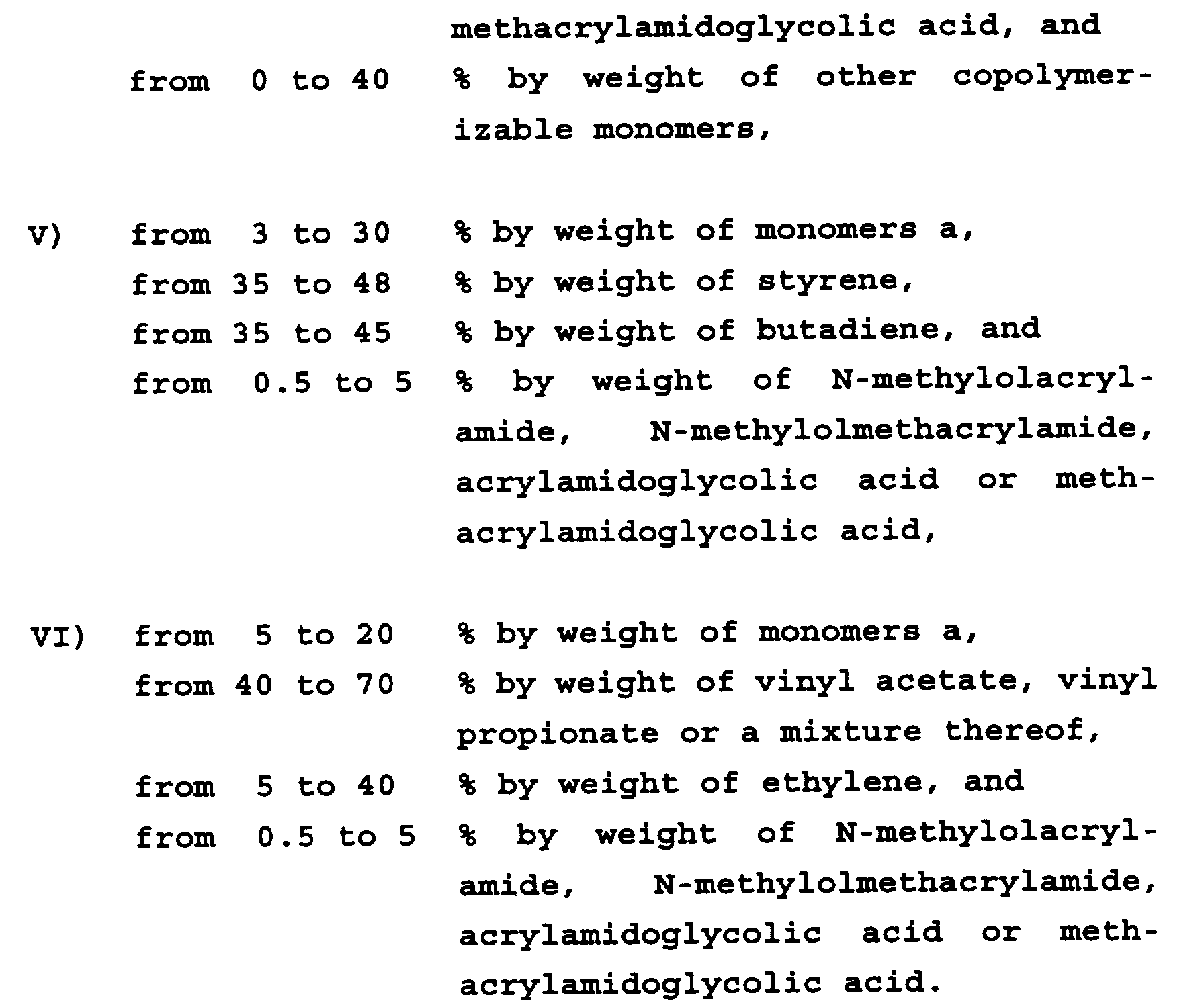
- The use of a polymer dispersion as claimed in any of claims 1 to 4, where the polymer dispersion contains zinc oxide.
- A nonwoven material which contains, as binder, a polymer of an aqueous polymer dispersion used as claimed in any of claims 1 to 5.
- A nonwoven material as claimed in claim 6, which additionally contains from 0.5 to 20 parts by weight, based on 100 parts by weight of the polymer of the aqueous polymer dispersion, of a resol or aminoplastic.
- Bitumen-treated roof sheeting based on a nonwoven material as claimed in claim 6 or 7.
Applications Claiming Priority (2)
| Application Number | Priority Date | Filing Date | Title |
|---|---|---|---|
| DE4004915A DE4004915A1 (en) | 1990-02-16 | 1990-02-16 | WAFER POLYMERISATE DISPERSIONS |
| DE4004915 | 1990-02-16 |
Publications (3)
| Publication Number | Publication Date |
|---|---|
| EP0442370A2 EP0442370A2 (en) | 1991-08-21 |
| EP0442370A3 EP0442370A3 (en) | 1992-10-28 |
| EP0442370B1 true EP0442370B1 (en) | 1996-06-26 |
Family
ID=6400344
Family Applications (1)
| Application Number | Title | Priority Date | Filing Date |
|---|---|---|---|
| EP91101650A Expired - Lifetime EP0442370B1 (en) | 1990-02-16 | 1991-02-07 | Use of aqueous polymer dispersions |
Country Status (3)
| Country | Link |
|---|---|
| EP (1) | EP0442370B1 (en) |
| CA (1) | CA2036071A1 (en) |
| DE (2) | DE4004915A1 (en) |
Families Citing this family (10)
| Publication number | Priority date | Publication date | Assignee | Title |
|---|---|---|---|---|
| JP2533974B2 (en) † | 1991-02-06 | 1996-09-11 | ユーホーケミカル株式会社 | Coating composition |
| NL1000118C2 (en) * | 1995-04-11 | 1996-10-14 | Adw Chem Prod Bv | Chromium-free coating composition for metal surface treatment and method using it. |
| EP0876532B1 (en) * | 1995-12-27 | 2002-04-24 | Performance Roof Systems S.A. | Method for manufacture of an impermeable membrane and a roof covering and products obtained by the method |
| DE19649331A1 (en) | 1996-02-29 | 1997-09-04 | Bayer Ag | Production of diene (co)polymer latex giving strong, abrasion-resistant film |
| DE19619639A1 (en) * | 1996-05-15 | 1997-11-20 | Basf Ag | Recovery of fibers from bonded nonwovens |
| DE19838668A1 (en) * | 1998-08-26 | 2000-03-02 | Basf Ag | Metal salt cross-linked adhesives |
| DE102004013390A1 (en) * | 2004-03-17 | 2005-10-06 | Basf Ag | roofing sheets |
| DE102007020523A1 (en) * | 2007-05-02 | 2008-11-06 | Helling, Günter, Dr. | Metal salt nanogel-containing polymers |
| WO2020221605A1 (en) | 2019-05-02 | 2020-11-05 | Basf Se | Aqueous binder composition |
| EP3967802B1 (en) | 2020-09-11 | 2023-03-29 | Basf Se | Consolidated nonwoven |
Family Cites Families (3)
| Publication number | Priority date | Publication date | Assignee | Title |
|---|---|---|---|---|
| NL83608C (en) * | 1953-02-12 | |||
| DE3433085A1 (en) * | 1984-09-08 | 1986-03-20 | Basf Ag, 6700 Ludwigshafen | STRONG DILATANT POLYMER DISPERSIONS WITH REDUCED TEMPERATURE DEPENDENCY OF CRITICAL SHEAR SPEED |
| CA2004525C (en) * | 1988-12-16 | 2000-05-02 | Joseph M. Owens | Improved transition metal crosslinking of acid-containing polymers |
-
1990
- 1990-02-16 DE DE4004915A patent/DE4004915A1/en not_active Withdrawn
-
1991
- 1991-02-07 EP EP91101650A patent/EP0442370B1/en not_active Expired - Lifetime
- 1991-02-07 DE DE59107953T patent/DE59107953D1/en not_active Expired - Lifetime
- 1991-02-11 CA CA002036071A patent/CA2036071A1/en not_active Abandoned
Also Published As
| Publication number | Publication date |
|---|---|
| EP0442370A3 (en) | 1992-10-28 |
| DE59107953D1 (en) | 1996-08-01 |
| EP0442370A2 (en) | 1991-08-21 |
| CA2036071A1 (en) | 1991-08-17 |
| DE4004915A1 (en) | 1991-08-22 |
Similar Documents
| Publication | Publication Date | Title |
|---|---|---|
| EP0084809B1 (en) | Dispersion of acryl plastics | |
| DE3017543A1 (en) | AQUEOUS DISPERSIONS BASED ON (METH) ACRYLIC ACID ALKYLESTER POLYMERISATES WITH TWO EXCELLENT, PRACTICALLY NOT OVERLAPPING MAXIMAS IN PARTICLE SIZE DISTRIBUTION WITHIN SPECIFIC PARTICLE LARGE RANGE | |
| DE2760188C2 (en) | ||
| EP0810274B2 (en) | Binder for low-emission coating compositions | |
| EP0442370B1 (en) | Use of aqueous polymer dispersions | |
| DE3923229A1 (en) | POLYMERISAT POWDER REDISPERGABLE IN WATER, PRODUCED BY SPRAYING OF AQUEOUS POLYMERISAT DISPERSIONS, AND THEIR USE AS ADDITIVES TO HYDRAULIC BINDERS | |
| EP0216257B1 (en) | Aqueous pasty coating composition and its use | |
| EP0257413A2 (en) | Use of specific ethylene-vinyl-acetate copolymers in the modification of PVC | |
| DE3035375C2 (en) | ||
| EP0113868B1 (en) | Finely divided polyvinyl acetals, a process for their preparation, and their use for baked coatings | |
| EP0765960A2 (en) | Method for producing reusable, fibrous, composite materials | |
| EP0134995A2 (en) | Water soluble esters of acrylic acid polymers | |
| DE3139090C1 (en) | Plastisols made from copolymers of methyl methacrylate with improved adhesive strength and their use | |
| DE2934086A1 (en) | EMULSION POLYMERISAT WITH THICKENING EFFECT IN THE ACID AREA | |
| DE1208023B (en) | Process for the production of storage and gelation-resistant coating agents based on aqueous polyacrylate dispersions | |
| US5300359A (en) | Non woven material containing aqueous polymer dispersions | |
| DE2855696A1 (en) | AQUEOUS POLYMER DISPERSION | |
| EP0025561A1 (en) | Discontinuous emulsion polymerisation process of vinyl chloride | |
| EP0775177B1 (en) | Aqueous contact adhesive dispersion with high storage stability and forming a wash-off film | |
| DE4332012A1 (en) | PSA dispersions | |
| DE68901909T2 (en) | DISPERSION OF RARE EARTH HALOGENIDES IN AQUEOUS MEDIUM. | |
| EP0850956A2 (en) | Process for preparing aqueous polymer dispersions by radical aqueous emulsionspolymerisation | |
| DE69034072T2 (en) | Flame retardant compositions | |
| DE1228015B (en) | Aqueous coating agents and stoving enamels | |
| DE2900843C2 (en) |
Legal Events
| Date | Code | Title | Description |
|---|---|---|---|
| PUAI | Public reference made under article 153(3) epc to a published international application that has entered the european phase |
Free format text: ORIGINAL CODE: 0009012 |
|
| AK | Designated contracting states |
Kind code of ref document: A2 Designated state(s): DE GB IT NL SE |
|
| PUAL | Search report despatched |
Free format text: ORIGINAL CODE: 0009013 |
|
| AK | Designated contracting states |
Kind code of ref document: A3 Designated state(s): DE GB IT NL SE |
|
| 17P | Request for examination filed |
Effective date: 19921031 |
|
| 17Q | First examination report despatched |
Effective date: 19940603 |
|
| GRAA | (expected) grant |
Free format text: ORIGINAL CODE: 0009210 |
|
| AK | Designated contracting states |
Kind code of ref document: B1 Designated state(s): DE GB IT NL SE |
|
| REF | Corresponds to: |
Ref document number: 59107953 Country of ref document: DE Date of ref document: 19960801 |
|
| GBT | Gb: translation of ep patent filed (gb section 77(6)(a)/1977) |
Effective date: 19960806 |
|
| ITF | It: translation for a ep patent filed | ||
| PLBE | No opposition filed within time limit |
Free format text: ORIGINAL CODE: 0009261 |
|
| STAA | Information on the status of an ep patent application or granted ep patent |
Free format text: STATUS: NO OPPOSITION FILED WITHIN TIME LIMIT |
|
| 26N | No opposition filed | ||
| PGFP | Annual fee paid to national office [announced via postgrant information from national office to epo] |
Ref country code: SE Payment date: 19980128 Year of fee payment: 8 |
|
| PGFP | Annual fee paid to national office [announced via postgrant information from national office to epo] |
Ref country code: NL Payment date: 19980130 Year of fee payment: 8 |
|
| PGFP | Annual fee paid to national office [announced via postgrant information from national office to epo] |
Ref country code: GB Payment date: 19980202 Year of fee payment: 8 |
|
| PGFP | Annual fee paid to national office [announced via postgrant information from national office to epo] |
Ref country code: DE Payment date: 19980226 Year of fee payment: 8 |
|
| PG25 | Lapsed in a contracting state [announced via postgrant information from national office to epo] |
Ref country code: GB Free format text: LAPSE BECAUSE OF NON-PAYMENT OF DUE FEES Effective date: 19990207 |
|
| PG25 | Lapsed in a contracting state [announced via postgrant information from national office to epo] |
Ref country code: SE Free format text: LAPSE BECAUSE OF NON-PAYMENT OF DUE FEES Effective date: 19990208 |
|
| PG25 | Lapsed in a contracting state [announced via postgrant information from national office to epo] |
Ref country code: DE Free format text: LAPSE BECAUSE OF THE APPLICANT RENOUNCES Effective date: 19990225 |
|
| PG25 | Lapsed in a contracting state [announced via postgrant information from national office to epo] |
Ref country code: NL Free format text: LAPSE BECAUSE OF NON-PAYMENT OF DUE FEES Effective date: 19990901 |
|
| GBPC | Gb: european patent ceased through non-payment of renewal fee |
Effective date: 19990207 |
|
| EUG | Se: european patent has lapsed |
Ref document number: 91101650.9 |
|
| PG25 | Lapsed in a contracting state [announced via postgrant information from national office to epo] |
Ref country code: IT Free format text: LAPSE BECAUSE OF NON-PAYMENT OF DUE FEES;WARNING: LAPSES OF ITALIAN PATENTS WITH EFFECTIVE DATE BEFORE 2007 MAY HAVE OCCURRED AT ANY TIME BEFORE 2007. THE CORRECT EFFECTIVE DATE MAY BE DIFFERENT FROM THE ONE RECORDED. Effective date: 20050207 |