EP0442371A2 - Bisglycosides - Google Patents
Bisglycosides Download PDFInfo
- Publication number
- EP0442371A2 EP0442371A2 EP91101651A EP91101651A EP0442371A2 EP 0442371 A2 EP0442371 A2 EP 0442371A2 EP 91101651 A EP91101651 A EP 91101651A EP 91101651 A EP91101651 A EP 91101651A EP 0442371 A2 EP0442371 A2 EP 0442371A2
- Authority
- EP
- European Patent Office
- Prior art keywords
- gly
- alkyl
- alkenyl
- bisglycosides
- general formula
- Prior art date
- Legal status (The legal status is an assumption and is not a legal conclusion. Google has not performed a legal analysis and makes no representation as to the accuracy of the status listed.)
- Withdrawn
Links
Classifications
-
- A—HUMAN NECESSITIES
- A61—MEDICAL OR VETERINARY SCIENCE; HYGIENE
- A61K—PREPARATIONS FOR MEDICAL, DENTAL OR TOILETRY PURPOSES
- A61K8/00—Cosmetics or similar toiletry preparations
- A61K8/18—Cosmetics or similar toiletry preparations characterised by the composition
- A61K8/30—Cosmetics or similar toiletry preparations characterised by the composition containing organic compounds
- A61K8/60—Sugars; Derivatives thereof
- A61K8/602—Glycosides, e.g. rutin
-
- A—HUMAN NECESSITIES
- A61—MEDICAL OR VETERINARY SCIENCE; HYGIENE
- A61Q—SPECIFIC USE OF COSMETICS OR SIMILAR TOILETRY PREPARATIONS
- A61Q19/00—Preparations for care of the skin
-
- C—CHEMISTRY; METALLURGY
- C07—ORGANIC CHEMISTRY
- C07C—ACYCLIC OR CARBOCYCLIC COMPOUNDS
- C07C215/00—Compounds containing amino and hydroxy groups bound to the same carbon skeleton
- C07C215/02—Compounds containing amino and hydroxy groups bound to the same carbon skeleton having hydroxy groups and amino groups bound to acyclic carbon atoms of the same carbon skeleton
- C07C215/04—Compounds containing amino and hydroxy groups bound to the same carbon skeleton having hydroxy groups and amino groups bound to acyclic carbon atoms of the same carbon skeleton the carbon skeleton being saturated
- C07C215/06—Compounds containing amino and hydroxy groups bound to the same carbon skeleton having hydroxy groups and amino groups bound to acyclic carbon atoms of the same carbon skeleton the carbon skeleton being saturated and acyclic
- C07C215/12—Compounds containing amino and hydroxy groups bound to the same carbon skeleton having hydroxy groups and amino groups bound to acyclic carbon atoms of the same carbon skeleton the carbon skeleton being saturated and acyclic the nitrogen atom of the amino group being further bound to hydrocarbon groups substituted by hydroxy groups
-
- C—CHEMISTRY; METALLURGY
- C07—ORGANIC CHEMISTRY
- C07C—ACYCLIC OR CARBOCYCLIC COMPOUNDS
- C07C31/00—Saturated compounds having hydroxy or O-metal groups bound to acyclic carbon atoms
- C07C31/18—Polyhydroxylic acyclic alcohols
- C07C31/20—Dihydroxylic alcohols
-
- C—CHEMISTRY; METALLURGY
- C07—ORGANIC CHEMISTRY
- C07H—SUGARS; DERIVATIVES THEREOF; NUCLEOSIDES; NUCLEOTIDES; NUCLEIC ACIDS
- C07H15/00—Compounds containing hydrocarbon or substituted hydrocarbon radicals directly attached to hetero atoms of saccharide radicals
- C07H15/02—Acyclic radicals, not substituted by cyclic structures
- C07H15/04—Acyclic radicals, not substituted by cyclic structures attached to an oxygen atom of the saccharide radical
-
- C—CHEMISTRY; METALLURGY
- C07—ORGANIC CHEMISTRY
- C07H—SUGARS; DERIVATIVES THEREOF; NUCLEOSIDES; NUCLEOTIDES; NUCLEIC ACIDS
- C07H15/00—Compounds containing hydrocarbon or substituted hydrocarbon radicals directly attached to hetero atoms of saccharide radicals
- C07H15/02—Acyclic radicals, not substituted by cyclic structures
- C07H15/04—Acyclic radicals, not substituted by cyclic structures attached to an oxygen atom of the saccharide radical
- C07H15/10—Acyclic radicals, not substituted by cyclic structures attached to an oxygen atom of the saccharide radical containing unsaturated carbon-to-carbon bonds
-
- C—CHEMISTRY; METALLURGY
- C11—ANIMAL OR VEGETABLE OILS, FATS, FATTY SUBSTANCES OR WAXES; FATTY ACIDS THEREFROM; DETERGENTS; CANDLES
- C11D—DETERGENT COMPOSITIONS; USE OF SINGLE SUBSTANCES AS DETERGENTS; SOAP OR SOAP-MAKING; RESIN SOAPS; RECOVERY OF GLYCEROL
- C11D1/00—Detergent compositions based essentially on surface-active compounds; Use of these compounds as a detergent
- C11D1/66—Non-ionic compounds
- C11D1/662—Carbohydrates or derivatives
Definitions
- the invention relates to a process for the preparation of these bisglycosides, the corresponding diols as intermediates for this production process, the use of the bisglycosides I as surface-active substances or emulsifiers in detergents, cleaners and personal care products, and detergents, cleaners and compositions containing I Personal care products.
- non-ionic surface-active substances based on renewable raw materials have increasingly come to the fore in recent years. Such substances generally have good biodegradability, low toxicity and therefore good environmental compatibility.
- alkyl glycosides e.g. in the tenside surf reference. Det. 26 (1989) 5, 318-324, (1), in which the long-chain hydrophobic alkyl radical is linked directly to the hydrophilic carbohydrate part of the molecule by means of an acetal bond.
- R.R. Schmidt describes in the reference Angew. Chem. 98 (1986), 213-236, (2), the possible uses of O-glycosyl trichloroacetimidates and the use of the trifluoromethanesulfonate group as a further activating group in glycoside and oligosaccharide synthesis.
- the object of the present invention was to provide nonionic surfactants based on renewable raw materials which no longer have the deficiencies described above.
- the linear or branched alkyl or alkenyl groups on which the radicals R1 to R4 are based consist of 1 to 30 or 2 to 30 C atoms. Groups with 6 to 22 carbon atoms, in particular 10 to 18 carbon atoms, give particularly good results. With a chain length of 14 to 16 carbon atoms, an optimum is achieved in the properties, since the optimal size ratio between the hydrophobic and hydrophilic part of the molecule is evidently present.
- alkyl and alkenyl groups are listed as examples: Methyl, ethyl, n-propyl, n-butyl, n-hexyl, n-octyl, 2-ethylhexyl, n-nonyl, iso-nonyl, n-decyl, n-undecyl, n-dodecyl, n-tridecyl, iso- Tridecyl, myristyl, cetyl, stearyl, eisosyl, vinyl, 1-propenyl, 2-propenyl, oleyl, linolyl and linolenyl.
- radical R 1 is on a C atom, it denotes an alkyl or alkenyl group or an alkoxy or alkenyloxy group.
- R 1 radical is on an N atom, it represents an alkylcarbonyl or alkenylcarbonyl group.
- radicals R2 to R4 are preferably hydrogen, but also other alkyl or alkenyl groups.
- variable n stands primarily for the value 1, but also for 2 or 3.
- variable m stands for 0 or 1.
- the variables p and q independently of one another stand for 0, 1 or 2, in particular both for 0.
- glycoside residue Gly denotes mono- or disaccharides which are composed of customary pentoses and / or ketoses.
- Aldopentoses such as ribose, arabinose, xylose and lyxose
- aldohexoses such as allose, old rose, glucose, mannose, gulose, idose, galactose and talose
- ketohexoses such as fructose serve as such building blocks.
- mannose, glucose, galactose and fructose are preferred.
- sucrose, lactose, maltose and cellobiose can be used as disaccharides.
- oligosaccharides with a degree of glycosidation of up to 8 and of polysaccharides with a degree of glycosidation greater than 8 may still be present as components in the compounds I.
- the carbohydrate components are usually linked to the rest of the molecular part of I by an acetal bond on the anomeric carbon atom, i.e. on the 1-C atom, where both ⁇ - and ⁇ -anomers can be present.
- Typical protecting groups for this are, for example, the acetyl group, the benzyl group or the isopropylidene grouping, which after the reaction has taken place can easily be split off again using the customary methods, for example by means of catalytic amounts of a sodium alcoholate or by means of protonic acids such as acetic acid.
- the diols II are normally reacted with the acetimidates III in the presence of catalytic amounts of a protonic acid or a Lewis acid.
- Lewis acids such as tin tetrachloride, titanium tetrachloride and especially boron trifluoride adducts, e.g. Boron trifluoride etherate used.
- the acetimidates III the trichloroacetimidates can be used most advantageously.
- Method (a) is usually carried out in an anhydrous inert solvent such as n-pentane, n-hexane, cyclohexane, toluene, chloroform, dichloromethane, tetrahydrofuran or diethyl ether or in a mixture of such solvents at room temperature or slightly elevated temperature up to about 50 ° C and at normal pressure.
- anhydrous inert solvent such as n-pentane, n-hexane, cyclohexane, toluene, chloroform, dichloromethane, tetrahydrofuran or diethyl ether or in a mixture of such solvents at room temperature or slightly elevated temperature up to about 50 ° C and at normal pressure.
- the reactions are usually completed after 1 to 5 hours. Chromatographic methods are best suited for any cleaning of the product.
- the bistrifluoromethanesulfonates IV obtainable from the diols II, for example by reaction with trifluoromethanesulfonic anhydride are reacted with the carbohydrates V as a rule in the presence of a strong base such as an alkali metal alcoholate or an alkali metal hydride.
- a strong base such as an alkali metal alcoholate or an alkali metal hydride.
- the procedure here is normally in an anhydrous inert solvent, such as in (a) at room temperature or at an elevated temperature up to about 80 ° C. and at atmospheric pressure.
- a protective gas such as nitrogen or argon is recommended. Chromatographic methods are best suited for any cleaning of the product.
- the present invention furthermore relates to diols of the general formula II HO-CHR2 (CH2) p - (XR1) n - (CH2) q - (CHR3) m -OH II as an intermediate for the production of bisglycosides I.
- the bisglycosides I are used as surface-active substances, mainly as nonionic surfactants or emulsifiers, in detergents and cleaning agents, for example for cleaning processes in technology and the home, such as for textile washing, or for cleaning processes in the food sector, such as the cleaning of beverage bottles. They also serve as emulsifiers in personal care products such as skin creams, lotions, gels, skin oils or hair shampoos.
- bisglycosides I also act as complexing agents and builders, which is due to the chelating effect of the two carbohydrate units.
- the interaction with the hydroxyl groups of the carbohydrate groups complexes metal ions such as calcium, magnesium and iron ions, which leads to an intensification of the washing action.
- the present invention also relates to detergents, cleaning agents and personal care compositions which contain 1 to 50% by weight, preferably 5 to 30% by weight, of a bisglycoside I or a mixture of such bisglycosides.
- a bisglycoside I preferably 5 to 30% by weight
- the usual constituents and composition of detergents and cleaning agents and of personal care products are known to the person skilled in the art and therefore need not be discussed further here.
- the bisglycosides I according to the invention result in a low surface tension in the range from approximately 30 to approximately 50 mN / m and, above all, a very low critical micelle formation concentration (CMC) in the range from approximately 1 to approximately 0.001 mmol / l.
- CMC critical micelle formation concentration
- the readily biodegradable bisglycosides I also have the advantage that they additionally act as complexing agents and builders in detergents and cleaning agents and can therefore at least partially replace conventional, difficultly biodegradable complexing agents and builders, which can reduce the environmental impact.
- the isopropylidene protective groups were removed by stirring the product obtained in 120 ml of 70% strength by weight acetic acid at room temperature for 5 days. After distilling off acetic acid and water in a water jet vacuum, the end product was purified by flash chromatography (dichloromethane / methanol / water 14: 6: 1). The title compound was obtained in a yield of 55%.
- the CMC values were determined at 20 ° C by the usual method.
- the surface tension was measured in accordance with DIN 53 914.
- the force is measured in mN / m, which is necessary to pull a horizontally suspended ring or bracket out of the liquid surface.
Landscapes
- Chemical & Material Sciences (AREA)
- Organic Chemistry (AREA)
- Life Sciences & Earth Sciences (AREA)
- Health & Medical Sciences (AREA)
- General Health & Medical Sciences (AREA)
- Engineering & Computer Science (AREA)
- Molecular Biology (AREA)
- Genetics & Genomics (AREA)
- Public Health (AREA)
- Crystallography & Structural Chemistry (AREA)
- Veterinary Medicine (AREA)
- Biochemistry (AREA)
- Biotechnology (AREA)
- Animal Behavior & Ethology (AREA)
- Epidemiology (AREA)
- Birds (AREA)
- Chemical Kinetics & Catalysis (AREA)
- Oil, Petroleum & Natural Gas (AREA)
- Wood Science & Technology (AREA)
- Dermatology (AREA)
- Saccharide Compounds (AREA)
- Detergent Compositions (AREA)
- Organic Low-Molecular-Weight Compounds And Preparation Thereof (AREA)
Abstract
Bisglykoside IBisglycosides I
Gly-O-CHR²-(CH₂)p-(XR¹)n-(CH₂)q-(CHR³)m-O-Gly I
bei denen die Variablen folgende Bedeutung haben:
- X
- C-R⁴ oder N
- R¹
- für den Fall X = C-R⁴: C₁-C₃₀-Alkyl oder C₂-C₃₀-Alkenyl oder O-C₁-C₃₀-Alkyl oder O-C₂-C₃₀-Alkenyl
für den Fall X = N: CO-C₁-C₃₀-Alkyl oder CO-C₂-C₃₀-Alkenyl - R² bis R⁴
- Wasserstoff oder C₁-C₃₀-Alkyl oder C₂-C₃₀-Alkenyl
- n
- 1 bis 3
- m
- 0 oder 1
- p,q
- 0 bis 2
- Gly
- aus Aldopentosen, Aldohexosen und/oder Ketohexosen aufgebaute Mono- oder Disaccharide.
Gly-O-CHR²- (CH₂) p - (XR¹) n - (CH₂) q - (CHR³) m -O-Gly I
where the variables have the following meaning:
- X
- C-R⁴ or N
- R¹
- for the case X = C-R⁴: C₁-C₃₀-alkyl or C₂-C₃₀-alkenyl or O-C₁-C₃₀-alkyl or O-C₂-C₃₀-alkenyl
for the case X = N: CO-C₁-C₃₀-alkyl or CO-C₂-C₃₀-alkenyl - R² to R⁴
- Hydrogen or C₁-C₃₀ alkyl or C₂-C₃₀ alkenyl
- n
- 1 to 3
- m
- 0 or 1
- p, q
- 0 to 2
- Gly
- mono- or disaccharides made up of aldopentoses, aldohexoses and / or ketohexoses.
Die Bisglykoside I dienen als oberflächenaktive Substanzen bzw. Emulgatoren in Wasch-, Reinigungs- und Körperpflegemitteln.The bisglycosides I serve as surface-active substances or emulsifiers in detergents, cleaning agents and personal care products.
Description
Die vorliegende Erfindung betrifft neue Bisglykoside der allgemeinen Formel I
Gly-O-CHR²-(CH₂)p-(XR¹)n-(CH₂)q-(CHR³)m-O-Gly I
in der die Variablen folgende Bedeutung haben:
- X
- C-R⁴ oder N
- R¹
- für den Fall X = C-R⁴: C₁-C₃₀-Alkyl oder C₂-C₃₀-Alkenyl oder O-C₁-C₃₀-Alkyl oder O-C₂-C₃₀-Alkenyl
für den Fall X = N: CO-C₁-C₃₀-Alkyl oder CO-c₂-c₃₀-Alkenyl - R² bis R⁴
- Wasserstoff oder C₁-C₃₀-Alkyl oder C₂-C₃₀-Alkenyl
- n
- 1 bis 3
- m
- 0 oder 1
- p,q
- 0 bis 2
- Gly
- aus Aldopentosen, Aldohexosen und/oder Ketohexosen aufgebaute Mono- oder Disaccharide.
Gly-O-CHR²- (CH₂) p - (XR¹) n - (CH₂) q - (CHR³) m -O-Gly I
in which the variables have the following meaning:
- X
- C-R⁴ or N
- R¹
- for the case X = C-R⁴: C₁-C₃₀-alkyl or C₂-C₃₀-alkenyl or O-C₁-C₃₀-alkyl or O-C₂-C₃₀-alkenyl
for the case X = N: CO-C₁-C₃₀-alkyl or CO-c₂-c₃₀-alkenyl - R² to R⁴
- Hydrogen or C₁-C₃₀ alkyl or C₂-C₃₀ alkenyl
- n
- 1 to 3
- m
- 0 or 1
- p, q
- 0 to 2
- Gly
- mono- or disaccharides composed of aldopentoses, aldohexoses and / or ketohexoses.
Weiterhin betrifft die Erfindung ein Verfahren zur Herstellung dieser Bisglykoside, die entsprechenden Diole als Zwischenprodukte für dieses Herstellungsverfahren, die Verwendung der Bisglykoside I als oberflächenaktive Substanzen bzw. Emulgatoren in Wasch-, Reinigungs- und Körperpflegemitteln sowie die Verbindungen I enthaltende Wasch-, Reinigungs- und Körperpflegemittel.Furthermore, the invention relates to a process for the preparation of these bisglycosides, the corresponding diols as intermediates for this production process, the use of the bisglycosides I as surface-active substances or emulsifiers in detergents, cleaners and personal care products, and detergents, cleaners and compositions containing I Personal care products.
Auf dem Tensid-Sektor sind in den letzten Jahren in zunehmendem Maße nichtionische oberflächenaktive Substanzen auf der Basis nachwachsender Rohstoffe in den Vordergrund getreten. Derartige Stoffe haben in der Regel eine gute biologische Abbaubarkeit, eine geringe Toxizität und somit eine gute Umweltverträglichkeit.In the surfactant sector, non-ionic surface-active substances based on renewable raw materials have increasingly come to the fore in recent years. Such substances generally have good biodegradability, low toxicity and therefore good environmental compatibility.
Eine wichtige Gruppe solcher nichtionischer Tenside stellen Alkylglykoside dar, wie sie z.B. in der Literaturstelle Tenside Surf. Det. 26 (1989) 5, 318-324, (1), beschrieben sind, bei denen der langkettige hydrophobe Alkylrest direkt an den hydrophilen Kohlenhydratteil des Moleküls mittels einer acetalischen Bindung angeknüpft ist.An important group of such nonionic surfactants are alkyl glycosides, e.g. in the tenside surf reference. Det. 26 (1989) 5, 318-324, (1), in which the long-chain hydrophobic alkyl radical is linked directly to the hydrophilic carbohydrate part of the molecule by means of an acetal bond.
Solche Produkte erfüllen die in sie gesetzten Erwartungen zwar schon weitgehend, erweisen sich aber in einigen Eigenschaften wie dem Solubilisierungsvermögen als noch verbesserungsbedürftig. Erwünscht wäre es außerdem, wenn die oberflächenaktiven Verbindungen in Wasch- und Reinigungsmittel außerdem noch Komplexbildner- und/oder Gerüststoff-Funktionen zumindest teilweise übernehmen könnten.Such products already largely meet the expectations placed on them, but they still prove to be in need of improvement in some properties, such as the solubilization capacity. It would also be desirable if the surface-active compounds in detergents and cleaners could also at least partially assume complexing and / or builder functions.
R.R. Schmidt beschreibt in der Literaturstelle Angew. Chem. 98 (1986), 213-236, (2), die Verwendungsmöglichkeiten von O-Glykosyl-trichloracetimidaten und die Verwendung der Trifluormethansulfonatgruppe als weitere aktivierende Gruppe in der Glykosid- und Oligosaccharid-Synthese.R.R. Schmidt describes in the reference Angew. Chem. 98 (1986), 213-236, (2), the possible uses of O-glycosyl trichloroacetimidates and the use of the trifluoromethanesulfonate group as a further activating group in glycoside and oligosaccharide synthesis.
Der vorliegenden Erfindung lag die Aufgabe zugrunde, nichtionische Tenside auf der Basis nachwachsender Rohstoffe bereitzustellen, die die oben geschilderten Mängel nicht mehr aufweisen.The object of the present invention was to provide nonionic surfactants based on renewable raw materials which no longer have the deficiencies described above.
Demgemäß wurden die eingangs definierten Bisglykoside I gefunden.Accordingly, the bisglycosides I defined at the outset were found.
Die den Resten R¹ bis R⁴ zugrundeliegenden linearen oder verzweigten Alkyl- oder Alkenylgruppen bestehen aus 1 bis 30 bzw. 2 bis 30 C-Atomen. Besonders gute Ergebnisse liefern Gruppen mit 6 bis 22 C-Atomen, insbesondere 10 bis 18 C-Atomen. Bei einer Kettenlänge von 14 bis 16 C-Atomen wird ein Optimum in den Eigenschaften erreicht, da hierbei offenbar das optimale Größenverhältnis zwischen hydrophobem und hydrophilem Molekülteil vorliegt.The linear or branched alkyl or alkenyl groups on which the radicals R¹ to R⁴ are based consist of 1 to 30 or 2 to 30 C atoms. Groups with 6 to 22 carbon atoms, in particular 10 to 18 carbon atoms, give particularly good results. With a chain length of 14 to 16 carbon atoms, an optimum is achieved in the properties, since the optimal size ratio between the hydrophobic and hydrophilic part of the molecule is evidently present.
Als Beispiele seien die folgenden Alkyl- bzw. Alkenylgruppen aufgeführt:
Methyl, Ethyl, n-Propyl, n-Butyl, n-Hexyl, n-Octyl, 2-Ethylhexyl, n-Nonyl, iso-Nonyl, n-Decyl, n-Undecyl, n-Dodecyl, n-Tridecyl, iso-Tridecyl, Myristyl, Cetyl, Stearyl, Eisosyl, Vinyl, 1-Propenyl, 2-Propenyl, Oleyl, Linolyl und Linolenyl.The following alkyl and alkenyl groups are listed as examples:
Methyl, ethyl, n-propyl, n-butyl, n-hexyl, n-octyl, 2-ethylhexyl, n-nonyl, iso-nonyl, n-decyl, n-undecyl, n-dodecyl, n-tridecyl, iso- Tridecyl, myristyl, cetyl, stearyl, eisosyl, vinyl, 1-propenyl, 2-propenyl, oleyl, linolyl and linolenyl.
Steht der Rest R¹ an einem C-Atom, bezeichnet er eine Alkyl- bzw. Alkenylgruppe oder eine Alkoxy- bzw. Alkenyloxygruppe. Steht der Rest R¹ dagegen an einem N-Atom, steht er für eine Alkylcarbonyl- bzw. Alkenylcarbonylgruppe.If the radical R 1 is on a C atom, it denotes an alkyl or alkenyl group or an alkoxy or alkenyloxy group. In contrast, when the R 1 radical is on an N atom, it represents an alkylcarbonyl or alkenylcarbonyl group.
Die Reste R² bis R⁴ stehen vorzugsweise für Wasserstoff, daneben aber auch für weitere Alkyl- bzw. Alkenylgruppen.The radicals R² to R⁴ are preferably hydrogen, but also other alkyl or alkenyl groups.
Die Variable n steht vor allem für den Wert 1, daneben aber auch für 2 oder 3. Die Variable m steht für 0 oder 1. Die Variablen p und q stehen unabhängig voneinander für 0, 1 oder 2, insbesondere beide für 0.The variable n stands primarily for the value 1, but also for 2 or 3. The variable m stands for 0 or 1. The variables p and q independently of one another stand for 0, 1 or 2, in particular both for 0.
Der Glykosidrest Gly bezeichnet Mono- oder Disaccharide, welche aus üblichen Pentosen und/oder Ketosen aufgebaut sind. Als derartige Bausteine dienen Aldopentosen wie Ribose, Arabinose, Xylose und Lyxose, Aldohexosen wie Allose, Altrose, Glucose, Mannose, Gulose, Idose, Galactose und Talose sowie Ketohexosen wie Fructose. Bevorzugt werden hiervon Mannose, Glucose, Galactose und Fructose.The glycoside residue Gly denotes mono- or disaccharides which are composed of customary pentoses and / or ketoses. Aldopentoses such as ribose, arabinose, xylose and lyxose, aldohexoses such as allose, old rose, glucose, mannose, gulose, idose, galactose and talose and ketohexoses such as fructose serve as such building blocks. Of these, mannose, glucose, galactose and fructose are preferred.
Als Disaccharide können vor allem Saccharose, Lactose, Maltose und Cellobiose verwendet werden.In particular, sucrose, lactose, maltose and cellobiose can be used as disaccharides.
Je nach den Herstellungsbedingungen der Bisglykoside I können noch geringe Anteile an Oligosacchariden mit einem Glykosidierungsgrad bis 8 und an Polysacchariden mit einem Glykosidierungsgrad größer als 8 als Komponenten in den Verbindungen I enthalten sein.Depending on the production conditions of the bisglycosides I, small amounts of oligosaccharides with a degree of glycosidation of up to 8 and of polysaccharides with a degree of glycosidation greater than 8 may still be present as components in the compounds I.
Eingesetzt werden normalerweise die in der Natur vorkommenden Kohlenhydrate der D-Reihe, es können aber auch Vertreter der L-Reihe verwendet werden.The naturally occurring carbohydrates of the D series are normally used, but representatives of the L series can also be used.
Die Verknüpfung der Kohlenhydrat-Komponenten mit dem übrigen Molekülteil von I geschieht in der Regel durch eine acetalische Bindung am anomeren C-Atom, d.h. am 1-C-Atom, wobei sowohl α- als auch β-Anomere vorliegen können.The carbohydrate components are usually linked to the rest of the molecular part of I by an acetal bond on the anomeric carbon atom, i.e. on the 1-C atom, where both α- and β-anomers can be present.
Bevorzugt werden Bisglykoside der allgemeinen Formel Ia
Gly-O-CHR²-CHR¹-(CHR³)m-O-Gly Ia
in der R¹ die für den Fall X = C-R⁴ angegebene Bedeutung hat.Bisglycosides of the general formula Ia are preferred
Gly-O-CHR²-CHR¹- (CHR³) m -O-Gly Ia
in which R¹ has the meaning given for the case X = C-R⁴.
Weiterhin werden bevorzugt Bisglykoside der allgemeinen Formel Ib
Gly-O-CHR²-(CH₂)p-NR¹(CH₂)q-CHR³-O-Gly Ib
in der R¹ die für den Fall X = N angegebene Bedeutung hat.Bisglycosides of the general formula Ib are also preferred
Gly-O-CHR²- (CH₂) p -NR¹ (CH₂) q -CHR³-O-Gly Ib
in which R¹ has the meaning given for the case X = N.
Die Bisglykoside I werden zweckmäßigerweise durch Umsetzung von
- (a) Diolen der allgemeinen Formel II
HO-CHR²-(CH₂)p-(XR¹)n-(CH₂)q-(CHR³)m-OH II
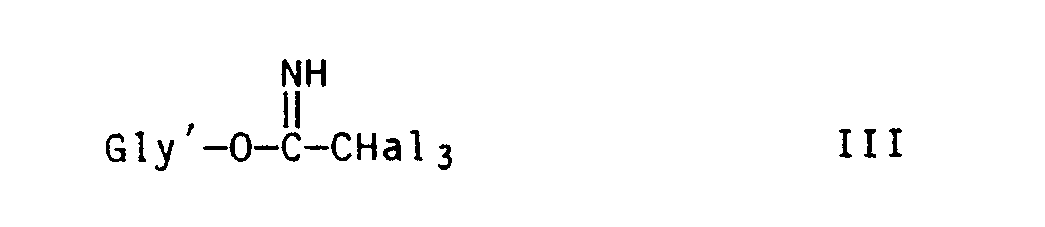
mit geschützten Glykosyl-trihalogenacetimidaten der allgemeinen Formel III
- (b) aus den Diolen II erhältlichen Bistrifluormethansulfonaten der allgemeinen Formel IV
CF₃SO₂O-CHR²-(CH₂)p-(XR¹)n-(CH₂)q-(CHR³)m-OSO₂CF₃ IV
mit geschützten Mono- oder Disacchariden der allgemeinen Formel V
Gly'-OH V
und anschließende Entfernung der Schutzgruppen der Glykosylreste nach den üblichen Methoden hergestellt.
- (a) Diols of the general formula II
HO-CHR²- (CH₂) p - (XR¹) n - (CH₂) q - (CHR³) m -OH II
with protected glycosyl trihaloacetimidates of the general formula III - (b) Bistrifluoromethanesulfonates of the general formula IV obtainable from the diols II
CF₃SO₂O-CHR²- (CH₂) p - (XR¹) n - (CH₂) q - (CHR³) m -OSO₂CF₃ IV
with protected mono- or disaccharides of the general formula V
Gly'-OH V
and then removing the protective groups of the glycosyl residues by the customary methods.
Die den beiden Ausführungsformen (a) und (b) zugrundeliegenden für diese Stoffklassen üblichen Synthesemethoden sind in (2) dargestellt.The synthetic methods used for these classes of substances on which the two embodiments (a) and (b) are based are shown in (2).
Bei den Kohlenhydrat-Verbindungen III und V tragen alle übrigen Hydroxylgruppen außer derjenigen, welche zur Verknüpfung mit dem übrigen Molekülteil von I dient und in der Regel am anomeren C-Atom, d.h. am 1-C-Atom, steht, Schutzgruppen, um unerwünschte Nebenreaktionen auszuschließen.In the case of carbohydrate compounds III and V, all other hydroxyl groups carry, except that which is used for linking to the rest of the molecular part of I and generally on the anomeric C atom, i.e. on the 1-C atom, there are protective groups to rule out undesirable side reactions.
übliche Schutzgruppen hierfür sind beispielsweise die Acetylgruppe, die Benzylgruppe oder die Isopropylidengruppierung, die sich nach erfolgter Umsetzung wieder leicht nach den üblichen Methoden, beispielsweise mittels katalytischer Mengen eines Natriumalkoholates oder mittels Protonensäuren wie Essigsäure, abspalten lassen.Typical protecting groups for this are, for example, the acetyl group, the benzyl group or the isopropylidene grouping, which after the reaction has taken place can easily be split off again using the customary methods, for example by means of catalytic amounts of a sodium alcoholate or by means of protonic acids such as acetic acid.
Bei der Trihalogenacetimidat-Methode (a) werden die Diole II mit den Acetimidaten III normalerweise in Gegenwart katalytischer Mengen einer Protonensäure oder einer Lewis-Säure umgesetzt. Hierfür werden vorzugsweise Lewis-Säuren wie Zinntetrachlorid, Titantetrachlorid und vor allem Bortrifluorid-Addukte, z.B. Bortrifluorid-Etherat, eingesetzt. Von den Acetimidaten III sind am vorteilhaftesten die Trichloracetimidate verwendbar.In the trihaloacetimidate method (a), the diols II are normally reacted with the acetimidates III in the presence of catalytic amounts of a protonic acid or a Lewis acid. Lewis acids such as tin tetrachloride, titanium tetrachloride and especially boron trifluoride adducts, e.g. Boron trifluoride etherate used. Of the acetimidates III, the trichloroacetimidates can be used most advantageously.
Bei Methode (a) arbeitet man in der Regel in einem wasserfreien inerten Lösungsmittel wie n-Pentan, n-Hexan, Cyclohexan, Toluol, Chloroform, Dichlormethan, Tetrahydrofuran oder Diethylether oder in einem Gemisch solcher Lösungsmittel bei Raumtemperatur oder leicht erhöhter Temperatur bis etwa 50°C und bei Normaldruck. Die Umsetzungen sind meist nach 1 bis 5 Stunden beendet. Für eine eventuelle Reinigung des Produktes eignen sich am besten chromatographische Methoden.Method (a) is usually carried out in an anhydrous inert solvent such as n-pentane, n-hexane, cyclohexane, toluene, chloroform, dichloromethane, tetrahydrofuran or diethyl ether or in a mixture of such solvents at room temperature or slightly elevated temperature up to about 50 ° C and at normal pressure. The reactions are usually completed after 1 to 5 hours. Chromatographic methods are best suited for any cleaning of the product.
Bei der Trifluormethansulfonat-Methode (b) werden die aus den Diolen II beispielsweise durch Umsetzung mit Trifluormethansulfonsäureanhydrid erhältlichen Bistrifluormethansulfonate IV mit den Kohlenhydraten V in der Regel in Gegenwart einer starken Base wie einem Alkalimetallalkoholat oder einem Alkalimetallhydrid umgesetzt. Man arbeitet hierbei normalerweise in einem wasserfreien inerten Lösungsmittel wie bei (a) bei Raumtemperatur oder erhöhter Temperatur bis etwa 80°C und bei Normaldruck. Die Verwendung eines Schutzgases wie Stickstoff oder Argon ist empfehlenswert. Für eine eventuelle Reinigung des Produktes eignen sich am besten chromatographische Methoden.In the trifluoromethanesulfonate method (b), the bistrifluoromethanesulfonates IV obtainable from the diols II, for example by reaction with trifluoromethanesulfonic anhydride, are reacted with the carbohydrates V as a rule in the presence of a strong base such as an alkali metal alcoholate or an alkali metal hydride. The procedure here is normally in an anhydrous inert solvent, such as in (a) at room temperature or at an elevated temperature up to about 80 ° C. and at atmospheric pressure. The use of a protective gas such as nitrogen or argon is recommended. Chromatographic methods are best suited for any cleaning of the product.
Gegenstand der vorliegenden Erfindung sind weiterhin Diole der allgemeinen Formel II
HO-CHR²(CH₂)p-(XR¹)n-(CH²)q-(CHR³)m-OH II
als Zwischenprodukt für die Herstellung der Bisglykoside I.The present invention furthermore relates to diols of the general formula II
HO-CHR² (CH₂) p - (XR¹) n - (CH²) q - (CHR³) m -OH II
as an intermediate for the production of bisglycosides I.
Die Bisglykoside I finden Verwendung als oberflächenaktive Substanzen, hauptsächlich als nichtionische Tenside oder Emulgatoren, in Wasch- und Reinigungsmitteln, beispielsweise für Reinigungsprozesse in Technik und Haushalt wie für die Textilwäsche oder für Reinigungsprozesse im Nahrungsmittelbereich wie die Reinigung von Getränkeflaschen. Weiterhin dienen sie in Körperpflegemitteln wie Hautcremes, Lotionen, Gelen, Hautölen oder Haarshampoos als Emulgatoren.The bisglycosides I are used as surface-active substances, mainly as nonionic surfactants or emulsifiers, in detergents and cleaning agents, for example for cleaning processes in technology and the home, such as for textile washing, or for cleaning processes in the food sector, such as the cleaning of beverage bottles. They also serve as emulsifiers in personal care products such as skin creams, lotions, gels, skin oils or hair shampoos.
In Wasch- und Reinigungsmitteln wirken die Bisglykoside I außerdem als Komplexbildner und Gerüststoffe (Builder), was auf die chelatisierende Wirkung der beiden Kohlenhydrat-Einheiten zurückzuführen ist. Durch die Wechselwirkung mit den Hydroxylgruppen der Kohlenhydrat-Gruppierungen werden Metallionen wie Calcium-, Magnesium- und Eisenionen komplexiert, was zu einer Verstärkung der Waschwirkung führt.In detergents and cleaning agents, bisglycosides I also act as complexing agents and builders, which is due to the chelating effect of the two carbohydrate units. The interaction with the hydroxyl groups of the carbohydrate groups complexes metal ions such as calcium, magnesium and iron ions, which leads to an intensification of the washing action.
Gegenstand der vorliegenden Erfindung sind ebenfalls Wasch-, Reinigungsund Körperpflegemittel, welche 1 bis 50 Gew.-%, vorzugsweise 5 bis 30 Gew.-% eines Bisglykosides I oder einer Mischung solcher Bisglykoside enthalten. Die üblichen Bestandteile und Zusammensetzung von Wasch- und Reinigungsmitteln sowie von Körperpflegemitteln sind dem Fachmann bekannt und brauchen deshalb hier nicht weiter erörtert zu werden.The present invention also relates to detergents, cleaning agents and personal care compositions which contain 1 to 50% by weight, preferably 5 to 30% by weight, of a bisglycoside I or a mixture of such bisglycosides. The usual constituents and composition of detergents and cleaning agents and of personal care products are known to the person skilled in the art and therefore need not be discussed further here.
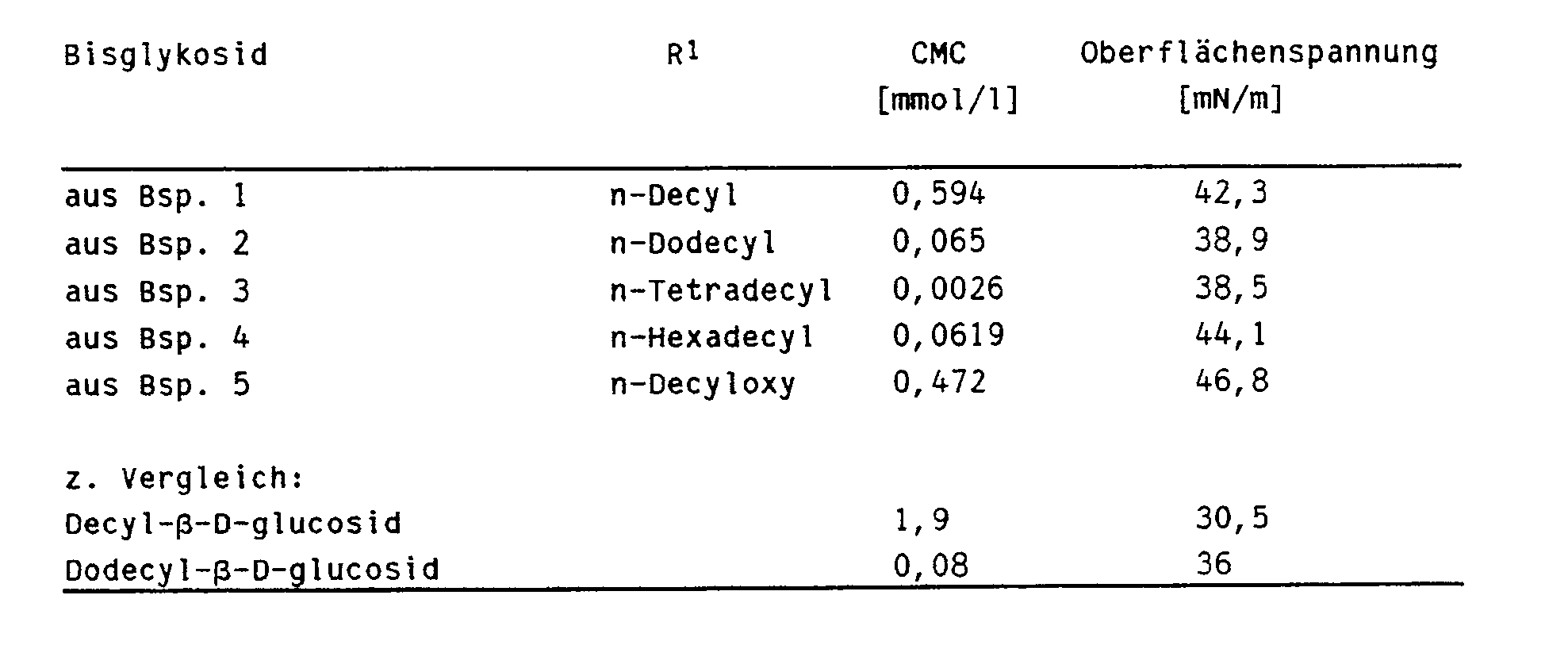
Die erfindungsgemäßen Bisglykoside I führen zu einer niedrigen Oberflächenspannung im Bereich von etwa 30 bis etwa 50 mN/m und vor allem einer sehr niedrigen kritischen Micellbildungskonzentration (CMC) im Bereich von etwa 1 bis etwa 0,001 mmol/l. Die geringen CMC-Werte sind Ausdruck des ausgezeichneten Solubilisierungsvermögens der Verbindungen I. Daher werden in Wasch-, Reinigungs- und Körperpflegemittelformulierungen wesentlich geringere Konzentrationen der erfindungsgemäßen Verbindungen I als bei üblichen Alkylglykosiden benötigt.The bisglycosides I according to the invention result in a low surface tension in the range from approximately 30 to approximately 50 mN / m and, above all, a very low critical micelle formation concentration (CMC) in the range from approximately 1 to approximately 0.001 mmol / l. The low CMC values are an expression of the excellent solubilization capacity of the compounds I. Therefore, much lower concentrations of the compounds I according to the invention are required in washing, cleaning and personal care formulations than in the case of conventional alkyl glycosides.
Die biologisch leicht abbaubaren Bisglykoside I weisen außerdem den Vorteil auf, daß sie in Wasch- und Reinigungsmitteln zusätzlich als Komplexbildner und Gerüststoffe wirken und somit übliche schwer biologisch abbaubare Komplexbildner und Gerüststoffe zumindest teilweise ersetzen können, wodurch die Umweltbelastung verringert werden kann.The readily biodegradable bisglycosides I also have the advantage that they additionally act as complexing agents and builders in detergents and cleaning agents and can therefore at least partially replace conventional, difficultly biodegradable complexing agents and builders, which can reduce the environmental impact.
2,05 g (4,18 mmol) 2,3,4,6-Tetra-O-acetyl-α-D-glucopyranosyl-trichloracetimidat und 0,43 g (2,0 mmol) 2-Hydroxymethyl-1-dodecanol wurden in 20 ml einer Mischung aus gleichen Volumenteilen wasserfreiem n-Hexan und wasserfreiem Dichlormethan gelöst. Unter Feuchtigkeitsausschluß wurden langsam 2,0 g einer ca. 1,5 gew.-%igen Lösung von Bortrifluorid-Etherat in Diethylether (entsprechend 0,2 mmol BF₃·Et₂O) zugetropft.2.05 g (4.18 mmol) of 2,3,4,6-tetra-O-acetyl-α-D-glucopyranosyl trichloroacetimidate and 0.43 g (2.0 mmol) of 2-hydroxymethyl-1-dodecanol were added dissolved in 20 ml of a mixture of equal parts by volume of anhydrous n-hexane and anhydrous dichloromethane. Excluding moisture, 2.0 g of an approximately 1.5% by weight solution of boron trifluoride etherate in diethyl ether (corresponding to 0.2 mmol of BF₃ · Et₂O) were slowly added dropwise.
Nach 2,5 Stunden Rühren bei Raumtemperatur wurden 0,3 g Natriumhydrogencarbonat und 20 ml Dichlormethan zugegeben. Nach Filtration, Abdestillieren der Lösungsmittel und Reinigung des erhaltenen Rohproduktes durch Flashchromatographie (Toluol/Essigsäureethylester 7:3) wurde das Produkt in 60 ml wasserfreiem Methanol gelöst und die Acetyl-Schutzgruppen wurden durch 5 stündiges Rühren mit 0,5 ml einer 0,1 molaren Natriummethanolat-Lösung in Methanol bei Raumtemperatur abgespalten.After stirring for 2.5 hours at room temperature, 0.3 g of sodium hydrogen carbonate and 20 ml of dichloromethane were added. After filtration, distillation of the solvents and purification of the crude product obtained by flash chromatography (toluene / ethyl acetate 7: 3), the product was dissolved in 60 ml of anhydrous methanol and the acetyl protective groups were stirred with 0.5 ml of a 0.1 molar solution for 5 hours Split off the sodium methoxide solution in methanol at room temperature.
Nach Behandeln mit saurem Ionenaustauschermaterial wurde die Lösung im Wasserstrahlvakuum eingeengt und das Endprodukt durch Flashchromatographie (Dichlormethan/Methanol 5:3) gereinigt. Die Titelverbindung wurde in einer Ausbeute von 52 % erhalten und hatte einen Schmelzpunkt von 146 - 146,5°C und einen spezifischen Drehwert von [α]²⁰D = -24,7°.After treatment with acidic ion exchange material, the solution was concentrated in a water jet vacuum and the end product was purified by flash chromatography (dichloromethane / methanol 5: 3). The title compound was obtained in a yield of 52% and had a melting point of 146-146.5 ° C. and a specific rotation value of [α] ²⁰ D = -24.7 °.
Ausgehend von 2-Hydroxymethyl-1-tetradecanol wurde die Titelverbindung in einer Ausbeute von 53 % analog zu Beispiel 1 hergestellt. Sie hatte einen Schmelzpunkt von 181,1 - 181,6°C und einen spezifischen Drehwert von [α]²⁰D = -8,5°.Starting from 2-hydroxymethyl-1-tetradecanol, the title compound was prepared analogously to Example 1 in a yield of 53%. It had a melting point of 181.1 - 181.6 ° C and a specific rotation value of [α] ²⁰ D = -8.5 °.
Ausgehend von 2-Hydroxymethyl-1-hexadecanol wurde die Titelverbindung in einer Ausbeute von 69 % analog zu Beispiel 1 hergestellt. Sie hatte einen Schmelzpunkt von 154,1 - 154,6°C und einen spezifischen Drehwert von [α]²⁰D = -18,2°.Starting from 2-hydroxymethyl-1-hexadecanol, the title compound was prepared analogously to Example 1 in a yield of 69%. It had a melting point of 154.1 - 154.6 ° C and a specific rotation value of [α] ²⁰ D = -18.2 °.
Ausgehend von 2-Hydroxymethyl-1-octadecanol wurde die Titelverbindung in einer Ausbeute von 43 % analog zu Beispiel 1 hergestellt. Sie hatte einen Schmelzpunkt von 214,1 - 214,7°C und einen spezifischen Drehwert von [α]²⁰D = -9,7°.Starting from 2-hydroxymethyl-1-octadecanol, the title compound was prepared in a yield of 43% analogously to Example 1. It had a melting point of 214.1 - 214.7 ° C and a specific rotation value of [α] ²⁰ D = -9.7 °.
Ausgehend von 2-Decyloxy-1,3-propandiol wurde die Titelverbindung in einer Ausbeute von 62 % analog zu Beispiel 1 hergestellt. Sie hatte einen Schmelzpunkt von 164,5 - 164,8°C und einen spezifischen Drehwert von [α]²⁰D= -12,9°.Starting from 2-decyloxy-1,3-propanediol, the title compound was prepared in a yield of 62% analogously to Example 1. It had a melting point of 164.5 - 164.8 ° C and a specific rotation value of [α] ²⁰ D = -12.9 °.
3,90 g (15,0 mmol) 2,3:5,6-Di-O-isopropyliden-mannofuranose wurden unter Stickstoff als Schutzgas in 100 ml wasserfreiem Toluol gelöst und mit 400 mg Natriumhydrid versetzt. Nach beendeter Wasserstoffentwicklung wurde auf 50°C erhitzt. 3,72 g (7,5 mmol) 2-Decyloxy-1,3-di-(trifluormethansulfonyloxy)-propan wurden langsam zugetropft.3.90 g (15.0 mmol) of 2,3: 5,6-di-O-isopropylidene-mannofuranose were dissolved under nitrogen as a protective gas in 100 ml of anhydrous toluene and 400 mg of sodium hydride were added. When the evolution of hydrogen had ended, the mixture was heated to 50 ° C. 3.72 g (7.5 mmol) of 2-decyloxy-1,3-di (trifluoromethanesulfonyloxy) propane were slowly added dropwise.
Nach beendeter Reaktion wurde überschüssiges Natriumhydrid unter Kühlung mit Methanol zersetzt, die Reaktionsmischung mit 200 ml Essigsäureethylester versetzt und mit gesättigter NaCl-Lösung und Wasser gewaschen. Nach Trocknen über MgSO₄ und Einengen der Lösung im Wasserstrahlvakuum wurde das Rohprodukt durch Flashchromatographie (Petrolether/Essigsäureethylester 5:3) gereinigt.When the reaction was complete, excess sodium hydride was decomposed with methanol while cooling, 200 ml of ethyl acetate were added to the reaction mixture, and the mixture was washed with saturated NaCl solution and water. After drying over MgSO₄ and concentration of the solution in a water jet vacuum, the crude product was purified by flash chromatography (petroleum ether / ethyl acetate 5: 3).
Die Isopropyliden-Schutzgruppen wurden durch 5 tägiges Rühren des erhaltenen Produktes in 120 ml 70 gew.-%iger Essigsäure bei Raumtemperatur entfernt. Nach Abdestillieren von Essigsäure und Wasser im Wasserstrahlvakuum wurde das Endprodukt durch Flashchromatographie (Dichlormethan/Methanol/Wasser 14:6:1) gereinigt. Die Titelverbindung wurde in einer Ausbeute von 55 % erhalten.The isopropylidene protective groups were removed by stirring the product obtained in 120 ml of 70% strength by weight acetic acid at room temperature for 5 days. After distilling off acetic acid and water in a water jet vacuum, the end product was purified by flash chromatography (dichloromethane / methanol / water 14: 6: 1). The title compound was obtained in a yield of 55%.
Ausgehend von 2-Dodecyloxy-1,3-di(trifluormethansulfonyloxy)-propan wurde die Titelverbindung in einer Ausbeute von 58 % analog zu Beispiel 6 hergestellt.Starting from 2-dodecyloxy-1,3-di (trifluoromethanesulfonyloxy) propane, the title compound was prepared analogously to Example 6 in a yield of 58%.
Ausgehend von 2-Hexadecyloxy-1,3-di-(trifluormethansulfonyloxy)-propan wurde die Titelverbindung in einer Ausbeute von 59 % analog zu Beispiel 6 hergestellt.Starting from 2-hexadecyloxy-1,3-di (trifluoromethanesulfonyloxy) propane, the title compound was prepared in a yield of 59% analogously to Example 6.
Die Bisglykoside aus den Beispielen 1 bis 5 (X=CH, R²=R³=H, n=m=1, p=q=0, Gly=Glycosyl) wurden auf ihre kritische Micellbildungskonzentration (CMC) und ihre Oberflächenspannung untersucht. Als Vergleichsbeispiele wurden die entsprechenden Werte für Decyl- und Dodecyl-β-D-glucosid aus Tab. 2 der Literaturstelle (1) herangezogen.The bisglycosides from Examples 1 to 5 (X = CH, R² = R³ = H, n = m = 1, p = q = 0, Gly = glycosyl) were examined for their critical micelle formation concentration (CMC) and their surface tension. The corresponding values for decyl- and dodecyl-β-D-glucoside from Table 2 of reference (1) were used as comparative examples.
Die CMC-Werte wurden bei 20°C nach der üblichen Methode bestimmt.The CMC values were determined at 20 ° C by the usual method.
Die Oberflächenspannung wurde gemäß DIN 53 914 gemessen. Dabei wird die Kraft in mN/m gemessen, welche notwendig ist, um einen horizontal aufgehängten Ring oder Bügel aus der Flüssigkeitsoberfläche herauszuziehen.The surface tension was measured in accordance with DIN 53 914. The force is measured in mN / m, which is necessary to pull a horizontally suspended ring or bracket out of the liquid surface.
Die folgende Tabelle zeigt Ergebnisse der Messungen:
Claims (9)
Gly-O-CHR²-(CH₂)p-(XR¹)n-(CH₂)q-(CHR³)m-O-Gly I
in der die Variablen folgende Bedeutung haben:
für den Fall X = N: CO-C₁-C₃₀-Alkyl oder CO-C₂-C₃₀-Alkenyl
Gly-O-CHR²- (CH₂) p- (XR¹) n - (CH₂) q - (CHR³) m -O-Gly I
in which the variables have the following meaning:
for the case X = N: CO-C₁-C₃₀-alkyl or CO-C₂-C₃₀-alkenyl
Gly-O-CHR²-CHR¹(CHR³)m-O-Gly Ia
in der R¹ die für den Fall X = C-R⁴ angegebene Bedeutung hat.Bisglycosides of the general formula Ia according to Claim 1 or 2
Gly-O-CHR²-CHR¹ (CHR³) m -O-Gly Ia
in which R¹ has the meaning given for the case X = C-R⁴.
Gly-O-CHR²-(CH₂)p-NR¹(CH₂)q-CHR³-O-Gly Ib
in der R¹ die für den Fall X = N angegebene Bedeutung hat.Bisglycosides of the general formula Ib according to Claim 1 or 2
Gly-O-CHR²- (CH₂) p -NR¹ (CH₂) q -CHR³-O-Gly Ib
in which R¹ has the meaning given for the case X = N.
HO-CHR²-(CH₂)p-(XR¹)n-(CH₂)q-(CHR³)m-OH II
mit geschützten Glykosyl-trihalogenacetimidaten der allgemeinen Formel III
CF₃SO₂O-CHR²-(CH₂)p-(XR¹)n-(CH₂)q-(CHR³)m-OSO₂CF₃ IV
mit geschützten Mono- oder Disacchariden der allgemeinen Formel V
Gly'-OH V
umsetzt und anschließend die Schutzgruppen der Glykosylreste nach den üblichen Methoden entfernt.
HO-CHR²- (CH₂) p - (XR¹) n - (CH₂) q - (CHR³) m -OH II
with protected glycosyl trihaloacetimidates of the general formula III
CF₃SO₂O-CHR²- (CH₂) p - (XR¹) n - (CH₂) q - (CHR³) m -OSO₂CF₃ IV
with protected mono- or disaccharides of the general formula V
Gly'-OH V
implemented and then the protective groups of the glycosyl residues removed by the usual methods.
HO-CHR²-(CH₂)p-(XR¹)n-(CH₂)q-(CHR³)m-OH II
als Zwischenprodukt für die Herstellung der Bisglykoside I.Diols of the general formula II according to claim 5
HO-CHR²- (CH₂) p - (XR¹) n - (CH₂) q - (CHR³) m -OH II
as an intermediate for the production of bisglycosides I.
Applications Claiming Priority (2)
| Application Number | Priority Date | Filing Date | Title |
|---|---|---|---|
| DE4004884A DE4004884A1 (en) | 1990-02-16 | 1990-02-16 | New bis-glycoside(s) from specified diol(s) |
| DE4004884 | 1990-02-16 |
Publications (2)
| Publication Number | Publication Date |
|---|---|
| EP0442371A2 true EP0442371A2 (en) | 1991-08-21 |
| EP0442371A3 EP0442371A3 (en) | 1992-02-26 |
Family
ID=6400326
Family Applications (1)
| Application Number | Title | Priority Date | Filing Date |
|---|---|---|---|
| EP19910101651 Withdrawn EP0442371A3 (en) | 1990-02-16 | 1991-02-07 | Bisglycosides |
Country Status (5)
| Country | Link |
|---|---|
| US (1) | US5126441A (en) |
| EP (1) | EP0442371A3 (en) |
| JP (1) | JPH0517495A (en) |
| CA (1) | CA2036069A1 (en) |
| DE (1) | DE4004884A1 (en) |
Cited By (1)
| Publication number | Priority date | Publication date | Assignee | Title |
|---|---|---|---|---|
| WO1998019783A3 (en) * | 1996-11-02 | 1998-08-20 | Henkel Kgaa | Twin surfactants |
Families Citing this family (2)
| Publication number | Priority date | Publication date | Assignee | Title |
|---|---|---|---|---|
| FR2831539B1 (en) * | 2001-10-25 | 2005-02-11 | Seppic Sa | USE OF ALKYLPOLYGLYCOSIDES AS EMULSIFYING AGENTS FOR THE PREPARATION OF OIL-IN-WATER EMULSION CONTAINING MINERAL FILLERS OR PIGMENTS, AND OIL-IN-WATER EMULSIONS CONTAINING SUCH ALKYLPOLYGLYCOSIDES |
| DE102011112280B4 (en) | 2011-09-05 | 2022-09-29 | Fraunhofer-Gesellschaft zur Förderung der angewandten Forschung eingetragener Verein | System for storing energy using compressed air |
Family Cites Families (8)
| Publication number | Priority date | Publication date | Assignee | Title |
|---|---|---|---|---|
| US4043951A (en) * | 1975-10-30 | 1977-08-23 | Union Carbide Corporation | Acrylonitrile-capped polyether-siloxane |
| US4103006A (en) * | 1976-05-20 | 1978-07-25 | Wisconsin Alumni Research Foundation | Glycosides of 2,6-bis(hydroxy-phenyl)-3,7-dioxabicyclo [3,3,0] octane |
| DE3220427A1 (en) * | 1982-05-29 | 1983-12-01 | Behringwerke Ag, 3550 Marburg | SS-D-GALACTOSE DERIVATIVES, METHOD FOR THE PRODUCTION THEREOF AND THEIR USE |
| BR8402706A (en) * | 1983-06-08 | 1985-05-14 | Du Pont | PROCESS TO PREPARE A MIXTURE OF 1,4-BUTANODIOL AND 2-ALKYL-1,4-BUTANODIOL; PROCESS TO PREPARE 2-ALKYL-1,4-BUTANODIOL; PROCESS TO PREPARE A MIXTURE OF TETRAHYDROFURAN AND 3-ALKYLTETRAIDRO-FURAN; TO PREPARE A TETRAHYDROFURAN AND 3-ALKYLTETRAHYDROFURAN COPOLYMER |
| GB8421884D0 (en) * | 1984-08-30 | 1984-10-03 | Manchester Inst Science Tech | Liquid carbohydrate derivatives |
| US4963399A (en) * | 1987-03-31 | 1990-10-16 | Union Carbide Chemicals And Plastics Company, Inc. | Polyurethane foam with low vinyl-staining tendencies |
| DE3729843A1 (en) * | 1987-09-05 | 1989-03-23 | Huels Chemische Werke Ag | METHOD FOR PRODUCING ALKYLOLIGOGLYCOSIDES |
| GB2213155B (en) * | 1987-12-04 | 1991-12-11 | Sanyo Chemical Ind Ltd | Polymer/polyol composition, processes for making the same and polyurethane therefrom |
-
1990
- 1990-02-16 DE DE4004884A patent/DE4004884A1/en not_active Withdrawn
-
1991
- 1991-02-07 EP EP19910101651 patent/EP0442371A3/en not_active Withdrawn
- 1991-02-11 CA CA002036069A patent/CA2036069A1/en not_active Abandoned
- 1991-02-12 JP JP3018820A patent/JPH0517495A/en not_active Withdrawn
- 1991-02-15 US US07/655,776 patent/US5126441A/en not_active Expired - Fee Related
Cited By (1)
| Publication number | Priority date | Publication date | Assignee | Title |
|---|---|---|---|---|
| WO1998019783A3 (en) * | 1996-11-02 | 1998-08-20 | Henkel Kgaa | Twin surfactants |
Also Published As
| Publication number | Publication date |
|---|---|
| EP0442371A3 (en) | 1992-02-26 |
| DE4004884A1 (en) | 1991-08-22 |
| CA2036069A1 (en) | 1991-08-17 |
| JPH0517495A (en) | 1993-01-26 |
| US5126441A (en) | 1992-06-30 |
Similar Documents
| Publication | Publication Date | Title |
|---|---|---|
| DE69400496T2 (en) | Process for the preparation of alkyl polyglucosides | |
| EP0306650B1 (en) | Method for the preparation of alkylglycosides | |
| DE3884021T2 (en) | External skin care preparation. | |
| EP0032252B1 (en) | Method for the purification of alkylglycosides by elimination of the unreacted alcohols by means of destillation | |
| EP0306651A1 (en) | Process for the preparation of alkyloligoglycosides | |
| EP0306652A1 (en) | Process for the preparation of alkyloligoglycosides | |
| EP0231890A2 (en) | Method for the purification of alkyl glycosides, the products so obtained and their use | |
| EP1436306B1 (en) | Method for the production of surface active agent mixtures | |
| EP0673361B1 (en) | Process for preparing n-alkanoyl-polyhydroxyalkylamines | |
| DE19962999A1 (en) | Process for the preparation of fatty acid N-alkyl polyhydroxyamides | |
| EP0364852A2 (en) | Substituted glucosides | |
| DE69629972T2 (en) | High degree of polymerization alkyl polyglycosides and process for their preparation | |
| DE3618725C2 (en) | Process for the preparation of ether carboxylates | |
| EP1465582B1 (en) | Alkyl- and/or alkylene oligoglycoside betaine ester quaternaries | |
| DE4004884A1 (en) | New bis-glycoside(s) from specified diol(s) | |
| EP0215376B1 (en) | Method for the preparation of o-protected glycosyl fluorides | |
| EP0656006B1 (en) | Method of preparing alkyl glycosides | |
| DE69225375T2 (en) | Glycosiduronic acids (manufacturing process) | |
| EP0745088A1 (en) | 1-(2'-hydroxy- and 2'-sulphatoalkyl)glycosides | |
| DE69313007T2 (en) | Process for the preparation of hydroxyalkyl glucosides | |
| DE69727680T2 (en) | Stereospecific mannosylation with high yield | |
| EP1572706B1 (en) | Method for producing alkyl oligoglucoside- and/or alkenyl oligoglucoside carboxylic acid salts | |
| EP0774469A2 (en) | Acylated saccharose monocarboxylic acids | |
| EP0618216B1 (en) | N-alkylisomaltamines, their preparation from isomaltulose and their application as surfactants | |
| EP0781292A1 (en) | Mixture of alkylation products of acetalized monosaccharides and epoxides |
Legal Events
| Date | Code | Title | Description |
|---|---|---|---|
| PUAI | Public reference made under article 153(3) epc to a published international application that has entered the european phase |
Free format text: ORIGINAL CODE: 0009012 |
|
| AK | Designated contracting states |
Kind code of ref document: A2 Designated state(s): CH DE FR GB IT LI |
|
| PUAL | Search report despatched |
Free format text: ORIGINAL CODE: 0009013 |
|
| AK | Designated contracting states |
Kind code of ref document: A3 Designated state(s): CH DE FR GB IT LI |
|
| 17P | Request for examination filed |
Effective date: 19920215 |
|
| 17Q | First examination report despatched |
Effective date: 19940725 |
|
| STAA | Information on the status of an ep patent application or granted ep patent |
Free format text: STATUS: THE APPLICATION HAS BEEN WITHDRAWN |
|
| 18W | Application withdrawn |
Withdrawal date: 19950207 |