EP0442561A1 - Halbleiter-Relais-Schaltung - Google Patents
Halbleiter-Relais-Schaltung Download PDFInfo
- Publication number
- EP0442561A1 EP0442561A1 EP91200228A EP91200228A EP0442561A1 EP 0442561 A1 EP0442561 A1 EP 0442561A1 EP 91200228 A EP91200228 A EP 91200228A EP 91200228 A EP91200228 A EP 91200228A EP 0442561 A1 EP0442561 A1 EP 0442561A1
- Authority
- EP
- European Patent Office
- Prior art keywords
- mos fet
- gate
- photovoltaic
- source electrodes
- resistor
- Prior art date
- Legal status (The legal status is an assumption and is not a legal conclusion. Google has not performed a legal analysis and makes no representation as to the accuracy of the status listed.)
- Granted
Links
- 239000004065 semiconductor Substances 0.000 title claims abstract description 35
- 230000008034 disappearance Effects 0.000 claims abstract description 3
- 239000000758 substrate Substances 0.000 claims description 3
- 230000004044 response Effects 0.000 description 26
- 238000010586 diagram Methods 0.000 description 7
- 239000000470 constituent Substances 0.000 description 4
- 230000002035 prolonged effect Effects 0.000 description 4
- 230000000630 rising effect Effects 0.000 description 4
- 229920006395 saturated elastomer Polymers 0.000 description 3
- XAGFODPZIPBFFR-UHFFFAOYSA-N aluminium Chemical compound [Al] XAGFODPZIPBFFR-UHFFFAOYSA-N 0.000 description 2
- 229910052782 aluminium Inorganic materials 0.000 description 2
- 238000009792 diffusion process Methods 0.000 description 2
- 150000002500 ions Chemical class 0.000 description 2
- 239000007787 solid Substances 0.000 description 2
- VYPSYNLAJGMNEJ-UHFFFAOYSA-N Silicium dioxide Chemical compound O=[Si]=O VYPSYNLAJGMNEJ-UHFFFAOYSA-N 0.000 description 1
- 230000004075 alteration Effects 0.000 description 1
- 239000003990 capacitor Substances 0.000 description 1
- 230000003247 decreasing effect Effects 0.000 description 1
- 230000005669 field effect Effects 0.000 description 1
- 239000012535 impurity Substances 0.000 description 1
- 230000001939 inductive effect Effects 0.000 description 1
- 230000007257 malfunction Effects 0.000 description 1
- 238000004519 manufacturing process Methods 0.000 description 1
- 230000004048 modification Effects 0.000 description 1
- 238000012986 modification Methods 0.000 description 1
- 230000003071 parasitic effect Effects 0.000 description 1
- 229910052814 silicon oxide Inorganic materials 0.000 description 1
Images

Classifications
-
- H—ELECTRICITY
- H03—ELECTRONIC CIRCUITRY
- H03K—PULSE TECHNIQUE
- H03K17/00—Electronic switching or gating, i.e. not by contact-making and –breaking
- H03K17/51—Electronic switching or gating, i.e. not by contact-making and –breaking characterised by the components used
- H03K17/78—Electronic switching or gating, i.e. not by contact-making and –breaking characterised by the components used using opto-electronic devices, i.e. light-emitting and photoelectric devices electrically- or optically-coupled
- H03K17/785—Electronic switching or gating, i.e. not by contact-making and –breaking characterised by the components used using opto-electronic devices, i.e. light-emitting and photoelectric devices electrically- or optically-coupled controlling field-effect transistor switches
-
- H—ELECTRICITY
- H10—SEMICONDUCTOR DEVICES; ELECTRIC SOLID-STATE DEVICES NOT OTHERWISE PROVIDED FOR
- H10F—INORGANIC SEMICONDUCTOR DEVICES SENSITIVE TO INFRARED RADIATION, LIGHT, ELECTROMAGNETIC RADIATION OF SHORTER WAVELENGTH OR CORPUSCULAR RADIATION
- H10F55/00—Radiation-sensitive semiconductor devices covered by groups H10F10/00, H10F19/00 or H10F30/00 being structurally associated with electric light sources and electrically or optically coupled thereto
- H10F55/20—Radiation-sensitive semiconductor devices covered by groups H10F10/00, H10F19/00 or H10F30/00 being structurally associated with electric light sources and electrically or optically coupled thereto wherein the electric light source controls the radiation-sensitive semiconductor devices, e.g. optocouplers
- H10F55/25—Radiation-sensitive semiconductor devices covered by groups H10F10/00, H10F19/00 or H10F30/00 being structurally associated with electric light sources and electrically or optically coupled thereto wherein the electric light source controls the radiation-sensitive semiconductor devices, e.g. optocouplers wherein the radiation-sensitive devices and the electric light source are all semiconductor devices
- H10F55/255—Radiation-sensitive semiconductor devices covered by groups H10F10/00, H10F19/00 or H10F30/00 being structurally associated with electric light sources and electrically or optically coupled thereto wherein the electric light source controls the radiation-sensitive semiconductor devices, e.g. optocouplers wherein the radiation-sensitive devices and the electric light source are all semiconductor devices formed in, or on, a common substrate
-
- Y—GENERAL TAGGING OF NEW TECHNOLOGICAL DEVELOPMENTS; GENERAL TAGGING OF CROSS-SECTIONAL TECHNOLOGIES SPANNING OVER SEVERAL SECTIONS OF THE IPC; TECHNICAL SUBJECTS COVERED BY FORMER USPC CROSS-REFERENCE ART COLLECTIONS [XRACs] AND DIGESTS
- Y10—TECHNICAL SUBJECTS COVERED BY FORMER USPC
- Y10S—TECHNICAL SUBJECTS COVERED BY FORMER USPC CROSS-REFERENCE ART COLLECTIONS [XRACs] AND DIGESTS
- Y10S136/00—Batteries: thermoelectric and photoelectric
- Y10S136/291—Applications
- Y10S136/293—Circuits
Definitions
- This invention relates to semiconductor relay circuits and, more particularly, to the semiconductor relay circuit in which a light-emitting diode converts an input signal to a light signal, a photovoltaic diode array optically coupled to the light-emitting diode converts the light signal to an electrical signal which is used for driving a metal-oxide-semiconductor field effect transistor (hereinafter, referred to simply as "MOS FET”) as an output means to obtain a contact signal as an output.
- MOS FET metal-oxide-semiconductor field effect transistor
- U.S. Patent No. 4,390,790 to Edward T. Rodriguez discloses a solid state relay circuit in which a photovoltaic diode array optically coupled to a light-emitting diode is connected in series with a MOS FET which has a normally-ON junction FET connected betweeen the gate and source electrodes of the MOS FET and an additional photovoltaic diode array is connected between the gate and source electrodes of the junction FET through a resistor.
- the instantaneous mistriggering of the MOS FET can be prevented by the provision of the additional diode array which can drive the normally-ON junction FET, but the necessity of the combined circuit arrangement of the junction FET with the additional diode array renders a high speed relay operation to be hardly realizable.
- Hideaki Siratori discloses in Japanese Utility Model Laid-Open Publication No. 1-88528 another semiconductor relay circiut in which two resistors are connected mutually in parallel and to an end of a photovoltaic diode array, a diode is connected in parallel to one of these two resistors, and a MOS FET is connected at its gate electrode to the parallel circuit of the resistor and diode.
- this relay circuit it may be possible to determine by the other of the two resistors a response time T OFF from the fall of the input signal to the fall of the output signal and to set the highest speed of a response time T ON from the rise of the input signal to the rise of the output signal, upon which the foregoing one of the two resistors is contributive only to the setting of lower speeds than the highest speed of the response time T ON , and the gradient of the rise and fall of the output signal may be made relatively gradual according to this relay circuit.
- a primary object of the present invention is, therefore, to provide a semiconductor relay circuit which allows the rising and falling gradient of the output signal to be gradual, the setting of the response time T ON and T OFF upon the conduction and non-conduction to be properly adjustable attained even with the resistors of relatively lower value employed, and, if required, the setting of the response time T ON and T OFF to be attainable with individual one of the resistors independently of each other.
- this object can be realized by a semiconductor relay circuit in which a photovoltaic diode array is optically coupled to a light-emitting element to receive a light signal generated by the element upon presence of an input current thereto and to generate a photovoltaic output, an output MOS FET is connected to the photovoltaic diode array to vary from a first impedance state to a second impedance state upon application of the photovoltaic output across gate and source electrodes of the MOS FET, and a control means which is in a high impedance state upon generation of the photovoltaic output but in a low impedance state upon disappearance of the photovoltaic output is connected across the gate and source electrodes of the MOS FET, characterized in that resistors are inserted in series with respect to a path flowing a charge current from the photovoltaic diode array across the gate and source electrodes of the MOS FET and a path flowing a discharge current from a capacity across the gate and source electrodes of
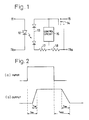
- the semiconductor relay circuit includes a pair of input terminals 11 and 11a receiving an input current signal, such light-emitting element 12 as a light-emitting diode, preferably, which is connected between the input terminals 11 and 11a for generating a light signal in response to the input current signal, and a diode array 13 is optically coupled to the light-emitting element 12 for generating a photovoltaic output in response to the light signal from the light-emitting element 12.
- an input current signal such light-emitting element 12 as a light-emitting diode, preferably, which is connected between the input terminals 11 and 11a for generating a light signal in response to the input current signal
- a diode array 13 is optically coupled to the light-emitting element 12 for generating a photovoltaic output in response to the light signal from the light-emitting element 12.
- a MOS FET 14 is connected in series, and this MOS FET 14 functions to vary from a first impedance state to a second impedance state upon application of the photovoltaic output across gate and source electrodes from the diode array 13, and a pair of output terminal 15 and 15a are connected to the MOS FET 14.
- a control circuit 16 is connected, a series circuit of first and second resistors 17 and 18 is connected between the diode array 13 and the source electrode of the MOS FET 14 while the control circuit 16 is connected at its one end to a connection point between the first and second resistors 17 and 18.
- an application of the input signal across the input terminals 11 and 11a causes the light signal generated from the light-emitting element 12, and the photovoltaic diode array 13 which has received this light signal is to generate the photovoltaic output across the both ends of the array, upon which the control circuit 16 is in a high impedance state so that a capacity across the gate and source electrodes will be charged through the first and second resistors 17 and 18 with the photovoltaic output from the diode array 13, and a voltage across the gate and source electrodes of the MOS FET 14 rises.
- the number of the diodes series connected in the photovoltaic diode array 13 is set for generating a higher photovoltaic output than a threshold voltage of the MOS FET 14, so that the MOS FET 14 will be conducted across drain and source electrodes and a conduction is thereby attained across the output terminals 15 and 15a.
- a current I ON is caused to flow during the conduction as shown in FIG. 3
- the voltage across the gate and source electrodes of the MOS FET 14 rises at a rate in accordance with a capacity across the gate and source electrodes and a time constant of the first and second resistors 17 and 18, whereby the response time T ON from a rise of the input signal to a rise of the output signal is relatively prolonged as shown in FIG.
- a balance time of the response time T ON upon the conduction from which the rising time T UP is deducted is to be a required time for the voltage across the gate and source electrodes of the MOS FET 14 to rise from zero level to a threshold value, and the rising time T UP subsequent thereto is to be a required time for the voltage across the gate and source electrodes of the MOS FET 14 to further rise from the threshold value to a saturated level.
- the control circuit 16 is to be varied into a low impedance state, so that an accumulated charge at the capacity across the gate and source electrodes of the MOS FET 14 will be discharged through the control circuit 16 and the second resistor 18 in the series connected resistors, as shown by a current I OFF in FIG. 3, whereby the voltage across the gate and source electrodes of the MOS FET 14 is lowered to be below the threshold value, and the MOS FET 14 attains an interrupted state across the gate and source electrodes.
- the voltage across the gate and source electrodes of the MOS FET 14 is decreased at a rate in accordance with the capacity across the gate and source electrodes and the time constant of the second resistor 18 so that, as shown in FIG. 2, the response time T OFF upon the non-conduction will be prolonged, a falling time T DN in which the output signal falls from 100% to 10% is thereby prolonged, and the falling gradient of the output signal is made gradual. Consequently, it is made possible to prevent the current from being abruptly interrupted even in an event where an inductance component is connected in series between the output terminals 15 and 15a, and thus to restrict the generation of the electric noise.
- a balance time of the response time T OFF upon the non-conduction from which the falling time T DN is deducted is to be a required time for the voltage across the gate and source electrodes of the MOS FET 14 to fall from the highest level to a saturated level
- the falling time T DN subsequent thereto is to be a required time for the voltage across the gate and source electrodes of the MOS FET 14 to further fall from the saturated level to a threshold value.
- the path for flowing the current I ON from the photovoltaic diode array 13 to the gate and source electrodes of the MOS FET 14 and the further path for flowing the discharge current from the capacity across the gate and source electrodes of the MOS FET 14 to the control circuit 16 respectively include each of the first and second resistors 17 and 18 so that, in particular, the response time T ON upon the conduction of the MOS FET 14 will be adjusted by these first and second resistors 17 and 18 series connected while the response time T OFF upon the non-conduction will be adjusted by the second resistor 18, while it will be readily appreciated that the value of these resistors 17 and 18 may be made relatively extremely low.
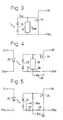
- FIG. 4 there is shown an embodiment of this feature, in which a rectifying element 29 is connected in parallel with the second resistor 28 among the series connected first and second resistors 27 and 28 which are contributive to the setting of the both response time T ON and T OFF upon the conduction and non-conduction, so as to be in normal direction with respect to the charge current upon the conduction but in reverse direction with respect to the discharge current upon the non-conduction.
- the charge current upon the conduction is made to flow through the rectifying element 29 and through the first resistor 27 while the discharge current upon the non-conduction is caused to flow through the second resistor 28, accordingly the response time T ON upon the conduction is set by the first resistor 27 while the response time T OFF upon the non-conduction is set by the second resistor 28, and thus the both response time can be set respectively independently by one of the first and second resistors 27 and 28.
- control circuit 26 in the semiconductor relay circuit of FIG. 4 further, it is possible to employ a controlling MOS FET of a depletion type as shown in FIG. 5, in which event the controlling MOS FET 26a is connected at its drain electrode to the gate electrode of the MOS FET 24, the first resistor 27 is inserted between gate and source electrodes of the controlling MOS FET 26a, and the parallel circuit of the second resistor 28 and rectifying element 29 is inserted between the source electrode of the MOS FET 24 and the source electrode of the controlling MOS FET 26a.
- the controlling MOS FET 26a is biased to be in a high impedance state so long as the photovoltaic output is generated at the photovoltaic diode array 23 but to be in a low impedance state when no photovoltaic output is generated.
- any other constituents than those described in the above are the same as corresponding ones in the embodiment of FIG. 1, including their function, and the same constituents as those in the embodiment of FIG. 1 are denoted by the same reference numerals but added by 10.
- FIG. 6 there is shown a circuit arrangement embodying this feature, in which a voltage responsive element 39 is connected in parallel with the second resistor 38 in the series connected first and second resistors 37 and 38 which are contributive to the setting of the response time T ON and T OFF upon the conduction and non-conduction.
- an NMOS FET of enhancement mode having short-circuited drain and gate electrodes is employed, and this NMOS FET is to be in the low impedance state until the voltage across the gate and source electrodes of the MOS FET 34 falls to a predetermined voltage level slightly higher than the threshold voltage of the MOS FET 34, but is to be in the high impedance state once the voltage across the gate and source electrodes of the MOS FET 34 reaches below the predetermined voltage.
- the charge current upon the conduction flows through the series connected first and second resistors 37 and 38 so as to set the response time T ON , while the discharge current upon the non-conduction is made to flow throuth the control circuit 36 as well as the voltage responsive element 39 which is in the low impedance state at initial stage of the non-conduction, until the predetermined voltage level slightly higher that the threshold voltage of the MOS FET 34, and through the second resistor 36 when the voltage falls below the predetermined level and the voltage responsive element 39 shifts to the high impedance state.
- the response time T OFF upon the non-conduction is thereby caused to be subjected stepwise to the current limitation of the voltage responsive element 39 and resistor 38, the discharge rate is made gradual within the predetermined response time, and thus the falling time T DN can be prolonged to a desired extent.
- Zener diode other than the NMOS FET.
- control circuit in the semiconductor relay circuit of FIG. 6 further, it will be desirable to use such controlling MOS FET 36a as shown in FIG. 7, which is substantiall of the same function as the controlling MOS FET in FIG. 5.
- any other constituents than those described in the above are the same as those in the embodiment of FIG. 1, including their function, and the same constituents as those in the embodiment of FIG. 1 are denoted by the same reference numerals but added by 20.
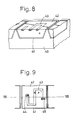
- a semiconductor substrate 40 is provided in one side surface with a P-type semiconductor layer 42 formed through an insulating film 41 comprising a silicon oxide, and an N-type semiconductor layer 43 is formed in top surface of the layer 42.
- the N-type semiconductor layer 43 is formed by a diffusion in the form of a narrow zigzag strip, and aluminum wirings 44 and 45 are connected to both ends of the zigzag strip.
- one of these wirings, i.e., the wiring 44 is connected to the foregoing first resistor 27 in the circuit of FIG.
- the PN junction between the P-type layer 42 and the N-type layer 43 is reversely biased when the potential at the aluminum wiring 44 is higher than that of the other wiring 45, whereas the PN junction is normally biased when the potential of the wiring 44 is lower than the other wiring 45, that is, the rectifying element 29 is thereby formed.
- a current is caused to flow from the wiring 44 through the N-type layer 43 forming a diffusion resistor to the other wiring 45, so that the second resistor is thereby formed.
- the value of this resistor 28 is determined by impurity concentration, length and width of the N-type semiconductor layer 43.
- the use of the rectifying element 29 does not result in any increase in its space factor and is rather effective to render the chip area relatively small.
Landscapes
- Electronic Switches (AREA)
Applications Claiming Priority (6)
| Application Number | Priority Date | Filing Date | Title |
|---|---|---|---|
| JP2034567A JPH03238918A (ja) | 1990-02-15 | 1990-02-15 | 半導体リレー回路 |
| JP34567/90 | 1990-02-15 | ||
| JP2289464A JPH0812993B2 (ja) | 1990-10-26 | 1990-10-26 | 半導体リレー回路 |
| JP289463/90 | 1990-10-26 | ||
| JP289464/90 | 1990-10-26 | ||
| JP28946390A JPH0812992B2 (ja) | 1990-10-26 | 1990-10-26 | 半導体リレー回路 |
Publications (2)
| Publication Number | Publication Date |
|---|---|
| EP0442561A1 true EP0442561A1 (de) | 1991-08-21 |
| EP0442561B1 EP0442561B1 (de) | 1996-05-08 |
Family
ID=27288453
Family Applications (1)
| Application Number | Title | Priority Date | Filing Date |
|---|---|---|---|
| EP91200228A Expired - Lifetime EP0442561B1 (de) | 1990-02-15 | 1991-02-05 | Halbleiter-Relais-Schaltung |
Country Status (5)
| Country | Link |
|---|---|
| US (1) | US5151602A (de) |
| EP (1) | EP0442561B1 (de) |
| KR (1) | KR950000320B1 (de) |
| CA (1) | CA2035496C (de) |
| DE (1) | DE69119261T2 (de) |
Cited By (4)
| Publication number | Priority date | Publication date | Assignee | Title |
|---|---|---|---|---|
| DE4228671A1 (de) * | 1991-09-02 | 1993-03-04 | Matsushita Electric Works Ltd | Festkoerperrelais |
| EP0576206A1 (de) * | 1992-06-26 | 1993-12-29 | AT&T Corp. | Öffner-Vor-Schliesser-Kontrolle eines Typ-C-Festkörperrelais |
| WO1994011947A1 (de) * | 1992-11-06 | 1994-05-26 | Robert Bosch Gmbh | Schaltung zum schutz eines mosfet-leistungstransistors |
| GB2279524A (en) * | 1993-06-22 | 1995-01-04 | Philips Electronics Uk Ltd | Gate control circuit for power MOSFET |
Families Citing this family (12)
| Publication number | Priority date | Publication date | Assignee | Title |
|---|---|---|---|---|
| US5306955A (en) * | 1991-04-22 | 1994-04-26 | Control Products, Inc. | Two-wire, electronic switch |
| JP2801825B2 (ja) * | 1993-01-14 | 1998-09-21 | 株式会社東芝 | フォトカプラ装置 |
| JPH0879041A (ja) * | 1994-08-31 | 1996-03-22 | Oki Electric Ind Co Ltd | 光半導体リレーとこれを用いたコントローラ、電力供給装置及び端末装置切換装置 |
| US5549762A (en) * | 1995-01-13 | 1996-08-27 | International Rectifier Corporation | Photovoltaic generator with dielectric isolation and bonded, insulated wafer layers |
| US6037602A (en) * | 1998-02-13 | 2000-03-14 | C.P. Clare Corporation | Photovoltaic generator circuit and method of making same |
| US5969581A (en) * | 1998-05-28 | 1999-10-19 | The United States Of America As Represented By The Secretary Of The Navy | Opto-electronically controlled RF waveguide |
| US6555935B1 (en) * | 2000-05-18 | 2003-04-29 | Rockwell Automation Technologies, Inc. | Apparatus and method for fast FET switching in a digital output device |
| US20080238354A1 (en) * | 2007-03-29 | 2008-10-02 | Kinpo Electronics, Inc. | Solar energy charging device for computer |
| JP5027680B2 (ja) * | 2008-01-18 | 2012-09-19 | パナソニック株式会社 | 半導体リレーモジュール |
| US7615396B1 (en) | 2008-04-28 | 2009-11-10 | Eugene Ching Lee | Photodiode stack for photo MOS relay using junction isolation technology |
| CN102332900B (zh) * | 2011-10-28 | 2012-11-07 | 电子科技大学 | 一种固体继电器 |
| US10003260B2 (en) * | 2015-06-23 | 2018-06-19 | Nxp Usa, Inc. | Semiconductor devices and methods for dead time optimization by measuring gate driver response time |
Citations (2)
| Publication number | Priority date | Publication date | Assignee | Title |
|---|---|---|---|---|
| FR2602620A1 (fr) * | 1986-08-11 | 1988-02-12 | Matsushita Electric Works Ltd | Circuit de commutation a semiconducteurs |
| US4804866A (en) * | 1986-03-24 | 1989-02-14 | Matsushita Electric Works, Ltd. | Solid state relay |
Family Cites Families (6)
| Publication number | Priority date | Publication date | Assignee | Title |
|---|---|---|---|---|
| US4277098A (en) * | 1978-09-18 | 1981-07-07 | Lloyd Gibney | Foldable truck cap assembly |
| US4390790A (en) * | 1979-08-09 | 1983-06-28 | Theta-J Corporation | Solid state optically coupled electrical power switch |
| JPS6481522A (en) * | 1987-09-24 | 1989-03-27 | Agency Ind Science Techn | Optical control circuit and semiconductor device constituting said circuit |
| JPS6488528A (en) * | 1987-09-30 | 1989-04-03 | Canon Kk | Remote control signal receiver for camera |
| GB2230395B (en) * | 1989-03-15 | 1992-09-30 | Matsushita Electric Works Ltd | Semiconductor relay circuit |
| JPH0758804B2 (ja) * | 1989-05-17 | 1995-06-21 | 株式会社東芝 | ホトカプラ装置 |
-
1991
- 1991-01-31 US US07/648,862 patent/US5151602A/en not_active Expired - Fee Related
- 1991-02-01 CA CA002035496A patent/CA2035496C/en not_active Expired - Fee Related
- 1991-02-05 DE DE69119261T patent/DE69119261T2/de not_active Expired - Fee Related
- 1991-02-05 EP EP91200228A patent/EP0442561B1/de not_active Expired - Lifetime
- 1991-02-12 KR KR1019910002335A patent/KR950000320B1/ko not_active Expired - Fee Related
Patent Citations (2)
| Publication number | Priority date | Publication date | Assignee | Title |
|---|---|---|---|---|
| US4804866A (en) * | 1986-03-24 | 1989-02-14 | Matsushita Electric Works, Ltd. | Solid state relay |
| FR2602620A1 (fr) * | 1986-08-11 | 1988-02-12 | Matsushita Electric Works Ltd | Circuit de commutation a semiconducteurs |
Non-Patent Citations (1)
| Title |
|---|
| NEW ELECTRONICS.INCORPORATING ELECTRONICS TODAY. vol. 18, no. 6, March 1985, LONDON GB pages 61 - 64; P.Benfield: "Developments in solid-state-relays" * |
Cited By (5)
| Publication number | Priority date | Publication date | Assignee | Title |
|---|---|---|---|---|
| DE4228671A1 (de) * | 1991-09-02 | 1993-03-04 | Matsushita Electric Works Ltd | Festkoerperrelais |
| EP0576206A1 (de) * | 1992-06-26 | 1993-12-29 | AT&T Corp. | Öffner-Vor-Schliesser-Kontrolle eines Typ-C-Festkörperrelais |
| WO1994011947A1 (de) * | 1992-11-06 | 1994-05-26 | Robert Bosch Gmbh | Schaltung zum schutz eines mosfet-leistungstransistors |
| US5424892A (en) * | 1992-11-06 | 1995-06-13 | Robert Bosch Gmbh | Circuit for protecting a MOSFET power transistor |
| GB2279524A (en) * | 1993-06-22 | 1995-01-04 | Philips Electronics Uk Ltd | Gate control circuit for power MOSFET |
Also Published As
| Publication number | Publication date |
|---|---|
| CA2035496C (en) | 1996-02-20 |
| KR950000320B1 (ko) | 1995-01-13 |
| EP0442561B1 (de) | 1996-05-08 |
| KR910016146A (ko) | 1991-09-30 |
| DE69119261D1 (de) | 1996-06-13 |
| DE69119261T2 (de) | 1996-10-31 |
| CA2035496A1 (en) | 1991-08-16 |
| US5151602A (en) | 1992-09-29 |
Similar Documents
| Publication | Publication Date | Title |
|---|---|---|
| EP0442561B1 (de) | Halbleiter-Relais-Schaltung | |
| US7209332B2 (en) | Transient detection circuit | |
| JP2759577B2 (ja) | バッファ回路 | |
| US4581540A (en) | Current overload protected solid state relay | |
| US4801822A (en) | Semiconductor switching circuit | |
| US4994904A (en) | MOSFET having drain voltage detection function | |
| EP0029681B1 (de) | Polarisationsspannungsgenerator | |
| US6369556B2 (en) | Power supply control device and method | |
| EP0463854A1 (de) | Takttreiber | |
| JP3142018B2 (ja) | 負荷駆動回路 | |
| US6353353B1 (en) | Integrated semiconductor circuit with improved power supply control | |
| EP0425035A2 (de) | Überlastschutz-Steuerschaltung für einen Leistungstransistor | |
| US5517107A (en) | On-chip variance detection for integrated circuit devices | |
| EP0542460B1 (de) | Steuerschaltung mit inverser Vorspannung für ein spannungsgesteuertes Schaltelement | |
| US4677325A (en) | High voltage MOSFET switch | |
| US5276370A (en) | MOS-type semiconductor device drive circuit | |
| US4321561A (en) | Switch operated capacitive oscillator apparatus | |
| EP0645890B1 (de) | BICMOS-Logikschaltung | |
| US5396120A (en) | Semiconductor integrated unit | |
| JP2541325B2 (ja) | 出力バツフア回路 | |
| JP4139893B2 (ja) | インバータ装置および多相インバータ装置 | |
| JPH0151091B2 (de) | ||
| JPH0537322A (ja) | 制御信号の出力回路 | |
| JPH0151092B2 (de) | ||
| JPH0812992B2 (ja) | 半導体リレー回路 |
Legal Events
| Date | Code | Title | Description |
|---|---|---|---|
| PUAI | Public reference made under article 153(3) epc to a published international application that has entered the european phase |
Free format text: ORIGINAL CODE: 0009012 |
|
| AK | Designated contracting states |
Kind code of ref document: A1 Designated state(s): DE FR GB |
|
| 17P | Request for examination filed |
Effective date: 19910726 |
|
| 17Q | First examination report despatched |
Effective date: 19940412 |
|
| GRAA | (expected) grant |
Free format text: ORIGINAL CODE: 0009210 |
|
| AK | Designated contracting states |
Kind code of ref document: B1 Designated state(s): DE FR GB |
|
| REF | Corresponds to: |
Ref document number: 69119261 Country of ref document: DE Date of ref document: 19960613 |
|
| ET | Fr: translation filed | ||
| PLBE | No opposition filed within time limit |
Free format text: ORIGINAL CODE: 0009261 |
|
| STAA | Information on the status of an ep patent application or granted ep patent |
Free format text: STATUS: NO OPPOSITION FILED WITHIN TIME LIMIT |
|
| 26N | No opposition filed | ||
| K1C1 | Correction of patent application (title page) published |
Effective date: 19910821 |
|
| REG | Reference to a national code |
Ref country code: GB Ref legal event code: 746 Effective date: 19990428 |
|
| REG | Reference to a national code |
Ref country code: FR Ref legal event code: D6 |
|
| PGFP | Annual fee paid to national office [announced via postgrant information from national office to epo] |
Ref country code: DE Payment date: 20010129 Year of fee payment: 11 |
|
| PGFP | Annual fee paid to national office [announced via postgrant information from national office to epo] |
Ref country code: GB Payment date: 20010131 Year of fee payment: 11 |
|
| PGFP | Annual fee paid to national office [announced via postgrant information from national office to epo] |
Ref country code: FR Payment date: 20010213 Year of fee payment: 11 |
|
| REG | Reference to a national code |
Ref country code: GB Ref legal event code: IF02 |
|
| PG25 | Lapsed in a contracting state [announced via postgrant information from national office to epo] |
Ref country code: GB Free format text: LAPSE BECAUSE OF NON-PAYMENT OF DUE FEES Effective date: 20020205 |
|
| PG25 | Lapsed in a contracting state [announced via postgrant information from national office to epo] |
Ref country code: DE Free format text: LAPSE BECAUSE OF NON-PAYMENT OF DUE FEES Effective date: 20020903 |
|
| GBPC | Gb: european patent ceased through non-payment of renewal fee |
Effective date: 20020205 |
|
| PG25 | Lapsed in a contracting state [announced via postgrant information from national office to epo] |
Ref country code: FR Free format text: LAPSE BECAUSE OF NON-PAYMENT OF DUE FEES Effective date: 20021031 |
|
| REG | Reference to a national code |
Ref country code: FR Ref legal event code: ST |