EP0442626B1 - Installieren von Kabeln in Schächten - Google Patents
Installieren von Kabeln in Schächten Download PDFInfo
- Publication number
- EP0442626B1 EP0442626B1 EP91300590A EP91300590A EP0442626B1 EP 0442626 B1 EP0442626 B1 EP 0442626B1 EP 91300590 A EP91300590 A EP 91300590A EP 91300590 A EP91300590 A EP 91300590A EP 0442626 B1 EP0442626 B1 EP 0442626B1
- Authority
- EP
- European Patent Office
- Prior art keywords
- cable
- pipeline
- drogue
- strain gauge
- deployment
- Prior art date
- Legal status (The legal status is an assumption and is not a legal conclusion. Google has not performed a legal analysis and makes no representation as to the accuracy of the status listed.)
- Expired - Lifetime
Links
- 239000012530 fluid Substances 0.000 claims description 25
- 238000000034 method Methods 0.000 claims description 12
- 230000000694 effects Effects 0.000 claims description 9
- 230000004044 response Effects 0.000 claims description 5
- 230000008878 coupling Effects 0.000 claims description 2
- 238000010168 coupling process Methods 0.000 claims description 2
- 238000005859 coupling reaction Methods 0.000 claims description 2
- 238000004873 anchoring Methods 0.000 claims 1
- 238000007789 sealing Methods 0.000 claims 1
- 239000007788 liquid Substances 0.000 description 12
- 230000003287 optical effect Effects 0.000 description 10
- 238000012544 monitoring process Methods 0.000 description 8
- 239000000835 fiber Substances 0.000 description 7
- 210000004907 gland Anatomy 0.000 description 7
- 238000013459 approach Methods 0.000 description 3
- 230000003068 static effect Effects 0.000 description 3
- 230000008859 change Effects 0.000 description 2
- 239000004020 conductor Substances 0.000 description 2
- 238000003780 insertion Methods 0.000 description 2
- 230000037431 insertion Effects 0.000 description 2
- 238000005259 measurement Methods 0.000 description 2
- 239000013307 optical fiber Substances 0.000 description 2
- 230000009467 reduction Effects 0.000 description 2
- 230000008901 benefit Effects 0.000 description 1
- 230000006835 compression Effects 0.000 description 1
- 238000007906 compression Methods 0.000 description 1
- 238000010276 construction Methods 0.000 description 1
- 238000013461 design Methods 0.000 description 1
- 230000005284 excitation Effects 0.000 description 1
- 239000004744 fabric Substances 0.000 description 1
- 238000009434 installation Methods 0.000 description 1
- 230000007774 longterm Effects 0.000 description 1
- 230000000246 remedial effect Effects 0.000 description 1
- 230000035945 sensitivity Effects 0.000 description 1
- 238000012360 testing method Methods 0.000 description 1
- 238000012876 topography Methods 0.000 description 1
Images

Classifications
-
- G—PHYSICS
- G01—MEASURING; TESTING
- G01L—MEASURING FORCE, STRESS, TORQUE, WORK, MECHANICAL POWER, MECHANICAL EFFICIENCY, OR FLUID PRESSURE
- G01L5/00—Apparatus for, or methods of, measuring force, work, mechanical power, or torque, specially adapted for specific purposes
- G01L5/04—Apparatus for, or methods of, measuring force, work, mechanical power, or torque, specially adapted for specific purposes for measuring tension in flexible members, e.g. ropes, cables, wires, threads, belts or bands
- G01L5/10—Apparatus for, or methods of, measuring force, work, mechanical power, or torque, specially adapted for specific purposes for measuring tension in flexible members, e.g. ropes, cables, wires, threads, belts or bands using electrical means
- G01L5/101—Apparatus for, or methods of, measuring force, work, mechanical power, or torque, specially adapted for specific purposes for measuring tension in flexible members, e.g. ropes, cables, wires, threads, belts or bands using electrical means using sensors inserted into the flexible member
-
- G—PHYSICS
- G02—OPTICS
- G02B—OPTICAL ELEMENTS, SYSTEMS OR APPARATUS
- G02B6/00—Light guides; Structural details of arrangements comprising light guides and other optical elements, e.g. couplings
- G02B6/46—Processes or apparatus adapted for installing or repairing optical fibres or optical cables
- G02B6/50—Underground or underwater installation; Installation through tubing, conduits or ducts
- G02B6/52—Underground or underwater installation; Installation through tubing, conduits or ducts using fluid, e.g. air
-
- H—ELECTRICITY
- H02—GENERATION; CONVERSION OR DISTRIBUTION OF ELECTRIC POWER
- H02G—INSTALLATION OF ELECTRIC CABLES OR LINES, OR OF COMBINED OPTICAL AND ELECTRIC CABLES OR LINES
- H02G1/00—Methods or apparatus specially adapted for installing, maintaining, repairing or dismantling electric cables or lines
- H02G1/06—Methods or apparatus specially adapted for installing, maintaining, repairing or dismantling electric cables or lines for laying cables, e.g. laying apparatus on vehicle
- H02G1/08—Methods or apparatus specially adapted for installing, maintaining, repairing or dismantling electric cables or lines for laying cables, e.g. laying apparatus on vehicle through tubing or conduit, e.g. rod or draw wire for pushing or pulling
-
- H—ELECTRICITY
- H02—GENERATION; CONVERSION OR DISTRIBUTION OF ELECTRIC POWER
- H02G—INSTALLATION OF ELECTRIC CABLES OR LINES, OR OF COMBINED OPTICAL AND ELECTRIC CABLES OR LINES
- H02G1/00—Methods or apparatus specially adapted for installing, maintaining, repairing or dismantling electric cables or lines
- H02G1/06—Methods or apparatus specially adapted for installing, maintaining, repairing or dismantling electric cables or lines for laying cables, e.g. laying apparatus on vehicle
- H02G1/08—Methods or apparatus specially adapted for installing, maintaining, repairing or dismantling electric cables or lines for laying cables, e.g. laying apparatus on vehicle through tubing or conduit, e.g. rod or draw wire for pushing or pulling
- H02G1/086—Methods or apparatus specially adapted for installing, maintaining, repairing or dismantling electric cables or lines for laying cables, e.g. laying apparatus on vehicle through tubing or conduit, e.g. rod or draw wire for pushing or pulling using fluid as pulling means, e.g. liquid, pressurised gas or suction means
Definitions
- This invention relates to deploying cables in pipelines utilising the drag of a liquid flowing in the pipeline.
- the drogue may become snagged on the pipeline wall where it is perhaps corroded, the drogue may not inflate properly after insertion through the side wall entry valve or the liquid flow rate may change or even cease altogether.
- a method of deploying a cable (c) in a pipeline (p) within which a fluid is flowing by utilising the drag of the flowing fluid in the direction in which deployment is intended to transport the cable along the pipeline by viscous drag between the fluid and the cable including coupling an inflatable drogue (D) to the leading end of the cable (c) to be deployed, inserting the drogue and the leading end of the cable into the pipeline, and feeding the cable into the pipeline at a controlled rate determined from a feedback signal received at the deployment point via the cable, characterised by providing a strain gauge (31) between the drogue and the cable end whereby to provide the feedback signal corresponding to the pulling force between the drogue and the cable, said force being determined by the fluid velocity relative to the cable, and that, in response to said feedback signal, the rate of deployment is controlled such that the cable is fed into the pipeline at a rate less than the fluid velocity whereby to ensure correct deployment of the cable within the pipeline.
- D inflatable drogue
- an arrangement for use in deploying a cable (c) in a pipeline (p) within which a fluid is flowing by utilising the drag of the flowing fluid in the direction in which deployment is intended to transport the cable along the pipeline by viscous drag between the fluid and the cable comprising an inflatable drogue coupled to the leading end of the cable, and means arranged to deploy the cable into the pipeline at a rate determined by a feedback signal received via the deployed cable, characterised in that a strain gauge (31) is provided between the drogue and the cable and arranged, in use, to provide the feedback signal corresponding to the pulling force between the drogue and the cable, said force being determined by the fluid velocity relative to the cable, and that the deployment means, in response to the feedback signal, is adapted to feed the cable into the pipeline at a rate less than the fluid velocity whereby to ensure correct deployment of the cable within the pipeline.
- a strain gauge (31) is provided between the drogue and the cable and arranged, in use, to provide the feedback signal corresponding to the pulling force between the d
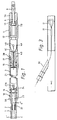
- the strain gauge device comprises a cable anchor ferrule 1 having a tapered clamp 2 locked to the strength member 22 of the cable C being deployed.
- Anchor ferrule 1 is sealed to the cable sheath C1 and fits in one end 3A of a first casing part 3, the entry being sealed by "O" rings 16 and locked by locking screw 18.
- Casing part 3 houses an amplifier 21 and fits at its other end 3B into a second casing part 4 housing the strain gauge elements 4A which are connected by leads 4B to amplifier 21.
- the casing parts are sealed to each other with "O" rings 15 and locked together by locking screw 17.
- Casing 4 is closed by a two-part drogue plug 7A and 7B with a compression seal 12 between the parts and having a drogue connection shackle 8 screwed to a swivel shaft 6 which rotates on a thrust bearing 13.
- the gauge elements 4A are secured to the inside of a thin-walled portion 4C of the casing part 4. Portion 4C obeys Hook's law so that extension of the thin wall caused by the pull of the drogue will be measured by the elements 4A which are connected in a bridge configuration, the out of balance signal of the bridge being amplified by amplifier 21.
- the amplified signal is passed via leads 21A connected to plug and socket 24 through wires 23 to the electrical conductors C'' of cable C.
- the pull of the drogue is measured by the strain gauge device and the amplified signal is passed along the conductor C ⁇ of cable C to the other end so that the deployment of the cable can be monitored by monitoring the signal from the strain gauge device.
- Fig 2 and Fig 3 as the drogue D in its collapsed state is introduced through the sidewall entry gland 30 followed by the strain gauge device 31 (as shown in Fig 1) and then the leading end of the cable C there will be no signal from the strain gauge device ie. no pull from the drogue, until the drogue is inflated (see Fig 3) by the flowing liquid L flowing in direction of intended deployment.
- a signal will suddenly appear on the monitor M of monitoring equipment 36 indicating that the drogue D has been inflated as shown in Fig 3 and is now pulling the leading end of the cable in the direction of intended deployment.
- the cable is pushed through the entry gland 30 by a motorised cable feeding device 32 so that a suitable pull, according to the drogue drag model in liquid filled pipelines, as measured by the strain gauge and visible on the monitor M is maintained as deployment proceeds.
- the feeding device 32 is controlled from the monitoring equipment 36 via link 38, to control the feed speed in dependence upon the monitored strain gauge signal.
- a rotating swivel is used to remove twisting of the drogue strings.
- the strain gauge device measures the tension due to the drag of the drogue in the fluid flow.
- the strain gauge output is routed along the cable for monitoring at the cable entry point into the pipeline
- the cable is supplied from a supply drum 33 and slip rings 34 couple the signal from the cable via a link 35 with the monitoring equipment 36.
- D.C. feed is also sent via the link 35 and slip rings 34 to the cable D and the power is fed down the cable for excitation of the strain gauge elements and to power the amplifier 21.
- a cable length/velocity counter 37 is used at the cable entry point to measure the cable deployment speed and overall length at any time and provide a signal to the monitoring equipment via the connection lead "length/velocity”.
- a flow meter (not shown) to measure the instantaneous flow rate in the pipe can be used to calibrate the drag imposed by the drogue relative to the cable end. This is coupled to the connection lead marked "FLOW".
- a pressure gauge 41 may be used to cancel the pipeline pressure effects on the strain gauge if desired, providing a signal to the monitoring equipment via the connection lead marked "Pressure".
- Fig 2 shows a pipeline P which extends underground from point A to point B where it is recovered through a sidewall exit gland 40. As shown both locations have been exposed by digging holes in the ground.
- the effective flow velocity is greater at the drogue because of the reduction in the pipe free flow cross-sectional area caused by the drogue fabric area. This results in a dramatic increase in drogue tension as the drogue diameter approaches that of the pipeline internal bore. Large relative drogue sizes however can become unstable in the static cable condition and therefore induce large variations in recorded pull which appear as noise on the mean pull. This effect reduces as the cable speed approaches the flow rate.
- Disturbances in flow due to pipeline construction such as in the region of severe bends, valves, T off's etc. result in drogue drag variations which can be detected in the strain gauge output.
- This additional information can be used to advantage in locating or confirming pipe features in conjunction with the cable-length-deployed counter.
- the cable C is pushed through the sidewall entry gland 30 by a motorised cable feeding device 32 so that a suitable pull as measured by the strain gauge is maintained as deployment proceeds, as discussed above.
- the speed of entry of the cable through the gland must not be as fast as the liquid flow otherwise the drogue will collapse indicated by a loss of signal from the strain gauge. This is undesirable since the drogue also acts to guide the leading end of the cable along the pipeline, keeping it away from the sidewall and possible obstructions on the sidewall. More importantly the net flow along the cable will be zero resulting in cable stall due to zero drag.
- Sudden loss of signal or a sharp drop in the signal can indicate that the drogue has collapsed or fouled an obstruction, in which case the cable feeding is immediately halted until the signal reappears indicating the drogue has inflated.
- a reduction in signal may indicate a change in the flow rate of the liquid in the pipeline and a slow drop in the signal can indicate the flow of liquid is dropping in which case the cable feed rate is changed accordingly in order to tend to maintain a desired pull from the drogue to ensure satisfactory deployment.
- a rise in signal can indicate a cable stall condition between the cable entry point and the strain gauge termination resulting in the drogue becoming stationary in the flow, or a rise in flow rate at the drogue position.
- the former can be eliminated/confirmed by deliberately stopping cable deployment and checking the strain gauge response.
- Deployment of the cable can result in laying of the cable from the point of entry A to the point of exit B, or it can be followed by laying of another cable attached to the deployed cable which is then used to pull the other cable back through the pipeline from point B to point A.
- the cable is attached to the strain gauge termination, having captured the drogue and extracted the termination at the exit point, and then using the leader cable to pull in the optic cable against normal flow. In this method the flow is not assisting in the deployment but the buoyancy assistance provided by the pipe liquid on both cables greatly reduces the frictional effects compared to dry duct pulling methods.
- the strain gauge is also used to monitor the cable link tension during the operation and cable feed is adjusted to maintain tension between an upper and lower limit. This method negates the need for accurate long term cable length measurement at both the input and output points of the pipeline.
- the cable being deployed is near neutrally buoyant and the liquid filled pipeline is under pressure producing the liquid flow.
- a strain gauge providing an optical signal along an optical fibre in the cable C.
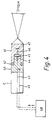
- an alternative embodiment is shown schematically in Fig 4 and operates on the basis of increasing the optical path length in dependence upon the pull of the drogue.
- the cable C is clamped to part 40 which is linked to part 41 by an extensible link 42.
- the optical fibre 43 of the cable C is coupled to an optical expanded beam termination 44, 46, and light passes against the gap 45 to an optical reflector 47 to reflect the signal back across the gap into the fibre 43.
- the optical loss across the gap increases with gap size which in turn increases as the pull from the drogue increases.
- the pull can be determined and the signal utilised in the same way as discussed earlier in respect of the electrical strain gauge. Care needs to be taken to ensure the cable has sufficient axial stiffness to not desensitize the strain gauge output through the effect of extension of the cable itself, or compensate for any cable extension effect.
- the cable extension effect could be compensated by use of a second fibre in the cable which has a silvered end at the rear of the strain gauge termination. The extensional (time delay increase) of this second fibre could then be subtracted from the primary fibre with the strain gauge attached, thus cancelling the cable extension component.
- the second fibre would preferably need to be directly adjacent to the primary fibre to ensure accurate cancellation. Static fibre length differences could be calibrated out with the strain gauge under zero tension.
- the flow rate of the liquid can be calibrated by stopping the cable at test intervals and measuring the static drag.
- the optical strain gauge technique means that an all optical cable can be laid without the need for a leader cable.
- the electrical strain gauge described with reference to Fig 1 is also pressure sensitive. This feature can be used to give additional positional information of head pressure along a pipeline route over hilly terrain.
- the aspect ratio of the thin walled tubular portion can be changed to increase or reduce the pressure sensitivity.
- the design shown can be pressure compensated by using a vented tube or bladder-filled tube to equalise internal and external pressures of the strain gauge tube for eg. unknown pipe route topographies or extreme pressure variant routes.
Landscapes
- Physics & Mathematics (AREA)
- General Physics & Mathematics (AREA)
- Chemical & Material Sciences (AREA)
- Analytical Chemistry (AREA)
- Optics & Photonics (AREA)
- Laying Of Electric Cables Or Lines Outside (AREA)
- Electric Cable Installation (AREA)
Claims (8)
- Verfahren zum Verlegen eines Kabels (C) in einer Rohrleitung (P), in der eine Flüssigkeit strömt, bei dem die Schleppkraft der strömenden Flüssigkeit in der Richtung ausgenutzt wird, in der die Verlegung beabsichtigt ist, um das Kabel entlang der Rohrleitung durch die viskose Schleppkraft zwischen der Flüssigkeit und dem Kabel zu transportieren, wobei das Verfahren die Kopplung eines entfaltbaren Schleppelementes (D) mit dem vorderen Ende des zu verlegenden Kabels (C), das Einsetzen des Schleppelementes und des vorderen Endes des Kabels in die Rohrleitung und die Einführung des Kabels in die Rohrleitung mit einer gesteuerten Geschwindigkeit einschließt, die aus einem Rückführungssignal bestimmt wird, das an dem Verlegepunkt über das Kabel empfangen wird,
dadurch gekennzeichnet, daß ein Dehnungsmesser (31) zwischen dem Schleppelement und dem Ende des Kabels vorgesehen wird, wodurch das Rückführungssignal geliefert wird, das der Zugkraft zwischen dem Schleppelement und dem Kabel entspricht, daß die Kraft durch die Flüssigkeitsgeschwindigkeit gegenüber dem Kabel bestimmt ist, und daß in Abhängigkeit von dem Rückführungssignal die Verlegegeschwindigkeit derart gesteuert wird, daß das Kabel in die Rohrleitung mit einer Geschwindigkeit eingeführt wird, die kleiner als die Flüssigkeitsgeschwindigkeit ist, so daß ein richtiges Verlegen des Kabels in der Rohrleitung sichergestellt wird. - Verfahren nach Anspruch 1,
dadurch gekennzeichnet, daß der Dehnungsmesser einen Verstärker zur Verstärkung des Dehnungsmessersignals einschließt. - Verfahren nach Anspruch 2,
dadurch gekennzeichnet, daß der Verstärker durch Leistung gespeist wird, die entlang des verlegten Kabels übertragen wird. - Anordnung zur Verwendung bei der Verlegung eines Kabels (c) in einer Rohrleitung (p), in der eine Flüssigkeit strömt, durch Verwenden der Schleppkraft der strömenden Flüssigkeit in der Richtung, in der das Verlegen beabsichtigt ist, zum Transportieren des Kabels entlang der Rohrleitung durch die viskose Schleppkraft zwischen der Flüssigkeit und dem Kabel, mit einem entfaltbaren Schleppelement, das mit dem vorderen Ende des Kabels gekoppelt ist, und mit Einrichtungen, die so angeordnet sind, daß das Kabel in die Rohrleitung mit einer Geschwindigkeit eingeführt wird, die durch ein Rückführungssignal bestimmt ist, das über das verlegte Kabel empfangen wird,
dadurch gekennzeichnet, daß ein Dehnungsmesser (31) zwischen dem Schleppelement und dem Kabel vorgesehen und derart angeordnet ist, daß er im Gebrauch das Rückführungssignal liefert, das der Zugkraft zwischen dem Schleppelement und dem Kabel entspricht, wobei die Kraft durch die Flüssigkeitsgeschwindigkeit gegenüber dem Kabel bestimmt ist, und daß die Verlegeeinrichtung so ausgebildet ist, daß sie in Abhängigkeit von dem Rückführungssignal das Kabel mit einer Geschwindigkeit in die Rohrleitung einführt, die kleiner als die Flüssigkeitsgeschwindigkeit ist, wodurch eine richtige Verlegung des Kabels in der Rohrleitung sichergestellt wird. - Vorrichtung nach Anspruch 4, mit einem Verankerungsklemmring zur Verankerung mit einem Kabel-Zugfestigkeitselement, das in dem Kabel vorgesehen ist, und mit einer Dichtung zur Abdichtung des Klemmringelementes durch einen Kabeleintritt in ein Gehäuse der Dehnungsmessereinrichtung.
- Vorrichtung nach einem der vorhergehenden Ansprüche,
dadurch gekennzeichnet, daß die Dehnungsmessereinrichtung einen Gehäuseteil mit einer dünnen ringförmigen Wand aufweist, auf der Dehnungsmesserelemente befestigt sind, wobei sich die Wand in Abhängigkeit von der Schleppkraft des Schleppelementes ausdehnt und zusammenzieht. - Vorrichtung nach Anspruch 6,
dadurch gekennzeichnet, daß der Dehnungsmesser ein belüftetes öl- oder blasengefülltes Rohr aufweist, um äußere Druckeffekte auf den Dehnungsmesser zu kompensieren. - Vorrichtung nach Anspruch 6 oder 7,
dadurch gekennzeichnet, daß das Dehnungsmessersignal den hydraulischen Druck in der Rohrleitung darstellt.
Applications Claiming Priority (2)
| Application Number | Priority Date | Filing Date | Title |
|---|---|---|---|
| GB9003343A GB2241120B (en) | 1990-02-14 | 1990-02-14 | Deploying cables in pipelines |
| GB9003343 | 1990-02-14 |
Publications (3)
| Publication Number | Publication Date |
|---|---|
| EP0442626A2 EP0442626A2 (de) | 1991-08-21 |
| EP0442626A3 EP0442626A3 (en) | 1992-05-27 |
| EP0442626B1 true EP0442626B1 (de) | 1995-08-16 |
Family
ID=10670984
Family Applications (1)
| Application Number | Title | Priority Date | Filing Date |
|---|---|---|---|
| EP91300590A Expired - Lifetime EP0442626B1 (de) | 1990-02-14 | 1991-01-25 | Installieren von Kabeln in Schächten |
Country Status (5)
| Country | Link |
|---|---|
| US (1) | US5121644A (de) |
| EP (1) | EP0442626B1 (de) |
| DE (1) | DE69112094T2 (de) |
| GB (1) | GB2241120B (de) |
| NO (1) | NO910581L (de) |
Families Citing this family (54)
| Publication number | Priority date | Publication date | Assignee | Title |
|---|---|---|---|---|
| US5474277A (en) * | 1990-02-27 | 1995-12-12 | Koninklijke Ptt Nederland N.V. | Pulling plug aided by drag forces of a fluid medium for a portion of which the plug has a leaking aperture |
| IT1244964B (it) * | 1991-04-05 | 1994-09-13 | Gialloreti Ugo Emberti | Procedimento ed apparecchiatura per la posa di cavi entro tubi a mezzo di un fluido idraulico a pressione |
| US5234198A (en) * | 1991-06-25 | 1993-08-10 | At&T Bell Laboratories | Apparatus for installing optical fiber in conduit |
| US5922995A (en) * | 1992-07-02 | 1999-07-13 | Vikimatic Sales, Inc. | Partitioning device for a tubular conduit and method of installation thereof |
| SE501770C2 (sv) * | 1992-10-20 | 1995-05-08 | Meab Mobile Equipment Ab | Arrangemang för att med hjälp utav en vätska kunna föra in en eller flera kablar i ett för kabelns omslutande avsett rör |
| US5374034A (en) * | 1993-09-02 | 1994-12-20 | Fast Laing Industries, Inc. | Apparatus for installing a line through conduits |
| US5813658A (en) * | 1994-11-23 | 1998-09-29 | Arnco Corporation | Cable feeding apparatus |
| US5730424A (en) * | 1995-04-14 | 1998-03-24 | Fli Line Tool Corporation | Apparatus for sending a line through a conduit |
| NL1003059C2 (nl) * | 1996-05-08 | 1997-11-18 | Heidemij Advies Bv | Systeem voor het trekken van aan kabel door een mediumleiding |
| GB9712806D0 (en) * | 1997-06-19 | 1997-08-20 | Rice Nigel L | Apparatus and method for curing the lining of a pipeline |
| US6012621A (en) * | 1997-09-04 | 2000-01-11 | Condux International, Inc. | Cable conveying apparatus |
| US6019351A (en) * | 1998-01-15 | 2000-02-01 | Vikimatic Sales, Inc. | Method and apparatus for introducing a cable into a conduit |
| GB9802418D0 (en) * | 1998-02-05 | 1998-04-01 | British Gas Plc | Pipe threading arrangement |
| US5906357A (en) * | 1998-07-10 | 1999-05-25 | Munson, Sr.; Karl Alvin | Conduit torpedo construction |
| US5973291A (en) * | 1998-08-11 | 1999-10-26 | Lincoln Global, Inc. | Method and system for determining the feedability of welding wire |
| GB2355507B (en) * | 1999-09-07 | 2003-04-02 | Wrc Plc | Deployment of equipment into fluid containers and conduits |
| US7331215B2 (en) | 1999-09-07 | 2008-02-19 | Wrc Plc | Deployment of equipment into fluid containers and conduits |
| GB0009164D0 (en) * | 2000-04-14 | 2000-05-31 | B G Intellectual Property Ltd | Pipe threading |
| AU2001275044A1 (en) * | 2000-06-01 | 2001-12-11 | Bbnt Solutions Llc | A system and method for deploying fiber optic networks through water distribution systems |
| US6736156B2 (en) | 2000-10-10 | 2004-05-18 | Sempra Fiber Links | Method and system for installing cable in pressurized pipelines |
| US6691734B2 (en) | 2000-10-10 | 2004-02-17 | Sempra Fiber Links | Methods and systems for installing cable and conduit in pipelines |
| US6691728B2 (en) | 2000-10-10 | 2004-02-17 | Sempra Fiber Links | Methods and systems for installing a pipeline within a pipeline |
| US6536463B1 (en) | 2000-10-10 | 2003-03-25 | Sempra Fiber Links | Method and system for installing cable in pressurized pipelines |
| EP1309055A1 (de) * | 2001-11-02 | 2003-05-07 | Alcatel | Kabel für die Verlegung in Kunststoffrohren |
| ATE308715T1 (de) * | 2002-11-25 | 2005-11-15 | Draka Comteq Bv | Verfahren zur verlegung eines kabels in einem rohr |
| CA2533622A1 (en) * | 2003-07-24 | 2005-02-03 | Federal-Mogul Powertrain, Inc. | Drogue having biased end opening |
| US6945515B2 (en) * | 2004-02-06 | 2005-09-20 | Bellsouth Intellectual Property Corporation | Fish tape guide and method of using same |
| US7360752B2 (en) * | 2005-06-16 | 2008-04-22 | Watkins Charles W | Apparatus and method for installing lines in conduits |
| US20060284149A1 (en) * | 2005-06-16 | 2006-12-21 | Watkins Charles W | Apparatus and method for installing lines in conduits |
| EP1994436B1 (de) * | 2006-03-10 | 2020-02-19 | British Telecommunications public limited company | Kabelverlegung |
| US20080051626A1 (en) * | 2006-08-28 | 2008-02-28 | Olympus Medical Systems Corp. | Fistulectomy method between first duct and second duct, ultrasonic endoscope, catheter with balloon, magnet retaining device, and magnet set |
| EP1914577A1 (de) * | 2006-10-17 | 2008-04-23 | British Telecommunications Public Limited Company | Faseroptisches Installationsgerät |
| US7621505B2 (en) * | 2007-02-28 | 2009-11-24 | Hamrick James C | Line runner for conduit |
| EP2075606A1 (de) * | 2007-12-28 | 2009-07-01 | British Telecmmunications public limited campany | Kabelinstallation mithilfe von Induktion |
| EP2075608A1 (de) * | 2007-12-28 | 2009-07-01 | British Telecmmunications public limited campany | Kabelinstallation mithilfe optischer Erkennung |
| US8517344B2 (en) | 2008-03-28 | 2013-08-27 | Daniel Hammons | System and method for installing fiber optic cable |
| FR2930337B1 (fr) * | 2008-04-22 | 2011-03-25 | Freyssinet | Systeme pour obtenir des informations relativement a une canalisation et procede associe |
| GB0817639D0 (en) * | 2008-09-26 | 2008-11-05 | British Telecomm | Cable installation apparatus |
| WO2010054072A1 (en) | 2008-11-06 | 2010-05-14 | Mark Lancaster | Real-time power line rating |
| EP2230545A1 (de) | 2009-03-19 | 2010-09-22 | BRITISH TELECOMMUNICATIONS public limited company | Passive entfernte Luftstrom- und Kabeldetektion |
| GB0905590D0 (en) | 2009-03-31 | 2009-05-13 | British Telecomm | Blown cable apparatus |
| US20110238374A1 (en) * | 2010-03-23 | 2011-09-29 | Mark Lancaster | Power Line Maintenance Monitoring |
| US10205307B2 (en) | 2010-03-23 | 2019-02-12 | Southwire Company, Llc | Power line maintenance monitoring |
| EP2369388A1 (de) | 2010-03-26 | 2011-09-28 | British Telecommunications public limited company | Spleisskassettenmodul für optische Faser |
| US8528385B2 (en) | 2010-12-30 | 2013-09-10 | Eaton Corporation | Leak detection system |
| US9291521B2 (en) | 2010-12-30 | 2016-03-22 | Eaton Corporation | Leak detection system |
| US20150184468A1 (en) * | 2013-12-30 | 2015-07-02 | Trican Well Service, Ltd. | Tractor for installing tubing encapsulated cable into coil tubing |
| EP3108550B1 (de) | 2014-02-17 | 2019-08-14 | Plumettaz Holding S.A. | Verfahren zum installieren eines länglichen elmentes in einen gebogenen kanal |
| JOP20190007B1 (ar) | 2016-08-04 | 2023-03-28 | Plumettaz Holding S A | جهاز وطريقة لنفث كابل داخل مسرب |
| HUE053823T2 (hu) | 2017-02-03 | 2021-07-28 | Plumettaz Holding Sa | Autonóm folyadék kompresszor optikai szálak csatornába fektetéséhez |
| US11248992B2 (en) | 2018-09-20 | 2022-02-15 | Hydra-Stop Llc | Systems and methods for accessing and monitoring a fluid within a pressurized pipe |
| CN109765666A (zh) * | 2019-03-28 | 2019-05-17 | 吉林工程技术师范学院 | 一种可稳定夹持保护光缆的吹缆机 |
| US12529862B2 (en) | 2020-12-17 | 2026-01-20 | Fremco A/S | Apparatus for installing a cable into a conduit |
| CA3215767A1 (en) | 2022-10-11 | 2024-04-11 | Hydra-Stop Llc | Insertion valves and methods of installing insertion valves in pressurized pipes |
Citations (2)
| Publication number | Priority date | Publication date | Assignee | Title |
|---|---|---|---|---|
| US4458880A (en) * | 1982-02-05 | 1984-07-10 | Conti Allen C | Method and apparatus to measure tension in a pull line for cable |
| FR2614698A1 (fr) * | 1987-04-28 | 1988-11-04 | Gematel Sa | Dispositif pour la mesure de la force de traction supportee par un cable et installation pour la mise en oeuvre de ce dispositif |
Family Cites Families (12)
| Publication number | Priority date | Publication date | Assignee | Title |
|---|---|---|---|---|
| US1208065A (en) * | 1916-06-01 | 1916-12-12 | Green B Williams | Registering wire-stretcher. |
| GB2171218B (en) * | 1982-05-06 | 1987-05-13 | Stc Plc | Laying cables |
| DE3220286C2 (de) * | 1982-05-28 | 1987-04-09 | Siemens AG, 1000 Berlin und 8000 München | Verfahren zum Einziehen von Übertragungselementen mittels Druckluft und Einrichtung zur Durchführung des Verfahrens |
| US4495808A (en) * | 1982-09-13 | 1985-01-29 | Shell Oil Company | Parachute profiler |
| FR2577724B1 (fr) | 1985-02-14 | 1987-03-06 | Lignes Telegraph Telephon | Procede de mise en place pneumatique d'un filin dans un fourreau et dispositif de mise en oeuvre |
| US4822005A (en) * | 1985-10-16 | 1989-04-18 | Fpl Qualtec, Inc. | Cable pulling system and adaptor |
| DE3621617A1 (de) * | 1986-06-27 | 1988-01-14 | Kabelverlegetechnik Otto Gmbh | Verfahren und vorrichtung zum einziehen von kabel, insbesondere von glasfaserkabel in ein rohr |
| US4856760A (en) * | 1986-07-16 | 1989-08-15 | British Telecommunications | Control method and apparatus |
| DE3708748C1 (de) * | 1987-03-18 | 1988-09-15 | Peter Lancier Maschb Hafenhuet | Einrichtung zur Messung einer Zugkraft mit Hilfe eines Zugkraft-Messwertgebers |
| GB2205916B (en) * | 1987-06-04 | 1991-04-17 | British Pipeline Agency | Pipeline systems |
| FR2623665B1 (fr) * | 1987-11-20 | 1996-10-31 | Baldechi Sauro | Procede a depression pneumatique permettant le tirage des cables dans les gaines et dispositif de mise en oeuvre |
| GB2236589B (en) | 1989-10-07 | 1993-05-05 | Stc Plc | Laying cables |
-
1990
- 1990-02-14 GB GB9003343A patent/GB2241120B/en not_active Expired - Fee Related
-
1991
- 1991-01-25 DE DE69112094T patent/DE69112094T2/de not_active Expired - Fee Related
- 1991-01-25 EP EP91300590A patent/EP0442626B1/de not_active Expired - Lifetime
- 1991-02-13 US US07/654,751 patent/US5121644A/en not_active Expired - Lifetime
- 1991-02-13 NO NO91910581A patent/NO910581L/no unknown
Patent Citations (2)
| Publication number | Priority date | Publication date | Assignee | Title |
|---|---|---|---|---|
| US4458880A (en) * | 1982-02-05 | 1984-07-10 | Conti Allen C | Method and apparatus to measure tension in a pull line for cable |
| FR2614698A1 (fr) * | 1987-04-28 | 1988-11-04 | Gematel Sa | Dispositif pour la mesure de la force de traction supportee par un cable et installation pour la mise en oeuvre de ce dispositif |
Also Published As
| Publication number | Publication date |
|---|---|
| GB2241120B (en) | 1994-01-19 |
| EP0442626A2 (de) | 1991-08-21 |
| DE69112094T2 (de) | 1996-01-11 |
| NO910581L (no) | 1991-08-15 |
| GB2241120A (en) | 1991-08-21 |
| NO910581D0 (no) | 1991-02-13 |
| US5121644A (en) | 1992-06-16 |
| EP0442626A3 (en) | 1992-05-27 |
| DE69112094D1 (de) | 1995-09-21 |
| GB9003343D0 (en) | 1990-04-11 |
Similar Documents
| Publication | Publication Date | Title |
|---|---|---|
| US5121644A (en) | Deploying cables in pipelines | |
| JP3165920B2 (ja) | パイプ検査システム | |
| AU2007200493B2 (en) | Fiber optic strain gauge and cable strain monitoring system for marine seismic acquisition systems | |
| US6889703B2 (en) | Deployment of equipment into fluid containers and conduits | |
| US6817257B2 (en) | Apparatus for the remote measurement of physical parameters | |
| US7331215B2 (en) | Deployment of equipment into fluid containers and conduits | |
| US11828121B2 (en) | Downhole fiber installation equipment and method | |
| CA2628133A1 (en) | Method for monitoring fluid properties | |
| US5160972A (en) | Apparatus for controlling deployment of a cable | |
| US9874084B2 (en) | Multifunction end cap for coiled tube telemetry | |
| US9359833B2 (en) | Method for installing multiple fiber optic cables in coiled tubing | |
| US20240401989A1 (en) | Flexible elongate members in sewage pipelines or channels | |
| NL1042187B1 (en) | Downhole armored optical cable tension measurement | |
| JPH0443210B2 (de) | ||
| CA2900016C (en) | Method for installing multiple sensors in coiled tubing | |
| JP7265464B2 (ja) | 線状体設置方法 |
Legal Events
| Date | Code | Title | Description |
|---|---|---|---|
| PUAI | Public reference made under article 153(3) epc to a published international application that has entered the european phase |
Free format text: ORIGINAL CODE: 0009012 |
|
| AK | Designated contracting states |
Kind code of ref document: A2 Designated state(s): BE DE FR NL |
|
| PUAL | Search report despatched |
Free format text: ORIGINAL CODE: 0009013 |
|
| AK | Designated contracting states |
Kind code of ref document: A3 Designated state(s): BE DE FR NL |
|
| 17P | Request for examination filed |
Effective date: 19920415 |
|
| 17Q | First examination report despatched |
Effective date: 19931229 |
|
| RAP1 | Party data changed (applicant data changed or rights of an application transferred) |
Owner name: NORTHERN TELECOM LIMITED |
|
| GRAA | (expected) grant |
Free format text: ORIGINAL CODE: 0009210 |
|
| AK | Designated contracting states |
Kind code of ref document: B1 Designated state(s): BE DE FR NL |
|
| PG25 | Lapsed in a contracting state [announced via postgrant information from national office to epo] |
Ref country code: NL Free format text: LAPSE BECAUSE OF FAILURE TO SUBMIT A TRANSLATION OF THE DESCRIPTION OR TO PAY THE FEE WITHIN THE PRESCRIBED TIME-LIMIT Effective date: 19950816 Ref country code: BE Effective date: 19950816 |
|
| ET | Fr: translation filed | ||
| REF | Corresponds to: |
Ref document number: 69112094 Country of ref document: DE Date of ref document: 19950921 |
|
| NLV1 | Nl: lapsed or annulled due to failure to fulfill the requirements of art. 29p and 29m of the patents act | ||
| PLBE | No opposition filed within time limit |
Free format text: ORIGINAL CODE: 0009261 |
|
| STAA | Information on the status of an ep patent application or granted ep patent |
Free format text: STATUS: NO OPPOSITION FILED WITHIN TIME LIMIT |
|
| 26N | No opposition filed | ||
| PGFP | Annual fee paid to national office [announced via postgrant information from national office to epo] |
Ref country code: FR Payment date: 20040102 Year of fee payment: 14 |
|
| PGFP | Annual fee paid to national office [announced via postgrant information from national office to epo] |
Ref country code: DE Payment date: 20040130 Year of fee payment: 14 |
|
| REG | Reference to a national code |
Ref country code: FR Ref legal event code: CD |
|
| PG25 | Lapsed in a contracting state [announced via postgrant information from national office to epo] |
Ref country code: DE Free format text: LAPSE BECAUSE OF NON-PAYMENT OF DUE FEES Effective date: 20050802 |
|
| PG25 | Lapsed in a contracting state [announced via postgrant information from national office to epo] |
Ref country code: FR Free format text: LAPSE BECAUSE OF NON-PAYMENT OF DUE FEES Effective date: 20050930 |
|
| REG | Reference to a national code |
Ref country code: FR Ref legal event code: ST |