EP0442676A2 - Rechnerbildschirmadapterschnittstelle - Google Patents
Rechnerbildschirmadapterschnittstelle Download PDFInfo
- Publication number
- EP0442676A2 EP0442676A2 EP91301063A EP91301063A EP0442676A2 EP 0442676 A2 EP0442676 A2 EP 0442676A2 EP 91301063 A EP91301063 A EP 91301063A EP 91301063 A EP91301063 A EP 91301063A EP 0442676 A2 EP0442676 A2 EP 0442676A2
- Authority
- EP
- European Patent Office
- Prior art keywords
- display
- program application
- adaptor
- data
- functions
- Prior art date
- Legal status (The legal status is an assumption and is not a legal conclusion. Google has not performed a legal analysis and makes no representation as to the accuracy of the status listed.)
- Withdrawn
Links
Images


Classifications
-
- G—PHYSICS
- G06—COMPUTING OR CALCULATING; COUNTING
- G06F—ELECTRIC DIGITAL DATA PROCESSING
- G06F9/00—Arrangements for program control, e.g. control units
- G06F9/06—Arrangements for program control, e.g. control units using stored programs, i.e. using an internal store of processing equipment to receive or retain programs
- G06F9/44—Arrangements for executing specific programs
- G06F9/445—Program loading or initiating
- G06F9/44521—Dynamic linking or loading; Link editing at or after load time, e.g. Java class loading
-
- G—PHYSICS
- G06—COMPUTING OR CALCULATING; COUNTING
- G06F—ELECTRIC DIGITAL DATA PROCESSING
- G06F13/00—Interconnection of, or transfer of information or other signals between, memories, input/output devices or central processing units
- G06F13/10—Program control for peripheral devices
- G06F13/102—Program control for peripheral devices where the program performs an interfacing function, e.g. device driver
Definitions
- This invention relates to a system and method for interfacing computer display adaptors.
- the present invention provides a system and method for interfacing between at least one program application and a plurality of hardware display adaptors.
- the program application can comprise a graphics package.
- a programming interface layer positioned between the display subsystem portion of an operating system and the specific display adaptors being utilized, combines a number of device independent graphics models and device dependent display drivers such that the hardware and software capabilities of the overall system can be optimized. This combination of graphical models and device drivers is realized through a procedure known as "dynamic binding."
- each independent drawing routine package would support its own device dependent control of the display adaptor.
- the different types of display adaptors would generally have unique means of entering hardware commands and unique means of representation of graphical data.
- the independent graphics routine packages each maintained their own "model" of graphics.
- the method of passing data and commands and the functionality of the programming interface to the routines were unique to each model.
- the uniqueness of the model determined pronounced differences between the ways the packages would implement device dependent control of the specific display adaptors.
- a specific prior art graphics package provides an application interface (API) with several device drivers which are incorporated therein and associated with a specific display adaptor. These device drivers are dependent upon the type of display adaptor being utilized. Additionally, every package present must have a display driver for each display adaptor present. Therefore, a problem arises when it is desired to change a display adaptor, or add an additional display adaptor, since the device drivers are actually contained within the independent graphics routine packages and each package would have to be updated with the new device driver code. Another problem arises in that there is a need to construct a number of device drivers equal to the product of the number of packages times the number of types of devices.
- API application interface
- the present invention provides a system for interfacing between at least one program application and a plurality of hardware display adaptors, each having specific functions, comprising: a library of resource functions (40) containing data defining functions provided by said hardware display adaptors; a plurality of device interfaces 10, 20, 30, matching the capability of said program application; and means for associating selected resource functions with one of said device interfaces, for a particular combination of a display adaptor and said program application.
- a library of resource functions (40) containing data defining functions provided by said hardware display adaptors
- a plurality of device interfaces 10, 20, 30, matching the capability of said program application and means for associating selected resource functions with one of said device interfaces, for a particular combination of a display adaptor and said program application.
- Such a system is able to reconfigure itself by dynamically binding an application such as a graphics package with the required RMS features and device specific model instance driver for the display adaptor being used.
- This process of dynamic binding uses a database or equivalent tabular representation to: (1) locate the specific graphics model desired; (2) retrieve this model; and (3) bind the model to the (a) device driver code for the specific display adaptor being utilized, and (b) the RMS function required by the particular graphics model.
- a preferred embodiment of the present invention utilizes two levels of dynamic binding, the first being within the RMS.
- the RMS functions present are independent from the graphics model being used, and hence it is necessary first to dynamically bind the device driver code necessary to provide the color resource, font, adaptor resource, and the like, required for the specific graphics model.
- the second level of dynamic binding occurs between the dynamically bound RMS, the desired graphics package and the device specific model corresponding to the display adaptor being utilized.
- a method of interfacing between at least one program application and a plurality of hardware display adaptors, each having specific functions comprising the steps of: providing a library of resource functions (40) containing data defining functions provided by said hardware display adaptors; providing a plurality of device interfaces (10, 20, 30) matching the capability of said program application; and associating selected resource functions with one of said device interfaces, for a particular combination of a display adaptor and said program application.
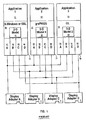
- FIG. 1 a prior art graphics application programming interface system is shown. Three separate application programs 51, 52, 53 are present. Application 51 is two-dimensional (2D), whereas applications 52 and 53 correspond to first and second three-dimensional (3D) applications. Next, a set of graphics packages 56, 57, 58, embodying models 10, 20, 30 are shown, each supporting applications 51, 52, 53, respectively. These packages provide a programming interface between a program application and display dependent device driver sets 70, 71, 72 as discussed in more detail below with reference to the present invention. It can be seen from Fig. 1 that each graphics package 56, 57, 58 includes a device driver set 70, 71, or 72, which must contain code that is dependent upon each display adaptor present.
- the programming interfaces to device driver sets 70, 71, and 72 are not necessarily the same, and there is not any particular requirement that all of the device dependent sections within a device driver have the same programming interface.
- display adaptors 1, 2, 3, 4 are provided with corresponding dependent display driver code 81, 82, 83, 84, 85, 86, 87, 88, 89, 90, 91, and 92.
- each device driver set 70, 71, 72 must contain code specifically written for each display adaptor present.
- device driver set 70 includes four sets of code 81, 82, 83, and 84;
- device driver set 71 includes four sets of code 85, 86, 87, and 88;
- device driver set 72 includes four sets of code 89, 90, 91, and 92.
- GUI graphics adaptor interface
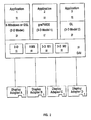
- Applications 51, 52, 53 are shown and represent the same program applications as previously described. That is, reference numeral 51 represents a 2D application and reference numerals 52 and 53 represent first and second 3D applications. Also, display adaptors 1, 2, 3, 4 are shown and represent the same components as described with regard to Figure 1.
- Applications 51, 52, 53 all utilize specific independent graphics drawing routine packages 56, 57, 58 (graphics packages, or packages) which embody different graphical models.
- the application programming interfaces of these packages implement their respective graphics models by calls to the Graphics Adapter Interface (GAI) 60, which incorporates device driver programming interface (device interface) models 10, 20 and 30.
- the programming interface of the device drivers is constructed to match the graphical model used by the various graphics packages 56, 57, 58.
- the GAI device drivers take the place of the device driver interfaces 70, 71, 72, as well as the device specific code 81, 82, 83, 84, 85, 86, 87, 88, 89, 90, 91, and 92.
- GAI 60 provides a common interface between the packages 56, 57, 58 and display adaptors 1, 2, 3, 4.
- a resource management services (RMS) library 40 is included, which is a library of routines which support the functions and characteristics, i.e. resources available on specific display adaptors 1, 2, 3, 4.
- RMS resource management services
- the RMS library 40 provides a standard means for packages to select which model of device driver will be used to implement the graphics functions.
- These device driver interface models 10, 20, 30 are each a library of functions, i.e., a group of related routines which correspond to and implement the specific 2D, 3D, or other functions required within a device driver by graphics packages 56, 57, 58 under control of applications 51, 52, 53.
- the 2D model 10 is based upon the X-Windows product, whereas 3D models 30 and 20 are based upon the Silicon Graphics, Inc., GL package and the IBM graPHIGS product. Therefore, it can be seen that the interface models 10, 20, 30 included within GAI 60 are a balanced collection of functions required by the specific models of different graphics packages.
- the aforementioned products are only used as examples and do not exclude other such functions from the scope of the present invention.
- the RMS 40 library provides the mechanism by which applications 51, 52, 53, running within independent processes, manipulate the specific display adaptors 1, 2, 3, and/or 4, as is desired by the application, such that all of the available characteristics of that adaptor are utilized.
- RMS 40 is organized on the basis of resource headers, attributes and procedures.
- a header contains pointers which direct an application to the attributes and procedures of a resource.
- a header may also contain pointers to private data and to extensions.
- An attribute is defined as the data description of a resource.
- a procedure is a function pointer that operates on a resource.
- the combination of resource headers, resource attributes, and resource procedures is an organization typical of those used for object-oriented programming. Functions which may be included within RMS 40 of GAI 60 may initialize, reset or update the previously noted function pointers.
- Each separate display adaptor 1, 2, 3, 4 may be capable of certain characteristics which enable the display adaptor to provide different functions to a user program application and may vary between adapt ers.
- the RMS 40 library provides a standard device driver programming interface to expose these functions to the graphics packages.
- the functions are embodied as RMS resources.
- monitor which enables the communication between the display adaptor and a display (CRT);
- group the ability to have an object on a display adaptor such as set of planes, but may include cursor and color maps;
- window information regarding application clipping information, active groups and active buffers;
- window geometry information regarding the size and configuration of any windows in a windowing environment;
- cursor information regarding a screen locator;
- color map which is a set of color specifications for a specified group;
- font which is a definition of operating system fonts (assortment of characters) in raster, vector, or outline format;
- model which specifies which type of device driver interface the package requires for compatible operation with the graphics model embodied in the API;
- adaptor which is the highest level resource and which contains attributes and procedures used in creating and controlling the other resources.
- the aforementioned resources are generally included in display adaptors which are contemplated to be used in conjunction with present invention. However, other resources may be available and as such the present invention is not limited to a system having only those resources listed above.
- Each of display adaptors 1, 2, 3, 4 may or may not utilize the same number and types of resources, i.e. each display adaptor will have its own associated RMS 40 library of function. Therefore, the resources which are capable of being exploited by a specific display adaptor must be configured and bound together when this specific display adaptor is utilized by a process within a program application.
- dynamic binding is the mecha nism by which RMS 40 configures resources into a display adaptor specific library of function. It should be noted that other methods of linking these resources, such as shared libraries, are contemplated by the scope of the present invention.
- Dynamic binding is a means of linking all of the resource codes and model specific libraries to the independent graphics drawing routine packages. This linking is implemented by means of operating system utilities, at the time of execution of the applications 51, 52, 53 as opposed to the time of compilation of the application or of the graphics package 56, 57, 58. Dynamic binding in GAI 60 is accomplished by rules contained in the device specific RMS library 40 using data supplied in the RMS adaptor resource by either the application or the API. Each display adaptor 1, 2, 3, 4 will have its own set of required RMS 40 library files (see Figure 5).
- a general GAI RMS call is invoked, to which is provided the ID of the display adaptor 1, 2, 3 or 4.
- the ID and other parameters from the call are used to access a look up table or configuration file and find a file system path to the required resource object file.
- the object file of the resource is then loaded and the entry point code is executed.
- the dynamic binding of the RMS library 40 is accomplished for a particular device to a particular package 56, 57, or 58 for use by its respective application 51, 52, or 53.
- the package When the package desires additional functionality not in place in the RMS library 40, it uses the RMS model resource to specify the model of GAI device driver 10, 20, or 30 required by the API.
- the RMS library 40 utilizes this model data to execute a second dynamic bind, loading the device-and model- specific GAI device driver and binding it to the package.
- the RMS library utilizes a similar lookup table or configuration file to find the path to the required model resource object file. The object file of the model resource is then loaded and the entry point code is executed. In this manner, the second level of dynamic binding of the package to a device specific, model specific device driver is accomplished.
- application 51 implements a process to be displayed by a display adaptor 1, onto a display such as a CRT, or like (not shown).
- the package 56 would determine that display adaptor 1 is required.
- the package 56 would dynamically bind with the RMS library 40 which supports display adaptor 1.
- the outcome of the binding would determine which RMS library resources and functions are required by display adaptor 1, and dynamically allocate these resources, e.g. the cursor resource, font resource, and color map resources as required for display adaptor 1.
- the package 56 utilizes the model resource of the RMS library 40 to dynamically bind to the 2D model GAI device driver 10 (see Figure 3) for the display adaptor 1.
- application 51 is able to write to display adaptor 1 and utilize all of the characteristics associated with that particular hardware device.
- the package 56 would repeat the dynamic bind with the RMS library, this time for a device specific instance RMS library 42 supporting display adaptor 3 (the programming interface to each RMS instance is identical).
- the package 56 then manipulates the model resource of RMS library 42 to dynamically bind to the device specific 2D model device driver 12, which driver supports display adaptor 3.
- the programming interface to 2D device driver 10 and 2D device driver 12 are identical, with only the device specific output of the routines varying.
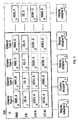
- FIG. 3 is a block diagram showing possible combinations of the compo nents contained within GAI 60.
- the output from GAI 60 to each display adaptor 1, 2, 3, 4 is shown such that the components required to be bound, for each adaptor to operate with a specific graphical model (as embodied by packages 56, 57, 58), can be determined.
- Particular RMS libraries 40, 41, 42, 43 correspond to display adaptors 1, 2, 3, 4, respectively and provide the required functions as previously discussed.
- Two-dimensional model specific device drivers 10, 11, 12, 13 directly relate to display adaptors 1, 2, 3, 4, respectively, and specific 3D model device interfaces 20, 21, 22, 23 respectively relate to display adaptors 1, 2, 3, 4.
- 3D model 30 includes display device driver models 30, 31, 32, 33 which also respectively relates to display adaptors 1, 2, 3, 4.
- display adaptors 1, 2, 3, 4. For each new display adaptor in Fig. 3, the several device specific instances of a particular model-specific device driver library have an identical programming interface.
- an independent drawing routine package need only implement one device driver programming interface, to gain access to a variety of devices.
- model 3D-M2 includes the graphics functions required by package 58 and application 53; and, the device specific implementation of the 3D-M2 device driver for display adaptor 2, shown on Figure 3 as item 31, converts the graphics functions into the corresponding device specific function provided by adaptor 2.
- application 53 is capable of writing to display adaptor 2 and utilizing all of the specific functions contained therein.
- application 51 desires to utilize display adaptor 4.
- an initial level of dynamic binding will occur between package 56 and GAI 60 to bind the RMS library 43 to the package 56.
- RMS library 43 is the resource library specific to display adaptor 4.
- the second level of dynamic binding will occur between the package 56 and the 2D graphics model 13.
- application 51 is now able to interface with and write to display adaptor 4 via the dynamically bound components within GAI 60.
- Figure 3 shows two display adaptors 3, 4 which are not capable of performing 3D operations.
- 3D models 22, 23, and 32, 33 are depicted, by dashed lines, as not containing any functional routines.
- this lack of function is due to a particularity of display adaptors 3, 4, discussed in this example and not to GAI 60.
- 3D models would be included within the functional capabilities of GAI 60, i.e. substituted for 22, 23 and 32, 33.
- the device drivers could be installed in place of 22, 23, 32, and 33 such that some functions would be passed to the display adaptors 3 or 4 and other functions would be emulated in the device driver. It can be seen how the interchangeability and the flexibility of GAI 60 allows ease of updating, enhancing and substitution of display adaptors without imposing a major reprogramming or re-linking burden on users of this computer graphics system. In the cases described above, no change would be required to any application or package.
- GAI 60 Another function embodied in GAI 60 and depicted in Figure 3 is the ease of addition of a new adaptor into a system in which packages, applications, and display adaptors already exist.
- the individual GAI libraries which must be added to accommodate a new display adaptor e.g. display adaptor 5, RMS library 44 and device drivers 14, 24, 34
- display adaptor 5 e.g. display adaptor 5, RMS library 44 and device drivers 14, 24, 34
- no changes at all are required to the packages or applications themselves, to use the new display adaptors. This is in direct contrast to the prior art shown in Figure 1, in which new device drivers would be required in each package to support the new device.
- Figure 4 illustrates a typical look up table and the commands used by the present invention to provide the dynamic binding that occurs within GAI 60. More particularly, the location and name in the file system of the operating system is stored in the table. The individual GAI instances of device specific code are each listed in the table. Additional columns associate each piece of code with the correct adaptor and model.
- the convention of assigning value 0 to the model column denotes the RMS library; 1 denotes the 2-D model device driver programming interface; 2 denotes the 32D-M1 device driver programming interface; and, 3 denotes the 3D-M2 device driver programming interface. Note that both the adaptor and the model entries must both be correctly matched in order to find the proper device specific device driver 10, 20, 30. Matching both values is accomplished by the analogous two layer dynamic bind.
- the exemplary table of Figure 4 corresponds to the components shown in Figure 3. It can be seen that the first line corresponds to the resource management services functions (in this case RMS 40, associated with display adaptor 1 and noted as adaptor 1, model 0). Further, display adaptor 1 is capable of displaying 2D and 3D applications and therefore includes models 2D, 3D-M1, and 3D-M2, listed as being at adaptor 1, models, 1, 2, 3, respectively. Similarly, adaptor 2 is capable of utilizing 2D and 3D applications and contains the same entries as does adaptor 1. Of course, the adaptor specific display driver code and RMS code 41 will be different for adaptor 2 than they were for adaptor 1.
- RMS 40 resource management services functions
- Figure 5 is a representation of the effect of the present invention in configuring the GAI with respect to each display adaptor 1, 2, 3, 4.
- GAI 60 presents the same interface to graphics packages 56, 57, 58 for each adaptor 1, 2, 3, 4 as would be accomplished if the programming interfaces shown in Figure 5 were actually present.
- the present invention allows an application to change the programming interface, specific to a graphics model, which is bound to a display adaptor. It can be reconfigured for each display adaptor by issuing a command to the RMS to destroy a model, upon which the dynamic binding previously implemented is released. The present invention then may, by subsequent dynamic binding, reconfigure GAI 60 to utilize the specific characteristics of the next display adaptor or graphics model desired to be used by a program application. Also, shown in Fig.
- N being equal to the next available reference numeral after the one used for the last graphics model added to the system.
- N being equal to the next available reference numeral after the one used for the last graphics model added to the system.
- GAI 60 additional advantages of the GAI 60 can be seen. It is possible to introduce new graphics packages, such as graPHIGS+ 59 (a 3D graphics product provided by IBM Corp.), which take advantage of the abilities of GAI 60. GAI 60 has the flexibility to allow simultaneous connections to more than one device driver interface model and more than one display adaptor. Thus, application 54, utilizing the programming interface of the graPHIGS+ package 59, may directly communicate with adaptors 1, 2, 3 and 4 simultaneously.
- graPHIGS+ 59 a 3D graphics product provided by IBM Corp.
- the graphics package utilizes the GAI RMS 40 libraries of the specific display adaptors to create model resources. These graphics packages use the model resources to bind to the display device driver graphics model 10, 20, 30 desired. Note that adaptors 3 and 4, as mentioned previously in Figures 3 and 4, do not have hardware support for graphics model 3D-M1 or 3D-M2 and therefore do not have the corresponding device specific GAI device driver models 22 and 23 (Fig. 3) for 3D-M1 and 32 and 33 for 3D-M2.
- the graphics package graPHIGS+ manages this hardware dependency by instead utilizing a 2D graphics model 10 when displaying to adaptors 3 and 4. From the perspective of application 54, the package graPHIGS+ 59 has provided the ability to draw to all four adaptors.
- the GAI 60 has provided a means of exploiting display hardware which can support 3D operations, by way of binding to GAI graphics model 20 (Fig. 6) device drivers for adaptors 1 and 2.
- the GAI 60 has provided a means for the package to exploit display hardware which can only support 2D operations, by way of binding to GAI graphics device driver model 10 for adaptors 3 and 4.
- the ability of graphics packages to make choices among the graphics device driver models, and to connect to more than one model, and to connect to multiple models at the same time, on the same adaptor provides substantial flexibility over the prior art.
- the present invention allows program applications the capability of providing this flexibility, given the standardized programming interface of the GAI RMS library 40 and the other GAI graphics model device drivers contained within GAI 60.
Landscapes
- Engineering & Computer Science (AREA)
- Software Systems (AREA)
- Theoretical Computer Science (AREA)
- Physics & Mathematics (AREA)
- General Engineering & Computer Science (AREA)
- General Physics & Mathematics (AREA)
- Digital Computer Display Output (AREA)
Applications Claiming Priority (2)
| Application Number | Priority Date | Filing Date | Title |
|---|---|---|---|
| US47838490A | 1990-02-12 | 1990-02-12 | |
| US478384 | 1990-02-12 |
Publications (2)
| Publication Number | Publication Date |
|---|---|
| EP0442676A2 true EP0442676A2 (de) | 1991-08-21 |
| EP0442676A3 EP0442676A3 (en) | 1993-09-01 |
Family
ID=23899723
Family Applications (1)
| Application Number | Title | Priority Date | Filing Date |
|---|---|---|---|
| EP19910301063 Withdrawn EP0442676A3 (en) | 1990-02-12 | 1991-02-11 | Computer display adaptor interfacing |
Country Status (3)
| Country | Link |
|---|---|
| US (1) | US5491813A (de) |
| EP (1) | EP0442676A3 (de) |
| JP (1) | JPH0727505B2 (de) |
Cited By (32)
| Publication number | Priority date | Publication date | Assignee | Title |
|---|---|---|---|---|
| EP0554975A3 (en) * | 1992-02-03 | 1993-11-18 | Hewlett Packard Co | Device independent interface for graphics display devices |
| EP0783154A3 (de) * | 1995-12-21 | 1997-11-19 | Cirrus Logic, Inc. | Grafikbibliothek auf geteilten Ebenen |
| EP0829039A4 (de) * | 1995-05-30 | 1998-06-17 | Roy G Biv Corp | Bewegungssteuerungssysteme |
| WO1999034285A1 (en) * | 1997-12-31 | 1999-07-08 | Alcatel Usa Sourcing, L.P. | Product-independent performance monitoring tool-kit |
| WO2001050282A1 (en) * | 1999-12-30 | 2001-07-12 | Qualcomm Incorporated | Virtual device architecture for mobile telephones |
| GB2361782A (en) * | 2000-04-26 | 2001-10-31 | Ant Ltd | Computer system with library between application and operating system |
| WO2000063817A3 (en) * | 1999-04-20 | 2002-03-14 | I2 Technologies Inc | Method and apparatus for supporting multiple alternative graphical user interfaces in computer-moderated electronic commerce |
| EP1008020A4 (de) * | 1995-11-21 | 2002-05-15 | Diamond Multimedia Systems Inc | Modulare virtuelle antriebsvorrichtungsarchitektur |
| US6480896B1 (en) | 1999-10-27 | 2002-11-12 | Roy-G-Biv Corporation | Systems and methods for generating and communicating motion data through a distributed network |
| US6513058B2 (en) | 1995-05-30 | 2003-01-28 | Roy-G-Biv Corporation | Distribution of motion control commands over a network |
| US6542925B2 (en) | 1995-05-30 | 2003-04-01 | Roy-G-Biv Corporation | Generation and distribution of motion commands over a distributed network |
| US6571141B1 (en) | 1995-05-30 | 2003-05-27 | Roy-G-Biv Corporation | Application programs for motion control devices including access limitations |
| WO2003040871A3 (en) * | 2001-11-05 | 2004-01-29 | Trendium Inc | Instantiating a device driver by dynamic association with a device-specific or service-specific software component |
| US6859671B1 (en) | 1995-05-30 | 2005-02-22 | Roy-G-Biv Corporation | Application programs for motion control devices including access limitations |
| US6885898B1 (en) | 2001-05-18 | 2005-04-26 | Roy-G-Biv Corporation | Event driven motion systems |
| US6941543B1 (en) | 1995-05-30 | 2005-09-06 | Roy-G-Biv Corporation | Motion control system and method |
| US6973626B1 (en) | 2001-06-22 | 2005-12-06 | I2 Technologies Us, Inc. | Automatically generating graphical user interface elements at a client system according to a current configuration model |
| US6983421B1 (en) | 2001-06-22 | 2006-01-03 | I2 Technologies Us, Inc. | Using connectors to automatically update graphical user interface elements at a client system according to an updated state of a configuration |
| US7024666B1 (en) | 2002-01-28 | 2006-04-04 | Roy-G-Biv Corporation | Motion control systems and methods |
| US7031798B2 (en) | 2001-02-09 | 2006-04-18 | Roy-G-Biv Corporation | Event management systems and methods for the distribution of motion control commands |
| US7137107B1 (en) | 2003-04-29 | 2006-11-14 | Roy-G-Biv Corporation | Motion control systems and methods |
| US7139843B1 (en) | 1995-05-30 | 2006-11-21 | Roy-G-Biv Corporation | System and methods for generating and communicating motion data through a distributed network |
| US7694229B2 (en) | 2000-04-06 | 2010-04-06 | Microsoft Corporation | System and theme file format for creating visual styles |
| US7721254B2 (en) | 2003-10-24 | 2010-05-18 | Microsoft Corporation | Programming interface for a computer platform |
| US7853645B2 (en) | 1997-10-07 | 2010-12-14 | Roy-G-Biv Corporation | Remote generation and distribution of command programs for programmable devices |
| US7904194B2 (en) | 2001-02-09 | 2011-03-08 | Roy-G-Biv Corporation | Event management systems and methods for motion control systems |
| US8032605B2 (en) | 1999-10-27 | 2011-10-04 | Roy-G-Biv Corporation | Generation and distribution of motion commands over a distributed network |
| US8271105B2 (en) | 1995-05-30 | 2012-09-18 | Roy-G-Biv Corporation | Motion control systems |
| US8458608B2 (en) | 2000-04-06 | 2013-06-04 | Microsoft Corporation | Focus state themeing |
| CN104217054A (zh) * | 2013-05-31 | 2014-12-17 | 北京空间技术研制试验中心 | 一种非规则设备的建模方法 |
| US9588510B2 (en) | 2003-09-25 | 2017-03-07 | Automation Middleware Solutions, Inc. | Database event driven motion systems |
| US9915934B2 (en) | 1999-05-04 | 2018-03-13 | Automation Middleware Solutions, Inc. | Systems and methods for communicating with motion control systems and devices |
Families Citing this family (62)
| Publication number | Priority date | Publication date | Assignee | Title |
|---|---|---|---|---|
| US5781797A (en) * | 1992-09-30 | 1998-07-14 | Microsoft Corporation | Method and system for configuring device driver by selecting a plurality of component drivers to be included in the device driver |
| DE69416152T2 (de) * | 1993-10-06 | 1999-07-01 | Honeywell, Inc., Minneapolis, Minn. | Virtueller graphikprozessor und verfahren für eingebettete echtzeitanzeigesysteme |
| EP0663659A3 (de) * | 1993-12-30 | 1995-11-22 | Ibm | Anzeige von Zeichen in einem Datenverarbeitungssystem. |
| US5787246A (en) * | 1994-05-27 | 1998-07-28 | Microsoft Corporation | System for configuring devices for a computer system |
| US5748980A (en) * | 1994-05-27 | 1998-05-05 | Microsoft Corporation | System for configuring a computer system |
| US6763454B2 (en) * | 1994-05-27 | 2004-07-13 | Microsoft Corp. | System for allocating resources in a computer system |
| US5655148A (en) * | 1994-05-27 | 1997-08-05 | Microsoft Corporation | Method for automatically configuring devices including a network adapter without manual intervention and without prior configuration information |
| US5745761A (en) * | 1994-12-15 | 1998-04-28 | International Business Machines Corporation | Advanced graphics driver architecture with extension capability |
| US5715459A (en) * | 1994-12-15 | 1998-02-03 | International Business Machines Corporation | Advanced graphics driver architecture |
| US5687376A (en) * | 1994-12-15 | 1997-11-11 | International Business Machines Corporation | System for monitoring performance of advanced graphics driver including filter modules for passing supported commands associated with function calls and recording task execution time for graphic operation |
| US5915131A (en) * | 1995-05-05 | 1999-06-22 | Apple Computer, Inc. | Method and apparatus for handling I/O requests utilizing separate programming interfaces to access separate I/O services |
| US5717903A (en) * | 1995-05-15 | 1998-02-10 | Compaq Computer Corporation | Method and appartus for emulating a peripheral device to allow device driver development before availability of the peripheral device |
| US20100131081A1 (en) * | 1995-05-30 | 2010-05-27 | Brown David W | Systems and methods for motion control |
| US5910180A (en) * | 1995-11-21 | 1999-06-08 | Diamond Multimedia Systems, Inc. | Context virtualizing device driver architecture |
| US5752032A (en) * | 1995-11-21 | 1998-05-12 | Diamond Multimedia Systems, Inc. | Adaptive device driver using controller hardware sub-element identifier |
| US6289396B1 (en) | 1995-11-21 | 2001-09-11 | Diamond Multimedia Systems, Inc. | Dynamic programmable mode switching device driver architecture |
| US6009476A (en) * | 1995-11-21 | 1999-12-28 | Diamond Multimedia Systems, Inc. | Device driver architecture supporting emulation environment |
| US6275266B1 (en) * | 1997-11-12 | 2001-08-14 | Philips Electronics North America Corporation | Apparatus and method for automatically detecting and configuring a television display for a personal computer |
| US6542938B1 (en) | 1997-12-23 | 2003-04-01 | Seiko Epson Corporation | Mechanism and apparatus for adaptive quality performance control in 3D based PC applications |
| US6078747A (en) * | 1998-01-05 | 2000-06-20 | Jewitt; James W. | Application program interface to physical devices |
| JPH11249949A (ja) * | 1998-03-04 | 1999-09-17 | Sharp Corp | ファイル転送方法およびファイル転送装置ならびにファイル転送プログラムを記録したコンピュータで読取可能な記録媒体 |
| US6631423B1 (en) * | 1998-03-31 | 2003-10-07 | Hewlett-Packard Development Company, L.P. | System and method for assessing performance optimizations in a graphics system |
| US6681266B2 (en) | 1998-04-14 | 2004-01-20 | Dell Usa, L.P. | Late binding dynamic software configuration information |
| US7503072B2 (en) * | 1998-04-29 | 2009-03-10 | Microsoft Corporation | Hardware ID to prevent software piracy |
| US6574588B1 (en) * | 1998-09-23 | 2003-06-03 | Microsoft Corporation | Solid-state memory device that emulates a known storage device |
| US7058563B1 (en) | 1998-09-23 | 2006-06-06 | Microsoft Corporation | Device driver auto-load |
| US6862735B1 (en) * | 1999-02-11 | 2005-03-01 | Sun Microsystems, Inc. | Mechanism by which platform independent software may bind to and access platform dependent software |
| US6323875B1 (en) * | 1999-04-28 | 2001-11-27 | International Business Machines Corporation | Method for rendering display blocks on display device |
| US6504547B1 (en) * | 1999-08-13 | 2003-01-07 | Pixo, Inc. | Standardization of graphics system logical frame buffer |
| US7089300B1 (en) * | 1999-10-18 | 2006-08-08 | Apple Computer, Inc. | Method and apparatus for administering the operating system of a net-booted environment |
| US20100131078A1 (en) * | 1999-10-27 | 2010-05-27 | Brown David W | Event driven motion systems |
| US6848110B2 (en) | 2000-12-22 | 2005-01-25 | International Business Machines Corporation | Automatic feature augmentation for component based application programming interfaces |
| US8214849B2 (en) * | 2001-07-13 | 2012-07-03 | Advanced Micro Devices, Inc. | System for loading device-specific code and method thereof |
| WO2003019397A1 (en) * | 2001-08-31 | 2003-03-06 | Roy-G-Biv Corporation | Motion services protocol accessible through uniform resource locator (url) |
| US7768522B2 (en) | 2002-01-08 | 2010-08-03 | Apple Inc. | Virtualization of graphics resources and thread blocking |
| US6809735B1 (en) * | 2002-01-08 | 2004-10-26 | Apple Computer, Inc. | Virtualization of graphics resources |
| US7015919B1 (en) | 2002-01-08 | 2006-03-21 | Apple Computer, Inc. | Virtualization of graphics resources |
| US6809736B1 (en) * | 2002-01-08 | 2004-10-26 | Apple Computer, Inc. | Virtualization of graphics resources |
| US7730155B1 (en) | 2002-10-01 | 2010-06-01 | Apple Inc. | Method and apparatus for dynamically locating resources |
| US20060064503A1 (en) * | 2003-09-25 | 2006-03-23 | Brown David W | Data routing systems and methods |
| US20070022194A1 (en) * | 2003-09-25 | 2007-01-25 | Brown David W | Database event driven motion systems |
| US7774774B1 (en) * | 2003-10-22 | 2010-08-10 | Apple Inc. | Software setup system |
| EP1690173A4 (de) * | 2003-11-17 | 2010-04-21 | Roy G Biv Corp | Befehlsverarbeitungssysteme und -verfahren |
| US20100131077A1 (en) * | 2004-02-25 | 2010-05-27 | Brown David W | Data Collection Systems and Methods for Motion Control |
| US7898533B2 (en) * | 2004-04-30 | 2011-03-01 | Microsoft Corporation | Video presenting network configuration solution space traversal |
| US8581803B2 (en) * | 2004-04-30 | 2013-11-12 | Microsoft Corporation | Video presenting network management |
| US7903045B2 (en) * | 2004-04-30 | 2011-03-08 | Microsoft Corporation | Video presenting network supporting separately-configurable resources |
| TWI302280B (en) * | 2005-04-28 | 2008-10-21 | Au Optronics Corp | Display driver ic and transmitting method for same |
| US8132148B2 (en) * | 2005-04-29 | 2012-03-06 | Microsoft Corporation | XML application framework |
| US8275793B2 (en) * | 2005-04-29 | 2012-09-25 | Microsoft Corporation | Transaction transforms |
| US7886269B2 (en) | 2005-04-29 | 2011-02-08 | Microsoft Corporation | XML application framework |
| US8418132B2 (en) * | 2005-04-29 | 2013-04-09 | Microsoft Corporation | Application description language |
| US20060245096A1 (en) * | 2005-04-29 | 2006-11-02 | Microsoft Corporation | Application framework phasing model |
| WO2007047986A1 (en) * | 2005-10-21 | 2007-04-26 | Wisconsin Alumni Research Foundation | Method and system for delivering nucleic acid into a target cell |
| US7774430B2 (en) * | 2005-11-14 | 2010-08-10 | Graphics Properties Holdings, Inc. | Media fusion remote access system |
| US7773085B2 (en) * | 2006-03-07 | 2010-08-10 | Graphics Properties Holdings, Inc. | Flexible landscape display system for information display and control |
| US7868893B2 (en) * | 2006-03-07 | 2011-01-11 | Graphics Properties Holdings, Inc. | Integration of graphical application content into the graphical scene of another application |
| US20090064196A1 (en) * | 2007-08-31 | 2009-03-05 | Microsoft Corporation | Model based device driver code generation |
| WO2012162687A1 (en) | 2011-05-26 | 2012-11-29 | Candi Controls, Inc. | System |
| US20120303750A1 (en) * | 2011-05-26 | 2012-11-29 | Mike Anderson | Cloud-assisted network device integration |
| CN102867284B (zh) * | 2011-07-07 | 2016-10-26 | 腾讯科技(深圳)有限公司 | 一种图形绘制引擎装置及其实现方法 |
| US9542172B2 (en) | 2013-02-05 | 2017-01-10 | Apple Inc. | Automatic updating of applications |
Family Cites Families (12)
| Publication number | Priority date | Publication date | Assignee | Title |
|---|---|---|---|---|
| US4672532A (en) * | 1982-06-14 | 1987-06-09 | Tektronix, Inc. | Software/hardware integration control system |
| US4589063A (en) * | 1983-08-04 | 1986-05-13 | Fortune Systems Corporation | Data processing system having automatic configuration |
| US4697232A (en) * | 1984-11-30 | 1987-09-29 | Storage Technology Corporation | I/O device reconnection in a multiple-CPU, dynamic path allocation environment |
| US4649479A (en) * | 1985-02-28 | 1987-03-10 | International Business Machines Corp. | Device driver and adapter binding technique |
| US4825358A (en) * | 1985-04-10 | 1989-04-25 | Microsoft Corporation | Method and operating system for executing programs in a multi-mode microprocessor |
| US4779187A (en) * | 1985-04-10 | 1988-10-18 | Microsoft Corporation | Method and operating system for executing programs in a multi-mode microprocessor |
| US4835685A (en) * | 1985-05-06 | 1989-05-30 | Computer X, Inc. | Virtual single machine with message-like hardware interrupts and processor exceptions |
| US5083262A (en) * | 1986-04-28 | 1992-01-21 | International Business Machines Corporation | Language bindings for graphics functions to enable one application program to be used in different processing environments |
| US4903218A (en) * | 1987-08-13 | 1990-02-20 | Digital Equipment Corporation | Console emulation for a graphics workstation |
| JP2737134B2 (ja) * | 1987-11-30 | 1998-04-08 | セイコーエプソン株式会社 | 電子機器 |
| US5065343A (en) * | 1988-03-31 | 1991-11-12 | Yokogawa Electric Corporation | Graphic display system for process control using a plurality of displays connected to a common processor and using an fifo buffer |
| JPH01263734A (ja) * | 1988-04-08 | 1989-10-20 | Internatl Business Mach Corp <Ibm> | マルチ・タスク環境における動的リンク識別子供給方法 |
-
1991
- 1991-01-21 JP JP3019227A patent/JPH0727505B2/ja not_active Expired - Lifetime
- 1991-02-11 EP EP19910301063 patent/EP0442676A3/en not_active Withdrawn
-
1994
- 1994-11-18 US US08/341,858 patent/US5491813A/en not_active Expired - Fee Related
Cited By (45)
| Publication number | Priority date | Publication date | Assignee | Title |
|---|---|---|---|---|
| EP0554975A3 (en) * | 1992-02-03 | 1993-11-18 | Hewlett Packard Co | Device independent interface for graphics display devices |
| US5481276A (en) * | 1992-02-03 | 1996-01-02 | Hewlett-Packard Company | Device independent interface for graphics display devices |
| EP2081094A3 (de) * | 1995-05-30 | 2011-04-13 | Roy-G-Biv Corporation | Bewegungssteuerungssysteme |
| US6513058B2 (en) | 1995-05-30 | 2003-01-28 | Roy-G-Biv Corporation | Distribution of motion control commands over a network |
| US5867385A (en) * | 1995-05-30 | 1999-02-02 | Roy-G-Biv Corporation | Motion control systems |
| US6941543B1 (en) | 1995-05-30 | 2005-09-06 | Roy-G-Biv Corporation | Motion control system and method |
| EP1560093A1 (de) * | 1995-05-30 | 2005-08-03 | Roy-G-Biv Corporation | Systeme zur Bewegungssteuerung |
| US7139843B1 (en) | 1995-05-30 | 2006-11-21 | Roy-G-Biv Corporation | System and methods for generating and communicating motion data through a distributed network |
| EP2302475A3 (de) * | 1995-05-30 | 2013-12-04 | Roy-G-Biv Corporation | Bewegungssteuerungssysteme |
| US6859671B1 (en) | 1995-05-30 | 2005-02-22 | Roy-G-Biv Corporation | Application programs for motion control devices including access limitations |
| US6571141B1 (en) | 1995-05-30 | 2003-05-27 | Roy-G-Biv Corporation | Application programs for motion control devices including access limitations |
| US6516236B1 (en) | 1995-05-30 | 2003-02-04 | Roy-G-Biv Corporation | Motion control systems |
| EP0829039A4 (de) * | 1995-05-30 | 1998-06-17 | Roy G Biv Corp | Bewegungssteuerungssysteme |
| EP1260891A1 (de) * | 1995-05-30 | 2002-11-27 | Roy-G-Biv Corporation | Systeme zur Bewegungssteuerung |
| US8271105B2 (en) | 1995-05-30 | 2012-09-18 | Roy-G-Biv Corporation | Motion control systems |
| US6542925B2 (en) | 1995-05-30 | 2003-04-01 | Roy-G-Biv Corporation | Generation and distribution of motion commands over a distributed network |
| EP1008020A4 (de) * | 1995-11-21 | 2002-05-15 | Diamond Multimedia Systems Inc | Modulare virtuelle antriebsvorrichtungsarchitektur |
| EP0783154A3 (de) * | 1995-12-21 | 1997-11-19 | Cirrus Logic, Inc. | Grafikbibliothek auf geteilten Ebenen |
| US7853645B2 (en) | 1997-10-07 | 2010-12-14 | Roy-G-Biv Corporation | Remote generation and distribution of command programs for programmable devices |
| US6041332A (en) * | 1997-12-31 | 2000-03-21 | Alcatel Usa Sourcing, L.P. | Product-independent performance monitoring tool kit |
| WO1999034285A1 (en) * | 1997-12-31 | 1999-07-08 | Alcatel Usa Sourcing, L.P. | Product-independent performance monitoring tool-kit |
| US7003729B1 (en) | 1999-04-20 | 2006-02-21 | I2 Technologies Us, Inc. | Method and apparatus for supporting multiple alternative graphical user interfaces in computer-moderated electronic commerce |
| WO2000063817A3 (en) * | 1999-04-20 | 2002-03-14 | I2 Technologies Inc | Method and apparatus for supporting multiple alternative graphical user interfaces in computer-moderated electronic commerce |
| US9915934B2 (en) | 1999-05-04 | 2018-03-13 | Automation Middleware Solutions, Inc. | Systems and methods for communicating with motion control systems and devices |
| US6480896B1 (en) | 1999-10-27 | 2002-11-12 | Roy-G-Biv Corporation | Systems and methods for generating and communicating motion data through a distributed network |
| US8032605B2 (en) | 1999-10-27 | 2011-10-04 | Roy-G-Biv Corporation | Generation and distribution of motion commands over a distributed network |
| WO2001050282A1 (en) * | 1999-12-30 | 2001-07-12 | Qualcomm Incorporated | Virtual device architecture for mobile telephones |
| US6553223B1 (en) | 1999-12-30 | 2003-04-22 | Qualcomm Incorporated | Virtual device architecture for mobile telephones |
| US7694229B2 (en) | 2000-04-06 | 2010-04-06 | Microsoft Corporation | System and theme file format for creating visual styles |
| US8458608B2 (en) | 2000-04-06 | 2013-06-04 | Microsoft Corporation | Focus state themeing |
| GB2361782B (en) * | 2000-04-26 | 2005-01-12 | Ant Ltd | Improvements relating to computer systems |
| GB2361782A (en) * | 2000-04-26 | 2001-10-31 | Ant Ltd | Computer system with library between application and operating system |
| US7904194B2 (en) | 2001-02-09 | 2011-03-08 | Roy-G-Biv Corporation | Event management systems and methods for motion control systems |
| US7031798B2 (en) | 2001-02-09 | 2006-04-18 | Roy-G-Biv Corporation | Event management systems and methods for the distribution of motion control commands |
| US6885898B1 (en) | 2001-05-18 | 2005-04-26 | Roy-G-Biv Corporation | Event driven motion systems |
| US7024255B1 (en) | 2001-05-18 | 2006-04-04 | Roy-G-Biv Corporation | Event driven motion systems |
| US6973626B1 (en) | 2001-06-22 | 2005-12-06 | I2 Technologies Us, Inc. | Automatically generating graphical user interface elements at a client system according to a current configuration model |
| US6983421B1 (en) | 2001-06-22 | 2006-01-03 | I2 Technologies Us, Inc. | Using connectors to automatically update graphical user interface elements at a client system according to an updated state of a configuration |
| US7574713B2 (en) | 2001-11-05 | 2009-08-11 | Trendium, Inc. | Methods, systems, and computer program products for instantiating a device driver for communication with a device by dynamically associating the device driver at run-time with a device-specific and/or service-specific software component |
| WO2003040871A3 (en) * | 2001-11-05 | 2004-01-29 | Trendium Inc | Instantiating a device driver by dynamic association with a device-specific or service-specific software component |
| US7024666B1 (en) | 2002-01-28 | 2006-04-04 | Roy-G-Biv Corporation | Motion control systems and methods |
| US7137107B1 (en) | 2003-04-29 | 2006-11-14 | Roy-G-Biv Corporation | Motion control systems and methods |
| US9588510B2 (en) | 2003-09-25 | 2017-03-07 | Automation Middleware Solutions, Inc. | Database event driven motion systems |
| US7721254B2 (en) | 2003-10-24 | 2010-05-18 | Microsoft Corporation | Programming interface for a computer platform |
| CN104217054A (zh) * | 2013-05-31 | 2014-12-17 | 北京空间技术研制试验中心 | 一种非规则设备的建模方法 |
Also Published As
| Publication number | Publication date |
|---|---|
| EP0442676A3 (en) | 1993-09-01 |
| US5491813A (en) | 1996-02-13 |
| JPH0727505B2 (ja) | 1995-03-29 |
| JPH04213741A (ja) | 1992-08-04 |
Similar Documents
| Publication | Publication Date | Title |
|---|---|---|
| US5491813A (en) | Display subsystem architecture for binding device independent drivers together into a bound driver for controlling a particular display device | |
| US6466973B2 (en) | Method and system for managing storage devices over a network | |
| US5675795A (en) | Boot architecture for microkernel-based systems | |
| US6102967A (en) | Testing a help system of a computer software application without executing the computer software application | |
| US5732282A (en) | Virtual device driver registry having a globally unique identifier supplying virtual driver call information to the requesting program | |
| US7111302B2 (en) | System and method for formatting data for transmission between an embedded computer and a host computer having different machine characteristics | |
| US5214761A (en) | Real-time adjustable-transform device driver for physical devices | |
| US6084553A (en) | Design and method for a large, virtual workspace | |
| JP4344403B2 (ja) | コンテキスト仮想化ディバイスドライバアーキテクチャ | |
| US9383974B2 (en) | Graphical computer programming | |
| Gosling et al. | The NeWS book: an introduction to the network/extensible window system | |
| EP0690375A2 (de) | Persistente Objektabbildung in einer objektorientierten Umgebung | |
| EP0376316A2 (de) | Nachrichten- und Bildschirmübertragung für Rechner in einem mehrsprachigen Netzwerk | |
| US6249818B1 (en) | Network transport driver interfacing | |
| JP3357368B2 (ja) | オブジェクト指向ビデオ・フレームワーク・システム | |
| US6525743B1 (en) | Method and apparatus for creating and performing graphics operation on device-independent bitmaps | |
| US5606657A (en) | Virtual graphics processor for embedded real time display systems | |
| US4831541A (en) | System for editing real and virtual storage and secondary storage media | |
| US20060010422A1 (en) | Common user interface development toolkit for a system administration program | |
| WO2000039740A1 (en) | Cad-neutral application programming interface | |
| KR20050023805A (ko) | 어플리케이션 프로그램 모듈의 동적 배치 방법 | |
| WO2006091408A2 (en) | System and method for testing devices | |
| US20040268300A1 (en) | Graphical computer programming | |
| US5802352A (en) | Method for separating data retrieval and presentation in an object-oriented reporting system | |
| US5345553A (en) | Method and apparatus for constructing edit mask entry fields with multiple nonprogrammable terminals attached to a workstation controller |
Legal Events
| Date | Code | Title | Description |
|---|---|---|---|
| PUAI | Public reference made under article 153(3) epc to a published international application that has entered the european phase |
Free format text: ORIGINAL CODE: 0009012 |
|
| AK | Designated contracting states |
Kind code of ref document: A2 Designated state(s): DE FR GB |
|
| 17P | Request for examination filed |
Effective date: 19911211 |
|
| PUAL | Search report despatched |
Free format text: ORIGINAL CODE: 0009013 |
|
| AK | Designated contracting states |
Kind code of ref document: A3 Designated state(s): DE FR GB |
|
| STAA | Information on the status of an ep patent application or granted ep patent |
Free format text: STATUS: THE APPLICATION HAS BEEN WITHDRAWN |
|
| 18W | Application withdrawn |
Withdrawal date: 19951222 |