EP0442796A1 - Optisches Bauteil für Anwendungen in integrierter Optik - Google Patents
Optisches Bauteil für Anwendungen in integrierter Optik Download PDFInfo
- Publication number
- EP0442796A1 EP0442796A1 EP91400336A EP91400336A EP0442796A1 EP 0442796 A1 EP0442796 A1 EP 0442796A1 EP 91400336 A EP91400336 A EP 91400336A EP 91400336 A EP91400336 A EP 91400336A EP 0442796 A1 EP0442796 A1 EP 0442796A1
- Authority
- EP
- European Patent Office
- Prior art keywords
- layer
- optical component
- central layer
- indices
- central
- Prior art date
- Legal status (The legal status is an assumption and is not a legal conclusion. Google has not performed a legal analysis and makes no representation as to the accuracy of the status listed.)
- Ceased
Links
- 230000003287 optical effect Effects 0.000 title claims abstract description 23
- 239000000758 substrate Substances 0.000 claims abstract description 16
- 239000011347 resin Substances 0.000 claims description 15
- 229920005989 resin Polymers 0.000 claims description 15
- 229920000642 polymer Polymers 0.000 claims description 13
- 239000000975 dye Substances 0.000 claims description 8
- 229920001577 copolymer Polymers 0.000 description 29
- LQNUZADURLCDLV-UHFFFAOYSA-N nitrobenzene Chemical compound [O-][N+](=O)C1=CC=CC=C1 LQNUZADURLCDLV-UHFFFAOYSA-N 0.000 description 16
- HEDRZPFGACZZDS-UHFFFAOYSA-N Chloroform Chemical compound ClC(Cl)Cl HEDRZPFGACZZDS-UHFFFAOYSA-N 0.000 description 15
- 238000010521 absorption reaction Methods 0.000 description 13
- 239000002904 solvent Substances 0.000 description 12
- -1 1, 1 dimethyl 2, 2, 3, 3 tetrafluoropropyl Chemical group 0.000 description 10
- 239000000126 substance Substances 0.000 description 8
- VVQNEPGJFQJSBK-UHFFFAOYSA-N Methyl methacrylate Chemical compound COC(=O)C(C)=C VVQNEPGJFQJSBK-UHFFFAOYSA-N 0.000 description 7
- YXFVVABEGXRONW-UHFFFAOYSA-N Toluene Chemical compound CC1=CC=CC=C1 YXFVVABEGXRONW-UHFFFAOYSA-N 0.000 description 6
- 229910052782 aluminium Inorganic materials 0.000 description 6
- XAGFODPZIPBFFR-UHFFFAOYSA-N aluminium Chemical compound [Al] XAGFODPZIPBFFR-UHFFFAOYSA-N 0.000 description 6
- QTBSBXVTEAMEQO-UHFFFAOYSA-M Acetate Chemical compound CC([O-])=O QTBSBXVTEAMEQO-UHFFFAOYSA-M 0.000 description 5
- 239000011248 coating agent Substances 0.000 description 5
- 238000000576 coating method Methods 0.000 description 5
- 230000005684 electric field Effects 0.000 description 5
- 239000000463 material Substances 0.000 description 5
- 238000000034 method Methods 0.000 description 5
- 238000002211 ultraviolet spectrum Methods 0.000 description 5
- 229910003327 LiNbO3 Inorganic materials 0.000 description 4
- 229910052757 nitrogen Inorganic materials 0.000 description 4
- 229920001897 terpolymer Polymers 0.000 description 4
- UBOXGVDOUJQMTN-UHFFFAOYSA-N 1,1,2-trichloroethane Chemical compound ClCC(Cl)Cl UBOXGVDOUJQMTN-UHFFFAOYSA-N 0.000 description 3
- ZWEHNKRNPOVVGH-UHFFFAOYSA-N 2-Butanone Chemical compound CCC(C)=O ZWEHNKRNPOVVGH-UHFFFAOYSA-N 0.000 description 3
- XEKOWRVHYACXOJ-UHFFFAOYSA-N Ethyl acetate Chemical compound CCOC(C)=O XEKOWRVHYACXOJ-UHFFFAOYSA-N 0.000 description 3
- ZMXDDKWLCZADIW-UHFFFAOYSA-N N,N-Dimethylformamide Chemical compound CN(C)C=O ZMXDDKWLCZADIW-UHFFFAOYSA-N 0.000 description 3
- HEMHJVSKTPXQMS-UHFFFAOYSA-M Sodium hydroxide Chemical compound [OH-].[Na+] HEMHJVSKTPXQMS-UHFFFAOYSA-M 0.000 description 3
- 238000000137 annealing Methods 0.000 description 3
- 239000002019 doping agent Substances 0.000 description 3
- JUOXYWXXPHUSAI-UHFFFAOYSA-N ethylamino acetate Chemical compound CCNOC(C)=O JUOXYWXXPHUSAI-UHFFFAOYSA-N 0.000 description 3
- GQYHUHYESMUTHG-UHFFFAOYSA-N lithium niobate Chemical compound [Li+].[O-][Nb](=O)=O GQYHUHYESMUTHG-UHFFFAOYSA-N 0.000 description 3
- 230000010287 polarization Effects 0.000 description 3
- XUIMIQQOPSSXEZ-UHFFFAOYSA-N Silicon Chemical compound [Si] XUIMIQQOPSSXEZ-UHFFFAOYSA-N 0.000 description 2
- NINIDFKCEFEMDL-UHFFFAOYSA-N Sulfur Chemical compound [S] NINIDFKCEFEMDL-UHFFFAOYSA-N 0.000 description 2
- 230000009477 glass transition Effects 0.000 description 2
- 230000001678 irradiating effect Effects 0.000 description 2
- 230000010349 pulsation Effects 0.000 description 2
- 229910052710 silicon Inorganic materials 0.000 description 2
- 239000010703 silicon Substances 0.000 description 2
- 238000009987 spinning Methods 0.000 description 2
- 229910052717 sulfur Inorganic materials 0.000 description 2
- 239000011593 sulfur Substances 0.000 description 2
- MXWVNAOIXKIIJK-UHFFFAOYSA-N 1-nitro-2-(2-nitrophenyl)sulfanylbenzene Chemical compound [O-][N+](=O)C1=CC=CC=C1SC1=CC=CC=C1[N+]([O-])=O MXWVNAOIXKIIJK-UHFFFAOYSA-N 0.000 description 1
- FCYVWWWTHPPJII-UHFFFAOYSA-N 2-methylidenepropanedinitrile Chemical compound N#CC(=C)C#N FCYVWWWTHPPJII-UHFFFAOYSA-N 0.000 description 1
- LKZPHJNKIKZCMQ-UHFFFAOYSA-N 2-nitro-3-(2-phenylethenyl)aniline Chemical compound NC1=CC=CC(C=CC=2C=CC=CC=2)=C1[N+]([O-])=O LKZPHJNKIKZCMQ-UHFFFAOYSA-N 0.000 description 1
- BAJQRLZAPXASRD-UHFFFAOYSA-N 4-Nitrobiphenyl Chemical group C1=CC([N+](=O)[O-])=CC=C1C1=CC=CC=C1 BAJQRLZAPXASRD-UHFFFAOYSA-N 0.000 description 1
- 206010019345 Heat stroke Diseases 0.000 description 1
- CERQOIWHTDAKMF-UHFFFAOYSA-M Methacrylate Chemical compound CC(=C)C([O-])=O CERQOIWHTDAKMF-UHFFFAOYSA-M 0.000 description 1
- 208000007180 Sunstroke Diseases 0.000 description 1
- ATJFFYVFTNAWJD-UHFFFAOYSA-N Tin Chemical compound [Sn] ATJFFYVFTNAWJD-UHFFFAOYSA-N 0.000 description 1
- RTAQQCXQSZGOHL-UHFFFAOYSA-N Titanium Chemical compound [Ti] RTAQQCXQSZGOHL-UHFFFAOYSA-N 0.000 description 1
- XTXRWKRVRITETP-UHFFFAOYSA-N Vinyl acetate Chemical compound CC(=O)OC=C XTXRWKRVRITETP-UHFFFAOYSA-N 0.000 description 1
- 239000011149 active material Substances 0.000 description 1
- 125000003118 aryl group Chemical group 0.000 description 1
- 125000004429 atom Chemical group 0.000 description 1
- QVGXLLKOCUKJST-UHFFFAOYSA-N atomic oxygen Chemical compound [O] QVGXLLKOCUKJST-UHFFFAOYSA-N 0.000 description 1
- 238000004132 cross linking Methods 0.000 description 1
- 238000000151 deposition Methods 0.000 description 1
- 238000004090 dissolution Methods 0.000 description 1
- 230000000694 effects Effects 0.000 description 1
- 230000005284 excitation Effects 0.000 description 1
- 239000011521 glass Substances 0.000 description 1
- 238000010438 heat treatment Methods 0.000 description 1
- 229910003437 indium oxide Inorganic materials 0.000 description 1
- PJXISJQVUVHSOJ-UHFFFAOYSA-N indium(iii) oxide Chemical compound [O-2].[O-2].[O-2].[In+3].[In+3] PJXISJQVUVHSOJ-UHFFFAOYSA-N 0.000 description 1
- 238000004519 manufacturing process Methods 0.000 description 1
- 125000004433 nitrogen atom Chemical group N* 0.000 description 1
- 239000011368 organic material Substances 0.000 description 1
- 229910052760 oxygen Inorganic materials 0.000 description 1
- 239000001301 oxygen Substances 0.000 description 1
- 229920000193 polymethacrylate Polymers 0.000 description 1
- 230000008961 swelling Effects 0.000 description 1
- 229910001887 tin oxide Inorganic materials 0.000 description 1
- 229910052719 titanium Inorganic materials 0.000 description 1
- 239000010936 titanium Substances 0.000 description 1
- 229910052724 xenon Inorganic materials 0.000 description 1
- FHNFHKCVQCLJFQ-UHFFFAOYSA-N xenon atom Chemical compound [Xe] FHNFHKCVQCLJFQ-UHFFFAOYSA-N 0.000 description 1
Images




Classifications
-
- G—PHYSICS
- G02—OPTICS
- G02F—OPTICAL DEVICES OR ARRANGEMENTS FOR THE CONTROL OF LIGHT BY MODIFICATION OF THE OPTICAL PROPERTIES OF THE MEDIA OF THE ELEMENTS INVOLVED THEREIN; NON-LINEAR OPTICS; FREQUENCY-CHANGING OF LIGHT; OPTICAL LOGIC ELEMENTS; OPTICAL ANALOGUE/DIGITAL CONVERTERS
- G02F1/00—Devices or arrangements for the control of the intensity, colour, phase, polarisation or direction of light arriving from an independent light source, e.g. switching, gating or modulating; Non-linear optics
- G02F1/35—Non-linear optics
- G02F1/355—Non-linear optics characterised by the materials used
- G02F1/361—Organic materials
- G02F1/3615—Organic materials containing polymers
-
- G—PHYSICS
- G02—OPTICS
- G02F—OPTICAL DEVICES OR ARRANGEMENTS FOR THE CONTROL OF LIGHT BY MODIFICATION OF THE OPTICAL PROPERTIES OF THE MEDIA OF THE ELEMENTS INVOLVED THEREIN; NON-LINEAR OPTICS; FREQUENCY-CHANGING OF LIGHT; OPTICAL LOGIC ELEMENTS; OPTICAL ANALOGUE/DIGITAL CONVERTERS
- G02F1/00—Devices or arrangements for the control of the intensity, colour, phase, polarisation or direction of light arriving from an independent light source, e.g. switching, gating or modulating; Non-linear optics
- G02F1/01—Devices or arrangements for the control of the intensity, colour, phase, polarisation or direction of light arriving from an independent light source, e.g. switching, gating or modulating; Non-linear optics for the control of the intensity, phase, polarisation or colour
- G02F1/061—Devices or arrangements for the control of the intensity, colour, phase, polarisation or direction of light arriving from an independent light source, e.g. switching, gating or modulating; Non-linear optics for the control of the intensity, phase, polarisation or colour based on electro-optical organic material
- G02F1/065—Devices or arrangements for the control of the intensity, colour, phase, polarisation or direction of light arriving from an independent light source, e.g. switching, gating or modulating; Non-linear optics for the control of the intensity, phase, polarisation or colour based on electro-optical organic material in an optical waveguide structure
-
- G—PHYSICS
- G02—OPTICS
- G02F—OPTICAL DEVICES OR ARRANGEMENTS FOR THE CONTROL OF LIGHT BY MODIFICATION OF THE OPTICAL PROPERTIES OF THE MEDIA OF THE ELEMENTS INVOLVED THEREIN; NON-LINEAR OPTICS; FREQUENCY-CHANGING OF LIGHT; OPTICAL LOGIC ELEMENTS; OPTICAL ANALOGUE/DIGITAL CONVERTERS
- G02F1/00—Devices or arrangements for the control of the intensity, colour, phase, polarisation or direction of light arriving from an independent light source, e.g. switching, gating or modulating; Non-linear optics
- G02F1/35—Non-linear optics
- G02F1/355—Non-linear optics characterised by the materials used
- G02F1/361—Organic materials
- G02F1/3615—Organic materials containing polymers
- G02F1/3617—Organic materials containing polymers having the non-linear optical group in a side chain
Definitions
- the present invention relates to optical components for applications in integrated optics. These components can be active or passive components such as second harmonic generators, electrooptic modulators, electrooptic couplers or electrooptic switches with n inputs and n outputs.
- the present invention relates to the production of optical components for applications in integrated optics such as the modulation of light and the generation of second harmonics by means of stacks of 3 judiciously chosen polymer layers. Two of these layers are passive and of sufficiently low optical index to confine the optical mode in the central layer of high optical index and composed of an active material. By playing locally on the index of one of the 3 layers, one obtains a lateral confinement of the light wave.
- the invention therefore relates to an optical component for applications in integrated optics, this component being produced on a substrate, characterized in that the substrate supports a stack of three polymer layers: a lower layer deposited on the substrate, a central layer and an upper layer, the lower and upper layers having optical indices lower than that of the central layer which is electrooptical and intended to convey a light beam, at least one layer, the central layer, the lower layer or the upper layer, having zones having indices of different values to create a confinement zone of the light beam in the central layer.
- Figure 1 shows, schematically, the three-layer structure according to the invention.
- a substrate 1 supports a stack of three layers: a lower layer 2, a central layer 3 and an upper layer 4.
- the central layer 3 has electrooptical properties and sufficient transparency in the wavelengths of use.
- the lower layers 2 and upper 4 have lower optical indices than that of the central layer.
- the optical component to be produced there exists, for its subsequent use (modulator, coupler or switch), a step of orientation of the central layer 3 which requires the application of an electric field.
- One of the electrodes necessary for the application of this electric field may therefore be constituted by the substrate 1. It may be chosen, for example, from silicon or glass covered with a aluminum layer or ITO layer (mixed tin and indium oxide).
- FIG. 1 makes it possible to obtain a planar light guide but does not yet make it possible to confine the light in a two-dimensional guide.
- the effective index of the active layer 3 that is to say by increasing the index of the lower layer 2 or of the upper layer 4 on a surface materializing the guide structure, it is possible to confine the light conveyed by the active layer to certain areas.
- FIG. 2 which takes up the three-layer structure represented in FIG. 1.
- the lower layer 2 comprises a zone 5, delimited by dashed lines, of higher index than in the rest of the layer 2.
- An index variation of the order of 10 ⁇ 3 may be sufficient to induce light confinement in the active layer 3 in a sector 6 located opposite zone 5.
- a first method consists in irradiating zones of the lower layer or of the upper layer differently in order to obtain zones with different indices and thus obtain confinement.
- the irradiated areas will have a higher index than the non-irradiated areas.
- a second method consists in locally polarizing the lower layer or the upper layer if these are polarizable, that is to say if they have dipoles at the locations making it possible to materialize a guide. Indeed, it is possible to increase the index by polarization.
- a third method consists in diffusing dyes increasing the index in the desired places by swelling in a chemical solution.
- Example 1 relates to the irradiation of a three-layer structure whose lower layer 2 is formed from a negative resin sensitive to X-rays and whose upper layer 4 is formed from a positive resin.
- the different polymer layers can be deposited by the so-called spinning method. It is thus possible to deposit layers approximately 1 ⁇ m thick.
- the negative resin constituting layer 2 can be a copolymer of methyl methacrylate / epithioglycidyl methacrylate such as that represented in FIG. 3 and described in patent FR 2 352 007.
- the positive resin constituting layer 4 may be poly (methacrylate of 1, 1 dimethyl 2, 2, 3, 3 tetrafluoropropyl) sold under the reference FPM 210 and represented in FIG. 4.
- the central layer or active layer can be composed of copolymers whose general structure is shown in FIG. 5. These are electroactive copolymers for which: X is CH3, H or Cl, n can be zero or be worth from 2 to 15 , y is equal to 1 or 2 and x is between 0 and 1. D is an electron donor atom or group such as oxygen, sulfur,> NC p H 2p + 1 with 0 ⁇ p ⁇ 3 , A is an electron accepting group such as:
- FIG. 6 represents the formula of the copolymer [methyl methacrylate, 4 (methacryloyloxypropyloxy) 4 ′ nitrobiphenyl].
- FIG. 7 represents the formula of the copolymer [methyl methacrylate, 4 (N-methacryloyloxypropylamino) nitrobenzene].
- the copolymer for which x 0.236 has been tested and is found to be satisfactory.
- FIG. 9 represents the formula of the copolymer [methyl methacrylate, 4 (methacryloyloxyhexanoyloxy-piperidino) nitrobenzene].
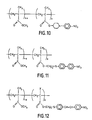
- FIG. 10 represents the formula of the copolymer [methyl methacrylate, 4 (methacryloyloxypiperidino) nitrobenzene].
- the central layer can also be composed of copolymers whose general structure is represented in FIG. 12. These are electroactive copolymers for which: X is CH3, H or Cl, x is between 0 and 1 and 2 ⁇ n ⁇ 15.
- copolymers have second order non-linearity coefficients d33 of between 5 and 30 ⁇ m / V under excitation at 1.06 ⁇ m and absorption maxima between 330 and 420 nm depending on whether they have a nitrogen atom or sulfur and one or more aromatic rings.
- the confinement zone in the active layer can be obtained by localized irradiation of the lower layer, thus creating zones of different index in this layer.
- Example 2 relates to a three-layer structure whose lower and upper layers are the same as those of Example 1 but which uses as active layer the photocrosslinkable X-ray terpolymer whose formula is shown in Figure 13.
- This terpolymer is described in patent application FR 2 630 744.
- the parameters x and z correspond to the following relationships: 0.25 ⁇ z 1-xz ⁇ 0.5 and x ⁇ 0.3.
- the radical X represents CH3, H or Cl.
- the group M can be that represented in FIG. 14 or the following: A, D as well as the values of n and y being the same as those announced for figure 5.
- the advantage of using this terpolymer is that, while increasing the orientation stability of the molecules over time by volume crosslinking, a two-dimensional confinement to the light wave is achieved by irradiating the guide zone differently from the rest of the layer. .
- the three-layer structure according to this example can be produced in the following manner.
- the lower layer is deposited from a solution of methyl ethyl ketone. Annealing is carried out at 100 ° C. under vacuum for 1 hour. This layer is then irradiated with X-rays of energy 10 mJ / cm2.
- the central layer is deposited from a solution of 1,1,2 trichloroethane. Annealing is also carried out at 100 ° C. under vacuum for 1 hour.
- a layer of 2 to 3 ⁇ m of a positive resin is then deposited (FPM 210 for example) from a toluene solution which is annealed under the same conditions as above.
- This layer of positive resin is irradiated by ultraviolet rays through an aluminum mask designed so that the exposed area of this layer is that located above the intended confinement area.
- the insolated resin is then removed and a layer of aluminum 200 angstroms thick is deposited under vacuum.
- a bias voltage is applied representing an electric field of 1 MV / cm at the same time as an X-ray irradiation.
- the entire active layer is therefore polarized but there is only the part of active layer not covered with resin which is photocrosslinked by X-rays.
- the aluminum layer is eliminated by sodium hydroxide and the rest of FPM 210 resin is eliminated by toluene.
- a negative resin solution containing 10% of a polymer with an aminonitrostilbene dye in 1,1.2 trichloroethane is deposited on the substrate with a spinning wheel.
- the solvent is evaporated.
- the layer is then irradiated by X-rays of energy between 10 and 50 mJ / cm2. It is then exposed under the effect of ultraviolet rays through a mask protecting the guide area.
- This sunstroke can last 1 hour and be produced using a 250 W xenon lamp. Its purpose is to destroy the dye in exposed areas. In this way, the non-irradiated area is a high index area.
- the posterior deposits of the active layer and of the upper layer are then produced.
- an aluminum guide electrode is finally deposited. An electric field applied to the structure by means of this guide electrode and of the conductive substrate (or made surface conductive) makes it possible to locally polarize the active layer.
- Example 4 relates to a three-layer structure using a copolymer based on vinylidene cyanide and vinyl acetate in 50/50 molar proportion and which can be designated by the term P (VDCN-VAc) and which is soluble in dimethylformamide.
- This material has the advantage of having a very high glass transition temperature (around 180 ° C.) and its structure is composed of 50% of strong C ⁇ N dipoles which give it piezoelectric and pyroelectric properties when they have been previously oriented. under electric field.
- Figure 15 shows this copolymer.
- the lower layer is hardened by annealing at 100 ° C for 1 hour to prevent its dissolution in the solvent of the central layer
- a copolymer P (VDCN - VAc) with 25 mol% of 4 (N ethylamino acetate) nitrobenzene made it possible to obtain in a structure of the type of the figure. 1 a control voltage v ⁇ of approximately 80 volts, for a coefficient d33 of 2 pm / V and a coefficient r33 of approximately 1 pm / V with a maximum absorption at 370 nm.
- the three-layer structure was formed by layers 2 ⁇ m thick, deposited on a silicon substrate.
- the higher index zone can be obtained in the lower layer in the same way as for Example 3.
- Example 5 relates to a three-layer structure according to the invention used in an electrooptical modulator and shown in FIG. 21.
- the lower layer 12 is formed from a negative resin sensitive to X-rays and its index n is 1.5.
- the upper layer 14 is formed from a positive resin such as that sold under the reference FPM 210 cited above and its index n is 1.42.
- the central layer 13, of index n 1.56, consists of the copolymer shown in FIG. 7 and which has been doped with 25% by mole of dye.
- An alumimium electrode 15 has been deposited on the layer 14 to apply between it and the electrode 11 a control voltage.
- the voltage v ⁇ obtained is 70 volts.
- the same structure, produced with the same materials but with a total thickness of 4 ⁇ m (each layer having the same thickness), should make it possible to obtain a voltage v ⁇ less than 30 volts for a polarization field of 100 V / ⁇ m.
- a voltage v ⁇ of less than 10 volts should be obtained.
Landscapes
- Physics & Mathematics (AREA)
- Nonlinear Science (AREA)
- General Physics & Mathematics (AREA)
- Optics & Photonics (AREA)
- Addition Polymer Or Copolymer, Post-Treatments, Or Chemical Modifications (AREA)
- Optical Integrated Circuits (AREA)
Applications Claiming Priority (2)
| Application Number | Priority Date | Filing Date | Title |
|---|---|---|---|
| FR9001877A FR2658620B1 (fr) | 1990-02-16 | 1990-02-16 | Composant optique pour applications en optique integree. |
| FR9001877 | 1990-02-16 |
Publications (1)
| Publication Number | Publication Date |
|---|---|
| EP0442796A1 true EP0442796A1 (de) | 1991-08-21 |
Family
ID=9393795
Family Applications (1)
| Application Number | Title | Priority Date | Filing Date |
|---|---|---|---|
| EP91400336A Ceased EP0442796A1 (de) | 1990-02-16 | 1991-02-12 | Optisches Bauteil für Anwendungen in integrierter Optik |
Country Status (4)
| Country | Link |
|---|---|
| US (1) | US5155793A (de) |
| EP (1) | EP0442796A1 (de) |
| JP (1) | JPH04214505A (de) |
| FR (1) | FR2658620B1 (de) |
Cited By (5)
| Publication number | Priority date | Publication date | Assignee | Title |
|---|---|---|---|---|
| EP0482207A4 (en) * | 1990-04-13 | 1992-12-23 | Toray Industries, Inc. | Laminated organic nonlinear optical crystal and production thereof |
| EP0642052A1 (de) * | 1993-08-24 | 1995-03-08 | Akzo Nobel N.V. | Optische Wellenleiteranordnung aus Polymermaterial mit thermooptischen Eigenschaften |
| WO1995006967A1 (en) * | 1993-09-02 | 1995-03-09 | Akzo Nobel N.V. | Optical amplifier |
| EP0780722A1 (de) * | 1995-12-22 | 1997-06-25 | Akzo Nobel N.V. | Elektrooptische Vorrichtung stabil im 600-1600 Nanometerwellenlängenbereich |
| EP2884331A1 (de) * | 2013-12-10 | 2015-06-17 | Institute of Solid State Physics, University of Latvia | Elektrooptischer Modulator und Herstellungsverfahren dafür |
Families Citing this family (5)
| Publication number | Priority date | Publication date | Assignee | Title |
|---|---|---|---|---|
| FR2703690B1 (fr) * | 1993-04-06 | 1995-05-12 | Thomson Csf | Matériau électrooptique à base de cristal liquide dispersé dans un polymère, procédé d'élaboration par modification chimique de l'interface et dispositif à base de ce matériau. |
| DE4339401C1 (de) * | 1993-11-18 | 1994-12-22 | Forschungszentrum Juelich Gmbh | Verfahren zur Herstellung einer Schichtstruktur und seine Verwendung |
| US5949942A (en) * | 1997-09-12 | 1999-09-07 | Intel Corporation | Planar waveguide and method of forming the same |
| US7298956B2 (en) * | 2002-09-06 | 2007-11-20 | The Johns Hopkins University | Transitions in refractive index using electro-optic polymers |
| WO2022024761A1 (ja) * | 2020-07-31 | 2022-02-03 | 国立研究開発法人情報通信研究機構 | 非線形光学デバイスの製造方法 |
Citations (1)
| Publication number | Priority date | Publication date | Assignee | Title |
|---|---|---|---|---|
| GB2191603A (en) * | 1986-06-13 | 1987-12-16 | Northern Telecom Ltd | Optical conductor having at least three layers |
Family Cites Families (6)
| Publication number | Priority date | Publication date | Assignee | Title |
|---|---|---|---|---|
| US4712854A (en) * | 1983-07-11 | 1987-12-15 | Omron Tateisi Electronics Co. | Optical waveguide and method of making the same |
| US4749245A (en) * | 1985-03-11 | 1988-06-07 | Kuraray Co., Ltd. | Thin film waveguide device and manufacturing method for making same |
| GB2220080A (en) * | 1988-06-24 | 1989-12-28 | Marconi Gec Ltd | Improvements in optical waveguides |
| US5016958A (en) * | 1989-02-07 | 1991-05-21 | E. I. Du Pont De Nemours And Company | Optical switch having a phase change region therein |
| US5051617A (en) * | 1990-06-29 | 1991-09-24 | National Research Council Canada | Multilayer semiconductor waveguide device for sum frequency generation from contra-propagating beams |
| US5046800A (en) * | 1990-10-09 | 1991-09-10 | At&T Bell Laboratories | Article comprising a passive optical waveguide |
-
1990
- 1990-02-16 FR FR9001877A patent/FR2658620B1/fr not_active Expired - Lifetime
-
1991
- 1991-01-24 US US07/645,469 patent/US5155793A/en not_active Expired - Fee Related
- 1991-02-12 EP EP91400336A patent/EP0442796A1/de not_active Ceased
- 1991-02-15 JP JP3042794A patent/JPH04214505A/ja active Pending
Patent Citations (1)
| Publication number | Priority date | Publication date | Assignee | Title |
|---|---|---|---|---|
| GB2191603A (en) * | 1986-06-13 | 1987-12-16 | Northern Telecom Ltd | Optical conductor having at least three layers |
Non-Patent Citations (3)
| Title |
|---|
| APPLIED PHYSICS LETTERS, vol. 52, no. 13, 28 mars 1988, pages 1031-1033; J.I. THACKARA et al.: "Poled electro-optic waveguide formation in thin-film organic media" * |
| SPIE, vol. 824: Advances in nonlinear polymers and inorganic crystals, liquid crystals, and laser media, 1987, pages 152-161, San Diego, CA, US; R. LYTEL et al.: "Advances in organic electro-optic devices" * |
| SPIE, vol. 971: Nonlinear optical properties of Organic Materials, 1988, pages 218-229, San Diego, CA, US; R. LYTEL et al.: "Organic electro-optic waveguide modulators and switches" * |
Cited By (6)
| Publication number | Priority date | Publication date | Assignee | Title |
|---|---|---|---|---|
| EP0482207A4 (en) * | 1990-04-13 | 1992-12-23 | Toray Industries, Inc. | Laminated organic nonlinear optical crystal and production thereof |
| EP0642052A1 (de) * | 1993-08-24 | 1995-03-08 | Akzo Nobel N.V. | Optische Wellenleiteranordnung aus Polymermaterial mit thermooptischen Eigenschaften |
| WO1995006967A1 (en) * | 1993-09-02 | 1995-03-09 | Akzo Nobel N.V. | Optical amplifier |
| EP0780722A1 (de) * | 1995-12-22 | 1997-06-25 | Akzo Nobel N.V. | Elektrooptische Vorrichtung stabil im 600-1600 Nanometerwellenlängenbereich |
| WO1997023807A1 (en) * | 1995-12-22 | 1997-07-03 | Akzo Nobel N.V. | Electro- or opto-optical device stable in the 600-1600 nanometer wavelength range |
| EP2884331A1 (de) * | 2013-12-10 | 2015-06-17 | Institute of Solid State Physics, University of Latvia | Elektrooptischer Modulator und Herstellungsverfahren dafür |
Also Published As
| Publication number | Publication date |
|---|---|
| FR2658620A1 (fr) | 1991-08-23 |
| FR2658620B1 (fr) | 1992-04-30 |
| US5155793A (en) | 1992-10-13 |
| JPH04214505A (ja) | 1992-08-05 |
Similar Documents
| Publication | Publication Date | Title |
|---|---|---|
| Zhang et al. | Photorefractive polymers and composites | |
| Kulyk et al. | Penta (zinc porphyrin)[60] fullerenes: Strong reverse saturable absorption for optical limiting applications | |
| Wright et al. | High-speed photorefractive polymer composites | |
| Chun et al. | Preparation of highly efficient polymeric photorefractive composite containing an isophorone-based NLO chromophore | |
| JP2865917B2 (ja) | 非線形重合光学層 | |
| EP0546891B1 (de) | Frequenzverdoppelungsvorrichtung unter Verwendung eines elektrisch steuerbaren optischen Indexgitters | |
| EP0442796A1 (de) | Optisches Bauteil für Anwendungen in integrierter Optik | |
| Sekkat et al. | Poling of polymer films by photoisomerization of azo dye chromophores | |
| Sakhno et al. | Deep surface relief grating in azobenzene-containing materials using a low-intensity 532 nm laser | |
| Zhang et al. | Bifunctional chromophore for photorefractive applications | |
| JPH03213822A (ja) | 偏光不感受性の線形導波電気光学位相変調器 | |
| Stroisch et al. | Intermediate high index layer for laser mode tuning in organic semiconductor lasers | |
| FR2665452A1 (fr) | Copolymeres amorphes pour composes photorefractifs utilises dans le traitement du signal optique. | |
| Goldenberg et al. | Liquid crystalline azobenzene-containing polymer as a matrix for distributed feedback lasers | |
| FR2642858A1 (fr) | Dispositif optique de traitement d'une onde optique, son procede de realisation et un doubleur de frequence | |
| Si et al. | All-optical poling of a polyimide film with azobenzene chromophore | |
| Bittner et al. | Nonsteady-state photo-EMF effect in photorefractive polymers | |
| US20130321897A1 (en) | Photorefractive devices having sol-gel buffer layers and methods of manufacturing | |
| Meerholz et al. | Competing photorefractive gratings in organic thin-film devices | |
| Kamanina et al. | Holographic recording in thin C70-doped polymer organic films | |
| Kwon et al. | Highly efficient photorefractive composites based on layered photoconductive polymers | |
| Dai et al. | Anomalous-dispersion phase-matched second-harmonic generation in polymer waveguides: chromophores for increased efficiency and ultraviolet stability | |
| Tang et al. | Effect of solvent vapor on optical properties of Pr4VOPc in polymethylmethacrylate | |
| Liu et al. | Terahertz rewritable wavefront modulator based on indium oxide and DMSO-doped PEDOT: PSS | |
| Kippelen et al. | Nonlinear photorefractive polymers |
Legal Events
| Date | Code | Title | Description |
|---|---|---|---|
| PUAI | Public reference made under article 153(3) epc to a published international application that has entered the european phase |
Free format text: ORIGINAL CODE: 0009012 |
|
| AK | Designated contracting states |
Kind code of ref document: A1 Designated state(s): DE GB |
|
| 17P | Request for examination filed |
Effective date: 19920111 |
|
| 17Q | First examination report despatched |
Effective date: 19930903 |
|
| RAP1 | Party data changed (applicant data changed or rights of an application transferred) |
Owner name: THOMSON-CSF |
|
| STAA | Information on the status of an ep patent application or granted ep patent |
Free format text: STATUS: THE APPLICATION HAS BEEN REFUSED |
|
| 18R | Application refused |
Effective date: 19940910 |