EP0443114A2 - Verfahren und Einrichtung zur Bilddatendekompression - Google Patents
Verfahren und Einrichtung zur Bilddatendekompression Download PDFInfo
- Publication number
- EP0443114A2 EP0443114A2 EP90122702A EP90122702A EP0443114A2 EP 0443114 A2 EP0443114 A2 EP 0443114A2 EP 90122702 A EP90122702 A EP 90122702A EP 90122702 A EP90122702 A EP 90122702A EP 0443114 A2 EP0443114 A2 EP 0443114A2
- Authority
- EP
- European Patent Office
- Prior art keywords
- special
- zero
- transform coefficients
- transform
- cosine
- Prior art date
- Legal status (The legal status is an assumption and is not a legal conclusion. Google has not performed a legal analysis and makes no representation as to the accuracy of the status listed.)
- Ceased
Links
- 238000000034 method Methods 0.000 title claims abstract description 22
- 230000006837 decompression Effects 0.000 title description 5
- 238000012360 testing method Methods 0.000 claims abstract description 17
- 238000012545 processing Methods 0.000 claims abstract description 14
- 230000008569 process Effects 0.000 claims abstract description 12
- 238000003491 array Methods 0.000 description 10
- 238000013144 data compression Methods 0.000 description 10
- 238000013139 quantization Methods 0.000 description 7
- 230000000007 visual effect Effects 0.000 description 7
- 238000007792 addition Methods 0.000 description 6
- 230000007246 mechanism Effects 0.000 description 6
- 230000001186 cumulative effect Effects 0.000 description 3
- 230000008901 benefit Effects 0.000 description 2
- 238000007906 compression Methods 0.000 description 2
- 230000006835 compression Effects 0.000 description 2
- 230000001419 dependent effect Effects 0.000 description 2
- 238000003672 processing method Methods 0.000 description 2
- 230000003190 augmentative effect Effects 0.000 description 1
- 230000005540 biological transmission Effects 0.000 description 1
- 238000006243 chemical reaction Methods 0.000 description 1
- 239000012141 concentrate Substances 0.000 description 1
- 238000007796 conventional method Methods 0.000 description 1
- 230000003467 diminishing effect Effects 0.000 description 1
- 230000000694 effects Effects 0.000 description 1
- 238000002372 labelling Methods 0.000 description 1
- 239000003550 marker Substances 0.000 description 1
- 238000012986 modification Methods 0.000 description 1
- 230000004048 modification Effects 0.000 description 1
- 230000008520 organization Effects 0.000 description 1
- 238000012827 research and development Methods 0.000 description 1
- 230000035945 sensitivity Effects 0.000 description 1
Images





Classifications
-
- H—ELECTRICITY
- H04—ELECTRIC COMMUNICATION TECHNIQUE
- H04N—PICTORIAL COMMUNICATION, e.g. TELEVISION
- H04N19/00—Methods or arrangements for coding, decoding, compressing or decompressing digital video signals
- H04N19/10—Methods or arrangements for coding, decoding, compressing or decompressing digital video signals using adaptive coding
- H04N19/169—Methods or arrangements for coding, decoding, compressing or decompressing digital video signals using adaptive coding characterised by the coding unit, i.e. the structural portion or semantic portion of the video signal being the object or the subject of the adaptive coding
- H04N19/18—Methods or arrangements for coding, decoding, compressing or decompressing digital video signals using adaptive coding characterised by the coding unit, i.e. the structural portion or semantic portion of the video signal being the object or the subject of the adaptive coding the unit being a set of transform coefficients
-
- H—ELECTRICITY
- H04—ELECTRIC COMMUNICATION TECHNIQUE
- H04N—PICTORIAL COMMUNICATION, e.g. TELEVISION
- H04N19/00—Methods or arrangements for coding, decoding, compressing or decompressing digital video signals
- H04N19/10—Methods or arrangements for coding, decoding, compressing or decompressing digital video signals using adaptive coding
- H04N19/102—Methods or arrangements for coding, decoding, compressing or decompressing digital video signals using adaptive coding characterised by the element, parameter or selection affected or controlled by the adaptive coding
- H04N19/115—Selection of the code volume for a coding unit prior to coding
-
- H—ELECTRICITY
- H04—ELECTRIC COMMUNICATION TECHNIQUE
- H04N—PICTORIAL COMMUNICATION, e.g. TELEVISION
- H04N19/00—Methods or arrangements for coding, decoding, compressing or decompressing digital video signals
- H04N19/10—Methods or arrangements for coding, decoding, compressing or decompressing digital video signals using adaptive coding
- H04N19/134—Methods or arrangements for coding, decoding, compressing or decompressing digital video signals using adaptive coding characterised by the element, parameter or criterion affecting or controlling the adaptive coding
- H04N19/136—Incoming video signal characteristics or properties
-
- H—ELECTRICITY
- H04—ELECTRIC COMMUNICATION TECHNIQUE
- H04N—PICTORIAL COMMUNICATION, e.g. TELEVISION
- H04N19/00—Methods or arrangements for coding, decoding, compressing or decompressing digital video signals
- H04N19/10—Methods or arrangements for coding, decoding, compressing or decompressing digital video signals using adaptive coding
- H04N19/169—Methods or arrangements for coding, decoding, compressing or decompressing digital video signals using adaptive coding characterised by the coding unit, i.e. the structural portion or semantic portion of the video signal being the object or the subject of the adaptive coding
- H04N19/17—Methods or arrangements for coding, decoding, compressing or decompressing digital video signals using adaptive coding characterised by the coding unit, i.e. the structural portion or semantic portion of the video signal being the object or the subject of the adaptive coding the unit being an image region, e.g. an object
- H04N19/176—Methods or arrangements for coding, decoding, compressing or decompressing digital video signals using adaptive coding characterised by the coding unit, i.e. the structural portion or semantic portion of the video signal being the object or the subject of the adaptive coding the unit being an image region, e.g. an object the region being a block, e.g. a macroblock
-
- H—ELECTRICITY
- H04—ELECTRIC COMMUNICATION TECHNIQUE
- H04N—PICTORIAL COMMUNICATION, e.g. TELEVISION
- H04N19/00—Methods or arrangements for coding, decoding, compressing or decompressing digital video signals
- H04N19/60—Methods or arrangements for coding, decoding, compressing or decompressing digital video signals using transform coding
-
- H—ELECTRICITY
- H04—ELECTRIC COMMUNICATION TECHNIQUE
- H04N—PICTORIAL COMMUNICATION, e.g. TELEVISION
- H04N19/00—Methods or arrangements for coding, decoding, compressing or decompressing digital video signals
- H04N19/10—Methods or arrangements for coding, decoding, compressing or decompressing digital video signals using adaptive coding
- H04N19/134—Methods or arrangements for coding, decoding, compressing or decompressing digital video signals using adaptive coding characterised by the element, parameter or criterion affecting or controlling the adaptive coding
- H04N19/146—Data rate or code amount at the encoder output
Definitions
- the present invention broadly concerns the processing of data representing two-dimensional images and the like. More particularly, the present invention concerns the conversion of "compressed" image data which compactly encodes data representative of a two-dimensional image or the like to "decompressed” image data which is representative of a reconstruction of the image or the like.
- a picture or other planar visual image can be accurately represented numerically by dividing the image into a two-dimensional array of picture elements or "pixels" which are sufficiently small and assigning a numeric value to each pixel which appropriately represents the brightness or other visual quality of the image over the pixel.
- the various numeric values in a collection of such image data representing a visual image can be conveniently indexed by two independent indices which represent the two coordinates which define the location of the pixel in the image. Consequently, a collection of numeric values representing a planar visual image can be conveniently treated as a two-dimensional array of numbers.
- Two-dimensional arrays of image data can be digitally processed in a digital computer or other digital processor - for example, to analyze the image represented by the data or to alter the image to enhance the display of certain aspects of the image.
- One application of digital processing of two-dimensional arrays of numeric data representing visual images which is particularly significant has the goal of reducing the number of numeric values needed to represent a given image without unduly diminishing the visual quality of the image. It is an advantage to reduce the number of image-data values required to represent an image satisfactorily, since if the number of image-data values can be reduced, the number of digital representations of images which can be stored in a given amount of digital memory can be increased and the speed with which a digital representation of an image can be transmitted digitally from one point to another can be increased.
- a digital processing technique which serves to reduce the number of numeric values needed to represent a visual image is referred to generally as an image-data "compression" technique.
- the discrete cosine transform plays an important role. Of particular importance are the two-dimensional forward discrete cosine transform and inverse discrete cosine transform for two-dimensional arrays of numbers.
- a two-dimensional forward discrete cosine transform carried out, for example, on an 8 x 8 array of numbers yields an 8 x 8 array of values referred to as discrete-cosine-transform coefficients.
- two-dimensional arrays of discrete-cosine-transform coefficients are subjected to a "quantization" process, which involves dividing individual coefficients by an array-position-dependent scale factor and either rounding or truncating the result.
- quantized discrete cosine transforms have been widely used in data compression techniques for continuous-tone color images. See, for example, A. K. Jain, Fundamentals of Digital Image Processing, (Prentice Hall, Englewood Cliffs, New Jersey, 1989); W. B. Pennebaker et al., IBM Journal of Research and Development, volume 32, pages 717-726 (November 1988); J. L. Mitchell and W. B. Pennebaker, ibid. pages 727-736; W. B. Pennebaker and J. L. Mitchell, ibid. pages 737-752; and Arai et al., Transactions of the IEICE, Volume E 71, pages 1095-1097 (November 1988).
- JPEG Joint Photographic Expert Group
- ISO International Organization for Standardization
- IEC International Electrotechnical Commission
- an image is effectively divided into 8 x 8 blocks of pixels and digital image data for each 8 x 8 block of pixels is processed sequentially.
- a two-dimensional forward discrete-cosine-transform is calculated for each 8 x 8 array of image data values representing an 8 x 8 block of pixels.
- the precision of the input image data values is limited to eight bits.
- the resulting 8 x 8 arrays of discrete-cosine-transform coefficients are quantized coefficient-by-coefficient following array-position-dependent scalar quantization rules set forth in the draft JPEG Technical Specifications to yield 8 x 8 arrays of quantized discrete-cosine-transform coefficients.
- the effective word length of the quantized coefficients varies from eleven bits downward from coefficient to coefficient in accordance with the quantization rules, which gives rise to an effective compression of the data. Furthermore, often certain of the quantized discrete-cosine-transform coefficients in an array tend to be zero, and the coefficients can be arranged as a vector in which the coefficients which tend to be zero are positioned at the end of the vector. As a result, further data compression can be achieved by truncating the vector at the last non zero component, and appending some descriptor of the vector length or marker of the vector end.
- the degree of data compression - and the corresponding image quality - is essentially determined by the quantization of the discrete-cosine-transform coefficients.
- the quantized discrete-cosine-transform coefficients from an 8 x 8 array can be arranged as a group in a compressed format of compressed quantized transform coefficients for efficient storage or transmission.
- the various quantized coefficients of each group can be rescaled coefficient-by-coefficient by the inverse of the corresponding scaling factor applied upon quantization.
- the resulting "dequantized" coefficients from the group - augmented as required by zeros - can be rearranged as an 8 x 8 array.
- the resulting 8 x 8 arrays of "dequantized” coefficients can be subjected in turn to a two-dimensional inverse discrete cosine transform to yield 8 x 8 arrays of reconstituted image data values. From the 8 x 8 arrays of reconstituted image data values, an output image can be formed.
- the discrete cosine transform is particularily useful for image data-compression systems since, for 8 x 8 blocks of pixels from typical images, the forward discrete cosine transform generally concentrates the image intensity of the 64 pixels in each block into a relatively small number of transform coefficients. For a given 8 x 8 block of pixels, eight times the average of the intensity values of the 64 pixels is found in one so-called "DC coefficient.” Of the remaining sixty-three so-called “AC coefficients,” typically only a few have non-zero values. This effect is enhanced by the greater sensitivity of the human eye for intensity variations corresponding to the "lower frequency” coefficients. Consequently, coarser quantizers are generally used for the "high frequency” coefficients. As a result, the high-frequency terms are even more likely to be zero.
- each two-dimensional array of discrete cosine transform coefficients can be rearranged into a one-dimensional vector using a "zigzag" pattern indexing scheme.
- Table 1 shows the zigzag indexing pattern for an 8 x 8 array relative to the normal two-dimensional array positions.
- the "lower frequency" coefficients tend to have lower numbered indices than the "higher frequency” coefficients.
- Coefficient 0 is the DC coefficient referred to above.
- the image-data processing system of the invention includes a special-pattern testing mechanism for determining for each group of compressed quantized transform coefficients in turn whether the group corresponds to one of a predetermined plurality of special patterns of zero and nonzero quantized transform coefficients.
- the special patterns of zero and non-zero quantized transform coefficients are patterns in which only a few of the lower-indexed coefficients are non-zero.
- the image-data processing system of the invention further includes a plurality of special-pattern inverse-transform mechanism.
- Each special-pattern inverse-transform mechanism is associated with one of the special patterns of zero and nonzero quantized transform coefficients for performing an inverse scaled two-dimensional discrete-cosine-transform process on groups of transform coefficients determined by the special-pattern testing mechanism to correspond to the associated special pattern.
- the image-data processing system of the invention also includes a full inverse-transform mechanism for performing a two-dimensional inverse scaled discrete-cosine-transform process on groups of transform coefficients determined by the special-pattern testing mechanism not to correspond to any of the predetermined plurality of special patterns of zero and nonzero quantized transform coefficients.
- Preferred image-data processing methods of the invention can be carried out to advantage on a general-purpose programmable computer, personal computer or computer workstation.
- Preferred image-data processing systems of the invention should be capable of carrying out image-data decompression operations at rates which are substantially greater than corresponding systems which employ conventional image-processing methods.
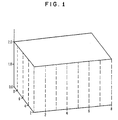
- Figure 1 is a graph of the results of an inverse two-dimensional discrete cosine transform operation performed on an 8 x 8 array of rescaled discrete-cosine-transform coefficients in which the coefficient 0 - or DC coefficient - has the value one, the remaining coefficients are zero, and the scaling factor is eight.
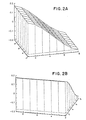
- Figures 2A and 2B are graphs of the results of an inverse two-dimensional discrete cosine transform performed on an 8 x 8 array of rescaled discrete-cosine-transform coefficients in which the coefficient 1 has the value one, the remaining coefficients are zero, and the scaling factor is eight.
- Figure 2 A has a viewing angle of about 15 degrees and
- Figure 2B has a viewing angle of about 75 degrees.
- Figures 3A and 3B are graphs of the results of an inverse two-dimensional discrete cosine transform performed on an 8 x 8 array of rescaled discrete-cosine-transform coefficients in which the coefficient 2 has the value one, the remaining coefficients are zero and the scaling factor is eight.
- Figures 3A and 3B have viewing angles of about 15 degrees and about 75 degrees, respectively.
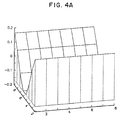
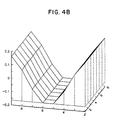
- Figures 4A and 4B are graphs of the results of an inverse two-dimensional discrete cosine transform performed on an 8 x 8 array of rescaled discrete-cosine-transform coefficients in which the coefficient 3 has the value one, the remaining coefficients are zero, and the scaling factor is eight.
- Figures 4A and 4B have viewing angles of about 15 degrees and about 75 degrees, respectively.
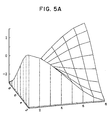
- Figures 5A and 5B are graphs of the results of an inverse two-dimensional discrete cosine transform performed on an 8 x 8 array of rescaled discrete-cosine-transform coefficients in which the coefficient 4 has the value one, the remaining coefficients are zero, and the scaling factor is eight.
- Figures 5A, 5B, 5C, and 5D have viewing angles respectively of about 15, about 75, about 105 and about 165 degrees.
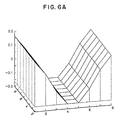
- Figures 6A and 6B are graphs of the results of an inverse two-dimensional discrete cosine transform performed on an 8 x 8 array of rescaled discrete-cosine-transform coefficients in which the coefficient 5 has the value one, the remaining coefficients are zero, and the scaling factor is eight.
- Figures 6A and 6B have viewing angles respectively of about 15 degrees and about 75 degrees.
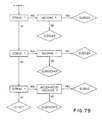
- Figure 7 is a flow chart of a preferred image-data decompression process of the present invention.
- the position of a last quantized discrete-cosine-transform coefficient in the zigzag-pattern-indexing order of Table 1 which is different from zero in a block of quantized coefficients is referred to as an "end-of-block" or "EOB" position.
- End-of-block positions for nine representative test images have been determined. To determine the statistics of the end-of-block positions, each of the nine test images was represented in terms of luminance, red-chrominance and blue-chrominance by respectively three sequences of blocks of quantized discrete-cosine-transform coefficients.
- Each entry in Table 2 below provides the ratio to the total number of blocks of quantized discrete-cosine-transform coefficients for the luminance - on a per one thousand basis - of the number of blocks of such coefficients for which the end-of-block position, as indexed in the zigzag pattern indexing scheme of Table 1 above, either corresponds to the location of the entry in the Table taken in a lexographical order or corresponds to a lower zigzag-pattern-indexed position.
- a total of 58,320 blocks of luminance image data were obtained for the nine test images.
- the luminance component about 0.2 percent of the blocks of quantized discrete-cosine-transform coefficients were entirely zero, including the DC coefficient; about 21.2 percent (21.4 percent - 0.2 percent) of the blocks had a non-zero coefficient only in the DC position; and about 5.6 percent (27.0 percent -21.4 percent) had a highest-indexed non-zero coefficient in the first AC position. Entries corresponding to the remaining eight positions not shown in Table 2 were 1000.
- Table 3 provides cumulative end-of-block position data for the red chrominance component for the nine test images.
- the data in Table 3 is analogous to the data for the luminance component of Table 2 above.
- the total number of blocks for the red-chrominance component was 29,160.
- red chrominance component For the red chrominance component, about 11.9 percent of the blocks were entirely zero, including the DC coefficient; about 51.2 percent (63.1 percent - 11.9 percent) of the blocks had a non-zero coefficient in the DC position only; and about 11.9 percent (75.0 percent -63.1 percent) had the highest-indexed non-zero term in the first AC position. Entries for the 47 highest order positions not shown in Table 3 were 1000.
- Table 4 provides cumulative end-of-block position data for the blue-chrominance component for the nine test images which is analogous to the cumulative end-of-block position data provided in Tables 2 and 3 above.
- the total number of blocks for the blue-chrominance component was 29,160.
- Tables 6 through 9 statistics are provided relating to the relative occurance of patterns of non-zero and zero coefficients in blocks of quantized discrete-cosine-transform coefficients having end-of-block portions of less than seven.
- the statistical data in Tables 7 through 9 was obtained by analyzing blocks of quantized discrete-cosine-transform coefficients obtained from the nine representative test images using the default quantization matrices employed in connection with Tables 2 through 4 above.
- Table 6 serves as an index for Tables 7 through 9. Specifically, each entry in Table 6 identifies a pattern of quantized discrete-cosine-transform coefficients having an end-of-block position of less than seven.
- the first entry in Table 6 represents a block of quantized discrete-cosine-transform coefficients of all zeroes.
- the last entry in Table 6 represents all patterns having an end-of-block position of seven or greater.
- the remaining entries of Table 6 specify in terms of the zigzag-pattern indexing scheme of Table 1 above patterns with non-zero quantized discrete-cosine-transform coefficients in the indicated position in the array of such coefficients and zeroes elsewhere.
- the pattern for each entry in each of Tables 7 through 9 is the pattern defined by the corresponding entry in Table 6.
- Each entry of Table 7 below provides - for the luminance component - the ratio to the total number of blocks of quantized discrete-cosine-transform coefficients - on a per one thousand block basis - of the number of blocks having the pattern of non-zero and zero coefficients defined by the corresponding entry of Table 6.
- Each entry of Table 8 below provides - for the red chrominance component - the ratio to the total number of blocks of quantized discrete-cosine-transform coefficients - on a per one thousand block basis - of the number of blocks having the pattern of non-zero coefficients defined by the corresponding entry of Table 6.
- each entry of Table 9 below provides - for the blue-chrominance component - the ratio to the total number of blocks of quantized discrete-cosine-transform coefficients - on a per one thousand block basis - of the number of blocks having the pattern of non-zero coefficients defined by the corresponding entry of Table 6.
- a preferred program for use in reconstituting quantized image data is set forth in Appendix A to this specification in an APL programming language.
- Preferred subroutines for handling specific special patterns of non-zero and zero coefficients are set forth in Appendix A. These subroutines involve effectively mathematically exact procedures and have efficient finite-precision implementation. Table 10 below labels the subroutines, and arranges them in relationship to their dependencies: the subroutines to the right are called as subroutines by the corresponding subroutines to their left.
- the labeling of the subroutines has been chosen to be suggestive of the special patterns of input data blocks handled by each of the subroutines.
- the numbers in the subroutine labels indicate which positions in the special pattern corresponding to the subroutine are different from zero.
- the letter "A" appears as a suffix whenever the output of the subroutine need not be stored in all 64 positions of the 8 x 8 array, but can be temporarily stored in perhaps smaller storage.
- the subroutine SUB0 computes the scaled inverse discrete cosine transform when the input data is non-zero only for the 0 coefficient. It uses only one multiplication.
- the routine SUB01 computes the scaled inverse discrete cosine transform when the input data is non-zero in positions 0 and 1 only. It uses five multiplications and four "sum/diff" operations.
- a sum/diff operation is defined to be a sum and a difference acting on identical pairs of inputs; i.e. a+b and a-b.
- the subroutine SUB02 is essentially the "transpose" of subroutine SUB01; that is, subroutine SUB02 is essentially the same as subroutine SUB01 except that the row labels and column labels have been interchanged.
- the subroutine SUB02 acts on data which is non-zero in positions 0 and 2 only.
- the subroutine SUB015 computes the scaled inverse discrete cosine transform when the input data is non-zero in positions 0, 1, and 5 only. It uses seven multiplications and six sum/diff operations.
- the subroutine SUB023 is essentially the transpose of the subroutine SUB015 and acts on data which is non-zero in positions 0, 2, and 3 only.
- the subroutine SUB012 computes the scaled inverse discrete cosine transform on data which is non-zero in positions 0, 1, and 2 only. It calls on subroutine SUB02A which is essentially the same as subroutine SUB02 except that subroutine SUBO2A only stores eight constants in eight memory locations instead of eight constants in 64 memory locations as does subroutine SUB02. Altogether, SUB012 uses nine multiplications and 36 sum/diff operations.
- Subroutine SUB0124 acts on data which is non-zero in positions 0, 1, 2, and 4 only. It calls on subroutines SUB02A and SUB14A. Subroutine SUB02A was discussed above. Subroutine SUB14A in turn calls on subroutines SUB1A and SUB4A. Subroutine SUB1A uses four multiplications. Subroutine SUB4A uses four multiplications and four sum/diff operations. Subroutine SUB14A combines the results from subroutine with sixteen sum/diff operations. The results of subroutines SUB14A and SUB02A are combined with 64 additions. Altogether, subroutine SUB0124 uses thirteen multiplications, 24 sum/diff operations and 64 additions.
- Subroutine SUB012345 acts on data which is non-zero only in positions 0, 1, 2, 3, 4, and 5. It calls on subroutines SUB015, SUB4A, and SUB23A. Subroutines SUB015 and SUB4A have already been discussed. Subroutine SUB23A uses six multiplications and four sum/diff operations. The results of subroutines SUB23A and SUB4A are combined with 32 sum/diff operations, which, in turn, are combined with the results of subroutine SUB015 with 64 additions. Altogether, subroutine SUB012345 uses seventeen multiplications, 46 sum/diff operations and 64 additions.
- the special-pattern subroutines listed in Table 10 above are used together with a full two-dimensional inverse discrete cosine transform routine such as the routine disclosed in United States patent application Serial No. 07/403,631, filed September 6, 1989.
- Each block of compressed quantized transform coefficients to be decompressed is checked to determine if it has a pattern of non-zero and zero quantized coefficients for which processing by one of the special pattern subroutines would be most efficient. If none of the special pattern subroutines is appropriate, the block of coefficients is processed by the full two-dimensional inverse discrete-cosine transform routine.
- a particularly preferred procedure for checking blocks of compressed quantized transform coefficients for special patterns of non-zero and zero coefficients involves the use of a 64-entry look-up table termed an end-of-block assignment table.
- Each entry of the end-of-block assignment table has an address j in the range of from 1 to 64 and an associated table pointer EOBP(j) which points to one of the special pattern subroutines or the full inverse discrete cosine transform routine.
- Each block of compressed quantized transform coefficients includes a descriptor field which specifies the end-of-block position.
- the end-of-block position value ranges form 1 to 64 and is used as an address to obtain the associated value from the end-of-block assignment table.
- the value thus obtained is used in determining how the block of coefficients is to be processed.
- the pointer EOBP(1) assigns the data to be processed by the subroutine SUB0.
- the pointer EOBP(2) in the end-of-block assignment table assigns the data to be processed by SUB01.
- the pointer EOBP(3) assigns the data to be processed by a subroutine as follows: First it is checked if the coefficient AC(1) is 0 or not. If the coefficient AC(1) is zero, then the data is assigned to be processed by the subroutine SUB02; otherwise the data is assigned to to be processed by the subroutine SUB012.
- the pointer EOBP(4) assigns the data to be processed by a subroutine as follows: First it is checked to determine if the coefficient AC(1) is 0 or not. If the entry is zero, the data is assigned to be processed by the subroutine SUB023; otherwise the data is assigned to to be processed by the subroutine SUB0124.
- the pointer EOBP(5) in the end-of-block assignment table assigns the data to be processed by a subroutine as follows: First it is checked to determine if the coefficient AC(3) is 0 or not. If the entry is zero, the data is assigned to be processed by the subroutine SUB0124; otherwise the data is assigned to to be processed by the subroutine SUB012345.
- the pointer EOBP(6) assigns the data to be processed by a subroutine as follows: First it is checked to determine if the coefficients AC(2), AC(3) and AC(4) are all 0 or not. If the three values are all zero, the data is assigned to be processed by the subroutine SUB015; otherwise the data is assigned to be processed by the subroutine SUB012345. For each j greater than 6, the pointer EOBP(j) assigns the data to be processed by the full inverse scaled discrete cosine transform routine.
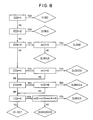
- FIG. 7 An alternate embodiment utilizes the flow chart depicted in Figure 7.
- the method of Figure 7 is a generally similar to that described above except the end-of-assignment table has been replaced by a sequence of if-then commands.
Landscapes
- Engineering & Computer Science (AREA)
- Multimedia (AREA)
- Signal Processing (AREA)
- Compression Or Coding Systems Of Tv Signals (AREA)
- Compression Of Band Width Or Redundancy In Fax (AREA)
- Compression, Expansion, Code Conversion, And Decoders (AREA)
- Image Processing (AREA)
Applications Claiming Priority (2)
| Application Number | Priority Date | Filing Date | Title |
|---|---|---|---|
| US48414990A | 1990-02-23 | 1990-02-23 | |
| US484149 | 1990-02-23 |
Publications (2)
| Publication Number | Publication Date |
|---|---|
| EP0443114A2 true EP0443114A2 (de) | 1991-08-28 |
| EP0443114A3 EP0443114A3 (en) | 1993-12-15 |
Family
ID=23922961
Family Applications (1)
| Application Number | Title | Priority Date | Filing Date |
|---|---|---|---|
| EP19900122702 Ceased EP0443114A3 (en) | 1990-02-23 | 1990-11-28 | Methods and apparatus for image-data decompression |
Country Status (2)
| Country | Link |
|---|---|
| EP (1) | EP0443114A3 (de) |
| JP (1) | JPH0556269A (de) |
Cited By (12)
| Publication number | Priority date | Publication date | Assignee | Title |
|---|---|---|---|---|
| EP0469855A3 (en) * | 1990-07-31 | 1994-05-18 | Fujitsu Ltd | Image data processing method and apparatus |
| EP0651353A1 (de) * | 1993-10-28 | 1995-05-03 | Nec Corporation | Datenverarbeitungssystem zur Kodierung von Bildern |
| EP0661886A3 (de) * | 1993-12-30 | 1996-07-24 | Hewlett Packard Co | Verfahren und Vorrichtung zur schnellen Dekodierung von digitalen Signalen. |
| US5875266A (en) * | 1990-07-31 | 1999-02-23 | Fujitsu Limited | Image data processing a method and apparatus |
| EP0805417A3 (de) * | 1996-04-30 | 1999-05-12 | Texas Instruments Inc. | Bildverarbeitung |
| US5933538A (en) * | 1990-07-31 | 1999-08-03 | Fujitsu Limited | Image data processing method and apparatus |
| WO1999035851A3 (en) * | 1997-12-30 | 1999-09-16 | Koninkl Philips Electronics Nv | Data transformation of the inverse fourier type |
| WO2000001156A3 (en) * | 1998-06-30 | 2000-04-13 | Koninkl Philips Electronics Nv | Method and device for gathering block statistics during inverse quantization and iscan |
| EP0854653A3 (de) * | 1997-01-15 | 2001-07-18 | Sun Microsystems, Inc. | System und Verfahren zur schnellen inversen diskreten Cosinus-Transformation, und Videokompressions-/Dekompressionssystem |
| US7142720B1 (en) | 1990-07-31 | 2006-11-28 | Fujitsu Limited | Image data processing method and apparatus |
| CN113302924A (zh) * | 2018-11-22 | 2021-08-24 | 交互数字Vc控股公司 | 用于视频编码和解码的量化 |
| US11323713B2 (en) * | 2018-05-17 | 2022-05-03 | Amimon Ltd. | Bit rate reduction for scalable video coding |
Family Cites Families (2)
| Publication number | Priority date | Publication date | Assignee | Title |
|---|---|---|---|---|
| JP2513654B2 (ja) * | 1986-12-26 | 1996-07-03 | キヤノン株式会社 | 画像符号化装置 |
| JP2584793B2 (ja) * | 1987-09-24 | 1997-02-26 | キヤノン株式会社 | 符号の割り付け方法 |
-
1990
- 1990-11-28 EP EP19900122702 patent/EP0443114A3/en not_active Ceased
-
1991
- 1991-01-23 JP JP3022867A patent/JPH0556269A/ja active Pending
Cited By (16)
| Publication number | Priority date | Publication date | Assignee | Title |
|---|---|---|---|---|
| US6549667B1 (en) | 1990-07-31 | 2003-04-15 | Fujitsu Limited | Image data encoding method and apparatus |
| EP0469855A3 (en) * | 1990-07-31 | 1994-05-18 | Fujitsu Ltd | Image data processing method and apparatus |
| US5416854A (en) * | 1990-07-31 | 1995-05-16 | Fujitsu Limited | Image data processing method and apparatus |
| US5875266A (en) * | 1990-07-31 | 1999-02-23 | Fujitsu Limited | Image data processing a method and apparatus |
| US5933538A (en) * | 1990-07-31 | 1999-08-03 | Fujitsu Limited | Image data processing method and apparatus |
| US5933533A (en) * | 1990-07-31 | 1999-08-03 | Fujitsu Limited | Image data processing method and apparatus |
| US7142720B1 (en) | 1990-07-31 | 2006-11-28 | Fujitsu Limited | Image data processing method and apparatus |
| US5555511A (en) * | 1993-10-28 | 1996-09-10 | Nec Corporation | Data processing system for picture coding processing |
| EP0651353A1 (de) * | 1993-10-28 | 1995-05-03 | Nec Corporation | Datenverarbeitungssystem zur Kodierung von Bildern |
| EP0661886A3 (de) * | 1993-12-30 | 1996-07-24 | Hewlett Packard Co | Verfahren und Vorrichtung zur schnellen Dekodierung von digitalen Signalen. |
| EP0805417A3 (de) * | 1996-04-30 | 1999-05-12 | Texas Instruments Inc. | Bildverarbeitung |
| EP0854653A3 (de) * | 1997-01-15 | 2001-07-18 | Sun Microsystems, Inc. | System und Verfahren zur schnellen inversen diskreten Cosinus-Transformation, und Videokompressions-/Dekompressionssystem |
| WO1999035851A3 (en) * | 1997-12-30 | 1999-09-16 | Koninkl Philips Electronics Nv | Data transformation of the inverse fourier type |
| WO2000001156A3 (en) * | 1998-06-30 | 2000-04-13 | Koninkl Philips Electronics Nv | Method and device for gathering block statistics during inverse quantization and iscan |
| US11323713B2 (en) * | 2018-05-17 | 2022-05-03 | Amimon Ltd. | Bit rate reduction for scalable video coding |
| CN113302924A (zh) * | 2018-11-22 | 2021-08-24 | 交互数字Vc控股公司 | 用于视频编码和解码的量化 |
Also Published As
| Publication number | Publication date |
|---|---|
| EP0443114A3 (en) | 1993-12-15 |
| JPH0556269A (ja) | 1993-03-05 |
Similar Documents
| Publication | Publication Date | Title |
|---|---|---|
| US6101279A (en) | Image compression system using block transforms and tree-type coefficient truncation | |
| US5377018A (en) | Video compression and decompression using block selection and subdivision | |
| US6643408B2 (en) | Image coding and decoding apparatus, method of image coding and decoding, and recording medium for recording program for image coding and decoding | |
| DE69020564T2 (de) | Verfahren und vorrichtung zur behandlung von numerischen daten. | |
| US20020076115A1 (en) | JPEG packed block structure | |
| KR100287624B1 (ko) | 화상데이타의압축,해제방법및그장치 | |
| US5712809A (en) | Method and apparatus for performing fast reduced coefficient discrete cosine transforms | |
| CA2171335A1 (en) | Coding methods and apparatus for scaling and filtering images using discrete cosine transforms | |
| US7489827B2 (en) | Scaling of multi-dimensional data in a hybrid domain | |
| US5371611A (en) | Method for and system of decoding compressed continuous-tone digital image data | |
| US6697529B2 (en) | Data compression method and recording medium with data compression program recorded therein | |
| DE69905428T2 (de) | Ungleiche Komprimierung von MSBs und LSBs mit hierarchischer Vektorquantisierung | |
| EP0875858B1 (de) | Verfahren zur Kompression/Dekompression von Bilddaten | |
| WO2000017730A2 (en) | Method of compressing and decompressing graphic images | |
| JPH07123269A (ja) | 画像信号の符号化装置 | |
| JPH0556269A (ja) | 二次元イメージを表す一連の圧縮および量子化された変換係数群を処理する装置 | |
| US7512277B2 (en) | Data compression for colour images using wavelet transform | |
| US6832001B1 (en) | Image processing apparatus and method | |
| Manduca | Compressing images with wavelet/subband coding | |
| EP0468165A2 (de) | Feldverarbeitungsverfahren mit kondensierten Multiplikations- und Additionsrechnerbefehlen | |
| US20020176630A1 (en) | Image data processing method | |
| Ayadi et al. | A FPGA-based implementation of JPEG encoder | |
| DE69738610T2 (de) | MPEG-Codierer/Decodierer | |
| Yonekawa et al. | Adaptive block cosine transform coding using a new quantization algorithm | |
| JP3163753B2 (ja) | 画像処理装置及び画像処理方法 |
Legal Events
| Date | Code | Title | Description |
|---|---|---|---|
| PUAI | Public reference made under article 153(3) epc to a published international application that has entered the european phase |
Free format text: ORIGINAL CODE: 0009012 |
|
| AK | Designated contracting states |
Kind code of ref document: A2 Designated state(s): DE FR GB |
|
| 17P | Request for examination filed |
Effective date: 19911211 |
|
| PUAL | Search report despatched |
Free format text: ORIGINAL CODE: 0009013 |
|
| AK | Designated contracting states |
Kind code of ref document: A3 Designated state(s): DE FR GB |
|
| 17Q | First examination report despatched |
Effective date: 19950407 |
|
| STAA | Information on the status of an ep patent application or granted ep patent |
Free format text: STATUS: THE APPLICATION HAS BEEN REFUSED |
|
| 18R | Application refused |
Effective date: 19950930 |