EP0443207B1 - Système d'aspiration de monomères - Google Patents
Système d'aspiration de monomères Download PDFInfo
- Publication number
- EP0443207B1 EP0443207B1 EP90125735A EP90125735A EP0443207B1 EP 0443207 B1 EP0443207 B1 EP 0443207B1 EP 90125735 A EP90125735 A EP 90125735A EP 90125735 A EP90125735 A EP 90125735A EP 0443207 B1 EP0443207 B1 EP 0443207B1
- Authority
- EP
- European Patent Office
- Prior art keywords
- nozzle
- exhaust system
- housing
- fumes
- exhaust
- Prior art date
- Legal status (The legal status is an assumption and is not a legal conclusion. Google has not performed a legal analysis and makes no representation as to the accuracy of the status listed.)
- Expired - Lifetime
Links
- 239000000178 monomer Substances 0.000 title claims description 27
- 239000003517 fume Substances 0.000 claims description 30
- 238000010791 quenching Methods 0.000 claims description 27
- JBKVHLHDHHXQEQ-UHFFFAOYSA-N epsilon-caprolactam Chemical compound O=C1CCCCCN1 JBKVHLHDHHXQEQ-UHFFFAOYSA-N 0.000 claims description 12
- 239000012530 fluid Substances 0.000 claims description 12
- 239000007921 spray Substances 0.000 claims description 9
- 238000002074 melt spinning Methods 0.000 claims description 8
- 238000004891 communication Methods 0.000 claims description 4
- 238000010926 purge Methods 0.000 claims description 3
- 238000005507 spraying Methods 0.000 claims description 2
- VGGSQFUCUMXWEO-UHFFFAOYSA-N Ethene Chemical compound C=C VGGSQFUCUMXWEO-UHFFFAOYSA-N 0.000 claims 1
- 239000005977 Ethylene Substances 0.000 claims 1
- 230000000737 periodic effect Effects 0.000 claims 1
- 229920000642 polymer Polymers 0.000 description 12
- 238000000034 method Methods 0.000 description 7
- XLYOFNOQVPJJNP-UHFFFAOYSA-N water Substances O XLYOFNOQVPJJNP-UHFFFAOYSA-N 0.000 description 7
- 238000012986 modification Methods 0.000 description 5
- 230000004048 modification Effects 0.000 description 5
- 229920002292 Nylon 6 Polymers 0.000 description 4
- 239000000463 material Substances 0.000 description 4
- 239000011248 coating agent Substances 0.000 description 3
- 238000000576 coating method Methods 0.000 description 3
- 238000010276 construction Methods 0.000 description 3
- 230000013011 mating Effects 0.000 description 3
- 238000012545 processing Methods 0.000 description 3
- 239000004677 Nylon Substances 0.000 description 2
- 239000004952 Polyamide Substances 0.000 description 2
- 229910052782 aluminium Inorganic materials 0.000 description 2
- XAGFODPZIPBFFR-UHFFFAOYSA-N aluminium Chemical compound [Al] XAGFODPZIPBFFR-UHFFFAOYSA-N 0.000 description 2
- 238000004519 manufacturing process Methods 0.000 description 2
- 239000000203 mixture Substances 0.000 description 2
- 229920001778 nylon Polymers 0.000 description 2
- 229920002647 polyamide Polymers 0.000 description 2
- 238000006116 polymerization reaction Methods 0.000 description 2
- 239000000047 product Substances 0.000 description 2
- 230000000171 quenching effect Effects 0.000 description 2
- 238000004064 recycling Methods 0.000 description 2
- 229910001220 stainless steel Inorganic materials 0.000 description 2
- 239000010935 stainless steel Substances 0.000 description 2
- 239000002699 waste material Substances 0.000 description 2
- 229910001369 Brass Inorganic materials 0.000 description 1
- RYGMFSIKBFXOCR-UHFFFAOYSA-N Copper Chemical compound [Cu] RYGMFSIKBFXOCR-UHFFFAOYSA-N 0.000 description 1
- 230000004075 alteration Effects 0.000 description 1
- 239000010951 brass Substances 0.000 description 1
- 239000006227 byproduct Substances 0.000 description 1
- TZFWDZFKRBELIQ-UHFFFAOYSA-N chlorzoxazone Chemical compound ClC1=CC=C2OC(O)=NC2=C1 TZFWDZFKRBELIQ-UHFFFAOYSA-N 0.000 description 1
- 230000003749 cleanliness Effects 0.000 description 1
- 238000001816 cooling Methods 0.000 description 1
- 229910052802 copper Inorganic materials 0.000 description 1
- 239000010949 copper Substances 0.000 description 1
- 238000000605 extraction Methods 0.000 description 1
- 239000007789 gas Substances 0.000 description 1
- 238000012423 maintenance Methods 0.000 description 1
- 229910052751 metal Inorganic materials 0.000 description 1
- 239000002184 metal Substances 0.000 description 1
- 230000001737 promoting effect Effects 0.000 description 1
- 239000008213 purified water Substances 0.000 description 1
- 239000002994 raw material Substances 0.000 description 1
- 239000000376 reactant Substances 0.000 description 1
- 238000007789 sealing Methods 0.000 description 1
- 239000007787 solid Substances 0.000 description 1
- 239000002904 solvent Substances 0.000 description 1
- 229920002994 synthetic fiber Polymers 0.000 description 1
- 239000008399 tap water Substances 0.000 description 1
- 235000020679 tap water Nutrition 0.000 description 1
- 238000005406 washing Methods 0.000 description 1
Images


Classifications
-
- D—TEXTILES; PAPER
- D01—NATURAL OR MAN-MADE THREADS OR FIBRES; SPINNING
- D01D—MECHANICAL METHODS OR APPARATUS IN THE MANUFACTURE OF ARTIFICIAL FILAMENTS, THREADS, FIBRES, BRISTLES OR RIBBONS
- D01D5/00—Formation of filaments, threads, or the like
- D01D5/08—Melt spinning methods
- D01D5/088—Cooling filaments, threads or the like, leaving the spinnerettes
- D01D5/092—Cooling filaments, threads or the like, leaving the spinnerettes in shafts or chimneys
-
- B—PERFORMING OPERATIONS; TRANSPORTING
- B08—CLEANING
- B08B—CLEANING IN GENERAL; PREVENTION OF FOULING IN GENERAL
- B08B15/00—Preventing escape of dirt or fumes from the area where they are produced; Collecting or removing dirt or fumes from that area
-
- D—TEXTILES; PAPER
- D01—NATURAL OR MAN-MADE THREADS OR FIBRES; SPINNING
- D01D—MECHANICAL METHODS OR APPARATUS IN THE MANUFACTURE OF ARTIFICIAL FILAMENTS, THREADS, FIBRES, BRISTLES OR RIBBONS
- D01D11/00—Other features of manufacture
-
- D—TEXTILES; PAPER
- D01—NATURAL OR MAN-MADE THREADS OR FIBRES; SPINNING
- D01F—CHEMICAL FEATURES IN THE MANUFACTURE OF ARTIFICIAL FILAMENTS, THREADS, FIBRES, BRISTLES OR RIBBONS; APPARATUS SPECIALLY ADAPTED FOR THE MANUFACTURE OF CARBON FILAMENTS
- D01F13/00—Recovery of starting material, waste material or solvents during the manufacture of artificial filaments or the like
- D01F13/04—Recovery of starting material, waste material or solvents during the manufacture of artificial filaments or the like of synthetic polymers
-
- Y—GENERAL TAGGING OF NEW TECHNOLOGICAL DEVELOPMENTS; GENERAL TAGGING OF CROSS-SECTIONAL TECHNOLOGIES SPANNING OVER SEVERAL SECTIONS OF THE IPC; TECHNICAL SUBJECTS COVERED BY FORMER USPC CROSS-REFERENCE ART COLLECTIONS [XRACs] AND DIGESTS
- Y02—TECHNOLOGIES OR APPLICATIONS FOR MITIGATION OR ADAPTATION AGAINST CLIMATE CHANGE
- Y02P—CLIMATE CHANGE MITIGATION TECHNOLOGIES IN THE PRODUCTION OR PROCESSING OF GOODS
- Y02P70/00—Climate change mitigation technologies in the production process for final industrial or consumer products
- Y02P70/50—Manufacturing or production processes characterised by the final manufactured product
- Y02P70/62—Manufacturing or production processes characterised by the final manufactured product related technologies for production or treatment of textile or flexible materials or products thereof, including footwear
Definitions
- the invention relates to an exhaust system for exhausting fumes released from a melt spinning process wherein a portion of the exhausted fumes condense on said system, comprising a housing defining an exhaust chamber, a nozzle assembly extending partially from said housing toward a fume source, said nozzle having a tip disposed sufficiently close to the fume source to collect the fumes, a duct in communication with said exhaust chamber and having an outlet for exhausting the fumes, a driving force moving the fumes through said system from said nozzle to said outlet, and rinsing means for automatically purging said exhaust system of condensed fume deposits.
- a system of this type is known from GB-A-11 44 238.
- the nozzle is fixed relative to the fume source.
- the quench cabinet and its surroundings are cooler than the incoming polymer and unreacted monomer vapor.
- the exhaust hood is also cooler. Monomer fumes condense on cool surfaces. Therefore, all known exhaust systems work intermittently depending on cleanliness.
- the exhaust system of the above type is characterized in that the nozzle is movable and adjustably retractable away from the fume source by retracting means.
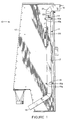
- FIG. 1 is a side elevational view of a monomer exhaust system according to the present invention and mounted on a quench cabinet.
- FIG. 2 is a front elevational view of the exhaust system and quench cabinet of FIG. 1.
- FIG. 3 is a front perspective view in partial cross-section of the exhaust hood housing of the present invention.
- FIG. 4 is a side elevation of the housing of FIG. 3 with a plunger assembly shown in phantom and in a first position.
- FIG. 5 is a cross-sectional view of the housing of FIG. 3 with the plunger assembly in a second position and taken along line 5-5, looking in the direction of the arrows.
- FIG. 6 is a front elevational view of a pickup nozzle according to the present invention.
- FIG. 1 is a side elevational view of one side of quench cabinet 10 with the monomer exhaust system of the present invention in place.
- Monomer exhaust system 11 is mounted to side 12 of quench cabinet 10.
- ordinary mounting bands 13 and 14 may be used.
- Suitable screws 15a, 15b, 16a and 16b with lock washers may fasten mounting bands 13 and 14 to side 12 of quench cabinet 10.
- Exhaust duct 17 extends substantially along side 12. Other arrangements of ducting are contemplated through any reasonable course as would be apparent to one ordinarily skilled in the relevant art.
- Monomer exhaust pickup housing 18 extends anteriorly adjacent quench cabinet 10.
- Duct exit 19 is disposed approximately vertically opposite exhaust pickup housing 18, an arrangement that facilitates gravitational flow of condensates and rinse solutions.
- Elbow 21 connects housing 18 with duct 17. Connector 22 mates elbow 21 with duct 17. In one preferred arrangement, elbow 21 is welded or otherwise attached to housing 18. For completeness, manometer 20 is shown mounted in an optional relative arrangement on quench cabinet side 12. Manometer 20 is not, however, functionally related to or necessary to exhaust system 11.
- FIG. 2 is a front elevational view of quench cabinet 10 with exhaust system 11 mounted thereon.
- Spray assembly 25 is shown disposed on quench cabinet side 26.
- duct 17 and spray assembly 25 are shown mounted on opposite sides of the quench cabinet, other arrangements of the duct relative to the spray assembly are contemplated.
- Exhaust pickup housing 18 is mounted to quench cabinet face 27.
- sliding latches 28a, 28b and mating strikers 29a and 29b may be used. Latches 28 are fastened to the exhaust system while strikers 29 are fastened to the quench cabinet face. Suitable sliding latches and strikers, perhaps having brazer soft aluminum rivets as hardware, are available from Southco Company.
- cabinet face 27 may include a door providing access to the inside of the cabinet. This door operates independently of the present exhaust system.
- Spray assembly 25 includes spray nozzle 30 which enters the side of exhaust pickup housing in fluid flow communication therewith.
- Quick connect-type connector 31 connects nozzle 30 with tubing 32.
- a useful quick connect stem and body comprising connectors 31 are available from Swagelok.
- Tubing 32 may be, for example, Paraflex tubing having appropriate outer and inner diameters. The tubing is connected at its end opposite nozzle 30 to a fluid supply (not shown). For most applications this fluid is water.
- a valve 33 is located at some point along the fluid supply system. The valve is preferably controlled by timer 34.
- FIG. 3 is a front perspective view showing exhaust hood housing 18 in greater detail.
- the view is a partial cross-section showing pipe tap 37 which is threaded along its inner diameter to threadingly receive externally threaded spray nozzle 30 having orifice 38.
- Orifice 38 is of a diameter sufficiently small to cause water flowing therethrough to spray upon exit.
- a useful spray nozzle is a Spraying Systems 1/8 inch GD 3.5 nozzle.
- Exhaust duct 17 opens into housing 18 through rear wall 39 thereof.
- Plunger assembly 40 includes plunger rod 41 and plunger stop 42.
- Pressure checking access 43 although not essential for operation of the present invention, is optionally provided in a convenient location.
- L-shaped bracket 44 present on the top of housing 18 provides a sealing surface between the exhaust pickup and the quench cabinet.
- FIG. 4 is a side elevational view of the present invention with the plunger assembly seen in phantom.
- Pickup nozzle 45 is fully extended. At this point nozzle tip 46 is closest to the source of extracted fumes S, here a spinneret.
- Pickup nozzle 45 is slidably mounted within rearwardly extending projection 47 of exhaust pickup housing 18. Nozzle 45 communicates with exhaust chamber 53 defined by housing 18.
- FIG. 5 is a cross-sectional view of the exhaust pickup system of the present invention.
- Pickup nozzle 45 is fully retracted into projection 47.
- Plunger rod 41 has ring 48 disposed externally of housing 18. Ring 48 may be used as a grasping handle.
- Plunger rod 41 enters housing 18 through plunger stop 42 which is drilled to an appropriate diameter slightly larger than plunger rod 41.
- Plunger rod 41 is slideably received through plunger stop 42.
- Plunger rod 41 is further provided with mating stop 49 which matingly engages plunger stop 42 to prevent further rearward movement of the plunger and pickup nozzle 45 which is attached thereto, thus defining the maximum extended position (see FIG. 4).
- Plunger rod 41 has holes 50.
- plunger stop 42 is provided with hole 54 for receiving a detent plunger (not shown).
- Hole 54 aligns with holes 50 while the detent plunder traverses 54 lengthwise to matingly engage in a selected hole 50.
- This arrangement allows nozzle 45 to be adjusted to and then set in various degrees of retraction.
- plunger rod 41 is threaded 55 for receiving correspondingly threaded jam nut 51.
- Jam nut 51 solidly meets bar 52.
- Bar 52 forms a partial end wall of nozzle 45 and has a hole therethrough for receiving plunger rod 41. Preferably this hole is threaded about its diameter.
- nozzle 45 is substantially hollow, having four substantially solid sides and is shown having a rectangular shape.
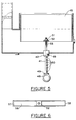
- FIG. 6 is a front elevational view of nozzle 45. Bar 52 is shown disposed approximately midway between sides 57 and 58 of nozzle 45. In this manner, the size of passageway 56 can be maximized while still providing a mating surface for plunger rod 41. (See FIG. 5)
- one-eighth inch aluminum may be used for most of the parts of the present invention, although certain parts might be advantageously made from stainless steel.
- plunger rod can be made from stainless steel.
- Certain other parts such as the fluid supply parts might preferably be made from brass, copper, or synthetic materials but the choice of materials is readily within the knowledge of the ordinary artisan.
- the metal portions of the present invention which are not designed to be movably or removably joined are beneficially of burr-free welded construction.
- Nozzle 45 may be provided with a coating on the exterior surface thereof to decrease friction between its exterior surface and the interior surface of exhaust pickup housing 18. This material may be .06 inch to .08 inch thick nylon, for example. It is contemplated that other friction reducing coating materials might be used and it may be desired to adjust the coating material to correspond to the polymerization process in which the present invention is installed.
- nozzle 45 is adjustable. To accomplish this the user simply grasps ring 48. Ring 48 is moved toward the user to retract nozzle 45 and away from the user to extend the nozzle. The desired position is fixed by engagement of the detent plunger within a hole 50. For access to the spinneret. nozzle 45 is retracted according to the above procedure. It is contemplated that similar parts may be used instead of a detent plunger. An example of such a part is a set screw.
- the adjustable nozzle allows for an adjustable modification ratio.
- the distance of nozzle 45 from spinneret S determines, to some degree, the cross-section of the filament produced.
- Cross-sections ranging from nearly or perfectly round to highly lobed can be achieved by retracting and extending the nozzle, respectively. Varying degrees of modification result from adjustment intermediate extension and retraction.
- the nozzle 45 extends toward the fume emitting source, in the present case monomer exhaust from the spinneret in a polyamide process.
- Quench gas most typically chilled air
- This driving force may be a suction fan located near duct exit 19 (FIG. 1).
- the quenching air is warmed to a degree by and mixes with fumes emitted from the extruded polymer.
- the air-fume mixture enters exhaust system 11 through nozzle tip 46 and is drawn into the chamber 53 of exhaust pickup housing 18.
- the driving force which is at work, or suction fan, drives the exhaust fume air mixture into the duct to a suitable waste collection area for recycling or disposal.
- the ⁇ -caprolactam monomer is water soluble so the rinse fluid is water which may be purified water if the collected waste monomer is intended for recycling or may be tap water or the like if it is intended for disposal.
- the water jet in the case of Nylon 6 polymerization, dissolves the monomer from the internal surfaces of the exhaust system upon which it has collected and the water and dissolved monomer then are exhausted through exhaust duct 17 (FIG. 1).
- other wash solvents may be used depending upon the solubility of the condensate to be rinsed.
- An additional feature of the present invention is the ease at which it may be removed for servicing and the like.
- Quick connector 31 is simply disconnected and sliding latches 28a and 28b are released from strikers 29a and b (FIG. 1).
- Exhaust duct 17 can remain stationary on quench cabinet 10 while elbow 21 releases from connector 22 (FIG. 1). The entire housing is then drawn forward and removed from quench cabinet 10.
Landscapes
- Engineering & Computer Science (AREA)
- Textile Engineering (AREA)
- Mechanical Engineering (AREA)
- Chemical & Material Sciences (AREA)
- Chemical Kinetics & Catalysis (AREA)
- General Chemical & Material Sciences (AREA)
- Spinning Methods And Devices For Manufacturing Artificial Fibers (AREA)
- Treating Waste Gases (AREA)
Claims (13)
- Système d'aspiration pour les fumées d'échappement émises au cours d'un procédé de filature en fusion, dans lequel une partie des fumées d'échappement se condense sur le système, comprenant : un logement (18) définissant une chambre d'échappement (53) ; un ensemble de tuyères (45) (41, 42, 45, 48, 40, 50, 51, 52, 55, 59) s'étendant partiellement à partir de ce logement (18) vers une source de fumées (5), cette tuyère (45) ayant une pointe (46) disposée de façon suffisamment proche de la source de fumées (5) pour recueillir les fumées ; une gaine (17) en communication avec la chambre d'échappement (53) et comportant un orifice de sortie (19) pour l'aspiration des fumées ;
une force d'entraînement déplaçant les fumées à travers ce système à partir de la tuyère (45) vers l'orifice de sortie (19) ; et
des moyens de rinçage (30, 37, 38) pour purger automatiquement le système d'aspiration des dépôts de fumées condensées,
caractérisé en ce que
la tuyère (45) est mobile et peut être escamotée de façon ajustable par rapport à la source de fumées (S) par des moyens d'escamotage. - Système d'aspiration selon la revendication 1, caractérisé par une commande d'escamotage externe (41, 42, 48, 49, 50, 59) communiquant avec la tuyère (45).
- Système d'aspiration selon la revendication 2, caractérisé en ce que la tuyère (45) est montée de façon rétractable ou escamotable dans ce logement (18).
- Système d'aspiration selon la revendication 2, caractérisé en ce que la commande externe (41, 42, 48, 49, 50, 59) possède des moyens d'ajustage (49, 50, 59) pour ajuster la tuyère (45) sur différents degrés d'escamotage.
- Système d'aspiration selon la revendication 1, caractérisé en ce que les fumées contiennent un monomère ε-caprolactame.
- Système d'aspiration selon la revendication 1, caractérisé en ce que les moyens de rinçage (30, 37, 38) comprennent une seconde tuyère (30) pour pulvériser un fluide à l'intérieur du logement (18), cette seconde tuyère (30) étant en communication de fluide avec une source continue de fluide, et une vanne de temporisation (33) pour temporiser la pulvérisation de fluide par la tuyère (30).
- Système d'aspiration selon la revendication 1, caractérisé par des moyens d'escamotage (41, 48) comprenant un piston plongeur (41), ce piston plongeur (41) s'étendant sur une extrémité à l'extérieur du logement (18) et étant fixé par une seconde extrémité sur la tuyère (45).
- Système d'aspiration selon la revendication 7, caractérisé en ce que le piston plongeur (41) possède une poignée de préhension (48) sur son extrémité externe.
- Système d'aspiration selon la revendication 7, caractérisé par des moyens d'ajustement (49, 50, 59) pour ajuster la distance de la tuyère (18) par rapport aux fumées, incluant une série d'alésages (50) sur le piston plongeur (41) et un piston plongeur de détente aligné pour coopérer avec les alésages (50).
- Système d'aspiration selon la revendication 6, caractérisé en ce que la soupape (33) est temporisée de façon à s'ouvrir automatiquement à des intervalles périodiques.
- Système d'aspiration selon la revendication 1, caractérisé en ce que le logement (18) est monté sur un coffret d'extinction (10).
- Système d'aspiration selon la revendication 1, caractérisé en ce que le logement (18) est amovible par rapport à l'armoire d'extinction (10).
- Système d'aspiration selon la revendication 1, caractérisé en ce que le procédé de filage en fusion incorpore du téréphtalate de polyéthylène.
Applications Claiming Priority (2)
| Application Number | Priority Date | Filing Date | Title |
|---|---|---|---|
| US48458690A | 1990-02-23 | 1990-02-23 | |
| US484586 | 1990-02-23 |
Publications (3)
| Publication Number | Publication Date |
|---|---|
| EP0443207A2 EP0443207A2 (fr) | 1991-08-28 |
| EP0443207A3 EP0443207A3 (en) | 1992-05-27 |
| EP0443207B1 true EP0443207B1 (fr) | 1994-09-21 |
Family
ID=23924751
Family Applications (1)
| Application Number | Title | Priority Date | Filing Date |
|---|---|---|---|
| EP90125735A Expired - Lifetime EP0443207B1 (fr) | 1990-02-23 | 1990-12-28 | Système d'aspiration de monomères |
Country Status (5)
| Country | Link |
|---|---|
| EP (1) | EP0443207B1 (fr) |
| JP (1) | JPH06294009A (fr) |
| AU (1) | AU635995B2 (fr) |
| CA (1) | CA2034306C (fr) |
| DE (1) | DE69012786T2 (fr) |
Families Citing this family (4)
| Publication number | Priority date | Publication date | Assignee | Title |
|---|---|---|---|---|
| KR960011040B1 (ko) | 1992-03-24 | 1996-08-16 | 안자이 구니오 | 질소 산화물 제거방법과 그 실시에 사용하기 위한 장치 |
| DE19830453A1 (de) * | 1998-07-08 | 2000-01-13 | Lurgi Zimmer Ag | Verfahren und Vorrichtung zum Transport von Dampf durch mindestens einen runden Spinndüsenschacht |
| DE102005054653B4 (de) * | 2005-11-11 | 2009-09-10 | Uhde Inventa-Fischer Gmbh & Co. Kg | Vorrichtung und Verfahren zur Herstellung schmelzgesponnener Filamente |
| US10477941B2 (en) | 2017-04-28 | 2019-11-19 | L'oreal | Volatile liquid applicator systems and fume-filtering apparatuses |
Family Cites Families (3)
| Publication number | Priority date | Publication date | Assignee | Title |
|---|---|---|---|---|
| US2886848A (en) * | 1955-02-10 | 1959-05-19 | American Enka Corp | Blow box |
| GB1144238A (en) * | 1967-03-01 | 1969-03-05 | Vnii Mash Dlay Proizv Syntheti | Cooling shaft for air flow cooling of filaments spun from polymeric felt |
| WO1989003903A1 (fr) * | 1987-10-26 | 1989-05-05 | Allied-Signal Inc. | Tuyau central pour l'evacuation de matieres monomeres |
-
1990
- 1990-12-28 EP EP90125735A patent/EP0443207B1/fr not_active Expired - Lifetime
- 1990-12-28 DE DE69012786T patent/DE69012786T2/de not_active Expired - Fee Related
-
1991
- 1991-01-14 AU AU69358/91A patent/AU635995B2/en not_active Ceased
- 1991-01-16 CA CA002034306A patent/CA2034306C/fr not_active Expired - Fee Related
- 1991-02-05 JP JP3014413A patent/JPH06294009A/ja active Pending
Also Published As
| Publication number | Publication date |
|---|---|
| CA2034306A1 (fr) | 1991-08-24 |
| AU6935891A (en) | 1991-08-29 |
| EP0443207A3 (en) | 1992-05-27 |
| DE69012786T2 (de) | 1995-02-02 |
| CA2034306C (fr) | 1996-05-14 |
| DE69012786D1 (de) | 1994-10-27 |
| EP0443207A2 (fr) | 1991-08-28 |
| AU635995B2 (en) | 1993-04-08 |
| JPH06294009A (ja) | 1994-10-21 |
Similar Documents
| Publication | Publication Date | Title |
|---|---|---|
| US5219585A (en) | Monomer exhaust system | |
| EP0443207B1 (fr) | Système d'aspiration de monomères | |
| CA2347041C (fr) | Procede et dispositif pour traiter, notamment pour nettoyer, retirer ou detacher par abrasion, des revetements, graffiti ou autres salissures superficielles sur des pieces ou surfaces | |
| US7485163B2 (en) | Nozzle and filter-type dust collector | |
| CA2077463C (fr) | Systeme et methode de nettoyage de precision par jet de liquide pulverise | |
| US3253788A (en) | Apparatus for lubrication of machining operations | |
| US5815975A (en) | Gun bore cleaning system | |
| CA2150011A1 (fr) | Appareil servant au nettoyage d'objets en mouvement | |
| CA2127598A1 (fr) | Methode de nettoyage de conditionneur d'air et dispositifs de nettoyage | |
| AU543962B2 (en) | A method and device for extracting contaminated air by suction | |
| CH655266A5 (de) | Einrichtung zum zerschneiden eines werkstuecks mittels thermischer energie und verwendung dieser einrichtung. | |
| DK0399249T3 (da) | Anordning ved en filterslange | |
| MY130460A (en) | Apparatus and process for spinning polymeric filaments | |
| GB2271304A (en) | Boaching tool for tubing | |
| US4768533A (en) | Paint and varnish stripping system | |
| US6357386B1 (en) | Assembly for controlling the gas flow in a plasma spraying apparatus | |
| US3109594A (en) | Cleaning gun | |
| DE102004047844A1 (de) | Vorrichtung zum Sortieren von Prüflingen mittels Bildverarbeitung | |
| US3221994A (en) | Retractable furnace slurry sprayer | |
| AU8262191A (en) | Air gun for producing nonwoven fabrics | |
| CN220417352U (zh) | 一种垃圾焚烧锅炉清焦装置 | |
| KR20030002571A (ko) | 고로 출선구의 부착물 제거장치 | |
| CN113058760A (zh) | 一种传动轴的喷塑设备及其控制方法 | |
| CN218796848U (zh) | 一种高效率水性漆喷房 | |
| CN216972649U (zh) | 一种热喷锌用喷锌间 |
Legal Events
| Date | Code | Title | Description |
|---|---|---|---|
| PUAI | Public reference made under article 153(3) epc to a published international application that has entered the european phase |
Free format text: ORIGINAL CODE: 0009012 |
|
| AK | Designated contracting states |
Kind code of ref document: A2 Designated state(s): CH DE IT LI NL |
|
| PUAL | Search report despatched |
Free format text: ORIGINAL CODE: 0009013 |
|
| AK | Designated contracting states |
Kind code of ref document: A3 Designated state(s): CH DE IT LI NL |
|
| 17P | Request for examination filed |
Effective date: 19920825 |
|
| 17Q | First examination report despatched |
Effective date: 19931112 |
|
| GRAA | (expected) grant |
Free format text: ORIGINAL CODE: 0009210 |
|
| AK | Designated contracting states |
Kind code of ref document: B1 Designated state(s): CH DE IT LI NL |
|
| PG25 | Lapsed in a contracting state [announced via postgrant information from national office to epo] |
Ref country code: IT Free format text: LAPSE BECAUSE OF FAILURE TO SUBMIT A TRANSLATION OF THE DESCRIPTION OR TO PAY THE FEE WITHIN THE PRE;WARNING: LAPSES OF ITALIAN PATENTS WITH EFFECTIVE DATE BEFORE 2007 MAY HAVE OCCURRED AT ANY TIME BEFORE 2007. THE CORRECT EFFECTIVE DATE MAY BE DIFFERENT FROM THE ONE RECORDED.SCRIBED TIME-LIMIT Effective date: 19940921 Ref country code: NL Effective date: 19940921 |
|
| REF | Corresponds to: |
Ref document number: 69012786 Country of ref document: DE Date of ref document: 19941027 |
|
| NLV1 | Nl: lapsed or annulled due to failure to fulfill the requirements of art. 29p and 29m of the patents act | ||
| PLBE | No opposition filed within time limit |
Free format text: ORIGINAL CODE: 0009261 |
|
| STAA | Information on the status of an ep patent application or granted ep patent |
Free format text: STATUS: NO OPPOSITION FILED WITHIN TIME LIMIT |
|
| 26N | No opposition filed | ||
| PGFP | Annual fee paid to national office [announced via postgrant information from national office to epo] |
Ref country code: CH Payment date: 19981218 Year of fee payment: 9 |
|
| PGFP | Annual fee paid to national office [announced via postgrant information from national office to epo] |
Ref country code: DE Payment date: 19981230 Year of fee payment: 9 |
|
| PG25 | Lapsed in a contracting state [announced via postgrant information from national office to epo] |
Ref country code: LI Free format text: LAPSE BECAUSE OF NON-PAYMENT OF DUE FEES Effective date: 19991231 Ref country code: CH Free format text: LAPSE BECAUSE OF NON-PAYMENT OF DUE FEES Effective date: 19991231 |
|
| PG25 | Lapsed in a contracting state [announced via postgrant information from national office to epo] |
Ref country code: DE Free format text: LAPSE BECAUSE OF NON-PAYMENT OF DUE FEES Effective date: 20001003 |