EP0443645A2 - Exhaust gas purification process - Google Patents
Exhaust gas purification process Download PDFInfo
- Publication number
- EP0443645A2 EP0443645A2 EP91200171A EP91200171A EP0443645A2 EP 0443645 A2 EP0443645 A2 EP 0443645A2 EP 91200171 A EP91200171 A EP 91200171A EP 91200171 A EP91200171 A EP 91200171A EP 0443645 A2 EP0443645 A2 EP 0443645A2
- Authority
- EP
- European Patent Office
- Prior art keywords
- exhaust gases
- exhaust gas
- wet scrubbing
- environment
- wet
- Prior art date
- Legal status (The legal status is an assumption and is not a legal conclusion. Google has not performed a legal analysis and makes no representation as to the accuracy of the status listed.)
- Withdrawn
Links
Images

Classifications
-
- F—MECHANICAL ENGINEERING; LIGHTING; HEATING; WEAPONS; BLASTING
- F01—MACHINES OR ENGINES IN GENERAL; ENGINE PLANTS IN GENERAL; STEAM ENGINES
- F01N—GAS-FLOW SILENCERS OR EXHAUST APPARATUS FOR MACHINES OR ENGINES IN GENERAL; GAS-FLOW SILENCERS OR EXHAUST APPARATUS FOR INTERNAL-COMBUSTION ENGINES
- F01N3/00—Exhaust or silencing apparatus having means for purifying, rendering innocuous, or otherwise treating exhaust
- F01N3/02—Exhaust or silencing apparatus having means for purifying, rendering innocuous, or otherwise treating exhaust for cooling, or for removing solid constituents of, exhaust
-
- B—PERFORMING OPERATIONS; TRANSPORTING
- B01—PHYSICAL OR CHEMICAL PROCESSES OR APPARATUS IN GENERAL
- B01D—SEPARATION
- B01D53/00—Separation of gases or vapours; Recovering vapours of volatile solvents from gases; Chemical or biological purification of waste gases, e.g. engine exhaust gases, smoke, fumes, flue gases, aerosols
- B01D53/34—Chemical or biological purification of waste gases
-
- F—MECHANICAL ENGINEERING; LIGHTING; HEATING; WEAPONS; BLASTING
- F23—COMBUSTION APPARATUS; COMBUSTION PROCESSES
- F23J—REMOVAL OR TREATMENT OF COMBUSTION PRODUCTS OR COMBUSTION RESIDUES; FLUES
- F23J15/00—Arrangements of devices for treating smoke or fumes
- F23J15/006—Layout of treatment plant
-
- F—MECHANICAL ENGINEERING; LIGHTING; HEATING; WEAPONS; BLASTING
- F23—COMBUSTION APPARATUS; COMBUSTION PROCESSES
- F23J—REMOVAL OR TREATMENT OF COMBUSTION PRODUCTS OR COMBUSTION RESIDUES; FLUES
- F23J2215/00—Preventing emissions
- F23J2215/20—Sulfur; Compounds thereof
-
- F—MECHANICAL ENGINEERING; LIGHTING; HEATING; WEAPONS; BLASTING
- F23—COMBUSTION APPARATUS; COMBUSTION PROCESSES
- F23J—REMOVAL OR TREATMENT OF COMBUSTION PRODUCTS OR COMBUSTION RESIDUES; FLUES
- F23J2215/00—Preventing emissions
- F23J2215/30—Halogen; Compounds thereof
-
- F—MECHANICAL ENGINEERING; LIGHTING; HEATING; WEAPONS; BLASTING
- F23—COMBUSTION APPARATUS; COMBUSTION PROCESSES
- F23J—REMOVAL OR TREATMENT OF COMBUSTION PRODUCTS OR COMBUSTION RESIDUES; FLUES
- F23J2215/00—Preventing emissions
- F23J2215/60—Heavy metals; Compounds thereof
-
- F—MECHANICAL ENGINEERING; LIGHTING; HEATING; WEAPONS; BLASTING
- F23—COMBUSTION APPARATUS; COMBUSTION PROCESSES
- F23J—REMOVAL OR TREATMENT OF COMBUSTION PRODUCTS OR COMBUSTION RESIDUES; FLUES
- F23J2219/00—Treatment devices
- F23J2219/40—Sorption with wet devices, e.g. scrubbers
-
- F—MECHANICAL ENGINEERING; LIGHTING; HEATING; WEAPONS; BLASTING
- F23—COMBUSTION APPARATUS; COMBUSTION PROCESSES
- F23J—REMOVAL OR TREATMENT OF COMBUSTION PRODUCTS OR COMBUSTION RESIDUES; FLUES
- F23J2219/00—Treatment devices
- F23J2219/70—Condensing contaminants with coolers
-
- F—MECHANICAL ENGINEERING; LIGHTING; HEATING; WEAPONS; BLASTING
- F23—COMBUSTION APPARATUS; COMBUSTION PROCESSES
- F23J—REMOVAL OR TREATMENT OF COMBUSTION PRODUCTS OR COMBUSTION RESIDUES; FLUES
- F23J2900/00—Special arrangements for conducting or purifying combustion fumes; Treatment of fumes or ashes
- F23J2900/15004—Preventing plume emission at chimney outlet
-
- F—MECHANICAL ENGINEERING; LIGHTING; HEATING; WEAPONS; BLASTING
- F23—COMBUSTION APPARATUS; COMBUSTION PROCESSES
- F23J—REMOVAL OR TREATMENT OF COMBUSTION PRODUCTS OR COMBUSTION RESIDUES; FLUES
- F23J2900/00—Special arrangements for conducting or purifying combustion fumes; Treatment of fumes or ashes
- F23J2900/15081—Reheating of flue gases
Definitions
- Such methods are, compared to so-called dry or semi-dry exhaust gas purification methods, generally much more effective with regard to the separation performance, but require treatment of the pollutant-containing scrubbing liquid and usually also re-heating of the exhaust gases to avoid corrosion problems or only to avoid the formation of steam when dispensing the Exhaust fumes in the environment.
- the visible plume is often seen as an indication of an impermissible emission, so that suppression is required even when there is no need for environmental reasons.
- it is often not sufficient that the exhaust gas purification process used falls well below the permissible limit values for pollutant emissions, and it must also be avoided that the harmless and unavoidable water vapor emission becomes visible, and that in all occurring weather conditions .
Landscapes
- Engineering & Computer Science (AREA)
- Chemical & Material Sciences (AREA)
- General Engineering & Computer Science (AREA)
- Mechanical Engineering (AREA)
- Environmental & Geological Engineering (AREA)
- Analytical Chemistry (AREA)
- General Chemical & Material Sciences (AREA)
- Oil, Petroleum & Natural Gas (AREA)
- Chemical Kinetics & Catalysis (AREA)
- Health & Medical Sciences (AREA)
- Biomedical Technology (AREA)
- Combustion & Propulsion (AREA)
- Treating Waste Gases (AREA)
- Chimneys And Flues (AREA)
- Drying Of Gases (AREA)
Abstract
Zur Vermeidung einer Abgasfahne bei einer Abgasreinigung mittels Naßwäsche und nachfolgender Wiederaufheizung wird vorgeschlagen, zwischen Naßwäsche (3) und Wiederaufheizung der Abgase eine zusätzliche Abgaskühlung (4) vorzusehen, wodurch aus dem nach der Naßwäsche gesättigten Abgas ein Teil des Wassers durch Kondensation entfernt und sichergestellt werden kann, daß bei allen vorkommenden Wetterbedingungen eine Schwadenbildung bei der Abgabe der Abgase in die Umgebung vermieden wird.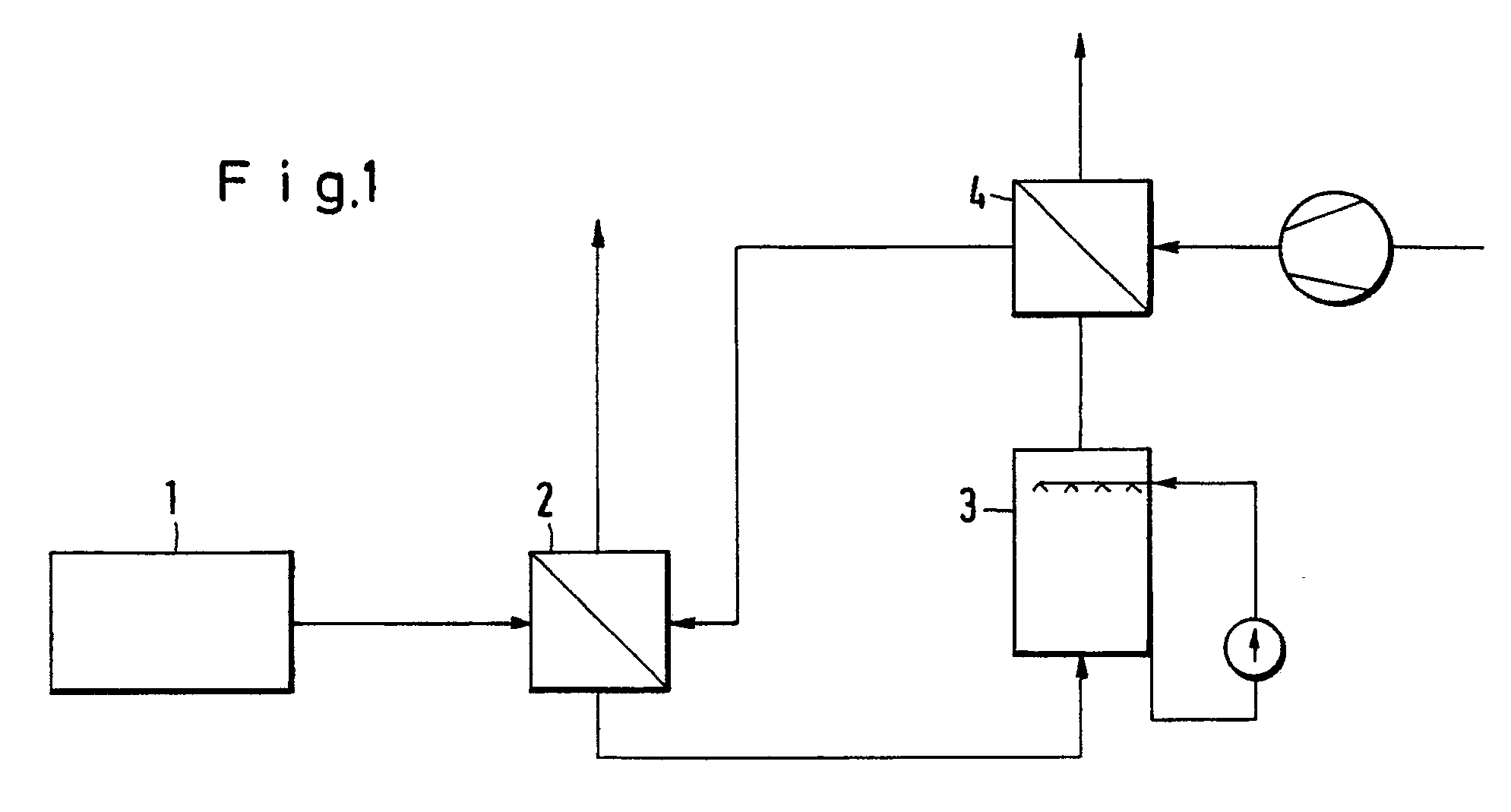
Description
Die Erfindung bezieht sich auf ein Verfahren zur Abscheidung von Schadstoffen aus Abgasen mittels Naßwäsche und Wiederaufheizung der Abgase vor Abgabe an die Umgebung.The invention relates to a method for separating pollutants from exhaust gases by means of wet scrubbing and reheating the exhaust gases before being released into the environment.
Derartige Verfahren sind, verglichen mit sogenannten trockenen oder halbtrockenen Abgasreinigungsverfahren, hinsichtlich der Abscheideleistung im allgemeinen zwar wesentlich effektiver, erfordern aber eine Aufbereitung der schadstoffhaltigen Waschflüssigkeit und meist auch eine Wiederaufheizung der Abgase zur Vermeidung von Korrosionsproblemen oder auch nur zur Vermeidung von Schwadenbildungen bei der Abgabe der Abgase in die Umgebung. Die sichtbare Abgasfahne wird vielfach als Indiz für eine unzulässige Emission angesehen, so daß ihre Unterdrückung selbst dann verlangt wird, wenn aus Umweltschutzgründen an sich keine Notwendigkeit besteht. Insbesondere bei Standorten in dichtbesiedelten Regionen genügt es häufig nicht, daß mit dem angewandten Abgasreinigungsverfahren alle zulässigen Grenzwerte für Schadstoffemissionen deutlich und dauerhaft unterschritten werden, es muß auch vermieden werden, daß die an sich unschädliche und unvermeidbare Wasserdampfemission sichtbar wird, und zwar bei allen vorkommenden Wetterlagen.Such methods are, compared to so-called dry or semi-dry exhaust gas purification methods, generally much more effective with regard to the separation performance, but require treatment of the pollutant-containing scrubbing liquid and usually also re-heating of the exhaust gases to avoid corrosion problems or only to avoid the formation of steam when dispensing the Exhaust fumes in the environment. The visible plume is often seen as an indication of an impermissible emission, so that suppression is required even when there is no need for environmental reasons. Especially in locations in densely populated regions, it is often not sufficient that the exhaust gas purification process used falls well below the permissible limit values for pollutant emissions, and it must also be avoided that the harmless and unavoidable water vapor emission becomes visible, and that in all occurring weather conditions .
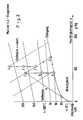
Diese Bedingung läßt sich anhand des bekannten i, x-Diagramms für feuchte Luft von Mollier dahingehend definieren, daß sowohl die Zustandsgrößen des Abgases bei dessen Abgabe an die Umgebung als auch die sich ändernden Zustandsgrößen des Gemisches aus Abgas und Umgebungsluft in jedem Fall oberhalb der Sättigungskurve liegen müssen. Bei der Mischung der Abgase mit der Umgebungsluft ändern sich die Zustandsgrößen längs einer Geraden, die im i, x-Diagramm durch die Werte für das Abgas einerseits und die Werte für die Umgebungsluft andererseits bestimmt ist. Liegt diese Gerade vollständig oberhalb der Sättigungskurve, so erfolgt kein Auskondensieren von Wasserdampf, d.h. die Abgasfahne bleibt unsichtbar.This condition can be defined on the basis of Mollier's known i, x diagram for moist air in such a way that both the state variables of the exhaust gas when it is released into the environment and the changing state variables of the mixture of exhaust gas and ambient air in any case above the saturation curve must lie. When the exhaust gases are mixed with the ambient air, the state variables change along a straight line, which is determined in the i, x diagram by the values for the exhaust gas on the one hand and the values for the ambient air on the other. Is this Just above the saturation curve, there is no condensation of water vapor, ie the exhaust plume remains invisible.
Daraus läßt sich die geometrische Bedingung ableiten, daß - ausgehend von einem gegebenen Punkt für die Umgebungsluft - die Zustandsgrößen des Abgases bei Abgabe an die Umgebung so gewählt werden müssen, daß sie nicht unterhalb einer von dem vorgegebenen Punkt der Umgebungsluft an die Sättigungskurve gelegten Tangente liegen dürfen. Daraus folgt ohne weiteres, daß die Temperatur - auf die die Abgase wiederaufgeheizt werden müssen - um so höher liegen muß, je kälter die Umgebungsluft ist. Daraus folgt weiter, daß die angestrebte Vermeidung einer Schwadenbildung unter Umständen nur mit einem erheblichen Energieaufwand zu erreichen ist, was dazu führen kann, daß diese Art von Abgasreinigungsverfahren als zu unwirtschaftlich abgelehnt wird.From this, the geometric condition can be derived that - starting from a given point for the ambient air - the state variables of the exhaust gas must be selected so that they are not released below a tangent from the given point of the ambient air to the saturation curve allowed to. From this it follows without further ado that the temperature - to which the exhaust gases have to be reheated - must be higher the colder the ambient air is. It also follows that the desired avoidance of steam formation can possibly only be achieved with a considerable expenditure of energy, which can lead to this type of exhaust gas purification process being rejected as being too uneconomical.
Es besteht somit die Aufgabe, das eingangs genannte Verfahren so weiterzubilden, daß bei allen vorkommenden Wetterlagen eine Schwadenbildung bei der Abgabe der gereinigten Abgase in die Umgebung vermieden wird und daß durch den dazu erforderlichen Energieaufwand die Wettbewerbsfähigkeit des Abgasreinigungsverfahrens nicht in Frage gestellt wird.It is therefore the task of developing the method mentioned at the outset in such a way that, in all weather conditions, the formation of steam in the discharge of the cleaned exhaust gases into the environment is avoided and that the competitiveness of the exhaust gas purification process is not called into question by the energy expenditure required for this.
Diese Aufgabe wird erfindungsgemäß dadurch gelöst, daß man aus den aus der Naßwäsche kommenden, mit Wasserdampf gesättigten Abgasen einen Teil des Wassergehalts durch Kühlung und Kondensation entfernt, bevor die Abgase wiederaufgeheizt werden. Die Abgase werden vor Eintritt in die Naßwäsche zweckmäßigerweise abgekühlt und die dabei anfallende Energie zur Wiederaufheizung der Abgase vor Abgabe an die Umgebung verwendet. Die aus der Naßwäsche kommenden Abgase werden erfindungsgemäß soweit abgekühlt und aus ihnen soviel Wasser durch Kondensation entfernt, daß die aus der Vor-Abkühlung (vor der Naßwäsche) verfügbare Energie ausreicht, die Abgase vor Abgabe an die Umgebung soweit aufzuheizen, daß bei ihrer Vermischung mit der Umgebungsluft keine Schwadenbildung stattfindet. Die aus der Naßwäsche kommenden Abgase werden vorteilhafterweise indirekt gekühlt, wobei Umgebungsluft verwendet werden kann. Eine vorteilhafte Anwendung des erfindungsgemäßen Verfahrens ergibt sich bei der Reinigung von Abgasen aus Müllverbrennungsanlagen.This object is achieved in that a part of the water content from the wet scrubbing, saturated with water vapor is removed by cooling and condensation before the exhaust gases are reheated. The exhaust gases are expediently cooled before entering the wet scrubber and the energy thereby generated is used to reheat the exhaust gases before being released into the environment. The exhaust gases coming from wet scrubbing are cooled according to the invention to the extent that enough water is removed from them by condensation that the energy available from pre-cooling (before wet scrubbing) it is sufficient to heat the exhaust gases to the point where they are released into the environment so that when they are mixed with the ambient air there is no formation of steam. The exhaust gases coming from wet scrubbing are advantageously indirectly cooled, and ambient air can be used. An advantageous application of the method according to the invention results in the cleaning of exhaust gases from waste incineration plants.
Durch die erfindungsgemäße Maßnahme verschieben sich die Zustandsgrößen der Abgase auf der Sättigungskurve im i, x-Diagramm von einem weiter rechts liegenden Punkt zu einem weiter links liegenden Punkt. Wird danach das Abgas wiederaufgeheizt, so ändern sich die Zustandsgrößen im i, x-Diagramm längs einer Vertikalen (Wassergehalt konstant). Verglichen mit einer Zustandsänderung bei höherem Wassergehalt wird dabei jede (vom Zustand der Umgebungsluft abhängige) Tangente an die Sättigungskurve bei einer niedrigeren Temperatur geschnitten, woraus folgt, daß die Endtemperatur für die Abgasaufheizung niedriger gewählt werden kann, ohne daß eine Schwadenbildung eintritt.The measure according to the invention shifts the state variables of the exhaust gases on the saturation curve in the i, x diagram from a point further to the right to a point further to the left. If the exhaust gas is then reheated, the state variables in the i, x diagram change along a vertical line (water content constant). Compared to a change in state with a higher water content, each tangent to the saturation curve (depending on the state of the ambient air) is cut at a lower temperature, from which it follows that the final temperature for the exhaust gas heating can be selected lower without the formation of steam.
Durch die erfindungsgemäß vorzunehmende Abkühlung der aus dem Naßwäscher kommenden Abgase wird außerdem erreicht, daß die mit dem Aufheizen zu realisierende Temperaturerhöhung der Abgase zu einem niedrigeren Temperaturniveau hin verschoben wird, so daß normalerweise die im Abgas vor der Naßwäsche vorhandene Abfallwärme nicht nur quantitativ, sondern auch qualitativ für die Wiederaufheizung der Abgase ausreicht. Mit anderen Worten, für den Wärmeübergang von dem noch relativ heißen Abgasstrom auf den gereinigten und zusätzlich gekühlten Abgasstrom steht stets eine ausreichend hohe Temperaturdifferenz zur Verfügung und das erfindungsgemäße Verfahren kann mit vertretbarem Aufwand für die Wärmetauscherflächen durchgeführt werden.The inventive cooling of the exhaust gases coming from the wet scrubber also ensures that the temperature increase of the exhaust gases to be realized with the heating is shifted to a lower temperature level, so that normally the waste heat present in the exhaust gas before the wet scrubbing is not only quantitative, but also qualitatively sufficient for the reheating of the exhaust gases. In other words, there is always a sufficiently high temperature difference available for the heat transfer from the still relatively hot exhaust gas stream to the cleaned and additionally cooled exhaust gas stream, and the method according to the invention can be carried out for the heat exchanger surfaces at a reasonable cost.
Weitere Einzelheiten des Erfindungsgedankens werden anhand des in Fig. 1 dargestellten Schaltbildes, an dem nachfolgenden Beispiel für eine Mengen- und Wärmebilanz sowie im i, x-Diagramm gemäß Fig. 2 näher erläutert.Further details of the inventive concept are based on the circuit diagram shown in FIG the following example for a quantity and heat balance and in the i, x diagram according to FIG. 2 explained in more detail.
In Fig. 1 ist eine Verbrennungseinrichtung (1) angedeutet, in der ein Abgas entsteht, das vor seiner Abgabe an die Umgebung gereinigt werden muß. Die Reinigung erfolgt mittels Naßwäscher (3), dem stromauf ein oder mehrere beliebige Reinigungsstufen vorgelagert sein können. Nach Durchlaufen des Naßwäschers (3) wird der Abgasstrom in einem Kühler (4) weiter abgekühlt, bevor er in einem Wärmetauscher (2) wiederaufgeheizt wird. Zweckmäßigerweise wird dazu das noch relativ heiße Abgas vor dessen Eintritt in den Naßwäscher (3) benutzt. Die zusätzliche Abkühlung des Abgasstroms im Anschluß an die Naßwäsche erfolgt am besten mit Umgebungsluft, wobei insofern eine gewisse Selbstregelung eintritt, als - bei sonst gleichbleibenden Parametern - die Abkühlung um so stärker ausfällt, je niedriger die Temperatur der Umgebungsluft ist. Da die zur Vermeidung einer Schwadenbildung bei der Abgabe der Abgase an die Umgebung erforderliche Kühlleistung mit fallender Umgebungstemperatur steigt, kann man sich bei richtiger Auslegung des Kühlers im Prinzip darauf verlassen, daß die zusätzliche Abkühlung der Abgase bei einer Änderung der Umgebungslufttemperatur stets den Erfordernissen entspricht.In Fig. 1, a combustion device (1) is indicated, in which an exhaust gas is generated, which must be cleaned before being released into the environment. The cleaning is carried out by means of a wet washer (3), which can be preceded by one or more cleaning stages. After passing through the wet scrubber (3), the exhaust gas stream is further cooled in a cooler (4) before it is reheated in a heat exchanger (2). For this purpose, the relatively hot exhaust gas is expediently used before it enters the wet scrubber (3). The additional cooling of the exhaust gas stream after the wet scrubbing is best carried out with ambient air, whereby a certain self-regulation occurs, since - with otherwise constant parameters - the cooling is more pronounced the lower the temperature of the ambient air. Since the cooling capacity required to avoid the formation of steam when the exhaust gases are released into the environment increases with falling ambient temperature, if the cooler is designed correctly, one can rely in principle on the fact that the additional cooling of the exhaust gases always corresponds to the requirements when the ambient air temperature changes.
Für eine Müllverbrennungsanlage mit einem Abgasanfall von 2 x 27700 Nm³/h wurden zur Realisierung des Erfindungsgedankens folgende Auslegungsdaten zugrundegelegt bzw. ermittelt. Das Abgas hat eine Temperatur von 220 bis 260°C und soll im Wärmetauscher zunächst um 90 bis 110°C vorgekühlt werden, bevor es im Wäscher mit einer im Kreislauf geführten Flüssigkeitsmenge von 90 bis 120 m³/h behandelt und auf 58 bis 64°C abgekühlt wird. Der Wassergehalt des Abgases beträgt bei Eintritt in den Wäscher 90 bis 200 g/Nm³, am Austritt 175 bis 250 g/Nm³. Die Schadstoffgehalte liegen bei:
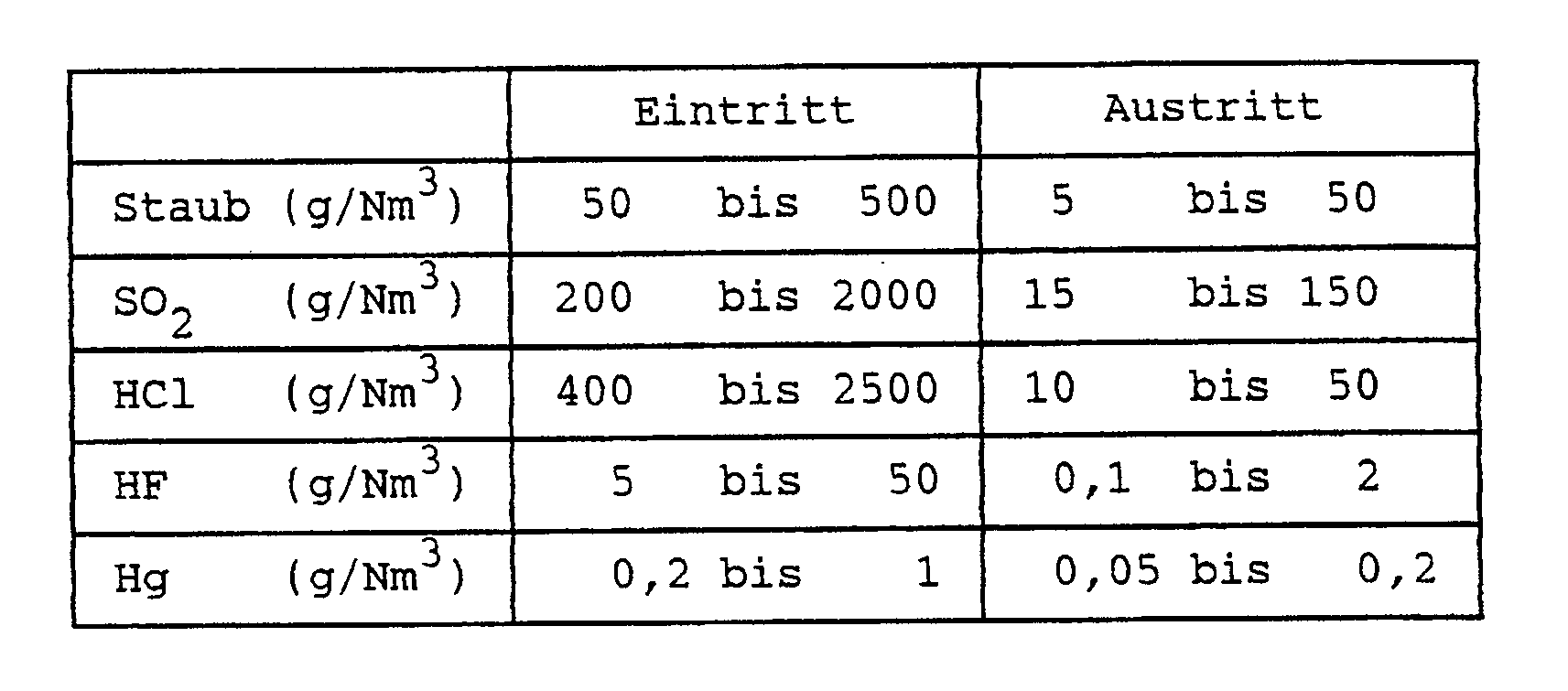
Die Abgase werden sodann im Kühler auf 45 bis 58°C abgekühlt, wobei gleichzeitig der Wassergehalt durch Auskondensieren auf 84 bis 175 g/Nm³ gesenkt wird. Anschließend erfolgt eine Wiederaufheizung der Abgase auf 120 bis 200°C, bevor sie an die Umgebung abgegeben werden.For a waste incineration plant with an exhaust gas output of 2 x 27700 Nm³ / h, the following design data were used as a basis for realizing the inventive concept. The flue gas has a temperature of 220 to 260 ° C and should first be pre-cooled in the heat exchanger by 90 to 110 ° C before it is treated in the scrubber with a circulated liquid volume of 90 to 120 m³ / h and to 58 to 64 ° C is cooled. The water content of the exhaust gas is 90 to 200 g / Nm³ when entering the scrubber and 175 to 250 g / Nm³ at the outlet. The pollutant levels are:
The exhaust gases are then cooled in the cooler to 45 to 58 ° C, while the water content is reduced to 84 to 175 g / Nm³ by condensation. The exhaust gases are then reheated to 120 to 200 ° C before they are released into the environment.
Für die jeweiligen Mittelwerte der vorstehenden Auslegungsdaten sind die Zustandsänderungen in das i, x-Diagramm gemäß Fig. 2 eingetragen. Zuerst erfolgt - bei unverändertem Wassergehalt - eine Abkühlung von 220°C auf 120°C (Wärmetauscher; Ziffern 1,2,3). Danach wird der Wassergehalt im Abgas von 160 auf 197 g/Nm³ erhöht und gleichzeitig die Temperatur auf 60°C gesenkt (Ziffern 3,4). Mittels indirekter Kühlung wird das Abgas sodann weiter auf 52°C abgekühlt, wobei der Wassergehalt auf 125 g/Nm³ sinkt (Ziffern 4,5). Schließlich erfolgt die Wiederaufheizung um 110°C, so daß schließlich ein Abgas mit 162°C vorliegt (Ziffern 5,6,7). Wird dieses Abgas in die Umgebungsluft abgegeben, für die eine Temperatur von -2°C angenommen wurde, so ändern sich die Zustandsgrößen des Gemisches längs der eingezeichneten Linie (a), die ersichtlich an allen Stellen oberhalb der Sättigungskurve verläuft. Damit ist sichergestellt, daß bei der Abgabe der Abgase an die Umgebung keine Schwadenbildung auftritt.For the respective mean values of the above design data, the changes in state are entered in the i, x diagram according to FIG. 2. First - with unchanged water content - there is a cooling from 220 ° C to 120 ° C (heat exchanger;
Claims (6)
Applications Claiming Priority (2)
| Application Number | Priority Date | Filing Date | Title |
|---|---|---|---|
| DE4004358A DE4004358A1 (en) | 1990-02-13 | 1990-02-13 | Prevention of smoke from gas from incineration process |
| DE4004358 | 1990-02-13 |
Publications (2)
| Publication Number | Publication Date |
|---|---|
| EP0443645A2 true EP0443645A2 (en) | 1991-08-28 |
| EP0443645A3 EP0443645A3 (en) | 1991-09-11 |
Family
ID=6400025
Family Applications (1)
| Application Number | Title | Priority Date | Filing Date |
|---|---|---|---|
| EP19910200171 Withdrawn EP0443645A3 (en) | 1990-02-13 | 1991-01-29 | Exhaust gas purification process |
Country Status (9)
| Country | Link |
|---|---|
| US (1) | US5102433A (en) |
| EP (1) | EP0443645A3 (en) |
| JP (1) | JPH04219116A (en) |
| KR (1) | KR910021521A (en) |
| AU (1) | AU7095991A (en) |
| CA (1) | CA2032583A1 (en) |
| CS (1) | CS29391A2 (en) |
| DE (1) | DE4004358A1 (en) |
| PL (1) | PL289031A1 (en) |
Cited By (2)
| Publication number | Priority date | Publication date | Assignee | Title |
|---|---|---|---|---|
| EP0538972A3 (en) * | 1991-10-25 | 1993-08-18 | Amphag Ag | Incinerator |
| CN106369625A (en) * | 2016-10-25 | 2017-02-01 | 福建龙净环保股份有限公司 | Dry type smoke purification system and smoke heating method thereof |
Families Citing this family (5)
| Publication number | Priority date | Publication date | Assignee | Title |
|---|---|---|---|---|
| DE9420276U1 (en) * | 1994-12-17 | 1996-01-04 | Scheel, Arnold, Dipl.-Ing. Univ., 86161 Augsburg | Exhaust air treatment device |
| US5613990A (en) * | 1995-03-28 | 1997-03-25 | Helical Dynamics, Inc. | Air cleaning system for mechanical industrial processes |
| DE19752709C2 (en) * | 1997-11-28 | 2003-08-28 | Gerhard Luther | exhaust converter |
| FI119522B (en) * | 2007-08-13 | 2008-12-15 | Waertsilae Finland Oy | Ship engine assembly |
| CN110227332A (en) * | 2019-06-14 | 2019-09-13 | 无锡市东方环境工程设计研究所有限公司 | The dehumidification purification system of depth containing wet flue gas |
Family Cites Families (15)
| Publication number | Priority date | Publication date | Assignee | Title |
|---|---|---|---|---|
| US3138440A (en) * | 1960-05-03 | 1964-06-23 | Metallgesellschaft Ag | Process for cleaning gases |
| US3619985A (en) * | 1968-11-26 | 1971-11-16 | P & W Engineers Inc | Method for treating heated gases to suppress steam plume formation |
| US3619983A (en) * | 1968-11-26 | 1971-11-16 | P & W Engineers Inc | Suppression of the steam plume from incinerator stacks |
| JPS5641291B2 (en) * | 1973-07-04 | 1981-09-28 | ||
| DE2709900A1 (en) * | 1977-03-08 | 1978-09-14 | Saarbergwerke Ag | Cleaning coal or oil fired power station flue gases - in circuit using cooling tower to cool and then scrub the gases |
| JPS5383972A (en) * | 1976-12-29 | 1978-07-24 | Nippon Kokan Kk <Nkk> | Preventing method for formation of white smoke in exhaust gas treating appa ratus |
| DE3237699A1 (en) * | 1982-10-12 | 1984-04-12 | Toschi Produktions-Gesellschaft mbH, 2800 Bremen | METHOD FOR SEPARATING AIR POLLUTANTS FROM EXHAUST GAS, IN PARTICULAR FROM FLUE GAS, BY CONDENSATION |
| DE3147838A1 (en) * | 1980-12-18 | 1982-07-29 | Steag Ag, 4300 Essen | METHOD FOR DRYING FLOWING GASES WITH A CONTENT OF FINE DISTRIBUTED SOLID-DRUGED LIQUID DROPS BY RADIATION ENERGY AND DEVICE FOR IMPLEMENTING THE METHOD |
| DE3145291A1 (en) * | 1981-11-14 | 1983-05-19 | Uhde Gmbh, 4600 Dortmund | "METHOD FOR CONDITIONING SUCTIONED AMBIENT AIR FOR SEA-STATIONED CHEMICAL SYSTEMS" |
| SE429408B (en) * | 1982-01-29 | 1983-09-05 | Graenges Aluminium Ab | PROCEDURE FOR WATER-CLEANING, VENTILATION AIR CONTAINING IN THE COOLING OR LUBRICATION OF PROCESSING MACHINES, SEPARATE COLLECTION WASTE, WASTE WASTE, AND PROCEDURE FOR EXECUTION OF THE PROCEDURE |
| DD214533A1 (en) * | 1983-03-30 | 1984-10-17 | Bergbau Und Huettenkombinat A | METHOD FOR FINE CLEANING OF SULFUR-CONTAINING EXHAUST GASES |
| DE3341021A1 (en) * | 1983-11-12 | 1985-05-23 | Kraftanlagen Ag, 6900 Heidelberg | METHOD AND DEVICE FOR REHEATING THE PURE GASES AFTER WET PURIFICATION OF RAW GASES |
| DE3415238A1 (en) * | 1984-04-21 | 1985-10-31 | Balcke-Dürr AG, 4030 Ratingen | METHOD AND DEVICE FOR REHEATING SMOKE GASES |
| FR2592812B1 (en) * | 1986-01-14 | 1990-05-04 | Sobea | PROCESS FOR REDUCING THE CONTENT OF ACID POLLUTANTS CONTAINED IN FUMES AND DEVICE FOR CARRYING OUT SAME |
| DE3721056A1 (en) * | 1987-06-26 | 1989-01-05 | Bayer Ag | METHOD FOR HEATING DAMP GASES |
-
1990
- 1990-02-13 DE DE4004358A patent/DE4004358A1/en not_active Withdrawn
- 1990-12-18 CA CA002032583A patent/CA2032583A1/en not_active Abandoned
-
1991
- 1991-01-18 KR KR1019910000794A patent/KR910021521A/en not_active Withdrawn
- 1991-01-22 US US07/644,267 patent/US5102433A/en not_active Expired - Fee Related
- 1991-01-29 EP EP19910200171 patent/EP0443645A3/en not_active Withdrawn
- 1991-02-07 CS CS91293A patent/CS29391A2/en unknown
- 1991-02-08 JP JP3039487A patent/JPH04219116A/en active Pending
- 1991-02-11 PL PL28903191A patent/PL289031A1/en unknown
- 1991-02-12 AU AU70959/91A patent/AU7095991A/en not_active Abandoned
Cited By (3)
| Publication number | Priority date | Publication date | Assignee | Title |
|---|---|---|---|---|
| EP0538972A3 (en) * | 1991-10-25 | 1993-08-18 | Amphag Ag | Incinerator |
| CN106369625A (en) * | 2016-10-25 | 2017-02-01 | 福建龙净环保股份有限公司 | Dry type smoke purification system and smoke heating method thereof |
| CN106369625B (en) * | 2016-10-25 | 2018-10-19 | 福建龙净环保股份有限公司 | A kind of dry type flue gas purification system and its flue gas method |
Also Published As
| Publication number | Publication date |
|---|---|
| KR910021521A (en) | 1991-12-20 |
| AU7095991A (en) | 1991-08-15 |
| CS29391A2 (en) | 1991-09-15 |
| JPH04219116A (en) | 1992-08-10 |
| DE4004358A1 (en) | 1991-08-14 |
| EP0443645A3 (en) | 1991-09-11 |
| PL289031A1 (en) | 1992-01-13 |
| US5102433A (en) | 1992-04-07 |
| CA2032583A1 (en) | 1991-08-14 |
Similar Documents
| Publication | Publication Date | Title |
|---|---|---|
| DE202018103280U1 (en) | Flue gas desulfurization system Heating | |
| DE3106580A1 (en) | METHOD FOR MINIMIZING EMISSIONS FROM POLLUTION PLANTS | |
| DE2518386A1 (en) | METHOD OF REMOVING SO DEEP 2 AND / OR OTHER ACID COMPONENTS FROM EXHAUST GASES | |
| DE4428168A1 (en) | Dry washer with condensate heat exchanger to improve the cycle efficiency | |
| CH676089A5 (en) | ||
| DE2928693A1 (en) | WASTE PROCESSING PLANT | |
| DE3236905C2 (en) | Process for desulphurization of flue gases and device for carrying out the process | |
| WO1985002453A1 (en) | Process for separating acid polluting gas and combustion plant | |
| EP0322944A1 (en) | Process for cleaning smoke | |
| EP0044916A2 (en) | Process and apparatus for the separation of sulfur dioxide and other pollutants from flue gas | |
| CH650162A5 (en) | COMBUSTION PROCESS WITH PURIFYING COMBUSTION AIR AND / OR EXHAUST GAS. | |
| EP0139626A2 (en) | Process and apparatus for the production of heat from gases containing water vapour by absorption or adsorption | |
| DE1810975A1 (en) | Process and device for the combined disposal of waste and sewage sludge | |
| DD218661A5 (en) | METHOD AND DEVICE FOR RE-HEATING DEFROSTED SMOKE GASES | |
| DE4004358A1 (en) | Prevention of smoke from gas from incineration process | |
| DE69832649T2 (en) | Process for the treatment of exhaust gas | |
| EP0108247B1 (en) | Process for the removal of undesired gaseous components from hot exhaust gases | |
| DE3603985C2 (en) | ||
| EP0162269B1 (en) | Process and device for reheating flue gases | |
| DE3436699A1 (en) | METHOD FOR REMOVING SULFUR DIOXIDE AND NITROXIDE FROM SMOKE GASES | |
| DE2757783A1 (en) | METHOD AND DEVICE FOR TREATMENT OF LIQUID WASTE | |
| DE4203385A1 (en) | Use of unchanged, emulsified or modified vegetable oil - for cleaning gas mixt. contg. solvent vapour, odorous substance or other harmful substances | |
| DE2232258C3 (en) | Process for the treatment of exhaust gases from industrial plants containing harmful components | |
| DE3741842C2 (en) | Process for reducing the gaseous pollutants SO¶x¶, HF and HCl that arise during combustion | |
| DE3831300C2 (en) |
Legal Events
| Date | Code | Title | Description |
|---|---|---|---|
| PUAI | Public reference made under article 153(3) epc to a published international application that has entered the european phase |
Free format text: ORIGINAL CODE: 0009012 |
|
| PUAL | Search report despatched |
Free format text: ORIGINAL CODE: 0009013 |
|
| AK | Designated contracting states |
Kind code of ref document: A2 Designated state(s): AT BE CH DE DK ES FR GB IT LI LU NL SE |
|
| AK | Designated contracting states |
Kind code of ref document: A3 Designated state(s): AT BE CH DE DK ES FR GB IT LI LU NL SE |
|
| 17P | Request for examination filed |
Effective date: 19911023 |
|
| 17Q | First examination report despatched |
Effective date: 19930916 |
|
| STAA | Information on the status of an ep patent application or granted ep patent |
Free format text: STATUS: THE APPLICATION HAS BEEN WITHDRAWN |
|
| 18W | Application withdrawn |
Withdrawal date: 19940315 |