EP0443720B1 - Kegelförmiger Expansionsdichtung - Google Patents
Kegelförmiger Expansionsdichtung Download PDFInfo
- Publication number
- EP0443720B1 EP0443720B1 EP91300484A EP91300484A EP0443720B1 EP 0443720 B1 EP0443720 B1 EP 0443720B1 EP 91300484 A EP91300484 A EP 91300484A EP 91300484 A EP91300484 A EP 91300484A EP 0443720 B1 EP0443720 B1 EP 0443720B1
- Authority
- EP
- European Patent Office
- Prior art keywords
- plug
- bore
- plug body
- expansion
- installation
- Prior art date
- Legal status (The legal status is an assumption and is not a legal conclusion. Google has not performed a legal analysis and makes no representation as to the accuracy of the status listed.)
- Expired - Lifetime
Links
Images



Classifications
-
- F—MECHANICAL ENGINEERING; LIGHTING; HEATING; WEAPONS; BLASTING
- F16—ENGINEERING ELEMENTS AND UNITS; GENERAL MEASURES FOR PRODUCING AND MAINTAINING EFFECTIVE FUNCTIONING OF MACHINES OR INSTALLATIONS; THERMAL INSULATION IN GENERAL
- F16L—PIPES; JOINTS OR FITTINGS FOR PIPES; SUPPORTS FOR PIPES, CABLES OR PROTECTIVE TUBING; MEANS FOR THERMAL INSULATION IN GENERAL
- F16L55/00—Devices or appurtenances for use in, or in connection with, pipes or pipe systems
- F16L55/10—Means for stopping flow in pipes or hoses
- F16L55/12—Means for stopping flow in pipes or hoses by introducing into the pipe a member expandable in situ
- F16L55/128—Means for stopping flow in pipes or hoses by introducing into the pipe a member expandable in situ introduced axially into the pipe or hose
- F16L55/13—Means for stopping flow in pipes or hoses by introducing into the pipe a member expandable in situ introduced axially into the pipe or hose the closure device being a plug fixed by plastic deformation
Definitions
- the present invention relates generally to expansion sealing plugs and more particularly to a new and improved tapered expansion plug for sealing access and other bores in metal castings, metal forgings and other metal parts as well as plastic parts.
- the expansion plug disclosed in U.S. Patent 3,825,146 to Hirmann, granted July 23, 1974 involves the use of an inner expansion member, in this case a ball, that is forced into a bore of lesser diameter. Said plugs require a shoulder within the installation bore to prevent the plug from moving during insertion of the expansion member. For these reasons, installation of the prior art plugs require the reaming of an installation bore of greater inside diameter than the original opening. Due to the relatively small size of the plugs, minor variations in tooling or reaming technique can produce clearances between the outside surface of the plug and the inside surface of installation bore that are significant to the function of the plug. Therefore, in said prior art expansion plugs, an installation tolerance must be allowed between the installation bore and the unexpanded plug outer surface.
- Prior art plug members are of uniform outside diameter which must not exceed the inside diameter of the installation bore.
- the specified performance level i.e. the blowout pressure of the plug, depends upon the radial force exerted against the installation bore which in turn depends upon the amount of expansion of the plug after the clearance between the plug outer surface and the installation bore has been bridged. Therefore, the total plug expansion must be increased by adding the installation tolerance to the expansion required for specified sealing performance.
- the total expansion of the plug must equal the sum of the minimum expansion and the installation tolerance, in this case, ten thousandths of an inch. It is to be expected that some installations will result in a perfect fit and as a result, the component must tolerate the total radial expansion (.010 inches in the example). The anticipation of occasional total radial expansions greater than that required for sealing must therefore be considered in the design of the component that includes the installation bore. Frequently the installation bore is formed in a boss designed to absorb the stress of the expansion.
- FR-A-444161 describes a bottle stopper for a glass bottle.
- the stopper comprises a thin wall conical sleeve, the inner bore of which receives a corresponding tapered shell. The stopper is pushed into the neck of the bottle and axial movement of the shell within the inner tapered bore aids sealing engagement of the stopper with the neck of the bottle.
- the method of installation does not involve reaming the neck of the bottle.
- US-1064544 also describes a bottle stopper comprising a frusto-conical cork body which has a conical bore receiving the projecting barbed shank of an end cap of different material. The end cap is assembled in the body before insertion into the bottle.
- the present invention provides the method of sealing an aperture by inserting into the aperture an expansion sealing plug comprising a plug body having a blind coaxial bore and an expansion sealing means, characterised by the steps of reaming the aperture to provide a tapered installation bore, inserting into the installation bore the expansion sealing plug whose plug body has a tapered outer surface with an inner axial end and an outer axial end of a larger outside diameter than the inner axial end and whose blind coaxial bore extends from an outer axial end of the plug body toward an inner axial end of the plug body, and in which the expansion sealing means has a diameter larger than the diameter of the plug bore by a predetermined amount, and applying force to the expansion means to drive the expansion means axially toward the inner axial end of the plug body and into the plug bore causing the plug body to expand radially into engagement with the wall of the installation bore.
- the plug comprises a plug body and an expansion member that is inserted into socket formed by a coaxial bore axially extending from the outer end of the plug body, which is open, to an inner end wall at the inner end of the plug body.
- the diameter of the expansion member is greater than the inside diameter of the coaxial bore such that the plug is radially expanded during installation.
- the expansion member may be partially preassembled with the plug body by partial insertion within the socket.
- An installation bore into which the plug of the instant invention is to be inserted is first reamed or formed to provide the same taper angle as the bore engaging surface of the plug body. As the plug is inserted into the installation bore, the parallel opposing surfaces of the plug body and installation bore are moved into snug engagement. After insertion of the plug into the installation bore the expansion member is driven further into the coaxial plug bore causing the plug body to be controllably radially expanded due to difference between the outside diameter of the expansion member and the inside diameter of the coaxial plug bore.
- the expansion member is a tapered pin that is to be inserted into a coaxial bore in the plug body that is also tapered.
- Alternative configurations of the expansion member include spherical or ball shaped members as well as pins with no or negligible taper and with such expansion members, the taper of the coaxial bore may be slight or nonexistent.
- the inside diameter of the installation bore is not required to be as precisely regulated as in the prior art plugs, since variations between the plug outside diameter and the inside diameter of the installation bore result in variations in the depth to which the plug is inserted rather than resulting in a clearance or interference between the bore engaging surface of the plug and the inner surface of the installation bore.
- little if any of the radial expansion is used to bridge the clearance between the plug and the installation bore and accordingly most or all of the radial expansive force is directed to engagement of the plug and the installation bore. Since only a light force is required or desired for inserting the plug into the reamed installation bore, the occasions for damage to the surfaces of the plug and installation bore are reduced.
- the reduction of the radial clearance results in a reduction of the total radial expansion necessary for the desired sealing force which, in turn, allows the tapered pin to be sized so that as part of the manufacturing process the pin can be preinserted into the tapered plug body socket where it will be frictionally retained without unacceptable distortion of the plug body.
- the outer end of the socket must be adapted to allow room for the expansion means to be partially preinserted without unduly distorting the plug body so as to prevent snug engagement in the installation bore.
- the preassembly of the pin and plug prevents contamination of the plug socket and possible mismatching of parts, eliminates the necessity for a vent bore through the pin and increases the convenience of the user on installation. Elimination of the vent bore further reduces the manufacturing costs of the expansion member.
- the outer plug body surface may be formed in a number of ways to aid in the sealing engagement with the installation bore.
- axially spaced, annular, peripheral grooves are formed in the outer plug body surface to provide axially alternating lands and grooves. Upon radial expansion of the plug body, the lands will form annular seals for retaining the plug within the installation bore.
- the illustrated grooves are generally U shaped such that the lands have squared edges, alternative shapes are possible, such as V shaped grooves spaced to provide saw-toothed lands or even no grooves and lands at all.
- the principal aim of the present invention is to provide a new and improved expansion sealing plug which meets the foregoing requirements and which is easily installed without the use of a shoulder in the installation bore.
- Another and further object and aim of the present invention is to provide a new and improved expansion sealing plug which will be economical to manufacture and install and which will be effective in sealing hydraulic system pressures up to 12,000 psi or more.
- Another and further object and aim of the present invention is to provide a new and improved expansion sealing plug for sealing openings with a relatively wide range of diameters.
- Another and further object and aim of the present invention is to provide a new and improved expansion sealing plug that can be installed with a minimum radial clearance between the plug surface and the installation bore.
- a sealing plug in accordance with the present invention is generally designated in FIG. 1 by the numeral 10, consisting of an expansion means comprising an inner generally frusto-conical pin 12 and an outer, generally frusto-conical plug body 14 having an internal, blind, coaxial bore 16 for receiving the inner pin 12.
- the bore 16 in the plug body 14 has a constant axial taper between an inner end wall 18 of the bore 16 and an enlarged opening 20 formed by a slight chamfer at the outer end of the bore 16.
- a frusto-conical socket 22 is thereby formed which extends nearly the entire length of the bore 16 and which has its larger diameter at its outer end (i.e. at the opening 20).
- the inner pin 12 has an outer generally frusto-conical surface 24 with a taper angle generally conforming to the taper, if any, of the socket 22.
- the outer pin surface 24 forms a frusto-conical pin wedge extending nearly the entire length of the pin 12 from its outer end to a chamfered or rounded inner end 26.
- the socket 22 as shown in Fig. 1 has a taper angle such that the tangent of the included angle ("a"), meaning the ratio of the amount by which a larger inside diameter of socket 22 ("D") exceeds a smaller inside diameter of socket 22 ("d") to the axial distance between the planes of D and d ("l”) equals 0.0365, ie.
- the taper angle of socket 23 is generally less than 52mm/m (0.625 inch per foot) ("Morse Taper") for most metals.
- the plug body 14 has a frusto-conical bore-engaging surface 34 that extends from an edge 36 of the inner end 38 of the plug body 14 to the outer end 39 of the plug body 14 to sealingly engage a tapered counterbore 28 formed or reamed in the component part 30.
- edge 36 is chamfered at a forty-five degree angle; however, it is anticipated that edge 36 may take a variety of forms including rounded or a sharp corner, depending upon the materials used and the method of manufacture.
- the taper of the outside surface 34 of the plug body 14 has a taper angle such that the tangent of the included angle ("b"), meaning the ratio of the amount by which a larger outside diameter of bore-engaging surface 34 ("D'") exceeds a smaller outside diameter of bore-engaging surface 34 ("d'") to the axial distance between the planes of D' and d' ("l'") equals 0.075, ie.
- the taper of .075 represents the tangent of the included angle b of approximately 4 degrees 17 minutes.
- the plug body surface 34 taper angle may be selected from a range of from 1 degree to 7 degrees, but 4.3 degrees is believed to be an acceptable compromise. It is understood that plug body surface 34 taper angles larger than 4.3 degrees result in an unjustifiable and undesirable drop off in retentive capacity obtainable for a given amount of radial expansion. On the other hand, generally, as the plug body surface 34 taper angles decrease, problems associated with the prior art plugs without such taper increase; for example, the radial tolerance between the counterbore 28 and the outside plug surface 34 becomes more critical and the plug 10 tends to migrate within the counterbore 28 in an axially inward direction in response to the force of installation.
- plug body surface 34 taper angles greater than those in the "Self-holding" range may provide greater convenience in handling as manual insertion and removal from the counter bore 28 would be easier. It is understood that available taper reamers are more likely to develop a variation in diameter from use, ie., from wear or burrs, than a variation in taper angle. The proper, snug seating of Plug 10 is more dependant on the correspondence of the taper angles of the plug body surface 34 and the counter bore 28 than on the diameters of said parts since diameter variations, within relatively wide limits, simply cause a variation in the axial position of the installed plug 10. Thus the probability of a misalignment is reduced. In the event of a slight mismatch of taper angles, a misalignment of the plug 10 within the counterbore 28 will initially occur until the force exerted on pin 12 forces enough axially inward movement of plug 10 to cause a more close fit.
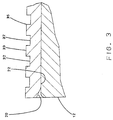
- the plug body 14 is shown with eight identical, equally axially spaced, peripheral, generally U-shaped, annular grooves 32 formed by the bore engaging surface 34.
- the grooves 32 are axially positioned to lie between the transverse end planes of the socket 22 and of the outer pin surface 24 of the installed pin 12.
- the grooves 32 have a total axial width which is approximately equal to the total axial width of the intermediate peripheral lands 33.
- grooves 32 are specific to machined metal components and may change to some extent depending upon the materials and method of manufacture used.
- the grooves 32 are cut perpendicular to the axis of plug body 14. In low pressure applications it may be possible to eliminate grooves 32 or to make other adaptations of bore engaging surface 34 while achieving the necessary retaining force upon installation.
- Alternative configurations include V shaped grooves, creating saw-tooth shape lands.
- FIG. 4 illustrates an alternative embodiment of the present invention, generally designated as plug 40. While in the embodiment illustrated in FIG. 1, the expansion member constitutes pin 12, in the embodiment illustrated in Figure 4, the expansion member constitutes a spherical ball member 42, accordingly the term “expansion member” may be used herein from time to time meaning either pin 12 or ball 42. Except as noted above or as otherwise noted herein or as may be obvious, the features and characteristics of plug bodies 14 and 44 are similar. Plug 40 has a plug body inner wall 48 similar to the plug body inner wall 18 of plug 10 and is installed in a method similar to the installation of plug 10.
- Plug 40 has a bore engaging surface 64 similar to bore engaging surface 34 of plug 10 and said bore engaging surface 64 comprises axially alternating peripheral lands 60 and grooves 58 similar to the lands 33 and grooves 32 of plug 10, and lands 60 have land edges 65 similar to the land edges 35 of lands 33 of plug 10.
- Chamfered plug body edge 66, plug body inner end 68 and plug body outer end 69 correspond and are similar to the chamfered plug body edge 36, plug body inner end 38 and plug body outer end 39 of plug 10, respectively. Therefore, with the noted exceptions, statements made herein regarding the features and characteristics of the elements and features of plug 10 are to be considered as applying to the corresponding elements and features of plug 40.
- a notable exception is the adaptation of opening 50 of the plug body bore 46.
- an area of enlarged inside diameter of bore 46 provides recess 70 that receives and retains the ball 42, accommodating the outside diameter of ball 42 without distorting the outer surface 64 of plug body 44, thereby allowing the preassembly of plug 40.
- the opening 50 of the socket 52 may be crimped after partial preinsertion of the ball 42 for the secure retention of the ball 42 after preinsertion into recess 70. Further, since the outside diameter of ball 42 remains relatively constant, the socket 52 need not be tapered.
- plug 10 and plug 40, the expansion member 12 or 42 is can be partially inserted into the socket 22 (or 52), so that the plug 10 or plug 40 can be preassembled as a one piece unit. Due to the amount of expansion required in plug body 14, and the angle of taper of the socket 22 and pin 12, the pin 12 will be retained therein by friction without requiring such forceful insertion as would unacceptably distort the plug body 14. Alternatively, in plugs of insufficient socket and pin taper, the plug body 14 outer end inside diameter may be increased and/or the outside diameter of pin 12 inner end may be decreased such that the pin 12 can be partially preinserted into the socket 22 while maintaining the desired taper of the outer surface 23 of the plug body 14.
- the preassembled expansion member 12 or 42 and plug body 14 or 44 may be inserted into the counterbore 28 as a unit.
- Construction of the plug 10 or 40 as a one piece unit prevents the otherwise possible inclusion of foreign matter in the plug body socket 22 or 52 and prevents mismatching of plug bodies with expansion members 12 or 42.
- preassembly simplifies and aids the procedure of installation by requiring less manual dexterity than is necessary with separate parts, particularly in the miniature sizes.
- the sealing plug 10 is used and installed in a method similar in many respects to that described in the aforementioned U.S. Patent 2,821,323, with exceptions as noted herein.
- the tapered counterbore 28 is reamed, cast or otherwise formed in the component part 30 with the same taper angle and approximately the same diameter as the outer surface 34 of the unstressed plug body 14 of the plug 10 dimensionned with the appropriate outside diameter.
- the preassembled plug body 14 and pin 12 are mounted within the counterbore 28 by inserting the same therein until the outer surface 34 of the unstressed plug body 14 snugly engages the inner surface of the counterbore 28.
- the pin 12 is then driven axially into the bore 16 of plug body 14 until the outer end of the pin 12 is flush with the outer end 39 of the plug body 14 as shown in broken lines in Fig. 1. whereby the plug body is radially expanded and the outer surface 34 of the plug body 14 forcibly and sealingly engages the inner surface of the counterbore 28. Installation of plug 40 is accomplished in essentially the same manner as set forth above with respect to plug 10.
- the sealing plug 10 is designed to provide the desired amount of radial expansion of the outer plug body 14 in accordance with the strength and hardness of the material of the associated component part 30.
- the range of acceptable radial interference between the unstressed expansion member 12 or 42 and plug body 14 or 44 is predetermined for each plug size.
- the average diameter of the expansion member 12 or 42 is related to the average diameter of the socket 22 or 52 to provide one of several predetermined diametral interferences for expanding the plug body 14 or 44 outwardly by driving the expansion member into the plug body 14.
- the plug body 14 or 44 is thereby expanded outwardly by the expansion member into engagement with the tapered wall of its counterbore 28.
- the dimensions of the expansion member 12 or 42 are established to provide a substantial radial force between the plug body 14 and the associated part 30. That radial force is dependent in part on (a) the radial expansion of the plug body 14 by the expansion member 12 or 42, (b) the radial expansion of the associated part 30 and (c) the elastic/plastic elongation of the plug body 14 and/or expansion member 12 or 42.
- the diameter of the expansion member 12 or 42 is made greater than the diameter of the plug body socket 22 by an amount corresponding to the desired theoretical radial expansion of the plug body 14.
- the unstressed interference or difference in the outside diameter of the pin outer surface 24 and the inside diameter of the plug body socket 22 is variable up to about 0.203mm (0.008 inches).
- Plug body 14 may be matched with a variety of pins 12 variously dimensioned to cause a corresponding variety of amounts of radial expansion.
- the expulsive force exerted against plug 10 or 40 is a function of the cross-sectional area exposed to the media within the counterbore, while the retentive capability is a function of both the amount of expansion and the area of the bore engaging surface 34 of the plug body 14. Since the ratio of the bore engaging surface to cross-sectional area is higher for smaller diameter plugs, smaller diameter plugs generally require less radial expansion to achieve retentive capability, as determined by blowout pressure, equivalent to that of plugs of larger diameter.
- the amount of expansion of plug 10 can be varied depending upon the proof pressure desired and limitations of structure and/or material of the component 30 or the plug body material. Relatively precise selection of the expansion desired for particular application is possible because of the snug fit of the tapered surfaces of counterbore 28 and plug body outer surface 34 whereby, as aforesaid, most if not all of the expansion of the plug body 14 results in radial, sealing force rather than being expended in bridging installation bore tolerances.
- the illustrated preferred embodiment for example, has been tested at the 10.41mm (0.41 inch) diameter size, in aluminum, with pin 12 of varying diameter to provide three expansion selections.
- the sealing plug of the present invention is suitable for manufacture over a wide range of sizes, following chart illustrates by way of example, the dimensions of an exemplar of plug 10 as illustrated in FIG. 1: Plug body outside diameter, outer end 0.4100 inches (10.41mm) Plug body outside diameter, inner end 0.382 inches (9.70mm) Tangent of plug body bore-engaging surface taper .075 Plug body inside diameter, outer end 0.364 inches (9.25 mm) Plug body inside diameter inter end 0.354 inches (8.99 mm) Tangent plug body socket inside taper angle .0365 Depth of plug body socket .360 inches (9.14) mm) Pin length (all expansions) .335 inches (8.51 mm) Tangent pin taper angle (all expansions) .0365 Pin outer end, outside diameter [0.008 inch (0.2 mm) expansion] .372 inches (9.45 mm) Pin outer end, outside diameter [0.006 inch (0.15 mm) expansion] .370 inches (9.40 mm) Pin outer end, outside diameter [
- plug 10 has been fabricated of aluminum, a variety of materials could be used with satisfactory, but somewhat different results. It is specifically anticipated that stainless steel, plastic or composite materials may be used and the differing characteristics of such materials would be design considerations. In applications involving softer or more plastic materials, the plug expansion and/or the diametral interference could be considerably greater and harder or more brittle materials would not tolerate as much expansion without cracking. Generally, the plug body 14 or 44 and expansion member 12 or 42 should be thermally compatible with each other and with the material of the component 30 to prevent the stresses or separations potentially caused by unequal expansion and contraction rates.
- the material of the tapered pin 12 or ball 42 may be the same as, but is preferably slightly harder than, the base material of the plug body 14 or 44 which shoulh have approximately the same hardness as the material of the component 30.
- the yield strength of the base material of the plug body 14 ensures that the radial expansion force between the plug 10 and its mounting bore wall is maintained within an acceptable tolerance.
- materials are preferably chosen that will tend to retain the radial expansion imparted by ball 42, in those expanded sections not supported by ball 42.
- a plug body 14 employing a machineable base material of lesser hardness and lesser yield strength and an outer surface material of substantially greater hardness and greater yield strength provides a more effective interengagement between the outer surface 34 of the plug body 14 and the wall of its counter bore 28 and provides for firmly locking the plug 10 in position against hydraulic system pressures.
- This tendency has been disclosed in the U.S. Patent No. 4,867,333 to Kolp, Anderson and Dickey which disclosure is incorporated herein.
- the plug body 14 consists of a base material of certain hardness and yield strength and an outer surface material of substantially higher hardness and yield strength.
Landscapes
- Engineering & Computer Science (AREA)
- General Engineering & Computer Science (AREA)
- Mechanical Engineering (AREA)
- Pressure Vessels And Lids Thereof (AREA)
Claims (10)
- Verfahren zum Verschließen einer Öffnung durch Einsetzen eines Ausdehnungsverschlußstopfens mit einem Stopfenkörper (14, 44), in dem eine koaxiale Grundbohrung (16, 46) ausgebildet ist, und einem Ausdehnungsverschlußmittel (12) in die Öffnung, wobei das Verfahren die folgenden Schritte umfaßt: Aufreiben der Öffnung zur Herstellung einer konisch zulaufenden Installationsbohrung (28), Einsetzen des Ausdehnungsverschlußstopfens in die Installationsbohrung, wobei der Stopfenkörper (14, 44) des Ausdehnungsverschlußstopfens eine konisch zulaufende Außenfläche (34, 64) mit einem axialen Innenende (18, 48) und einem axialen Außenende mit einem größeren Außendurchmesser als das axiale Innenende aufweist und seine koaxiale Grundbohrung (16, 46) von einem axialen Außenende des Stopfenkörpers zu einem axialen Innenende des Stopfenkörpers verläuft, und wobei das Ausdehnungsverschlußmittel (12, 42) einen Durchmesser aufweist, der um einen vorbestimmten Betrag größer ist als der Durchmesser der Stopfenbohrung, und Ausüben einer Kraft auf das Ausdehnungsmittel zum Treiben des Ausdehnungsmittels in Axialrichtung zu dem axialen Innenende des Stopfenkörpers und in die stopfenbohrung, wodurch sich der Stopfenkörper radial in Eingriff mit der Wand der Installationsbohrung ausdehnt.
- Verfahren nach Anspruch 1, bei dem die Außenfläche des Stopfenkörpers in dem gleichen Winkel konisch zuläuft wie die Installationsbohrung.
- Verfahren nach Anspruch 1 oder 2, bei dem die Stopfenbohrung konisch zuläuft und so eine kegelstumpfförmige Hülse bildet.
- Verfahren nach Anspruch 1, 2 oder 3, bei dem das innere Ausdehnungsmittel einen kegelstumpfförmigen Stift umfaßt.
- Verfahren nach einem der Ansprüche 1, 2 oder 3, bei dem das innere Ausdehnungsmittel ein kugelförmiges Glied umfaßt.
- Verfahren nach einem der Ansprüche 1 bis 5, bei dem der Schritt des Aufreibens der Installationsbohrung einen Kegelwinkel von ca. 3,5 bis ca. 5,0 Grad bildet.
- Verfahren nach Anspruch 6, bei dem der Kegelwinkel der Installationsbohrung und der Außenfläche des Stopfenkörpers ca. 4,3 Grad beträgt.
- Verfahren nach einem der Ansprüche 1 bis 7, bei dem die koaxiale Bohrung an dem äußeren Ende einen Innendurchmesser aufweist, der zur Aufnahme des teilweise eingesetzten und durch Reibung darin festgehaltenen Ausdehnungsmittels ausreicht.
- Verfahren nach einem der Ansprüche 1 bis 8, weiterhin mit dem Vorbereitungsschritt des teilweisen Einsetzens des Ausdehnungsmittels in die Stopfenbohrung, und zwar so weit, daß das Ausdehnungsmittel durch Reibung in der Stopfenbohrung festgehalten wird, ohne den Stopfenkörper auszudehnen.
- Verfahren nach einem der Ansprüche 1 bis 9, bei dem der Stopfenkörper weiterhin mehrere axial beabstandete, um den Umfang verlaufende, ringförmige Nuten und Stege entlang der Außenfläche des Stopfenkörpers umfaßt.
Applications Claiming Priority (2)
| Application Number | Priority Date | Filing Date | Title |
|---|---|---|---|
| US07/483,235 US5160226A (en) | 1990-02-22 | 1990-02-22 | Tapered expansion sealing plug |
| US483235 | 1990-02-22 |
Publications (3)
| Publication Number | Publication Date |
|---|---|
| EP0443720A2 EP0443720A2 (de) | 1991-08-28 |
| EP0443720A3 EP0443720A3 (en) | 1992-02-19 |
| EP0443720B1 true EP0443720B1 (de) | 1997-04-23 |
Family
ID=23919254
Family Applications (1)
| Application Number | Title | Priority Date | Filing Date |
|---|---|---|---|
| EP91300484A Expired - Lifetime EP0443720B1 (de) | 1990-02-22 | 1991-01-22 | Kegelförmiger Expansionsdichtung |
Country Status (4)
| Country | Link |
|---|---|
| US (1) | US5160226A (de) |
| EP (1) | EP0443720B1 (de) |
| JP (1) | JPH04211766A (de) |
| DE (1) | DE69125739T2 (de) |
Families Citing this family (44)
| Publication number | Priority date | Publication date | Assignee | Title |
|---|---|---|---|---|
| JPH0578948U (ja) * | 1992-03-30 | 1993-10-26 | 日産ディーゼル工業株式会社 | シリンダブロックのシーリング装置 |
| JP2940898B2 (ja) * | 1993-05-14 | 1999-08-25 | 永山電子工業 株式会社 | Tナット |
| US5505229A (en) * | 1993-07-12 | 1996-04-09 | The Lee Company | Fluid resistor |
| DE4434139C1 (de) * | 1994-09-24 | 1995-08-31 | Ford Werke Ag | Gußteilform mit Gießkernabstützung und Gußteil mit Kernöffnungsverschluß |
| US5779085A (en) * | 1997-03-11 | 1998-07-14 | Gas Research Institute | Expandable pin plug for automated use |
| US6637309B2 (en) | 1999-10-15 | 2003-10-28 | Champion Fiberglass, Inc. | Launch tube and a method for making a launch tube |
| DE10040193A1 (de) * | 2000-08-17 | 2002-03-07 | Aerolas Gmbh | Gasdrucklager |
| DE10064697A1 (de) * | 2000-08-29 | 2002-06-06 | Frank Bolles | Verfahren und System zum Verschließen eines Hohlkörpers wie eines Rohres, insbesondere eines kontaminierten Rohres |
| US6805024B1 (en) * | 2001-10-09 | 2004-10-19 | Valeo Electrical Systems, Inc. | End play restriction wedge |
| US7407630B2 (en) | 2003-09-19 | 2008-08-05 | Applera Corporation | High density plate filler |
| US20070014694A1 (en) * | 2003-09-19 | 2007-01-18 | Beard Nigel P | High density plate filler |
| US7998435B2 (en) | 2003-09-19 | 2011-08-16 | Life Technologies Corporation | High density plate filler |
| US20050232821A1 (en) * | 2003-09-19 | 2005-10-20 | Carrillo Albert L | High density plate filler |
| US8277760B2 (en) | 2003-09-19 | 2012-10-02 | Applied Biosystems, Llc | High density plate filler |
| EP1584388A1 (de) * | 2004-04-05 | 2005-10-12 | Kabushiki Kaisha Toyota Jidoshokki | Ecrou borgne à noyer dans une pièce moulé, pièce comprenant l'écrou, et procédé de coulée de la pièce |
| US6978765B2 (en) * | 2004-04-26 | 2005-12-27 | Siemens Vdo Automotive Corporation | Fuel system with press fit plug assembly |
| US7278480B2 (en) * | 2005-03-31 | 2007-10-09 | Schlumberger Technology Corporation | Apparatus and method for sensing downhole parameters |
| US7575379B2 (en) * | 2006-06-22 | 2009-08-18 | Applied Optical Systems, Inc. | Body having staking pin and method of making |
| US7721694B2 (en) | 2006-07-20 | 2010-05-25 | Delphi Technologies, Inc. | Lock pin retention plug for a two-step rocker arm assembly |
| US8104248B2 (en) * | 2007-04-27 | 2012-01-31 | Handy & Harman | Plug finishing system and tool therefor |
| EP2000630A1 (de) * | 2007-06-08 | 2008-12-10 | Services Pétroliers Schlumberger | 4D-Druckmessvorrichtung im Borhloch und Verfahren zur Permeabilitätscharakterisierung |
| WO2009003166A1 (en) * | 2007-06-27 | 2008-12-31 | Parker-Hannifin Corporation | Spring-energized sealing plug |
| AT505294B1 (de) | 2007-08-10 | 2008-12-15 | Hoerbiger Automatisierungstech | Verfahren zum druckdichten verschliessen einer bohrung, sowie druckgehäuse |
| DE102007042997A1 (de) * | 2007-09-10 | 2009-03-12 | Marco Systemanalyse Und Entwicklung Gmbh | Verschlussstopfen |
| US7946440B2 (en) * | 2007-11-13 | 2011-05-24 | Kvt Koenig, Llc | Two-piece expandable sealing plug |
| US7631664B1 (en) * | 2008-09-04 | 2009-12-15 | Tejas Research And Engineering, Lp | Threaded expansion plugs |
| US20110274515A1 (en) * | 2009-01-16 | 2011-11-10 | R & B Marketing Corporation | Plugs With Dimensional Tolerance Absorbing Hold-In Surfaces |
| CN101793322B (zh) * | 2010-02-10 | 2015-02-18 | 中国人民解放军63908部队 | 一种自闭式密封塞头 |
| US8540469B2 (en) | 2010-06-10 | 2013-09-24 | Black & Decker Inc. | Drop-in anchor |
| JP2012112355A (ja) * | 2010-11-26 | 2012-06-14 | Otics Corp | デリバリパイプ |
| FR3012564B1 (fr) * | 2013-10-30 | 2015-12-18 | Dassault Aviat | Dispositif et procede d'obturation d'une extremite d'un conduit |
| US10040182B2 (en) | 2014-01-21 | 2018-08-07 | Engineered Inserts & Systems, Inc. | System and method for installing a manifold plug |
| EP3104025A1 (de) * | 2015-06-11 | 2016-12-14 | HILTI Aktiengesellschaft | Spreizdübel mit doppelbeschichtung |
| GB2543853B (en) * | 2015-11-02 | 2019-10-02 | Ford Global Tech Llc | A passage closure plug |
| DE102016106818B3 (de) * | 2016-04-13 | 2017-07-13 | Gemü Gebr. Müller Apparatebau Gmbh & Co. Kommanditgesellschaft | Ventilelement mit RFID-CHIP |
| DE102016211282A1 (de) * | 2016-06-23 | 2017-12-28 | Baier & Michels Gmbh & Co. Kg | Verschlusselement zum Verschließen und Abdichten innendruckbeanspruchter Bohrungen |
| EP3312105B1 (de) | 2016-10-21 | 2022-10-19 | Collins Engine Nozzles, Inc. | Hydraulikstecker |
| EP3366970B1 (de) | 2017-02-22 | 2019-10-30 | Delavan, Inc. | Hydraulikstopfen |
| CN107187099A (zh) * | 2017-07-18 | 2017-09-22 | 中国工程物理研究院化工材料研究所 | 用于等静压成型工艺柔性模具进料口快速密封方法和装置 |
| EP3477180B1 (de) | 2017-10-28 | 2021-04-14 | Hamilton Sundstrand Corporation | Hydraulikstecker |
| US10859105B2 (en) | 2017-11-07 | 2020-12-08 | Engineered Inserts & Systems, Inc. | Insert and system for providing a calibrated metering orifice |
| US20190380543A1 (en) * | 2018-06-15 | 2019-12-19 | Prateek N. Bhargava | Modular cutting board and accessories |
| US11261691B2 (en) * | 2020-07-15 | 2022-03-01 | Vertechs Petroleum Technology Innovation & Equipment Manufacturing Co., Ltd. | Integrated coupling and downhole plugging system and plugging method |
| US12553562B2 (en) * | 2022-03-10 | 2026-02-17 | The Lee Company | Insert with diametral locking feature and indication feature for installation and method of installation thereof |
Family Cites Families (13)
| Publication number | Priority date | Publication date | Assignee | Title |
|---|---|---|---|---|
| US577737A (en) * | 1897-02-23 | Robert flaherty | ||
| FR16018E (fr) * | 1912-11-05 | Jules Guy Fernand Bernard Roge | Dispositif de bouchage de sureté pour bouteilles | |
| US1064544A (en) * | 1912-10-04 | 1913-06-10 | Louis Rosenfield | Bottle-stopper. |
| CH79937A (de) * | 1918-08-12 | 1919-01-16 | Rudolf Leuthold | Verfahren zum Verschließen von Gefäßen, insbesondere von Flaschen, Sterilisiergläsern und dergleichen und nach dem Verfahren hergestellter Verschluß |
| CH95226A (de) * | 1919-04-24 | 1922-06-16 | Leuthold Rudolf | Verschluss, insbesondere für Sterilisiergefässe. |
| US2821323A (en) * | 1955-12-07 | 1958-01-28 | Lee Co | Pin plug |
| US3200694A (en) * | 1963-02-08 | 1965-08-17 | Illinois Tool Works | Plastic fastener |
| US3525365A (en) * | 1966-10-17 | 1970-08-25 | Pneumo Dynamics Corp | Expansion plug |
| DE1625262A1 (de) * | 1967-10-18 | 1970-02-05 | Avdel Verbindungselemente | Klemmutter |
| BE745681A (fr) * | 1970-02-09 | 1970-07-16 | Polack Andre | Element de fixation, |
| NL7109253A (de) * | 1970-07-08 | 1972-01-11 | ||
| US4113006A (en) * | 1977-01-31 | 1978-09-12 | Clapp Porter B | Two-piece tube plug for repairing tubes in heat exchangers and the like |
| US4186645A (en) * | 1977-12-02 | 1980-02-05 | General Motors Corporation | Plastic plug, nut and stud fastener assembly |
-
1990
- 1990-02-22 US US07/483,235 patent/US5160226A/en not_active Expired - Lifetime
-
1991
- 1991-01-22 EP EP91300484A patent/EP0443720B1/de not_active Expired - Lifetime
- 1991-01-22 DE DE69125739T patent/DE69125739T2/de not_active Expired - Lifetime
- 1991-02-20 JP JP3047700A patent/JPH04211766A/ja not_active Withdrawn
Also Published As
| Publication number | Publication date |
|---|---|
| EP0443720A3 (en) | 1992-02-19 |
| DE69125739T2 (de) | 1997-11-13 |
| JPH04211766A (ja) | 1992-08-03 |
| US5160226A (en) | 1992-11-03 |
| EP0443720A2 (de) | 1991-08-28 |
| DE69125739D1 (de) | 1997-05-28 |
Similar Documents
| Publication | Publication Date | Title |
|---|---|---|
| EP0443720B1 (de) | Kegelförmiger Expansionsdichtung | |
| US4322175A (en) | Joint assembly | |
| US5181752A (en) | Pipe fitting with swage ring locking mechanism | |
| US4867333A (en) | High-pressure pin plug | |
| US3501993A (en) | Setscrew with rotatable plastic end | |
| US4048898A (en) | Fastener for multi metal stack-ups | |
| US6062611A (en) | Locked pipe joint and split metal retaining ring therefor | |
| EP1370793B1 (de) | Kupplungsadapteranordnung | |
| CA1073498A (en) | Automotive quick connect tube coupling | |
| US4818166A (en) | Fastening a component on a shaft or in a bore against axial displacement | |
| GB2264993A (en) | Securing shaft and hub together | |
| US5643092A (en) | Assembly for axially fixing a splined hub on a splined shaft | |
| US4775249A (en) | Plain bearing | |
| JPH022035B2 (de) | ||
| US5007746A (en) | Thrust bearing with resilient retention tang | |
| GB2314286A (en) | Forming a frictional connection | |
| AU2001294076A1 (en) | Coupling adapter and assembly | |
| US5839845A (en) | Adjustable torque pivot joint | |
| US5121947A (en) | Expansion sealing device | |
| US6027292A (en) | Expansion anchor with tabs having a changing curvature radius | |
| US3198058A (en) | Blind rivet | |
| CA1281196C (en) | Axial retaining member and method for interconnecting male and female splined members | |
| GB2188387A (en) | Securing connector to a pipe | |
| US6543817B1 (en) | Process for forming radially upset tube flange and tube connector assembly formed thereby | |
| US4371356A (en) | Sliding universal joints, particularly for automobile transmissions |
Legal Events
| Date | Code | Title | Description |
|---|---|---|---|
| PUAI | Public reference made under article 153(3) epc to a published international application that has entered the european phase |
Free format text: ORIGINAL CODE: 0009012 |
|
| AK | Designated contracting states |
Kind code of ref document: A2 Designated state(s): DE FR GB IT |
|
| PUAL | Search report despatched |
Free format text: ORIGINAL CODE: 0009013 |
|
| AK | Designated contracting states |
Kind code of ref document: A3 Designated state(s): DE FR GB IT |
|
| RHK1 | Main classification (correction) |
Ipc: B65D 39/12 |
|
| 17P | Request for examination filed |
Effective date: 19920722 |
|
| 17Q | First examination report despatched |
Effective date: 19940315 |
|
| GRAG | Despatch of communication of intention to grant |
Free format text: ORIGINAL CODE: EPIDOS AGRA |
|
| GRAH | Despatch of communication of intention to grant a patent |
Free format text: ORIGINAL CODE: EPIDOS IGRA |
|
| GRAH | Despatch of communication of intention to grant a patent |
Free format text: ORIGINAL CODE: EPIDOS IGRA |
|
| GRAA | (expected) grant |
Free format text: ORIGINAL CODE: 0009210 |
|
| AK | Designated contracting states |
Kind code of ref document: B1 Designated state(s): DE FR GB IT |
|
| REF | Corresponds to: |
Ref document number: 69125739 Country of ref document: DE Date of ref document: 19970528 |
|
| ET | Fr: translation filed | ||
| PLBE | No opposition filed within time limit |
Free format text: ORIGINAL CODE: 0009261 |
|
| STAA | Information on the status of an ep patent application or granted ep patent |
Free format text: STATUS: NO OPPOSITION FILED WITHIN TIME LIMIT |
|
| 26N | No opposition filed | ||
| REG | Reference to a national code |
Ref country code: GB Ref legal event code: IF02 |
|
| PGFP | Annual fee paid to national office [announced via postgrant information from national office to epo] |
Ref country code: FR Payment date: 20100210 Year of fee payment: 20 |
|
| PGFP | Annual fee paid to national office [announced via postgrant information from national office to epo] |
Ref country code: GB Payment date: 20100202 Year of fee payment: 20 Ref country code: DE Payment date: 20100129 Year of fee payment: 20 |
|
| REG | Reference to a national code |
Ref country code: GB Ref legal event code: PE20 Expiry date: 20110121 |
|
| PG25 | Lapsed in a contracting state [announced via postgrant information from national office to epo] |
Ref country code: IT Free format text: LAPSE BECAUSE OF NON-PAYMENT OF DUE FEES Effective date: 20100122 |
|
| PG25 | Lapsed in a contracting state [announced via postgrant information from national office to epo] |
Ref country code: GB Free format text: LAPSE BECAUSE OF EXPIRATION OF PROTECTION Effective date: 20110121 |
|
| PGFP | Annual fee paid to national office [announced via postgrant information from national office to epo] |
Ref country code: IT Payment date: 20100125 Year of fee payment: 20 |
|
| PGRI | Patent reinstated in contracting state [announced from national office to epo] |
Ref country code: IT Effective date: 20110616 |
|
| PG25 | Lapsed in a contracting state [announced via postgrant information from national office to epo] |
Ref country code: DE Free format text: LAPSE BECAUSE OF EXPIRATION OF PROTECTION Effective date: 20110122 |