EP0443755B1 - Système de commande d'antémémoire - Google Patents
Système de commande d'antémémoire Download PDFInfo
- Publication number
- EP0443755B1 EP0443755B1 EP91301062A EP91301062A EP0443755B1 EP 0443755 B1 EP0443755 B1 EP 0443755B1 EP 91301062 A EP91301062 A EP 91301062A EP 91301062 A EP91301062 A EP 91301062A EP 0443755 B1 EP0443755 B1 EP 0443755B1
- Authority
- EP
- European Patent Office
- Prior art keywords
- data
- shared
- cache
- private
- count value
- Prior art date
- Legal status (The legal status is an assumption and is not a legal conclusion. Google has not performed a legal analysis and makes no representation as to the accuracy of the status listed.)
- Expired - Lifetime
Links
Images




Classifications
-
- G—PHYSICS
- G06—COMPUTING OR CALCULATING; COUNTING
- G06F—ELECTRIC DIGITAL DATA PROCESSING
- G06F12/00—Accessing, addressing or allocating within memory systems or architectures
- G06F12/02—Addressing or allocation; Relocation
- G06F12/08—Addressing or allocation; Relocation in hierarchically structured memory systems, e.g. virtual memory systems
- G06F12/0802—Addressing of a memory level in which the access to the desired data or data block requires associative addressing means, e.g. caches
- G06F12/0806—Multiuser, multiprocessor or multiprocessing cache systems
- G06F12/0815—Cache consistency protocols
- G06F12/0831—Cache consistency protocols using a bus scheme, e.g. with bus monitoring or watching means
Definitions
- This invention relates to a cache control system for a multiprocessor system having a plurality of processors connected to a shared bus and a shared memory through respective private caches.
- Tightly coupled multiprocessor systems having a plurality of processors with private caches, which processors are connected one another through a shared bus, are being used in practical applications.
- each processor has a private cache, keeps in the cache a partial copy of data stored in the shared memory, and performs read/write access to the data within the cache, and thereby the shared bus and memory are not used very frequently (A multi-cache system). That approach however causes the problem that when each processor modifies shared data in its cache without relation to the other one or more sharing processors, the sharing processors may have different data at a given address at a particular time. Means for keeping data at a given address in different caches the same is accordingly needed.
- the term "the consistency of data” will be used to refer to every processor being able to access the same data at a given address.
- the snoopy cache technique maintains data consistency among caches by monitoring the shared bus with cache controllers provided for each processor. That is, when a processor modifies data in its cache, it sends information about how it is modifying the data and what address the modified data is at, on the shared bus. If another one or more processors share that data, the cache controllers of the other processors see that information and either update or invalidate the data in their caches to maintain data consistency.
- JP-A-2 186 456 provides a cache control system designed to selectively switch between the update and invalidate types with implementation in software.
- the update type is suitable for cases where data tightly shared by processors (or where the processors almost equally access shared data) is manipulated.
- the invalidate type is not suitable for those cases, because each time each processor modifies a shared data area the copies in the caches of the other sharing processors are invalidated, thereby a read/write access to that area by the other sharing processors inevitably causes a cache miss and requires access to the shared bus.
- the copies in the sharing caches are accordingly updated thereby enabling the data area to be read without accessing to the shared bus.
- the update type works well when using for buffers used the parallel program of the producer and consumer model, and semaphore or the like used to synchronize processors, etc.
- the invalidate type is preferably applied to shared data which is exclusively used by one processor or shared data to which access is not made frequently by the other processors. Paging of process migration may make data exclusively held by one processor as shared while it should be kept as exclusive, which situation places unnecessary shared data in the system and degrades the performance. The invalidate type is effective in that situation.
- Japanese Patent application No. JP-A-3 217 963 provides a technique which switches between cache protocols automatically depending on the information of working sets.
- the present invention provides a cache control system (C) for a private cache (4) in a multiprocessor data processing system comprising a plurality of processors (P1-Pn) each connected to a shared bus (1) via similar private caches (C1-Ch), the cache control system (C) co-operating with similar cache control systems (C1-Cn) provided for other private caches in the data processing system, the cache control system (C) comprising:
- the present invention enables a mechanism to be provided enabling dynamically and most favourably to switch between the protocols of the invalidate and update types. This mechanism enables traffic on the shared bus to be reduced and the system performance to be improved.
- this is achieved by switching the protocol used for each shared data at each private cache, automatically depending upon the likelihood or frequency that the processor corresponding to the private cache concerned accesses the shared data concerned, and the likelihood or frequency that the other processors that the processor concerned access the shared data concerned.
- a cache control system as claimed in claim 1 further comprising means for incrementing the count value upon detecting on the shared bus of a signal indicating that the data has been modified at another of the private caches in the data processing system and means for decrementing the count value upon access to the shared data by the processor associated with the cache control system.
- a frequency that the processor corresponding to the private cache concerned accesses the shared data concerned is determined, and further another frequency that such a signal is sent on the shared bus which indicates that either of the other processors modifies the shared data concerned is determined, and then the difference between the above frequencies is calculated to compare with a predetermined reference value. The result of the comparing is used to automatically switch the protocols used for the shared data concerned at the private cache concerned.
- the controller when a piece of shared data is modified at one of the other private caches in the system the controller either invalidates the shared data concerned or modifies the shared data in accordance with the modification to the shared data at the other of the private caches, depending on the result of the determination.
- the invention further enables a cache memory system or private cache comprising a data storage means and a cache control system as described above to be provided, a processor capable of co-operating with a plurality of similar processors and comprising the cache memory system to be provided and a multiprocessor data processing system comprising a plurality of the processors, a shared bus and a shared memory means to be provided.
- Figure 1 shows the overall configuration of the multiprocessor system of the embodiment, wherein a plurality of processors P1, P2,..Pn are connected to a shared bus 1 and shared memory 2 via respective caches C1, C2,..Cn.
- the caches C1, C2,..Cn enable the processors P1, P2,..Pn to perform memory access more rapidly at average and have means for maintaining the consistency among the caches C1, C2,..Cn.
- Each of the caches C is configured as shown in Figure 2, wherein a cache controller 3 performs such basic control of the whole of the cache C, required when the cache C is accessed by the processor P, and when snooping the bus 1.
- a cache data memory 4 is a high speed memory for storing a partial copy of data stored at the main memory (the shared memory 2).
- the cache data memory 4 is for example capable of storing 16 data blocks each having 64 bits.
- the processor P can read / write required data via the data memory 4 at most of times without accessing the main memory (the data block is a unit of data in accessing). Therefore the processor P can perform more rapid memory access on average.
- a cache tag memory 5 is designed to store a cache tag as shown in figure 3 for each data block stored in the cache data memory 4.
- the cache tag includes fields of V, S, D, an access count, and address information , as described in detail later.
- a reference register 6 is designed to store a reference value in relation to the access counts in the cache tags stored in the cache tag memory 5.
- a comparator 7 is designed to compare the access count in the cache tag specified with the address information, with the reference value and supply the comparison result to the cache controller 3.
- the cache tag is constituted of the fields of V, S, D, an Access count, and address information.
- the address information is the same as used for the data block corresponding to the cache tag concerned.
- V, S, and D are valid, shared, and dirty flags, and indicate the state of the data block identified with the address information as follows:
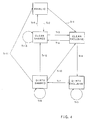
- the states of a data block in the cache data memory 4 are, also as shown in Figure 4, the following five states.
- Conventional snoopy protocols have a cache tag including a D ( dirty) flag, an S ( shared ) flag, and a V ( valid) flag, and thereby control the statuses of data blocks.
- the access count field is provided in addition to those flags ( Figure 3).
- the control for shared copies in the cases is optimized by using the relationship between the the reference value (the above mentioned register 6 ) and the value in the added field,or the access count field.
- This field is a counter which holds a positive value, said value is incremented or decremented in accordance to the following rules.
- M is held in the reference register 6 of Figure 2, and can be updated with software.
- the cache controller 3 operates as to perform the protocol of the update type in the R state, and to perform the protocol of the invalidate type in the R state (not R state).
- the reference value (M) is set to zero the protocol is of the conventional invalidate, and when set to infinite (practically impossible due to the bit width limitation of the access count field) the protocol is of the conventional update type.
- the reference value for optimizing the cache performance is determined on the cache configuration (the block size, the access width of the processor P), the penalty for bus use (cycle duration of bus read and bus write), the number of caches in the system, etc. The optimization factors are described later.
- the cache controller 3 makes reference to the cache tag each time the processor P accesses or each time the snooping on the bus 1 occurs, and thereby determines how to operate. At the same time it determines whether or not the state is R based on the output from the comparator 7 which compares between the value of the access count and the value in the reference register 6.
- a data block is aforementioned controlled with the five states.
- the CH (Cache Hit) signal line is a special purpose signal line provided to the bus 1 and indicates whether the block concerned is in the shared or exclusive state over the caches.
- the cache controller 3 asserts the CH when it receives a read or write signal from the bus and the cache C has a copy of the data concerned. That asserting informs the requesting cache that the cache C has the copy.
- the five states themselves are basically identical to ones used the update protocol disclosed in Japanese Patent Application H1-4799.
- the access count field is added in the cache tag for use of transition among the five states.
- the cache tag of the embodiment consists of not only the address information used for conventional caches C but also the three flags of valid, shared, and dirty types and the access count field operating as an up-down counter.
- This transition occurs when the processor P performs a read operation and no copy exist in the cache C, thereby a cache miss occurs, and further no CH signal is asserted. After the transition, no copy exist in other caches than the cache, and only cache C has a copy in the whole of the system.
- This transition occurs when my processor P performs a read operation and no copy exists in cache C, thereby a cache miss occurs, and further one or more CH signals are asserted. At least one other cache has the same copy.
- This transition occurs when processor P performs a write operation, and a cache hit occurs, and further no other caches assert a CH signal.
- the block is accordingly set to a exclusive state.
- processor P performs a write operation and a cache hit occurs. Since only processor P has a copy, it can modify the copy without informing the other processors of it.
- the cache C concerned has a different contents from the shared memory 2, and the state is accordingly changed to dirty.
- This transition occurs when processor P performs a write operation and a cache hit occurs. Since only the cache concerned has a copy, it only modifies the copy.
- This transition occurs when another processor causes a read miss thereby sending a read signal on the shared bus 1, and only cache C has a copy through the system. Since a copy is to be placed in the other cache, a CH signal is asserted and the block gets into a shared state.
- This transition occurs when another processor causes a read miss thereby sending a request signal on the shared bus 1, and only cache C has a copy through the system, the copy being different from the contents stored in the shared memory and the newest.
- Cache C supplies the other cache with the newest data and asserts a CH signal to get into a shared state.
- This transition occurs when another processor causes a read miss thereby sending a read signal on the shared bus, and cache C has the newest value of the copy.
- Cache C supplies the newest data to the requesting cache and asserts a CH signal.
- a bus write request occurs for a block in a clean- shared state. And the block happens to have an access count field of the R state. The block is accordingly invalidated and no CH signal is sent.
- Processor P causes a write hit. It is possible that one or more other caches have copies, and cache C accordingly issues a write request on the shared bus. It is thereafter determined that no other cache asserts a CH signal. The state is accordingly changed to clean- exclusive and the access count field is set to the initial zero value.
- a bus write request is issued for a block in a dirty-shared state, and that block is in an R state.
- the block is accordingly invalidated and no CH signal is asserted.
- the main feature of the invention involves the manipulation of shared data. Whenever a processor P modifies shared data, the consistency of the data is maintained by updating or invalidating related copies in other caches.
- shared data exists in a state of clean- shared or dirty- shared.
- the protocol of the invention is identical to conventional snoopy protocols.
- the access count field is added in the cache tag for minimizing overhead related to shared data, and thereby a block in a shared state is provided with an R attribute indicative whether or not the access count field has reached a reference value (M).
- M reference value
- a processor P causes a cache hit as to shared data and accordingly issues a bus write request
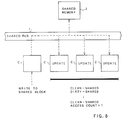
- shared copies in the other caches, in R state are updated, and then the related access counts are counted up by one to record the updating (Figure 5).
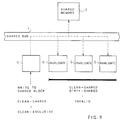
- Shared copies in an R state are invalidated ( Figure 6).
- processor P accesses a shared copy the access count is counted down by one ( Figure 7).
- Figure 7 The difference between the frequency of updating a shared block by the other processors and the frequency of accessing the same by processor P automatically determines whether the block should be updated or invalidated.
- the operations are more simple as described as follows.
- a shared block in cache C is updated by one of the other processors without being accessed even once by processor P after the block was previously updated by one of the other processors, the block in cache C will be invalidated.
- processor P accesses a shared block at least one time in the duration defined by two consecutive update requests to the block from others of the processors, the block remains in cache C.
- the embodiment operates in the same way as conventional update types for shared blocks which are frequently read/written by a plurality of processors. That is, when write access occurs for each of such shared blocks, the relevant copies stored in a plurality of caches are immediately updated but not invalidated ( Figure 8).
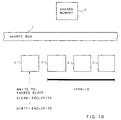
- Figure 8 By contrast, when a shared block which is not frequently accessed by other than one processor P, only the copy in that one processor remains, the copies in the other caches being however invalidated. After the invalidating, that one cache performs operations independently from the others, because the others don't keep the copies( figure 10).
- a snoopy cache C of the embodiment operates at a time in the same way as the update type caches, for shared data which is desired to exist as shared data in that cache at that time.
- the snoopy cache operates in the same way as the invalidate type caches, for shared data which is originally not required to be shared data, or likewise operates at a time, for shared data which is preferably shared data in a long span but a single processor preferably performs exclusive read /write operations for efficient performance at that time.
- the value M which is a decisive factor for switching between the update and invalidate types is optimized depending the processors P, the block size of the caches, patterns in read write operations in a particular program, etc, and cannot be easily determined. Below, the block size and the characteristics of the program are exemplified, and then how the value M affects the performance is described.
- the caches operate in the same way as the invalidate type, thereby at the type the producer writes the first word of the 8 words in the producer's cache, the block in the consumer's cache is invalidated. At this time one cycle is consumed on the bus. The remaining 7 words, as a result, exist only in the producer's cache, and the modification of the data occurs in the producer's cache, and thereby the bus 1 is not used. Following that, the consumer tries to read the first word of the 8 words, and then the block of the 8 words is transferred by using 1 cycle on the bus 1.
- the cache controller of this invention operates in the same way as conventional update types for shared blocks which are frequently read/ written by a plurality of processors P. That is, when write access occurs for each such shared block, the relevant copies stored in a plurality of caches are immediately updated but not invalidated.
- the controller operates in the same way as conventional invalidate types for shared blocks which are not frequently accessed by other than one respective processor P. That is, only the copy in that one processor remains, the copies in the other caches being however invalidated. This invention maximizes the cache performance in terms of the bus traffic, as a result.
- the optimized cache control is achieved. Furthermore since the protocol type can be set for each processor independently, the optimization is achieved for individual processors. Furthermore since the protocol switching is performed by the cache controls, conventional processors and memory control units can be used. Still further since the protocol switching needs not be performed with software such as a compiler or scheduler etc, the conventional software can be used.
- each of said private caches comprises:
- one of said types of procedures is an invalidate type, the procedures of which type, when a shared data is modified at a private cache, change the status of said shared data piece at said private cache into an exclusive status and invalidate said shared data piece or pieces each at the other one or more private caches, the other of said types of procedures being an update type, the procedures of which type, when a shared data piece is modified at a private cache, update accordingly said shared data piece or pieces each at the other one or more private cache, if any, or change the status of said shared data piece at said private cache into an exclusive status if no other private cache has said shared data.
Landscapes
- Engineering & Computer Science (AREA)
- Theoretical Computer Science (AREA)
- Physics & Mathematics (AREA)
- General Engineering & Computer Science (AREA)
- General Physics & Mathematics (AREA)
- Memory System Of A Hierarchy Structure (AREA)
Claims (10)
- Système de commande d'antémémoire (C) pour une antémémoire privée (4) dans un système de traitement de données à multiprocesseur comprenant une pluralité de processeurs (P1 à Pn) chacun relié à un bus partagé (1) via des antémémoires privées similaires (C1 à Ch), le système de commande d'antémémoire (C) coopérant avec des systèmes de commande d'antémémoire similaires (C1 à Cn) prévus pour les autres antémémoires privées dans le système de traitement de données, le système de commande d'antémémoire (C) comprenant :un contrôleur (3) pour surveiller les signaux sur le bus partagé (1) et, lorsque les données partagées entre un des processeurs sont modifiées dans une autre antémémoire, pour effectuer un des deux types de procédures de cohérence de données pour les données partagées ; etun moyen pour déterminer la vraisemblance relative de l'accès aux données partagées par le processeur correspondant à l'antémémoire privée et aux autres processeurs dans le système, le type de procédure de cohérence de données effectuée par le contrôleur est en fonction des résultats de la détermination, ledit moyen pour la détermination comprenant :un moyen de mémorisation d'informations de commande de données (5) pour mémoriser, pour chaque ensemble de données partagées mémorisé dans l'antémémoire privée, une valeur de compte, etun moyen pour comparer (7) la valeur de compte à une valeur de référence (6) ;ledit contrôleur (3) étant conçu pour commuter dynamiquement entre et effectuer l'un ou l'autre desdits types de procédures de cohérence de données en fonction du fait que la valeur de compte est au-dessous d'une valeur de référence ;le système de commande d'antémémoire étant caractérisé par ledit moyen de mémorisation et d'informations de commande de données étant conçu pour compter et décompter par des quantités identiques de sorte que la valeur de compte compte la différence entre le nombre d'accès à l'ensemble de données partagées par le processeur correspondant à l'antémémoire privée et le nombre d'accès à un ensemble de données partagées par les autres processeurs dans le système de traitement de données.
- Système de commande d'antémémoire (C) selon la revendication 1, comprenant de plus un moyen pour incrémenter la valeur de compte sur la détection que sur le bus partagé est présent un signal indiquant que les données ont été modifiées au niveau d'une autre des antémémoires privées dans le système de traitement de données et un moyen pour décrémenter la valeur de compte sur accès aux données partagées par le processeur associé au système de commande d'antémémoire.
- Système de commande d'antémémoire (C) selon la revendication 1 ou 2, dans lequel ledit ensemble de données partagées est modifié au niveau d'une des autres antémémoires privées dans le système de traitement de données à multiprocesseurs, le contrôleur est conçu pour soit invalider sa copie de données partagées, soit modifier sa copie de données partagées en conformité avec la modification effectuée sur les données partagées au niveau de l'autre des antémémoires, en fonction du résultat de la détermination.
- Antémémoire privée (4) pour interconnecter un processeur (P) et un bus partagé (1) dans un système de traitement de données à multiprocesseurs comprenant une pluralité de processeurs (P1 à Pn) reliés au bus partagé (1) par des antémémoires privées similaires, l'antémémoire privée comprenant :un moyen de mémorisation de données ;un système de commande d'antémémoire (C) selon l'une quelconque des revendications 1 à 3.
- Processeur (P) capable de coopérer avec une mémoire partagée et au moins un autre processeur similaire dans un système de traitement de données à multiprocesseurs, le processeur incluant une antémémoire privée (4) selon la revendication 4.
- Système de traitement de données à multiprocesseurs comprenant une pluralité de processeurs selon la revendication 5, un bus partagé et un moyen de mémorisation de données partagées.
- Système à multiprocesseurs ayant une pluralité de processeurs (P1 à Pn) chacun relié à une mémoire partagée (2) et à un bus partagé (1) par l'intermédiaire d'une antémémoire privée correspondante (C1 à Cn) et ayant de plus des contrôleurs (3) chacun prévu pour chacune desdites antémémoires privées (C1 à Cn), chaque contrôleur étant conçu pour surveiller les signaux sur ledit bus partagé (1) et lorsque les données partagées sont modifiées au niveau d'une des autres antémémoires, effectuer l'un des deux types de procédures de cohérence de données pour lesdites données partagées au niveau de son antémémoire privée, pour résoudre le désaccord desdites données partagées entre lesdites antémémoires privées, dans lequel chacun desdits contrôleur (3) comprend :un moyen de mémorisation d'informations de commande de données (5) pour mémoriser, pour chaque ensemble de données mémorisé dans son antémémoire privée, des informations d'adresse dudit ensemble de données, des informations d'état dudit ensemble de données et une valeur de compte ;ledit système à multiprocesseurs étant caractérisé en ce que chacun desdits contrôleurs comprend de plus :un moyen pour incrémenter la valeur de compte lors d'un premier type d'accès audit ensemble de données partagées ;un moyen pour décrémenter la valeur de compte lors d'un second type d'accès audit ensemble de données partagées, de sorte que la valeur de compte compte la différence entre le nombre d'accès des premier et second types ;un moyen de mémorisation de valeur de référence (6) pour mémoriser une valeur de référence liée à ladite valeur de compte ;un moyen de comparaison (7) pour comparer entre ladite valeur de compte et ladite valeur de référence ; etun moyen de maintenance de cohérence (3) pour commuter dynamiquement entre et effectuer l'un ou l'autre des deux types de procédures de maintenance de cohérence de données en fonction du résultat dudit moyen de comparaison et desdites informations d'état se rapportant audit ensemble de données partagées.
- Système à multiprocesseurs selon la revendication 7, dans lequel la valeur de compte a des limites supérieure et inférieure, chacun des contrôleurs comprenant de plus un moyen pour décrémenter la valeur de compte d'un sur accès aux données partagées au niveau de son antémémoire privée et un moyen pour incrémenter la valeur de compte d'un lors de la détection sur ledit bus partagé d'un signal représentatif que les données partagées sont modifiées au niveau d'une autre antémémoire privée.
- Système à multiprocesseurs selon la revendication 8, comprenant de plus un moyen pour établir la valeur de référence à ladite limite supérieure.
- Système à multiprocesseurs selon l'une quelconque des revendications 7, 8 ou 9, dans lequel le moyen de maintenance de cohérence de chaque antémémoire privée comprend de plus un moyen étant conçu pour invalider et modifier lorsqu'un ensemble de données partagées est modifié par une desdites autres antémémoires privées afin d'invalider sa copie dudit ensemble de données partagées en réponse à un signal de coïncidence provenant dudit moyen de comparaison et de modifier sa copie de l'ensemble de données partagées en conséquence et pour conserver les informations d'état pour indiquer comme partagées en réponse à un signal discordant.
Applications Claiming Priority (2)
| Application Number | Priority Date | Filing Date | Title |
|---|---|---|---|
| JP2037536A JPH0625984B2 (ja) | 1990-02-20 | 1990-02-20 | マルチプロセツサ・システム |
| JP37536/90 | 1990-02-20 |
Publications (3)
| Publication Number | Publication Date |
|---|---|
| EP0443755A2 EP0443755A2 (fr) | 1991-08-28 |
| EP0443755A3 EP0443755A3 (en) | 1992-08-19 |
| EP0443755B1 true EP0443755B1 (fr) | 1998-12-09 |
Family
ID=12500247
Family Applications (1)
| Application Number | Title | Priority Date | Filing Date |
|---|---|---|---|
| EP91301062A Expired - Lifetime EP0443755B1 (fr) | 1990-02-20 | 1991-02-11 | Système de commande d'antémémoire |
Country Status (4)
| Country | Link |
|---|---|
| US (1) | US5241664A (fr) |
| EP (1) | EP0443755B1 (fr) |
| JP (1) | JPH0625984B2 (fr) |
| DE (1) | DE69130583T2 (fr) |
Families Citing this family (80)
| Publication number | Priority date | Publication date | Assignee | Title |
|---|---|---|---|---|
| US5553266A (en) * | 1992-04-24 | 1996-09-03 | Digital Equipment Corporation | Update vs. invalidate policy for a snoopy bus protocol |
| GB2271201B (en) * | 1992-10-01 | 1995-12-13 | Digital Equipment Int | Low-overhead,non-coherent cache refreshment mechanism |
| EP0624844A2 (fr) * | 1993-05-11 | 1994-11-17 | International Business Machines Corporation | Architecture d'antémémoire entièrement intégrée |
| TW234174B (en) * | 1993-05-14 | 1994-11-11 | Ibm | System and method for maintaining memory coherency |
| FR2707776B1 (fr) * | 1993-07-15 | 1995-08-18 | Bull Sa | Procédé de gestion de mémoires d'un système informatique, système informatique mémoire et support d'enregistrement mettant en Óoeuvre le procédé. |
| FR2707774B1 (fr) * | 1993-07-15 | 1995-08-18 | Bull Sa | Procédé de gestion cohérente des échanges entre des niveaux d'une hiérarchie de mémoires à au moins trois niveaux. |
| FR2707777B1 (fr) * | 1993-07-15 | 1995-08-18 | Bull Sa | Ensemble informatique à mémoire partagée. |
| FR2707778B1 (fr) * | 1993-07-15 | 1995-08-18 | Bull Sa | NÓoeud de processeurs. |
| US5442758A (en) * | 1993-07-19 | 1995-08-15 | Sequent Computer Systems, Inc. | Apparatus and method for achieving reduced overhead mutual exclusion and maintaining coherency in a multiprocessor system utilizing execution history and thread monitoring |
| US5604882A (en) * | 1993-08-27 | 1997-02-18 | International Business Machines Corporation | System and method for empty notification from peer cache units to global storage control unit in a multiprocessor data processing system |
| US5522057A (en) * | 1993-10-25 | 1996-05-28 | Intel Corporation | Hybrid write back/write through cache having a streamlined four state cache coherency protocol for uniprocessor computer systems |
| JPH07129468A (ja) * | 1993-11-04 | 1995-05-19 | Matsushita Electric Ind Co Ltd | 主記憶制御装置 |
| US5829052A (en) * | 1994-12-28 | 1998-10-27 | Intel Corporation | Method and apparatus for managing memory accesses in a multiple multiprocessor cluster system |
| JPH11508375A (ja) * | 1995-06-26 | 1999-07-21 | ラプラント、パトリック、アール. | 流体圧による引っ張り及び同調システム |
| US5787477A (en) * | 1996-06-18 | 1998-07-28 | International Business Machines Corporation | Multi-processor cache coherency protocol allowing asynchronous modification of cache data |
| US5734922A (en) * | 1996-07-01 | 1998-03-31 | Sun Microsystems, Inc. | Multiprocessing system configured to detect and efficiently provide for migratory data access patterns |
| US6523095B1 (en) * | 1996-07-22 | 2003-02-18 | Motorola, Inc. | Method and data processing system for using quick decode instructions |
| JP3068469B2 (ja) * | 1996-08-28 | 2000-07-24 | 新潟日本電気株式会社 | 2次レベルキャッシュメモリシステム |
| JPH1173370A (ja) * | 1997-08-29 | 1999-03-16 | Fujitsu Ltd | 情報処理装置 |
| US6519686B2 (en) * | 1998-01-05 | 2003-02-11 | Intel Corporation | Information streaming in a multi-process system using shared memory |
| JP3751741B2 (ja) | 1998-02-02 | 2006-03-01 | 日本電気株式会社 | マルチプロセッサシステム |
| US6263407B1 (en) | 1998-02-17 | 2001-07-17 | International Business Machines Corporation | Cache coherency protocol including a hovering (H) state having a precise mode and an imprecise mode |
| US6415358B1 (en) | 1998-02-17 | 2002-07-02 | International Business Machines Corporation | Cache coherency protocol having an imprecise hovering (H) state for instructions and data |
| US6292872B1 (en) | 1998-02-17 | 2001-09-18 | International Business Machines Corporation | Cache coherency protocol having hovering (H) and recent (R) states |
| US6272603B1 (en) | 1998-02-17 | 2001-08-07 | International Business Machines Corporation | Cache coherency protocol having hovering (H), recent (R), and tagged (T) states |
| US8127121B2 (en) | 1999-01-28 | 2012-02-28 | Ati Technologies Ulc | Apparatus for executing programs for a first computer architechture on a computer of a second architechture |
| US7941647B2 (en) | 1999-01-28 | 2011-05-10 | Ati Technologies Ulc | Computer for executing two instruction sets and adds a macroinstruction end marker for performing iterations after loop termination |
| US7065633B1 (en) | 1999-01-28 | 2006-06-20 | Ati International Srl | System for delivering exception raised in first architecture to operating system coded in second architecture in dual architecture CPU |
| US8121828B2 (en) | 1999-01-28 | 2012-02-21 | Ati Technologies Ulc | Detecting conditions for transfer of execution from one computer instruction stream to another and executing transfer on satisfaction of the conditions |
| US6954923B1 (en) | 1999-01-28 | 2005-10-11 | Ati International Srl | Recording classification of instructions executed by a computer |
| US6978462B1 (en) | 1999-01-28 | 2005-12-20 | Ati International Srl | Profiling execution of a sequence of events occuring during a profiled execution interval that matches time-independent selection criteria of events to be profiled |
| US7275246B1 (en) | 1999-01-28 | 2007-09-25 | Ati International Srl | Executing programs for a first computer architecture on a computer of a second architecture |
| US7013456B1 (en) | 1999-01-28 | 2006-03-14 | Ati International Srl | Profiling execution of computer programs |
| US8074055B1 (en) | 1999-01-28 | 2011-12-06 | Ati Technologies Ulc | Altering data storage conventions of a processor when execution flows from first architecture code to second architecture code |
| US7111290B1 (en) * | 1999-01-28 | 2006-09-19 | Ati International Srl | Profiling program execution to identify frequently-executed portions and to assist binary translation |
| US6763452B1 (en) | 1999-01-28 | 2004-07-13 | Ati International Srl | Modifying program execution based on profiling |
| US7617240B2 (en) | 1999-05-04 | 2009-11-10 | Accenture Llp | Component based task handling during claim processing |
| US7979382B2 (en) | 1999-05-04 | 2011-07-12 | Accenture Global Services Limited | Component based information linking during claim processing |
| US6574636B1 (en) | 1999-05-04 | 2003-06-03 | Accenture Llp | Method and article of manufacture for isolating data within a computer program |
| US7013284B2 (en) * | 1999-05-04 | 2006-03-14 | Accenture Llp | Component based interface to handle tasks during claim processing |
| US7100000B1 (en) * | 1999-05-28 | 2006-08-29 | International Business Machines Corporation | System and methods for processing audio using multiple speech technologies |
| US6779107B1 (en) | 1999-05-28 | 2004-08-17 | Ati International Srl | Computer execution by opportunistic adaptation |
| US6505475B1 (en) | 1999-08-20 | 2003-01-14 | Hudson Technologies Inc. | Method and apparatus for measuring and improving efficiency in refrigeration systems |
| US7254806B1 (en) | 1999-08-30 | 2007-08-07 | Ati International Srl | Detecting reordered side-effects |
| US6532520B1 (en) | 1999-09-10 | 2003-03-11 | International Business Machines Corporation | Method and apparatus for allocating data and instructions within a shared cache |
| US6934832B1 (en) | 2000-01-18 | 2005-08-23 | Ati International Srl | Exception mechanism for a computer |
| US6438658B1 (en) * | 2000-06-30 | 2002-08-20 | Intel Corporation | Fast invalidation scheme for caches |
| JP2002032265A (ja) * | 2000-07-14 | 2002-01-31 | Hitachi Ltd | キャッシュ・アクセス制御方式およびデータ処理システム |
| US6651145B1 (en) * | 2000-09-29 | 2003-11-18 | Intel Corporation | Method and apparatus for scalable disambiguated coherence in shared storage hierarchies |
| US6892546B2 (en) | 2001-05-03 | 2005-05-17 | Emerson Retail Services, Inc. | System for remote refrigeration monitoring and diagnostics |
| US6668240B2 (en) | 2001-05-03 | 2003-12-23 | Emerson Retail Services Inc. | Food quality and safety model for refrigerated food |
| TW591526B (en) * | 2002-04-09 | 2004-06-11 | Via Tech Inc | Data maintenance method of DSM system |
| US6889173B2 (en) | 2002-10-31 | 2005-05-03 | Emerson Retail Services Inc. | System for monitoring optimal equipment operating parameters |
| US8126742B2 (en) | 2003-05-09 | 2012-02-28 | Accenture Global Services Limited | Automated assignment of insurable events |
| US7133977B2 (en) * | 2003-06-13 | 2006-11-07 | Microsoft Corporation | Scalable rundown protection for object lifetime management |
| US7412842B2 (en) | 2004-04-27 | 2008-08-19 | Emerson Climate Technologies, Inc. | Compressor diagnostic and protection system |
| US7275377B2 (en) | 2004-08-11 | 2007-10-02 | Lawrence Kates | Method and apparatus for monitoring refrigerant-cycle systems |
| ATE553422T1 (de) | 2005-02-21 | 2012-04-15 | Computer Process Controls Inc | Kontroll- und beobachtungssystem für unternehmen |
| US7933786B2 (en) | 2005-11-01 | 2011-04-26 | Accenture Global Services Limited | Collaborative intelligent task processor for insurance claims |
| US8590325B2 (en) | 2006-07-19 | 2013-11-26 | Emerson Climate Technologies, Inc. | Protection and diagnostic module for a refrigeration system |
| US7571285B2 (en) * | 2006-07-21 | 2009-08-04 | Intel Corporation | Data classification in shared cache of multiple-core processor |
| US20080216494A1 (en) | 2006-09-07 | 2008-09-11 | Pham Hung M | Compressor data module |
| US20090037142A1 (en) | 2007-07-30 | 2009-02-05 | Lawrence Kates | Portable method and apparatus for monitoring refrigerant-cycle systems |
| US8209689B2 (en) * | 2007-09-12 | 2012-06-26 | Intel Corporation | Live lock free priority scheme for memory transactions in transactional memory |
| US9140728B2 (en) | 2007-11-02 | 2015-09-22 | Emerson Climate Technologies, Inc. | Compressor sensor module |
| US8515786B2 (en) | 2008-02-22 | 2013-08-20 | Accenture Global Services Gmbh | Rule generation system adapted for an insurance claim processing system |
| US8478769B2 (en) | 2008-02-22 | 2013-07-02 | Accenture Global Services Limited | Conversational question generation system adapted for an insurance claim processing system |
| US8103834B2 (en) * | 2008-10-29 | 2012-01-24 | Oracle America, Inc. | Coherence protocol with dynamic privatization |
| JP2010128698A (ja) * | 2008-11-26 | 2010-06-10 | Toshiba Corp | マルチプロセッサシステム |
| MX2011012546A (es) | 2009-05-29 | 2012-10-03 | Emerson Retail Services Inc | Sistema y metodo para monitorear y evaluar modificaciones de parametros operativos de equipo. |
| EP2681497A4 (fr) | 2011-02-28 | 2017-05-31 | Emerson Electric Co. | Solutions de contrôle et de diagnostic d'un système hvac destinées à des habitations |
| US8964338B2 (en) | 2012-01-11 | 2015-02-24 | Emerson Climate Technologies, Inc. | System and method for compressor motor protection |
| US9310439B2 (en) | 2012-09-25 | 2016-04-12 | Emerson Climate Technologies, Inc. | Compressor having a control and diagnostic module |
| US9803902B2 (en) | 2013-03-15 | 2017-10-31 | Emerson Climate Technologies, Inc. | System for refrigerant charge verification using two condenser coil temperatures |
| US9551504B2 (en) | 2013-03-15 | 2017-01-24 | Emerson Electric Co. | HVAC system remote monitoring and diagnosis |
| WO2014144446A1 (fr) | 2013-03-15 | 2014-09-18 | Emerson Electric Co. | Diagnostic et système de télésurveillance de chauffage, de ventilation et de climatisation |
| CA2908362C (fr) | 2013-04-05 | 2018-01-16 | Fadi M. Alsaleem | Systeme de pompe a chaleur a diagnostique de charge de fluide refrigerant |
| JP5936152B2 (ja) * | 2014-05-17 | 2016-06-15 | インターナショナル・ビジネス・マシーンズ・コーポレーションInternational Business Machines Corporation | メモリアクセストレース方法 |
| US11188471B2 (en) * | 2020-04-03 | 2021-11-30 | Alibaba Group Holding Limited | Cache coherency for host-device systems |
| CN112100093B (zh) * | 2020-08-18 | 2023-11-21 | 海光信息技术股份有限公司 | 保持多处理器共享内存数据一致性的方法和多处理器系统 |
Family Cites Families (4)
| Publication number | Priority date | Publication date | Assignee | Title |
|---|---|---|---|---|
| US3938097A (en) * | 1974-04-01 | 1976-02-10 | Xerox Corporation | Memory and buffer arrangement for digital computers |
| US4755930A (en) * | 1985-06-27 | 1988-07-05 | Encore Computer Corporation | Hierarchical cache memory system and method |
| US4969088A (en) * | 1988-04-26 | 1990-11-06 | International Business Machines Corporation | Hardware mechanism for automatically detecting hot-spot references and diverting same from memory traffic in a multiprocessor computer system |
| EP0343567A3 (fr) * | 1988-05-25 | 1991-01-09 | Hitachi, Ltd. | Système multiprocesseur et dispositif d'antémémoire pour y être utilisé |
-
1990
- 1990-02-20 JP JP2037536A patent/JPH0625984B2/ja not_active Expired - Lifetime
-
1991
- 1991-01-07 US US07/637,902 patent/US5241664A/en not_active Expired - Fee Related
- 1991-02-11 EP EP91301062A patent/EP0443755B1/fr not_active Expired - Lifetime
- 1991-02-11 DE DE69130583T patent/DE69130583T2/de not_active Expired - Lifetime
Also Published As
| Publication number | Publication date |
|---|---|
| EP0443755A3 (en) | 1992-08-19 |
| JPH03253963A (ja) | 1991-11-13 |
| JPH0625984B2 (ja) | 1994-04-06 |
| EP0443755A2 (fr) | 1991-08-28 |
| US5241664A (en) | 1993-08-31 |
| DE69130583T2 (de) | 1999-07-15 |
| DE69130583D1 (de) | 1999-01-21 |
Similar Documents
| Publication | Publication Date | Title |
|---|---|---|
| EP0443755B1 (fr) | Système de commande d'antémémoire | |
| EP0438211B1 (fr) | Système d'antémémoire | |
| JP2780032B2 (ja) | マルチプロセッサディジタルデータ処理システム | |
| US4977498A (en) | Data processing system having a data memory interlock coherency scheme | |
| JP2540517B2 (ja) | 階層キヤツシユメモリ装置および方法 | |
| EP0936555B1 (fr) | Protocole de cohérence d'antémémoire avec réalisation indépendante d'operations d'antémémoire optimisées | |
| US5692149A (en) | Block replacement method in cache only memory architecture multiprocessor | |
| EP0667578B1 (fr) | Dispositif et méthode pour la vérification de cohérence d'antémémoire avec double mécanisme d'écoute | |
| US5537569A (en) | Multiprocessor system utilizing a directory memory and including grouped processing elements each having cache | |
| CN101446923B (zh) | 一种响应于指令而清洗高速缓冲存储器线的装置和方法 | |
| JP3309425B2 (ja) | キャッシュ制御装置 | |
| US7340565B2 (en) | Source request arbitration | |
| US6625698B2 (en) | Method and apparatus for controlling memory storage locks based on cache line ownership | |
| EP0062165A2 (fr) | Ordinateurs de multitraitement avec mémoires tampon particulières et en commun | |
| US20070239938A1 (en) | Area effective cache with pseudo associative memory | |
| US20020169935A1 (en) | System of and method for memory arbitration using multiple queues | |
| US6915396B2 (en) | Fast priority determination circuit with rotating priority | |
| JP3132749B2 (ja) | マルチプロセッサ・データ処理システム | |
| US20030115402A1 (en) | Multiprocessor system | |
| US5675765A (en) | Cache memory system with independently accessible subdivided cache tag arrays | |
| US5761724A (en) | Write-invalidate cache system for a split transaction bus based shared memory multiprocessor | |
| US5619673A (en) | Virtual access cache protection bits handling method and apparatus | |
| US6240491B1 (en) | Process and system for switching between an update and invalidate mode for each cache block | |
| EP0388032A2 (fr) | Commande de mémoire dans des systèmes multiprocesseurs à antémémoires | |
| USRE38514E1 (en) | System for and method of efficiently controlling memory accesses in a multiprocessor computer system |
Legal Events
| Date | Code | Title | Description |
|---|---|---|---|
| PUAI | Public reference made under article 153(3) epc to a published international application that has entered the european phase |
Free format text: ORIGINAL CODE: 0009012 |
|
| AK | Designated contracting states |
Kind code of ref document: A2 Designated state(s): DE FR GB |
|
| 17P | Request for examination filed |
Effective date: 19911211 |
|
| PUAL | Search report despatched |
Free format text: ORIGINAL CODE: 0009013 |
|
| AK | Designated contracting states |
Kind code of ref document: A3 Designated state(s): DE FR GB |
|
| 17Q | First examination report despatched |
Effective date: 19970219 |
|
| GRAG | Despatch of communication of intention to grant |
Free format text: ORIGINAL CODE: EPIDOS AGRA |
|
| GRAG | Despatch of communication of intention to grant |
Free format text: ORIGINAL CODE: EPIDOS AGRA |
|
| GRAH | Despatch of communication of intention to grant a patent |
Free format text: ORIGINAL CODE: EPIDOS IGRA |
|
| GRAH | Despatch of communication of intention to grant a patent |
Free format text: ORIGINAL CODE: EPIDOS IGRA |
|
| GRAA | (expected) grant |
Free format text: ORIGINAL CODE: 0009210 |
|
| AK | Designated contracting states |
Kind code of ref document: B1 Designated state(s): DE FR GB |
|
| REF | Corresponds to: |
Ref document number: 69130583 Country of ref document: DE Date of ref document: 19990121 |
|
| PGFP | Annual fee paid to national office [announced via postgrant information from national office to epo] |
Ref country code: FR Payment date: 19990211 Year of fee payment: 9 |
|
| PGFP | Annual fee paid to national office [announced via postgrant information from national office to epo] |
Ref country code: DE Payment date: 19990301 Year of fee payment: 9 |
|
| ET | Fr: translation filed | ||
| PLBE | No opposition filed within time limit |
Free format text: ORIGINAL CODE: 0009261 |
|
| STAA | Information on the status of an ep patent application or granted ep patent |
Free format text: STATUS: NO OPPOSITION FILED WITHIN TIME LIMIT |
|
| 26N | No opposition filed | ||
| PG25 | Lapsed in a contracting state [announced via postgrant information from national office to epo] |
Ref country code: DE Free format text: LAPSE BECAUSE OF THE APPLICANT RENOUNCES Effective date: 20000226 |
|
| PG25 | Lapsed in a contracting state [announced via postgrant information from national office to epo] |
Ref country code: FR Free format text: LAPSE BECAUSE OF NON-PAYMENT OF DUE FEES Effective date: 20001031 |
|
| REG | Reference to a national code |
Ref country code: FR Ref legal event code: ST |
|
| PGFP | Annual fee paid to national office [announced via postgrant information from national office to epo] |
Ref country code: GB Payment date: 20010201 Year of fee payment: 11 |
|
| REG | Reference to a national code |
Ref country code: GB Ref legal event code: IF02 |
|
| PG25 | Lapsed in a contracting state [announced via postgrant information from national office to epo] |
Ref country code: GB Free format text: LAPSE BECAUSE OF NON-PAYMENT OF DUE FEES Effective date: 20020211 |
|
| GBPC | Gb: european patent ceased through non-payment of renewal fee |
Effective date: 20020211 |