EP0443791B1 - Procédé de chauffage par micro-ondes de produits alimentaires à faible taux d'humidité - Google Patents
Procédé de chauffage par micro-ondes de produits alimentaires à faible taux d'humidité Download PDFInfo
- Publication number
- EP0443791B1 EP0443791B1 EP91301254A EP91301254A EP0443791B1 EP 0443791 B1 EP0443791 B1 EP 0443791B1 EP 91301254 A EP91301254 A EP 91301254A EP 91301254 A EP91301254 A EP 91301254A EP 0443791 B1 EP0443791 B1 EP 0443791B1
- Authority
- EP
- European Patent Office
- Prior art keywords
- food product
- package
- accordance
- sealed
- packet
- Prior art date
- Legal status (The legal status is an assumption and is not a legal conclusion. Google has not performed a legal analysis and makes no representation as to the accuracy of the status listed.)
- Expired - Lifetime
Links
- 235000013305 food Nutrition 0.000 title claims description 66
- 238000000034 method Methods 0.000 title claims description 24
- 238000010438 heat treatment Methods 0.000 title claims description 23
- FAPWRFPIFSIZLT-UHFFFAOYSA-M Sodium chloride Chemical compound [Na+].[Cl-] FAPWRFPIFSIZLT-UHFFFAOYSA-M 0.000 claims description 40
- 230000005855 radiation Effects 0.000 claims description 23
- 239000007788 liquid Substances 0.000 claims description 22
- 239000011780 sodium chloride Substances 0.000 claims description 20
- 239000000243 solution Substances 0.000 claims description 17
- 239000007864 aqueous solution Substances 0.000 claims description 14
- 239000000463 material Substances 0.000 claims description 7
- 235000021491 salty snack Nutrition 0.000 claims description 4
- 230000001678 irradiating effect Effects 0.000 claims description 2
- 239000000047 product Substances 0.000 description 27
- 235000008371 tortilla/corn chips Nutrition 0.000 description 14
- XLYOFNOQVPJJNP-UHFFFAOYSA-N water Substances O XLYOFNOQVPJJNP-UHFFFAOYSA-N 0.000 description 12
- 239000006185 dispersion Substances 0.000 description 10
- 229920000728 polyester Polymers 0.000 description 5
- -1 polypropylene Polymers 0.000 description 5
- 230000000712 assembly Effects 0.000 description 4
- 238000000429 assembly Methods 0.000 description 4
- 239000012153 distilled water Substances 0.000 description 4
- 239000000796 flavoring agent Substances 0.000 description 4
- 235000019634 flavors Nutrition 0.000 description 4
- 238000007789 sealing Methods 0.000 description 4
- 239000008151 electrolyte solution Substances 0.000 description 3
- 229920006280 packaging film Polymers 0.000 description 3
- 239000012785 packaging film Substances 0.000 description 3
- 239000005022 packaging material Substances 0.000 description 3
- 238000004806 packaging method and process Methods 0.000 description 3
- 230000008016 vaporization Effects 0.000 description 3
- 239000004698 Polyethylene Substances 0.000 description 2
- 239000004743 Polypropylene Substances 0.000 description 2
- 239000013466 adhesive and sealant Substances 0.000 description 2
- 229920000573 polyethylene Polymers 0.000 description 2
- 229920001155 polypropylene Polymers 0.000 description 2
- 239000000565 sealant Substances 0.000 description 2
- 238000009834 vaporization Methods 0.000 description 2
- 229920000298 Cellophane Polymers 0.000 description 1
- 229920001328 Polyvinylidene chloride Polymers 0.000 description 1
- 229920003182 Surlyn® Polymers 0.000 description 1
- 239000000654 additive Substances 0.000 description 1
- 239000000853 adhesive Substances 0.000 description 1
- 230000001070 adhesive effect Effects 0.000 description 1
- 230000002411 adverse Effects 0.000 description 1
- 235000019568 aromas Nutrition 0.000 description 1
- 238000009833 condensation Methods 0.000 description 1
- 230000005494 condensation Effects 0.000 description 1
- 239000003623 enhancer Substances 0.000 description 1
- 239000012467 final product Substances 0.000 description 1
- 235000013373 food additive Nutrition 0.000 description 1
- 239000002778 food additive Substances 0.000 description 1
- 239000011086 glassine Substances 0.000 description 1
- 239000012729 immediate-release (IR) formulation Substances 0.000 description 1
- 239000004615 ingredient Substances 0.000 description 1
- 238000007689 inspection Methods 0.000 description 1
- 229920000554 ionomer Polymers 0.000 description 1
- 239000000203 mixture Substances 0.000 description 1
- 238000013021 overheating Methods 0.000 description 1
- 235000021485 packed food Nutrition 0.000 description 1
- 239000005033 polyvinylidene chloride Substances 0.000 description 1
- 235000013606 potato chips Nutrition 0.000 description 1
- 235000012434 pretzels Nutrition 0.000 description 1
- 229920005989 resin Polymers 0.000 description 1
- 239000011347 resin Substances 0.000 description 1
- 230000000717 retained effect Effects 0.000 description 1
- 239000012812 sealant material Substances 0.000 description 1
- 238000010792 warming Methods 0.000 description 1
Images


Classifications
-
- B—PERFORMING OPERATIONS; TRANSPORTING
- B65—CONVEYING; PACKING; STORING; HANDLING THIN OR FILAMENTARY MATERIAL
- B65D—CONTAINERS FOR STORAGE OR TRANSPORT OF ARTICLES OR MATERIALS, e.g. BAGS, BARRELS, BOTTLES, BOXES, CANS, CARTONS, CRATES, DRUMS, JARS, TANKS, HOPPERS, FORWARDING CONTAINERS; ACCESSORIES, CLOSURES, OR FITTINGS THEREFOR; PACKAGING ELEMENTS; PACKAGES
- B65D81/00—Containers, packaging elements, or packages, for contents presenting particular transport or storage problems, or adapted to be used for non-packaging purposes after removal of contents
- B65D81/34—Containers, packaging elements, or packages, for contents presenting particular transport or storage problems, or adapted to be used for non-packaging purposes after removal of contents for packaging foodstuffs or other articles intended to be cooked or heated within the package
- B65D81/3446—Containers, packaging elements, or packages, for contents presenting particular transport or storage problems, or adapted to be used for non-packaging purposes after removal of contents for packaging foodstuffs or other articles intended to be cooked or heated within the package specially adapted to be heated by microwaves
- B65D81/3461—Flexible containers, e.g. bags, pouches, envelopes
-
- B—PERFORMING OPERATIONS; TRANSPORTING
- B65—CONVEYING; PACKING; STORING; HANDLING THIN OR FILAMENTARY MATERIAL
- B65D—CONTAINERS FOR STORAGE OR TRANSPORT OF ARTICLES OR MATERIALS, e.g. BAGS, BARRELS, BOTTLES, BOXES, CANS, CARTONS, CRATES, DRUMS, JARS, TANKS, HOPPERS, FORWARDING CONTAINERS; ACCESSORIES, CLOSURES, OR FITTINGS THEREFOR; PACKAGING ELEMENTS; PACKAGES
- B65D2581/00—Containers, packaging elements, or packages, for contents presenting particular transport or storage problems, or adapted to be used for non-packaging purposes after removal of contents
- B65D2581/34—Containers, packaging elements, or packages, for contents presenting particular transport or storage problems, or adapted to be used for non-packaging purposes after removal of contents for packaging foodstuffs or other articles intended to be cooked or heated within
- B65D2581/3401—Cooking or heating method specially adapted to the contents of the package
- B65D2581/3402—Cooking or heating method specially adapted to the contents of the package characterised by the type of product to be heated or cooked
- B65D2581/3405—Cooking bakery products
-
- B—PERFORMING OPERATIONS; TRANSPORTING
- B65—CONVEYING; PACKING; STORING; HANDLING THIN OR FILAMENTARY MATERIAL
- B65D—CONTAINERS FOR STORAGE OR TRANSPORT OF ARTICLES OR MATERIALS, e.g. BAGS, BARRELS, BOTTLES, BOXES, CANS, CARTONS, CRATES, DRUMS, JARS, TANKS, HOPPERS, FORWARDING CONTAINERS; ACCESSORIES, CLOSURES, OR FITTINGS THEREFOR; PACKAGING ELEMENTS; PACKAGES
- B65D2581/00—Containers, packaging elements, or packages, for contents presenting particular transport or storage problems, or adapted to be used for non-packaging purposes after removal of contents
- B65D2581/34—Containers, packaging elements, or packages, for contents presenting particular transport or storage problems, or adapted to be used for non-packaging purposes after removal of contents for packaging foodstuffs or other articles intended to be cooked or heated within
- B65D2581/3401—Cooking or heating method specially adapted to the contents of the package
- B65D2581/3429—Packages containing a secondary product to be cooked and discharged over the primary product
- B65D2581/3432—Packages containing a secondary product to be cooked and discharged over the primary product the secondary product, e.g. flavouring sauce, being enclosed in a second package
-
- Y—GENERAL TAGGING OF NEW TECHNOLOGICAL DEVELOPMENTS; GENERAL TAGGING OF CROSS-SECTIONAL TECHNOLOGIES SPANNING OVER SEVERAL SECTIONS OF THE IPC; TECHNICAL SUBJECTS COVERED BY FORMER USPC CROSS-REFERENCE ART COLLECTIONS [XRACs] AND DIGESTS
- Y10—TECHNICAL SUBJECTS COVERED BY FORMER USPC
- Y10S—TECHNICAL SUBJECTS COVERED BY FORMER USPC CROSS-REFERENCE ART COLLECTIONS [XRACs] AND DIGESTS
- Y10S99/00—Foods and beverages: apparatus
- Y10S99/14—Induction heating
Definitions
- the present invention relates to a method for heating low moisture food products using microwave radiation.
- microwave ovens for the heating of food products has become quite popular, primarily for the convenience provided thereby to consumers. It is estimated that microwave ovens are now in more than seventy percent of all U.S. households. Because of this popularity, a large number of packaged food products are being provided specifically for use with microwave ovens. Specific packaging systems have also been developed for use in microwave ovens.
- microwave products and package assemblies rely on the moisture content contained within the food material for heating the product by microwave radiation.
- certain food products which are low-moisture, shelf-stable products, contain insufficient moisture to permit consistent uniform heating of the product without the product being scorched and/or burned.
- US-A-4596713 discloses a microwave food package for preparing foods, containing a packet of food additive or flavoring which is automatically dispersed over the food product when the package is heated by microwave radiation.
- a method of heating a low-moisture food product, having a moisture content of less than five weight percent comprises the steps of:
- shelf stable low-moisture food products can be quickly and reliably heated with steam in a manner which avoids scorching and which does not adversely change the perceived texture of the product.
- the method disclosed herein is effective for warming foods having moisture contents below about five weight percent.
- This package assembly and method is especially effective for heating salty snack foods which typically have moisture contents of less than two weight percent.
- salty snack foods include tortilla chips, corn chips, potato chips, pretzels and the like.
- Such products are typically fried or baked to low-moisture contents, two weight percent or less, packaged in moisture-barrier films, stored and eaten at ambient temperatures. If the products absorb moisture, their textures are altered and the products are organoleptically perceived to be stale.
- the present invention utilizes steam to heat such low moisture food products without incurring any perceived loss of texture and while favorably increasing the flavor and aroma of the products.
- the present package assembly and method are used to raise the temperature of such low moisture food products by means of microwave radiation to temperatures between about 43°C (110°F) and 135°C (275°F).
- the low-moisture food products are heated to temperatures of between about 71°C (160°F) and 88°C (190°F).
- the invention is suitable for heating low-moisture products in home microwave ovens, which typically operate in the range of 350-750 watts, as well as in commercial restaurant microwave ovens which may operate as high as 1500 watts.
- the invention is desirably carried out by utilizing presently available packaging materials and packaging methods to produce a unique package assembly for low-moisture content foods.
- the packaging permits the foods to be eaten at room temperature or to be heated by microwave radiation prior to consumption.
- the package assembly comprises a sealed packet, containing an aqueous liquid, and the low moisture food product disposed within the cavity of a sealed package.
- the sealed packet contains a predetermined amount of an aqueous liquid, such as water, an aqueous solution containing an electrolytic material, and/or an aqueous solution containing flavor and/or aroma enhancers.
- an aqueous liquid such as water, an aqueous solution containing an electrolytic material, and/or an aqueous solution containing flavor and/or aroma enhancers.
- the packet's design is such that a seal failure will occur when the interior temperature and pressure reach a predetermined point. When the packet seal fails, the volatilized contents of the sealed package disperse throughout the sealed package.
- the sealed packet is formed from food grade packaging materials and may be a rigid container having a separate seal, a flexible container, or other sealed packet.
- materials suitable for use as the sealed packet include polyester, cellophane, polypropylene and laminates thereof.
- Sealant materials include polyethylene, ethylene vinyl acetate, ionomer resins such as those available from the E.I. DuPont Company under the tradename of Surlyn, and mixtures thereof.
- the packet and seal material is preferably chosen so that, at the temperature and pressure when the packet ruptures, about all of the contents of the packet will have volatalized and exited the packet.
- an amount of aqueous liquid disposed within the sealed packet equal to between one-half and ten weight percent of the food product to be heated is sufficient to accomplish the objectives of the present invention.
- the ratio of food product to aqueous solution in the package assembly ranges from about 1:0.005 to about 1:0.1, and most preferably ranges from about 1:0.01 to about 1:0.09.
- a sealed package containing 56.7 grams of tortilla chips to be heated will also contain a sealed packet holding about 3 grams of an aqueous liquid.
- the aqueous liquid may contain additives which hasten the onset of volatility or which impart desirable flavors or aromas to the food product.
- the aqueous liquid is a sodium chloride solution, preferably between one and ten weight percent sodium chloride, and most preferably between about one and three weight percent sodium chloride.
- the electrolytic properties of a sodium chloride solution dramatically reduce the time required to reach volatile conditions within the sealed packet when that packet is subjected to microwave radiation.
- the sealed packet and the low-moisture food product are disposed in a package which can be manufactured using conventional form-fill-and seal techniques and which is made from conventional packaging films.
- conventional packaging films include laminates of polypropylene, polyethylene, polyester, glassine and the like.
- the package may contain a structural weakness, such as a weak seal or a pre-weakened spot along one seal, to incipiate a vent for the release of steam from the package to avoid its condensation within the package and on the food product after the product has been heated.
- the package assembly is chosen so that when the package is exposed to microwave radiation, the sealed packet therein will rupture within about thirty seconds, disperse its volatilized contents throughout the package and uniformly heat the low-moisture food product in less than an additional 120 seconds, preferably less than an additional 30 seconds.
- the primary package is a flexible bag 10 constructed from a food grade polymeric or cellulosic structure, such as polymeric film in coextrusion or laminated form which is transparent to microwave radiation.
- package 10 includes end seals 12 and 14, and a longitudinal fin-type seal 16 which can be formed by heat-sealing, ultrasonic-sealing or the like.
- the sealed package 10 defines an interior cavity 18 containing a low moisture food product 20, which may be a salty snack food product such as tortilla chips.
- a low moisture food product 20 which may be a salty snack food product such as tortilla chips.
- the food product contains less than 5% moisture by weight and preferably less than 2% moisture by weight.
- packet 22 is also contained within the cavity 18 of package 10 .
- packet 22 is formed of radiation-transmissive polymeric or cellulosic flexible film material sealed along its outer edges 26 using an adhesive sealant, thermal sealing, ultrasonic sealing or the like.
- the ratio of the weight of the food product 20 to the weight of the aqueous liquid 24 is generally in the range from 1:0.005 to 1:0.1 and is preferably in the range from 1:0.01 to 1:0.09.
- the low-moisture food product 20 is heated by placing package 10, along with its contents sealed therein, in a microwave oven and subjecting the bag to microwave radiation within the oven.
- the microwave radiation excites the aqueous liquid molecules in the sealed packet, causing the liquid to rise in temperature. Because of the concentration of liquid 24 in packet 22, relative to the small amounts of moisture present in the food product 20, liquid 24 heats at a noticeably faster rate from the exposure to microwave radiation than the food product 20.
- the aqueous liquid 24 vaporizes into steam, causing packet 22 to expand and the pressure inside packet 22 to increase.
- the increased pressure within packet 22 causes the pressure of vaporization to increase, until the pressure inside packet 22 exceeds the strength of the seals formed at edges 26. This increased pressure causes packet 22 to rupture along the sealed edge 26 after less than 30 seconds exposure to microwave energy, allowing the steam to disperse into the cavity 18 of package 10 and heat the food product 20.
- the aqueous liquid 24 within packet 22 may contain water alone, or may be a solution of an electrolytic material, such as an aqueous solution containing generally from 1% to 10% NaCl by weight, or preferably from 1% to 3% NaCl by weight, or may be an aqueous solution containing flavor-enhancing and/or aroma-enhancing ingredients which are vaporized along with the water and are carried into the package cavity 18 with the steam when the packet ruptures.
- an electrolytic material such as an aqueous solution containing generally from 1% to 10% NaCl by weight, or preferably from 1% to 3% NaCl by weight, or may be an aqueous solution containing flavor-enhancing and/or aroma-enhancing ingredients which are vaporized along with the water and are carried into the package cavity 18 with the steam when the packet ruptures.
- the types of package seals used can predetermine the location of the bag opening for consumer use. For example, a bag having a longitudinal fin seal 16, as shown, will result in the longitudinal seams 16 opening at the end of the heating cycle, rather than the end seals 12 and 14 of the package. Thus, if the bag is adapted to open along its' longitudinal seam 16, it is preferred to heat the bag with the longitudinal seam 16 oriented upwardly.
- a lap-type seal is used to form the longitudinal seam of the package 10
- steam pressure within the package can be utilized to open an end seal of the package, rather than the longitudinal seam.
- one of the end seals can be made weaker than the other, using techniques known in the art, to control which end seal opens under pressure.
- a weakness designed into the packaging film can provide a relief vent for the steam generated inside the package and avoid failure of any seals. By heating until a package or seal failure creates an escape for the steam inside the package, the moisture content of the food product remains low and ensures that the steam used to heat the product does not perceptively alter the product's organoleptic characteristics in a negative fashion.
- Example 1 This Example demonstrates the preferred product heating obtainable by practicing the present invention.
- the two packages were prepared and heated in a 530 watt microwave oven on full power for three minutes.
- Each package was formed from a laminate having the structure: 75 gauge oriented polyepropylene, 3.5# polyvinylidene chloride, 10# polyethylene, 60 gauge coextruded polyester sealant.
- Both packages were filled with 53 grams of tortilla chips available from Frito-Lay, Inc. under the tradename TOSTITOS.
- the tortilla chips had an initial moisture content of 1.1 weight percent.
- the control package was sealed with the tortilla chips therein.
- the second package comprises a package assembly in accordance with the present invention.
- the temperature profile of the tortilla chips heated in the control package is shown on the graph in Figure 2 as a dotted line.
- the temperature profile of the tortilla chips heated in a package assembly as disclosed herein is depicted in Figure 2 as a solid line.
- the sealed packet in the inventive package assembly ruptured, producing a sudden increase in product temperature to about 75°C (167°F), as designated in the Figure by arrow A.
- the steam in the sealed package raised the product temperature in a controlled manner, gradually leveling off at about 149°C (300°F) and prevented overheating of the tortilla chips.
- the heated product was accompanied by a flavorful aroma and retained its crisp texture.
- the tortilla chips in the control package gradually warmed for about the first sixty seconds to a temperature of only about 49°C (120°F), then heated rapidly to a temperature in excess of about 204°C (400°F), indicating a strong likelihood that the product was burnt and/or scorched, which was confirmed upon subsequent inspection.
- Example 2 This example demonstrates the controlled dispersion of water vapor from the sealed packet that is obtained by the selective use of an aqueous electrolytic solution.
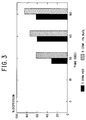
- Packets having about 18cc volumes were formed from a laminate of 50 gauge oriented polyester, adhesive and sealant. Into one set of packets was sealed three grams of distilled water. A second set of sealed packets contained a 1% NaCl solution. The sealed packets were heated in a 530 watt microwave oven for one minute. Packets were sampled at the time of rupture and at fifteen second intervals to determine the amount of liquid that had been vaporized. The dispersion efficiencies of these packets are shown in Figure 3.
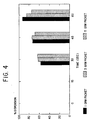
- Example 3 The dispersion efficiencies of sealed packets containing various amounts of electrolytic solutions are shown in Figure 4. There is displayed in Figure 4 the percent dispersion of steam vapor from sealed packets containing one, three and five grams of 1% NaCl solution. These packets were subjected to the same heating conditions as described in Example 2 above.
- the dispersion efficiency is relatively independent of the amount of solution in the sealed packet over this range, each amount being successful in vaporizing at least 50 weight percent of its contents in the first thirty seconds of heating, and dispersing as a vapor at least 75 weight percent of its contents after sixty seconds of heating.
- Example 4 In this Example, the variation in product temperature when heated in a package assembly, and in accordance with the method taught herein, will be demonstrated.
- the same packaging materials and food product described for use in Example 1 were used in this Example.
- Sealed packages containing 56 grams of TOSTITOS® brand Tortilla Chips and a sealed packet containing either 1 gram or 5 grams of a 1% NaCl solution were subjected to microwave heating in a 530 watt oven at full power for sixty seconds.
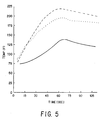
- the temperature profiles of the tortilla chips are shown in Figure 5 as a function of time.
- the temperature profile of the food product heated in the package assembly utilizing 1 gram of 1% NaCl solution is shown by a dotted line.
- the temperature profile of the food product heated in the package assembly utilizing 5 grams of 1% NaCl solution is shown by a dashed line.
- the temperature profile of a control package having no sealed packet therein is depicted by a solid line.
- the rate of product heating began to increase dramatically at about ten seconds, for the package assemblies containing the 1 gram and 5 grams 1% NaCl solution-filled packets, when the packets ruptured and vapor began to fill the package.
- the product temperature heated with the 5 gram 1% NaCl solution-filled packet was stable at about 104°C (220°F)
- the product temperature heated in the 1 gram 1% NaCl solution-filled packet was stable at about 91°C (220°F)
- the temperature of the product in the control package had only reached about 56°C (133°F).
- the controlled dispersion of liquid will not only aid in heating, but can also determine the final product temperature which contributes to optimizing the flavor, aroma and texture that is most organoleptically acceptable to the consumer.
Landscapes
- Engineering & Computer Science (AREA)
- Life Sciences & Earth Sciences (AREA)
- Food Science & Technology (AREA)
- Mechanical Engineering (AREA)
- General Preparation And Processing Of Foods (AREA)
- Package Specialized In Special Use (AREA)
- Food Preservation Except Freezing, Refrigeration, And Drying (AREA)
Claims (12)
- Procédé de chauffage d'un produit alimentaire à faible taux d'humidité ayant une teneur en humidité inférieure à 5 % en poids, comprenant les étapes suivantes :a) on utilise un produit alimentaire présentant une teneur en humidité inférieure à 5 % en poids ;b) on utilise une solution aqueuse contenue dans un sachet scellé, lequel est au moins partiellement transparent au rayonnement en micro-ondes ;c) on dispose le produit alimentaire à faible taux d'humidité et le sachet scellé contenant la solution aqueuse dans un paquet scellé, lequel paquet est transparent au rayonnement en micro-ondes ;d) on irradie le paquet scellé au moyen du rayonnement en micro-ondes provoquant la volatilisation dans le sachet scellé du liquide aqueux et la rupture dudit sachet après moins de 30 secondes d'exposition au rayonnement en micro-ondes ; ete) on laisse se disperser le liquide volatilisé sous forme de vapeur à travers ledit paquet scellé de façon à augmenter la température du produit alimentaire.
- Procédé selon la revendication 1, dans lequel, lors de l'étape d'approvisionnement du produit alimentaire, ce produit alimentaire présente une teneur en humidité inférieure à 2 % en poids.
- Procédé selon la revendication 1 ou la revendication 2, dans lequel, dans l'étape d'approvisionnement du produit alimentaire, ce produit alimentaire est constitué par un aliment de collation salé.
- Procédé selon l'une quelconque des revendications 1 à 3, dans lequel, dans l'étape d'approvisionnement de la solution aqueuse, cette solution aqueuse contient un matériau électrolytique.
- Procédé selon la revendication 4, dans lequel la solution aqueuse comprend une solution de chlorure de sodium ayant au moins de 1 à 10 % en poids de chlorure de sodium.
- Procédé selon la revendication 5, dans lequel la solution de chlorure de sodium a de 1 à 3 % en poids de chlorure de sodium.
- Procédé selon l'une quelconque des revendications précédentes, dans lequel la température dudit produit alimentaire est augmentée jusqu'à une température comprise entre 43°C (110°F) et 135°C (275°F).
- Procédé selon la revendication 7, dans lequel la température dudit produit alimentaire est augmentée dans l'intervalle compris entre 71°C (160°F) et 88°C (190°F).
- Procédé selon l'une quelconque des revendications précédentes, dans lequel, dans l'étape d'approvisionnement du produit alimentaire à faible taux d'humidité et du sachet contenant la solution aqueuse dans un paquet scellé, le rapport du produit alimentaire à la solution aqueuse placés dans le paquet scellé s'établit entre environ 1/0,005 et environ 1/0,1.
- Procédé selon la revendication 9, dans lequel le rapport du produit alimentaire à la solution aqueuse placés dans le paquet scellé s'établit entre environ 1/0,01 et environ 1/0,09.
- Procédé selon l'une quelconque des revendications précédentes, dans lequel ledit produit alimentaire est chauffé en moins de 150 secondes.
- Procédé selon la revendication 11, dans lequel ledit produit alimentaire est chauffé en moins de 60 secondes.
Applications Claiming Priority (2)
| Application Number | Priority Date | Filing Date | Title |
|---|---|---|---|
| US07/483,494 US4987280A (en) | 1990-02-20 | 1990-02-20 | Method for microwave heating of low moisture food products |
| US483494 | 1990-02-20 |
Publications (3)
| Publication Number | Publication Date |
|---|---|
| EP0443791A2 EP0443791A2 (fr) | 1991-08-28 |
| EP0443791A3 EP0443791A3 (en) | 1992-04-08 |
| EP0443791B1 true EP0443791B1 (fr) | 1994-11-02 |
Family
ID=23920271
Family Applications (1)
| Application Number | Title | Priority Date | Filing Date |
|---|---|---|---|
| EP91301254A Expired - Lifetime EP0443791B1 (fr) | 1990-02-20 | 1991-02-18 | Procédé de chauffage par micro-ondes de produits alimentaires à faible taux d'humidité |
Country Status (7)
| Country | Link |
|---|---|
| US (1) | US4987280A (fr) |
| EP (1) | EP0443791B1 (fr) |
| CA (1) | CA2076368C (fr) |
| DE (1) | DE69104863T2 (fr) |
| ES (1) | ES2066344T3 (fr) |
| GR (1) | GR3014941T3 (fr) |
| WO (1) | WO1991013528A1 (fr) |
Families Citing this family (45)
| Publication number | Priority date | Publication date | Assignee | Title |
|---|---|---|---|---|
| US5236727A (en) * | 1991-11-14 | 1993-08-17 | Roy Huston | Taco shell |
| US5400704A (en) * | 1991-11-14 | 1995-03-28 | Huston; Roy | Tortilla cooking apparatus and method |
| ES2173648T3 (es) * | 1997-12-18 | 2002-10-16 | Karl Keller | Envase para productos alimenticios y procedimiento para cocer productos alimenticios. |
| US6727484B2 (en) * | 1998-04-16 | 2004-04-27 | Nini Policappelli | Making beverages and food in a microwave oven |
| US6229128B1 (en) | 1998-04-16 | 2001-05-08 | Nini Policappelli | Making beverages in a microwave oven |
| DE29918753U1 (de) | 1999-08-09 | 2000-02-17 | Keller, Karl, Rafz | Lebensmittelverpackung |
| WO2001021506A1 (fr) | 1999-09-24 | 2001-03-29 | Brown Bruce W | Emballage alimentaire a deux compartiments pour cuisson aux micro-ondes |
| NL1013691C2 (nl) | 1999-11-29 | 2001-05-30 | Beheermij Barbu B V | Houder voor het verpakken van levensmiddelen. |
| WO2001087737A1 (fr) | 2000-05-18 | 2001-11-22 | John Jay Johns | Sachets de cuisson a la vapeur pour micro-ondes |
| EP1245504A1 (fr) * | 2001-03-28 | 2002-10-02 | Cryovac, Inc. | Sachet a double paroi pour cuire des aliments à la vapeur |
| US20030049354A1 (en) * | 2001-08-27 | 2003-03-13 | R. Charles Murray | Packaging for use in heating food in a microwave oven and method of use |
| US20060127549A1 (en) * | 2001-08-27 | 2006-06-15 | Murray R C | Heatable package with frangible seal and method of manufacture |
| US20080138474A1 (en) * | 2001-08-27 | 2008-06-12 | Pouch Pac Innovations, Llc | Heatable package with multi-purpose valve and method of manufacture |
| US7172780B1 (en) * | 2002-10-11 | 2007-02-06 | The Vivian A. Skaife Trust, C/O Margaret Skaife, Trustee | Food packaging for microwave pressure cooking and method of using same |
| US7435436B2 (en) * | 2002-11-18 | 2008-10-14 | Conagra Foods Pdm, Inc. | Microwave popcorn package |
| US7444926B2 (en) * | 2003-09-09 | 2008-11-04 | Nottingham John R | Apparatus for brewing and method for making the same |
| US20070125430A1 (en) * | 2003-10-16 | 2007-06-07 | Murray R C | Packaging release valve for microwavable food items |
| GB2421937B (en) * | 2005-01-05 | 2008-07-02 | Nigel John Brace Parker | A water vapour generating device to improve the quality of prepared fresh produce cooked in microwave ovens within self-venting retail packaging |
| US7458195B2 (en) * | 2005-01-14 | 2008-12-02 | Frito-Lay North America, Inc. | Method for making a multi-compartment microwavable package having a permeable wall between compartments |
| US8492689B2 (en) * | 2005-07-20 | 2013-07-23 | Frito-Lay North America, Inc. | Microwaveable package having a steam source |
| EP1760010A1 (fr) * | 2005-09-01 | 2007-03-07 | Seminis Vegetable Seeds, Inc. | Sachet en plastique pour la cuisson de légumes frais et contenant une pochette avec un condiment |
| US8302528B2 (en) * | 2005-10-20 | 2012-11-06 | Conagra Foods Rdm, Inc. | Cooking method and apparatus |
| US9211030B2 (en) * | 2005-10-20 | 2015-12-15 | Conagra Foods Rdm, Inc. | Steam cooking apparatus |
| US8850964B2 (en) * | 2005-10-20 | 2014-10-07 | Conagra Foods Rdm, Inc. | Cooking method and apparatus |
| US9132951B2 (en) * | 2005-11-23 | 2015-09-15 | Conagra Foods Rdm, Inc. | Food tray |
| CA2527770C (fr) | 2005-11-21 | 2014-07-22 | Steven M. Parsons | Plateau a nourriture |
| USD635816S1 (en) | 2006-06-09 | 2011-04-12 | Conagra Foods Rdm, Inc. | Container basket |
| EP2086849A4 (fr) * | 2006-09-19 | 2010-09-01 | Conagra Foods Rdm Inc | Produit alimentaire, appareil de cuisson et dispositif de stockage |
| EP2137081A2 (fr) | 2007-03-02 | 2009-12-30 | ConAgra Foods RDM, Inc. | Système d'emballage à composants multiples |
| US8613249B2 (en) * | 2007-08-03 | 2013-12-24 | Conagra Foods Rdm, Inc. | Cooking apparatus and food product |
| US20090142455A1 (en) * | 2007-11-29 | 2009-06-04 | Conagra Foods Rdm, Inc. | Dessert food package |
| FR2929491A1 (fr) * | 2008-04-08 | 2009-10-09 | Alain Sebban | Nouveau produit alimentaire |
| US7931928B2 (en) * | 2008-04-14 | 2011-04-26 | Frito-Lay North America, Inc. | Pellet drying process |
| GB2478282B (en) | 2010-03-01 | 2012-02-29 | Planit Products Ltd | Self adhesive bags for steam cooking in a microwave oven |
| USD639186S1 (en) | 2010-09-08 | 2011-06-07 | Conagra Foods Rdm, Inc. | Container with sleeve |
| USD639656S1 (en) | 2010-09-08 | 2011-06-14 | Con Agra Foods RDM, Inc. | Container lid |
| USD638701S1 (en) | 2010-09-08 | 2011-05-31 | Conagra Foods Rdm, Inc. | Container |
| EP2574565A1 (fr) * | 2011-09-30 | 2013-04-03 | Papier-Mettler Inhaber Michael Mettler e.K. | Sachet, notamment sachet d'emballage en papier sulfurisé ou en pâte de cellulose revêtue de fluor |
| US9481777B2 (en) | 2012-03-30 | 2016-11-01 | The Procter & Gamble Company | Method of dewatering in a continuous high internal phase emulsion foam forming process |
| USD680426S1 (en) | 2012-06-12 | 2013-04-23 | Conagra Foods Rdm, Inc. | Container |
| USD717162S1 (en) | 2012-06-12 | 2014-11-11 | Conagra Foods Rdm, Inc. | Container |
| US9027825B2 (en) | 2012-06-12 | 2015-05-12 | Conagra Foods Rdm, Inc. | Container assembly and foldable container system |
| US9193515B2 (en) * | 2012-09-06 | 2015-11-24 | Frito-Lay North America, Inc. | Package for microwaving dry foods |
| WO2014190266A1 (fr) | 2013-05-24 | 2014-11-27 | Graphic Packaging International, Inc. | Emballage permettant le chauffage combiné a la vapeur et a micro-ondes d'aliment |
| CN107848681B (zh) * | 2015-07-09 | 2022-07-05 | 蒙诺苏尔有限公司 | 食物产品和其制备方法 |
Family Cites Families (16)
| Publication number | Priority date | Publication date | Assignee | Title |
|---|---|---|---|---|
| US3286149A (en) * | 1964-02-24 | 1966-11-15 | Gen Electric | Control means for electric motor start winding |
| US3287140A (en) * | 1966-04-11 | 1966-11-22 | Brussell Jacob | Self-heating frozen food package |
| US3717478A (en) * | 1967-09-22 | 1973-02-20 | Gen Foods Corp | Disposable cook-in package for frozen food products |
| IT995140B (it) * | 1973-08-03 | 1975-11-10 | Grosso A | Contenitore autoscaldante per cibi precotti |
| US4133896A (en) * | 1976-02-09 | 1979-01-09 | The Pillsbury Company | Food package including condiment container for heating food |
| US4259089A (en) * | 1978-08-10 | 1981-03-31 | Tyrolit Schleifmittelwerke Swarovski K.G. | Grinding wheel containing grain-coated reinforcement fibers and method of making it |
| US4233325A (en) * | 1979-09-13 | 1980-11-11 | International Flavors & Fragrances Inc. | Ice cream package including compartment for heating syrup |
| US4419373A (en) * | 1982-03-29 | 1983-12-06 | American Can Company | Method of heating contents in a self venting container |
| FR2536251A1 (fr) * | 1982-11-19 | 1984-05-25 | Piquilloud Pierre | Produit alimentaire conditionne et son procede de preparation rapide et commode en portions de mets chaud |
| US4596713A (en) * | 1983-04-14 | 1986-06-24 | Burdette Darrell C | Microwave food packets capable of dispersing a food additive during heating |
| US4529089A (en) * | 1984-11-30 | 1985-07-16 | Anthony Gasbarra | Food container |
| US4803088A (en) * | 1985-05-01 | 1989-02-07 | House Food Industrial Company Limited | Container packed with instant food for use in microwave oven |
| US4762113A (en) * | 1986-08-04 | 1988-08-09 | Chori Company, Ltd. | Self-heating container |
| US4705927A (en) * | 1986-08-14 | 1987-11-10 | Aluminum Company Of America | Cooking utensil for combined microwave and steam cooking |
| US4806371A (en) * | 1986-11-10 | 1989-02-21 | Packageing Concepts, Inc. | Microwavable package for packaging combination of products and ingredients |
| US4851246A (en) * | 1987-07-06 | 1989-07-25 | General Mills, Inc. | Dual compartment food package |
-
1990
- 1990-02-20 US US07/483,494 patent/US4987280A/en not_active Expired - Lifetime
-
1991
- 1991-02-07 WO PCT/US1991/000796 patent/WO1991013528A1/fr not_active Ceased
- 1991-02-07 CA CA002076368A patent/CA2076368C/fr not_active Expired - Fee Related
- 1991-02-18 EP EP91301254A patent/EP0443791B1/fr not_active Expired - Lifetime
- 1991-02-18 DE DE69104863T patent/DE69104863T2/de not_active Expired - Fee Related
- 1991-02-18 ES ES91301254T patent/ES2066344T3/es not_active Expired - Lifetime
-
1995
- 1995-02-01 GR GR950400207T patent/GR3014941T3/el unknown
Also Published As
| Publication number | Publication date |
|---|---|
| CA2076368A1 (fr) | 1991-08-21 |
| EP0443791A3 (en) | 1992-04-08 |
| ES2066344T3 (es) | 1995-03-01 |
| WO1991013528A1 (fr) | 1991-09-05 |
| GR3014941T3 (en) | 1995-05-31 |
| US4987280A (en) | 1991-01-22 |
| CA2076368C (fr) | 1999-09-28 |
| DE69104863T2 (de) | 1995-06-08 |
| DE69104863D1 (de) | 1994-12-08 |
| EP0443791A2 (fr) | 1991-08-28 |
Similar Documents
| Publication | Publication Date | Title |
|---|---|---|
| US4987280A (en) | Method for microwave heating of low moisture food products | |
| US4596713A (en) | Microwave food packets capable of dispersing a food additive during heating | |
| US6068898A (en) | Sheet films, packaging materials, and packaging using the same having pressure control valve | |
| US4904488A (en) | Uniformly-colored, flavored, microwaveable popcorn | |
| US4904487A (en) | Uniformly-colored, cheese flavored, microwaveable popcorn | |
| JP4248737B2 (ja) | 食品包装体及び食品の調理方法 | |
| US8492689B2 (en) | Microwaveable package having a steam source | |
| EP1277672B1 (fr) | Materiau d'emballage et produit d'emballage | |
| EP0429488B1 (fr) | Emballage de forme adaptable a effet brunisseur avec bords thermoscelles se decollant sous l'action de la chaleur pour la cuisson aux micro-ondes | |
| AU601347B2 (en) | Dual compartment food package and method of using same | |
| AU2002324146B2 (en) | Packaged food product | |
| US6054698A (en) | Microwave retaining package for microwave cooking | |
| US4891482A (en) | Disposable microwave heating receptacle and method of using same | |
| US3615646A (en) | Food package and process | |
| US7038182B2 (en) | Microwave oven cooking process | |
| EP0294087A2 (fr) | Emballage servant de plat destiné à la préparation de pop-corn dans un four à micro-ondes | |
| EP0256791A2 (fr) | Emballage pour mais à griller et à éclater au four à micro-ondes, méthode de production de l'emballage et appareil pour sceller celui-ci | |
| WO2002080623A9 (fr) | Sachet fonctionnel de cuisson et de conservation d'aliments | |
| US5919390A (en) | Method and package for microwave roasting of unshelled peanuts/nuts/seeds | |
| KR20030088442A (ko) | 달고 짭잘한 전자레인지용 팝콘 조성물; 배열 및 방법 | |
| JPH1042800A (ja) | 電子レンジ用容器入り調理用食品 | |
| AU644760B2 (en) | Method for microwave heating of low moisture food products | |
| JP2567376B2 (ja) | 食品収納体を用いる電子レンジ調理方法 | |
| JP3349573B2 (ja) | 枝豆入り包装体 | |
| JP3240236B2 (ja) | 電子レンジ調理用食品包装体 |
Legal Events
| Date | Code | Title | Description |
|---|---|---|---|
| PUAI | Public reference made under article 153(3) epc to a published international application that has entered the european phase |
Free format text: ORIGINAL CODE: 0009012 |
|
| AK | Designated contracting states |
Kind code of ref document: A2 Designated state(s): DE ES FR GB GR IT NL SE |
|
| PUAL | Search report despatched |
Free format text: ORIGINAL CODE: 0009013 |
|
| AK | Designated contracting states |
Kind code of ref document: A3 Designated state(s): DE ES FR GB GR IT NL SE |
|
| 17P | Request for examination filed |
Effective date: 19920530 |
|
| 17Q | First examination report despatched |
Effective date: 19930720 |
|
| RAP1 | Party data changed (applicant data changed or rights of an application transferred) |
Owner name: RECOT, INC. |
|
| GRAA | (expected) grant |
Free format text: ORIGINAL CODE: 0009210 |
|
| AK | Designated contracting states |
Kind code of ref document: B1 Designated state(s): DE ES FR GB GR IT NL SE |
|
| ITF | It: translation for a ep patent filed | ||
| ET | Fr: translation filed | ||
| REF | Corresponds to: |
Ref document number: 69104863 Country of ref document: DE Date of ref document: 19941208 |
|
| REG | Reference to a national code |
Ref country code: ES Ref legal event code: FG2A Ref document number: 2066344 Country of ref document: ES Kind code of ref document: T3 |
|
| REG | Reference to a national code |
Ref country code: GR Ref legal event code: FG4A Free format text: 3014941 |
|
| PLBE | No opposition filed within time limit |
Free format text: ORIGINAL CODE: 0009261 |
|
| STAA | Information on the status of an ep patent application or granted ep patent |
Free format text: STATUS: NO OPPOSITION FILED WITHIN TIME LIMIT |
|
| 26N | No opposition filed | ||
| REG | Reference to a national code |
Ref country code: GB Ref legal event code: IF02 |
|
| PGFP | Annual fee paid to national office [announced via postgrant information from national office to epo] |
Ref country code: FR Payment date: 20030131 Year of fee payment: 13 |
|
| PGFP | Annual fee paid to national office [announced via postgrant information from national office to epo] |
Ref country code: SE Payment date: 20030203 Year of fee payment: 13 Ref country code: NL Payment date: 20030203 Year of fee payment: 13 |
|
| PGFP | Annual fee paid to national office [announced via postgrant information from national office to epo] |
Ref country code: GR Payment date: 20030211 Year of fee payment: 13 |
|
| PGFP | Annual fee paid to national office [announced via postgrant information from national office to epo] |
Ref country code: GB Payment date: 20030212 Year of fee payment: 13 |
|
| PGFP | Annual fee paid to national office [announced via postgrant information from national office to epo] |
Ref country code: DE Payment date: 20030228 Year of fee payment: 13 |
|
| PGFP | Annual fee paid to national office [announced via postgrant information from national office to epo] |
Ref country code: ES Payment date: 20030311 Year of fee payment: 13 |
|
| PG25 | Lapsed in a contracting state [announced via postgrant information from national office to epo] |
Ref country code: GB Free format text: LAPSE BECAUSE OF NON-PAYMENT OF DUE FEES Effective date: 20040218 |
|
| PG25 | Lapsed in a contracting state [announced via postgrant information from national office to epo] |
Ref country code: SE Free format text: LAPSE BECAUSE OF NON-PAYMENT OF DUE FEES Effective date: 20040219 Ref country code: ES Free format text: LAPSE BECAUSE OF NON-PAYMENT OF DUE FEES Effective date: 20040219 |
|
| PG25 | Lapsed in a contracting state [announced via postgrant information from national office to epo] |
Ref country code: NL Free format text: LAPSE BECAUSE OF NON-PAYMENT OF DUE FEES Effective date: 20040901 Ref country code: DE Free format text: LAPSE BECAUSE OF NON-PAYMENT OF DUE FEES Effective date: 20040901 |
|
| PG25 | Lapsed in a contracting state [announced via postgrant information from national office to epo] |
Ref country code: GR Free format text: LAPSE BECAUSE OF NON-PAYMENT OF DUE FEES Effective date: 20040903 |
|
| EUG | Se: european patent has lapsed | ||
| GBPC | Gb: european patent ceased through non-payment of renewal fee |
Effective date: 20040218 |
|
| PG25 | Lapsed in a contracting state [announced via postgrant information from national office to epo] |
Ref country code: FR Free format text: LAPSE BECAUSE OF NON-PAYMENT OF DUE FEES Effective date: 20041029 |
|
| NLV4 | Nl: lapsed or anulled due to non-payment of the annual fee |
Effective date: 20040901 |
|
| REG | Reference to a national code |
Ref country code: FR Ref legal event code: ST |
|
| PG25 | Lapsed in a contracting state [announced via postgrant information from national office to epo] |
Ref country code: IT Free format text: LAPSE BECAUSE OF NON-PAYMENT OF DUE FEES;WARNING: LAPSES OF ITALIAN PATENTS WITH EFFECTIVE DATE BEFORE 2007 MAY HAVE OCCURRED AT ANY TIME BEFORE 2007. THE CORRECT EFFECTIVE DATE MAY BE DIFFERENT FROM THE ONE RECORDED. Effective date: 20050218 |
|
| REG | Reference to a national code |
Ref country code: ES Ref legal event code: FD2A Effective date: 20040219 |