EP0444713B1 - Dispositif pour déteminer la vitesse angulaire - Google Patents
Dispositif pour déteminer la vitesse angulaire Download PDFInfo
- Publication number
- EP0444713B1 EP0444713B1 EP91103235A EP91103235A EP0444713B1 EP 0444713 B1 EP0444713 B1 EP 0444713B1 EP 91103235 A EP91103235 A EP 91103235A EP 91103235 A EP91103235 A EP 91103235A EP 0444713 B1 EP0444713 B1 EP 0444713B1
- Authority
- EP
- European Patent Office
- Prior art keywords
- casing
- axis
- magnet member
- rotating
- declination
- Prior art date
- Legal status (The legal status is an assumption and is not a legal conclusion. Google has not performed a legal analysis and makes no representation as to the accuracy of the status listed.)
- Expired - Lifetime
Links
- 238000001514 detection method Methods 0.000 claims description 15
- 239000011553 magnetic fluid Substances 0.000 claims description 15
- 230000008878 coupling Effects 0.000 claims description 10
- 238000010168 coupling process Methods 0.000 claims description 10
- 238000005859 coupling reaction Methods 0.000 claims description 10
- 230000004044 response Effects 0.000 claims description 3
- 229910010293 ceramic material Inorganic materials 0.000 claims description 2
- 239000000919 ceramic Substances 0.000 claims 1
- 239000003990 capacitor Substances 0.000 description 8
- 238000010276 construction Methods 0.000 description 6
- 239000012530 fluid Substances 0.000 description 6
- 230000002093 peripheral effect Effects 0.000 description 5
- 230000001133 acceleration Effects 0.000 description 4
- 230000008901 benefit Effects 0.000 description 3
- 239000000463 material Substances 0.000 description 3
- 230000035945 sensitivity Effects 0.000 description 3
- 230000008859 change Effects 0.000 description 2
- 230000004907 flux Effects 0.000 description 2
- 238000005259 measurement Methods 0.000 description 2
- 230000002411 adverse Effects 0.000 description 1
- 235000012489 doughnuts Nutrition 0.000 description 1
- 230000006872 improvement Effects 0.000 description 1
- 230000006698 induction Effects 0.000 description 1
- 230000001788 irregular Effects 0.000 description 1
- 239000000314 lubricant Substances 0.000 description 1
- 230000007246 mechanism Effects 0.000 description 1
- 230000004048 modification Effects 0.000 description 1
- 238000012986 modification Methods 0.000 description 1
- 230000005405 multipole Effects 0.000 description 1
- 230000035939 shock Effects 0.000 description 1
- 125000006850 spacer group Chemical group 0.000 description 1
- 238000009987 spinning Methods 0.000 description 1
- 238000004804 winding Methods 0.000 description 1
Images


Classifications
-
- G—PHYSICS
- G01—MEASURING; TESTING
- G01C—MEASURING DISTANCES, LEVELS OR BEARINGS; SURVEYING; NAVIGATION; GYROSCOPIC INSTRUMENTS; PHOTOGRAMMETRY OR VIDEOGRAMMETRY
- G01C19/00—Gyroscopes; Turn-sensitive devices using vibrating masses; Turn-sensitive devices without moving masses; Measuring angular rate using gyroscopic effects
- G01C19/02—Rotary gyroscopes
- G01C19/04—Details
- G01C19/16—Suspensions; Bearings
- G01C19/20—Suspensions; Bearings in fluid
Definitions
- the invention relates to an angular velocity detecting device according to the preamble of claim 1.
- Such a device is known from DE-A-3 825 088, wherein a rotatable disk is mechanically connected to a rotating means and the deformation of the disk is detected for determining an angular velocity.
- US-A-4 570 507 discloses a magnetic fluid gyro bearing and caging mechanism wherein a rotor and a stator is provided between which a magnetic fluid is arranged.
- the rotor is driven by an induction motor and is also connected to an actuator via a caging plate including a magnetic fluid.
- reference numeral 1 denotes a casing connected to an appropriate member (not shown) of an object, the angular velocity of which is to be measured, such as a vehicle.
- the casing 1 is made from a material having a non-magnetizing and high electrical resistance property.
- a cap 9, made from the same material as that of the casing 1 is connected to the casing 1, to thereby form a complete casing in which a cylindrical space 100 having a predetermined volume is defined, and wherein a magnetizing fluid 2 and a disk-shaped, multi-pole, permanently magnetized magnet 3 are provided.
- the disk-shaped magnet 3 has a central axis XX, axially spaced apart surfaces, and a circumferential surface.
- the disk 3 is, for example, magnetized at four positions angularly spaced along the circumferential periphery thereof.
- a non-uniform density of the magnetizing fluid is obtained in the space 100, i.e., a density distribution is obtained in the space in accordance with the distribution of the strength of the magnetic field in the space 100.
- the inner cylindrical space 100 has a diameter D which is slightly larger than the diameter d of the permanent magnet disk 3, and the casing 1 defines an annular side wall 1a which allows the disk 3 to rotate about its axis.
- the inner cylindrical space 100 has a total axial thickness which is equal to or more or less smaller than the maximum total thickness of the disk 3 including the magnetizing fluid magnetically attachable thereto in a free space under a usual temperature and an atmospheric pressure.
- the magnetic fluid 2 as magnetically attached around the permanent magnet 3 serves not only as a lubricant which allows the permanent magnet 3 to rotate about its axis but also as a spring and a damper in the direction of the thickness of the magnet 3.
- a floating supporting of the magnet disk 3 in the center of the cylindrical space 100 is obtained, which allows the disk 3 to be surrounded by the casing 1 without being in contact therewith.
- Reference numerals 41 and 42 denote Hall elements as an declination detection means for detecting a relative declination of the permanent magnet 3 and the casing 1. These Hall elements 41 and 42 are fixedly connected to a plate 13 in such a manner that they are symmetrical with respect to the rotation axis of the permanent magnet 3; i.e., the Hall elements 41 and 42 are arranged under a diametrically opposite relationship.
- the Hall elements 41 and 42 have terminals soldered to a terminal plate 7, and the plate 13 for mounting the Hall elements and the terminal plate 7 are connected to the casing 1 by screws 81, 82 and (not-shown) 83 through tubular spacers 141, 142 and 143 located between the plate 13 and the casing 1, and 61, 62 and (not-shown) 63 located between the plates 13 and 7.
- An upper cap 9 is screwed to the casing 1 via an O-ring 5, a seal plug 11 made of a rubber material is inserted to an opening 10, for introducing a magnetizing fluid into the space 100, and an upper cap 12 is fitted above the plug 11.
- angularly spaced coils 131, 132 and 133, and angularly spaced Hall elements 121, 122 and 123 are arranged along the outer circumference of the casing 1.
- Figure 3 shows a diagrammatic view of the entire device according to the present invention, which is constructed by a drive unit 410, a sensor 420, and a detecting unit 430.
- the drive unit 410 is constructed by a circuit 204 for generating a rotating magnetic field, and a constant speed control circuit 205.
- the rotating magnetic field generating circuit employs a three phase, all wave drive principle, to thereby obtain a rotating magnetic field having small fluctuations of the torque and rotational speed thereof.
- the three phase, all wave drive is preferably constructed by an integrated circuit, such as TA7259P from Toshiba Corp.
- the constant speed control circuit 205 is constructed by a PLL control integrated circuit, such as TC9142P from Toshiba Corp.
- the sensor 420 is constructed as shown in Fig. 1 and 2, as already explained and the detection unit 430 is constructed by Hall elements 41 and 42 for the detection of a declination, a difference amplifier 203, and an angular speed calculation circuit 202. It should be noted that, in Fig. 1, the positioning of the Hall elements 41 and 42 for the detection of a declination is determined such that they are less influenced by a magnetic field generated by the rotating magnetic field generating coils 131, 132 and 133.
- Figure 4 shows details of the angular velocity detecting unit 430, which is comprised of a Hall element driving circuit 660, a difference amplifier 661, an envelope detection circuit 662, and a low pass filter 663.
- the Hall circuit driving circuit 660 includes operating amplifiers 650 for an electric current feedback and having positive inputs connected to the ground via a resistor 602, negative inputs connected to the ground via resistors 603 and 604, respectively, and outputs connected to inlets of the Hall elements 41 and 42, respectively.
- the Hall elements 41 and 42 have second inlets connected to negative inputs of the operating amplifiers 650 and 651, respectively.
- the difference amplifier circuit 661 includes operating amplifiers 652 and 653, which have positive first inlets connected to the ground via resistors 608 and 613, respectively, on one side, and connected to the outputs of the Hall elements 41 and 42 via resistors 606 and 610, respectively, on the other side, negative inlets connected to the second inlets of the Hall elements 41 and 42, via resistors 605 and 609, respectively, and outputs connected to self negative inputs, via resistors 607 and 612, respectively.
- the operating amplifier 654 has a negative input connected to the output of the operating amplifier 652 via a resistor 615 and alternate current coupling capacitor 614, a positive input connected to the output of the operating amplifier 653, via a resistor 617 and alternate current coupling capacitor 616, and an output connected to the self negative input via a resistor 618.
- the positive input of the operating amplifier 654 is also connected to the ground via a resistor 619.
- the envelope detecting circuit 622 includes an operating amplifier 655 having a positive input connected to the ground, a negative input connected to the output of the operating amplifier 654 via a resistor 621 and alternate current coupling capacitor 620, and an output connected to a cathode of a diode 624.
- An anode of the diode 624 is connected to the negative input of the operating amplifier 655 via a resistor 622 and is grounded via a capacitor 625 and resistor 626.
- the output of the operating amplifier 655 is also connected to an anode of a diode 623, and the cathode of the diode 623 is connected to a point between the alternate current coupling capacitor 620 and the resistor 621.
- the construction of the low pass filter 663 includes an operating amplifier 656 having a positive input grounded via a capacitor 630 and connected to the anode of the diode 624 via resistors 629 and 627, a negative input connected to a location between the resistors 627 and 629, via a capacitor 628, and an output connected to a terminal 201 and to the negative input thereof.
- the rotating field generating circuit 204 causes the coils 131, 132 and 133 to generate a rotating magnetic field, which allows the permanent magnet 3 to rotate about its axis in the cylindrical chamber 100 at a constant velocity Ws. Assuming that the angular velocity sensor is mounted on a vehicle (not shown) so that the axis Z in Fig.
- the magnetizing fluid 2 arranged around the permanent magnet 3 can operate as a damper with a spring in the direction of the axial thickness of the permanent magnet 3, so that the magnet 3 is inclined with respect to the casing 1 at an angle until the precession torque Wp and the spring force are balanced.
- This angle of the declination of the disk 3 is detected by the Hall elements 41 and 42 and amplified by the difference amplifier 203, and introduced into the angular velocity calculating circuit 202.
- the signals detected by the Hall elements 41 and 42 are amplified by the difference amplifier 203, and introduced into the angular velocity calculating circuit 202 by obtaining a electric signal having a voltage level which corresponds to the angular velocity applied to the casing 1.
- the difference amplifier system is employed to cancel the changes in the output voltages from the Hall elements 41 and 42 generated by the translational movement of the permanent magnet 3 in the cylindrical chamber 100 induced by an acceleration along the direction parallel to the axis X , because these changes in the Hall voltages have the same phase.
- the difference in the inner diameter D of the cylindrical space 100 and the outer diameter d of the permanent magnet disk 3 is small enough that the side wall 1a, as a movement limiting means, can prevent any significant movement of the magnet 3 in the rotating plane thereof which is parallel to both of the axes Y and Z , which minimizes the change in the output voltage caused by such a translational movement of the disk to thereby decrease any possible error that may occur.
- the operation of the angular velocity detecting apart 430 in Fig. 4 is as follows.
- a constant electric current drive operation of the Hall elements 41 and 42 is obtained by the Hall element driving circuit 660.
- the difference amplifier 661 is constructed by first stage and second stage difference amplifiers which are connected with each other by the alternate current couplings 614 and 616. These A/C couplings serve to cut off various unbalances which may otherwise adversely affect the desired measurement, such as unbalanced voltages applied to the Hall elements, an unbalanced voltage-to-temperature characteristic between the Hall elements, unbalanced offset voltages applied to the first stage operating amplifiers, and unbalanced temperature drift characteristics.
- the difference amplifier issues an output signal which has been as subjected to an amplitude modulation, and the angular velocity component can be obtained to thereby determine the envelope of the amplitude-modulated signal.
- An envelope detection operation is obtained by the envelope detection circuit 662, which includes a peak-to-peak detector.
- the envelope detected output signal from the detecting circuit 662 is introduced into the low pass filter 663, to remove any ripple components.
- the permanent magnet 3 is rotated by the magnetic type rotating means, and therefore, an advantage can be obtained such that a mechanical shaft between the magnet type rotating means and the permanent magnet 3 is not required. Furthermore, a difference between the inner diameter of the case and the outer diameter of the permanent magnet disk is small enough to substantially limit the movement of the disk along the diametric direction, which makes negligible any change in the output value due to such a movement, thereby reducing errors. Furthermore, the permanent magnet member 3 is in contact only with the magnetic fluid 2, and not with the remaining members, which increases the sensitivity of the detection of angular velocity to thereby allow the detection of a very small amount of angular velocity. A relatively simple construction is sufficient to obtain a precise detection of the angular velocity.
- a symmetric arrangement of the Hall elements for a detection of the declination of the permanent magnet disk with respect to the central axis of the disk 3 can cancel the changes in the output voltages from the hall elements when a movement without angular velocity of the vehicle is obtained, i.e., only a linear movement of the vehicle is obtained to cause the permanent magnet to make a translation movement, thereby providing an advantage in that there is not response to any acceleration that does not provide an angular velocity.
- the alternate current coupling by the A/C coupling capacitors 614 and 616 provides an advantage in that unbalanced voltages applied to the Hall elements 41 and 42 can cut.
- the floating arrangement of the rotating member 3 in the magnetizing fluid 2 is advantageous in that the device is substantially impervious to damage by an externally applied shock.
- FIG. 5 A second embodiment is shown in Fig. 5. This embodiment differs from the first embodiment only in the sensor 420, and therefore, the following explanation will be focused thereon, and a detailed explanation of the remaining parts will be omitted.
- the cap and the casing 1 and 9 have opposite inner faces facing the permanent magnets 3, which faces define at the center portions thereof projections 21 and 22, respectively, having a semi-spherical shape. Note, these projected portions 21 and 22 are not in contact with the permanent magnet member 3. Namely, a small space remains between the projections 21 and 22 and the magnet 3, by which any movement of the permanent magnet member 3 is limited in the thickness direction thereof, i.e., perpendicular to the direction of the diameter of the disk 3.
- This construction makes it possible to limit not only a straight or translational movement in the diametric direction of the magnet 3 by the peripheral wall 1a but also a straight or translational movement in the direction which is parallel to the axial direction of the disk 3, i.e., the direction transverse to the diametrical direction of the magnet 3, and as a result, in this embodiment, only the rotational movement of the magnet 3 about the central rotational axis thereof, and about the diametric axis for declining same with respect to the casing 1, are allowed.
- Figure 6 shows a third embodiment which, similar to the second embodiment, is focused on the sensor portion.
- the casing 1 and cap 9 also have facing conical inner surfaces projecting toward each other, whereby projections 23 and 24 facing the permanent magnet 3 are obtained.
- These conical shape projections 23 and 24 operate in the same way as those in the embodiment in Fig. 5, to limit unnecessary movement of the permanent magnet 3 other than a rotational movement thereof, about its own rotating axis, and any declining movement needed to obtain an increased precision of the measurement.
- Figure 7 shows a fourth embodiment of the sensor portion.
- the permanent magnet 3 has at the center thereof an axial bore to which a shaft 27 is fixedly inserted so that the ends thereof project outward.
- the casing 1 is provided with facing inner walls which face the major planes of the disk 3, and the inner walls form axially faced concave recesses 25 and 26 having a diameter R .
- the casing 1 has, in a plane parallel to and including the axis of the shaft 27, an inner peripheral surface having an arc shape with a diameter R, which is adjacent to the free ends of the shaft 3.
- the ends of the shaft 27 are positioned adjacent to the concave recess 25 and 26 not in contact therewith, and as a result, the disk 3 can be rotated while the ends of the shaft 27 move along the recesses 25 and 26 as adjacent as possible thereto without covering into contact therewith.
- Figure 8 shows fifth embodiment related to an improvement of the embodiment in Fig. 6.
- a pair of opposite second projections 231 and 241, and a pair of needle shape opposite third projections 232 and 242 are formed on the facing walls of the case 1 such that these pairs of projections are arranged symmetrical to the axis X-X of the rotation of the disk 3.
- the diametric rotational movement of the magnet 3 is allowed only about the diametric axis, which is parallel to a plane formed by the projections 231 and 241, and 232 and 242, and as a result, an angular velocity along only a single diametric axis can be detected.
- Figure 9 is a combination of the third embodiment of Fig. 6 wherein the opposite walls facing the permanent magnet 3 are projected thereto so that they form conical shapes 24 and 25, and the fourth embodiment in Fig. 7 wherein a shaft 27 is fixed to the center of the magnet 3 so that the ends thereof are positioned adjacent to the concave recesses formed on the facing walls of the casing.
- the ends of the shaft 27 are rounded so as to be complimentary to the concave shapes of the recesses.
- the tubular peripheral wall 1a of the casing acts as a means for limiting the translational movement of the permanent magnet 3 in a direction transverse to the rotating axis X-X of the disk 3, but in place of this arrangement, in the third embodiment of Fig. 6 and fifth embodiment of Fig. 8, the projections 23 and 24 may come into contact with the permanent magnet 3 to limit such a translational movement of the magnet 3, and in such a case, the inner peripheral wall 1a of the casing 1 and the outer peripheral wall of the permanent magnet 3 can be largely distanced.
- Figs. 5 to 9 provide an angular velocity detecting device which is reliable when subjected to vibration or linear acceleration.
- Figure 10 shows a seventh embodiment of the present invention.
- This embodiment features rotating magnetic field generating coils 132, 133 and (not shown) 131, and pole detection Hall elements 121 and (not shown) 122 and 123 are arranged in a plane which is parallel to and axially spaced from the permanent magnet 3.
- the declination detecting Hall elements 41 and 42 are arranged on the plane axially spaced from the permanent magnet member 3 on the other side thereof opposite to the plane wherein the coils 132, 133 and 131, and the Hall elements 121, 122 and 123 are arranged.
- This embodiment is advantageous in that any magnetic influence from the Hall motor on the declination detecting Hall elements 41 and 42 becomes negligible, and as a result, the permanent magnet 3 may be magnetized along the direction of the thickness thereof.
- Figure 11 shows an eighth embodiment in which the declination detection Hall elements 41 and 42 are arranged in a point symmetric relationship with respect to the center point O of the permanent magnet 3. Namely, the Hall element 41 is arranged on one side of the permanent magnet 3 and the Hall element 42 is arranged on the other side of the permanent magnet 3, in such a manner that the Hall elements 41 and 42 are diametrically spaced apart.
- Figure 12 shows a ninth embodiment of the present invention in which two pairs of 90 degree spaced Hall elements 41 and 42, and 51 and 52 are provided, to detect an angular velocity about two axes, i.e., the Z-axis and Y-axis.
- This embodiment differs from that shown in Fig. 3 only in that two pairs of Hall elements are provided, and therefore, a detailed description of its construction and operation will be omitted.
- first to ninth embodiments employ, as a declination detecting means, a pair or pairs of diametrically opposite Hall elements, but other magnetic detecting elements such as an MRE and the like can be employed in a similar manner, to construct such a detecting unit.
- Figure 13 illustrates a tenth embodiment of the present invention.
- a pair of pressure sensors 500 and 501 are employed as the declination detecting means.
- the pressure sensors 500 and 501 are arranged on the casing 1 such that they are axially spaced from the permanent magnet and are symmetric with respect to the rotating axis X-X of the permanent magnet 3.
- the detecting means for the detection of the mutual declination of the magnet and casing does not rely on the magnetic principle, and therefore, is advantageous in that it is free from measuring errors caused by the rotating magnetic field when rotating the permanent magnet 3 about its own axis.
- a three phase type all wave drive system utilizing a principle of the Hall motor is employed, but depending on the number of poles of the permanent magnet or the rotation speed required, other drive systems can be employed, including a four phase half wave drive system, three phase half wave drive system, two phase all wave drive system or multi wave drive system.
- Figure 14 shows an eleventh embodiment of the present invention, wherein six rotating magnetic field generating coils 131, 132, 133, 134, 135 and 136 are employed.
- the construction of this embodiment is the same as that of the first embodiment, except for the arrangement of the rotating magnetic field generating coils.
- the drive system in Fig. 14 is a three phase all wave system, but the coils are arranged as three pairs of opposing coils, i.e., coils 131 and 136, 132 and 134, and 133 and 135, and the opposite coils in each pair are operated simultaneously to obtain a rotation without any unevenness of the rotation speed and torque obtained.
- the rotating system for the permanent magnet is not necessarily limited to the Hall motor, and any other drive principle can be employed, including an electrical rotating motor.
- the rotating container 1 is connected, via a coupling shaft 91 to a usual electric rotating motor 92, to directly impart a rotational movement from the motor 92 to the container 1.
- the rotation of the output shaft of the motor 92 causes the cylindrical container 1 to be rotated, which causes the permanent magnet 3 to be rotated via the magnetic fluid 2 stored in the container 1.
- sheet-shaped drive coils 131, 132, 133, 134, 135 and 136 and detecting Hall elements 41 and 42 are formed integraly with a cylindrical container 130 made of a ceramic material.
- This embedded construction of the sheet shaped coils and Hall element is advantageous in that the magnetic flux efficiency of the drive system, and the sensitivity thereof, are improved.
- Figure 17 shows a fourteenth embodiment wherein drive coils 131, 132 and 133 are constructed by windings wound directly around the cylindrical container 130, to increase the magnetic flux efficiency and sensitivity as in the thirteenth embodiment of Fig. 16.
- the permanent magnet 3 has a circular disk shape, but it may have a shape other than that, such as a polygon or an irregular shape, as long as it is rotatable within the case.
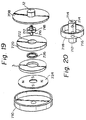
- FIGS 18 to 20 show a fifteenth embodiment. Parts having functions similar to those described with reference to the previously explained embodiments are indicated by the same reference numbers, and a detailed explanation thereof is omitted.
- the drive coils 700 and 702, which function as a magnet rotating means, are provided with cores 704 and 706, respectively, an outer case cap 708 is connected to an inner casing 710, and an axial joint 712 is arranged centrally inside the casing 710, so that the ends thereof are fixedly connected to the casing 710.
- the joint 712 is provided with a T shaped passageway 714, for filling the magnetic fluid 2 in a space formed between the inner and outer casings 720 and 710, and another joint 716 is connected to the first joint 712 so that these joints 712 and 716 are transverse to each other.
- a rotating ring 718 is rotatably connected to the ends of the second joint 716, and an inner case 720 together with an inner case cap 724 functions as a second casing.
- the inner casing is provided with a tubular portion 722 supported by the rotating ring 718.
- a donut shape four pole magnetized ring shaped permanent magnet 3 is supported on the tubular portion 722 of the inner casing 720 by a bearing unit comprised by an inner rail 726a, outer rail 726b and balls 726c.
- a chamber 740 is formed between the magnet 3, inner case 720 and inner case cap 724, in which a gas such as air is filled. Note, instead of filling same with gas, the chamber may be evacuated.
- an angular movement of an angular velocity as shown by an arrow W causes the permanent magnet 3 and the inner casing 720 to be declined with respect to the outer case 708 by the rotating ring 718 about the joint 716 until the precession torque is balanced with a spring force of the magnetic fluid 2.
- the rotation of the permanent magnet 3 supported by the bearing 726 takes place about the rotating axis thereof in the inner casing 720, without coming into contact with the magnetic fluid 2 in the outer casing 710, which prevents the generation of a contact resistance between the permanent magnet 3 and the magnetic fluid 3 as inevitably occurs in the previous embodiments.
Landscapes
- Physics & Mathematics (AREA)
- Engineering & Computer Science (AREA)
- General Physics & Mathematics (AREA)
- Radar, Positioning & Navigation (AREA)
- Remote Sensing (AREA)
- Transmission And Conversion Of Sensor Element Output (AREA)
- Gyroscopes (AREA)
- Measurement Of Length, Angles, Or The Like Using Electric Or Magnetic Means (AREA)
Claims (16)
- Dispositif de détection de vitesse angulaire comprenant :- un boîtier complètement fermé (1);- un élément d'aimant (3) disposé à l'intérieur dudit boîtier et ayant un premier axe de rotation et au moins un second axe transversal audit premier axe pour la déclinaison dudit élément d'aimant (3) par rapport audit boîtier (1);- un moyen (204) de mise en rotation dudit élément d'aimant (3) autour dudit premier axe;- un moyen pour commander ledit moyen de mise en rotation afin de maintenir une valeur constante de ladite vitesse de rotation dudit élément d'aimant (3) autour dudit premier axe;- un moyen (41, 42) pour détecter le degré de déclinaison dudit élément d'aimant (3) par rapport audit boîtier (1) alors que ledit élément d'aimant (3) tourne à une vitesse constante et;- un moyen pour calculer la vitesse angulaire du mouvement en réponse au degré détecté de la déclinaison dudit élément d'aimant (3) par rapport audit boîtier (1)
caractérisé en ce que- ledit moyen de mise en rotation dudit élément d'aimant (3) autour dudit premier axe est agencé de manière à produire un champ magnétique tournant appliqué audit dispositif et à faire tourner ledit élément d'aimant (3) autour dudit premier axe sans avoir un contact mécanique avec ledit élément d'aimant (3);- un fluide magnétique est rempli dans ledit boîtier (1);- l'élément d'aimant peut tourner librement autour dudit premier axe tout en étant à même de subir une déclinaison par rapport audit boîtier à l'encontre de la force élastique dudit fluide magnétique autour dudit second axe lors de l'application dudit champ magnétique tournant; et
en ce que ledit moyen (41, 42) pour détecter le degré de déclinaison dudit élément d'aimant (3) comprend des éléments disposés symétriquement par rapport audit premier axe. - Dispositif selon la revendication 1, dans lequel ledit moyen de mise en rotation comprend des éléments à effet Hall (121, 122, 123) et des bobines électriques (131, 132, 133) disposées dans le boîtier et autour de l'élément d'aimant, les bobines électriques engendrant un champ magnétique et les éléments à effet Hall (121, 122, 123) détectant les pôles de l'élément d'aimant.
- Dispositif selon la revendication 2, dans lequel une multitude de paires de bobines électriques (131, 132, 133) qui sont excitées simultanément, est prévue.
- Dispositif selon la revendication 2, dans lequel lesdites bobines (131, 132, 133) sont enroulées directement autour du boîtier (130).
- Dispositif selon la revendication 1, dans lequel ledit moyen de mise en rotation comprend un moteur relié mécaniquement au boîtier (1) pour mettre en rotation l'élément d'aimant (3) via le fluide magnétique présent dans le boîtier (1).
- Dispositif selon la revendication 1, dans lequel ledit moyen de détection de déclinaison comprend au moins une paire d'éléments à effet Hall (41, 42) disposés symétriquement par rapport au premier axe.
- Dispositif selon la revendication 6, dans lequel l'un des éléments à effet Hall de ladite paire est disposé sur un côté de l'aimant suivant le premier axe, et l'autre élément à effet Hall est agencé sur son autre côté.
- Dispositif selon la revendication 1, dans lequel ledit moyen de détection de la déclinaison comprend au moins une paire de capteurs de pression diamétralement opposés afin de détecter la pression du fluide magnétique dans le boîtier.
- Dispositif selon la revendication 7, caractérisé en ce que ledit moyen de détection de la déclinaison comprend au moins une paire d'éléments à effet Hall diamétralement opposés par rapport au premier axe, et
dans lequel le boîtier est réalisé en matériau céramique et tous les éléments à effet Hall et les bobines électriques sont en une pièce avec le boîtier en céramique. - Dispositif selon l'une quelconque des revendications 1 à 9, caractérisé en ce que :- ledit moyen de détection de la déclinaison (430) comprend un circuit amplificateur de différence (203) amplifiant les signaux détectés par lesdits éléments (41, 42) alors que la sortie dudit amplificateur est introduite dans un moyen de calcul.
- Dispositif selon la revendication 10, caractérisé en ce que :- ledit circuit amplificateur de différence (203) comprend des moyens d'amplificateur de différence d'un premier étage et d'un second étage qui sont connectés l'un à l'autre par des coupleurs à courant alternatif (614, 616).
- Dispositif selon la revendication 1, dans lequel le boîtier (1) présente des parois intérieures espacées axialement et l'élément d'aimant (3) a des parois extérieures espacées axialement, la paroi intérieure dudit boîtier (1) ayant une paire de parties opposées en saillie vers les parois extérieures en regard de l'élément d'aimant (3), respectivement, suivant le premier axe.
- Dispositif selon la revendication 12, dans lequel lesdites parois intérieures ont une forme conique.
- Dispositif selon la revendication 13, comportant en outre des paires opposées de saillies disposées symétriquement autour du premier axe et en contact avec l'élément d'aimant de sorte que la déclinaison de l'élément d'aimant autour du second axe n'est permise qu'autour de ce second axe qui est situé dans un plan dans lequel se trouvent lesdites paires de saillies.
- Dispositif selon la revendication 1, dans lequel le boîtier a des parois intérieures espacées axialement et l'élément d'aimant (3) a des parois extérieures espacées axialement, la paroi intérieure du boîtier (1) ayant une paire d'évidements opposés, respectivement, suivant le premier axe, et comportant en outre un arbre relié à l'élément d'aimant (3) suivant son premier axe, l'arbre ayant des extrémités opposées qui sont situées en étant contiguës aux évidements correspondants, respectivement.
- Dispositif selon la revendication 15, dans lequel les parois intérieures du boîtier sont chanfreinées vers l'intérieur à des points autres que les parties évidées opposées.
Applications Claiming Priority (4)
| Application Number | Priority Date | Filing Date | Title |
|---|---|---|---|
| JP5250390 | 1990-03-02 | ||
| JP52503/90 | 1990-03-02 | ||
| JP3000999A JP2815712B2 (ja) | 1990-03-02 | 1991-01-09 | 角速度検出装置 |
| JP999/91 | 1991-01-09 |
Publications (2)
| Publication Number | Publication Date |
|---|---|
| EP0444713A1 EP0444713A1 (fr) | 1991-09-04 |
| EP0444713B1 true EP0444713B1 (fr) | 1995-05-10 |
Family
ID=26334148
Family Applications (1)
| Application Number | Title | Priority Date | Filing Date |
|---|---|---|---|
| EP91103235A Expired - Lifetime EP0444713B1 (fr) | 1990-03-02 | 1991-03-04 | Dispositif pour déteminer la vitesse angulaire |
Country Status (4)
| Country | Link |
|---|---|
| US (1) | US5253525A (fr) |
| EP (1) | EP0444713B1 (fr) |
| JP (1) | JP2815712B2 (fr) |
| DE (1) | DE69109517T2 (fr) |
Cited By (1)
| Publication number | Priority date | Publication date | Assignee | Title |
|---|---|---|---|---|
| RU2514145C1 (ru) * | 2012-12-07 | 2014-04-27 | Игорь Михайлович Фроимсон | Инерционная система стабилизации изображения оптических приборов |
Families Citing this family (9)
| Publication number | Priority date | Publication date | Assignee | Title |
|---|---|---|---|---|
| DE10124659A1 (de) * | 2001-05-18 | 2002-12-05 | Krones Ag | Vorrichtung zum Aufschrauben von Schraubverschlüssen auf Behälter |
| US7868610B2 (en) * | 2006-06-09 | 2011-01-11 | The Regents Of The University Of California | Angular motion tracking sensor |
| JP5055904B2 (ja) * | 2006-09-08 | 2012-10-24 | セイコーエプソン株式会社 | 検出装置、センサ及び電子機器 |
| US20090212645A1 (en) * | 2008-02-27 | 2009-08-27 | Infineon Technologies Ag | Electronic device for harvesting energy |
| KR101245196B1 (ko) * | 2011-01-25 | 2013-03-19 | 주식회사 아앤시티 | 자이로스코프 |
| US10370125B2 (en) * | 2015-01-13 | 2019-08-06 | Honeywell International Inc. | Satellite control system |
| RU2637713C1 (ru) * | 2016-10-18 | 2017-12-06 | Общество с ограниченной ответственностью "Гиробайк" | Гиростабилизатор двухколесного одноколейного транспортного средства |
| EP3539849B1 (fr) * | 2016-11-08 | 2021-08-25 | LG Innotek Co., Ltd. | Capteur d'indice de couple et dispositif de direction le comprenant |
| CN107092756B (zh) * | 2017-04-26 | 2020-10-02 | 上海航天控制技术研究所 | 一种基于磁流体动力学效应的角速度传感器建模方法 |
Family Cites Families (12)
| Publication number | Priority date | Publication date | Assignee | Title |
|---|---|---|---|---|
| US3148456A (en) * | 1960-12-08 | 1964-09-15 | Browning Alva La Roy | Electrostatic accelerometer and/or gyroscope |
| US3311987A (en) * | 1965-05-19 | 1967-04-04 | Sperry Rand Corp | Pneumatic attitude sensor |
| US3902374A (en) * | 1973-10-19 | 1975-09-02 | Singer Co | Electrostatic rate gyroscope |
| GB1492142A (en) * | 1975-03-26 | 1977-11-16 | Russell A | Linear accelerometers |
| US4043204A (en) * | 1976-08-16 | 1977-08-23 | The United States Of America As Represented By The Secretary Of The Army | Magnetic fluid bearing accelerometer |
| US4192189A (en) * | 1978-10-02 | 1980-03-11 | The Bendix Corporation | Rate sensor |
| GB2070244B (en) * | 1980-01-23 | 1984-02-29 | Furuno Electric Co | Gyroscopic instrument |
| US4570507A (en) * | 1983-08-19 | 1986-02-18 | The United States Of America As Represented By The Secretary Of The Army | Magnetic fluid gyro bearing and caging mechanism |
| GB8704076D0 (en) * | 1987-02-21 | 1987-03-25 | Sperry Sun Inc | Accelerometers |
| JPH0697236B2 (ja) * | 1987-05-30 | 1994-11-30 | 株式会社日本自動車部品総合研究所 | 加速度センサ |
| JPS6435381A (en) * | 1987-07-31 | 1989-02-06 | Nippon Denso Co | Angular velocity detecting device |
| DE3825088C1 (en) * | 1988-07-23 | 1990-02-01 | Robert Bosch Gmbh, 7000 Stuttgart, De | Sensor for determining angular velocity |
-
1991
- 1991-01-09 JP JP3000999A patent/JP2815712B2/ja not_active Expired - Fee Related
- 1991-03-01 US US07/662,295 patent/US5253525A/en not_active Expired - Fee Related
- 1991-03-04 DE DE69109517T patent/DE69109517T2/de not_active Expired - Fee Related
- 1991-03-04 EP EP91103235A patent/EP0444713B1/fr not_active Expired - Lifetime
Cited By (1)
| Publication number | Priority date | Publication date | Assignee | Title |
|---|---|---|---|---|
| RU2514145C1 (ru) * | 2012-12-07 | 2014-04-27 | Игорь Михайлович Фроимсон | Инерционная система стабилизации изображения оптических приборов |
Also Published As
| Publication number | Publication date |
|---|---|
| JPH04212013A (ja) | 1992-08-03 |
| DE69109517D1 (de) | 1995-06-14 |
| US5253525A (en) | 1993-10-19 |
| DE69109517T2 (de) | 1996-01-11 |
| EP0444713A1 (fr) | 1991-09-04 |
| JP2815712B2 (ja) | 1998-10-27 |
Similar Documents
| Publication | Publication Date | Title |
|---|---|---|
| US5501110A (en) | Torsion measuring device for a rotating shaft | |
| US4498342A (en) | Integrated silicon accelerometer with stress-free rebalancing | |
| US6576890B2 (en) | Linear output non-contacting angular position sensor | |
| US4316394A (en) | Magnetically suspended free rotor gyroscope | |
| US4000929A (en) | Magnetic bearing system | |
| US4065189A (en) | Magnetically suspended angular momentum wheel | |
| US4061043A (en) | Electrostatic rate gyroscope | |
| EP3964788B1 (fr) | Capteur à courant de foucault pour arbre rotatif, et appareil à arbre rotatif | |
| EP0444713B1 (fr) | Dispositif pour déteminer la vitesse angulaire | |
| US2716893A (en) | Means and apparatus for utilizing gyrodynamic energy | |
| JP2006047227A (ja) | 回転角度検出装置 | |
| JPS6295421A (ja) | ジヤイロ装置 | |
| US4487083A (en) | Pick-off, torquer, and reference signal generator for free rotor gyroscopes | |
| US4397185A (en) | Inertial instrument with cup-shaped inertial mass | |
| US3438270A (en) | Two-axis torquer | |
| JP5202343B2 (ja) | 回転角検出器 | |
| US5763972A (en) | Magnetic bearing with alternating actuators and sensors | |
| US3490297A (en) | Dual-rotor inertial sensor | |
| EP0025446B1 (fr) | Gyroscope a deux degres de liberte ayant un moteur a aimants permanents | |
| US4189948A (en) | Permanent magnet torquer for free rotor flexure suspended gyroscopes | |
| US3327541A (en) | Signal pickoff and torque generator | |
| US4461176A (en) | Miniature gyroscope | |
| US4506221A (en) | Magnetic heading transducer having dual-axis magnetometer with electromagnet mounted to permit pivotal vibration thereof | |
| CA1283797C (fr) | Gyrometre bi-axial | |
| JP2022098153A (ja) | 回転角センサ |
Legal Events
| Date | Code | Title | Description |
|---|---|---|---|
| PUAI | Public reference made under article 153(3) epc to a published international application that has entered the european phase |
Free format text: ORIGINAL CODE: 0009012 |
|
| 17P | Request for examination filed |
Effective date: 19910304 |
|
| AK | Designated contracting states |
Kind code of ref document: A1 Designated state(s): DE FR GB |
|
| 17Q | First examination report despatched |
Effective date: 19930622 |
|
| GRAA | (expected) grant |
Free format text: ORIGINAL CODE: 0009210 |
|
| AK | Designated contracting states |
Kind code of ref document: B1 Designated state(s): DE FR GB |
|
| REF | Corresponds to: |
Ref document number: 69109517 Country of ref document: DE Date of ref document: 19950614 |
|
| ET | Fr: translation filed | ||
| PLBE | No opposition filed within time limit |
Free format text: ORIGINAL CODE: 0009261 |
|
| STAA | Information on the status of an ep patent application or granted ep patent |
Free format text: STATUS: NO OPPOSITION FILED WITHIN TIME LIMIT |
|
| 26N | No opposition filed | ||
| REG | Reference to a national code |
Ref country code: GB Ref legal event code: IF02 |
|
| PGFP | Annual fee paid to national office [announced via postgrant information from national office to epo] |
Ref country code: GB Payment date: 20040303 Year of fee payment: 14 |
|
| PGFP | Annual fee paid to national office [announced via postgrant information from national office to epo] |
Ref country code: FR Payment date: 20040309 Year of fee payment: 14 |
|
| PGFP | Annual fee paid to national office [announced via postgrant information from national office to epo] |
Ref country code: DE Payment date: 20050224 Year of fee payment: 15 |
|
| PG25 | Lapsed in a contracting state [announced via postgrant information from national office to epo] |
Ref country code: GB Free format text: LAPSE BECAUSE OF NON-PAYMENT OF DUE FEES Effective date: 20050304 |
|
| GBPC | Gb: european patent ceased through non-payment of renewal fee |
Effective date: 20050304 |
|
| PG25 | Lapsed in a contracting state [announced via postgrant information from national office to epo] |
Ref country code: FR Free format text: LAPSE BECAUSE OF NON-PAYMENT OF DUE FEES Effective date: 20051130 |
|
| REG | Reference to a national code |
Ref country code: FR Ref legal event code: ST Effective date: 20051130 |
|
| PG25 | Lapsed in a contracting state [announced via postgrant information from national office to epo] |
Ref country code: DE Free format text: LAPSE BECAUSE OF NON-PAYMENT OF DUE FEES Effective date: 20061003 |