EP0444760B1 - Production améliorée de méthane à partir de couches de charbon par déshydratation - Google Patents
Production améliorée de méthane à partir de couches de charbon par déshydratation Download PDFInfo
- Publication number
- EP0444760B1 EP0444760B1 EP91200443A EP91200443A EP0444760B1 EP 0444760 B1 EP0444760 B1 EP 0444760B1 EP 91200443 A EP91200443 A EP 91200443A EP 91200443 A EP91200443 A EP 91200443A EP 0444760 B1 EP0444760 B1 EP 0444760B1
- Authority
- EP
- European Patent Office
- Prior art keywords
- treatment fluid
- well treatment
- set forth
- surfactant
- fluid
- Prior art date
- Legal status (The legal status is an assumption and is not a legal conclusion. Google has not performed a legal analysis and makes no representation as to the accuracy of the status listed.)
- Expired - Lifetime
Links
Images



Classifications
-
- E—FIXED CONSTRUCTIONS
- E21—EARTH OR ROCK DRILLING; MINING
- E21F—SAFETY DEVICES, TRANSPORT, FILLING-UP, RESCUE, VENTILATION, OR DRAINING IN OR OF MINES OR TUNNELS
- E21F7/00—Methods or devices for drawing- off gases with or without subsequent use of the gas for any purpose
-
- C—CHEMISTRY; METALLURGY
- C09—DYES; PAINTS; POLISHES; NATURAL RESINS; ADHESIVES; COMPOSITIONS NOT OTHERWISE PROVIDED FOR; APPLICATIONS OF MATERIALS NOT OTHERWISE PROVIDED FOR
- C09K—MATERIALS FOR MISCELLANEOUS APPLICATIONS, NOT PROVIDED FOR ELSEWHERE
- C09K8/00—Compositions for drilling of boreholes or wells; Compositions for treating boreholes or wells, e.g. for completion or for remedial operations
- C09K8/60—Compositions for stimulating production by acting on the underground formation
-
- E—FIXED CONSTRUCTIONS
- E21—EARTH OR ROCK DRILLING; MINING
- E21B—EARTH OR ROCK DRILLING; OBTAINING OIL, GAS, WATER, SOLUBLE OR MELTABLE MATERIALS OR A SLURRY OF MINERALS FROM WELLS
- E21B43/00—Methods or apparatus for obtaining oil, gas, water, soluble or meltable materials or a slurry of minerals from wells
- E21B43/006—Production of coal-bed methane
Definitions
- This invention relates to the art of recovery of natural gas from coal seams and, more particularly, to a well treatment fluid and method of treating a well which enhances the dewatering of a coal seam so that methane production therefrom is facilitated.
- the flow of water through the pores and fractures of a coal reservoir is significantly influenced by chemical adsorption of the water onto the surface of the coal.
- the coal surface is uncharged and the movement of water is restricted only by physical relationships. Physical restrictions result from either the viscosity of the flowing phase or the interfacial tension between the water and the coal.
- the presence of fines within a fracture, particularly at the fracture extremities, can result in restricted flow of the water into and within the fracture.
- Fines are often observed during well production. Many of these fines are probably generated near the wellbore by mechanical failure of the coal. It is also likely that some of these fines originate from weathering of the coal seam in the vicinity of the fracture because of changes in the downhole environment resulting from stimulation, production and periodic workovers. Processes that lead to the development of fines include dehydration, oxidation, proppant embedment and changes in the in situ stresses within the coal seams. These fines tend to migrate within the fractures during the fracturing process and concentrate at the fracture tips restricting the flow of water in and through the fracture.
- Air dissolved in the fluids which are introduced to the coal seams during the fracturing treatment and other well operations may also result in oxidation of the coal surface.
- oxidation will also change the normally hydrocarbon-wet and electrically neutral surface of the coal to a surface that is water-wet and electro-negative, thereby inhibiting the dewatering process.
- Wettability changes in the coal surface may also result from the choice and use of surfactants in stimulation or workover fluids.
- surfactants may affect the coal surface and lead to changes in the relative permeability of the coal which can affect both the water drainage rate and fluid saturation level of the coal, either advantageously or detrimentally.
- Surfactants which have proven beneficial in the removal of water form filter cakes in mineral beneficiation processes include polyoxyethylene ethers of a hexitol anhydride partial long-chain fatty acid ester such as described in U.S. Patent 2,864,765; oxyalkylated surfactants such as described in U.S. Patents 3,194,758, 4,156,649 and 4,206,063.
- Other beneficial dewatering surfactants include dialkylsulphosuccinates such as described in U.S. Patent 4,097,390 and 4,146,473. While use of these filtration and dewatering aids is suggested by their beneficial properties in dewatering of slurried fines under atmospheric pressure conditions, their use in a pressurized, porous subterranean environment has met with considerably less success.
- USP 3,902,557 (1975) describes certain treating fluid compositions containing solvents selected from the group consisting of C4 - C10 alkyl ethers of polyglycols at least partially miscible with oil and water and containing from 10 to 22 carbon atoms per molecule.
- the present invention provides a well treatment fluid and method of treating a well which incorporates a group of surfactants which have been found to greatly benefit the dewatering process and, additionally, offer the advantage of being tenaciously bound to the coal surface so that the benefits of their presence on the coal surface can be realized over a long period of formation dewatering.
- a process for recovering natural gas from a subterranean coal reservoir through a wellbore penetrating the coal reservoir comprises pumping into the reservoir, a well treatment fluid comprising an aqueous carrier fluid and an effective amount of a dewatering surfactant selected from a group consisting of
- EO is an ethylene oxide radical
- PO and BO radicals derived from propylene oxide and, respectively, butylene oxide.
- the well treatment fluid is pumped at a pressure sufficient to fracture the formation.
- the above process of fracturing includes providing a well treatment fluid including a proppant and pumping the fluid at a pressure sufficient to fracture the formation.
- a well treatment fluid for fracturing or workover of a subterranean formation comprises an aqueous carrier fluid and an effective amount of a dewatering surfactant selected from a group consisting of
- the above well treatment fluid is a fracturing fluid which further includes a proppant.
- a wellbore In the process of recovering natural gas, principally methane, from subterranean coal reservoirs, a wellbore is drilled to the subterranean coal seam and completed and perforated in a manner substantially identical to the procedure for drilling and completing a normal subterranean gas well.
- a wellbore In order to stimulate production of subterranean fluids (liquids and gases) to the wellbore, it is common practice to fracture the formation and this procedure is also beneficial in the dewatering and production of gas from subterranean coal reservoirs.
- Fracturing fluids typically comprise an aqueous or oil-based liquid carrier fluid which is commonly viscosified to improve its rheological and proppant-carrying properties typically using a polysaccharide polymer such as a cellulosic polymer or a galactomannan gum.
- Common materials used in the viscosifying of fracturing fluids comprise cellulose and cellulose derivatives such as hydroxyethyl cellulose, carboxymethyl hydroxyethyl cellulose and the like and guar and modified guar gums such as hydroxypropyl guar, carboxymethyl hydroxypropyl guar and the like.
- Such viscosifiers or gelling agents may additionally be crosslinked in order to further increase their proppant-carrying capacity and improve their rheological properties as is known in the art using various crosslinking materials such as borates, titanates, zirconates, aluminates and the like.
- Such fracturing fluids also employ gel breaking agents in order to break the gels and assist in the return of the fracturing fluids to the wellbore once a fracturing operation has been completed.
- aqueous fracturing fluids which may be thickened by either crosslinked or uncrosslinked gelling agents as described above and may further include gaseous energizing or foaming materials such as carbon dioxide and/or nitrogen.
- the fracture is initiated by pumping a low viscosity aqueous fluid with good to moderate leak-off properties, low polymer loadings and, typically, no proppant into the formation.
- This initial fluid typically referred to as a "pad”
- fracturing fluid of higher viscosity carrying initially low quantities and then gradually increasing quantities of proppant into the extended fractures.
- Wells which have been previously fractured and/or wells having initial high permeability may show a decrease in production over time due to formation and/or fracturing plugging due to various well conditions such as fines migration, oxidation and the like.
- workover fluids may simply comprise water used to flush out the flow channels in the reservoir or an acid solution which may dissolve detrimental deposits. Either of these fluids may include low polymer loading and are conducted at pressures below fracturing pressures so as to avoid disturbing a proppant pack within fractures of the formations.
- an aqueous well treatment fluid for use in both workover operations and in fracturing coal seams includes a dewatering aid for facilitating the desorption of water through the pores and the fractures of the coal formation to the wellbore.
- the dewatering aid is an organic surfactant selected from a group consisting of
- the surfactants of the present invention are adsorbed onto the coal surface thereby increasing the hydrophobicity of the coal.
- the preferred surfactants also are relatively tenaciously bound to the coal surfaces thereby preventing re-wetting and re-adsorption of water on the coal surface by the passage of subsequent volumes of water through the formation drainage process.
- This feature of the surfactants offers the additional advantage that, since the surfactants are tenaciously bound to the coal, minor, if any, amounts are contained in the produced water thereby greatly reducing any environmental discharge problems associated with the produced water. Further, the surfactants of this invention inhibit the migration of fines within the fracture thereby additionally enhancing and maintaining fracture conductivity.
- any dewatering aid should resist removal from the surface of the coal by being tenaciously bound thereto.
- the preferred dewatering aids enhance the conductivity of a coal seam fracture but, most importantly, maintain that conductivity over an extended period of production.
- the testing comprised flowing fluids under pressure through packs of fine coal.
- One inch inside diameter plexiglass tubes were filled with 100 grams of dry coal fines. With the bottom end of the tubes opened, water was flowed vertically downwardly through the coal and any air above the coal was bled off. Water pressure was increased to 20 psi and the tubes were tapped in order to compact the coal column. After stable flow was achieved, the permeability of the coal pack was determined. Using a syringe, approximately two pore volumes (100 cc) of water containing 1000 to 4000 ppm by volume (1 to 4 gallons per thousand gallons of water) of the selected surfactant was added to the top of the column.
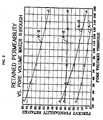
- Figure 1 illustrates a plot of the testing of four ethylene oxide, butylene oxide substituted alcohols in comparison with a prior art standard.
- Plot A-1 represents the testing of a fluorinated alkyl quaternary ammonium iodide surfactant system such as described in U.S. Patent 4,028,257 which has been commonly used in coalbed dewatering applications.
- this material shows a substantial decrease in the permeability enhancement over time. It is speculated that this decrease in the permeability enhancement affect is a result of the leaching of the surfactant material from the coal surface by the passage of water flowing through the pack.
- Additional materials tested against this standard shown in Figure 1 comprise ethanol with 3.2 ethylene oxide and 9.0 butylene oxide adducts (line A-2), tridecyl alcohol having 7.5 ethylene oxide and 1.8 butylene oxide adducts (line A-3); butanol having 10 ethylene oxide and 6 butylene oxide adducts (line A-4) and methanol having 3.1 ethylene oxide and 8.5 butylene oxide adducts (line A-5). It can be seen that all of these materials are more tenaciously bound to the coal surface since permeability decreases at a much slower rate due to the passage of water through the column than the prior art standard. A larger percentage of the initial permeability enhancement is retained throughout the test.
- Figure 2 illustrates the testing of three additional ethylene oxide, butylene oxide substituted alcohols against the same prior art standard fluoro surfactant (line A-6).
- the poor performance of tridecyl alcohol having 6.5 ethylene oxide adducts (line A-7) illustrates the importance of the presence of butylene oxide in the substituted alcohol. Not only does this material lack tenacious binding to the coal surface, the initial permeability enhancement in the coal pack is substantially less than that of the prior art standard.
- Butanol having 3.3 ethylene oxide and 5 butylene oxide adducts shows extremely tenacious binding of the surfactant to the coal surface and long-term retained permeability enhancement.
- Di-secondarybutylphenol having 5 ethylene oxide and 4 butylene oxide adducts (line A-9) while not being tenaciously bound to the coal surface does show an extremely high permeability enhancement effects over a long period of time.
- Figure 3 illustrates the testing of four ethylene carbonate substituted alcohols against the same prior art fluorinated surfactant material (line B-1).
- Dodecanol having 20 ethylene carbonate adducts (line B-2) shows an initial low permeability enhancement with some increase and then a substantial fall off thereafter.
- Dodecanol having 5 ethylene carbonate adducts (line B-4) actually destroys permeability below that of a surfactant-free coal pack.
- Decanol having 10 ethylene carbonate adducts (line B-5) shows both high permeability and long-term retention of the material on the coal surface.
- Line B-3 of Figure 3 illustrates the effects of a prior art sulfosuccinate surfactant shown to be effective in low pressure mineral dewatering processes to be somewhat effective in increasing initial permeability enhancement but showing substantial fall-off in permeability enhancement over time.
- Figure 4 illustrates the testing of three glycol-based materials having ethylene oxide and/or butylene oxide adducts.
- the prior art fluorinated surfactant standard system is illustrated by line C-1.
- a commercial mixture of diethyleneglycol monobutyl ether, triethyleneglycol monobutyl ether and higher glycol ethers having 9.5 butylene oxide adducts (line C-2) shows destruction of permeability over a surfactant-free system.
- the same commercial mixture of diethylene, triethylene and higher glycol ether mixtures having 4.2 ethylene oxide and 6 butylene oxide adducts shows acceptable permeability enhancement and good long-term retention of the surfactant on the coal surface.
- Triethyleneglycol monobutyl ether-formal (line C-4) shows excellent permeability enhancement and good long-term tenacity in retention on the coal surface.
- Figure 5 illustrates that known prior art dewatering aids used in the dewatering of coal or minerals in surface beneficiation processes can unexpectedly show undesirable effects when used in a pressurized environment such as is found in the process of dewatering a subterranean coal formation.
- Line D-1 represents the standard, prior art fluorinated surfactant illustrated in all of the other Figures.
- Line D-2, D-3 and D-4 represent the testing of dicocoamine acetate, dimethyldicoco ammonium chloride and a commercial dewatering aid of unknown composition sold by Chemlink as SR-8102, respectively. None of these materials show performance which would be at all acceptable in a dewatering aid for inclusion in a well treatment fluid for subterranean coal formations.
- Figure 6 illustrates the effects of extremely long-term use of the prior art standard fluorinated surfactant (line E-1) versus a preferred material comprising tridecyl alcohol having 7.5 ethylene oxide and 3.6 butylene oxide adducts (line E-2).
- the fracture is initiated using 1 to 4 gallons of a selected dewatering surfactant in accordance with the invention per 1000 gallons of water.
- the water may be neat or a brine and may also contain low amounts of a polymeric gelling agent.
- This stage has high water leak-off into the coal formation and primarily is intended to initiate the fracture and to place the initial quanitites of the dewatering surfactant in the formation.
- additional fracturing fluid is pumped to attain wider fractures and contain higher polymer loadings (40 to 60lbs per thousand gallons).
- the polymer may be either crosslinked or uncrosslinked.
- the fracturing fluid further includes 1 to 2 gallons of selected dewatering surfactant per 1000 gallons of fracturing fluid.
- the initial, low proppant-loaded fracturing fluids can contain 1 to 2 gallons of the selected surfactant per 1000 gallons of fracturing fluid. Little or no additional dewatering surfactant is provided in the later, higher proppant-loaded stages of the fracturing process.
- the well treatment fluid of the present invention may also be used to enhance water and gas recovery from "poor" producers that have previously been fractured and propped or wells which contain some conductive drainage channels to the wellbore.
- water having little or no polymer loading is used to transport 2 to 4 gallons of the selected dewatering surfactant per 1000 gallons of fracturing fluid into the coal seam.
- This treatment is normally done at less than fracturing pressure to prevent dislodging the proppant that may be present in the fracture.
- the total volume of fluid containing the dewatering surfactant would depend on the coal seam height and the desired penetration of the dewatering surfactant.
Landscapes
- Engineering & Computer Science (AREA)
- Mining & Mineral Resources (AREA)
- Life Sciences & Earth Sciences (AREA)
- General Life Sciences & Earth Sciences (AREA)
- Geology (AREA)
- Chemical & Material Sciences (AREA)
- Geochemistry & Mineralogy (AREA)
- Organic Chemistry (AREA)
- Materials Engineering (AREA)
- Chemical Kinetics & Catalysis (AREA)
- General Chemical & Material Sciences (AREA)
- Oil, Petroleum & Natural Gas (AREA)
- Physics & Mathematics (AREA)
- Environmental & Geological Engineering (AREA)
- Fluid Mechanics (AREA)
- Emulsifying, Dispersing, Foam-Producing Or Wetting Agents (AREA)
- Solid Fuels And Fuel-Associated Substances (AREA)
Claims (23)
- Fluide de traitement de puits pour le traitement de la formation souterraine pénétrée par un puits de forage, comprenant un fluide véhicule aqueux et une quantité efficace d'un agent tensio-actif déshydratant choisi dans le groupe comprenanta) des composés tensio-actifs organiques répondant à la formule
R₁-O([EO]x-[PO]y-[BO]z)H
où R₁ représente un alcool, un phénol ou un dérivé de phénol ou un acide gras comportant de 1 à 16 atomes de carbone, EO représente un radical d'oxyde d'éthylène et x va de 1 à 20 ; PO représente un radical d'oxyde de propylène et y va de 0 à 15 et BO représente un radical d'oxyde de butylène et z va de 1 à 15 ;b) un carbonate de polyéthylène organique répondant à la formule c) des glycols butoxylés comportant de 1 à 5 groupes d'oxyde de butylène, etd) des glycols éthoxylés-butoxylés comportant de 1 à 5 groupes d'oxyde d'éthylène et de 5 à 10 groupes d'oxyde de butylène, avec l'exception que ledit agent tensio-actif déshydratant ne soit pas choisi dans le groupe constitué d'éthers d'alkyle en C₄-C₁₀ de polyglycols, au moins partiellement miscibles à l'huile et à l'eau, et contenant un nombre d'atome de carbone de 10 à 22 par molécule.
 - Fluide de traitement de puits selon la revendication 1, caractérisé en ce que ledit agent tensioactif choisi est présent dans ledit fluide à une teneur d'au moins 50 parties par million en volume.
- Fluide de traitement de puits selon la revendication 2, caractérisé en ce que ledit agent tensioactif choisi est présent dans le ledit fluide en une quantité comprise entre 1 et 4 gallons de surfactant par 1000 gallons d'eau (1 à 4 litres par mètre cube).
- Fluide de traitement de puits selon la revendication 1, comprenant de plus un agent gélifiant.
- Fluide de traitement de puits selon la revendication 4, caractérisé en ce que ledit agent gélifiant comprend un polysaccharide.
- Fluide de traitement de puits selon la revendication 5, caractérisé en ce que ledit agent gélifiant de type polysaccharide est choisi dans le groupe constitué de la cellulose et des polymères de cellulose modifiés et des gommes de galactomannane modifiées ou non modifiées.
- Fluide de traitement de puits selon la revendication 6, caractérisé en ce que ledit agent gélifiant de type polysaccharide est une gomme de guar ou une gomme de guar modifiée.
- Fluide de traitement de puits selon la revendication 4, caractérisé en ce que ledit fluide est un fluide de fracturation comprenant de plus un agent de soutènement.
- Fluide de traitement de puits selon la revendication 4, comprenant de plus un agent de rupture de gel (ou "breaker").
- Fluide de traitement de puits selon la revendication 4, comprenant de plus un agent réticulant.
- Fluide de traitement de puits selon la revendication 10, caractérisé en ce que l'agent réticulant comprend un composé organométallique.
- Fluide de traitement de puits selon la revendication 10, caractérisé en ce que ledit agent réticulant comprend un composé de type borate.
- Fluide de traitement de puits selon la revendication 10, caractérisé en ce que le fluide est un fluide de fracturation comprenant de plus un agent de soutènement.
- Fluide de traitement de puits selon la revendication 1, caractérisé en ce que l'agent tensio-actif déshydratant choisi comprend l'alcohol tridécylique comportant 7,5 motifs d'addition d'oxyde d'éthylène et 3,6 addition d'oxyde de butylène.
- Fluide de traitement de puits selon la revendication 1, caractérisé en ce que l'agent tensio-actif déshydratant choisi comprend le décanol comportant 10 addition de carbonate d'éthylène.
- Fluide de traitement de puits selon la revendication 1, caractérisé en ce que l'agent tensio-actif déshydratant choisi comprend l'éther-formal monobutylique du triéthylène glycol.
- Fluide de traitement de puits selon la revendication 1, caractérisé en ce que l'agent tensio-actif déshydratant choisi comprend un mélange de diéthylène glycol, triéthylène glycol et de glycols supérieurs comportant 4,2 d'additions d'oxyde d'éthylène et 6 d'addition d'oxyde de butylène.
- Méthode de traitement de d'une formation souterraine pénétrée par un puits de forage comprenant les étapes de fourniture d'un fluide de traitement de puits, comprenant un agent véhicule aqueux et une quantité efficace d'un agent tensio-actif déshydratant choisi dans le groupe constitué :a) des composés tensio-actifs organiques répondant à la formule
R₁-O([EO]x-[PO]y-[BO]z)H
dans laquelle R₁ est un alcool, un phénol ou un dérivé de phénol ou un acide gras comportant de 1 à 16 atomes de carbone ; EO est un radical d'oxyde d'éthylène et x va de 1 à 20 ; PO est un radical d'oxyde de propylène et y va de 0 à 15 et BO est un radical d'oxyde de butylène et z va de 1 à 15 ;b) un carbonate de polyéthylène organique répondant à la formule c) des glycols butoxylés comportant de 1 à 5 groupes d'oxyde de butylène, etd) des glycols éthoxylés-butoxylés comportant de 1 à 5 groupes d'oxyde d'éthylène et 5 à 10 groupes d'oxyde de butylène,et le pompage du fluide de traitement de puits dans la formation à travers le puits de forage.
 - Méthode selon la revendication 18, caractérisée en ce que l'étape de fourniture d'un fluide de traitement de puits comprend la fourniture d'un fluide comprenant de plus un agent de soutènement, et ladite étape de pompage comprend le pompage dudit fluide de traitement de puits à une pression suffisante pour fracturer la formation.
- Méthode selon la revendication 18, caractérisée en ce que l'étape de fourniture d'un fluide de traitement de puits comprend la fourniture d'un fluide de traitement de puits comprenant de plus un agent gélifiant.
- Méthode selon la revendication 18, caractérisée en ce que l'étape de fourniture d'un fluide de traitement de puits comprend la fourniture d'un fluide comprenant de plus un agent gélifiant et un agent réticulant pour l'agent gélifiant.
- Méthode selon la revendication 18, caractérisée en ce que l'étape de fourniture d'un fluide de traitement de puits comprend la fourniture d'un fluide de traitement de puits comprenant de plus un agent gélifiant et un agent de rupture de gel (ou "breaker").
- Méthode selon la revendication 18, caractérisée en ce que l'étape de fourniture d'un fluide de traitement puits comprend la fourniture d'un fluide de traitement de puits comprenant de plus un agent gélifiant, un agent réticulant et un agent de rupture de gel.
Applications Claiming Priority (2)
| Application Number | Priority Date | Filing Date | Title |
|---|---|---|---|
| US07/487,370 US5229017A (en) | 1990-03-01 | 1990-03-01 | Method of enhancing methane production from coal seams by dewatering |
| US487370 | 1990-03-01 |
Publications (2)
| Publication Number | Publication Date |
|---|---|
| EP0444760A1 EP0444760A1 (fr) | 1991-09-04 |
| EP0444760B1 true EP0444760B1 (fr) | 1994-07-13 |
Family
ID=23935469
Family Applications (1)
| Application Number | Title | Priority Date | Filing Date |
|---|---|---|---|
| EP91200443A Expired - Lifetime EP0444760B1 (fr) | 1990-03-01 | 1991-03-01 | Production améliorée de méthane à partir de couches de charbon par déshydratation |
Country Status (6)
| Country | Link |
|---|---|
| US (1) | US5229017A (fr) |
| EP (1) | EP0444760B1 (fr) |
| AU (1) | AU638106B2 (fr) |
| CA (1) | CA2037454A1 (fr) |
| DE (1) | DE69102792T2 (fr) |
| DK (1) | DK0444760T3 (fr) |
Families Citing this family (30)
| Publication number | Priority date | Publication date | Assignee | Title |
|---|---|---|---|---|
| DE4218074A1 (de) * | 1992-06-01 | 1993-12-02 | Henkel Kgaa | Verfahren zur Entwässerung von feinteiligen Feststoffsuspensionen |
| US5390741A (en) * | 1993-12-21 | 1995-02-21 | Halliburton Company | Remedial treatment methods for coal bed methane wells |
| CO4560488A1 (es) * | 1995-10-03 | 1998-02-10 | Nor Ind Inc | Composiciones limpiadoras para pozos de lineas, carcasas, formaciones y equipo de petroleo y gas . |
| US6242389B1 (en) * | 1997-04-14 | 2001-06-05 | Bp Chemicals Limited | Ethers |
| US6054416A (en) * | 1998-05-07 | 2000-04-25 | Baker Hughes Incorporated | Drilling fluids comprising biodegradable heteropolyglycols |
| NZ520671A (en) | 2000-02-25 | 2003-03-28 | Sofitech N | Foaming agents for use in coal seam reservoirs |
| US6660693B2 (en) | 2001-08-08 | 2003-12-09 | Schlumberger Technology Corporation | Methods for dewatering shaly subterranean formations |
| US6915854B2 (en) * | 2001-10-02 | 2005-07-12 | Schlumberger Technology Corporation | Foaming agents for use in coal seam reservoirs |
| US7595281B2 (en) * | 2005-05-18 | 2009-09-29 | Halliburton Energy Services, Inc. | Methods to increase recovery of treatment fluid following stimulation of a subterranean formation comprising in situ fluorocarbon coated particles |
| DE102005026716A1 (de) * | 2005-06-09 | 2006-12-28 | Basf Ag | Tensidmischungen für die tertiäre Erdölförderung |
| GB2436576B (en) * | 2006-03-28 | 2008-06-18 | Schlumberger Holdings | Method of facturing a coalbed gas reservoir |
| US20080016768A1 (en) | 2006-07-18 | 2008-01-24 | Togna Keith A | Chemically-modified mixed fuels, methods of production and used thereof |
| US8053395B2 (en) * | 2007-01-19 | 2011-11-08 | Halliburton Energy Services, Inc. | Compositions for increasing gas production from a subterranean formation |
| US8302691B2 (en) * | 2007-01-19 | 2012-11-06 | Halliburton Energy Services, Inc. | Methods for increasing gas production from a subterranean formation |
| US7971648B2 (en) | 2007-08-03 | 2011-07-05 | Pine Tree Gas, Llc | Flow control system utilizing an isolation device positioned uphole of a liquid removal device |
| US7552771B2 (en) | 2007-11-14 | 2009-06-30 | Halliburton Energy Services, Inc. | Methods to enhance gas production following a relative-permeability-modifier treatment |
| WO2009114792A2 (fr) | 2008-03-13 | 2009-09-17 | Joseph A Zupanick | Amélioration apportée à un système d’allègement au gaz |
| US7726404B2 (en) | 2008-04-16 | 2010-06-01 | Schlumberger Technology Corporation | Use of carbon-dioxide-based fracturing fluids |
| US8127835B2 (en) * | 2009-02-18 | 2012-03-06 | Schlumberger Technology Corporation | Integrated cable hanger pick-up system |
| US7980311B2 (en) * | 2009-02-18 | 2011-07-19 | Schlumberger Technology Corporation | Devices, systems and methods for equalizing pressure in a gas well |
| US8177526B2 (en) * | 2009-02-18 | 2012-05-15 | Schlumberger Technology Corporation | Gas well dewatering system |
| US8082991B2 (en) * | 2009-02-19 | 2011-12-27 | Schlumberger Technology Corporation | Monitoring and control system for a gas well dewatering pump |
| CA2688202C (fr) * | 2009-12-11 | 2012-11-13 | Bj Services Company | Fluides viscoelastiques contenant de l'hydroxyethylcellulose |
| EP2516792A4 (fr) | 2009-12-23 | 2015-05-06 | Bp Corp North America Inc | Système de pompe à faible volume sans appareil de forage |
| US8950494B2 (en) * | 2010-11-19 | 2015-02-10 | Nalco Company | Foamers for downhole injection |
| US20140060834A1 (en) * | 2012-08-31 | 2014-03-06 | Baker Hughes Incorporated | Controlled Electrolytic Metallic Materials for Wellbore Sealing and Strengthening |
| WO2014158918A1 (fr) | 2013-03-14 | 2014-10-02 | Stepan Company | Agents moussants pour décharger des puits de gaz à haute teneur en produit de condensation |
| CA2888027A1 (fr) | 2014-04-16 | 2015-10-16 | Bp Corporation North America, Inc. | Pompes alternatives pour systemes de deliquification et systemes de distribution de liquide servant a actionner les pompes alternatives |
| WO2016093690A1 (fr) * | 2014-12-12 | 2016-06-16 | Schlumberger Technology B.V. | Procédé de traitement de formation de méthane de couche de houille |
| CN108868871B (zh) * | 2018-05-18 | 2024-03-29 | 河南能源化工集团研究总院有限公司 | 水力冲孔后应力快速平衡方法 |
Family Cites Families (7)
| Publication number | Priority date | Publication date | Assignee | Title |
|---|---|---|---|---|
| US3194758A (en) * | 1961-05-24 | 1965-07-13 | Petrolite Corp | Method of agglomerating finely divided solids in an aqueous medium |
| US3380531A (en) * | 1967-05-18 | 1968-04-30 | Chevron Res | Method of pumping viscous crude |
| DE2350569C2 (de) * | 1973-10-09 | 1982-04-08 | Alfred Teves Gmbh, 6000 Frankfurt | Verwendung von Alkyl-polyäthylenglykol - tert.- butyläthern als Bestandteil eines hydraulischen Mittels. |
| US3902557A (en) * | 1974-03-25 | 1975-09-02 | Exxon Production Research Co | Treatment of wells |
| US4330481A (en) * | 1978-12-26 | 1982-05-18 | The Dow Chemical Company | Process for preparing polycarbonates |
| CA1140457A (fr) * | 1979-10-19 | 1983-02-01 | Noval Technologies Ltd. | Methode d'extraction du methane present dans les veines de charbon |
| US4842065A (en) * | 1988-05-11 | 1989-06-27 | Marathon Oil Company | Oil recovery process employing cyclic wettability alteration |
-
1990
- 1990-03-01 US US07/487,370 patent/US5229017A/en not_active Expired - Lifetime
-
1991
- 1991-03-01 AU AU72051/91A patent/AU638106B2/en not_active Ceased
- 1991-03-01 EP EP91200443A patent/EP0444760B1/fr not_active Expired - Lifetime
- 1991-03-01 DK DK91200443.9T patent/DK0444760T3/da active
- 1991-03-01 CA CA002037454A patent/CA2037454A1/fr not_active Abandoned
- 1991-03-01 DE DE69102792T patent/DE69102792T2/de not_active Expired - Fee Related
Also Published As
| Publication number | Publication date |
|---|---|
| US5229017A (en) | 1993-07-20 |
| CA2037454A1 (fr) | 1991-09-02 |
| DE69102792D1 (de) | 1994-08-18 |
| EP0444760A1 (fr) | 1991-09-04 |
| DK0444760T3 (da) | 1994-11-21 |
| AU7205191A (en) | 1991-09-05 |
| AU638106B2 (en) | 1993-06-17 |
| DE69102792T2 (de) | 1995-03-09 |
Similar Documents
| Publication | Publication Date | Title |
|---|---|---|
| US5229017A (en) | Method of enhancing methane production from coal seams by dewatering | |
| EP1257729B1 (fr) | Agents moussants utilises dans des reservoirs de couches de charbon | |
| US10526529B2 (en) | Treatment fluids comprising viscosifying agents and methods of using the same | |
| US6915854B2 (en) | Foaming agents for use in coal seam reservoirs | |
| AU659302B2 (en) | Gas well treatment compositions and methods | |
| US10526530B2 (en) | Flooding operations employing chlorine dioxide | |
| US6660693B2 (en) | Methods for dewatering shaly subterranean formations | |
| US6875728B2 (en) | Method for fracturing subterranean formations | |
| EP1991633B1 (fr) | Fluide de forage comprenant un fluide de base et un agent de pontage particulaire | |
| AU2002333350A1 (en) | Methods for dewatering shaly subterranean formations | |
| US20190093463A1 (en) | Hydraulic Fracturing with Nanobubbles | |
| US4110224A (en) | Secondary recovery process utilizing water saturated with gas | |
| US3335794A (en) | Secondary recovery method with surfactant in fracturing fluid | |
| GB2348447A (en) | Wellbore service fluids | |
| US12152194B2 (en) | Low surface tension surfactant system for enhancing flow-back performance | |
| Crowe et al. | Development of Oil Soluble Resin Mixture for Control of Fluid Loss in Water Base Workover and Completion Fluids | |
| CA2597137C (fr) | Agents moussants utilises dans des reservoirs de couches de charbon | |
| CA2360626C (fr) | Methode de fracturation de formations souterraines |
Legal Events
| Date | Code | Title | Description |
|---|---|---|---|
| PUAI | Public reference made under article 153(3) epc to a published international application that has entered the european phase |
Free format text: ORIGINAL CODE: 0009012 |
|
| AK | Designated contracting states |
Kind code of ref document: A1 Designated state(s): DE DK FR GB IT NL |
|
| 17P | Request for examination filed |
Effective date: 19920218 |
|
| 17Q | First examination report despatched |
Effective date: 19920724 |
|
| GRAA | (expected) grant |
Free format text: ORIGINAL CODE: 0009210 |
|
| AK | Designated contracting states |
Kind code of ref document: B1 Designated state(s): DE DK FR GB IT NL |
|
| REF | Corresponds to: |
Ref document number: 69102792 Country of ref document: DE Date of ref document: 19940818 |
|
| ITF | It: translation for a ep patent filed | ||
| RAP2 | Party data changed (patent owner data changed or rights of a patent transferred) |
Owner name: COMPAGNIE DES SERVICES DOWELL SCHLUMBERGER Owner name: PUMPTECH N.V. |
|
| ET | Fr: translation filed | ||
| REG | Reference to a national code |
Ref country code: DK Ref legal event code: T3 |
|
| NLT2 | Nl: modifications (of names), taken from the european patent patent bulletin |
Owner name: PUMPTECH N.V. TE ANTWERPEN, BELGIE. |
|
| PLBE | No opposition filed within time limit |
Free format text: ORIGINAL CODE: 0009261 |
|
| STAA | Information on the status of an ep patent application or granted ep patent |
Free format text: STATUS: NO OPPOSITION FILED WITHIN TIME LIMIT |
|
| 26N | No opposition filed | ||
| PGFP | Annual fee paid to national office [announced via postgrant information from national office to epo] |
Ref country code: FR Payment date: 20010305 Year of fee payment: 11 |
|
| REG | Reference to a national code |
Ref country code: GB Ref legal event code: IF02 |
|
| PGFP | Annual fee paid to national office [announced via postgrant information from national office to epo] |
Ref country code: DK Payment date: 20020315 Year of fee payment: 12 |
|
| PGFP | Annual fee paid to national office [announced via postgrant information from national office to epo] |
Ref country code: NL Payment date: 20020328 Year of fee payment: 12 |
|
| PG25 | Lapsed in a contracting state [announced via postgrant information from national office to epo] |
Ref country code: FR Free format text: LAPSE BECAUSE OF NON-PAYMENT OF DUE FEES Effective date: 20021129 |
|
| REG | Reference to a national code |
Ref country code: FR Ref legal event code: ST |
|
| PG25 | Lapsed in a contracting state [announced via postgrant information from national office to epo] |
Ref country code: DK Free format text: LAPSE BECAUSE OF NON-PAYMENT OF DUE FEES Effective date: 20030331 |
|
| PG25 | Lapsed in a contracting state [announced via postgrant information from national office to epo] |
Ref country code: NL Free format text: LAPSE BECAUSE OF NON-PAYMENT OF DUE FEES Effective date: 20031001 |
|
| NLV4 | Nl: lapsed or anulled due to non-payment of the annual fee |
Effective date: 20031001 |
|
| PGFP | Annual fee paid to national office [announced via postgrant information from national office to epo] |
Ref country code: GB Payment date: 20031224 Year of fee payment: 14 |
|
| PGFP | Annual fee paid to national office [announced via postgrant information from national office to epo] |
Ref country code: DE Payment date: 20040311 Year of fee payment: 14 |
|
| PG25 | Lapsed in a contracting state [announced via postgrant information from national office to epo] |
Ref country code: IT Free format text: LAPSE BECAUSE OF NON-PAYMENT OF DUE FEES;WARNING: LAPSES OF ITALIAN PATENTS WITH EFFECTIVE DATE BEFORE 2007 MAY HAVE OCCURRED AT ANY TIME BEFORE 2007. THE CORRECT EFFECTIVE DATE MAY BE DIFFERENT FROM THE ONE RECORDED. Effective date: 20050301 Ref country code: GB Free format text: LAPSE BECAUSE OF NON-PAYMENT OF DUE FEES Effective date: 20050301 |
|
| PG25 | Lapsed in a contracting state [announced via postgrant information from national office to epo] |
Ref country code: DE Free format text: LAPSE BECAUSE OF NON-PAYMENT OF DUE FEES Effective date: 20051001 |
|
| GBPC | Gb: european patent ceased through non-payment of renewal fee |
Effective date: 20050301 |