EP0444935B1 - Système de commande d'un faisceau d'ions - Google Patents
Système de commande d'un faisceau d'ions Download PDFInfo
- Publication number
- EP0444935B1 EP0444935B1 EP91301654A EP91301654A EP0444935B1 EP 0444935 B1 EP0444935 B1 EP 0444935B1 EP 91301654 A EP91301654 A EP 91301654A EP 91301654 A EP91301654 A EP 91301654A EP 0444935 B1 EP0444935 B1 EP 0444935B1
- Authority
- EP
- European Patent Office
- Prior art keywords
- ion
- ions
- extraction
- ion beam
- source
- Prior art date
- Legal status (The legal status is an assumption and is not a legal conclusion. Google has not performed a legal analysis and makes no representation as to the accuracy of the status listed.)
- Expired - Lifetime
Links
- 238000010884 ion-beam technique Methods 0.000 title claims description 48
- 150000002500 ions Chemical class 0.000 claims description 86
- 238000000605 extraction Methods 0.000 claims description 47
- 235000012431 wafers Nutrition 0.000 claims description 25
- 238000005468 ion implantation Methods 0.000 claims description 12
- 238000009826 distribution Methods 0.000 claims description 9
- 238000000034 method Methods 0.000 claims description 9
- 238000002955 isolation Methods 0.000 claims description 6
- 230000005684 electric field Effects 0.000 claims description 5
- 230000005591 charge neutralization Effects 0.000 claims description 2
- 230000003116 impacting effect Effects 0.000 claims description 2
- 239000002245 particle Substances 0.000 claims description 2
- 230000003213 activating effect Effects 0.000 claims 1
- 239000002184 metal Substances 0.000 claims 1
- 238000002513 implantation Methods 0.000 description 7
- VYPSYNLAJGMNEJ-UHFFFAOYSA-N Silicium dioxide Chemical compound O=[Si]=O VYPSYNLAJGMNEJ-UHFFFAOYSA-N 0.000 description 6
- XUIMIQQOPSSXEZ-UHFFFAOYSA-N Silicon Chemical compound [Si] XUIMIQQOPSSXEZ-UHFFFAOYSA-N 0.000 description 6
- 229910052710 silicon Inorganic materials 0.000 description 6
- 239000010703 silicon Substances 0.000 description 6
- 239000004020 conductor Substances 0.000 description 4
- 230000001133 acceleration Effects 0.000 description 3
- 239000004065 semiconductor Substances 0.000 description 3
- 235000012239 silicon dioxide Nutrition 0.000 description 3
- 239000000377 silicon dioxide Substances 0.000 description 3
- 238000000151 deposition Methods 0.000 description 2
- 238000004519 manufacturing process Methods 0.000 description 2
- 239000000463 material Substances 0.000 description 2
- 238000006386 neutralization reaction Methods 0.000 description 2
- 239000010022 Myron Substances 0.000 description 1
- 241001439614 Myron Species 0.000 description 1
- 235000010627 Phaseolus vulgaris Nutrition 0.000 description 1
- 244000046052 Phaseolus vulgaris Species 0.000 description 1
- 238000010420 art technique Methods 0.000 description 1
- 230000015572 biosynthetic process Effects 0.000 description 1
- 238000001739 density measurement Methods 0.000 description 1
- 230000001419 dependent effect Effects 0.000 description 1
- 230000001687 destabilization Effects 0.000 description 1
- 238000009792 diffusion process Methods 0.000 description 1
- 230000003292 diminished effect Effects 0.000 description 1
- 230000000694 effects Effects 0.000 description 1
- 239000000284 extract Substances 0.000 description 1
- 239000007943 implant Substances 0.000 description 1
- 238000012986 modification Methods 0.000 description 1
- 230000004048 modification Effects 0.000 description 1
- 230000003472 neutralizing effect Effects 0.000 description 1
Images

Classifications
-
- H—ELECTRICITY
- H01—ELECTRIC ELEMENTS
- H01J—ELECTRIC DISCHARGE TUBES OR DISCHARGE LAMPS
- H01J37/00—Discharge tubes with provision for introducing objects or material to be exposed to the discharge, e.g. for the purpose of examination or processing thereof
- H01J37/02—Details
- H01J37/04—Arrangements of electrodes and associated parts for generating or controlling the discharge, e.g. electron-optical arrangement or ion-optical arrangement
- H01J37/08—Ion sources; Ion guns
-
- H—ELECTRICITY
- H01—ELECTRIC ELEMENTS
- H01J—ELECTRIC DISCHARGE TUBES OR DISCHARGE LAMPS
- H01J37/00—Discharge tubes with provision for introducing objects or material to be exposed to the discharge, e.g. for the purpose of examination or processing thereof
- H01J37/30—Electron-beam or ion-beam tubes for localised treatment of objects
- H01J37/317—Electron-beam or ion-beam tubes for localised treatment of objects for changing properties of the objects or for applying thin layers thereon, e.g. for ion implantation
- H01J37/3171—Electron-beam or ion-beam tubes for localised treatment of objects for changing properties of the objects or for applying thin layers thereon, e.g. for ion implantation for ion implantation
- H01J37/3172—Maskless patterned ion implantation
Definitions
- the present invention relates to an ion source and an ion implantation system incorporating the ion source.
- Ion beam treatment of workpieces such as silicon wafers for manufacture of semiconductor material is well-known in the prior art.
- Charged ions are created and accelerated to a specific velocity and caused to impinge upon a workpiece such as a silicon wafer.
- the prior art techniques for doping silicon wafers to produce semiconductor material are broadly divided into two classes of implanters.
- High dose implanters typically use an ion source and focusing components for directing a high current ion beam along a specified travel path.
- the workpiece to be implanted is mechanically moved through the high current ion beam in a controlled fashion to achieve uniform ion beam treatment of the workpiece.
- a U.S. prior art patent assigned to the Eaton Corporation which discloses and describes such a high current ion implantation system is U.S. Patent No. 4,234,797 to Ryding.
- a second broad class of ion implantation systems use less intense ion beams which can be controllably deflected away from an initial trajectory to impinge upon different zones or areas at an implantation station.
- This type of lower intensity system also includes an ion beam source and focusing components for directing an ion beam along a specified trajectory. Along this trajectory, however, are positioned electric field creating electrodes which are energized in a controlled manner to deflect the ion beam away from the initial trajectory to the workpiece, typically a silicon wafer used in semiconductor manufacture. By controlling the voltage on the scanning electrodes, a uniform pattern of ion doping of the silicon wafer can be achieved.
- a representative U.S. patent disclosing a low current ion implantation system is disclosed in U.S. Patent No. 4,736,107 to Myron which is also assigned to the Eaton Corporation.
- Deflection scanning systems used with lower current ion bean implantation have advantages in size and Simplicity but cannot be used with high currents because the deflecting electric field results in beam deneutralization and consequent beam blow-up. They also suffer a disadvantage due to the varying angle of beam incidence the ions impinge upon the wafer. This varying angle of incidence is due to the electrode scanning of the ion beam side to side across the surface of the silicon wafer.
- FR-A-2316724 discloses an ion implanter including an ion source having a multi-aperture source electrode. A plurality of ion beams produced by the source are focused onto a target. The plurality of beams are not merged together to produce a single beam.
- an ion source comprising:
- an ion implantation system comprising:
- An ion implantation system constructed in accordance with one aspect of the present invention includes an ion source for providing a plurality of ion beam portions which collectively form the workpiece implantation beam.
- the ion source creates ions within a region bounded by a wall having multiple exit apertures that emit ions. Ions from a particular exist aperture form a beam portion or "beamlet.” Multiple beamlets combine to form an ion beam having a beam cross section greater than that of any beam portion.
- the combined cross section of the ion beam is preferably larger than the width of the workpiece being treated so that no beam or workpiece scanning is required.
- An extraction plate is positioned in close proximity to the source and maintained at an electric potential which attracts ions from the source.
- the extraction plate defines multiple extraction apertures generally aligned with the multiple exit apertures of the source.
- An intensity control structure positioned near the extraction plate selectively extracts electrons from beam portions. Once a beam portion is deneutralized due to the extraction of the electrons it rapidly diffuses and is lost from the ion beam.
- multiple conductive rings for attracting electrons from the beamlets are located on an exit side of the extraction plate.
- the conductive rings are spaced from the extraction plate and are coupled to a source of energy by a conductive pattern deposited onto the isolation layer.
- the energy source controls energization of each conductive ring to control the beam distribution across the beam cross section. This allows relatively uniform as well as controlled non-uniform ion implantation of a workpiece.
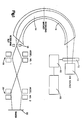
- Figure 1 depicts an ion implantation system including a low energy ( ⁇ 2kv) ion source 10 for emitting ions that are accelerated away from the source by an ion extraction electrode 12.
- the source 10 emits a plurality of small cross section beams that gradually lose their definition and diffuse as they move along a travel path. This diffusion allows individual beam portions or beamlets emitted from the source 10 to combine and form a beam 14 that is wider than any of the beam portions.
- the ion intensity within the cross section of the ion beam 14 is controlled by removing neutralizing electrons from a given beamlet before it diffuses into the combined beam 14.
- the beam 14 passes through an analyzing or resolving magnet 16 where the ions in the beam are bent in a manner dependent upon their mass and charge. Downstream from the resolving magnet 16, the beam 14 enters a metallic resolving slit 18 that defines a beam waist in a dispersive plane. Those ions passing through the resolving slit 18 are further accelerated by two accelerating tubes 19, 20 which accelerate the ions to a desired energy level (between 5 and 200 kv) and project the beam onto a workpiece 22.
- the two accelerating tubes 19, 20 act as a telescope and by controlling the size of the accelerating energy and distance along the beam path between the two tubes 19, 20 the size and angle of beam impact on the workpiece 22 are controlled.
- the wafer 22 is moved to and from a proper position and orientation in the ion beam 14 by automatic wafer handling apparatus. Since the beam 14 is in a highly evacuated chamber from the source to the region of the wafer 22, this apparatus must move the wafers from atmospheric to very low pressure. Apparatus for accomplishing this task is known in the prior art.
- the source 10 is a multi-aperture Kaufman-type source capable of producing ions having an energy of approximately 1 kilovolt and currents of approximately 10 milliamps per square centimeter.
- the specific source utilized in the embodiment shown in Figure 1 includes a 3 centimeter wide ion emitting area having 288 apertures arranged in the general shape of a hexagon with a total current capability of 70 milliamps.
- the magnet 16 helps focus the individual beamlets forming the beam 14 into a single merged beam which is resolved through the single slit 18 and then accelerated as a single beam. Certain advantages accompany use of this merged beam technique over a technique where each of the beamlets are resolved and accelerated.
- the resolving magnet gap is kept small since the source 10 itself is smaller in cross section.
- the common resolving slit 18 is easier to accomplish than would be multiple slits, one for each individual beamlet. Resolving and ion acceleration are achieved more easily since duplicate acceleration electrodes for each beamlet are not needed.
- the simplicity of the post acceleration apparatus results in fewer surfaces to accumulate condensates.
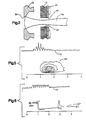
- Figure 2 depicts a representative one 30 of the 288 exit apertures in the array of exit apertures defined by an aperture defining wall 32 of the ion source 10.
- An ion plasma exists within a confines of the ion source 10 and ions within the plasma naturally migrate to the vicinity of the wall 32 and more particularly to the vicinity of exit apertures within the wall.
- the extraction electrode 12 is maintained at an electrical potential of -100 volts with respect to ground and creates an electric field in the vicinity of the source 10 (which is biased at a potential of approximately 5 kilovolts) to cause ions in the plasma to be accelerated through a region between the aperture electrode 12 and the source 10. This results in the formation of a beamlet 14a that combines with other beamlets to form the beam 14.
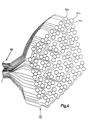
- the extraction electrode 12 defines an array 50 of apertures (Figure 3) configured to align with the array of apertures formed in the source wall 32 and the electrode aperture 34 corresponding to the aperture 30 is shown in Figure 2.
- a silicon dioxide layer 36 is deposited on one surface of the extraction electrode 12 using thick film deposition techniques. In this way each opening or aperture in the extraction plate is made slightly wider by the presence of the silicon dioxide layer 36.
- each of the openings defined by the extraction electrode is bounded by a control electrode or ring 40 which when energized attracts electrons within the beamlet 14a to create a net positive charge per unit volume within the beamlet. This results in a rapid destabilization of the beamlet due to repulsion between ions. This occurs within a very short distance downstream from the electrode 40 and results in a diminished contribution from the aperture 30 within the resultant ion beam 14.
- the electrode array 50 surrounding the individual apertures in the extraction electrode 12 define a generally hexagon or six sided Figure.
- Each group of three rings 50a, 50b, 50c, for example, are electrically coupled together.
- a conductor 52 connects the three rings 50a,50b,50c to an energy source 60 ( Figure 1).
- the voltage source 60 periodically applies a voltage of +15 volts to each ring (115 volts above the -100 volt potential of the extraction electrode 12) grouping in a controlled sequence such that if a diminution of beam intensity at a particular region of the combined beam 14 is desired the ring grouping contributing to that portion of the ion beam is activated for longer time periods than other groupings within the array 50.
- the programmable controller 62 executes a control program loaded from disk is used to adjust the energization times of various ring groupings within the array 50.
- Each ring 40 within the array 50 can be categorized by the conductor which transmits the ring's energization signals.
- the electrodes or rings of the array 50 are divided into three portions. Each electrode portion is serviced by energization conductors that extend inward from radially outer portions of the extraction electrode 12. In combination the conductions coupled to each array portion form a bus. Thus, as seen in Figure 3, three buses 80, 81, 82, each of which includes multiple individual electric conductors deposited onto the silicon dioxide layer 36 in patterns that lead to the array 50.
- the source 60 of voltage is supplied by integrated circuits coupled to the extraction electrode 12 at locations 84, 85, 86. Appropriate energizing signals are derived from address information routed to the electrode through a connector that engages the electrode 12 at a location 87 and communicates with the programmable controller 62.
- each spike represents a line integral of the ion distribution along a line passing through the region of the beamlet. Large spikes pass through high concentrations of ions.
- the series of concentric lines 112 in Figure 5 are derived from the raster scan data. It is in the form of a two dimensional contour map (as a topographic map). Contour lines of equal ion density are drawn and the center line has the highest density. The next contour line represents a region having 1/8 the first etc.
- Figure 5 shows a tightly collimated beamlet, with the 1/2 maximum contour being approximately 1 cm in diameter.
- Figure 6 shows a widely scattered beamlet, caused by electron extraction, with contour lines spread across several centimeters, beyond the area covered by the scanning device. These beamlet cross-section ion density measurements were taken at a distance 15 cm from the extraction aperture 34 ( Figure 2). This implies a 1/2 angle divergence of about 2 degrees in the case of Figure 5, and in excess of 10 degrees in the case of Figure 6.
Landscapes
- Chemical & Material Sciences (AREA)
- Analytical Chemistry (AREA)
- Physical Vapour Deposition (AREA)
- Electron Sources, Ion Sources (AREA)
Claims (12)
- Procédé de formation d'un faisceau d'ions (14) comprenant les étapes de :a) création d'un plasma d'ions dans une région délimitée par une paroi (32) comportant en son sein de multiples ouvertures de sortie (30) ;b) extraction d'ions depuis l'intérieur de la région en créant un champ électrique au voisinage des ouvertures de sortie (30) pour accélérer les ions qui sortent au travers des ouvertures (30) afin de former de multiples segments de faisceau (14a),caractérisé en ce que les multiples segments de faisceau (14a) sont combinés pour former le faisceau d'ions (14), et par l'étape de :
c) attraction de particules de neutralisation de charge provenant des segments de faisceau d'ions (14a) lorsque des ions sortent des ouvertures (30) afin d'atténuer certains sélectionnés des segments de faisceau (14a) et afin de commander l'intensité de faisceau d'ions en fonction d'une position à l'intérieur du faisceau d'ions (14). - Procédé selon la revendication 1, dans lequel l'étape d'extraction comprend la sous-étape d'application d'une tension à une électrode d'extraction en métal (12) présentant un motif d'ouvertures d'électrode d'extraction (34) qui s'étendent au travers de l'électrode d'extraction (12) et qui sont alignées avec de multiples ouvertures de sortie (30) dans la paroi (32).
- Procédé selon la revendication 2, dans lequel l'étape d'attraction comprend la sous-étape de positionnement de multiples électrodes de commande d'intensité (40, 50a, 50b, 50c) à proximité intime des ouvertures d'électrode d'extraction (34) et d'activation de certaines individuelles des électrodes de commande d'intensité (40, 50a, 50b, 50c) en appliquant une tension d'attraction d'électrons aux électrodes de commande d'intensité (40, 50a, 50b, 50c).
- Source d'ions comprenant :a) un moyen de source (10) pour créer des ions à l'intérieur d'une région confinée et incluant une paroi (32) délimitant la région confinée comportant de multiples ouvertures de sortie (30) qui permettent à des ions de sortir de la région confinée et de former des parties de faisceau d'ions (14a) ; etb) un moyen d'extraction comprenant une plaque d'extraction conductrice (12) maintenue à un potentiel électrique pour attirer des ions depuis le moyen de source (10),caractérisée en ce que lesdites parties de faisceau d'ions (14a) sont combinées pour former un faisceau d'ions (14) présentant une section en coupe de faisceau supérieure à celles des parties de faisceau individuelles (14a) ; et ladite plaque d'extraction conductrice (12) inclut de multiples ouvertures d'extraction (34) de façon générale alignées avec les multiples ouvertures de sortie (30) dans la paroi (32) dudit moyen de source (10); et par
c) un moyen de commande d'intensité (40, 50a, 50b, 50c) pour extraire des électrons depuis des parties de faisceau (14a) dans la région de la plaque d'extraction conductrice (12) pour commander une densité de faisceau sur la section en coupe du faisceau d'ions (14). - Appareil selon la revendication 4, dans lequel le moyen de commande d'intensité (40, 50a, 50b, 50c) comprend de multiples anneaux conducteurs (50a, 50b, 50c) fixes par rapport à la plaque d'extraction (12) et isolés électriquement de la plaque d'extraction (12).
- Appareil selon la revendication 5, comprenant de façon supplémentaire une couche d'isolation (36) déposée sur une surface de la plaque d'extraction conductrice (12) et dans lequel les anneaux conducteurs (50a, 50b, 50c) sont fixés à la couche d'isolation (36) et sont couplés à une source de tension (60) par un motif conducteur (80, 81, 82) déposé sur la couche d'isolation (36).
- Système d'implantation d'ions comprenant:a) un moyen de source d'ions (10) comportant de multiples ouvertures de sortie (30) pour former une pluralité de parties de faisceau (14a);b) un moyen d'analyse (16) pour analyser des ions provenant de la source d'ions et pour diriger certains ions de manière à ce qu'ils suivent une trajectoire de traitement de plaquette ; etc) une station de traitement de plaquette pour placer des plaquettes dans une position d'interception desdits certains ions après que des ions sont sortis du moyen d'analyse (16),caractérisé en ce que les parties de faisceau d'ions (14a) sont combinées pour former un faisceau d'ions (14) présentant une section en coupe supérieure à celles des parties de faisceau individuelles (14a), et pard) un moyen de commande de distribution d'ions (12, 36, 40, 50a, 50b, 50c) incluant une pluralité d'électrodes espacées (40, 50a, 50b, 50c) pour déneutraliser sélectivement une charge dans au moins certaines des parties de faisceau d'ions (14a) ; ete) un moyen de commutation (62, 80, 81, 82) couplé au moyen de commande de distribution d'ions (12, 36, 40, 50a, 50b, 50c) pour commander individuellement des potentiels de polarisation des électrodes espacées (40, 50a, 50b, 50c) afin de produire une distribution d'ions contrôlée des ions qui arrivent en impact sur une surface de plaquette (22) au niveau de la station de traitement de plaquette.
- Appareil selon la revendication 7, dans lequel le moyen de source d'ions (10) comprend une chambre de source pour confiner des ions, ladite chambre de source définissant un motif d'ouvertures d'émission d'ions (30) s'étendant au travers d'une paroi (32) dans ladite chambre et dans lequel des ions qui sortent de la chambre au travers d'une ouverture donnée contribuent à l'une des parties de faisceau d'ions (14a).
- Appareil selon la revendication 8, dans lequel le moyen de source d'ions (10) comprend en outre une plaque d'électrode d'extraction (12) comportant un réseau d'ouvertures (34) alignées avec les ouvertures d'émission d'ions (30) de la chambre ; ladite plaque d'électrode (12) étant maintenue à un potentiel par rapport à la chambre pour accélérer les ions sortant de la chambre.
- Appareil selon la revendication 9, dans lequel le moyen de commande de distribution d'ions (12, 36, 40, 50a, 50b, 50c) comprend un réseau d'anneaux conducteurs (40, 50a, 50b, 50c), dans lequel chaque anneau est concentrique à une ouverture dans la plaque d'électrode d'extraction (12) et dans lequel le moyen de commutation (62) dirige des potentiels électriques sur lesdits anneaux (40, 50a, 50b, 50c) pour extraire des électrons depuis les parties de faisceau (14a) lorsqu'ils traversent la plaque d'électrode d'extraction (12).
- Appareil selon la revendication 10, dans lequel le réseau d'anneaux conducteurs (40, 50a, 50b, 50c) est couplé à la plaque d'électrode d'extraction (12) et est espacé d'une surface conductrice de la plaque d'électrode d'extraction (12) par une couche d'isolation (36) appliquée à l'électrode d'extraction (12).
- Appareil selon la revendication 11, dans lequel le moyen de commutation (62, 80, 81, 82) comprend :a) un contrôleur programmable (62);b) un système de bus (80, 81, 82) déposé sur la couche d'isolation (36) pour diriger des signaux d'activation d'extraction sur les anneaux (40, 50a, 50b, 50c) dudit réseau d'anneaux ; etc) un circuit de multiplexage pour décoder une information d'adresse d'anneau provenant du contrôleur programmable (62) et pour activer un motif sélectionné d'anneaux (50a, 50b, 50c) dans le réseau sur la base de l'information d'adresse.
Applications Claiming Priority (2)
| Application Number | Priority Date | Filing Date | Title |
|---|---|---|---|
| US07/487,158 US5023458A (en) | 1989-01-04 | 1990-03-01 | Ion beam control system |
| US487158 | 1990-03-01 |
Publications (3)
| Publication Number | Publication Date |
|---|---|
| EP0444935A2 EP0444935A2 (fr) | 1991-09-04 |
| EP0444935A3 EP0444935A3 (en) | 1992-02-19 |
| EP0444935B1 true EP0444935B1 (fr) | 1996-10-09 |
Family
ID=23934651
Family Applications (1)
| Application Number | Title | Priority Date | Filing Date |
|---|---|---|---|
| EP91301654A Expired - Lifetime EP0444935B1 (fr) | 1990-03-01 | 1991-02-28 | Système de commande d'un faisceau d'ions |
Country Status (5)
| Country | Link |
|---|---|
| US (1) | US5023458A (fr) |
| EP (1) | EP0444935B1 (fr) |
| JP (1) | JP2946433B2 (fr) |
| KR (1) | KR960014524B1 (fr) |
| DE (1) | DE69122526T2 (fr) |
Cited By (1)
| Publication number | Priority date | Publication date | Assignee | Title |
|---|---|---|---|---|
| US7442946B2 (en) | 2005-06-29 | 2008-10-28 | Hynix Semiconductor Inc. | Nonuniform ion implantation apparatus and method using a wide beam |
Families Citing this family (6)
| Publication number | Priority date | Publication date | Assignee | Title |
|---|---|---|---|---|
| US5218210A (en) * | 1992-02-18 | 1993-06-08 | Eaton Corporation | Broad beam flux density control |
| US5661308A (en) * | 1996-05-30 | 1997-08-26 | Eaton Corporation | Method and apparatus for ion formation in an ion implanter |
| US20040051053A1 (en) * | 2002-05-22 | 2004-03-18 | Barletta William A. | Universal pattern generator with multiplex addressing |
| JP4443816B2 (ja) * | 2002-09-06 | 2010-03-31 | シャープ株式会社 | イオンドーピング装置及びイオンドーピング装置用多孔電極 |
| US7446326B2 (en) * | 2005-08-31 | 2008-11-04 | Varian Semiconductor Equipment Associates, Inc. | Technique for improving ion implanter productivity |
| US7897945B2 (en) * | 2008-09-25 | 2011-03-01 | Twin Creeks Technologies, Inc. | Hydrogen ion implanter using a broad beam source |
Family Cites Families (9)
| Publication number | Priority date | Publication date | Assignee | Title |
|---|---|---|---|---|
| FR2076567A5 (fr) * | 1970-01-20 | 1971-10-15 | Commissariat Energie Atomique | |
| US3795833A (en) * | 1972-05-25 | 1974-03-05 | Hughes Aircraft Co | Ion beam deflection system |
| US3999097A (en) * | 1975-06-30 | 1976-12-21 | International Business Machines Corporation | Ion implantation apparatus utilizing multiple aperture source plate and single aperture accel-decel system |
| EP0106497B1 (fr) * | 1982-09-10 | 1988-06-01 | Nippon Telegraph And Telephone Corporation | Appareil d'arrosage ionique |
| US4578589A (en) * | 1983-08-15 | 1986-03-25 | Applied Materials, Inc. | Apparatus and methods for ion implantation |
| US4522657A (en) * | 1983-10-20 | 1985-06-11 | Westinghouse Electric Corp. | Low temperature process for annealing shallow implanted N+/P junctions |
| US4523971A (en) * | 1984-06-28 | 1985-06-18 | International Business Machines Corporation | Programmable ion beam patterning system |
| DE3504714A1 (de) * | 1985-02-12 | 1986-08-14 | Siemens AG, 1000 Berlin und 8000 München | Lithografiegeraet zur erzeugung von mikrostrukturen |
| DE3601632A1 (de) * | 1986-01-21 | 1987-07-23 | Leybold Heraeus Gmbh & Co Kg | Verfahren zum herstellen von extraktionsgittern fuer ionenquellen und durch das verfahren hergestellte extraktionsgitter |
-
1990
- 1990-03-01 US US07/487,158 patent/US5023458A/en not_active Expired - Fee Related
-
1991
- 1991-02-26 KR KR1019910003061A patent/KR960014524B1/ko not_active Expired - Fee Related
- 1991-02-28 DE DE69122526T patent/DE69122526T2/de not_active Expired - Fee Related
- 1991-02-28 EP EP91301654A patent/EP0444935B1/fr not_active Expired - Lifetime
- 1991-03-01 JP JP3104917A patent/JP2946433B2/ja not_active Expired - Fee Related
Cited By (1)
| Publication number | Priority date | Publication date | Assignee | Title |
|---|---|---|---|---|
| US7442946B2 (en) | 2005-06-29 | 2008-10-28 | Hynix Semiconductor Inc. | Nonuniform ion implantation apparatus and method using a wide beam |
Also Published As
| Publication number | Publication date |
|---|---|
| KR960014524B1 (ko) | 1996-10-16 |
| DE69122526D1 (de) | 1996-11-14 |
| EP0444935A2 (fr) | 1991-09-04 |
| EP0444935A3 (en) | 1992-02-19 |
| US5023458A (en) | 1991-06-11 |
| DE69122526T2 (de) | 1997-05-15 |
| JPH04230942A (ja) | 1992-08-19 |
| JP2946433B2 (ja) | 1999-09-06 |
Similar Documents
| Publication | Publication Date | Title |
|---|---|---|
| EP0428319B1 (fr) | Méthode et appareil permettant la distribution elliptique d'un faisceau d'ions | |
| JP5650461B2 (ja) | 通気型ファラデーカップ及びガスクラスタイオンビーム処理システム | |
| US4914305A (en) | Uniform cross section ion beam system | |
| US6207963B1 (en) | Ion beam implantation using conical magnetic scanning | |
| US6534775B1 (en) | Electrostatic trap for particles entrained in an ion beam | |
| US7112809B2 (en) | Electrostatic lens for ion beams | |
| JPH0594799A (ja) | イオンビーム注入装置およびその方法 | |
| KR101311612B1 (ko) | 이온빔용 정전기 평행 렌즈 | |
| EP0557067B1 (fr) | Commande de la densité de flux d'un faisceau large | |
| US3585397A (en) | Programmed fine ion implantation beam system | |
| US3999097A (en) | Ion implantation apparatus utilizing multiple aperture source plate and single aperture accel-decel system | |
| KR100831442B1 (ko) | 자석의 이온 빔 중성화를 위한 방법 및 장치 | |
| EP0444935B1 (fr) | Système de commande d'un faisceau d'ions | |
| US20040227106A1 (en) | System and methods for ion beam containment using localized electrostatic fields in an ion beam passageway | |
| JP3420338B2 (ja) | イオン注入装置 | |
| JPH0877960A (ja) | イオン打込み装置 | |
| JPS63299041A (ja) | イオンビ−ム中性化装置 | |
| JP2001237197A (ja) | イオン注入装置 | |
| JPH05217540A (ja) | イオン注入装置 | |
| WO2006124075A2 (fr) | Systeme et procedes de confinement de faisceau ionique au moyen de champs electrostatiques localises dans une voie de passage de faisceau ionique |
Legal Events
| Date | Code | Title | Description |
|---|---|---|---|
| PUAI | Public reference made under article 153(3) epc to a published international application that has entered the european phase |
Free format text: ORIGINAL CODE: 0009012 |
|
| AK | Designated contracting states |
Kind code of ref document: A2 Designated state(s): DE FR GB IT |
|
| PUAL | Search report despatched |
Free format text: ORIGINAL CODE: 0009013 |
|
| AK | Designated contracting states |
Kind code of ref document: A3 Designated state(s): DE FR GB IT |
|
| 17P | Request for examination filed |
Effective date: 19920604 |
|
| 17Q | First examination report despatched |
Effective date: 19940817 |
|
| GRAH | Despatch of communication of intention to grant a patent |
Free format text: ORIGINAL CODE: EPIDOS IGRA |
|
| GRAH | Despatch of communication of intention to grant a patent |
Free format text: ORIGINAL CODE: EPIDOS IGRA |
|
| GRAA | (expected) grant |
Free format text: ORIGINAL CODE: 0009210 |
|
| AK | Designated contracting states |
Kind code of ref document: B1 Designated state(s): DE FR GB IT |
|
| REF | Corresponds to: |
Ref document number: 69122526 Country of ref document: DE Date of ref document: 19961114 |
|
| ET | Fr: translation filed | ||
| ITF | It: translation for a ep patent filed | ||
| PLBE | No opposition filed within time limit |
Free format text: ORIGINAL CODE: 0009261 |
|
| STAA | Information on the status of an ep patent application or granted ep patent |
Free format text: STATUS: NO OPPOSITION FILED WITHIN TIME LIMIT |
|
| 26N | No opposition filed | ||
| REG | Reference to a national code |
Ref country code: FR Ref legal event code: TP |
|
| REG | Reference to a national code |
Ref country code: GB Ref legal event code: 732E |
|
| REG | Reference to a national code |
Ref country code: GB Ref legal event code: IF02 |
|
| PGFP | Annual fee paid to national office [announced via postgrant information from national office to epo] |
Ref country code: GB Payment date: 20030106 Year of fee payment: 13 |
|
| PGFP | Annual fee paid to national office [announced via postgrant information from national office to epo] |
Ref country code: FR Payment date: 20030204 Year of fee payment: 13 |
|
| PGFP | Annual fee paid to national office [announced via postgrant information from national office to epo] |
Ref country code: DE Payment date: 20030228 Year of fee payment: 13 |
|
| PG25 | Lapsed in a contracting state [announced via postgrant information from national office to epo] |
Ref country code: GB Free format text: LAPSE BECAUSE OF NON-PAYMENT OF DUE FEES Effective date: 20040228 |
|
| PG25 | Lapsed in a contracting state [announced via postgrant information from national office to epo] |
Ref country code: DE Free format text: LAPSE BECAUSE OF NON-PAYMENT OF DUE FEES Effective date: 20040901 |
|
| GBPC | Gb: european patent ceased through non-payment of renewal fee | ||
| PG25 | Lapsed in a contracting state [announced via postgrant information from national office to epo] |
Ref country code: FR Free format text: LAPSE BECAUSE OF NON-PAYMENT OF DUE FEES Effective date: 20041029 |
|
| REG | Reference to a national code |
Ref country code: FR Ref legal event code: ST |
|
| PG25 | Lapsed in a contracting state [announced via postgrant information from national office to epo] |
Ref country code: IT Free format text: LAPSE BECAUSE OF NON-PAYMENT OF DUE FEES Effective date: 20050228 |