EP0444955A2 - Superconducting material of metal oxide - Google Patents
Superconducting material of metal oxide Download PDFInfo
- Publication number
- EP0444955A2 EP0444955A2 EP91301719A EP91301719A EP0444955A2 EP 0444955 A2 EP0444955 A2 EP 0444955A2 EP 91301719 A EP91301719 A EP 91301719A EP 91301719 A EP91301719 A EP 91301719A EP 0444955 A2 EP0444955 A2 EP 0444955A2
- Authority
- EP
- European Patent Office
- Prior art keywords
- smaller
- blend
- superconducting material
- temperature
- 40logp
- Prior art date
- Legal status (The legal status is an assumption and is not a legal conclusion. Google has not performed a legal analysis and makes no representation as to the accuracy of the status listed.)
- Granted
Links
- 239000000463 material Substances 0.000 title claims abstract description 33
- 229910044991 metal oxide Inorganic materials 0.000 title claims abstract description 7
- 150000004706 metal oxides Chemical class 0.000 title claims abstract description 7
- 239000000203 mixture Substances 0.000 claims abstract description 34
- QVGXLLKOCUKJST-UHFFFAOYSA-N atomic oxygen Chemical compound [O] QVGXLLKOCUKJST-UHFFFAOYSA-N 0.000 claims abstract description 23
- 239000001301 oxygen Substances 0.000 claims abstract description 23
- 229910052760 oxygen Inorganic materials 0.000 claims abstract description 23
- 229910052727 yttrium Inorganic materials 0.000 claims abstract description 15
- 238000010438 heat treatment Methods 0.000 claims abstract description 13
- 229910052751 metal Inorganic materials 0.000 claims abstract description 10
- 239000002184 metal Substances 0.000 claims abstract description 10
- 150000002739 metals Chemical class 0.000 claims abstract description 9
- 229910052691 Erbium Inorganic materials 0.000 claims abstract description 6
- 229910052693 Europium Inorganic materials 0.000 claims abstract description 6
- 229910052688 Gadolinium Inorganic materials 0.000 claims abstract description 6
- 229910052689 Holmium Inorganic materials 0.000 claims abstract description 6
- 229910052779 Neodymium Inorganic materials 0.000 claims abstract description 6
- 229910052772 Samarium Inorganic materials 0.000 claims abstract description 6
- 229910052769 Ytterbium Inorganic materials 0.000 claims abstract description 6
- 229910052746 lanthanum Inorganic materials 0.000 claims abstract description 6
- 150000001875 compounds Chemical class 0.000 claims abstract description 4
- 229910052765 Lutetium Inorganic materials 0.000 claims abstract description 3
- 229910052771 Terbium Inorganic materials 0.000 claims abstract description 3
- 229910052775 Thulium Inorganic materials 0.000 claims abstract description 3
- 238000000034 method Methods 0.000 claims description 15
- 238000000465 moulding Methods 0.000 claims 1
- 239000012071 phase Substances 0.000 description 24
- 239000010949 copper Substances 0.000 description 17
- VTYYLEPIZMXCLO-UHFFFAOYSA-L Calcium carbonate Chemical compound [Ca+2].[O-]C([O-])=O VTYYLEPIZMXCLO-UHFFFAOYSA-L 0.000 description 10
- AYJRCSIUFZENHW-UHFFFAOYSA-L barium carbonate Chemical compound [Ba+2].[O-]C([O-])=O AYJRCSIUFZENHW-UHFFFAOYSA-L 0.000 description 10
- 229910052791 calcium Inorganic materials 0.000 description 10
- QPLDLSVMHZLSFG-UHFFFAOYSA-N Copper oxide Chemical compound [Cu]=O QPLDLSVMHZLSFG-UHFFFAOYSA-N 0.000 description 9
- 229910052745 lead Inorganic materials 0.000 description 9
- 229910052802 copper Inorganic materials 0.000 description 8
- 238000002441 X-ray diffraction Methods 0.000 description 6
- 239000000843 powder Substances 0.000 description 6
- 229910052712 strontium Inorganic materials 0.000 description 6
- 229910000019 calcium carbonate Inorganic materials 0.000 description 5
- 235000010216 calcium carbonate Nutrition 0.000 description 5
- 150000002500 ions Chemical class 0.000 description 5
- HTUMBQDCCIXGCV-UHFFFAOYSA-N lead oxide Chemical compound [O-2].[Pb+2] HTUMBQDCCIXGCV-UHFFFAOYSA-N 0.000 description 5
- YEXPOXQUZXUXJW-UHFFFAOYSA-N lead(II) oxide Inorganic materials [Pb]=O YEXPOXQUZXUXJW-UHFFFAOYSA-N 0.000 description 5
- 230000001590 oxidative effect Effects 0.000 description 5
- 229910000018 strontium carbonate Inorganic materials 0.000 description 5
- LEDMRZGFZIAGGB-UHFFFAOYSA-L strontium carbonate Chemical compound [Sr+2].[O-]C([O-])=O LEDMRZGFZIAGGB-UHFFFAOYSA-L 0.000 description 5
- 239000000126 substance Substances 0.000 description 5
- 229910052761 rare earth metal Inorganic materials 0.000 description 4
- RUDFQVOCFDJEEF-UHFFFAOYSA-N yttrium(III) oxide Inorganic materials [O-2].[O-2].[O-2].[Y+3].[Y+3] RUDFQVOCFDJEEF-UHFFFAOYSA-N 0.000 description 4
- 229910052788 barium Inorganic materials 0.000 description 3
- 230000004927 fusion Effects 0.000 description 3
- 239000007789 gas Substances 0.000 description 3
- 239000012535 impurity Substances 0.000 description 3
- 238000004519 manufacturing process Methods 0.000 description 3
- 150000002736 metal compounds Chemical class 0.000 description 3
- RYGMFSIKBFXOCR-UHFFFAOYSA-N Copper Chemical compound [Cu] RYGMFSIKBFXOCR-UHFFFAOYSA-N 0.000 description 2
- 238000006243 chemical reaction Methods 0.000 description 2
- 238000000975 co-precipitation Methods 0.000 description 2
- 239000007791 liquid phase Substances 0.000 description 2
- 238000010791 quenching Methods 0.000 description 2
- 230000000171 quenching effect Effects 0.000 description 2
- 239000007787 solid Substances 0.000 description 2
- 239000000243 solution Substances 0.000 description 2
- 238000007738 vacuum evaporation Methods 0.000 description 2
- 229910052684 Cerium Inorganic materials 0.000 description 1
- 241001124569 Lycaenidae Species 0.000 description 1
- 229910052777 Praseodymium Inorganic materials 0.000 description 1
- 238000010521 absorption reaction Methods 0.000 description 1
- 229910001424 calcium ion Inorganic materials 0.000 description 1
- 230000000052 comparative effect Effects 0.000 description 1
- 235000014987 copper Nutrition 0.000 description 1
- LBJNMUFDOHXDFG-UHFFFAOYSA-N copper;hydrate Chemical compound O.[Cu].[Cu] LBJNMUFDOHXDFG-UHFFFAOYSA-N 0.000 description 1
- 230000003247 decreasing effect Effects 0.000 description 1
- 238000001739 density measurement Methods 0.000 description 1
- 238000004090 dissolution Methods 0.000 description 1
- 238000001035 drying Methods 0.000 description 1
- 238000001704 evaporation Methods 0.000 description 1
- 230000008020 evaporation Effects 0.000 description 1
- 238000005259 measurement Methods 0.000 description 1
- 239000010453 quartz Substances 0.000 description 1
- 238000007789 sealing Methods 0.000 description 1
- VYPSYNLAJGMNEJ-UHFFFAOYSA-N silicon dioxide Inorganic materials O=[Si]=O VYPSYNLAJGMNEJ-UHFFFAOYSA-N 0.000 description 1
- 238000003980 solgel method Methods 0.000 description 1
- 238000003746 solid phase reaction Methods 0.000 description 1
- 239000006104 solid solution Substances 0.000 description 1
- 238000004544 sputter deposition Methods 0.000 description 1
- 238000006467 substitution reaction Methods 0.000 description 1
- 239000000758 substrate Substances 0.000 description 1
- 239000002887 superconductor Substances 0.000 description 1
- 238000002076 thermal analysis method Methods 0.000 description 1
- 230000007704 transition Effects 0.000 description 1
- 238000005491 wire drawing Methods 0.000 description 1
Images

Classifications
-
- H—ELECTRICITY
- H10—SEMICONDUCTOR DEVICES; ELECTRIC SOLID-STATE DEVICES NOT OTHERWISE PROVIDED FOR
- H10N—ELECTRIC SOLID-STATE DEVICES NOT OTHERWISE PROVIDED FOR
- H10N60/00—Superconducting devices
- H10N60/80—Constructional details
- H10N60/85—Superconducting active materials
- H10N60/855—Ceramic superconductors
- H10N60/857—Ceramic superconductors comprising copper oxide
-
- Y—GENERAL TAGGING OF NEW TECHNOLOGICAL DEVELOPMENTS; GENERAL TAGGING OF CROSS-SECTIONAL TECHNOLOGIES SPANNING OVER SEVERAL SECTIONS OF THE IPC; TECHNICAL SUBJECTS COVERED BY FORMER USPC CROSS-REFERENCE ART COLLECTIONS [XRACs] AND DIGESTS
- Y10—TECHNICAL SUBJECTS COVERED BY FORMER USPC
- Y10S—TECHNICAL SUBJECTS COVERED BY FORMER USPC CROSS-REFERENCE ART COLLECTIONS [XRACs] AND DIGESTS
- Y10S505/00—Superconductor technology: apparatus, material, process
- Y10S505/775—High tc, above 30 k, superconducting material
- Y10S505/776—Containing transition metal oxide with rare earth or alkaline earth
- Y10S505/779—Other rare earth, i.e. Sc,Y,Ce,Pr,Nd,Pm,Sm,Eu,Gd,Tb,Dy,Ho,Er,Tm,Yb,Lu and alkaline earth, i.e. Ca,Sr,Ba,Ra
-
- Y—GENERAL TAGGING OF NEW TECHNOLOGICAL DEVELOPMENTS; GENERAL TAGGING OF CROSS-SECTIONAL TECHNOLOGIES SPANNING OVER SEVERAL SECTIONS OF THE IPC; TECHNICAL SUBJECTS COVERED BY FORMER USPC CROSS-REFERENCE ART COLLECTIONS [XRACs] AND DIGESTS
- Y10—TECHNICAL SUBJECTS COVERED BY FORMER USPC
- Y10S—TECHNICAL SUBJECTS COVERED BY FORMER USPC CROSS-REFERENCE ART COLLECTIONS [XRACs] AND DIGESTS
- Y10S505/00—Superconductor technology: apparatus, material, process
- Y10S505/775—High tc, above 30 k, superconducting material
- Y10S505/776—Containing transition metal oxide with rare earth or alkaline earth
- Y10S505/779—Other rare earth, i.e. Sc,Y,Ce,Pr,Nd,Pm,Sm,Eu,Gd,Tb,Dy,Ho,Er,Tm,Yb,Lu and alkaline earth, i.e. Ca,Sr,Ba,Ra
- Y10S505/78—Yttrium and barium-, e.g. YBa2Cu307
-
- Y—GENERAL TAGGING OF NEW TECHNOLOGICAL DEVELOPMENTS; GENERAL TAGGING OF CROSS-SECTIONAL TECHNOLOGIES SPANNING OVER SEVERAL SECTIONS OF THE IPC; TECHNICAL SUBJECTS COVERED BY FORMER USPC CROSS-REFERENCE ART COLLECTIONS [XRACs] AND DIGESTS
- Y10—TECHNICAL SUBJECTS COVERED BY FORMER USPC
- Y10S—TECHNICAL SUBJECTS COVERED BY FORMER USPC CROSS-REFERENCE ART COLLECTIONS [XRACs] AND DIGESTS
- Y10S505/00—Superconductor technology: apparatus, material, process
- Y10S505/775—High tc, above 30 k, superconducting material
- Y10S505/776—Containing transition metal oxide with rare earth or alkaline earth
- Y10S505/779—Other rare earth, i.e. Sc,Y,Ce,Pr,Nd,Pm,Sm,Eu,Gd,Tb,Dy,Ho,Er,Tm,Yb,Lu and alkaline earth, i.e. Ca,Sr,Ba,Ra
- Y10S505/78—Yttrium and barium-, e.g. YBa2Cu307
- Y10S505/781—Noble metal, i.e. Ag, Au, Os, Ir, Pt, Ru, Rh, Pd or chromium, manganese, iron, cobalt or nickel
Definitions
- This invention relates generally to a novel superconducting material of metal oxides and, more specifically, to a superconducting material containing, as metal components, Pb, Sr, Ba, Y or a rare earth element, Ca and Cu.
- the present invention is also directed to a method of producing such a superconducting material.
- Pb-containing, copper oxide-type superconducting materials Pb2Sr2(Y, Ca)Cu3O w (hereinafter referred to as 2213-phase), PbSrBa(Y, Ca)Cu3O w (hereinafter referred to as 1213-phase) and (Pb, Sr)Sr2(Y, Ca)Cu2O w (hereinafter referred to as 1212-phase) are known in the art (Cava, R. J. et al, Nature, 363 , 211-214 (1988); Syono et al, Nikkei Chodendo, pp 4-5 (Jan. 1990); and Rouillon, T.
- the 2213- and 1213-phase superconducting materials which have a superconducting transition temperature Tc of about 50-70 K are considered to contain copper in both monovalent and divalent states. Thus, it is necessary to produce the 2213- and 1213 crystallographic phases in the atmosphere of a reducing gas so that both monovalent and divalent coppers may coexist.
- the 1212 phase superconducting material has a high Tc of about 100 K.
- the production of the 1212 crystallographic phase should be performed in a vacuum sealed quartz tube. Therefore, it is very difficult to practically utilize these materials for the production of superconducting articles such as a cable, since they require large, specific reaction apparatuses. It is reported that (Pb, Cu)Sr2YCu2O w which is a 1212 phase does not exhibit superconductivity (Sunshine, S. A. et al, Chemistry of Materials, 1 , 331-335(1989).
- a YBa2Cu3O y (hereinafter referred to as 123-phase) superconductor which is the typical example of Pb-free cupper oxide superconducting materials is known to have Tc of about 90 K.
- the 123 phase has a problem because Tc thereof varies with the oxygen content thereof.
- the present invention has been made with the foregoing problems of the known Pb-containing, metal oxide superconducting materials in view.
- a superconducting material comprising oxides of metals, said metals having the following composition: (Pb 1-z Cu z )((Sr 1-y Ba y ) 1-v Ca v )2(A 1-x Ca x )Cu2 wherein A is at least one element selected from the group consisting of Y, La, Nd, Sm, Eu, Gd, Ho, Er, Yb and mixtures of at least one of Y, La, Nd, Sm, Eu, Gd, Ho, Er and Yb with at least one of Tb, Tm and Lu, x is a number not smaller than 0 but not greater than 0.4, v is a number not smaller than 0 but not greater than 0.2x, y is a number not smaller than 0.1 but is smaller than 0.7 and z is a number not smaller than (2y - 0.4) but not greater than (2y + 0.2) with the proviso that when x is smaller than 0.2
- x, y, v and z are numbers satisfying the following conditions: 0 ⁇ x ⁇ 0.4, 0.1 ⁇ y ⁇ 0.7, 0 ⁇ v ⁇ 0.2x,and 2y - 0.4 ⁇ z ⁇ 2y + 0.2 with the proviso that 0.6 - x ⁇ z ⁇ 1.0 when 0 ⁇ x ⁇ 0.2 and that 0.4 ⁇ z ⁇ 1.0 when 0.2 ⁇ x ⁇ 0.4.
- x, y, v and z be numbers satisfying the following conditions for reasons of providing a high Tc: 0 ⁇ x ⁇ 0.4; 0.4 - 0.5x ⁇ y ⁇ 0.6 and 0.7 - x ⁇ z ⁇ 1.0 when 0 ⁇ x ⁇ 0.2; 0.3 ⁇ y ⁇ 0.6 and 0.5 ⁇ z ⁇ 1.0 when 0.2 ⁇ x ⁇ 0.4; and 2y - 0.4 ⁇ z ⁇ 1.0.
- the present invention provides a method of producing the above superconducting material, comprising the steps of:
- the heating step is performed at an oxygen partial pressure P of 0.1 to 1 atm and a temperature within the range of from (950 + 40logP) °C to (1050 + 40logP) °C.
- the superconducting material according to the present invention can be produced in an oxidizing atmosphere, it is possible to obtain an elongated superconducting article such as a cable without using specific reaction conditions or apparatuses. Further, the superconducting material of this invention has a high Tc and has such a dense structure as to provide a high superconductive critical current density. Moreover, the superconducting material can be produced in various methods using gas phase, liquid phase or solid phase reactions. With a gas phase method, such as sputtering, vacuum evaporation or CVD, epitaxial growth is accelerated and the superconducting film as produced exhibits satisfactory characteristics.
- a gas phase method such as sputtering, vacuum evaporation or CVD
- the superconducting phase as produced exhibits satisfactory superconducting characteristics.
- a post treatment for intentionally increasing the oxygen content may be omitted.
- the superconducting material of a Pb-system according to the present invention can be easily prepared at relatively low costs.
- the superconducting material according to the present invention has a crystallographic phase which is similar to that of known (Pb, Cu)Sr2YCu2O w but which differs from the known 1212 phase in that portions of Sr and Y are substituted with Ba and Ca, respectively, in the superconducting material of the present invention.
- the amount and disposition of oxygen are not critical.
- w is a number in the range of between 6.9 and 7.0.
- the (Pb, Cu)(Sr, Ba, Ca)2(A, Ca)Cu2O w superconducting material of this invention can be produced by a heat treatment in an oxidizing atmosphere.
- the X-ray diffraction analysis has revealed that the presence of Ba permits Ca to form solid solution.
- the superconductivity in the material of this invention is considered to be ascribed to the sufficient dissolution of divalent Ca ion into trivalent A ion (Y or a rare earth element), which results in the introduction of a sufficient amount of holes to show superconductivity.
- the Ba substitution can form an ion disposition in the vicinity of A ion (Y or a rare earth element) similar to that of YBa2CuO3O w (Jirak, Z. et al, Physica C 156 , 750-754(1988) so that Ca can be dissolved into the Y site.
- the superconducting material of the present invention may be produced by a method including providing a blend of compounds of the metals in the metal oxide superconducting material.
- the blend is in the form of a solid and may be obtained by a method including mixing powders of metal compounds, a method including applying a solution containing the metal compounds onto a substrate, followed by drying or a method including subjecting a solution containing the metal compounds to coprecipitation conditions. Other methods such as spattering, vacuum evaporation, CVD, fusion quenching or sol-gel may be also used.
- the solid blend is then heated at an oxygen partial pressure P of at least 0.001 atm and a temperature of between (860 + 40logP) °C and (1060 + 40logP) °C where P is the oxygen partial pressure in terms of atm.
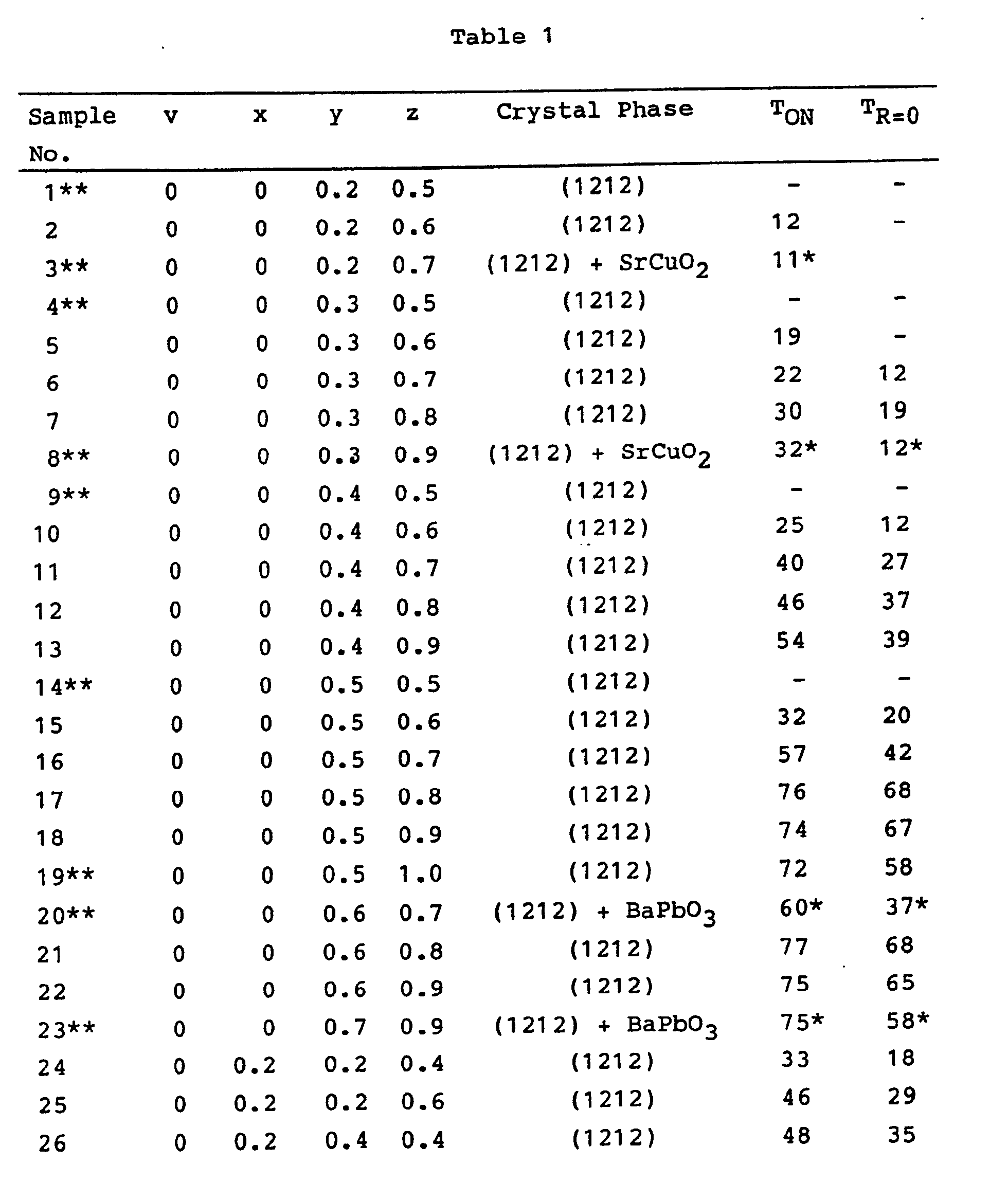
- Powders of PbO, SrCO3, BaCO3, Y2O3, CaCO3 and CuO were mixed in molar proportions so that blends having the following chemical compositions were obtained: (Pb 1-z Cu z )((Sr 1-y Ba y ) 1-v Ca v )2(A 1-x Ca x )Cu2 in which x, y, v and z are numbers as shown in Table 1.
- Each of the blends was pressure molded to form a parallelepiped bar and the bar was sintered at 1000 °C for 1 hour in an oxygen stream at 1 atmosphere.
- the resulting products were tested for their X-ray diffraction patterns and superconductivity and the results were as summarized in Table 1.
- the term "1212 phase” refers to the crystallographic phase similar to that of the known (Pb, Sr)Sr2(Y, Ca)Cu2O w superconducting material. Samples Nos. 1, 3, 4, 8, 9, 14, 19, 20, 23, 29, 30, 32, 38, 39, 41 and 44 are comparative samples.
- Powders of PbO, SrCO3, BaCO3, A2O3 (or A6O11 or AO2), CaCO3 and CuO were mixed in molar proportions so that blends having the following chemical compositions were obtained: (Pb 1-z Cu z )(Sr 1-y Ba y )2(A 1-x Ca x )Cu2 in which x, y and z are 0.4, 0.5 and 0.7, respectively.
- Each of the blends was pressure molded to form a bar and the bar was sintered at 1000 °C for 1 hour in an oxygen stream at 1 atmosphere.
- Powders of PbO, SrCO3, BaCO3, Y2O3, CaCO3 and CuO were mixed in molar proportions so that a blend having the following chemical compositions was obtained: (Pb 1-z Cu z )(Sr 1-y Ba y )2(Y 1-x Ca x )Cu2 in which x, y and z are 0.4, 0.5 and 0.7, respectively. Portions of the blend were pressure molded to form bars and the bars were sintered at a temperature and under a partial pressure of oxygen as shown in Table 3. The resulting products were tested for their X-ray diffraction patterns and superconductivity and the results were as summarized in Table 3.
- Powders of PbO, SrCO3, BaCO3, Y2O3, CaCO3 and CuO were mixed in molar proportions so that a blend having the following chemical compositions was obtained: (Pb 1-z Cu z )(Sr 1-y Ba y )2(Y 1-x Ca x )Cu2 in which x, y and z are 0.4, 0.5 and 0.7, respectively.
- Portions of the blend were subjected to thermal analysis. Other portions of the blend were pressure molded and sintered at a temperature and under a partial pressure of oxygen as shown in Table 4.
- the resulting products were subjected to porosity measurement and superconducting critical current density measurement to obtain the results summarized in Table 4.
- the superconducting critical current density of samples obtained by using a heat treatment temperature higher than the just-below temperature of the heat absorption peak is higher than that obtained at heat treatment tempeture lower than the just-below temperature.
- the just-below temperature is a temperature at which part of the components of the sample is fused.
- Powders of PbO, SrCO3, BaCO3, Y2O3, CaCO3 and CuO were mixed in molar proportions so that a blend having the following chemical compositions was obtained: (Pb 1-z Cu z )(Sr 1-y Ba y )2(Y 1-x Ca x )Cu2 in which x, y and z are 0.4, 0.5 and 0.7, respectively.
- Portions of the blend were pressure molded and sintered at 1000 °C in an oxygen stream.
- the resulting products were then post-treated under various conditions as shown in Table 5 to obtain products whose Tc were as shown in Table 5. From the results summarized in Table 5, it is seen that the post treatment at a high oxygen partial pressure can produce superconducting materials with a high Tc.
- Such a post treatment though it is not essential in the present invention, can improve T ON .
Landscapes
- Chemical & Material Sciences (AREA)
- Engineering & Computer Science (AREA)
- Ceramic Engineering (AREA)
- Compositions Of Oxide Ceramics (AREA)
- Inorganic Compounds Of Heavy Metals (AREA)
- Superconductors And Manufacturing Methods Therefor (AREA)
- Superconductor Devices And Manufacturing Methods Thereof (AREA)
Abstract




Description
- This invention relates generally to a novel superconducting material of metal oxides and, more specifically, to a superconducting material containing, as metal components, Pb, Sr, Ba, Y or a rare earth element, Ca and Cu. The present invention is also directed to a method of producing such a superconducting material.
- As Pb-containing, copper oxide-type superconducting materials, Pb₂Sr₂(Y, Ca)Cu₃Ow (hereinafter referred to as 2213-phase), PbSrBa(Y, Ca)Cu₃Ow (hereinafter referred to as 1213-phase) and (Pb, Sr)Sr₂(Y, Ca)Cu₂Ow (hereinafter referred to as 1212-phase) are known in the art (Cava, R. J. et al, Nature, 363, 211-214 (1988); Syono et al, Nikkei Chodendo, pp 4-5 (Jan. 1990); and Rouillon, T. et al, Physica C, 159, 201-209(1989)). The 2213- and 1213-phase superconducting materials which have a superconducting transition temperature Tc of about 50-70 K are considered to contain copper in both monovalent and divalent states. Thus, it is necessary to produce the 2213- and 1213 crystallographic phases in the atmosphere of a reducing gas so that both monovalent and divalent coppers may coexist. The 1212 phase superconducting material has a high Tc of about 100 K. The production of the 1212 crystallographic phase should be performed in a vacuum sealed quartz tube. Therefore, it is very difficult to practically utilize these materials for the production of superconducting articles such as a cable, since they require large, specific reaction apparatuses. It is reported that (Pb, Cu)Sr₂YCu₂Ow which is a 1212 phase does not exhibit superconductivity (Sunshine, S. A. et al, Chemistry of Materials, 1, 331-335(1989).
- A YBa₂Cu₃Oy (hereinafter referred to as 123-phase) superconductor which is the typical example of Pb-free cupper oxide superconducting materials is known to have Tc of about 90 K. The 123 phase, however, has a problem because Tc thereof varies with the oxygen content thereof.
- The present invention has been made with the foregoing problems of the known Pb-containing, metal oxide superconducting materials in view.
- In accordance with one aspect of the present invention, there is provided a superconducting material comprising oxides of metals, said metals having the following composition:


- It is preferred that x, y, v and z be numbers satisfying the following conditions for reasons of providing a high Tc:




- In another aspect, the present invention provides a method of producing the above superconducting material, comprising the steps of:
- providing a blend of compounds of the metals in said metal oxides; and
- heating said blend at an oxygen partial pressure P of at least 0.001 atm and a temperature within the range of from (860 + 40ℓogP) °C to (1060 + 40ℓogP) °C where P is the oxygen partial pressure in terms of atm.
- Preferably, the heating step is performed at an oxygen partial pressure P of 0.1 to 1 atm and a temperature within the range of from (950 + 40ℓogP) °C to (1050 + 40ℓogP) °C.
- Since the superconducting material according to the present invention can be produced in an oxidizing atmosphere, it is possible to obtain an elongated superconducting article such as a cable without using specific reaction conditions or apparatuses. Further, the superconducting material of this invention has a high Tc and has such a dense structure as to provide a high superconductive critical current density. Moreover, the superconducting material can be produced in various methods using gas phase, liquid phase or solid phase reactions. With a gas phase method, such as sputtering, vacuum evaporation or CVD, epitaxial growth is accelerated and the superconducting film as produced exhibits satisfactory characteristics. With a liquid phase method, such as coprecipitation, evaporation to dryness, sol-gel method or fusion quenching, too, the superconducting phase as produced exhibits satisfactory superconducting characteristics. When the superconducting material of this invention is processed to form a cable by wire drawing after being filled in a sheath, a post treatment for intentionally increasing the oxygen content may be omitted. In addition, the superconducting material of a Pb-system according to the present invention can be easily prepared at relatively low costs.
- The present invention will now be described in detail below with reference to the accompanying drawings in which the sole FIGURE is X-ray diffraction patterns of Sample Nos. 14-19 obtained in Example 1.
- The superconducting material according to the present invention has a crystallographic phase which is similar to that of known (Pb, Cu)Sr₂YCu₂Ow but which differs from the known 1212 phase in that portions of Sr and Y are substituted with Ba and Ca, respectively, in the superconducting material of the present invention. In the superconducting material of this invention the amount and disposition of oxygen are not critical. Generally, w is a number in the range of between 6.9 and 7.0.
- It has been found that when the known 1212 phase is prepared in an oxidizing atmosphere, superconductivity is not observed. The X-ray diffraction analysis has revealed that when (Pb, Sr)Sr₂(Y, Ca)Cu₂Ow is prepared in an oxidizing atmosphere Sr does not exist in the same site with that of Pb and that when (Pb, Cu)Sr₂(Y, Ca)Cu₂Ow is prepared in an oxidizing atmosphere Ca is not completely dissolved into the Y site with a Pb/Cu ratio of 1:1. This fact, when taken in conjunction with the fact that the known, superconducting 1212 phase is prepared in a vacuum sealed reactor, suggests that the vacuum sealing is essential for the production of the known (Pb, Cu)Sr₂ (Y, Ca)Cu₂Ow superconducting material.
- In contrast, the (Pb, Cu)(Sr, Ba, Ca)₂(A, Ca)Cu₂Ow superconducting material of this invention can be produced by a heat treatment in an oxidizing atmosphere. The X-ray diffraction analysis has revealed that the presence of Ba permits Ca to form solid solution. The superconductivity in the material of this invention is considered to be ascribed to the sufficient dissolution of divalent Ca ion into trivalent A ion (Y or a rare earth element), which results in the introduction of a sufficient amount of holes to show superconductivity.
- It is considered that the Ba substitution can form an ion disposition in the vicinity of A ion (Y or a rare earth element) similar to that of YBa₂CuO₃Ow (Jirak, Z. et al, Physica C 156, 750-754(1988) so that Ca can be dissolved into the Y site.
- The superconducting material of the present invention may be produced by a method including providing a blend of compounds of the metals in the metal oxide superconducting material. The blend is in the form of a solid and may be obtained by a method including mixing powders of metal compounds, a method including applying a solution containing the metal compounds onto a substrate, followed by drying or a method including subjecting a solution containing the metal compounds to coprecipitation conditions. Other methods such as spattering, vacuum evaporation, CVD, fusion quenching or sol-gel may be also used. The solid blend is then heated at an oxygen partial pressure P of at least 0.001 atm and a temperature of between (860 + 40ℓogP) °C and (1060 + 40ℓogP) °C where P is the oxygen partial pressure in terms of atm.
- The following examples will further illustrate the present invention.
- Powders of PbO, SrCO₃, BaCO₃, Y₂O₃, CaCO₃ and CuO were mixed in molar proportions so that blends having the following chemical compositions were obtained:

- From these results, it is seen that when Ba is not present (y = 0), no superconductivity is exhibited. Superconductivity is observed when Ba is present. With the increase in Ba content, Tc becomes higher but an impurity phase (BaPbO₃) is formed. This impurity phase disappears, without encountering a reduction of Tc, when the amount of Cu is increased (when z is increased). Even with a high Cu content, however, the impurity phase occurs when y is increased to 0.7. When x is 0 and y is 0.5, Tc increases with the increse in Pb content (with the decrease in z). This suggests that even a small amount of Pb serves to reduce non-stoichiometry of oxygen to the extent that no specific post treatment is necessitated.
- Powders of PbO, SrCO₃, BaCO₃, A₂O₃ (or A₆O₁₁ or AO₂), CaCO₃ and CuO were mixed in molar proportions so that blends having the following chemical compositions were obtained:

- Powders of PbO, SrCO₃, BaCO₃, Y₂O₃, CaCO₃ and CuO were mixed in molar proportions so that a blend having the following chemical compositions was obtained:

- Powders of PbO, SrCO₃, BaCO₃, Y₂O₃, CaCO₃ and CuO were mixed in molar proportions so that a blend having the following chemical compositions was obtained:

- Powders of PbO, SrCO₃, BaCO₃, Y₂O₃, CaCO₃ and CuO were mixed in molar proportions so that a blend having the following chemical compositions was obtained:



Claims (7)
- A superconducting material comprising oxides of metals, said metals having the following composition:

- A superconducting material as claimed in claim 1, wherein x, y, v and z are numbers satisfying the following conditions:


- A method of producing a superconducting material according to claim 1, comprising the steps of:
providing a blend of compounds of the metals in said metal oxides; and
heating said blend at an oxygen partial pressure P of at least 0.001 atm and a temperature within the range of from (860 + 40ℓogP) °C to (1060 + 40ℓogP) °C where P is the oxygen partial pressure in terms of atm. - A method as claimed in claim 3, wherein said heating step is performed at an oxygen partial pressure P of 0.1 to 1 atm and a temperature within the range of from (950 + 40ℓogP) °C to (1050 + 40ℓogP) °C
- A method as claimed in claim 3, wherein said heating step is performed after molding said blend into a desired shape.
- A method as claimed in claim 3, wherein said heating step is peformed at a temperature sufficient to melt a portion of said blend but is insufficient to entirely melt said blend.
- A method as claimed in any preceding claim, further comprising post-treating the product obtained in said heating step with an oxygen-containing atmosphere at an oxygen partial pressure of at least 0.1 atm and at a temperature lower than the temperature at which said heating step has been performed.
Applications Claiming Priority (2)
| Application Number | Priority Date | Filing Date | Title |
|---|---|---|---|
| JP5148390 | 1990-03-02 | ||
| JP51483/90 | 1990-03-02 |
Publications (3)
| Publication Number | Publication Date |
|---|---|
| EP0444955A2 true EP0444955A2 (en) | 1991-09-04 |
| EP0444955A3 EP0444955A3 (en) | 1992-01-29 |
| EP0444955B1 EP0444955B1 (en) | 1996-09-18 |
Family
ID=12888204
Family Applications (1)
| Application Number | Title | Priority Date | Filing Date |
|---|---|---|---|
| EP91301719A Expired - Lifetime EP0444955B1 (en) | 1990-03-02 | 1991-03-01 | Superconducting material of metal oxide |
Country Status (4)
| Country | Link |
|---|---|
| US (1) | US5190914A (en) |
| EP (1) | EP0444955B1 (en) |
| JP (1) | JP2672033B2 (en) |
| DE (1) | DE69122141T2 (en) |
Families Citing this family (4)
| Publication number | Priority date | Publication date | Assignee | Title |
|---|---|---|---|---|
| US5389603A (en) * | 1988-10-25 | 1995-02-14 | At&T Corp. | Oxide superconductors, and devices and systems comprising such a superconductor |
| JPH0881221A (en) * | 1994-09-13 | 1996-03-26 | Furukawa Electric Co Ltd:The | Oxide superconductor and method for manufacturing the same |
| US6096327A (en) * | 1998-11-05 | 2000-08-01 | Protease Sciences Inc. | Cosmetic compositions containing human type serine protease inhibitors for revitalizing the skin |
| KR20050118294A (en) * | 2003-03-31 | 2005-12-16 | 후루까와덴끼고오교 가부시끼가이샤 | Metal base plate for oxide superconductive wire rod, oxide superconductive wire rod and process for producing the same |
-
1991
- 1991-02-28 US US07/662,457 patent/US5190914A/en not_active Expired - Fee Related
- 1991-03-01 DE DE69122141T patent/DE69122141T2/en not_active Expired - Fee Related
- 1991-03-01 JP JP3036409A patent/JP2672033B2/en not_active Expired - Fee Related
- 1991-03-01 EP EP91301719A patent/EP0444955B1/en not_active Expired - Lifetime
Non-Patent Citations (3)
| Title |
|---|
| JAPANESE JOURNAL OF APPLIED PHYSICS. LETTERS vol. 29, no. 7, July 1990, TOKYO JP pages 1086 - 1088; A. ONO ET AL: "Preparation and properties of superconducting copper oxides (Pb,Cu)(Sr,Ba)2(Y,Ca)Cu2Oz" * |
| JOURNAL OF MATERIALS RESEARCH. vol. 4, no. 4, August 1989, NEW YORK USA pages 763 - 766; J. Y. LEE ET AL: "The crystal structure of the 1212 nonsuperconductor phase (Pb0.71Cu0.29)Sr2(Y0.73Ca0.27)Cu2O7" * |
| PHYSICA C. vol. 166, no. 5+6, 01 April 1990, AMSTERDAM NL pages 413 - 416; S. KORIYAMA ET AL: "Superconductivity in Pb-based layered copper oxides, (Pb0.5Cu0.5)(Sr,Ba)2(Y,Ca)Cu2O7" * |
Also Published As
| Publication number | Publication date |
|---|---|
| DE69122141D1 (en) | 1996-10-24 |
| DE69122141T2 (en) | 1997-04-03 |
| JP2672033B2 (en) | 1997-11-05 |
| JPH04214027A (en) | 1992-08-05 |
| EP0444955B1 (en) | 1996-09-18 |
| US5190914A (en) | 1993-03-02 |
| EP0444955A3 (en) | 1992-01-29 |
Similar Documents
| Publication | Publication Date | Title |
|---|---|---|
| EP0280812B1 (en) | Superconductivity in square - planar compound systems | |
| Hiroi et al. | Structure and superconductivity of the infinite-layer compound (Ca1− ySry) 1− xCuO2− z | |
| US4962083A (en) | High temperature T1-Ba-Ca-Cu-O and T1-Sr-Cu-O superconductor | |
| EP0292382B1 (en) | Process for producing a compound oxide type superconducting material | |
| KR0123196B1 (en) | Superconducting metal oxide compositions and processes for manufacture and the usage | |
| Kawashima et al. | New series of oxide superconductors, BSr2Can− 1CunO2n+ 3 (n= 3∼ 5), prepared at high pressure | |
| US5190914A (en) | Superconducting material of metal oxides | |
| EP0558160B1 (en) | Process for preparing a single crystal of oxide superconducting material | |
| EP0701980B1 (en) | Oxide superconductor and method for manufacturing the same | |
| EP0432187B1 (en) | Superconducting metal oxide compositions | |
| US5017554A (en) | Superconducting metal oxide Tl-Pb-Ca-Sr-Cu-O compositions and processes for manufacture and use | |
| EP0659704B1 (en) | Method of manufacturing oxide superconductor | |
| EP0489087B1 (en) | Superconducting metal oxide compositions and processes for manufacture and use | |
| EP0644600B1 (en) | Oxide superconductor and method of manufacturing the same | |
| DE69219269T2 (en) | Superconducting ceramic composition | |
| US5219833A (en) | Process for manufacturing single phase Tl2 Ba2 CuO6-x superconductors | |
| US5508252A (en) | Bi oxide superconductors | |
| Moore et al. | Microstructure and phase development in melt processed Tl-1223 tapes | |
| EP0441893B1 (en) | Superconducting metal oxide compositions and processes for manufacture and use | |
| AU632069B2 (en) | Superconducting metal oxide compositions and processes for manufacture and use | |
| CA2171714C (en) | Ti-m-cu-o-f superconductors | |
| EP0441903A1 (en) | Superconducting metal oxide compositions and processes for manufacture and use | |
| Maeda et al. | Substitution effects of Ca for Sr in Pb-based layered copper oxides,(Pb (1+ x)/2Cu (1− x)/2Sr2 (Y1− xCax) Cu2O7+ δ | |
| Hakuraku et al. | Reaction and Intermixing at the Bi2Sr2Ca4Cu6O x/PbO Interfaces | |
| Schneemeyer et al. | Single Cu-O Layer Bismuth Strontium Cuprates: Crystal Growth and Electronic Properties |
Legal Events
| Date | Code | Title | Description |
|---|---|---|---|
| PUAI | Public reference made under article 153(3) epc to a published international application that has entered the european phase |
Free format text: ORIGINAL CODE: 0009012 |
|
| AK | Designated contracting states |
Kind code of ref document: A2 Designated state(s): DE FR GB |
|
| PUAL | Search report despatched |
Free format text: ORIGINAL CODE: 0009013 |
|
| AK | Designated contracting states |
Kind code of ref document: A3 Designated state(s): DE FR GB |
|
| 17P | Request for examination filed |
Effective date: 19920612 |
|
| 17Q | First examination report despatched |
Effective date: 19940609 |
|
| GRAH | Despatch of communication of intention to grant a patent |
Free format text: ORIGINAL CODE: EPIDOS IGRA |
|
| GRAH | Despatch of communication of intention to grant a patent |
Free format text: ORIGINAL CODE: EPIDOS IGRA |
|
| GRAA | (expected) grant |
Free format text: ORIGINAL CODE: 0009210 |
|
| AK | Designated contracting states |
Kind code of ref document: B1 Designated state(s): DE FR GB |
|
| RIN1 | Information on inventor provided before grant (corrected) |
Inventor name: TANAKA, SHOJI Inventor name: YAMAUCHI, HISAO Inventor name: MAEDA, TOSHIHIKO Inventor name: SAKUYAMA, KAZUHIRO Inventor name: KORIYAMA, SHIN-ICHI |
|
| ET | Fr: translation filed | ||
| REF | Corresponds to: |
Ref document number: 69122141 Country of ref document: DE Date of ref document: 19961024 |
|
| ET | Fr: translation filed | ||
| PLBE | No opposition filed within time limit |
Free format text: ORIGINAL CODE: 0009261 |
|
| STAA | Information on the status of an ep patent application or granted ep patent |
Free format text: STATUS: NO OPPOSITION FILED WITHIN TIME LIMIT |
|
| 26N | No opposition filed | ||
| PGFP | Annual fee paid to national office [announced via postgrant information from national office to epo] |
Ref country code: DE Payment date: 20000228 Year of fee payment: 10 |
|
| PGFP | Annual fee paid to national office [announced via postgrant information from national office to epo] |
Ref country code: GB Payment date: 20000301 Year of fee payment: 10 |
|
| PGFP | Annual fee paid to national office [announced via postgrant information from national office to epo] |
Ref country code: FR Payment date: 20000310 Year of fee payment: 10 |
|
| PG25 | Lapsed in a contracting state [announced via postgrant information from national office to epo] |
Ref country code: GB Free format text: LAPSE BECAUSE OF NON-PAYMENT OF DUE FEES Effective date: 20010301 |
|
| GBPC | Gb: european patent ceased through non-payment of renewal fee |
Effective date: 20010301 |
|
| PG25 | Lapsed in a contracting state [announced via postgrant information from national office to epo] |
Ref country code: FR Free format text: LAPSE BECAUSE OF NON-PAYMENT OF DUE FEES Effective date: 20011130 |
|
| REG | Reference to a national code |
Ref country code: FR Ref legal event code: ST |
|
| PG25 | Lapsed in a contracting state [announced via postgrant information from national office to epo] |
Ref country code: DE Free format text: LAPSE BECAUSE OF NON-PAYMENT OF DUE FEES Effective date: 20020101 |