EP0444968A2 - Copolyester resin and resin composition - Google Patents
Copolyester resin and resin composition Download PDFInfo
- Publication number
- EP0444968A2 EP0444968A2 EP91301783A EP91301783A EP0444968A2 EP 0444968 A2 EP0444968 A2 EP 0444968A2 EP 91301783 A EP91301783 A EP 91301783A EP 91301783 A EP91301783 A EP 91301783A EP 0444968 A2 EP0444968 A2 EP 0444968A2
- Authority
- EP
- European Patent Office
- Prior art keywords
- copolyester resin
- copolyester
- sheet
- resin
- dimer diol
- Prior art date
- Legal status (The legal status is an assumption and is not a legal conclusion. Google has not performed a legal analysis and makes no representation as to the accuracy of the status listed.)
- Withdrawn
Links
Classifications
-
- C—CHEMISTRY; METALLURGY
- C08—ORGANIC MACROMOLECULAR COMPOUNDS; THEIR PREPARATION OR CHEMICAL WORKING-UP; COMPOSITIONS BASED THEREON
- C08G—MACROMOLECULAR COMPOUNDS OBTAINED OTHERWISE THAN BY REACTIONS ONLY INVOLVING UNSATURATED CARBON-TO-CARBON BONDS
- C08G63/00—Macromolecular compounds obtained by reactions forming a carboxylic ester link in the main chain of the macromolecule
- C08G63/02—Polyesters derived from hydroxycarboxylic acids or from polycarboxylic acids and polyhydroxy compounds
- C08G63/12—Polyesters derived from hydroxycarboxylic acids or from polycarboxylic acids and polyhydroxy compounds derived from polycarboxylic acids and polyhydroxy compounds
- C08G63/52—Polycarboxylic acids or polyhydroxy compounds in which at least one of the two components contains aliphatic unsaturation
-
- C—CHEMISTRY; METALLURGY
- C08—ORGANIC MACROMOLECULAR COMPOUNDS; THEIR PREPARATION OR CHEMICAL WORKING-UP; COMPOSITIONS BASED THEREON
- C08J—WORKING-UP; GENERAL PROCESSES OF COMPOUNDING; AFTER-TREATMENT NOT COVERED BY SUBCLASSES C08B, C08C, C08F, C08G or C08H
- C08J5/00—Manufacture of articles or shaped materials containing macromolecular substances
- C08J5/18—Manufacture of films or sheets
-
- C—CHEMISTRY; METALLURGY
- C08—ORGANIC MACROMOLECULAR COMPOUNDS; THEIR PREPARATION OR CHEMICAL WORKING-UP; COMPOSITIONS BASED THEREON
- C08G—MACROMOLECULAR COMPOUNDS OBTAINED OTHERWISE THAN BY REACTIONS ONLY INVOLVING UNSATURATED CARBON-TO-CARBON BONDS
- C08G63/00—Macromolecular compounds obtained by reactions forming a carboxylic ester link in the main chain of the macromolecule
- C08G63/02—Polyesters derived from hydroxycarboxylic acids or from polycarboxylic acids and polyhydroxy compounds
- C08G63/12—Polyesters derived from hydroxycarboxylic acids or from polycarboxylic acids and polyhydroxy compounds derived from polycarboxylic acids and polyhydroxy compounds
- C08G63/16—Dicarboxylic acids and dihydroxy compounds
- C08G63/18—Dicarboxylic acids and dihydroxy compounds the acids or hydroxy compounds containing carbocyclic rings
- C08G63/199—Acids or hydroxy compounds containing cycloaliphatic rings
-
- C—CHEMISTRY; METALLURGY
- C08—ORGANIC MACROMOLECULAR COMPOUNDS; THEIR PREPARATION OR CHEMICAL WORKING-UP; COMPOSITIONS BASED THEREON
- C08J—WORKING-UP; GENERAL PROCESSES OF COMPOUNDING; AFTER-TREATMENT NOT COVERED BY SUBCLASSES C08B, C08C, C08F, C08G or C08H
- C08J2367/00—Characterised by the use of polyesters obtained by reactions forming a carboxylic ester link in the main chain; Derivatives of such polymers
- C08J2367/02—Polyesters derived from dicarboxylic acids and dihydroxy compounds
Definitions
- the present invention relates to a copolyester resin and resin composition which have reduced colorability and excellent flexibility and which display excellent heat-sealability when formed into a film or sheet.
- Aromatic polyesters such as polyethylene terephthalate (PET) and polybutylene terephthalate (PBT) have well-balanced physical properties such as heat resistance, mechanical strength and gas impermeability and are used as valuable engineering plastics in various fields.
- PET polyethylene terephthalate
- PBT polybutylene terephthalate
- polyesters Since, however, these polyesters have a glass transition point (Tg) exceeding room temperature, they have not hitherto been used when high flexibility at low temperature is required.
- Tg glass transition point
- the present invention relates to a copolyester resin produced by the polycondensation of, as the main constituents,
- the acidic material (a) terephthalic acid or a dialkyl terephthalate is mainly used. Preferred is a dialkyl terephthalate, particularly dimethyl terephthalate.
- At least one alkylene glycol (b) having 2 to 8 carbon atoms is used.
- Preferred main alkylene glycols include ethylene glycol, 1,3-propylene glycol and 1,4-butylene glycol among which 1,4-butylene glycol is particularly preferred.
- the most characteristic feature of the copolyester constituting the present invention is that a diol compound (c) called “dimer diol” is used as another indispensable diol component.
- the dimer diol comprises a compound of the above-mentioned formula (1) obtained by dimerizing an unsaturated fatty acid having 15 to 21 carbon atoms and then reducing the dimer as the main component (at least 50% by weight).
- dimer diols of the general formula (1) are those wherein the total number of carbon atoms of R1, R2, R3 and R4 is 28.
- the copolyester of the present invention produced by the polycondensation of the above-described (a), (b) and (c) essentially comprises at least two main constituent units of the following formulae (2) and (3): wherein R1, R2, R3 and R4 are as defined above for the formula (1) and n represents an integer of 2 to 8.
- a diol compound of the following formula (4) is also formed as a by-product, and it may be used as a mixture thereof with the dimer diol of the above formula (1) without being separated therefrom in some cases: wherein each of R′1 to R′4 is an unsaturation-free, substantially linear group and, in particular, R′1 and R′2 each represents an alkyl group and R′3 and R′4 each represent an alkylene group, the total number of carbon atoms of R′1, R′2, R′3 and R′4 being 25 to 37, particularly 31.
- the copolyester comprises a constituent unit of the following formula (5) in addition to the above-described constituent units (2) and (3):
- a mixture of 60 to 85% by weight of the dimer diol of the formula (1) and 40 to 15% by weight of the diol compound of the formula (4) is used.
- the dimer diol of the formula (1) may contain, in addition to the diol compound of the formula (4) formed as the by-product, a small amount of a diol compound of the formula (1) wherein the positions of R1 and R3CH2OH are changed with each other and a diol compound having a bicyclo ring.
- copolyester of the present invention may comprise also a small amount of another constituent unit derived from an auxiliary ester-forming monomer used.
- the copolyester of the present invention can be produced by the polycondensation of the above-described monomer components according to an ordinary copolymerization process for polyesters.
- the amount of the dimer diol (c) to be introduced into the aromatic polyester is preferably 0.5 to 20 molar %, particularly preferably 5 to 10 molar % based on the terephthalic acid or the dialkyl terephthalate (a) which is the acid component of the polyester.
- the amount of the dimer diol (c) is less than 0.5 molar %, none of the effects expected in the present invention such as excellent impact resistance, flexibility at a low temperature and heat-sealability can be sufficiently attained and, on the contrary, when it exceeds 20 molar %, the melting point of the copolyester is seriously lowered and the heat resistance which is one of the characteristic properties of the aromatic polyester is unfavourably impaired.
- dimer diol (c) When a high heat resistance is not so eagerly required, more than 20 molar % of the dimer diol (c) may be properly used.
- the intrinsic viscosity of the copolyester resin of the present invention usually ranges from 0.5 to 2.0. From the viewpoint of film forming properties, it is preferably, 1.0 to 1.5.
- the copolymer produced by melt polymerization is further subjected to a suitable solid phase polymerization by an ordinary process for increasing the molecular weight of polyesters.
- Methods for forming a film or sheet from the copolyester resin include the T-die method and the inflation method.
- the inflation method is preferred.
- a film or sheet made of the resin of the present invention can be easily heat-sealed and is therefore suitable for use as a packaging material, since it has a low heat-sealing temperature and a wide heat-sealing temperature range of at least 20 C. In contrast a PBT film having a narrow heat-sealing temperature range cannot be easily heat-sealed. Further the film or sheet made of the resin of the present invention is suitable for use for storing frozen substances, since it has an excellent flexibility even at a low temperature.
- a desirable thickness of the film or sheet ranges from 10 to 500 ⁇ m, more desirably from 15 to 300 ⁇ m.
- copolyester resin of the present invention is useful also as an injection molding resin having excellent impact resistance and flexibility even at low temperature.
- Other thermoplastic resins and organic or inorganic fillers may be incorporated into the resin of the present invention according to the use thereof so far as the effect of the present invention is not impaired.
- thermoplastic resins thus usable are not particularly limited. Examples of them include polyolefins such as polyethylene and polypropylene; aromatic polyesters of an aromatic dicarboxylic acid and a diol or hydroxy carboxylic acid such as polyethylene terephthalate; as well as polyacetals (homopolymers and copolymers), polystyrene, polyvinyl chloride, polyamides, polycarbonates, ABS, polyphenylene oxides, polyphenylene sulphides and fluororesins. These thermoplastic resins may be used either singly or in the form of a mixture of two or more of them.
- the inorganic fillers may be fibrous, powdery or platy inorganic fillers which can be selected depending on their required duty.
- Suitable fibrous fillers include inorganic fibrous materials such as glass fiber, asbestos fiber, silica fiber, silica/alumina fiber, alumina fiber, zirconia fiber, boron nitride fiber, silicon nitride fiber, boron fiber, potassium titanate fiber and fibers of metals such as stainless steel, aluminum, titanium, copper and brass.
- the powdery fillers include carbon black; graphite; silicates such as silica, quartz powder, glass beads, milled glass fiber, glass balloon, glass powder, calcium silicate, aluminum silicate, kaolin, talc, clay, diatomaceous earth and wollastonite; metal oxides such as iron oxide, titanium oxide, zinc oxide, antimony trioxide and alumina; metal sulphates such as calcium carbonate and magnesium carbonate; as well as ferrite, silicon carbide, silicon carbide, silicon nitride, boron nitride and various metal powders.
- silicates such as silica, quartz powder, glass beads, milled glass fiber, glass balloon, glass powder, calcium silicate, aluminum silicate, kaolin, talc, clay, diatomaceous earth and wollastonite
- metal oxides such as iron oxide, titanium oxide, zinc oxide, antimony trioxide and alumina
- metal sulphates such as calcium carbonate and magnesium carbonate
- the platy fillers include mica, glass flake and metal foil. These inorganic fillers may be used either singly or in combination of two or more of them.
- the organic fillers include heat-resistant, high-tenacity synthetic fibers such as aromatic polyester fibers, liquid-crystal polymer fibers and aromatic polyamide and polyimide fibers.
- the inorganic or organic filler may be used in combination with a known surface-treating agent according to the desired properties.
- the surface-treating agents include functional compounds such as epoxy compounds, isocyanate compounds, titanate compounds and silane compounds. These fillers may be used after having been surface-treated or they may be added together with other components in the preparation of the material.
- the inorganic or organic filler is used in an amount of 0.01 to 60 % by weight based on the whole composition.
- the copolyester resin obtained by the present invention has the following excellent properties:
- DMT dimethyl terephthalate
- BG 1,4-butylene glycol
- DDO dimer diol
- the dimer diol unit introduction rate based on the acid component of the copolyester was determined according to 1H-NMR spectroscopy using trifluoroacetic acid-d as the solvent.
- the glass transition point (Tg) and melting point (Tm) were determined according to JIS K 7121.
- the copolyester was melted at 240°C and extruded through a T-die onto a cooling roll at 25° to form a sheet having a thickness of 200 ⁇ m.
- tensile impact breaking strengths at 0°C, -10°C and -20°C were determined at a pulling rate of 100 mm/sec according to JIS Z 1702 to calculate the retentivity thereof bases on the strength at ambient temperature.
- the sheet was immersed in hot water at 90°C for 20 days and then dried at 100°C for 2 h to determine the retentivity of the tensile impact breaking strength.
- Example 1 The polymerization was conducted in the same manner as that of Example 1 except that the amounts of BG and DDO were varied to give copolyesters having various compositions. They were evaluated in the same manner as that of Example 1. The results are given in Table 1
- Example 1 The polymerization was conducted in the same manner as that of Example 1 except that no DDO was used and the amount of BG was altered to 180.2 parts by weight to give a PBT polyester having a limiting viscosity of 0.88, which was evaluated in the same manner as that of Example 1. The results are given in Table 1.
- Example 2 The copolyester obtained in Example 2 was pelletized and the pellets were subjected to solid-phase polymerization at 190°C in a nitrogen stream to give a polyester of a high degree of polymerization, which was evaluated in the same manner as that of Example 1. The results are given in Table 1.
- Example 1 The copolyester obtained in Example 1 or PBT obtained in Comparative Example 1 was melt-kneaded together with 10% by weight of glass fibers and a sheet was prepared therefrom in the same manner as that of Example 1. The sheet was evaluated in the same manner as that of Example 1. The results are given in Table 2.
- the copolyester having a high degree of polymerization as obtained in Example 4 was melted at 240°C and formed into a film having a thickness of 40 ⁇ m by the inflation method. Two films thus produced were put together and heat-sealed with a heat bar at varied temperatures to determine the heat-sealing strength thereof according to JIS Z 1707. The results are given in Table 3.
Landscapes
- Chemical & Material Sciences (AREA)
- Health & Medical Sciences (AREA)
- Chemical Kinetics & Catalysis (AREA)
- Medicinal Chemistry (AREA)
- Polymers & Plastics (AREA)
- Organic Chemistry (AREA)
- Engineering & Computer Science (AREA)
- Manufacturing & Machinery (AREA)
- Materials Engineering (AREA)
- Polyesters Or Polycarbonates (AREA)
- Manufacture Of Macromolecular Shaped Articles (AREA)
- Compositions Of Macromolecular Compounds (AREA)
Abstract
- (a) terephthalic acid or a dialkyl terephthalate,
- (b) at least one alkylene glycol having 2 to 8 carbon atoms and
- (c) a dimer diol comprising as the main component a compound of the following formula (1):
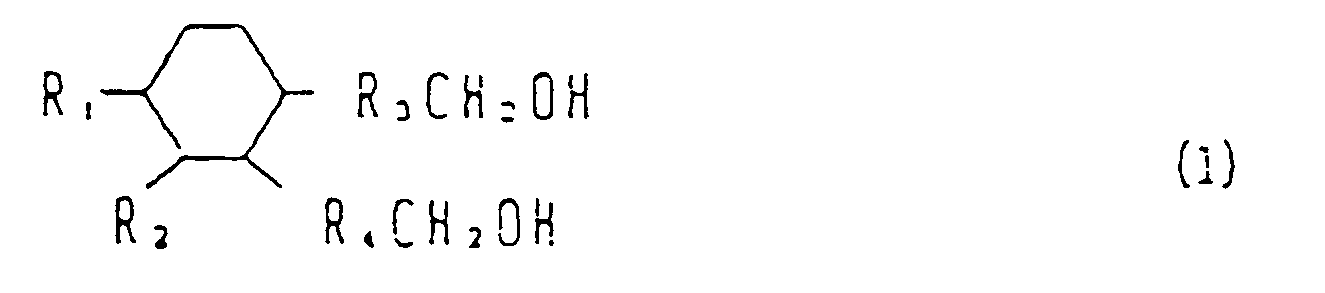
R₁ and R₂ each represent an alkyl group and
R₃ and R₄ each represent an alkylene group, the total number of carbon atoms of R₁, R₂, R₃ and R₄ being 22 to 34.
Description
- The present invention relates to a copolyester resin and resin composition which have reduced colorability and excellent flexibility and which display excellent heat-sealability when formed into a film or sheet.
- Aromatic polyesters such as polyethylene terephthalate (PET) and polybutylene terephthalate (PBT) have well-balanced physical properties such as heat resistance, mechanical strength and gas impermeability and are used as valuable engineering plastics in various fields.
- Since, however, these polyesters have a glass transition point (Tg) exceeding room temperature, they have not hitherto been used when high flexibility at low temperature is required.
- There has also been a problem in effectively exploiting the excellent gas impermeability of a film or sheet formed from such polyesters because they have poor heat-sealability and this has created difficulties in making a bag or other container from the film or sheet.
- After intensive investigations made for the purpose of solving the above-described problems, the inventors have found that a copolyester produced by introducing a specified comonomer unit into an aromatic polyester has an excellent hue, a high hydrolysis resistance and a high flexibility which is not reduced even at a low temperature and that a film or sheet produced therefrom has excellent heat-sealability. The present invention has been completed on the basis of these findings.
- Thus the present invention relates to a copolyester resin produced by the polycondensation of, as the main constituents,
- (a) terephthalic acid or a dialkyl terephthalate,
- (b) at least one alkylene glycol having 2 to 8 carbon atoms and
- (c) a dimer diol comprising as the main component a compound of the following formula (1):
- A detailed description is given below on the starting materials for the copolyesters according to the present invention. As the acidic material (a), terephthalic acid or a dialkyl terephthalate is mainly used. Preferred is a dialkyl terephthalate, particularly dimethyl terephthalate.
- As the starting diol, at least one alkylene glycol (b) having 2 to 8 carbon atoms is used. Preferred main alkylene glycols include ethylene glycol, 1,3-propylene glycol and 1,4-butylene glycol among which 1,4-butylene glycol is particularly preferred.
- The most characteristic feature of the copolyester constituting the present invention is that a diol compound (c) called "dimer diol" is used as another indispensable diol component.
- The dimer diol comprises a compound of the above-mentioned formula (1) obtained by dimerizing an unsaturated fatty acid having 15 to 21 carbon atoms and then reducing the dimer as the main component (at least 50% by weight).
- Typical examples of the dimer diols of the general formula (1) are those wherein the total number of carbon atoms of R₁, R₂, R₃ and R₄ is 28.
- The copolyester of the present invention produced by the polycondensation of the above-described (a), (b) and (c) essentially comprises at least two main constituent units of the following formulae (2) and (3):

wherein R₁, R₂, R₃ and R₄ are as defined above for the formula (1) and n represents an integer of 2 to 8. - In the course of the production of the dimer diol of the above formula (1), a diol compound of the following formula (4) is also formed as a by-product, and it may be used as a mixture thereof with the dimer diol of the above formula (1) without being separated therefrom in some cases:

wherein each of R′₁ to R′₄ is an unsaturation-free, substantially linear group and, in particular, R′₁ and R′₂ each represents an alkyl group and R′₃ and R′₄ each represent an alkylene group, the total number of carbon atoms of R′₁, R′₂, R′₃ and R′₄ being 25 to 37, particularly 31. - In such a case, the copolyester comprises a constituent unit of the following formula (5) in addition to the above-described constituent units (2) and (3):

For example, usually a mixture of 60 to 85% by weight of the dimer diol of the formula (1) and 40 to 15% by weight of the diol compound of the formula (4) is used. - The dimer diol of the formula (1) may contain, in addition to the diol compound of the formula (4) formed as the by-product, a small amount of a diol compound of the formula (1) wherein the positions of R₁ and R₃CH₂OH are changed with each other and a diol compound having a bicyclo ring.
- Further the copolyester of the present invention may comprise also a small amount of another constituent unit derived from an auxiliary ester-forming monomer used.
- The copolyester of the present invention can be produced by the polycondensation of the above-described monomer components according to an ordinary copolymerization process for polyesters.
- When the copolyester resin of the present invention is used as a resin to be injection-molded or as a resin to form a film or sheet, the amount of the dimer diol (c) to be introduced into the aromatic polyester is preferably 0.5 to 20 molar %, particularly preferably 5 to 10 molar % based on the terephthalic acid or the dialkyl terephthalate (a) which is the acid component of the polyester.
- When the amount of the dimer diol (c) is less than 0.5 molar %, none of the effects expected in the present invention such as excellent impact resistance, flexibility at a low temperature and heat-sealability can be sufficiently attained and, on the contrary, when it exceeds 20 molar %, the melting point of the copolyester is seriously lowered and the heat resistance which is one of the characteristic properties of the aromatic polyester is unfavourably impaired.
- When a high heat resistance is not so eagerly required, more than 20 molar % of the dimer diol (c) may be properly used.
- The intrinsic viscosity of the copolyester resin of the present invention usually ranges from 0.5 to 2.0. From the viewpoint of film forming properties, it is preferably, 1.0 to 1.5. When the copolymer having a high intrinsic viscosity (or, in other words, a high degree of polymerization) is intended, the copolymer produced by melt polymerization is further subjected to a suitable solid phase polymerization by an ordinary process for increasing the molecular weight of polyesters.
- Methods for forming a film or sheet from the copolyester resin include the T-die method and the inflation method. The inflation method is preferred.
- A film or sheet made of the resin of the present invention can be easily heat-sealed and is therefore suitable for use as a packaging material, since it has a low heat-sealing temperature and a wide heat-sealing temperature range of at least 20 C. In contrast a PBT film having a narrow heat-sealing temperature range cannot be easily heat-sealed. Further the film or sheet made of the resin of the present invention is suitable for use for storing frozen substances, since it has an excellent flexibility even at a low temperature.
- With regard to the preferred thickness of the film or sheet, if the thickness is insufficient, the mechanical strength of the film or sheet per se and the excellent practical effect cannot be sufficiently achieved. The film of the resin of the present invention exhibits excellent heat-sealability even when it is relatively thick, while the thickness of a PBT film must be reduced, since its heat-sealability is quite poor. However, when the thickness exceeds a certain limit, the heat-sealability is unfavourably impaired. Therefore, a desirable thickness of the film or sheet ranges from 10 to 500 µm, more desirably from 15 to 300 µm.
- The copolyester resin of the present invention is useful also as an injection molding resin having excellent impact resistance and flexibility even at low temperature. Other thermoplastic resins and organic or inorganic fillers may be incorporated into the resin of the present invention according to the use thereof so far as the effect of the present invention is not impaired.
- The thermoplastic resins thus usable are not particularly limited. Examples of them include polyolefins such as polyethylene and polypropylene; aromatic polyesters of an aromatic dicarboxylic acid and a diol or hydroxy carboxylic acid such as polyethylene terephthalate; as well as polyacetals (homopolymers and copolymers), polystyrene, polyvinyl chloride, polyamides, polycarbonates, ABS, polyphenylene oxides, polyphenylene sulphides and fluororesins. These thermoplastic resins may be used either singly or in the form of a mixture of two or more of them.
- The inorganic fillers may be fibrous, powdery or platy inorganic fillers which can be selected depending on their required duty.
- Suitable fibrous fillers include inorganic fibrous materials such as glass fiber, asbestos fiber, silica fiber, silica/alumina fiber, alumina fiber, zirconia fiber, boron nitride fiber, silicon nitride fiber, boron fiber, potassium titanate fiber and fibers of metals such as stainless steel, aluminum, titanium, copper and brass.
- The powdery fillers include carbon black; graphite; silicates such as silica, quartz powder, glass beads, milled glass fiber, glass balloon, glass powder, calcium silicate, aluminum silicate, kaolin, talc, clay, diatomaceous earth and wollastonite; metal oxides such as iron oxide, titanium oxide, zinc oxide, antimony trioxide and alumina; metal sulphates such as calcium carbonate and magnesium carbonate; as well as ferrite, silicon carbide, silicon carbide, silicon nitride, boron nitride and various metal powders.
- The platy fillers include mica, glass flake and metal foil. These inorganic fillers may be used either singly or in combination of two or more of them.
- The organic fillers include heat-resistant, high-tenacity synthetic fibers such as aromatic polyester fibers, liquid-crystal polymer fibers and aromatic polyamide and polyimide fibers.
- The inorganic or organic filler may be used in combination with a known surface-treating agent according to the desired properties. The surface-treating agents include functional compounds such as epoxy compounds, isocyanate compounds, titanate compounds and silane compounds. These fillers may be used after having been surface-treated or they may be added together with other components in the preparation of the material.
- The inorganic or organic filler is used in an amount of 0.01 to 60 % by weight based on the whole composition.
- The copolyester resin obtained by the present invention has the following excellent properties:
- 1) it is suitable for use as a material for bags, since it has excellent heat-sealability and it can be heat-sealed over a wide temperature range;
- 2) it is suitable for use as a packaging material for foods to be kept in a freezer or to be cooked in a microwave oven, since the resin has a high heat resistance and excellent gas-barrier properties and its flexibility can be kept even at a low temperature;
- 3) it is usable as a material for tubes and pipes of which a high flexibility is required in the fields of extrusion molding and injection molding, in addition to the above-described thin articles.
- The following non-limiting Examples further illustrate the present invention
- 194.2 parts by weight of dimethyl terephthalate (DMT), 175.7 parts by weight of 1,4-butylene glycol (BG) and 26.9 parts by weight of dimer diol (DDO) were placed in a reactor equipped with a stirrer and distillation tube together with a predetermined amount of a transesterification catalyst (tetrabutyl titanate). After thoroughly replacing air in the reactor with nitrogen, the temperature was elevated to 160°C under atmospheric pressure and stirring was started. Then the temperature was further slowly elevated and methanol formed as a by-product was distilled off. After the temperature reached 240°C, the pressure in the ractor was gradually reduced and the stirring was continued under a pressure of 27 Pa (0.2 Torr) for 3.5 h to give a copolyester having a limiting viscosity of 0.88.
- The properties of the resultant copolyester were examined as described below.
- The dimer diol unit introduction rate based on the acid component of the copolyester was determined according to ¹H-NMR spectroscopy using trifluoroacetic acid-d as the solvent.
- The glass transition point (Tg) and melting point (Tm) were determined according to JIS K 7121.
- The copolyester was melted at 240°C and extruded through a T-die onto a cooling roll at 25° to form a sheet having a thickness of 200µm.
- To examine the deterioration of the properties of the sheet at a low temperature, tensile impact breaking strengths at 0°C, -10°C and -20°C were determined at a pulling rate of 100 mm/sec according to JIS Z 1702 to calculate the retentivity thereof bases on the strength at ambient temperature.
- To determine the hydrolysis resistance, the sheet was immersed in hot water at 90°C for 20 days and then dried at 100°C for 2 h to determine the retentivity of the tensile impact breaking strength.
- The results are given in Table 1.
- The polymerization was conducted in the same manner as that of Example 1 except that the amounts of BG and DDO were varied to give copolyesters having various compositions. They were evaluated in the same manner as that of Example 1. The results are given in Table 1
- The polymerization was conducted in the same manner as that of Example 1 except that no DDO was used and the amount of BG was altered to 180.2 parts by weight to give a PBT polyester having a limiting viscosity of 0.88, which was evaluated in the same manner as that of Example 1. The results are given in Table 1.
- The copolyester obtained in Example 2 was pelletized and the pellets were subjected to solid-phase polymerization at 190°C in a nitrogen stream to give a polyester of a high degree of polymerization, which was evaluated in the same manner as that of Example 1. The results are given in Table 1.
- PBT obtained in Comparative Example 1 was subjected to solid-phase polymerization in the same manner as that of Example 4 to give a polyester of a high degree of polymerization, which was evaluated in the same manner as that of Example 1. The results are given in Table 1.

- The copolyester obtained in Example 1 or PBT obtained in Comparative Example 1 was melt-kneaded together with 10% by weight of glass fibers and a sheet was prepared therefrom in the same manner as that of Example 1. The sheet was evaluated in the same manner as that of Example 1. The results are given in Table 2.

- The copolyester having a high degree of polymerization as obtained in Example 4 was melted at 240°C and formed into a film having a thickness of 40µm by the inflation method. Two films thus produced were put together and heat-sealed with a heat bar at varied temperatures to determine the heat-sealing strength thereof according to JIS Z 1707. The results are given in Table 3.
- PBT having a high degree of polymerization as obtained in Comparative Example 2 was formed into a film and its heat-sealability was evaluated in the same manner as that of Example 6. The results are given in Table 3.


wherein each of R₁ to R₄ is an unsaturation-free, substantially linear group and, in particular, R₁ and R₂ each represent an alkyl group and R₃ and R₄ each represent an alkylene group, the total number of carbon atoms of R₁, R₂, R₃ and R₄ being 22 to 34.
Claims (10)
- A copolyester resin produced by the polycondensation of, as the main constituents,(a) terephthalic acid or a dialkyl terephthalate,(b) at least one alkylene glycol having 2 to 8 carbon atoms and(c) a dimer diol comprising as the main component a compound of the following formula (1):

R₁ and R₂ each represent an alkyl group and
R₃ and R₄ each represent an alkylene group, the total number of carbon atoms of R₁, R₂,
R₃ and R₄ being 22 to 34. - A copolyester resin according to claim 1, wherein the constituent (a) is dimethyl terephthalate.
- A copolyester resin according to claim 1 or claim 2, wherein the amount of the dimer diol (c) is in the range from 0.5 to 20 molar %, based on the terephthalic acid or dialkyl terephthalate (a).
- A copolyester resin according to claim 3, wherein the amount of the dimer diol (c) is in the range from 5 to 10 molar %, based on the terephthalic acid or dialkyl terephthalate (a).
- A copolyester resin according to any preceding claim, wherein the alkylene glycol (b) is 1,4-butylene glycol.
- A copolyester resin according to any preceding claim and having an intrinsic viscosity of 1.0 to 1.5.
- A copolyester resin composition comprising the copolyester resin according to any preceding claim and an inorganic or organic filler.
- A copolyester resin composition according to claim 7, wherein the amount of filler is 0.01 to 60% by weight, based on the whole composition.
- A polyester film or sheet comprising a copolyester resin or resin composition according to any preceding claim.
- A polyester film or sheet according to claim 9 and having a thickness in the range 10 to 500 µm.
Applications Claiming Priority (2)
| Application Number | Priority Date | Filing Date | Title |
|---|---|---|---|
| JP51425/90 | 1990-03-02 | ||
| JP2051425A JPH03252419A (en) | 1990-03-02 | 1990-03-02 | Copolymerized polyester resin and resin composition |
Publications (2)
| Publication Number | Publication Date |
|---|---|
| EP0444968A2 true EP0444968A2 (en) | 1991-09-04 |
| EP0444968A3 EP0444968A3 (en) | 1992-07-01 |
Family
ID=12886572
Family Applications (1)
| Application Number | Title | Priority Date | Filing Date |
|---|---|---|---|
| EP19910301783 Withdrawn EP0444968A3 (en) | 1990-03-02 | 1991-03-04 | Copolyester resin and resin composition |
Country Status (6)
| Country | Link |
|---|---|
| US (1) | US5101009A (en) |
| EP (1) | EP0444968A3 (en) |
| JP (1) | JPH03252419A (en) |
| KR (1) | KR910016803A (en) |
| BR (1) | BR9100866A (en) |
| CA (1) | CA2037416A1 (en) |
Families Citing this family (6)
| Publication number | Priority date | Publication date | Assignee | Title |
|---|---|---|---|---|
| AU7472994A (en) * | 1993-07-30 | 1995-02-28 | Henkel Corporation | Polyesters for use in blood partitioning |
| DE4419229A1 (en) * | 1994-06-01 | 1995-12-07 | Bayer Ag | Acid-terminated polyester(s), useful for polyester-carbonate(s) prodn. |
| KR100359331B1 (en) * | 1996-08-28 | 2002-11-01 | 유니케마 케미에 비.브이. | Polyether polyol and a method for the manufacture of mouldable polyester containing said polyether polyol |
| US6248844B1 (en) * | 1999-06-04 | 2001-06-19 | Henkel Corporation | Method of partitioning blood using polyesters |
| EP1950036A4 (en) * | 2005-11-15 | 2008-11-19 | Toray Industries | Matte multilayer polyester film |
| CN107099024A (en) * | 2017-06-21 | 2017-08-29 | 珠海市金团化学品有限公司 | A kind of waterborne polyester of water boiling resistance excellent performance and preparation method thereof |
Family Cites Families (3)
| Publication number | Priority date | Publication date | Assignee | Title |
|---|---|---|---|---|
| US3091600A (en) * | 1961-01-05 | 1963-05-28 | Eastman Kodak Co | Linear aromatic acid copolyesters modified with dimer glycols having 36 carbons |
| DE3030539A1 (en) * | 1980-08-13 | 1982-04-01 | Chemische Werke Hüls AG, 4370 Marl | METHOD FOR THE PRODUCTION OF NON-GAP-FREE POLYURETHANE POWDER VARNISHES, AND THE LACQUES THEREFORE PRODUCED |
| US4451641A (en) * | 1983-06-13 | 1984-05-29 | Eastman Kodak Company | Radiation-resistant container material of poly(tetramethylene terephthalate) |
-
1990
- 1990-03-02 JP JP2051425A patent/JPH03252419A/en active Pending
-
1991
- 1991-03-01 CA CA002037416A patent/CA2037416A1/en not_active Abandoned
- 1991-03-01 US US07/661,998 patent/US5101009A/en not_active Expired - Fee Related
- 1991-03-02 KR KR1019910003442A patent/KR910016803A/en not_active Ceased
- 1991-03-04 BR BR919100866A patent/BR9100866A/en not_active Application Discontinuation
- 1991-03-04 EP EP19910301783 patent/EP0444968A3/en not_active Withdrawn
Also Published As
| Publication number | Publication date |
|---|---|
| CA2037416A1 (en) | 1991-09-03 |
| JPH03252419A (en) | 1991-11-11 |
| BR9100866A (en) | 1991-11-05 |
| KR910016803A (en) | 1991-11-05 |
| EP0444968A3 (en) | 1992-07-01 |
| US5101009A (en) | 1992-03-31 |
Similar Documents
| Publication | Publication Date | Title |
|---|---|---|
| EP0057415B1 (en) | Polyester resin composition | |
| CA1110376A (en) | Polyester composition | |
| EP1185576B1 (en) | Polyester molding composition | |
| EP0020693B1 (en) | Copolyesters of polybutylene terephthalate | |
| EP0139726A1 (en) | Container having improved gas barrier properties. | |
| KR960015448B1 (en) | Modified polyester | |
| JP2574055B2 (en) | Polybutylene terephthalate resin hollow molded article and method for producing the same | |
| US5101009A (en) | Copolyester resins and methods of making the same | |
| US4937310A (en) | Polyester resin exhibiting optical anisotropy in molten state and composition thereof | |
| US5302690A (en) | Process for preparing polyester resin and the polyester resin thereby prepared | |
| EP0484105A2 (en) | Thermoplastic polyester resin composition | |
| CA1102469A (en) | Flame retardant compositions comprising block copolyesters of polybutylene terephthalate | |
| KR930003020B1 (en) | Modified polyarylate resin and composition comprising the same | |
| JP3650557B2 (en) | Flame-retardant polyester resin composition, molded product thereof, and production method thereof | |
| JP3913527B2 (en) | Totally aromatic polyesteramide and polyesteramide resin composition | |
| US5189140A (en) | Heat-resistant injection-moldable copolyester resins and resin blends of the same | |
| JPH0625397A (en) | Method for producing polyester resin or composition thereof | |
| CA1261996A (en) | Polyester composition improved in fluidity | |
| KR960002954B1 (en) | Polyester showing melt anisotropy | |
| JP3142366B2 (en) | Copolyester and film | |
| JP2908648B2 (en) | Method for producing modified polybutylene terephthalate resin | |
| JP2807580B2 (en) | Polyester resin composition | |
| JPH07188521A (en) | Modified polyester resin composition | |
| KR900006302B1 (en) | Composition of polyester resin | |
| JP3448351B2 (en) | Flame retardant polyester resin and composition for injection molding |
Legal Events
| Date | Code | Title | Description |
|---|---|---|---|
| PUAI | Public reference made under article 153(3) epc to a published international application that has entered the european phase |
Free format text: ORIGINAL CODE: 0009012 |
|
| AK | Designated contracting states |
Kind code of ref document: A2 Designated state(s): AT BE CH DE DK ES FR GB GR IT LI LU NL SE |
|
| PUAL | Search report despatched |
Free format text: ORIGINAL CODE: 0009013 |
|
| AK | Designated contracting states |
Kind code of ref document: A3 Designated state(s): AT BE CH DE DK ES FR GB GR IT LI LU NL SE |
|
| 17P | Request for examination filed |
Effective date: 19921102 |
|
| 17Q | First examination report despatched |
Effective date: 19950227 |
|
| STAA | Information on the status of an ep patent application or granted ep patent |
Free format text: STATUS: THE APPLICATION IS DEEMED TO BE WITHDRAWN |
|
| 18D | Application deemed to be withdrawn |
Effective date: 19961127 |