EP0445023B1 - Vehicle for a therapeutically active agent for external use and antiseptic preparation comprising said vehicle - Google Patents
Vehicle for a therapeutically active agent for external use and antiseptic preparation comprising said vehicle Download PDFInfo
- Publication number
- EP0445023B1 EP0445023B1 EP91400519A EP91400519A EP0445023B1 EP 0445023 B1 EP0445023 B1 EP 0445023B1 EP 91400519 A EP91400519 A EP 91400519A EP 91400519 A EP91400519 A EP 91400519A EP 0445023 B1 EP0445023 B1 EP 0445023B1
- Authority
- EP
- European Patent Office
- Prior art keywords
- compound
- formula
- straight
- chain alkyl
- excipient
- Prior art date
- Legal status (The legal status is an assumption and is not a legal conclusion. Google has not performed a legal analysis and makes no representation as to the accuracy of the status listed.)
- Expired - Lifetime
Links
- 230000002421 anti-septic effect Effects 0.000 title claims description 25
- 238000002360 preparation method Methods 0.000 title claims description 25
- 239000013543 active substance Substances 0.000 title 1
- 150000001875 compounds Chemical class 0.000 claims description 69
- 239000000546 pharmaceutical excipient Substances 0.000 claims description 40
- 125000000217 alkyl group Chemical group 0.000 claims description 23
- 229920001184 polypeptide Polymers 0.000 claims description 16
- 102000004196 processed proteins & peptides Human genes 0.000 claims description 16
- 108090000765 processed proteins & peptides Proteins 0.000 claims description 16
- 239000000203 mixture Substances 0.000 claims description 11
- XLYOFNOQVPJJNP-UHFFFAOYSA-N water Substances O XLYOFNOQVPJJNP-UHFFFAOYSA-N 0.000 claims description 11
- 150000001408 amides Chemical class 0.000 claims description 9
- 239000008139 complexing agent Substances 0.000 claims description 6
- KCXVZYZYPLLWCC-UHFFFAOYSA-N EDTA Chemical compound OC(=O)CN(CC(O)=O)CCN(CC(O)=O)CC(O)=O KCXVZYZYPLLWCC-UHFFFAOYSA-N 0.000 claims description 3
- 108010010803 Gelatin Proteins 0.000 claims description 3
- 229920000159 gelatin Polymers 0.000 claims description 3
- 239000008273 gelatin Substances 0.000 claims description 3
- 235000019322 gelatine Nutrition 0.000 claims description 3
- 235000011852 gelatine desserts Nutrition 0.000 claims description 3
- 230000001225 therapeutic effect Effects 0.000 claims description 3
- 150000002500 ions Chemical class 0.000 claims description 2
- 239000003002 pH adjusting agent Substances 0.000 claims description 2
- ICUTUKXCWQYESQ-UHFFFAOYSA-N triclocarban Chemical compound C1=CC(Cl)=CC=C1NC(=O)NC1=CC=C(Cl)C(Cl)=C1 ICUTUKXCWQYESQ-UHFFFAOYSA-N 0.000 claims description 2
- 230000002378 acidificating effect Effects 0.000 claims 2
- 239000003795 chemical substances by application Substances 0.000 claims 1
- 230000000536 complexating effect Effects 0.000 claims 1
- 238000010979 pH adjustment Methods 0.000 claims 1
- UEUXEKPTXMALOB-UHFFFAOYSA-J tetrasodium;2-[2-[bis(carboxylatomethyl)amino]ethyl-(carboxylatomethyl)amino]acetate Chemical class [Na+].[Na+].[Na+].[Na+].[O-]C(=O)CN(CC([O-])=O)CCN(CC([O-])=O)CC([O-])=O UEUXEKPTXMALOB-UHFFFAOYSA-J 0.000 claims 1
- VEXZGXHMUGYJMC-UHFFFAOYSA-N Hydrochloric acid Chemical compound Cl VEXZGXHMUGYJMC-UHFFFAOYSA-N 0.000 description 6
- 230000000844 anti-bacterial effect Effects 0.000 description 5
- 238000009833 condensation Methods 0.000 description 5
- 230000005494 condensation Effects 0.000 description 5
- 150000004045 organic chlorine compounds Chemical class 0.000 description 5
- 239000004480 active ingredient Substances 0.000 description 4
- 238000010790 dilution Methods 0.000 description 4
- 239000012895 dilution Substances 0.000 description 4
- KRKNYBCHXYNGOX-UHFFFAOYSA-N citric acid Chemical compound OC(=O)CC(O)(C(O)=O)CC(O)=O KRKNYBCHXYNGOX-UHFFFAOYSA-N 0.000 description 3
- 230000000855 fungicidal effect Effects 0.000 description 3
- 239000002609 medium Substances 0.000 description 3
- 238000000034 method Methods 0.000 description 3
- 239000000243 solution Substances 0.000 description 3
- GWEHVDNNLFDJLR-UHFFFAOYSA-N 1,3-diphenylurea Chemical compound C=1C=CC=CC=1NC(=O)NC1=CC=CC=C1 GWEHVDNNLFDJLR-UHFFFAOYSA-N 0.000 description 2
- MHAJPDPJQMAIIY-UHFFFAOYSA-N Hydrogen peroxide Chemical compound OO MHAJPDPJQMAIIY-UHFFFAOYSA-N 0.000 description 2
- 241001465754 Metazoa Species 0.000 description 2
- 239000002253 acid Substances 0.000 description 2
- 239000012736 aqueous medium Substances 0.000 description 2
- 230000015572 biosynthetic process Effects 0.000 description 2
- 125000003178 carboxy group Chemical group [H]OC(*)=O 0.000 description 2
- -1 des amides Chemical class 0.000 description 2
- 230000000694 effects Effects 0.000 description 2
- 238000001914 filtration Methods 0.000 description 2
- 238000009472 formulation Methods 0.000 description 2
- 230000007062 hydrolysis Effects 0.000 description 2
- 238000006460 hydrolysis reaction Methods 0.000 description 2
- JVTAAEKCZFNVCJ-UHFFFAOYSA-N lactic acid Chemical compound CC(O)C(O)=O JVTAAEKCZFNVCJ-UHFFFAOYSA-N 0.000 description 2
- 239000012528 membrane Substances 0.000 description 2
- 244000005700 microbiome Species 0.000 description 2
- 159000000000 sodium salts Chemical class 0.000 description 2
- 239000000126 substance Substances 0.000 description 2
- 239000004094 surface-active agent Substances 0.000 description 2
- 150000003512 tertiary amines Chemical class 0.000 description 2
- 102000009027 Albumins Human genes 0.000 description 1
- 108010088751 Albumins Proteins 0.000 description 1
- 241000222122 Candida albicans Species 0.000 description 1
- 102000008186 Collagen Human genes 0.000 description 1
- 108010035532 Collagen Proteins 0.000 description 1
- 241000194031 Enterococcus faecium Species 0.000 description 1
- 241000588724 Escherichia coli Species 0.000 description 1
- 241000589517 Pseudomonas aeruginosa Species 0.000 description 1
- 241000700159 Rattus Species 0.000 description 1
- 241000191967 Staphylococcus aureus Species 0.000 description 1
- 239000000654 additive Substances 0.000 description 1
- 230000000996 additive effect Effects 0.000 description 1
- 239000002280 amphoteric surfactant Substances 0.000 description 1
- 229940064004 antiseptic throat preparations Drugs 0.000 description 1
- 230000003385 bacteriostatic effect Effects 0.000 description 1
- 229940095731 candida albicans Drugs 0.000 description 1
- 229940041514 candida albicans extract Drugs 0.000 description 1
- FOCAUTSVDIKZOP-UHFFFAOYSA-N chloroacetic acid Chemical compound OC(=O)CCl FOCAUTSVDIKZOP-UHFFFAOYSA-N 0.000 description 1
- 229920001436 collagen Polymers 0.000 description 1
- 230000000052 comparative effect Effects 0.000 description 1
- 238000006482 condensation reaction Methods 0.000 description 1
- 239000000470 constituent Substances 0.000 description 1
- 125000002704 decyl group Chemical group [H]C([H])([H])C([H])([H])C([H])([H])C([H])([H])C([H])([H])C([H])([H])C([H])([H])C([H])([H])C([H])([H])C([H])([H])* 0.000 description 1
- 239000003599 detergent Substances 0.000 description 1
- 235000014113 dietary fatty acids Nutrition 0.000 description 1
- IUNMPGNGSSIWFP-UHFFFAOYSA-N dimethylaminopropylamine Chemical compound CN(C)CCCN IUNMPGNGSSIWFP-UHFFFAOYSA-N 0.000 description 1
- 239000000194 fatty acid Substances 0.000 description 1
- 229930195729 fatty acid Natural products 0.000 description 1
- 150000004665 fatty acids Chemical class 0.000 description 1
- 238000005187 foaming Methods 0.000 description 1
- 239000008233 hard water Substances 0.000 description 1
- 230000002452 interceptive effect Effects 0.000 description 1
- 230000007794 irritation Effects 0.000 description 1
- 239000004310 lactic acid Substances 0.000 description 1
- 235000014655 lactic acid Nutrition 0.000 description 1
- 231100000344 non-irritating Toxicity 0.000 description 1
- 125000001400 nonyl group Chemical group [H]C([*])([H])C([H])([H])C([H])([H])C([H])([H])C([H])([H])C([H])([H])C([H])([H])C([H])([H])C([H])([H])[H] 0.000 description 1
- 230000003647 oxidation Effects 0.000 description 1
- 238000007254 oxidation reaction Methods 0.000 description 1
- 238000001556 precipitation Methods 0.000 description 1
- 108090000623 proteins and genes Proteins 0.000 description 1
- 102000004169 proteins and genes Human genes 0.000 description 1
- 239000008213 purified water Substances 0.000 description 1
- 239000001509 sodium citrate Substances 0.000 description 1
- 230000003381 solubilizing effect Effects 0.000 description 1
- 239000002904 solvent Substances 0.000 description 1
- 238000001356 surgical procedure Methods 0.000 description 1
- 238000011282 treatment Methods 0.000 description 1
- HRXKRNGNAMMEHJ-UHFFFAOYSA-K trisodium citrate Chemical compound [Na+].[Na+].[Na+].[O-]C(=O)CC(O)(CC([O-])=O)C([O-])=O HRXKRNGNAMMEHJ-UHFFFAOYSA-K 0.000 description 1
- 229940038773 trisodium citrate Drugs 0.000 description 1
- 239000012138 yeast extract Substances 0.000 description 1
Classifications
-
- A—HUMAN NECESSITIES
- A61—MEDICAL OR VETERINARY SCIENCE; HYGIENE
- A61K—PREPARATIONS FOR MEDICAL, DENTAL OR TOILETRY PURPOSES
- A61K47/00—Medicinal preparations characterised by the non-active ingredients used, e.g. carriers or inert additives; Targeting or modifying agents chemically bound to the active ingredient
- A61K47/06—Organic compounds, e.g. natural or synthetic hydrocarbons, polyolefins, mineral oil, petrolatum or ozokerite
- A61K47/16—Organic compounds, e.g. natural or synthetic hydrocarbons, polyolefins, mineral oil, petrolatum or ozokerite containing nitrogen, e.g. nitro-, nitroso-, azo-compounds, nitriles, cyanates
- A61K47/18—Amines; Amides; Ureas; Quaternary ammonium compounds; Amino acids; Oligopeptides having up to five amino acids
- A61K47/186—Quaternary ammonium compounds, e.g. benzalkonium chloride or cetrimide
-
- A—HUMAN NECESSITIES
- A61—MEDICAL OR VETERINARY SCIENCE; HYGIENE
- A61K—PREPARATIONS FOR MEDICAL, DENTAL OR TOILETRY PURPOSES
- A61K9/00—Medicinal preparations characterised by special physical form
- A61K9/0012—Galenical forms characterised by the site of application
- A61K9/0014—Skin, i.e. galenical aspects of topical compositions
Definitions
- the present invention relates to an excipient for a therapeutic active principle for external use such as an antiseptic of the organochlorine compound type from the class of carbanilides; it also relates to an antiseptic preparation comprising this excipient.
- organochlorine compounds of the class of carbanilides demonstrate an bacteriostatic, bactericidal and fungicidal activity and therefore find their use as antiseptic active ingredients.
- these compounds are insoluble in water and very poorly soluble in the solvents usually used for external uses, which limits their practical interest. Attempts have therefore been made in the past to develop excipients for said organochlorine compounds; it nevertheless appears that the preparations obtained with these excipients do not exhibit an antiseptic activity satisfying the activity criteria defined in the French Pharmacopoeia mentioned above.
- Compounds (Ia) and (Ib) are amphoteric solubilizing surfactants. Like the compounds (IIa) and (IIb), they combine very good solubility in water, with their own bactericidal power, which is of particular interest when said excipient is intended for the formulation of a preparation comprising a antiseptic active ingredient since within this preparation there will be a combination of the bactericidal power of this active ingredient and that of the excipient.
- the above compounds (Ib) where R4 denotes a linear C tripod and C10 alkyl group represent at most 10% and the compounds (Ib) where R4 denotes a linear C concerning, C16 or C18 alkyl group represent respectively 17-24%, 6-12% and 5-10%, these percentages being given relative to the sum of the weights of the compound of formula ( Ia) and compounds of formula (Ib).
- the derivatives (IIIb) obtained by using the amides of formula (IVb) where R7 denotes a linear C Deutschen and C9 alkyl group represent at most 10% of the sum of the weights of the derivative (IIIa) and derivatives (IIIb) and derivatives (IIIb) obtained by using amides of formula (IVb) where R7 denotes a linear C alk, C15 and C17 alkyl group representing respectively 17-24%, 6-12 % and 5-10% of this same amount.
- the polypeptide involved in the formation of derivatives (IIIa) and (IIIb) consists, for example, of a collagen polypeptide obtained by hydrolysis of gelatin.
- the weight ratios of derivative (IIIa) / compound (Ia), derivative (IIIa) / compound (Ia) + compound (s) (Ib), derivative (IIIa) + derivative (s) (IIIb) / compound (Ia) and derivative (IIIa) + derivative (s) (IIIb) / compound (Ia) + compound (s) (Ib) are each less than or equal to 0.4.
- the excipient according to the invention can also comprise water in which the compounds and derivatives (Ia), (Ib), (IIa), (IIb), (IIIa) and (IIIb) are easily miscible.
- this excipient is intended to enter into the composition of an antiseptic preparation capable of being diluted in water of variable hardness before use, it is advantageous, with a view to increasing the stability of the resulting diluted solution, that said excipient contains a complexing agent for alkaline earth ions, such as EDTA, the sodium salts of EDTA and their mixtures, the weight ratios of complexing agent / compound (Ia) and complexing agent / compound (Ia) + compound ( s) (Ib) each preferably being less than or equal to 0.1.
- a complexing agent for alkaline earth ions such as EDTA, the sodium salts of EDTA and their mixtures
- the weight ratios of complexing agent / compound (Ia) and complexing agent / compound (Ia) + compound ( s) (Ib) each preferably being less than or equal to 0.1.
- a pH adjusting agent such as citric acid, lactic acid and / or trisodium citrate, may be desirable to give the excipient a pH compatible with the tissues with which it is intended to be contacted.
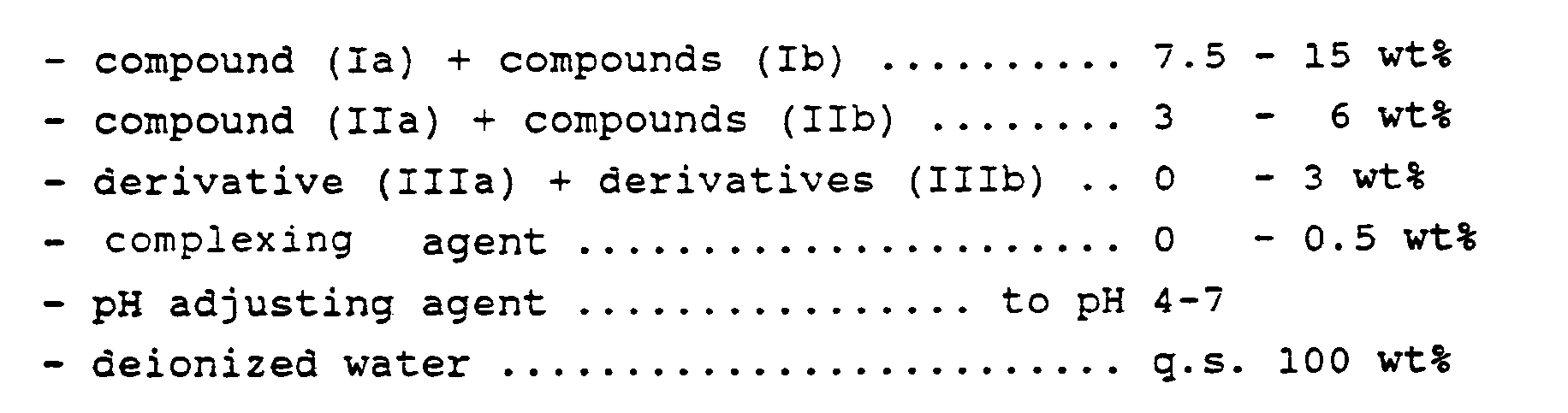
- Preferred excipients according to the invention correspond to the composition below where the percentage values given between parentheses correspond to very particularly preferred excipients:
- the compounds (Ia) and (Ib) used according to the invention can be obtained by condensation, in an aqueous medium at 70-80 ° C, of the sodium salt of monochloracetic acid on a tertiary amine of formula R1R2R2N or R4R2R2N where R1, R2 and R4 have the same meaning as in the formulas (Ia) and (Ib).
- a condensation reaction may for example be carried out according to the method described in Amphoteric surfactant - Surfactant Sciences Series Vol. 12 - DEKKER page 75.
- the compounds (Ia) and (Ib) are products marketed by the French company SEPPIC, under the brand AMONYL® 640NL.
- the compounds (IIa) and (IIb) can for their part be prepared by oxidation with hydrogen peroxide in aqueous medium, in particular at 70 ° C., of a tertiary amine of formula where R1 and R5 have the same meaning as in formulas (IIa) and (IIb).
- the compounds (IIa) and (IIb) are products sold by the company AKZO, under the brand AROMOX®, in particular AROMOX® DMMCD-W.
- the compounds (IVa) and (IVb) can be obtained by the action of the fatty acid of formula R6-COOH or R7-COOH on dimethylamino propylamine in an alkaline medium.
- the polypeptide to be condensed with these compounds (IVa) and (IVb) can be prepared by hydrolysis, for example according to the technique described in US-A-3,738,913, of proteins of the gelatin type.
- excipient thus described is of particular interest for the formulation of an antiseptic preparation, the active principle of which is an organochlorine compound insoluble in water, of the class of carbanilides, in particular 3,4,4 ′ carbanilide trichloro.
- this antiseptic preparation comprises the following constituents:
- the bactericidal and fungicidal activity of the antiseptic preparation was determined against the following five reference strains: Pseudomonas aeruginosa CIPA22, Escherichia coli CIP 54.127, Staphylococcus aureus CIP 53.154, Enterococcus faecium CIP 58.55 and candida albicans CIP 1180.79.
- Table 1 above shows that a reduction of at least 5 log (at least 105 times) in the population of microorganisms is obtained with the composition tested at concentrations (V / V) of:
- Table 2 below collates the comparative results of the lowest concentrations (V / V) of the composition according to the invention for which a reduction of 5 log of the population of microorganisms could be obtained.
- the antiseptic preparation according to the invention can be used pure or diluted in water, in particular at 10-15% (V / V), and preferably at 12% (V / V).
- V / V the best physiological tolerance being obtained with a preparation at pH 5-6.5 and the best antiseptic efficacy of the active principle being obtained at 4.5-6, the pH of this preparation will advantageously be adjusted to 5-6.
Landscapes
- Health & Medical Sciences (AREA)
- Life Sciences & Earth Sciences (AREA)
- Chemical & Material Sciences (AREA)
- General Health & Medical Sciences (AREA)
- Public Health (AREA)
- Veterinary Medicine (AREA)
- Animal Behavior & Ethology (AREA)
- Epidemiology (AREA)
- Medicinal Chemistry (AREA)
- Pharmacology & Pharmacy (AREA)
- Engineering & Computer Science (AREA)
- Oil, Petroleum & Natural Gas (AREA)
- Proteomics, Peptides & Aminoacids (AREA)
- Chemical Kinetics & Catalysis (AREA)
- General Chemical & Material Sciences (AREA)
- Dermatology (AREA)
- Medicinal Preparation (AREA)
- Agricultural Chemicals And Associated Chemicals (AREA)
Description
La présente invention a pour objet un excipient pour un principe actif thérapeutique à usage externe tel qu'un antiseptique du type composé organochloré de la classe des carbanilides ; elle concerne également une préparation antiseptique comprenant cet excipient.The present invention relates to an excipient for a therapeutic active principle for external use such as an antiseptic of the organochlorine compound type from the class of carbanilides; it also relates to an antiseptic preparation comprising this excipient.
L'une des difficultés rencontrées lors de la mise au point d'une préparation antiseptique à usage externe, réside dans le choix de l'excipient devant être associé au principe actif antiseptique. En effet, cet excipient doit répondre à au moins trois conditions essentielles. Il doit être physiologiquement toléré par les tissus sur lesquels il est destiné à être appliqué ; il doit ensuite être capable de solubiliser le principe actif dans une mesure suffisante pour que la préparation résultante ait l'activité antiseptique recherchée et notamment une activité antiseptique telle que définie dans la Pharmacopée Française Xème Edition au chapitre consacré à la monographie des antiseptiques ; il doit enfin assurer une bonne stabilité de la préparation, notamment lorsque celle-ci est soumise à une dilution.One of the difficulties encountered during the development of an antiseptic preparation for external use lies in the choice of the excipient to be associated with the active antiseptic principle. Indeed, this excipient must meet at least three essential conditions. It must be physiologically tolerated by the tissues on which it is intended to be applied; it must then be capable of dissolving the active principle to a sufficient extent so that the resulting preparation has the desired antiseptic activity and in particular an antiseptic activity as defined in the French Pharmacopoeia Xth Edition in the chapter devoted to the monograph of antiseptics; Finally, it must ensure good stability of the preparation, especially when it is subject to dilution.
Les composés organochlorés de la classe des carbanilides, et en particulier le trichloro-3,4,4′ carbanilide, font preuve d'une activité bactériostatique, bactéricide et fongicide intéressante et trouvent donc leur utilisation en tant que principes actifs antiseptiques. Toutefois, ces composés sont insolubles dans l'eau et très peu solubles dans les solvants habituellement utilisés pour des usages externes, ce qui en limite l'intérêt pratique. On a donc cherché, dans le passé, à mettre au point des excipients pour lesdits composés organochlorés ; il s'avère néanmoins que les préparations obtenues avec ces excipients ne présentent pas une activité antiseptique satisfaisant aux critères d'activité définis dans la Pharmacopée Française susmentionnée.The organochlorine compounds of the class of carbanilides, and in particular the 3,4,4'-trichloro carbanilide, demonstrate an bacteriostatic, bactericidal and fungicidal activity and therefore find their use as antiseptic active ingredients. However, these compounds are insoluble in water and very poorly soluble in the solvents usually used for external uses, which limits their practical interest. Attempts have therefore been made in the past to develop excipients for said organochlorine compounds; it nevertheless appears that the preparations obtained with these excipients do not exhibit an antiseptic activity satisfying the activity criteria defined in the French Pharmacopoeia mentioned above.
Le but de la présente invention est par conséquent de proposer un nouvel excipient pour principe actif thérapeutique à usage externe tel qu'un composé organochloré de la classe des carbanilides, répondant aux trois conditions rappelées ci-dessus. Conformément à l'invention, cet excipient se caractérisé en ce qu'il comprend :
- un composé de formule :
R₁ - ⊕NR₂R₂R₃ (Ia)
où R₁ = alkyle linéaire en C₁₂, R₂ = (CH₂CH₂O)₂H et R₃ = CH₂COO⁻ , et - un composé de formule :

- a compound of formula:
R₁ - ⊕ NR₂R₂R₃ (Ia)
where R₁ = linear C en alkyl, R₂ = (CH₂CH₂O) ₂H and R₃ = CH₂COO⁻, and - a compound of formula:
Du point de vue de la tolérance, on préfère selon l'invention, que l'excipient comprenne en outre au moins un composé choisi parmi ceux de formule :
R₄ - ⊕NR₂R₂R₃ (Ib)
où R₄ = alkyle linéaire en C₈, C₁₀, C₁₄, C₁₆ ou C₁₈ et R₂ et R₃ ont la même signification que dans la formule (Ia) et au moins un composé choisi parmi ceux de formule :

où R₅ = alkyle linéaire en C₁₄ ou C₁₆.From the point of view of tolerance, it is preferred according to the invention, that the excipient also comprises at least one compound chosen from those of formula:
R₄ - ⊕ NR₂R₂R₃ (Ib)
where R₄ = linear C en, C₁₀, C₁₄, C₁₆ or C₁₈ and R₂ and R₃ alkyl have the same meaning as in formula (Ia) and at least one compound chosen from those of formula:
where R₅ = linear C en or C₁₆ alkyl.
Les composés (Ia) et (Ib) sont des agents tensio-actifs amphotères solubilisants. Tout comme les composés (IIa) et (IIb), ils conjuguent une très bonne solubilité dans l'eau, avec un pouvoir bactéricide propre, ce qui présente un intérêt tout particulier lorsque ledit excipient est destiné à la formulation d'une préparation comprenant un principe actif antiseptique puisqu'au sein de cette préparation il y aura cumul du pouvoir bactéricide de ce principe actif et de celui de l'excipient.Compounds (Ia) and (Ib) are amphoteric solubilizing surfactants. Like the compounds (IIa) and (IIb), they combine very good solubility in water, with their own bactericidal power, which is of particular interest when said excipient is intended for the formulation of a preparation comprising a antiseptic active ingredient since within this preparation there will be a combination of the bactericidal power of this active ingredient and that of the excipient.
Avantageusement, les composés (Ib) ci-dessus où R₄ désigne un groupe alkyle linéaire en C₈ et C₁₀ représentent au plus 10 % et les composés (Ib) où R₄ désigne un groupe alkyle linéaire en C₁₄, C₁₆ ou C₁₈ représentent respectivement 17-24 %, 6-12 % et 5-10 %, ces pourcentages étant donnés par rapport à la somme des poids du composé de formule (Ia) et des composés de formule (Ib).Advantageously, the above compounds (Ib) where R₄ denotes a linear C groupe and C₁₀ alkyl group represent at most 10% and the compounds (Ib) where R₄ denotes a linear C groupe, C₁₆ or C₁₈ alkyl group represent respectively 17-24%, 6-12% and 5-10%, these percentages being given relative to the sum of the weights of the compound of formula ( Ia) and compounds of formula (Ib).
Quant au composé (IIb) où R₅ = alkyle linéaire en C₁₄ et au composé (IIb) où R₅ = alkyle linéaire en C₁₆, ils sont avantageusement mis en oeuvre respectivement à raison de 27-31 % et 2,5-3,5 % de la somme des poids du composé de formule (IIa) et des composés de formule (IIb).As for the compound (IIb) where R₅ = linear C en alkyl and to the compound (IIb) where R₅ = linear C en alkyl, they are advantageously used respectively at a rate of 27-31% and 2.5-3.5% the sum of the weights of the compound of formula (IIa) and the compounds of formula (IIb).
Par ailleurs, on peut notamment choisir les quantités des composés (Ia), (IIa), (Ib) et (IIb) de telle sorte que les rapports en poids composé (IIa)/composé (Ia) et composé (IIa) + composé(s) (IIb)/composé (Ia) + composé(s) (Ib) soient compris chacun dans l'intervalle de 0,2 à 0,8.Furthermore, it is possible in particular to choose the quantities of compounds (Ia), (IIa), (Ib) and (IIb) so that the weight ratios of compound (IIa) / compound (Ia) and compound (IIa) + compound (s) (IIb) / compound (Ia) + compound (s) (Ib) are each in the range of 0.2 to 0.8.
Pour améliorer encore la tolérance de l'excipient, ce dernier peut de plus comprendre :
- un dérivé de polypeptide (IIIa) obtenu par condensation en milieu acide, notamment l'acide chlorhydrique, de l'amide de formule :

- de préférence au moins un dérivé de polypeptide (IIIb) choisi parmi ceux obtenus par condensation, en milieu acide, notamment l'acide chlorhydrique, des amides de formule :

- a polypeptide derivative (IIIa) obtained by condensation in an acid medium, in particular hydrochloric acid, of the amide of formula:
- preferably at least one polypeptide derivative (IIIb) chosen from those obtained by condensation, in an acid medium, in particular hydrochloric acid, of the amides of formula:
Selon un mode de réalisation de l'excipient, les dérivés (IIIb) obtenus par mise en oeuvre des amides de formule (IVb) où R₇ désigne un groupe alkyle linéaire en C₇ et C₉ représentent au plus 10 % de la somme des poids du dérivé (IIIa) et des dérivés (IIIb) et les dérivés (IIIb) obtenus par mise en oeuvre des amides de formule (IVb) où R₇ désigne un groupe alkyle linéaire en C₁₃, C₁₅ et C₁₇ représentant respectivement 17-24 %, 6-12 % et 5-10 % de cette même somme.According to one embodiment of the excipient, the derivatives (IIIb) obtained by using the amides of formula (IVb) where R₇ denotes a linear C groupe and C₉ alkyl group represent at most 10% of the sum of the weights of the derivative (IIIa) and derivatives (IIIb) and derivatives (IIIb) obtained by using amides of formula (IVb) where R₇ denotes a linear C alk, C₁₅ and C₁₇ alkyl group representing respectively 17-24%, 6-12 % and 5-10% of this same amount.
Le polypeptide entrant dans la formation des dérivés (IIIa) et (IIIb) est par exemple constitué par un polypeptide collagénique obtenu par hydrolyse de la gélatine.The polypeptide involved in the formation of derivatives (IIIa) and (IIIb) consists, for example, of a collagen polypeptide obtained by hydrolysis of gelatin.
D'autre part, il est souhaitable que les rapports en poids dérivé (IIIa)/composé (Ia), dérivé (IIIa)/composé (Ia) + composé(s) (Ib), dérivé (IIIa) + dérivé(s) (IIIb)/composé (Ia) et dérivé (IIIa) + dérivé(s) (IIIb)/composé (Ia) + composé(s) (Ib) soient chacun inférieurs ou égaux à 0,4.On the other hand, it is desirable that the weight ratios of derivative (IIIa) / compound (Ia), derivative (IIIa) / compound (Ia) + compound (s) (Ib), derivative (IIIa) + derivative (s) (IIIb) / compound (Ia) and derivative (IIIa) + derivative (s) (IIIb) / compound (Ia) + compound (s) (Ib) are each less than or equal to 0.4.
L'excipient selon l'invention peut en outre comprendre de l'eau dans laquelle les composés et dérivés (Ia), (Ib), (IIa), (IIb), (IIIa) et (IIIb) sont aisément miscibles.The excipient according to the invention can also comprise water in which the compounds and derivatives (Ia), (Ib), (IIa), (IIb), (IIIa) and (IIIb) are easily miscible.
Lorsque cet excipient est destiné à entrer dans la composition d'une préparation antiseptique susceptible d'être diluée dans de l'eau de dureté variable avant utilisation, il est avantageux, en vue d'augmenter la stabilité de la solution diluée résultante, que ledit excipient contienne un agent complexant des ions alcalino-terreux, tel que l'EDTA, les sels sodiques de l'EDTA et leurs mélanges, les rapports en poids agent complexant/composé (Ia) et agent complexant/composé (Ia) + composé(s) (Ib) étant chacun de préférence inférieurs ou égaux à 0,1.When this excipient is intended to enter into the composition of an antiseptic preparation capable of being diluted in water of variable hardness before use, it is advantageous, with a view to increasing the stability of the resulting diluted solution, that said excipient contains a complexing agent for alkaline earth ions, such as EDTA, the sodium salts of EDTA and their mixtures, the weight ratios of complexing agent / compound (Ia) and complexing agent / compound (Ia) + compound ( s) (Ib) each preferably being less than or equal to 0.1.
Enfin, l'adjonction d'un agent d'ajustement du pH à 4-7, tel que l'acide citrique, l'acide lactique et/ou le citrate trisodique, peut être souhaitable pour conférer à l'excipient un pH compatible avec les tissus avec lesquels il est destiné à être mis en contact.Finally, the addition of a pH adjusting agent to 4-7, such as citric acid, lactic acid and / or trisodium citrate, may be desirable to give the excipient a pH compatible with the tissues with which it is intended to be contacted.
Des excipients préférés selon l'invention, répondent à la composition ci-après où les valeurs de pourcentage données entre parenthèses correspondent à des excipients tout particulièrement préférés :

Les composés (Ia) et (Ib) mis en oeuvre selon l'invention peuvent être obtenus par condensation, en milieu aqueux à 70-80° C, du sel de sodium de l'acide monochloracétique sur une amine tertiaire de formule R₁R₂R₂N ou R₄R₂R₂N où R₁, R₂ et R₄ ont la même signification que dans les formules (Ia) et (Ib). Une telle réaction de condensation pourra par exemple être effectuée selon la méthode décrite dans Amphoteric surfactant - Surfactant Sciences Series Vol. 12 - DEKKER page 75. Les composés (Ia) et (Ib) sont des produits commercialisés par la société française SEPPIC, sous la marque AMONYL® 640NL.The compounds (Ia) and (Ib) used according to the invention can be obtained by condensation, in an aqueous medium at 70-80 ° C, of the sodium salt of monochloracetic acid on a tertiary amine of formula R₁R₂R₂N or R₄R₂R₂N where R₁, R₂ and R₄ have the same meaning as in the formulas (Ia) and (Ib). Such a condensation reaction may for example be carried out according to the method described in Amphoteric surfactant - Surfactant Sciences Series Vol. 12 - DEKKER page 75. The compounds (Ia) and (Ib) are products marketed by the French company SEPPIC, under the brand AMONYL® 640NL.
Les composés (IIa) et (IIb) peuvent pour leur part être préparés par oxydation par le peroxyde d'hydrogène en milieu aqueux, notamment à 70° C, d'une amine tertiaire de formule

où R₁ et R₅ ont la même signification que dans les formules (IIa) et (IIb). Les composés (IIa) et (IIb) sont des produits commercialisés par la société AKZO, sous la marque AROMOX®, notamment AROMOX® DMMCD-W.The compounds (IIa) and (IIb) can for their part be prepared by oxidation with hydrogen peroxide in aqueous medium, in particular at 70 ° C., of a tertiary amine of formula
where R₁ and R₅ have the same meaning as in formulas (IIa) and (IIb). The compounds (IIa) and (IIb) are products sold by the company AKZO, under the brand AROMOX®, in particular AROMOX® DMMCD-W.
Quant aux composés (IVa) et (IVb), ils peuvent être obtenus par action de l'acide gras de formule R₆-COOH ou R₇-COOH sur la diméthylamino propylamine en milieu alcalin. D'autre part, le polypeptide à condenser avec ces composés (IVa) et (IVb) peut être préparé par hydrolyse, par exemple selon la technique décrite dans US-A-3 738 913, de protéines du type gélatine.As for the compounds (IVa) and (IVb), they can be obtained by the action of the fatty acid of formula R₆-COOH or R₇-COOH on dimethylamino propylamine in an alkaline medium. On the other hand, the polypeptide to be condensed with these compounds (IVa) and (IVb) can be prepared by hydrolysis, for example according to the technique described in US-A-3,738,913, of proteins of the gelatin type.
Il est à noter par ailleurs que les dérivés (IIIa) et (IIIb) sont des produits commercialisés sous la marque de fabrique MONTEINE® LCQ par la société française SEPPIC (Société d'Exploitation de Produits pour les Industries Chimiques).It should also be noted that the derivatives (IIIa) and (IIIb) are products marketed under the trademark MONTEINE® LCQ by the French company SEPPIC (Société d'Exploitation de Products for the Chemical Industries).
L'excipient ainsi décrit présente un intérêt tout particulier pour la formulation d'une préparation antiseptique dont le principe actif est un composé organochloré insoluble dans l'eau, de la classe des carbanilides, notamment le trichloro-3,4,4′ carbanilide.The excipient thus described is of particular interest for the formulation of an antiseptic preparation, the active principle of which is an organochlorine compound insoluble in water, of the class of carbanilides, in particular 3,4,4 ′ carbanilide trichloro.
Selon un mode de réalisation préféré, cette préparation antiseptique comprend les constituants suivants :

Diverses études de stabilité, de tolérance et d'activité ont été effectuées sur la préparation antiseptique selon l'invention.Various stability, tolerance and activity studies have been carried out on the antiseptic preparation according to the invention.
En ce qui concerne la stabilité, la formation d'aucun trouble ou précipitation de la préparation n'a pu être constatée après 6 mois ; en particulier, une dilution de 30 ml de ladite préparation dans 250 ml d'eau a conduit à une solution diluée stable pendant au moins 6 mois.With regard to stability, the formation of no disorder or precipitation of the preparation could not be observed after 6 months; in particular, a dilution of 30 ml of said preparation in 250 ml of water led to a stable diluted solution for at least 6 months.
Par ailleurs, les études de tolérance oculaire et primaire cutanée chez l'animal ont montré que la solution diluée susmentionnée n'est que très faiblement irritante sur l'oeil et non irritante sur la peau. L'application cutanée itérative dans les conditions normales d'emploi pendant 4 semaines chez l'animal n'entraîne pas d'irritation particulière. De plus, des études ex vivo effectuées sur la peau épilée ou rasée de rats, n'ont pas permis de déceler un passage transcutané du principe actif.Furthermore, studies of ocular and primary skin tolerance in animals have shown that the above-mentioned dilute solution is only slightly irritating to the eye and non-irritating to the skin. Iterative cutaneous application under normal conditions of use for 4 weeks in animals does not cause any particular irritation. In addition, ex vivo studies carried out on the shaved or shaved skin of rats, have not made it possible to detect a transcutaneous passage of the active principle.
D'autres part, la détermination de l'activité bactéricide et fongicide de la préparation antiseptique a été menée vis-à-vis des cinq souches de référence suivantes : Pseudomonas aeruginosa C.I.P. A.22, Escherichia coli C.I.P. 54.127, Staphylococcus aureus C.I.P. 53.154, Enterococcus faecium C.I.P. 58.55 et candida albicans C.I.P. 1180.79.On the other hand, the bactericidal and fungicidal activity of the antiseptic preparation was determined against the following five reference strains: Pseudomonas aeruginosa CIPA22, Escherichia coli CIP 54.127, Staphylococcus aureus CIP 53.154, Enterococcus faecium CIP 58.55 and candida albicans CIP 1180.79.
L'étude a porté sur la préparation suivante :

dans les conditions expérimentales ci-après :
- dilution préalable à raison de 30 ml dans 250 ml d'eau purifiée,
- temps de contact : 5 minutes
- méthode par filtration sur membranes, conforme au protocole défini dans l'arrêté du 20.3.87 portant additif No. 5 à la Pharmacopée Française (Xème Edition).
under the following experimental conditions:
- prior dilution at a rate of 30 ml in 250 ml of purified water,
- contact time: 5 minutes
- method by filtration on membranes, in accordance with the protocol defined in the decree of 20.3.87 bearing additive No. 5 to the French Pharmacopoeia (Xth Edition).
Diverses concentrations de la préparation antiseptique selon l'invention ont été étudiées et les valeurs expérimentales de deux dénombrements, de la moyenne calculée et du pH sont rassemblées dans le tableau 1 ci-après :

Le tableau 1 ci-dessus montre qu'une réduction d'au moins 5 log (d'au moins 10⁵ fois) de la population en microorganismes est obtenue avec la composition testée aux concentrations (V/V) de :

La détermination de l'activité bactéricide et fongicide a été répétée en présence des substances interférentes suivantes :
- eau dure (titre final dans l'essai : 60° français ou 12 méq.) ;
- mélange d'albumine (1 % M/V) et d'extrait de levure (1 % M/V)
- hard water (final title in the essay: 60 ° French or 12 meq.);
- mixture of albumin (1% M / V) and yeast extract (1% M / V)
Le Tableau 2 ci-après rassemble les résultats comparatifs des plus faibles concentrations (V/V) de la composition selon l'invention pour lesquelles une réduction de 5 log de la population en microorganismes a pu être obtenue.

Les résultats qui précèdent démontrent le pouvoir antiseptique élevé de la préparation selon l'invention, qui en fait un moyen de choix pour les traitements antiseptiques dans les domaines les plus divers et notamment en dermatologie, cosmétologie, gynécologie et petite chirurgie, l'intérêt de cette composition étant encore accru par le bon pouvoir détergent dont sont à l'origine les propriétés moussantes des composés (Ia), (Ib), (IIa), et (IIb) entrant dans la constitution de l'excipient.The above results demonstrate the high antiseptic power of the preparation according to the invention, which makes it a means of choice for antiseptic treatments in the most diverse fields and in particular in dermatology, cosmetology, gynecology and minor surgery, the interest of this composition being further increased by the good detergent power which is at the origin of the foaming properties of the compounds (Ia), (Ib), (IIa), and (IIb) used in the constitution of the excipient.
On ajoutera encore que la préparation antiseptique selon l'invention peut être utilisée pure ou diluée dans l'eau, notamment à 10-15 % (V/V), et de préférence à 12 % (V/V). En outre, la meilleure tolérance physiologique étant obtenue avec une préparation à pH 5-6,5 et la meilleure efficacité antiseptique du principe actif étant obtenue à 4,5-6, on ajustera avantageusement le pH de cette préparation à 5-6.It will also be added that the antiseptic preparation according to the invention can be used pure or diluted in water, in particular at 10-15% (V / V), and preferably at 12% (V / V). In addition, the best physiological tolerance being obtained with a preparation at pH 5-6.5 and the best antiseptic efficacy of the active principle being obtained at 4.5-6, the pH of this preparation will advantageously be adjusted to 5-6.
Claims (21)
- Excipient for therapeutic active principle for external application, characterized in that it comprises :- a compound having the formula :
R₁ - ⊕NR₂R₂R₃ (Ia)
wherein :- R₁ = C₁₂ straight-chain alkyl ;- R₂ = (CH₂CH₂O)₂H ; and- R₃ = CH₂COO⁻ ; and- a compound having the formula :
- Excipient according to Claim 1, characterized in that it further comprises at least one compound selected among those having the formula :
R₄ - ⊕NR₂R₂R₃ (Ib)
wherein :- R₄ = C₈, C₁₀, C₁₄, C₁₆ or C₁₈ straight-chain alkyl, and- R₂ and R₃ have the same meaning as in the formula (Ia). - Excipient according to Claim 2, characterized in that the compounds having the formula (Ib) wherein R₄ stants for a C₈ and C₁₀ straight-chain alkyl group represent at most 10% and the compounds (Ib) wherein R₄ stands for a C₁₄, C₁₆ or C₁₈ straight-chain alkyl represent 17-24%, 6-12% and 5-10%, respectively, these percentages being given with respect to the sum of the weights of the compound of formula (Ia) and the compounds of formula (Ib).
- Excipient according to anyone of Claims 1 to 3, chaaracterized in that it further comprises at least one compound selected among those having the formula :

- Excipient according to Claim 4, characterized in that the compound of formula (IIb) wherein R₅ = C₁₄ straight-chain alkyl and the compound of formula (IIb) wherein R₅ = C₁₆ straight-chain alkyl represent 27-31% and 2.5-3.5% respectively of the sum of the weights of the compound of formula (IIa) and the compounds of formula (IIb).
- Excipient according to anyone of the previous Claims, characterized in that the compound (IIa)/compound (Ia) and compound (IIa) + compound(s) (IIb)/compound (Ia) + compound(s) (Ib) weight ratios are included in the interval of 0.2 - 0.8, respectively.
- Excipient according to anyone of the previous Claims, characterized in that it further comprises a polypeptide derivative (IIIa) obtained by condensing in an acidic medium, the amide having the formula :

with a polypeptide having an average molecular weight of 300 to 2,000. - Excipient according to Claim 7, characterized in that it further comprises at least one polypeptide dérivative (IIIb) selected among those obtained by condensing in an acidic medium, amides having the formula :

- Excipient according to Claim 8, characterized in that the dérivatives (IIIb) obtained by using the amides of formula (IVb) wherein R₇ stands for a C₇ and C₉ straight-chain alkyl, represent at most 10% of the sum of the weights of the derivative (IIIa) and the derivatives (IIIb), and that the dérivatives (IIIb) obtained by using the amides of formula (IVb) wherein R₇ stands for C₁₃, C₁₅ and C₁₇ straight-chain alkyl represent 17-24%, 6-12% and 5-10% of said sum, respectively.
- Excipient according to Claim 7, 8 or 9, characterized in that the polypeptide is a gelatin hydrolyzate.
- Excipient according to Claims 7, 8, 9 or 10, characterized in that the derivative (IIIa)/ compound (Ia), derivative (IIIa)/compound (Ia) + compound(s) (Ib), derivative (IIIa) + derivative(s) (IIIb)/compound (Ia) and derivative (IIIa) + derivative(s) (IIIb)/compound (Ia) + compound(s) (Ib) weight ratios are each less than or equal to 0.4.
- Excipient according to anyone of the previous Claims, characterized in that it comprises water.
- Excipient according to anyone of the previous Claims, characterized in that it comprises an agent complexing the alkaline-earth ions.
- Excipient according to Claim 13, characterized in that the complexing agent is at least one selected among EDTA, EDTA sodium salts and their mixtures.
- Excipient according to Claim 13 or 14, characterized in that the complexing agent/compound (Ia) and complexing agent/compound (Ia) + compound(s) (Ib) weight ratios are each less than or equal to 0.1.
- Excipient according to anyone of Claims 12 to 15, characterized in that it contains a pH adjusting agent allowing the pH adjustment to 4-7.
- Excipient according to anyone of Claims 12 to 16, characterized in that it comprises :
- Antiseptic preparation comprising a water-insoluble organo-chlorinated compound, belonging to the class of carbanilides, and an excipient, characterized in that the excipient is constituted by the one which makes the subject-matter of anyone of Claims 1 to 17.
- Antiseptic preparation according to Claim 18, characterized in that said organo-chlorinated compound is 3,4,4′-trichlorocarbanilide.
- Antiseptic preparation according to Claim 18 or 19, characterized in that it contains 0.5 to 2.5 weight % of said organo-chlorinated compound belonging to the class of carbanilides.
- Antiseptic preparation according to Claim 20, characterized in that it comprises the following components :

Applications Claiming Priority (2)
| Application Number | Priority Date | Filing Date | Title |
|---|---|---|---|
| FR9002355A FR2658722B1 (en) | 1990-02-26 | 1990-02-26 | EXCIPIENT FOR THERAPEUTIC ACTIVE INGREDIENT FOR EXTERNAL USE AND ANTISEPTIC PREPARATION COMPRISING THE SAME. |
| FR9002355 | 1990-02-26 |
Publications (2)
| Publication Number | Publication Date |
|---|---|
| EP0445023A1 EP0445023A1 (en) | 1991-09-04 |
| EP0445023B1 true EP0445023B1 (en) | 1993-02-10 |
Family
ID=9394130
Family Applications (1)
| Application Number | Title | Priority Date | Filing Date |
|---|---|---|---|
| EP91400519A Expired - Lifetime EP0445023B1 (en) | 1990-02-26 | 1991-02-26 | Vehicle for a therapeutically active agent for external use and antiseptic preparation comprising said vehicle |
Country Status (4)
| Country | Link |
|---|---|
| EP (1) | EP0445023B1 (en) |
| DE (1) | DE69100027T2 (en) |
| ES (1) | ES2054453T3 (en) |
| FR (1) | FR2658722B1 (en) |
Family Cites Families (2)
| Publication number | Priority date | Publication date | Assignee | Title |
|---|---|---|---|---|
| US4525200A (en) * | 1983-02-22 | 1985-06-25 | American Cyanamid Company | Aqueous-soluble compositions for adjusting growth of ornamental and crop plants |
| DE3880923T3 (en) * | 1987-02-23 | 1997-12-18 | Shiseido Co Ltd | PERCUTANE ABSORPTION PROMOTOR AND DERMATOLOGICAL COMPOSITION FOR EXTERNAL USE. |
-
1990
- 1990-02-26 FR FR9002355A patent/FR2658722B1/en not_active Expired - Fee Related
-
1991
- 1991-02-26 ES ES91400519T patent/ES2054453T3/en not_active Expired - Lifetime
- 1991-02-26 EP EP91400519A patent/EP0445023B1/en not_active Expired - Lifetime
- 1991-02-26 DE DE9191400519T patent/DE69100027T2/en not_active Expired - Fee Related
Also Published As
| Publication number | Publication date |
|---|---|
| FR2658722A1 (en) | 1991-08-30 |
| EP0445023A1 (en) | 1991-09-04 |
| ES2054453T3 (en) | 1994-08-01 |
| DE69100027D1 (en) | 1993-03-25 |
| DE69100027T2 (en) | 1993-05-27 |
| FR2658722B1 (en) | 1992-06-05 |
Similar Documents
| Publication | Publication Date | Title |
|---|---|---|
| BE891088R (en) | COMPOSITION BASED ON BENZOYL PEROXIDE | |
| EP0939618B1 (en) | Triclosan skin wash with enhanced efficacy | |
| EP3060040B1 (en) | Antimicrobial compositions | |
| CA1220427A (en) | Cosmetic cleaner, especially for the removal of eye make-up | |
| FR2560523A1 (en) | OPHTHALMIC SOLUTION CONTAINING PRANOPROFEN AND BORIC ACID | |
| FR2536277A1 (en) | NOVEL ANTI-ACNE COMPOSITION BASED ON BENZOYL PEROXIDE AND AT LEAST ONE OTHER ACTIVE INGREDIENT | |
| EP0649274A1 (en) | Aqueous compositions comprising an organic peroxiacid | |
| FR2552305A1 (en) | HIGH BACTERICIDAL COMPOSITION CONTAINING BIGUANIDE AND PYRIMIDINE | |
| EP0904054B1 (en) | USE OF alpha-ALKYLGLUCOSIDES AND alpha-ALKYLGLUCOSIDE ESTERS AS ANTI-MICROBIAL EMULSIFYING AGENTS | |
| EP0920857A2 (en) | Oral composition for the treatment of halitosis | |
| EP0399858B1 (en) | Cleansing composition containing in particular naftifine and/or terbinafine | |
| FR2462424A1 (en) | COMPOSITION BASED ON BENZYL PEROXIDE, IN PARTICULAR FOR THE TREATMENT OF ACNE | |
| US20030148927A1 (en) | Stable solutions of peptide copper complexes and cosmetic and pharmaceutical formulations produced therefrom | |
| EP0445023B1 (en) | Vehicle for a therapeutically active agent for external use and antiseptic preparation comprising said vehicle | |
| FR2987269A1 (en) | GELIFYING FORMULATION BASED ON CALCIUM GLUCONATE | |
| FR2738487A1 (en) | ANTISEPTIC DERMATOLOGICAL COMPOSITION AND METHOD FOR PRODUCING THE SAME | |
| CA1083482A (en) | Eye make-up remover | |
| FR2940113A1 (en) | CAROB BEAN HYDROLYSAT, PROCESS FOR PREPARING THE SAME AND USE THEREOF IN CAPILLARY COSMETICS | |
| FR2714603A1 (en) | Dermatological composition and its use for the preparation of a medicament | |
| EP0520865A1 (en) | Use of acid derivatives for the preparation of a pediculicidal medicament | |
| EP1247521B1 (en) | Use of biguanide and pyrimidine derivatives for the preparation of a topical skin care composition | |
| EP1283033B1 (en) | Combination of alkylglycoside and pyridine carboxamide | |
| EP0067084B1 (en) | Eye-lotion compositions for the treatment of conjunctivitis and keratitis | |
| CA1095067A (en) | Hydrocarbyl-thio-ethylamies salts and their applications | |
| EP0356326A1 (en) | Preparation of a disinfectant to prevent subclinical mastitis in ruminants |
Legal Events
| Date | Code | Title | Description |
|---|---|---|---|
| PUAI | Public reference made under article 153(3) epc to a published international application that has entered the european phase |
Free format text: ORIGINAL CODE: 0009012 |
|
| AK | Designated contracting states |
Kind code of ref document: A1 Designated state(s): BE CH DE DK ES GB IT LI LU NL SE |
|
| 17P | Request for examination filed |
Effective date: 19911121 |
|
| 17Q | First examination report despatched |
Effective date: 19920601 |
|
| GRAA | (expected) grant |
Free format text: ORIGINAL CODE: 0009210 |
|
| AK | Designated contracting states |
Kind code of ref document: B1 Designated state(s): BE CH DE DK ES GB IT LI LU NL SE |
|
| PG25 | Lapsed in a contracting state [announced via postgrant information from national office to epo] |
Ref country code: DK Effective date: 19930210 |
|
| ITF | It: translation for a ep patent filed | ||
| GBT | Gb: translation of ep patent filed (gb section 77(6)(a)/1977) |
Effective date: 19930222 |
|
| REF | Corresponds to: |
Ref document number: 69100027 Country of ref document: DE Date of ref document: 19930325 |
|
| PLBE | No opposition filed within time limit |
Free format text: ORIGINAL CODE: 0009261 |
|
| STAA | Information on the status of an ep patent application or granted ep patent |
Free format text: STATUS: NO OPPOSITION FILED WITHIN TIME LIMIT |
|
| 26N | No opposition filed | ||
| EPTA | Lu: last paid annual fee | ||
| REG | Reference to a national code |
Ref country code: ES Ref legal event code: FG2A Ref document number: 2054453 Country of ref document: ES Kind code of ref document: T3 |
|
| EAL | Se: european patent in force in sweden |
Ref document number: 91400519.4 |
|
| REG | Reference to a national code |
Ref country code: GB Ref legal event code: IF02 |
|
| PGFP | Annual fee paid to national office [announced via postgrant information from national office to epo] |
Ref country code: SE Payment date: 20040204 Year of fee payment: 14 |
|
| PGFP | Annual fee paid to national office [announced via postgrant information from national office to epo] |
Ref country code: NL Payment date: 20040205 Year of fee payment: 14 |
|
| PGFP | Annual fee paid to national office [announced via postgrant information from national office to epo] |
Ref country code: GB Payment date: 20040225 Year of fee payment: 14 |
|
| PGFP | Annual fee paid to national office [announced via postgrant information from national office to epo] |
Ref country code: LU Payment date: 20040227 Year of fee payment: 14 Ref country code: ES Payment date: 20040227 Year of fee payment: 14 Ref country code: CH Payment date: 20040227 Year of fee payment: 14 |
|
| PGFP | Annual fee paid to national office [announced via postgrant information from national office to epo] |
Ref country code: DE Payment date: 20040304 Year of fee payment: 14 |
|
| PGFP | Annual fee paid to national office [announced via postgrant information from national office to epo] |
Ref country code: BE Payment date: 20040506 Year of fee payment: 14 |
|
| PG25 | Lapsed in a contracting state [announced via postgrant information from national office to epo] |
Ref country code: IT Free format text: LAPSE BECAUSE OF NON-PAYMENT OF DUE FEES Effective date: 20050226 Ref country code: GB Free format text: LAPSE BECAUSE OF NON-PAYMENT OF DUE FEES Effective date: 20050226 |
|
| PG25 | Lapsed in a contracting state [announced via postgrant information from national office to epo] |
Ref country code: SE Free format text: LAPSE BECAUSE OF NON-PAYMENT OF DUE FEES Effective date: 20050227 |
|
| PG25 | Lapsed in a contracting state [announced via postgrant information from national office to epo] |
Ref country code: LI Free format text: LAPSE BECAUSE OF NON-PAYMENT OF DUE FEES Effective date: 20050228 Ref country code: ES Free format text: LAPSE BECAUSE OF NON-PAYMENT OF DUE FEES Effective date: 20050228 Ref country code: CH Free format text: LAPSE BECAUSE OF NON-PAYMENT OF DUE FEES Effective date: 20050228 Ref country code: BE Free format text: LAPSE BECAUSE OF NON-PAYMENT OF DUE FEES Effective date: 20050228 |
|
| BERE | Be: lapsed |
Owner name: *INNOTHERA Effective date: 20050228 |
|
| PG25 | Lapsed in a contracting state [announced via postgrant information from national office to epo] |
Ref country code: NL Free format text: LAPSE BECAUSE OF NON-PAYMENT OF DUE FEES Effective date: 20050901 Ref country code: DE Free format text: LAPSE BECAUSE OF NON-PAYMENT OF DUE FEES Effective date: 20050901 |
|
| EUG | Se: european patent has lapsed | ||
| REG | Reference to a national code |
Ref country code: CH Ref legal event code: PL |
|
| GBPC | Gb: european patent ceased through non-payment of renewal fee |
Effective date: 20050226 |
|
| NLV4 | Nl: lapsed or anulled due to non-payment of the annual fee |
Effective date: 20050901 |
|
| REG | Reference to a national code |
Ref country code: ES Ref legal event code: FD2A Effective date: 20050228 |
|
| BERE | Be: lapsed |
Owner name: *INNOTHERA Effective date: 20050228 |