EP0445086A1 - Une paire d'éléments de friction pour bloquer les sections extractibles tronconiques d'une canne à pêche télescopique - Google Patents
Une paire d'éléments de friction pour bloquer les sections extractibles tronconiques d'une canne à pêche télescopique Download PDFInfo
- Publication number
- EP0445086A1 EP0445086A1 EP91830064A EP91830064A EP0445086A1 EP 0445086 A1 EP0445086 A1 EP 0445086A1 EP 91830064 A EP91830064 A EP 91830064A EP 91830064 A EP91830064 A EP 91830064A EP 0445086 A1 EP0445086 A1 EP 0445086A1
- Authority
- EP
- European Patent Office
- Prior art keywords
- truncated
- rod
- sleeve
- section
- telescopic
- Prior art date
- Legal status (The legal status is an assumption and is not a legal conclusion. Google has not performed a legal analysis and makes no representation as to the accuracy of the status listed.)
- Withdrawn
Links
- 230000000903 blocking effect Effects 0.000 title 1
- 239000004677 Nylon Substances 0.000 claims description 4
- 239000000463 material Substances 0.000 claims description 4
- 229920001778 nylon Polymers 0.000 claims description 4
- 238000000605 extraction Methods 0.000 abstract description 2
- 230000007423 decrease Effects 0.000 description 2
- 241000277331 Salmonidae Species 0.000 description 1
- 230000008878 coupling Effects 0.000 description 1
- 238000010168 coupling process Methods 0.000 description 1
- 238000005859 coupling reaction Methods 0.000 description 1
- 230000000694 effects Effects 0.000 description 1
- 238000000034 method Methods 0.000 description 1
- 230000000284 resting effect Effects 0.000 description 1
Images
Classifications
-
- A—HUMAN NECESSITIES
- A01—AGRICULTURE; FORESTRY; ANIMAL HUSBANDRY; HUNTING; TRAPPING; FISHING
- A01K—ANIMAL HUSBANDRY; AVICULTURE; APICULTURE; PISCICULTURE; FISHING; REARING OR BREEDING ANIMALS, NOT OTHERWISE PROVIDED FOR; NEW BREEDS OF ANIMALS
- A01K87/00—Fishing rods
- A01K87/02—Connecting devices for parts of the rods
- A01K87/025—Connecting devices for parts of the rods telescopic
Definitions
- This application for a utility design patent relates to a pair of friction parts, for fitting on a telescopic fishing rod with extractable truncated-cone sections, which fix the latter at any point of extraction.
- This invention was developed after careful observation of river fishing methods - especially trout fishing - and of the problems related to using standard fishing rods.
- River fishing is often carried out in thick vegetation which makes it impossible to use - when throwing or pulling in the line - the full length of the fishing rod; this forces the fisherman to lengthen or shorten the range of his fishing rod continuously by adjusting the telescopic sections according to his fishing requirements.
- a telescopic rod consists of a number of sections whose cross-sections decrease gradually from the top to the handle; when the rod is not used the sections telescope into each other starting from the smaller sections, until they all fit into the handle. When the rod is used, all the sections, starting from the one with the narrowest cross-section, are pulled out from the larger sections in which they are housed.
- Fishing rods of this type have friction parts inside between the various telescopic sections: these parts balance and centre the longitudinal run of each telescopic section with respect to the larger one following it as well as allowing each part to be fixed into place in extracted position with respect to the previous section.
- the first of these friction parts is a guide bushing fitted outside the bottom end of each telescopic section and whose width is about the same as that of the internal sides of the telescopic section in which it slides;
- the second friction part is a cup - fitted at the top of each section of the telescopic rod - which has a through hole at the centre whose width is about the same as that of the thickness of the next narrower section of rod than the section supporting it.
- each telescopic section has the same thickness from the bottom to the top; in these cases in fact, each section of the rod - thanks to its constant cross-section and regardless of the length which is extracted - is subjected to the friction caused by the above parts, which stops it from falling into the previous larger section of rod.
- This version of the telescopic fishing rod is in fact easier to use since much less effort is required in using this.
- the size of this opening is such that the part acts only on the section with the larger cross-section of the sliding part; there is no way of fixing it along the intermediate sections of this part.
- the purpose of this invention which was developed on the basis of the above observations, is to produce a telescopic rod with truncated-cone parts in which it is possible to extract and fix the single telescopic sections in different positions besides the end of the run.
- the invention solution adopted was to use special friction parts at the base and at the top of each truncated-cone section of these telescopic rods so that the extension of each telescopic section - regardless of the length extracted with respect to the element containing it - involves a certain forcing, which on one hand ensures a more balance longitudinal extension and on the other, guarantees its stability and safe use in any situation.
- the fishing rod in question is characterized by two friction parts, positioned respectively at the opposite ends of each of its truncated-cone telescopic sections.
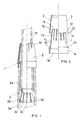
- the first friction part consists of an upside-down cup (1) fitted at the mouth of each telescopic section of the rod - with exception obviously of the top end - whose purpose is to grasp and hold the telescopic section inside the same, in any position it is extracted;
- the second friction part consists of a funnel cap (3) fitted at the rear end of each telescopic section - namely the part sliding inside the next larger section of rod - whose purpose is to balance the longitudinal runs.
- the above upside-down cup (1) is made of nylon or a similar material and consists of a circular base collar (1a) which is forced around the mouth of the respective rod section; this collar (1a) is joined by means of a concentric step (1b) to a tapered truncated-cone coupling sleeve (1c).
- This sleeve (1c) has a number of longitudinal slots (1d) which form a number of identical elastic tabs (1e) on its side walls.
- tabs (1e) delimit the top hole (1f) on the sleeve (1c); their inclination inwards allows them to tend spontaneously and rather firmly towards the centre of the sleeve (1c), while their elasticity allows them to widen under the force of a suitable pressure.
- this widening occurs when the truncated-cone section housed inside the section of the rod on which each sleeve (1c) is fitted, is pulled out through the hole (1f); the widening force against these tabs (1e) increases as the internal telescopic section is pulled out, as a result of the increasing diameter from the narrow top part to its wide bottom part.
- the sleeve (1c) can adapt to the different cross-sections of the telescopic rod sliding inside it, the sleeve (1c) must however create a certain pressure on the external walls of the same in that only in this way will it be able to hold any point of the telescopic truncated-cone section inside the same, as it is extracted.
- the diameter of the hole (1f) of each sleeve (1c) is such that - even when the rod is completely pulled in - the same can quite firmly hold the narrow top end of the telescopic section inside.
- this hole (1f) can widen gradually so as to adjust its width to the growing size of the passing section of the truncated-cone section of the rod inside, while ensuring a uniform and firm pressure on the external walls of the same.
- a rubber cap (2) is fitted on the sleeve (1c); this rubber cap (2) holds and covers the slotted walls of the sleeve (1c), with its bottom edge resting over the external perimeter step (1b) which couples the collar (1a) to the sleeve (1c), while its top mouth is above another step (1g) at the external top end of each tab (1e) of the sleeve (1c).
- the second friction part on the fishing rod consists of a funnel-shaped plug (3) fitted on the rear hollow end of each telescopic section of the rod, with exception of the large section for the handle, whose bottom part is obviously closed.
- This plug (3) - also made of nylon or a similar material - has a short cylindrical body (3a) which fits inside the hollow end of each telescopic section of the rod; a truncated-cone body (3b) projects from the plug (3); this truncated-cone body (3b) has walls which open towards the bottom having several longitudinal slots - from bottom to top - spaced at equal distances from each other (3c) forming a number of identical elastic tabs (3d).
- the widening and slotted sides of the truncated-cone body (3b) form the actual friction part, in that their sizes and shapes are such that they constantly and elastically open outwards, so as to interfere - from top to bottom and always rather firmly - against the internal walls of the telescopic section in which this body (3b) completes alternating vertical runs.
- each telescopic section of the rod there must be a body (3b) having suitable widening walls whose size - in normal widened position - is larger than the maximum transverse cross-section of the telescopic section housing the same.
- the walls of the body (3b) - thanks to the fact that they consist of a number of adjacent and independent tabs (3d) - can vary their inclination elastically according to the pressure on these by the internal walls of the telescopic section of the rod in which it slides; in the narrowest point of this rod section, these walls will be almost vertical while in the widest part of the rod section, they will be almost completely open.
- the slotted walls of the body (3b) can exercise the same, uniform and balanced friction against the internal walls of the respective housings in which they slide, to ensure a constant and perfect coaxiality between the different telescopic sections of the rod according to the invention.
Landscapes
- Life Sciences & Earth Sciences (AREA)
- Environmental Sciences (AREA)
- Marine Sciences & Fisheries (AREA)
- Animal Husbandry (AREA)
- Biodiversity & Conservation Biology (AREA)
- Mechanical Operated Clutches (AREA)
- Fishing Rods (AREA)
Applications Claiming Priority (2)
| Application Number | Priority Date | Filing Date | Title |
|---|---|---|---|
| IT1940490U IT223940Z2 (it) | 1990-03-02 | 1990-03-02 | Coppia di elementi di frizione per il bloccaggio dei tratti tronco-co=nici estraibili dalle canne da pesca periscopiche. |
| IT1940490U | 1990-03-02 |
Publications (1)
| Publication Number | Publication Date |
|---|---|
| EP0445086A1 true EP0445086A1 (fr) | 1991-09-04 |
Family
ID=11157451
Family Applications (1)
| Application Number | Title | Priority Date | Filing Date |
|---|---|---|---|
| EP91830064A Withdrawn EP0445086A1 (fr) | 1990-03-02 | 1991-02-26 | Une paire d'éléments de friction pour bloquer les sections extractibles tronconiques d'une canne à pêche télescopique |
Country Status (2)
| Country | Link |
|---|---|
| EP (1) | EP0445086A1 (fr) |
| IT (1) | IT223940Z2 (fr) |
Cited By (1)
| Publication number | Priority date | Publication date | Assignee | Title |
|---|---|---|---|---|
| US5529364A (en) * | 1992-11-13 | 1996-06-25 | Vilsmeier; Walter | Motor vehicle seat with means for vertical and longitudinal adjustment |
Citations (5)
| Publication number | Priority date | Publication date | Assignee | Title |
|---|---|---|---|---|
| FR1390608A (fr) * | 1964-03-23 | 1965-02-26 | Mecanique Halieutique S A | Perfectionnements aux cannes à pêche télescopiques |
| FR1491257A (fr) * | 1966-04-14 | 1967-08-11 | Canne A Peche | Dispositif télescopique, notamment pour canne à pêche |
| FR2031863A5 (fr) * | 1969-02-11 | 1970-11-20 | Garbolino Henri | |
| FR2064581A5 (fr) * | 1969-09-30 | 1971-07-23 | Vigier Roger | |
| FR2082470A6 (fr) * | 1970-03-17 | 1971-12-10 | Canne A Peche |
-
1990
- 1990-03-02 IT IT1940490U patent/IT223940Z2/it active IP Right Grant
-
1991
- 1991-02-26 EP EP91830064A patent/EP0445086A1/fr not_active Withdrawn
Patent Citations (5)
| Publication number | Priority date | Publication date | Assignee | Title |
|---|---|---|---|---|
| FR1390608A (fr) * | 1964-03-23 | 1965-02-26 | Mecanique Halieutique S A | Perfectionnements aux cannes à pêche télescopiques |
| FR1491257A (fr) * | 1966-04-14 | 1967-08-11 | Canne A Peche | Dispositif télescopique, notamment pour canne à pêche |
| FR2031863A5 (fr) * | 1969-02-11 | 1970-11-20 | Garbolino Henri | |
| FR2064581A5 (fr) * | 1969-09-30 | 1971-07-23 | Vigier Roger | |
| FR2082470A6 (fr) * | 1970-03-17 | 1971-12-10 | Canne A Peche |
Cited By (1)
| Publication number | Priority date | Publication date | Assignee | Title |
|---|---|---|---|---|
| US5529364A (en) * | 1992-11-13 | 1996-06-25 | Vilsmeier; Walter | Motor vehicle seat with means for vertical and longitudinal adjustment |
Also Published As
| Publication number | Publication date |
|---|---|
| IT223940Z2 (it) | 1995-10-05 |
| IT9019404U1 (it) | 1991-09-03 |
| IT9019404V0 (it) | 1990-03-02 |
Similar Documents
| Publication | Publication Date | Title |
|---|---|---|
| US4675939A (en) | A curtain runner with an axially removable rod | |
| US5011319A (en) | Locking mechanism for telescoping tubular poles | |
| US4126086A (en) | Fork for barbecuing and open fire cooking | |
| KR890701162A (ko) | 부분 카테테르를 체강내에 설치하는 기구 | |
| EP3485854A1 (fr) | Dispositif applicateur pour coupe menstruelle | |
| US3095033A (en) | Traverse rod for draperies | |
| US4289292A (en) | Variably supported container | |
| US6179759B1 (en) | Portable collapsible aquatic abdominal exercise apparatus | |
| US3337981A (en) | Fishing float | |
| US4356793A (en) | Bird feeder | |
| US4121369A (en) | Hollow fishing rod with elastic line | |
| AU2019289575B2 (en) | A trick scooter | |
| US2354099A (en) | Garment hanger | |
| EP0445086A1 (fr) | Une paire d'éléments de friction pour bloquer les sections extractibles tronconiques d'une canne à pêche télescopique | |
| US4986023A (en) | Line tie | |
| US5551184A (en) | Fishing rod butt pad | |
| JPS55135235A (en) | Assembly unit of clutch release bearing with automatically aligning mechanism | |
| US4156319A (en) | Fishing rod guide | |
| US3340922A (en) | Terminal providing length adjustment for shade rollers | |
| US12349844B2 (en) | Shower rod assembly | |
| KR870003512A (ko) | 핵 연료 집합체 | |
| US4155551A (en) | Nunchaku device | |
| US5076002A (en) | Lure release rod | |
| EP0830812B1 (fr) | Perfectionnement pour flotteur et détecteur de profondeur | |
| EP0882396B1 (fr) | Lest pour la pêche |
Legal Events
| Date | Code | Title | Description |
|---|---|---|---|
| PUAI | Public reference made under article 153(3) epc to a published international application that has entered the european phase |
Free format text: ORIGINAL CODE: 0009012 |
|
| AK | Designated contracting states |
Kind code of ref document: A1 Designated state(s): AT BE CH DE DK ES FR GB GR LI LU NL SE |
|
| STAA | Information on the status of an ep patent application or granted ep patent |
Free format text: STATUS: THE APPLICATION IS DEEMED TO BE WITHDRAWN |
|
| 18D | Application deemed to be withdrawn |
Effective date: 19920305 |