EP0445248B1 - Derives de pyridine - Google Patents
Derives de pyridine Download PDFInfo
- Publication number
- EP0445248B1 EP0445248B1 EP90913696A EP90913696A EP0445248B1 EP 0445248 B1 EP0445248 B1 EP 0445248B1 EP 90913696 A EP90913696 A EP 90913696A EP 90913696 A EP90913696 A EP 90913696A EP 0445248 B1 EP0445248 B1 EP 0445248B1
- Authority
- EP
- European Patent Office
- Prior art keywords
- trans
- pyridine
- cyclohexyl
- fluoro
- acetylene
- Prior art date
- Legal status (The legal status is an assumption and is not a legal conclusion. Google has not performed a legal analysis and makes no representation as to the accuracy of the status listed.)
- Expired - Lifetime
Links
- 0 *C1CCCCC1 Chemical compound *C1CCCCC1 0.000 description 4
Classifications
-
- C—CHEMISTRY; METALLURGY
- C07—ORGANIC CHEMISTRY
- C07D—HETEROCYCLIC COMPOUNDS
- C07D213/00—Heterocyclic compounds containing six-membered rings, not condensed with other rings, with one nitrogen atom as the only ring hetero atom and three or more double bonds between ring members or between ring members and non-ring members
- C07D213/02—Heterocyclic compounds containing six-membered rings, not condensed with other rings, with one nitrogen atom as the only ring hetero atom and three or more double bonds between ring members or between ring members and non-ring members having three double bonds between ring members or between ring members and non-ring members
- C07D213/04—Heterocyclic compounds containing six-membered rings, not condensed with other rings, with one nitrogen atom as the only ring hetero atom and three or more double bonds between ring members or between ring members and non-ring members having three double bonds between ring members or between ring members and non-ring members having no bond between the ring nitrogen atom and a non-ring member or having only hydrogen or carbon atoms directly attached to the ring nitrogen atom
- C07D213/60—Heterocyclic compounds containing six-membered rings, not condensed with other rings, with one nitrogen atom as the only ring hetero atom and three or more double bonds between ring members or between ring members and non-ring members having three double bonds between ring members or between ring members and non-ring members having no bond between the ring nitrogen atom and a non-ring member or having only hydrogen or carbon atoms directly attached to the ring nitrogen atom with hetero atoms or with carbon atoms having three bonds to hetero atoms with at the most one bond to halogen, e.g. ester or nitrile radicals, directly attached to ring carbon atoms
- C07D213/62—Oxygen or sulfur atoms
- C07D213/63—One oxygen atom
- C07D213/64—One oxygen atom attached in position 2 or 6
-
- C—CHEMISTRY; METALLURGY
- C07—ORGANIC CHEMISTRY
- C07D—HETEROCYCLIC COMPOUNDS
- C07D213/00—Heterocyclic compounds containing six-membered rings, not condensed with other rings, with one nitrogen atom as the only ring hetero atom and three or more double bonds between ring members or between ring members and non-ring members
- C07D213/02—Heterocyclic compounds containing six-membered rings, not condensed with other rings, with one nitrogen atom as the only ring hetero atom and three or more double bonds between ring members or between ring members and non-ring members having three double bonds between ring members or between ring members and non-ring members
- C07D213/04—Heterocyclic compounds containing six-membered rings, not condensed with other rings, with one nitrogen atom as the only ring hetero atom and three or more double bonds between ring members or between ring members and non-ring members having three double bonds between ring members or between ring members and non-ring members having no bond between the ring nitrogen atom and a non-ring member or having only hydrogen or carbon atoms directly attached to the ring nitrogen atom
- C07D213/24—Heterocyclic compounds containing six-membered rings, not condensed with other rings, with one nitrogen atom as the only ring hetero atom and three or more double bonds between ring members or between ring members and non-ring members having three double bonds between ring members or between ring members and non-ring members having no bond between the ring nitrogen atom and a non-ring member or having only hydrogen or carbon atoms directly attached to the ring nitrogen atom with substituted hydrocarbon radicals attached to ring carbon atoms
- C07D213/26—Radicals substituted by halogen atoms or nitro radicals
-
- C—CHEMISTRY; METALLURGY
- C07—ORGANIC CHEMISTRY
- C07D—HETEROCYCLIC COMPOUNDS
- C07D213/00—Heterocyclic compounds containing six-membered rings, not condensed with other rings, with one nitrogen atom as the only ring hetero atom and three or more double bonds between ring members or between ring members and non-ring members
- C07D213/02—Heterocyclic compounds containing six-membered rings, not condensed with other rings, with one nitrogen atom as the only ring hetero atom and three or more double bonds between ring members or between ring members and non-ring members having three double bonds between ring members or between ring members and non-ring members
- C07D213/04—Heterocyclic compounds containing six-membered rings, not condensed with other rings, with one nitrogen atom as the only ring hetero atom and three or more double bonds between ring members or between ring members and non-ring members having three double bonds between ring members or between ring members and non-ring members having no bond between the ring nitrogen atom and a non-ring member or having only hydrogen or carbon atoms directly attached to the ring nitrogen atom
- C07D213/60—Heterocyclic compounds containing six-membered rings, not condensed with other rings, with one nitrogen atom as the only ring hetero atom and three or more double bonds between ring members or between ring members and non-ring members having three double bonds between ring members or between ring members and non-ring members having no bond between the ring nitrogen atom and a non-ring member or having only hydrogen or carbon atoms directly attached to the ring nitrogen atom with hetero atoms or with carbon atoms having three bonds to hetero atoms with at the most one bond to halogen, e.g. ester or nitrile radicals, directly attached to ring carbon atoms
- C07D213/61—Halogen atoms or nitro radicals
-
- C—CHEMISTRY; METALLURGY
- C07—ORGANIC CHEMISTRY
- C07D—HETEROCYCLIC COMPOUNDS
- C07D213/00—Heterocyclic compounds containing six-membered rings, not condensed with other rings, with one nitrogen atom as the only ring hetero atom and three or more double bonds between ring members or between ring members and non-ring members
- C07D213/02—Heterocyclic compounds containing six-membered rings, not condensed with other rings, with one nitrogen atom as the only ring hetero atom and three or more double bonds between ring members or between ring members and non-ring members having three double bonds between ring members or between ring members and non-ring members
- C07D213/04—Heterocyclic compounds containing six-membered rings, not condensed with other rings, with one nitrogen atom as the only ring hetero atom and three or more double bonds between ring members or between ring members and non-ring members having three double bonds between ring members or between ring members and non-ring members having no bond between the ring nitrogen atom and a non-ring member or having only hydrogen or carbon atoms directly attached to the ring nitrogen atom
- C07D213/60—Heterocyclic compounds containing six-membered rings, not condensed with other rings, with one nitrogen atom as the only ring hetero atom and three or more double bonds between ring members or between ring members and non-ring members having three double bonds between ring members or between ring members and non-ring members having no bond between the ring nitrogen atom and a non-ring member or having only hydrogen or carbon atoms directly attached to the ring nitrogen atom with hetero atoms or with carbon atoms having three bonds to hetero atoms with at the most one bond to halogen, e.g. ester or nitrile radicals, directly attached to ring carbon atoms
- C07D213/62—Oxygen or sulfur atoms
- C07D213/63—One oxygen atom
- C07D213/65—One oxygen atom attached in position 3 or 5
-
- C—CHEMISTRY; METALLURGY
- C09—DYES; PAINTS; POLISHES; NATURAL RESINS; ADHESIVES; COMPOSITIONS NOT OTHERWISE PROVIDED FOR; APPLICATIONS OF MATERIALS NOT OTHERWISE PROVIDED FOR
- C09K—MATERIALS FOR MISCELLANEOUS APPLICATIONS, NOT PROVIDED FOR ELSEWHERE
- C09K19/00—Liquid crystal materials
- C09K19/04—Liquid crystal materials characterised by the chemical structure of the liquid crystal components, e.g. by a specific unit
- C09K19/06—Non-steroidal liquid crystal compounds
- C09K19/34—Non-steroidal liquid crystal compounds containing at least one heterocyclic ring
- C09K19/3441—Non-steroidal liquid crystal compounds containing at least one heterocyclic ring having nitrogen as hetero atom
- C09K19/3444—Non-steroidal liquid crystal compounds containing at least one heterocyclic ring having nitrogen as hetero atom the heterocyclic ring being a six-membered aromatic ring containing one nitrogen atom, e.g. pyridine
Definitions
- the invention relates to pyridine derivatives of the formula I wherein
- the invention was based on the object of discovering new stable liquid crystal or mesogenic compounds which are suitable as components of liquid crystalline media and, in particular have advantageous values of optical and dielectric anisotropy, in particular for the value of ⁇ ⁇ / ⁇ , combined with high nematogenity.
- pyridine derivatives of the formula I are highly suitable as components of liquid crystalline media.
- they have advantageous values of optical and dielectric anisotropy and especially advantageous low values of ⁇ / ⁇ .
- a small ratio of ⁇ / ⁇ has an important influence on the electrooptic characteristics of TN liquid crystal cells.
- the compounds of the formula I can be used as the base materials from which liquid crystal media are predominantly composed; however, it is also possible for compounds of the formula I to be added to liquid crystal base materials of other classes of compounds, for example in order to influence the dielectric and/or optical anisotropy and/or the viscosity and/or the nematic mesophase range of such a dielectric.
- the compounds of the formula I are colourless in the pure state and are liquid crystalline in a temperature range which is favourable placed for electrooptical use. They are very stable towards chemicals, heat and light.
- the compounds of the formula I are further highly useful as starting material for the preparation of liquid crystalline compounds having the structural element
- the invention thus relates to the pyridine derivatives of the formula I, to liquid crystalline media with at least two liquid crystalline compounds, wherein at least one component is a compound of the formula I and to liquid crystal display devices containing such media.
- R1, Y, A1, A2, Z1, Z2, n and X have the meaning indicated, unless something else is specifically stated.
- Phe is a 1,4-phenylene group which may be substituted by one or more halogen atoms and/or CN and/or CH3 groups
- Cyc is a trans-1,4-cyclohexylene group
- Dio is a 1,3-dioxane-2,5-diyl group
- Dit is a 1,3-dithian-2,5-diyl group
- Pyd is a pyridine-2,5-diyl group
- Pyr is a pyrimidine-2,5-diyl group.
- PydX denotes the group
- the compounds of the formula I accordingly also include compounds of the partial formulae Ia to Ib (having two rings), Ic to If (having three rings) and Ig to In (having four rings): R1-A2-PydX-Y Ia R1-A2-Z2-PydX-Y Ib R1-A1-A2-PydX-Y Ic R1-A1-A2-Z2-PydX-Y Id R1-A1-Z1-A2-PydX-Y Ie R1-A1-Z1-A2-Z2-PydX-Y If R1-A1-A1-A2-PydX-Y Ig R1-A1-Z1-A1-A2-PydX-Y Ih R1-A1-A1-Z1-A2-PydX-Y Ii R1-A1-A1-A2-Z2-PydX-Y Ij R1-A1-Z1-A1-Z1-A2-PydX
- the preferred compounds of the partial formulae Ia include those of the partial formulae Iaa to Iad: R1-Phe-PydX-Y Iaa R1-Cyc-PydX-Y Iab R1-Pyd-PydX-Y Iac R1-Pyr-PydX-Y Iad Among these, those of the formulae Iaa and Iab are particularly preferred.
- the preferred compounds of the partial formula Ib include those of the partial formulae Iba to Ibj: R1-Phe-C ⁇ C-PydX-Y Iba R1-Cyc-C ⁇ C-PydX-Y Ibb R1-Phe-CO-O-PydX-Y Ibc R1-Cyc-CO-O-PydX-Y Ibd R1-Phe-CH2CH2-PydX-Y Ibe R1-Cyc-CH2CH2-PydX-Y Ibf R1-Phe-CH2O-PydX-Y Ibg R1-Cyc-CH2O-PydX-Y Ibh R1-Pyd-Z2-PydX-Y Ibi R1-Pyr-Z2-PydX-Y Ibj Among these, those of the formulae Iba, Ibb, Ibc, Ibd and Ibe are particularly preferred.
- the preferred compounds of the partial formula Ic include those of the partial formulae Ica to Ich: R1-Cyc-Cyc-PydX-Y Ica R1-Phe-Phe-PydX-Y Icb R1-Dio-Phe-PydX-Y Icc R1-Dit-Phe-PydX-Y Icd R1-Cyc-Phe-PydX-Y Ice R1-Phe-Pyd-PydX-Y Icf R1-Phe-Pyr-PydX-Y Icg R1-Phe-Cyc-PydX-Y Ich Among these, those of the partial formulae Ica, Icb, Ice and Icf are particularly preferred.
- the preferred compounds of the partial formula Id include those of the partial formulae Ida to Idm: R1-Cyc-Cyc-C ⁇ C-PydX-Y Id a R1-Phe-Phe-C ⁇ C-PydX-Y Id b R1-Cyc-Phe-C ⁇ C-PydX-Y Idc R1-Cyc-Phe-CH2CH2-PydX-Y Idd R1-Cyc-Cyc-CH2CH2-PydX-Y Ide R1-Phe-Phe-CH2CH2-PydX-Y Idf R1-Cyc-Cyc-COO-PydX-Y Idg R1-Phe-Cyc-COO-PydX-Y Idh R1-Phe-Phe-COO-PydX-Y Idi R1-Cyc-Phe-COO-PydX-Y Idj R1-
- the preferred compounds of the partial formula Ie include those of the partial formulae Iea to Iem: R1-Cyc-CH2CH2-Phe-PydX-Y Iea R1-Phe-CH2CH2-Phe-PydX-Y Ieb R1-Cyc-C ⁇ C-Phe-PydX-Y Iec R1-Phe-C ⁇ C-Phe-PydX-Y Ied R1-Phe-CH2O-Phe-PydX-Y Iee R1-Cyc-COO-Phe-PydX-Y Ief R1-Cyc-COO-Cyc-PydX-Y Ieg R1-A1-OCO-Phe-PydX-Y Ieh R1-A1-OCH2-Phe-PydX-Y Iei R1-A1-Z1-Pyd-PydX-Y Iej R1-A1-Z1-
- the preferred compounds of the partial formula include those of the partial formulae Ifa to Ifh: R1-A1-Z1-Phe-C ⁇ C-PydX-Y Ifa R1-A1-CH2CH2-Phe-CH2CH2-PydX-Y Ifb R1-A1-Z1-Phe-CH2CH2-PydX-Y Ifc R1-A1-Z1-Cyc-COO-PydX-Y Ifd R1-Cyc-Z1-Cyc-C ⁇ C-PydX-Y Ife R1-Cyc-Z1-Cyc-CH2CH2-PydX-Y Iff R1-A1-COO-Phe-Z2-PydX-Y Ifg R1-A1-CH2O-Phe-Z2PydX-Y Ifh
- the preferred compounds of the formulae Ig to In include those of the partial formulae Iga to Igo: R1-A1-Cyc-Cyc-PydX-Y Iga R1-Cyc-Cyc-Phe-PydX-Y Igb R1-Phe-Phe-Cyc-PydX-Y Igc R1-A1-CH2CH2-A1-Cyc-PydX-Y Igd R1-Cyc-COO-A1-Phe-PydX-Y Ige R1-A1-A1-CH2CH2-Phe-PydX-Y Igf R1-Cyc-Cyc-Z1-A2-PydX-Y Igg R1-A1-Phe-Phe-C ⁇ C-PydX-Y Igh R1-A1-Cyc-Phe-C ⁇ C-PydX-Y Igi R1-A1-A1-A2-
- R1 is preferably alkyl, alkoxy, oxaalkyl, alkanoyloxy or alkenyl and can exhibit a straight-chain or branched structure.
- Alkyl or alkoxy preferably are straight-chain and have 2, 3, 4, 5, 6 or 7 C atoms. Accordingly they are preferably ethyl, propyl, butyl, pentyl, hexyl, heptyl, ethoxy, propoxy, butoxy, pentoxy, hexoxy, or heptoxy, also methyl, octyl, nonyl, decyl, undecyl, dodecyl, methoxy, octoxy, nonoxy, decoxy or undecoxy.
- Alkenyl is preferably straight-chain and has 2 to 10 C atoms. It is accordingly, in particular, vinyl, prop-1- or prop-2-enyl, but-1-, -2- or -3-enyl, pent-1-, -2-, -3- or -4-enyl, hex-1-, -2-, -3-, -4- or -5-enyl, hept-1-, -2-, -3-, -4-, -5- or -6-enyl, oct-1-, -2-, -3-, -4-, -5- -6- or -7-enyl, non-1-, -2-, -3-, -4-, -5-, -6-, -7- or -8-enyl or dec-1-, -2-, -3-, -4-, -5-, -6-, -7-, -8- or -9-enyl.
- Branched groups of this type as a rule contain not more than one chain branching.
- formula I includes both the optical antipodes and racemates as well as mixtures thereof.
- n is preferably 0 or 1. If n is 2, the two groups A1 and Z1 may be identical or different from one another.
- Z1 and Z2 are preferably a single bond, a -CH2CH2-, a -CO-O- or a -CH2CH2-group, also -O-CO-, -CH2O- or -OCH2-.
- A1 and A2 are preferably unsubstituted 1,4-phenylene or trans 1,4-cyclohexylene.
- Compounds wherein A1 and/or A2 are substituted 1,4-phenylene are also preferred. They are then preferably mono- or disubstituted by fluorine and the 1,4-phenylene group has preferably the following structures: A1 and A2 also preferably have the meaning of Pyd or Pyr.
- the compounds of the formula I are prepared by methods which are known per se, such as are described in the literature (for example in the standard works, such as Houben-Weyl, Methoden der Organischen Chemie [Methods of Organic Chemistry], Georg Thieme Verlag, Stuttgart), and in particular under reaction conditions which are known and suitable for the reactions mentioned. Variants which are known per se and are not mentioned in more detail here can also be used in this connection.
- the starting materials can also be formed in situ, such that they are not isolated from the reaction mixture but are immediately reacted further to give the compounds of the formula I.
- LDA lithiumdiisopropylamide
- the compounds of the formula I thus can be prepared preferably by the following coupling reactions which are known per se:
- the compounds of the formula I wherein X denotes -OCF3 can be obtained for example from the compounds of the formula I wherein X denotes Cl or F by nucleophilic substitution with sodium trifluoromethanolate.
- the compounds of the formula I wherein X denotes -OCF2H can be prepared as described in WO 90/01056, for example, by reacting the hydroxypyridines of the formula I' with chlorodifluoromethane.
- reaction conditions are known to the skilled worker or described in the literature already mentioned. Other routes are apparent to the skilled worker.
- liquid crystal media according to the invention preferably contain 2-40 components and in particular 4-30 components. Liquid crystal media being composed of one or more compounds of formula I and 7-25 other components are especially preferred.
- These additional components are preferably chosen from the nematic or nematogenic (monotropic or isotropic) substances; in particular from the classes of azoxybenzenes, benzylideneanilines, biphenyls, terphenyls, phenyl or cyclohexyl benzoates, phenyl or cyclohexyl cyclohexanecarboxylates , phenyl or cyclohexyl cyclohexylbenzoates, phenyl or cyclohexyl cyclohexylcyclohexanecarboxylates, cyclohexylphenylbenzoates , cyclohexylphenyl cyclohexanecarboxylates, cyclohexylphenyl cyclohexanecarboxylates, cyclohexylphenyl cyclohexanecarboxylates, cyclohexylphen
- the 1,4-phenylene groups of these compounds may be fluorinated.
- L and U independently from each other denote a bivalent residue selected from the group consisting of -Phe-, -Cyc-, -Phe-Phe-, -Phe-Cyc-, -Cyc-Cyc-, -Pyr-, -Dio-, -G-Phe-, -G-Cyc- and their mirror images; in this compilation of residues Phe denotes unsubstituted or fluorinated 1,4-phenylene, Cyc trans- 1,4-cyclohexylene or 1,4-cyclohexenylene, Pyr pyrimidine-2,5-diyl or pyridine-2,5-diyl, Dio 1,3-dioxane-2,5-diyl and G 2-(trans-1,4-cyclohexyl)-ethyl, pyrimidine-2,5-diyl, pyridine-2,5-diyl or 1,3-dioxan
- One of the residues L and U is preferably Cyc, Phe or Pyr.
- U preferably denotes Cyc, Phe or Phe-Cyc.
- the liquid crystal media according to the invention preferably contain one or more components selected from the compounds of formulae 1, 2, 3, 4 and 5 with L and U meaning Cyc, Phe and Pyr, said liquid crystal media further containing at the same time one ore more components selected from the compounds of formulae 1, 2, 3, 4 and 5 with one of the residues L and U denoting Cyc, Phe and Pyr and the other residue being selected from the group consisting of -Phe-Phe-, -Phe-Cyc-, -Cyc-Cyc-, -G-Cyc-, said liquid crystal media containing in addition to this optionally one or more components selected from the compounds of formulae 1, 2, 3, 4 and 5 with L and U being selected from the group consisting of -Phe-Cyc-, -Cyc-Cyc-, -G-Phe-
- R' and R'' are independently from each other alkyl, alkenyl, alkoxy, alkenoxy with up to 8 carbon atoms. R' and R'' differ from one another in most of these compounds, one of the residues usually being alkyl or alkenyl.
- R'' denotes -CN, -CF3, -F, -Cl or -NCS while R' has the meaning indicated in subgroup 1 and is preferably alkyl or alkenyl.
- Other variants of the envisaged substituents in the compounds of formulae 1, 2, 3, 4 and 5 are also customary. Many such substances are commercially available. All these substances are obtainable by methods which are known from the literature or by analogous methods.
- the liquid crystal media according to the invention preferably contain in addition to components selected from subgroup 1 also components of subgroup 2, the percentage of these components being as follows: subgroup 1: 20 to 90 %, in particular 30 to 90 % subgroup 2: 10 to 50 %, in particular 10 to 50 %
- the media according to the invention preferably contain 1 to 40 %, in particular 5 to 30 % of the compounds according to the invention. Media containing more than 40 %, in particular 45 to 90 % of the compounds according to the invention are further preferred.
- the media contain preferably 3, 4 or 5 compounds according to the invention.
- the media according to the invention are prepared in a manner which is customary per se. As a rule, the components are dissolved in one another, advantageously at elevated temperature.
- the liquid crystal media according to the invention can be modified by suitable additives so that they can be used in all the types of liquid crystal display devices. Such additives are known to the expert and are described in detail in the literature (H. Kelker/R. Hats, Handbook of Liquid Crystals, Verlag Chemie, Weinheim, 1980). For example, it is possible to add pleochroic dyestuffs to prepare colored guest-host systems or substances for modifying the dielectric anisotropy, the viscosity and/or the orientation of the nematic phases.
- C crystalline-solid state
- S smectic phase (the index denoting the type of smectic phase)
- N nematic phase
- Ch cholesteric phase
- I isotropic phase. The number being embraced by 2 of these symbols denotes the temperature of phase change.
- 0,2 mM of Pd(Ph3P)2Cl2 and 0,1 mM of CuJ are added to a mixture of 0,01 M of 3-bromo-2,6-difluoropyridine (preparation: 2,6-difluoropyridine is reacted with lithiumdiisopropylamide (LDA) as described in example 3a, then Br2 is added at -60° to -70°. The mixture is allowed to warm up to room temperature and worked up, the product is purified by distillation), 0,01 M of 4-pentylphenyl-acetylene and 200 ml of triethylamine.
- LDA lithiumdiisopropylamide
- a suspension of 0,02 M of trans-4-(trans-4-ethylcyclohexyl)cyclohexylbromide, 0,04 M of lithium and 0,01 M of ZnBr2 is stirred for 2 hours at about 10° with ultrasonic.
- 0,02 M of 3-bromo-2,6-difluoropyridine and 0,1 g of Pd(Ph3P)4 are added and the mixture is stirred for 4 hours.
- a liquid crystalline medium consisting of
- a liquid crystalline medium consisting of
Landscapes
- Chemical & Material Sciences (AREA)
- Organic Chemistry (AREA)
- Crystallography & Structural Chemistry (AREA)
- Engineering & Computer Science (AREA)
- Materials Engineering (AREA)
- Liquid Crystal Substances (AREA)
- Pyridine Compounds (AREA)
Abstract
Claims (15)
- Dérivés de la pyridine de formule I
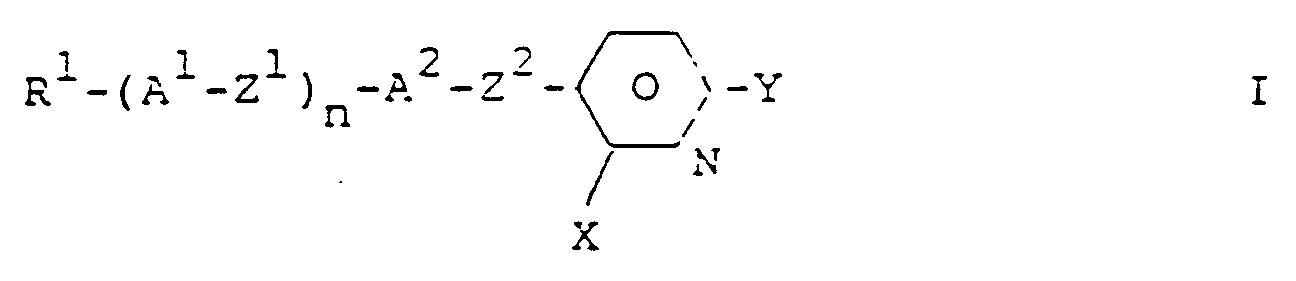 R¹ représente un alkyle ayant jusqu'à 12 atomes de carbone où un ou deux groupes CH₂ non adjacents peuvent aussi être remplacés par -O-, -O-CO-, -CO-O- et/ou -CH=CH-,Y est F, Cl, -CF₃, -OCF₃ ou OCHF₂,A¹ et A² dans chaque cas, indépendamment l'un de l'autre, sont le trans- 1,4-cyclohexylène, où un ou deux groupes CH₂ non adjacents peuvent aussi être remplacés par -O- et/ou -S-, ou le 1,4-phénylène qui est non substitué ou substitué par un ou plusieurs atomes d'halogènes et/ou groupes nitrile et/ou groupes CH₃, et où un ou plusieurs groupes CH peuvent aussi être remplacés par N,Z¹ et Z² dans chaque cas, indépendamment l'un de l'autre, sont -CH₂CH₂-, -CO-O-, -O-CO-, -CH₂O-, -OCH₂-, -C≡C- ou une liaison simple,X est H, ou dans le cas où Y = F ou Cl, aussi Fetn est 0, 1 ou 2.
 - Dérivés de la pyridine selon la revendication 1, où X est H.
- Dérivés de la pyridine selon la revendication 1,où X est F.
- Dérivés de la pyridine selon la revendication 1 ou 2, où Y est F ou Cl.
- Dérives de la pyridine selon la revendication 1 ou 3, où Y est F ou Cl.
- Dérives de la pyridine selon la revendication 1, où Y est -OCF₃.
- Dérivés de la pyridine selon la revendication 1, où Y est -CF₃.
- Dérivés de la pyridine selon la revendication 1, où Y est -OCHF₂.
- Dérivés de la pyridine selon les revendications 1 à 8, où R¹ représente un radical alkyle non ramifié ayant de 2 à 7 atomes de carbone.
- Dérivés de la pyridine selon les revendications 1 à 9, où n est 0 ou 1.
- Dérivés de la pyridine selon les revendications 1 à 10, où Z¹ et Z² sont chacun une liaison simple.
- Dérivés de la pyridine selon les revendications 1 à 11, où Z² est -CO-O-, -CH₂CH₂- ou -C≡C-.
- Milieu à crystaux liquides qui est un mélange d'au moins deux composés, caractérisé en ce qu'au moins un composé est un dérivé de la pyridine selon la revendication 1.
- Dispositif d'affichage à cristaux liquides, caractérisé en ce qu'il contient un milieu à cristaux liquides selon la revendication 13.
- Dispositif d'affichage électro-optique, caractérisé en ce qu'il contient un milieu à cristaux liquides selon la revendication 13.
Applications Claiming Priority (3)
| Application Number | Priority Date | Filing Date | Title |
|---|---|---|---|
| GB8921520 | 1989-09-22 | ||
| GB898921520A GB8921520D0 (en) | 1989-09-22 | 1989-09-22 | Pyridine derivatives |
| PCT/EP1990/001536 WO1991004248A1 (fr) | 1989-09-22 | 1990-09-12 | Derives de pyridine |
Publications (2)
| Publication Number | Publication Date |
|---|---|
| EP0445248A1 EP0445248A1 (fr) | 1991-09-11 |
| EP0445248B1 true EP0445248B1 (fr) | 1995-03-08 |
Family
ID=10663516
Family Applications (1)
| Application Number | Title | Priority Date | Filing Date |
|---|---|---|---|
| EP90913696A Expired - Lifetime EP0445248B1 (fr) | 1989-09-22 | 1990-09-12 | Derives de pyridine |
Country Status (7)
| Country | Link |
|---|---|
| US (1) | US5205962A (fr) |
| EP (1) | EP0445248B1 (fr) |
| JP (1) | JP2965696B2 (fr) |
| KR (1) | KR920701158A (fr) |
| DE (1) | DE69017657T2 (fr) |
| GB (1) | GB8921520D0 (fr) |
| WO (1) | WO1991004248A1 (fr) |
Families Citing this family (10)
| Publication number | Priority date | Publication date | Assignee | Title |
|---|---|---|---|---|
| EP0513262B1 (fr) * | 1990-11-27 | 2000-04-05 | MERCK PATENT GmbH | 2-fluoropyridines 3,6-disubstituees |
| WO1992011241A1 (fr) * | 1990-12-19 | 1992-07-09 | Hoechst Aktiengesellschaft | 2-fluoropyridine, son procede de production et son utilisation dans des melanges de cristaux liquides |
| US5630962A (en) * | 1990-12-19 | 1997-05-20 | Hoechst Aktiengesellschaft | 2-Fluoropyridines, their preparation and their use in liquid crystal mixtures |
| DE59209008D1 (de) * | 1991-08-17 | 1997-12-11 | Hoechst Ag | 2-Fluorpyrazine, Verfahren zu ihrer Herstellung und ihre Verwendung in flüssigkristallinen Mischungen |
| EP0573878B1 (fr) * | 1992-06-09 | 2000-12-20 | Aventis Research & Technologies GmbH & Co. KG | 3-fluoropyridines, procédé pour leur préparation et leur utilisation dans des compositions de cristaux liquides |
| DE4315867A1 (de) * | 1993-05-12 | 1994-11-17 | Hoechst Ag | 3-Chlorpyridine, Verfahren zu ihrer Herstellung und ihre Verwendung in Flüssigkristallmischungen |
| US6017467A (en) * | 1996-06-28 | 2000-01-25 | Chisso Corporation | Propiolonitrile derivatives and liquid crystal compositions comprising the same |
| DE19825488A1 (de) * | 1998-06-08 | 1999-12-09 | Aventis Res & Tech Gmbh & Co | Monostabiles ferroelektrisches Aktivmatrix-Display |
| KR100659088B1 (ko) * | 2005-07-15 | 2006-12-21 | 삼성에스디아이 주식회사 | 디플루오로피리딘계 화합물 및 이를 이용한 유기 발광 소자 |
| CN118667556A (zh) * | 2023-03-16 | 2024-09-20 | 默克专利股份有限公司 | 液晶介质 |
Family Cites Families (3)
| Publication number | Priority date | Publication date | Assignee | Title |
|---|---|---|---|---|
| US4684477A (en) * | 1985-03-06 | 1987-08-04 | Chisso Corporation | Pyridine derivatives and their use in liquid crystals |
| EP0310676A4 (fr) * | 1987-04-07 | 1989-04-27 | Pavljuchenko Assya I | Derives cristallins liquides de 2,5-pyridine disubstituee a usage de constituants de materiau cristallin liquide, et materiau cristallin liquide. |
| US5329604A (en) * | 1993-02-11 | 1994-07-12 | International Business Machines Corporation | Optical fiber coupling device and optoelectronic system utilizing same |
-
1989
- 1989-09-22 GB GB898921520A patent/GB8921520D0/en active Pending
-
1990
- 1990-09-12 KR KR1019910700510A patent/KR920701158A/ko not_active Withdrawn
- 1990-09-12 JP JP2512850A patent/JP2965696B2/ja not_active Expired - Fee Related
- 1990-09-12 EP EP90913696A patent/EP0445248B1/fr not_active Expired - Lifetime
- 1990-09-12 DE DE69017657T patent/DE69017657T2/de not_active Expired - Fee Related
- 1990-09-12 WO PCT/EP1990/001536 patent/WO1991004248A1/fr not_active Ceased
- 1990-09-12 US US07/651,392 patent/US5205962A/en not_active Expired - Fee Related
Also Published As
| Publication number | Publication date |
|---|---|
| US5205962A (en) | 1993-04-27 |
| KR920701158A (ko) | 1992-08-11 |
| EP0445248A1 (fr) | 1991-09-11 |
| GB8921520D0 (en) | 1989-11-08 |
| JP2965696B2 (ja) | 1999-10-18 |
| WO1991004248A1 (fr) | 1991-04-04 |
| DE69017657D1 (de) | 1995-04-13 |
| DE69017657T2 (de) | 1995-07-20 |
Similar Documents
| Publication | Publication Date | Title |
|---|---|---|
| US4925590A (en) | Derivatives of 4-cyano-2,3-difluorophenol | |
| US5279764A (en) | Dihalogenobenzene derivatives | |
| US5356562A (en) | Fluoro tolans and liquid crystalline media | |
| US4897216A (en) | 2,3-difluorophenol derivatives | |
| US5205962A (en) | Pyridine derivatives | |
| EP0445257B1 (fr) | Derives de pyridine et milieu a cristaux liquides | |
| EP0502154A1 (fr) | Derives de fluorobenzene | |
| US5194178A (en) | Chloro tolanes | |
| US5190692A (en) | Four ring esters and ethers | |
| EP0426815B1 (fr) | Derives de byphenyles fluorures | |
| EP0519370B1 (fr) | Dérivés hétéro cyclique | |
| US5637257A (en) | Fluoro-chloro-benzene derivatives | |
| US5204017A (en) | Difluorobenzonitriles and liquid-crystalline medium | |
| EP0437595B1 (fr) | Derives de fluoro-chloro-benzene | |
| EP0428666B1 (fr) | Derives de fluoro-chloro-benzene | |
| US5389294A (en) | Chlorobenzene derivatives | |
| GB2271351A (en) | Carbocyclyl-phenyl-pyrazines and liquid crystalline media | |
| EP0394906B1 (fr) | Composition liquide cristalline | |
| EP0456793B1 (fr) | Derives heterocycliques substitues par halophenyle | |
| EP0446911A1 (fr) | Dérivés de fluorobenzène | |
| WO1991009016A1 (fr) | Derives heterocycliques substitues par halophenyle | |
| GB2271563A (en) | Liquid crystalline (2-(cyclylcarboxy)-5-pyrazyl)benzenes | |
| EP0521420A1 (fr) | Dérivés fluorés du cyclohexyle | |
| GB2273705A (en) | Liquid crystalline phenylpyrazines | |
| GB2264300A (en) | Liquid crystalline phenylpyrazines |
Legal Events
| Date | Code | Title | Description |
|---|---|---|---|
| PUAI | Public reference made under article 153(3) epc to a published international application that has entered the european phase |
Free format text: ORIGINAL CODE: 0009012 |
|
| AK | Designated contracting states |
Kind code of ref document: A1 Designated state(s): CH DE FR GB IT LI |
|
| 17P | Request for examination filed |
Effective date: 19910906 |
|
| 17Q | First examination report despatched |
Effective date: 19931004 |
|
| GRAA | (expected) grant |
Free format text: ORIGINAL CODE: 0009210 |
|
| AK | Designated contracting states |
Kind code of ref document: B1 Designated state(s): CH DE FR GB IT LI |
|
| PG25 | Lapsed in a contracting state [announced via postgrant information from national office to epo] |
Ref country code: IT Free format text: LAPSE BECAUSE OF FAILURE TO SUBMIT A TRANSLATION OF THE DESCRIPTION OR TO PAY THE FEE WITHIN THE PRESCRIBED TIME-LIMIT;WARNING: LAPSES OF ITALIAN PATENTS WITH EFFECTIVE DATE BEFORE 2007 MAY HAVE OCCURRED AT ANY TIME BEFORE 2007. THE CORRECT EFFECTIVE DATE MAY BE DIFFERENT FROM THE ONE RECORDED. Effective date: 19950308 Ref country code: FR Effective date: 19950308 Ref country code: LI Effective date: 19950308 Ref country code: CH Effective date: 19950308 |
|
| REF | Corresponds to: |
Ref document number: 69017657 Country of ref document: DE Date of ref document: 19950413 |
|
| REG | Reference to a national code |
Ref country code: CH Ref legal event code: PL |
|
| EN | Fr: translation not filed | ||
| PLBE | No opposition filed within time limit |
Free format text: ORIGINAL CODE: 0009261 |
|
| STAA | Information on the status of an ep patent application or granted ep patent |
Free format text: STATUS: NO OPPOSITION FILED WITHIN TIME LIMIT |
|
| 26N | No opposition filed | ||
| PGFP | Annual fee paid to national office [announced via postgrant information from national office to epo] |
Ref country code: DE Payment date: 19970919 Year of fee payment: 8 |
|
| PG25 | Lapsed in a contracting state [announced via postgrant information from national office to epo] |
Ref country code: DE Free format text: LAPSE BECAUSE OF NON-PAYMENT OF DUE FEES Effective date: 19990701 |
|
| PGFP | Annual fee paid to national office [announced via postgrant information from national office to epo] |
Ref country code: GB Payment date: 19990908 Year of fee payment: 10 |
|
| PG25 | Lapsed in a contracting state [announced via postgrant information from national office to epo] |
Ref country code: GB Free format text: LAPSE BECAUSE OF NON-PAYMENT OF DUE FEES Effective date: 20000912 |
|
| GBPC | Gb: european patent ceased through non-payment of renewal fee |
Effective date: 20000912 |