EP0445755A2 - Polymère à base de norbornène, procédé de préparation, film à base de ce polymère et procédé de préparation de ce film - Google Patents
Polymère à base de norbornène, procédé de préparation, film à base de ce polymère et procédé de préparation de ce film Download PDFInfo
- Publication number
- EP0445755A2 EP0445755A2 EP91103371A EP91103371A EP0445755A2 EP 0445755 A2 EP0445755 A2 EP 0445755A2 EP 91103371 A EP91103371 A EP 91103371A EP 91103371 A EP91103371 A EP 91103371A EP 0445755 A2 EP0445755 A2 EP 0445755A2
- Authority
- EP
- European Patent Office
- Prior art keywords
- norbornene
- based polymer
- group
- film
- polymer
- Prior art date
- Legal status (The legal status is an assumption and is not a legal conclusion. Google has not performed a legal analysis and makes no representation as to the accuracy of the status listed.)
- Granted
Links
Images



Classifications
-
- C—CHEMISTRY; METALLURGY
- C08—ORGANIC MACROMOLECULAR COMPOUNDS; THEIR PREPARATION OR CHEMICAL WORKING-UP; COMPOSITIONS BASED THEREON
- C08G—MACROMOLECULAR COMPOUNDS OBTAINED OTHERWISE THAN BY REACTIONS ONLY INVOLVING UNSATURATED CARBON-TO-CARBON BONDS
- C08G61/00—Macromolecular compounds obtained by reactions forming a carbon-to-carbon link in the main chain of the macromolecule
- C08G61/02—Macromolecular compounds containing only carbon atoms in the main chain of the macromolecule, e.g. polyxylylenes
- C08G61/04—Macromolecular compounds containing only carbon atoms in the main chain of the macromolecule, e.g. polyxylylenes only aliphatic carbon atoms
- C08G61/06—Macromolecular compounds containing only carbon atoms in the main chain of the macromolecule, e.g. polyxylylenes only aliphatic carbon atoms prepared by ring-opening of carbocyclic compounds
- C08G61/08—Macromolecular compounds containing only carbon atoms in the main chain of the macromolecule, e.g. polyxylylenes only aliphatic carbon atoms prepared by ring-opening of carbocyclic compounds of carbocyclic compounds containing one or more carbon-to-carbon double bonds in the ring
-
- Y—GENERAL TAGGING OF NEW TECHNOLOGICAL DEVELOPMENTS; GENERAL TAGGING OF CROSS-SECTIONAL TECHNOLOGIES SPANNING OVER SEVERAL SECTIONS OF THE IPC; TECHNICAL SUBJECTS COVERED BY FORMER USPC CROSS-REFERENCE ART COLLECTIONS [XRACs] AND DIGESTS
- Y10—TECHNICAL SUBJECTS COVERED BY FORMER USPC
- Y10S—TECHNICAL SUBJECTS COVERED BY FORMER USPC CROSS-REFERENCE ART COLLECTIONS [XRACs] AND DIGESTS
- Y10S526/00—Synthetic resins or natural rubbers -- part of the class 520 series
- Y10S526/943—Polymerization with metallocene catalysts
Definitions
- the present invention relates to a high molecular weight norbornene-based polymer having a specified structure which is excellent in properties such as mechanical strength, heat resistance and transparency, a process for efficiently producing said polymer, a film made of said polymer which is excellent in heat resistance and transparency, and a process for efficiently producing said film.
- radical polymerization cationic polymerization
- polymerization using a Ziegler-type catalyst or polymerization using a metathesis catalyst of 2-norbornene or its derivatives results in polymers.
- catalytic activity is as low as 54 to 64 g-polymer/g-Ti, and the molecular weight of the resulting polymer is only 550 to 750.
- Pd(C6H5CN)2Cl2 catalyst catalytic activity is as low as 72 g-polymer/g-Pd, and the molecular weight of the resulting polymer is about 9,000.
- the present invention provides a norbornene-based polymer having mainly a repeating unit represented by the general formula (I): wherein R1 to R12 may be the same or different and are independently a hydrogen atom, a hydrocarbon group having 1 to 20 carbon atoms, or a substituent containing a halogen atom, an oxygen atom or a nitrogen atom; R5 and R7 may combine together to form a ring; and n is an integer of 0 or more, and having a weight average molecular weight as determined by gel permeation chromatography of at least 2x10⁴.
- R1 to R12 may be the same or different and are independently a hydrogen atom, a hydrocarbon group having 1 to 20 carbon atoms, or a substituent containing a halogen atom, an oxygen atom or a nitrogen atom
- R5 and R7 may combine together to form a ring
- n is an integer of 0 or more, and having a weight average molecular weight as determined by gel permeation
- the present invention further provides a process for producing the above norbornene-based polymer which process comprises polymerizing a norbornene-based monomer represented by the general formula (II): wherein all the symbols are the same as defined above, in the presence of a catalyst comprising mainly a transition metal compound component containing a transition metal belonging to the Periodic Table Group VB, VIB, VIIB or VIII, and an aluminoxane component.
- a catalyst comprising mainly a transition metal compound component containing a transition metal belonging to the Periodic Table Group VB, VIB, VIIB or VIII, and an aluminoxane component.
- the present invention further provides a film made of the above norbornene-based polymer.
- the present invention further provides a process for producing the above film which comprises flow-extending a solution of the above norbornene-based polymer in an organic solvent, and then evaporating the organic solvent.
- R1 to R12 represent as described above, a hydrogen atom, a hydrocarbon group having 1 to 20 carbon atoms, or a substituent containing a halogen atom, an oxygen atom or a nitrogen atom, and n represents an integer of 0 or more, preferably 0 to 3 and is usually 0 or 1.
- Examples of the hydrocarbon group having 1 to 20 carbon atoms are an alkyl group having 1 to 20 carbon atoms, such as a methyl group, an ethyl group, a n-propyl group, an isopropyl group, a n-butyl group, an isobutyl group, a tert-butyl group or a hexyl group; an aryl, alkylaryl or arylalkyl group having 6 to 20 carbon atoms such as a phenyl group, a tolyl group or a benzyl group; an alkylidene group having 1 to 20 carbon atoms, such as a methylidene group, ethylidene group or propylidene group; and an alkenyl group having 2 to 20 carbon atoms such as a vinyl group or an allyl group.
- an alkyl group having 1 to 20 carbon atoms such as a methyl group, an ethyl group,
- R1, R2, R9 and R10 exclude an alkylidene group, and when any of R3 to R8 and R11 to R12 is an alkylidene group, the carbon atom to which the alkylidene group is connected does not have another substituent.
- substituent containing a halogen atom examples include a halogen group such as fluorine, chlorine, bromine or iodine, and a halogen-substituted alkyl group having 1 to 20 carbon atoms, such as a chloromethyl group, a bromomethyl group or a chloroethyl group.
- Examples of the substituent containing an oxygen atom are an alkoxy group having 1 to 20 carbon atoms, such as a methoxy group, an ethoxy group, a propoxy group or a phenoxy group, and an alkoxycarbonyl group having 1 to 20 carbon atoms, such as a methoxycarbonyl group or an ethoxycarbonyl group.
- Examples of the substituent containing a nitrogen atom are an alkylamino group having 1 to 20 carbon atoms, such as a dimethylamino group or a diethylamino group, and a cyano group.
- Examples of the norbornene-based polymer having the repeating unit represented by the general formula (I) are polynorbornene, poly(5-methylnorbornene), poly(5-ethylnorbornene), poly(5-propylnorbornene), poly(5,6-dimethylnorbornene), poly(1-methylnorbornene), poly(7-methylnorbornene), poly(5,5,6-trimethylnorbornene), poly(5-phenylnorbornene), poly(5-benzylnorbornene), poly(5-ethylidenenorbornene), poly(5-vinylnorbornene), poly(1,4,5,8-dimethano-1,2,3,4,4a,5,8,8a-octahydronapthalene), poly(2-methyl-1,4,5,8-dimethano-1,2,3,4,4a,5,8,8a-octahydronapthalene), poly(2-methyl-1,4,5
- the norbornene-based polymer of the present invention has mainly the vinylene-type structure, i.e., the structure resulting from polymerization of the norbornene-based monomer through a double bond thereof.
- the vinylene-type structure is a structure represented by the general formula (I), and the ring opening type structure is a structure represented by the following general formula: wherein R1 to R12 and n has the same meanings as R1 to R12 and n in the general formula (I).
- the polymer having mainly the vinylene-type structure as used herein means a polymer in which the ring opening-type structure unit as determined by the 1H-NMR method is not more than 50 mol% and preferably not more than 20 mol%.
- the norbornene-based polymer of the present invention has a weight average molecular weight (M W ) as determined by gel permeation chromatography (GPC) of at least 2x10⁴, preferably 1x10⁵ to 1x10⁷.
- M W weight average molecular weight
- Measurement of M W by GPC can be carried out by the known method: for example, a method described below.
- GPC measuring conditions are as follows.
- M w and M n were measured by the above method.
- the norbornene-based polymer of the present invention is not always required to be a single compound; it may be a mixture of a norbornene-based polymer and a norbornene-based polymer of the ring opening-type structure, or a polymer with a norbornene-based polymer incorporated in a copolymer chain, as long as the ring opening-type unit is within the above range.
- the norbornene-based polymer of the present invention can be efficiently produced by polymerizing a norbornene-based monomer represented by the general formula: wherein R1 to R12 may be the same or different and are independently a hydrogen atom, a hydrocarbon group having 1 to 20 carbon atoms, or a substituent containing a halogen atom, an oxygen atom or a nitrogen atom, R5 and R7 may combine together to form a ring, and n is an integer of 0 or more, in the presence of a catalyst comprising mainly a transition metal compound component containing a transition metal belonging to the Periodic Table Group VB, VIB, VIIB or VIII, and an aluminoxane component.
- the transition metal compound component comprises, as described above, a transition metal compound containing a transition metal belonging to the Periodic Table Group VB, VIB, VIIB or VIII.
- transition metal is chromium, manganese, nickel, palladium, and platinum. Of these, nickel and palladium are particularly preferred.
- M represents a transition metal belonging to the Periodic Table Group VB, VIB, VIIB or VIII, and a, b, c and d each represent an integer of 0 to 7.
- R13 to R16 may be the same or different, and a plurality of groups of R13 to R16 may combine together to form a ring.
- R13 to R16 are each a hydrogen atom; a halogen atom such as fluorine, chlorine, bromine or iodine; an oxygen atom; an alkyl group having 1 to 20 carbon atoms, such as a methyl group, an ethyl group, a n-propyl group, an isopropyl group, a n-butyl group, a tert-butyl group, an isobutyl group, an octyl group or a 2-ethylhexyl group; an alkoxy group having 1 to 20 carbon atoms, such as a methoxy group, an ethoxy group, a propoxy group, a butoxy group or a phenoxy group; an aryl, alkylaryl or arylalkyl group having 6 to 20 carbon atoms, such as a phenyl group, a tolyl group, a xylyl group or a benzyl
- the substitute is preferably an alkyl group.
- transition metal compounds as derived from the general formula (IV) can be used effectively as the catalyst component of the present invention.
- Examples of the chromium compound are tetreamethylchromium, tetra(tert-butoxy)chromium, bis(cyclopentadienyl)chromium, hydridotricarbonyl(cyclopentadienyl)chromium, hexacarbonyl(cyclopentadienyl)chromium, bis(benzene)chromium, tricarbonyl-tris(triphenyl phosphonate)chromium, tris(allyl)chromium, triphenyltris(tetrahydrofuran)chromium, and chromium tris(acetylacetonate).
- manganese compound examples include tricarbonyl(cyclopentadienyl)manganese, pentacarbonylmethylmanganese, bis(cyclopentadienyl)manganese, and manganese bis(acetylacetonate).
- nickel compouns dicarbonylbis(triphenylphosphine)nickel, dibromobis(triphenylphosphine)nickel, dinitrogenbis[bis(tricyclohexylphosphine)nickel], chlorohydrido-bis(tricyclohexylphosphine)nickel, chloro(phenyl)bis(triphenylphosphine)nickel, dimethylbis(trimethylphosphine)nickel, diethyl(2,2,bipyridyl)nickel, bis(allyl)nickel, bis(cyclopentadienyl)nickel, bis(methylcyclopentadienyl)nickel, bis(pentamethylcyclopentadienyl)nickel, allyl(cyclopentadienyl)nickel, (cyclopentadienyl)(cyclooctadiene)nickel tetrafluoroborate, bis(cycloocta
- Examples of the palladium compound are dichlorobis(benzonitrile)palladium, carbonyltris(triphenylphosphine)palladium, dichlorobis(triethylphosphine)palladium, bis(tert-butyl-iso-cyanide)palladium, palladium bis(acetylacetonate), dichloro(tetraphenylcyclobutadiene)palladium, dichloro(1,5-cyclooctadiene)palladium, allyl(cyclopentadienyl)palladium, bis(allyl)palladium, allyl(1,5-cyclooctadiene)palladium tetrafluoroborate, (acetylacetonate) (1,5-cyclooctadiene)palladium tetrafluoroborate, and tetrakis (acetonitrile)palladium bis(tetrafluoroborate).
- the nickel compounds
- the aluminoxane component constituting the main component of the catalyst in combination with the above transition metal compound component is a compound obtained by contacting an organoaluminum compound and water.
- organoaluminum compound to be used as the starting material for the aluminoxane component an organoaluminum compound represented by the general formula: AlR173 (V) wherein R17 is at least one alkyl group having 1 to 8 carbon atoms is usually employed.
- organoaluminum compound represented by the general formula (V) examples are trimethylaluminum, triethylaluminum and triisobutylaluminum. Of these, trimethylaluminum is most preferred.
- the usual water, ice or various water-containing compounds such as solvent saturated water, water adsorbed on an inorganic material, or crystal water contained in metal salt, e.g., CuSO4 ⁇ 5H2O can be employed.
- reaction product between the organoaluminum compound exemplified by alkylaluminum and water i.e., the aluminoxane component
- m is usually 2 to 50.
- the contacting product of an organoaluminum compound such as trialkyl aluminums and the like and water is a mixture of, besides the above mentioned chain-like alkyl aluminoxanes and cyclic alkyl aluminoxanes, the unreacted trialkyl aluminum and various kinds of condensation products or, further, a molecule by complicated association thereof and can be a variety of products depending on the contacting conditions of the trialkyl aluminum and water.
- the reaction of the organoaluminum compound and water is not particularly limitative and can be carried out according to the known technique.
- a method in which an organoaluminum compound is dissolved in an organic solvent and then contacted with water (2) a method in which at the time of polymerization, the organoaluminum compound is first added, and then water is added, (3) a method in which crystal water contained in a metal salt, for example, or water adsorbed on an inorganic or organic material is reacted with an organoaluminum compound, (4) a method in which tetraalkyldialuminoxane is reacted with trialkylaluminum, and (5) a method in which the reaction product obtained in method (4) is further reacted with water can be employed.
- the reaction is preferably carried out in a solvent although it proceeds in the absence of a solvent.
- the solvent are aliphatic hydrocarbon such as hexane, heptane or decane, and aromatic hydrocarbons such as benzene, toluene or xylene.
- the aluminoxane component can be used in various embodiments; for example, an embodiment in which the aluminoxane component is used singly, an embodiment in which the aluminoxane component is mixed with an organoaluminum compound (e.g., compound represented by the general formula (V)), an embodiment in which the aluminoxane component is mixed with other organometallic compound, and an embodiment in which the aluminoxane component is absorbed or deposited on an inorganic material, for example.
- an organoaluminum compound e.g., compound represented by the general formula (V)
- V organoaluminum compound
- the catalyst to be used in the present invention contains the transition metal compound component and the aluminoxane component as main components.
- the catalyst may contain other organometallic compound, for example, if necessary.
- a norbornene-based monomer represented by the general formula (II) is polymerized in the presence of the above catalyst to produce a norbornene-based polymer having a repeating unit represented by the general formula (I).
- the norbornene-based monomer represented by the general formula (II) is used as the starting material.
- R1 to R12 represent a hydrogen atom, a hydrocarbon group having 1 to 20 carbon atoms, or a substituent containing a halogen atom, an oxygen atom or a nitrogen atom, and R5 and R7 may combine together to form a ring.
- R1 to R12 may be the same or different.
- n is an integer of 0 or more, preferably 0 to 3: usually it is 0 or 1.
- Examples of the hydrocarbon group having 1 to 20 carbon atoms are an alkyl group having 1 to 20 carbon atoms, such as a methyl group, an ethyl group, a n-propyl group, an isopropyl group, a n-butyl group, an isobutyl group, a tert-butyl group or a hexyl group; an aryl, alkylaryl or arylalkyl group having 6 to 20 carbon atoms, such as a phenyl group, a tolyl group or a benzyl group; an alkylidene group having 1 to 20 carbon atoms, such as a methylidene group, an ethylidene group or a propylidene group; and an alkenyl group having 2 to 20 carbon atoms, such as a vinyl group or an allyl group.
- an alkyl group having 1 to 20 carbon atoms such as a methyl group, an eth
- R1, R2, R9 and R10 exclude an alkylidene group.
- R3 to R8 and R11 to R12 is an alkylidene group, the carbon atom to which the group is connected does not have other substituent.
- substituent containing a halogen atom examples include a halogen group such as fluorine, chlorine, bromine or iodine, and a halogen-substituted alkyl group having 1 to 20 carbon atoms, such as a chloromethyl group, a bromomethyl group or a chloroethyl group.
- Examples of the substituent containing an oxygen atom are an alkoxy group having 1 to 20 carbon atoms, such as a methoxy group, an ethoxy group, a propoxy group or a phenoxy group; and a carboxyester group having 1 to 20 carbon atoms, such as a carboxymethylester group or a carboxyethylester group.
- Examples of the substituent containing a nitrogen atom are an alkylamino group having 1 to 20 carbon atoms, such as a dimethylamino group or a diethylamino group, and a cyano group.
- Examples of the norbornene-based monomer represented by the general formula (II) are norbornene,5-methylnornornene, 5-ethylnorbornene, 5-propylnorbornene, 5,6-dimethylnorbornene, 1-methylnorbornene, 7-methylnorbornene, 5,5,6-trimethylnorbornene, 5-phenylnorbornene, 5-benzylnorbornene , 5-ethylidenenorbornene, 5-vinylnorbornene, 1,4,5,8-dimethano-1,2,3,4,4a,5,8,8a-octahydronaphthalene, 2-methyl-1,4,5,8-dimethano-1,2,3,4,4a,5,8,8a-octahydronaphthalene, 2-ethyl-1,4,5,8-dimethano-1,2,3,4,4a,5,8, 8a-octahydronaphthalene, 2-ethy
- the ratio of the transition metal compound component to the aluminoxane component in the catalyst of the present invention varies with various conditions and cannot be determined unconditionally, it usually suffices that the ratio, i.e., aluminum/transition metal (molar ratio), is 1 to 106 and preferably 10 to 104.
- Polymerization may be carried out in a bulky form, or in a solvent of aliphatic hydrocarbon such as pentane, hexane or heptane, alicyclic hydrocarbon such as cyclohexane, or aromatic hydrocarbon such as benzene, toluene or xylene.
- aliphatic hydrocarbon such as pentane, hexane or heptane
- alicyclic hydrocarbon such as cyclohexane
- aromatic hydrocarbon such as benzene, toluene or xylene.
- the amount of the transition metal used and the polymerization temperature are chosen depending on the object, or the polymerization reaction is carried out in the presence of hydrogen.
- a norbornene-based polymer having a weight average molecular weight of at least 20,000, preferably 1x10⁵ to 1x10⁷ is obtained.
- the film of the present invention is produced from the norbornene-based polymer having the repeating unit represented by the general formula (I). Although the film of the present invention is not always, limited in thickness, the film thickness is usually 0.5 to 1,000 ⁇ m and preferably 1 to 500 ⁇ m.
- the film of the present invention has markedly high transparency, and holds a modulus of elasticity over a range from room temperature to about 360°C and similarly an even dielectric constant; it has markedly excellent heat resistance.
- the film of the present invention is obtained by flow-extending a solution of the norbornene-based polymer having mainly the repeating unit represented by the general formula (I) in an organic solvent and then evaporating the organic solvent. More specifically the above norbornene-based polymer is dissolved in an organic solvent capable of dissolving the polymer to prepare the solution, or the above norbornene-based monomer is polymerized in an organic solvent capable of dissolving the resulting polymer and the organic solvent solution thus obtained is used as such.
- Any organic solvent capable of dissolving the norbornene-based polymer having the repeating unit represented by the general formula (I) at room temperature or at elevated temperature can be employed.
- at least one solvent selected from aromatic hydrocarbons, alicyclic hydrocarbons and halogenated hydrocarbons is used.
- aromatic hydrocarbon examples include benzene, toluene, xylene, ethylbenzene, methylnaphthalene, and tetraline.
- alicyclic hydrocarbon examples include cyclohexane, cyclohexene, methylcyclohexane, ethylcyclohexane, and decahydronaphthalene.
- halogenated hydrocarbon examples include dichloromethane, chloroform, carbon tetrachloride, dichloroethane, trichloroethane, tetrachloroethane, trifluoroethane, trichlene, chlorobenzene, dichlorobenzene, trichlorobenzene, and the like.
- organic solvents can be used singly or as mixtures comprising two or more thereof.
- the norbornene-based polymer having mainly the vinylene-type structure is dissolved in an organic solvent.
- the concentration of the polymer in the resulting solution is preferably 0.1 to 20% by weight, although it is not always limited. If the concentration of the polymer is too low, a film having the desired thickness is difficult to form by a single operation according to the flow-extending method or the coating method and, furthermore, the amount of the organic solvent used is large, which is not desirable from an economic standpoint. On the other hand, if the concentration of the polymer is too high, the organic solvent solution is increased in viscosity, forming a gel-like material and becoming uneven in composition, and thus handling and molding undesirably become difficult.
- additives soluble in the organic solvent used such as an antioxidant, a ultraviolet absorbing agent, a heat stabilizer, a flame retardant, an antistatic agent, and a colorant, can be added.
- the organic solvent solution thus prepared may be used as it is, or may be used after removal of insoluble materials remaining in the organic solvent solution by means such as filtration, if necessary.
- the above filtration is usually carried out under pressure by the use of a filter medium, such as cotton cloth, flannel, glass wool, calico or a combination thereof.
- a filter medium such as cotton cloth, flannel, glass wool, calico or a combination thereof.
- these bubbles may be removed by a suitable technique, if necessary.
- the organic solvent solution is flow-extended on the surface of a support comprising metal or glass, for example, having a smooth and even surface and, thereafter, the organic solvent is evaporated.
- metallic support those made of nickel, chromium, copper or stainless steel, nickel-plated supports, those comprising an iron basic metal layer, a steel layer provided on the basic layer, and a nickel layer provided on the steel layer, and those comprising an iron basic layer, and an alloy layer of nickel and chromium as provided on the basic layer can be used.
- a method of evaporating the organic solvent is not always critical; any of a method of evaporating the organic solvent at room temperature, a method of evaporating the organic solvent at an elevated temperature, and a method of evaporating the organic solvent under ordinary pressure or under reduced pressure can be employed.
- the norbornene-based polymer of the present invention is a novel norbornene-based polymer having a high molecular weight and the vinylene-type structure.
- the novel norbornene-based polymer of the present invention is excellent in mechanical properties, heat resistance and solubility in an organic solvent, and further transparent, and thus can be widely used as a material for production of various moldings.
- the film of the present invention is excellent in transparency, is not changed in viscoelastic characteristics and electric characteristics to markedly high temperatures, and has excellent heat resistance.
- the film is suitable for use as a condensor film or an insulative film.
- the film having excellent properties can be produced with high ease and high efficiency.
- Catalytic activity per gram of nickel atom was 23.6 kg-polymer/g-nickel.
- the weight average molecular weight of the polynorbornene as determined by GPC was 2,220,000, and the number average molecular weight was 705,000.
- the reduced viscosity, ⁇ sp/c, determined at 135°C in 1,2,4-trichlorobenzene was 2.66 dl/g (concentration 0.1 g/dl).
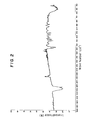
- FIG. 1 A 1H-NMR spectrum of the polynorbornene is shown in Fig. 1, and its infrared ray (IR) absorption spectrum is shown in Fig. 2.
- the film thus obtained was measured for transparency by the use of a direct-reading Haze Computer HGM-2DP manufactured by Suga Shikenki Co., Ltd.
- the total light transmittance was 92.7% and haze was 5.1%.
- the film was further measured for kinematic viscoelasticity by the use of Viscoelastic Analyzer RSA-II manufactured by Reometrics Far East Co., Ltd. The results are shown in Fig. 3. In this measurement, frequency was 1 Hz, temperature-raising speed was 3°C/min, and strain was 0.1%.
- a 1H-NMR spectrum of a chloroform-soluble portion of the polymer is shown in Fig. 5, and in Fig. 6, an IR spectrum of the polymer is shown.
- Example 2 In the same manner as in Example 1 (2) except that 2.5 micromoles of allylcyclopentadienylnickel was used in place of 2.5 micromoles of nickel bisacetylacetonate, 1.21 g of a polymer (polynorbornene) was obtained.
- Catalytic activity per gram of nickel atom was 8.25 kg/polymer/g-nickel.
- the weight average molecular weight of the polynorbornene thus obtained as determined by GPC was 1,880,000, and the number average molecular weight was 779,000.
- the reduced viscosity, ⁇ sp/c, as measured in 1,2,4-trichlorobenzene at 135°C (concentration 0.1 g/dl) was 2.57 dl/g.
- Example 1 In the same manner as in Example 1 (2) except that 2.5 micromoles of a transition metal compound component shown in Table 1 was used in place of 2.5 micromoles of nickel bisacetylacetonate, a polymer (polynorbornene) was obtained.
- Example 2 In the same manner as in Example 1 (2) except that 0.5 mmol of diethylaluminum monochloride was used in place of methylaluminoxane, and 0.25 mmol of titanium tetrachloride was used in place of nickel bisacetylacetonate, 0.65 g of a polymer was obtained.
- Catalytic activity per gram of titanium atom was 0.054 kg-polymer/g-titanium.
- the weight average molecular weight of the polynorbornene as determined by GPC was 6,200, and the number average molecular weight was 2,670.
- a cast film was produced using 1,2,4-trichlorobenzene as a solvent, but this film was very brittle and could not be measured for physical properties. On heating the film, it melted at about 180°C.
- Example 1 (2) In the same manner as in Example 1 (2) except that methylaluminoxane was not used, a polymer was intended to produced, but with no formation of any polymer.
- Example 2 In the same manner as in Example 1 (2) except that 0.5 mmol of trimethylaluminum was used in place of methylaluminoxane, a polymer was intended to produce, but with no formation of any polymer.
- Example 2 In the same manner as in Example 1 (2) except that 0.5 mmol of diethylaluminum monochloride was used in place of methylaluminoxane, and in place of 2.5 micromoles of nickel bisacetylacetonate, 62.5 micromoles of bis(acetylacetonate)vanazyl was used, 0.01 g of a polymer was obtained.
- Example 1 (2) In the same manner as in Example 1 (2) except that 0.5 mmol of triisobutylaluminum was used in place of methylaluminoxane, and in place of 2.5 micromoles of nickel bisacetylacetonate, 1 mmol of titanium tetrachloride was used, 2.41 g of a polymer was obtained.
- Catalytic activity per gram of titanium atom was 0.050 kg-polymer/g-titanium.
- the weight average molecular weight of the polynorbornene as determined by GPC was 4,180, and the number average molecular weight was 1,260. With this polymer, no cast film permitting measurement of physical properties was obtained; it melted at about 170°C.
- Example 2 In the same manner as in Example 1 (2) except that 2.5 micromoles of dicyclorobis(benzonitrile)palladium was used in place of methylaluminoxane and nickel bisacetylacetonate, 0.02 g of a polymer was obtained.
- Catalytic activity per gram of palladium atom was 0.075 kg-polymer/g-palladium.
- the weight average molecular weight of the polynorbornene as determined by GPC was 3,130, and the number average molecular weight was 1,780. With this polymer, no cast film permitting measurement of physical properties was obtained, and it melted at about 160°C.
- Example 2 In the same manner as in Example 1 (2) except that the amount of methylaluminoxane used was changed to 0.25 mmol, and 0.25 mmol of trimethylaluminum was added, 2.12 g of a polymer was obtained.
- Catalytic activity per gram of nickel atom was 14.4 kg-polymer/g-nickel.
- the weight average molecular weight of the polynorbornene as determined by GPC was 2,520,000, and the number average molecular weight was 1,280,000.
- the reduced viscosity, ⁇ sp/c, measured at 135°C in 1,2,4-trichlorobenzene (concentration 0.1 g/dl) was 5.36 dl/g.
- Catalytic activity per gram of nickel atom was 7.02 kg-polymer/g-nickel.
- the weight average molecular weight of the polynorbornene as determined by GPC was 2,660,000, and the number average molecular weight was 1,050,000.
- the reduced viscosity, ⁇ sp/c, measured at 135°C in 1,2,4-trichlorobenzene (concentration 0.1 g/dl) was 3.82 dl/g.
- Example 2 In the same manner as in Example 1 (2) except that 50 mmol of 1,4,5,8-dimethano-1,2,3,4,4a,5,8,8a-octahydronaphthalene was used in place of 2-norbornene, 2.53 g of a polymer was obtained.
- Catalytic activity per gram of nickel atom was 17.2 kg-polymer/g-nickel.
- the weight average molecular weight of the poly(1,4,5,8-dimethano-1,2,3,4,4a,5,8,8a-octahydronaphthalene) as determined by GPC was 1,960,000, and the number average molecular weight was 623,000.
- Example 2 In the same manner as in Example 1 (2) except that 50 mmol of 5-ethylidene-2-norbornene was used in place of 2-norbornene, and 2.5 micromoles of dichloro(1,5-cyclooctadiene)palladium was used in place of nickel bisacetylacetonate 0.25 g of a polymer was obtained.
- Catalytic activity per gram of palladium atom was 0.94 kg-polymer/g-palladium.
- the weight average molecular weight of the poly(5-ethyliene-2-norbornene) as determined by GPC was 563,000, and the number average molecular weight was 226,000.
- the product thus obtained was subjected to de-ashing treatment using a mixed solution of hydrochloric acid and methanol, washed with methanol, and dried under reduced pressure at room temperature to obtain a white, powdery polymer in an yield of 6.4%.
- Catalytic activity per gram of transition metal was 1,250 g-polymer/g-transition metal.
- the polymer obtained was soluble in solvents such as toluene and chloroform.
- the weight average molecular weight of the polymer as determined by GPC was 6,000.
- a 1H-NMR spectrum and IR absorption spectrum of the polymer were in good agreement with those of the polymer of Example 1.
- Example 2 In a 300-milliliter flask, 2.0 g of the polymer obtained in Example 1 (2) and 98 g of cyclohexane were placed and heated with stirring on an oil bath maintained at 80°C to prepare a uniform solution.
- Example 1 For this film, the thickness was 100 ⁇ m, the total light transmittance was 93.7%, and the haze was 4.8%. Temperature dependency of kinematic viscoelasticity and dielectric constant was the same as in Example 1 (3).
- Example 1 (3) In the same manner as in Example 1 (3) except that decaline was used in place of 1,2,4-trichlorobenzene, a 100 ⁇ m thick film was obtained.
- Example 1 For this film, the total light transmittance was 93.1% and the haze was 7.0%. Temperature dependency of kinematic viscoelasticity and dielectric constant was the same as in Example 1 (3).
- Example 1 For this film, the thickness was 100 ⁇ m, the total light transmittance was 90.2%, and the haze was 7.0%. Temperature dependency of kinematic viscoelasticity and dielectric constant was the same as in Example 1 (3).
- Example 1 For this film, the thickness was 100 ⁇ m, the total light transmittance was 92.6%, and the haze was 6.3%. Temperature dependency of kinematic viscoelasticity and dielectric constant was the same as in Example 1 (3).
Landscapes
- Chemical & Material Sciences (AREA)
- Health & Medical Sciences (AREA)
- Chemical Kinetics & Catalysis (AREA)
- Medicinal Chemistry (AREA)
- Polymers & Plastics (AREA)
- Organic Chemistry (AREA)
- Transition And Organic Metals Composition Catalysts For Addition Polymerization (AREA)
- Addition Polymer Or Copolymer, Post-Treatments, Or Chemical Modifications (AREA)
- Polymerization Catalysts (AREA)
Applications Claiming Priority (4)
| Application Number | Priority Date | Filing Date | Title |
|---|---|---|---|
| JP52639/90 | 1990-03-06 | ||
| JP5263990 | 1990-03-06 | ||
| JP2325854A JPH0463807A (ja) | 1990-03-06 | 1990-11-29 | ノルボルネン系重合体およびその製造方法ならびに該重合体からなるフィルムおよびその製造方法 |
| JP325854/90 | 1990-11-29 |
Publications (3)
| Publication Number | Publication Date |
|---|---|
| EP0445755A2 true EP0445755A2 (fr) | 1991-09-11 |
| EP0445755A3 EP0445755A3 (en) | 1991-12-18 |
| EP0445755B1 EP0445755B1 (fr) | 1998-06-17 |
Family
ID=26393267
Family Applications (1)
| Application Number | Title | Priority Date | Filing Date |
|---|---|---|---|
| EP91103371A Expired - Lifetime EP0445755B1 (fr) | 1990-03-06 | 1991-03-06 | Procédé de préparation des polymères à base de norbornène |
Country Status (4)
| Country | Link |
|---|---|
| US (1) | US5344900A (fr) |
| EP (1) | EP0445755B1 (fr) |
| JP (1) | JPH0463807A (fr) |
| DE (1) | DE69129600T2 (fr) |
Cited By (24)
| Publication number | Priority date | Publication date | Assignee | Title |
|---|---|---|---|---|
| US5334424A (en) * | 1991-06-17 | 1994-08-02 | Nippon Zeon Co., Ltd. | Thermoplastic norbornene resin formed articles and sustrates for liquid crystal display |
| US5468819A (en) * | 1993-11-16 | 1995-11-21 | The B.F. Goodrich Company | Process for making polymers containing a norbornene repeating unit by addition polymerization using an organo (nickel or palladium) complex |
| WO1996037526A1 (fr) * | 1995-05-25 | 1996-11-28 | The B.F. Goodrich Company | Polymeres d'addition de polycycloolefines contenant des substituants fonctionnels |
| WO1996037529A1 (fr) * | 1995-05-24 | 1996-11-28 | The B.F. Goodrich Company | Homopolymeres et copolymeres issus de monomeres polymerisables par l'intermediaire du cation et procede visant a leur production |
| EP0837079A3 (fr) * | 1996-10-17 | 1998-07-15 | Bayer Ag | Catalyseur palladium pour la polymérisation |
| US5929181A (en) * | 1997-06-09 | 1999-07-27 | The B.F.Goodrich Co. | Method for preparation of copolymers of ethylene/norbornene-type monomers with nickel catalysts |
| US6040403A (en) * | 1996-09-12 | 2000-03-21 | Bayer Aktiengesellschaft | Nickel catalysts for polymerization |
| US6057466A (en) * | 1996-10-17 | 2000-05-02 | Bayer Aktiengesellschaft | Palladium catalysts for polymerization |
| US6162838A (en) * | 1998-06-05 | 2000-12-19 | Georgia Tech Research Corporation | Porous insulating compounds and method for making same |
| US6165890A (en) * | 1997-01-21 | 2000-12-26 | Georgia Tech Research Corporation | Fabrication of a semiconductor device with air gaps for ultra-low capacitance interconnections |
| US6538087B2 (en) | 2000-07-28 | 2003-03-25 | Promerus, Llc | Polymeric compositions for forming optical waveguides; optical waveguides formed therefrom; and methods for making same |
| US6610593B2 (en) | 2000-08-31 | 2003-08-26 | Georgia Tech Research Corporation | Fabrication of semiconductor device with air gaps for ultra low capacitance interconnections and methods of making same |
| US7101654B2 (en) | 2004-01-14 | 2006-09-05 | Promerus Llc | Norbornene-type monomers and polymers containing pendent lactone or sultone groups |
| CN100368446C (zh) * | 2006-05-30 | 2008-02-13 | 中山大学 | 利用a-二亚胺镍配合物催化制备β-蒎烯聚合物的方法 |
| CN100368447C (zh) * | 2006-05-30 | 2008-02-13 | 中山大学 | 利用双水杨醛亚胺镍催化制备β-蒎烯聚合物的方法 |
| US7442752B2 (en) | 2002-07-10 | 2008-10-28 | Lg Chem, Ltd. | Nobonene-ester based addition polymer and method for preparing the same |
| WO2010087528A2 (fr) | 2009-01-29 | 2010-08-05 | Showa Denko K.K. | Copolymère de norbornène et son procédé de production thereof |
| WO2011021805A2 (fr) | 2009-08-18 | 2011-02-24 | 주식회사 엘지화학 | Nouveau composé, composition catalytique le comprenant, et procédé de préparation dun polymère doléfine cyclique à laide de celui-ci |
| US7989571B2 (en) | 2002-07-10 | 2011-08-02 | Lg Chem, Ltd. | Method for producing norbornene monomer composition, norbornene polymer prepared therefrom, optical film comprising the norbornene polymer, and method for producing the norbornene polymer |
| WO2012033227A2 (fr) | 2010-09-10 | 2012-03-15 | Showa Denko K.K. | Catalyseur de polymérisation de monomères de norbornène et procédé de production de polymère de norbornène |
| WO2012057135A1 (fr) | 2010-10-26 | 2012-05-03 | 昭和電工株式会社 | Catalyseur pour la polymérisation de monomères de type norbornène et procédé pour la production de polymère de norbornène |
| CN102482295A (zh) * | 2009-08-21 | 2012-05-30 | 可隆工业株式会社 | 吸收剂和包含该吸收剂的用于光学元件的钝化层 |
| CN102905785A (zh) * | 2010-06-30 | 2013-01-30 | 可隆工业株式会社 | 吸收剂以及包含该吸收剂的用于光学元件的钝化层 |
| KR20230067142A (ko) | 2021-11-09 | 2023-05-16 | 엔에이치케미칼주식회사 | 노보넨 알코올 화합물의 알킬화 방법 |
Families Citing this family (33)
| Publication number | Priority date | Publication date | Assignee | Title |
|---|---|---|---|---|
| WO1992006123A1 (fr) * | 1990-10-05 | 1992-04-16 | Idemitsu Kosan Co., Ltd. | Procede de production de polymere de cycloolefine et de copolymere de cycloolefine et composition et moulage prepares a partir de ces composes |
| JP3273046B2 (ja) * | 1991-06-25 | 2002-04-08 | 日本ゼオン株式会社 | 位相板 |
| JP3332051B2 (ja) * | 1992-12-18 | 2002-10-07 | 出光興産株式会社 | 重合用触媒及び該触媒系を用いる重合体の製造方法 |
| JP3868508B2 (ja) * | 1993-01-29 | 2007-01-17 | 日本ゼオン株式会社 | プレス・スルー・パッケージ |
| EP0997482B1 (fr) | 1997-07-18 | 2007-01-17 | Nippon Zeon Co., Ltd. | Polymere d'addition de cycloolefine modifie et composition de resine durcissable a base de ce polymere |
| WO1999009085A1 (fr) | 1997-08-19 | 1999-02-25 | Nippon Zeon Co., Ltd. | Polymere de norbornene et son procede de preparation |
| US6372869B1 (en) * | 1998-05-26 | 2002-04-16 | E. I. Du Pont De Nemours And Company | Molecular weight control in olefin polymerization |
| JP2001354755A (ja) * | 2000-06-13 | 2001-12-25 | Jsr Corp | 樹脂フィルムおよびその製造方法 |
| KR100475546B1 (ko) * | 2001-01-05 | 2005-03-10 | 삼성전자주식회사 | 노르보넨계 수지의 제조방법 |
| WO2003068831A1 (fr) | 2002-02-14 | 2003-08-21 | Nippon Petrochemicals Co., Ltd. | Polymere diene conjugue bicyclique et copolymere diene conjugue bicyclique |
| TWI301490B (en) * | 2002-02-27 | 2008-10-01 | Ind Tech Res Inst | Catalyst composition and process for preparing norbornene-type homopolymers or copolymers |
| US6809057B2 (en) | 2003-02-10 | 2004-10-26 | Exxonmobil Chemical Patents Inc. | Chromium compounds and olefin polymerization processes utilizing them |
| KR100599319B1 (ko) * | 2003-05-06 | 2006-07-14 | 차국헌 | 나노다공성 저유전성 폴리노보넨계 공중합체 박막 및 그 제조방법 |
| ATE414118T1 (de) * | 2004-07-07 | 2008-11-15 | Promerus Llc | Lichtempfindliche dielektrische harzzusammensetzungen und ihre verwendungen |
| US7875686B2 (en) * | 2004-08-18 | 2011-01-25 | Promerus Llc | Polycycloolefin polymeric compositions for semiconductor applications |
| EP2033978A1 (fr) * | 2004-12-15 | 2009-03-11 | Nihon University | Méthode de synthèse d'un polymère ou d'un copolymère d'addition dérivé du norbornène |
| EP1862504B1 (fr) * | 2005-03-18 | 2012-01-18 | Mitsui Chemicals, Inc. | Composition de resine pour encapsulation de cellule solaire |
| KR101150218B1 (ko) | 2005-05-24 | 2012-06-12 | 도소 가부시키가이샤 | 황함유 환상 올레핀 수지 및 그 제조방법 |
| JP2006328034A (ja) * | 2005-05-30 | 2006-12-07 | Nippon Zeon Co Ltd | 遷移金属錯体、環状オレフィン重合用触媒、および環状オレフィン重合体の製造方法 |
| RU2315064C1 (ru) * | 2006-08-03 | 2008-01-20 | ГОУ ВПО Иркутский государственный университет | Способ получения катализатора для полимеризации норборнена |
| TW201039447A (en) | 2009-03-09 | 2010-11-01 | Sekisui Chemical Co Ltd | Underside protective sheet for solar cell, solar cell module, and gas-barrier film |
| JPWO2010104069A1 (ja) | 2009-03-09 | 2012-09-13 | 積水化学工業株式会社 | 太陽電池用裏面保護シート、太陽電池モジュール及びガスバリアフィルム |
| US8541523B2 (en) * | 2010-04-05 | 2013-09-24 | Promerus, Llc | Norbornene-type polymers, compositions thereof and lithographic process using such compositions |
| JP5212659B2 (ja) | 2010-07-30 | 2013-06-19 | 信越化学工業株式会社 | 高気体透過性環状オレフィン付加重合体の製造方法 |
| JP6080112B2 (ja) | 2011-10-07 | 2017-02-15 | 三菱瓦斯化学株式会社 | 医療用包装容器 |
| US10035129B2 (en) | 2011-11-25 | 2018-07-31 | Mitsubishi Gas Chemical Company, Inc. | Oxygen-absorbing resin composition and oxygen-absorbing molded article using same and multilayer body, container, injection-molded article and medical container using these |
| CN103998523B (zh) | 2011-12-16 | 2016-04-20 | 三菱瓦斯化学株式会社 | 吸氧性树脂组合物、以及使用其的多层体、容器、注射成型体及医疗用容器 |
| TWI576147B (zh) | 2012-08-07 | 2017-04-01 | 住友電木股份有限公司 | 環烷基降莰烯單體、衍生自其的聚合物及其在滲透蒸發的用途 |
| JP2014040532A (ja) * | 2012-08-23 | 2014-03-06 | Shin Etsu Chem Co Ltd | 環状オレフィン付加重合体及びその製造方法 |
| KR20150128809A (ko) | 2013-03-06 | 2015-11-18 | 미츠비시 가스 가가쿠 가부시키가이샤 | 산소 흡수성 의료용 다층 용기 및 바이오 의약의 보존 방법 |
| KR102523525B1 (ko) | 2014-10-23 | 2023-04-18 | 니폰 제온 가부시키가이샤 | 대전 방지 필름 및 액정 표시 장치 |
| JP6819600B2 (ja) | 2015-09-30 | 2021-01-27 | 日本ゼオン株式会社 | 帯電防止ハードコートフィルムの製造方法、偏光板の製造方法、タッチパネルの製造方法、及び液晶表示装置の製造方法 |
| CA3060007A1 (fr) | 2017-04-13 | 2018-10-18 | Braskem America, Inc. | Olefine modifiee par un azide en tant qu'agent de couplage polymere |
Family Cites Families (7)
| Publication number | Priority date | Publication date | Assignee | Title |
|---|---|---|---|---|
| US3330815A (en) * | 1964-03-24 | 1967-07-11 | Union Carbide Corp | Novel polynorbornenes, process for production thereof, and products produced therefrom |
| GB1268973A (en) * | 1969-09-03 | 1972-03-29 | Ici Ltd | Polycyclic compounds and copolymers derived therefrom |
| US4080491A (en) * | 1975-08-27 | 1978-03-21 | Showa Denko K.K. | Process of producing ring-opening polymerization products |
| US4138448A (en) * | 1977-12-05 | 1979-02-06 | The B. F. Goodrich Company | Process for preparing polymers of cyclopentadiene and bicycloheptene mixtures |
| GB2127030A (en) * | 1982-09-13 | 1984-04-04 | Nat Res Dev | Block copolymers |
| JPH0713084B2 (ja) * | 1985-03-26 | 1995-02-15 | 三井石油化学工業株式会社 | 環状オレフイン系共重合体の製法 |
| JPH0236223A (ja) * | 1988-07-27 | 1990-02-06 | Nippon Oil Co Ltd | 淡色な樹脂の製造方法 |
-
1990
- 1990-11-29 JP JP2325854A patent/JPH0463807A/ja active Pending
-
1991
- 1991-03-06 DE DE69129600T patent/DE69129600T2/de not_active Expired - Fee Related
- 1991-03-06 EP EP91103371A patent/EP0445755B1/fr not_active Expired - Lifetime
-
1993
- 1993-04-30 US US08/056,587 patent/US5344900A/en not_active Expired - Lifetime
Cited By (42)
| Publication number | Priority date | Publication date | Assignee | Title |
|---|---|---|---|---|
| US5334424A (en) * | 1991-06-17 | 1994-08-02 | Nippon Zeon Co., Ltd. | Thermoplastic norbornene resin formed articles and sustrates for liquid crystal display |
| US5741869A (en) * | 1993-11-16 | 1998-04-21 | The B.F. Goodrich Company | Addition polymers derived from norbornene-functional monomers and process therefor |
| US5468819A (en) * | 1993-11-16 | 1995-11-21 | The B.F. Goodrich Company | Process for making polymers containing a norbornene repeating unit by addition polymerization using an organo (nickel or palladium) complex |
| US5569730A (en) * | 1993-11-16 | 1996-10-29 | The B. F. Goodrich Company | Addition polymers derived from norbornene-functional monomers and process therefor |
| US5571881A (en) * | 1993-11-16 | 1996-11-05 | The B. F. Goodrich Company | Addition polymers derived from norbornene-functional monomers and process therefor |
| CN1104450C (zh) * | 1995-05-24 | 2003-04-02 | B·F·谷德里奇公司 | 可阳离子聚合的单体的均聚物和共聚物及其制备方法 |
| WO1996037529A1 (fr) * | 1995-05-24 | 1996-11-28 | The B.F. Goodrich Company | Homopolymeres et copolymeres issus de monomeres polymerisables par l'intermediaire du cation et procede visant a leur production |
| US5677405A (en) * | 1995-05-24 | 1997-10-14 | The B.F. Goodrich Company | Homopolymers and copolymers of cationically polymerizable monomers and method of their preparation |
| WO1996037526A1 (fr) * | 1995-05-25 | 1996-11-28 | The B.F. Goodrich Company | Polymeres d'addition de polycycloolefines contenant des substituants fonctionnels |
| US5705503A (en) * | 1995-05-25 | 1998-01-06 | Goodall; Brian Leslie | Addition polymers of polycycloolefins containing functional substituents |
| US6040403A (en) * | 1996-09-12 | 2000-03-21 | Bayer Aktiengesellschaft | Nickel catalysts for polymerization |
| EP0837079A3 (fr) * | 1996-10-17 | 1998-07-15 | Bayer Ag | Catalyseur palladium pour la polymérisation |
| US6057466A (en) * | 1996-10-17 | 2000-05-02 | Bayer Aktiengesellschaft | Palladium catalysts for polymerization |
| US7504699B1 (en) | 1997-01-21 | 2009-03-17 | George Tech Research Corporation | Fabrication of a semiconductor device with air gaps for ultra-low capacitance interconnections |
| US6165890A (en) * | 1997-01-21 | 2000-12-26 | Georgia Tech Research Corporation | Fabrication of a semiconductor device with air gaps for ultra-low capacitance interconnections |
| RU2204181C2 (ru) * | 1997-01-21 | 2003-05-10 | Джорджиэ Тек Рисеч Копэрейшн | Полупроводниковое устройство (варианты) и способ формирования воздушных зазоров внутри структуры (варианты) |
| US5929181A (en) * | 1997-06-09 | 1999-07-27 | The B.F.Goodrich Co. | Method for preparation of copolymers of ethylene/norbornene-type monomers with nickel catalysts |
| US6509386B1 (en) | 1998-06-05 | 2003-01-21 | Georgia Tech Research Corporation | Porous insulating compounds and method for making same |
| US6162838A (en) * | 1998-06-05 | 2000-12-19 | Georgia Tech Research Corporation | Porous insulating compounds and method for making same |
| US6538087B2 (en) | 2000-07-28 | 2003-03-25 | Promerus, Llc | Polymeric compositions for forming optical waveguides; optical waveguides formed therefrom; and methods for making same |
| US6888249B2 (en) | 2000-08-31 | 2005-05-03 | Georgia Tech Research Corporation | Fabrication of semiconductor devices with air gaps for ultra low capacitance interconnections and methods of making same |
| US6610593B2 (en) | 2000-08-31 | 2003-08-26 | Georgia Tech Research Corporation | Fabrication of semiconductor device with air gaps for ultra low capacitance interconnections and methods of making same |
| US7442752B2 (en) | 2002-07-10 | 2008-10-28 | Lg Chem, Ltd. | Nobonene-ester based addition polymer and method for preparing the same |
| US7989571B2 (en) | 2002-07-10 | 2011-08-02 | Lg Chem, Ltd. | Method for producing norbornene monomer composition, norbornene polymer prepared therefrom, optical film comprising the norbornene polymer, and method for producing the norbornene polymer |
| US7101654B2 (en) | 2004-01-14 | 2006-09-05 | Promerus Llc | Norbornene-type monomers and polymers containing pendent lactone or sultone groups |
| CN100368446C (zh) * | 2006-05-30 | 2008-02-13 | 中山大学 | 利用a-二亚胺镍配合物催化制备β-蒎烯聚合物的方法 |
| CN100368447C (zh) * | 2006-05-30 | 2008-02-13 | 中山大学 | 利用双水杨醛亚胺镍催化制备β-蒎烯聚合物的方法 |
| WO2010087528A2 (fr) | 2009-01-29 | 2010-08-05 | Showa Denko K.K. | Copolymère de norbornène et son procédé de production thereof |
| US8163860B2 (en) | 2009-01-29 | 2012-04-24 | Showa Denko K.K. | Norbornene copolymer and production method thereof |
| US8420755B2 (en) | 2009-08-18 | 2013-04-16 | Lg Chem, Ltd. | Compounds, catalyst composition comprising the same, and method for preparing of cycloolefin-based polymer using the same |
| WO2011021805A2 (fr) | 2009-08-18 | 2011-02-24 | 주식회사 엘지화학 | Nouveau composé, composition catalytique le comprenant, et procédé de préparation dun polymère doléfine cyclique à laide de celui-ci |
| TWI503169B (zh) * | 2009-08-21 | 2015-10-11 | Kolon Inc | 吸收劑及包含該吸收劑的光學元件用鈍化層 |
| CN102482295A (zh) * | 2009-08-21 | 2012-05-30 | 可隆工业株式会社 | 吸收剂和包含该吸收剂的用于光学元件的钝化层 |
| EP2467389A4 (fr) * | 2009-08-21 | 2013-01-02 | Kolon Inc | Couche de passivation et absorbante pour élément optique la comprenant |
| CN102482295B (zh) * | 2009-08-21 | 2015-02-18 | 可隆工业株式会社 | 吸收剂和包含该吸收剂的用于光学元件的钝化层 |
| CN102905785A (zh) * | 2010-06-30 | 2013-01-30 | 可隆工业株式会社 | 吸收剂以及包含该吸收剂的用于光学元件的钝化层 |
| CN102905785B (zh) * | 2010-06-30 | 2015-08-05 | 可隆工业株式会社 | 吸收剂以及包含该吸收剂的用于光学元件的钝化层 |
| US8598288B2 (en) | 2010-09-10 | 2013-12-03 | Showa Denko K.K. | Catalyst for polymerization of norbornene monomers, method for producing norbornene polymer, method for producing norbornene copolymer, norbornene polymer and transition metal complex |
| WO2012033227A2 (fr) | 2010-09-10 | 2012-03-15 | Showa Denko K.K. | Catalyseur de polymérisation de monomères de norbornène et procédé de production de polymère de norbornène |
| US8835580B2 (en) | 2010-10-26 | 2014-09-16 | Showa Denko K.K. | Catalyst for norbornene monomer polymerization and method for producing norbornene polymer |
| WO2012057135A1 (fr) | 2010-10-26 | 2012-05-03 | 昭和電工株式会社 | Catalyseur pour la polymérisation de monomères de type norbornène et procédé pour la production de polymère de norbornène |
| KR20230067142A (ko) | 2021-11-09 | 2023-05-16 | 엔에이치케미칼주식회사 | 노보넨 알코올 화합물의 알킬화 방법 |
Also Published As
| Publication number | Publication date |
|---|---|
| EP0445755A3 (en) | 1991-12-18 |
| EP0445755B1 (fr) | 1998-06-17 |
| DE69129600T2 (de) | 1998-11-05 |
| DE69129600D1 (de) | 1998-07-23 |
| US5344900A (en) | 1994-09-06 |
| JPH0463807A (ja) | 1992-02-28 |
Similar Documents
| Publication | Publication Date | Title |
|---|---|---|
| EP0445755A2 (fr) | Polymère à base de norbornène, procédé de préparation, film à base de ce polymère et procédé de préparation de ce film | |
| US5929181A (en) | Method for preparation of copolymers of ethylene/norbornene-type monomers with nickel catalysts | |
| EP0764653B1 (fr) | Catalyseurs de polymérisation, leur procédé de préparation, les précurseurs et procédé d'utilisation | |
| US5635573A (en) | Method for preparing alpha-olefin/cycloolefin copolymers | |
| US5539124A (en) | Polymerization catalysts based on transition metal complexes with ligands containing pyrrolyl ring | |
| CZ281689B6 (cs) | Katalyzátor polymerace olefinů | |
| Galan-Fereres et al. | Synthesis and olefin polymerization using supported and non-supported geometry constrained titanium complexes | |
| HK1001918B (en) | Constrained geometry addition polymerization catalysts, processes for their preparation, precursors therefor, methods of use, and novel polymers formed therewith | |
| CN101010349A (zh) | 含金属茂配合物的聚合催化剂组合物和使用其制备的聚合物 | |
| PT92201A (pt) | Processo para a preparacao de cera polietileno mediante polimerizacao de fase de gas | |
| WO1994029356A1 (fr) | Procede de production de polymere olefinique, et catalyseur pour la polymerisation d'une olefine | |
| CA2332165A1 (fr) | Composes organometalliques contenant des ligands indenyles condenses | |
| JP3779759B2 (ja) | メタロセン化合物及び触媒成分としてのその使用 | |
| JP3196419B2 (ja) | アルミニウムオキシ化合物及びそれを含有する重合用触媒 | |
| US8404792B2 (en) | Cyclobutene polymers and methods of making the same | |
| JP3264338B2 (ja) | 特定のアルミニウム化合物を含有する重合用触媒 | |
| KR20170108810A (ko) | 폴리프로필렌 | |
| KR100371909B1 (ko) | 다핵으로 구속된 배열을 갖는 메탈로센 촉매 및 이를이용한 에틸렌/방향족 비닐화합물의 공중합체 | |
| JP3660067B2 (ja) | ポリエチレン組成物 | |
| KR100770291B1 (ko) | 다핵으로 연결된 전이금속 화합물 촉매 및 이를 이용한중합체 제조방법 | |
| JP3169187B2 (ja) | オレフィン系共重合体及びその製造法 | |
| WO2000047643A1 (fr) | Copolymeres de propylene contenant des unites styrene | |
| JP3704205B2 (ja) | 遷移金属化合物および該遷移金属化合物からなるオレフィン重合用触媒成分 | |
| KR100376053B1 (ko) | 다핵으로 구속된 배열을 갖는 메탈로센 촉매 및 이를이용한 중합체 제조방법 | |
| JPS6225112A (ja) | エチレン共重合体の製造法 |
Legal Events
| Date | Code | Title | Description |
|---|---|---|---|
| PUAI | Public reference made under article 153(3) epc to a published international application that has entered the european phase |
Free format text: ORIGINAL CODE: 0009012 |
|
| AK | Designated contracting states |
Kind code of ref document: A2 Designated state(s): BE DE FR GB IT NL |
|
| PUAL | Search report despatched |
Free format text: ORIGINAL CODE: 0009013 |
|
| AK | Designated contracting states |
Kind code of ref document: A3 Designated state(s): BE DE FR GB IT NL |
|
| 17P | Request for examination filed |
Effective date: 19920612 |
|
| 17Q | First examination report despatched |
Effective date: 19941206 |
|
| GRAG | Despatch of communication of intention to grant |
Free format text: ORIGINAL CODE: EPIDOS AGRA |
|
| GRAH | Despatch of communication of intention to grant a patent |
Free format text: ORIGINAL CODE: EPIDOS IGRA |
|
| GRAH | Despatch of communication of intention to grant a patent |
Free format text: ORIGINAL CODE: EPIDOS IGRA |
|
| GRAH | Despatch of communication of intention to grant a patent |
Free format text: ORIGINAL CODE: EPIDOS IGRA |
|
| ITF | It: translation for a ep patent filed | ||
| GRAA | (expected) grant |
Free format text: ORIGINAL CODE: 0009210 |
|
| AK | Designated contracting states |
Kind code of ref document: B1 Designated state(s): BE DE FR GB IT NL |
|
| PG25 | Lapsed in a contracting state [announced via postgrant information from national office to epo] |
Ref country code: NL Free format text: LAPSE BECAUSE OF FAILURE TO SUBMIT A TRANSLATION OF THE DESCRIPTION OR TO PAY THE FEE WITHIN THE PRESCRIBED TIME-LIMIT Effective date: 19980617 Ref country code: BE Free format text: LAPSE BECAUSE OF FAILURE TO SUBMIT A TRANSLATION OF THE DESCRIPTION OR TO PAY THE FEE WITHIN THE PRESCRIBED TIME-LIMIT Effective date: 19980617 |
|
| REF | Corresponds to: |
Ref document number: 69129600 Country of ref document: DE Date of ref document: 19980723 |
|
| ET | Fr: translation filed | ||
| NLV1 | Nl: lapsed or annulled due to failure to fulfill the requirements of art. 29p and 29m of the patents act | ||
| PLBE | No opposition filed within time limit |
Free format text: ORIGINAL CODE: 0009261 |
|
| STAA | Information on the status of an ep patent application or granted ep patent |
Free format text: STATUS: NO OPPOSITION FILED WITHIN TIME LIMIT |
|
| 26N | No opposition filed | ||
| PGFP | Annual fee paid to national office [announced via postgrant information from national office to epo] |
Ref country code: GB Payment date: 20010228 Year of fee payment: 11 |
|
| REG | Reference to a national code |
Ref country code: GB Ref legal event code: IF02 |
|
| PG25 | Lapsed in a contracting state [announced via postgrant information from national office to epo] |
Ref country code: GB Free format text: LAPSE BECAUSE OF NON-PAYMENT OF DUE FEES Effective date: 20020306 |
|
| GBPC | Gb: european patent ceased through non-payment of renewal fee |
Effective date: 20020306 |
|
| PG25 | Lapsed in a contracting state [announced via postgrant information from national office to epo] |
Ref country code: IT Free format text: LAPSE BECAUSE OF NON-PAYMENT OF DUE FEES;WARNING: LAPSES OF ITALIAN PATENTS WITH EFFECTIVE DATE BEFORE 2007 MAY HAVE OCCURRED AT ANY TIME BEFORE 2007. THE CORRECT EFFECTIVE DATE MAY BE DIFFERENT FROM THE ONE RECORDED. Effective date: 20050306 |
|
| PGFP | Annual fee paid to national office [announced via postgrant information from national office to epo] |
Ref country code: FR Payment date: 20050308 Year of fee payment: 15 |
|
| REG | Reference to a national code |
Ref country code: FR Ref legal event code: ST Effective date: 20061130 |
|
| PG25 | Lapsed in a contracting state [announced via postgrant information from national office to epo] |
Ref country code: FR Free format text: LAPSE BECAUSE OF NON-PAYMENT OF DUE FEES Effective date: 20060331 |
|
| PGFP | Annual fee paid to national office [announced via postgrant information from national office to epo] |
Ref country code: DE Payment date: 20090226 Year of fee payment: 19 |
|
| PG25 | Lapsed in a contracting state [announced via postgrant information from national office to epo] |
Ref country code: DE Free format text: LAPSE BECAUSE OF NON-PAYMENT OF DUE FEES Effective date: 20101001 |