EP0446062A1 - C-Linked pyrazole derivatives - Google Patents
C-Linked pyrazole derivatives Download PDFInfo
- Publication number
- EP0446062A1 EP0446062A1 EP91301933A EP91301933A EP0446062A1 EP 0446062 A1 EP0446062 A1 EP 0446062A1 EP 91301933 A EP91301933 A EP 91301933A EP 91301933 A EP91301933 A EP 91301933A EP 0446062 A1 EP0446062 A1 EP 0446062A1
- Authority
- EP
- European Patent Office
- Prior art keywords
- group
- methyl
- biphenyl
- butyl
- compound
- Prior art date
- Legal status (The legal status is an assumption and is not a legal conclusion. Google has not performed a legal analysis and makes no representation as to the accuracy of the status listed.)
- Withdrawn
Links
- 0 CC1(C2CCCC2)NC(*)C(Cc(cc2)ccc2-c2c(*)cccc2)C(*)N1 Chemical compound CC1(C2CCCC2)NC(*)C(Cc(cc2)ccc2-c2c(*)cccc2)C(*)N1 0.000 description 5
Classifications
-
- C—CHEMISTRY; METALLURGY
- C07—ORGANIC CHEMISTRY
- C07D—HETEROCYCLIC COMPOUNDS
- C07D231/00—Heterocyclic compounds containing 1,2-diazole or hydrogenated 1,2-diazole rings
- C07D231/02—Heterocyclic compounds containing 1,2-diazole or hydrogenated 1,2-diazole rings not condensed with other rings
- C07D231/10—Heterocyclic compounds containing 1,2-diazole or hydrogenated 1,2-diazole rings not condensed with other rings having two or three double bonds between ring members or between ring members and non-ring members
- C07D231/12—Heterocyclic compounds containing 1,2-diazole or hydrogenated 1,2-diazole rings not condensed with other rings having two or three double bonds between ring members or between ring members and non-ring members with only hydrogen atoms, hydrocarbon or substituted hydrocarbon radicals, directly attached to ring carbon atoms
-
- A—HUMAN NECESSITIES
- A61—MEDICAL OR VETERINARY SCIENCE; HYGIENE
- A61P—SPECIFIC THERAPEUTIC ACTIVITY OF CHEMICAL COMPOUNDS OR MEDICINAL PREPARATIONS
- A61P27/00—Drugs for disorders of the senses
- A61P27/02—Ophthalmic agents
-
- A—HUMAN NECESSITIES
- A61—MEDICAL OR VETERINARY SCIENCE; HYGIENE
- A61P—SPECIFIC THERAPEUTIC ACTIVITY OF CHEMICAL COMPOUNDS OR MEDICINAL PREPARATIONS
- A61P43/00—Drugs for specific purposes, not provided for in groups A61P1/00-A61P41/00
-
- A—HUMAN NECESSITIES
- A61—MEDICAL OR VETERINARY SCIENCE; HYGIENE
- A61P—SPECIFIC THERAPEUTIC ACTIVITY OF CHEMICAL COMPOUNDS OR MEDICINAL PREPARATIONS
- A61P5/00—Drugs for disorders of the endocrine system
- A61P5/38—Drugs for disorders of the endocrine system of the suprarenal hormones
-
- A—HUMAN NECESSITIES
- A61—MEDICAL OR VETERINARY SCIENCE; HYGIENE
- A61P—SPECIFIC THERAPEUTIC ACTIVITY OF CHEMICAL COMPOUNDS OR MEDICINAL PREPARATIONS
- A61P9/00—Drugs for disorders of the cardiovascular system
-
- A—HUMAN NECESSITIES
- A61—MEDICAL OR VETERINARY SCIENCE; HYGIENE
- A61P—SPECIFIC THERAPEUTIC ACTIVITY OF CHEMICAL COMPOUNDS OR MEDICINAL PREPARATIONS
- A61P9/00—Drugs for disorders of the cardiovascular system
- A61P9/08—Vasodilators for multiple indications
-
- A—HUMAN NECESSITIES
- A61—MEDICAL OR VETERINARY SCIENCE; HYGIENE
- A61P—SPECIFIC THERAPEUTIC ACTIVITY OF CHEMICAL COMPOUNDS OR MEDICINAL PREPARATIONS
- A61P9/00—Drugs for disorders of the cardiovascular system
- A61P9/10—Drugs for disorders of the cardiovascular system for treating ischaemic or atherosclerotic diseases, e.g. antianginal drugs, coronary vasodilators, drugs for myocardial infarction, retinopathy, cerebrovascula insufficiency, renal arteriosclerosis
-
- A—HUMAN NECESSITIES
- A61—MEDICAL OR VETERINARY SCIENCE; HYGIENE
- A61P—SPECIFIC THERAPEUTIC ACTIVITY OF CHEMICAL COMPOUNDS OR MEDICINAL PREPARATIONS
- A61P9/00—Drugs for disorders of the cardiovascular system
- A61P9/12—Antihypertensives
-
- C—CHEMISTRY; METALLURGY
- C07—ORGANIC CHEMISTRY
- C07C—ACYCLIC OR CARBOCYCLIC COMPOUNDS
- C07C205/00—Compounds containing nitro groups bound to a carbon skeleton
- C07C205/45—Compounds containing nitro groups bound to a carbon skeleton the carbon skeleton being further substituted by at least one doubly—bound oxygen atom, not being part of a —CHO group
-
- C—CHEMISTRY; METALLURGY
- C07—ORGANIC CHEMISTRY
- C07C—ACYCLIC OR CARBOCYCLIC COMPOUNDS
- C07C45/00—Preparation of compounds having >C = O groups bound only to carbon or hydrogen atoms; Preparation of chelates of such compounds
- C07C45/45—Preparation of compounds having >C = O groups bound only to carbon or hydrogen atoms; Preparation of chelates of such compounds by condensation
- C07C45/455—Preparation of compounds having >C = O groups bound only to carbon or hydrogen atoms; Preparation of chelates of such compounds by condensation with carboxylic acids or their derivatives
-
- C—CHEMISTRY; METALLURGY
- C07—ORGANIC CHEMISTRY
- C07C—ACYCLIC OR CARBOCYCLIC COMPOUNDS
- C07C49/00—Ketones; Ketenes; Dimeric ketenes; Ketonic chelates
- C07C49/04—Saturated compounds containing keto groups bound to acyclic carbon atoms
- C07C49/175—Saturated compounds containing keto groups bound to acyclic carbon atoms containing ether groups, groups, groups, or groups
-
- C—CHEMISTRY; METALLURGY
- C07—ORGANIC CHEMISTRY
- C07C—ACYCLIC OR CARBOCYCLIC COMPOUNDS
- C07C49/00—Ketones; Ketenes; Dimeric ketenes; Ketonic chelates
- C07C49/20—Unsaturated compounds containing keto groups bound to acyclic carbon atoms
- C07C49/255—Unsaturated compounds containing keto groups bound to acyclic carbon atoms containing ether groups, groups, groups, or groups
-
- C—CHEMISTRY; METALLURGY
- C07—ORGANIC CHEMISTRY
- C07D—HETEROCYCLIC COMPOUNDS
- C07D231/00—Heterocyclic compounds containing 1,2-diazole or hydrogenated 1,2-diazole rings
- C07D231/02—Heterocyclic compounds containing 1,2-diazole or hydrogenated 1,2-diazole rings not condensed with other rings
- C07D231/10—Heterocyclic compounds containing 1,2-diazole or hydrogenated 1,2-diazole rings not condensed with other rings having two or three double bonds between ring members or between ring members and non-ring members
- C07D231/14—Heterocyclic compounds containing 1,2-diazole or hydrogenated 1,2-diazole rings not condensed with other rings having two or three double bonds between ring members or between ring members and non-ring members with hetero atoms or with carbon atoms having three bonds to hetero atoms with at the most one bond to halogen, e.g. ester or nitrile radicals, directly attached to ring carbon atoms
-
- C—CHEMISTRY; METALLURGY
- C07—ORGANIC CHEMISTRY
- C07D—HETEROCYCLIC COMPOUNDS
- C07D403/00—Heterocyclic compounds containing two or more hetero rings, having nitrogen atoms as the only ring hetero atoms, not provided for by group C07D401/00
- C07D403/02—Heterocyclic compounds containing two or more hetero rings, having nitrogen atoms as the only ring hetero atoms, not provided for by group C07D401/00 containing two hetero rings
- C07D403/10—Heterocyclic compounds containing two or more hetero rings, having nitrogen atoms as the only ring hetero atoms, not provided for by group C07D401/00 containing two hetero rings linked by a carbon chain containing aromatic rings
Definitions
- This invention relates to C-linked pyrazole derivatives, processes for their preparation and pharmaceutical compositions containing them.
- a compound of general formula (I) or a physiologically acceptable salt, solvate (e.g. hydrate) or a metabolically labile ester thereof in which R1 represents a hydrogen atom or a group selected from C1 ⁇ 6alkyl or C2 ⁇ 6alkenyl; R2 represents a hydrogen atom or a group selected from C1 ⁇ 6alkyl, C3 ⁇ 7cycloalkyl, C3 ⁇ 7cycloalkylC1 ⁇ 4alkyl, C3 ⁇ 6alkenyl, fluoroC1 ⁇ 6alkyl, fluoroC3 ⁇ 6alkenyl, phenyl, -(CH2) k COR5 or -(CH2) k SO2R5; R3 represents a hydrogen atom or a group selected from C1 ⁇ 6alkyl optionally substituted by a hydroxy or C1 ⁇ 6alkoxy group,
- formula (I) is intended to cover all enantiomers, diastereoisomers and mixtures thereof including racemates. Where a compound of the present invention contains one or two double bonds, these may exist in the cis or trans configuration. Furthermore where such geometric isomers exist, formula (I) is intended to cover mixtures thereof.
- the invention also includes within its scope the solvates, especially the hydrates, of compounds of general formula (I).
- the term 'alkyl' or 'alkoxy' as a group or part of a group means that the group is straight or branched.
- the term 'alkenyl' as a group or part of a group means that the group is straight or branched and contains at least one carbon-carbon double bond.
- the term 'cycloalkyl' as a group or part of a group may be, for example, a cyclopropyl, cyclobutyl, cyclopentyl or cyclohexyl group.
- -NR10R11 represents a saturated heterocyclic ring, this contains 5 or 6 ring members, one of which may be an oxygen atom.
- Suitable heterocyclic groups are a pyrrolidino, piperidino or morpholino group.
- a preferred class of compounds of general formula (I) is that wherein the group R1 is a C1 ⁇ 5alkyl (for example, ethyl, n-propyl or n-butyl), especially a C3 ⁇ 5alkyl, or C3 ⁇ 5alkenyl group. Particularly preferred are those compounds wherein R1 is an n-butyl, n-propyl, but-1-enyl or prop-1-enyl group.
- R2 is a fluoroC1 ⁇ 6alkyl group or the group (CH2) k SO2R5.
- R2 represents a fluoroC1 ⁇ 3alkyl group, especially -CH2CF3, or R5 represents the group -NR10R11 (where R10 and R11 each represent a C1 ⁇ 4alkyl group), especially SO2N(CH3)2.
- a further preferred class of compound of general formula (I) is that wherein the group R2 is a group selected from C1 ⁇ 6alkyl, preferably C1 ⁇ 5alkyl, especially ethyl, isopropyl or isobutyl; C3 ⁇ 7cycloalkyl, preferably C3 ⁇ 5cycloalkyl, especially cyclobutyl; C3 ⁇ 7cycloalkylC1 ⁇ 4alkyl, preferably C3 ⁇ 5cycloalkylC1 ⁇ 4alkyl, especially cyclopropylmethyl; or phenyl.
- the group R2 is a group selected from C1 ⁇ 6alkyl, preferably C1 ⁇ 5alkyl, especially ethyl, isopropyl or isobutyl; C3 ⁇ 7cycloalkyl, preferably C3 ⁇ 5cycloalkyl, especially cyclobutyl; C3 ⁇ 7cycloalkylC1 ⁇ 4alkyl, preferably C3 ⁇ 5cycloalkylC1 ⁇
- Another preferred class of compound of general formula (I) is that wherein the group R2 is adjacent to the group R3.
- R3 is selected from a hydrogen atom or a group selected from C1 ⁇ 6alkyl, preferably C1 ⁇ 4alkyl, optionally substituted by hydroxy or C1 ⁇ 3alkoxy, especially methoxy; or -(CH2) m R6, especially wherein R6 is a benzyloxy group; or -(CH2) n COR7, especially wherein R7 represents hydrogen, hydroxy or C1 ⁇ 3alkoxy, especially methoxy, and m is 1 or 2 and n is zero, 1 or 2, especially zero or 1.
- R3 may represent a hydrogen atom or a group selected from methyl, ethyl, propyl, butyl,-CH2OH, -CHO, -CH2OCH3 or -CO2H.
- R3 is the group -(CH2) p NR8COR9, especially wherein R8 represents hydrogen or a C1 ⁇ 3alkyl group and R9 represents hydrogen or a C1 ⁇ 3alkyl or C1 ⁇ 3alkoxy group.
- R4 may be the group -CO2H, or a C-linked tetrazolyl group.
- Particularly preferred compounds are: 4′-[[3-butyl-5-(methoxymethyl)-1-(2,2,2-trifluoroethyl)-1H-pyrazol-4-yl]methyl][1,1′-biphenyl]-2-carboxylic acid; 4′-[[5-butyl-3-(methoxymethyl)-1-(2,2,2-trifluoroethyl)-1H-pyrazol-4-yl]methyl][1,1′-biphenyl]-2-carboxylic acid; 5-[4′-[[3-butyl-5-(methoxymethyl)-1-(2,2,2-trifluoroethyl)-1H-pyrazol-4-yl]methyl][1,1′-biphenyl]-2-yl]-1H-tetrazole; 5-[4′[[[5-butyl-3-(methoxymethyl)-1-(2,2,2-trifluoroethyl)-1H-pyrazol-4-yl
- Further particularly preferred compounds of the present invention include: 3-butyl-1-ethyl-4-[[2′-(1H-tetrazol-5-yl)[1,1′-biphenyl]-4-yl]methyl]-1H-pyrazole-5-methanol; 3-butyl-1-(1-methylethyl)-4-[[2′-(1H-tetrazol-5-yl)[1,1′-biphenyl]-4-yl]methyl]-1H-pyrazole-5-methanol; 3-butyl-1-(2-methylpropyl)-4-[[2′-(1H-tetrazol-5-yl)[1,1′biphenyl]-4-yl]methyl]-1H-pyrazole-5-methanol; 3-butyl-1-(2-cyclopropylmethyl)-4-[[2′-(1H-tetrazol-5-yl)[1,1′-biphenyl]-4-yl]methyl]-1H-pyrazole-5
- R1 represents a C1 ⁇ 6alkyl group
- R2 represents a hydrogen atom or group selected from C1 ⁇ 6alkyl, C3 ⁇ 7cycloalkyl, C3 ⁇ 7cycloalkylC1 ⁇ 4alkyl, fluoroC1 ⁇ 6alkyl, phenyl, -(CH2) k COR5 or -(CH2) k SO2R5
- R3 represents a group selected from C1 ⁇ 6alkyl substituted by a hydroxy or C1 ⁇ 6alkoxy group, -(CH2) m R6 or -(CH2) n COR7
- R4 represents a group selected from -CO2H, -NHSO2CF3 or a C-linked tetrazolyl group
- R5 represents the group NR10R11
- R6 represents a
- physiologically acceptable acid addition salts of the compounds of formula (I) may be derived from inorganic or organic acids.
- examples of such salts include hydrochlorides, hydrobromides, sulphates, phosphates, benzoates, methanesulphonates or trifluoroacetates.
- the compounds may also form salts with suitable bases.
- suitable bases include alkali metal (e.g. sodium or potassium), alkaline earth metal (e.g. calcium or magnesium), ammonium and substituted ammonium (e.g. dimethylammonium, triethylammonium, 2-hydroxyethyldimethylammonium, piperazinium, N,N-dimethylpiperazinium, tetraalkylammonium, piperidinium, ethylenediammonium and choline).
- alkali metal e.g. sodium or potassium
- alkaline earth metal e.g. calcium or magnesium
- ammonium and substituted ammonium e.g. dimethylammonium, triethylammonium, 2-hydroxyethyldimethylammonium, piperazinium, N,N-dimethylpiperazinium, tetraalkylammonium, piperidinium, ethylenediammonium and choline.
- salts referred to above will be physiologically acceptable, but other salts may find use, for example, in the preparation of the compounds of formula (I) and the physiologically acceptable salts thereof.
- the compounds of general formula (I) may be chemically modified in the form of compounds which in vivo (for example, by enzymic attack) will provide the parent compounds of general formula (I).
- Such prodrugs may be, for example, physiologically acceptable metabolically labile ester derivatives. These may be formed by esterification, for example of any of the carboxylic acid groups in the parent compound of general formula (I), with prior protection of any other reactive groups present in the molecule.
- esters include lower alkyl esters (e.g. methyl or ethyl esters), alkenyl esters (e.g. vinyl or alkyl esters), alkynyl esters(e.g.
- alkoxyalkyl esters e.g. methoxymethyl or 2-methoxyethyl esters
- alkylthioalkyl esters e.g. methylthiomethyl esters
- haloalkyl esters e.g. 2-iodoethyl or 2,2,2,-trichloromethyl esters
- alkanoyloxyalkyl esters e.g. acetoxymethyl, 1-acetoxyethyl or pivaloyloxymethyl esters
- alkoxycarbonyloxyalkyl esters e.g.
- aroyloxyalkyl esters e.g. benzoyloxymethyl or 1-benzoyloxyethyl esters
- substituted or unsubstituted aralkyl esters e.g. benzyl or 4-amidobenzyl esters
- the present invention includes within its scope compounds of general formula (I) in the form of other physiologically acceptable equivalents, i.e. physiologically acceptable compounds which, like the metabolically labile esters, are converted in vivo into the parent compounds of general formula (I).
- the compounds of the invention may be used in the treatment or prophylaxis of hypertension. They are also potentially useful for the treatment of cognitive disorders such as dementia (e.g. Alzheimer's disease) and other diseases such as renal failure, hyperaldosteronism, cardiac insufficiency, congestive heart failure, post-myocardial infarction, cerebrovascular disorders, glaucoma and disorders of intracellular homeostasis.
- cognitive disorders such as dementia (e.g. Alzheimer's disease) and other diseases such as renal failure, hyperaldosteronism, cardiac insufficiency, congestive heart failure, post-myocardial infarction, cerebrovascular disorders, glaucoma and disorders of intracellular homeostasis.
- a method of treating the aforementioned diseases, especially hypertension comprises administering an effective amount to a patient in need of such treatment of a compound of general formula (I) or a physiologically acceptable salt, solvate or metabolically labile ester thereof.
- the compounds of general formula (I) or a physiologically acceptable salt, solvate or metabolically labile ester thereof may advantageously be used in conjunction with one or more other therapeutic agents, such as for example diuretics and/or different antihypertensive agents such as ⁇ -blockers, calcium channel blockers or ACE inhibitors. It is to be understood that such combination therapy constitutes a further aspect of the present invention.
- compositions comprising at least one compound of general formula (I) or a physiologically acceptable salt, solvate or metabolically labile ester thereof adapted for use in human or veterinary medicine.
- Such compositions may be presented for use in conventional manner in admixture with one or more physiologically acceptable carriers or excipients.
- the carrier(s) must be 'acceptable' in the sense of being compatible with the other ingredients of the formulation and not deleterious to the recipient thereof.
- the compounds according to the invention may be formulated for oral, buccal, parenteral or rectal administration or in a form suitable for administration by inhalation or insufflation. Oral administration is preferred.
- Tablets and capsules for oral administration may contain conventional excipients such as binding agents, for example mucilage of starch or polyvinylpyrrolidone; fillers, for example, lactose, microcrystalline cellulose or maize-starch; lubricants, for example, magnesium stearate or stearic acid; disintegrants, for example, potato starch, croscarmellose sodium or sodium starch glycollate; or wetting agents such as sodium lauryl sulphate.
- binding agents for example mucilage of starch or polyvinylpyrrolidone
- fillers for example, lactose, microcrystalline cellulose or maize-starch
- lubricants for example, magnesium stearate or stearic acid
- disintegrants for example, potato starch, croscarmellose sodium or sodium starch glycollate
- wetting agents such as sodium lauryl sulphate.
- the tablets may be coated according to methods well known in the art.
- Oral liquid preparations may be in the form of, for example, aqueous or oily suspensions, solutions, emulsions, syrups or elixirs, or may be presented as a dry product for constitution with water or other suitable vehicle before use.
- Such liquid preparations may contain conventional additives such as suspending agents, for example, sorbitol syrup, methyl cellulose, glucose/sugar syrup or carboxymethyl cellulose; emulsifying agents, for example, sorbitan mono-oleate; non-aqueous vehicles (which may include edible oils), for example, propylene glycol or ethyl alcohol; and preservatives, for example, methyl or propyl p-hydroxybenzoates or sorbic acid.
- suspending agents for example, sorbitol syrup, methyl cellulose, glucose/sugar syrup or carboxymethyl cellulose
- emulsifying agents for example, sorbitan mono-oleate
- non-aqueous vehicles which may include edible oils
- the compounds or their salts or esters may also be formulated as suppositories, e.g. containing conventional suppository bases such as cocoa butter or other glycerides.
- suppositories e.g. containing conventional suppository bases such as cocoa butter or other glycerides.
- the composition may take the form of tablets or lozenges formulated in conventional manner.
- both tablets and capsules may be manufactured in the form of sustained release formulations, such that they provide a controlled continuous release of the compounds according to the invention over a period of hours.
- the compounds of general formula (I) and their physiologically acceptable salts, solvates and metabolically labile esters may be formulated for parenteral administration by bolus injection or continuous infusion and may be presented in unit dose form in ampoules, or in multi-dose containers with an added preservative.
- the compositions may take such forms as suspensions, solutions, or emulsions in oily or aqueous vehicles, and may contain formulatory agents such as suspending, stabilising and/or dispersing agents.
- the active ingredient may be in powder form for constitution with a suitable vehicle, e.g. sterile, pyrogen-free water, before use.
- the compounds according to the invention are conveniently delivered in the form of an aerosol spray presentation from pressurised packs or a nebuliser, with the use of a suitable propellant, e.g. dichlorodifluoromethane, trichlorofluoromethane, dichlorotetrafluoroethane or other suitable gas.
- a suitable propellant e.g. dichlorodifluoromethane, trichlorofluoromethane, dichlorotetrafluoroethane or other suitable gas.
- the dosage unit may be determined by providing a valve to deliver a metered amount.
- the compounds according to the invention may take the form of a dry powder composition, for example a powder mix of the compound and a suitable powder base such as lactose or starch.
- the powder composition may be presented in unit dosage form in, for example, capsules or cartridges of e.g. gelatin, or blister packs from which the powder may be administered with the aid of an inhaler or insufflator.
- the pharmaceutical formulations according to the invention may also contain other active ingredients such as antimicrobial agents, or preservatives.
- each unit will preferably contain 0.1mg to 500mg, advantageously where the compounds are to be administered orally 1mg to 400mg of the active compound.
- the daily dosage as employed for adult human treatment will preferably range from 0.1mg to 2g, most preferably from 1mg to 1g which may be administered in 1 to 4 daily doses.
- the compounds of the invention may be prepared by a number of processes as described below wherein the various groups are as defined for general formula (I) unless otherwise specified.
- a process (A) for preparing the compounds of general formula (I) which comprises treating a compound of general formula (II) (wherein R1, R3 and R4 are as defined in general formula (I)) with a hydrazine of formula (III) R2NHNH2 (III) (wherein R2 is as defined in general formula (I)) followed by the removal of any protecting groups where present, as described hereinafter.
- the reaction is preferably effected in a solvent such as an aqueous alcohol e.g. ethanol, an ether e.g tetrahydrofuran or dioxan, a substituted amide e.g dimethylformamide, acetonitrile or water at a temperature in the range of 0°C to reflux and preferably at room temperature.
- a solvent such as an aqueous alcohol e.g. ethanol, an ether e.g tetrahydrofuran or dioxan, a substituted amide e.g dimethylformamide, acetonitrile or water at a temperature in the range of 0°C to reflux and preferably at room temperature.
- the intermediate diketones of formula (II) are novel compounds and form a further aspect of the invention.
- a compound of general formula (I) may be obtained by interconversion of another compound of general formula (I).
- R2 represents a hydrogen atom
- such a compound may be converted into a compound of general formula (I) wherein R2 represents a group -(CH2) k COR5 or -(CH2) k SO2R5 by reaction with L-(CH2) k COR5 or L-(CH2) k SO2R5, respectively
- L represents a leaving group, for example, a halogen atom such as a chlorine, bromine or iodine, or a hydrocarbylsulphonyloxy group such as methanesulphonyloxy, or p-toluenesulphonyloxy).
- the reaction is conveniently effected in a suitable solvent such as a substituted amide e.g dimethylformamide or an ether e.g tetrahydrofuran in the presence of a base such as sodium hydride or sodium amide, at a temperature in the range 0°C to reflux, and preferably at room temperature.
- a suitable solvent such as a substituted amide e.g dimethylformamide or an ether e.g tetrahydrofuran
- a base such as sodium hydride or sodium amide
- a compound of general formula (I) wherein R2 is a hydrogen atom may be converted into a compound of general formula (I) wherein R2 represents a C1 ⁇ 6alkyl, C3 ⁇ 7cycloaklyl or C3 ⁇ 7cycloalkylC1 ⁇ 4alkyl group, or a group -(CH2) k COR5 or -(CH2) k SO2R5 where k is 1 to 4, by reaction with a corresponding alkylating agent, for example, an alkylhalide such as an alkyliodide.
- the reaction is conveniently effected in a suitable solvent such as a substituted amide e.g. dimethylformamide or an ether e.g. tetrahydrofuran in the presence of a base such as potassium carbonate or sodium hydride, at a temperature in the range of 0°C to reflux, and preferably at room temperature.
- a compound of general formula (I) may be obtained by deprotection of a protected intermediate of general formula (Ia) (wherein R1, R2, R3 and R4 are as defined in general formula (I) except that at least one reactive group is blocked by a protecting group).
- the protecting groups may be any conventional protecting groups, for example as described in "Protective Groups in Organic Synthesis” by Theodora Greene (John Wiley and Sons Inc., 1981).
- Examples of carboxyl protecting groups include C1 ⁇ 6alkyl such as methyl or t-butyl, or C7 ⁇ 10aralkyl such as benzyl.
- R4 is a tetrazolyl group
- this may be protected with, for example, the trityl group -C(phenyl)3, or a p -nitrobenzyl or 1-ethoxyethyl group.
- aralkyl groups may be cleaved by hydrogenolysis in a suitable organic solvent such as an alcohol, e.g. ethanol, in the presence of a noble metal catalyst such as palladium or an oxide thereof on a support such as charcoal, and conveniently at room temperature and pressure.
- Carboxyl protecting groups such as alkyl groups may be cleaved by hydrolysis using a base such as an alkali metal hydroxide (e.g. sodium hydroxide or potassium hydroxide) in a suitable solvent (e.g. an aqueous alcohol such as methanol or ethanol) at any suitable temperature up to reflux.
- Deprotection of the tetrazolyl group when protected with a trityl group may be effected by acid hydrolysis using trifluoroacetic acid, a sulphonic acid such as dl-10-camphor sulphonic acid, or a mineral acid such as hydrochloric acid in a suitable solvent such as methanol, ethanol, tetrahydrofuran or mixtures thereof conveniently at room temperature to reflux.
- a suitable solvent such as methanol, ethanol, tetrahydrofuran or mixtures thereof conveniently at room temperature to reflux.
- deprotection of the tetrazolyl group can be effected by catalytic hydrogenation as previously described.
- a compound of general formula (I) in which the substituent R4 represents a C-linked tetrazolyl group may also be prepared from a compound of general formula (IV) (wherein, R1, R2 and R3 are as defined in general formula (I)) by reaction with a suitable azide such as sodium azide, ammonium azide (preferably prepared in situ from sodium azide and ammonium chloride), trialkyl-(e.g.triethyl)ammonium azide (preferably prepared in situ from sodium azide and a trialkylamine (e.g. triethylamine)), a trialkylsilylazide (e.g. trimethylsilylazide) or an alkyl azide e.g.
- a suitable azide such as sodium azide, ammonium azide (preferably prepared in situ from sodium azide and ammonium chloride), trialkyl-(e.g.triethyl)ammonium azide (preferably prepared in situ from sodium azide and a trialkylamine
- tributyl tin azide The reaction is conveniently effected in a solvent such as xylene, an ether, for example, dimethoxyethane or tetrahydrofuran, or a substituted amide, for example, dimethylformamide, at an elevated temperature, such as the reflux temperature of the solvent, for between 1 and 10 days.
- a solvent such as xylene, an ether, for example, dimethoxyethane or tetrahydrofuran, or a substituted amide, for example, dimethylformamide
- the reaction may conveniently be effected in the absence of a solvent at a temperature between room temperature and 180°C.
- Such a reaction leaves the tetrazolyl group protected with a tributyl tin group, which can readily be removed using aqueous base or acid.
- aqueous base is used to effect this deprotection, the compound may be treated with an aqueous acid to liberate the tetrazole.
- a compound of general formula (I) in which the substituent R4 represents -NHSO2CF3 may be prepared from a compound of general formula (V) (wherein R1, R2 and R3 are as defined in general formula (I)) by reaction with trifluoromethanesulphonic anhydride or trifluoromethylsulphonyl chloride, in a suitable solvent such as a halogenated hydrocarbon, e.g. dichloromethane or chlorform.
- a suitable solvent such as a halogenated hydrocarbon, e.g. dichloromethane or chlorform.
- compounds of general formula (V) may be prepared by a Curtius rearrangement of a compound of formula (I) wherein R4 is -CO2H (provided that this is the only carboxyl group in the molecule) using, for example, diphenylphosphorylazide in the presence of a base such as triethylamine and in a solvent such as an alcohol (e.g. tert -butanol) to form a carbamate followed by deprotection of the amine in a conventional manner, for example by acid hydrolysis using hydrochloric acid in a solvent such as ethanol.
- a base such as triethylamine
- a solvent such as an alcohol (e.g. tert -butanol)
- the intermediate compounds of general formula (V) and their acid addition salts are novel compounds and form a further aspect of the present invention.
- a compound of general formula (I) may be prepared by treating a compound of formula (VI) with a compound of formula (VII) (where one of R12 and R13 represents a halogen atom, for example, bromine or iodine, and the other represents the group -B(OH)2 or an ester thereof, and R1, R2, R3 and R4 are as defined in general formula (I)).
- the reaction may be effected in the presence of a transition metal catalyst such as tetrakis(triphenylphosphine)palladium (0), in a suitable solvent such as an ether (e.g. 1,2-dimethoxyethane or tetrahydrofuran) or an aromatic hydrocarbon (e.g. benzene).
- a transition metal catalyst such as tetrakis(triphenylphosphine)palladium (0)
- a suitable solvent such as an ether (e.g. 1,2-dimethoxyethane or tetrahydrofuran) or an aromatic hydrocarbon (e.g. benzene).
- a base such as an alkali or alkaline earth metal carbonate (e.g. sodium carbonate) at a suitable temperature up to reflux.
- the intermediate compounds of formula (VI) are novel compounds and form a further aspect of the present invention.
- a compound of general formula (I) wherein R3 represents the group -(CH2) n COR7 where n is zero and R7 is C1 ⁇ 6alkoxy may be prepared by reacting a biphenyl compound of formula (VIII) (wherein R4 is as defined in general formula (I) and L is a leaving group as defined above) with a compound of formula (IX) (wherein R1 and R2 are as defined in general formula (I) and R 7a is a C1 ⁇ 6alkoxy group).
- the reaction is conveniently effected at a temperature between -100°C and room temperature in a suitable solvent such as an ether, for example, tetrahydrofuran, dimethoxyethane or diethyl ether.
- a suitable solvent such as an ether, for example, tetrahydrofuran, dimethoxyethane or diethyl ether.
- the compounds of general formula (I) may be obtained in the form of a salt, conveniently in the form of a physiologically acceptable salt. Where desired, such salts may be converted into the corresponding free acids or free bases using conventional methods.
- Physiologically acceptable salts of the compounds of general formula (I) may be prepared by reacting a compound of general formula (I) with an appropriate acid or base in the presence of a suitable solvent such as acetonitrile, acetone, chloroform, ethyl acetate or an alcohol, e.g. methanol, ethanol or isopropanol.
- a suitable solvent such as acetonitrile, acetone, chloroform, ethyl acetate or an alcohol, e.g. methanol, ethanol or isopropanol.
- Physiologically acceptable salts may also be prepared from other salts, including other physiologically acceptable salts, of the compounds of general formula (I), using conventional methods.
- the intermediate compounds of general formula (II) may be prepared from a compound of formula (X) (wherein R1 and R3 are as defined in general formula (I)) by condensation with a compound of formula (XI) (wherein R4 is defined in general formula (I) and L is a leaving group, for example a halogen atom such as chlorine, bromine or iodine, or a hydrocarbylsulphonyloxy group such as methanesulphonyloxy, or p -toluenesulphonyloxy).
- the reaction is preferably effected under basic conditions, for example, in the presence of sodium hydride, potassium carbonate or sodium methoxide.
- the reaction is conveniently effected in a solvent such as acetonitrile or an ether e.g. tetrahydrofuran or dioxan, a ketone e.g. butanone or acetone, or a substituted amide e.g. dimethylformamide, at a temperature between 0°C and the reflux temperature of the solvent.
- a solvent such as acetonitrile or an ether e.g. tetrahydrofuran or dioxan, a ketone e.g. butanone or acetone, or a substituted amide e.g. dimethylformamide
- Compounds of formula (X) may be prepared by reaction of a compound of formula (XII) R1COCH3 (XII) With a compound of formula (XIII) R3CO2CH3 (XIII) preferably in the presence of a base such as sodium amide, sodium hydride or tetra-n-butyl ammonium fluoride.
- a base such as sodium amide, sodium hydride or tetra-n-butyl ammonium fluoride.
- the reaction is conveniently effected in a solvent such as an ether e.g. tetrahydrofuran or dioxan, or a halogenated hydrocarbon e.g. dichloromethane at a temperature between 0°C and the reflux temperature of the solvent.
- Compounds of formula (VIII) and (XI) may be prepared from a compound of formula (XIV) using any suitable reagent well known in the art for converting the methyl group in formula (XIV) into the group -CH2L (wherein L is as defined above).
- L is a halogen atom
- a compound of formula (XIV) can be converted into a compound of formula (XI) using N -chloro amides, tert -butyl hypochlorite or N-bromosuccinimide.
- Halogenation may be catalysed by light, thus the reaction mixture can be illuminated with a suitable artificial light source, and preferably in the presence of a free radical initiator such as azobisisobutyronitrile (AIBN) or dibenzoyl peroxide.
- a free radical initiator such as azobisisobutyronitrile (AIBN) or dibenzoyl peroxide.
- the reaction may be conveniently effected in a solvent such as a halogenated hydrocarbon, e.g. carbon tetrachloride at an elevated temperature such as the reflux temperature of the solvent.
- Compounds of formula (XIV) in which R4 represents -COOH or -NHSO2CF3, and compounds of formulae (XV) and (XVI), may be prepared by reaction of a compound of formula (XVII) (wherein Z represents a bromine or iodine atom or the group -OSO2CF3, and R 4a represents either -COOH, -NHSO2CF3, a nitrile or amino group or a group convertible thereto by standard methodology) with a corresponding 4-methylbenzeneboronic acid derivative in the presence of a palladium (0) compound such as tetrakis(triphenylphosphine) palladium (0) in a solvent such as dimethoxyethane in the presence of a base such as sodium carbonate or thallium hydroxide.
- the reaction is conveniently effected at an elevated temperature, such as the reflux temperature of the solvent.
- Compounds of formulae (VI) or (VII) where R12 or R13 represents -B(OH)2 may be prepared from the corresponding halides by lithiation at low temperature followed by reaction with a suitable boronic acid ester (e.g. triisopropylborate) and subsequent hydrolysis with water or an acid (e.g. hydrochloric acid).
- a suitable boronic acid ester e.g. triisopropylborate
- water or an acid e.g. hydrochloric acid
- compounds of formula (VI) wherein R12 represents Hal may be prepared by the reaction of a compound of formula (XVIII) with a compound of formula (III) under the reaction conditions of general process (A).
- Compounds of formula (XVIII) may be prepared by reaction of a compound of formula (XIX) (wherein Hal is a bromine or iodine atom and L is a leaving group) with a compound of formula (X) under basic conditions, for example, in the presence of sodium hydride, potassium carbonate or sodium methoxide.
- the reaction is conveniently effected in a solvent such as acetonitrile or an ether e.g. tetrahydrofuran, a ketone, e.g. acetone or a substituted amine e.g. dimethylformamide, at a temperature between 0°C and the reflux temperature of the solvent.
- the reaction may be effected using an alkyllithium compound, for example, tert -butyl lithium at a temperature between -100°C and room temperature, in a suitable solvent such as an ether, for example, tetrahydrofuran, dimethoxyethane or diethyl ether.
- an alkyllithium compound for example, tert -butyl lithium at a temperature between -100°C and room temperature
- a suitable solvent such as an ether, for example, tetrahydrofuran, dimethoxyethane or diethyl ether.
- Compounds of formula (XXI) may be prepared by the reaction of a compound of formula (X) wherein R3 represents -(CH2) n COR7 (where n is zero and R7 is C1 ⁇ 6alkoxy) with a compound of formula (III) using the method of general process (A).
- Example 22a as a colourless foam (1.33g), T.1.c System A (1:2) Rf 0.2; and (b) Example 22b as a colourless foam (1.60g), T.1.c. System A (1:2) Rf 0.5.
- Trifluoroacetic acid (1ml) was added to a stirred solution of Intermediate 12b (310mg) in dry DMF (10ml) at room temperature, and stirring was continued at room temperature for 27h. The solvent was evaporated to give a pale yellow oil (470mg). n-Heptane (20ml) was added and evaporated; this was repeated twice to give the title compound as a pale yellow oil (263mg). T.1.c (Ether) Rf 0.25.
- Tetra-n-propylammonium perruthenate (2mg) was added to a mixture of the product of Example 20 (26.5mg), 4-methylmorpholine N-oxide (10mg) and powdered 4A molecular sieves (152mg) in a mixture of dry dichloromethane (2ml) and dry acetonitrile (2ml) at room temperature under nitrogen. The resultant mixture was stirred at room temperature for 10 min, then the solvent evaporated in vacuo . The residue was purified by short-path column chromatography on silica gel eluting with ether/petroleum ether/acetic acid (70:35:1) to give the title compound as a pale purple foam (18mg) n.m.r.
- Tetra-n-propylammonium perruthenate (TPAP,22mg) was added to a mixture of the product of Example 26 (531mg), 4-methyl morpholine-N-oxide (224mg) and powdered 4A molecular sieves (6.3g) in a mixture of dry dichloromethane (15ml) and acetonitrile (15ml) at room temperature under nitrogen. The mixture was stirred for 1h at room temperature. Further portions of TPAP (27mg), and 4-methyl morpholine-N-oxide (224mg) were added and the mixture stirred at room temperature for 15 mins.
- the compounds of the invention are tested in vitro for angiotensin II antagonism.
- Aortic strips are obtained from male New Zealand white rabbits and prepared for recording isometric contractions in response to cumulative addition of angiotensin II.
- the potencies of test antagonists are assessed by measuring their abilities to displace the angiotensin II cumulative concentration response curve.
- the method used is that of Ackerly et al., Proc. Natl. Acad. Sci ., 74 (12), pp5725-28 (1977) with the exception that the final composition of the physiological salt solution is as given below in Table 1:
- the tissues are initially challenged with K+ (80mM) and then washed at 0, 5, 10 and 15 minutes after the response to K+ has plateaued. After a further 45 minutes an angiotensin II cumulative response curve is constructed (0.1nM to 0.1 ⁇ M in 10-fold increments) and the tissues are washed as before. A second, third and fourth angiotensin II cumulative response curve (0.1nM to 0.1 ⁇ M in 3-fold increments) is then constructed at hourly intervals (15 minutes washing after each curve followed by 45 minutes equilibration). The compounds of the invention (30 ⁇ M) are tested for angiotensin II antagonism by application 45 minutes before construction of the fourth angiotensin II curve.
- the third and fourth angiotensin II curves are expressed graphically and a concentration ratio (CR) is calculated by dividing the angiotensin II EC50 value obtained in the presence of the test antagonist (i.e. fourth curve) by the angiotensin II EC50 value obtained in the absence of the test antagonist (i.e. third curve).
- the potency of the test antagonist is expressed as a pKb which is calculated from the equation : which is a rearrangement of equation 4 described by Furchgott, in Handbook of Exp. Pharmacol. , 33 , p290 (1972) (eds. Blaschkott and Muscholl).
- Compounds of the invention will desirably exhibit a pKb in the range between 5 and 12.
- the compounds of the invention inhibit the action of the hormone angiotensin II and are therefore useful in the treatment of conditions in which it is desirable to inhibit angiotensin II activity.
- the compounds of Examples are active in the above test.
- a compound of general formula (I) or a physiologically acceptable salt, solvate or metabolically labile ester thereof for the manufacture of a therapeutic agent for the treatment of conditions associated with excessive or unregulated angiotensin II activity.
- a method for the treatment of conditions associated with excessive or unregulated angiotensin II activity in a mammal including man comprising administration of an effective amount to a mammal in need of such treatment a compound of general formula (I) or a physiologically acceptable salt, solvate or metabolically labile ester thereof.
- active ingredient is used herein to represent a compound of formula (I).
- the tablets may be coated with a thin polymer coat applied by film coating techniques well known to those skilled in art. Pigments may be incorporated in the film coat.
- the contents of the cartridges may be administered using a powder inhaler.
- Sodium chloride may be added to adjust the tonicity of the solution and the pH may be adjusted to that of maximum stability and/or to facilitate solution of the active ingredient using dilute acid or alkali or by the addition of suitable buffer salts.
- Antioxidants and metal chelating salts may also be included.
- the solution is prepared, clarified and filled into appropriate sized ampoules sealed by fusion of the glass.
- the injection is sterilised by heating in an autoclave using one of the acceptable cycles.
- the solution may be sterilised by filtration and filled into sterile ampoules under aseptic conditions.
- the solution may be packed under an inert atmosphere of nitrogen.
- Titanium trichloride solution (15%w/v, 33ml) was added to a solution of Intermediate 57a (1.5g) in acetone (30ml) and the resulting mixture stirred overnight. Further titanium trichloride solution (10ml) was added and the reaction warmed to 40°C for 16h. 2N Sodium carbonate (200ml) was added and the mixture extracted with dichloromethane (3x150ml). The combined, dried, organic extracts were evaporated in vacuo and the residue purified by chromatography eluting with System A (2:1) to give the title compound as a yellow coloured oil (1.03g). T.l.c. System A (4:1), Rf 0.36
- T.1.c. System B (150:8:1) Rf 0.15 From Intermediate 60.
- Examples 65 to 71 inclusive were prepared according the method of Example 26:-
- Examples 76 to 80 inclusive were prepared according to the method of Example 50:-
- Tetra-n-propylammonium perruthenate (46mg) was added to a mixture of the product of Example 86 (630mg), N-methylmorpholine N-oxide (0.46g) and 4A molecular sieves (2.5g) in dichloromethane (10ml) and dry acetonitrile (10ml) and the reaction left for 5min. The reaction was filtered, solvent removed in vacuo and the residue adsorbed onto silica. The material was purified by chromatography eluting with System A (4:1) to give the title compound as a yellow gum (0.44g). T.l.c. System A (4:1), Rf 0.64 I.r. (CHBr3) 1679, 1597, 1366 cm ⁇ 1.
Landscapes
- Chemical & Material Sciences (AREA)
- Organic Chemistry (AREA)
- Health & Medical Sciences (AREA)
- Engineering & Computer Science (AREA)
- Bioinformatics & Cheminformatics (AREA)
- Life Sciences & Earth Sciences (AREA)
- Public Health (AREA)
- General Chemical & Material Sciences (AREA)
- Medicinal Chemistry (AREA)
- Nuclear Medicine, Radiotherapy & Molecular Imaging (AREA)
- Chemical Kinetics & Catalysis (AREA)
- Pharmacology & Pharmacy (AREA)
- Veterinary Medicine (AREA)
- Animal Behavior & Ethology (AREA)
- General Health & Medical Sciences (AREA)
- Heart & Thoracic Surgery (AREA)
- Cardiology (AREA)
- Diabetes (AREA)
- Endocrinology (AREA)
- Urology & Nephrology (AREA)
- Vascular Medicine (AREA)
- Ophthalmology & Optometry (AREA)
- Pharmaceuticals Containing Other Organic And Inorganic Compounds (AREA)
- Plural Heterocyclic Compounds (AREA)
- Organic Low-Molecular-Weight Compounds And Preparation Thereof (AREA)
Abstract
The invention provides compounds of the general formula (I):
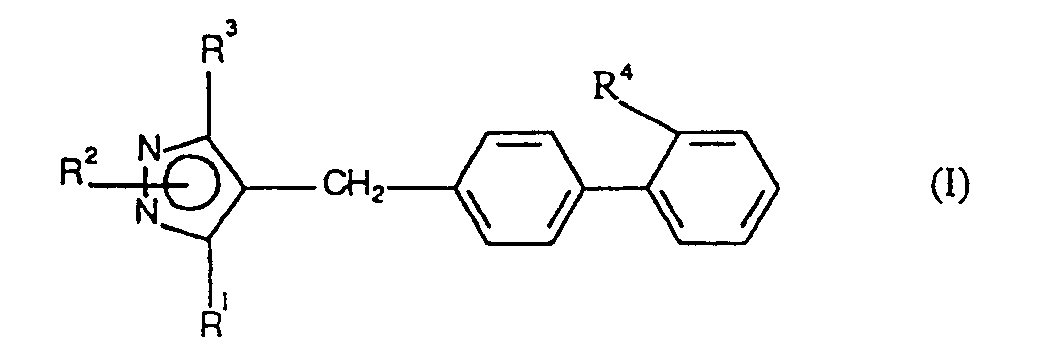
or a physiologically acceptable salt, solvate (e.g. hydrate) or a metabolically labile ester thereof in which
R¹ represents a hydrogen atom or a group selected from C₁₋₆alkyl or C₂₋₆alkenyl;
R² represents a hydrogen atom or a group selected from C₁₋₆alkyl, C₃₋₇cycloalkyl, C₃₋₇cycloalkylC₁₋₄alkyl, C₃₋₆alkenyl, fluoroC₁₋₆alkyl, fluoroC₃₋₆alkenyl, phenyl, -(CH₂)kCOR⁵ or -(CH₂)kSO₂R⁵;
R³ represents a hydrogen atom or a group selected from C₁₋₆alkyl optionally substituted by a hydroxy or C₁₋₆alkoxy group, C₂₋₆alkenyl, fluoroC₁₋₆alkyl, -(CH₂)mR⁶, -(CH₂)nCOR⁷ or -(CH₂)pNR⁸COR⁹;
R⁴ represents a group selected from -CO₂H, -NHSO₂CF₃ or a C-linked tetrazolyl group;
R⁵ represents a group selected from C₁₋₆alkyl, C₂₋₆alkenyl, C₁₋₆alkoxy or the group -NR¹⁰R¹¹;
R⁶ represents a phenoxy or benzyloxy group;
R⁷ represents a hydrogen atom or a group selected from hydroxy, C₁₋₆alkyl, C₁₋₆alkoxy, phenyl, phenoxy or the group -NR¹⁰R¹¹;
R⁸ represents a hydrogen atom or a C₁₋₆alkyl group;
R⁹ represents a hydrogen atom or a group selected from C₁₋₆alkyl, C₁₋₆alkoxy, phenyl, benzyl, phenoxy or the group -NR¹⁰R¹¹;
R¹⁰ and R¹¹ which may be the same or different each independently represent a hydrogen atom or a C₁₋₄alkyl group or -NR¹⁰R¹¹ forms a saturated heterocyclic ring which has 5 or 6 ring members and may optionally contain in the ring one oxygen atom;
k represents zero or an integer from 1 to 4;
m represents an integer from 1 to 4;
n represents zero or an integer from 1 to 4; and
p represents an integer from 1 to 4.
or a physiologically acceptable salt, solvate (e.g. hydrate) or a metabolically labile ester thereof in which
R¹ represents a hydrogen atom or a group selected from C₁₋₆alkyl or C₂₋₆alkenyl;
R² represents a hydrogen atom or a group selected from C₁₋₆alkyl, C₃₋₇cycloalkyl, C₃₋₇cycloalkylC₁₋₄alkyl, C₃₋₆alkenyl, fluoroC₁₋₆alkyl, fluoroC₃₋₆alkenyl, phenyl, -(CH₂)kCOR⁵ or -(CH₂)kSO₂R⁵;
R³ represents a hydrogen atom or a group selected from C₁₋₆alkyl optionally substituted by a hydroxy or C₁₋₆alkoxy group, C₂₋₆alkenyl, fluoroC₁₋₆alkyl, -(CH₂)mR⁶, -(CH₂)nCOR⁷ or -(CH₂)pNR⁸COR⁹;
R⁴ represents a group selected from -CO₂H, -NHSO₂CF₃ or a C-linked tetrazolyl group;
R⁵ represents a group selected from C₁₋₆alkyl, C₂₋₆alkenyl, C₁₋₆alkoxy or the group -NR¹⁰R¹¹;
R⁶ represents a phenoxy or benzyloxy group;
R⁷ represents a hydrogen atom or a group selected from hydroxy, C₁₋₆alkyl, C₁₋₆alkoxy, phenyl, phenoxy or the group -NR¹⁰R¹¹;
R⁸ represents a hydrogen atom or a C₁₋₆alkyl group;
R⁹ represents a hydrogen atom or a group selected from C₁₋₆alkyl, C₁₋₆alkoxy, phenyl, benzyl, phenoxy or the group -NR¹⁰R¹¹;
R¹⁰ and R¹¹ which may be the same or different each independently represent a hydrogen atom or a C₁₋₄alkyl group or -NR¹⁰R¹¹ forms a saturated heterocyclic ring which has 5 or 6 ring members and may optionally contain in the ring one oxygen atom;
k represents zero or an integer from 1 to 4;
m represents an integer from 1 to 4;
n represents zero or an integer from 1 to 4; and
p represents an integer from 1 to 4.
The compounds may be used in the treatment or prophylaxis of hypertension and diseases associated with cognitive disorders.
Description
- This invention relates to C-linked pyrazole derivatives, processes for their preparation and pharmaceutical compositions containing them. According to the invention we provide a compound of general formula (I):

or a physiologically acceptable salt, solvate (e.g. hydrate) or a metabolically labile ester thereof in which
R¹ represents a hydrogen atom or a group selected from C₁₋₆alkyl or C₂₋₆alkenyl;
R² represents a hydrogen atom or a group selected from C₁₋₆alkyl, C₃₋₇cycloalkyl, C₃₋₇cycloalkylC₁₋₄alkyl, C₃₋₆alkenyl, fluoroC₁₋₆alkyl, fluoroC₃₋₆alkenyl, phenyl, -(CH₂)kCOR⁵ or -(CH₂)kSO₂R⁵;
R³ represents a hydrogen atom or a group selected from C₁₋₆alkyl optionally substituted by a hydroxy or C₁₋₆alkoxy group, C₂₋₆alkenyl, fluoroC₁₋₆alkyl, -(CH₂)mR⁶, -(CH₂)nCOR⁷ or -(CH₂)pNR⁸COR⁹;
R⁴ represents a group selected from -CO₂H, -NHSO₂CF₃ or a C-linked tetrazolyl group;
R⁵ represents a group selected from C₁₋₆alkyl, C₂₋₆alkenyl, C₁₋₆alkoxy or the group -NR¹⁰R¹¹;
R⁶ represents a phenoxy or benzyloxy group;
R⁷ represents a hydrogen atom or a group selected from hydroxy, C₁₋₆alkyl, C₁₋₆alkoxy, phenyl, phenoxy or the group -NR¹⁰R¹¹;
R⁸ represents a hydrogen atom or a C₁₋₆alkyl group;
R⁹ represents a hydrogen atom or a group selected from C₁₋₆alkyl, C₁₋₆alkoxy, phenyl, benzyl, phenoxy or the group -NR¹⁰R¹¹;
R¹⁰ and R11 which may be the same or different each independently represent a hydrogen atom or a C₁₋₄alkyl group or -NR¹⁰R¹¹ forms a saturated heterocyclic ring which has 5 or 6 ring members and may optionally contain in the ring one oxygen atom;
k represents zero or an integer from 1 to 4, preferably zero, 1 or 2, especially zero or 1;
m represents an integer from 1 to 4, preferably 1 or 2, especially 1;
n represents zero or an integer from 1 to 4, preferably zero, 1 or 2, especially 0 or 1; and
p represents an integer from 1 to 4, preferably 1 or 2. - Where the compound of general formula (I) is optically active, said formula (I) is intended to cover all enantiomers, diastereoisomers and mixtures thereof including racemates. Where a compound of the present invention contains one or two double bonds, these may exist in the cis or trans configuration. Furthermore where such geometric isomers exist, formula (I) is intended to cover mixtures thereof.
- The invention also includes within its scope the solvates, especially the hydrates, of compounds of general formula (I).
- Within the above definition the term 'alkyl' or 'alkoxy' as a group or part of a group means that the group is straight or branched. The term 'alkenyl' as a group or part of a group means that the group is straight or branched and contains at least one carbon-carbon double bond. The term 'cycloalkyl' as a group or part of a group may be, for example, a cyclopropyl, cyclobutyl, cyclopentyl or cyclohexyl group.
- The term 'fluoroC₁₋₆alkyl' or 'fluoroC₃₋₆alkenyl' means an alkyl or alkenyl group in which one or more hydrogen atoms have been substituted by a fluorine atom, for example, -CH₂CF₃ or -CH=CHCF₃.
- Within the above definition when -NR¹⁰R¹¹ represents a saturated heterocyclic ring, this contains 5 or 6 ring members, one of which may be an oxygen atom. Suitable heterocyclic groups are a pyrrolidino, piperidino or morpholino group.
- A preferred class of compounds of general formula (I) is that wherein the group R¹ is a C₁₋₅alkyl (for example, ethyl, n-propyl or n-butyl), especially a C₃₋₅alkyl, or C₃₋₅alkenyl group. Particularly preferred are those compounds wherein R¹ is an n-butyl, n-propyl, but-1-enyl or prop-1-enyl group.
- Another preferred class of compounds of general formula (I) is that wherein the group R² is a fluoroC₁₋₆alkyl group or the group (CH₂)kSO₂R⁵. Particularly preferred are those compounds wherein R² represents a fluoroC₁₋₃alkyl group, especially -CH₂CF₃, or R⁵ represents the group -NR¹⁰R¹¹ (where R¹⁰ and R¹¹ each represent a C₁₋₄alkyl group), especially SO₂N(CH₃)₂.
- A further preferred class of compound of general formula (I) is that wherein the group R² is a group selected from C₁₋₆alkyl, preferably C₁₋₅alkyl, especially ethyl, isopropyl or isobutyl; C₃₋₇cycloalkyl, preferably C₃₋₅cycloalkyl, especially cyclobutyl; C₃₋₇cycloalkylC₁₋₄alkyl, preferably C₃₋₅cycloalkylC₁₋₄alkyl, especially cyclopropylmethyl; or phenyl.
- Another preferred class of compound of general formula (I) is that wherein the group R² is adjacent to the group R³.
- Yet another preferred class of compounds of general formula (I) is that wherein R³ is selected from a hydrogen atom or a group selected from C₁₋₆alkyl, preferably C₁₋₄alkyl, optionally substituted by hydroxy or C₁₋₃alkoxy, especially methoxy; or -(CH₂)mR⁶, especially wherein R⁶ is a benzyloxy group; or -(CH₂)nCOR⁷, especially wherein R⁷ represents hydrogen, hydroxy or C₁₋₃alkoxy, especially methoxy, and m is 1 or 2 and n is zero, 1 or 2, especially zero or 1. In particular, R³ may represent a hydrogen atom or a group selected from methyl, ethyl, propyl, butyl,-CH₂OH, -CHO, -CH₂OCH₃ or -CO₂H.
- Another preferred class of compounds of general formula (I) is that wherein R³ is the group -(CH₂)pNR⁸COR⁹, especially wherein R⁸ represents hydrogen or a C₁₋₃alkyl group and R⁹ represents hydrogen or a C₁₋₃alkyl or C₁₋₃alkoxy group.
- Preferably, in the compounds of general formula (I), R⁴ may be the group -CO₂H, or a C-linked tetrazolyl group.
- Particularly preferred compounds are:
4′-[[3-butyl-5-(methoxymethyl)-1-(2,2,2-trifluoroethyl)-1H-pyrazol-4-yl]methyl][1,1′-biphenyl]-2-carboxylic acid;
4′-[[5-butyl-3-(methoxymethyl)-1-(2,2,2-trifluoroethyl)-1H-pyrazol-4-yl]methyl][1,1′-biphenyl]-2-carboxylic acid;
5-[4′-[[3-butyl-5-(methoxymethyl)-1-(2,2,2-trifluoroethyl)-1H-pyrazol-4-yl]methyl][1,1′-biphenyl]-2-yl]-1H-tetrazole;
5-[4′[[5-butyl-3-(methoxymethyl)-1-(2,2,2-trifluoroethyl)-1H-pyrazol-4-yl]methyl][1,1′-biphenyl]-2-yl]-1H-tetrazole;
4′-[[5-butyl-1-[(dimethylamino)sulphonyl]-3-(methoxymethyl)-1H-pyrazol-4-yl]methyl][1,1′-biphenyl]-2-carboxylic acid;
4′-[[3-butyl-1-[(dimethylamino)sulphonyl]-5-(methoxymethyl)-1H-pyrazol-4-yl]methyl][1,1′-biphenyl]-2-carboxylic acid;
5-[4′-[[3-butyl-1-[(dimethylamino)sulphonyl]-5-(methoxymethyl)-1H-pyrazol-4-yl]methyl][1,1′-biphenyl]-2-yl]-1H-tetrazole;
5-[4′-[[5-butyl-1-[(dimethylamino)sulphonyl]-3-(methoxymethyl)-1H-pyrazol-4-yl]methyl][1,1′-biphenyl]-2-yl]-1H-tetrazole;
and the physiologically acceptable salts, solvates and metabolically labile esters thereof. - Further particularly preferred compounds of the present invention include:
3-butyl-1-ethyl-4-[[2′-(1H-tetrazol-5-yl)[1,1′-biphenyl]-4-yl]methyl]-1H-pyrazole-5-methanol;
3-butyl-1-(1-methylethyl)-4-[[2′-(1H-tetrazol-5-yl)[1,1′-biphenyl]-4-yl]methyl]-1H-pyrazole-5-methanol;
3-butyl-1-(2-methylpropyl)-4-[[2′-(1H-tetrazol-5-yl)[1,1′biphenyl]-4-yl]methyl]-1H-pyrazole-5-methanol;
3-butyl-1-(2-cyclopropylmethyl)-4-[[2′-(1H-tetrazol-5-yl)[1,1′-biphenyl]-4-yl]methyl]-1H-pyrazole-5-methanol;
3-butyl-1-cyclobutyl-4-[[2′-(1H-tetrazol-5-yl)[1,1′-biphenyl]-4-yl]methyl]-1H-pyrazole-5-methanol;
1,3-dibutyl-4-[[2′-(1H-tetrazol-5-yl)[1,1′-biphenyl]-4-yl]methyl]-1H-pyrazole-5-methanol;
1-ethyl-3-propyl-4-[[2′-(1H-tetrazol-5-yl)[1,1′-biphenyl]-4-yl]methyl]-1H-pyrazole-5-methanol;
1-(1-methylethyl)-3-propyl-4-[[2′-(1H-tetrazol-5-yl)[1,1′-biphenyl]-4-yl]methyl]-1H-pyrazole-5-methanol;
3-butyl-1-(1-methylethyl)-4-[[2′-(1H-tetrazol-5-yl)[1,1′-biphenyl]-4-yl]methyl]-1H-pyrazole-5-carboxaldehyde;
3-butyl-1-(2-methylpropyl)-4-[[2′-(1H-tetrazol-5-yl)[1,1′-biphenyl]-4-yl]methyl]-1H-pyrazole-5-carboxaldehyde;
3-butyl-1-(2-cyclopropylmethyl)-4-[[2′-(1H-tetrazol-5-yl)[1,1′biphenyl]-4-yl]methyl]-1H-pyrazole-5-carboxaldehyde;
3-butyl-1-cyclobutyl-4-[[2′-(1H-tetrazol-5-yl)[1,1′-biphenyl]-4-yl]methyl]-1H-pyrazole-5-carboxaldehyde;
1,3-dibutyl-4-[[2′-(1H-tetrazol-5-yl)[1,1′-biphenyl]-4-yl]methyl]-1H-pyrazole-5-carboxaldehyde;
1-(1-methylethyl)-3-propyl-4-[[2′-(1H-tetrazol-5-yl)[1,1′-biphenyl]-4-yl]methyl]-1H-pyrazole-5-carboxaldehyde;
3-butyl-1-(1-methylethyl)-4-[[2′-(1H-tetrazol-5-yl)[1,1′-biphenyl]-4-yl]methyl]-1H-pyrazole-5-carboxylic acid;
3-butyl-1-(2-methylpropyl)-4-[[2′-(1H-tetrazol-5-yl)[1,1′-biphenyl]-4-yl]methyl]-1H-pyrazole-5-carboxylic acid;
3-butyl-1-cyclobutyl-4-[[2′-(1H-tetrazol-5-yl)[1,1′-biphenyl]-4-yl]methyl]-1H-pyrazole-5-carboxylic acid;
3-butyl-4-[(2′-carboxy[1,1′-biphenyl]-4-yl)methyl]-1-ethyl-1H-pyrazole-5-carboxylic acid;
3-butyl-1-propyl-4-[[2′-(1H-tetrazol-5-yl)[1,1′-biphenyl]-4-yl]methyl]-1H-pyrazole-5-methanol;
1-ethyl-3-propyl-4-[[2′-(1H-tetrazol-5-yl)[1,1′-biphenyl]-4-yl]methyl]-1H-pyrazole-5-carboxaldehyde;
1-ethyl-3-propyl-4-[[2′-(1H-tetrazol-5-yl)[1,1′-biphenyl]-4-yl]methyl]-1H-pyrazole-5-carboxylic acid;
1-(1-methylethyl)-3-propyl-4-[[2′-[1H-tetrazol-5-yl)[1,1′-biphenyl]-4-yl]methyl]-1H-pyrazole-5-carboxylic acid;
1,3-dibutyl-4-[[2′-(1H-tetrazol-5-yl)[1,1′-biphenyl]-4-yl]methyl]-1H-pyrazole-5-carboxylic acid;
3-butyl-4-[(2′-carboxy[1,1′-biphenyl]-4-yl)methyl]-1-(1-methylethyl)-1H-pyrazole-5-carboxylic acid;
3-butyl-1-ethyl-4-[[2′-(1H-tetrazol-5-yl)[1,1′-biphenyl]-4-yl]methyl]-1H-pyrazole-5-carboxaldehyde;
3-butyl-1-propyl-4-[[2′-(1H-tetrazol-5-yl)[1,1′-biphenyl]-4-yl]methyl]-1H-pyrazole-5-carboxaldehyde;
1-(2-methylpropyl)-3-propyl-4-[[2′-(1H-tetrazol-5-yl)[1,1′-biphenyl]-4-yl]methyl]-1H-pyrazole-5-carboxylic acid;
3-butyl-1-propyl-4-[[2′-(1H-tetrazol-5-yl)[1,1′-biphenyl]-4-yl]methyl]-1H-pyrazole-5-carboxylic acid;
3-butyl-1-ethyl-4-[[2′-(1H-tetrazol-5-yl)[1,1′-biphenyl]-4-yl]methyl]-1H-pyrazole-5-carboxylic acid;
3-butyl-1-(2-cyclopropylmethyl)-4-[[2′-(1H-tetrazol-5-yl)[1,1′-biphenyl]-4-yl]methyl]-1H-pyrazole-5-carboxylic acid;
3-butyl-1-ethyl-4-[[2′-[[(trifluoromethyl)sulphonyl]amino][1,1′-biphenyl]-4-yl]methyl]-1H-pyrazole-5-carboxylic acid;
1-ethyl-3-propyl-4-[[2′-[[(trifluoromethyl)sulphonyl]amino][1,1′-biphenyl]-4-yl]methyl]-1H-pyrazole-5-carboxylic acid;
5-[4′-[[3-butyl-1-ethyl-5-(methoxymethyl)-1H-pyrazol-4-yl]methyl][1,1′-biphenyl]-2-yl]-1H-tetrazole;
and the physiologically acceptable salts, solvates and metabolically labile esters thereof. - In accordance with the first aspect of the present invention, there is also provided a compound of the general formula (I) above or a physiologically acceptable salt, solvate or metabolically labile ester thereof wherein
R¹ represents a C₁₋₆alkyl group;
R² represents a hydrogen atom or group selected from C₁₋₆alkyl, C₃₋₇cycloalkyl, C₃₋₇cycloalkylC₁₋₄alkyl, fluoroC₁₋₆alkyl, phenyl, -(CH₂)kCOR⁵ or -(CH₂)kSO₂R⁵;
R³ represents a group selected from C₁₋₆alkyl substituted by a hydroxy or C₁₋₆alkoxy group, -(CH₂)mR⁶ or -(CH₂)nCOR⁷;
R⁴ represents a group selected from -CO₂H, -NHSO₂CF₃ or a C-linked tetrazolyl group;
R⁵ represents the group NR¹⁰R¹¹;
R⁶ represents a benzyloxy group;
R⁷ represent a hydrogen atom or a hydroxy group;
R¹⁰ and R¹¹ each independently represent a hydrogen atom or a C₁₋₄alkyl group;
k represents zero or an integer from 1 to 4;
m represents an integer from 1 to 4; and
n represents zero or an integer from 1 to 4. - The physiologically acceptable acid addition salts of the compounds of formula (I) may be derived from inorganic or organic acids. Examples of such salts include hydrochlorides, hydrobromides, sulphates, phosphates, benzoates, methanesulphonates or trifluoroacetates.
- The compounds may also form salts with suitable bases. Examples of such salts are alkali metal (e.g. sodium or potassium), alkaline earth metal (e.g. calcium or magnesium), ammonium and substituted ammonium (e.g. dimethylammonium, triethylammonium, 2-hydroxyethyldimethylammonium, piperazinium, N,N-dimethylpiperazinium, tetraalkylammonium, piperidinium, ethylenediammonium and choline).
- It will be appreciated that, for pharmaceutical use the salts referred to above will be physiologically acceptable, but other salts may find use, for example, in the preparation of the compounds of formula (I) and the physiologically acceptable salts thereof.
- It will be further appreciated that the compounds of general formula (I) may be chemically modified in the form of compounds which in vivo (for example, by enzymic attack) will provide the parent compounds of general formula (I). Such prodrugs may be, for example, physiologically acceptable metabolically labile ester derivatives. These may be formed by esterification, for example of any of the carboxylic acid groups in the parent compound of general formula (I), with prior protection of any other reactive groups present in the molecule. Examples of such esters include lower alkyl esters (e.g. methyl or ethyl esters), alkenyl esters (e.g. vinyl or alkyl esters), alkynyl esters(e.g. ethynyl or propynyl esters), alkoxyalkyl esters, (e.g. methoxymethyl or 2-methoxyethyl esters), alkylthioalkyl esters (e.g. methylthiomethyl esters) haloalkyl esters (e.g. 2-iodoethyl or 2,2,2,-trichloromethyl esters), alkanoyloxyalkyl esters (e.g. acetoxymethyl, 1-acetoxyethyl or pivaloyloxymethyl esters), alkoxycarbonyloxyalkyl esters (e.g. 1-ethoxycarbonyloxyethyl or 1-methoxycarbonyloxyethyl esters), aroyloxyalkyl esters (e.g. benzoyloxymethyl or 1-benzoyloxyethyl esters), substituted or unsubstituted aralkyl esters (e.g. benzyl or 4-amidobenzyl esters), substituted or unsubstituted aminoethyl esters (e.g aminoalkyl or 2-N,N-dimethylaminoethyl esters) or hydroxyalkyl esters (e.g. 2-hydroxyethyl or 2,3-dihydroxypropyl esters).
- In addition to the above ester derivatives the present invention includes within its scope compounds of general formula (I) in the form of other physiologically acceptable equivalents, i.e. physiologically acceptable compounds which, like the metabolically labile esters, are converted in vivo into the parent compounds of general formula (I).
- According to a second aspect of the invention we provide a compound of general formula (I) or a physiologically acceptable salt, solvate or metabolically labile ester thereof for use in therapy.
- In particular, the compounds of the invention may be used in the treatment or prophylaxis of hypertension. They are also potentially useful for the treatment of cognitive disorders such as dementia (e.g. Alzheimer's disease) and other diseases such as renal failure, hyperaldosteronism, cardiac insufficiency, congestive heart failure, post-myocardial infarction, cerebrovascular disorders, glaucoma and disorders of intracellular homeostasis.
- According to a further aspect of the invention we provide a compound of general formula (I) or a physiologically acceptable salt, solvate or metabolically labile ester thereof for use in the treatment of the aforementioned diseases, especially hypertension.
- According to another aspect of the invention we provide a compound of general formula (I) or a physiologically acceptable salt, solvate or metabolically labile ester thereof for the manufacture of a therapeutic agent for the treatment of the aforementioned diseases, especially hypertension.
- According to a further aspect of the invention we provide a method of treating the aforementioned diseases, especially hypertension, which method comprises administering an effective amount to a patient in need of such treatment of a compound of general formula (I) or a physiologically acceptable salt, solvate or metabolically labile ester thereof.
- It will be appreciated that the compounds of general formula (I) or a physiologically acceptable salt, solvate or metabolically labile ester thereof may advantageously be used in conjunction with one or more other therapeutic agents, such as for example diuretics and/or different antihypertensive agents such as β-blockers, calcium channel blockers or ACE inhibitors. It is to be understood that such combination therapy constitutes a further aspect of the present invention.
- It will be further appreciated that reference herein to treatment extends to prophylaxis as well as to the treatment and relief of established symptoms.
- While it is possible that a compound of general formula (I) may be administered as the raw chemical it is preferable to present the active ingredient as a pharmaceutical formulation.
- The compounds of general formula (I) and their physiologically acceptable salts, solvates and metabolically labile esters may be formulated for administration in any convenient way, and the invention also includes within its scope pharmaceutical compositions comprising at least one compound of general formula (I) or a physiologically acceptable salt, solvate or metabolically labile ester thereof adapted for use in human or veterinary medicine. Such compositions may be presented for use in conventional manner in admixture with one or more physiologically acceptable carriers or excipients. The carrier(s) must be 'acceptable' in the sense of being compatible with the other ingredients of the formulation and not deleterious to the recipient thereof.
- Thus, the compounds according to the invention may be formulated for oral, buccal, parenteral or rectal administration or in a form suitable for administration by inhalation or insufflation. Oral administration is preferred.
- Tablets and capsules for oral administration may contain conventional excipients such as binding agents, for example mucilage of starch or polyvinylpyrrolidone; fillers, for example, lactose, microcrystalline cellulose or maize-starch; lubricants, for example, magnesium stearate or stearic acid; disintegrants, for example, potato starch, croscarmellose sodium or sodium starch glycollate; or wetting agents such as sodium lauryl sulphate. The tablets may be coated according to methods well known in the art. Oral liquid preparations may be in the form of, for example, aqueous or oily suspensions, solutions, emulsions, syrups or elixirs, or may be presented as a dry product for constitution with water or other suitable vehicle before use. Such liquid preparations may contain conventional additives such as suspending agents, for example, sorbitol syrup, methyl cellulose, glucose/sugar syrup or carboxymethyl cellulose; emulsifying agents, for example, sorbitan mono-oleate; non-aqueous vehicles (which may include edible oils), for example, propylene glycol or ethyl alcohol; and preservatives, for example, methyl or propyl p-hydroxybenzoates or sorbic acid. The compounds or their salts or esters may also be formulated as suppositories, e.g. containing conventional suppository bases such as cocoa butter or other glycerides. For buccal administration the composition may take the form of tablets or lozenges formulated in conventional manner.
- It will be appreciated that both tablets and capsules may be manufactured in the form of sustained release formulations, such that they provide a controlled continuous release of the compounds according to the invention over a period of hours.
- The compounds of general formula (I) and their physiologically acceptable salts, solvates and metabolically labile esters may be formulated for parenteral administration by bolus injection or continuous infusion and may be presented in unit dose form in ampoules, or in multi-dose containers with an added preservative. The compositions may take such forms as suspensions, solutions, or emulsions in oily or aqueous vehicles, and may contain formulatory agents such as suspending, stabilising and/or dispersing agents. Alternatively the active ingredient may be in powder form for constitution with a suitable vehicle, e.g. sterile, pyrogen-free water, before use.
- For administration by inhalation the compounds according to the invention are conveniently delivered in the form of an aerosol spray presentation from pressurised packs or a nebuliser, with the use of a suitable propellant, e.g. dichlorodifluoromethane, trichlorofluoromethane, dichlorotetrafluoroethane or other suitable gas. In the case of a pressurised aerosol the dosage unit may be determined by providing a valve to deliver a metered amount.
- Alternatively, for administration by inhalation or insufflation, the compounds according to the invention may take the form of a dry powder composition, for example a powder mix of the compound and a suitable powder base such as lactose or starch. The powder composition may be presented in unit dosage form in, for example, capsules or cartridges of e.g. gelatin, or blister packs from which the powder may be administered with the aid of an inhaler or insufflator.
- The pharmaceutical formulations according to the invention may also contain other active ingredients such as antimicrobial agents, or preservatives.
- It will be appreciated that the amount of a compound of general formula (I) required for use in treatment will vary not only with the particular compound selected but also with the route of administration, the nature of the condition being treated and the age and condition of the patient and will ultimately be at the discretion of the attendant physician or veterinarian. In general, however, when the compositions comprise dosage units, each unit will preferably contain 0.1mg to 500mg, advantageously where the compounds are to be administered orally 1mg to 400mg of the active compound. The daily dosage as employed for adult human treatment will preferably range from 0.1mg to 2g, most preferably from 1mg to 1g which may be administered in 1 to 4 daily doses.
- The compounds of the invention may be prepared by a number of processes as described below wherein the various groups are as defined for general formula (I) unless otherwise specified.
- It will be appreciated by a person skilled in the art that where necessary, reactive or labile groups in the following processes may be protected in a conventional manner using, for example, one of the groups described in process (C) hereinafter.
- Thus, according to a further aspect of the present invention we provide a process (A) for preparing the compounds of general formula (I) which comprises treating a compound of general formula (II)

(wherein R¹, R³ and R⁴ are as defined in general formula (I)) with a hydrazine of formula (III)
R²NHNH₂ (III)
(wherein R² is as defined in general formula (I)) followed by the removal of any protecting groups where present, as described hereinafter. - The reaction is preferably effected in a solvent such as an aqueous alcohol e.g. ethanol, an ether e.g tetrahydrofuran or dioxan, a substituted amide e.g dimethylformamide, acetonitrile or water at a temperature in the range of 0°C to reflux and preferably at room temperature.
- The intermediate diketones of formula (II) are novel compounds and form a further aspect of the invention.
- In another general process (B) a compound of general formula (I) may be obtained by interconversion of another compound of general formula (I). Thus for example, when R² represents a hydrogen atom, such a compound may be converted into a compound of general formula (I) wherein R² represents a group -(CH₂)kCOR⁵ or -(CH₂)kSO₂R⁵ by reaction with L-(CH₂)kCOR⁵ or L-(CH₂)kSO₂R⁵, respectively (wherein L represents a leaving group, for example, a halogen atom such as a chlorine, bromine or iodine, or a hydrocarbylsulphonyloxy group such as methanesulphonyloxy, or p-toluenesulphonyloxy). The reaction is conveniently effected in a suitable solvent such as a substituted amide e.g dimethylformamide or an ether e.g tetrahydrofuran in the presence of a base such as sodium hydride or sodium amide, at a temperature in the range 0°C to reflux, and preferably at room temperature.
- In an alternative example of process (B) a compound of general formula (I) wherein R² is a hydrogen atom may be converted into a compound of general formula (I) wherein R² represents a C₁₋₆alkyl, C₃₋₇cycloaklyl or C₃₋₇cycloalkylC₁₋₄alkyl group, or a group -(CH₂)kCOR⁵ or -(CH₂)kSO₂R⁵ where k is 1 to 4, by reaction with a corresponding alkylating agent, for example, an alkylhalide such as an alkyliodide. The reaction is conveniently effected in a suitable solvent such as a substituted amide e.g. dimethylformamide or an ether e.g. tetrahydrofuran in the presence of a base such as potassium carbonate or sodium hydride, at a temperature in the range of 0°C to reflux, and preferably at room temperature.
- It will also be appreciated that other substituents in a compound of general formula (I) may be modified by techniques well known in the art to produce alternative compounds of general formula (I).
- In another general process (C) a compound of general formula (I) may be obtained by deprotection of a protected intermediate of general formula (Ia)

(wherein R¹, R², R³ and R⁴ are as defined in general formula (I) except that at least one reactive group is blocked by a protecting group). The protecting groups may be any conventional protecting groups, for example as described in "Protective Groups in Organic Synthesis" by Theodora Greene (John Wiley and Sons Inc., 1981). Examples of carboxyl protecting groups include C₁₋₆alkyl such as methyl or t-butyl, or C₇₋₁₀aralkyl such as benzyl. - When R⁴ is a tetrazolyl group, this may be protected with, for example, the trityl group -C(phenyl)₃, or a p-nitrobenzyl or 1-ethoxyethyl group.
- Deprotection to yield the compound of general formula (I) may be effected using conventional techniques. Thus, for example, aralkyl groups may be cleaved by hydrogenolysis in a suitable organic solvent such as an alcohol, e.g. ethanol, in the presence of a noble metal catalyst such as palladium or an oxide thereof on a support such as charcoal, and conveniently at room temperature and pressure. Carboxyl protecting groups such as alkyl groups may be cleaved by hydrolysis using a base such as an alkali metal hydroxide (e.g. sodium hydroxide or potassium hydroxide) in a suitable solvent (e.g. an aqueous alcohol such as methanol or ethanol) at any suitable temperature up to reflux. Deprotection of the tetrazolyl group when protected with a trityl group may be effected by acid hydrolysis using trifluoroacetic acid, a sulphonic acid such as dl-10-camphor sulphonic acid, or a mineral acid such as hydrochloric acid in a suitable solvent such as methanol, ethanol, tetrahydrofuran or mixtures thereof conveniently at room temperature to reflux. Alternatively, when possible, deprotection of the tetrazolyl group can be effected by catalytic hydrogenation as previously described.
- In another general process (D) a compound of general formula (I) in which the substituent R⁴ represents a C-linked tetrazolyl group, may also be prepared from a compound of general formula (IV)

(wherein, R¹, R² and R³ are as defined in general formula (I)) by reaction with a suitable azide such as sodium azide, ammonium azide (preferably prepared in situ from sodium azide and ammonium chloride), trialkyl-(e.g.triethyl)ammonium azide (preferably prepared in situ from sodium azide and a trialkylamine (e.g. triethylamine)), a trialkylsilylazide (e.g. trimethylsilylazide) or an alkyl azide e.g. tributyl tin azide. The reaction is conveniently effected in a solvent such as xylene, an ether, for example, dimethoxyethane or tetrahydrofuran, or a substituted amide, for example, dimethylformamide, at an elevated temperature, such as the reflux temperature of the solvent, for between 1 and 10 days. Where the azide is tributyl tin azide the reaction may conveniently be effected in the absence of a solvent at a temperature between room temperature and 180°C. Such a reaction leaves the tetrazolyl group protected with a tributyl tin group, which can readily be removed using aqueous base or acid. Where aqueous base is used to effect this deprotection, the compound may be treated with an aqueous acid to liberate the tetrazole. - Compounds of general formula (IV) may be prepared by processes analogous to those described herein commencing from a compound of formula (XV).
- The Intermediate compounds of general formula (IV) are novel compounds and form a further aspect of the present invention.
- In another general process (E) a compound of general formula (I) in which the substituent R⁴ represents -NHSO₂CF₃, may be prepared from a compound of general formula (V)

(wherein R¹, R² and R³ are as defined in general formula (I)) by reaction with trifluoromethanesulphonic anhydride or trifluoromethylsulphonyl chloride, in a suitable solvent such as a halogenated hydrocarbon, e.g. dichloromethane or chlorform. - Compounds of general formula (V) may be prepared by processes analogous to those described herein commencing from a compound of formula (XVI) or a nitro precursor thereof.
- Alternatively, compounds of general formula (V) may be prepared by a Curtius rearrangement of a compound of formula (I) wherein R⁴ is -CO₂H (provided that this is the only carboxyl group in the molecule) using, for example, diphenylphosphorylazide in the presence of a base such as triethylamine and in a solvent such as an alcohol (e.g. tert-butanol) to form a carbamate followed by deprotection of the amine in a conventional manner, for example by acid hydrolysis using hydrochloric acid in a solvent such as ethanol.
- The intermediate compounds of general formula (V) and their acid addition salts are novel compounds and form a further aspect of the present invention.
- In another general process (F) a compound of general formula (I) may be prepared by treating a compound of formula (VI) with a compound of formula (VII)

(where one of R¹² and R¹³ represents a halogen atom, for example, bromine or iodine, and the other represents the group -B(OH)₂ or an ester thereof, and R¹, R², R³ and R⁴ are as defined in general formula (I)). - The reaction may be effected in the presence of a transition metal catalyst such as tetrakis(triphenylphosphine)palladium (0), in a suitable solvent such as an ether (e.g. 1,2-dimethoxyethane or tetrahydrofuran) or an aromatic hydrocarbon (e.g. benzene). The reaction is preferably carried out in the presence of a base such as an alkali or alkaline earth metal carbonate (e.g. sodium carbonate) at a suitable temperature up to reflux.
- The intermediate compounds of formula (VI) are novel compounds and form a further aspect of the present invention.
- In another general process (G) a compound of general formula (I) wherein R³ represents the group -(CH₂)nCOR⁷ where n is zero and R⁷ is C₁₋₆alkoxy, may be prepared by reacting a biphenyl compound of formula (VIII)

(wherein R⁴ is as defined in general formula (I) and L is a leaving group as defined above) with a compound of formula (IX)
(wherein R¹ and R² are as defined in general formula (I) and R7a is a C₁₋₆alkoxy group). - The reaction is conveniently effected at a temperature between -100°C and room temperature in a suitable solvent such as an ether, for example, tetrahydrofuran, dimethoxyethane or diethyl ether.
- In the processes (A),(B), (C), (D), (E), (F) and (G) described above, the compounds of general formula (I) may be obtained in the form of a salt, conveniently in the form of a physiologically acceptable salt. Where desired, such salts may be converted into the corresponding free acids or free bases using conventional methods.
- Physiologically acceptable salts of the compounds of general formula (I) may be prepared by reacting a compound of general formula (I) with an appropriate acid or base in the presence of a suitable solvent such as acetonitrile, acetone, chloroform, ethyl acetate or an alcohol, e.g. methanol, ethanol or isopropanol.
- Physiologically acceptable salts may also be prepared from other salts, including other physiologically acceptable salts, of the compounds of general formula (I), using conventional methods.
- The intermediate compounds of general formula (II) may be prepared from a compound of formula (X)
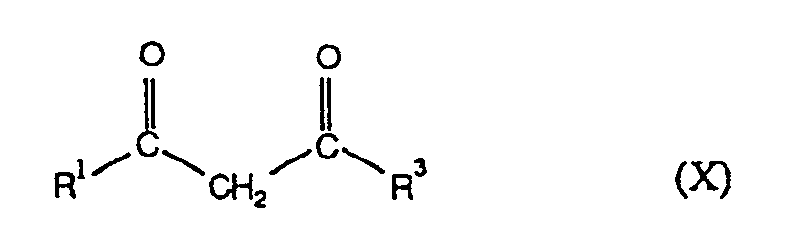
(wherein R¹ and R³ are as defined in general formula (I)) by condensation with a compound of formula (XI)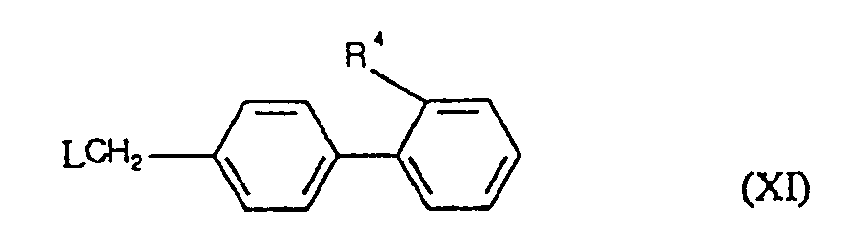
(wherein R⁴ is defined in general formula (I) and L is a leaving group, for example a halogen atom such as chlorine, bromine or iodine, or a hydrocarbylsulphonyloxy group such as methanesulphonyloxy, or p-toluenesulphonyloxy). The reaction is preferably effected under basic conditions, for example, in the presence of sodium hydride, potassium carbonate or sodium methoxide. The reaction is conveniently effected in a solvent such as acetonitrile or an ether e.g. tetrahydrofuran or dioxan, a ketone e.g. butanone or acetone, or a substituted amide e.g. dimethylformamide, at a temperature between 0°C and the reflux temperature of the solvent. - Compounds of formula (X) may be prepared by reaction of a compound of formula (XII)
R¹COCH₃ (XII)
With a compound of formula (XIII)
R³CO₂CH₃ (XIII)
preferably in the presence of a base such as sodium amide, sodium hydride or tetra-n-butyl ammonium fluoride. The reaction is conveniently effected in a solvent such as an ether e.g. tetrahydrofuran or dioxan, or a halogenated hydrocarbon e.g. dichloromethane at a temperature between 0°C and the reflux temperature of the solvent. - Compounds of formula (VIII) and (XI) may be prepared from a compound of formula (XIV)

using any suitable reagent well known in the art for converting the methyl group in formula (XIV) into the group -CH₂L (wherein L is as defined above). Thus for example, when L is a halogen atom, a compound of formula (XIV) can be converted into a compound of formula (XI) using N-chloro amides, tert-butyl hypochlorite or N-bromosuccinimide. Halogenation may be catalysed by light, thus the reaction mixture can be illuminated with a suitable artificial light source, and preferably in the presence of a free radical initiator such as azobisisobutyronitrile (AIBN) or dibenzoyl peroxide. The reaction may be conveniently effected in a solvent such as a halogenated hydrocarbon, e.g. carbon tetrachloride at an elevated temperature such as the reflux temperature of the solvent. - Compounds of formula (XIV) in which R⁴ represents a C-linked tetrazolyl group may be prepared from a compound of formula (XV)

using the reagents and conditions described in process (D). - Compounds of formula (XIV) in which R⁴ represents the group -NHSO₂CH₃ may be prepared from a compound of formula (XVI)
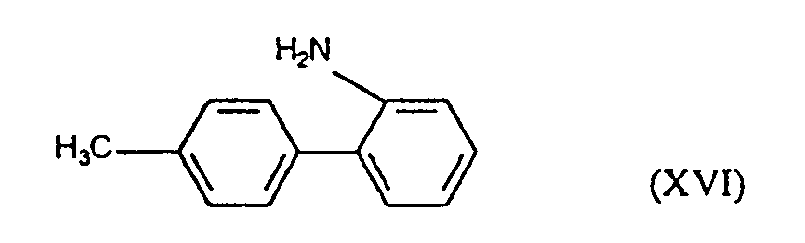
using the reagents and conditions described in process (E). - Compounds of formula (XIV) in which R⁴ represents -COOH or -NHSO₂CF₃, and compounds of formulae (XV) and (XVI), may be prepared by reaction of a compound of formula (XVII)

(wherein Z represents a bromine or iodine atom or the group -OSO₂CF₃, and R4a represents either -COOH, -NHSO₂CF₃, a nitrile or amino group or a group convertible thereto by standard methodology) with a corresponding 4-methylbenzeneboronic acid derivative in the presence of a palladium (0) compound such as tetrakis(triphenylphosphine) palladium (0) in a solvent such as dimethoxyethane in the presence of a base such as sodium carbonate or thallium hydroxide. The reaction is conveniently effected at an elevated temperature, such as the reflux temperature of the solvent. - Compounds of formulae (VI) or (VII) where R¹² or R¹³ represents -B(OH)₂ may be prepared from the corresponding halides by lithiation at low temperature followed by reaction with a suitable boronic acid ester (e.g. triisopropylborate) and subsequent hydrolysis with water or an acid (e.g. hydrochloric acid).
- Alternatively, compounds of formula (VI) wherein R¹² represents Hal may be prepared by the reaction of a compound of formula (XVIII)

with a compound of formula (III) under the reaction conditions of general process (A). - Compounds of formula (XVIII) may be prepared by reaction of a compound of formula (XIX)
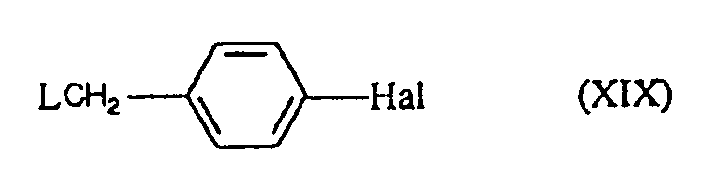
(wherein Hal is a bromine or iodine atom and L is a leaving group) with a compound of formula (X) under basic conditions, for example, in the presence of sodium hydride, potassium carbonate or sodium methoxide. The reaction is conveniently effected in a solvent such as acetonitrile or an ether e.g. tetrahydrofuran, a ketone, e.g. acetone or a substituted amine e.g. dimethylformamide, at a temperature between 0°C and the reflux temperature of the solvent. - Compounds of formula (IX) may be prepared by lithiation of a compound of formula (XX)

- The reaction may be effected using an alkyllithium compound, for example, tert-butyl lithium at a temperature between -100°C and room temperature, in a suitable solvent such as an ether, for example, tetrahydrofuran, dimethoxyethane or diethyl ether.
- Compounds of formula (XX) may be prepared by halogenation of a compound of formula (XXI)

using standard methodology described herein above. - Compounds of formula (XXI) may be prepared by the reaction of a compound of formula (X) wherein R³ represents -(CH₂)nCOR⁷ (where n is zero and R⁷ is C₁₋₆alkoxy) with a compound of formula (III) using the method of general process (A).
- Intermediates of formulae (III), (VII), (VIII), (XII), (XIII), (XVI) and (XVII) are either known compounds or may be prepared by methods analogous to those described herein or used for the preparation of the known compounds.
- The following examples illustrate the invention. Temperatures are in °C. "Dried" refers to drying using magnesium sulphate. Thin layer chromatography was carried out on silca, using one of the following solvent systems: A - ether:hexane, B - dichloromethane:ethanol:ammonia, C - ether:petroleum ether (40-60°), D - ethyl acetate:hexane, E - ethyl acetate:ethanol, F - ether:acetic acid, G - ether:hexane:acetic acid, or H - ethyl acetate: acetic acid. The following abbreviations are used: DFC - dry flash chromatography on silica gel (Merck 9385); THF-tetrahydrofuran; DME - dimethoxyethane ; AIBN - azobisisobutyronitrile; DMF - N,N-dimethylformamide; TFA - trifluoroacetic acid.
- 2-Hexanone (96.8g) was added dropwise over 15min under nitrogen to a stirred suspension of sodium amide (37.7g) in dry ether (1 litre) at room temperature. The mixture was stirred for 12min, a solution of methyl methoxyacetate (50.3g) in dry ether (150ml) was added diopwise over 20min, and the mixture was heated under reflux for 2h. The mixture was cooled, poured into ice and 2N hydrochloric acid (600ml) and the aqueous layer extracted with ether (4x 300ml). The organic layers were washed with 8% sodium bicarbonate solution and brine, dried and evaporated to give an orange liquid (102g). Purification by DFC, eluting with System A (5:95) gave a yellow liquid (36g).
T.l.c. (System A 5:95) Rf 0.1. - A solution of o-bromobenzoic acid (1g), N,N′-dicyclohexyl carbodiimide (1.129g), t-butanol (405mg) and 4-dimethylaminopyridine (61mg) in dry ether (20ml) was stirred at room temperature for 18h. The resulting precipitate was filtered off and the filtrate evaporated to give a colourless solid which was triturated under petroleum ether (40-60°) (20ml) and filtered. The filtrate was evaporated to give a pale yellow oil (0.994g). b.p. 80-84°/0.35 mmHg.
- A mixture of Intermediate 2a (2.0g) 4-methylbenzeneboronic acid (1.17g), tetrakis(triphenylphosphine) palladium (0) (269mg) and sodium carbonate solution (1M; 21ml) in DME (80ml) was heated under reflux for 18h. The solvent was evaporated and the residue partitioned between ether (3x 50ml) and sodium carbonate (2N; 100ml) and the combined organic extracts were washed with brine (2x 100ml) and dried. The solvent was evaporated to give a pale-yellow oil which was purified by short-path column chromatography on silica gel (Merck 7729; 40g). Elution with System C (1:40) gave a colourless, mobile oil (1.88g).
T.1.c (System C 1:40) Rf 0.3. - A mixture of Intermediate 2b (1.825g), N-bromosuccinimide (1.21g) and dibenzoyl peroxide (130mg) in carbon tetrachloride (30ml) was heated under reflux for 18h. The solvent was evaporated in vacuo and the residue partitioned between ether (3x 50ml) and sodium bisulphite solution (50ml). The combined organic extracts were dried and the solvent evaporated to give a yellow oil which was purified by short-path column chromatogrpahy on silica gel (Merck 7729; 60g). Elution with System C (1:50) gave a colourless crystalline solid (1.15g).
T.1.c (System C 1:50) Rf 0.25. - To a solution of o-bromobenzonitrile (40g) and 4-methylbenzeneboronic acid (33g) in DME (2 litres) was added tetrakis (triphenylphosphine) palladium (0) (7.58g) and then sodium carbonate (1M, 592ml). The mixture was stirred vigorously and heated at reflux for 18 hours. The solvent was removed in vacuo and the dark residue partitioned between ether (800ml) and sodium carbonate (1M, 800ml); the aqueous phase was extracted with ether (3x 400ml). The combined organic phases were dried and concentrated in vacuo to afford an orange oil which was crystallised from System C (1:3) using activated charcoal as a decolourising agent to afford a white solid (33.0g).
T.1.c. System A (1:9) Rf 0.30 -
A mixture of Intermediate 3a (7g) and tributyl tin azide (24g) was heated at 160°C. Further amounts of Intermediate 3a were added after 2h (4g) and a further 1.5h (2g) and heating then continued for another 1.5h. The cooled reaction mixture diluted with ether (200ml) and extracted with aqueous sodium hydroxide solution (2M;50ml). The aqueous mixture was poured into cold concentrated HCl (50ml) and the white solid filtered and air-dried. This solid was crystallised from toluene (200ml) to give the title compound as cream microcrystals (10.2g).
T.1.c. ether Rf. 040 - To a suspension of Intermediate 3b (12.2g) in dry dichloromethane (100ml) was added triethylamine (12.8ml). Trityl chloride (14.6g) was added followed by N,N-dimethylaminopyridine (251mg) and the resultant solution was stirred at room temperature for 16h. The reaction mixture was partitioned between water (200ml) and dichloromethane (200ml). The separated organic phase was washed with water (200ml), dried and concentrated in vacuo to give the title compound as a cream-coloured solid (21.2g).
T.1.c. System A (1:1) Rf 0.55 - To a solution of Intermediate 3c (21.1g) in carbon tetrachloride (600ml) was added N-bromosuccinimide (8.3g), and the mixture heated almost to reflux. Dibenzoyl peroxide (854mg) was added and the mixture heated at reflux for 3.5h. Further dibenzoyl peroxide (800mg) was added and the reaction mixture heated at reflux for a further 60h. Further N-bromosuccinimide (4.2g) and dibenzoyl peroxide (854mg) were added and the mixture heated at reflux in the presence of a 200W lamp for 3h. The cooled mixture was filtered and the filtrate washed with water (2x150ml), dried and concentrated in vacuo to afford the title compound as a cream glassy solid (23g).
T.1.c (ethyl acetate:petroleum ether 1:1) Rf 0.90.
-
- Intermediate 1 (13.4g) was heated under reflux with Intrmediate 2 (30.0g) and anhydrous potassium carbonate (10.8g) in acetone (390ml) with stirring under nitrogen for 6h. The solvent was evaporated and the residue partitioned between water (300ml) and ether (3x 200ml); the organic extracts were washed with brine, dried and evaporated to give an orange oil (39.5g). Purification by DFC eluting with System A (1:4) gave the title compound as a pale yellow oil (25g).
T.l.c. System A (1:3) Rf 0.1. - Sodium hydride (80% dispersion in oil, 200mg) was added to a stirred solution of Intermediate 1 (0.96g) in dry THF (20ml) at room temperature under nitrogen, and stirring was continued at room temperature for 40min. A solution of Intermediate 3 (2.08g) in THF (5ml) was added, and the mixture was heated under reflux for 22h. The mixture was poured into water (50ml) and extracted with ether (3x 40ml); the organic layers were washed with brine, dried and evaporated to give a dark yellow oil (2.38g). Purification by DFC eluting with System A (20:80 to 50:50) gave the title compound as pale yellow oil (0.8g).
T.l.c. (System A 40:60) Rf 0.2. - Intermediate 4 (0.5g) was stirred at room temperature with hydrazine hydrate (85% 0.086ml) in absolute ethanol (15ml) under nitrogen for 16h. The solvent was evaporated to give a colourless oil (375mg). Purification by DFC eluting with System B (98:2:0.2) gave a colourless oil (325mg).
T.l.c. System C (50:50), Rf 0.2. -
- Intermediate 4 (1.0g) was stirred with phenylhydrazine (0.224ml) in ethanol (absolute, 20ml) at room temperature under nitrogen for 16h and heated under reflux for 24h. The solvent was evaporated to give an orange oil (1.22g). Purification by DFC eluting with System A (10:90 - 30:70) gave:
(a) Intermediate 7a as a pale yellow oil (229mg),
T.l.c. (System C 50:50) Rf 0.4, and
(b) Intermediate 7b as a pale yellow oil (256mg),
T.l.c. (System C 50:50) Rf 0.75. - Intermediate 4 (0.5g) was stirred at room temperature under nitrogen with 2,2,2-trifluoroethylhydrazine (70% in water, 0.204ml) in ethanol (10ml) for 24h. The solvent was evaporated and the residue (0.7g) purified by DFC eluting with System A (10:90 → 50:50) to give:
(a) Intermediate 8a as a pale yellow oil (180mg),
T.1.c (System A 50:50) Rf 0.55; and
(b) Intermediate 8b as a colourless oil (239mg),
T.l.c. (System A 50:50) Rf 0.25. - Intermediate 5 (150mg) was stirred at room temperature under nitrogen with hydrazine hydrate (80% hydrazine hydrate; 0.018ml) in absolute ethanol (3ml) for 3 days. The solvent was evaporated and the residue purified by DFC, eluting with ether to give the title compound as a colourless gum (78mg).
T.l.c. (ether) Rf 0.2 - Intermediate 5 (0.805g) was stirred at room temperature with 2,2,2-trifluoroethylhydrazine (70% solution in water, 0.304ml) in ethanol for 21h. The solvent was evaporated and the residue purified by DFC eluting with System A (10:90 to 60:40) to give:
(a) Intermediate 10a, T.1.c (System A 50:50) Rf 0.35; and
(b) Intermediate 10b, T.1.c. (System A 50:50) Rf 0.2. - Sodium hydride (52mg) was added to a stirred solution of Intermediate 6 (0.5g) in dry DMF (5ml), and stirring was continued at room temperature under nitrogen for 1.5h. Chloroacetamide (122mg) was added and stirring was continued at room temperature for 3h. The mixture was partitioned between water (30ml) and ethyl acetate (3x 20ml); the organic extracts were washed with 50:50 brine:water (3x30ml), dried and evaporated to give a pale yellow gum (658mg). Purification by DFC, eluting with System D (50:50) followed by ethyl acetate, and System E (95:5) gave:
(a) Intermediate 11a as a colourless oil (291mg),
T.1.c. (ethyl acetate) Rf 0.15; and
(b) Intermediate 11b as a pale yellow gum (277mg),
T.1.c (ethyl acetate) Rf 0.3. -
- A mixture of Intermediate 6 (1.0g), methyl iodide (330mg) and potassium carbonate (320mg) in DMF (30ml) was stirred at room temperature for 3 days. The reaction mixture was poured into water and extracted with ethyl acetate. The combined organic extracts were washed with water, brine, dried and evaporated to give a colourless oil. This was chromatographed on silica gel eluting with System A (20:80 → 80:20) followed by ether to give:
(a) Intermediate 12a as a colourless oil (124mg),
T.1.c (System F 99:1) Rf 0.3; and
(b) Intermediate 12b as a colourless oil (330mg),
T.1.c (System A 50:50) Rf 0.50. - Sodium hydride (52mg; 80% dispersion in oil) was added to a stirred solution of Intermediate 6 (0.5g) in dry DMF (5ml) at room temperature under nitrogen. After stirring for 0.5h, N,N-dimethylsulphamoyl chloride (0.185ml) was added at 0° and stirring was continued at 0° for 2h. The mixture was partitioned between water (30ml) and ethyl acetate (3x 20ml); the organic layers were washed with 50:50 brine:water (3x 30ml) and brine (30ml), dried and evaporated to give a pale yellow oil (0.76g). Purification by DFC eluting with System A (20:80 to 40:60) gave:
(a) Intermediate 13a as a colourless oil (296mg),
T.1.c. (System A 50:50) Rf 0.3; and
(b) Intermediate 13b as a colourless oil (231mg),
T.1.c. (System A 50:50) Rf 0.45. -
- A solution of Intermediate 9 (1.26g) in dry DMF (5ml) was added dropwise to a suspension of sodium hydride (60% in oil, 116mg) in dry DMF (5ml). The resulting pale yellow solution was stirred at room temperature for 0.5h, then a solution of the ethyl iodide (0.16ml) in dry DMF (1ml) was added dropwise. The mixture was stirred at room temperature for 2h, then partitioned between water (20ml) and ethyl acetate ( 3 x 20ml). The combined organic extracts were washed with brine/water 1:1 (3x 50ml) and dried. The solvent was evaporated to give a pale yellow foam (1.283g) which was purified by short-path column chromatography on silica gel (Merck 7729) eluting with System C (1:1→2:1) to give:
(a) Intermediate 14a as a pale yellow gum (569mg)
n.m.r. (CDCl₃, 250 MHz) δ 0.85 (3H,t), 1.2-1.6 (4H, m), 1.40 (3H, t), 2.45 (2H, t), 3.20 (3H, s), 3.70 (2H, s), 4.12 (2H, q), 4.20 (2H, s), 6.90-7.50 (7H, m), 7.85-7.9 (1H); and
(b) Intermediate 14b (654mg)
n.m.r. (CDCl₃, 250 MHz) δ 0.85 (3H, t), 1.2-1.35 (4H, m), 1.41 (3H, t), 2.40 (2H, t), 3.30 (3H, s), 3.72 (2H, s) 4.05 (2H, q), 4.28 (2H, s), 6.90-7.50 (7H, m), 7.85-7.9 (1H). - Sodium hydride (60% in oil; 93mg) was added portionwise to a solution of Intermediate 9 (1.0g) in dry DMF (10ml) at room temperature under nitrogen. The resulting pale yellow suspension was stirred at room temperature for 0.5h, cooled to 0°C then a solution of dimethylsulphamoyl chloride (222mg) in dry DMF (0.5ml) was added dropwise. The resulting mixture was stirred at room temperature for 2h, then partitioned between ethyl acetate (3 x 20ml) and water (20ml). The combined organic extracts were washed with brine/water (1:1) (3 x 20ml) and dried. The solvent was evaporated to give a pale yellow foam (1.27g), which was purified by short-path column chromatography on silica gel (Merck 7729) eluting with System A (1:2) to give:
(a) Intermediate 15a as a colourless foam (462mg)
T.1.c. (System C 1:1) Rf 0.4; and
(b) Intermediate 15b as a colourless foam (615mg)
T.1.c (System C 1:1) Rf 0.35. - 2-Hexanone (26.7g) was added dropwise over 5 min at room temperature to a stirred suspension of sodium amide (10.4g) in dry ether (290ml) under nitrogen. The reaction mixture was stirred for 13min and a solution of methyl phenylmethoxyacetate (24.0g) in dry ether (40ml) was added dropwise over 12min. The mixture was then heated at reflux for 3h, cooled, and then poured into ice (400g) and 2N HCl (200ml). The aqueous phase was extracted with ether (2 x 350ml) and the combined etheral solution washed with 8% sodium bicarbonate solution (2 x 250ml), water (200ml) and brine (200ml), then dried and evaporated to leave a yellow liquid (35.8g). This was purified by column chromatography on silica gel eluting with System A (2:98) to give the title compound as a yellow oil (10.95g)
T.1.c. (System C 1:9) Rf. 0.50 - To a suspension of sodium hydride (60% in oil; 820mg) in THF (63ml) at 0°C was added a solution of Intermediate 16 (4g) in THF (6.5ml) dropwise over 35min. The reaction mixture was stirred at room temperature for 40min prior to the addition of Intermediate 3 (6.38g) in THF (21ml) over 15 min. The resultant reaction mixture was heated at reflux for 17h. The reaction mixture was concentrated in vacuo and the residue partitioned between water (80ml) and ether (3x80ml). The combined organic layers were dried and concentrated in vacuo and then purified by column chromatography on silica gel eluting with System C (1:8) to afford the title compound (3.0g) as a white solid.
T.1.c (System C 1:3) Rf 0.28 - Hydrazine hydrate (85%; 0.85ml) was added to a solution of Intermediate 17 (10.17g) in ethanol (100ml) containing dichloromethane (20ml). The mixture was stirred at room temperature for 2 days. The solvent was evaporated in vacuo and the residue purified by column chromatography on silica gel eluting with System C (4:1) and increasing the polarity to neat ether, to give the title compound as a colourless foam (7.67g).
T.1.c (ether) Rf 0.5. - From 2-heptanone and methyl phenylmethoxyacetate according to the method of Intermediate 16.
T.1.c. System A (1:10) Rf 0.39 - From Intermediate 19 according to the method of Intermediate 17.
T.1.c. System A (1:4) Rf 0.20 - From Intermediate 20 according to the method of Intermediate 18.
T.1.c. System A (5:1) Rf 0.25 - and
-
A solution of Intermediate 18 (3.0g) in dry DMF (15ml) was added dropwise to a suspension of sodium hydride (60% dispersion in oil; 254mg), in dry DMF (15ml) at 0° under nitrogen. The mixture was stirred at 5-10° for 15mins, then a solution of ethyl iodide (660mg) in dry DMF (1ml) was added dropwise. The mixture was allowed to warm to room temperature over 1h. The mixture was partitioned between water (50ml) and ethyl acetate (3x25ml) and the combined organic extracts washed with brine/water 1:1 (2x50ml) and dried. The solvent was evaporated to give a pale yellow gum (3.19g) which was purified by column chromatography on silica gel eluting with System A (1:2→1:1) to give the title compound:
(a) Example 22a as a colourless foam (1.33g),
T.1.c System A (1:2) Rf 0.2; and
(b) Example 22b as a colourless foam (1.60g),
T.1.c. System A (1:2) Rf 0.5. - Similarly prepared from Intermediate 18 and the appropriate alkyl halide were:-
- T.1.c. System A (1:2) Rf 0.45
- T.1.c. System A (1:2) Rf 0.35
- T.1.c. System A (2:3) Rf 0.3
- T.1.c. System A (1:2) Rf 0.25
- T.1.c. System A (2:3) Rf 0.45
- T.1.c. System A (2:3) Rf 0.42
- T.1.c. System A (1:1) Rf 0.71
- T.1.c. System A (1:1) Rf 0.68
- T.1.c. System A (4:1) Rf 0.44
- T.1.c. System A (4:1) Rf 0.34
- T.1.c. System A (2:1) Rf 0.60
- T.1.c. System A (2:1) Rf 0.44
-
- T.1.c. System G (60:30:1) Rf 0.80
- T.1.c. System G (60:30:1) Rf 0.66
Similarly prepared from Intermediate 21 and the appropriate alkyl halide were:- - T.1.c. System A (3:1) Rf 0.75
- T.1.c. System A (3:1) Rf 0.60
- T.1.c. System A (1:1) Rf 0.50
- T.1.c. System A (1:1) Rf 0.36
- 2-Butanone (47.65ml) was added dropwise over 10min to a mechanically stirred suspension of sodium amide (95%; 20.78g) dry ether (600ml) at room temperature under nitrogen. The reaction mixture was stirred at room temperature for 15min. A solution of methyl phenylmethoxyacetate (48.0g) in dry ether (50ml) was added dropwise over 13min at room temperature under nitrogen, and the reaction progressed according to the method of Intermediate 16, to give the title compound as a yellow oil (23.35g)
T.l.c. System A (1:10) Rf 0.15. - From Intermediate 32 according to the method of Intermediate 20.
T.1.c. System A (1:4) Rf 0.30. - From Intermediate 33 according to the method of Intermediate 21.
T.1.c. System A (6:1) Rf 0.21. - and
- From Intermediate 34 according to the method of Intermediate 22 gave:
(a) Intermediate 35a as a yellow gum (1.18g)
T.1.c. System A (3:1) Rf 0.60
(b) Intermediate 35b as a yellow gum (1.40g)
T.1.c. System A (3:1) Rf. 0.40. - From Intermediate 16 and Intermediate 2 according to the method of Intermediate 17.
T.1.c. System A (1:5) Rf 0.25. - From Intermediate 36 according to the method of Intermediate 18.
T.1.c. System A (3:2) Rf 0.15. - From Intermediate 37 and ethyl iodide according to the method of Intermediate 22.
Intermediate 38a: T.1.c. System A (1:1) Rf 0.35
Intermediate 38b: T.1.c. System A (1:1) Rf 0.2. - From Intermediate 37 and isopropyl iodide according to the method of Intermediate 22.
Intermediate 39a: T.1.c. System A (1:2) Rf 0.3
Intermediate 39b: T.1.c. System A (1:2) Rf 0.2. - From Intermediate 38a according to the method of Example 26.
T.1.c. ethyl acetate:hexane (1:1) Rf. 0.4. - From Intermediate 39a according to the method of Example 26.
T.1.c. System A (1:1) Rf. 0.25. -
- From Intermediate 40 according to the method of Example 42.
T.1.c. System A (1:1) Rf 0.7. - From Intermediate 41 according to the method of Example 42.
T.1.c. System A (1:1) Rf. 0.7. - From Intermediate 42 according to the method of Example 50.
T.1.c. ether:hexane:acetic acid (50:50:1) Rf. 0.6 - From Intermediate 21 and 2-methylpropyl iodide according to the method of Intermediate 22.
Intermediate 45a: T.1.c. System A (1:1) Rf 0.27
Intermediate 45b: T.1.c. System A (1:1) Rf 0.19 - From Intermediate 43 according to the method of Example 50.
T.1.c. System G (20:20:1) Rf 0.65 -
A solution of Intermediate 6 (320mg) in dry dichloromethane (30ml) was treated with TFA (1ml) and the reaction stirred at room temperature for 5h. The volatiles were removed in vacuo and the residue triturated with ether to give the title compound (162mg) as a white solid.
T.1.c. (System C 50:50), Rf 0.05. - Assay Found:
- C,60.7; H,5.7; N,5.5.
- C₂₃H₂₆N₂O₃.CF₃CO₂2H requires
- C,61.0; H,5.5; N,5.7%.
- A solution of Intermediate 7a in TFA (3ml) was stirred at 20° for 90min. The reaction mixture was concentrated in vacuo and the residue was dissolved in dichloromethane (15ml). The organic layer was extracted with sodium bicarbonate solution (8%; 3x 30ml). The combined extracts were acidified to pH=1 with dilute hydrochloric acid and then extracted with dichloromethane (3x 30ml). The combined extracts were washed with brine (30ml), dried and concentrated in vacuo to yield a the title compound as a pale brown solid (157mg). m.p. 85-91°C
T.1.c. (System B 50:8:1) Rf 0.44. - Intermediate 7b (256mg) was stirred at room temperature with TFA (1ml) in dry dichloromethane (5ml) overnight. The solvent was evaporated to give a brown oil (280mg). Purification by DFC eluting with System G gave the title compound as a pale yellow gum (95mg).
T.1.c. (System G 50:50:1) Rf 0.4 - Analysis Found:
- C,76.6; H,6.9; N,5.7.
- C₂₉H₃₀N₂O₃ requires
- C,76.6; H,6.65 N,6.2%
-
Intermediate 8a (180mg) was dissolved in 98% formic acid (4ml) and the solution allowed to stand at room temperature overnight (16h). The excess formic acid was evaporated and the residue azeotroped with toluene (20ml) to give a colourless gum (175mg). Purification by DFC eluting with System G (50:50:1) gave the title compound as a colourless gum (90mg). T.1.c (System G 50:50:1) Rf 0.5. - Analysis Found:
- C,65.5; H,5.9; N,6.1.
- C₂₅H₂₇F₃N₂O₃ requires
- C,65.2; H,5.9; N,6.1%.
- Intermediate 8b was treated according to the method of Example 4 to give the title compound as a colourless gum (89mg).
T.1.c (System F 99:1) Rf 0.75. - Analysis Found:
- C,65.5; H,6.2; N,5.9.
- C₂₅H₂₇F₃N₂O₃ requires
- C,65.2; H,5.9; N,6.1%.
- Intermediate 9 (40mg) was treated with 2N hydrochloric acid (1ml) in THF (5ml) at room temperature and the mixture was stirred at room temperature for 7h. The mixture was partitioned between ethyl acetate (15ml) and dilute aqueous sodium hydroxide (2ml of 2N in 15ml of water). The aqueous layer was neutralized with excess saturated aqueous ammonium chloride (10ml) and extracted with ethyl acetate (3x 10ml). The latter organic layers were washed with brine, dried and evaporated to give the title compound as a colourless gum (12mg). T.l.c. (System H 99:1) Rf 0.3.
n.m.r. (CDCl₃,250 MHz) δ 0.85 (3H, t), 1.15-1.55 (4H, m), 2.45 (2H, t), 3.2 (3H, s), 3.77 (2H, s), 4.14 (2H, s), 7.0-8.0 (8H, m), 8.8 (2H, broad s). - dl-10-Camphor sulphonic acid (20mg) was added to a stirred solution of Intermediate 10a (103mg) in THF (10ml) and methanol (3ml), and stirring was continued at room temperature for 16h. The solvent was evaporated to give a pale yellow oil, which was purified by DFC eluting with System G to give the title compound as a white solid (39mg). m.p. 45-51°C T.l.c. (System F 99:1) Rf 0.5.
- dl-10-Camphor sulphonic acid (40mg) was added to a stirred solution of Intermediate 10b (203mg) in THF (20ml) and methanol (6ml), and stirring was continued at room temperature for 20h. The solvent was evaporated to give a pale yellow oil. Purification by DFC eluting with System G (50:50:1 to 100:0:1) gave a colourless oil (129mg) which was dissolved in chloroform (10ml). n-Heptane was added, and the solvents evaporated to give the title compound as a white foam (101mg) m.p. 48-50°.
T.l.c. (System F 99:1) Rf 0.4. - Intermediate 11a was treated according to the method of Example 4 to give the title compound as a white solid (170mg), m.p. 204-206°,
T.l.c. (System H 98:2) Rf 0.15 . - Intermediate 11b was treated according to the method of Example 4 to give the title compound as a white solid (126mg), m.p. 179-180°
T.1.c (System H 98:2) Rf 0.3. -
A solution of Intermediate 12a (114mg) in dry DMF (5ml) was treated with TFA (1ml) at room temperature, and stirring was continued at room temperature for 19h. The solvent was evaporated to give a pale yellow oil, which was azeotroped with n-heptane to give a yellow oil. Purification by DFC eluting System F (98:2) gave a pale orange oil (110mg), which was azeotroped with n-heptane to give the title compound as a light brown foam (78mg) m.p. 45-51°.
T.1.c. (System F 99:1) Rf 0.2. - Trifluoroacetic acid (1ml) was added to a stirred solution of Intermediate 12b (310mg) in dry DMF (10ml) at room temperature, and stirring was continued at room temperature for 27h. The solvent was evaporated to give a pale yellow oil (470mg). n-Heptane (20ml) was added and evaporated; this was repeated twice to give the title compound as a pale yellow oil (263mg). T.1.c (Ether) Rf 0.25.
- Assay Found:
- C,61.9; H,6.0; N,5.6.
- C₂₄H₂₈N₂O₃.CF₃COOH requires
- C,61.65; H,5.8; N,5.5%.
- Intermediate 13a (221mg) was dissolved in 98% formic acid (4ml) and the solution allowed to stand at room temperature for 6h. The excess formic acid was evaporated and the residue azeotroped twice with toluene (2x 15ml) to give a colourless gum (250mg). Purification by DFC eluting with System A (50:50) and System G (50:50:1) gave the title compound as a colourless gum (169mg).
T.l.c. (System F 99:1) Rf 0.7 - Analysis Found:
- C,61.5; H,6.4; N,8.7.
- C₂₅H₃₁N₃O₅S requires
- C,61.8; H,6.4; N,8.65%.
-
Intermediate 13b was treated according to the method of example 13 to give the title compound as a white foam (111mg).
T.l.c. (System F 99:1) Rf 0.8. - Analysis Found:
- C,62.0; H,6.5; N,8.4.
- C₂₅H₃₁N₃O₅S requires
- C,61.8; H,6.4; N,8.65%.
- Concentrated HCl (0.4ml) was added dropwise to a solution of Intermediate 14a (0.542g) in methanol (10ml) containing THF (2ml). The mixture was stirred at room temperature under nitrogen for 1h, then basified to pH 10 with sodium hydroxide solution (2N; 3ml). The solvent was concentrated in vacuo and the residue diluted with water (20ml). The mixture was extracted with ether (3 x 20ml), then the aqueous phase acidified to pH 1 with HCl (2N; 4ml). The resulting opaque solution was extracted with ethyl acetate (3 x 30ml) and the combined ethyl acetate fractions washed with brine (1 x 30ml) and dried. The solvent was evaporated in vacuo to give a colourless foam (0.34g) which was purified by column chromatography on silica gel eluting with ethyl acetate/petroleum ether (40-60°)(2:1) to give the title compound as a colourless foam (304mg)
n.m.r. (MeOD, 250 MHz) δ 0.85 (3H, t), 1.2-1.5 (6H, m), 2.45 (2H, t), 3.25 (3H, s), 3.80 (2H, s), 4.13 (2H, q), 4.38 (2H, s), 7.04 (4H, dd), 7.5-7.68 (4H, m).
T.1.c. (ether/petroleum ether/acetic acid 50:20:0.2) Rf 0.2. - n.m.r. (MeOD, 250 MHz) δ 0.85 (3H, t), 1.3-1.4 (6H, m), 2.55 (2H, t), 3.25 (3H, s), 3.80 (2H, s), 4.05 (2H, q), 4.28 (2H, s), 7.05 (4H, q), 7.5-7.68 (4H, m).
T.1.c (ether/petroleum ether/acetic acid 50:20:0.2) Rf 0.15.
From the dropwise addition of concentrated HCl (0.4ml) to a solution of Intermediate 14b (634mg) in methanol (10ml) and THF (2ml). - n.m.r. (d₆-DMSO, 250 MHz) δ 0.80 (3H, t), 1.6-1.30 (2H,m), 1.37-1.49 (2H,m), 2.40 (2H, t), 2.90 (6H, s) 3.28 (3H, s), 3.83 (2H, s), 4.60 (2H, s), 7.0-7.1 (4H, dd), 7.46-7.68 (4H, m).
T.1.c (ethyl acetate) Rf 0.7.
From the dropwise addition of concentrated HCl (0.4ml) to a solution of Intermediate 15a (430mg) in methanol (10ml) and THF (2ml). - n.m.r. (d₆-DMSO, 250 MHz) δ 0.82 (3H, t), 1.17-1.40 (4H,m), 2.76 (2H, t), 2.95 (6H, s), 3.20 (3H, s), 3.80 (2H, s) 4.20 (2H, s) 7.05 (4H, dd), 7.48-7.68 (4H, m).
T.1.c (ethyl acetate) Rf 0.7.
From the dropwise addition of concentrated HCl (0.5ml) to a solution of Intermediate 15b (579mg) in methanol (10ml) and THF (2ml). - A solution of Intermediate 17 (2.6g) and 2,2,2-trifluoroethylhydrazine (70% in water, 584mg) in ethanol (75ml) and dichloromethane (25ml) was heated at reflux for 3h at which point a further quantity of 2,2,2-trifluoroethylhydrazine (300mg) was added and the resultant solution heated at reflux for 16h. Concentrated HCl (1ml) was added to the cooled reaction mixture and the resultant solution stirred at room temperature for 4h. The reaction mixture was then adjusted to pH 10 (5N NaOH aq) and the solvents removed in vacuo. The residue was partitioned between water (100ml) and ether (3 x 100ml) and the aqueous phase was acidified to pH 5 (2N HCl aq) and extracted into ethyl acetate (3 x 100ml). The combined organic extracts were dried, concentrated in vacuo and purified by column chromatography on silica gel eluting with petroleum ether:ether:methanol:acetic acid (66:34:1:1) to afford:
(a) Example 19a as a white solid (930mg),
T.1.c (petroleum ether:ether:methanol:acetic acid 66:34:1:1) Rf. 0.5
n.m.r. (CDCl₃, 250MHz) δ 0.85 (3H, t), 1.28 (2H, sex), 1.51 (2H, pent), 2.48 (2H, t) 3.8 (2H, s), 4.46 (4H, 2 x s), 4.68 (2H, q), 7.2-7.6 (12H,m), 8.1 (1H, d); and
(b) Example 19b as a white solid (892 mg).
T.1.c (petroleum ether:ether:methanol:acetic acid 66:34:1:1) Rf 0.22
n.m.r. (CDCl₃, 250MHz) δ 0.9 (3H, t), 1.3 - 1.5 (4H,m), 2.62 (2H, t), 3.86 (2H, s), 4.40 (2H, s), 4.42 (2H, s), 4.62 (2H, q), 7.0 -7.6 (12H,m), 8.12 (1H, dd). - A suspension of palladium on charcoal (10%, 32mg) in ethanol (5ml) was pre-treated with hydrogen and then a solution of the product of Example 19a (170mg) in ethanol (3ml) was added and the resultant mixture was stirred vigorously under an atmosphere of hydrogen for 16h. The catalyst was removed by filtration and the filtrate concentrated in vacuo. This crude product was purified by column chromatography on silica gel eluting with chloroform/methanol (20:1) to afford the title compound (90mg) as a white solid.
n.m.r. (CDCl₃, 400MHz) δ 0.90 (3H, t), 1.25 (2H, sex), 1.52 (2H, pent), 2.52 (2H, t) 3.0-4.0 (2H, br), 3.82 (2H, s), 4.52 (2H, s), 4.76 (2H, dd), 6.9-7.6 (7H,m), 8.18 (1H,d).
I.r. (CHCl₃) cm⁻¹ 3464 (s), 2873 (m), 1717 (w) 1390 (m). -
- T.1.c (petroleum ether:ether:methanol:acetic acid 50:50:3:3) Rf 0.15
From a solution of the product of Example 19b (450mg) in ethanol (10ml).
n.m.r. (d₆-DMSO,250MHz) 0.80 (3H,t), 1.20 (4H,m), 2.50 (2H,m), 3.81 (2H,s), 4.31 (2H,s), 5.00 (2H,dd), 7.00 (2H,d), 7.12(2H,d), 7.5-7.7 (4H,m). - Tetra-n-propylammonium perruthenate (2mg) was added to a mixture of the product of Example 20 (26.5mg), 4-methylmorpholine N-oxide (10mg) and powdered 4A molecular sieves (152mg) in a mixture of dry dichloromethane (2ml) and dry acetonitrile (2ml) at room temperature under nitrogen. The resultant mixture was stirred at room temperature for 10 min, then the solvent evaporated in vacuo. The residue was purified by short-path column chromatography on silica gel eluting with ether/petroleum ether/acetic acid (70:35:1) to give the title compound as a pale purple foam (18mg)
n.m.r. (CDCl₃; 250 MHz) δ 0.9 (3H, t), 1.3-1.4 (2H,m), 1.5-1.6 (2H,m), 2.58 (2H, t), 4.15 (2H, s), 5.18 (2H, q), 7.18-7.65 (7H,m), 8.15 (1H, d), 9.85 (1H, s).
T.1.c. (ether/acetic acid 100:1) Rf. 0.35 - T.1.c. (petroleum ether:ether:methanol:acetic acid 25:25:1:1) Rf 0.6.
n.m.r. (CDCl₃, 250MHz), 0.76 (3H,t), 1.1-1.3 (4H,m), 2.45(2H,t), 2.90(2H,s), 4.50 (2H, q), 6.8-7.3 (7H,m), 8.0 (1H,d),9.75 (1H,s).
From the addition of tetra-n-propylammonium perruthenoate (4mg) to a stirred mixture of the product of Example 21 (104mg), N-methylmorpholine N-oxide (38.9mg) and freshly powdered 4A molecular seives (1.1g) in dry dichloromethane (2.5ml) and dry acetonitrile (2.5ml). - A solution of sodium chlorite (325mg; 80%) and sodium dihydrogen phosphate (325mg) in water (3ml) was added to a solution of the product of Example 22 (168mg), 2-methyl-2-butene (2.14ml;2M in THF), tert-butanol (4ml) in THF (3ml) at room temperature and the mixture stirred for 15 min under nitrogen. The solvent was evaporated and the residue was partitioned between water (10ml) and ethyl acetate (3 x 10ml). The combined organic extracts were dried and evaporated to give a pale purple foam (242mg). The crude material was purified by short-path column chromatography on silica gel eluting with ether/petroleum ether/acetic acid (50:50:1) to give the title compound as a colourless foam (91mg).
T.1.c (ether/petroleum ether/acetic acid 50:50:1) Rf 0.2.
n.m.r. (MeOD; 250 MHz) δ 0.88 (3H, t), 1.1-1.5 (4H,m), 2.49 (2H, t), 4.15 (2H, s), 5.25 (2H, q) 7.05 (4H, dd), 7.50-7.70 (4H,m). - T.1.c. (ether:petroleum ether:ethanol:acetic acid, 25:25:1:1) Rf 0.12.
n.m.r. (d₆-DMSO,400MHz) δ 0.81 (3H, t), 1.24 (4H, br),2.62 (2H, t), 4.05 (2H, s), 5.12 (2H,q), 6.98 (4H, dd), 7.3-7.6 (4H, m).
From a solution of sodium chlorite (171mg; 80%) and sodium dihydrogen phosphate (171mg) in water (1.5ml) added to a stirred solution of the product of Example 23 (88.5mg), 2-methylbut-2-ene (2M in THF, 1.13ml), tert-butanol (2ml) and THF (1.6,ml). - A solution of Intermediate 22a (1.31g) in absolute ethanol (20ml) was hydrogenolysed over palladium catalyst (0.4g, 5% on activated charcoal) over a period of 72h. A further portion of palladium catalyst (5%;0.4g) and glacial acetic acid (1 ml) was added and the mixture hydrogenolysed for a further 12h. A further portion of palladium catalyst (5%;0.4g) was added with concentrated HCl (1ml) and the mixture hydrogenolysed for a further 12h. The catalyst was filtered off and the filtrate evaporated in vacuo to give a pale yellow foam which was purified by column chromatography on silica gel eluting with System F (100:1). The combined fractions were evaporated and azeotroped with heptane to give the title compound as a colourless foam (0.54g)
T.1.c. System F (100:1) Rf 0.2.
n.m.r. δ (250 MHz; CDCl₃) 0.82 (3H,t), 1.18-1.30 (5H, t +m), 1.45 (2H,m), 2.40(2H,t), 3.78 (2H,s), 3.98 (2H,q), 4.45 (2H,s), 7.0 (2H, 1/2 A′BB′), 7.1, (2H, 1/2 A′BB′), 7.4 (1H, br.d), 7.45-7.52 (12H, m), 7.88 (1H,br.d). - m.p. 107-118°C
T.1.c. ether:acetic acid (100:1) Rf 0.5
From Intermediate 23a. - m.p. 80-84°C
T.1.c. dichloromethane:ether:acetic acid (75:25:1) Rf 0.1
From Intermediate 23b. - m.p. 86-89°C
T.1.c. dichloromethane:methanol (10:1) Rf 0.45
From Intermediate 24a. - m.p. 87-98°C
T.1.c. dichloromethane:methanol (10:1) Rf 0.5
From Intermediate 25a. - m.p. 103-109°C
T.1.c. dichloromethane:methanol (10:1) Rf 0.5
From Intermediate 22b. - T.1.c. System F (95:5) Rf 0.47
n.m.r (250MHz; CDCl₃) δ 0.65 (3H,t), 0.95-2.70 (12H,m), 3.58 (2H,s), 4.28 (2H,s), 4.71 (1H,pent), 6.80-7.55 (8H,m).
From Intermediate 26a. - m.p. 85-90°C
T.1.c. dichloromethane:ether:acetic:acid (70:10:1) Rf 0.16
From Intermediate 26b. -
- m.p. 125°C
T.1.c. dichloromethane:methanol:acetic acid (200: 15:1) Rf 0.33
From Intermediate 27a. - m.p. 129°C
T.1.c. dichloromethane:methanol (9:1) Rf 0.60
From Intermediate 27b. - m.p. 125°C
T.1.c. ether:hexane:acetic acid (60:30:1) Rf 0.13
From Intermediate 29a. - m.p. 56-58°C
T.1.c. System G (60:30:1) Rf 0.17
From Intermediate 29b. - m.p. 77-82°C
T.1.c. dichloromethane:methanol (10:1) Rf 0.34
From Intermediate 30a. - m.p. 69-73°C
T.1.c. dichloromethane:methanol (10:1) Rf 0.45
From Intermediate 30b. - m.p. 89-91°C
T.1.c. dichloromethane:methanol (10:1) Rf 0.55
From Intermediate 31a. - m.p. 86-90°C
T.1.c. dichloromethane:methanol (10:1) Rf 0.80
From Intermediate 31b. - Tetra-n-propylammonium perruthenate (TPAP,22mg) was added to a mixture of the product of Example 26 (531mg), 4-methyl morpholine-N-oxide (224mg) and powdered 4A molecular sieves (6.3g) in a mixture of dry dichloromethane (15ml) and acetonitrile (15ml) at room temperature under nitrogen. The mixture was stirred for 1h at room temperature. Further portions of TPAP (27mg), and 4-methyl morpholine-N-oxide (224mg) were added and the mixture stirred at room temperature for 15 mins. The solvent was evaporated and the residue purified by column chromatography on silica gel eluting with dichloromethane/ether/acetic acid (75:25:1) to give the title compound as a pale purple foam (221mg).
T.1.c. dichloromethane/ether/acetic acid (75:25:1) Rf 0.6
n.m.r (250MHz; CDCl₃) δ 0.90 (3H,t), 1.25-1.45 (5H, t+m) 1.55 (2H, m), 2.55 (2H,t), 4.11 (2H,s), 4.49 (2H,q),7.15 (1H,dd), 7.51-7.63 (2H,2xddd), 8.15 (1H,dd), 9.85 (1H,s). -
- T.1.c. dichloromethane:ether:acetic acid (75:25:1) Rf 0.75
n.m.r. (250MHz, CDCl₃) δ 0.9 (3H,t), 1.30 (4H,m), 1.50 (6H,d), 2.60 (2H,t), 4.10 (2H,s), 5.30(1H,sept), 7.20 (4H,A′BB′), 7.4 (1H,br.d), 7.50-7.65 (2H,m), 8.25 (1H, br.d), 9.85 (1H,s).
From the product of Example 27. - m.p. 146-148°C
T.1.c. dichloromethane:ether:acetic acid (75:25:1) Rf 0.5
From the product of Example 28. - T.1.c. dichloromethane:ether:acetic acid (75:25:1) Rf. 0.45
n.m.r. (250MHz, CDCl₃) δ 0.85-0.93 (9H, t+d), 1.33 (2H,m), 1.55 (2H,m), 2.15 (1H,sept), 2.57 (2H,t), 4.13 (2H,s), 4.27 (2H,d), 7.18 (4H, A′BB′), 7.4 (1H,dd), 7.52-7.62 (2H, m), 8.20 (1H,dd), 9.85 (1H,s).
From the product of Example 29. - m.p. 58-60°C
T.1.c. dichloromethane:ether:acetic acid (75:25:1) Rf 0.65
From the product of Example 30. - T.1.c. System F (95:5) Rf 0.63
IR (CHBr₃) 1677cm⁻¹
From the product of Example 32. - m.p.50-53°C
T.1.c. dichloromethane:ether:acetic acid (75:25:1) Rf 0.71
From the product of Example 36. - m.p. 48-50°C
T.1.c. dichloromethane:ether:acetic acid (80:20:1) Rf 0.73
From the product of Example 40. - A solution of sodium chlorite (80%;0.44g) and sodium dihydrogen phosphate (0.44g) in water (5ml) was added to a mixture of the product of Example 27 (203mg), 2-methyl-2-butene (2M,0.62ml) and t-butanol (4ml) in THF (10ml) at room temperature. The mixture was stirred vigorously for 20 mins. The mixture was partitioned between ethyl acetate (3x15ml) and water (15ml). The combined organic extracts were dried. The solvent was evaporated to give a colourless foam (0.2g) which was purified by column chromatography on silica gel eluting with System G (50:50:1) to give the title compound as a colourless solid (60mg).
T.1.c. System G (50:50:1) Rf 0.25; - Assay Found:
- C,66.8; H,6.0: N,19.4;
- C₂₄H₂₆N₆O₂ requires:
- C,67.0; H,6.1: N,19.5%
-
m.p. 80-81°C
T.1.c. dichloromethane:ether:acetic acid (120:10:1) Rf 0.2
From the product of Example 43. - m.p. 105-108°C
T.1.c. dichloromethane:ether:acetic acid (75:25:1) Rf 0.25
From the product of Example 44. - m.p. 178-182°C
T.1.c. dichloromethane:ether:acetic acid (75:25:1) Rf 0.5
From the product of Example 45. - m.p. 103-106°C
T.1.c. dichloromethane:ether:acetic acid (175:10:1) Rf 0.13
From the product of Example 47. - Phenylhydrazine and Intermediate 5 were reacted according to the method of Intermediate 18 to give the title compound as a pale yellow foam.
T.1.c. ether:petroleum ether:acetic acid (100:100:1) Rf. 0.2 n.m.r. (250MHz, CH₃OD) δ 0.88 (3H,t), 1.30 (2H,m), 1.48 (2H,m), 2.52 (2H,t), 3.28 (3H,s), 3.92 (2H,s), 4.30 (2H,s), 7.1 (4H,dd), 7.4-7.7 (9H,m). -
- From Intermediate 35a according to the method of Example 26.
T.1.c. dichloromethane:methanol (10:1) Rf 0.56
IR (Nujol mull) 3350 & 1494 cm⁻¹. - From Intermediate 35b according to the method of Example 26.
T.1.c. dichloromethane:methanol (10:1) Rf 0.36
IR (Nujol mull) 3317 & 1494 cm⁻¹. - From Intermediate 44 according to the method of Example 4.
m.p. 190-192°C
T.1.c. ether:hexane:acetic acid (50:50:1) Rf 0.35 - From Intermediate 28a according to the method of Example 26.
m.p. 79-82°C.
T.1.c. dichloromethane:methanol (10:1) Rf 0.45 - From the product of Example 38 according to the method of Example 42.
m.p. 48-50°C.
T.1.c. dichloromethane:ether:acetic acid (80:20:1) Rf 0.73. -
From the product of Example 60 according to the method of Example 50.
m.p. 118-123°C.
T.1.c. dichloromethane:ether:acetic acid (80:20:1) Rf 0.45. - From the product of Example 49 according to the method of Example 50.
m.p. 108-111°C.
T.1.c. dichloromethane:ether:acetic acid (90:10:1) Rf 0.62. - From the product of Example 48 according to the method of Example 50.
m.p. 185-188°C.
T.1.c. dichloromethane:ether:acetic acid (100:5:1) Rf 0.42. - From the product of Intermediate 46 according to the method of Example 4.
m.p. 213-215°C.
T.1.c. System G (20:20:1) Rf 0.44 - The compounds of the invention are tested in vitro for angiotensin II antagonism. Aortic strips are obtained from male New Zealand white rabbits and prepared for recording isometric contractions in response to cumulative addition of angiotensin II. The potencies of test antagonists are assessed by measuring their abilities to displace the angiotensin II cumulative concentration response curve. The method used is that of Ackerly et al., Proc. Natl. Acad. Sci., 74(12), pp5725-28 (1977) with the exception that the final composition of the physiological salt solution is as given below in Table 1:

- The tissues are initially challenged with K⁺ (80mM) and then washed at 0, 5, 10 and 15 minutes after the response to K⁺ has plateaued. After a further 45 minutes an angiotensin II cumulative response curve is constructed (0.1nM to 0.1µM in 10-fold increments) and the tissues are washed as before. A second, third and fourth angiotensin II cumulative response curve (0.1nM to 0.1µM in 3-fold increments) is then constructed at hourly intervals (15 minutes washing after each curve followed by 45 minutes equilibration). The compounds of the invention (30µM) are tested for angiotensin II antagonism by application 45 minutes before construction of the fourth angiotensin II curve. The third and fourth angiotensin II curves are expressed graphically and a concentration ratio (CR) is calculated by dividing the angiotensin II EC₅₀ value obtained in the presence of the test antagonist (i.e. fourth curve) by the angiotensin II EC₅₀ value obtained in the absence of the test antagonist (i.e. third curve).
- The potency of the test antagonist is expressed as a pKb which is calculated from the equation :
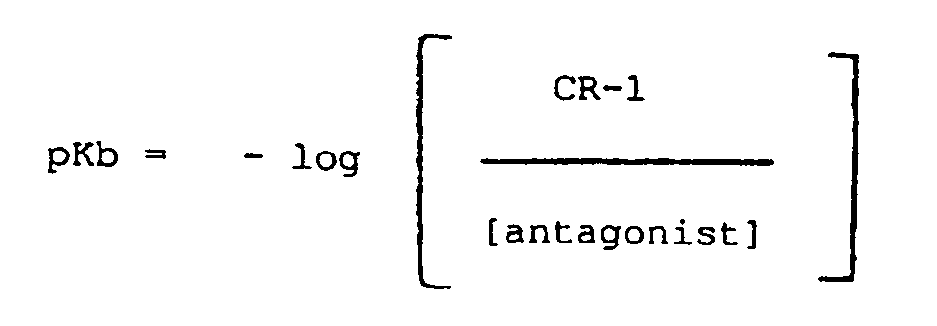
which is a rearrangement of equation 4 described by Furchgott, in Handbook of Exp. Pharmacol., 33, p290 (1972) (eds. Blaschkott and Muscholl). - Compounds of the invention will desirably exhibit a pKb in the range between 5 and 12. Thus we have found that the compounds of the invention inhibit the action of the hormone angiotensin II and are therefore useful in the treatment of conditions in which it is desirable to inhibit angiotensin II activity. In particular, the compounds of Examples are active in the above test.
- There is thus provided as a further aspect of the invention a compound of general formula (I) or a physiologically acceptable salt, solvate or metabolically labile ester thereof for use in the treatment of conditions associated with excessive or unregulated angiotensin II activity.
- In a further or alternative aspect of the invention there is provided a compound of general formula (I) or a physiologically acceptable salt, solvate or metabolically labile ester thereof for the manufacture of a therapeutic agent for the treatment of conditions associated with excessive or unregulated angiotensin II activity.
- There is also provided in a further or alternative aspect of the invention a method for the treatment of conditions associated with excessive or unregulated angiotensin II activity in a mammal including man comprising administration of an effective amount to a mammal in need of such treatment a compound of general formula (I) or a physiologically acceptable salt, solvate or metabolically labile ester thereof.
- The following examples illustrate pharmaceutical formulations according to the invention. The term "active ingredient" is used herein to represent a compound of formula (I).
-
- Oral Tablet A
- Active Ingredient
- 700mg
- Sodium starch glycollate
- 10mg
- Microcrystalline cellulose
- 50mg
- Magnesium stearate
- 4mg
- Sieve the active ingredient and microcrystalline cellulose through a 40 mesh screen and blend in a appropriate blender. Sieve the sodium starch glycollate and magnesium stearate through a 60 mesh screen, add to the powder blend and blend until homogeneous. Compress with appropriate punches in an automatic tablet press. The tablets may be coated with a thin polymer coat applied by the film coating techniques well known to those skilled in the art. Pigments may be incorporated in the film coat.
-
- Oral Tablet B
- Active Ingredient
- 500mg
- Lactose
- 100mg
- Maize Starch
- 50mg
- Polyvinyl pyrrolidone
- 3mg
- Sodium starch glycollate
- 10mg
- Magnesium stearate
- 4mg
- Tablet Weight
- 667mg
- Sieve the active ingredient, lactose and maize starch through a 40 mesh screen and blend the powders in a suitable blender. Make an aqueous solution of the polyvinyl pyrrolidone (5 - 10% w/v). Add this solution to the blended powders and mix until granulated; pass the granulate through a 12 mesh screen and dry the granules in a suitable oven or fluid bed dryer. Sieve the remaining components through a 60 mesh screen and blend them with the dried granules. Compress, using appropriate punches, on an automatic tablet press.
- The tablets may be coated with a thin polymer coat applied by film coating techniques well known to those skilled in art. Pigments may be incorporated in the film coat.
-
- Inhalation Cartridge
- Active Ingredient
- 1mg
- Lactose
- 24mg
- Blend active ingredient, particle size reduced to a very fine particle size (weight mean diameter ca. 5µm) with the lactose in a suitable powder blender and fill the powder blender into No. 3 hard gelatin capsules.
- The contents of the cartridges may be administered using a powder inhaler.
-
- % w/v
- Active ingredient
- 1.00
- Water for injections B.P. to
- 100.00
- Sodium chloride may be added to adjust the tonicity of the solution and the pH may be adjusted to that of maximum stability and/or to facilitate solution of the active ingredient using dilute acid or alkali or by the addition of suitable buffer salts. Antioxidants and metal chelating salts may also be included.
- The solution is prepared, clarified and filled into appropriate sized ampoules sealed by fusion of the glass. The injection is sterilised by heating in an autoclave using one of the acceptable cycles. Alternatively the solution may be sterilised by filtration and filled into sterile ampoules under aseptic conditions. The solution may be packed under an inert atmosphere of nitrogen.
- The present invention is further illustrated by the following Examples:-
- From Intermediate 21 and 2,2-dimethylpropyl iodide according to the method of Intermediate 22.
Intermediate 47a: T.l.c. System A (1:2) Rf 0.29
Intermediate 47b: T.1.c. System A (1:2) Rf 0.21 - A solution of Intermediate 9 (2.5g) in DMF (10ml) was added dropwise to a suspension of sodium hydride (60% dispersion in oil, 0.22g) in DMF (5ml) at 0°C under nitrogen. 3-Bromopropene (0.46g) was added to the stirred mixture and stirring continued at room temperature for 3 hours. The solvent was removed in vacuo and the residue purified by column chromatography eluting with System A (4:3) to give the title compound:
(a) Intermediate 48a as a white foam (860mg),
T.1.c. System A (2:1) Rf 0.50
(b) Intermediate 48b as a white foam (101mg),
T.1.c. System A (2:1) Rf 0.25 -
From Intermediate 37 and methyl iodide according to the method of Intermediate 22.
Intermediate 49a: T.l.c. System A (1:1) Rf 0.15
Intermediate 49b: T.l.c. System A (1:1) Rf 0.10 - From Intermediate 49a according to the method of Example 26.
T.1.c. System D (1:1) Rf 0.1 - From Intermediate 50 according to the method of Example 42.
T.1.c. System D (1:1) Rf 0.3 - From Intermediate 51 according to the method of Example 50.
m.p. 117-118°C. - From Intermediate 19 and 4′-(bromomethyl)-2-nitro-1,1′-biphenyl according to the method of Intermediate 17.
T.1.c. System A (1:1) Rf 0.6 - From Intermediate 16 and 4′-(bromomethyl)-2-nitro-1,1′-biphenyl according to the method of Intermediate 17.
T.1.c. System A (1:5) Rf 0.4 -
- From Intermediate 53 and hydrazine hydrate according to the method of Intermediate 18.
T.1.c. System B (300:8:1) Rf 0.28 - From Intermediate 54 and hydrazine hydrate according to the method of Intermediate 18.
T.1.c. System B (400:8:1) Rf 0.5 - From Intermediate 55 and ethyl iodide according to the method of Intermediate 22.
Intermediate 57a: T.l.c. System A (1:1) Rf 0.2
Intermediate 57b: T.l.c. System A (1:1) Rf 0.12 - From Intermediate 56 and ethyl iodide according to the method of Intermediate 22.
Intermediate 58a: T.l.c. System A (1:1) Rf 0.22
Intermediate 58b: T.l.c. System A (1:1) Rf 0.11 - Titanium trichloride solution (15%w/v, 33ml) was added to a solution of Intermediate 57a (1.5g) in acetone (30ml) and the resulting mixture stirred overnight. Further titanium trichloride solution (10ml) was added and the reaction warmed to 40°C for 16h. 2N Sodium carbonate (200ml) was added and the mixture extracted with dichloromethane (3x150ml). The combined, dried, organic extracts were evaporated in vacuo and the residue purified by chromatography eluting with System A (2:1) to give the title compound as a yellow coloured oil (1.03g).
T.l.c. System A (4:1), Rf 0.36 - T.1.c. System A (2:1) Rf 0.28
From Intermediate 58a. - A solution of Intermediate 59 (1g) and triethylamine (0.35ml) in dry dichloromethane (20ml) at -70°C was treated dropwise with a solution of triflic anhydride (0.46ml) in dichloromethane (5ml) and the resulting mixture stirred at -70°C for 1h. Water (10ml) was added and the reaction allowed to warm to room temperature. The aqueous layer was separated and the organic washed with 2N hydrochloric acid (10ml). The dried organic solution was evaporated in vacuo and the residue purified by chromatography eluting with System B (300:8:1) to give the title compound as a foam (0.93g).
T.l.c. System B (100:8:1), Rf 0.31 - T.1.c. System B (150:8:1) Rf 0.15
From Intermediate 60. - Examples 65 to 71 inclusive were prepared according the method of Example 26:-
- m.p. 65-68°C
T.1.c. dichloromethane:ether:acetic acid (75:25:1) Rf 0.15
From Intermediate 24b. - m.p. 70-75°C
T.1.c. dichloromethane:ether:acetic acid (75:25:1) Rf 0.15
From Intermediate 25b. - m.p. 59-62°C
T.1.c. dichloromethane:methanol (10:1) Rf 0.41
From Intermediate 28b. - m.p. 104-108°C
T.1.c. dichloromethane:methanol (10:1) Rf 0.7
From Intermediate 45a. - m.p. 55-61°C
T.1.c. dichloromethane:methanol (10:1) Rf 0.57
From Intermediate 45b. - m.p. 79-80°C
T.1.c. dichloromethane:ether:acetic acid (90:10:1) Rf 0.3
From Intermediate 47a. - m.p. 136-139°C
T.1.c. dichloromethane:ether:acetic acid (90:10:1) Rf 0.28
From Intermediate 47b. - Examples 72 to 75 inclusive were prepared according to the method of Example 42:-
- m.p. 53-56°C
T.1.c. dichloromethane:ether:acetic acid (90:10:1) Rf 0.3
From the product of Example 34. - m.p. 48-50°C
T.1.c. dichloromethane:ether:acetic acid (75:25:1) Rf 0.68
From the product of Example 59. - m.p. 54-56°C
T.1.c. dichloromethane:ether:acetic acid (90:10:1) Rf 0.57
From the product of Example 68. - m.p. 60-62°C
T.1.c. dichloromethane:ether:acetic acid (90:10:1) Rf 0.46
From the product of Example 70. - Examples 76 to 80 inclusive were prepared according to the method of Example 50:-
- m.p. 205-206°C
T.1.c. dichloromethane:ether:acetic acid (72:25:1) Rf 0.5
From the product of Example 46. - m.p. 118-122°C
T.1.c. dichloromethane:ether:acetic acid (90:10:1) Rf 0.23
From the product of Example 72. - m.p. 181-183°C
T.1.c. dichloromethane:ether:acetic acid (90:10:1) Rf 0.36
From the product of Example 73. - m.p. 138-140°C
T.1.c. dichloromethane:ether:acetic acid (90:10:1) Rf 0.22
From the product of Example 74. - m.p. 122-126°C
T.1.c. dichloromethane:ether:acetic acid (95:5:1) Rf 0.3
From the product of Example 75. - A solution of Intermediate 5 (5g), 1,1-dimethylethylhydrazine hydrochloride (959mg) and triethylamine (1.11ml) in ethanol (50m) was heated at 60°c for 6h after which time additional triethylamine (2.22ml) and 1,1-dimethylethylhydrazine hydrochloride (1.92g) were added and the resultant mixture stirred at 60°c for a further 18h and then at room temperature for 24h. The solvents were removed in vacuo and the residue purified by column chromatography eluting with petroleum ether:ether (2:1) initially followed by ethanol. The concentrated ethanolic extracts were further purified by column chromatography eluting with System B (100:5:1) to give the title compound(746mg) as a cream coloured foam.
mp 58-60°C - A solution of potassium permanganate (55mg) in water (3ml) was added to a stirred solution of the product of Example 37 (140mg) in acetone (3ml) at 50°C. The resulting mixture was stirred at 65°C for 1½ hours. A further portion of potassium permanganate (55mg) was added and the mixture stirred for 3 hours. Sodium metabisulphite (5% w/v, 15ml) was added and the aqueous phase was extracted with ethyl acetate (3x30ml). The combined organic extracts were dried and concentrated to yield a white foam which was purified by column chromatography, eluting with ether/dichloromethane (1:1) to yield the title compound as a white solid (70mg).
m.p. 108°C - A solution of Intermediate 48a (800mg), methanol (15ml) and concentrated hydrochloric acid (0.5ml) was stirred at room temperature for 3 hours. The pH of the solution was adjusted to pH9 (2N NaCO₃) and the solvent removed in vacuo. The residue was partitioned between water (20ml) and ether (3x20ml). The aqueous layer was then acidified to pH3 (2NHCl) and extracted into ethyl acetate (3x20ml). The ethyl acetate fractions were combined, dried and the solvent removed in vacuo to afford the title compound as a white foam (470mg). m.p. 39-41°C
T.1.c. ether Rf 0.40 - T.1.c. ether Rf 0.24
From a solution of Intermediate 48b (1.00g), methanol (15ml) and concentrated hydrochloric acid (0.5ml). - From Intermediate 52 according to the method of Example 4.
m.p. 168-170°C. - Analysis Found
- C,70.2: H,6.3; N,6.8;
- C₂₃H₂₄N₂O₄ requires
- C,70.4: H,6.2: N,7.1%
-
A solution of Intermediate 61 (0.89g) in absolute ethanol (25ml) and 2N hydrochloric acid (0.7ml) was hydrogenated with 10% palladium on carbon catalyst (0.6g) for 1½h. The reaction was filtered into a flask containing 2N sodium carbonate solution (0.7ml) and the solvent removed in vacuo. The residue was taken up in dichloromethane (15ml) and washed with water (15ml). The organic solution was dried and evaporated in vacuo to give the title compound as a white foam (0.65g) m.p. 59-64°C.
T.l.c. System A Rf 0.19 - T.1.c System B (150:8:1) Rf 0.12
- Analysis Found
- C,57.8; H,6.1: N,8.2;
- C₂₄H₂₈N₃O₃ requires
- C,58.2; H,5.7; N,8.5%
- Tetra-n-propylammonium perruthenate (46mg) was added to a mixture of the product of Example 86 (630mg), N-methylmorpholine N-oxide (0.46g) and 4A molecular sieves (2.5g) in dichloromethane (10ml) and dry acetonitrile (10ml) and the reaction left for 5min. The reaction was filtered, solvent removed in vacuo and the residue adsorbed onto silica. The material was purified by chromatography eluting with System A (4:1) to give the title compound as a yellow gum (0.44g).
T.l.c. System A (4:1), Rf 0.64
I.r. (CHBr₃) 1679, 1597, 1366 cm⁻¹. -
- T.1.c. System A (3:1) Rf 0.56
n.m.r. (CDCl₃, 250MHz) δ 0.94 (3H,t), 1.44 (3H,t), 1.62 (2H,m), 2.55 (2H,t), 4.15 (2H,s), 4.54 (2H, quad), 7.25-7.45 (7H,m), 7.64 (1H,m), 9.9 (1H,s).
From the product of Example 87. - A solution of sodium chlorite (0.4g) and sodium dihydrogen orthophosphate (2.56g) in water (5ml) was added to a solution of the product of Example 88 (430mg) and 2-methyl-2-butene (4.5ml, 2M solution in THF) in t-butanol (5ml) and THF (10ml) and the resulting mixture stirred for 3h. Solvent was removed in vacuo, the residue taken up in dichloromethane (10ml) and washed with water (10ml). 2N Sodium hydroxide (10ml) was added to the organic solution and the organic layer removed. 2N Hydrochloric acid (∼11ml) was added to the aqueous phase which was then extracted with ethyl acetate (2x15ml). The dried organic extracts were evaporated in vacuo to give a yellow gummy solid which was recrystallised from System D (1:1) to give the title compound as a white solid (250mg) m.p. 68-72°C.
T.l.c. System A (2:1), Rf 0.53 - T.1.c. System G (300:100:4) Rf 0.55
n.m.r. (CDCl₃ 250MHz) δ 0.87 (3H,t), 1.32 (2H, m), 1.44 (3H,t), 1.55 (2H,m), 2.56 (2H,t), 4.18 (2H,s), 4.58 (2H,q), 6.67 (1H,br.s), 7.17-7.3 (7H,m), 7.37 (1H,dt), 7.61 (1H,br.d).
From the product of Example 89.
Claims (23)
- A compound of the general formula (I)

R¹ represents a hydrogen atom or a group selected from C₁₋₆alkyl or C₂₋₆alkenyl;
R² represents a hydrogen atom or a group selected from C₁₋₆alkyl, C₃₋₇cycloalkyl, C₃₋₇cycloalkylC₁₋₄alkyl, C₃₋₆alkenyl, fluoroC₁₋₆alkyl, fluoroC₃₋₆alkenyl, phenyl, -(CH₂)kCOR⁵ or -(CH₂)kSO₂R⁵;
R³ represents a hydrogen atom or a group selected from C₁₋₆alkyl optionally substituted by a hydroxy or C₁₋₆alkoxy group, C₂₋₆alkenyl, fluoroC₁₋₆alkyl, -(CH₂)mR⁶, -(CH₂)nCOR⁷ or -(CH₂)pNR⁸COR⁹;
R⁴ represents a group selected from -CO₂H, -NHSO₂CF₃ or a C-linked tetrazolyl group;
R⁵ represents a group selected from C₁₋₆alkyl, C₂₋₆alkenyl, C₁₋₆alkoxy or the group -NR¹⁰R11 ;
R⁶ represents a phenoxy or benzyloxy group;
R⁷ represents a hydrogen atom or a group selected from hydroxy, C₁₋₆alkyl, C₁₋₆alkoxy, phenyl, phenoxy or the group -NR¹⁰R¹¹;
R⁸ represents a hydrogen atom or a C₁₋₆alkyl group;
R⁹ represents a hydrogen atom or a group selected from C₁₋₆alkyl, C₁₋₆alkoxy, phenyl, benzyl, phenoxy or the group -NR¹⁰R¹¹;
R¹⁰ and R¹¹ which may be the same or different each independently represent a hydrogen atom or a C₁₋₄alkyl group or -NR¹⁰R¹¹ forms a saturated heterocyclic ring which has 5 or 6 ring members and may optionally contain in the ring one oxygen atom;
k represents zero or an integer from 1 to 4, for example zero, 1 or 2, preferably zero or 1;
m represents an integer from 1 to 4, for example 1 or 2, preferably 1;
n represents zero or an integer from 1 to 4, for example zero, 1 or 2, preferably zero or 1; and
p represents an integer from 1 to 4, preferably 1 or 2. - A compound as claimed in Claim 1 or a physiologically acceptable salt, solvate or a metabolically labile ester thereof wherein
R¹ represents a group selected from C₁₋₆alkyl or C₂₋₆alkenyl;
R² represents a hydrogen atom or a group selected from C₁₋₆alkyl, C₃₋₆alkenyl, fluoroC₁₋₆alkyl, fluoroC₃₋₆alkenyl, phenyl, -(CH₂)kCOR⁵ or -(CH₂)kSO₂R⁵;
R³ represents a hydrogen atom or a group selected from C₁₋₆alkyl optionally substituted by a hydroxy or C₁₋₆alkoxy group, C₂₋₆alkenyl, fluoroC₁₋₆alkyl, -(CH₂)mR⁶, -(CH₂)nCOR⁷ or -(CH₂)pNR⁸COR⁹;
R⁴ represents a group selected from -CO₂H, -NHSO₂CF₃ or a C-linked tetrazolyl group;
R⁵ represents a group selected from C₁₋₆alkyl, C₂₋₆alkenyl, C₁₋₆alkoxy or the group -NR¹⁰R¹¹;
R⁶ represents a phenoxy or benzyloxy group;
R⁷ represents a hydrogen atom or a group selected from hydroxy, C₁₋₆alkyl, C₁₋₆6alkoxy, phenyl, phenoxy or the group -NR¹⁰R¹¹;
R⁸ represents a hydrogen atom or a C₁₋₆alkyl group;
R⁹ represents a hydrogen atom or a group selected from C₁₋₆alkyl, C₁₋₆alkoxy, phenyl, benzyl, phenoxy or the group -NR¹⁰R¹¹;
R¹⁰ and R¹¹ which may be the same or different each independently represent a hydrogen atom or a C₁₋₄alkyl group or -NR¹⁰R¹¹ forms a saturated heterocyclic ring which has 5 or 6 ring members and may optionally contain in the ring one oxygen atom;
k represents zero or an integer from 1 to 4;
m represents an integer from 1 to 4;
n represents zero or an integer from 1 to 4; and
p represents an integer from 1 to 4. - A compound as claimed in Claim 1 or a physiologically acceptable salt, solvate or a metabolically labile ester thereof wherein
R¹ represents a group selected from C₁₋₆alkyl or C₂₋₆alkenyl;
R² represents a hydrogen atom or a group selected from C₁₋₆alkyl, C₃₋₆alkenyl, fluoroC₁₋₆alkyl, fluoroC₃₋₆alkenyl, -(CH₂)kCOR⁵ or -(CH₂)kSO₂R⁵;
R³ represents a hydrogen atom or a group selected from C₁₋₆alkyl optionally substituted by a hydroxy or C₁₋₆alkoxy group, C₂₋₆alkenyl, fluoroC₁₋₆alkyl, -(CH₂)mR⁶, -(CH₂)nCOR⁷ or -(CH₂)pNR⁸COR⁹;
R⁴ represents a group selected from -CO₂H, -NHSO₂CF₃ or a C-linked tetrazolyl group;
R⁵ represents a group selected from C₁₋₆alkyl, C₂₋₆alkenyl, C₁₋₆alkoxy or the group -NR¹⁰R¹¹;
R⁶ represents a phenoxy or benzyloxy group;
R⁷ represents a hydrogen atom or a group selected from hydroxy, C₁₋₆alkyl, C₁₋₆alkoxy, phenyl, phenoxy or the group -NR¹⁰R¹¹;
R⁸ represents a hydrogen atom or a C₁₋₆alkyl group;
R⁹ represents a hydrogen atom or a group selected from C₁₋₆alkyl, C₁₋₆alkoxy, phenyl, benzyl, phenoxy or the group -NR¹⁰R¹¹;
R¹⁰ and R¹¹ which may be the same or different each independently represent a hydrogen atom or a C₁₋₄alkyl group or -NR¹⁰R¹¹ forms a saturated heterocyclic ring which has 5 or 6 ring members and may optionally contain in the ring one oxygen atom;
k represents zero or an integer from 1 to 4;
m represents an integer from 1 to 4;
n represents zero or an integer from 1 to 4; and
p represents an integer from 1 to 4. - A compound as claimed in any one of Claims 1 to 3 wherein R¹ represents a C₁₋₅alkyl group, preferably an ethyl, n-propyl or n-butyl group.
- A compound as claimed in any one of Claims 1 to 3 wherein R¹ represents a C₃₋₅alkyl group, preferably an n-propyl or n-butyl group or a C₃₋₅alkenyl group, preferably a prop-1-enyl or but-1-enyl group.
- A compound as claimed in any one of Claims 1 to 5 wherein R² represents a group selected from fluoroC₁₋₆alkyl, preferably fluoroC₁₋₃alkyl, or -(CH₂)kSO₂R⁵ wherein R⁵ is, for example, the group -NR¹⁰R¹¹ where R¹⁰ and R¹¹ each represent a C₁₋₄alkyl group, and k represents zero or 1.
- A compound as claimed in Claim 6 wherein R² represents the group -CH₂CF₃ or -SO₂N(CH₃)₂.
- A compound as claimed in any one of Claims 1, 4 or 5 wherein R² represents a group selected from phenyl; C₁₋₆alkyl, for example, C₁₋₅alkyl, preferably ethyl, isopropyl or isobutyl; C₃₋₇cycloalkyl, for example, C₃₋₅cycloalkyl, preferably cyclobutyl; or C₃₋₇cycloalkylC₁₋₄alkyl, for example, C₃₋₅cycloalkylC₁₋₄alkyl, preferably cyclopropylmethyl.
- A compound as claimed in any one of Claims 1 to 8 wherein the group R² is adjacent to the group R³.
- A compound as claimed in any one of claims 1 to 9 wherein R³ represents a hydrogen atom or a group selected form C₁₋₆alkyl, for example, C₁₋₃alkyl, optionally substituted by hydroxy or C₁₋₃alkoxy, for example, methoxy; -(CH₂)mR⁶ wherein R⁶ is, for example, a benzyloxy group, and m preferably represents 1 or 2; -(CH₂)nCOR⁷ wherein R⁷ is, for example, a hydrogen atom or a group selected from hydroxy or C₁₋₃alkoxy, for example, methoxy, and n preferably represents zero, 1 or 2; or -(CH₂)pNR⁸COR⁹ wherein R⁸ is, for example, a hydrogen atom or a C₁₋₃alkyl group, R⁹ is, for example, a hydrogen atom or a group selected from C₁₋₃alkyl or C₁₋₃alkoxy, and p preferably represents 1 or 2.
- A compound as claimed in Claim 10 wherein R³ represents a hydrogen atom or a group selected from methyl, ethyl, propyl, butyl, -CH₂OH, -CH₂OCH₃, or preferably -CO₂H.
- A compound as claimed in any one of Claims 1 to 11 wherein R⁴ represents a -CO₂H group, or R⁴ represents a C-linked tetrazolyl group
- A compound as claimed in Claim 1 of the general formula (I)

R¹ represents a C₁₋₆alkyl group;
R² represents a hydrogen atom or group selected from C₁₋₆alkyl, C₃₋₇cycloalkyl, C₃₋₇cycloalkylC₁₋₄alkyl, fluoroC₁₋₆alkyl, phenyl, -(CH₂)kCOR⁵ or -(CH₂)kSO₂R⁵;
R³ represents a group selected from C₁₋₆alkyl substituted by a hydroxy or C₁₋₆alkoxy group, -(CH₂)mR⁶ or -(CH₂)nCOR⁷;
R⁴ represents a group selected from -CO₂H, -NHSO₂CF₃ or a C-linked tetrazolyl group;
R⁵ represents the group NR¹⁰R¹¹;
R⁶ represents a benzyloxy group;
R⁷ represent a hydrogen atom or a hydroxy group;
R¹⁰ and R¹¹ each independently represent a hydrogen atom or a C₁₋₄alkyl group;
k represents zero or an integer from 1 to 4;
m represents an integer from 1 to 4; and
n represents zero or an integer from 1 to 4. - A compound as claimed in Claim 1 selected from :
4′-[[3-butyl-5-(methoxymethyl)-1-(2,2,2-trifluoroethyl)-1H-pyrazol-4-yl]methyl][1,1′-biphenyl]-2-carboxylic acid;
4′-[[5-butyl-3-(methoxymethyl)-1-(2,2,2-trifluoroethyl)-1H-pyrazol-4-yl]methyl][1,1′-biphenyl]-2-carboxylic acid;
5-[4′-[[3-butyl-5-(methoxymethyl)-1-(2,2,2-trifluoroethyl)-1H-pyrazol-4-yl]methyl][1,1′-biphenyl]-2-yl]-1H-tetrazole;
5-[4′[[5-butyl-3-(methoxymethyl)-1-(2,2,2-trifluoroethyl)-1H-pyrazol-4-yl]methyl][1,1′-biphenyl]-2-yl]-1H-tetrazole;
4′-[[5-butyl-1-[(dimethylamino)sulphonyl]-3-(methoxymethyl)-1H-pyrazol-4-yl]methyl][1,1′-biphenyl]-2-carboxylic acid;
4′-[[3-butyl-1-[(dimethylamino)sulphonyl]-5-(methoxymethyl)-1H-pyrazol-4-yl]methyl][1,1′-biphenyl]-2-carboxylic acid;
5-[4′-[[3-butyl-1-1(dimethylamino)sulphonyl]-5-(methoxymethyl)-1H-pyrazol-4-yl]methyl][1,1′-biphenyl]-2-yl]-1H-tetrazole;
5-[4′-[[5-butyl-1-[dimethylamino)sulphonyl]-3-(methoxymethyl)-1H-pyrazol-4-yl]methyl][1,1′-biphenyl]-2-yl]-1H-tetrazole;
or a physiologically acceptable salt, solvate or metabolically labile ester thereof. - A compound as claimed in Claim 1 selected from:
3-butyl-1-ethyl-4-[[2′-(1H-tetrazol-5-yl)[1,1′-biphenyl]-4-yl]methyl]-1H-pyrazole-5-methanol;
3-butyl-1-(1-methylethyl)-4-[[2′-(1H-tetrazol-5-yl)[1,1′-biphenyl]-4-yl]methyl]-1H-pyrazole-5-methanol;
3-butyl-1-(2-methylpropyl)-4-[[2′-(1H-tetrazol-5-yl)[1,1′-biphenyl]-4-yl]methyl]-1H-pyrazole-5-methanol;
3-butyl-1-(2-cyclopropylmethyl)-4-[[2′-(1H-tetrazol-5-yl)[1,1′-biphenyl]-4-yl]methyl]-1H-pyrazole-5-methanol;
3-butyl-1-cyclobutyl-4-[[2′-(1H-tetrazol-5-yl)[1,1′-biphenyl]-4-yl]methyl]-1H-pyrazole-5-methanol;
1,3-dibutyl-4-[[2′-(1H-tetrazol-5-yl)[1,1′-biphenyl]-4-yl]methyl]-1H-pyrazole-5-methanol;
1-ethyl-3-propyl-4-[[2′-(1H-tetrazol-5-yl)[1,1′-biphenyl]-4-yl]methyl]-1H-pyrazole-5-methanol;
1-(1-methylethyl)-3-propyl-4-[[2′-(1H-tetrazol-5-yl)[1,1′-biphenyl]-4-yl]methyl]-1H-pyrazole-5-methanol;
3-butyl-1-(1-methylethyl)-4-[[2′-(1H-tetrazol-5-yl)[1,1′-biphenyl]-4-yl]methyl]-1H-pyrazole-5-carboxaldehyde;
3-butyl-1-(2-methylpropyl)-4-[[2′-(1H-tetrazol-5-yl)[1,1′-biphenyl]-4-yl]methyl]-1H-pyrazole-5-carboxaldehyde;
3-butyl-1-(2-cyclopropylmethyl)-4-[(2′-(1H-tetrazol-5-yl)[1,1′-biphenyl]-4-yl]methyl]-1H-pyrazole-5-carboxaldehyde;
3-butyl-1-cyclobutyl-4-[[2′-(1H-tetrazol-5-yl)[1,1′-biphenyl]-4-yl]methyl]-1H-pyrazole-5-carboxaldehyde;
1,3-dibutyl-4-[[2′-(1H-tetrazol-5-yl)[1,1′-biphenyl]-4-yl]methyl]-1H-pyrazole-5-carboxaldehyde;
1-(1-methylethyl)-3-propyl-4-[[2′-(1H-tetrazol-5-yl)[1,1′-biphenyl]-4-yl]methyl]-1H-pyrazole-5-carboxaldehyde;
3-butyl-1-(1-methylethyl)-4-[[2′-(1H-tetrazol-5-yl)(1,1′-biphenyl]-4-yl]methyl]-1H-pyrazole-5-carboxylic acid;
3-butyl-1-(2-methylpropyl)-4-[[2′-(1H-tetrazol-5-yl)[1,1′biphenyl]-4-yl]methyl]-1H-pyrazole-5-carboxylic acid;
3-butyl-1-cyclobutyl-4-[[2′-(1H-tetrazol-5-yl)[1,1′-biphenyl]-4-yl]methyl]-1H-pyrazole-5-carboxylic acid;
3-butyl-4-[(2′-carboxy[1,1′-biphenyl]-4-yl)methyl]-1-ethyl-1H-pyrazole-5-carboxylic acid;
3-butyl-1-propyl-4-[[2′-(1H-tetrazol-5-yl)[1,1′-biphenyl]-4-yl]methyl]-1H-pyrazole-5-methanol;
1-ethyl-3-propyl-4-[[2′-(1H-tetrazol-5-yl)[1,1′-biphenyl]-4-yl]methyl]-1H-pyrazole-5-carboxaldehyde;
1-ethyl-3-propyl-4-[[2′-(1H-tetrazol-5-yl)[1,1′-biphenyl]-4-yl]methyl]-1H-pyrazole-5-carboxylic acid;
1-(1-methylethyl)-3-propyl-4-[[2′-(1H-tetrazol-5-yl)[1,1′-biphenyl]-4-yl]methyl]-1H-pyrazole-5-carboxylic acid;
1,3-dibutyl-4-[[2′-(1H-tetrazol-5-yl)[1,1′-biphenyl]-4-yl]methyl]-1H-pyrazole-5-carboxylic acid;
3-butyl-4-[(2′-carboxy[1,1′-biphenyl]-4-yl)methyl]-1-(1-methylethyl)-1H-pyrazole-5-carboxylic acid;
3-butyl-1-ethyl-4-[[2′-(1H-tetrazol-5-yl)[1,1′-biphenyl]-4-yl]methyl]-1H-pyrazole-5-carboxaldehyde;
3-butyl-1-propyl-4-[[2′-(1H-tetrazol-5-yl)[1,1′-biphenyl]-4-yl]methyl]-1H-pyrazole-5-carboxaldehyde;
1-(2-methylpropyl)-3-propyl-4-[[2′-(1H-tetrazol-5-yl)[1,1′-biphenyl]-4-yl]methyl]-1H-pyrazole-5-carboxylic acid;
3-butyl-1-propyl-4-[[2′-(1H-tetrazol-5-yl)[1,1′-biphenyl]-4-yl]methyl]-1H-pyrazole-5-carboxylic acid;
3-butyl-1-ethyl-4-[[2′-(1H-tetrazol-5-yl)[1,1′-biphenyl]-4-yl]methyl]-1H-pyrazole-5-carboxylic acid;
3-butyl-1-(2-cyclopropylmethyl)-4-[[2′-(1H-tetrazol-5-yl)[1,1′-biphenyl]-4-yl]methyl]-1H-pyrazole-5-carboxylic acid;
3-butyl-1-ethyl-4-[[2′-[[(trifluoromethyl)sulphonylyl]amino][1,1′-biphenyl]-4-yl]methyl]-1H-pyrazole-5-carboxylic acid;
1-ethyl-3-propyl-4-[[2′-[[(trifluoromethyl)sulphonyl]amino][1,1′-biphenyl]-4-yl]methyl]-1H-pyrazole-5-carboxylic acid;
5-[4′-[[3-butyl-1-ethyl-5-(methoxymethyl)-1H-pyrazol-4-yl]methyl][1,1′-biphenyl]-2-yl]-1H-tetrazole;
or a physiologically acceptable salt , solvate or metabolically labile ester thereof. - A process for the preparation of a compound as claimed in any one of Claims 1 to 15 or a physiologically acceptable salt, solvate or metabolically labile ester thereof which comprises :(A) treating a compound of general formula (II)

R²NHNH₂ (III)
followed, if necessary, by the removal of any protecting group present; or(B) converting a compound of general formula (I) into another compound of general formula (I); or(C) deprotecting a compound of general formula (Ia) (D) where R⁴ represents a C-linked tetrazolyl group, by reacting a compound of general formula (IV)
 (E) where R⁴ is a -NHSO₂CF₃ group, by reacting a compound of general formula (V)
 (F) treating a compound of formula (VI)

 (G) wherein R³ represents the group -(CH₂)nCOR⁷ in which n is zero and R⁷ is a C₁₋₆alkoxy group, reacting a compound of formula (VIII)


and when the compound of general formula (I) is obtained as a mixture of enantiomers optionally resolving the mixture to obtain the desired enantiomer;
and/or, if desired, converting the resulting compound of general formula (I) or a salt thereof into a physiologically acceptable salt, solvate or metabolically labile ester thereof. - A process for the preparation of a compound as claimed in any one of Claims 1 to 15 or a physiologically acceptable salt, solvate or metabolically labile ester thereof which comprises :(A) treating a compound of general formula (II)

R²NHNH₂ (III)
followed, if necessary, by the removal of any protecting group present; or(B) converting a compound of general formula (I) into another compound of general formula (I); or(C) deprotecting a compound of general formula (Ia) (D) where R⁴ represents a C-linked tetrazolyl group, by reacting a compound of general formula (IV)

and when the compound of general formula (I) is obtained as a mixture of enantiomers optionally resolving the mixture to obtain the desired enantiomer;
and/or, if desired, converting the resulting compound of general formula (I) or a salt thereof into a physiologically acceptable salt, solvate or metabolically labile ester thereof. - A pharmaceutical composition comprising at least one compound of general formula (I) as defined in any one of Claims 1 to 15 or a physiologically acceptable salt, solvate or metabolically labile ester thereof, together with at least one physiologically acceptable carrier or excipient.
- A compound of general formula (I) as claimed in any one of Claims 1 to 15 or a physiologically acceptable salt, solvate or metabolically labile ester thereof for use in therapy, for example, (i) for use in the treatment or prophylaxis of hypertension; or (ii) for use in the treatment or prophylaxis of a disease associated with cognitive disorders, renal failure, hyperaldosteronism, cardiac insufficiency, congestive heart failure, post-myocardial infarction, cerebrovascular disorders, glaucoma and disorders of intracellular homeostasis; or (iii) for use in the treatment of conditions associated with excessive or unregulated angiotensin II activity.
- A compound of general formula (II)
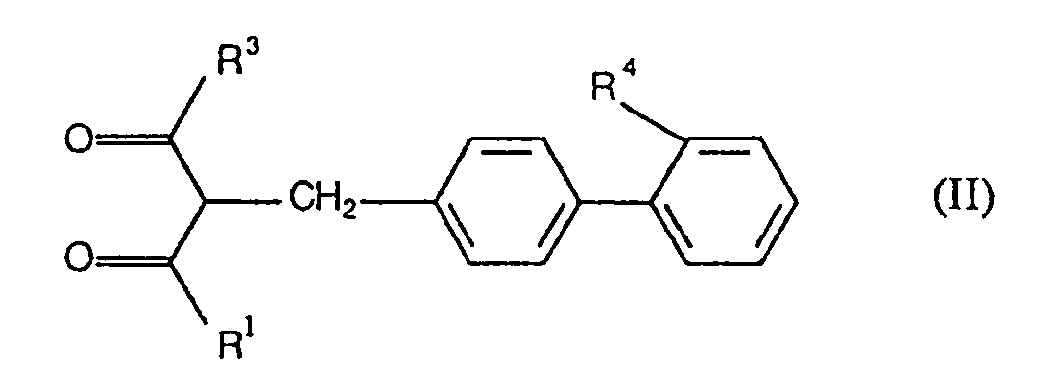
- A compound of general formula (IV)

- A compound of general formula (V)
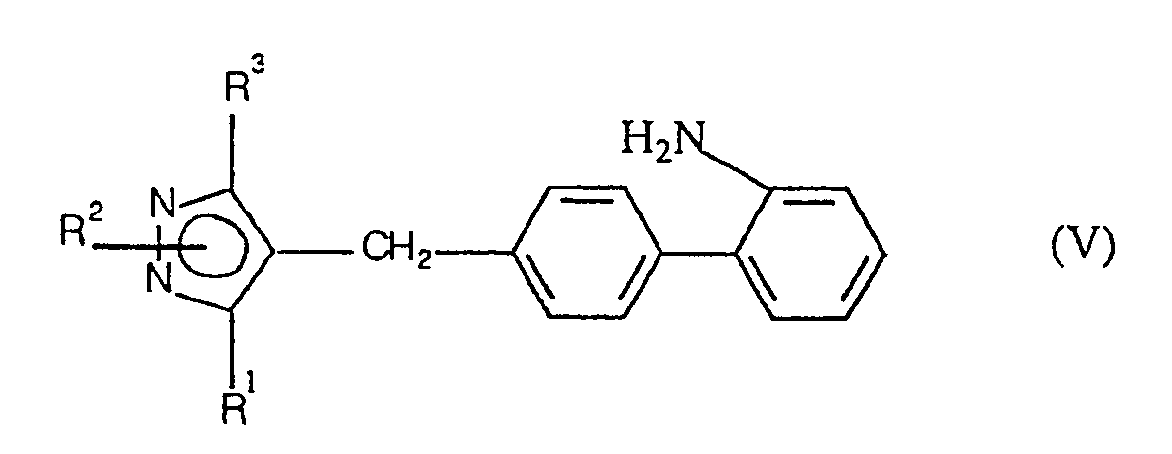
- A compound of formula (VI)

Applications Claiming Priority (2)
| Application Number | Priority Date | Filing Date | Title |
|---|---|---|---|
| GB909005354A GB9005354D0 (en) | 1990-03-09 | 1990-03-09 | Chemical compounds |
| GB9005354 | 1990-03-09 |
Publications (1)
| Publication Number | Publication Date |
|---|---|
| EP0446062A1 true EP0446062A1 (en) | 1991-09-11 |
Family
ID=10672340
Family Applications (1)
| Application Number | Title | Priority Date | Filing Date |
|---|---|---|---|
| EP91301933A Withdrawn EP0446062A1 (en) | 1990-03-09 | 1991-03-08 | C-Linked pyrazole derivatives |
Country Status (15)
| Country | Link |
|---|---|
| US (1) | US5389659A (en) |
| EP (1) | EP0446062A1 (en) |
| JP (1) | JPH0625175A (en) |
| KR (1) | KR920005717A (en) |
| AU (1) | AU636720B2 (en) |
| CA (1) | CA2037872A1 (en) |
| FI (1) | FI911161A7 (en) |
| GB (1) | GB9005354D0 (en) |
| IE (1) | IE910783A1 (en) |
| IL (1) | IL97481A0 (en) |
| NO (1) | NO910935L (en) |
| NZ (2) | NZ244221A (en) |
| PT (1) | PT96976A (en) |
| TW (1) | TW211004B (en) |
| ZA (1) | ZA911721B (en) |
Cited By (21)
| Publication number | Priority date | Publication date | Assignee | Title |
|---|---|---|---|---|
| EP0514217A1 (en) * | 1991-05-16 | 1992-11-19 | Glaxo Group Limited | Antihypertensive benzofuran derivatives carrying 4-pyrazolylmethyl substituents |
| WO1993005025A1 (en) * | 1991-09-06 | 1993-03-18 | Glaxo Group Limited | C-linked pyrazole derivatives |
| EP0449699A3 (en) * | 1990-03-19 | 1993-04-07 | Laboratoires Upsa | Pyrazole derivatives as angiotensin ii-receptor antagonists, process for their preparation and pharmaceutical compositions containing them |
| EP0523141A4 (en) * | 1990-03-30 | 1993-04-21 | Merck & Co. Inc. | Substituted pyrazoles, isoxazoles and isothiazoles |
| AP254A (en) * | 1991-09-05 | 1993-05-05 | Glaxo Group Ltd | C-Linked pyrazole derivatives. |
| GB2263638A (en) * | 1992-01-28 | 1993-08-04 | Merck & Co Inc | Substituted pyrazoles, isoxazoles and isothiazoles as neurotensin antagonists |
| US5262412A (en) * | 1993-03-10 | 1993-11-16 | Merck & Co., Inc. | Substituted pyrazoles, compositions and use |
| EP0603712A3 (en) * | 1992-12-22 | 1994-07-13 | Takeda Chemical Industries Ltd | Heterocyclic compounds having angiotensin ii antagonistic activity and use thereof. |
| WO1994017069A1 (en) * | 1993-01-28 | 1994-08-04 | The Upjohn Company | Pyrazole derivatives and pharmaceutical compositions thereof |
| EP0553879B1 (en) * | 1992-01-31 | 1996-08-14 | Takeda Chemical Industries, Ltd. | Process for producing 4-bromomethylbiphenyl compounds |
| EP0577025A3 (en) * | 1992-07-01 | 1998-02-04 | Hoechst Aktiengesellschaft | Angiotensin-ii-receptorantagonist for the treatment and prophylaxis of coronary heart diseases |
| US6071913A (en) * | 1997-03-28 | 2000-06-06 | Development Center For Biotechnology | Angiotensin II receptor antagonistic 1,2,4-triazin-5-one derivatives |
| EP1925303A2 (en) | 1999-08-27 | 2008-05-28 | Sanofi-Aventis Deutschland GmbH | Use of Angiotensin II type 1 receptor antagonists for the prevention of stroke, diabetes and/or congestive heart failure |
| WO2011069038A2 (en) | 2009-12-03 | 2011-06-09 | Synergy Pharmaceuticals, Inc. | Agonists of guanylate cyclase useful for the treatment of hypercholesterolemia, atherosclerosis, coronary heart disease, gallstone, obesity and other cardiovascular diseases |
| WO2013138352A1 (en) | 2012-03-15 | 2013-09-19 | Synergy Pharmaceuticals Inc. | Formulations of guanylate cyclase c agonists and methods of use |
| WO2014151200A2 (en) | 2013-03-15 | 2014-09-25 | Synergy Pharmaceuticals Inc. | Compositions useful for the treatment of gastrointestinal disorders |
| WO2014151206A1 (en) | 2013-03-15 | 2014-09-25 | Synergy Pharmaceuticals Inc. | Agonists of guanylate cyclase and their uses |
| EP2810951A2 (en) | 2008-06-04 | 2014-12-10 | Synergy Pharmaceuticals Inc. | Agonists of guanylate cyclase useful for the treatment of gastrointestinal disorders, inflammation, cancer and other disorders |
| WO2014197720A2 (en) | 2013-06-05 | 2014-12-11 | Synergy Pharmaceuticals, Inc. | Ultra-pure agonists of guanylate cyclase c, method of making and using same |
| EP2998314A1 (en) | 2007-06-04 | 2016-03-23 | Synergy Pharmaceuticals Inc. | Agonists of guanylate cyclase useful for the treatment of gastrointestinal disorders, inflammation, cancer and other disorders |
| EP3241839A1 (en) | 2008-07-16 | 2017-11-08 | Synergy Pharmaceuticals Inc. | Agonists of guanylate cyclase useful for the treatment of gastrointestinal, inflammation, cancer and other disorders |
Families Citing this family (5)
| Publication number | Priority date | Publication date | Assignee | Title |
|---|---|---|---|---|
| ES2105939B1 (en) * | 1994-08-02 | 1998-07-01 | Uriach & Cia Sa J | NEW PIRAZOLES WITH ANTAGONIST ACTIVITY OF ANGIOTENSIN II. |
| GB0402262D0 (en) * | 2004-02-02 | 2004-03-10 | Novartis Ag | Process for the manufacture of organic compounds |
| US7411082B2 (en) | 2004-03-29 | 2008-08-12 | Cambridge University Technical Services Ltd. | Synthesizing method for compound, and catalyst for synthesis reaction |
| JP4794436B2 (en) | 2004-04-28 | 2011-10-19 | ケンブリッジユニバーシティテクニカルサービスリミテッド | Compound synthesis method and synthesis reaction catalyst |
| WO2014136781A1 (en) * | 2013-03-04 | 2014-09-12 | 国立大学法人 東京大学 | Fluorescent probe |
Family Cites Families (1)
| Publication number | Priority date | Publication date | Assignee | Title |
|---|---|---|---|---|
| US5015651A (en) * | 1988-01-07 | 1991-05-14 | E. I. Du Pont De Nemours And Company | Treatment of hypertension with 1,2,4-angiotensin II antagonists |
-
1990
- 1990-03-09 GB GB909005354A patent/GB9005354D0/en active Pending
-
1991
- 1991-03-08 FI FI911161A patent/FI911161A7/en not_active Application Discontinuation
- 1991-03-08 KR KR1019910003745A patent/KR920005717A/en not_active Withdrawn
- 1991-03-08 CA CA002037872A patent/CA2037872A1/en not_active Abandoned
- 1991-03-08 IE IE078391A patent/IE910783A1/en unknown
- 1991-03-08 IL IL97481A patent/IL97481A0/en unknown
- 1991-03-08 PT PT96976A patent/PT96976A/en not_active Application Discontinuation
- 1991-03-08 NZ NZ244221A patent/NZ244221A/en unknown
- 1991-03-08 ZA ZA911721A patent/ZA911721B/en unknown
- 1991-03-08 NO NO91910935A patent/NO910935L/en unknown
- 1991-03-08 AU AU72736/91A patent/AU636720B2/en not_active Ceased
- 1991-03-08 US US07/666,746 patent/US5389659A/en not_active Expired - Fee Related
- 1991-03-08 EP EP91301933A patent/EP0446062A1/en not_active Withdrawn
- 1991-03-08 NZ NZ237366A patent/NZ237366A/en unknown
- 1991-03-08 JP JP3069159A patent/JPH0625175A/en active Pending
- 1991-03-12 TW TW080101944A patent/TW211004B/zh active
Non-Patent Citations (1)
| Title |
|---|
| CHEMICAL ABSTRACTS, vol. 86, No. 9, February 28, 1977, Columbus, Ohio, USA FREEMAN, J.P. et al. "Novel substitution reactions of 4-chloro-4H-pyrazole derivatives" page 431, column 1, abstract -No. 55 335n * |
Cited By (28)
| Publication number | Priority date | Publication date | Assignee | Title |
|---|---|---|---|---|
| EP0449699A3 (en) * | 1990-03-19 | 1993-04-07 | Laboratoires Upsa | Pyrazole derivatives as angiotensin ii-receptor antagonists, process for their preparation and pharmaceutical compositions containing them |
| EP0523141A4 (en) * | 1990-03-30 | 1993-04-21 | Merck & Co. Inc. | Substituted pyrazoles, isoxazoles and isothiazoles |
| US5252593A (en) * | 1991-05-16 | 1993-10-12 | Glaxo Group Limited | Pyrazole containing benzofuran derivatives and pharmaceutical compositions |
| EP0514217A1 (en) * | 1991-05-16 | 1992-11-19 | Glaxo Group Limited | Antihypertensive benzofuran derivatives carrying 4-pyrazolylmethyl substituents |
| AP254A (en) * | 1991-09-05 | 1993-05-05 | Glaxo Group Ltd | C-Linked pyrazole derivatives. |
| WO1993005025A1 (en) * | 1991-09-06 | 1993-03-18 | Glaxo Group Limited | C-linked pyrazole derivatives |
| GB2263638A (en) * | 1992-01-28 | 1993-08-04 | Merck & Co Inc | Substituted pyrazoles, isoxazoles and isothiazoles as neurotensin antagonists |
| EP0553879B1 (en) * | 1992-01-31 | 1996-08-14 | Takeda Chemical Industries, Ltd. | Process for producing 4-bromomethylbiphenyl compounds |
| EP0577025A3 (en) * | 1992-07-01 | 1998-02-04 | Hoechst Aktiengesellschaft | Angiotensin-ii-receptorantagonist for the treatment and prophylaxis of coronary heart diseases |
| EP0603712A3 (en) * | 1992-12-22 | 1994-07-13 | Takeda Chemical Industries Ltd | Heterocyclic compounds having angiotensin ii antagonistic activity and use thereof. |
| US5496835A (en) * | 1992-12-22 | 1996-03-05 | Takeda Chemical Industries, Ltd. | Heterocyclic compounds having angiotensin II antagonistic activity and use thereof |
| WO1994017069A1 (en) * | 1993-01-28 | 1994-08-04 | The Upjohn Company | Pyrazole derivatives and pharmaceutical compositions thereof |
| US5262412A (en) * | 1993-03-10 | 1993-11-16 | Merck & Co., Inc. | Substituted pyrazoles, compositions and use |
| US6071913A (en) * | 1997-03-28 | 2000-06-06 | Development Center For Biotechnology | Angiotensin II receptor antagonistic 1,2,4-triazin-5-one derivatives |
| EP1925303A2 (en) | 1999-08-27 | 2008-05-28 | Sanofi-Aventis Deutschland GmbH | Use of Angiotensin II type 1 receptor antagonists for the prevention of stroke, diabetes and/or congestive heart failure |
| EP2277519A2 (en) | 1999-08-27 | 2011-01-26 | Sanofi-Aventis Deutschland GmbH | Use of Angiotensin II type 1 receptor antagonists for the prevention of stroke, diabetes and/or congestive heart failure |
| EP2998314A1 (en) | 2007-06-04 | 2016-03-23 | Synergy Pharmaceuticals Inc. | Agonists of guanylate cyclase useful for the treatment of gastrointestinal disorders, inflammation, cancer and other disorders |
| EP2810951A2 (en) | 2008-06-04 | 2014-12-10 | Synergy Pharmaceuticals Inc. | Agonists of guanylate cyclase useful for the treatment of gastrointestinal disorders, inflammation, cancer and other disorders |
| EP3241839A1 (en) | 2008-07-16 | 2017-11-08 | Synergy Pharmaceuticals Inc. | Agonists of guanylate cyclase useful for the treatment of gastrointestinal, inflammation, cancer and other disorders |
| WO2011069038A2 (en) | 2009-12-03 | 2011-06-09 | Synergy Pharmaceuticals, Inc. | Agonists of guanylate cyclase useful for the treatment of hypercholesterolemia, atherosclerosis, coronary heart disease, gallstone, obesity and other cardiovascular diseases |
| EP2923706A1 (en) | 2009-12-03 | 2015-09-30 | Synergy Pharmaceuticals Inc. | Agonists of guanylate cyclase useful for the treatment of hypercholesterolemia |
| WO2013138352A1 (en) | 2012-03-15 | 2013-09-19 | Synergy Pharmaceuticals Inc. | Formulations of guanylate cyclase c agonists and methods of use |
| EP4309673A2 (en) | 2012-03-15 | 2024-01-24 | Bausch Health Ireland Limited | Formulations of guanylate cyclase c agonists and methods of use |
| EP3708179A1 (en) | 2012-03-15 | 2020-09-16 | Bausch Health Ireland Limited | Formulations of guanylate cyclase c agonists and methods of use |
| WO2014151200A2 (en) | 2013-03-15 | 2014-09-25 | Synergy Pharmaceuticals Inc. | Compositions useful for the treatment of gastrointestinal disorders |
| WO2014151206A1 (en) | 2013-03-15 | 2014-09-25 | Synergy Pharmaceuticals Inc. | Agonists of guanylate cyclase and their uses |
| WO2014197720A2 (en) | 2013-06-05 | 2014-12-11 | Synergy Pharmaceuticals, Inc. | Ultra-pure agonists of guanylate cyclase c, method of making and using same |
| EP4424697A2 (en) | 2013-06-05 | 2024-09-04 | Bausch Health Ireland Limited | Ultra-pure agonists of guanylate cyclase c, method of making and using same |
Also Published As
| Publication number | Publication date |
|---|---|
| AU7273691A (en) | 1991-09-12 |
| NZ244221A (en) | 1992-11-25 |
| CA2037872A1 (en) | 1991-09-10 |
| TW211004B (en) | 1993-08-11 |
| FI911161A0 (en) | 1991-03-08 |
| NO910935D0 (en) | 1991-03-08 |
| JPH0625175A (en) | 1994-02-01 |
| PT96976A (en) | 1991-10-31 |
| AU636720B2 (en) | 1993-05-06 |
| ZA911721B (en) | 1992-02-26 |
| US5389659A (en) | 1995-02-14 |
| IE910783A1 (en) | 1991-09-11 |
| NZ237366A (en) | 1992-11-25 |
| KR920005717A (en) | 1992-04-03 |
| FI911161A7 (en) | 1991-09-10 |
| GB9005354D0 (en) | 1990-05-02 |
| IL97481A0 (en) | 1992-06-21 |
| NO910935L (en) | 1991-09-10 |
Similar Documents
| Publication | Publication Date | Title |
|---|---|---|
| US5389659A (en) | C-linked pyrazole derivatives | |
| AU654350B2 (en) | Benzofuran derivatives | |
| RU2114838C1 (en) | Triazole derivatives, pharmaceutical composition and intermedium compounds | |
| AU602638B2 (en) | Triazole antifungal agents | |
| AU638077B2 (en) | Benzofuran derivatives | |
| TW212798B (en) | ||
| EP0505954A1 (en) | N-Imidazolylmethyl benzofuran derivatives as inhibitors of angiotensin II activity | |
| JPH06293740A (en) | Azole compound, its production and use thereof | |
| US4808581A (en) | Imidazolyl- indolylpropanones as 5-HT3 receptor antagonists | |
| EP0242973B1 (en) | Indole derivatives, method for their preparation and pharmaceutical compositions containing them | |
| JPS6366835B2 (en) | ||
| WO1993005025A1 (en) | C-linked pyrazole derivatives | |
| US5374646A (en) | Benzofuran derivatives | |
| EP0514193A1 (en) | N-linked imidazolyl-methyl benzofuran derivatives with antihypotensive activity | |
| EP0514197A1 (en) | Anti-hypertensive benzofuran derivatives substituted by N-imidazolyl-methyl groups which are condensed with optionally nitrogen containing, six-membered rings | |
| WO1992009600A1 (en) | Benzofuran and benzthiophene derivatives | |
| EP0514192A1 (en) | Antihypertensive benzofuran derivatives, substituted by varied N-pyrimidinyl- or N-imidazolyl-methyl groups | |
| AP254A (en) | C-Linked pyrazole derivatives. | |
| US5252593A (en) | Pyrazole containing benzofuran derivatives and pharmaceutical compositions | |
| EP0994876A1 (en) | Quaternary ammonium compounds as tachykinin antagonists | |
| AP185A (en) | Benzofuran derivatives | |
| IE920928A1 (en) | Benzofuran derivatives | |
| CZ48094A3 (en) | Pyrrazole derivatives, process of their preparation and pharmaceutical preparations in which they are comprised | |
| HK1063781B (en) | Pyrazole derivatives for treating hiv | |
| HK1063781A1 (en) | Pyrazole derivatives for treating hiv |
Legal Events
| Date | Code | Title | Description |
|---|---|---|---|
| PUAI | Public reference made under article 153(3) epc to a published international application that has entered the european phase |
Free format text: ORIGINAL CODE: 0009012 |
|
| AK | Designated contracting states |
Kind code of ref document: A1 Designated state(s): AT BE CH DE DK ES FR GB GR IT LI LU NL SE |
|
| 17P | Request for examination filed |
Effective date: 19920117 |
|
| 17Q | First examination report despatched |
Effective date: 19940729 |
|
| STAA | Information on the status of an ep patent application or granted ep patent |
Free format text: STATUS: THE APPLICATION IS DEEMED TO BE WITHDRAWN |
|
| 18D | Application deemed to be withdrawn |
Effective date: 19950209 |