EP0446301B1 - Herstellung von biaryl-verbindungen - Google Patents
Herstellung von biaryl-verbindungen Download PDFInfo
- Publication number
- EP0446301B1 EP0446301B1 EP90901266A EP90901266A EP0446301B1 EP 0446301 B1 EP0446301 B1 EP 0446301B1 EP 90901266 A EP90901266 A EP 90901266A EP 90901266 A EP90901266 A EP 90901266A EP 0446301 B1 EP0446301 B1 EP 0446301B1
- Authority
- EP
- European Patent Office
- Prior art keywords
- accordance
- range
- nickel
- defined above
- carbon atoms
- Prior art date
- Legal status (The legal status is an assumption and is not a legal conclusion. Google has not performed a legal analysis and makes no representation as to the accuracy of the status listed.)
- Expired - Lifetime
Links
- -1 biaryl compounds Chemical class 0.000 title claims abstract description 30
- 238000002360 preparation method Methods 0.000 title abstract description 6
- PXHVJJICTQNCMI-UHFFFAOYSA-N Nickel Chemical compound [Ni] PXHVJJICTQNCMI-UHFFFAOYSA-N 0.000 claims abstract description 43
- 239000003446 ligand Substances 0.000 claims abstract description 42
- 238000000034 method Methods 0.000 claims abstract description 40
- 229910052751 metal Inorganic materials 0.000 claims abstract description 21
- 239000002184 metal Substances 0.000 claims abstract description 21
- 229910052759 nickel Inorganic materials 0.000 claims abstract description 20
- OAICVXFJPJFONN-UHFFFAOYSA-N Phosphorus Chemical compound [P] OAICVXFJPJFONN-UHFFFAOYSA-N 0.000 claims abstract description 9
- 239000000010 aprotic solvent Substances 0.000 claims abstract description 9
- 229910052698 phosphorus Inorganic materials 0.000 claims abstract description 9
- 239000011574 phosphorus Substances 0.000 claims abstract description 9
- 125000003118 aryl group Chemical group 0.000 claims description 30
- 125000004432 carbon atom Chemical group C* 0.000 claims description 27
- ZMXDDKWLCZADIW-UHFFFAOYSA-N N,N-Dimethylformamide Chemical group CN(C)C=O ZMXDDKWLCZADIW-UHFFFAOYSA-N 0.000 claims description 23
- 239000000203 mixture Substances 0.000 claims description 15
- 125000000217 alkyl group Chemical group 0.000 claims description 14
- 150000002816 nickel compounds Chemical class 0.000 claims description 12
- HCHKCACWOHOZIP-UHFFFAOYSA-N Zinc Chemical compound [Zn] HCHKCACWOHOZIP-UHFFFAOYSA-N 0.000 claims description 11
- 229910052757 nitrogen Inorganic materials 0.000 claims description 10
- 125000004429 atom Chemical group 0.000 claims description 9
- 125000001424 substituent group Chemical group 0.000 claims description 9
- 239000011701 zinc Substances 0.000 claims description 9
- 229910052725 zinc Inorganic materials 0.000 claims description 9
- 125000001183 hydrocarbyl group Chemical group 0.000 claims description 8
- 150000005347 biaryls Chemical group 0.000 claims description 7
- 125000001997 phenyl group Chemical group [H]C1=C([H])C([H])=C(*)C([H])=C1[H] 0.000 claims description 7
- IBSQPLPBRSHTTG-UHFFFAOYSA-N 1-chloro-2-methylbenzene Chemical compound CC1=CC=CC=C1Cl IBSQPLPBRSHTTG-UHFFFAOYSA-N 0.000 claims description 6
- NPDACUSDTOMAMK-UHFFFAOYSA-N 4-Chlorotoluene Chemical compound CC1=CC=C(Cl)C=C1 NPDACUSDTOMAMK-UHFFFAOYSA-N 0.000 claims description 6
- FYYHWMGAXLPEAU-UHFFFAOYSA-N Magnesium Chemical compound [Mg] FYYHWMGAXLPEAU-UHFFFAOYSA-N 0.000 claims description 6
- 238000005859 coupling reaction Methods 0.000 claims description 6
- 239000011777 magnesium Substances 0.000 claims description 6
- 229910052749 magnesium Inorganic materials 0.000 claims description 6
- 125000004433 nitrogen atom Chemical group N* 0.000 claims description 6
- 230000008878 coupling Effects 0.000 claims description 5
- 238000010168 coupling process Methods 0.000 claims description 5
- 229910052736 halogen Inorganic materials 0.000 claims description 5
- 229910052748 manganese Inorganic materials 0.000 claims description 5
- 239000011572 manganese Substances 0.000 claims description 5
- PWHULOQIROXLJO-UHFFFAOYSA-N Manganese Chemical compound [Mn] PWHULOQIROXLJO-UHFFFAOYSA-N 0.000 claims description 4
- SECXISVLQFMRJM-UHFFFAOYSA-N N-Methylpyrrolidone Chemical group CN1CCCC1=O SECXISVLQFMRJM-UHFFFAOYSA-N 0.000 claims description 4
- CTQNGGLPUBDAKN-UHFFFAOYSA-N O-Xylene Chemical group CC1=CC=CC=C1C CTQNGGLPUBDAKN-UHFFFAOYSA-N 0.000 claims description 4
- SZKMTZNASRXXCE-UHFFFAOYSA-N [2-[2-(diphenylphosphanylmethyl)phenyl]phenyl]methyl-diphenylphosphane Chemical group C=1C=CC=C(C=2C(=CC=CC=2)CP(C=2C=CC=CC=2)C=2C=CC=CC=2)C=1CP(C=1C=CC=CC=1)C1=CC=CC=C1 SZKMTZNASRXXCE-UHFFFAOYSA-N 0.000 claims description 4
- 125000002178 anthracenyl group Chemical group C1(=CC=CC2=CC3=CC=CC=C3C=C12)* 0.000 claims description 4
- 125000001624 naphthyl group Chemical group 0.000 claims description 4
- 125000005561 phenanthryl group Chemical group 0.000 claims description 4
- SIOXPEMLGUPBBT-UHFFFAOYSA-N picolinic acid Chemical compound OC(=O)C1=CC=CC=N1 SIOXPEMLGUPBBT-UHFFFAOYSA-N 0.000 claims description 4
- WPAGBONHLZEYLC-UHFFFAOYSA-N 1-chloro-2-(ethoxymethyl)benzene Chemical compound CCOCC1=CC=CC=C1Cl WPAGBONHLZEYLC-UHFFFAOYSA-N 0.000 claims description 3
- VVGDMTFRMSXUJC-UHFFFAOYSA-N 1-chloro-2-(methoxymethyl)benzene Chemical compound COCC1=CC=CC=C1Cl VVGDMTFRMSXUJC-UHFFFAOYSA-N 0.000 claims description 3
- VZUTXPLXWJODDS-UHFFFAOYSA-N 1-chloro-2-[3-[3-(2-chlorophenyl)-2-methoxypropoxy]-2-methoxypropyl]benzene Chemical compound C=1C=CC=C(Cl)C=1CC(OC)COCC(OC)CC1=CC=CC=C1Cl VZUTXPLXWJODDS-UHFFFAOYSA-N 0.000 claims description 3
- YRGAYAGBVIXNAQ-UHFFFAOYSA-N 1-chloro-4-methoxybenzene Chemical compound COC1=CC=C(Cl)C=C1 YRGAYAGBVIXNAQ-UHFFFAOYSA-N 0.000 claims description 3
- CSARJIQZOSVYHA-UHFFFAOYSA-N 2-chloro-4-fluoro-1-methylbenzene Chemical compound CC1=CC=C(F)C=C1Cl CSARJIQZOSVYHA-UHFFFAOYSA-N 0.000 claims description 3
- OKDGRDCXVWSXDC-UHFFFAOYSA-N 2-chloropyridine Chemical compound ClC1=CC=CC=N1 OKDGRDCXVWSXDC-UHFFFAOYSA-N 0.000 claims description 3
- UFHFLCQGNIYNRP-UHFFFAOYSA-N Hydrogen Chemical compound [H][H] UFHFLCQGNIYNRP-UHFFFAOYSA-N 0.000 claims description 3
- 125000003545 alkoxy group Chemical group 0.000 claims description 3
- 125000002877 alkyl aryl group Chemical group 0.000 claims description 3
- 125000003368 amide group Chemical group 0.000 claims description 3
- 125000003710 aryl alkyl group Chemical group 0.000 claims description 3
- 230000003197 catalytic effect Effects 0.000 claims description 3
- 229910052739 hydrogen Inorganic materials 0.000 claims description 3
- 239000001257 hydrogen Substances 0.000 claims description 3
- 125000002887 hydroxy group Chemical group [H]O* 0.000 claims description 3
- 229910017053 inorganic salt Inorganic materials 0.000 claims description 3
- 125000005740 oxycarbonyl group Chemical group [*:1]OC([*:2])=O 0.000 claims description 3
- 125000002924 primary amino group Chemical group [H]N([H])* 0.000 claims description 3
- 150000003460 sulfonic acids Chemical group 0.000 claims description 3
- KZPYGQFFRCFCPP-UHFFFAOYSA-N 1,1'-bis(diphenylphosphino)ferrocene Chemical compound [Fe+2].C1=CC=C[C-]1P(C=1C=CC=CC=1)C1=CC=CC=C1.C1=CC=C[C-]1P(C=1C=CC=CC=1)C1=CC=CC=C1 KZPYGQFFRCFCPP-UHFFFAOYSA-N 0.000 claims description 2
- JGGOWVIYGLEHAV-UHFFFAOYSA-N 2-[2-(2-diphenylphosphanylethyl)phenyl]ethyl-diphenylphosphane Chemical compound C=1C=CC=CC=1P(C=1C=CC=CC=1)CCC1=CC=CC=C1CCP(C=1C=CC=CC=1)C1=CC=CC=C1 JGGOWVIYGLEHAV-UHFFFAOYSA-N 0.000 claims description 2
- BCJVBDBJSMFBRW-UHFFFAOYSA-N 4-diphenylphosphanylbutyl(diphenyl)phosphane Chemical compound C=1C=CC=CC=1P(C=1C=CC=CC=1)CCCCP(C=1C=CC=CC=1)C1=CC=CC=C1 BCJVBDBJSMFBRW-UHFFFAOYSA-N 0.000 claims description 2
- MZFPAWGWFDGCHP-UHFFFAOYSA-N 5-diphenylphosphanylpentyl(diphenyl)phosphane Chemical compound C=1C=CC=CC=1P(C=1C=CC=CC=1)CCCCCP(C=1C=CC=CC=1)C1=CC=CC=C1 MZFPAWGWFDGCHP-UHFFFAOYSA-N 0.000 claims description 2
- GPORFKPYXATYNX-UHFFFAOYSA-N 6-diphenylphosphanylhexyl(diphenyl)phosphane Chemical compound C=1C=CC=CC=1P(C=1C=CC=CC=1)CCCCCCP(C=1C=CC=CC=1)C1=CC=CC=C1 GPORFKPYXATYNX-UHFFFAOYSA-N 0.000 claims description 2
- ROFVEXUMMXZLPA-UHFFFAOYSA-N Bipyridyl Chemical group N1=CC=CC=C1C1=CC=CC=N1 ROFVEXUMMXZLPA-UHFFFAOYSA-N 0.000 claims description 2
- FXHOOIRPVKKKFG-UHFFFAOYSA-N N,N-Dimethylacetamide Chemical group CN(C)C(C)=O FXHOOIRPVKKKFG-UHFFFAOYSA-N 0.000 claims description 2
- 229910021586 Nickel(II) chloride Inorganic materials 0.000 claims description 2
- DGEZNRSVGBDHLK-UHFFFAOYSA-N [1,10]phenanthroline Chemical compound C1=CN=C2C3=NC=CC=C3C=CC2=C1 DGEZNRSVGBDHLK-UHFFFAOYSA-N 0.000 claims description 2
- CMIHWILCIPLTFO-UHFFFAOYSA-N [1-[2-(diphenylphosphanylmethyl)naphthalen-1-yl]naphthalen-2-yl]methyl-diphenylphosphane Chemical group C=1C=C2C=CC=CC2=C(C=2C3=CC=CC=C3C=CC=2CP(C=2C=CC=CC=2)C=2C=CC=CC=2)C=1CP(C=1C=CC=CC=1)C1=CC=CC=C1 CMIHWILCIPLTFO-UHFFFAOYSA-N 0.000 claims description 2
- OYFPVKNGUZJYGJ-UHFFFAOYSA-N [2-[2-(diphenylphosphanylmethyl)naphthalen-1-yl]phenyl]methyl-diphenylphosphane Chemical compound C=1C=CC=C(C=2C3=CC=CC=C3C=CC=2CP(C=2C=CC=CC=2)C=2C=CC=CC=2)C=1CP(C=1C=CC=CC=1)C1=CC=CC=C1 OYFPVKNGUZJYGJ-UHFFFAOYSA-N 0.000 claims description 2
- ZMICNIIXFABDIO-UHFFFAOYSA-N [2-[2-[bis(2-methylpropyl)phosphanylmethyl]phenyl]phenyl]methyl-bis(2-methylpropyl)phosphane Chemical group CC(C)CP(CC(C)C)CC1=CC=CC=C1C1=CC=CC=C1CP(CC(C)C)CC(C)C ZMICNIIXFABDIO-UHFFFAOYSA-N 0.000 claims description 2
- 229910001513 alkali metal bromide Inorganic materials 0.000 claims description 2
- 229910001514 alkali metal chloride Inorganic materials 0.000 claims description 2
- 229910001516 alkali metal iodide Inorganic materials 0.000 claims description 2
- FBCTUOKJPABAGQ-UHFFFAOYSA-N benzyl-[[2-[2-[benzylphosphanyl(phenyl)methyl]phenyl]phenyl]-phenylmethyl]phosphane Chemical group C=1C=CC=CC=1CPC(C=1C(=CC=CC=1)C=1C(=CC=CC=1)C(PCC=1C=CC=CC=1)C=1C=CC=CC=1)C1=CC=CC=C1 FBCTUOKJPABAGQ-UHFFFAOYSA-N 0.000 claims description 2
- 229910052794 bromium Inorganic materials 0.000 claims description 2
- 229910052799 carbon Inorganic materials 0.000 claims description 2
- 229910052801 chlorine Inorganic materials 0.000 claims description 2
- YOOCYKAMXQHUMO-UHFFFAOYSA-N dibenzyl-[[2-[2-(dibenzylphosphanylmethyl)phenyl]phenyl]methyl]phosphane Chemical group C=1C=CC=CC=1CP(CC=1C(=CC=CC=1)C=1C(=CC=CC=1)CP(CC=1C=CC=CC=1)CC=1C=CC=CC=1)CC1=CC=CC=C1 YOOCYKAMXQHUMO-UHFFFAOYSA-N 0.000 claims description 2
- 229910052740 iodine Inorganic materials 0.000 claims description 2
- QMMRZOWCJAIUJA-UHFFFAOYSA-L nickel dichloride Chemical compound Cl[Ni]Cl QMMRZOWCJAIUJA-UHFFFAOYSA-L 0.000 claims description 2
- JUJWROOIHBZHMG-UHFFFAOYSA-N pyridine Substances C1=CC=NC=C1 JUJWROOIHBZHMG-UHFFFAOYSA-N 0.000 claims description 2
- UMJSCPRVCHMLSP-UHFFFAOYSA-N pyridine Natural products COC1=CC=CN=C1 UMJSCPRVCHMLSP-UHFFFAOYSA-N 0.000 claims description 2
- 239000000376 reactant Substances 0.000 claims 3
- 150000002367 halogens Chemical group 0.000 claims 2
- 125000001072 heteroaryl group Chemical group 0.000 claims 1
- 125000002496 methyl group Chemical group [H]C([H])([H])* 0.000 claims 1
- 239000003054 catalyst Substances 0.000 abstract description 5
- 230000015572 biosynthetic process Effects 0.000 abstract description 4
- 150000001875 compounds Chemical class 0.000 description 23
- 150000001502 aryl halides Chemical class 0.000 description 19
- 238000006243 chemical reaction Methods 0.000 description 10
- 150000001500 aryl chlorides Chemical class 0.000 description 8
- JHJLBTNAGRQEKS-UHFFFAOYSA-M sodium bromide Chemical compound [Na+].[Br-] JHJLBTNAGRQEKS-UHFFFAOYSA-M 0.000 description 8
- 0 *CNN(CCC(N*)NC(CC*(CN)**)N)N Chemical compound *CNN(CCC(N*)NC(CC*(CN)**)N)N 0.000 description 7
- XYFCBTPGUUZFHI-UHFFFAOYSA-N Phosphine Chemical compound P XYFCBTPGUUZFHI-UHFFFAOYSA-N 0.000 description 7
- 239000000047 product Substances 0.000 description 7
- YXFVVABEGXRONW-UHFFFAOYSA-N Toluene Chemical compound CC1=CC=CC=C1 YXFVVABEGXRONW-UHFFFAOYSA-N 0.000 description 6
- 229910021585 Nickel(II) bromide Inorganic materials 0.000 description 5
- IPLJNQFXJUCRNH-UHFFFAOYSA-L nickel(2+);dibromide Chemical compound [Ni+2].[Br-].[Br-] IPLJNQFXJUCRNH-UHFFFAOYSA-L 0.000 description 5
- 239000002904 solvent Substances 0.000 description 5
- 125000005843 halogen group Chemical group 0.000 description 4
- 238000006578 reductive coupling reaction Methods 0.000 description 4
- UHOVQNZJYSORNB-UHFFFAOYSA-N Benzene Chemical compound C1=CC=CC=C1 UHOVQNZJYSORNB-UHFFFAOYSA-N 0.000 description 3
- RTZKZFJDLAIYFH-UHFFFAOYSA-N Diethyl ether Chemical compound CCOCC RTZKZFJDLAIYFH-UHFFFAOYSA-N 0.000 description 3
- XEKOWRVHYACXOJ-UHFFFAOYSA-N Ethyl acetate Chemical compound CCOC(C)=O XEKOWRVHYACXOJ-UHFFFAOYSA-N 0.000 description 3
- 229910000073 phosphorus hydride Inorganic materials 0.000 description 3
- 239000011541 reaction mixture Substances 0.000 description 3
- 230000035484 reaction time Effects 0.000 description 3
- 239000007858 starting material Substances 0.000 description 3
- 239000000126 substance Substances 0.000 description 3
- QSSXJPIWXQTSIX-UHFFFAOYSA-N 1-bromo-2-methylbenzene Chemical compound CC1=CC=CC=C1Br QSSXJPIWXQTSIX-UHFFFAOYSA-N 0.000 description 2
- ABMKWMASVFVTMD-UHFFFAOYSA-N 1-methyl-2-(2-methylphenyl)benzene Chemical group CC1=CC=CC=C1C1=CC=CC=C1C ABMKWMASVFVTMD-UHFFFAOYSA-N 0.000 description 2
- NLXLAEXVIDQMFP-UHFFFAOYSA-N Ammonia chloride Chemical compound [NH4+].[Cl-] NLXLAEXVIDQMFP-UHFFFAOYSA-N 0.000 description 2
- IJGRMHOSHXDMSA-UHFFFAOYSA-N Atomic nitrogen Chemical compound N#N IJGRMHOSHXDMSA-UHFFFAOYSA-N 0.000 description 2
- IAZDPXIOMUYVGZ-UHFFFAOYSA-N Dimethylsulphoxide Chemical compound CS(C)=O IAZDPXIOMUYVGZ-UHFFFAOYSA-N 0.000 description 2
- WYURNTSHIVDZCO-UHFFFAOYSA-N Tetrahydrofuran Chemical compound C1CCOC1 WYURNTSHIVDZCO-UHFFFAOYSA-N 0.000 description 2
- 150000001499 aryl bromides Chemical class 0.000 description 2
- 239000012298 atmosphere Substances 0.000 description 2
- 150000001649 bromium compounds Chemical class 0.000 description 2
- 239000007862 dimeric product Substances 0.000 description 2
- 150000004677 hydrates Chemical class 0.000 description 2
- VLKZOEOYAKHREP-UHFFFAOYSA-N n-Hexane Chemical class CCCCCC VLKZOEOYAKHREP-UHFFFAOYSA-N 0.000 description 2
- 150000002815 nickel Chemical class 0.000 description 2
- 150000003003 phosphines Chemical class 0.000 description 2
- 238000006456 reductive dimerization reaction Methods 0.000 description 2
- 230000002829 reductive effect Effects 0.000 description 2
- XEXHCQJRVMVJMY-UHFFFAOYSA-N (4-bromophenyl) acetate Chemical compound CC(=O)OC1=CC=C(Br)C=C1 XEXHCQJRVMVJMY-UHFFFAOYSA-N 0.000 description 1
- KEUPLGRNURQXAR-UHFFFAOYSA-N (4-chlorophenyl) acetate Chemical compound CC(=O)OC1=CC=C(Cl)C=C1 KEUPLGRNURQXAR-UHFFFAOYSA-N 0.000 description 1
- POILWHVDKZOXJZ-ARJAWSKDSA-M (z)-4-oxopent-2-en-2-olate Chemical compound C\C([O-])=C\C(C)=O POILWHVDKZOXJZ-ARJAWSKDSA-M 0.000 description 1
- AVQQQNCBBIEMEU-UHFFFAOYSA-N 1,1,3,3-tetramethylurea Chemical compound CN(C)C(=O)N(C)C AVQQQNCBBIEMEU-UHFFFAOYSA-N 0.000 description 1
- IRJIHLOLKDSXAJ-UHFFFAOYSA-N 1-bromo-2-(ethoxymethyl)benzene Chemical compound CCOCC1=CC=CC=C1Br IRJIHLOLKDSXAJ-UHFFFAOYSA-N 0.000 description 1
- QFAZLCRHLRJNAW-UHFFFAOYSA-N 1-bromo-2-(methoxymethyl)benzene Chemical compound COCC1=CC=CC=C1Br QFAZLCRHLRJNAW-UHFFFAOYSA-N 0.000 description 1
- DCVXCEKXGLOZJC-UHFFFAOYSA-N 1-bromo-2-[3-[3-(2-bromophenyl)-2-methoxypropoxy]-2-methoxypropyl]benzene Chemical compound C=1C=CC=C(Br)C=1CC(OC)COCC(OC)CC1=CC=CC=C1Br DCVXCEKXGLOZJC-UHFFFAOYSA-N 0.000 description 1
- CMIMBQIBIZZZHQ-UHFFFAOYSA-N 1-bromo-2-methylnaphthalene Chemical compound C1=CC=CC2=C(Br)C(C)=CC=C21 CMIMBQIBIZZZHQ-UHFFFAOYSA-N 0.000 description 1
- ZBTMRBYMKUEVEU-UHFFFAOYSA-N 1-bromo-4-methylbenzene Chemical compound CC1=CC=C(Br)C=C1 ZBTMRBYMKUEVEU-UHFFFAOYSA-N 0.000 description 1
- MNCMVFFWMBXFLK-UHFFFAOYSA-N 1-chloro-2-methylnaphthalene Chemical compound C1=CC=CC2=C(Cl)C(C)=CC=C21 MNCMVFFWMBXFLK-UHFFFAOYSA-N 0.000 description 1
- VLCPISYURGTGLP-UHFFFAOYSA-N 1-iodo-3-methylbenzene Chemical compound CC1=CC=CC(I)=C1 VLCPISYURGTGLP-UHFFFAOYSA-N 0.000 description 1
- UZQLBACCROFUKQ-UHFFFAOYSA-N 1-methyl-2-(3-methylphenyl)benzene Chemical group CC1=CC=CC(C=2C(=CC=CC=2)C)=C1 UZQLBACCROFUKQ-UHFFFAOYSA-N 0.000 description 1
- GVEDOIATHPCYGS-UHFFFAOYSA-N 1-methyl-3-(3-methylphenyl)benzene Chemical group CC1=CC=CC(C=2C=C(C)C=CC=2)=C1 GVEDOIATHPCYGS-UHFFFAOYSA-N 0.000 description 1
- AEJFBKVIGAYAQV-UHFFFAOYSA-N 2-bromo-1-methylnaphthalene Chemical compound C1=CC=C2C(C)=C(Br)C=CC2=C1 AEJFBKVIGAYAQV-UHFFFAOYSA-N 0.000 description 1
- MQYUUWGCGPVNLO-UHFFFAOYSA-N 2-bromo-3-methylnaphthalene Chemical compound C1=CC=C2C=C(Br)C(C)=CC2=C1 MQYUUWGCGPVNLO-UHFFFAOYSA-N 0.000 description 1
- SFGFOJPGCOYQJK-UHFFFAOYSA-N 2-bromo-4-fluoro-1-methylbenzene Chemical compound CC1=CC=C(F)C=C1Br SFGFOJPGCOYQJK-UHFFFAOYSA-N 0.000 description 1
- IMRWILPUOVGIMU-UHFFFAOYSA-N 2-bromopyridine Chemical compound BrC1=CC=CC=N1 IMRWILPUOVGIMU-UHFFFAOYSA-N 0.000 description 1
- TUCRZHGAIRVWTI-UHFFFAOYSA-N 2-bromothiophene Chemical compound BrC1=CC=CS1 TUCRZHGAIRVWTI-UHFFFAOYSA-N 0.000 description 1
- PETFQBPMSMMWNM-UHFFFAOYSA-N 2-chloro-1-methylnaphthalene Chemical compound C1=CC=C2C(C)=C(Cl)C=CC2=C1 PETFQBPMSMMWNM-UHFFFAOYSA-N 0.000 description 1
- YZMYXWNTNLVDIY-UHFFFAOYSA-N 2-chloro-3-methylnaphthalene Chemical compound C1=CC=C2C=C(Cl)C(C)=CC2=C1 YZMYXWNTNLVDIY-UHFFFAOYSA-N 0.000 description 1
- GSFNQBFZFXUTBN-UHFFFAOYSA-N 2-chlorothiophene Chemical compound ClC1=CC=CS1 GSFNQBFZFXUTBN-UHFFFAOYSA-N 0.000 description 1
- UTXLKIYFDKKKEC-UHFFFAOYSA-N 3-bromo-1-methylnaphthalene Chemical compound C1=CC=C2C(C)=CC(Br)=CC2=C1 UTXLKIYFDKKKEC-UHFFFAOYSA-N 0.000 description 1
- OXAHAOCNSXWPED-UHFFFAOYSA-N 3-chloro-1-methylnaphthalene Chemical compound C1=CC=C2C(C)=CC(Cl)=CC2=C1 OXAHAOCNSXWPED-UHFFFAOYSA-N 0.000 description 1
- QJPJQTDYNZXKQF-UHFFFAOYSA-N 4-bromoanisole Chemical compound COC1=CC=C(Br)C=C1 QJPJQTDYNZXKQF-UHFFFAOYSA-N 0.000 description 1
- 229910018583 Ni(O) Inorganic materials 0.000 description 1
- VEQPNABPJHWNSG-UHFFFAOYSA-N Nickel(2+) Chemical class [Ni+2] VEQPNABPJHWNSG-UHFFFAOYSA-N 0.000 description 1
- 229910019142 PO4 Inorganic materials 0.000 description 1
- OFBQJSOFQDEBGM-UHFFFAOYSA-N Pentane Chemical class CCCCC OFBQJSOFQDEBGM-UHFFFAOYSA-N 0.000 description 1
- 125000001931 aliphatic group Chemical group 0.000 description 1
- 150000001338 aliphatic hydrocarbons Chemical class 0.000 description 1
- 239000003513 alkali Substances 0.000 description 1
- 229910001508 alkali metal halide Inorganic materials 0.000 description 1
- 150000008045 alkali metal halides Chemical class 0.000 description 1
- 229910052782 aluminium Inorganic materials 0.000 description 1
- 235000019270 ammonium chloride Nutrition 0.000 description 1
- 150000004945 aromatic hydrocarbons Chemical class 0.000 description 1
- 150000001503 aryl iodides Chemical class 0.000 description 1
- 238000010533 azeotropic distillation Methods 0.000 description 1
- 150000004649 carbonic acid derivatives Chemical class 0.000 description 1
- 150000007942 carboxylates Chemical class 0.000 description 1
- 239000003638 chemical reducing agent Substances 0.000 description 1
- 150000001805 chlorine compounds Chemical class 0.000 description 1
- 238000004587 chromatography analysis Methods 0.000 description 1
- 239000012612 commercial material Substances 0.000 description 1
- SBZXBUIDTXKZTM-UHFFFAOYSA-N diglyme Chemical compound COCCOCCOC SBZXBUIDTXKZTM-UHFFFAOYSA-N 0.000 description 1
- 239000000539 dimer Substances 0.000 description 1
- ZUOUZKKEUPVFJK-UHFFFAOYSA-N diphenyl Chemical class C1=CC=CC=C1C1=CC=CC=C1 ZUOUZKKEUPVFJK-UHFFFAOYSA-N 0.000 description 1
- SNRUBQQJIBEYMU-UHFFFAOYSA-N dodecane Chemical class CCCCCCCCCCCC SNRUBQQJIBEYMU-UHFFFAOYSA-N 0.000 description 1
- 150000002170 ethers Chemical class 0.000 description 1
- 238000002474 experimental method Methods 0.000 description 1
- 125000000524 functional group Chemical group 0.000 description 1
- 150000004820 halides Chemical class 0.000 description 1
- 238000010438 heat treatment Methods 0.000 description 1
- 239000012442 inert solvent Substances 0.000 description 1
- 150000004694 iodide salts Chemical class 0.000 description 1
- 239000000463 material Substances 0.000 description 1
- 150000005309 metal halides Chemical class 0.000 description 1
- KBJMLQFLOWQJNF-UHFFFAOYSA-N nickel(ii) nitrate Chemical class [Ni+2].[O-][N+]([O-])=O.[O-][N+]([O-])=O KBJMLQFLOWQJNF-UHFFFAOYSA-N 0.000 description 1
- 239000012299 nitrogen atmosphere Substances 0.000 description 1
- 239000012074 organic phase Substances 0.000 description 1
- 235000021317 phosphate Nutrition 0.000 description 1
- 150000003013 phosphoric acid derivatives Chemical class 0.000 description 1
- 229920006395 saturated elastomer Polymers 0.000 description 1
- HXJUTPCZVOIRIF-UHFFFAOYSA-N sulfolane Chemical compound O=S1(=O)CCCC1 HXJUTPCZVOIRIF-UHFFFAOYSA-N 0.000 description 1
- 150000003467 sulfuric acid derivatives Chemical class 0.000 description 1
- YLQBMQCUIZJEEH-UHFFFAOYSA-N tetrahydrofuran Natural products C=1C=COC=1 YLQBMQCUIZJEEH-UHFFFAOYSA-N 0.000 description 1
- 150000003613 toluenes Chemical class 0.000 description 1
- XLYOFNOQVPJJNP-UHFFFAOYSA-N water Substances O XLYOFNOQVPJJNP-UHFFFAOYSA-N 0.000 description 1
- 239000008096 xylene Substances 0.000 description 1
- 150000003738 xylenes Chemical class 0.000 description 1
Classifications
-
- C—CHEMISTRY; METALLURGY
- C07—ORGANIC CHEMISTRY
- C07C—ACYCLIC OR CARBOCYCLIC COMPOUNDS
- C07C255/00—Carboxylic acid nitriles
- C07C255/49—Carboxylic acid nitriles having cyano groups bound to carbon atoms of six-membered aromatic rings of a carbon skeleton
- C07C255/50—Carboxylic acid nitriles having cyano groups bound to carbon atoms of six-membered aromatic rings of a carbon skeleton to carbon atoms of non-condensed six-membered aromatic rings
- C07C255/51—Carboxylic acid nitriles having cyano groups bound to carbon atoms of six-membered aromatic rings of a carbon skeleton to carbon atoms of non-condensed six-membered aromatic rings containing at least two cyano groups bound to the carbon skeleton
-
- B—PERFORMING OPERATIONS; TRANSPORTING
- B01—PHYSICAL OR CHEMICAL PROCESSES OR APPARATUS IN GENERAL
- B01J—CHEMICAL OR PHYSICAL PROCESSES, e.g. CATALYSIS OR COLLOID CHEMISTRY; THEIR RELEVANT APPARATUS
- B01J31/00—Catalysts comprising hydrides, coordination complexes or organic compounds
- B01J31/16—Catalysts comprising hydrides, coordination complexes or organic compounds containing coordination complexes
- B01J31/18—Catalysts comprising hydrides, coordination complexes or organic compounds containing coordination complexes containing nitrogen, phosphorus, arsenic or antimony as complexing atoms, e.g. in pyridine ligands, or in resonance therewith, e.g. in isocyanide ligands C=N-R or as complexed central atoms
- B01J31/1805—Catalysts comprising hydrides, coordination complexes or organic compounds containing coordination complexes containing nitrogen, phosphorus, arsenic or antimony as complexing atoms, e.g. in pyridine ligands, or in resonance therewith, e.g. in isocyanide ligands C=N-R or as complexed central atoms the ligands containing nitrogen
- B01J31/181—Cyclic ligands, including e.g. non-condensed polycyclic ligands, comprising at least one complexing nitrogen atom as ring member, e.g. pyridine
-
- B—PERFORMING OPERATIONS; TRANSPORTING
- B01—PHYSICAL OR CHEMICAL PROCESSES OR APPARATUS IN GENERAL
- B01J—CHEMICAL OR PHYSICAL PROCESSES, e.g. CATALYSIS OR COLLOID CHEMISTRY; THEIR RELEVANT APPARATUS
- B01J31/00—Catalysts comprising hydrides, coordination complexes or organic compounds
- B01J31/16—Catalysts comprising hydrides, coordination complexes or organic compounds containing coordination complexes
- B01J31/18—Catalysts comprising hydrides, coordination complexes or organic compounds containing coordination complexes containing nitrogen, phosphorus, arsenic or antimony as complexing atoms, e.g. in pyridine ligands, or in resonance therewith, e.g. in isocyanide ligands C=N-R or as complexed central atoms
- B01J31/1805—Catalysts comprising hydrides, coordination complexes or organic compounds containing coordination complexes containing nitrogen, phosphorus, arsenic or antimony as complexing atoms, e.g. in pyridine ligands, or in resonance therewith, e.g. in isocyanide ligands C=N-R or as complexed central atoms the ligands containing nitrogen
- B01J31/181—Cyclic ligands, including e.g. non-condensed polycyclic ligands, comprising at least one complexing nitrogen atom as ring member, e.g. pyridine
- B01J31/1815—Cyclic ligands, including e.g. non-condensed polycyclic ligands, comprising at least one complexing nitrogen atom as ring member, e.g. pyridine with more than one complexing nitrogen atom, e.g. bipyridyl, 2-aminopyridine
-
- B—PERFORMING OPERATIONS; TRANSPORTING
- B01—PHYSICAL OR CHEMICAL PROCESSES OR APPARATUS IN GENERAL
- B01J—CHEMICAL OR PHYSICAL PROCESSES, e.g. CATALYSIS OR COLLOID CHEMISTRY; THEIR RELEVANT APPARATUS
- B01J31/00—Catalysts comprising hydrides, coordination complexes or organic compounds
- B01J31/16—Catalysts comprising hydrides, coordination complexes or organic compounds containing coordination complexes
- B01J31/22—Organic complexes
- B01J31/2282—Unsaturated compounds used as ligands
- B01J31/2295—Cyclic compounds, e.g. cyclopentadienyls
-
- B—PERFORMING OPERATIONS; TRANSPORTING
- B01—PHYSICAL OR CHEMICAL PROCESSES OR APPARATUS IN GENERAL
- B01J—CHEMICAL OR PHYSICAL PROCESSES, e.g. CATALYSIS OR COLLOID CHEMISTRY; THEIR RELEVANT APPARATUS
- B01J31/00—Catalysts comprising hydrides, coordination complexes or organic compounds
- B01J31/16—Catalysts comprising hydrides, coordination complexes or organic compounds containing coordination complexes
- B01J31/24—Phosphines, i.e. phosphorus bonded to only carbon atoms, or to both carbon and hydrogen atoms, including e.g. sp2-hybridised phosphorus compounds such as phosphabenzene, phosphole or anionic phospholide ligands
-
- B—PERFORMING OPERATIONS; TRANSPORTING
- B01—PHYSICAL OR CHEMICAL PROCESSES OR APPARATUS IN GENERAL
- B01J—CHEMICAL OR PHYSICAL PROCESSES, e.g. CATALYSIS OR COLLOID CHEMISTRY; THEIR RELEVANT APPARATUS
- B01J31/00—Catalysts comprising hydrides, coordination complexes or organic compounds
- B01J31/16—Catalysts comprising hydrides, coordination complexes or organic compounds containing coordination complexes
- B01J31/24—Phosphines, i.e. phosphorus bonded to only carbon atoms, or to both carbon and hydrogen atoms, including e.g. sp2-hybridised phosphorus compounds such as phosphabenzene, phosphole or anionic phospholide ligands
- B01J31/2404—Cyclic ligands, including e.g. non-condensed polycyclic ligands, the phosphine-P atom being a ring member or a substituent on the ring
- B01J31/2409—Cyclic ligands, including e.g. non-condensed polycyclic ligands, the phosphine-P atom being a ring member or a substituent on the ring with more than one complexing phosphine-P atom
-
- B—PERFORMING OPERATIONS; TRANSPORTING
- B01—PHYSICAL OR CHEMICAL PROCESSES OR APPARATUS IN GENERAL
- B01J—CHEMICAL OR PHYSICAL PROCESSES, e.g. CATALYSIS OR COLLOID CHEMISTRY; THEIR RELEVANT APPARATUS
- B01J31/00—Catalysts comprising hydrides, coordination complexes or organic compounds
- B01J31/16—Catalysts comprising hydrides, coordination complexes or organic compounds containing coordination complexes
- B01J31/24—Phosphines, i.e. phosphorus bonded to only carbon atoms, or to both carbon and hydrogen atoms, including e.g. sp2-hybridised phosphorus compounds such as phosphabenzene, phosphole or anionic phospholide ligands
- B01J31/2404—Cyclic ligands, including e.g. non-condensed polycyclic ligands, the phosphine-P atom being a ring member or a substituent on the ring
- B01J31/2409—Cyclic ligands, including e.g. non-condensed polycyclic ligands, the phosphine-P atom being a ring member or a substituent on the ring with more than one complexing phosphine-P atom
- B01J31/2414—Cyclic ligands, including e.g. non-condensed polycyclic ligands, the phosphine-P atom being a ring member or a substituent on the ring with more than one complexing phosphine-P atom comprising aliphatic or saturated rings
-
- B—PERFORMING OPERATIONS; TRANSPORTING
- B01—PHYSICAL OR CHEMICAL PROCESSES OR APPARATUS IN GENERAL
- B01J—CHEMICAL OR PHYSICAL PROCESSES, e.g. CATALYSIS OR COLLOID CHEMISTRY; THEIR RELEVANT APPARATUS
- B01J31/00—Catalysts comprising hydrides, coordination complexes or organic compounds
- B01J31/16—Catalysts comprising hydrides, coordination complexes or organic compounds containing coordination complexes
- B01J31/24—Phosphines, i.e. phosphorus bonded to only carbon atoms, or to both carbon and hydrogen atoms, including e.g. sp2-hybridised phosphorus compounds such as phosphabenzene, phosphole or anionic phospholide ligands
- B01J31/2404—Cyclic ligands, including e.g. non-condensed polycyclic ligands, the phosphine-P atom being a ring member or a substituent on the ring
- B01J31/2442—Cyclic ligands, including e.g. non-condensed polycyclic ligands, the phosphine-P atom being a ring member or a substituent on the ring comprising condensed ring systems
- B01J31/2447—Cyclic ligands, including e.g. non-condensed polycyclic ligands, the phosphine-P atom being a ring member or a substituent on the ring comprising condensed ring systems and phosphine-P atoms as substituents on a ring of the condensed system or on a further attached ring
- B01J31/2452—Cyclic ligands, including e.g. non-condensed polycyclic ligands, the phosphine-P atom being a ring member or a substituent on the ring comprising condensed ring systems and phosphine-P atoms as substituents on a ring of the condensed system or on a further attached ring with more than one complexing phosphine-P atom
-
- C—CHEMISTRY; METALLURGY
- C07—ORGANIC CHEMISTRY
- C07C—ACYCLIC OR CARBOCYCLIC COMPOUNDS
- C07C1/00—Preparation of hydrocarbons from one or more compounds, none of them being a hydrocarbon
- C07C1/26—Preparation of hydrocarbons from one or more compounds, none of them being a hydrocarbon starting from organic compounds containing only halogen atoms as hetero-atoms
-
- C—CHEMISTRY; METALLURGY
- C07—ORGANIC CHEMISTRY
- C07C—ACYCLIC OR CARBOCYCLIC COMPOUNDS
- C07C17/00—Preparation of halogenated hydrocarbons
- C07C17/26—Preparation of halogenated hydrocarbons by reactions involving an increase in the number of carbon atoms in the skeleton
- C07C17/263—Preparation of halogenated hydrocarbons by reactions involving an increase in the number of carbon atoms in the skeleton by condensation reactions
- C07C17/269—Preparation of halogenated hydrocarbons by reactions involving an increase in the number of carbon atoms in the skeleton by condensation reactions of only halogenated hydrocarbons
-
- C—CHEMISTRY; METALLURGY
- C07—ORGANIC CHEMISTRY
- C07C—ACYCLIC OR CARBOCYCLIC COMPOUNDS
- C07C253/00—Preparation of carboxylic acid nitriles
- C07C253/30—Preparation of carboxylic acid nitriles by reactions not involving the formation of cyano groups
-
- C—CHEMISTRY; METALLURGY
- C07—ORGANIC CHEMISTRY
- C07C—ACYCLIC OR CARBOCYCLIC COMPOUNDS
- C07C41/00—Preparation of ethers; Preparation of compounds having groups, groups or groups
- C07C41/01—Preparation of ethers
- C07C41/18—Preparation of ethers by reactions not forming ether-oxygen bonds
- C07C41/30—Preparation of ethers by reactions not forming ether-oxygen bonds by increasing the number of carbon atoms, e.g. by oligomerisation
-
- C—CHEMISTRY; METALLURGY
- C07—ORGANIC CHEMISTRY
- C07C—ACYCLIC OR CARBOCYCLIC COMPOUNDS
- C07C45/00—Preparation of compounds having >C = O groups bound only to carbon or hydrogen atoms; Preparation of chelates of such compounds
- C07C45/61—Preparation of compounds having >C = O groups bound only to carbon or hydrogen atoms; Preparation of chelates of such compounds by reactions not involving the formation of >C = O groups
- C07C45/67—Preparation of compounds having >C = O groups bound only to carbon or hydrogen atoms; Preparation of chelates of such compounds by reactions not involving the formation of >C = O groups by isomerisation; by change of size of the carbon skeleton
- C07C45/68—Preparation of compounds having >C = O groups bound only to carbon or hydrogen atoms; Preparation of chelates of such compounds by reactions not involving the formation of >C = O groups by isomerisation; by change of size of the carbon skeleton by increase in the number of carbon atoms
- C07C45/72—Preparation of compounds having >C = O groups bound only to carbon or hydrogen atoms; Preparation of chelates of such compounds by reactions not involving the formation of >C = O groups by isomerisation; by change of size of the carbon skeleton by increase in the number of carbon atoms by reaction of compounds containing >C = O groups with the same or other compounds containing >C = O groups
-
- B—PERFORMING OPERATIONS; TRANSPORTING
- B01—PHYSICAL OR CHEMICAL PROCESSES OR APPARATUS IN GENERAL
- B01J—CHEMICAL OR PHYSICAL PROCESSES, e.g. CATALYSIS OR COLLOID CHEMISTRY; THEIR RELEVANT APPARATUS
- B01J2231/00—Catalytic reactions performed with catalysts classified in B01J31/00
- B01J2231/40—Substitution reactions at carbon centres, e.g. C-C or C-X, i.e. carbon-hetero atom, cross-coupling, C-H activation or ring-opening reactions
- B01J2231/42—Catalytic cross-coupling, i.e. connection of previously not connected C-atoms or C- and X-atoms without rearrangement
- B01J2231/4205—C-C cross-coupling, e.g. metal catalyzed or Friedel-Crafts type
-
- B—PERFORMING OPERATIONS; TRANSPORTING
- B01—PHYSICAL OR CHEMICAL PROCESSES OR APPARATUS IN GENERAL
- B01J—CHEMICAL OR PHYSICAL PROCESSES, e.g. CATALYSIS OR COLLOID CHEMISTRY; THEIR RELEVANT APPARATUS
- B01J2531/00—Additional information regarding catalytic systems classified in B01J31/00
- B01J2531/02—Compositional aspects of complexes used, e.g. polynuclearity
- B01J2531/0202—Polynuclearity
- B01J2531/0205—Bi- or polynuclear complexes, i.e. comprising two or more metal coordination centres, without metal-metal bonds, e.g. Cp(Lx)Zr-imidazole-Zr(Lx)Cp
-
- B—PERFORMING OPERATIONS; TRANSPORTING
- B01—PHYSICAL OR CHEMICAL PROCESSES OR APPARATUS IN GENERAL
- B01J—CHEMICAL OR PHYSICAL PROCESSES, e.g. CATALYSIS OR COLLOID CHEMISTRY; THEIR RELEVANT APPARATUS
- B01J2531/00—Additional information regarding catalytic systems classified in B01J31/00
- B01J2531/02—Compositional aspects of complexes used, e.g. polynuclearity
- B01J2531/0261—Complexes comprising ligands with non-tetrahedral chirality
- B01J2531/0266—Axially chiral or atropisomeric ligands, e.g. bulky biaryls such as donor-substituted binaphthalenes, e.g. "BINAP" or "BINOL"
-
- B—PERFORMING OPERATIONS; TRANSPORTING
- B01—PHYSICAL OR CHEMICAL PROCESSES OR APPARATUS IN GENERAL
- B01J—CHEMICAL OR PHYSICAL PROCESSES, e.g. CATALYSIS OR COLLOID CHEMISTRY; THEIR RELEVANT APPARATUS
- B01J2531/00—Additional information regarding catalytic systems classified in B01J31/00
- B01J2531/80—Complexes comprising metals of Group VIII as the central metal
- B01J2531/84—Metals of the iron group
- B01J2531/842—Iron
-
- B—PERFORMING OPERATIONS; TRANSPORTING
- B01—PHYSICAL OR CHEMICAL PROCESSES OR APPARATUS IN GENERAL
- B01J—CHEMICAL OR PHYSICAL PROCESSES, e.g. CATALYSIS OR COLLOID CHEMISTRY; THEIR RELEVANT APPARATUS
- B01J2531/00—Additional information regarding catalytic systems classified in B01J31/00
- B01J2531/80—Complexes comprising metals of Group VIII as the central metal
- B01J2531/84—Metals of the iron group
- B01J2531/847—Nickel
-
- C—CHEMISTRY; METALLURGY
- C07—ORGANIC CHEMISTRY
- C07C—ACYCLIC OR CARBOCYCLIC COMPOUNDS
- C07C2527/00—Catalysts comprising the elements or compounds of halogens, sulfur, selenium, tellurium, phosphorus or nitrogen; Catalysts comprising carbon compounds
- C07C2527/06—Halogens; Compounds thereof
- C07C2527/128—Compounds comprising a halogen and an iron group metal or a platinum group metal
-
- C—CHEMISTRY; METALLURGY
- C07—ORGANIC CHEMISTRY
- C07C—ACYCLIC OR CARBOCYCLIC COMPOUNDS
- C07C2531/00—Catalysts comprising hydrides, coordination complexes or organic compounds
- C07C2531/16—Catalysts comprising hydrides, coordination complexes or organic compounds containing coordination complexes
- C07C2531/24—Phosphines
-
- C—CHEMISTRY; METALLURGY
- C07—ORGANIC CHEMISTRY
- C07C—ACYCLIC OR CARBOCYCLIC COMPOUNDS
- C07C2531/00—Catalysts comprising hydrides, coordination complexes or organic compounds
- C07C2531/26—Catalysts comprising hydrides, coordination complexes or organic compounds containing in addition, inorganic metal compounds not provided for in groups C07C2531/02 - C07C2531/24
- C07C2531/28—Catalysts comprising hydrides, coordination complexes or organic compounds containing in addition, inorganic metal compounds not provided for in groups C07C2531/02 - C07C2531/24 of the platinum group metals, iron group metals or copper
- C07C2531/30—Halides
Definitions
- the present invention relates to the preparation of biaryl compounds from aryl halides.
- the present invention relates to the reductive coupling of aryl halides.
- biphenyl compounds can be produced by the reductive coupling of aryl halides.
- Chao, et al. in the Journal of Organic Chemistry , Volume 48, at pages 4904-4907 (1983), disclose the reaction of aryl halides with an equivalent amount of a highly activated metal such as nickel powder.
- Aryl chlorides are frequently more readily available than are the corresponding bromides and iodides.
- the chlorides are also typically less reactive and are less expensive materials as well. It would, therefore, be desirable to find a means to promote the coupling of aryl chlorides to produce high yields of biaryl compounds.
- Such coupling of aryl chlorides has been disclosed by Colon, et al., in U.S. 4,263,466.
- the authors disclose the use of a metallic reducing agent such as zinc, magnesium, or manganese in a dipolar, aprotic solvent such as dimethylformamide with a catalyst containing a nickel compound in combination with triaryl organophosphines and alkali metal halide promoters.
- the reducing metal converts the nickel salts into highly reactive zerovalent nickel compounds which promote the coupling of the aryl halides and regenerate the nickel salts which can be reduced again to the zerovalent state, thereby maintaining the catalytic cycle.
- aryl chlorides can be reductively coupled employing bidentate ligands to produce biaryl compounds in high yield.
- a catalyst comprising a nickel compound, at least one bidentate phosphorus-containing ligand selected from a specified group and a reducing metal, high yields of biaryl compounds are obtained.
- Aryl chlorides are generally preferred starting materials as they are more accessible on a commercial basis and are generally less expensive than the corresponding aryl bromides or aryl iodides.
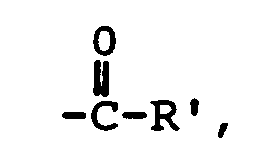
- biaryl compounds of the structure wherein Ar is an aromatic moiety having in the range of 4 up to 20 carbon atoms, each R is independently selected from alkyl, aryl, -F, -NR'2, -CN, -CHO, -OR', -OCO-R', -COO-R', -SO2-R', -SO3R', or -NR'COR': wherein R' is a hydrocarbyl or heteroaryl radical having up to 20 carbon atoms, and x is an integer falling in the range of 0 up to 8, depending on the size of the aromatic ring, Ar, and with the proviso that there be no more than one substituent ortho to the Ar-Ar bond.
- the invention method comprises contacting an aromatic halide having the structure: wherein Ar, R and x are as defined above and X is a halogen; under conditions suitable for the formation of the desired biaryl compound in the presence of at least 0.001 equivalents of a nickel catalyst comprising:
- Reaction temperatures employed in the practice of the present invention can vary widely. Typically, reaction temperatures fall in the range of 0 up to 250°C, with reaction temperatures in the range of 25 up to 120°C being preferred.
- reaction times contemplated for the practice of the present invention can vary widely.
- One of skill in the art can readily determine that amount of time which is sufficient to allow formation of the desired biaryl or heterobiaryl compounds.
- reaction times will fall in the range of 0.1 up to 24 hours or longer, with reaction times in the range of 0.5 up to 16 hours being preferred.
- Aryl halides contemplated for use in the practice of the present invention are compounds have the general structure: wherein Ar is an aromatic moiety having in the range of 4 up to 20 carbon atoms, each R is independently selected from alkyl, aryl, -F, -NR'2, -CN, -CHO, -OR', -OCO-R', -SO2R', SO3R', or NR'COR': wherein R' is a hydrocarbyl or heteroaryl radical having up to 20 carbon atoms; X is a halogen and x is an integer falling in the range of 0 up to 8, depending on the size of the aromatic ring, Ar, and with the further proviso that there be no more than one substituent ortho to the halogen moiety.
- Exemplary aryl halides contemplated for use in the practice of the present invention include: 2-chlorotoluene, 2-bromotoluene, 4-chlorotoluene, 4-bromotoluene, 2-chloro-4-methylnaphthalene, 2-bromo-4-methylnaphthalene, 4-chloroanisole, 4-bromoanisole, 4-chlorophenylacetate, 4-bromophenylacetate, 2-chlorobenzyl(2-methoxy)ethyl ether, 2-bromobenzyl(2-methoxy)ethyl ether, 2-chlorobenzyl methyl ether, 2-bromobenzyl methyl ether, 2-chlorobenzyl ethyl ether, 2-bromobenzyl ethyl ether, 2-chlorothiophene, 2-bromothiophene, 2-chloropyridine, 2-bromopyridine, 2-chloro-3-methylnaphthalene
- Presently preferred monohalides contemplated for use in the practice of the present invention include compounds having the structural formula: wherein one or more of the carbon atoms of the benzene ring in formula (I) is optionally replaced by N; wherein X is a halogen selected from the group consisting of Cl, Br and I; R is a monovalent radical selected from alkyl, aryl, -F, -NR'2, -CN, -CHO, -OR', -OCO-R, -COO-R', -SO2-R', -SO3-R', or -NR'COR': wherein R' is a hydrocarbyl or heteroaryl radical having up to 20 carbon atoms,and x is an integer having values of 0 to 4 with the proviso that no more than one R is in a position ortho to the X-containing ring carbon atom.
- Additional compounds contemplated by the above structural formula are those wherein one or more of the carbon atoms of the benzene ring is replaced by N.
- Especially preferred compounds contemplated by the above formula are those wherein X is Cl.
- Examples of preferred monohalides which satisfy structural formula (I) include: 2-chlorotoluene, 2-chloropyridine, 4-fluoro-2-chlorotoluene, 2-chlorobenzyl methyl ether, 2-chlorobenzyl ethyl ether, 4-(N-ethyl-N-acetyl)amino-2-chlorotoluene, 6-(N-ethyl-N-acetyl)amino-2-chlorotoluene, 4-chlorotoluene, 4-chloroanisole, 2-chlorobenzyl(2-methoxy)ethyl ether, as well as mixtures of any two or more thereof.
- nickel compounds are suitable for use in the practice of the present invention, so long as the nickel compounds employed are essentially water-free.
- the nickel(II) halide salts are a convenient source of nickel as such compounds are readily available in anhydrous form.
- hydrates of such compounds can be employed if an appropriate means of water removal, e.g., azeotropic distillation, is employed prior to contacting the nickel species with the reducing metal and aryl halide:
- nickel compounds can be used in addition to the nickel(II) halides, e.g., nickel nitrates, sulfates, phosphates, oxides, carbonates, carboxylates, acetylacetonate and the like, as well as Ni(O) complexes such as, for example, bis(1,5-cyclooctadienyl)nickel(O), nickel(O) tetracarbonyl, and the like.
- nickel(II) halides are presently preferred because of their ready availability in anhydrous form (or, alternatively, the case with which the hydrates forms such compounds can be dehydrated), and because the presence of halides in the reaction mixture appears to promote the coupling reaction.
- nickel chloride and nickel bromide are presently preferred because of their ready availability in anhydrous form (or, alternatively, the case with which the hydrates forms such compounds can be dehydrated), and because the presence of halides in the reaction mixture appears to promote the coupling reaction.
- nickel chloride and nickel bromide are especially preferred because of their ready availability in anhydrous form (or, alternatively, the case with which the hydrates forms such compounds can be dehydrated), and because the presence of halides in the reaction mixture appears to promote the coupling reaction.
- nickel chloride and nickel bromide are Especially preferred because nickel chloride and nickel bromide.
- Suitable ratios of nickel to aryl halides can vary widely. Molar ratios in the range of 0.0001 up to 0.5:1 are generally suitable. Ratios in the range of 0.01 up to 0.2:1 are preferred, with molar ratios in the range of 0.03 up to 0.1 being most preferred because good conversions are obtained at reasonable reaction rates.
- inorganic salt promoters are optionally added to the catalyst composition.
- preferred promoters include alkali, alkaline earth, zinc, magnesium, manganese and aluminum halides, or mixtures thereof. Bromides are particularly preferred.
- the amount of promoter, when used, can range from 0.1 to 1000 moles per gram atom of nickel with 1 to 100 moles of promoter being preferred.
- the presently most preferred promoters include alkali metal iodides, alkali metal bromides and alkali metal chlorides.
- Organophosphines contemplated for use in the practice of the present invention are compounds having the structures set forth above as (i), (ii), (iii), or (iv).
- Exemplary compounds contemplated by structure (i) include compounds having the structural formula: wherein R, R1, R2, R3, R4, and n are as defined above; including such compounds as 2,2'-bis(diphenylphosphinomethyl)-1,1'-biphenyl; 2,2'-bis(dibenzylphosphinomethyl)-1,1'-biphenyl; 2,2'-bis(phenylbenzylphosphinomethyl)-1,1'-biphenyl; and 2,2'-bis(diisobutylphosphinomethyl)-1,1'-biphenyl.
- Exemplary compounds contemplated by structure (i) also include compounds having the structural formula: wherein R, R1, R2, R3, R4, x and y are defined above; such as, for example 2-(diphenylphosphinomethyl)-1-[2-(diphenylphosphino-methyl)phenyl]naphthalene.
- Exemplary compounds contemplated by structure (i) also include compounds having the structural formula: wherein R, R1, R2, R3, R4, x and y are as defined above; such as, for example 2,2'-bis(diphenylphosphinomethyl)-1,1'-binaphthyl.
- Exemplary compounds contemplated by structure (ii) include compounds having the structural formula: wherein R, R1, R2, R3, R4 and n are as defined above; such as, for example ⁇ , ⁇ '-bis(diphenylphosphino)ortho-xylene.
- Exemplary compounds contemplated by structure (ii) also include compounds having the structural formula: wherein R, R1, R2, R3, R4 and n are as defined above; such as, for example ⁇ , ⁇ '-bis(diphenylphosphino)-2-ethyltoluene.
- Exemplary compounds contemplated by structure (ii) also include compounds having wherein R, R1, R2, R3, R4 and n are as defined above; such as, for example 1,2-bis[2-(diphenylphosphino)ethyl]benzene.
- Exemplary compounds contemplated by structure (iii) include: 1,1'-bis(diphenylphosphino)ferrocene, and the like.
- Exemplary compounds contemplated by structure (iv) include: 1,4-bis(diphenylphosphino)butane, 1,5-bis(diphenylphosphino)pentane, and 1,6-bis(diphenylphosphino)hexane; as well as mixtures of any two or more thereof. Also contemplated are mixtures of any two or more of said type (i), (ii), (iii) or (iv) organophosphines.
- the molar ratio of organophosphine to nickel compound employed in the practice of the present invention can vary widely. Typically, such molar ratio will fall within the range of 0.5:1 up to 20:1, with ratios in the range of 1:1 up to 10:1 preferred. Ratios in the range of 1:1 up to 3:1 are presently most preferred because little added benefit is seen in the use of large excesses of organophosphine(s).
- Optional coordinating ligands employed in combination with the above-described bidentate organophosphines are bidentate ligands containing at least one nitrogen atom as part of an aromatic ring structure.
- bidentate ligands include bipyridine, a C1 up to C6 dialkylamino pyridine, phenanthroline or 2-picolinic acid, and the like.
- molar ratios of the bidentate organophosphine to the bidentate ligand containing at least one nitrogen atom as part of an aromatic ring structure can vary widely, for example, in the range of 0.1:1 up to 20:1, with ratios in the range of 0.5 up to 10 preferred. Ratios in the range of 1:1 up to 2:1 are presently most preferred because little added benefit is observed when large excesses of the bidentate ligand containing at least one nitrogen atom as part of an aromatic ring structure are employed.
- Solvents suitable for use in the practice of the present invention include dipolar, aprotic solvents such as solvents, such as N,N-dimethylacetamide, N,N-dimethylformamide, 1-methyl-2-pyrrolidinone, tetramethylurea, dimethylsulfoxide, sulfolane, and the like.
- dipolar, aprotic solvents such as solvents, such as N,N-dimethylacetamide, N,N-dimethylformamide, 1-methyl-2-pyrrolidinone, tetramethylurea, dimethylsulfoxide, sulfolane, and the like.
- these dipolar, aprotic solvents can be mixed with lower polarity inert solvents, such as saturated aliphatic hydrocarbons, including pentanes, hexanes, dodecanes and the like; aromatic hydrocarbons, such as benzene, toluene, xylenes and the like; and saturated aliphatic and cycloaliphatic ethers, such as, diethyl ether, diglyme, tetrahydrofuran and the like.
- saturated aliphatic hydrocarbons including pentanes, hexanes, dodecanes and the like
- aromatic hydrocarbons such as benzene, toluene, xylenes and the like
- saturated aliphatic and cycloaliphatic ethers such as, diethyl ether, diglyme, tetrahydrofuran and the like.
- zinc metal is the presently preferred reducing metal for use in the invention process for coupling aryl monochlorides.
- the molar ratio of reducing metal to aryl halide employed in the practice of the present invention can vary widely. Typically, such molar ratio will fall within the range of about 0.01:1 up to 20:1, with ratios in the range of about 0.2:1 up to 10:1 preferred. Ratios in the range of about 0.4:1 up to 5:1 are presently most preferred because it is desired to minimize the quantity of reducing metal which must be removed from the reaction mixture and little added benefit is obtained when large excesses of reducing metal are employed.
- the molar ratio of reducing metal to nickel employed in the practice of the present invention can vary widely. Typically, such molar ratios will fall within the range of 1 up to 1000:1, with ratios in the range of 10 up to 500:1 being preferred. Ratios in the range of 40 up to 100:1 are presently preferred for the same reasons as stated in the preceding paragraph.
- Preparation of the novel catalyst composition is carried out conveniently by mixing the aforementioned nickel compound, ligand(s), promoter, and reducing metal(s) in the dipolar, aprotic solvent under an inert atmosphere and heating to a temperature in the range of 25° to 80°C.
- Organophosphine ligands were purchased or prepared by methods known by those of skill in the art.
- Nickel(II) bromide (0.22 g, 1 mmol), the desired phosphine ligand (1.5 to 3 mmol), sodium bromide (3 g), anhydrous dimethylformamide (DMF; 15 mL), zinc powder (3 g, 45 mmol) and an aryl halide (20 mmoles) were combined under a nitrogen atmosphere and heated to 70°C for 14 to 16 hours. The mixture was cooled to ambient and analyzed by conventional chromatography techniques. In those cases where the DMF solvent may obscure one of the products, the reaction mixture was partitioned between aqueous ammonium chloride and ethyl acetate. The organic phase was then analyzed by normal procedures.
- the ligand for all of these runs was 2,2'-bis(diphenylphosphinomethyl) -1,1'-biphenyl (BISBI; 1.5 mmol).
- 1Expected dimeric product is 2,2'-bitolyl.
- 2Expected dimeric product is 3,3'-bitolyl.
- aryl chlorides are preferred starting materials for the invention reductive coupling reaction because they give the desired products in high yields with very high selectivity, without producing significant levels of reduced mono-aromatic product (i.e., toluene) or isomerized product (e.g., 2,3'-bitolyl).
Landscapes
- Chemical & Material Sciences (AREA)
- Organic Chemistry (AREA)
- Chemical Kinetics & Catalysis (AREA)
- Inorganic Chemistry (AREA)
- Engineering & Computer Science (AREA)
- Materials Engineering (AREA)
- Organic Low-Molecular-Weight Compounds And Preparation Thereof (AREA)
- Low-Molecular Organic Synthesis Reactions Using Catalysts (AREA)
- Pyridine Compounds (AREA)
Claims (33)
- Verfahren zur Verknüpfung von Aryl- und Heteroaryl-Monohalogeniden mit 4 bis 20 Kohlenstoffatomen, um Diaryl- oder Hetero-Diarylverbindungen zu erhalten, mit der Struktur:

worin R' ein Kohlenwasserstoff- oder Heteroaryl-Rest mit bis zu 20 Kohlenstoffatomen ist und x eine ganze Zahl ist im Bereich von 0 bis zu 8, abhängig von der Größe des aromatischen Ringes, Ar, und mit der Maßgabe, daß es nicht mehr als einen Substituenten in Ortho-Stellung zu der Ar-Ar-Bindung gibt; dieses Verfahren umfaßt das Inkontaktbringen des Monohalogenids mit der Struktur: (I) eine wasserfreie Nickelverbindung, wobei das Verhältnis Grammatome Nickel zu Mole Monohalogenid im Bereich von 0,0001 bis zu 0,5 ist;(II) mindestens einen zweizähnigen Phosphor-enthaltenden Liganden, ausgewählt aus der Gruppe bestehend aus
die x-Bindungen und die y-Bindungen sind mit benachbarten Kohlenstoffatomen der Ringstrukturen verknüpft;
jedes R, soweit es als Substituent vorhanden ist, ist unabhängig voneinander ausgewählt aus Alkyl, Aryl, -F, -NR'₂, -CN, -CHO, -OR', -OCO-R', -COO-R',
worin R' ein Kohlenwasserstoff- oder Heteroaryl-Rest mit bis zu 20 Kohlenstoffatomen ist;
n ist eine ganze Zahl im Bereich von 0-4, wenn Ar Phenyl ist; 0-6, wenn Ar Naphthyl ist; und 0-8, wenn Ar Phenanthryl oder Anthracenyl ist;
jedes R1 und R2 ist unabhängig voneinander ausgewählt aus Alkyl, Aryl, Aralkyl, Alkaryl oder cycloaliphatischen Resten nicht-substituiert oder substituiert mit Amino-, Amido-, Sulfonsäure-, Oxycarbonyl-, Hydroxyl- oder Alkoxygruppen
jedes R₃ und R₄ ist unabhängig voneinander ausgewählt aus Wasserstoff und den R₁-Substituenten;
jede der vorstehend genannten Alkylgruppen oder Reste ist geradkettig oder verzweigtkettig mit 1-20 Kohlenstoffatomen;
jede Arylgruppe enthält 4-20 Ringkohlenstoffatome; und
jede cycloaliphatische Gruppe enthält von 4-8 Ringkohlenstoffe;
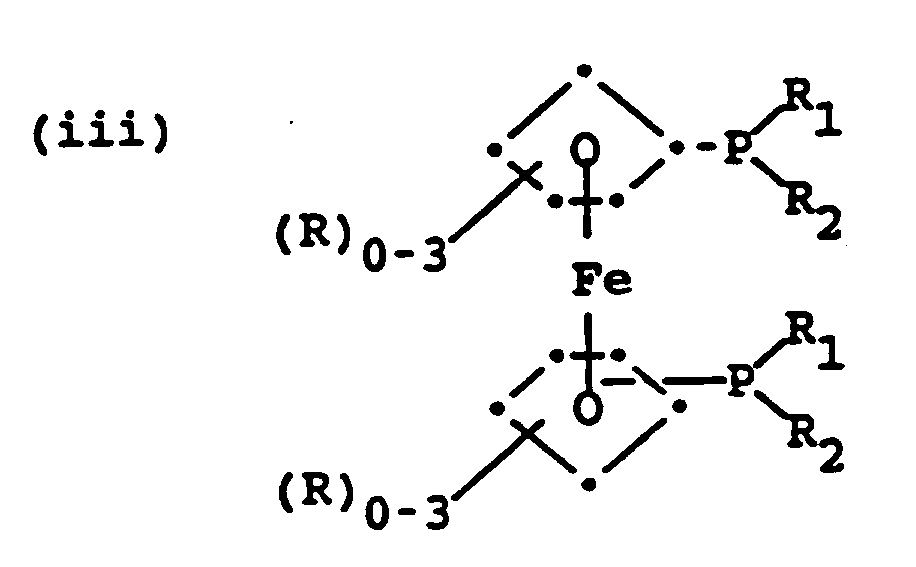

sowie Mischungen von beliebigen zwei oder mehreren davon; wobei die Menge des Liganden im Bereich von 0,5 bis zu 20 Mole pro Grammatom Nickel liegt; und(III) mindestens ein reduzierendes Metall, ausgewählt aus der Gruppe bestehend aus Zink, Magnesium und Mangan, wobei das Mol-Verhältnis reduzierendes Metall zu Monohalogenid-Reaktant in den Bereich von 0,01 bis zu 20:1 fällt;
wobei das Inkontaktbringen in Gegenwart eines polaren aprotischen Lösungsmittels bei einer Temperatur im Bereich von 0 bis zu 250°C über eine ausreichende Zeit zur Bildung der Diaryl- oder Heterodiaryl-Verbindungen durchgeführt wird. - Verfahren nach Anspruch 1, wobei der zweizähnige Ligand die Strukturformel:

- Verfahren nach Anspruch 2, wobei der zweizähnige Ligand ausgewählt ist aus der Gruppe bestehend aus:
2,2'-Bis(diphenylphosphinomethyl)-1,1'-biphenyl;
2,2'-Bis(dibenzylphosphinomethyl)-1,1'-biphenyl;
2,2'-Bis(phenylbenzylphosphinomethyl)-1,1'-biphenyl und
2,2'-Bis(diisobutylphosphinomethyl)-1,1'-biphenyl. - Verfahren nach Anspruch 1, wobei der zweizähnige Ligand die Strukturformel:
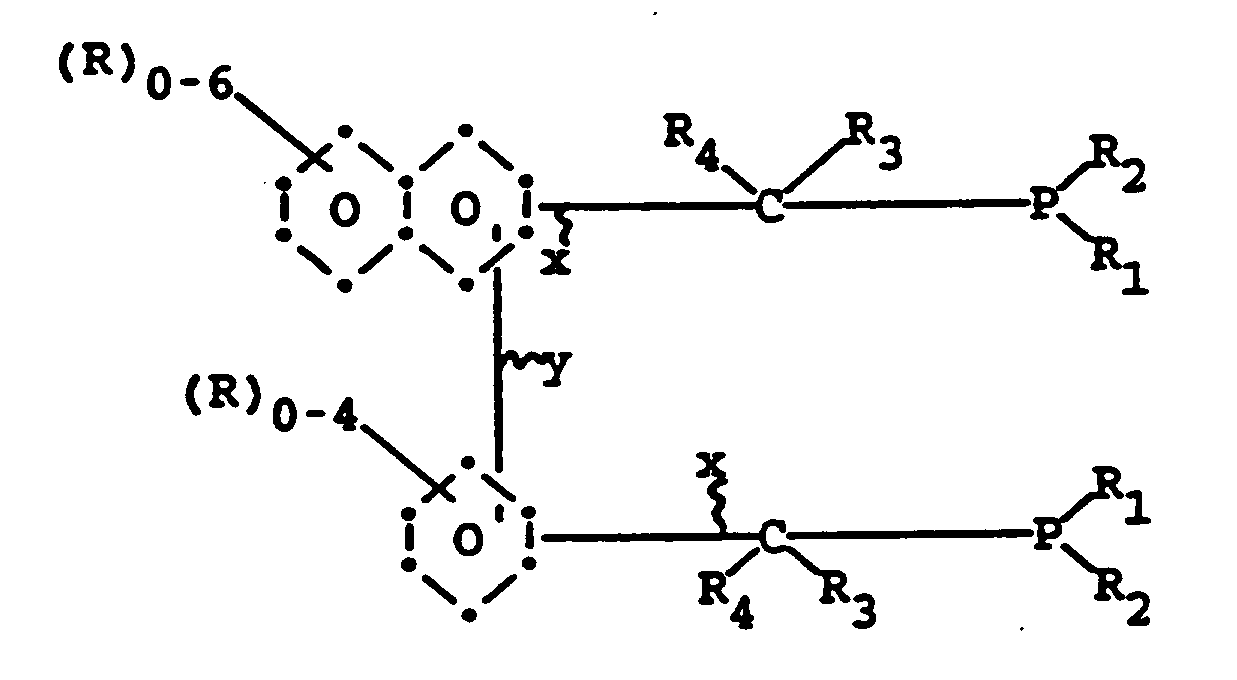
- Verfahren nach Anspruch 4, wobei der zweizähnige Ligand 2-(Diphenylphosphinomethyl)-1-[2-(diphenylphosphinomethyl)phenyl]-naphthalin ist.
- Verfahren nach Anspruch 1, wobei der zweizähnige Ligand die Strukturformel:

- Verfahren nach Anspruch 6, wobei der zweizähnige Ligand 2,2'-Bis(diphenylphosphinomethyl)-1,1'-binaphthyl ist.
- Verfahren nach Anspruch 1, wobei der zweizähnige Ligand die folgende Strukturformel:
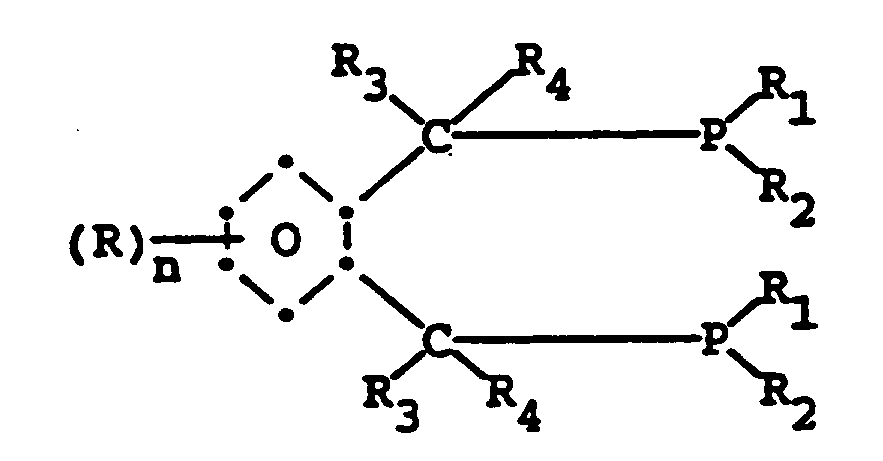
- Verfahren nach Anspruch 8, wobei der zweizähnige Ligand α,α'-Bis(diphenylphosphino)ortho-xylol ist.
- Verfahren nach Anspruch 1, wobei der zweizähnige Ligand die Strukturformel:

- Verfahren nach Anspruch 2, wobei der zweizähnige Ligand α,β'-Bis(diphenylphosphino)-2-ethyltoluol ist.
- Verfahren nach Anspruch 1, wobei der zweizähnige Ligand die Strukturformel:

- Verfahren nach Anspruch 12, wobei der zweizähnige Ligand 1,2-Bis[2-diphenylphosphino)ethyl]benzol ist.
- Verfahren nach Anspruch 1, wobei der zweizähnige Ligand 1,1'-Bis(diphenylphosphino)ferrocen ist.
- Verfahren nach Anspruch 1, wobei der zweizähnige Ligand die Strukturformel:

- Verfahren nach Anspruch 15, wobei der zweizähnige Ligand ausgewählt ist aus der Gruppe bestehend aus:
1,4-Bis(diphenylphosphino)butan,
1,5-Bis(diphenylphosphino)pentan,
1,6-Bis(diphenylphosphino)hexan,
sowie Mischungen von zwei oder mehreren davon. - Verfahren nach einem der Ansprüche 1 bis 16, wobei die katalytische Kombination weiterhin mindestens einen zweizähnigen Liganden umfaßt, der mindestens ein Stickstoffatom als Teil einer aromatischen Struktur enthält.
- Verfahren nach Anspruch 17, wobei der zweizähnige Ligand, der mindestens ein Stickstoffatom enthält, ausgewählt ist aus 2,2'-Bipyridin, ein C₁- bis zu C₆-Dialkylaminopyridin, Phenanthrolin oder 2-Picolinsäure.
- Verfahren nach Anspruch 1, wobei das reduzierende Metall Zink ist.
- Verfahren nach Anspruch 1, wobei die Nickelverbindung Nickelchlorid ist.
- Verfahren nach Anspruch 1, wobei mindestens ein Mol pro Grammatom Nickel eines anorganischen Salzes dem Promoter hinzugegeben wird.
- Verfahren nach Anspruch 21, wobei das anorganische Salz ausgewählt ist aus der Gruppe bestehend aus: ein Alkalimetalliodid, ein Alkalimetallbromid, ein Alkalimetallchlorid, sowie Mischungen von beliebigen zwei oder mehreren davon.
- Verfahren nach Anspruch 1, wobei das aprotische Lösungsmittel N,N-Dimethylacetamid ist.
- Verfahren nach Anspruch 1, wobei das aprotische Lösungsmittel N,N-Dimethylformamid ist.
- Verfahren nach Anspruch 1, wobei das aprotische Lösungsmittel 1-Methyl-2-pyrrolidinon ist.
- Verfahren nach Anspruch 1, wobei das Monohalogenid die Formel hat:

worin X ein Halogenid ist, ausgewählt aus der Gruppe bestehend aus Cl, Br und I;
R ist ein einwertiger Rest, ausgewählt aus Alkyl, Aryl, -F, -NR'₂, -CN, -CHO, -OR' -OCO-R', -COO-R',
worin R' ein Kohlenwasserstoff- oder Heteroaryl-Rest ist mit bis zu 20 Kohlenstoffatomen und x ist eine ganze Zahl mit Werten von 0 bis 4 mit der Maßgabe, daß nicht mehr als ein R in einer Ortho-Position zu dem X-enthaltenden Ringkohlenstoffatom ist. - Verfahren nach Anspruch 26, wobei X Cl ist.
- Verfahren nach Anspruch 27, wobei das Monohalogenid ausgewählt ist aus der Gruppe bestehend aus:
2-Chlortoluol,
2-Chlorpyridin,
4-Fluor-2-chlortoluol,
2-Chlorbenzylmethylether,
2-Chlorbenzylethylether,
4-(N-Ethyl-N-acetyl)amino-2-chlortoluol
6-(N-Ethyl-N-acetyl)amino-2-chlortoluol
4-Chlortoluol,
4-Chloranisol,
2-Chlorbenzyl(2-methoxy)ethylether,
sowie Mischungen von beliebigen zwei oder mehreren davon. - Verfahren nach Anspruch 26, wobei R Methyl ist und x gleich 1 ist.
- Verfahren nach Anspruch 1, wobei die Temperatur von 25°C bis 120°C ist.
- Verfahren nach Anspruch 30, wobei das Verhältnis Gramm-Atome Nickel zu Mole Monohalogenid in den Bereich von 0,01 bis zu 0,2:1 fällt; die Menge des zweizähnigen Phosphor-enthaltenden Liganden fällt in den Bereich von 1 bis zu 10 Molen pro Grammatom Nickel und das Molverhältnis reduzierendes Metall zu Monohalogenid-Reaktant fällt in den Bereich von 0,2 bis zu 10:1.
- Verfahren nach Anspruch 30, wobei das Verhältnis Grammatom Nickel zu Mole Monohalogenid in den Bereich von 0,03 bis zu 0,1:1 fällt; die Menge an zweizähnigem Phosphor-enthaltendem Liganden fällt in den Bereich von 1 bis zu 5 Molen pro Gramm-Atom Nickel und das Molverhältnis reduzierendes Metall zu Monohalogenid-Reaktant fällt in den Bereich von 0,4 bis zu 5:1.
- Eine katalytisch aktive Kombination, umfassend:(I) eine wasserfreie Nickelverbindung,(II) mindestens ein zweizähniger Phosphor-enthaltender Ligand, ausgewählt aus der Gruppe bestehend aus

die x-Bindungen und die y-Bindungen sind mit benachbarten Kohlenstoffatomen der Ringstruktur verknüpft;
jedes R, soweit als Substituent vorhanden, ist unabhängig voneinander ausgewählt aus Alkyl, Aryl, -F, -NR'₂, -CN, -CHO, -OR', -OCO-R', -COO-R',
worin R' ein Kohlenwasserstoff- oder Heteroaryl-Rest ist mit bis zu 20 Kohlenstoffatomen;
n ist eine ganze Zahl im Bereich von 0-4, wenn Ar Phenyl ist; 0-6, wenn Ar Naphthyl ist; und 0-8, wenn Ar Phenanthryl oder Anthracenyl ist;
jedes R1 und R2 ist jeweils unabhängig voneinander ausgewählt aus Alkyl, Aryl, Aralkyl, Alkaryl oder cycloaliphatischen Resten unsubstituiert oder substituiert mit Amino-, Amido-, Sulfonsäuren, Oxycarbonyl-, Hydroxyl- oder Alkoxygruppen
jedes R₃ und R₄ ist unabhängig voneinander ausgewählt aus Wasserstoff und dem R₁-Substituenten;
jede der vorstehend genannten Alkylgruppen oder Reste ist geradkettig oder verzweigtkettig mit 1-20 Kohlenstoffatomen;
jede Arylgruppe enthält 4-20 Ringkohlenstoffe; und
jede cycloaliphatische Gruppe enthält von 4-8 Ringkohlenstoffe;


sowie Mischungen von beliebigen zwei oder mehreren (i), (ii), (iii) oder (iv) Organophosphinarten; und(III) mindestens ein reduzierendes Metall, ausgewählt aus der Gruppe bestehend aus Zink, Magnesium und Mangan;wobei die Menge an zweizähnigem Phosphor-enthaltendem Liganden in den Bereich von 0,5 bis zu 20 Mol pro Gramm-atom Nickel fällt und worin die Menge an reduzierendem Metall in den Bereich von 1 bis zu 1 000 Mole pro Mol Nickel fällt.
Applications Claiming Priority (5)
| Application Number | Priority Date | Filing Date | Title |
|---|---|---|---|
| US27782688A | 1988-11-30 | 1988-11-30 | |
| US277826 | 1988-11-30 | ||
| US07/389,022 US4916227A (en) | 1989-08-03 | 1989-08-03 | Preparation of biaryl compounds |
| US389022 | 1989-08-03 | ||
| PCT/US1989/005218 WO1990006295A1 (en) | 1988-11-30 | 1989-11-13 | Preparation of biaryl compounds |
Publications (2)
| Publication Number | Publication Date |
|---|---|
| EP0446301A1 EP0446301A1 (de) | 1991-09-18 |
| EP0446301B1 true EP0446301B1 (de) | 1994-11-23 |
Family
ID=26958736
Family Applications (2)
| Application Number | Title | Priority Date | Filing Date |
|---|---|---|---|
| EP89420436A Pending EP0376856A1 (de) | 1988-11-30 | 1989-11-13 | Herstellung von Biarylverbindungen |
| EP90901266A Expired - Lifetime EP0446301B1 (de) | 1988-11-30 | 1989-11-13 | Herstellung von biaryl-verbindungen |
Family Applications Before (1)
| Application Number | Title | Priority Date | Filing Date |
|---|---|---|---|
| EP89420436A Pending EP0376856A1 (de) | 1988-11-30 | 1989-11-13 | Herstellung von Biarylverbindungen |
Country Status (6)
| Country | Link |
|---|---|
| EP (2) | EP0376856A1 (de) |
| JP (1) | JP2922289B2 (de) |
| AT (1) | ATE114295T1 (de) |
| CA (1) | CA2002598A1 (de) |
| DE (1) | DE68919478T2 (de) |
| WO (1) | WO1990006295A1 (de) |
Families Citing this family (8)
| Publication number | Priority date | Publication date | Assignee | Title |
|---|---|---|---|---|
| JP3008510B2 (ja) * | 1991-02-16 | 2000-02-14 | ダイキン工業株式会社 | 含フッ素エタンの2量体の製法 |
| US5380910A (en) * | 1992-04-28 | 1995-01-10 | Ihara Chemical Industry Co., Ltd. | Method for producing an asymmetric biaryl derivative |
| TW225485B (de) * | 1992-05-29 | 1994-06-21 | Hoechst Ag | |
| EP0613719A1 (de) * | 1993-03-05 | 1994-09-07 | Duphar International Research B.V | Nickel-Katalysator für die Cyanierung von aromatischen Halogenverbindungen |
| EP0613720A1 (de) | 1993-03-05 | 1994-09-07 | Duphar International Research B.V | Nickel Katalysator für die Cyanierung von aromatischen Halogenverbindungen |
| DE4326169B4 (de) * | 1993-08-04 | 2004-08-19 | Merck Patent Gmbh | Verfahren zur Herstellung von unsymmetrischen Bisarylverbindungen |
| DE10241814A1 (de) | 2002-09-06 | 2004-03-25 | Covion Organic Semiconductors Gmbh | Prozeß zur Herstellung von Aryl-Aryl gekoppelten Verbindungen |
| CN112707778B (zh) * | 2019-10-24 | 2022-08-12 | 杭州奥得科技有限公司 | 一种制备1,2,7,8-四氢双环戊烷并[cd, lm]苝化合物的方法及其产物 |
Family Cites Families (1)
| Publication number | Priority date | Publication date | Assignee | Title |
|---|---|---|---|---|
| US4263466A (en) * | 1978-10-30 | 1981-04-21 | Union Carbide Corporation | Coupling of aryl and heteroaryl mono chlorides |
-
1989
- 1989-11-09 CA CA002002598A patent/CA2002598A1/en not_active Abandoned
- 1989-11-13 JP JP2501271A patent/JP2922289B2/ja not_active Expired - Lifetime
- 1989-11-13 AT AT90901266T patent/ATE114295T1/de active
- 1989-11-13 WO PCT/US1989/005218 patent/WO1990006295A1/en not_active Ceased
- 1989-11-13 EP EP89420436A patent/EP0376856A1/de active Pending
- 1989-11-13 EP EP90901266A patent/EP0446301B1/de not_active Expired - Lifetime
- 1989-11-13 DE DE68919478T patent/DE68919478T2/de not_active Expired - Fee Related
Non-Patent Citations (1)
| Title |
|---|
| Bulletin of the Chemical Society of Japan, vol. 57, no. 7, July 1984 K Takagi et al. Pages 1887-1890 * |
Also Published As
| Publication number | Publication date |
|---|---|
| ATE114295T1 (de) | 1994-12-15 |
| DE68919478T2 (de) | 1995-04-06 |
| DE68919478D1 (de) | 1995-01-05 |
| EP0376856A1 (de) | 1990-07-04 |
| CA2002598A1 (en) | 1990-05-31 |
| EP0446301A1 (de) | 1991-09-18 |
| WO1990006295A1 (en) | 1990-06-14 |
| JPH05501853A (ja) | 1993-04-08 |
| JP2922289B2 (ja) | 1999-07-19 |
Similar Documents
| Publication | Publication Date | Title |
|---|---|---|
| EP0131936B1 (de) | Katalytisch aktive Zusammensetzung zur Kupplung von Aryl und Heteroarylmonochloriden | |
| Hayashi et al. | Dichloro [1, 1′-bis (diphenylphosphino) ferrocene] palladium (II): an effective catalyst for cross-coupling reaction of a secondary alkyl grignard reagent with organic halides | |
| Takagi et al. | The in situ-generated nickel (0)-catalyzed reaction of aryl halides with potassium iodide and zinc powder. | |
| EP0499329B1 (de) | Katalytisches System für die Carbonylierung | |
| US4912276A (en) | Preparation of biaryl compounds | |
| US4326989A (en) | Catalyst of nickel compound and ligand in presence of a reducing metal | |
| EP0376856A1 (de) | Herstellung von Biarylverbindungen | |
| US6140460A (en) | Catalyst composition | |
| US6590100B2 (en) | Process for preparing a polyaromatic compound | |
| US5061669A (en) | Preparation of biaryl compounds | |
| US4692548A (en) | Process for the preparation of unsaturated compounds | |
| US4916227A (en) | Preparation of biaryl compounds | |
| EP0032548B1 (de) | Verfahren zur Herstellung von Aryl- und Heteroarylhexadiensäuren | |
| EP0283194B1 (de) | Verfahren zur Herstellung von Carbonsäuren | |
| US4939309A (en) | Preparation of biaryl compounds | |
| US5037998A (en) | Hydrogenolysis process | |
| EP0613719A1 (de) | Nickel-Katalysator für die Cyanierung von aromatischen Halogenverbindungen | |
| US5021380A (en) | Catalyst for preparation of biaryl compounds | |
| EP1484304A1 (de) | Verfahren zur Herstellung von Fluorphenylalkylensäure-Derivate | |
| Oezdemir et al. | Benzimidazolylidene carbene ligated palladium catalysis of the Heck reaction in aqueous media | |
| EP0212729A2 (de) | Herstellungsverfahren von Diestern von Alkandicarbonsäuren | |
| US4016194A (en) | Preparative process for preparing phenylenediacetate diesters | |
| US4536340A (en) | Process for the preparation of alkyl nonadienoate esters | |
| Michman et al. | Interference by phosphine decomposition in oxidative additions of aryl halides to methyl-, and trimethylsilyl-tris (triphenylphosphine) cobalt | |
| JPH035380B2 (de) |
Legal Events
| Date | Code | Title | Description |
|---|---|---|---|
| PUAI | Public reference made under article 153(3) epc to a published international application that has entered the european phase |
Free format text: ORIGINAL CODE: 0009012 |
|
| 17P | Request for examination filed |
Effective date: 19910518 |
|
| AK | Designated contracting states |
Kind code of ref document: A1 Designated state(s): AT BE CH DE FR GB IT LI LU NL SE |
|
| 17Q | First examination report despatched |
Effective date: 19930805 |
|
| RBV | Designated contracting states (corrected) |
Designated state(s): AT BE CH DE ES FR GB GR IT LI LU NL SE |
|
| XX | Miscellaneous (additional remarks) |
Free format text: VERBUNDEN MIT 89420436.1/0376856 (EUROPAEISCHE ANMELDENUMMER/VEROEFFENTLICHUNGSNUMMER) DURCH ENTSCHEIDUNG VOM 12.10.93. |
|
| RAP1 | Party data changed (applicant data changed or rights of an application transferred) |
Owner name: EASTMAN CHEMICAL COMPANY |
|
| GRAA | (expected) grant |
Free format text: ORIGINAL CODE: 0009210 |
|
| AK | Designated contracting states |
Kind code of ref document: B1 Designated state(s): AT BE CH DE ES FR GB GR IT LI LU NL SE |
|
| PG25 | Lapsed in a contracting state [announced via postgrant information from national office to epo] |
Ref country code: GR Free format text: LAPSE BECAUSE OF FAILURE TO SUBMIT A TRANSLATION OF THE DESCRIPTION OR TO PAY THE FEE WITHIN THE PRESCRIBED TIME-LIMIT Effective date: 19941123 Ref country code: ES Free format text: THE PATENT HAS BEEN ANNULLED BY A DECISION OF A NATIONAL AUTHORITY Effective date: 19941123 Ref country code: AT Effective date: 19941123 |
|
| REF | Corresponds to: |
Ref document number: 114295 Country of ref document: AT Date of ref document: 19941215 Kind code of ref document: T |
|
| XX | Miscellaneous (additional remarks) |
Free format text: VERBUNDEN MIT 89420436.1/0376856 (EUROPAEISCHE ANMELDENUMMER/VEROEFFENTLICHUNGSNUMMER) DURCH ENTSCHEIDUNG VOM 12.10.93. |
|
| REF | Corresponds to: |
Ref document number: 68919478 Country of ref document: DE Date of ref document: 19950105 |
|
| ITF | It: translation for a ep patent filed | ||
| EAL | Se: european patent in force in sweden |
Ref document number: 90901266.8 |
|
| ET | Fr: translation filed | ||
| PLBE | No opposition filed within time limit |
Free format text: ORIGINAL CODE: 0009261 |
|
| STAA | Information on the status of an ep patent application or granted ep patent |
Free format text: STATUS: NO OPPOSITION FILED WITHIN TIME LIMIT |
|
| 26N | No opposition filed | ||
| PG25 | Lapsed in a contracting state [announced via postgrant information from national office to epo] |
Ref country code: LU Free format text: LAPSE BECAUSE OF NON-PAYMENT OF DUE FEES Effective date: 19951130 |
|
| PGFP | Annual fee paid to national office [announced via postgrant information from national office to epo] |
Ref country code: CH Payment date: 19981218 Year of fee payment: 10 |
|
| PGFP | Annual fee paid to national office [announced via postgrant information from national office to epo] |
Ref country code: NL Payment date: 19990921 Year of fee payment: 11 |
|
| PGFP | Annual fee paid to national office [announced via postgrant information from national office to epo] |
Ref country code: GB Payment date: 19991004 Year of fee payment: 11 |
|
| PGFP | Annual fee paid to national office [announced via postgrant information from national office to epo] |
Ref country code: SE Payment date: 19991103 Year of fee payment: 11 Ref country code: FR Payment date: 19991103 Year of fee payment: 11 |
|
| PGFP | Annual fee paid to national office [announced via postgrant information from national office to epo] |
Ref country code: DE Payment date: 19991125 Year of fee payment: 11 |
|
| PG25 | Lapsed in a contracting state [announced via postgrant information from national office to epo] |
Ref country code: LI Free format text: LAPSE BECAUSE OF NON-PAYMENT OF DUE FEES Effective date: 19991130 Ref country code: CH Free format text: LAPSE BECAUSE OF NON-PAYMENT OF DUE FEES Effective date: 19991130 |
|
| PGFP | Annual fee paid to national office [announced via postgrant information from national office to epo] |
Ref country code: BE Payment date: 19991214 Year of fee payment: 11 |
|
| REG | Reference to a national code |
Ref country code: CH Ref legal event code: PL |
|
| PG25 | Lapsed in a contracting state [announced via postgrant information from national office to epo] |
Ref country code: GB Free format text: LAPSE BECAUSE OF NON-PAYMENT OF DUE FEES Effective date: 20001113 |
|
| PG25 | Lapsed in a contracting state [announced via postgrant information from national office to epo] |
Ref country code: SE Free format text: THE PATENT HAS BEEN ANNULLED BY A DECISION OF A NATIONAL AUTHORITY Effective date: 20001114 |
|
| PG25 | Lapsed in a contracting state [announced via postgrant information from national office to epo] |
Ref country code: BE Free format text: LAPSE BECAUSE OF NON-PAYMENT OF DUE FEES Effective date: 20001130 |
|
| BERE | Be: lapsed |
Owner name: EASTMAN CHEMICAL CY Effective date: 20001130 |
|
| PG25 | Lapsed in a contracting state [announced via postgrant information from national office to epo] |
Ref country code: NL Free format text: LAPSE BECAUSE OF NON-PAYMENT OF DUE FEES Effective date: 20010601 |
|
| GBPC | Gb: european patent ceased through non-payment of renewal fee |
Effective date: 20001113 |
|
| EUG | Se: european patent has lapsed |
Ref document number: 90901266.8 |
|
| PG25 | Lapsed in a contracting state [announced via postgrant information from national office to epo] |
Ref country code: FR Free format text: LAPSE BECAUSE OF NON-PAYMENT OF DUE FEES Effective date: 20010731 |
|
| NLV4 | Nl: lapsed or anulled due to non-payment of the annual fee |
Effective date: 20010601 |
|
| PG25 | Lapsed in a contracting state [announced via postgrant information from national office to epo] |
Ref country code: DE Free format text: LAPSE BECAUSE OF NON-PAYMENT OF DUE FEES Effective date: 20010801 |
|
| REG | Reference to a national code |
Ref country code: FR Ref legal event code: ST |
|
| PG25 | Lapsed in a contracting state [announced via postgrant information from national office to epo] |
Ref country code: IT Free format text: LAPSE BECAUSE OF NON-PAYMENT OF DUE FEES;WARNING: LAPSES OF ITALIAN PATENTS WITH EFFECTIVE DATE BEFORE 2007 MAY HAVE OCCURRED AT ANY TIME BEFORE 2007. THE CORRECT EFFECTIVE DATE MAY BE DIFFERENT FROM THE ONE RECORDED. Effective date: 20051113 |