EP0446330B1 - Systeme de segmentation pour produire des valeurs de couleurs interpolees pour un echantillon de signal d'image en couleurs - Google Patents
Systeme de segmentation pour produire des valeurs de couleurs interpolees pour un echantillon de signal d'image en couleurs Download PDFInfo
- Publication number
- EP0446330B1 EP0446330B1 EP90914590A EP90914590A EP0446330B1 EP 0446330 B1 EP0446330 B1 EP 0446330B1 EP 90914590 A EP90914590 A EP 90914590A EP 90914590 A EP90914590 A EP 90914590A EP 0446330 B1 EP0446330 B1 EP 0446330B1
- Authority
- EP
- European Patent Office
- Prior art keywords
- image
- sampled
- segmentation
- signal values
- sub
- Prior art date
- Legal status (The legal status is an assumption and is not a legal conclusion. Google has not performed a legal analysis and makes no representation as to the accuracy of the status listed.)
- Expired - Lifetime
Links
- 230000011218 segmentation Effects 0.000 title claims abstract description 48
- 230000007246 mechanism Effects 0.000 title claims abstract description 31
- 238000000034 method Methods 0.000 claims abstract description 34
- 238000005070 sampling Methods 0.000 claims abstract description 22
- 238000010586 diagram Methods 0.000 claims description 15
- 238000003384 imaging method Methods 0.000 claims description 4
- 238000003709 image segmentation Methods 0.000 claims 3
- 230000001419 dependent effect Effects 0.000 claims 1
- 230000006835 compression Effects 0.000 description 2
- 238000007906 compression Methods 0.000 description 2
- 238000012935 Averaging Methods 0.000 description 1
- 238000007476 Maximum Likelihood Methods 0.000 description 1
- 238000006243 chemical reaction Methods 0.000 description 1
- 239000011159 matrix material Substances 0.000 description 1
- 238000005259 measurement Methods 0.000 description 1
- 238000000691 measurement method Methods 0.000 description 1
- 230000005693 optoelectronics Effects 0.000 description 1
- 238000003909 pattern recognition Methods 0.000 description 1
- 238000013179 statistical model Methods 0.000 description 1
- 238000012109 statistical procedure Methods 0.000 description 1
Images


Classifications
-
- H—ELECTRICITY
- H04—ELECTRIC COMMUNICATION TECHNIQUE
- H04N—PICTORIAL COMMUNICATION, e.g. TELEVISION
- H04N9/00—Details of colour television systems
- H04N9/64—Circuits for processing colour signals
- H04N9/646—Circuits for processing colour signals for image enhancement, e.g. vertical detail restoration, cross-colour elimination, contour correction, chrominance trapping filters
-
- H—ELECTRICITY
- H04—ELECTRIC COMMUNICATION TECHNIQUE
- H04N—PICTORIAL COMMUNICATION, e.g. TELEVISION
- H04N23/00—Cameras or camera modules comprising electronic image sensors; Control thereof
- H04N23/80—Camera processing pipelines; Components thereof
- H04N23/84—Camera processing pipelines; Components thereof for processing colour signals
- H04N23/843—Demosaicing, e.g. interpolating colour pixel values
Definitions
- the present invention relates in general to color imagery signal processing and is particularly directed to a segmentation mechanism for interpolating color band signal values so as to substantially reduce color fringing in the neighborhood of a color edge.
- Multi-channel imagery sensing devices such as a digital RGB video camera
- Multi-channel imagery sensing devices such as a digital RGB video camera
- the amount of green information may be two or three times that of the red or blue channels.
- the interpolated value is a color difference signal, such as an I, Q, R-G, or B-G signal.
- WO-A-8601965 describes a method of processing sampled color image signal values, according to the preamble of claim 1, in order to produce interpolated signal values.
- the color image signal values are representative of the color contents of an input image and comprises at least two different color bands, a first of said sampled color image signal values, associated with a first of the color contents of said input image, being sampled at a first spatial frequency, and a second of said sampled color image signal values, associated with a second of the color contents of said input image, being sampled at a second spatial frequency, lower than said first spatial frequency.
- the interpolation method described is only based on the hue component (ratio of the second sampled color content to the first sampled color content) and the first sampled color content. Only one relationship is used independent on the presence of an edge between consecutive second sampled color image signal values.
- the above-described color fringing of edges between regions of different color in images that are processed by conventional interpolation mechanisms is effectively avoided by means of a new and improved signal processing technique that subdivided.the fully sampled channel into a segmentation diagram comprised of a plurality of contiguous image regions of respectively different image characteristics.
- the segmentation mechanism is such that, within a respective region, the fully sampled signal values are associated with a common image characteristic.
- a boundary between adjacent regions occurs where the segmentation mechanism has inferred the presence of an edge between sub-sampled locations and has assigned signal values for successive sampling locations of the fully sampled channel on opposite sides of the edge in accordance with different image characteristics.
- signal values for non-sampled locations of a sub-sampled channel are interpolated in accordance with a predetermined relationship between fully sampled and sub-sampled signal values at a sampling location in that region whereat each of fully sampled and sub-sampled signal values have been produced.
- the interpolation process according to the present invention may be carried out using more than one segmentation mechanism.
- the image processing performance of each segmentation scheme is weighted.
- Interpolation values based upon each segmentation scheme are then combined as a weighted average.
- the invention resides primarily in a novel color imagery signal interpolation mechanism, rather than a particular implementation of that mechanism.
- the interpolation mechanism may be carried out by means of a variety of structural combinations of conventional signal processing circuits and components, such as custom-configured integrated circuit hardware. Accordingly, the structure, control and arrangement of the signal processing hardware of an embodiment of the invention have been illustrated in the drawings by a readily understandable block diagram, which shows only those specific details that are pertinent to the present invention, so as not to obscure the disclosure with structural details which will be readily apparent to those skilled in the art having the benefit of the present description.
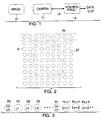
- a color image processing system is diagrammatically shown as comprising a color image transducer device, such as a digital RGB video camera 11, that supplies over its output link 13 image characteristic-representative digital signals, such as respective red, green and blue channel signal values representative of the red, green and blue color band components of a color image 21, light from which is incident upon an opto-electronic conversion matrix within the camera.
- image characteristic-representative digital signals such as respective red, green and blue channel signal values representative of the red, green and blue color band components of a color image 21, light from which is incident upon an opto-electronic conversion matrix within the camera.
- image characteristic-representative digital signals such as respective red, green and blue channel signal values representative of the red, green and blue color band components of a color image 21, light from which is incident upon an opto-electronic conversion matrix within the camera.
- the sampling frequency is not the same for each of the respective image information bands.
- green is fully sampled
- red and blue are sampled at a lower frequency.
- a microprocessor programmed to execute the interpolation procedure set forth in detail below), which derives values for those portions (pixel locations) of an image that lie between fully sampled pixels.
- those pixels that are fully sampled will be denoted by the reference character L, while the subsampled components will be denoted by the reference character C.
- Figure 2 diagrammatically illustrates a portion of a two-dimensional array of image pixels Pi,j, for which image characteristic representative signals, associated with respective image attributes, such as a specified chrominance or chrominance difference value, a luminance value, etc. are provided by camera 11.
- image characteristic representative signals associated with respective image attributes, such as a specified chrominance or chrominance difference value, a luminance value, etc. are provided by camera 11.
- image attributes such as a specified chrominance or chrominance difference value, a luminance value, etc.
- the problem of color fringing of edges between portions of an image having differing color characteristics is effectively avoided by first segmenting the image into a plurality of contiguous image regions, between which edges are inferred and then interpolating sub-sampled signal values within each region in accordance with a predetermined relationship between fully sampled and sub-sampled signal values at sampling locations whereat fully sampled and sub-sampled signal values have been supplied by camera 11.
- the mechanism chosen to segment the image may be any of a number of conventional imagery signal processing techniques, including both one and two-dimensional segmentation schemes and the invention is not limited any specific method. Consequently, the segmentation examples given below are merely for purposes of illustration. other procedures described in the literature are equally applicable to the invention.
- One example of a technique for segmenting the image on a one-dimensional basis involves the analysis of successive linear groups or lines of pixels, such as linear portion 25 of the array of Figure 2, using sub-intervals delineated by those pixel locations at which signal values for a sub-sampled channel have been produced by camera 11. Within each sub-interval a color edge is presumed and the analysis proceeds to determine the most likely position of the edge based upon an iterative processing of the fully sampled channel signals for all of the pixels within the sub-interval.
- FIG. 3 which diagrammatically illustrates a portion 25 of one row of the pixel array of Figure 2
- differential (frequency) sampling of the pixel locations Pi within the row produces fully sampled signal values Li for each pixel Pi and sub-sampled signal values CO, Cn, C2n, ... for every nth pixel location, where the sub-sample factor n typically has a value of 2, 4 or 8. It is necessary, therefore, to interpolate C values for pixel locations Cl, C2, C3, ..., Cn-1, Cn+l, etc.
- a color edge is inferred, and the characteristics of the image on opposite sides of the edge are presumed to conform to respectively different color characteristics, such as respectively different constant color levels or respective uniform variations in color, so that between the edge and the end points of the subinterval, there are two color regions that are contiguous with one another at the edge.
- the segmentation process is carried out on an iterative basis, producing a series of measurements of the 'fit' of each segmented sub-interval iteration.
- That segmented sub-interval iteration which best fits or matches the L values of the fully sampled channel is selected.
- the best fit may be determined using conventional error measurement techniques, such as a least squares fit or a maximum likelihood, or Bayesion statistical procedure, or a threshold crossing of the L values between the regions.
- Figure 4 diagrammatically illustrates an iterative segmentation process applied to a sub-interval of fully sampled L signal values, with an edge E being inferred between respective high and low constant levels LKH and LKL, for successively offset edge-representative locations among fully sampled locations 0 and n.
- LKH and LKL constant levels
- Figure 4 diagrammatically illustrates an iterative segmentation process applied to a sub-interval of fully sampled L signal values, with an edge E being inferred between respective high and low constant levels LKH and LKL, for successively offset edge-representative locations among fully sampled locations 0 and n.
- an edge E is presumed between pixel locations 0 and n; on each side of the edge the value of L is a constant (either LKH or LKL).
- the values of the constants may be chosen by setting a given threshold based upon a priori knowledge of the image statistics and averaging the L values within the interval. As with the segmentation process itself, the particular mechanism through which the constants are defined is not critical to the invention.
- the sequence of L values LO, Ll, L2, ..., Ln is compared with the model M and a measure of the fit of the model to the actual image-representative signals (for example, through a least squared error fit or choosing the center zero-crossing of L-(Lo+Ln)/2) is derived.
- That segmentation model which produces the 'best fit' thereby 'tailors' the optimal location of the edge E and the mechanism through which the sub-sampled C values are interpolated within the sub-interval or region between pixel locations 0 and n.
- the particular mechanism for interpolating an unknown value of C will depend on the characteristics of the bands of the L and C signals. Examples of the mechanism through which unknown values of C are defined include making each value of C within a region (on one side of the edge E) constant, making the difference C-L constant within the region, or making the ratio C/L constant within the region. For bands which are essentially decorrelated with one another, such as the in-phase and luminance channels in a YIQ system, the value of C is fixed within the region. For a red and green intensity imaging device, the ratio of red to green (green is fully sampled) is made constant within the region. For a log exposure imaging device, the difference between the red and green values is made constant within the region.
- the model M of the image characteristic has the form of a linear equation, represented in Figure 5 by respective lines Ll and L2.
- an edge E is presumed between pixel locations 0 and n, and on each side of the edge the value of L conforms with a respective relationship (here a linear variation rather than a constant, as in the previous example).
- the values of the coefficients a and b may be selected in accordance with image characteristics, including expected noise, and the magnitudes of each of CO, LO and Cn, Ln at pixel locations 0 and n, respectively.
- the sequence of L values LO, Ll, L2, ..., Ln is compared with the model M and a measure of the fit of the model to the actual image-representative signals is derived. That model which produces the best fit then establishes the location of the edge E and the mechanism through which the sub-sampled C values are interpolated within the sub-interval or region between pixel locations 0 and n.
- the mechanism for interpolating an unknown value of C will depend on the characteristics of the bands of the L and C signals and may include the relationships set forth above.
- Figures 6(a) - 6(b) show portion 27 of the pixel array of Figure 2, which has been segmented into respective segmentation diagrams by a two-dimensional segmenting process, such that each region of each diagram contains a plurality of pixel locations whereat fully sampled signal values are provided and one pixel location whereat a sub-sampled signal value is provided. More particularly, each of Figures 6(a) - 6(b) illustrates a two-dimensional 'neighborhood' segmenting or subdividing of a two-dimensional array of pixels into four regions 31-34, each of which contains a pixel location P at which both L and C values are supplied by camera 11 and some number of additional pixel locations Po at which only L values are provided and for which C values must be interpolated.
- FIG. 6 An example of a 'neighborhood' segmenting process for the sampling geometry illustrated in Figure 6 may be any of the types described in the published literature (e.g. "Handbook of Pattern Recognition and Image Processing” eds. T.Y. Young & K.S. Fu Academic Press 1986).
- groups of interconnected edge lines E between adjacent regions are produced, as shown in Figures 6(a) - (c).
- the geometry is subdivided by an edge line E12 between regions 31 and 32, edge line E13 between regions 31 and 33, edge line E14 between regions 31 and 34 and edge line E34 between regions 33 and 34.
- the L values within each region are compared with a (two-dimensional) model for the array (e.g a constant level or 'planar' model)" and a measure of the f it of the model to the L values for each pixel location within a region is derived.
- a two-dimensional model which produces the best fit establishes the paths of the edge lines E and the mechanism through which the sub-sampled C values are interpolated within the region.
- the interpolation mechanism first segments image data pursuant to some prescribed one or two-dimensional segmentation procedure, and then, after performing a best fit tailoring the boundaries of the segmented regions, interpolates the sub-sampled C values at pixel locations for which C data was not originally supplied.
- the mechanism of the present invention may be carried out by applying a plurality of segmentation schemes to the data and assigning a figure of merit to each segmentation process. A typical measure of the figure of merit may again be based upon the mean square deviation of the actual L data from the chosen segmentation model.
- Another measure of the figure of merit that may be used is the likelihood that a segmentation could produce the given observed L data, based upon a statistical model of the image.
- Wl, W2, W3, Wk a weighting coefficient that is associated with the figure of merit and a priori characteristics of the image.
- W exp( -(mean square deviation)/(flat field variance)), wherein the variance value provides a measure of the noise within a generally uniform region of the image.
- the problem of color fringing of edges between image regions of different color characteristics that are processed by conventional interpolation mechanisms is effectively obviated in accordance with the present invention by basing interpolation of sub-sampled image signals on an initial segmentation diagram, boundaries between which have been tailored to optimally subdivide the image data into a plurality of contiguous image regions of respectively different image characteristics. Because a boundary between adjacent regions occurs where the segmentation mechanism has tailored the inference of an edge, interpolated sub-sampled values in the neighborhood of that edge produce a reconstructed image that enjoys significantly improved quality over images produced by conventional linear interpolation.
Landscapes
- Engineering & Computer Science (AREA)
- Multimedia (AREA)
- Signal Processing (AREA)
- Color Television Image Signal Generators (AREA)
- Color Television Systems (AREA)
- Processing Of Color Television Signals (AREA)
- Image Analysis (AREA)
Abstract
Claims (7)
- Procédé pour traiter des valeurs de signaux échantillonnées, produites par un dispositif de formation d'image couleur, représentatives de contenus d'information couleur respectivement différente (C, L) d'une image d'entrée, un canal totalement échantillonné desdites valeurs de signaux étant associé à une première bande contenant des informations de premières caractéristiques de composante de couleur (L) de ladite image d'entrée et un canal sous-échantillonné desdites valeurs de signaux échantillonnées étant associé à une seconde bande contenant des informations de caractéristiques de seconde composante de couleur (C) de ladite image d'entrée, ledit procédé produisant des secondes valeurs de signaux interpolées pour emplacements de ladite image entre des emplacements d'échantillonnage pour lesquels les secondes valeurs de signaux ne sont pas produites, basé sur un mécanisme de segmentation choisi, dépendant des caractéristiques des bandes desdits signaux totalement échantillonnés et sous-échantillonnés, comprenant les étapes consistant à :(a) segmenter le canal totalement échantillonné en une configuration de segmentation contenant une pluralité de régions image contiguës de caractéristiques image respectives différentes, de sorte que, à l'intérieur d'une région respective, les valeurs de signaux totalement échantillonnées soient associées à une caractéristique d'image commune et, sur chaque côté d'une frontière entre deux régions contiguës, les valeurs de signaux pour les emplacements d'échantillonnage suivants du canal totalement échantillonné sont affectées en conformité avec les caractéristiques d'image différentes, et(b) interpoler, à l'intérieur de chaque région, les valeurs de signaux pour les emplacements non échantillonnés dudit canal sous-échantillonné en conformité avec une relation prédéterminée entre les valeurs de signaux totalement échantillonnées et sous-échantillonnées à un emplacement d'échantillonnage dans cette région, sur lequel chacune des valeurs de signaux totalement échantillonnées et sous-échantillonnées a été produite, ladite relation prédéterminée étant fonction dudit mécanisme de segmentation sélectionné et de ladite caractéristique d'image commune associée à la région d'image respective.
- Procédé selon la revendication 1, dans lequel, pour un mécanisme de segmentation sélectionné, une pluralité de configurations de segmentation et une pluralité correspondante de valeurs interpolées sont obtenus.
- Procédé selon l'une quelconque des revendications 1 à 2, dans lequel une pluralité de configurations de segmentation correspondant à une pluralité de mécanismes de segmentation d'image respectivement différente sont obtenues et pondérant chacune de ladite pluralité de configurations de segmentation en conformité avec une caractéristique d'erreur prescrite entre chaque configuration segmentée et ladite image d'entrée, et dans lequel une pluralité de valeurs interpolées respectives correspondant à chacun des mécanismes de segmentation d'image différents sont combinés et pondérés en conformité avec la pondération de ladite pluralité des configurations de segmentation.
- Procédé selon la revendication 3, dans lequel l'étape (a) comprend la segmentation de ladite image en une configuration de segmentation d'image formée d'une pluralité de régions des premières valeurs de signaux, de sorte que, à l'intérieur d'une région respective, chaque première valeur de signal est la même, tandis que les valeurs des premiers signaux pour les régions contiguës diffèrent les unes des autres, de sorte qu'une frontière d'image est définie entre des régions contiguës.
- Procédé selon la revendication 1, dans lequel l'étape (a) comprend les étapes consistant à :(a1) déduire une limite de caractéristique d'image entre des emplacements d'échantillonnage successifs auxquels des secondes valeurs de signaux sont produites par ledit dispositif de formation d'image,(a2) traiter les premières valeurs de signaux produites aux emplacements d'échantillonnage qui se trouvent entre ladite limite de caractéristique d'image et un emplacement desdits emplacements d'échantillonnage successif en conformité avec une relation définissant les premières caractéristiques d'image et des premières valeurs de signaux produites aux emplacements d'échantillonnage qui se trouvent entre ladite limite caractéristique d'image et un desdits emplacements d'échantillonnage successifs, en conformité avec une relation de définition de caractéristique de seconde image, de façon à obtenir une mesure d'une frontière de segmentation prédite entre lesdits emplacements d'échantillonnage successifs,(a3) répéter les étapes (a1) et (a2) pour plusieurs limites de caractéristique d'image déduits entre des emplacements d'échantillonnage successifs, de façon à obtenir de multiples mesures de frontières de segmentation prédites, et(a4) sélectionner, en tant que frontière d'image entre des régions contiguës de ladite configuration de segmentation, la limite caractéristique d'image qui s'adapte le mieux à une variation desdites premières valeurs de signaux en conformité avec lesdites mesures des frontières de segmentation prédites.
- Procédé selon la revendication 5, dans lequel les étapes (a1) à (a4) sont effectuées par rapport à une disposition unidimensionnelle d'emplacements d'échantillonnage.
- procédé selon la revendication 5, dans lequel les étapes (a1) à (a4) sont effectuées par rapport à une disposition bidimensionnelle d'emplacements d'échantillonnage.
Applications Claiming Priority (3)
| Application Number | Priority Date | Filing Date | Title |
|---|---|---|---|
| US07/415,942 US5040064A (en) | 1989-10-02 | 1989-10-02 | Method of processing sampled signal valves produced by a color imaging device |
| US415942 | 1989-10-02 | ||
| PCT/US1990/005363 WO1991005441A1 (fr) | 1989-10-02 | 1990-09-24 | Systeme de segmentation pour produire des valeurs de couleurs interpolees pour un echantillon de signal d'image en couleurs |
Publications (2)
| Publication Number | Publication Date |
|---|---|
| EP0446330A1 EP0446330A1 (fr) | 1991-09-18 |
| EP0446330B1 true EP0446330B1 (fr) | 1994-12-14 |
Family
ID=23647867
Family Applications (1)
| Application Number | Title | Priority Date | Filing Date |
|---|---|---|---|
| EP90914590A Expired - Lifetime EP0446330B1 (fr) | 1989-10-02 | 1990-09-24 | Systeme de segmentation pour produire des valeurs de couleurs interpolees pour un echantillon de signal d'image en couleurs |
Country Status (5)
| Country | Link |
|---|---|
| US (1) | US5040064A (fr) |
| EP (1) | EP0446330B1 (fr) |
| JP (1) | JPH04502097A (fr) |
| DE (1) | DE69015153T2 (fr) |
| WO (1) | WO1991005441A1 (fr) |
Families Citing this family (15)
| Publication number | Priority date | Publication date | Assignee | Title |
|---|---|---|---|---|
| JP2948240B2 (ja) * | 1989-10-09 | 1999-09-13 | 株式会社日立製作所 | 信号補間装置 |
| US5475769A (en) * | 1992-07-13 | 1995-12-12 | Polaroid Corporation | Method and apparatus for recovering image data through the use of a color test pattern |
| US5382976A (en) * | 1993-06-30 | 1995-01-17 | Eastman Kodak Company | Apparatus and method for adaptively interpolating a full color image utilizing luminance gradients |
| US5555324A (en) * | 1994-11-01 | 1996-09-10 | Massachusetts Institute Of Technology | Method and apparatus for generating a synthetic image by the fusion of signals representative of different views of the same scene |
| US5778106A (en) * | 1996-03-14 | 1998-07-07 | Polaroid Corporation | Electronic camera with reduced color artifacts |
| JPH11122626A (ja) | 1997-10-17 | 1999-04-30 | Nikon Corp | 画像処理方法及び装置並びに画像処理プログラムを記録した記録媒体 |
| US6650795B1 (en) | 1999-08-10 | 2003-11-18 | Hewlett-Packard Development Company, L.P. | Color image capturing system with antialiazing |
| US6580837B1 (en) * | 1999-12-07 | 2003-06-17 | Intel Corporation | Up-sampling decimated color plane data |
| US6903782B2 (en) * | 2001-03-28 | 2005-06-07 | Koninklijke Philips Electronics N.V. | System and method for performing segmentation-based enhancements of a video image |
| US7221793B2 (en) * | 2003-05-27 | 2007-05-22 | Hewlett-Packard Development Company, L.P. | Systems and methods for providing spatially-varied demosaicing |
| GB0316994D0 (en) * | 2003-07-21 | 2003-08-27 | E2V Tech Uk Ltd | Smear reduction in CCD images |
| US20070198725A1 (en) * | 2004-10-06 | 2007-08-23 | Morris Robert P | System and method for utilizing contact information, presence information and device activity |
| US7568628B2 (en) | 2005-03-11 | 2009-08-04 | Hand Held Products, Inc. | Bar code reading device with global electronic shutter control |
| US7770799B2 (en) | 2005-06-03 | 2010-08-10 | Hand Held Products, Inc. | Optical reader having reduced specular reflection read failures |
| TWI268709B (en) * | 2005-08-26 | 2006-12-11 | Realtek Semiconductor Corp | Digital filtering device and related method |
Family Cites Families (4)
| Publication number | Priority date | Publication date | Assignee | Title |
|---|---|---|---|---|
| US4642678A (en) * | 1984-09-10 | 1987-02-10 | Eastman Kodak Company | Signal processing method and apparatus for producing interpolated chrominance values in a sampled color image signal |
| US4630307A (en) * | 1984-09-10 | 1986-12-16 | Eastman Kodak Company | Signal processing method and apparatus for sampled image signals |
| EP0192736B1 (fr) * | 1984-09-10 | 1990-05-23 | EASTMAN KODAK COMPANY (a New Jersey corporation) | Procede et appareil de traitement de signaux pour signaux d'images couleur echantillonnes |
| US4764805A (en) * | 1987-06-02 | 1988-08-16 | Eastman Kodak Company | Image transmission system with line averaging preview mode using two-pass block-edge interpolation |
-
1989
- 1989-10-02 US US07/415,942 patent/US5040064A/en not_active Expired - Lifetime
-
1990
- 1990-09-24 JP JP2513797A patent/JPH04502097A/ja active Pending
- 1990-09-24 WO PCT/US1990/005363 patent/WO1991005441A1/fr not_active Ceased
- 1990-09-24 DE DE69015153T patent/DE69015153T2/de not_active Expired - Fee Related
- 1990-09-24 EP EP90914590A patent/EP0446330B1/fr not_active Expired - Lifetime
Also Published As
| Publication number | Publication date |
|---|---|
| US5040064A (en) | 1991-08-13 |
| EP0446330A1 (fr) | 1991-09-18 |
| JPH04502097A (ja) | 1992-04-09 |
| WO1991005441A1 (fr) | 1991-04-18 |
| DE69015153T2 (de) | 1995-06-22 |
| DE69015153D1 (de) | 1995-01-26 |
Similar Documents
| Publication | Publication Date | Title |
|---|---|---|
| US5040064A (en) | Method of processing sampled signal valves produced by a color imaging device | |
| US6934056B2 (en) | Noise cleaning and interpolating sparsely populated color digital image using a variable noise cleaning kernel | |
| JP3293920B2 (ja) | 画像処理装置およびその方法 | |
| EP0920221B1 (fr) | Appareil et procédé de traitement d'image | |
| US6816197B2 (en) | Bilateral filtering in a demosaicing process | |
| US7486844B2 (en) | Color interpolation apparatus and color interpolation method utilizing edge indicators adjusted by stochastic adjustment factors to reconstruct missing colors for image pixels | |
| EP0460193B1 (fr) | Procede pour accroitre la plage lineaire des images fixees sur un film | |
| DE19816123B4 (de) | Verfahren zum Erzeugen von Mehrfachwiedergaben eines Bilds mit einer Mehrfachbildabtastvorrichtung | |
| US6175430B1 (en) | Interpolating operation method and apparatus for color image signals | |
| EP1552474B1 (fr) | Procede d'interpolation et d'affinage d'images | |
| KR100332268B1 (ko) | 텔레비전신호에서움직임에대한계위적추정을하는방법 | |
| EP1337115B1 (fr) | Processeur d'image et procede de conversion de systeme colorimetrique | |
| KR20010020797A (ko) | 전색 이미지 생성을 위한 데이터 처리 시스템 동작 방법과2차원 픽셀값 어레이를 포함하는 이미지의 보간 방법 | |
| EP0901278B1 (fr) | Procédé et appareil pour générer une table de conversion de couleurs avec interpolation | |
| US6208753B1 (en) | Quality of digitized images through post-scanning reregistration of their color planes | |
| US4907096A (en) | Image processing | |
| US7289665B2 (en) | Image processing device and image processing program | |
| US20060119896A1 (en) | Image processing apparatus, image processing program, electronic camera, and image processing method for smoothing image of mixedly arranged color components | |
| US7068396B1 (en) | Method and apparatus for performing tone scale modifications on a sparsely sampled extended dynamic range digital image | |
| EP0446329B1 (fr) | Systeme pour produire des valeurs de couleurs interpolees pour un echantillon de signal d'image en couleurs | |
| JP3059205B2 (ja) | 画像処理装置 | |
| US20050093989A1 (en) | Determination of shooting scene and image processing for the determined scene | |
| US7133569B1 (en) | Aliasing artifact attenuation system | |
| US5204738A (en) | Method of an apparatus for compressing images data | |
| US7023576B1 (en) | Method and an apparatus for elimination of color Moiré |
Legal Events
| Date | Code | Title | Description |
|---|---|---|---|
| PUAI | Public reference made under article 153(3) epc to a published international application that has entered the european phase |
Free format text: ORIGINAL CODE: 0009012 |
|
| AK | Designated contracting states |
Kind code of ref document: A1 Designated state(s): AT BE CH DE DK ES FR GB IT LI LU NL SE |
|
| 17P | Request for examination filed |
Effective date: 19910919 |
|
| 17Q | First examination report despatched |
Effective date: 19930715 |
|
| GRAA | (expected) grant |
Free format text: ORIGINAL CODE: 0009210 |
|
| AK | Designated contracting states |
Kind code of ref document: B1 Designated state(s): DE FR GB |
|
| REF | Corresponds to: |
Ref document number: 69015153 Country of ref document: DE Date of ref document: 19950126 |
|
| ET | Fr: translation filed | ||
| PLBE | No opposition filed within time limit |
Free format text: ORIGINAL CODE: 0009261 |
|
| STAA | Information on the status of an ep patent application or granted ep patent |
Free format text: STATUS: NO OPPOSITION FILED WITHIN TIME LIMIT |
|
| 26N | No opposition filed | ||
| PGFP | Annual fee paid to national office [announced via postgrant information from national office to epo] |
Ref country code: GB Payment date: 19960808 Year of fee payment: 7 |
|
| PGFP | Annual fee paid to national office [announced via postgrant information from national office to epo] |
Ref country code: FR Payment date: 19960910 Year of fee payment: 7 |
|
| PGFP | Annual fee paid to national office [announced via postgrant information from national office to epo] |
Ref country code: DE Payment date: 19960927 Year of fee payment: 7 |
|
| PG25 | Lapsed in a contracting state [announced via postgrant information from national office to epo] |
Ref country code: GB Free format text: LAPSE BECAUSE OF NON-PAYMENT OF DUE FEES Effective date: 19970924 |
|
| PG25 | Lapsed in a contracting state [announced via postgrant information from national office to epo] |
Ref country code: FR Free format text: THE PATENT HAS BEEN ANNULLED BY A DECISION OF A NATIONAL AUTHORITY Effective date: 19970930 |
|
| GBPC | Gb: european patent ceased through non-payment of renewal fee |
Effective date: 19970924 |
|
| PG25 | Lapsed in a contracting state [announced via postgrant information from national office to epo] |
Ref country code: DE Free format text: LAPSE BECAUSE OF NON-PAYMENT OF DUE FEES Effective date: 19980603 |
|
| REG | Reference to a national code |
Ref country code: FR Ref legal event code: ST |