EP0446537A1 - Process for preparing lower alkyl-halides - Google Patents
Process for preparing lower alkyl-halides Download PDFInfo
- Publication number
- EP0446537A1 EP0446537A1 EP90400667A EP90400667A EP0446537A1 EP 0446537 A1 EP0446537 A1 EP 0446537A1 EP 90400667 A EP90400667 A EP 90400667A EP 90400667 A EP90400667 A EP 90400667A EP 0446537 A1 EP0446537 A1 EP 0446537A1
- Authority
- EP
- European Patent Office
- Prior art keywords
- hbr
- process according
- reactor
- alcohol
- water
- Prior art date
- Legal status (The legal status is an assumption and is not a legal conclusion. Google has not performed a legal analysis and makes no representation as to the accuracy of the status listed.)
- Ceased
Links
- 150000001350 alkyl halides Chemical class 0.000 title claims abstract description 18
- 238000004519 manufacturing process Methods 0.000 title claims abstract description 8
- XLYOFNOQVPJJNP-UHFFFAOYSA-N water Substances O XLYOFNOQVPJJNP-UHFFFAOYSA-N 0.000 claims abstract description 37
- LFQSCWFLJHTTHZ-UHFFFAOYSA-N Ethanol Chemical compound CCO LFQSCWFLJHTTHZ-UHFFFAOYSA-N 0.000 claims abstract description 34
- 238000006243 chemical reaction Methods 0.000 claims abstract description 22
- 238000004821 distillation Methods 0.000 claims abstract description 13
- 125000005843 halogen group Chemical group 0.000 claims abstract description 3
- 238000000034 method Methods 0.000 claims description 33
- 230000008569 process Effects 0.000 claims description 33
- OKKJLVBELUTLKV-UHFFFAOYSA-N Methanol Chemical compound OC OKKJLVBELUTLKV-UHFFFAOYSA-N 0.000 claims description 27
- GZUXJHMPEANEGY-UHFFFAOYSA-N bromomethane Chemical compound BrC GZUXJHMPEANEGY-UHFFFAOYSA-N 0.000 claims description 16
- 239000000203 mixture Substances 0.000 claims description 9
- QTBSBXVTEAMEQO-UHFFFAOYSA-N Acetic acid Chemical compound CC(O)=O QTBSBXVTEAMEQO-UHFFFAOYSA-N 0.000 claims description 8
- 150000001347 alkyl bromides Chemical group 0.000 claims description 7
- 239000007864 aqueous solution Substances 0.000 claims description 7
- LRHPLDYGYMQRHN-UHFFFAOYSA-N N-Butanol Chemical compound CCCCO LRHPLDYGYMQRHN-UHFFFAOYSA-N 0.000 claims description 6
- 238000009835 boiling Methods 0.000 claims description 6
- 239000012535 impurity Substances 0.000 claims description 5
- 239000007788 liquid Substances 0.000 claims description 5
- 238000005893 bromination reaction Methods 0.000 claims description 3
- 239000011541 reaction mixture Substances 0.000 claims description 3
- BDERNNFJNOPAEC-UHFFFAOYSA-N propan-1-ol Chemical compound CCCO BDERNNFJNOPAEC-UHFFFAOYSA-N 0.000 claims description 2
- 150000001348 alkyl chlorides Chemical group 0.000 claims 1
- -1 t-PrOH Chemical compound 0.000 claims 1
- 239000002253 acid Substances 0.000 abstract description 14
- 238000004064 recycling Methods 0.000 abstract description 2
- CPELXLSAUQHCOX-UHFFFAOYSA-N Hydrogen bromide Chemical compound Br CPELXLSAUQHCOX-UHFFFAOYSA-N 0.000 description 50
- 238000010992 reflux Methods 0.000 description 12
- 239000000047 product Substances 0.000 description 7
- 238000002474 experimental method Methods 0.000 description 6
- 229940102396 methyl bromide Drugs 0.000 description 6
- NEHMKBQYUWJMIP-UHFFFAOYSA-N chloromethane Chemical compound ClC NEHMKBQYUWJMIP-UHFFFAOYSA-N 0.000 description 5
- FJBFPHVGVWTDIP-UHFFFAOYSA-N dibromomethane Chemical compound BrCBr FJBFPHVGVWTDIP-UHFFFAOYSA-N 0.000 description 5
- VNWKTOKETHGBQD-UHFFFAOYSA-N methane Chemical compound C VNWKTOKETHGBQD-UHFFFAOYSA-N 0.000 description 5
- 239000006227 byproduct Substances 0.000 description 4
- 239000000243 solution Substances 0.000 description 4
- 239000002699 waste material Substances 0.000 description 4
- KFZMGEQAYNKOFK-UHFFFAOYSA-N Isopropanol Chemical compound CC(C)O KFZMGEQAYNKOFK-UHFFFAOYSA-N 0.000 description 3
- HEMHJVSKTPXQMS-UHFFFAOYSA-M Sodium hydroxide Chemical compound [OH-].[Na+] HEMHJVSKTPXQMS-UHFFFAOYSA-M 0.000 description 3
- 150000001298 alcohols Chemical class 0.000 description 3
- 239000003153 chemical reaction reagent Substances 0.000 description 3
- 238000012856 packing Methods 0.000 description 3
- CSCPPACGZOOCGX-UHFFFAOYSA-N Acetone Chemical compound CC(C)=O CSCPPACGZOOCGX-UHFFFAOYSA-N 0.000 description 2
- WKBOTKDWSSQWDR-UHFFFAOYSA-N Bromine atom Chemical compound [Br] WKBOTKDWSSQWDR-UHFFFAOYSA-N 0.000 description 2
- OAICVXFJPJFONN-UHFFFAOYSA-N Phosphorus Chemical compound [P] OAICVXFJPJFONN-UHFFFAOYSA-N 0.000 description 2
- NINIDFKCEFEMDL-UHFFFAOYSA-N Sulfur Chemical compound [S] NINIDFKCEFEMDL-UHFFFAOYSA-N 0.000 description 2
- QAOWNCQODCNURD-UHFFFAOYSA-N Sulfuric acid Chemical compound OS(O)(=O)=O QAOWNCQODCNURD-UHFFFAOYSA-N 0.000 description 2
- GDTBXPJZTBHREO-UHFFFAOYSA-N bromine Substances BrBr GDTBXPJZTBHREO-UHFFFAOYSA-N 0.000 description 2
- 229910052794 bromium Inorganic materials 0.000 description 2
- 239000003795 chemical substances by application Substances 0.000 description 2
- 239000000356 contaminant Substances 0.000 description 2
- 238000010924 continuous production Methods 0.000 description 2
- 239000000463 material Substances 0.000 description 2
- 229940050176 methyl chloride Drugs 0.000 description 2
- 238000006386 neutralization reaction Methods 0.000 description 2
- 229910052698 phosphorus Inorganic materials 0.000 description 2
- 239000011574 phosphorus Substances 0.000 description 2
- 238000002360 preparation method Methods 0.000 description 2
- 230000035484 reaction time Effects 0.000 description 2
- 238000003860 storage Methods 0.000 description 2
- 229910052717 sulfur Inorganic materials 0.000 description 2
- 239000011593 sulfur Substances 0.000 description 2
- 239000012808 vapor phase Substances 0.000 description 2
- HLVFKOKELQSXIQ-UHFFFAOYSA-N 1-bromo-2-methylpropane Chemical compound CC(C)CBr HLVFKOKELQSXIQ-UHFFFAOYSA-N 0.000 description 1
- LGAJYTCRJPCZRJ-UHFFFAOYSA-N 2-bromopentane Chemical compound CCCC(C)Br LGAJYTCRJPCZRJ-UHFFFAOYSA-N 0.000 description 1
- NAMYKGVDVNBCFQ-UHFFFAOYSA-N 2-bromopropane Chemical compound CC(C)Br NAMYKGVDVNBCFQ-UHFFFAOYSA-N 0.000 description 1
- UXVMQQNJUSDDNG-UHFFFAOYSA-L Calcium chloride Chemical compound [Cl-].[Cl-].[Ca+2] UXVMQQNJUSDDNG-UHFFFAOYSA-L 0.000 description 1
- XBDQKXXYIPTUBI-UHFFFAOYSA-M Propionate Chemical compound CCC([O-])=O XBDQKXXYIPTUBI-UHFFFAOYSA-M 0.000 description 1
- 239000004809 Teflon Substances 0.000 description 1
- 229920006362 Teflon® Polymers 0.000 description 1
- KXKVLQRXCPHEJC-UHFFFAOYSA-N acetic acid trimethyl ester Natural products COC(C)=O KXKVLQRXCPHEJC-UHFFFAOYSA-N 0.000 description 1
- 150000007513 acids Chemical class 0.000 description 1
- PNEYBMLMFCGWSK-UHFFFAOYSA-N aluminium oxide Inorganic materials [O-2].[O-2].[O-2].[Al+3].[Al+3] PNEYBMLMFCGWSK-UHFFFAOYSA-N 0.000 description 1
- 230000015572 biosynthetic process Effects 0.000 description 1
- 230000031709 bromination Effects 0.000 description 1
- 239000001110 calcium chloride Substances 0.000 description 1
- 235000011148 calcium chloride Nutrition 0.000 description 1
- 229910001628 calcium chloride Inorganic materials 0.000 description 1
- 239000003054 catalyst Substances 0.000 description 1
- 230000008859 change Effects 0.000 description 1
- NEHMKBQYUWJMIP-NJFSPNSNSA-N chloro(114C)methane Chemical compound [14CH3]Cl NEHMKBQYUWJMIP-NJFSPNSNSA-N 0.000 description 1
- 150000001875 compounds Chemical class 0.000 description 1
- 238000009833 condensation Methods 0.000 description 1
- 230000005494 condensation Effects 0.000 description 1
- 238000009826 distribution Methods 0.000 description 1
- 238000001035 drying Methods 0.000 description 1
- 230000000694 effects Effects 0.000 description 1
- 230000032050 esterification Effects 0.000 description 1
- 238000005886 esterification reaction Methods 0.000 description 1
- ZMMJGEGLRURXTF-UHFFFAOYSA-N ethidium bromide Chemical compound [Br-].C12=CC(N)=CC=C2C2=CC=C(N)C=C2[N+](CC)=C1C1=CC=CC=C1 ZMMJGEGLRURXTF-UHFFFAOYSA-N 0.000 description 1
- 239000011521 glass Substances 0.000 description 1
- 230000026030 halogenation Effects 0.000 description 1
- 238000005658 halogenation reaction Methods 0.000 description 1
- 230000006872 improvement Effects 0.000 description 1
- 239000007791 liquid phase Substances 0.000 description 1
- BSUHUYNJLGMEPD-UHFFFAOYSA-N methanol;propan-1-ol Chemical compound OC.CCCO BSUHUYNJLGMEPD-UHFFFAOYSA-N 0.000 description 1
- SNMVRZFUUCLYTO-UHFFFAOYSA-N n-propyl chloride Chemical compound CCCCl SNMVRZFUUCLYTO-UHFFFAOYSA-N 0.000 description 1
- 230000007935 neutral effect Effects 0.000 description 1
- 150000003138 primary alcohols Chemical class 0.000 description 1
- 239000000376 reactant Substances 0.000 description 1
- 230000009257 reactivity Effects 0.000 description 1
- 150000003839 salts Chemical class 0.000 description 1
- 238000003756 stirring Methods 0.000 description 1
- 238000003786 synthesis reaction Methods 0.000 description 1
- 239000002351 wastewater Substances 0.000 description 1
- 239000011592 zinc chloride Substances 0.000 description 1
- 235000005074 zinc chloride Nutrition 0.000 description 1
- JIAARYAFYJHUJI-UHFFFAOYSA-L zinc dichloride Chemical compound [Cl-].[Cl-].[Zn+2] JIAARYAFYJHUJI-UHFFFAOYSA-L 0.000 description 1
Images

Classifications
-
- C—CHEMISTRY; METALLURGY
- C07—ORGANIC CHEMISTRY
- C07C—ACYCLIC OR CARBOCYCLIC COMPOUNDS
- C07C17/00—Preparation of halogenated hydrocarbons
- C07C17/093—Preparation of halogenated hydrocarbons by replacement by halogens
- C07C17/16—Preparation of halogenated hydrocarbons by replacement by halogens of hydroxyl groups
Definitions
- the present invention relates to a process for preparing lower alkyl-halides, particularly alkyl bromides. More particularly, the invention relates to a continuous process by means of which lower alkyl-halides are prepared from HX and the corresponding lower alcohol in an aqeous solution of the acid.
- Alkyl bromide can be produced by reacting the alcohol with elemental bromine and either phosphorus or sulfur. Elemental bromine is more expensive than HBr which is obtainable as a by-product in bromination reactions. Furthermore, the cost of using the phosphorus or the sulfur is increased even more, since these are converted into the corresponding acids in the reaction and become ecologically troublesome wastes. This reaction is nevertheless employed in the industrial manufacture of methyl bromide.
- This fact renders the process of the invention an attractive way to employ HBr obtained as by-product in various processes.
- DBM dibromomethane
- the boiling point of the reaction mixture may be lowered by the presence of impurities.
- the term "azeotropic composition” must be interpreted so as to take into account the effect of such impurities on the boiling point of the mixture, rather than as referring to that of pure components.
- the laboratory system comprises a 0.5 lit reactor, indicated by numeral 1, which is electrically heated.
- a packed column 2, mounted above the reactor, has a diameter of 5 cm and contains 10 mm Raschig rings, with a packing height of 60 cm .
- the column is divided into two sections (2A and 2B), and HBr is fed at the center of the column (height: 30 cm), through a metering pump 3.
- the alcohol is fed to the reactor via a metering pump 3'.
- a condenser 4 is mounted above the column 3, to condense alkyl bromide and water which are separated in a phase-separator 5. Water from the separator 5 is refluxed via a recycle metering pump 6 to the head of the column 2. Temperature control is achieved by controlling the amount of heat supplied to the reactor.
- Fig. 2 shows the pilot plant in which several experimental runs detailed below were carried out.
- the reactor 7 is a 100 lit. glass-lined reactor, equipped with a steam jacket, an agitator and standard accessories.
- the bubble-caps distillation column 8 has a diameter of 4" and contains 12 actual plates made of Teflon and separated from one another by a space of 6". The area of the cap holes of each plate is 8.2 cm2.
- An alcohol supply tank 9 and an aqueous HBr supply tank 10 are provided, as well as respective metering pumps 11 and 12.
- An additional metering pump 13 is provided for recycling water which separates in the H2O/AlkBr phase-separator 14, after condensing in the condenser 15. Surplus separated water is disposed of as waste product.
- the pot 16 is heated by an electric heater, and comprises a mechanical stirrer and other standard fittings, such as a thermometer.
- Alcohol is fed by a pump 18, and the acid by pump 19 and through a preheater 20.
- the distillation column 21 is fitted with a condenser 22 and receives a reflux stream via a reflux pump 23.
- a phase-separator 24, a waste water reservoir 25 and an acid neutralization tank 26, containing 15% NaOH solution, are connected downstream.
- the drying and storage step comprises a column 27, filled with CaCl2, to which the alkyl halide leaving the neutralization tank 26 is fed, a heat-exchanger 28, an acetone/CO2 trap 29 and an alkyl halide storage tank 30, cooled by ice.
- Example 3 was repeated, but employing i-Propanol instead of ethanol.
- the feed rate was 1.2-1.7 mol/lit.-hr.
- the reactor temperature was 122 o -124 o C and the HBr concentration in the reactor was 46-47%.
- the reflux ratio varied between 0.5-1.0.
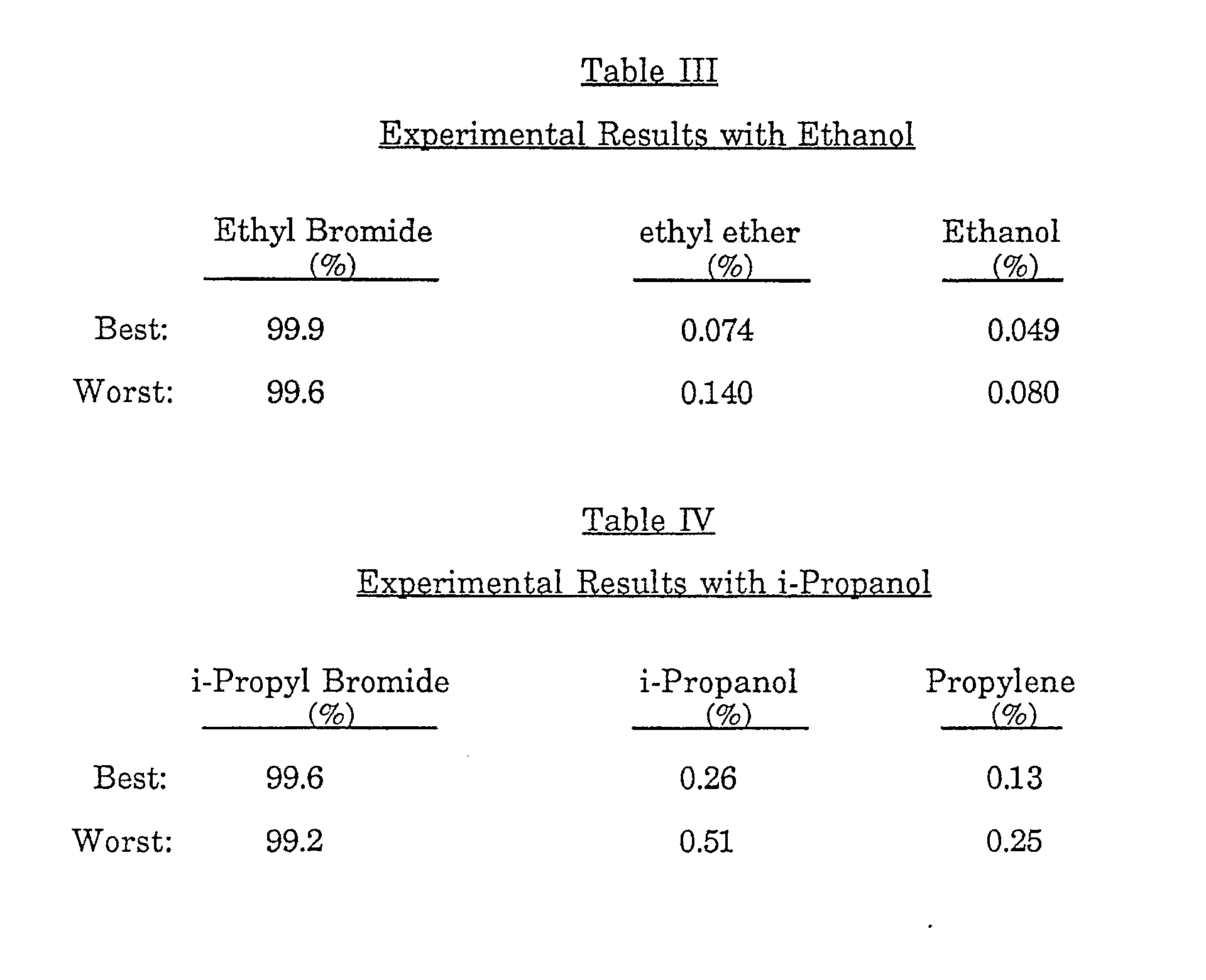
- the results are shown in Table IV, and are similar to those obtained in Example 3.
- the distillate water contained about 1.1% i-PrOH and about 0.3% i-PrBr.
- the maximal HBr concentration in the water was 0.12%.
- the actual yield based an alcohol was > 95%.
- Example 3 was repeated, but employing n-Butanol as the alcohol.
- the feed rates employed were 0.65-2.1 mol/lit.-hr, the reactor temperature was 120-123 o C, and the water reflux ratio 0.4-1.2.
- Example 5 was repeated, but n-BuOH was fed as a vapor.
- an evaporator was introduced in line after the alcohol metering pump (3' in Fig. 1).
- the experimental results detailed in Table VI show an improvement in the process rate, as compared to the results of Example 5, as well as a drop in the extent of i-BuBr formation.
- the distillate water at a reflux ratio of 1 was neutral.
- Example 7 was repeated, using n-BuOH as the alcohol.
- the temperature employed was 120 o -123 o C, the feed rate 40-65 mol/hr and the reflux ratio was 1.1-1.5.
- Different runs were carried out feeding the HBr either to the center of the column or directly to the reactor. This change did not affect the quality of the product obtained. Also increasing the stirring speed form 50 to 110 rpm did not increase the process rate significantly. Typical results for this run are shown in Table VIII.
- Table IX shows a typical distribution of materials in the distillation column, from which it can be seen that essentially all the reaction takes place within the reactor.
- Example 8 was repeated, feeding HBr directly to the reactor and using n-PrOH as the alcohol, with a feed rate of 60-90 mol/hr. The results are shown in Table X.
- Example 9 was repeated, using EtOH, with a feed rate of 90-100 mol/hr and a reflux ratio of 0.8-1.2. The results are shown in Table XI.
- Example 11 was repeated, but using a 62% aqueous HBr solution.
- the reflux ratio was in this case 1.2-1.7.
- the results obtained were as in Example 11.
- Example 13 was repeated by feeding to the reactor containing aqueous HBr, equimolar amounts of methanol and aqueous 48% HBr, which also contained 0.5% dibromomethane (DBM) as an impurity.
- DBM dibromomethane
- Example 14 was repeated under identical conditions, using as feed aqueous HBr contaminated with 1% acetic acid. Methyl bromide 99.8% pure was produced. Acetic acid and some methyl acetate were found in the aqueous distillate.
- Fig. 3 The set-up of Fig. 3 was used, employing a 45x2 cm distillation column filled with 0.3 cm Wilson glass helices. Aqueous 20% HCl was placed in the reactor which was heated and maintained at 110°C. Equimolar quantities of methanol and aqueous 20% HCl were fed to the reactor at a rate of about 0.3 mole/lit. reactor, while the aqueous distillate was removed continuously. The methyl chloride which formed, flashed out of the reaction zone, was condensed and found to be 99% pure.
- Example 16 was repeated, using instead of methanol n-propanol. By continuous water removal in the distillate, the reaction proceeded to produce n-propyl chloride, 98% pure.
- Example 13 was repeated, using anhydrous HBr gas instead of aqueous HBr.
- the initial acid concentration in the reactor was 45-6% and it was kept in this strength by maintaining a temperature of 121°C.
- the reagent feed was equimolar throughout, and the feed rate was 2.6 mole/l reactor.
- Methyl bromide of 99.5% purity was obtained along with distillate water containing only 0.3% HBr.
- the volume of the aqueous distillate was only 17% of that produced when using 48% HBr. The thermal requirements for distillation were therefore considerably reduced.
Landscapes
- Chemical & Material Sciences (AREA)
- Organic Chemistry (AREA)
- Organic Low-Molecular-Weight Compounds And Preparation Thereof (AREA)
Abstract
A process for preparing lower alkyl-halides from the reaction of HX and the corresponding lower alcohol, wherein X represents a halogen atom, comprises continuously feeding HX and a lower alcohol to a reactor maintaining the instantaneous molar ratio of HX to the alcohol greater than 3, and continuously distilling off lower alkyl-halide and water from the reactor, continuously separating the lower alkyl-halide and water and recycling part of the said water to the distillation column to abate HX distillation from the reactor. High acid concentrations and temperatures are maintained to obtain high yields and rapid conversion of alkanols.
Description
- The present invention relates to a process for preparing lower alkyl-halides, particularly alkyl bromides. More particularly, the invention relates to a continuous process by means of which lower alkyl-halides are prepared from HX and the corresponding lower alcohol in an aqeous solution of the acid.
- The reaction:
Alk-OH + HX → Alk-X + H₂O
in which X represents a halogen atom, is generally known to take place. It is, however, considered to conform in type to the process of esterification, in which equilibrium between reactants and products is attained, as described by Migrdichian ["Organic Synthesis", Vol. 1, p.17, 1957, Reinhold Publishing Corp]. In practice, the preparation of alkyl halides in aqueous solution of the acid has been impractically slow, inefficient and in some cases even impossible to achieve. For this reason, even though aqueous HX is a very convenient form of HX and often the cheapest form available, the art has so far not provided an efficient process for the production of alkyl-halides in aqueous solutions of the acid, in good yield and with industrially acceptable rates. Thus Jolles ["Bromine and its Compounds", Ernest Benn Ltd., 1966, p.377] reports the preparation of 2-bromopentane in only 89% yield from the corresponding alcohol and 54% aqueous HBr in a 4 hour reaction in which two-thirds of the HBr must subsequently be discharged as waste. Norris [Am. Chem. J., 38, 627-42 (1907)] obtained similarly low yields of alkyl bromides by the slow distillation of product from mixtures of the corresponding alcohols in excess aqueous HBr, but under such conditions primary alcohols did not react with aqueous HCl. - In the case of such slow reactions with the lower alcohols, one cannot conceive to distil out the product alkyl halide and water as formed, and thus hope to maintain a constant acid concentration, because the alcohols themselves are very volatile and most of them form low boiling azeotropes with water and would thus be distilled out of the reactor before reacting. This is a serious limitation when operating with the process described by Norris. With methanol, the yield of CH₃Br obtained by Norris was only 50%.
- To promote such reactions it is common practice either to use anhydrous HX and operate in the vapor phase, or/and to employ dehydrating agents. Thus, sulfuric acid is commonly used for this purpose, sometimes both as a means of generating HX from a convenient salt (thus operating in an almost anhydrous mode) as well as to serve as a condensation agent. ZnCl₂ is commonly used in the case of CH₃Cl manufacture in the liquid phase, and alumina often serves as catalyst for the manufacture of this material in the vapor phase [see, e.g., Weissermel and Arpe, "Industrial Organic Chemistry", Weinheim (1978), pp. 46-50].
- It should be borne in mind that aqueous HX, on reacting in such processes, not only produces one mole of water for each mole of acid reacted, but at the same time liberates all of the water molecules which were associated with it in the original acid solution. Thus, on using 48% aqueous HBr, for each mole reacting 6 moles of water are liberated, which dilute the unreacted acid. The serious influence of the phenomena on reducing the reactivity of the remaining acid is immediately obvious.
- In the cases of methyl bromide and methyl chloride, these can be produced by the halogenation of methane. This process is of industrial use in the case of methyl chloride if one has available a source of pure methane gas and can use the large amount of by-products (higher chlorinated methanes) coproduced [Weissermel and Arpe]. The corresponding reaction with bromine is not industrially useful.
- Alkyl bromide can be produced by reacting the alcohol with elemental bromine and either phosphorus or sulfur. Elemental bromine is more expensive than HBr which is obtainable as a by-product in bromination reactions. Furthermore, the cost of using the phosphorus or the sulfur is increased even more, since these are converted into the corresponding acids in the reaction and become ecologically troublesome wastes. This reaction is nevertheless employed in the industrial manufacture of methyl bromide.
- In spite of the failure of previous attempts to obtain high yields and rapid conversions of alkanols to alkyl halides in aqueous HX, it has now been found that it is possible to obtain the desired result if both the acid concentration and the temperature are high enough, and the instantaneous molar ratio of HX to alkanol is greater than 3. This is accomplished by continuously feeding HX and a lower alcohol to a reactor containing aqueous HX maintained under the appropriate conditions and lower alkyl-bromide and water are continuously distilled off from the said reactor, the lower alkyl-bromide and water being continuously separated, and part of the said water being recycled to the distillation column to abate HBr distillation from the reactor.
- It has thus been found, and this is an object of the invention, that it is possible to provide a continuous process which is both simple and economic, and which permits to prepare alkyl halides in good yield and high purity.
- It is another object of the invention to provide a process which can employ HBr in different forms, whether gaseous or aqueous. Even HBr from waste streams which contain organic contaminants whose boiling point, or those of their azeotropes, are below that of 48% aqueous HBr is useful in the process of this application. This fact, as will be apparent to the skilled engineer, renders the process of the invention an attractive way to employ HBr obtained as by-product in various processes. For instance, in UK Patent Application GB 2,219,583 of the same applicant, there is disclosed a process for the bromination of CH₃Br to dibromomethane (DBM), which produces HBr as a useful by-product, which HBr can be conveniently employed in the process of the invention.
- In order for the process to be convenient and effective, it is desirable to operate in such a way that reaction rates are high, and the concentration of HX in the distillate water is low. It was been found that this can be achieved, when employing the process of the invention, by operating close to the azeotropic composition of HX/water mixtures, viz., close to 48% for HBr and 20% for HCl. Thus it is preferred to operate at an HBr concentration of about 42-46%, and an HCl concentration of about 19%. Since in the process water is formed, relatively large amounts of water distill off, and the HX/water composition may be maintained substantially constant by keeping the temperature of the reaction mixture at about 120o-123oC for HBr and 108-109°C for HCl. As will be apparent to the skilled engineer, the boiling point of the reaction mixture may be lowered by the presence of impurities. In the case that contaminants are present, the term "azeotropic composition" must be interpreted so as to take into account the effect of such impurities on the boiling point of the mixture, rather than as referring to that of pure components. The temperatures mentioned above, therefore, may vary according to the specific case.
- The above and other characteristics and advantages of the invention will be better understood from the following illustrative and non-limitative examples, and with reference to the appended drawings wherein:
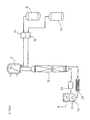
- Fig. 1 is a schematic representation of a bench experimental system;
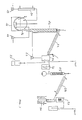
- Fig. 2 is a pilot plant constructed according to one embodiment of the invention; and
- Fig. 3 is an alternative experimental system.
- With reference now to Fig. 1, the laboratory system comprises a 0.5 lit reactor, indicated by
numeral 1, which is electrically heated. A packedcolumn 2, mounted above the reactor, has a diameter of 5 cm and contains 10 mm Raschig rings, with a packing height of 60 cm . The column is divided into two sections (2A and 2B), and HBr is fed at the center of the column (height: 30 cm), through ametering pump 3. The alcohol is fed to the reactor via a metering pump 3'. - A
condenser 4 is mounted above thecolumn 3, to condense alkyl bromide and water which are separated in a phase-separator 5. Water from theseparator 5 is refluxed via arecycle metering pump 6 to the head of thecolumn 2. Temperature control is achieved by controlling the amount of heat supplied to the reactor. - Fig. 2 shows the pilot plant in which several experimental runs detailed below were carried out. In this plant the
reactor 7 is a 100 lit. glass-lined reactor, equipped with a steam jacket, an agitator and standard accessories. The bubble-caps distillation column 8 has a diameter of 4" and contains 12 actual plates made of Teflon and separated from one another by a space of 6". The area of the cap holes of each plate is 8.2 cm². Analcohol supply tank 9 and an aqueous HBrsupply tank 10 are provided, as well asrespective metering pumps additional metering pump 13 is provided for recycling water which separates in the H₂O/AlkBr phase-separator 14, after condensing in thecondenser 15. Surplus separated water is disposed of as waste product. - In Fig. 3 the pot 16 is heated by an electric heater, and comprises a mechanical stirrer and other standard fittings, such as a thermometer. Alcohol is fed by a
pump 18, and the acid bypump 19 and through apreheater 20. Thedistillation column 21 is fitted with acondenser 22 and receives a reflux stream via areflux pump 23. A phase-separator 24, awaste water reservoir 25 and anacid neutralization tank 26, containing 15% NaOH solution, are connected downstream. The drying and storage step comprises a column 27, filled with CaCl₂, to which the alkyl halide leaving theneutralization tank 26 is fed, a heat-exchanger 28, an acetone/CO₂ trap 29 and an alkylhalide storage tank 30, cooled by ice. - The operation of the bench and pilot experimental systems is self-evident to the skilled engineer, from the description given above, and will be further illustrated by the following examples.
- Several experimental runs were carried out to determine the influence of the molar ratio HBr (aq)/MeOH. The experiments were carried out with MeOH (Fluka) and 48% HBr (Merck). Reactions were carried out with 2 ml samples placed in 10 ml flasks fitted with a condenser and a thermometer. The samples were heated to the reaction temperature during less than 1 minute, by placing them in a thermostated bath preheated to about 140oC. After the predetermined reaction time lapsed, the reaction was virtually stopped by rapidly inserting the flask into an ice-cold bath. The total acidity (HBr) left in the sample was analyzed. The difference in HBr concentration corresponds to the amount of MeBr formed. The results of these experiments are set forth in Table I, from which it can be seen that by increasing the molar ratio of HBr/MeOH from 3 to 10, the time of complete reaction is shortened from 30 to 3 minutes.
- Kinetic experiments were carried out, similarly to those described in Example 1, but varying the initial HBr concentration (in the range 42-48wt%), at an initial fixed HBr/MeOH molar ratio (2/1). The results are summarized in Table II. Lowering the initial HBr concentration from 48% to 42% sensibly increases the reaction time.
- Several experimental runs were carried out in the laboratory unit of Fig. 1, by feeding ethanol to the reactor at rates of 0.9-1.8 mol/lit.-hr. The 48% HBr was fed continuously to the center of the column at an equivalent molar rate. The concentration of HBr in the reactor was maintained constant at 44.5%-46.5% by controlling the temperature of the liquid at 120-123oC. The product and water were collected continuously from the distillate. Part of the water was recycled at a reflux ratio of 0.5-1.5, to remove HBr from the distillate and to maintain the neutrality of the effluent water. The best and worst product compositions obtained are shown in Table III, from which it can be seen that excellent results are obtained throughout the range of parameters described. The distillate water collected contained 1-1.7 % EtBr and 0,3-0,5 EtOH. The yield based on alcohol was 90-95%.
- Example 3 was repeated, but employing i-Propanol instead of ethanol. The feed rate was 1.2-1.7 mol/lit.-hr. The reactor temperature was 122o-124oC and the HBr concentration in the reactor was 46-47%. The reflux ratio varied between 0.5-1.0. The results are shown in Table IV, and are similar to those obtained in Example 3. The distillate water contained about 1.1% i-PrOH and about 0.3% i-PrBr. The maximal HBr concentration in the water was 0.12%. The actual yield based an alcohol was > 95%.
- Example 3 was repeated, but employing n-Butanol as the alcohol. The feed rates employed were 0.65-2.1 mol/lit.-hr, the reactor temperature was 120-123oC, and the water reflux ratio 0.4-1.2.
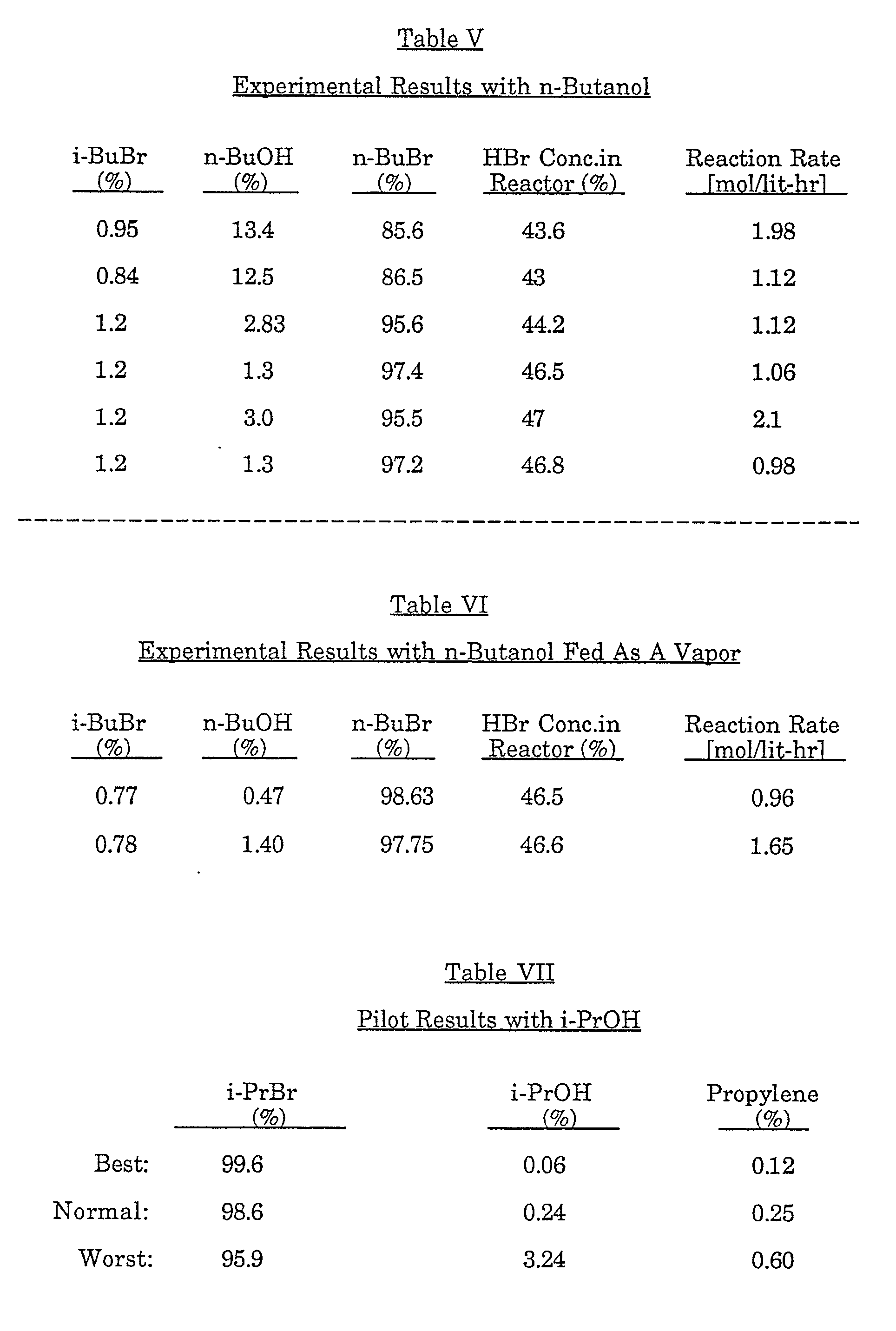
- The results of those experiments are summarized in Table V. It should be noted that increasing the HBr concentration from about 44 to 46.5 % lowers the amount of unreacted alcohol by one order of magnitude.
- Example 5 was repeated, but n-BuOH was fed as a vapor. For this purpose, an evaporator was introduced in line after the alcohol metering pump (3' in Fig. 1). By this means, better thermal control was achieved than in Example 5, and less fluctuations in the reactor temperature resulted. This led to better control of the reaction as well as better average results. The experimental results detailed in Table VI show an improvement in the process rate, as compared to the results of Example 5, as well as a drop in the extent of i-BuBr formation. The distillate water at a reflux ratio of 1 was neutral.
- Reaction of HBr and i-PrOH was carried out in the pilot plant of Fig. 2. The reaction temperature was 121o-124oC, the feed rate 50-70 mol/hr, and the reflux ratio was 1-1.5. The HBr (48%) was preheated to 110oC and fed to the center of the
column 8 of Fig. 2. Typical results are shown in Table VII. - Example 7 was repeated, using n-BuOH as the alcohol. The temperature employed was 120o-123oC, the feed rate 40-65 mol/hr and the reflux ratio was 1.1-1.5. Different runs were carried out feeding the HBr either to the center of the column or directly to the reactor. This change did not affect the quality of the product obtained. Also increasing the stirring speed form 50 to 110 rpm did not increase the process rate significantly. Typical results for this run are shown in Table VIII.
- Table IX shows a typical distribution of materials in the distillation column, from which it can be seen that essentially all the reaction takes place within the reactor.
- Example 8 was repeated, feeding HBr directly to the reactor and using n-PrOH as the alcohol, with a feed rate of 60-90 mol/hr. The results are shown in Table X.
- Example 9 was repeated, using EtOH, with a feed rate of 90-100 mol/hr and a reflux ratio of 0.8-1.2. The results are shown in Table XI.
- Experiments with n-BuOH were performed using a column packed with Raschig rings, and feeding HBr directly to the reactor via a dip pipe. The feed rate was 50-75 mol/hr and the reflux ratio was 0.8-1.5. The reactor temperature was maintained at 121-123°C. The packed column consisted of two sections: the lower, of packing height 87 cm, and the upper of packing height 61 cm. The results obtained are shown in Table XII.
- Example 11 was repeated, but using a 62% aqueous HBr solution. The reflux ratio was in this case 1.2-1.7. The results obtained were as in Example 11.
- Experiments were carried out in the set-up of Fig. 3, by feeding to the reactor containing aqueous HBr, equimolar amounts of methanol and aqueous 48% HBr, and maintaining in the reactor, at about 118-121°C, a constant HBr concentration (∼44-46%), by continuous removal of the water by distillation.
- The results, summarized in Table XIII, show that at an hourly reagents feed rate of 1.6-4.1 mole/lit. reactor, 0.15-0.4 Kg/lit. reactor of 99-99.9% pure methyl bromide are formed.
- Example 13 was repeated by feeding to the reactor containing aqueous HBr, equimolar amounts of methanol and aqueous 48% HBr, which also contained 0.5% dibromomethane (DBM) as an impurity. At an hourly reagents feed rate of about 3 mole/lit. reactor and 119°C in the pot, 290 g/lit. reactor of 99.8% pure methyl bromide were produced. The DBM present in the aqueous HBr feed was removed from the bottom of the aqueous distillate.
- Example 14 was repeated under identical conditions, using as feed aqueous HBr contaminated with 1% acetic acid. Methyl bromide 99.8% pure was produced. Acetic acid and some methyl acetate were found in the aqueous distillate.
- The set-up of Fig. 3 was used, employing a 45x2 cm distillation column filled with 0.3 cm Wilson glass helices. Aqueous 20% HCl was placed in the reactor which was heated and maintained at 110°C. Equimolar quantities of methanol and aqueous 20% HCl were fed to the reactor at a rate of about 0.3 mole/lit. reactor, while the aqueous distillate was removed continuously. The methyl chloride which formed, flashed out of the reaction zone, was condensed and found to be 99% pure.
- Example 16 was repeated, using instead of methanol n-propanol. By continuous water removal in the distillate, the reaction proceeded to produce n-propyl chloride, 98% pure.
- Example 13 was repeated, using anhydrous HBr gas instead of aqueous HBr. The initial acid concentration in the reactor was 45-6% and it was kept in this strength by maintaining a temperature of 121°C. The reagent feed was equimolar throughout, and the feed rate was 2.6 mole/l reactor.
- Methyl bromide of 99.5% purity was obtained along with distillate water containing only 0.3% HBr. The volume of the aqueous distillate was only 17% of that produced when using 48% HBr. The thermal requirements for distillation were therefore considerably reduced.
- The above description and examples have been provided for the purpose of illustration, and are not intended to be limitative. Many variations can be effected in the process of the invention. Different ways can be exploited for feeding HX to the reactor, at different feed points and in different concentrations, or different temperatures and reflux ratios can be used, all without exceeding the scope of the invention.




Claims (17)
- A process for preparing lower alkyl-halides from the reaction of HX and the corresponding lower alcohol, wherein X represents a halogen atom, characterized in that HX and a lower alcohol are continuously fed to a reactor, and lower alkyl-halide and water are continuously distilled off from the said reactor, the lower alkyl-halide and water being continuously separated and part of the said water being recycled to the distillation column to abate HX distillation from the reactor, the instantaneous molar ratio of HX to the alcohol being greater than 3.
- A process according to claim 1, wherein the concentration of HX in the reactor is maintained substantially constant by adjusting the temperature of the reaction mixture.
- A process acording to claim 1 or 2, wherein HX is HBr and the alkyl halide is alkyl bromide.
- A process according to claim 1 or 2, wherein HX is HCl and the alkyl halide is alkyl chloride.
- A process according to claim 3, wherein the concentration of HBr in the reactor is about 43-46% by weight.
- A process according to claim 3, wherein the temperature of the reactor mixture is about 120-123oC.
- A process according to claim 4, wherein the concentration of HBr in the reactor is about 19-20% by weight.
- A process according to claim 4, wherein the temperature of the reactor mixture is about 108-109°C.
- A process according to claim 1, wherein the alcohol is fed in liquid form or in vapor form.
- A process according to claim 1, wherein HX is fed in gaseous form or in liquid form.
- A process according to claim 10, wherein HX is HBr and the liquid form is an about 48% aqueous solution or an about 62% aqueous solution.
- A process according to claim 10, wherein HX is HCl and the liquid form is an about 20% aqueous solution.
- A process according to claim 3, wherein HBr contains impurities having a boiling point below that of a 48% aqueous solution of HBr, or which form aqueous azeotropes having a boiling point below that of a 48% aqueous solution of HBr.
- A process according to claim 13, wherein the impurities comprise DBM and/or CH₃COOH.
- A process according to claim 3, wherein the HBr employed is the product of the bromination reaction of CH₃Br to DBM.
- A process according to claim 1, wherein the lower alcohol is a C₁-C₄ alcohol.
- A process according to claim 16, wherein the alcohol is selected from the group consisting essentially of MeOH, EtOH, t-PrOH, n-PrOH and n-BuOH.
Priority Applications (2)
| Application Number | Priority Date | Filing Date | Title |
|---|---|---|---|
| EP90400667A EP0446537A1 (en) | 1990-03-13 | 1990-03-13 | Process for preparing lower alkyl-halides |
| US07/746,137 US5138110A (en) | 1990-03-13 | 1991-08-13 | Process for the preparation of alkyl-halides |
Applications Claiming Priority (1)
| Application Number | Priority Date | Filing Date | Title |
|---|---|---|---|
| EP90400667A EP0446537A1 (en) | 1990-03-13 | 1990-03-13 | Process for preparing lower alkyl-halides |
Publications (1)
| Publication Number | Publication Date |
|---|---|
| EP0446537A1 true EP0446537A1 (en) | 1991-09-18 |
Family
ID=8205689
Family Applications (1)
| Application Number | Title | Priority Date | Filing Date |
|---|---|---|---|
| EP90400667A Ceased EP0446537A1 (en) | 1990-03-13 | 1990-03-13 | Process for preparing lower alkyl-halides |
Country Status (1)
| Country | Link |
|---|---|
| EP (1) | EP0446537A1 (en) |
Cited By (2)
| Publication number | Priority date | Publication date | Assignee | Title |
|---|---|---|---|---|
| WO2003042138A1 (en) * | 2001-11-12 | 2003-05-22 | Bromine Compounds Ltd. | Method for the preparation of n-propyl bromide |
| DE10247497B4 (en) * | 2002-10-11 | 2008-08-21 | Evonik Degussa Gmbh | Process for the continuous production of acyclic C4 to C6 mono- and di-chlorohydrocarbons |
Citations (2)
| Publication number | Priority date | Publication date | Assignee | Title |
|---|---|---|---|---|
| US2516638A (en) * | 1947-03-03 | 1950-07-25 | Dow Chemical Co | Continuous process for the manufacture of ethyl chloride |
| FR2270224A1 (en) * | 1974-05-08 | 1975-12-05 | Du Pont | Continuous methyl chloride prepn - from methanol and hydrochloric acid without requiring catalyst |
-
1990
- 1990-03-13 EP EP90400667A patent/EP0446537A1/en not_active Ceased
Patent Citations (2)
| Publication number | Priority date | Publication date | Assignee | Title |
|---|---|---|---|---|
| US2516638A (en) * | 1947-03-03 | 1950-07-25 | Dow Chemical Co | Continuous process for the manufacture of ethyl chloride |
| FR2270224A1 (en) * | 1974-05-08 | 1975-12-05 | Du Pont | Continuous methyl chloride prepn - from methanol and hydrochloric acid without requiring catalyst |
Cited By (4)
| Publication number | Priority date | Publication date | Assignee | Title |
|---|---|---|---|---|
| WO2003042138A1 (en) * | 2001-11-12 | 2003-05-22 | Bromine Compounds Ltd. | Method for the preparation of n-propyl bromide |
| JP2005509013A (en) * | 2001-11-12 | 2005-04-07 | ブローミン コンパウンズ リミテッド | Method for preparing n-propyl bromide |
| US7217849B2 (en) | 2001-11-12 | 2007-05-15 | Bromine Compounds Ltd. | Method for the preparation of n-propyl bromide |
| DE10247497B4 (en) * | 2002-10-11 | 2008-08-21 | Evonik Degussa Gmbh | Process for the continuous production of acyclic C4 to C6 mono- and di-chlorohydrocarbons |
Similar Documents
| Publication | Publication Date | Title |
|---|---|---|
| EP0786444B1 (en) | Process for producing acetaldehyde dimethylacetal | |
| EP1057802B1 (en) | Process for manufacturing methyl chloride | |
| US5138110A (en) | Process for the preparation of alkyl-halides | |
| US6187972B1 (en) | Process for producing an alkylene glycol | |
| CS183991A3 (en) | Process for preparing 4-acetoxystyrene | |
| EP0392579B1 (en) | Improvements in and relating to aldol condensation | |
| US5767330A (en) | Process for preparing alkyl chlorides | |
| GB2087915A (en) | A process for concurrent preparation of organosiloxanes and methyl chloride | |
| US4332956A (en) | Process for preparing acyloxysilanes | |
| EP0074162B1 (en) | Process for producing p-cresol | |
| US6281392B1 (en) | Preparation of orthoesters | |
| EP0247234B1 (en) | Process for the manufacture of acetals of chloro- or bromoacetaldehyde | |
| EP0093255B1 (en) | Preparation of mono and dibromo or mono and dichloro aldehydes and acid chlorides | |
| US4876404A (en) | Preparation of dichlorotrifluoromethyltoluenes including novel isomers | |
| US4760209A (en) | Process for preparing 3,5-dichloro-α-methylstyrene | |
| US6657075B2 (en) | Continuous process for tertiary butyl esters | |
| CA1124748A (en) | Process for production of dimethylformamide | |
| EP0282914B1 (en) | Process for preparing chlorinated olefins | |
| IE43261B1 (en) | Continuous production of 2,5-dioxo-1-oxa-2-phospholanes | |
| US4486608A (en) | Preparation of mono- and dibromo- or chloroaldehydes | |
| US4670607A (en) | Method for producing 2-(substituted aryl) propionaldehyde | |
| EP0143864B1 (en) | Process for the production of 1,1,2-trichloro-2,2-difluoroethane | |
| US4570009A (en) | Process for preparing dimethylsilyl dicyanide | |
| US2947776A (en) | Process of preparing trimethyl borate | |
| GB2036720A (en) | Preparation of tetrachloro or tetrabromo cyclohexanone |
Legal Events
| Date | Code | Title | Description |
|---|---|---|---|
| PUAI | Public reference made under article 153(3) epc to a published international application that has entered the european phase |
Free format text: ORIGINAL CODE: 0009012 |
|
| AK | Designated contracting states |
Kind code of ref document: A1 Designated state(s): DE FR GB IT NL |
|
| 17P | Request for examination filed |
Effective date: 19920311 |
|
| 17Q | First examination report despatched |
Effective date: 19920709 |
|
| STAA | Information on the status of an ep patent application or granted ep patent |
Free format text: STATUS: THE APPLICATION HAS BEEN REFUSED |
|
| 18R | Application refused |
Effective date: 19931231 |