EP0446732A2 - Verfahren zur Herstellung lagerstabiler Farbstofflösungen - Google Patents
Verfahren zur Herstellung lagerstabiler Farbstofflösungen Download PDFInfo
- Publication number
- EP0446732A2 EP0446732A2 EP91103157A EP91103157A EP0446732A2 EP 0446732 A2 EP0446732 A2 EP 0446732A2 EP 91103157 A EP91103157 A EP 91103157A EP 91103157 A EP91103157 A EP 91103157A EP 0446732 A2 EP0446732 A2 EP 0446732A2
- Authority
- EP
- European Patent Office
- Prior art keywords
- boric acid
- salts
- process according
- dye
- solution
- Prior art date
- Legal status (The legal status is an assumption and is not a legal conclusion. Google has not performed a legal analysis and makes no representation as to the accuracy of the status listed.)
- Withdrawn
Links
Classifications
-
- C—CHEMISTRY; METALLURGY
- C09—DYES; PAINTS; POLISHES; NATURAL RESINS; ADHESIVES; COMPOSITIONS NOT OTHERWISE PROVIDED FOR; APPLICATIONS OF MATERIALS NOT OTHERWISE PROVIDED FOR
- C09B—ORGANIC DYES OR CLOSELY-RELATED COMPOUNDS FOR PRODUCING DYES, e.g. PIGMENTS; MORDANTS; LAKES
- C09B67/00—Influencing the physical, e.g. the dyeing or printing properties of dyestuffs without chemical reactions, e.g. by treating with solvents grinding or grinding assistants, coating of pigments or dyes; Process features in the making of dyestuff preparations; Dyestuff preparations of a special physical nature, e.g. tablets, films
- C09B67/0071—Process features in the making of dyestuff preparations; Dehydrating agents; Dispersing agents; Dustfree compositions
- C09B67/0072—Preparations with anionic dyes or reactive dyes
- C09B67/0073—Preparations of acid or reactive dyes in liquid form
-
- C—CHEMISTRY; METALLURGY
- C09—DYES; PAINTS; POLISHES; NATURAL RESINS; ADHESIVES; COMPOSITIONS NOT OTHERWISE PROVIDED FOR; APPLICATIONS OF MATERIALS NOT OTHERWISE PROVIDED FOR
- C09B—ORGANIC DYES OR CLOSELY-RELATED COMPOUNDS FOR PRODUCING DYES, e.g. PIGMENTS; MORDANTS; LAKES
- C09B67/00—Influencing the physical, e.g. the dyeing or printing properties of dyestuffs without chemical reactions, e.g. by treating with solvents grinding or grinding assistants, coating of pigments or dyes; Process features in the making of dyestuff preparations; Dyestuff preparations of a special physical nature, e.g. tablets, films
- C09B67/0096—Purification; Precipitation; Filtration
Definitions
- the present invention relates to a process for the preparation of highly concentrated, aqueous solutions of anionic dyes, in particular reactive dyes.
- anionic dyes in particular reactive dyes.
- the content of salts which results from the synthesis and isolation, must frequently be greatly reduced.
- this is mainly done by pressure permeation, with desalting first by removing saline permeate through a partially permeable membrane and replacing it with deionized water.
- a concentration step is followed, with only permeate being discharged but no water being added.
- the costs for this process step essentially depend on the residence time in the pressure permeation system. This is determined by the amount of water, the membrane area and the filtration current density. For a given plant and taking into account the fact that a minimum amount of water is required due to the fluidity of the solution or suspension, the economy depends crucially on the filtration current density. The higher the filtration density, the lower the costs.
- the filtration current density can be increased by adding boric acid or its salts before or during desalination.
- the invention thus relates to a process for the preparation of storage-stable, aqueous solutions of anionic dyes, preferably reactive dyes, by pressure permeation of solutions or suspensions of the raw dye, characterized in that the solution or suspension, before or during pressure permeation, comprises the steps of desalination and, if appropriate, concentration comprises boric acid or its salts.
- the boric acid or its salts are present in the starting solutions before the pressure permeation in concentrations of between 0.01 and 10% by weight, but preferably between 0.3 and 3% by weight.
- the reaction suspension which is present after the synthesis and already contains salts is reacted with e.g. Lithium salts added in solid form or as a concentrated solution, so that the concentration of the salt in question required for a solution of the dye results.
- the boric acid (salts) can also be added continuously during the pressure permeation, so that the required concentration is not changed.
- Suitable dyes that are to be processed into storage-stable solutions are anionic dyes, but in particular reactive dyes.
- reactive dyes there are also those with two or more identical or different reactive groups.
- the reactive dyes can belong to a wide variety of classes, for example the series of metal-free or metal-containing mono- or polyazo dyes, metal-free or metal-containing azaporphine dyes such as copper, cobalt or nickel phthalocyanine dyes, anthraquinone, oxazine, dioxazine, triphenylmethane, nitro, azomethine -, metal-free or metal-containing formazan dyes.
- metal-free or metal-containing mono- or polyazo dyes such as copper, cobalt or nickel phthalocyanine dyes, anthraquinone, oxazine, dioxazine, triphenylmethane, nitro, azomethine -, metal-free or metal-containing formazan dyes.
- symmetrical, asymmetrical, and composite membranes with semipermeable properties can be used for the pressure-operated membrane separation processes of the method according to the invention. They can consist of both organic and inorganic materials.
- Organic materials are preferred: polyvinylidene fluoride, cellulose acetate, polytetrafluoroethylene, polyacrylonitrile, polyethyleneimine, copolymers of polyacrylonitrile and vinylpyrrolidone, polysulfone, polyamide, polyhydantioin or also hydrophilized polyolefins, e.g. based on polypropylene.
- physicochemically or chemically modified membranes such as modified polyacrylonitrile membranes (see, for example, EP-A-25 973), which are obtained, for example, by reacting the base polymer with hydroxylamine, a polyfunctional, low molecular weight compound, a reactive group-containing polymer and an ionic compound which can handle a chemical bond with the polymer , and then with active chlorine, e.g. is treated in the form of a hypochlorite solution,
- Inorganic membranes are those made of porous metal or metal alloys - (so-called metal sintered membranes eg made of porous steel) or those made of porous carbon, the surface of which can be covered, for example, with a thin layer of zirconium dioxide, silicon or aluminum oxide, or furthermore those made of porous glass or ceramic.
- the solutions are preferably subjected to pressure permeation on asymmetric membranes or composite membranes, salt-containing permeate being discharged and, if appropriate, being completely or partially replaced by deionized water.
- Pressure permeation that is to say reverse osmosis and ultrafiltration, is preferably used, in which the passage of water and any dissolved substances through the semipermeable membrane takes place under the driving force of a hydrostatic pressure which exceeds the osmotic pressure.
- the pressure permeation for the process according to the invention can be carried out on all commercially available pressure permeation devices.
- Such devices can be designed, for example, as a plate-frame, tube, tube, hollow fiber or hollow fiber module.
- the membranes listed above which can be used according to the invention can be installed in the modules mentioned.
- solutions prepared by the process according to the invention can be used after adding a buffer and optionally one or more water-miscible organic solvents or solubilizers.
- Suitable agents are, for example, open-chain or cyclic amides, ureas, sulfones and sulfoxides, mono- and polyhydric alcohols and their ethers, polyethers and esters derived therefrom and dicyandiamide. If necessary, these agents can also be added before the pressure permeation. However, some of the additives then go into the permeate during pressure permeation.
- solutions prepared by the process according to the invention can, if appropriate after the addition of buffers and suitable adjusting agents, be worked up by spray drying or other drying processes to give solid formations. If necessary, buffers and adjusting agents can also be added after drying.
- This solution is desalted at a temperature of approx. 30 - 35 ° C, a pH of 6 and a pressure of 40 bar on a plate-frame module (with polysulfone membrane).
- a plate-frame module with polysulfone membrane.
- 4,000 kg of saline permeate are continuously replaced by 4,000 kg of demineralized water and then concentrated by removing 1,118.4 kg of saline permeate.
- 881.6 kg of concentrate are mixed with 100.8 kg of ⁇ -caprolactam and 20.2 kg of demineralized water and buffered with 5 kg of boric acid.
- a low-viscosity, storage-stable liquid setting of the dye of the formula (I) of 15% is obtained. Pure color, 10%. ⁇ -caprolactam, 0.5% boric acid and water ad 100%.
- the pH of the setting is 7.5; Cl content: ⁇ 0.05%.
- Dye loss in the permeate ⁇ 0.05%.
- the filtration current density This example is considerably larger than the same example without the addition of boric acid before the pressure permeation.
- This solution is desalted at a temperature of approx. 40-45 ° C and a pH of 7.5 and a pressure of 40 bar on a plate-frame module.
- 788.7 kg of saline permeate are continuously replaced by 788.7 kg of demineralized water and then concentrated by removing 133.9 kg of saline permeate.
- a commercially available composite membrane (carrier layer: polysulfone, membrane layer: polyamide) is used as the membrane.
- a low-viscosity, storage-stable liquid setting of the dye of the formula (II) with about 21% pure color, 2% dicyandiamide, 0.5% boric acid and water ad 100% is obtained.
- the pH of the setting is 7.5; Cl content: ⁇ 0.05%.
- the filtration current density This example is considerably larger than in the same example without the addition of boric acid before or during pressure permeation.
- reaction broth of the dye of the formula are solved by adding 0.29 kg of boric acid and 1.82 kg of LiNO3.
- the solution then contains approx. 8% pure color.
- This solution is desalted on a plate-frame module at room temperature, a pH of 7.5 and a pressure of 40 bar.
- 111.2 kg of saline permeate are continuously replaced by 111.2 kg of demineralized water and then concentrated by removing 30.1 kg of saline permeate. 25.5 kg of concentrate are mixed with 1.46 kg of demineralized water and buffered with 0.14 kg of boric acid.
- a low-viscosity, storage-stable liquid setting of the dye of the formula (III) with about 16% pure color, 0.5% boric acid, 2% dicyandiamide and water ad 100% is obtained.
- the pH of the setting is 7.5; Cl ⁇ content: ⁇ 0.05%.
- reaction suspension of the dye of the formula are mixed with 1 kg of boric acid. In addition to boric acid and process salts, the suspension then contains 5.3% pure dye.
- This suspension is desalted on a tubular module at a temperature of approx. 45 ° C, a pH of 7.5 and a pressure of 30 bar.
- 760 kg of saline permeate are continuously replaced by 760 kg of demineralized water and then concentrated by removing 95 kg of saline permeate.
- a commercially available composite membrane (carrier layer: polysulfone, membrane layer: polyamide) is used as the membrane.
- a low-viscosity, storage-stable liquid setting of the dye of the formula (IV) with about 10% pure color, 2% dicyandiamide, 0.5% boric acid and water ad 100% is obtained.
- the pH of the setting is 7.5; Cl content: ⁇ 0.05%.
Landscapes
- Chemical & Material Sciences (AREA)
- Chemical Kinetics & Catalysis (AREA)
- Organic Chemistry (AREA)
- Separation Using Semi-Permeable Membranes (AREA)
Abstract
Description
- Die vorliegende Erfindung betrifft ein Verfahren zur Herstellung von hochkonzentrierten, wäßrigen Lösungen von anionischen Farbstoffen, insbesondere Reaktivfarbstoffen. Um stabile konzentrierte, wäßrige Lösungen von Farbstoffen und Weißtönern zu erhalten, muß häufig der Gehalt an Salzen, wie er sich durch die Synthese und Isolierung ergibt, stark vermindert werden. Technisch geschieht dies überwiegend durch die Druckpermeation, wobei zunächst entsalzt wird, indem salzhaltiges Permeat durch eine teildurchlässige Membran ausgeschleust und durch entionisiertes Wasser ersetzt wird. In vielen Fällen wird noch ein Aufkonzentrationsschritt angeschlossen, wobei nur Permeat ausgeschleust, aber kein Wasser zugesetzt wird.
- Für eine weitgehende Entsalzung ist bei technischen Prozesen ein 1- bis 4-facher Austausch des ursprünglichen Wasservolumens erforderlich.
- Die Kosten für diesen Verfahrensschritt hängen im Wesentlichen von der Verweilzeit in der Druckpermeationsanlage ab. Diese wird bestimmt von der Wassermenge, der Membranfläche und der Filtrationsstromdichte. Bei einer gegebenen Anlage und unter Berücksichtigung der Tatsache, daß wegen der Fließfähigkeit der Lösung oder Suspension eine Mindestmenge an Wasser erforderlich ist, hängt die Wirtschaftlichkeit entscheidend von der Filtrationsstromdichte ab. Je höher die Filtrationsdichte, desto niedriger sind die Kosten.
- Es wurde überraschenderweise gefunden, daß man durch Zusatz von Borsäure oder deren Salze vor oder während der Entsalzung die Filtrationsstromdichte erhöhen kann.
- Bei einer eventuell anschließend vorgenommenen Aufkonzentration wird dann ebenfalls eine erhöhte Filtrationsstromdichte gefunden.
- Gegenstand der Erfindung ist somit ein Verfahren zur Herstellung von lagerstabilen, wäßrigen Lösungen von anionischen Farbstoffen, vorzugsweise Reaktivfarbstoffen durch Druckpermeation von Lösungen oder Suspensionen des Rohfarbstoffs, dadurch gekennzeichnet, daß die Lösung oder Suspension vor oder während der Druckpermeation, die die Schritte Entsalzung und gegebenenfalls Aufkonzentration umfaßt, mit Borsäure oder deren Salzen versetzt wird.
- Der nach diesem Verfahren erzielbare Effekt ist deshalb überraschend, weil der Zusatz von Elektrolyten normalerweise auf die Filtrationsstromdichte keinen oder einen erniedrigenden Einfluß hat.
- Neben Borsäure eignen sich Salze der Borsäure, wie die Alkali-, Erdalkali- und Ammoniumsalze, sowie Trialkylammoniumsalze deren Kation der Formel

entspricht, wobei - R¹
- = C₁-C₄-Alkyl
- R² =
- -(CH₂-CH₂-O)nH
- R³ =
-


- K =
- 0 bis 2
- L =
- 0 bis 3
- M =
- 0 bis 3
K + L + M = 3 - n =
- 1 bis 4
- Die Borsäure bzw. deren Salze liegen in den Ausgangslösungen vor der Druckpermeation in Konzentrationen zwischen 0,01 bis 10 Gew.-%, bevorzugt jedoch zwischen 0,3 und 3 Gew.-%, vor.
- Bei der praktischen Durchführung des Verfahrens geht man so vor, daß man die nach der Synthese vorliegende und schon Salze enthaltende Reaktionssuspension mit z.B. Lithium-Salzen in fester Form oder als konzentrierte Lösung versetzt, so daß sich die für eine Lösung des Farbstoffs erforderliche Konzentration des betreffenden Salzes ergibt.
- Bevorzugte Lithium-Salze sind Li₂CO₃, LiHCO₃, LiNO₃, Li-Citrat. Auch LiOH ist geeignet.
- Die Borsäure(salze) kann man auch kontinuierlich während der Druckpermeation zusetzen, so daß die erforderliche Konzentration dabei nicht verändert wird.
- Geeignete Farbstoffe, die zu lagerstabilen Lösungen verarbeitet werden sollen, sind anionische Farbstoffe insbesondere aber Reaktivfarbstoffe. Als Reaktivfarbstoffe kommen auch solche mit zwei oder mehreren gleichen oder verschiedenen Reaktivgruppen in Frage.
- Die Reaktivfarbstoffe können den verschiedensten Klassen angehören, z.B. der Reihe der metallfreien oder metallhaltigen Mono- oder Polyazofarbstoffe, metallfreien oder metallhaltigen Azaporphinfarbstoffe wie Kupfer-, Kobalt-, oder Nickelphthalocyaninfarbstoffe, der Anthrachinon-, Oxazin-, Dioxazin-, Triphenylmethan, Nitro-, Azomethin-, metallfreie oder metallhaltigen Formazanfarbstoffe.
- Unter dem Begriff "Farbstoff" sollen im Rahmen dieser Erfindung im übrigen auch anionische Weißtöner verstanden werden.
- Für die druckbetriebenen Membrantrennprozesse des erfindungsgemäßen Verfahrens können prinzipiell symmetrische, asymmetrische, und Compositemembranen mit semipermeablen Eigenschaften Verwendung finden, Sie können sowohl aus organischen, als auch aus anorganischen Materialien bestehen.
- Organische Materialien sind bevorzugt: Polyvinylidenfluorid, Celluloseacetat, Polytetrafluorethen, Polyacrylnitril, Polyethylenimin, Copolymerisate aus Polyacrylnitril und Vinylpyrrolidon, Polysulfon, Polyamid, Polyhydantioin oder auch hydrophilierte Polyolefine, z.B. auf Basis von Polypropylen. Ebenfalls geeignet sind physikochemisch oder chemisch modifizierte Membranen wie z.B. modifizierte Polyacrylnitrilmembranen (vgl. z.B. EP-A-25 973), die beispielsweise erhalten werden durch Umsetzung des Basispolymers mit Hydroxylamin, einer polyfunktionellen, niedermolekularen Verbindung, einem reaktive Gruppen enthaltenden Polymer und einer ionischen Verbindung, die mit dem Polymer eine chemische Bindung umgehen kann, und anschließend mit Aktivchlor, z.B. in Form einer Hypochloridlösung behandelt wird,
- Anorganische Membranen sind solche aus porösem Metall bzw. Metallegierungen - (sogenannte Metallsintermembranen z.B. aus porösem Stahl) oder solche aus porösem Kohlenstoff, deren Oberfläche z.B. mit einer dünnen Schicht aus Zirkondioxid, Silicium- oder Aluminiumoxid belegt sein kann, oder weiterhin solche aus porösem Glas oder Keramik.
- Vorzugsweise werden zur Durchführung des erfindungsgemäßen Verfahrens die Lösungen einer Druckpermeation an asymmetrischen Membranen oder Compositemembranen unterworfen, wobei salzhaltiges Permeat ausgeschleust und gegebenenfalls ganz oder teilweise durch entionisiertes Wasser ersetzt wird.
- Vorzugsweise wird die Druckpermeation, also Reversosmose und Ultrafiltration, angewendet, bei der der Durchtritt von Wasser und evtl. gelösten Stoffen durch die semipermeable Membrane unter der treibenden Kraft eines den osmotischen Druck übersteigenden hydrostatischen Druckes stattfindet.
- Die Druckpermeation für das erfindungsgemäße Verfahren läßt sich auf allen handelsüblichen Druckpermeationsgeräten durchführen. Solche Geräte können z.B. als Platten-Rahmen-, Rohr-, Schlauch-, Hohlfaser oder Hohlfeinfasermodul ausgebildet sein. Die oben aufgeführten, erfindungsgemäß verwendbaren Membranen können in die genannten Module eingebaut werden.
- Die nach dem erfindungsgemäßen Verfahren hergestellten Lösungen können nach Zusatz eines Puffers und gegebenenfalls eines oder mehreren wassermischbaren organischen Lösungsmittels oder Lösevermittlers verwendet werden.
- Geeignete Mittel sind beispielsweise offenkettige oder cyclische Amide, Harnstoffe, Sulfone und Sulfoxide, ein- und mehrwertige Alkohole sowie deren Ether, Polyether und daraus abgeleitete Ester sowie Dicyandiamid. Gegebenenfalls können diese Mittel auch vor der Druckpermeation zugesetzt werden. Ein Teil der Zusätze geht dann allerdings bei der Druckpermeation in das Permeat.
- Man erhält so lagerstabile Lösungen mit 10 - 30 Gew.-% Farbstoffgehalt , die sich hervorragend eignen zum Färben von flächenförmigen Gebilden, überwiegend textilen Substraten.
- Die nach dem erfindungsgemäßen Verfahren hergestellten Lösungen können aber auch gegebenenfalls nach Zusatz von Puffern und geeigneten Stellmitteln durch Sprühtrocknung oder andere Trocknungsverfahren zu festen Formierungen aufgearbeitet werden. Gegebenenfalls können Puffer und Stellmittel auch nach der Trocknung zugesetzt werden.
-

- 935 kg Kondensationsbrühe des Farbstoffs der Formel (I) und 10 kg Borsäure werden in 1.065 kg LiHCO₃ (4 %) bei einer Temperatur von ∼35°C gelöst. Die Lösung enthält dann LiHCO₃, Prozeßsalze und 7,56 % Reinfarbe.
- Diese Lösung wird bei einer Temperatur von ca. 30 - 35°C, einem pH von 6 und einem Druck von 40 bar auf einem Platten-Rahmen-Modul (mit Polysulfonmembran) entsalzt. Hierzu werden 4.000 kg salzhaltiges Permeat kontinuierlich durch 4.000 kg entmineralisiertes Wasser ersetzt und anschließend durch Entfernen von 1.118,4 kg salzhaltigem Permeat aufkonzentriert. 881,6 kg Konzentrat werden mit 100,8 kg ε-Caprolactam und 20,2 kg entmineralisiertem Wasser versetzt und mit 5 kg Borsäure gepuffert.
- Man erhält eine niedrig viskose, lagerstabile Flüssigeinstellung des Farbstoffs der Formel (I) mit 15 %. Reinfarbe, 10 %. ε-Caprolactam, 0,5 % Borsäure und Wasser ad 100 %.
- Der pH der Einstellung beträgt 7,5; Cl-Gehalt: 〈0,05 %. Farbstoffverlust im Permeat: 〈0,05 %. Die Filtrationsstromdichte

diesem Beispiel erheblich größer als beim gleichen Beispiel ohne Zusatz von Borsäure vor der Druckpermeation. - 113,4 kg Reaktionsbrühe, des Farbstoffs der Formel

und 1,1 kg Borsäure werden in 113,4 kg LiHCO₃-Lösung (4 %ig) bei einer Temperatur von ca. 45° gelöst. Die Lösung enthält dann neben Borsäure, LiHCO₃ und Prozeßsalze 8,1 % Reinfarbe. - Diese Lösung wird bei einer Temperatur von ca. 40-45°C und einen pH-Wert von 7,5 und einem Druck von 40 bar auf einem Platten-Rahmen-Modul entsalzt. Hierbei werden 788,7 kg salzhaltiges Permeat kontinuierlich durch 788,7 kg entmineralisiertes Wasser ersetzt und anschließend durch Entfernen von 133,9 kg salzhaltigem Permeat aufkonzentriert. Als Membran wird eine handelsübliche Composite-Membran (Trägerschicht: Polysulfon, Membranschicht: Polyamid) verwendet.
- 94 kg Konzentrat werden mit 2 kg Dicyandiamid und 3,5 kg entmineralisiertem Wasser versetzt und mit 0,5 kg Borsäure gepuffert.
- Man erhält eine niedrig viskose, lagerstabile Flüssigeinstellung des Farbstoffs der Formel (II) mit ca. 21 % Reinfarbe, 2 % Dicyandiamid, 0,5 % Borsäure und Wasser ad 100 %. Der pH-Wert der Einstellung beträgt 7,5; Cl-Gehalt: 〈0,05 %.
- Die Filtrationsstromdichte

diesem Beispiel erheblich größer als beim gleichen Beispiel ohne Zusatz von Borsäure vor oder während der Druckpermeation. - 53,3 kg Reaktionsbrühe des Farbstoffs der Formel

werden durch Zugabe von 0,29 kg Borsäure und 1,82 kg LiNO₃ gelöst. Die Lösung enthält dann ca. 8 % Reinfarbe. Diese Lösung wird bei Raumtemperatur, einem pH-Wert von 7,5 und einem Druck von 40 bar auf einem Platten-Rahmen-Modul entsalzt. - Hierzu werden 111,2 kg salzhaltiges Permeat kontinuierlich durch 111,2 kg entmineralisiertes Wasser ersetzt und anschließend durch Entfernen von 30,1 kg salzhaltigem Permeat aufkonzentriert. 25,5 kg Konzentrat werden mit 1,46 kg entmineralisiertem Wasser versetzt und mit 0,14 kg Borsäure gepuffert.
- Man erhält eine niedrigviskose, lagerstabile Flüssigeinstellung des Farbstoffs der Formel (III) mit ca. 16 % Reinfarbe, 0,5 % Borsäure, 2 % Dicyandiamid und Wasser ad 100 %. Der pH-Wert der Einstellung beträgt 7,5; Cl⁻-Gehalt: 〈 0,05 %.
- Die Filtrationsstromdichte

diesem Beispiel erheblich höher als beim gleichen Beispiel ohne Zusatz von Borsäure vor der Druckpermeation. - 189 kg Reaktionssuspension des Farbstoffs der Formel
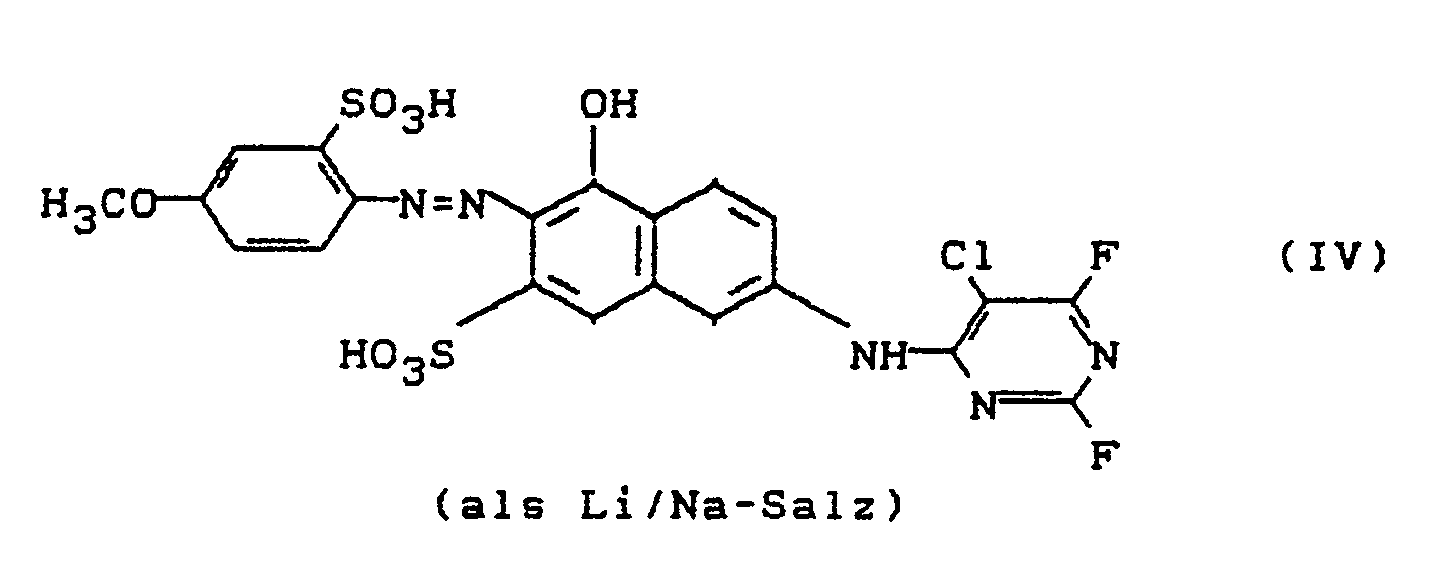
werden mit 1 kg Borsäure versetzt. Die Suspension enthält dann neben Borsäure und Prozeßsalzen 5,3 % Reinfarbstoff. - Diese Suspension wird bei einer Temperatur von ca. 45°C, einem pH von 7,5 und einem Druck von 30 bar auf einem Tubularmodul entsalzt. Hierbei werden 760 kg salzhaltiges Permeat kontinuierlich durch 760 kg entmineralisiertes Wasser ersetzt und anschließend durch Entfernen von 95 kg salzhaltigem Permeat aufkonzentriert. Als Membran wird eine handelsübliche Composite-Membran (Trägerschicht: Polysulfon, Membranschicht: Polyamid) verwendet.
- 95 kg Konzentrat werden mit 2 kg Dicyandiamid und 2,5 kg entmineralisiertem Wasser versetzt und mit 0,5 kg Borsäure gepuffert.
- Man erhält eine niedrigviskose, lagerstabile Flüssigeinstellung des Farbstoffs der Formel (IV) mit ca. 10 % Reinfarbe, 2 % Dicyandiamid, 0,5 % Borsäure und Wasser ad 100 %. Der pH-Wert der Einstellung beträgt 7,5; Cl-Gehalt: 〈0,05 %.
- Die Filtrationsstromdichte

diesem Beispiel erheblich höher als beim gleichen Beispiel ohne Zusatz von Borsäure vor der Druckpermeation.
Claims (7)
- Verfahren zur Herstellung von lagerstabilen, wäßrigen Lösungen von anionischen Farbstoffen, vorzugsweise Reaktivfarbstoffen durch Druckpermeation von Lösungen oder Suspensionen des Rohfarbstoffs, dadurch gekennzeichnet, daß die Lösung oder Suspension vor oder während der Druckpermeation, die die Schritte Entsalzung und gegebenenfalls Aufkonzentration umfaßt, mit Borsäure oder deren Salzen versetzt wird.
- Verfahren nach Anspruch 1, dadurch gekennzeichnet, daß die Lösung oder Suspension vor oder während des Entsalzungsschrittes mit Borsäure oder deren Salzen versetzt wird.
- Verfahren nach Anspruch 1 und 2, dadurch gekennzeichnet, daß Alkali-, Erdalkali- und/oder Ammoniumsalze der Borsäure und/oder Trialkylammoniumsalze der Borsäure, deren Kation der Formel
 R¹ = C₁-C₄-AlkylR² = -(CH₂-CH₂-O)nHR³ = -
 K = 0 bis 2L = 0 bis 3M = 0 bis 3
K + L + M = 3n = 1 bis 4
entspricht,
eingesetzt werden. - Verfahren nach Anspruch 1 bis 3, dadurch gekennzeichnet, daß die Lösung oder Suspension vor der Druckpermeation mit Borsäure oder deren Salzen in Konzentrationen zwischen 0,01 und 10 Gew,-% versetzt wird.
- Verfahren nach Anspruch 1 bis 4, dadurch gekennzeichnet, daß anionische Reaktivfarbstoffe in Form ihrer Alkalisalze eingesetzt werden, wobei ein Teil der Alkaliionen als Lithium vorliegt.
- Verfahren nach Anspruch 1 bis 5, dadurch gekennzeichnet, daß Reaktivfarbstoffe der Fluortriazin und Fluorchlorpyrimidinreihe eingesetzt werden.
- Verfahren nach Anspruch 1-6, dadurch gekennzeichnet, daß die lagerstabilen, wärßigen Farbstofflösungen einen Farbstoffgehalt von 10-30 Gew.-% aufweisen.
Applications Claiming Priority (2)
| Application Number | Priority Date | Filing Date | Title |
|---|---|---|---|
| DE4008262A DE4008262A1 (de) | 1990-03-15 | 1990-03-15 | Verfahren zur herstellung lagerstabiler farbstoffloesungen |
| DE4008262 | 1990-03-15 |
Publications (2)
| Publication Number | Publication Date |
|---|---|
| EP0446732A2 true EP0446732A2 (de) | 1991-09-18 |
| EP0446732A3 EP0446732A3 (en) | 1992-05-20 |
Family
ID=6402255
Family Applications (1)
| Application Number | Title | Priority Date | Filing Date |
|---|---|---|---|
| EP19910103157 Withdrawn EP0446732A3 (en) | 1990-03-15 | 1991-03-02 | Process for the manufacture of storage stable dye solutions |
Country Status (3)
| Country | Link |
|---|---|
| US (1) | US5145485A (de) |
| EP (1) | EP0446732A3 (de) |
| DE (1) | DE4008262A1 (de) |
Cited By (2)
| Publication number | Priority date | Publication date | Assignee | Title |
|---|---|---|---|---|
| EP0433810A3 (en) * | 1989-12-22 | 1992-01-15 | Bayer Ag | Process for the manufacture of storage stable solutions of dye |
| US7597721B2 (en) | 2003-12-04 | 2009-10-06 | Clariant Finance (Bvi) Limited | Concentrated aqueous compositions of dyestuffs |
Families Citing this family (5)
| Publication number | Priority date | Publication date | Assignee | Title |
|---|---|---|---|---|
| US5199953A (en) * | 1990-09-14 | 1993-04-06 | Ortec, Inc. | Process for reducing discoloration of cellulosic fibers, treated at a high temperature with a solution of a polycarboxylic acid and boric acid or borate |
| US5948153A (en) * | 1998-04-24 | 1999-09-07 | Milliken & Company | Water-soluble complexes of optical brighteners and quaternary ammonium compounds which are substantially free from unwanted salts |
| FR2783050B1 (fr) * | 1998-09-09 | 2000-12-08 | Atochem Elf Sa | Solution aqueuse a base d'un colorant azoique, son procede de fabrication et son utilisation |
| US6582476B1 (en) | 1999-12-15 | 2003-06-24 | Unilever Home & Personal Care Usa, Division Of Conopco, Inc. | Durable wrinkle reduction laundry product compositions with improved softness and wrinkle reduction |
| JP2008530327A (ja) * | 2005-02-18 | 2008-08-07 | クラリアント インターナショナル リミティド | 濃厚染料溶液 |
Family Cites Families (12)
| Publication number | Priority date | Publication date | Assignee | Title |
|---|---|---|---|---|
| JPS5034633B1 (de) * | 1970-06-25 | 1975-11-10 | ||
| GB1506207A (en) * | 1974-04-09 | 1978-04-05 | Hoechst Ag | Liquid preparations of reactive dyestuffs |
| IN143734B (de) * | 1974-04-09 | 1978-01-21 | Hoechst Ag | |
| DE2508246A1 (de) * | 1975-02-26 | 1976-09-09 | Bayer Ag | Verfahren zur entfernung wasserloeslicher ionischer verbindungen aus waessrigen loesungen mittels ultrafiltration |
| DE2805891C2 (de) * | 1978-02-13 | 1988-12-22 | Bayer Ag, 5090 Leverkusen | Konzentrierte Farbstoff- und Aufhellerlösungen, deren Herstellung und Verwendung |
| CH667664A5 (de) * | 1985-03-29 | 1988-10-31 | Ciba Geigy Ag | Verfahren zur herstellung von praeparaten wasserloeslicher organischer farbstoffe. |
| DE3521129A1 (de) * | 1985-06-13 | 1986-12-18 | Bayer Ag, 5090 Leverkusen | Verfahren zur herstellung konzentrierter loesungen von anionischen farbstoffen und farbstoffadditiven |
| IN168302B (de) * | 1986-02-19 | 1991-03-09 | Lubrizol Corp | |
| DE3703738A1 (de) * | 1987-02-07 | 1988-08-18 | Bayer Ag | Verfahren zur herstellung einer konzentrierten waessrigen reaktivfarbstoff-loesung |
| DE3861738D1 (de) * | 1987-04-16 | 1991-03-14 | Ciba Geigy Ag | Verfahren zur herstellung konzentrierter waessriger farbstoffzubereitungen. |
| ES2022704B3 (es) * | 1987-04-16 | 1991-12-01 | Ciba-Geigy Ag | Procedimiento para la obtencion de preparaciones colorantes acuosas concentradas de colorantes organicos. |
| DE3842054A1 (de) * | 1988-12-14 | 1990-06-21 | Bayer Ag | Farbstoffpraeparationen |
-
1990
- 1990-03-15 DE DE4008262A patent/DE4008262A1/de not_active Withdrawn
-
1991
- 1991-03-02 EP EP19910103157 patent/EP0446732A3/de not_active Withdrawn
- 1991-03-06 US US07/665,630 patent/US5145485A/en not_active Expired - Fee Related
Cited By (2)
| Publication number | Priority date | Publication date | Assignee | Title |
|---|---|---|---|---|
| EP0433810A3 (en) * | 1989-12-22 | 1992-01-15 | Bayer Ag | Process for the manufacture of storage stable solutions of dye |
| US7597721B2 (en) | 2003-12-04 | 2009-10-06 | Clariant Finance (Bvi) Limited | Concentrated aqueous compositions of dyestuffs |
Also Published As
| Publication number | Publication date |
|---|---|
| DE4008262A1 (de) | 1991-09-19 |
| EP0446732A3 (en) | 1992-05-20 |
| US5145485A (en) | 1992-09-08 |
Similar Documents
| Publication | Publication Date | Title |
|---|---|---|
| DE60127666T2 (de) | Säurebeständige membranen zur nanofiltration | |
| EP0287515B1 (de) | Verfahren zur Herstellung von konzentrierten, wässrigen Farbstoffzubereitungen wasserlöslicher organischer Farbstoffe | |
| DE69122934T2 (de) | Semipermeable Verbundmembran, Verfahren zu ihrer Herstellung und Verfahren zu deren Verwendung für die Erzeugung hochreinen Wassers | |
| DE68910785T2 (de) | Membrane zum Trennen von flüssigen Wasser-Alkohol-Gemischen und Verfahren zu ihrer Herstellung. | |
| EP0197006A2 (de) | Verfahren zur Herstellung von Präparaten wasserlöslicher organischer Farbstoffe | |
| DE2735443A1 (de) | Verfahren zur herstellung von asymmetrischen membranen | |
| DE2638065A1 (de) | Verfahren zur herstellung von semipermeablen membranen | |
| DE2454111B2 (de) | Verfahren zur herstellung von poroesen glasgegenstaenden durch thermische phasentrennung und anschliessende auslaugung, sowie verwendung der poroesen glasgegenstaende | |
| DE102015213801A1 (de) | Komplexe Nanofiltrationsmembran und Herstellung davon | |
| EP0576830A1 (de) | Membran und Verfahren zu deren Herstellung | |
| DE3611410C2 (de) | Im wesentlichen Protein nicht-adsorbierende, semipermeable Filtrationsmembran | |
| DE2642245C3 (de) | Polyvinylalkohol-Hohlfaser und ihre Verwendung | |
| DE4338196A1 (de) | Verfahren zum Reinigen organischer Syntheseprodukte | |
| DE2743673C3 (de) | Mikroporöse, selektiv durchlässige Membran | |
| EP0288434B1 (de) | Verfahren zur Herstellung konzentrierter wässriger Farbstoffzubereitungen | |
| EP0194546B1 (de) | Porenmembranen | |
| EP0446732A2 (de) | Verfahren zur Herstellung lagerstabiler Farbstofflösungen | |
| EP0029960A1 (de) | Wässrige, lösungsmittelfreie konzentrierte Präparationen von Reaktivfarbstoffen und Verfahren zu ihrer Herstellung | |
| DE3424506A1 (de) | Verfahren zur herstellung salzarmer, fluessiger, waessriger zubereitungen von faserreaktiven farbstoffen | |
| DE2855775C2 (de) | ||
| DE10319044A1 (de) | Vorrichtung zur elektrolytischen und oxidativen Behandlung von Abwässern, hierbei eingesetzte Filtrationsmembranen, deren Herstellung sowie Verfahren zur Behandlung von Abwässern mittels dieser Anlage und/oder dieser Filtrationsmembranen | |
| EP0433810A2 (de) | Verfahren zur Herstellung lagerstabiler Farbstofflösungen | |
| DE2910413A1 (de) | Semipermeable membran und verfahren zu deren herstellung | |
| DE4117501C2 (de) | Aminmodifizierte Polyimid-Membran für Gastrennung und Ultrafiltration | |
| EP0040709B1 (de) | Verfahren zur Herstellung von Diacetonketogulonsäure |
Legal Events
| Date | Code | Title | Description |
|---|---|---|---|
| PUAI | Public reference made under article 153(3) epc to a published international application that has entered the european phase |
Free format text: ORIGINAL CODE: 0009012 |
|
| AK | Designated contracting states |
Kind code of ref document: A2 Designated state(s): CH DE FR GB LI |
|
| PUAL | Search report despatched |
Free format text: ORIGINAL CODE: 0009013 |
|
| AK | Designated contracting states |
Kind code of ref document: A3 Designated state(s): CH DE FR GB LI |
|
| 17P | Request for examination filed |
Effective date: 19920603 |
|
| 17Q | First examination report despatched |
Effective date: 19940721 |
|
| STAA | Information on the status of an ep patent application or granted ep patent |
Free format text: STATUS: THE APPLICATION HAS BEEN WITHDRAWN |
|
| 18W | Application withdrawn |
Withdrawal date: 19940920 |