EP0446843B1 - Verfahren und Vorrichtung zur Bestimmung der Phasenveränderung einer Emulsion - Google Patents
Verfahren und Vorrichtung zur Bestimmung der Phasenveränderung einer Emulsion Download PDFInfo
- Publication number
- EP0446843B1 EP0446843B1 EP19910103702 EP91103702A EP0446843B1 EP 0446843 B1 EP0446843 B1 EP 0446843B1 EP 19910103702 EP19910103702 EP 19910103702 EP 91103702 A EP91103702 A EP 91103702A EP 0446843 B1 EP0446843 B1 EP 0446843B1
- Authority
- EP
- European Patent Office
- Prior art keywords
- emulsion
- sliding
- pushing part
- accordance
- sliding surface
- Prior art date
- Legal status (The legal status is an assumption and is not a legal conclusion. Google has not performed a legal analysis and makes no representation as to the accuracy of the status listed.)
- Expired - Lifetime
Links
Images




Classifications
-
- G—PHYSICS
- G01—MEASURING; TESTING
- G01N—INVESTIGATING OR ANALYSING MATERIALS BY DETERMINING THEIR CHEMICAL OR PHYSICAL PROPERTIES
- G01N11/00—Investigating flow properties of materials, e.g. viscosity, plasticity; Analysing materials by determining flow properties
-
- G—PHYSICS
- G01—MEASURING; TESTING
- G01N—INVESTIGATING OR ANALYSING MATERIALS BY DETERMINING THEIR CHEMICAL OR PHYSICAL PROPERTIES
- G01N13/00—Investigating surface or boundary effects, e.g. wetting power; Investigating diffusion effects; Analysing materials by determining surface, boundary, or diffusion effects
- G01N13/02—Investigating surface tension of liquids
-
- G—PHYSICS
- G01—MEASURING; TESTING
- G01N—INVESTIGATING OR ANALYSING MATERIALS BY DETERMINING THEIR CHEMICAL OR PHYSICAL PROPERTIES
- G01N19/00—Investigating materials by mechanical methods
- G01N19/02—Measuring coefficient of friction between materials
-
- G—PHYSICS
- G01—MEASURING; TESTING
- G01N—INVESTIGATING OR ANALYSING MATERIALS BY DETERMINING THEIR CHEMICAL OR PHYSICAL PROPERTIES
- G01N33/00—Investigating or analysing materials by specific methods not covered by groups G01N1/00 - G01N31/00
- G01N33/02—Food
- G01N33/04—Dairy products
-
- G—PHYSICS
- G01—MEASURING; TESTING
- G01N—INVESTIGATING OR ANALYSING MATERIALS BY DETERMINING THEIR CHEMICAL OR PHYSICAL PROPERTIES
- G01N33/00—Investigating or analysing materials by specific methods not covered by groups G01N1/00 - G01N31/00
- G01N33/26—Oils; Viscous liquids; Paints; Inks
Definitions
- the present invention relates to an apparatus and a method for evaluating phase change of an emulsion.
- Emulsions are mixtures of two or more incompletely miscible liquids such as oil and water.
- emulsions There are many kinds of emulsions in use in the modern world. Some, such as milk, mayonnaise, creams for foods, cosmetic creams and the like, are used in the home. Others, such as paints, adhesives, drugs, pesticides, asphalt and the like, are utilized in industry.
- an emulsion If an emulsion is left to stand without agitation for a long period, it will generally separate into its two or more constituent liquids by creaming, cohesion and coalescence of its dispersed droplets. It is therefore important for industrial use of emulsions to be able to evaluate their chemical stability as well as their mechanical properties such as hardness, fluidity and deformability.
- Some emulsions such as cosmetic creams, nutrient creams and butters are not stable during the use, and the evaluation of such emulsions has conventionally depended on tactile tests conducted by skilled panelers. Although human sensitivity is very high and such evaluations are generally accurate, they involve some disadvantages. Specifically, they are strongly influenced by the panelers' physical condition individual preferences, the test environment, and so on. Therefore, the data sometimes vary widely and are not always reliable.
- US-A-4,095,461 shows a rheometer by which also the viscous elastic properties of polymeric materials or other materials like foodstuffs, petrochemicals is measured.
- the apparatuses known from DE-A-27 06 855 and US-A-4,095,461 are rheometers including an upper and lower part, where the upper part is fixed during the measurement.
- GB-A-2 013 903 refers to the testing of rheological properties of a fluid between a pair of members having cooperating faces.
- the present invention provides an apparatus for evaluating phase change of an emulsion according to claim 1.
- the present invention also provides a method for evaluating phase change of an emulsion according to claim 10.
- Figure 1 is a schematic view of an apparatus in accordance with one embodiment of the present invention.
- Figure 2 is a schematic view of an apparatus in accordance with another embodiment of the present invention.
- Figure 3 is a schematic view of an apparatus in accordance with another embodiment of the present invention.
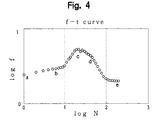
- Figure 4 illustrates the relationship between the measured shearing force and the microscopic state of a commercial cosmetic cream "M".
- Figure 5 illustrates the relationship between the number of reciprocations and the measured shearing force in the case of commercial nutrient creams "A"and "B".
- Figure 6 illustrates the relationship between the number of reciprocations and the measured shearing force in the case of commercial cleansing creams "C" and "D".
- Figure 7 illustrates the relationship between the number of reciprocations and the measured shearing force in the case of commercial nutrient cream "A", in which four different films are used.
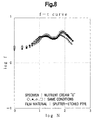
- Figure 8 illustrates the relationship between the number of rotations and the measured shearing force in the case of a commercial nutrient cream "G".
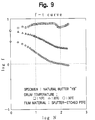
- Figure 9 illustrates the relationship between the number of rotations and the measured shearing force in the case of a commercial natural butter "YB”.
- Figure 1 shows an apparatus in accordance with a first embodiment of the present invention.
- the apparatus comprises a sliding part or movable plate 1 horizontally supported by bearings (not shown) and reciprocated parallel to a surface thereof (referred to herein as the "sliding surface") by a well-known drive mechanism (not shown).
- a film of polymer substance is preferably attached to the sliding surface.
- the emulsion to be evaluated is applied to the sliding surface, or to the attached film.
- the apparatus preferably includes a temperature controlling means (not shown) to control the temperature of the movable plate 1 between -20°C and 100°C.
- the apparatus further comprises a pushing part 2 rigidly connected to a vertical shaft 2a which is in turn connected to an enlarged shaft 2b extending vertically upward.
- a film of polymer substance is preferably attached to the bottom surface of the pushing part 2.
- the shaft 2b is vertically slidably supported by a bearing portion 7 fixed to a stationary part(not shown).
- the bottom end of a vertically oriented coil spring 5 is attached to the top end of the shaft 2b and the top end of the spring 5 is attached to the bottom end of an up-and-down mechanism 6.
- the body of the up-and-down mechanism 6 is disposed on a stationary part(not shown) and the mechanism is adapted to move the shafts 2a and 2b up and down through the spring 5.
- the force of the spring 5 pushes the pushing part 2 or the attached film against the sliding surface of the movable plate 1 or the attached film to which the emulsion has been applied.
- the apparatus further comprises a sensor means or strain gauge 3 attached to the surface of the shaft 2a and adapted to measure the force imparted to the pushing part 2 in the sliding direction.
- the sensor means need not necessarily be a strain gauge and any of various other well-known measuring devices can alternatively be used for measuring the force.
- a fan 4 is preferably positioned laterally of the pushing part 2 for blowing air onto the emulsion to volatilize its volatile components.
- the procedure for using the apparatus is as follows.
- the evaluation can be made by comparing the measured force with standard data, as shown later in the examples.
- FIGS 2 and 3 show two other apparatuses in accordance with the present invention.
- the sliding part is a disc 11 supported horizontally by bearings (not shown) and rotated around the axis thereof by a well-known drive mechanism (not shown).
- the sliding part is a cylidrical drum 21 supported by bearings (not shown) and rotated around the axis thereof by a well-known drive mechanism (not shown).
- the other parts of the apparatuses of Figures 2 and 3 are same as those of the first embodiment.
- the sliding part and the pushing part preferably have high chemical stability, thermal shock resistance, mechanical shock resistance, and abrasion resistance. They are preferably made of a metal, ceramic, polymer substance, or a composite thereof.
- a metal When a metal is used it can be used either without any treatment or as coated with another metal by vapor depositions or plating.
- Polymer substances can include addition polymers of vinyl compounds such as polyethylene, polystyrene, poly(meth)acrylic acid, poly(meth)acrylic ester, polyvinyl acetate, polyacrylonitrile and polyhalogenated vinyl, interpolymers of fluorinated vinyl compound with ethylene, vinylidene cyanide and the like, chemical compounds including fluorine such as polytrifluoroethylene, polytetrafluoroethylene and polyhexafluoropropylene, polyesters, polycarbonates and polyethers such as polyamide, polyimide, polyurethane and polyethylene terephthalate, and heat-hardening resins such as unsaturated polyester, epoxy and bakelite.
- the polymer substaces can be used either without any treatment for the surfaces of the sliding part and the pushing part, or after being subjected to one of the processes described below in response to their intended use.
- these films can be used either without any treatment or after being subjected to alkaline metal solvent treatment, treatment by the alkaline metal amalgam process, chemical etching by, for example, the electrolylic process, vapor deposition of silver, aluminium or the like, vacuum discharge treatment, sputter etching (coating), corona discharge treatment, graft treatment, plasma spray coating, sandblast treatment, chemical treatments for making films porous, and the like.
- alkaline metal solvent treatment treatment by the alkaline metal amalgam process
- chemical etching by, for example, the electrolylic process, vapor deposition of silver, aluminium or the like, vacuum discharge treatment, sputter etching (coating), corona discharge treatment, graft treatment, plasma spray coating, sandblast treatment, chemical treatments for making films porous, and the like.
- the substance to be used is preferably selected by comparing the results of organoleptie test with the test results obtained by the apparatus according to the invention. Generally chemically etched or sputter-etched films including fluorine are most preferable.
- Sputter-etched films were obtained by sputtering PTFE virgin films by use of a sputtering apparatus.
- the original thickness of the films was about 15 ⁇ m.
- SEM (scanning electron microscope) observation of the films showed it to have many fibres of 0.5 to 1.0 ⁇ m length uniformly distributed over the surfaces.
- the surfaces were hydropihlic.
- the films were attached to the opposed surfaces of the movable plate 1 and the pushing part 2 shown in Figure 1.
- a commercial cosmetic cream "M” was applied to the sliding surface of the movable plate 1 and tested by the apparatus according to the procedure described earlier.
- the sliding rate of the movable plate 1 was 9 reciprocations per minute and the number of reciprocations was 230.
- the horizontal axis represents the logarithm (log N) of the number of reciprocations of the movable plate 1 and the vertical axis represents the logarithm (log f) of the measured shearing force.
- Points "a",”b”,”c”,”d” and “e” in the same figure are the points at which samples were taken during the test.
- the five microphotographs "a” through “e” in Figure 4a through 4e correspond to the sampling points.
- the cream was an oil-in-water type (hereinafter called O/W type) emulsion at point "a" (the starting point). At point “b” it was still of O/W type but had partially changed to water-in-oil-in-water type (W/O/W type). Between points “c” and “d”, the phase was in the process of changing from O/W type to water-in-oil type (W/O type). At point “e”, the phase had fully changed to W/O type. Accordingly, the cream was found to be an emulsion which could be changed from O/W type to W/O type.
- O/W type oil-in-water type
- Chemically etched films were obtained by treating PTFE virgin films with a complex solution of naphthalene and metallic sodium in tetrahydrofuran and then rinsing them with water. While no substantial change in the surfaces of the films could be observed by a SEM, the color of the films changed from white to brown and the surface became hydrophilic. The films were attached to the opposed surfaces of the movable plate 1 and the pushing part 2 of the same apparatus as in Example 1.
- the apparatus can accurately evaluate emulsion phase change and can therefore replace panelers in the evaluation of emulsions.
- Chemically etched films were obtained by treating PTFE virgin films with a liquid ammonium solution of metallic sodium in tetrahydrofuran as in Example 2.
- porous films were obtained by heat stretching PTFE film.
- the chemically etched films, the porous films and the sputter-etched films obtained in Example 1 were attached to the opposed surfaces of the movable plate 1 and the pushing part 2 of the same apparatus as in Example 1.
- a commercial nutrient cream "A" was tested by the apparatus with air being blowing onto the cream.
- the surfaces of the pretreated PTFE films, the sputter-etched films and the porous films were fluorines, and that of the chemically etched film was carbons.
- the films showed that the surfaces of the pretreated PTFE films and the chemically etched films were generally smooth and that of the sputter-etched films had many fibres of 1.0 to 1.5 ⁇ m length, and that of the porous films had many holes of about 2 ⁇ m diameter.
- phase change behavior of the emulsion is influenced by the compositions and the structures of the surface materials. It also means that the phase change is influenced by the compositions and the cofigurations of the emulsion created at the initial stage of the phase change.
- Example 1 The sputter-etched films obtained in Example 1 were attached to the opposed surfaces of the disc 11 and the pushing part 2 of the apparatus shown in Figure 2 and a commercial nutrient cream "G" was tested by the apparatus at room temperature with air being blown onto the cream.
- the disc 11 was rotated at 9 revolutions per minute (rpm) and the number of rotations was 230.
- Example 1 The sputter-etched films obtained in Example 1 were attached to the opposed surfaces of the drum 21 and the pushing part 2 of the apparatus shown in Figure 3 and a commercial natural butter "YB" was tested by the apparatus.
- the drum was rotated at 9 rpm and the number of rotations was 230.
- the test results are shown in Figure 9, in which the two axes represent the same parameters as in Figure 8.
- the butter is a W/O type emulsion of water droplets dispersed in animal oil.
- the butter do not change phase in the temperature range of the test. Therefore the figure merely shows the changes in viscosity. As seen from Figure 9, there was no change in viscosity under 10°C while at over 20 °C the viscosity decreased with increasing number of rotations.
- organoleptic test conducted by a panel on the butter under 20 °C and over 25°C showed it to be too soft to keep its shape over 25 °C . Comparing this result with the results in Figure 9 shows that the test results by the apparatus correspond to human feelings.
Landscapes
- General Health & Medical Sciences (AREA)
- General Physics & Mathematics (AREA)
- Life Sciences & Earth Sciences (AREA)
- Chemical & Material Sciences (AREA)
- Analytical Chemistry (AREA)
- Biochemistry (AREA)
- Immunology (AREA)
- Physics & Mathematics (AREA)
- Health & Medical Sciences (AREA)
- Pathology (AREA)
- Sampling And Sample Adjustment (AREA)
- Colloid Chemistry (AREA)
- Investigating Strength Of Materials By Application Of Mechanical Stress (AREA)
- Force Measurement Appropriate To Specific Purposes (AREA)
Claims (10)
- Vorrichtung zur Bestimmung der Phasenänderung einer Emulsion, umfassend:ein gleitendes Teil (1, 11, 21) mit einer gleitenden Oberfläche, auf die eine Emulsion aufgetragen wird,einem Drückerteil (2), das zu der gleitenden Oberfläche bewegbar ist, um gegen die Emulsion auf der gleitenden Oberfläche in einer vorgegebenen Position zu drücken, undSensormittel (3) für das kontinuierliche Messen einer auf das Drückerteil (2) in die Gleitrichtung wirkenden Kraft während der Phasenveränderung der Emulsion und für das Bestimmen der Phasenveränderung der Emulsion durch Änderungen in der gemessenen Kraft, dadurch gekennzeichnet, daß der Oberteil des Drückerteils an einer vertikal orientierten Schraubenfeder (5) angeordnet ist.
- Vorrichtung nach Anspruch 1, dadurch gekennzeichnet, daß Filme aus einer polymeriden Substanz an mindestens einer der gleitenden Oberflächen (1, 11, 21) und der Oberfläche des Drückerteils (2) aufgebracht sind.
- Vorrichtung nach Anspruch 2, dadurch gekennzeichnet, daß die Filme chemisch geätzte polymeride Filme sind.
- Vorrichtung nach Anspruch 2, dadurch gekennzeichnet, daß die Filme sputtergeätzte polymeride Filme sind.
- Vorrichtung nach Anspruch 1, dadurch gekennzeichnet, daß Ventilatormittel (4) vorgesehen sind, die seitlich des Drückerteils zum Blasen von Luft auf die Emulsion vorgesehen sind, um ihre flüchtigen Komponenten verdampfen zu lassen.
- Vorrichtung nach Anspruch 1, dadurch gekennzeichnet, daß Temperatursteuermittel zum Steuern der Temperatur des gleitenden Teils während der Messungen zwischen -20°C und 100°C vorgesehen sind.
- Vorrichtung nach Anspruch 1, dadurch gekennzeichnet, daß das gleitende Teil (1) eine hin- und herbewegbare Platte ist.
- Vorrichtung nach Anspruch 1, dadurch gekennzeichnet, daß das gleitende Teil (1) eine drehbare Scheibe ist.
- Vorrichtung nach Anspruch 1, dadurch gekennzeichnet, daß das gleitende Teil (21) eine drehbare zylindrische Trommel ist.
- Verfahren zur Bestimmung der Phasenveränderung einer Emulsion, umfassend:Aufbringen der Emulsion auf eine gleitende Oberfläche oder ein gleitendes Teil,Verschieben des gleitenden Teils parallel zu der gleitenden Oberfläche, Schieben eines Drückerteils durch elastisches Spannen des Drückerteils unter Verwendung einer vertikal orientierten Schraubenfeder in Richtung der gleitenden Oberfläche, so daß eine Oberfläche des Drückerteils, die der gleitenden Oberfläche gegenüberliegt, in Kontakt mit der Emulsion auf der gleitenden Oberfläche an einer vorbestimmten Position während der gleitenden Bewegung der gleitenden Oberfläche gebracht wird, wobei die Phase der zwischen der gleitenden Oberfläche und der Oberfläche des Drückerteils angeordneten Emulsion zu einer unterschiedlichen Phase verändert wird, Messen einer Kraft, die auf das Drückerteil in die Gleitrichtung wirkt, und Bestimmen der Phasenänderung der Emulsion durch die Änderungen in der gemessenen Kraft.
Applications Claiming Priority (8)
| Application Number | Priority Date | Filing Date | Title |
|---|---|---|---|
| JP2061883A JP3023132B2 (ja) | 1990-03-13 | 1990-03-13 | エマルジョンの転相評価方法 |
| JP61883/90 | 1990-03-13 | ||
| JP2151132A JP3023142B2 (ja) | 1990-06-08 | 1990-06-08 | エマルジョンの転相評価方法及び装置 |
| JP151132/90 | 1990-06-08 | ||
| JP170790/90 | 1990-06-28 | ||
| JP2170790A JP3023143B2 (ja) | 1990-06-28 | 1990-06-28 | エマルジョンの転相評価方法及び装置 |
| JP5949/91 | 1991-01-22 | ||
| JP03005949A JP3130539B2 (ja) | 1991-01-22 | 1991-01-22 | エマルジョンの転相評価装置及び方法 |
Publications (3)
| Publication Number | Publication Date |
|---|---|
| EP0446843A2 EP0446843A2 (de) | 1991-09-18 |
| EP0446843A3 EP0446843A3 (de) | 1991-10-30 |
| EP0446843B1 true EP0446843B1 (de) | 1997-06-04 |
Family
ID=27454395
Family Applications (1)
| Application Number | Title | Priority Date | Filing Date |
|---|---|---|---|
| EP19910103702 Expired - Lifetime EP0446843B1 (de) | 1990-03-13 | 1991-03-11 | Verfahren und Vorrichtung zur Bestimmung der Phasenveränderung einer Emulsion |
Country Status (2)
| Country | Link |
|---|---|
| EP (1) | EP0446843B1 (de) |
| DE (1) | DE69126348T2 (de) |
Families Citing this family (1)
| Publication number | Priority date | Publication date | Assignee | Title |
|---|---|---|---|---|
| CN116754598A (zh) * | 2023-05-17 | 2023-09-15 | 上海道宜半导体材料有限公司 | 一种测试环氧树脂组合物的凝胶化时间的方法及应用 |
Family Cites Families (5)
| Publication number | Priority date | Publication date | Assignee | Title |
|---|---|---|---|---|
| US4109514A (en) * | 1976-02-17 | 1978-08-29 | Imperial Chemical Industries Limited | Rheometer and uses thereof |
| US4095461A (en) * | 1976-12-27 | 1978-06-20 | Starita Joseph M | Rheological test method and apparatus |
| US4167110A (en) * | 1978-02-01 | 1979-09-11 | Ovutime, Inc. | Devices and processes for determining properties of viscous fluids |
| US4512182A (en) * | 1983-05-26 | 1985-04-23 | Cornell Research Foundation, Inc. | Gelation measuring apparatus and method |
| US4862735A (en) * | 1988-04-04 | 1989-09-05 | The United States Of America As Represented By The Secretary Of The Navy | Microviscometer |
-
1991
- 1991-03-11 EP EP19910103702 patent/EP0446843B1/de not_active Expired - Lifetime
- 1991-03-11 DE DE1991626348 patent/DE69126348T2/de not_active Expired - Fee Related
Also Published As
| Publication number | Publication date |
|---|---|
| DE69126348D1 (de) | 1997-07-10 |
| EP0446843A2 (de) | 1991-09-18 |
| EP0446843A3 (de) | 1991-10-30 |
| DE69126348T2 (de) | 1997-09-25 |
Similar Documents
| Publication | Publication Date | Title |
|---|---|---|
| Krishnan et al. | An evaluation of methods for contact angle measurement | |
| Sahi et al. | Functionality of emulsifiers in sponge cake production | |
| Rudge et al. | Uncovering friction dynamics using hydrogel particles as soft ball bearings | |
| EP1745851B1 (de) | Verfahren, Vorrichtung und Computerprogrammprodukt zum Klassifizieren einer Flüssigkeit | |
| US5319958A (en) | Apparatus and method for evaluating phase change of emulsion | |
| Minale et al. | Study of the morphological hysteresis in immiscible polymer blends | |
| Mielniczuk et al. | Evaporation-induced evolution of the capillary force between two grains | |
| KR960014934A (ko) | 일차 지혈에 있어서 혈소판의 기능을 측정하기 위한 방법 및 장치 | |
| Lerdwijitjarud et al. | Influence of weak elasticity of dispersed phase on droplet behavior in sheared polybutadiene/poly (dimethyl siloxane) blends | |
| Osaki et al. | Nonlinear viscoelasticity of polystyrene solutions. III. Stress development at the start of steady shear flow and an experimental check of some constitutive models | |
| Tsakalos et al. | Deformation and breakup mechanisms of single drops during shear | |
| Samaras et al. | Measurement of molten chocolate friction under simulated tongue-palate kinematics: Effect of cocoa solids content and aeration | |
| EP0446843B1 (de) | Verfahren und Vorrichtung zur Bestimmung der Phasenveränderung einer Emulsion | |
| De Preval et al. | Influence of surface properties and bulk viscosity on bubble size prediction during foaming operation | |
| Vélez‐Ruiz et al. | Flow and structural characteristics of concentrated milk | |
| Hermitte et al. | Contribution of the comonomers to the bulk and surface properties of methacrylate copolymers | |
| JP3023142B2 (ja) | エマルジョンの転相評価方法及び装置 | |
| JP3023143B2 (ja) | エマルジョンの転相評価方法及び装置 | |
| JP2768205B2 (ja) | 乳化油脂組成物の製造方法 | |
| Michalski et al. | Adhesion of edible oils and food emulsions to rough surfaces | |
| JP3130539B2 (ja) | エマルジョンの転相評価装置及び方法 | |
| Kim et al. | Decoupled rolling, sliding and sticking of a viscoplastic drop on a superhydrophobic surface | |
| Carneri et al. | Sliding and rolling of yield stress fluid droplets on highly slippery lubricated surfaces | |
| WO2003004998A1 (en) | Method and apparatus for measuring the elasticity of fluids | |
| Keslarek et al. | Electric charge clustering and migration in latex films: A study by scanning electric potential microscopy |
Legal Events
| Date | Code | Title | Description |
|---|---|---|---|
| PUAI | Public reference made under article 153(3) epc to a published international application that has entered the european phase |
Free format text: ORIGINAL CODE: 0009012 |
|
| PUAL | Search report despatched |
Free format text: ORIGINAL CODE: 0009013 |
|
| AK | Designated contracting states |
Kind code of ref document: A2 Designated state(s): DE FR GB |
|
| AK | Designated contracting states |
Kind code of ref document: A3 Designated state(s): DE FR GB |
|
| 17P | Request for examination filed |
Effective date: 19920428 |
|
| 17Q | First examination report despatched |
Effective date: 19940713 |
|
| GRAG | Despatch of communication of intention to grant |
Free format text: ORIGINAL CODE: EPIDOS AGRA |
|
| GRAH | Despatch of communication of intention to grant a patent |
Free format text: ORIGINAL CODE: EPIDOS IGRA |
|
| GRAH | Despatch of communication of intention to grant a patent |
Free format text: ORIGINAL CODE: EPIDOS IGRA |
|
| GRAA | (expected) grant |
Free format text: ORIGINAL CODE: 0009210 |
|
| AK | Designated contracting states |
Kind code of ref document: B1 Designated state(s): DE FR GB |
|
| REF | Corresponds to: |
Ref document number: 69126348 Country of ref document: DE Date of ref document: 19970710 |
|
| ET | Fr: translation filed | ||
| PLBE | No opposition filed within time limit |
Free format text: ORIGINAL CODE: 0009261 |
|
| STAA | Information on the status of an ep patent application or granted ep patent |
Free format text: STATUS: NO OPPOSITION FILED WITHIN TIME LIMIT |
|
| 26N | No opposition filed | ||
| REG | Reference to a national code |
Ref country code: GB Ref legal event code: IF02 |
|
| PGFP | Annual fee paid to national office [announced via postgrant information from national office to epo] |
Ref country code: FR Payment date: 20050126 Year of fee payment: 15 |
|
| PGFP | Annual fee paid to national office [announced via postgrant information from national office to epo] |
Ref country code: GB Payment date: 20050309 Year of fee payment: 15 |
|
| PGFP | Annual fee paid to national office [announced via postgrant information from national office to epo] |
Ref country code: DE Payment date: 20050530 Year of fee payment: 15 |
|
| PG25 | Lapsed in a contracting state [announced via postgrant information from national office to epo] |
Ref country code: GB Free format text: LAPSE BECAUSE OF NON-PAYMENT OF DUE FEES Effective date: 20060311 |
|
| PG25 | Lapsed in a contracting state [announced via postgrant information from national office to epo] |
Ref country code: DE Free format text: LAPSE BECAUSE OF NON-PAYMENT OF DUE FEES Effective date: 20061003 |
|
| GBPC | Gb: european patent ceased through non-payment of renewal fee |
Effective date: 20060311 |
|
| REG | Reference to a national code |
Ref country code: FR Ref legal event code: ST Effective date: 20061130 |
|
| PG25 | Lapsed in a contracting state [announced via postgrant information from national office to epo] |
Ref country code: FR Free format text: LAPSE BECAUSE OF NON-PAYMENT OF DUE FEES Effective date: 20060331 |