EP0447044A1 - Magnetoelastischer Film und Verfahren - Google Patents
Magnetoelastischer Film und Verfahren Download PDFInfo
- Publication number
- EP0447044A1 EP0447044A1 EP91301392A EP91301392A EP0447044A1 EP 0447044 A1 EP0447044 A1 EP 0447044A1 EP 91301392 A EP91301392 A EP 91301392A EP 91301392 A EP91301392 A EP 91301392A EP 0447044 A1 EP0447044 A1 EP 0447044A1
- Authority
- EP
- European Patent Office
- Prior art keywords
- water
- per liter
- amount
- cobalt
- electrolyte composition
- Prior art date
- Legal status (The legal status is an assumption and is not a legal conclusion. Google has not performed a legal analysis and makes no representation as to the accuracy of the status listed.)
- Withdrawn
Links
- 238000000034 method Methods 0.000 title claims description 15
- 230000008569 process Effects 0.000 title description 5
- 239000000203 mixture Substances 0.000 claims abstract description 52
- XEEYBQQBJWHFJM-UHFFFAOYSA-N Iron Chemical compound [Fe] XEEYBQQBJWHFJM-UHFFFAOYSA-N 0.000 claims abstract description 44
- 239000003792 electrolyte Substances 0.000 claims abstract description 39
- 229910052742 iron Inorganic materials 0.000 claims abstract description 22
- 229910001313 Cobalt-iron alloy Inorganic materials 0.000 claims abstract description 17
- XLYOFNOQVPJJNP-UHFFFAOYSA-N water Substances O XLYOFNOQVPJJNP-UHFFFAOYSA-N 0.000 claims description 35
- KTVIXTQDYHMGHF-UHFFFAOYSA-L cobalt(2+) sulfate Chemical compound [Co+2].[O-]S([O-])(=O)=O KTVIXTQDYHMGHF-UHFFFAOYSA-L 0.000 claims description 11
- GVPFVAHMJGGAJG-UHFFFAOYSA-L cobalt dichloride Chemical compound [Cl-].[Cl-].[Co+2] GVPFVAHMJGGAJG-UHFFFAOYSA-L 0.000 claims description 8
- 229940044175 cobalt sulfate Drugs 0.000 claims description 8
- 229910000361 cobalt sulfate Inorganic materials 0.000 claims description 8
- KGBXLFKZBHKPEV-UHFFFAOYSA-N boric acid Chemical compound OB(O)O KGBXLFKZBHKPEV-UHFFFAOYSA-N 0.000 claims description 7
- 239000004327 boric acid Substances 0.000 claims description 7
- BAUYGSIQEAFULO-UHFFFAOYSA-L iron(2+) sulfate (anhydrous) Chemical compound [Fe+2].[O-]S([O-])(=O)=O BAUYGSIQEAFULO-UHFFFAOYSA-L 0.000 claims description 7
- 229910000359 iron(II) sulfate Inorganic materials 0.000 claims description 7
- CVHZOJJKTDOEJC-UHFFFAOYSA-N saccharin Chemical compound C1=CC=C2C(=O)NS(=O)(=O)C2=C1 CVHZOJJKTDOEJC-UHFFFAOYSA-N 0.000 claims description 7
- 229940081974 saccharin Drugs 0.000 claims description 7
- 235000019204 saccharin Nutrition 0.000 claims description 7
- 239000000901 saccharin and its Na,K and Ca salt Substances 0.000 claims description 7
- 239000000654 additive Substances 0.000 claims description 6
- -1 alkene sulfonate Chemical class 0.000 claims description 5
- 239000003945 anionic surfactant Substances 0.000 claims description 5
- 150000001732 carboxylic acid derivatives Chemical class 0.000 claims description 5
- 235000003891 ferrous sulphate Nutrition 0.000 claims description 5
- 239000011790 ferrous sulphate Substances 0.000 claims description 5
- 239000000080 wetting agent Substances 0.000 claims description 5
- 229910021580 Cobalt(II) chloride Inorganic materials 0.000 claims description 2
- BRLQWZUYTZBJKN-UHFFFAOYSA-N Epichlorohydrin Chemical class ClCC1CO1 BRLQWZUYTZBJKN-UHFFFAOYSA-N 0.000 claims description 2
- 239000002270 dispersing agent Substances 0.000 claims description 2
- 230000000996 additive effect Effects 0.000 claims 3
- LDMOEFOXLIZJOW-UHFFFAOYSA-N 1-dodecanesulfonic acid Chemical compound CCCCCCCCCCCCS(O)(=O)=O LDMOEFOXLIZJOW-UHFFFAOYSA-N 0.000 claims 1
- 239000004094 surface-active agent Substances 0.000 claims 1
- 239000000758 substrate Substances 0.000 abstract description 9
- 238000004070 electrodeposition Methods 0.000 abstract description 3
- 230000001747 exhibiting effect Effects 0.000 abstract description 2
- 239000000853 adhesive Substances 0.000 abstract 1
- 230000001070 adhesive effect Effects 0.000 abstract 1
- 230000005291 magnetic effect Effects 0.000 description 12
- 239000000470 constituent Substances 0.000 description 5
- 230000000694 effects Effects 0.000 description 4
- 239000010941 cobalt Substances 0.000 description 3
- 229910017052 cobalt Inorganic materials 0.000 description 3
- GUTLYIVDDKVIGB-UHFFFAOYSA-N cobalt atom Chemical compound [Co] GUTLYIVDDKVIGB-UHFFFAOYSA-N 0.000 description 3
- FQMNUIZEFUVPNU-UHFFFAOYSA-N cobalt iron Chemical compound [Fe].[Co].[Co] FQMNUIZEFUVPNU-UHFFFAOYSA-N 0.000 description 3
- 238000000151 deposition Methods 0.000 description 3
- 238000007747 plating Methods 0.000 description 3
- 239000000243 solution Substances 0.000 description 3
- PXHVJJICTQNCMI-UHFFFAOYSA-N Nickel Chemical compound [Ni] PXHVJJICTQNCMI-UHFFFAOYSA-N 0.000 description 2
- 230000008859 change Effects 0.000 description 2
- 150000001875 compounds Chemical class 0.000 description 2
- 239000004020 conductor Substances 0.000 description 2
- 230000004907 flux Effects 0.000 description 2
- 230000036571 hydration Effects 0.000 description 2
- 238000006703 hydration reaction Methods 0.000 description 2
- 239000000463 material Substances 0.000 description 2
- 238000002360 preparation method Methods 0.000 description 2
- 230000009471 action Effects 0.000 description 1
- 230000001154 acute effect Effects 0.000 description 1
- 230000002411 adverse Effects 0.000 description 1
- 230000008901 benefit Effects 0.000 description 1
- 239000011248 coating agent Substances 0.000 description 1
- 238000000576 coating method Methods 0.000 description 1
- 230000008021 deposition Effects 0.000 description 1
- 238000009713 electroplating Methods 0.000 description 1
- 230000005294 ferromagnetic effect Effects 0.000 description 1
- 239000003302 ferromagnetic material Substances 0.000 description 1
- 230000006872 improvement Effects 0.000 description 1
- 230000006698 induction Effects 0.000 description 1
- 230000001939 inductive effect Effects 0.000 description 1
- 230000005415 magnetization Effects 0.000 description 1
- 238000012544 monitoring process Methods 0.000 description 1
- 229910052759 nickel Inorganic materials 0.000 description 1
- 230000006911 nucleation Effects 0.000 description 1
- 238000010899 nucleation Methods 0.000 description 1
- 230000000704 physical effect Effects 0.000 description 1
- 238000005240 physical vapour deposition Methods 0.000 description 1
- 239000012266 salt solution Substances 0.000 description 1
- 230000035945 sensitivity Effects 0.000 description 1
- DAJSVUQLFFJUSX-UHFFFAOYSA-M sodium;dodecane-1-sulfonate Chemical compound [Na+].CCCCCCCCCCCCS([O-])(=O)=O DAJSVUQLFFJUSX-UHFFFAOYSA-M 0.000 description 1
- 239000003381 stabilizer Substances 0.000 description 1
- 239000000126 substance Substances 0.000 description 1
- 239000002344 surface layer Substances 0.000 description 1
Images
Classifications
-
- C—CHEMISTRY; METALLURGY
- C25—ELECTROLYTIC OR ELECTROPHORETIC PROCESSES; APPARATUS THEREFOR
- C25D—PROCESSES FOR THE ELECTROLYTIC OR ELECTROPHORETIC PRODUCTION OF COATINGS; ELECTROFORMING; APPARATUS THEREFOR
- C25D3/00—Electroplating: Baths therefor
- C25D3/02—Electroplating: Baths therefor from solutions
- C25D3/56—Electroplating: Baths therefor from solutions of alloys
- C25D3/562—Electroplating: Baths therefor from solutions of alloys containing more than 50% by weight of iron or nickel or cobalt
-
- G—PHYSICS
- G01—MEASURING; TESTING
- G01L—MEASURING FORCE, STRESS, TORQUE, WORK, MECHANICAL POWER, MECHANICAL EFFICIENCY, OR FLUID PRESSURE
- G01L3/00—Measuring torque, work, mechanical power, or mechanical efficiency, in general
- G01L3/02—Rotary-transmission dynamometers
- G01L3/04—Rotary-transmission dynamometers wherein the torque-transmitting element comprises a torsionally-flexible shaft
- G01L3/10—Rotary-transmission dynamometers wherein the torque-transmitting element comprises a torsionally-flexible shaft involving electric or magnetic means for indicating
- G01L3/101—Rotary-transmission dynamometers wherein the torque-transmitting element comprises a torsionally-flexible shaft involving electric or magnetic means for indicating involving magnetic or electromagnetic means
- G01L3/102—Rotary-transmission dynamometers wherein the torque-transmitting element comprises a torsionally-flexible shaft involving electric or magnetic means for indicating involving magnetic or electromagnetic means involving magnetostrictive means
-
- G—PHYSICS
- G01—MEASURING; TESTING
- G01L—MEASURING FORCE, STRESS, TORQUE, WORK, MECHANICAL POWER, MECHANICAL EFFICIENCY, OR FLUID PRESSURE
- G01L3/00—Measuring torque, work, mechanical power, or mechanical efficiency, in general
- G01L3/02—Rotary-transmission dynamometers
- G01L3/04—Rotary-transmission dynamometers wherein the torque-transmitting element comprises a torsionally-flexible shaft
- G01L3/10—Rotary-transmission dynamometers wherein the torque-transmitting element comprises a torsionally-flexible shaft involving electric or magnetic means for indicating
- G01L3/101—Rotary-transmission dynamometers wherein the torque-transmitting element comprises a torsionally-flexible shaft involving electric or magnetic means for indicating involving magnetic or electromagnetic means
- G01L3/102—Rotary-transmission dynamometers wherein the torque-transmitting element comprises a torsionally-flexible shaft involving electric or magnetic means for indicating involving magnetic or electromagnetic means involving magnetostrictive means
- G01L3/103—Details about the magnetic material used
Definitions
- This invention relates generally to magneto-elastic film and its preparation and use and more particularly to a cobalt and iron containing magneto-elastic film, its preparation from an electrolyte composition, and its use in a strain sensor, particularly a torque-induced strain sensor.
- Magneto-elastic films have been known for many years. Such films characteristically contain ferromagnetic materials such as iron and cobalt or iron and nickel and are commonly made by depositing the films upon substrates by physical vapor deposition techniques.
- Magneto-elastic films undergo both dimensional and magnetization changes upon imposition of mechanical stress and/or a magnetic field. As such, they are commonly characterized according to their particular magnetostriction coefficient expressed in micro-inches/inch (u-in/in). Generally, the higher the manetostriction coefficient, the greater the elasticity of the film. Increasing elasticity of the film characteristically broadens its strain-monitoring or sensing-range capability or both as well as increasing its sensitivity to small changes. A magnetostriction coefficient of about 50 u-in/in has been found to be suitable for any torque or pressure sensing applications for magneto-elastic film.
- magneto-elastic films adhere well to the substrate upon which they are deposited in a broad range of thicknesses (commonly up to about 10 mils) and that they exhibit good cohesion, uniformity, and be essentially stress-and crack-free.
- an object of this invention to provide an electrolyte composition operable to provide a uniform, iron-containing, magneto-elastic film having an attractive magnetostriction coefficient so that small changes in torque may be observed.
- the magneto-elastic film of the present invention is a cobalt-iron alloy having rom about 20% to about 40% atomic weight percent iron.
- the film is preferably deposited upon a selected substrate by electroplating it onto the substrate whilst immersed in an electrolyte bath composition of the present invention.
- the electrolyte composition of the present invention is prepared by adding the following constituents to a liter of water within the range indicated in following TABLE I:
- additives are added to the electrolyte composition.
- the preferred types and amounts of the additives are given in Table I.
- the addition of the additives effects the physical properties of the film and provides films which are essentially uniform and stress-, crack-, and void-free.
- the constituents consist of cobalt sulfate, cobalt chloride, boric acid and ferrous sulfate. Either the dehydrated versions or the hydrated versions of the cobalt sulfate, the cobalt chloride, and the ferrous sulfate may be used.
- the compound may essentially have any level of hydration, as the hydration level is not critical. The amounts reported,however, are based on the following hydrated versions: CoSO4*7H2O, CoCl2*6H2O, and FeSO4*7H2O, as these are the common forms of these compounds.
- at least one wetting agent and at least one disperser may be included in the electrolyte bath composition to enhance the properties of the deposited film.
- the wetting agent(s) consist of anionic surfactants, and the dispersing agent is preferably based on a sodium lauryl sulfonate wetting agent.
- a carboxylic acid mixture to act as a stabilizer, a carrier salt solution including about 10-25% saccharin solution, alkene sulfonate and a secondary brightener which may consist of an alkoxylated epichlorohydrin derivative.
- the normal, or conventional, procedure used in electrodeposition process is to plate with uninterrupted DC current until so many coulombs (amp-sections) have passed to yield some desired thickness of coating.
- the technique of the present invention involves that and in addition, the use of pulsed or controllably interrupted current.
- Circuitry designed to interrupt the current in microseconds is preferred.
- the duty cycle can vary from 20% to 75% "on” time, althrough the preferred duty cycle is 1:3, the current being "on” 25% of the time and "off” for 75% of the time.
- the interruption of the plating process is speculated to yield the benefit of depositing material with smaller than normal grain size compared to uninterrupted DC plating. This effect may be caused by the induced creation of new nucleation sites.
- the cessation of current stops growth of a particular grain and the re-application of the current does not necessary re-initiate growth at the same site.
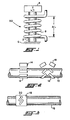
- FIG. 1 An example of a sensor using the cobalt-iron alloy magneto-elastic film of the present invention is torque sensor 50 shown in Figure 1 for which it has been found that an iron concentration of about 26% for the electrolyte composition is advantageously optimum.
- Sensor 50 has a shaft member 2 having the magneto-elastic film of the present invention of about 2-10 mils thickness electroplated onto its outer surface from the electrolyte composition of the present invention herein described.
- One end of shaft 2 is secured to a stationary foundation or frame referenced by numeral 6 and the opposite end of shaft 2 is fixedly secured to an object 4 to which a torque "T" is being applied and it is desired to monitor the amount.
- Shaft 2 is surrounded by a coiled ferromagnetic electrical conductor 8.
- twisting of shaft 2 by torque "T” causes the magneto-elastic film on the surface of shaft 2 to stretch which in turn changes its magnetic characteristics which affect the magnetic field about coiled conductor 8 and induces a change in inductance thereacross that is correlatable to the torque being applied to object 4.
- the cobalt-iron alloy magneto-elastic films of the present invention contain from about 20 to about 40 atomic weight percent iron, exhibit excellent adhesion characteristics and uniformity, and are essentially stress and crack-free in addition to providing attractive magneto-striction coefficients commonly around 50 u-in/in and potentially as high or even higher than 130 u-in/in.
- the magneto-elastic film of the invention does not have to cover the entire surface of a substrate to which it is adhered but may be in the form of one or more discrete segments, such as segments 12, adhered to shaft 10 at various orientations, such as parallel (for measuring tensile and compressive strain or at an acute angle such as 45° to the central axis of shaft 10 for measuring torque strain, as shown in Figure 2.
- a magnetic detector 14 well known to those skilled in the art, can be utilized to measure magnetic changes occurring in film 12 as a result of strain arising from stresses imposed upon shaft 10.
- Figure 3 shows an example where segments of magneto-elastic film 20 of the invention are not adhered directly to shaft 16 but rather to an electrically conductive film 18 disposed therebetween that is bonded to shaft 16. Magnetic changes occurring in film 20 in combination with conductive film 18 are detected by suitable magnetic detectors well known to those skilled in the art.
- Patterned segment arrangements of magneto-elastic film of the invention shown in Figure 2 enable the tailoring of magnetic flux paths to enhance a change in magnetic inductance per unit of stress being applied to the member under test.
- a combination of an electrically conductive film and the magneto-elastic film of the invention provides enhanced modulation of total magnetic induction as well as concentrating magnetic flux to provide greater changes in the inductive field and thereby improve measurability of changes in the magnetic field arising from stresses imposed upon the member being tested.
Landscapes
- Physics & Mathematics (AREA)
- Electromagnetism (AREA)
- General Physics & Mathematics (AREA)
- Chemical & Material Sciences (AREA)
- Electrochemistry (AREA)
- Chemical Kinetics & Catalysis (AREA)
- Engineering & Computer Science (AREA)
- Materials Engineering (AREA)
- Metallurgy (AREA)
- Organic Chemistry (AREA)
- Electroplating And Plating Baths Therefor (AREA)
- Measurement Of Length, Angles, Or The Like Using Electric Or Magnetic Means (AREA)
- Electroplating Methods And Accessories (AREA)
Applications Claiming Priority (2)
| Application Number | Priority Date | Filing Date | Title |
|---|---|---|---|
| US48586990A | 1990-02-23 | 1990-02-23 | |
| US485869 | 1990-02-23 |
Publications (1)
| Publication Number | Publication Date |
|---|---|
| EP0447044A1 true EP0447044A1 (de) | 1991-09-18 |
Family
ID=23929748
Family Applications (1)
| Application Number | Title | Priority Date | Filing Date |
|---|---|---|---|
| EP91301392A Withdrawn EP0447044A1 (de) | 1990-02-23 | 1991-02-21 | Magnetoelastischer Film und Verfahren |
Country Status (2)
| Country | Link |
|---|---|
| EP (1) | EP0447044A1 (de) |
| JP (1) | JPH04221094A (de) |
Cited By (3)
| Publication number | Priority date | Publication date | Assignee | Title |
|---|---|---|---|---|
| CN1050833C (zh) * | 1993-10-05 | 2000-03-29 | 壳牌国际研究玛莎贝有限公司 | 酰基氯化合物的制备方法 |
| DE19949549A1 (de) * | 1999-10-14 | 2001-04-26 | Hille & Mueller Gmbh & Co | Elektrolytisch beschichtetes Kaltband, vorzugsweise zur Verwendung für die Herstellung von Batteriehülsen sowie Verfahren zur Beschichtung desselben |
| US7913569B2 (en) | 2007-12-11 | 2011-03-29 | Israel Aerospace Industries Ltd. | Magnetostrictive type strain sensing means and methods |
Families Citing this family (1)
| Publication number | Priority date | Publication date | Assignee | Title |
|---|---|---|---|---|
| DE4333199C2 (de) * | 1993-09-29 | 1995-08-31 | Daimler Benz Ag | Sensor zur berührungslosen Drehmomentmessung an einer Welle sowie Meßschicht für einen solchen Sensor |
Citations (2)
| Publication number | Priority date | Publication date | Assignee | Title |
|---|---|---|---|---|
| US3922209A (en) * | 1974-08-20 | 1975-11-25 | M & T Chemicals Inc | Electrode position of alloys of nickel, cobalt or nickel and cobalt with iron and electrolytes therefor |
| EP0293107A2 (de) * | 1987-05-29 | 1988-11-30 | Seagate Technology International | Wässeriges Bad für das Elektroplattieren von Kobalt-Eisen und Verfahren zur Elektroplattierung unter Verwendung dieses Bades |
-
1991
- 1991-02-21 EP EP91301392A patent/EP0447044A1/de not_active Withdrawn
- 1991-02-22 JP JP5072491A patent/JPH04221094A/ja active Pending
Patent Citations (2)
| Publication number | Priority date | Publication date | Assignee | Title |
|---|---|---|---|---|
| US3922209A (en) * | 1974-08-20 | 1975-11-25 | M & T Chemicals Inc | Electrode position of alloys of nickel, cobalt or nickel and cobalt with iron and electrolytes therefor |
| EP0293107A2 (de) * | 1987-05-29 | 1988-11-30 | Seagate Technology International | Wässeriges Bad für das Elektroplattieren von Kobalt-Eisen und Verfahren zur Elektroplattierung unter Verwendung dieses Bades |
Non-Patent Citations (1)
| Title |
|---|
| CHEMICAL ABSTRACTS, vol. 97, no. 8, August 1982, page 483, abstract no. 63108q, Columbus, Ohio, US; & CS-A-195 997 (V. LANDA et al.) 01-03-1982 * |
Cited By (4)
| Publication number | Priority date | Publication date | Assignee | Title |
|---|---|---|---|---|
| CN1050833C (zh) * | 1993-10-05 | 2000-03-29 | 壳牌国际研究玛莎贝有限公司 | 酰基氯化合物的制备方法 |
| DE19949549A1 (de) * | 1999-10-14 | 2001-04-26 | Hille & Mueller Gmbh & Co | Elektrolytisch beschichtetes Kaltband, vorzugsweise zur Verwendung für die Herstellung von Batteriehülsen sowie Verfahren zur Beschichtung desselben |
| US6923897B1 (en) | 1999-10-14 | 2005-08-02 | Hille & Mueller Gmbh | Method for producing electrolytically coated cold rolled strip, preferably for use in the production of battery sheaths, and battery sheath produced according to this method |
| US7913569B2 (en) | 2007-12-11 | 2011-03-29 | Israel Aerospace Industries Ltd. | Magnetostrictive type strain sensing means and methods |
Also Published As
| Publication number | Publication date |
|---|---|
| JPH04221094A (ja) | 1992-08-11 |
Similar Documents
| Publication | Publication Date | Title |
|---|---|---|
| Pasa et al. | Electrodeposition of thin films and multilayers on silicon | |
| Tóth‐Kádár et al. | Preparation and magnetoresistance characteristics of electrodeposited Ni‐Cu alloys and Ni‐Cu/Cu multilayers | |
| Bergmann | Transition from Pauli paramagnetism to band ferromagnetism in very thin Ni films | |
| Alper et al. | The effect of pH changes on the giant magnetoresistance of electrodeposited superlattices | |
| US4279707A (en) | Electroplating of nickel-iron alloys for uniformity of nickel/iron ratio using a low density plating current | |
| Kim et al. | Soft magnetic films by electroless Ni‐Co‐P plating | |
| Wolf | Electrodeposition of magnetic materials | |
| Liu et al. | Structural and magnetic characterization of electrodeposited, high moment FeCoNi films | |
| Osaka et al. | Influence of crystalline structure and sulfur inclusion on corrosion properties of electrodeposited CoNiFe soft magnetic films | |
| EP0471946A2 (de) | Materialien mit hochmagnetischem Moment und Herstellungsverfahren von Dünnschichtmagnetköpfen | |
| Kuru et al. | Giant magnetoresistance (GMR) behavior of electrodeposited NiFe/Cu multilayers: Dependence of non-magnetic and magnetic layer thicknesses | |
| Bennett et al. | Magnetic properties of electrodeposited copper-nickel composition-modulated alloys | |
| Lloyd et al. | Structural and magnetic properties of Permalloy films | |
| Spada et al. | Thin films of FexNi1− x electroplated on silicon (1 0 0) | |
| EP0361451B1 (de) | Verfahren zur Herstellung eines dünnen Legierungsfilms mit hoher Sättigung der magnetischen Flussdichte | |
| Atalay et al. | Effect of pH on the magnetoimpedance properties of electrodeposited CoNiFe microtubes | |
| Atalay et al. | Magnetoimpedance effect in electroplated NiFeRu/Cu wire | |
| US3518170A (en) | Electrodeposition of iron group metals | |
| Wolf | Composition and thickness effects on magnetic properties of electrodeposited nickel‐iron thin films | |
| Yanai et al. | Effects of Glycine in DES-Based Plating Baths on Structural and Magnetic Properties of Fe–Ni Films | |
| Bradley et al. | Pulse plating of cobalt–iron–copper alloys | |
| EP0012326B1 (de) | Verfahren zur elektrolytischen Abscheidung von Nickel-Eisen-Legierungen | |
| JPH04221094A (ja) | 磁気弾性フィルム及びその製造方法 | |
| Wolf et al. | Magnetoelastic sensitivities in evaporated and electrodeposited permalloy films | |
| Bang et al. | Planarity improvement and reduction of coercivity by organic additives in electroplated Ni–Fe permalloy thin films |
Legal Events
| Date | Code | Title | Description |
|---|---|---|---|
| PUAI | Public reference made under article 153(3) epc to a published international application that has entered the european phase |
Free format text: ORIGINAL CODE: 0009012 |
|
| AK | Designated contracting states |
Kind code of ref document: A1 Designated state(s): DE ES FR GB IT SE |
|
| 17P | Request for examination filed |
Effective date: 19920317 |
|
| 17Q | First examination report despatched |
Effective date: 19940418 |
|
| STAA | Information on the status of an ep patent application or granted ep patent |
Free format text: STATUS: THE APPLICATION IS DEEMED TO BE WITHDRAWN |
|
| 18D | Application deemed to be withdrawn |
Effective date: 19940830 |