EP0447313A1 - Polymères cristaux liquides ferroélectriques - Google Patents
Polymères cristaux liquides ferroélectriques Download PDFInfo
- Publication number
- EP0447313A1 EP0447313A1 EP91400672A EP91400672A EP0447313A1 EP 0447313 A1 EP0447313 A1 EP 0447313A1 EP 91400672 A EP91400672 A EP 91400672A EP 91400672 A EP91400672 A EP 91400672A EP 0447313 A1 EP0447313 A1 EP 0447313A1
- Authority
- EP
- European Patent Office
- Prior art keywords
- synthesis
- monomers
- liquid crystal
- polymers
- chloro
- Prior art date
- Legal status (The legal status is an assumption and is not a legal conclusion. Google has not performed a legal analysis and makes no representation as to the accuracy of the status listed.)
- Granted
Links
- 229920000106 Liquid crystal polymer Polymers 0.000 title claims abstract description 9
- 239000005262 ferroelectric liquid crystals (FLCs) Substances 0.000 title claims abstract description 5
- 229920000642 polymer Polymers 0.000 claims abstract description 18
- 229920000058 polyacrylate Polymers 0.000 claims abstract description 3
- 229920000193 polymethacrylate Polymers 0.000 claims abstract description 3
- 239000000463 material Substances 0.000 claims description 11
- 238000012800 visualization Methods 0.000 claims description 6
- 150000003384 small molecules Chemical class 0.000 claims description 5
- 238000003786 synthesis reaction Methods 0.000 description 34
- 230000015572 biosynthetic process Effects 0.000 description 33
- 239000000178 monomer Substances 0.000 description 27
- ZUOUZKKEUPVFJK-UHFFFAOYSA-N diphenyl Chemical compound C1=CC=CC=C1C1=CC=CC=C1 ZUOUZKKEUPVFJK-UHFFFAOYSA-N 0.000 description 18
- 238000002844 melting Methods 0.000 description 13
- 230000008018 melting Effects 0.000 description 13
- 238000006243 chemical reaction Methods 0.000 description 12
- 239000004990 Smectic liquid crystal Substances 0.000 description 10
- 239000004305 biphenyl Substances 0.000 description 10
- -1 chloropropanoyloxy Chemical group 0.000 description 10
- 150000001875 compounds Chemical class 0.000 description 10
- 235000010290 biphenyl Nutrition 0.000 description 9
- CSCPPACGZOOCGX-UHFFFAOYSA-N Acetone Chemical compound CC(C)=O CSCPPACGZOOCGX-UHFFFAOYSA-N 0.000 description 8
- LFQSCWFLJHTTHZ-UHFFFAOYSA-N Ethanol Chemical compound CCO LFQSCWFLJHTTHZ-UHFFFAOYSA-N 0.000 description 6
- 230000004927 fusion Effects 0.000 description 6
- 238000006116 polymerization reaction Methods 0.000 description 6
- 238000001757 thermogravimetry curve Methods 0.000 description 6
- VZIQXGLTRZLBEX-UHFFFAOYSA-N 2-chloro-1-propanol Chemical compound CC(Cl)CO VZIQXGLTRZLBEX-UHFFFAOYSA-N 0.000 description 5
- 239000004977 Liquid-crystal polymers (LCPs) Substances 0.000 description 5
- 238000010586 diagram Methods 0.000 description 5
- 239000004973 liquid crystal related substance Substances 0.000 description 5
- 230000004044 response Effects 0.000 description 5
- VEXZGXHMUGYJMC-UHFFFAOYSA-N Hydrochloric acid Chemical compound Cl VEXZGXHMUGYJMC-UHFFFAOYSA-N 0.000 description 4
- 230000008901 benefit Effects 0.000 description 4
- 230000032050 esterification Effects 0.000 description 4
- 238000005886 esterification reaction Methods 0.000 description 4
- 229940126062 Compound A Drugs 0.000 description 3
- NLDMNSXOCDLTTB-UHFFFAOYSA-N Heterophylliin A Natural products O1C2COC(=O)C3=CC(O)=C(O)C(O)=C3C3=C(O)C(O)=C(O)C=C3C(=O)OC2C(OC(=O)C=2C=C(O)C(O)=C(O)C=2)C(O)C1OC(=O)C1=CC(O)=C(O)C(O)=C1 NLDMNSXOCDLTTB-UHFFFAOYSA-N 0.000 description 3
- OKKJLVBELUTLKV-UHFFFAOYSA-N Methanol Chemical compound OC OKKJLVBELUTLKV-UHFFFAOYSA-N 0.000 description 3
- 150000001718 carbodiimides Chemical class 0.000 description 3
- 230000008859 change Effects 0.000 description 3
- 239000013078 crystal Substances 0.000 description 3
- XSAOIFHNXYIRGG-UHFFFAOYSA-M lithium;prop-2-enoate Chemical compound [Li+].[O-]C(=O)C=C XSAOIFHNXYIRGG-UHFFFAOYSA-M 0.000 description 3
- 238000000034 method Methods 0.000 description 3
- YYTSGNJTASLUOY-UHFFFAOYSA-N 1-chloropropan-2-ol Chemical compound CC(O)CCl YYTSGNJTASLUOY-UHFFFAOYSA-N 0.000 description 2
- OZAIFHULBGXAKX-UHFFFAOYSA-N 2,2'-azo-bis-isobutyronitrile Substances N#CC(C)(C)N=NC(C)(C)C#N OZAIFHULBGXAKX-UHFFFAOYSA-N 0.000 description 2
- VHYFNPMBLIVWCW-UHFFFAOYSA-N 4-Dimethylaminopyridine Chemical compound CN(C)C1=CC=NC=C1 VHYFNPMBLIVWCW-UHFFFAOYSA-N 0.000 description 2
- QNAYBMKLOCPYGJ-REOHCLBHSA-N L-alanine Chemical compound C[C@H](N)C(O)=O QNAYBMKLOCPYGJ-REOHCLBHSA-N 0.000 description 2
- 239000002253 acid Substances 0.000 description 2
- 238000004458 analytical method Methods 0.000 description 2
- 230000005684 electric field Effects 0.000 description 2
- 239000000203 mixture Substances 0.000 description 2
- 230000010287 polarization Effects 0.000 description 2
- LPXPTNMVRIOKMN-UHFFFAOYSA-M sodium nitrite Chemical compound [Na+].[O-]N=O LPXPTNMVRIOKMN-UHFFFAOYSA-M 0.000 description 2
- 239000002904 solvent Substances 0.000 description 2
- 230000007704 transition Effects 0.000 description 2
- HFVIYAZBVIGNAN-UHFFFAOYSA-N 1,1-dibromodecane Chemical compound CCCCCCCCCC(Br)Br HFVIYAZBVIGNAN-UHFFFAOYSA-N 0.000 description 1
- SAWCWRKKWROPRB-UHFFFAOYSA-N 1,1-dibromohexane Chemical compound CCCCCC(Br)Br SAWCWRKKWROPRB-UHFFFAOYSA-N 0.000 description 1
- STBMZSJLFYGOJU-UHFFFAOYSA-N 1,1-dibromooctane Chemical compound CCCCCCCC(Br)Br STBMZSJLFYGOJU-UHFFFAOYSA-N 0.000 description 1
- ADFXKUOMJKEIND-UHFFFAOYSA-N 1,3-dicyclohexylurea Chemical compound C1CCCCC1NC(=O)NC1CCCCC1 ADFXKUOMJKEIND-UHFFFAOYSA-N 0.000 description 1
- RYHBNJHYFVUHQT-UHFFFAOYSA-N 1,4-Dioxane Chemical compound C1COCCO1 RYHBNJHYFVUHQT-UHFFFAOYSA-N 0.000 description 1
- JLEWELSSCZFUGA-UHFFFAOYSA-N 2-(2-chloropropoxycarbonyl)benzoic acid Chemical compound CC(COC(=O)C1=CC=CC=C1C(=O)O)Cl JLEWELSSCZFUGA-UHFFFAOYSA-N 0.000 description 1
- SMZOUWXMTYCWNB-UHFFFAOYSA-N 2-(2-methoxy-5-methylphenyl)ethanamine Chemical compound COC1=CC=C(C)C=C1CCN SMZOUWXMTYCWNB-UHFFFAOYSA-N 0.000 description 1
- NIXOWILDQLNWCW-UHFFFAOYSA-N 2-Propenoic acid Natural products OC(=O)C=C NIXOWILDQLNWCW-UHFFFAOYSA-N 0.000 description 1
- DDTJFSPKEIAZAM-UHFFFAOYSA-N 2-chloro-3-methylbutanoic acid Chemical compound CC(C)C(Cl)C(O)=O DDTJFSPKEIAZAM-UHFFFAOYSA-N 0.000 description 1
- GAWAYYRQGQZKCR-UHFFFAOYSA-N 2-chloropropionic acid Chemical compound CC(Cl)C(O)=O GAWAYYRQGQZKCR-UHFFFAOYSA-N 0.000 description 1
- OZAIFHULBGXAKX-VAWYXSNFSA-N AIBN Substances N#CC(C)(C)\N=N\C(C)(C)C#N OZAIFHULBGXAKX-VAWYXSNFSA-N 0.000 description 1
- NIXOWILDQLNWCW-UHFFFAOYSA-M Acrylate Chemical compound [O-]C(=O)C=C NIXOWILDQLNWCW-UHFFFAOYSA-M 0.000 description 1
- TVSBRLGQVHJIKT-UHFFFAOYSA-N CC(C)C1CCCC1 Chemical compound CC(C)C1CCCC1 TVSBRLGQVHJIKT-UHFFFAOYSA-N 0.000 description 1
- AYLWPPUVZHHHHA-UHFFFAOYSA-N CCCCC(CCCOC1=C(C=CC(=C1)O)C2=CC=CC=C2)OC(=O)C=C Chemical group CCCCC(CCCOC1=C(C=CC(=C1)O)C2=CC=CC=C2)OC(=O)C=C AYLWPPUVZHHHHA-UHFFFAOYSA-N 0.000 description 1
- RTZKZFJDLAIYFH-UHFFFAOYSA-N Diethyl ether Chemical compound CCOCC RTZKZFJDLAIYFH-UHFFFAOYSA-N 0.000 description 1
- WHXSMMKQMYFTQS-UHFFFAOYSA-N Lithium Chemical compound [Li] WHXSMMKQMYFTQS-UHFFFAOYSA-N 0.000 description 1
- 239000004988 Nematic liquid crystal Substances 0.000 description 1
- KWYUFKZDYYNOTN-UHFFFAOYSA-M Potassium hydroxide Chemical compound [OH-].[K+] KWYUFKZDYYNOTN-UHFFFAOYSA-M 0.000 description 1
- 241001085205 Prenanthella exigua Species 0.000 description 1
- 238000002441 X-ray diffraction Methods 0.000 description 1
- 230000009471 action Effects 0.000 description 1
- 229920006125 amorphous polymer Polymers 0.000 description 1
- 238000004873 anchoring Methods 0.000 description 1
- 230000003416 augmentation Effects 0.000 description 1
- 238000009835 boiling Methods 0.000 description 1
- 244000309464 bull Species 0.000 description 1
- 229920001429 chelating resin Polymers 0.000 description 1
- 125000001309 chloro group Chemical group Cl* 0.000 description 1
- 230000003098 cholesteric effect Effects 0.000 description 1
- 238000009833 condensation Methods 0.000 description 1
- 230000005494 condensation Effects 0.000 description 1
- 238000001816 cooling Methods 0.000 description 1
- 230000002950 deficient Effects 0.000 description 1
- 238000006193 diazotization reaction Methods 0.000 description 1
- 125000000950 dibromo group Chemical group Br* 0.000 description 1
- PQVSTLUFSYVLTO-UHFFFAOYSA-N ethyl n-ethoxycarbonylcarbamate Chemical compound CCOC(=O)NC(=O)OCC PQVSTLUFSYVLTO-UHFFFAOYSA-N 0.000 description 1
- 238000010575 fractional recrystallization Methods 0.000 description 1
- 230000009477 glass transition Effects 0.000 description 1
- 238000001093 holography Methods 0.000 description 1
- 229920001519 homopolymer Polymers 0.000 description 1
- 239000003999 initiator Substances 0.000 description 1
- 229910052744 lithium Inorganic materials 0.000 description 1
- GLXDVVHUTZTUQK-UHFFFAOYSA-M lithium hydroxide monohydrate Substances [Li+].O.[OH-] GLXDVVHUTZTUQK-UHFFFAOYSA-M 0.000 description 1
- 229940040692 lithium hydroxide monohydrate Drugs 0.000 description 1
- QSHDDOUJBYECFT-UHFFFAOYSA-N mercury Chemical compound [Hg] QSHDDOUJBYECFT-UHFFFAOYSA-N 0.000 description 1
- 229910052753 mercury Inorganic materials 0.000 description 1
- 238000002156 mixing Methods 0.000 description 1
- 239000002808 molecular sieve Substances 0.000 description 1
- 230000003287 optical effect Effects 0.000 description 1
- 238000000399 optical microscopy Methods 0.000 description 1
- ISWSIDIOOBJBQZ-UHFFFAOYSA-N phenol group Chemical group C1(=CC=CC=C1)O ISWSIDIOOBJBQZ-UHFFFAOYSA-N 0.000 description 1
- 229940072033 potash Drugs 0.000 description 1
- BWHMMNNQKKPAPP-UHFFFAOYSA-L potassium carbonate Substances [K+].[K+].[O-]C([O-])=O BWHMMNNQKKPAPP-UHFFFAOYSA-L 0.000 description 1
- 235000015320 potassium carbonate Nutrition 0.000 description 1
- 239000000843 powder Substances 0.000 description 1
- 238000000746 purification Methods 0.000 description 1
- 230000005616 pyroelectricity Effects 0.000 description 1
- 238000001953 recrystallisation Methods 0.000 description 1
- 230000009467 reduction Effects 0.000 description 1
- 229920005989 resin Polymers 0.000 description 1
- 239000011347 resin Substances 0.000 description 1
- URGAHOPLAPQHLN-UHFFFAOYSA-N sodium aluminosilicate Chemical compound [Na+].[Al+3].[O-][Si]([O-])=O.[O-][Si]([O-])=O URGAHOPLAPQHLN-UHFFFAOYSA-N 0.000 description 1
- 235000010288 sodium nitrite Nutrition 0.000 description 1
- 239000007787 solid Substances 0.000 description 1
- 230000002269 spontaneous effect Effects 0.000 description 1
- 238000004381 surface treatment Methods 0.000 description 1
- LXEJRKJRKIFVNY-UHFFFAOYSA-N terephthaloyl chloride Chemical compound ClC(=O)C1=CC=C(C(Cl)=O)C=C1 LXEJRKJRKIFVNY-UHFFFAOYSA-N 0.000 description 1
Images




Classifications
-
- C—CHEMISTRY; METALLURGY
- C08—ORGANIC MACROMOLECULAR COMPOUNDS; THEIR PREPARATION OR CHEMICAL WORKING-UP; COMPOSITIONS BASED THEREON
- C08F—MACROMOLECULAR COMPOUNDS OBTAINED BY REACTIONS ONLY INVOLVING CARBON-TO-CARBON UNSATURATED BONDS
- C08F20/00—Homopolymers and copolymers of compounds having one or more unsaturated aliphatic radicals, each having only one carbon-to-carbon double bond, and only one being terminated by only one carboxyl radical or a salt, anhydride, ester, amide, imide or nitrile thereof
- C08F20/02—Monocarboxylic acids having less than ten carbon atoms, Derivatives thereof
- C08F20/10—Esters
- C08F20/26—Esters containing oxygen in addition to the carboxy oxygen
- C08F20/30—Esters containing oxygen in addition to the carboxy oxygen containing aromatic rings in the alcohol moiety
-
- C—CHEMISTRY; METALLURGY
- C09—DYES; PAINTS; POLISHES; NATURAL RESINS; ADHESIVES; COMPOSITIONS NOT OTHERWISE PROVIDED FOR; APPLICATIONS OF MATERIALS NOT OTHERWISE PROVIDED FOR
- C09K—MATERIALS FOR MISCELLANEOUS APPLICATIONS, NOT PROVIDED FOR ELSEWHERE
- C09K19/00—Liquid crystal materials
- C09K19/04—Liquid crystal materials characterised by the chemical structure of the liquid crystal components, e.g. by a specific unit
- C09K19/38—Polymers
- C09K19/3833—Polymers with mesogenic groups in the side chain
- C09K19/3842—Polyvinyl derivatives
- C09K19/3852—Poly(meth)acrylate derivatives
- C09K19/3857—Poly(meth)acrylate derivatives containing at least one asymmetric carbon atom
Definitions
- the present invention relates to side chain liquid crystal polymers having ferroelectric properties. It also relates to the use of these ferroelectric polymers for obtaining ferroelectric materials having applications in the field of visualization.
- the liquid crystal polymers with side chains which have only been known for about fifteen years combine the anisotropy properties of the physical quantities characteristic of small liquid crystal molecules with those of the properties specific to amorphous polymers (ease of use, existence of a glass transition temperature, Young's modulus, etc.).
- These new materials which can have the same types of phase as small liquid crystal molecules, have potential applications in fields as varied as: optical recording (digital, analog, holography), linear optics (filters, polarizers). .), nonlinear optics, visualization, pyroelectricity.
- optical recording digital, analog, holography
- linear optics filters, polarizers
- nonlinear optics visualization
- pyroelectricity pyroelectricity
- Such materials can find their application in the field of large screens having a slow image renewal rate.
- the present invention provides a new family of liquid crystal polymers with side chains, ferroelectric, derived from biphenyl, having an application in the field of visualization.
- These polymers can be used alone or better as a mixture with small molecules having an S F or S F * phase.
- the ferroelectric materials thus obtained can find an application in the field of visualization where needs for large screens or curved screens are felt.
- the subject of the invention is therefore a ferroelectric liquid crystal polymer with side chains, the polymer comprising a skeleton of the polyacrylate, polymethacrylate or polychloroacrylate type to which the side chains are connected, characterized in that it corresponds to the following general formula:
- Example 1 Synthesis of poly [(acryloyloxyalkyloxy) -4 (2 chloropropanoyloxy) -4 ′ biphenyl] or compound P1 n .
- Lithium acrylate is prepared from lithium hydroxide monohydrate (supplied by the company JANSSEN) in excess relative to acrylic acid in methanol. The reaction yield is 86%.
- the excess of the dibrominated derivatives must be distilled under reduced pressure and washed with ethanol.
- This product is synthesized by reaction of an excess of lithium acrylate in hexamethylphosphortriamide (HMPA). During the synthesis, the temperature must not exceed 45-50 ° C to avoid polymerization of the acrylate.
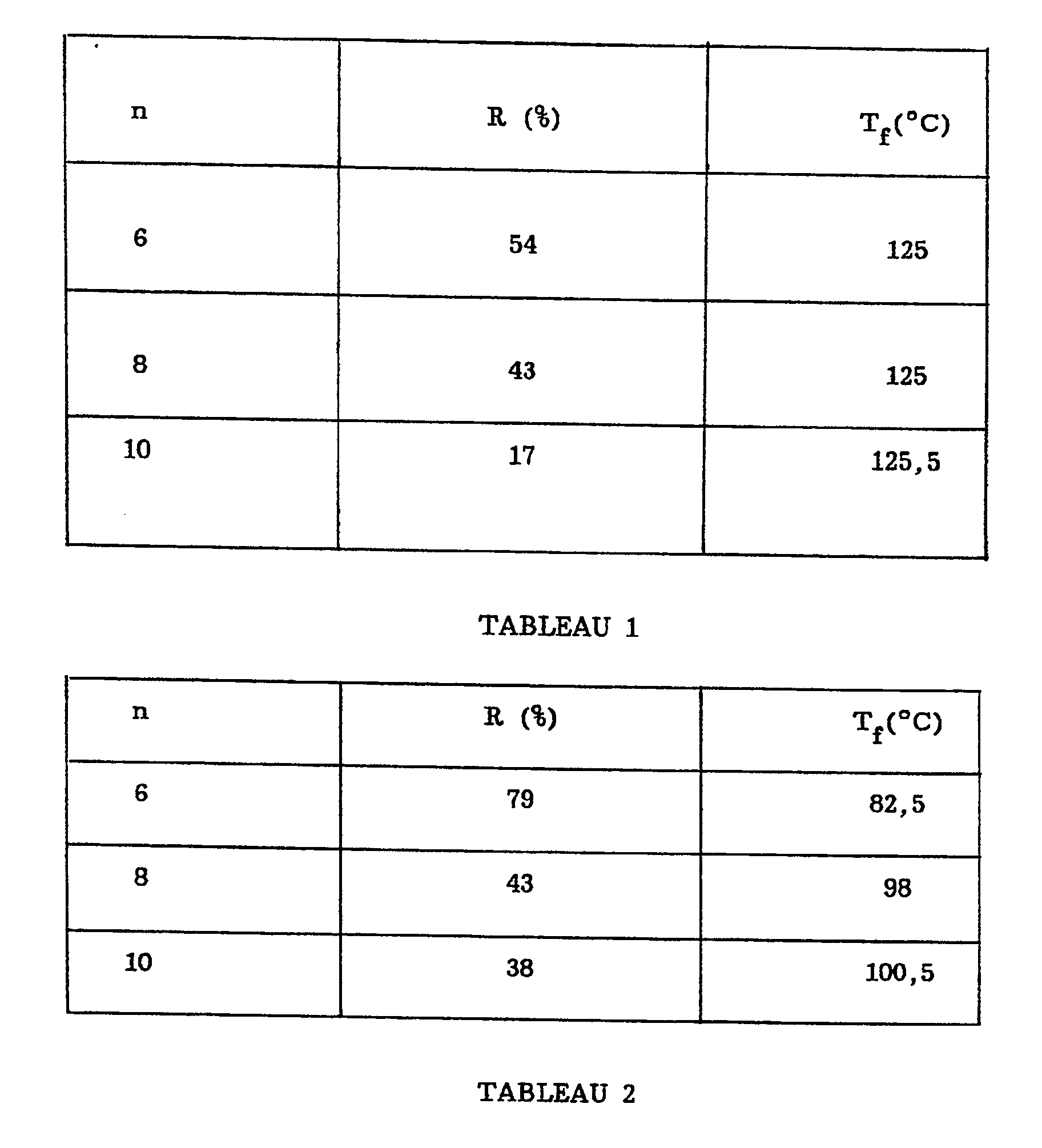
- Table 2 placed at the end of the description, indicates the melting temperatures and the yields obtained according to the values of n.
- the difference in melting temperature between the first and second temperature increases corresponds, as will be seen later, to a change in crystal structure.
- the polymerization of the monomers can be carried out by radical route, under vacuum, using the distilled N-N-dimethylformamide as solvent and as initiator 1′- ⁇ - ⁇ ′-azobisisobutyronitrile (AIBN), for 24 hours and at 60 ° C.
- AIBN initiator 1′- ⁇ - ⁇ ′-azobisisobutyronitrile
- Example 2 Synthesis of poly [(acryloyloxyoctyloxy) - 4 (chloro - 2 methyl- 3 butanoyloxyl) - 4 ′ biphenyl] or compound P28.
- the corresponding monomer M28 is obtained by esterification of 4-acryloyloxyoctyloxy-4-hydroxy-biphenyl or compound A8 (which is obtained according to the procedure described in Example 1) with 2-chloro-3-methylbutanoic acid according to reaction diagram shown in Figure 2.
- the polymerization can be obtained as previously.
- Example 3 Synthesis of poly [(acryloyloxyoctyloxy) -4 (2-chloro pentanoyloxy) -4 ′ biphenyl] or compound P38.
- the yield of this synthesis is 62%.
- the melting points are at the first pass of 79.7 ° C and on the second pass of 69 ° C.
- the polymerization can be obtained as for Example 1.
- Example 4 Synthesis of poly [(acryloyloxyoctyloxy) - 4 (chloro-2 phenyl-3 propanoyloxy) -4 ′ biphenyl] or compound P48.
- the yield of this synthesis is 52%.
- the melting points are at the first pass of 72 ° C and the second pass of 63 ° C.
- the polymerization can be obtained as for Example 1.
- Example 5 Synthesis of poly [(acryloyloxyalkyloxy) -4 (2-chloro-propyloxycarbonyl-4 benzoyloxy-4 ′ biphenyl] or compound P5 n .
- the synthesis of 2-chloro-propanol is carried out in two stages starting from S-alanine according to the reaction scheme represented in FIG. 4.
- the 2-chloro-propanoic acid is obtained by diazotization of S-alanine in the presence of an excess of sodium nitrite in 6N hydrochloric acid (see B. KOPPENHOEFFER, R. WEBER, V. SCHURING, Synthesis, p. 316, 1982).
- the yield of this synthesis is 68%.
- the boiling point under 10 mm of mercury E10 is 76 - 77 ° C.
- the monomers are obtained by esterification of the derivatives whose synthesis has been described previously.
- the reaction is carried out in acetone using dicyclohexyl 1-3 carbodiimide and 4-dimethylamino-pyridine (n can take the values ranging from 2 to 14).
- the polymerization can be obtained as for Example 1.
- the monomers and homopolymers according to the invention were studied by differential enthalpy analysis, optical microscopy and X-ray diffraction. These observations made it possible to determine the structure of the mesophases presented by these compounds. The results are presented in Tables 5 and 6 placed at the end of the description.
- thermograms of the monomers M1 n are shown in FIG. 5.
- thermograms of the monomers M5 n are shown in FIG. 7. These monomers are mesomorphic. Table 5, placed at the end of the description, groups the transition temperatures (given in ° C) between the crystalline (K), chiral smectic C (S C *), smectic A, cholesteric (N *) and isotropic (L ). The temperatures mentioned in this table are those obtained by differential enthalpy analysis during a second temperature rise. The monomers M58 and M510 exhibit a change in texture on cooling which suggests the existence of an ordered low temperature smectic phase.
- Figures 8, 9 and 10 show thermograms of polymers according to the invention.
- Figure 8 relates to polymers P16, P18 and P110.
- Figure 9 relates to polymers P28, P38 and P48.
- Figure 10 relates to polymers P56, P58 and P510.
- Table 6 placed at the end of the description, groups the transition temperatures (given in ° C) between the glassy, smectic, chiral F smectic, smectic A and isotropic phases.
Landscapes
- Chemical & Material Sciences (AREA)
- Organic Chemistry (AREA)
- Crystallography & Structural Chemistry (AREA)
- Engineering & Computer Science (AREA)
- Materials Engineering (AREA)
- Health & Medical Sciences (AREA)
- Chemical Kinetics & Catalysis (AREA)
- Medicinal Chemistry (AREA)
- Polymers & Plastics (AREA)
- Addition Polymer Or Copolymer, Post-Treatments, Or Chemical Modifications (AREA)
- Liquid Crystal Substances (AREA)
- Organic Low-Molecular-Weight Compounds And Preparation Thereof (AREA)
Abstract
Description
- La présente invention concerne des polymères cristaux liquides à chaînes latérales, présentant des propriétés ferroélectriques. Elle concerne également l'utilisation de ces polymères ferroélectriques pour l'obtention de matériaux ferroélectriques ayant des applications dans le domaine de la visualisation.
- Actuellement, sept mésophases possédant des propriétés ferroélectriques sont connues. Il s'agit de phases smectiques formées à partir de molécules chirales dans lesquelles le grand axe des molécules est incliné d'un angle ϑ non nul par rapport à la normale aux plans des couches smectiques. Les cristaux liquides ferroélectriques peuvent être divisés en deux grandes classes :
- . les smectiques 2D, auxquelles appartiennent les phases SC*, SF* et SI*
- . les smectiques ordonnés, parfois appelés cristaux smectiques qui regroupent les phases SG*, SH*, SJ* et SK*.
- Toutes ces phases après orientation par un champ électrique continu deviennent ferroélectriques et bistables.
- Ces propriétés ont été mises à profit dans le domaine de la visualisation par N. A. CLARK et S. LAGERWALL (Appl. Phys. Lett. Vol. 36, n° 89, 1980) qui ont montré que des temps de réponse très courts, de l'ordre de la dizaine de microsecondes pouvaient être obtenus avec des petites molécules de cristaux liquides SC* à condition que celles-ci soient introduites dans une cellule dont l'épaisseur est inférieure au pas de la phase. Depuis 1980, un effort de recherche important a été entrepris dans le monde, d'une part pour obtenir des matériaux SC* bien adaptés aux besoins de l'affichage, d'autre part pour maîtriser les problèmes technologiques que posent ce type d'afficheur (multiplexage, obtention des teintes de gris, réalisation de cellules de faible épaisseur sur une grande surface, traitement de surface des électrodes pour obtenir à la fois un ancrage planaire et la bistabilité... ). S'il existe actuellement des mélanges SC* présentant des propriétés satisfaisantes, les problèmes technologiques sont encore mal résolus ce qui limite le développement de ce type d'afficheur. C'est la raison pour laquelle les cristaux liquides nématiques, bien qu'ayant des temps de réponse élevés (de l'ordre de la dizaine de millisecondes), sont les seuls matériaux mésomorphes utilisés dans les systèmes d'affichage commercialisés.
- Les polymères cristaux liquides à chaînes latérales qui ne sont connus que depuis une quinzaine d'années combinent les propriétés d'anisotropie des grandeurs physiques caractéristiques des petites molécules de cristaux liquides à celles des propriétés propres aux polymères amorphes (facilité de mise en oeuvre, existence d'une température de transition vitreuse, module d'Young... ). Ces nouveaux matériaux qui peuvent présenter les mêmes types de phase que les petites molécules de cristaux liquides ont des applications potentielles dans des domaines aussi variés que : l'enregistrement optique (digital, analogique, holographie), l'optique linéaire (filtres, polariseurs. . . ), l'optique non linéaire, la visualisation, la pyroélectricité. L'ouvrage " Side Chain Liquid Crystal" édité par Mc Ardle en 1989 (Blackie Glasgow and London) fait un point récent des connaissances acquises dans le domaine.
- Parmi les polymères cristaux liquides à chaînes latérales, ceux qui présentent une phase SC* ont reçu une attention toute particulière depuis leurs premières synthèses en 1984 (V. SHIBAEV, M. KOZLOVSKY, L. BERESNEV, L. BLINOV and A. PLATE, Polymer Bull. n° 12, p. 299, 1984).
- Cet intérêt s'est accru lorsque SCHEROWSKY et ses collaborateurs ont montré la faisabilité d'obtenir des monodomaines orientés avec des polymères SC* et la possibilité de les commuter d'un état stable à l'autre par action d'un champ électrique continu, avec des temps de réponse de l'ordre de 10 ms (Proceedings of the twelfth International Liquid Crystal Conference).
- De tels matériaux peuvent trouver leur application dans le domaine des écrans de grandes dimensions ayant une cadence de renouvellement d'image lente.
- Enfin, la Société "IDEMITSU KOSAN COMPANY LIMITED" a montré qu'il était possible d'obtenir des matériaux ferroélectriques à base de polymères cristaux liquides à chaînes latérales possédant une phase SC* sur une large gamme de température comprenant la température ambiante et ayant un temps de réponse de l'ordre de la milliseconde en mélangeant un polymère ferroélectrique avec une petite molécule présentant la phase SC ou SC*, ce qui ouvre la voie aux applications écrans plats de grande dimension compatibles avec la cadence vidéo (Cf. EP 297 554).
- La présente invention propose une nouvelle famille de polymères cristaux liquides à chaînes latérales, ferroélectriques, dérivés du biphényle, ayant une application dans le domaine de la visualisation.
- L'intérêt de ces nouveaux polymères par rapport à l'art antérieur réside dans le fait que certains d'entre eux présentent une phase smectique chirale 2D plus ordonnée que la phase SC*, conduisant ainsi à une valeur de la polarisation spontanée obtenue après polarisation, supérieure à celle présentée par la phase SC*.
- Ces polymères pourront être utilisés seuls ou mieux en mélange avec de petites molécules présentant une phase SF ou SF*.
- L'addition de petites molécules SF ou SF* aux polymères selon l'invention aura pour intérêt de :
- diminuer la viscosité du matériau ferroélectrique final, donc d'obtenir des temps de réponse de l'ordre de la milliseconde,
- d'élargir la gamme en température de la phase SF*,
- d'amener la phase SF* dans un domaine de température comprenant la température ambiante.
- Grâce à leur mouillabilité, les matériaux ferroélectriques ainsi obtenus pourront trouver une application dans le domaine de la visualisation où des besoins en écrans de grandes dimensions ou en écrans courbes se font sentir.
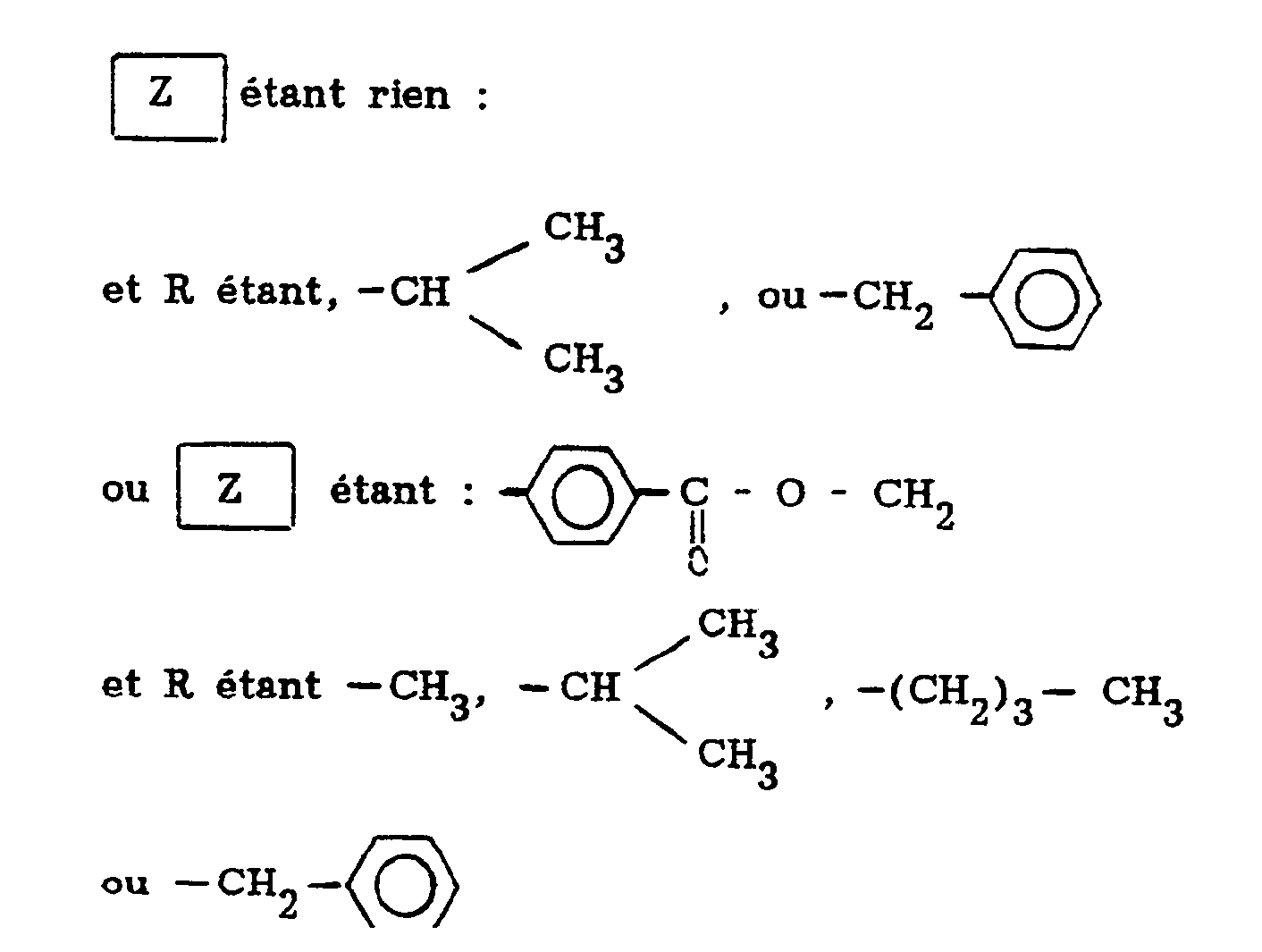
- L'invention a donc pour objet un polymère cristal liquide ferroélectrique à chaînes latérales, le polymère comprenant un squelette du type polyacrylate, polyméthacrylate ou polychloroacrylate sur lequel sont branchées les chaînes latérales, caractérisé en ce qu'il répond à la formule générale suivante :

- L'invention sera mieux comprise et d'autres avantages apparaîtront grâce à la description qui va suivre, donnée à titre non limitatif, accompagnée des dessins annexés parmi lesquels :
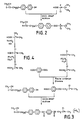
- la figure 1 est un schéma général de synthèse de monomères selon l'invention,
- la figure 2 est un schéma réactionnel d'estérification,
- la figure 3 est un schéma général de synthèse d'autres monomères selon l'invention,
- la figure 4 est un schéma de synthèse du chloro-2 propanol,
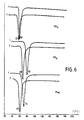
- les figures 5, 6 et 7 sont des thermogrammes de monomères selon l'invention,
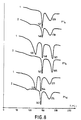
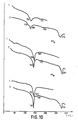
- les figures 8, 9 et 10 sont des thermogrammes de polymères selon l'invention.
- Des exemples de synthèse de polymères selon l'invention vont maintenant être détaillés.
- Exemple 1: Synthèse du poly [(acryloyloxyalkyloxy)-4 (2 chloropropanoyloxy)-4′ biphényle] ou composé P1n.
- Le schéma général de la synthèse des monomères correspondants est présenté à la figure 1.
- . Synthèse de l'acryloyloxy alkyloxy-4 hydroxy-4′ biphényle ou composé An :
- La synthèse est réalisée en trois étapes:
- i) Synthèse de l'acrylate de lithium.
- L'acrylate de lithium est préparé à partir du monohydrate d'hydroxyde de lithium (fourni par la Société JANSSEN) en excès par rapport de l'acide acrylique dans le méthanol. Le rendement de la réaction est 86 % .
- ii) Synthèse de 1′(ω-bromoalkyloxy)-4 hydroxy-4′ biphényle ou composé Bn.
- Cette synthèse a été faite selon la méthode de KLARMANN. On opère en présence de potasse en défaut et du dérivé dibromé en excès par rapport aux fonctions phénol.
- Les rendements R de la réaction et les températures de fusion Tf selon les différentes valeurs de n sont reportés dans le tableau 1 placé en fin de description.
- Les modes opératoires sont identiques quelle que soit la valeur de n. Seules quelques variations dans les procédés de purification sont à noter.
- En effet, contrairement au dibromohexane, le dibromooctane et le dibromodécane sont des solides à température ambiante (pour Br(CH₂)₈Br, Tf = 24°C et pour Br(CH₂)₁₀Br, Tf = 27°C) de faible solubilité et difficile à éliminer. Il faut distiller l'excès des dérivés dibromés sous pression réduite et laver à l'éthanol.
- iii) Synthèse de l'acryloyloxy alkyloxy-4 hydroxy-4′ biphényle (composé An )
- Ce produit est synthétisé par réaction d'un excès d'acrylate de lithium dans l'hexaméthylphosphortriamide (HMPA). Lors de la synthèse il faut que la température n'excède pas 45-50°C pour éviter une polymérisation de l'acrylate. Le tableau 2, placé en fin de description, indique les températures de fusion et les rendements obtenus selon les valeurs de n.
- . Synthèse des monomères : l'acryloyloxy alkyloxy-4 (chloro- 2) propanoyloxy 4′ biphényle ou composé M1n :
- La synthèse de ces monomères peut être effectuée par les deux voies indiquées dans la figure 1.
- C'est la méthode utilisant le dicyclohexyl 1-3 carbodiimide qui conduit aux monomères avec un meilleur rendement et une plus grande pureté.
- Estérification en présence de dicyclohexyl 1-3 carbodiimide :
- Pour cette synthèse, on a choisi l'acétone comme solvant en raison de l'insolubilité de la dicyclohexylurée formée au cours de la réaction. Dans cette condition, en mettant à profit la différence de solubilité dans l'acétone puis dans l'éthanol, entre les produits initiaux et finaux, on a réussi par recristalisation fractionnée, à obtenir un produit pur avec un rendement satisfaisant. Ce produit se présente alors sous la forme d'une poudre blanche et brillante.
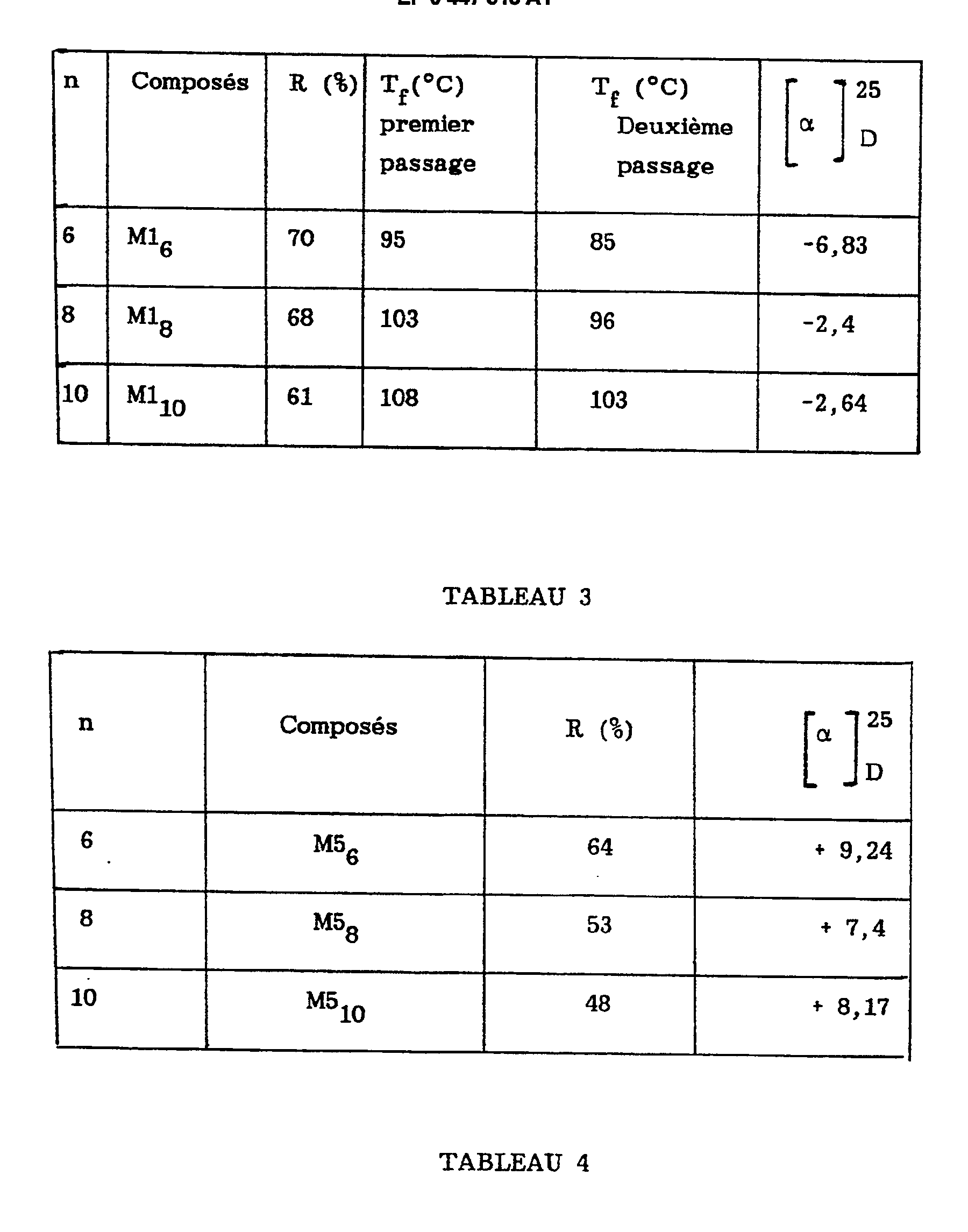
- Les rendements, les points de fusion et les pouvoirs rotatoires de différents monomères sont rassemblés dans le tableau 3 placé en fin de description.
- La différence de température de fusion entre les premières et deuxièmes montées en température correspond, comme on le verra ultérieurement à un changement de structure cristalline.
- La polymérisation des monomères peut se faire par voie radicalaire, sous vide, en utilisant comme solvant le N-N-diméthylformamide distillé et comme amorceur 1′-α-α′-azobisisobutyronitrile (AIBN), pendant 24 heures et à 60°C.
- Exemple 2: Synthèse du poly [(acryloyloxyoctyloxy)- 4 (chloro - 2 methyl- 3 butanoyloxyl)- 4′ biphényle] ou composé P2₈.
- Le monomère correspondant M2₈ est obtenu par estérification de l'acryloyloxyoctyloxy-4 hydroxy-4′ biphényle ou composé A₈ (qui s'obtient selon la procédure décrite dans l'exemple 1) par l'acide chloro-2 méthyl-3 butanoïque selon le schéma réactionnel représenté à la figure 2.
- Cette synthèse a été effectuée avec un rendement de 60 % . Une première montée en température révèle un point de fusion à 59, 5°C pour le matériau obtenu. Une deuxième montée en température donne un point de fusion pour 57°C.
- La polymérisation peut être obtenue comme précédemment.
- Exemple 3: Synthèse du poly [(acryloyloxyoctyloxy)-4 (chloro-2 pentanoyloxy)-4′ biphényle] ou composé P3₈.
- Le monomère correspondant M3₈ est obtenu de la même manière que celui de l'exemple 2.
- Le rendement de cette synthèse est de 62 % . Les points de fusion sont au premier passage de 79,7°C et au deuxième passage de 69°C.
- La polymérisation peut être obtenue comme pour l'exemple 1.
- Exemple 4 : Synthèse du poly [(acryloyloxyoctyloxy)- 4 (chloro- 2 phényl- 3 propanoyloxy)-4′ biphényle] ou composé P4₈.
- Le monomère correspondant M4₈ est obtenu de la même manière que celui de l'exemple 2.
- Le rendement de cette synthèse est de 52 % . Les points de fusion sont au premier passage de 72°C et au deuxième passage de 63°C.
- La polymérisation peut être obtenue comme pour l'exemple 1.
- Exemple 5: Synthèse du poly [(acryloyloxyalkyloxy)-4 (chloro-2 propyloxycarbonyl-4 benzoyloxy-4′ biphényle] ou composé P5n.
- La synthèse des monomères correspondants M5n s'effectue selon le schéma réactionnel représenté à la figure 3.
- Ces monomères sont synthétisés en deux étapes par condensation des trois produits suivants :
- l'acryloyloxyalkyloxy-4 hydroxy-4′ biphényle ou composé An dont la synthèse a été décrite à l'exemple 1,
- le dichlorure de téréphtaloyle qui est commercial,
- le chloro-2 propanol.
- La synthèse du chloro-2 propanol s'effectue en deux étapes à partir de la S-alanine selon le schéma réactionnel représenté à la figure 4. L'acide chloro-2 propanoïque est obtenu par diazotation de la S-alanine en présence d'un excès de nitrite de sodium dans l'acide chlorhydrique 6N (voir B. KOPPENHOEFFER, R. WEBER, V. SCHURING, Synthesis, p. 316, 1982). Le rendement de cette synthèse est de 68 %. La température d'ébullition sous 10 mm de mercure E₁₀ vaut 76 - 77°C. Le pouvoir rotatoire du produit obtenu est [α]

- La réduction de l'acide obtenu précédemment en chloro-2 propanol -1 est réalisée dans l'éther anhydre en présence d'hydrogénoaluminate de lithium. Le rendement de la réaction est de 40 % et le pouvoir rotatoire du produit obtenu est [α]

- . Synthèse de l'acide (chloro-2) propyloxycarbonyl - benzoïque.
- La synthèse de cet acide s'effectue par réaction du dichlorure de téraphtalate avec le chloro-2 propanol dans le dioxane séché sur le tamis moléculaire 4 Å, en présence de résine Amberlyst (Aldrich A-21), pour piéger l'acide chlorhydrique formé au cours de la réaction.
- Le rendement de cette synthèse est de 31 % . Le point de fusion du produit obtenu est de 168°C. Son pouvoir rotatoire est [α]

- . Synthèse des monomères M5n
- Les monomères sont obtenus par estérification des dérivés dont la synthèse a été décrite précédemment. La réaction s'effectue dans l'acétone en utilisant le dicyclohexyl 1-3 carbodiimide et la diméthylamino- 4 pyridine (n pouvant prendre les valeurs allant de 2 à 14).
- Ces monomères sont purifiés par recristallisation dans l'acétone puis dans l'éthanol. Les rendements et les pouvoirs rotatoires de quelques monomères (n = 6, 8 et 10 ) sont rassemblés dans le tableau 4 placé en fin de description.
- La polymérisation peut être obtenue comme pour l'exemple 1.
- Les monomères et les homopolymères selon l'invention ont été étudiés par analyse enthalpique différentielle, microscopie optique et diffraction des rayons X. L'ensemble de ces observations a permis de déterminer la structure des mésophases présentées par ces composés. Les résultats sont présentés dans les tableaux 5 et 6 placés en fin de description.
- Les thermogrammes des monomères M1n sont représentés à la figure 5.
- Pour ces monomères, on n'observe qu'un seul pic endothermique correspondant à la fusion. Une variation de la température de fusion est observée entre la première montée en température et les suivantes. Ces données sont résumées dans le tableau 3. D'après celui-ci on peut faire les remarques suivantes :
- un allongement de la séquence flexible (̵CH₂)n entraîne une augmentation de la température de fusion
- la température de fusion varie entre le premier et le deuxième passage, ce qui peut traduire l'existence de deux formes cristallines différentes (Figure 5),
- ces composés ne sont pas mésomorphes. L'observation au microscope polarisant confirme cette dernière remarque. Ces produits passent directement de l'état cristallin à l'état isotrope.
- Les thermogrammes des monomères M2₈, M3₈ et M4₈ sont représentés à la figure 6. On remarque de nouveau que :
- un changement de structure cristalline se produit après la première montée en température. Il se traduit par une diminution du point de fusion (figure 6)
- les monomères ne sont pas mésomorphes et seul un pic endothermique correspondant à la fusion est observé. Ce résultat est confirmé par l'étude au microscope polarisant.
- Les thermogrammes des monomères M5n sont représentés à la figure 7. Ces monomères sont mésomorphes. le tableau 5, placé en fin de description, regroupe les températures de transition (données en °C) entre les phases cristallines (K), smectiques C chirales (SC*), smectique A, cholestériques (N*) et isotropes (L). Les températures mentionnées dans ce tableau sont celles obtenues par analyse enthalpique différentielle lors d'une deuxième montée en température. Les monomères M5₈ et M5₁₀ présentent au refroidissement un changement de texture qui suggère l'existence d'une phase smectique basse température ordonnée.
- Le figures 8, 9 et 10 représentent des thermogrammes de polymères selon l'invention. La figure 8 se rapporte aux polymères P1₆, P1₈ et P1₁₀. La figure 9 se rapporte aux polymères P2₈, P3₈ et P4₈. La figure 10 se rapporte aux polymères P5₆, P5₈ et P5₁₀.
- Le tableau 6, placé en fin de description, regroupe les températures de transition (données en °C) entre les phases vitreuses, smectiques , smectiques F chirales, smectiques A et isotropes.

Claims (3)

2 ≦ n ≦ 14
Applications Claiming Priority (2)
| Application Number | Priority Date | Filing Date | Title |
|---|---|---|---|
| FR9003381 | 1990-03-16 | ||
| FR9003381A FR2659663A1 (fr) | 1990-03-16 | 1990-03-16 | Polymeres cristaux liquides ferroelectriques. |
Publications (2)
| Publication Number | Publication Date |
|---|---|
| EP0447313A1 true EP0447313A1 (fr) | 1991-09-18 |
| EP0447313B1 EP0447313B1 (fr) | 1995-01-18 |
Family
ID=9394813
Family Applications (1)
| Application Number | Title | Priority Date | Filing Date |
|---|---|---|---|
| EP19910400672 Expired - Lifetime EP0447313B1 (fr) | 1990-03-16 | 1991-03-12 | Polymères cristaux liquides ferroélectriques |
Country Status (3)
| Country | Link |
|---|---|
| EP (1) | EP0447313B1 (fr) |
| DE (1) | DE69106748T2 (fr) |
| FR (1) | FR2659663A1 (fr) |
Cited By (5)
| Publication number | Priority date | Publication date | Assignee | Title |
|---|---|---|---|---|
| GB2269387A (en) * | 1992-08-03 | 1994-02-09 | Toshiba Kk | Smectic A phase polymers for use in liquid crystal compositions and display elements |
| WO1994022977A1 (fr) * | 1993-04-06 | 1994-10-13 | The Secretary Of State For Defence | Polymeres pour cristaux liquides |
| GB2257432B (en) * | 1990-07-02 | 1994-11-09 | Secr Defence | Liquid crystal polyacrylates |
| GB2294052A (en) * | 1993-04-06 | 1996-04-17 | Secr Defence | Liquid crystal polymers |
| WO1999005645A1 (fr) * | 1997-07-25 | 1999-02-04 | Aventis Research & Technologies Gmbh & Co & Kg. | Carte a puce dotee d'un afficheur bistable pouvant etre charge mecaniquement |
Citations (2)
| Publication number | Priority date | Publication date | Assignee | Title |
|---|---|---|---|---|
| EP0228703A2 (fr) * | 1985-12-26 | 1987-07-15 | Idemitsu Kosan Company Limited | Polymère cristal liquide ferro-électrique |
| WO1990000586A1 (fr) * | 1988-07-08 | 1990-01-25 | Hoechst Aktiengesellschaft | Polymeres ferroelectriques a cristaux liquides, leur procede de production et leur utilisation dans des composants electro-optiques |
-
1990
- 1990-03-16 FR FR9003381A patent/FR2659663A1/fr not_active Withdrawn
-
1991
- 1991-03-12 EP EP19910400672 patent/EP0447313B1/fr not_active Expired - Lifetime
- 1991-03-12 DE DE1991606748 patent/DE69106748T2/de not_active Expired - Fee Related
Patent Citations (2)
| Publication number | Priority date | Publication date | Assignee | Title |
|---|---|---|---|---|
| EP0228703A2 (fr) * | 1985-12-26 | 1987-07-15 | Idemitsu Kosan Company Limited | Polymère cristal liquide ferro-électrique |
| WO1990000586A1 (fr) * | 1988-07-08 | 1990-01-25 | Hoechst Aktiengesellschaft | Polymeres ferroelectriques a cristaux liquides, leur procede de production et leur utilisation dans des composants electro-optiques |
Non-Patent Citations (3)
| Title |
|---|
| MOLECULAR CRYSTALS & LIQUID CRYSTALS, vol. 157, 1988, pages 151-162; N. KOIDE et al.: "Synthesis and thermal properties of side chain type liquid crystalline polymers with chiral unit in the flexible moiety" * |
| PATENT ABSTRACTS OF JAPAN, vol. 13, no. 562 (C-665)[3910], 13 décembre 1989; & JP-A-1 234 413 (IDEMITSU KOSAN) 19-09-1989 * |
| PATENT ABSTRACTS OF JAPAN, vol. 13, no. 562 (C-665)[3910], 13 décembre 1989; & JP-A-1 234 414 (IDEMITSU KOSAN) 19-09-1989 * |
Cited By (8)
| Publication number | Priority date | Publication date | Assignee | Title |
|---|---|---|---|---|
| GB2257432B (en) * | 1990-07-02 | 1994-11-09 | Secr Defence | Liquid crystal polyacrylates |
| GB2269387A (en) * | 1992-08-03 | 1994-02-09 | Toshiba Kk | Smectic A phase polymers for use in liquid crystal compositions and display elements |
| GB2269387B (en) * | 1992-08-03 | 1996-09-18 | Toshiba Kk | Liquid crystal composition and liquid crystal display element |
| WO1994022977A1 (fr) * | 1993-04-06 | 1994-10-13 | The Secretary Of State For Defence | Polymeres pour cristaux liquides |
| GB2294052A (en) * | 1993-04-06 | 1996-04-17 | Secr Defence | Liquid crystal polymers |
| US5676878A (en) * | 1993-04-06 | 1997-10-14 | The Secretary Of State For Defence In Her Britannic Majesty's Government Of The United Kingdom Of Great Britain And Northern Ireland | Liquid crystal polymers |
| CN1050858C (zh) * | 1993-04-06 | 2000-03-29 | 大不列颠及北爱尔兰联合王国国防大臣 | 液晶聚合物 |
| WO1999005645A1 (fr) * | 1997-07-25 | 1999-02-04 | Aventis Research & Technologies Gmbh & Co & Kg. | Carte a puce dotee d'un afficheur bistable pouvant etre charge mecaniquement |
Also Published As
| Publication number | Publication date |
|---|---|
| EP0447313B1 (fr) | 1995-01-18 |
| DE69106748D1 (de) | 1995-03-02 |
| FR2659663A1 (fr) | 1991-09-20 |
| DE69106748T2 (de) | 1995-07-13 |
Similar Documents
| Publication | Publication Date | Title |
|---|---|---|
| US5332522A (en) | Thermotropic chiral nematic liquid crystalline copolymers | |
| US4293435A (en) | Liquid-crystalline polymer phase having a cholesteric structure, processes for its preparation and its use | |
| FR2597109A1 (fr) | Materiau polymerique mesomorphe utilisable en optique non lineaire | |
| US5252251A (en) | Mesomorphic polymer, monomeric mesomorphic compounds, liquid crystal composition and liquid crystal device | |
| EP0184482A1 (fr) | Polymères thermotropes à chaines latérales ayant une structure chirale et leur procédé de fabrication | |
| US5728864A (en) | Liquid crystal compound having ferrielectric phase and liquid crystal composition | |
| EP0447313B1 (fr) | Polymères cristaux liquides ferroélectriques | |
| EP0853076B1 (fr) | Composé crystal liquide | |
| US5264150A (en) | Optically active alcohol, process for producing same and liquid crystal compound using same | |
| KR19990014109A (ko) | 페리유전성 액정화합물 | |
| EP0829469B1 (fr) | Composé racémique et composition liquide cristalline antiferroélectrique | |
| KR101449139B1 (ko) | 덴드론 형태의 액정화합물 및 그 제조방법 | |
| JPH0431405A (ja) | 光学活性な高分子液晶共重合体化合物、その組成物及びそれらを用いた高分子液晶素子 | |
| EP0844294A1 (fr) | Composé racémique et composition liquide cristalline le contenant | |
| EP0418140A1 (fr) | Cristaux liquides chiraux dérivés du biphényle | |
| WO2006060625A2 (fr) | Compositions pour cristaux liquides comprenant un compose organogermanique, et procedes d'utilisation correspondants | |
| EP0239444A1 (fr) | Cristal liquide ferroélectrique, son procédé de fabrication et son utilisation dans un mélange de cristaux liquides | |
| EP0463931B1 (fr) | Copolymères amorphes, transparents dans le visible, pour applications en optique non linéaire | |
| WO1997009295A1 (fr) | Complexes metalliques mesogenes, procede de polymerisation de ces complexes et polymeres anisotropes ainsi obtenus | |
| EP0343029B1 (fr) | Polymères mésomorphes à chaînes latérales comportant un motif trans (cyano-4 phényl)-2 dioxanne 1,3 YL-5 | |
| JP2000273098A (ja) | β−エストラジオールまたはメチルアンドロステンジオールを原料とする新規重合性光学活性物質及びそれを含む光学活性液晶組成物、光学活性液晶高分子ネットワーク | |
| Cooray et al. | Synthesis and characterization of monodisperse ferroelectric side chain liquid-crystalline siloxane oligomers | |
| JP2796722B2 (ja) | 光学素子用液晶 | |
| JP3470725B2 (ja) | 反強誘電性液晶物質および液晶表示素子 | |
| JP2741675B2 (ja) | 強誘電性液晶組成物 |
Legal Events
| Date | Code | Title | Description |
|---|---|---|---|
| PUAI | Public reference made under article 153(3) epc to a published international application that has entered the european phase |
Free format text: ORIGINAL CODE: 0009012 |
|
| AK | Designated contracting states |
Kind code of ref document: A1 Designated state(s): DE FR GB SE |
|
| 17P | Request for examination filed |
Effective date: 19920111 |
|
| 17Q | First examination report despatched |
Effective date: 19930719 |
|
| RAP1 | Party data changed (applicant data changed or rights of an application transferred) |
Owner name: THOMSON-CSF |
|
| GRAA | (expected) grant |
Free format text: ORIGINAL CODE: 0009210 |
|
| AK | Designated contracting states |
Kind code of ref document: B1 Designated state(s): DE FR GB SE |
|
| REF | Corresponds to: |
Ref document number: 69106748 Country of ref document: DE Date of ref document: 19950302 |
|
| GBT | Gb: translation of ep patent filed (gb section 77(6)(a)/1977) |
Effective date: 19950327 |
|
| PLBE | No opposition filed within time limit |
Free format text: ORIGINAL CODE: 0009261 |
|
| STAA | Information on the status of an ep patent application or granted ep patent |
Free format text: STATUS: NO OPPOSITION FILED WITHIN TIME LIMIT |
|
| 26N | No opposition filed | ||
| PGFP | Annual fee paid to national office [announced via postgrant information from national office to epo] |
Ref country code: SE Payment date: 19990217 Year of fee payment: 9 Ref country code: DE Payment date: 19990217 Year of fee payment: 9 |
|
| PGFP | Annual fee paid to national office [announced via postgrant information from national office to epo] |
Ref country code: GB Payment date: 19990219 Year of fee payment: 9 |
|
| PGFP | Annual fee paid to national office [announced via postgrant information from national office to epo] |
Ref country code: FR Payment date: 19990323 Year of fee payment: 9 |
|
| PG25 | Lapsed in a contracting state [announced via postgrant information from national office to epo] |
Ref country code: GB Free format text: LAPSE BECAUSE OF NON-PAYMENT OF DUE FEES Effective date: 20000312 |
|
| PG25 | Lapsed in a contracting state [announced via postgrant information from national office to epo] |
Ref country code: SE Free format text: LAPSE BECAUSE OF NON-PAYMENT OF DUE FEES Effective date: 20000313 |
|
| GBPC | Gb: european patent ceased through non-payment of renewal fee |
Effective date: 20000312 |
|
| EUG | Se: european patent has lapsed |
Ref document number: 91400672.1 |
|
| PG25 | Lapsed in a contracting state [announced via postgrant information from national office to epo] |
Ref country code: FR Free format text: LAPSE BECAUSE OF NON-PAYMENT OF DUE FEES Effective date: 20001130 |
|
| REG | Reference to a national code |
Ref country code: FR Ref legal event code: ST |
|
| PG25 | Lapsed in a contracting state [announced via postgrant information from national office to epo] |
Ref country code: DE Free format text: LAPSE BECAUSE OF NON-PAYMENT OF DUE FEES Effective date: 20010103 |