EP0447325A1 - Novel ascorbic acid derivatives - Google Patents
Novel ascorbic acid derivatives Download PDFInfo
- Publication number
- EP0447325A1 EP0447325A1 EP91400708A EP91400708A EP0447325A1 EP 0447325 A1 EP0447325 A1 EP 0447325A1 EP 91400708 A EP91400708 A EP 91400708A EP 91400708 A EP91400708 A EP 91400708A EP 0447325 A1 EP0447325 A1 EP 0447325A1
- Authority
- EP
- European Patent Office
- Prior art keywords
- compound
- alkyl
- compounds
- nr4r5
- formula
- Prior art date
- Legal status (The legal status is an assumption and is not a legal conclusion. Google has not performed a legal analysis and makes no representation as to the accuracy of the status listed.)
- Granted
Links
- 0 CC(C(*C1O*)OC1=O)O Chemical compound CC(C(*C1O*)OC1=O)O 0.000 description 2
Classifications
-
- C—CHEMISTRY; METALLURGY
- C07—ORGANIC CHEMISTRY
- C07D—HETEROCYCLIC COMPOUNDS
- C07D307/00—Heterocyclic compounds containing five-membered rings having one oxygen atom as the only ring hetero atom
- C07D307/02—Heterocyclic compounds containing five-membered rings having one oxygen atom as the only ring hetero atom not condensed with other rings
- C07D307/34—Heterocyclic compounds containing five-membered rings having one oxygen atom as the only ring hetero atom not condensed with other rings having two or three double bonds between ring members or between ring members and non-ring members
- C07D307/56—Heterocyclic compounds containing five-membered rings having one oxygen atom as the only ring hetero atom not condensed with other rings having two or three double bonds between ring members or between ring members and non-ring members with hetero atoms or with carbon atoms having three bonds to hetero atoms with at the most one bond to halogen, e.g. ester or nitrile radicals, directly attached to ring carbon atoms
- C07D307/62—Three oxygen atoms, e.g. ascorbic acid
-
- A—HUMAN NECESSITIES
- A61—MEDICAL OR VETERINARY SCIENCE; HYGIENE
- A61P—SPECIFIC THERAPEUTIC ACTIVITY OF CHEMICAL COMPOUNDS OR MEDICINAL PREPARATIONS
- A61P29/00—Non-central analgesic, antipyretic or antiinflammatory agents, e.g. antirheumatic agents; Non-steroidal antiinflammatory drugs [NSAID]
-
- A—HUMAN NECESSITIES
- A61—MEDICAL OR VETERINARY SCIENCE; HYGIENE
- A61P—SPECIFIC THERAPEUTIC ACTIVITY OF CHEMICAL COMPOUNDS OR MEDICINAL PREPARATIONS
- A61P3/00—Drugs for disorders of the metabolism
- A61P3/06—Antihyperlipidemics
-
- A—HUMAN NECESSITIES
- A61—MEDICAL OR VETERINARY SCIENCE; HYGIENE
- A61P—SPECIFIC THERAPEUTIC ACTIVITY OF CHEMICAL COMPOUNDS OR MEDICINAL PREPARATIONS
- A61P9/00—Drugs for disorders of the cardiovascular system
-
- A—HUMAN NECESSITIES
- A61—MEDICAL OR VETERINARY SCIENCE; HYGIENE
- A61P—SPECIFIC THERAPEUTIC ACTIVITY OF CHEMICAL COMPOUNDS OR MEDICINAL PREPARATIONS
- A61P9/00—Drugs for disorders of the cardiovascular system
- A61P9/08—Vasodilators for multiple indications
-
- A—HUMAN NECESSITIES
- A61—MEDICAL OR VETERINARY SCIENCE; HYGIENE
- A61P—SPECIFIC THERAPEUTIC ACTIVITY OF CHEMICAL COMPOUNDS OR MEDICINAL PREPARATIONS
- A61P9/00—Drugs for disorders of the cardiovascular system
- A61P9/10—Drugs for disorders of the cardiovascular system for treating ischaemic or atherosclerotic diseases, e.g. antianginal drugs, coronary vasodilators, drugs for myocardial infarction, retinopathy, cerebrovascula insufficiency, renal arteriosclerosis
Definitions
- This invention relates to derivatives of certain 3,4-dihydroxy-2,5-dihydrofuran-5-ones, to the intermediates and processes useful for their preparation, to their free-radical scavenger and cellular protective properties, and to their end-use application as therapeutic agents.
- this invention relates to derivatives of 3,4-dihydroxy-2,5-dihydrofuran-5-ones of the formula the enantiomers and mixtures thereof, the inner salts and the pharmaceutically acceptable salts thereof wherein Q is NR4R5 or N ⁇ R4R5R6 ⁇ X ⁇ , n is an integer 1 to 4, X is a halide or OS(O)2R7, with R7 being C1 ⁇ 6 alkyl, (CH2) m -Z-substituted phenyl wherein m is 0, 1, 2, 3 or 4 and Z is H, C1 ⁇ 6 alkyl, C1 ⁇ 6 alkoxy or halogeno, R1 is H or C1 ⁇ 20 alkyl, R2 is H or C1 ⁇ 20 alkyl, R3 is H, or OR2 and each of R4, R5 and R6 are C1 ⁇ 6 alkyl, (CH2) x phenyl or (CH2) x halogenated phenyl x being zero,
- the (CH2) n moiety of Formula I wherein n is an integer 1 to 4, it is preferred that n be one or two. It is also contemplated that these carbon atoms may have one or both of their hydrogen atoms replaced with methyl groups.
- Q represents a quaternary moiety. In those instances wherein Q is N ⁇ R4R5R6 ⁇ X ⁇ , representing a quaternary ammonium derivative, it is preferred that all of the R4R5R6 alkyl radicals be the same, preferably methyl or ethyl. However, within the contemplated scope of this invention are those moieties wherein one, two or all three are different.
- R6 represents (CH2) x phenyl which includes phenyl, and preferably benzyl, phenethyl, phenypropyl, and phenylbutyl, which may be mono- or di-halogenated, preferably para chloro- or bromo-containing moieties.
- the preferred tertiary amines are those wherein R4 and R5 are methyl and/or ethyl and one of R1 or R2 is an alkyl radical. In those instances wherein X is a halogen, chloro and bromo are preferred .
- the preferred Z substituents are H, methyl, methoxy, chloro or brom.
- the preferred ethers are those wherein R1 contains an alkyl moiety designed to increase lipophilicity and includes those having straight or branched C12 to C20 carbon atoms, particularly octadecyl.
- R1 is H or a long chain alkyl (e.g., C14 ⁇ 20), preferably octadecyl.
- cyclic heterocyclic moieties having one or two nitrogen atoms and which form 5 to 7 membered ring systems, including saturated and unsaturated manifestations are also contemplated as part of the definition of the Q moiety.
- exemplary of such moieties are those derived from such compounds as pyrrolidine, piperidine, azepine, pyridine, pyrazine, piperazine, pyrrole, pyrroline and the like.
- pharmaceutically acceptable acid addition salts embraces all those salts normally found useful in the pharmaceutical art, particularly those formed by the interaction of the base with such organic and inorganic acids as hydrochloric, hydrobromic, sulphuric and phosphoric acid and acid metal salts such as sodium monohydrogen orthophosphate and potassium hydrogen sulfate.
- organic acids which form suitable salts include the mono-, di- and tricarboxylic acids.
- Illustrative of such acids are, for example, acetic, glycolic, lactic, pyruvic, malonic, succinic, glutaric, fumaric, malic, tartaric, citric, ascorbic, maleic, hydroxymaleic, benzoic, hydroxybenzoic, phenylacetic, cinnamic, salicylic, 2-phenoxybenzoic and sulfonic acids such as methane sulfonic acid and 2-hydroxyethane sulfonic acid.
- Either the mono- or the di-acid salts can be formed, and such salts can exist in either a hydrated or a substantially anhydrous form.
- the compounds may form an inner salt, i.e., a zwitterion form, with the nitrogen atom of Q.
- the anion X ⁇ may be deleted from the definition of Q.
- Such compounds are contemplated within the scope of this invention as defined in formula I.
- salts of these compounds are crystalline materials which are soluble in water and various hydrophilic organic solvents.
- the compounds of this invention may be prepared by methods analogously known in the art according to the following Reaction Scheme A. wherein n is a previously defined,
- R′2 is H, C1 ⁇ 20 alkyl or Pg wherein Pg is a hydroxy-protecting group
- R′1 is H, C1 ⁇ 20 alkyl or Pg
- R′3 is H or OR′2
- X′ is chloro, bromo, iodo or -O S(O)2R7 ⁇
- the first step of the reaction entails the activation of the alcohols (2) by their conversion to either their halides or tosylates, (i.e., X′ is iodo, chloro or preferably bromo or a sulfonyl radical of the formula -OS(O)2R7, R7 being as previously defined).
- X′ is iodo, chloro or preferably bromo or a sulfonyl radical of the formula -OS(O)2R7, R7 being as previously defined.
- routes of conversion are: (a) treatment of the alcohol with a hydrohalide, (preferably HBr) in 33% acetic acid at about room temperature, (b) treatment of the alcohol with a tetrahalomethane, preferably CBr4 with triphenylphosphine (P ⁇ 3) in such solvents as dimethylformamide, pyridine, acetonitrile and the like, under an inert atmosphere, (nitrogen or argon) and (c) treatment with hydrogen bromide in formic acid according to the teachings of USP 3,043,937.
- a hydrohalide preferably HBr
- a tetrahalomethane preferably CBr4 with triphenylphosphine (P ⁇ 3) in such solvents as dimethylformamide, pyridine, acetonitrile and the like
- solvents as dimethylformamide, pyridine, acetonitrile and the like
- R1 or R2 are H and/or R3 is OH
- such moieties may bear reaction-protecting groups such as benzyl, which may be readily removed by standard techniques following amination.
- Amination of the activated compounds of Formula 3 is effected by treatment of the halo or sulfonyl moiety-bearing compounds (as defined by X), with the appropriate amine in polar solvents, preferably methanol but also in ethanol, water, isopropanol or in acetonitrile, at from room temperature to about 60°C.
- polar solvents preferably methanol but also in ethanol, water, isopropanol or in acetonitrile
- compounds 4 and 5 may be converted to their 3-O-alkyl derivatives by treatment with an alkyl halide.
- compounds 3 may be reacted with a dialkyl amine R4R5NH2 and the tertiary amine may be treated with R6X to form the quaternary ammonium salts.
- the hydrxyl groups of the intermediates may be selectively protected and deprotected such as illustrated by the following Reaction Scheme B.
- Tr is a trityl protecting group
- Pg is a reaction protecting group, preferably benzyl
- n and R1 are as previously defined.
- the preparation of the compounds bearing the protecting, as well as the removal of these groups may be effected by standard procedures well known in the art.
- Step A
- Step B
- Step A
- Step B
- Oxygen-deprived (ischemic) tissue finds itself in an abnormal state and is vulnerable when suddenly exposed to oxygen-rich blood. This has been termed the "oxygen paradox" and leads to reperfusion damage in the form of cell death. It has been postulated that this damage is due to oxygen-derived free radicals and, in particular, to the superoxide radical, O2 ⁇ . Evidence for this hypothesis has been obtained in animal experiments. B.R.
- the compounds of this invention possess a structure related to ascorbic acid, a natural substance known to possess anti-oxidant or free radical scavenger properties, and like ascorbic acid also are useful as pharmacologic antioxidants and free radical scavengers and, in particular, as scavengers of superoxide anion radical O2 ⁇ . They can be therapeutically employed where reperfusion damage due to oxygen-derived free radicals and hydrogen peroxide causes cell death in tissues. This situation arises when total or partial blockade of blood supply to tissues is removed, either spontaneously (transient ischemia) or by pharmacologic or surgical intervention (thrombolysis, angioplasty, by-pass, organ transplant and the like).
- Tissues subjected to transient ischemia or reperfusion in various disease states, or by their medical treatment are those of heart, lung, kidney, pancreas, intestine and brain.
- pharmacologic thrombolysis also known as reperfusion
- reperfusion after coronary infarct and stroke, will benefit by prior or concomitant administration of a free radical scavenger such as the compounds of this invention.
- the process of inflammation is also known to involve the release of superoxide radicals from phagocytic cells which cause some of the symptoms of rheumatoid arthritis and a free radical scavenger, such as the compounds of this invention, is also useful in the treatment of this disease as well as being useful in the treatment of inflammatory bowel disease.
- a free radical scavenger such as the compounds of this invention
- the compounds may also be useful in the treatment of cancers and of aging since oxygen-derived free radicals have been identified among causative factors. For reviews, see B. Halliwell and C. Gutteridge, Biochem. J., 1984, 219 , 1-14; TINS 1985, 22-6.
- a further utility of the compounds of this invention is for the treatment of cardiac arrhythmia, particularly that of the class 111 type and they also are useful in lowering blood-cholesterol levels, useful in treating cholesterol-induced atherogenosis.
- the compounds are administered intravenously particularly under crisis situations wherein it is essential that the therapeutic agent be gotten to its site of action as quickly as possible, such as in those emergency conditions caused by coronary infarction, stroke and surgical interventions, conditions which can cause severe reperfusion damage.
- the compounds of this invention are administered intravenously wherein Q is a dialkylamino moiety, and orally in those instances wherein Q is a quaternary ammonium salt.
- the compounds of this invention can be utilized both prophylactically and therapeutically.
- the amount of active ingredient for therapeutic administration can vary over a wide range and is dependent upon such factors as the age, health, sex and weight of the patient, as well as the nature and the severity of the condition being treated. Generally, a therapeutically effective amount of the active ingredient to be administered will range from about 0.1 mg/kg to 50 mg/kg of body weight per day. For prophylactic administration, corresponding lower doses can be utilized.
- the compounds of this invention also can be orally administered, preferably using more active ingredient per day than when parenterally administered, preferably taking divided doses 3 to 4 times per day.
- enteral administration in post "crisis" situations, particularly after release from hospitalized conditions.
- the compounds can be used in standard dosage unit forms such as tablets, capsules, dragees, lozenges, elixirs, emulsions, suspensions, and in cases wherein topical application is preferred by suppository or sub-lingual administration. Tablets and capsules containing from 100 to 400 mg of active ingredient are preferred modes of enteral administration.
- the preferred method of administration is by depot injection directly to the situs of the inflammation area with follow-up enteral means of administration.
- the active ingredient is generally blended with conventional pharmaceutical carriers or excipients such as gelatin, various starches, lactose, calcium phosphate or powdered sugar.
- pharmaceutical carrier as used herein also includes lubricants employed to improve the flow of tablet granulations and which prevent adhesion of tablet material to the surfaces of tablet dies and punches. Suitable lubricants include, for example, talc, stearic acid, calcium stearate, magnesium stearate and zinc stearate.
- disintegrating agents added to assist the breakup and dissolution of tablets following administration, as well as coloring and/or flavoring agents to enhance the aesthetic qualities of the tablets and make them more acceptable to the patient.
- Suitable liquid excipients for the preparation of liquid dosage unit forms include water and alcohols such as ethanol, benzyl alcohol and the polyethylene glycols, either with or without the addition of a surfactant.
- the preferred liquid excipients, particularly for injectable preparations include water, physiological and saline solutions, dextrose and glycol solutions such as an aqueous propylene glycol or polyethylene glycol solutions.
- such compositions may contain a non-ionic surfactant having a hydrophile-lipophile balance (HLB) of from about 12 to about 17.
- HLB hydrophile-lipophile balance
- the quantity of surfactant in such formulations ranges from about 5 to 15% by weight.
- the surfactant can be a single component having the above-identified HLB, or a mixture of two or more components having the desired HLB.
- Illustrative of surfactants useful in parenteral formulations are the class of polyoxyethylene sorbitan fatty acid esters as, for example, sorbitan monooleate and the high molecular weight adducts of ethylene oxide with a hydrophobic base, formed by the condensation of propylene oxide with propylene glycol.
- various oils can be utilized as carriers or excipients.
- oils are mineral oils, glyceride oils such as lard oil, cod liver oil, peanut oil, sesame oil, corn oil and soybean oil.
- suspending agents may be added as well as agents to control the viscosity, as for example, magnesium aluminum silicate or carboxymethylcellulose.
- agents to control the viscosity as for example, magnesium aluminum silicate or carboxymethylcellulose.
- buffers,preservatives and emulsifying agents may also be added.
- R4 and R5 are methyl or ethyl are preferred.
- Preferred R6 moieties are methyl, ethyl, benzyl, phenethyl, phenyl propyl or phenylbutyl, particularly when the phenyl moiety bears one or two halo atoms, particularly chloro or bromo one of which being in the para position.
- n is one or two, preferably one
- R7 is phenyl or preferably (CH2) m phenyl, most preferably benzyl, or a halogeno substituted benzyl
- R1 and R2 preferably are hydrogen, but when they represent an alkoxy moiety, it is preferred that the alkyl moiety be the longer alkyl chains (particularly for R2), straight or branched, within the limits of the definition for each alkyl group, particularly octadecyl
- R3 is preferably OH, OCH3, or H
- X preferably is chloro or bromo or a sulfonate.
- R2 is not H, halide salts are preferred.
- the quaternary ammonium compounds preferably forming an inner salt when R2 is H. Otherwise the tertiary amines are preferably utilized.
- the preferred enantiomers are the ⁇ S,2R isomers.
- Particularly preferred compounds are those of the above examples and the R1 octadecyl analogs thereof, the p -toluene-sulfonate quaternary analogs thereof, the p -chlorophenylbutyl tertiary amines or quaternary analogs thereof, (i.e., one of R4, R5 or R6 is a p-chlorophenylbutyl radical).
Landscapes
- Health & Medical Sciences (AREA)
- Chemical & Material Sciences (AREA)
- Organic Chemistry (AREA)
- General Health & Medical Sciences (AREA)
- Veterinary Medicine (AREA)
- Bioinformatics & Cheminformatics (AREA)
- Public Health (AREA)
- Chemical Kinetics & Catalysis (AREA)
- General Chemical & Material Sciences (AREA)
- Medicinal Chemistry (AREA)
- Nuclear Medicine, Radiotherapy & Molecular Imaging (AREA)
- Pharmacology & Pharmacy (AREA)
- Life Sciences & Earth Sciences (AREA)
- Animal Behavior & Ethology (AREA)
- Engineering & Computer Science (AREA)
- Heart & Thoracic Surgery (AREA)
- Cardiology (AREA)
- Diabetes (AREA)
- Rheumatology (AREA)
- Urology & Nephrology (AREA)
- Vascular Medicine (AREA)
- Pain & Pain Management (AREA)
- Hematology (AREA)
- Obesity (AREA)
- Pharmaceuticals Containing Other Organic And Inorganic Compounds (AREA)
- Furan Compounds (AREA)
- Organic Low-Molecular-Weight Compounds And Preparation Thereof (AREA)
- Treatments For Attaching Organic Compounds To Fibrous Goods (AREA)
Abstract
Description
- This invention relates to derivatives of certain 3,4-dihydroxy-2,5-dihydrofuran-5-ones, to the intermediates and processes useful for their preparation, to their free-radical scavenger and cellular protective properties, and to their end-use application as therapeutic agents.
- More specifically, this invention relates to derivatives of 3,4-dihydroxy-2,5-dihydrofuran-5-ones of the formula

the enantiomers and mixtures thereof, the inner salts and the pharmaceutically acceptable salts thereof wherein
Q is NR₄R₅ or N⊕R₄R₅R₆·X⊖, n is an integer 1 to 4,
X is a halide or OS(O)₂R₇, with R₇ being C₁₋₆ alkyl, (CH₂)m-Z-substituted phenyl wherein m is 0, 1, 2, 3 or 4 and
Z is H, C₁₋₆ alkyl, C₁₋₆ alkoxy or halogeno,
R₁ is H or C₁₋₂₀ alkyl,
R₂ is H or C₁₋₂₀ alkyl,
R₃ is H, or OR₂ and each of
R₄, R₅ and R₆ are C₁₋₆ alkyl, (CH₂)x phenyl or (CH₂)x halogenated phenyl x being zero, or 1 to 6, with the proviso that when n is one and Q is NR₄R₅, then one of R₁ or R₂ is other than H. - As used herein, the (CH₂)n moiety of Formula I, wherein n is an integer 1 to 4, it is preferred that n be one or two. It is also contemplated that these carbon atoms may have one or both of their hydrogen atoms replaced with methyl groups. Preferably Q represents a quaternary moiety. In those instances wherein Q is N⊕R₄R₅R₆·X⊖, representing a quaternary ammonium derivative, it is preferred that all of the R₄R₅R₆ alkyl radicals be the same, preferably methyl or ethyl. However, within the contemplated scope of this invention are those moieties wherein one, two or all three are different. Another preferred group of quaternary compounds are those wherein R₆ represents (CH₂)x phenyl which includes phenyl, and preferably benzyl, phenethyl, phenypropyl, and phenylbutyl, which may be mono- or di-halogenated, preferably para chloro- or bromo-containing moieties. The preferred tertiary amines are those wherein R₄ and R₅ are methyl and/or ethyl and one of R₁ or R₂ is an alkyl radical. In those instances wherein X is a halogen, chloro and bromo are preferred . When X represents a sulfonate , the preferred Z substituents are H, methyl, methoxy, chloro or brom. The preferred ethers are those wherein R₁ contains an alkyl moiety designed to increase lipophilicity and includes those having straight or branched C₁₂ to C₂₀ carbon atoms, particularly octadecyl. Preferably R₁ is H or a long chain alkyl (e.g., C₁₄₋₂₀), preferably octadecyl.
- In addition to the tertiary amines and quaternary ammonium moieties defined for Q of Formula I, cyclic heterocyclic moieties having one or two nitrogen atoms and which form 5 to 7 membered ring systems, including saturated and unsaturated manifestations are also contemplated as part of the definition of the Q moiety. Exemplary of such moieties are those derived from such compounds as pyrrolidine, piperidine, azepine, pyridine, pyrazine, piperazine, pyrrole, pyrroline and the like.
- The term "pharmaceutically acceptable acid addition salts" embraces all those salts normally found useful in the pharmaceutical art, particularly those formed by the interaction of the base with such organic and inorganic acids as hydrochloric, hydrobromic, sulphuric and phosphoric acid and acid metal salts such as sodium monohydrogen orthophosphate and potassium hydrogen sulfate. Illustrative organic acids which form suitable salts include the mono-, di- and tricarboxylic acids. Illustrative of such acids are, for example, acetic, glycolic, lactic, pyruvic, malonic, succinic, glutaric, fumaric, malic, tartaric, citric, ascorbic, maleic, hydroxymaleic, benzoic, hydroxybenzoic, phenylacetic, cinnamic, salicylic, 2-phenoxybenzoic and sulfonic acids such as methane sulfonic acid and 2-hydroxyethane sulfonic acid. Either the mono- or the di-acid salts can be formed, and such salts can exist in either a hydrated or a substantially anhydrous form. In those instances wherein R₂ is H, the compounds may form an inner salt, i.e., a zwitterion form, with the nitrogen atom of Q. Thus, in such instances the anion X⊖ may be deleted from the definition of Q. Such compounds are contemplated within the scope of this invention as defined in formula I. In general, salts of these compounds are crystalline materials which are soluble in water and various hydrophilic organic solvents.
- In practice it is preferred to utilize those isomeric forms which most closely mimic the configuration of L-ascorbic acid (Ia). However, within the scope of this invention are included those isomeric forms analogous to D-isoascorbic acid (Ib), D-ascorbic acid and L-isoascorbic acid (Ic, Id, respectively). The generic structural formulae of the isomeric forms of this invention being

with R₁, R₂, R₃, n and Q being as previously defined. Preferred enantiomeric forms are those (βS,2R) enantiomers. - In general, the compounds of this invention may be prepared by methods analogously known in the art according to the following Reaction Scheme A.

wherein n is a previously defined, - R′₂ is H, C₁₋₂₀ alkyl or Pg wherein Pg is a hydroxy-protecting group, R′₁ is H, C₁₋₂₀ alkyl or Pg, R′₃ is H or OR′₂, X′ is chloro, bromo, iodo or -O S(O)₂R₇·
- The first step of the reaction entails the activation of the alcohols (2) by their conversion to either their halides or tosylates, (i.e., X′ is iodo, chloro or preferably bromo or a sulfonyl radical of the formula -OS(O)₂R₇, R₇ being as previously defined). In the conversion of the alcohol to a halide, several routes are generally available, the choice being partially dependent upon whether the R₁ and R₂ are hydrogen or alkyl. These routes of conversion are: (a) treatment of the alcohol with a hydrohalide, (preferably HBr) in 33% acetic acid at about room temperature, (b) treatment of the alcohol with a tetrahalomethane, preferably CBr₄ with triphenylphosphine (P⌀₃) in such solvents as dimethylformamide, pyridine, acetonitrile and the like, under an inert atmosphere, (nitrogen or argon) and (c) treatment with hydrogen bromide in formic acid according to the teachings of USP 3,043,937. Of course, in those instances wherein problems may arise by the presence of free hydroxyl groups, R₁ or R₂ are H and/or R₃ is OH, then such moieties may bear reaction-protecting groups such as benzyl, which may be readily removed by standard techniques following amination. Amination of the activated compounds of Formula 3 is effected by treatment of the halo or sulfonyl moiety-bearing compounds (as defined by X), with the appropriate amine in polar solvents, preferably methanol but also in ethanol, water, isopropanol or in acetonitrile, at from room temperature to about 60°C. In those instances wherein R₂ is H, then such compounds form an inner salt, such as depicted below.
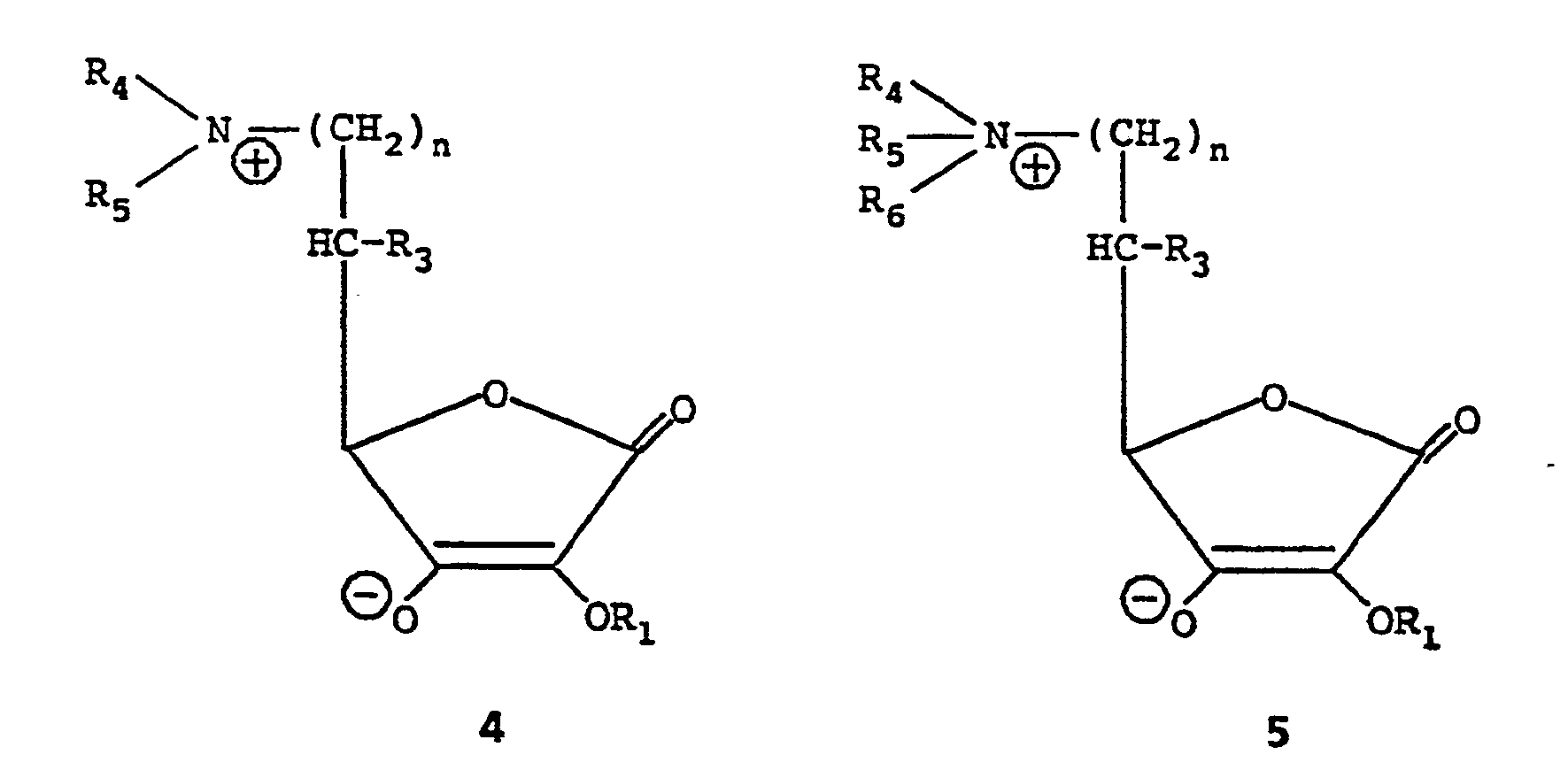
- If desired, compounds 4 and 5 may be converted to their 3-O-alkyl derivatives by treatment with an alkyl halide.
- Alternatively, compounds 3 may be reacted with a dialkyl amine R₄R₅NH₂ and the tertiary amine may be treated with R₆X to form the quaternary ammonium salts.
- As stated, if desired the hydrxyl groups of the intermediates may be selectively protected and deprotected such as illustrated by the following Reaction Scheme B.

wherein Tr is a trityl protecting group, Pg is a reaction protecting group, preferably benzyl, and n and R₁ are as previously defined. The preparation of the compounds bearing the protecting, as well as the removal of these groups may be effected by standard procedures well known in the art. - The following examples illustrate the above-described methods for the preparation of the compounds of Formula I.
- A solution of 6-bromo-6-deoxy-L-ascorbic acid (8.33 g) and trimethylamine (20 ml) in methanol (70 ml) is stirred at room temperature under nitrogen for 4 days. The mixture is filtered and the residue is chromatographed on silica gel (isopropanol/water, 70:30). Recrystallization from methanol/water yields 3.26 g of the title compound as colorless crystals (m.p. 180°C decomposed).
- Following the procedure described in Example 1, but using dimethylamine as the amine, the title compound is obtained (m.p. 230°C decomposed).
- Following the procedure described in Example 1, but using N,N-dimethyl-phenylmethylamine as the amine, the title compound is obtained (m.p. 225°C decomposed).
- To a stirred solution of 2-O-octadecyl-L-ascorbic acid (4.91 g) in dimethylformamide (100 ml) is added portionwise at 0°C and under nitrogen carbon tetrabromide (3.65 g), followed by triphenylphosphine (2.88 g). The mixture is stirred overnight at room temperature and evaporated. The remaining residue is purified by column chromatography to give the 6-bromo derivative.
- Following the procedure described in Example 1, but using the 6-bromo derivative prepared above, the title compound is obtained.
- Starting from 3-O-butyl-L-ascorbic acid and following the procedure described in Example 4, Step A, the title compound is obtained.
- Using 6-bromo-6-deoxy-3-O-butyl-L-ascorbic acid and following the procedure described in Example 1 the 3-O-butyl-trimethyl-ammonium derivative is obtained.
- To a solution of 2,5-dihydro-β,3,4-trihydroxy-N,N,N-trimethyl-5-oxo-2-furanethanaminium (2.17 g) and 1-bromo-butane (1.37 g) in dimethylformamide (20 ml) is added potassium carbonate (1.38 g). The mixture is stirred overnight at room temperature and evaporated to dryness. The residue is then purified by column chromatography and recrystallized to give the title compound.
- Having described the scope of the compounds of this invention as well as the generic and specific methods for preparing said compounds, the following information details the utility of the compounds of this invention.
- When the blood supply to parts of the heart muscle is blocked, a myocardial infarct (heart attack) results and the deprived muscle tissue dies with the result of permanent heart damage. If the blood supply can be re-established within hours after infarction, the heart muscle tissue remains viable and permanent damage can be reduced. This can be accomplished by surgical as well as pharmacologic (thrombolysis) procedures and these processes are known as reperfusion.
- Reperfusion is now widely and successfully applied and it has been claimed that fatalities due to myocardial infarction can be reduced by 20-30%. However, reperfusion also poses problems. Oxygen-deprived (ischemic) tissue finds itself in an abnormal state and is vulnerable when suddenly exposed to oxygen-rich blood. This has been termed the "oxygen paradox" and leads to reperfusion damage in the form of cell death. It has been postulated that this damage is due to oxygen-derived free radicals and, in particular, to the superoxide radical, O₂⁻. Evidence for this hypothesis has been obtained in animal experiments. B.R. Lucchesi and coworkers showed that the enzyme superoxide dismutase, as well as the free radical scavenger N-(mercaptopropionyl)glycine reduce canine myocardial reperfusion injury (Cir. Res., 1984, 54, 277-285; J. Cardiovasc. Pharmacol., 1986, 8, 978-88; Fed. Proc., 1987, 46, 2413-21).
- The compounds of this invention possess a structure related to ascorbic acid, a natural substance known to possess anti-oxidant or free radical scavenger properties, and like ascorbic acid also are useful as pharmacologic antioxidants and free radical scavengers and, in particular, as scavengers of superoxide anion radical O₂⁻. They can be therapeutically employed where reperfusion damage due to oxygen-derived free radicals and hydrogen peroxide causes cell death in tissues. This situation arises when total or partial blockade of blood supply to tissues is removed, either spontaneously (transient ischemia) or by pharmacologic or surgical intervention (thrombolysis, angioplasty, by-pass, organ transplant and the like). Tissues subjected to transient ischemia or reperfusion in various disease states, or by their medical treatment, are those of heart, lung, kidney, pancreas, intestine and brain. In particular, the now rapidly increasing practice of pharmacologic thrombolysis, also known as reperfusion, after coronary infarct and stroke, will benefit by prior or concomitant administration of a free radical scavenger such as the compounds of this invention. Similarly, surgical interventions, such as percutaneous transluminal coronary angioplasty, where a dilating balloon is used to increase the luminal diameter in severely occluded atherosclerotic vessels, coronary by-pass operations, and organ transplant surgery create conditions where reperfusion damage due to oxygen-derived radicals takes place and can be reduced by scavengers. Transient ischemia is one of the causative factors that lead to angina pectoris, and thus the compounds of this invention are also useful as anti-anginal agents. Additionally, particularly in the instance wherein Q represents a tertiary amine, the compounds are useful in the treatment of stroke.
- The process of inflammation is also known to involve the release of superoxide radicals from phagocytic cells which cause some of the symptoms of rheumatoid arthritis and a free radical scavenger, such as the compounds of this invention, is also useful in the treatment of this disease as well as being useful in the treatment of inflammatory bowel disease. The compounds may also be useful in the treatment of cancers and of aging since oxygen-derived free radicals have been identified among causative factors. For reviews, see B. Halliwell and C. Gutteridge, Biochem. J., 1984, 219, 1-14; TINS 1985, 22-6.
- A further utility of the compounds of this invention is for the treatment of cardiac arrhythmia, particularly that of the class 111 type and they also are useful in lowering blood-cholesterol levels, useful in treating cholesterol-induced atherogenosis.
- In vitro and in vivo activity for the utility of the compounds of this invention may be demonstrated by the use of standard assays. Particularly useful for demonstrating the properties of the compounds of this invention are those assays which demonstrate the free radical scavenging property, affinity for cardiac tissue and cardioprotective properties. Based upon those assays, as well as by comparison with other compounds similarly useful for their anti-oxidant properties, the compounds of this invention will be effective when administered within the range from about 0.1 mg/kg to 50 mg/kg of body weight per day. For prophylactic administration, corresponding lower doses can be utilized.
- Most preferably, the compounds are administered intravenously particularly under crisis situations wherein it is essential that the therapeutic agent be gotten to its site of action as quickly as possible, such as in those emergency conditions caused by coronary infarction, stroke and surgical interventions, conditions which can cause severe reperfusion damage. Otherwise, the compounds of this invention are administered intravenously wherein Q is a dialkylamino moiety, and orally in those instances wherein Q is a quaternary ammonium salt.
- The compounds of this invention can be utilized both prophylactically and therapeutically. The amount of active ingredient for therapeutic administration can vary over a wide range and is dependent upon such factors as the age, health, sex and weight of the patient, as well as the nature and the severity of the condition being treated. Generally, a therapeutically effective amount of the active ingredient to be administered will range from about 0.1 mg/kg to 50 mg/kg of body weight per day. For prophylactic administration, corresponding lower doses can be utilized.
- The compounds of this invention also can be orally administered, preferably using more active ingredient per day than when parenterally administered, preferably taking divided doses 3 to 4 times per day. Preferably, enteral administration in post "crisis" situations, particularly after release from hospitalized conditions. The compounds can be used in standard dosage unit forms such as tablets, capsules, dragees, lozenges, elixirs, emulsions, suspensions, and in cases wherein topical application is preferred by suppository or sub-lingual administration. Tablets and capsules containing from 100 to 400 mg of active ingredient are preferred modes of enteral administration. Of course, in the treatment of inflammation the preferred method of administration is by depot injection directly to the situs of the inflammation area with follow-up enteral means of administration.
- In preparing solid dose forms such as tablets, the active ingredient is generally blended with conventional pharmaceutical carriers or excipients such as gelatin, various starches, lactose, calcium phosphate or powdered sugar. The term pharmaceutical carrier as used herein also includes lubricants employed to improve the flow of tablet granulations and which prevent adhesion of tablet material to the surfaces of tablet dies and punches. Suitable lubricants include, for example, talc, stearic acid, calcium stearate, magnesium stearate and zinc stearate. Also included within the definition of a pharmaceutical carrier as used herein, are disintegrating agents added to assist the breakup and dissolution of tablets following administration, as well as coloring and/or flavoring agents to enhance the aesthetic qualities of the tablets and make them more acceptable to the patient.
- Suitable liquid excipients for the preparation of liquid dosage unit forms include water and alcohols such as ethanol, benzyl alcohol and the polyethylene glycols, either with or without the addition of a surfactant. In general, the preferred liquid excipients, particularly for injectable preparations, include water, physiological and saline solutions, dextrose and glycol solutions such as an aqueous propylene glycol or polyethylene glycol solutions. In order to:minimize or eliminate irritation at the site of injection, such compositions may contain a non-ionic surfactant having a hydrophile-lipophile balance (HLB) of from about 12 to about 17. The quantity of surfactant in such formulations ranges from about 5 to 15% by weight. The surfactant can be a single component having the above-identified HLB, or a mixture of two or more components having the desired HLB. Illustrative of surfactants useful in parenteral formulations are the class of polyoxyethylene sorbitan fatty acid esters as, for example, sorbitan monooleate and the high molecular weight adducts of ethylene oxide with a hydrophobic base, formed by the condensation of propylene oxide with propylene glycol. In certain topical and parenteral preparations, various oils can be utilized as carriers or excipients. Illustrative of such oils are mineral oils, glyceride oils such as lard oil, cod liver oil, peanut oil, sesame oil, corn oil and soybean oil. For insoluble compounds, suspending agents may be added as well as agents to control the viscosity, as for example, magnesium aluminum silicate or carboxymethylcellulose. In addition to these excipients, buffers,preservatives and emulsifying agents may also be added.
- As is true in most instances wherein certain classes of compounds have been found to have beneficial therapeutic uses, certain members and sub-groups are preferred. In this instance those compounds wherein R₄ and R₅ are methyl or ethyl are preferred. Preferred R₆ moieties are methyl, ethyl, benzyl, phenethyl, phenyl propyl or phenylbutyl, particularly when the phenyl moiety bears one or two halo atoms, particularly chloro or bromo one of which being in the para position.
n is one or two, preferably one,
R₇ is phenyl or preferably (CH₂)m phenyl, most preferably benzyl, or a halogeno substituted benzyl,
R₁ and R₂ preferably are hydrogen, but when they represent an alkoxy moiety, it is preferred that the alkyl moiety be the longer alkyl chains (particularly for R₂), straight or branched, within the limits of the definition for each alkyl group, particularly octadecyl,
R₃ is preferably OH, OCH₃, or H, and X preferably is chloro or bromo or a sulfonate.
When R₂ is not H, halide salts are preferred. - In those instances wherein it is desired to protect cardiac tissue, it is preferred to utilize the quaternary ammonium compounds, said compounds preferably forming an inner salt when R₂ is H. Otherwise the tertiary amines are preferably utilized. The preferred enantiomers are the βS,2R isomers.
- Particularly preferred compounds are those of the above examples and the R₁ octadecyl analogs thereof, the p-toluene-sulfonate quaternary analogs thereof, the p-chlorophenylbutyl tertiary amines or quaternary analogs thereof, (i.e., one of R₄, R₅ or R₆ is a p-chlorophenylbutyl radical).
Claims (12)
- A compound of the formula

Q is NR₄R₅ or N⊕R₄R₅R₆·X⊖, n is an integer 1 to 4,
X is a halide or OS(O)₂R₇, with R₇ being C₁₋₆ alkyl,
(CH₂)mZ-substituted phenyl wherein m is O, 1, 2, 3 or 4 and
Z is H, C₁₋₆ alkyl, C₁₋₆ alkoxy or halogeno;
R₁ is H or C₁₋₂₀ alkyl,
R₂ is H or C₁₋₂₀₁ alkyl,
R₃ is H, or OR₂ and each of
R₄, R₅ and R₆ are C₁₋₆ alkyl, (CH₂)x phenylor (CH₂)x halogenated phenyl x being zero, or 1 to 6, with the proviso that when n is one and Q is NR₄R₅, then one of R₁ or R₂ is other than H. - A compound of Claim 1 wherein the compound is in its βS,2R enantiomeric form.
- A compound of Claim 1 wherein Q is N⊕R₄R₅R₆·X⊖.
- A compound of Claim 1 wherein Q is NR₄R₅.
- A compound of Claim 3 wherein R₄, R₅ and R₆ are methyl or ethyl.
- A compound of Claim 4 wherein R₄ and R₅ are methyl
- A compound of Claim 5 or 6 wherein R₂ is H.
- A compound of Claims 5 or 6 wherein R₁ is octadecyl.
- A compound of Claim 1 wherein R₁, R₂ are hydrogen and R₃ are OH.
- A compound of Claim 1 wherein the compound forms an inner salt.
- The process for preparing a compound of the formula

Q is NR₄R₅ or N⊕R₄R₅R₆·X⊖, n is an integer 1 to 4,
X is a halide or OS(O)₂R₇, with R₇ being C₁₋₆ alkyl,
(CH₂)m-Z-substituted phenyl wherein m is O, 1, 2, 3 or 4 and
Z is H, C₁₋₆ alkyl, C₁₋₆ alkoxy or halogeno,
R₁ is H or C₁₋₂₀ alkyl,
R₂ is H or C₁₋₂₀ alkyl,
R₃ is H, or OH, and each of
R₄, R₅ and R₆ are C₁₋₆ alkyl, (CH₂)x phenylor (CH₂)x halogenated phenyl, x being zero, or 1 to 6, with the proviso that when n is one and Q is NR₄R₅, then one of R₁ or R₂ is other than H,
which comprises(a) reacting a compound of the formula (b) optionnaly treating compounds of the formulae
 (c) optionally treating a compound of the formula
- The use of the compound according to claim as pharmaceutically active compound.
Priority Applications (1)
| Application Number | Priority Date | Filing Date | Title |
|---|---|---|---|
| EP91400708A EP0447325B1 (en) | 1990-03-16 | 1991-03-15 | Novel ascorbic acid derivatives |
Applications Claiming Priority (3)
| Application Number | Priority Date | Filing Date | Title |
|---|---|---|---|
| EP90400731 | 1990-03-16 | ||
| EP90400731A EP0446539A1 (en) | 1990-03-16 | 1990-03-16 | Novel ascorbic acid derivatives |
| EP91400708A EP0447325B1 (en) | 1990-03-16 | 1991-03-15 | Novel ascorbic acid derivatives |
Publications (2)
| Publication Number | Publication Date |
|---|---|
| EP0447325A1 true EP0447325A1 (en) | 1991-09-18 |
| EP0447325B1 EP0447325B1 (en) | 1996-04-24 |
Family
ID=8205691
Family Applications (2)
| Application Number | Title | Priority Date | Filing Date |
|---|---|---|---|
| EP90400731A Withdrawn EP0446539A1 (en) | 1990-03-16 | 1990-03-16 | Novel ascorbic acid derivatives |
| EP91400708A Expired - Lifetime EP0447325B1 (en) | 1990-03-16 | 1991-03-15 | Novel ascorbic acid derivatives |
Family Applications Before (1)
| Application Number | Title | Priority Date | Filing Date |
|---|---|---|---|
| EP90400731A Withdrawn EP0446539A1 (en) | 1990-03-16 | 1990-03-16 | Novel ascorbic acid derivatives |
Country Status (21)
| Country | Link |
|---|---|
| US (1) | US5175188A (en) |
| EP (2) | EP0446539A1 (en) |
| JP (1) | JP3029055B2 (en) |
| KR (1) | KR0171190B1 (en) |
| CN (1) | CN1034415C (en) |
| AT (1) | ATE137230T1 (en) |
| AU (1) | AU632907B2 (en) |
| CA (1) | CA2038416C (en) |
| DE (1) | DE69118955T2 (en) |
| DK (1) | DK0447325T5 (en) |
| ES (1) | ES2089159T3 (en) |
| FI (1) | FI97884C (en) |
| GR (1) | GR3020411T3 (en) |
| HU (1) | HU208004B (en) |
| IE (1) | IE910879A1 (en) |
| IL (1) | IL97574A (en) |
| NO (1) | NO177705C (en) |
| NZ (1) | NZ237400A (en) |
| PT (1) | PT97041B (en) |
| TW (1) | TW213455B (en) |
| ZA (1) | ZA911994B (en) |
Cited By (1)
| Publication number | Priority date | Publication date | Assignee | Title |
|---|---|---|---|---|
| US5380724A (en) * | 1992-06-17 | 1995-01-10 | Gyogyszerkutato Intezet Kft | Piperazine and homopiperazine derivatives, pharmaceutical compositions containing them and process for preparing same |
Families Citing this family (4)
| Publication number | Priority date | Publication date | Assignee | Title |
|---|---|---|---|---|
| US5559251A (en) * | 1993-02-05 | 1996-09-24 | Pliva, Farmaceutska | Derivatives of amino-ascorbic acid, the processes for their preparation and use |
| RU2126398C1 (en) * | 1993-02-05 | 1999-02-20 | Плива, Фармацеутска, Кемийска, Прехрамбена и Козметичка Индустрия Дионичко Друштво Загреб | Derivatives of aminoascorbic acid and methods of their synthesis and derivatives of haloidascorbic acid |
| HRP930131A2 (en) * | 1993-02-05 | 1997-02-28 | Bozidar Suskovic | Amino-ascorbic acid derivatives, process for the preparation and use thereof |
| FR2946252B1 (en) * | 2009-06-08 | 2011-07-29 | Fabre Pierre Dermo Cosmetique | BIS ESTERS OF UNCORBIC ACID-INSATURATED FATTY ACID AND COSMETIC USES THEREOF |
Citations (3)
| Publication number | Priority date | Publication date | Assignee | Title |
|---|---|---|---|---|
| US4368330A (en) * | 1981-04-30 | 1983-01-11 | Pfizer Inc. | Derivatives of L-ascorbic acid and D-erythorbic acid |
| EP0202589A2 (en) * | 1985-05-17 | 1986-11-26 | Takeda Chemical Industries, Ltd. | Pharmaceutical compositions containing ascorbic acid derivatives |
| EP0259707A2 (en) * | 1986-08-29 | 1988-03-16 | Takeda Chemical Industries, Ltd. | Hydroxybutenolide derivatives, production and use thereof |
Family Cites Families (2)
| Publication number | Priority date | Publication date | Assignee | Title |
|---|---|---|---|---|
| RO86439B (en) * | 1982-01-15 | 1985-03-31 | Eli Lilly And Company | PROCEDURE FOR PREPARING ANY DERIVATIVES OF ASCORBIC ACID |
| IT1215325B (en) * | 1987-01-07 | 1990-02-08 | Barisintex Sa | -H2 RECEPTOR ANTAGONIST COMPOUNDS AND PROCEDURE FOR THEIR PREPARATION. |
-
1990
- 1990-03-16 EP EP90400731A patent/EP0446539A1/en not_active Withdrawn
-
1991
- 1991-03-13 TW TW080102010A patent/TW213455B/zh active
- 1991-03-14 HU HU91854A patent/HU208004B/en not_active IP Right Cessation
- 1991-03-14 PT PT97041A patent/PT97041B/en not_active IP Right Cessation
- 1991-03-14 AU AU72878/91A patent/AU632907B2/en not_active Ceased
- 1991-03-15 NO NO911051A patent/NO177705C/en unknown
- 1991-03-15 IE IE087991A patent/IE910879A1/en unknown
- 1991-03-15 AT AT91400708T patent/ATE137230T1/en not_active IP Right Cessation
- 1991-03-15 CA CA002038416A patent/CA2038416C/en not_active Expired - Fee Related
- 1991-03-15 FI FI911282A patent/FI97884C/en not_active IP Right Cessation
- 1991-03-15 KR KR1019910004142A patent/KR0171190B1/en not_active Expired - Fee Related
- 1991-03-15 ES ES91400708T patent/ES2089159T3/en not_active Expired - Lifetime
- 1991-03-15 DE DE69118955T patent/DE69118955T2/en not_active Expired - Fee Related
- 1991-03-15 EP EP91400708A patent/EP0447325B1/en not_active Expired - Lifetime
- 1991-03-15 JP JP3074250A patent/JP3029055B2/en not_active Expired - Fee Related
- 1991-03-15 DK DK91400708.3T patent/DK0447325T5/en active
- 1991-03-16 CN CN91101600A patent/CN1034415C/en not_active Expired - Fee Related
- 1991-03-17 IL IL9757491A patent/IL97574A/en not_active IP Right Cessation
- 1991-03-18 ZA ZA911994A patent/ZA911994B/en unknown
- 1991-03-18 NZ NZ237400A patent/NZ237400A/en unknown
-
1992
- 1992-01-10 US US07/821,243 patent/US5175188A/en not_active Expired - Fee Related
-
1996
- 1996-06-12 GR GR960401586T patent/GR3020411T3/en unknown
Patent Citations (3)
| Publication number | Priority date | Publication date | Assignee | Title |
|---|---|---|---|---|
| US4368330A (en) * | 1981-04-30 | 1983-01-11 | Pfizer Inc. | Derivatives of L-ascorbic acid and D-erythorbic acid |
| EP0202589A2 (en) * | 1985-05-17 | 1986-11-26 | Takeda Chemical Industries, Ltd. | Pharmaceutical compositions containing ascorbic acid derivatives |
| EP0259707A2 (en) * | 1986-08-29 | 1988-03-16 | Takeda Chemical Industries, Ltd. | Hydroxybutenolide derivatives, production and use thereof |
Non-Patent Citations (1)
| Title |
|---|
| Chemiker -Zeitung vol. 109, no. 10, 1985, pages 341 - 343; Franz Dallacker et al.: "Derivate der L-Ascorbinsäure,3*. 6-Amino-6-desoxy -O2,O3-ethandiyl- und 6-Amino-6-desoxy-L-ascorbinsäuren" * |
Cited By (1)
| Publication number | Priority date | Publication date | Assignee | Title |
|---|---|---|---|---|
| US5380724A (en) * | 1992-06-17 | 1995-01-10 | Gyogyszerkutato Intezet Kft | Piperazine and homopiperazine derivatives, pharmaceutical compositions containing them and process for preparing same |
Also Published As
Similar Documents
| Publication | Publication Date | Title |
|---|---|---|
| EP0369874B1 (en) | Cardioprotective tocopherol analogs | |
| EP0308021A2 (en) | Subsituted thieno (2,3-B)pyrole-5-sulfonamides as antiglaucoma agents | |
| JP3230699B2 (en) | Cardioprotective tocopherol analogues | |
| EP0447325B1 (en) | Novel ascorbic acid derivatives | |
| US3843796A (en) | Antihypertensive agents | |
| US5270336A (en) | Ascorbic acid derivatives | |
| EP0586518B1 (en) | Cholesterol-lowering tocopherol analogs | |
| PT99835B (en) | PROCESS FOR THE PREPARATION OF CASTANOSPERMINE ESTERS WITH ANTIVIRAL ACTION | |
| EP0550292A1 (en) | Tissue protective tocopherol analogs | |
| US5137904A (en) | Thiohydantoin inhibitors of collagen-induced and ADP-induced platelet aggregation | |
| EP0369083A1 (en) | Cardioprotective tocopherol analogs | |
| KR960029319A (en) | 4-aminobenzoylguanidine derivatives | |
| US3627791A (en) | Bis(aminoalkylsulfamoyl) anthraquinones | |
| US5500444A (en) | Cardioprotective tocopherol analogs | |
| US3452052A (en) | Certain 1-(2**1-benzofuranyl)-1-hydroxy-2-alkylamino or aralkylamino ethanes | |
| US5182387A (en) | Bis-dibenzoazepine compounds | |
| EP0369082A1 (en) | Cardioprotective tocopherol analogs | |
| NO146744B (en) | ANALOGY PROCEDURE FOR THE PREPARATION OF THERAPEUTIC ACTIVITY (OMEGA-AMINOALCOXY) -DIBENZYL DERIVATIVES | |
| HU184763B (en) | Process for preparing n-/tetrazol-5-yl/-prostaglandin carboxa mides |
Legal Events
| Date | Code | Title | Description |
|---|---|---|---|
| REG | Reference to a national code |
Ref country code: DK Ref legal event code: T5 |
|
| PUAI | Public reference made under article 153(3) epc to a published international application that has entered the european phase |
Free format text: ORIGINAL CODE: 0009012 |
|
| AK | Designated contracting states |
Kind code of ref document: A1 Designated state(s): AT BE CH DE DK ES FR GB GR IT LI LU NL SE |
|
| 17P | Request for examination filed |
Effective date: 19920317 |
|
| 17Q | First examination report despatched |
Effective date: 19931111 |
|
| GRAA | (expected) grant |
Free format text: ORIGINAL CODE: 0009210 |
|
| RAP1 | Party data changed (applicant data changed or rights of an application transferred) |
Owner name: MERRELL PHARMACEUTICALS INC. |
|
| AK | Designated contracting states |
Kind code of ref document: B1 Designated state(s): AT BE CH DE DK ES FR GB GR IT LI LU NL SE |
|
| REF | Corresponds to: |
Ref document number: 137230 Country of ref document: AT Date of ref document: 19960515 Kind code of ref document: T |
|
| REG | Reference to a national code |
Ref country code: DK Ref legal event code: T5 |
|
| REF | Corresponds to: |
Ref document number: 69118955 Country of ref document: DE Date of ref document: 19960530 |
|
| ITF | It: translation for a ep patent filed | ||
| REG | Reference to a national code |
Ref country code: GR Ref legal event code: FG4A Free format text: 3020411 |
|
| ET | Fr: translation filed | ||
| REG | Reference to a national code |
Ref country code: ES Ref legal event code: FG2A Ref document number: 2089159 Country of ref document: ES Kind code of ref document: T3 |
|
| REG | Reference to a national code |
Ref country code: ES Ref legal event code: FG2A Ref document number: 2089159 Country of ref document: ES Kind code of ref document: T3 |
|
| PLBE | No opposition filed within time limit |
Free format text: ORIGINAL CODE: 0009261 |
|
| STAA | Information on the status of an ep patent application or granted ep patent |
Free format text: STATUS: NO OPPOSITION FILED WITHIN TIME LIMIT |
|
| 26N | No opposition filed | ||
| REG | Reference to a national code |
Ref country code: GB Ref legal event code: IF02 |
|
| PGFP | Annual fee paid to national office [announced via postgrant information from national office to epo] |
Ref country code: SE Payment date: 20030221 Year of fee payment: 13 Ref country code: NL Payment date: 20030221 Year of fee payment: 13 Ref country code: FR Payment date: 20030221 Year of fee payment: 13 Ref country code: AT Payment date: 20030221 Year of fee payment: 13 |
|
| PGFP | Annual fee paid to national office [announced via postgrant information from national office to epo] |
Ref country code: CH Payment date: 20030225 Year of fee payment: 13 |
|
| PGFP | Annual fee paid to national office [announced via postgrant information from national office to epo] |
Ref country code: DK Payment date: 20030226 Year of fee payment: 13 |
|
| PGFP | Annual fee paid to national office [announced via postgrant information from national office to epo] |
Ref country code: BE Payment date: 20030228 Year of fee payment: 13 |
|
| PGFP | Annual fee paid to national office [announced via postgrant information from national office to epo] |
Ref country code: LU Payment date: 20030310 Year of fee payment: 13 |
|
| PGFP | Annual fee paid to national office [announced via postgrant information from national office to epo] |
Ref country code: GB Payment date: 20030312 Year of fee payment: 13 |
|
| PGFP | Annual fee paid to national office [announced via postgrant information from national office to epo] |
Ref country code: GR Payment date: 20030327 Year of fee payment: 13 |
|
| PGFP | Annual fee paid to national office [announced via postgrant information from national office to epo] |
Ref country code: DE Payment date: 20030331 Year of fee payment: 13 |
|
| PGFP | Annual fee paid to national office [announced via postgrant information from national office to epo] |
Ref country code: ES Payment date: 20030408 Year of fee payment: 13 |
|
| PG25 | Lapsed in a contracting state [announced via postgrant information from national office to epo] |
Ref country code: LU Free format text: LAPSE BECAUSE OF NON-PAYMENT OF DUE FEES Effective date: 20040315 Ref country code: GB Free format text: LAPSE BECAUSE OF NON-PAYMENT OF DUE FEES Effective date: 20040315 Ref country code: AT Free format text: LAPSE BECAUSE OF NON-PAYMENT OF DUE FEES Effective date: 20040315 |
|
| PG25 | Lapsed in a contracting state [announced via postgrant information from national office to epo] |
Ref country code: SE Free format text: LAPSE BECAUSE OF NON-PAYMENT OF DUE FEES Effective date: 20040316 Ref country code: ES Free format text: LAPSE BECAUSE OF NON-PAYMENT OF DUE FEES Effective date: 20040316 |
|
| PG25 | Lapsed in a contracting state [announced via postgrant information from national office to epo] |
Ref country code: LI Free format text: LAPSE BECAUSE OF NON-PAYMENT OF DUE FEES Effective date: 20040331 Ref country code: DK Free format text: LAPSE BECAUSE OF NON-PAYMENT OF DUE FEES Effective date: 20040331 Ref country code: CH Free format text: LAPSE BECAUSE OF NON-PAYMENT OF DUE FEES Effective date: 20040331 Ref country code: BE Free format text: LAPSE BECAUSE OF NON-PAYMENT OF DUE FEES Effective date: 20040331 |
|
| BERE | Be: lapsed |
Owner name: *MERRELL PHARMACEUTICALS INC. Effective date: 20040331 |
|
| PG25 | Lapsed in a contracting state [announced via postgrant information from national office to epo] |
Ref country code: NL Free format text: LAPSE BECAUSE OF NON-PAYMENT OF DUE FEES Effective date: 20041001 Ref country code: DE Free format text: LAPSE BECAUSE OF NON-PAYMENT OF DUE FEES Effective date: 20041001 |
|
| PG25 | Lapsed in a contracting state [announced via postgrant information from national office to epo] |
Ref country code: GR Free format text: LAPSE BECAUSE OF NON-PAYMENT OF DUE FEES Effective date: 20041006 |
|
| EUG | Se: european patent has lapsed | ||
| GBPC | Gb: european patent ceased through non-payment of renewal fee |
Effective date: 20040315 |
|
| REG | Reference to a national code |
Ref country code: CH Ref legal event code: PL |
|
| PG25 | Lapsed in a contracting state [announced via postgrant information from national office to epo] |
Ref country code: FR Free format text: LAPSE BECAUSE OF NON-PAYMENT OF DUE FEES Effective date: 20041130 |
|
| NLV4 | Nl: lapsed or anulled due to non-payment of the annual fee |
Effective date: 20041001 |
|
| REG | Reference to a national code |
Ref country code: FR Ref legal event code: ST |
|
| PG25 | Lapsed in a contracting state [announced via postgrant information from national office to epo] |
Ref country code: IT Free format text: LAPSE BECAUSE OF NON-PAYMENT OF DUE FEES;WARNING: LAPSES OF ITALIAN PATENTS WITH EFFECTIVE DATE BEFORE 2007 MAY HAVE OCCURRED AT ANY TIME BEFORE 2007. THE CORRECT EFFECTIVE DATE MAY BE DIFFERENT FROM THE ONE RECORDED. Effective date: 20050315 |
|
| REG | Reference to a national code |
Ref country code: ES Ref legal event code: FD2A Effective date: 20040316 |