EP0447417B1 - Commutation a poles multiples, a module de declenchement - Google Patents
Commutation a poles multiples, a module de declenchement Download PDFInfo
- Publication number
- EP0447417B1 EP0447417B1 EP89913070A EP89913070A EP0447417B1 EP 0447417 B1 EP0447417 B1 EP 0447417B1 EP 89913070 A EP89913070 A EP 89913070A EP 89913070 A EP89913070 A EP 89913070A EP 0447417 B1 EP0447417 B1 EP 0447417B1
- Authority
- EP
- European Patent Office
- Prior art keywords
- switch
- tripping
- section
- module
- bar member
- Prior art date
- Legal status (The legal status is an assumption and is not a legal conclusion. Google has not performed a legal analysis and makes no representation as to the accuracy of the status listed.)
- Expired - Lifetime
Links
- 230000005405 multipole Effects 0.000 title claims abstract description 9
- 238000006073 displacement reaction Methods 0.000 claims abstract description 5
- 238000004519 manufacturing process Methods 0.000 description 2
- 238000000034 method Methods 0.000 description 2
- 230000003213 activating effect Effects 0.000 description 1
- 230000005484 gravity Effects 0.000 description 1
- 239000002184 metal Substances 0.000 description 1
Images


Classifications
-
- H—ELECTRICITY
- H01—ELECTRIC ELEMENTS
- H01H—ELECTRIC SWITCHES; RELAYS; SELECTORS; EMERGENCY PROTECTIVE DEVICES
- H01H71/00—Details of the protective switches or relays covered by groups H01H73/00 - H01H83/00
- H01H71/02—Housings; Casings; Bases; Mountings
- H01H71/0207—Mounting or assembling the different parts of the circuit breaker
- H01H71/0228—Mounting or assembling the different parts of the circuit breaker having provisions for interchangeable or replaceable parts
Definitions
- the invention relates to a multi-pole, power switch comprising a plurality of switch sections, i.e. one switch section per pole, wherein each switch section comprises a set of fixed and a set of movable contacts, and a section for mechanical operation which causes a longitudinal displacement of a bar member along its own longitudinal axis, said bar member extending through all the sections, the movable contacts in each section being secured to said bar member, said bar arranged so that the movable contacts are displaced towards and away from surfaces of the fixed contacts for the IN and OUT movement respectively, and wherein the section for mechanical operation comprises a toggle mechanism with a toggle spring ensuring both a quick make and a quick break of the circuit irrespective of the manual operation when the dead point of said toggle mechanism has been passed, wherein the toggle mechanism engages a shaft tube which is rotatable by means of a square shaft with a handle, and wherein a toggle joint pivot of said toggle mechanism engages said bar member, and wherein means are provided for tripping the switch, said tripping means
- Heavy current switches of the above type are inter alia known from the applicant's EP-A-0.188.258 and 0.179.482, the latter of which forms the basis for the preamble of claim 1, disclosing a heavy current, low voltage switch constructed to quick make and quick break of currents in the order of 125-1600 Amps, and from FR-A-2,516,699 showing a heavy current switch of similar kind.
- a switch of the type mentioned in the preamble is provided, said switch being characterised in that the section for mechanical operation comprises an opening or recess able to receive a tripping module, and that a tripping module is provided, being receivable in said opening and comprising the entire trip mechanism, and in that the shaft tube extends through the tripping module and is adapted to engage said tripping module.
- the tripping module can be inserted over the shaft tube, said shaft tube extending from the mechanical section and protruding through an opening provided for this purpose in the tripping module. In this manner it is easy to insert a tripping module into a switch without such a tripping module.
- the modular structure allows a delivery of switches with or without the tripping module according to the need of the customers.
- the modular structure presents great advantages with respect to storage and production because the same switch type can be used irrespective of whether the switch is to be delivered with or without the tripping module.
- the switch is preferably characterised in that the spring means for the storage of mechanical energy for effectuation the tripping proces can be compressed by a manual rotation of the handle shaft (46). In this manner the tripping module can be actuated during the "switching on” or closing of the switch in such a manner that the energy storing spring of the tripping module is compressed and consequently ensures a storing of energy which is sufficient for forcibly turn the switch off or "open" the switch, if necessary.
- the switch is preferably of the type wherein the toggle joint is displaced along a circular arc during the switching-on or -off movement of the switch, and where a toggle joint pivot is extended into engagement with the bar member.
- means are provided for disengaging the toggle joint pivot and the bar member during a disconnection (switching off) of the switch caused by the tripping module.
- the tripping module is included in a switch housing composed of two substantially identical halves, which presents great advantages with respect to production and storage.
- the actuation (operation) section of the switch housing is according to the invention preferably such that the mechanical actuation (operation) mechanism is included in an actuating (operation) module, which apart from the protruding shaft tube is of substantially the same dimensions as the tripping module and is mounted by inserting said actuating (operation) module into the bottom portion of the switch housing through the opening.
- the tripping module is preferably situated between two switch sections, which implies that the bar displacing force is applied close to the centre of the bar member, said centre being the most rational point of application because the ideal point of application of a translatory force actuation on a body is the centre of gravity of said body.
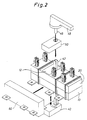
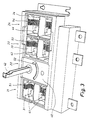
- the switch of Figs. 1 to 5 comprises a switch housing with a bottom portion 10 and a top portion 20, said portions preferably being identical.
- the switch further comprises a bar member 30 which in the embodiment shown is formed as an almost rectangular plate with openings receiving the movable contacts 36, which only appear from Fig. 4, as well as a shaft tube 42, a square shaft 46 displaceable inside the shaft tube 42 into a suitable position in which it is locked, and a handle 48.
- the switch housing is divided into a switch section 21, an actuation (operation) section 22, a switch section 23, and the switch section 24 when seen from the left to the right of the drawing.
- Fig. 3 illustrates the switch chambers 31, 33, and 34 with their respective set of fixed contacts 41, 43, 44 and extinguishing metal plates 51, 53, 54.
- An actuating mechanism 40 with a shaft tube 42 constitutes the mechanical actuation (operation) 22 allowing by means of the square shaft 46 (Fig 2) with the handle 48 a control of the position of the bar plate 30 and consequently of the movable contacts 36 in such a manner that the switch can be connected and disconnected (switched on and off) according to desire.
- the shaft tube is preferably a hollow, square tube and/or of a U-shaped profile of a cross section forming three of the sides of a square.
- the actuating mechanism 40 is built in a manner known per se as a toggle mechanism with a spring-loaded toggle joint.
- Fig. 3 only illustrates the extended toggle joint pivot 52 adapted to engage the bar plate 30 mounted thereabove.
- Fig. 4 illustrates the same bottom portion 10 with the bar plate 30 and roller contacts 36.
- An oblong hole 32 is provided for the shaft tube 42 in such a manner that the bar plate 30 with the roller contacts 36 can reciprocate during the disconnection (switching off) and the connection (switching on).
- a stop 37 projects from the bar plate 30 and into the tripping module 50 so as thereby to be actuated by the disconnecting means of the tripping module.
- These disconnecting means can be shaped in many ways.
- Fig. 5 illustrates the tripping module 50 included in the actuation (operation) section 22 of the top portion 20.
- Fig. 5 shows in addition that in principle all the switch chambers 31, 33, 34 can be identical both in the top portion and in the bottom portion.
- the device 60 shown in Figs. 1 and 2 may be an excess current relay transmitting a signal current to the tripping module 50 in case of an excess current.
- the switch operates in the following manner. Usual connection is established by turning the handle 48 and consequently the shaft tube 42, whereby the toggle mechanism is compressed. The rotation of the shaft tube is transferred through the toggle joint pivot 52 of the toggle mechanism to a translatory displacement of the bar plate 30 and the roller contacts 36 mounted thereon. During the connecting movement and preferably during the last portion of said movement the rotation of the shaft tube is utilized for compressing the energy storing spring of the tripping module. The latter procedure is possible because the shaft tube extends through the tripping module so as therein to engage means compressing the spring. As a result, the tripping module is always compressed and consequently capable of disconnecting the switch as soon as said switch is connected.
- a manual disconnection is carried out by turning the handle 48 and consequently the shaft tube 42 in the opposite direction compared to previously, whereby the toggle mechanism is compressed like previously and forces - when a dead point of the toggle mechanism has been passed - the bar plate back into the disconnected position.
- a disconnection caused by an excess current is actuated by the tripping module according to the following procedure.
- a relay 60 transmits a signal to the tripping module 50.
- the signal actuates activating means in the tripping module so as to activate release means, which in turn release the energy storing spring.
- release means which in turn release the energy storing spring.
- the toggle joint pivot engages the bar plate in such a manner that by means of a spring-loaded ratchet or inclined chamfered surface the bar plate can pass freely back to its disconnected position, i.e. not engaging the toggle joint pivot 52.
Landscapes
- Breakers (AREA)
- Keying Circuit Devices (AREA)
- Use Of Switch Circuits For Exchanges And Methods Of Control Of Multiplex Exchanges (AREA)
- Driving Mechanisms And Operating Circuits Of Arc-Extinguishing High-Tension Switches (AREA)
- Switches That Are Operated By Magnetic Or Electric Fields (AREA)
- Road Signs Or Road Markings (AREA)
- Emergency Protection Circuit Devices (AREA)
Claims (6)
- Un commutateur de courant à pôles multiples comprenant une pluralité de parties de commutateur (21,23,24) c'est-à-dire une partie de commutateur par pôle dans lequel chaque partie de commutateur comprend un groupe de contacts fixes (41, 43, 44) et un groupe de contacts mobiles (36) et une section (22) pour l'actionnement mécanique qui provoque un déplacement longitudinal d'un élément barre (30) le long de son propre axe longitudinal, ledit élément barre (30) s'étendant à travers toutes les parties (21, 23, 24), les contacts mobiles (36) dans chaque partie étant fixés audit élément barre (30), ledit élément barre étant agencé de sorte que les contacts mobiles (36) soient déplacés vers et à distance des surfaces des contacts fixes (41, 43, 44) pour le mouvement respectif vers l'intérieur et vers l'extérieur et dans lequel la partie (22) pour chaque actionnement mécanique comprend un mécanisme à rotule avec un ressort de rotule assurant à la fois un établissement rapide et une rupture rapide d'un courant indépendamment de l'actionnement manuel après le dépassement du point mort dudit mécanisme à rotule, dans lequel le mécanisme à rotule vient au contact d'un tube d'axe (42) qui est susceptible de tourner au moyen d'un arbre carré (46) avec une poignée (48) et dans lequel un pivot d'articulation à rotule (52) dudit mécanisme à rotule vient au contact dudit élément barre (30) et dans lequel des moyens sont prévus pour déclencher le commutateur, lesdits moyens de déclenchement comprenant un mécanisme de déclenchement pour la déconnexion des contacts (41, 43, 46, 36) dans chaque partie de commutateur sous des conditions de courant en excès comprenant un mécanisme à ressort pour emmagasiner de l'énergie à libérer pendant l'action de déclenchement et, en outre, lesdits moyens de déclenchement étant agencés pour être actionnés par un signal au travers d'une porte,
caractérisé en ce que la partie (22) pour l'actionnement mécanique comprend une ouverture (12) apte à recevoir un module de déclenchement (50), en ce qu'un module de déclenchement (50) est prévu en étant susceptible d'être reçu dans ladite ouverture (12) et comprenant tout le mécanisme de déclenchement et en ce que le tube d'axe (42) s'étend au travers du module de déclenchement (50) et est agencé pour venir au contact dudit module de déclenchement (50). - Un commutateur à pôles multiples selon la revendication 1, caractérisé en ce que les moyens à ressort pour le stockage de l'énergie mécanique pour effectuer le processus de déclenchement peuvent être comprimés par une rotation manuelle de l'arbre de poignée (46).
- Un commutateur à pôles multiples selon l'une des revendications 1 ou 2, dans lequel l'articulation à rotule est déplacée le long d'un axe circulaire pendant le mouvement de commutation du commutateur, caractérisé en ce que des dispositifs sont prévus pour désengager le pivot d'articulation à rotule (52) et l'élément barre (30) pendant une déconnexion du commutateur provoquée par le module de déclenchement (50).
- Un commutateur à pôles multiples selon l'une des revendications 1, 2 ou 3, caractérisé en ce que le commutateur comprenant le module de déclenchement (50) est constitué de deux moitiés essentiellement identiques (10, 20).
- Un commutateur à pôles multiples selon la revendication 4, caractérisé en ce que la partie d'actionnement (22) du commutateur est telle que le mécanisme d'actionnement mécanique est incorporé dans un module d'actionnement (40), qui à distance du tube d'axe faisant saillie (42) est essentiellement des mêmes dimensions que le module de déclenchement (50) et est monté en insérant ledit module d'actionnement (40) dans la partie inférieure du commutateur au travers de l'ouverture (12).
- Un commutateur à pôles multiples selon l'une quelconque des revendications 1 à 5, caractérisé en ce que la partie (22) pour l'actionnement mécanique comprenant le module de déclenchement (50) est située entre deux parties de commutateur (21, 23).
Applications Claiming Priority (3)
| Application Number | Priority Date | Filing Date | Title |
|---|---|---|---|
| DK628588A DK165611C (da) | 1988-11-10 | 1988-11-10 | Flerpolet staerkstroemsafbryder med tripmodul |
| DK6285/88 | 1988-11-10 | ||
| PCT/DK1989/000253 WO1990005375A1 (fr) | 1988-11-10 | 1989-10-27 | Commutation a poles multiples, a module de declenchement |
Publications (2)
| Publication Number | Publication Date |
|---|---|
| EP0447417A1 EP0447417A1 (fr) | 1991-09-25 |
| EP0447417B1 true EP0447417B1 (fr) | 1994-07-13 |
Family
ID=8148494
Family Applications (1)
| Application Number | Title | Priority Date | Filing Date |
|---|---|---|---|
| EP89913070A Expired - Lifetime EP0447417B1 (fr) | 1988-11-10 | 1989-10-27 | Commutation a poles multiples, a module de declenchement |
Country Status (9)
| Country | Link |
|---|---|
| EP (1) | EP0447417B1 (fr) |
| AT (1) | ATE108574T1 (fr) |
| AU (1) | AU4637889A (fr) |
| DE (1) | DE68916810T2 (fr) |
| DK (1) | DK165611C (fr) |
| ES (1) | ES2019177A6 (fr) |
| GR (1) | GR1001283B (fr) |
| PT (1) | PT92243B (fr) |
| WO (1) | WO1990005375A1 (fr) |
Families Citing this family (3)
| Publication number | Priority date | Publication date | Assignee | Title |
|---|---|---|---|---|
| FI121154B (fi) | 2008-06-19 | 2010-07-30 | Abb Oy | Ohjainyksikkö kytkinlaitetta varten |
| FI121153B (fi) | 2008-06-19 | 2010-07-30 | Abb Oy | Laukaisinkokoonpano kytkinlaitetta varten |
| FI121155B (fi) | 2008-06-19 | 2010-07-30 | Abb Oy | Ohjainyksikkö kytkinlaitetta varten |
Citations (1)
| Publication number | Priority date | Publication date | Assignee | Title |
|---|---|---|---|---|
| EP0179482A2 (fr) * | 1984-10-25 | 1986-04-30 | Aktieselskabet Laur. Knudsen Nordisk Elektricitets Selskab | Interrupteur électrique |
Family Cites Families (4)
| Publication number | Priority date | Publication date | Assignee | Title |
|---|---|---|---|---|
| DE1022298B (de) * | 1956-09-07 | 1958-01-09 | Siemens Ag | Aus Baugruppen zusammensetzbarer Selbstschalter |
| IT8121367U1 (it) * | 1981-04-02 | 1982-10-02 | Sace S P A Costr Elettromeccaniche | Interruttore elettrico |
| IT8123567U1 (it) * | 1981-11-19 | 1983-05-19 | Technoelectric S R L | Struttura per interruttore di manovra-sezionatore compatta, a contatti visibili e a comando manuale agente direttamente su una slitta porta-contatti mobili. |
| FR2517114A1 (fr) * | 1981-11-26 | 1983-05-27 | Alsthom Cgee | Commutateur electrique a commande rotative rappele automatiquement en l'absence de tension |
-
1988
- 1988-11-10 DK DK628588A patent/DK165611C/da not_active IP Right Cessation
-
1989
- 1989-10-27 AT AT89913070T patent/ATE108574T1/de not_active IP Right Cessation
- 1989-10-27 WO PCT/DK1989/000253 patent/WO1990005375A1/fr not_active Ceased
- 1989-10-27 AU AU46378/89A patent/AU4637889A/en not_active Abandoned
- 1989-10-27 DE DE68916810T patent/DE68916810T2/de not_active Expired - Fee Related
- 1989-10-27 EP EP89913070A patent/EP0447417B1/fr not_active Expired - Lifetime
- 1989-11-07 GR GR890100738A patent/GR1001283B/el not_active IP Right Cessation
- 1989-11-08 ES ES8903782A patent/ES2019177A6/es not_active Expired - Fee Related
- 1989-11-09 PT PT92243A patent/PT92243B/pt not_active IP Right Cessation
Patent Citations (1)
| Publication number | Priority date | Publication date | Assignee | Title |
|---|---|---|---|---|
| EP0179482A2 (fr) * | 1984-10-25 | 1986-04-30 | Aktieselskabet Laur. Knudsen Nordisk Elektricitets Selskab | Interrupteur électrique |
Also Published As
| Publication number | Publication date |
|---|---|
| DK628588A (da) | 1990-05-11 |
| DK165611C (da) | 1993-05-03 |
| PT92243B (pt) | 1995-09-12 |
| DE68916810D1 (de) | 1994-08-18 |
| ATE108574T1 (de) | 1994-07-15 |
| AU4637889A (en) | 1990-05-28 |
| WO1990005375A1 (fr) | 1990-05-17 |
| GR890100738A (en) | 1990-12-31 |
| DE68916810T2 (de) | 1994-10-27 |
| ES2019177A6 (es) | 1991-06-01 |
| PT92243A (pt) | 1990-05-31 |
| GR1001283B (el) | 1993-07-30 |
| DK628588D0 (da) | 1988-11-10 |
| EP0447417A1 (fr) | 1991-09-25 |
| DK165611B (da) | 1992-12-21 |
Similar Documents
| Publication | Publication Date | Title |
|---|---|---|
| US5534832A (en) | Switch | |
| US4595812A (en) | Circuit interrupter with detachable optional accessories | |
| JP2778974B2 (ja) | 補助トリップ装置 | |
| US5422453A (en) | Handle actuator for a circuit interrupter handle | |
| US5901025A (en) | Circuit breaker | |
| GB1589016A (en) | Stored energy circuit breaker | |
| US5534833A (en) | Circuit breaker remote closing operator | |
| EP0362871A3 (fr) | Disjoncteur de commande à distance | |
| US5302786A (en) | Molded case circuit breaker for remote control operations | |
| EP0362845A3 (fr) | Disjoncteur de commande à distance | |
| EP0105945A1 (fr) | Disjoncteur électrique | |
| US5489755A (en) | Handle operator assembly for high ampere-rated circuit breaker | |
| CA2121850C (fr) | Declencheur shunt a actionneur lineaire | |
| EP1557851A1 (fr) | Fixation de poignée pour un commutateur électrique | |
| CN215580511U (zh) | 双电源切换开关 | |
| US6552286B2 (en) | Handle operating mechanism of circuit breaker | |
| GB2118780A (en) | Drive mechanism for an electrical switch | |
| EP0364950A3 (fr) | Disjoncteur commandé à distance | |
| US4242577A (en) | Circuit breaker having insulation barrier | |
| US6288348B1 (en) | Pneumatic operator for circuit breakers | |
| EP0352679A3 (en) | Electrical switchgear | |
| KR101078916B1 (ko) | 배선용차단기의 부족전압 트립장치 | |
| EP0872867B1 (fr) | Ensemble électrique avec dispositif de commande pour un disjoncteur | |
| US4149052A (en) | Safety-disconnect power tool switch | |
| CN210722810U (zh) | 双电源转换机构及具有该双电源转换机构的供电电源 |
Legal Events
| Date | Code | Title | Description |
|---|---|---|---|
| PUAI | Public reference made under article 153(3) epc to a published international application that has entered the european phase |
Free format text: ORIGINAL CODE: 0009012 |
|
| 17P | Request for examination filed |
Effective date: 19910503 |
|
| AK | Designated contracting states |
Kind code of ref document: A1 Designated state(s): AT BE CH DE FR GB IT LI LU NL SE |
|
| 17Q | First examination report despatched |
Effective date: 19930405 |
|
| RAP1 | Party data changed (applicant data changed or rights of an application transferred) |
Owner name: HOLEC SYSTEMEN EN COMPONENTEN B.V. |
|
| GRAA | (expected) grant |
Free format text: ORIGINAL CODE: 0009210 |
|
| AK | Designated contracting states |
Kind code of ref document: B1 Designated state(s): AT BE CH DE FR GB IT LI LU NL SE |
|
| REF | Corresponds to: |
Ref document number: 108574 Country of ref document: AT Date of ref document: 19940715 Kind code of ref document: T |
|
| REF | Corresponds to: |
Ref document number: 68916810 Country of ref document: DE Date of ref document: 19940818 |
|
| ITF | It: translation for a ep patent filed | ||
| ET | Fr: translation filed | ||
| EAL | Se: european patent in force in sweden |
Ref document number: 89913070.2 |
|
| PLBE | No opposition filed within time limit |
Free format text: ORIGINAL CODE: 0009261 |
|
| STAA | Information on the status of an ep patent application or granted ep patent |
Free format text: STATUS: NO OPPOSITION FILED WITHIN TIME LIMIT |
|
| 26N | No opposition filed | ||
| REG | Reference to a national code |
Ref country code: CH Ref legal event code: PUE Owner name: HOLEC SYSTEMEN & COMPONENTEN B.V. TRANSFER- HOLEC Ref country code: CH Ref legal event code: NV Representative=s name: PATENTANWALTSBUREAU R. A. MASPOLI |
|
| NLS | Nl: assignments of ep-patents |
Owner name: HOLEC HOLLAND N.V. |
|
| REG | Reference to a national code |
Ref country code: GB Ref legal event code: 732E |
|
| REG | Reference to a national code |
Ref country code: FR Ref legal event code: TP |
|
| PGFP | Annual fee paid to national office [announced via postgrant information from national office to epo] |
Ref country code: LU Payment date: 20011002 Year of fee payment: 13 |
|
| REG | Reference to a national code |
Ref country code: GB Ref legal event code: IF02 |
|
| PG25 | Lapsed in a contracting state [announced via postgrant information from national office to epo] |
Ref country code: LU Free format text: LAPSE BECAUSE OF NON-PAYMENT OF DUE FEES Effective date: 20021027 |
|
| NLS | Nl: assignments of ep-patents |
Owner name: EATON HOLDING INTERNATIONAL I BV Owner name: EATON ELECTRIC N.V. |
|
| REG | Reference to a national code |
Ref country code: GB Ref legal event code: 732E |
|
| REG | Reference to a national code |
Ref country code: GB Ref legal event code: 732E |
|
| BECA | Be: change of holder's address |
Owner name: *EATON ELECTRIC N.V.EUROPALAAN 202, NL-7559 SC HEN Effective date: 20040610 |
|
| BECH | Be: change of holder |
Owner name: *EATON ELECTRIC N.V.EUROPALAAN 202, NL-7559 SC HEN Effective date: 20040610 |
|
| REG | Reference to a national code |
Ref country code: CH Ref legal event code: PUE Owner name: EATON HOLDING INTERNATIONAL I BV Free format text: HOLEC HOLLAND N.V.#TUINDORPSTRAAT 61#7555 CS HENGELO (NL) -TRANSFER TO- EATON HOLDING INTERNATIONAL I BV#BOEING AVENUE 11#1119 PC SCHIPHOL-RIJK (NL) Ref country code: CH Ref legal event code: PUE Owner name: EATON ELECTRIC N.V. Free format text: EATON HOLDING INTERNATIONAL I BV#BOEING AVENUE 11#1119 PC SCHIPHOL-RIJK (NL) -TRANSFER TO- EATON ELECTRIC N.V.#P.O. BOX 23#7550 AA HENGELO (NL) |
|
| PGFP | Annual fee paid to national office [announced via postgrant information from national office to epo] |
Ref country code: NL Payment date: 20041007 Year of fee payment: 16 |
|
| PGFP | Annual fee paid to national office [announced via postgrant information from national office to epo] |
Ref country code: DE Payment date: 20041008 Year of fee payment: 16 |
|
| PGFP | Annual fee paid to national office [announced via postgrant information from national office to epo] |
Ref country code: CH Payment date: 20041011 Year of fee payment: 16 |
|
| PGFP | Annual fee paid to national office [announced via postgrant information from national office to epo] |
Ref country code: SE Payment date: 20041012 Year of fee payment: 16 Ref country code: FR Payment date: 20041012 Year of fee payment: 16 Ref country code: AT Payment date: 20041012 Year of fee payment: 16 |
|
| PGFP | Annual fee paid to national office [announced via postgrant information from national office to epo] |
Ref country code: GB Payment date: 20041018 Year of fee payment: 16 |
|
| PGFP | Annual fee paid to national office [announced via postgrant information from national office to epo] |
Ref country code: BE Payment date: 20041117 Year of fee payment: 16 |
|
| REG | Reference to a national code |
Ref country code: FR Ref legal event code: TP |
|
| PG25 | Lapsed in a contracting state [announced via postgrant information from national office to epo] |
Ref country code: IT Free format text: LAPSE BECAUSE OF NON-PAYMENT OF DUE FEES;WARNING: LAPSES OF ITALIAN PATENTS WITH EFFECTIVE DATE BEFORE 2007 MAY HAVE OCCURRED AT ANY TIME BEFORE 2007. THE CORRECT EFFECTIVE DATE MAY BE DIFFERENT FROM THE ONE RECORDED. Effective date: 20051027 Ref country code: GB Free format text: LAPSE BECAUSE OF NON-PAYMENT OF DUE FEES Effective date: 20051027 Ref country code: AT Free format text: LAPSE BECAUSE OF NON-PAYMENT OF DUE FEES Effective date: 20051027 |
|
| PG25 | Lapsed in a contracting state [announced via postgrant information from national office to epo] |
Ref country code: SE Free format text: LAPSE BECAUSE OF NON-PAYMENT OF DUE FEES Effective date: 20051028 |
|
| PG25 | Lapsed in a contracting state [announced via postgrant information from national office to epo] |
Ref country code: LI Free format text: LAPSE BECAUSE OF NON-PAYMENT OF DUE FEES Effective date: 20051031 Ref country code: CH Free format text: LAPSE BECAUSE OF NON-PAYMENT OF DUE FEES Effective date: 20051031 Ref country code: BE Free format text: LAPSE BECAUSE OF NON-PAYMENT OF DUE FEES Effective date: 20051031 |
|
| PG25 | Lapsed in a contracting state [announced via postgrant information from national office to epo] |
Ref country code: NL Free format text: LAPSE BECAUSE OF NON-PAYMENT OF DUE FEES Effective date: 20060501 |
|
| PG25 | Lapsed in a contracting state [announced via postgrant information from national office to epo] |
Ref country code: DE Free format text: LAPSE BECAUSE OF NON-PAYMENT OF DUE FEES Effective date: 20060503 |
|
| REG | Reference to a national code |
Ref country code: CH Ref legal event code: PL |
|
| EUG | Se: european patent has lapsed | ||
| GBPC | Gb: european patent ceased through non-payment of renewal fee |
Effective date: 20051027 |
|
| PG25 | Lapsed in a contracting state [announced via postgrant information from national office to epo] |
Ref country code: FR Free format text: LAPSE BECAUSE OF NON-PAYMENT OF DUE FEES Effective date: 20060630 |
|
| NLV4 | Nl: lapsed or anulled due to non-payment of the annual fee |
Effective date: 20060501 |
|
| REG | Reference to a national code |
Ref country code: FR Ref legal event code: ST Effective date: 20060630 |
|
| BERE | Be: lapsed |
Owner name: *EATON ELECTRIC N.V. Effective date: 20051031 |