EP0447467B1 - Kollagenfolie als pervaporationsmembran - Google Patents
Kollagenfolie als pervaporationsmembran Download PDFInfo
- Publication number
- EP0447467B1 EP0447467B1 EP90900799A EP90900799A EP0447467B1 EP 0447467 B1 EP0447467 B1 EP 0447467B1 EP 90900799 A EP90900799 A EP 90900799A EP 90900799 A EP90900799 A EP 90900799A EP 0447467 B1 EP0447467 B1 EP 0447467B1
- Authority
- EP
- European Patent Office
- Prior art keywords
- membrane
- collagen
- use according
- separation
- water
- Prior art date
- Legal status (The legal status is an assumption and is not a legal conclusion. Google has not performed a legal analysis and makes no representation as to the accuracy of the status listed.)
- Expired - Lifetime
Links
- 239000012528 membrane Substances 0.000 title claims abstract description 66
- 102000008186 Collagen Human genes 0.000 title claims abstract description 37
- 108010035532 Collagen Proteins 0.000 title claims abstract description 37
- 229920001436 collagen Polymers 0.000 title claims abstract description 37
- 238000005373 pervaporation Methods 0.000 title claims abstract description 22
- 238000000926 separation method Methods 0.000 claims abstract description 27
- XLYOFNOQVPJJNP-UHFFFAOYSA-N water Substances O XLYOFNOQVPJJNP-UHFFFAOYSA-N 0.000 claims description 22
- 239000000203 mixture Substances 0.000 claims description 20
- 239000012141 concentrate Substances 0.000 claims description 7
- OKKJLVBELUTLKV-UHFFFAOYSA-N Methanol Chemical compound OC OKKJLVBELUTLKV-UHFFFAOYSA-N 0.000 claims description 6
- 239000007788 liquid Substances 0.000 claims description 5
- 239000000126 substance Substances 0.000 claims description 5
- 238000006243 chemical reaction Methods 0.000 claims description 4
- 235000011389 fruit/vegetable juice Nutrition 0.000 claims description 3
- 238000006482 condensation reaction Methods 0.000 claims description 2
- 238000004519 manufacturing process Methods 0.000 claims description 2
- 239000003960 organic solvent Substances 0.000 claims description 2
- 235000014101 wine Nutrition 0.000 claims description 2
- 235000008504 concentrate Nutrition 0.000 claims 2
- 239000012466 permeate Substances 0.000 description 16
- LFQSCWFLJHTTHZ-UHFFFAOYSA-N Ethanol Chemical compound CCO LFQSCWFLJHTTHZ-UHFFFAOYSA-N 0.000 description 14
- QTBSBXVTEAMEQO-UHFFFAOYSA-N Acetic acid Chemical compound CC(O)=O QTBSBXVTEAMEQO-UHFFFAOYSA-N 0.000 description 9
- 238000000034 method Methods 0.000 description 9
- KFZMGEQAYNKOFK-UHFFFAOYSA-N Isopropanol Chemical compound CC(C)O KFZMGEQAYNKOFK-UHFFFAOYSA-N 0.000 description 7
- 238000009792 diffusion process Methods 0.000 description 7
- 230000004907 flux Effects 0.000 description 7
- 230000008569 process Effects 0.000 description 7
- 239000000243 solution Substances 0.000 description 7
- 229920001661 Chitosan Polymers 0.000 description 6
- 239000011888 foil Substances 0.000 description 6
- 229920002284 Cellulose triacetate Polymers 0.000 description 5
- NNLVGZFZQQXQNW-ADJNRHBOSA-N [(2r,3r,4s,5r,6s)-4,5-diacetyloxy-3-[(2s,3r,4s,5r,6r)-3,4,5-triacetyloxy-6-(acetyloxymethyl)oxan-2-yl]oxy-6-[(2r,3r,4s,5r,6s)-4,5,6-triacetyloxy-2-(acetyloxymethyl)oxan-3-yl]oxyoxan-2-yl]methyl acetate Chemical compound O([C@@H]1O[C@@H]([C@H]([C@H](OC(C)=O)[C@H]1OC(C)=O)O[C@H]1[C@@H]([C@@H](OC(C)=O)[C@H](OC(C)=O)[C@@H](COC(C)=O)O1)OC(C)=O)COC(=O)C)[C@@H]1[C@@H](COC(C)=O)O[C@@H](OC(C)=O)[C@H](OC(C)=O)[C@H]1OC(C)=O NNLVGZFZQQXQNW-ADJNRHBOSA-N 0.000 description 5
- 229920002678 cellulose Polymers 0.000 description 4
- 239000001913 cellulose Substances 0.000 description 4
- -1 polyethylene Polymers 0.000 description 4
- 235000018102 proteins Nutrition 0.000 description 4
- 108090000623 proteins and genes Chemical class 0.000 description 4
- 102000004169 proteins and genes Human genes 0.000 description 4
- LYCAIKOWRPUZTN-UHFFFAOYSA-N Ethylene glycol Chemical compound OCCO LYCAIKOWRPUZTN-UHFFFAOYSA-N 0.000 description 3
- 230000002378 acidificating effect Effects 0.000 description 3
- 238000004132 cross linking Methods 0.000 description 3
- 230000007423 decrease Effects 0.000 description 3
- 239000006185 dispersion Substances 0.000 description 3
- 229920000578 graft copolymer Polymers 0.000 description 3
- 230000004048 modification Effects 0.000 description 3
- 238000012986 modification Methods 0.000 description 3
- 239000000047 product Substances 0.000 description 3
- 239000012465 retentate Substances 0.000 description 3
- IJGRMHOSHXDMSA-UHFFFAOYSA-N Atomic nitrogen Chemical compound N#N IJGRMHOSHXDMSA-UHFFFAOYSA-N 0.000 description 2
- VYZAMTAEIAYCRO-UHFFFAOYSA-N Chromium Chemical compound [Cr] VYZAMTAEIAYCRO-UHFFFAOYSA-N 0.000 description 2
- 229920002307 Dextran Polymers 0.000 description 2
- 239000004743 Polypropylene Substances 0.000 description 2
- 229920000615 alginic acid Polymers 0.000 description 2
- 235000010443 alginic acid Nutrition 0.000 description 2
- 125000003277 amino group Chemical group 0.000 description 2
- 235000015197 apple juice Nutrition 0.000 description 2
- 150000001768 cations Chemical class 0.000 description 2
- 210000004027 cell Anatomy 0.000 description 2
- 238000004113 cell culture Methods 0.000 description 2
- 238000000502 dialysis Methods 0.000 description 2
- 230000029087 digestion Effects 0.000 description 2
- 238000002474 experimental method Methods 0.000 description 2
- 238000001125 extrusion Methods 0.000 description 2
- 230000002349 favourable effect Effects 0.000 description 2
- 239000000835 fiber Substances 0.000 description 2
- 238000010438 heat treatment Methods 0.000 description 2
- 230000014759 maintenance of location Effects 0.000 description 2
- 229910052751 metal Inorganic materials 0.000 description 2
- 239000002184 metal Substances 0.000 description 2
- 229910021645 metal ion Inorganic materials 0.000 description 2
- 150000002739 metals Chemical class 0.000 description 2
- 239000000178 monomer Substances 0.000 description 2
- 230000020477 pH reduction Effects 0.000 description 2
- 230000000149 penetrating effect Effects 0.000 description 2
- 230000000737 periodic effect Effects 0.000 description 2
- 239000004033 plastic Substances 0.000 description 2
- 229920003023 plastic Polymers 0.000 description 2
- 229920001155 polypropylene Polymers 0.000 description 2
- 239000004627 regenerated cellulose Substances 0.000 description 2
- 238000001223 reverse osmosis Methods 0.000 description 2
- 230000001953 sensory effect Effects 0.000 description 2
- 239000012808 vapor phase Substances 0.000 description 2
- 125000000391 vinyl group Chemical group [H]C([*])=C([H])[H] 0.000 description 2
- 229920002554 vinyl polymer Polymers 0.000 description 2
- FPQQSJJWHUJYPU-UHFFFAOYSA-N 3-(dimethylamino)propyliminomethylidene-ethylazanium;chloride Chemical compound Cl.CCN=C=NCCCN(C)C FPQQSJJWHUJYPU-UHFFFAOYSA-N 0.000 description 1
- QTBSBXVTEAMEQO-UHFFFAOYSA-M Acetate Chemical compound CC([O-])=O QTBSBXVTEAMEQO-UHFFFAOYSA-M 0.000 description 1
- LSNNMFCWUKXFEE-UHFFFAOYSA-M Bisulfite Chemical compound OS([O-])=O LSNNMFCWUKXFEE-UHFFFAOYSA-M 0.000 description 1
- 241000283690 Bos taurus Species 0.000 description 1
- KXDHJXZQYSOELW-UHFFFAOYSA-M Carbamate Chemical compound NC([O-])=O KXDHJXZQYSOELW-UHFFFAOYSA-M 0.000 description 1
- YCKRFDGAMUMZLT-UHFFFAOYSA-N Fluorine atom Chemical compound [F] YCKRFDGAMUMZLT-UHFFFAOYSA-N 0.000 description 1
- 108010010803 Gelatin Proteins 0.000 description 1
- 108010068370 Glutens Proteins 0.000 description 1
- 229920000877 Melamine resin Polymers 0.000 description 1
- WHNWPMSKXPGLAX-UHFFFAOYSA-N N-Vinyl-2-pyrrolidone Chemical compound C=CN1CCCC1=O WHNWPMSKXPGLAX-UHFFFAOYSA-N 0.000 description 1
- 229910002651 NO3 Inorganic materials 0.000 description 1
- NHNBFGGVMKEFGY-UHFFFAOYSA-N Nitrate Chemical compound [O-][N+]([O-])=O NHNBFGGVMKEFGY-UHFFFAOYSA-N 0.000 description 1
- 239000000020 Nitrocellulose Substances 0.000 description 1
- OAICVXFJPJFONN-UHFFFAOYSA-N Phosphorus Chemical compound [P] OAICVXFJPJFONN-UHFFFAOYSA-N 0.000 description 1
- 239000004952 Polyamide Substances 0.000 description 1
- 239000004698 Polyethylene Substances 0.000 description 1
- 239000004793 Polystyrene Substances 0.000 description 1
- 108010073771 Soybean Proteins Proteins 0.000 description 1
- QAOWNCQODCNURD-UHFFFAOYSA-L Sulfate Chemical compound [O-]S([O-])(=O)=O QAOWNCQODCNURD-UHFFFAOYSA-L 0.000 description 1
- NINIDFKCEFEMDL-UHFFFAOYSA-N Sulfur Chemical compound [S] NINIDFKCEFEMDL-UHFFFAOYSA-N 0.000 description 1
- 229920002494 Zein Polymers 0.000 description 1
- 230000006978 adaptation Effects 0.000 description 1
- 239000000654 additive Substances 0.000 description 1
- 150000001299 aldehydes Chemical class 0.000 description 1
- 239000000783 alginic acid Substances 0.000 description 1
- 229960001126 alginic acid Drugs 0.000 description 1
- 150000004781 alginic acids Chemical class 0.000 description 1
- 239000003513 alkali Substances 0.000 description 1
- 229910052783 alkali metal Inorganic materials 0.000 description 1
- 150000001340 alkali metals Chemical class 0.000 description 1
- 150000001447 alkali salts Chemical class 0.000 description 1
- 239000012670 alkaline solution Substances 0.000 description 1
- 150000001450 anions Chemical class 0.000 description 1
- QVGXLLKOCUKJST-UHFFFAOYSA-N atomic oxygen Chemical compound [O] QVGXLLKOCUKJST-UHFFFAOYSA-N 0.000 description 1
- 230000001588 bifunctional effect Effects 0.000 description 1
- 230000015572 biosynthetic process Effects 0.000 description 1
- 239000012159 carrier gas Substances 0.000 description 1
- 239000005018 casein Substances 0.000 description 1
- BECPQYXYKAMYBN-UHFFFAOYSA-N casein, tech. Chemical compound NCCCCC(C(O)=O)N=C(O)C(CC(O)=O)N=C(O)C(CCC(O)=N)N=C(O)C(CC(C)C)N=C(O)C(CCC(O)=O)N=C(O)C(CC(O)=O)N=C(O)C(CCC(O)=O)N=C(O)C(C(C)O)N=C(O)C(CCC(O)=N)N=C(O)C(CCC(O)=N)N=C(O)C(CCC(O)=N)N=C(O)C(CCC(O)=O)N=C(O)C(CCC(O)=O)N=C(O)C(COP(O)(O)=O)N=C(O)C(CCC(O)=N)N=C(O)C(N)CC1=CC=CC=C1 BECPQYXYKAMYBN-UHFFFAOYSA-N 0.000 description 1
- 235000021240 caseins Nutrition 0.000 description 1
- 238000005341 cation exchange Methods 0.000 description 1
- 230000000052 comparative effect Effects 0.000 description 1
- 239000002131 composite material Substances 0.000 description 1
- 150000001875 compounds Chemical class 0.000 description 1
- 238000009749 continuous casting Methods 0.000 description 1
- 238000001816 cooling Methods 0.000 description 1
- 239000002537 cosmetic Substances 0.000 description 1
- 239000003431 cross linking reagent Substances 0.000 description 1
- 230000018044 dehydration Effects 0.000 description 1
- 238000006297 dehydration reaction Methods 0.000 description 1
- 238000010612 desalination reaction Methods 0.000 description 1
- NBIIXXVUZAFLBC-UHFFFAOYSA-M dihydrogenphosphate Chemical compound OP(O)([O-])=O NBIIXXVUZAFLBC-UHFFFAOYSA-M 0.000 description 1
- 125000005442 diisocyanate group Chemical group 0.000 description 1
- 210000002919 epithelial cell Anatomy 0.000 description 1
- 125000002534 ethynyl group Chemical group [H]C#C* 0.000 description 1
- 238000011156 evaluation Methods 0.000 description 1
- 239000004744 fabric Substances 0.000 description 1
- 229910052731 fluorine Inorganic materials 0.000 description 1
- 239000011737 fluorine Substances 0.000 description 1
- 235000013305 food Nutrition 0.000 description 1
- 235000015203 fruit juice Nutrition 0.000 description 1
- 125000000524 functional group Chemical group 0.000 description 1
- 229920000159 gelatin Polymers 0.000 description 1
- 239000008273 gelatin Substances 0.000 description 1
- 235000019322 gelatine Nutrition 0.000 description 1
- 235000011852 gelatine desserts Nutrition 0.000 description 1
- 150000002302 glucosamines Chemical class 0.000 description 1
- 235000021312 gluten Nutrition 0.000 description 1
- 239000001963 growth medium Substances 0.000 description 1
- 125000005843 halogen group Chemical group 0.000 description 1
- 238000013007 heat curing Methods 0.000 description 1
- 229910001385 heavy metal Inorganic materials 0.000 description 1
- 229910052739 hydrogen Inorganic materials 0.000 description 1
- 239000001257 hydrogen Substances 0.000 description 1
- 230000007062 hydrolysis Effects 0.000 description 1
- 238000006460 hydrolysis reaction Methods 0.000 description 1
- 239000007943 implant Substances 0.000 description 1
- 230000006872 improvement Effects 0.000 description 1
- 238000010348 incorporation Methods 0.000 description 1
- 239000004615 ingredient Substances 0.000 description 1
- 238000011835 investigation Methods 0.000 description 1
- 239000003014 ion exchange membrane Substances 0.000 description 1
- 150000002500 ions Chemical class 0.000 description 1
- 239000007791 liquid phase Substances 0.000 description 1
- 239000000463 material Substances 0.000 description 1
- 239000011159 matrix material Substances 0.000 description 1
- 235000013622 meat product Nutrition 0.000 description 1
- JDSHMPZPIAZGSV-UHFFFAOYSA-N melamine Chemical compound NC1=NC(N)=NC(N)=N1 JDSHMPZPIAZGSV-UHFFFAOYSA-N 0.000 description 1
- 239000005445 natural material Substances 0.000 description 1
- 230000006855 networking Effects 0.000 description 1
- 150000002825 nitriles Chemical class 0.000 description 1
- 229920001220 nitrocellulos Polymers 0.000 description 1
- 229910052757 nitrogen Inorganic materials 0.000 description 1
- 230000009965 odorless effect Effects 0.000 description 1
- 150000002894 organic compounds Chemical class 0.000 description 1
- 229910052760 oxygen Inorganic materials 0.000 description 1
- 239000001301 oxygen Substances 0.000 description 1
- 239000005022 packaging material Substances 0.000 description 1
- 230000035699 permeability Effects 0.000 description 1
- 150000002989 phenols Chemical class 0.000 description 1
- 229910052698 phosphorus Inorganic materials 0.000 description 1
- 239000011574 phosphorus Substances 0.000 description 1
- 239000004014 plasticizer Substances 0.000 description 1
- 229920002492 poly(sulfone) Polymers 0.000 description 1
- 229920002647 polyamide Polymers 0.000 description 1
- 229920000573 polyethylene Polymers 0.000 description 1
- 238000006116 polymerization reaction Methods 0.000 description 1
- 229920001282 polysaccharide Polymers 0.000 description 1
- 239000005017 polysaccharide Substances 0.000 description 1
- 150000004804 polysaccharides Chemical class 0.000 description 1
- 229920002223 polystyrene Polymers 0.000 description 1
- 229920002717 polyvinylpyridine Polymers 0.000 description 1
- 238000002360 preparation method Methods 0.000 description 1
- 108090000765 processed proteins & peptides Proteins 0.000 description 1
- 230000005855 radiation Effects 0.000 description 1
- 230000001105 regulatory effect Effects 0.000 description 1
- 229920005989 resin Polymers 0.000 description 1
- 239000011347 resin Substances 0.000 description 1
- 230000000717 retained effect Effects 0.000 description 1
- 238000009958 sewing Methods 0.000 description 1
- 239000002904 solvent Substances 0.000 description 1
- 229940001941 soy protein Drugs 0.000 description 1
- 239000007858 starting material Substances 0.000 description 1
- 238000003756 stirring Methods 0.000 description 1
- 125000001424 substituent group Chemical group 0.000 description 1
- 125000001273 sulfonato group Chemical group [O-]S(*)(=O)=O 0.000 description 1
- 239000011593 sulfur Substances 0.000 description 1
- 229910052717 sulfur Inorganic materials 0.000 description 1
- 229920001864 tannin Polymers 0.000 description 1
- 239000001648 tannin Substances 0.000 description 1
- 235000018553 tannin Nutrition 0.000 description 1
- 238000012360 testing method Methods 0.000 description 1
- 150000003567 thiocyanates Chemical class 0.000 description 1
- 229910052723 transition metal Inorganic materials 0.000 description 1
- 150000003624 transition metals Chemical class 0.000 description 1
- 238000000108 ultra-filtration Methods 0.000 description 1
- 235000013311 vegetables Nutrition 0.000 description 1
- 235000020097 white wine Nutrition 0.000 description 1
- 239000005019 zein Substances 0.000 description 1
- 229940093612 zein Drugs 0.000 description 1
Images



Classifications
-
- B—PERFORMING OPERATIONS; TRANSPORTING
- B01—PHYSICAL OR CHEMICAL PROCESSES OR APPARATUS IN GENERAL
- B01D—SEPARATION
- B01D61/00—Processes of separation using semi-permeable membranes, e.g. dialysis, osmosis or ultrafiltration; Apparatus, accessories or auxiliary operations specially adapted therefor
- B01D61/36—Pervaporation; Membrane distillation; Liquid permeation
- B01D61/362—Pervaporation
-
- B—PERFORMING OPERATIONS; TRANSPORTING
- B01—PHYSICAL OR CHEMICAL PROCESSES OR APPARATUS IN GENERAL
- B01D—SEPARATION
- B01D71/00—Semi-permeable membranes for separation processes or apparatus characterised by the material; Manufacturing processes specially adapted therefor
- B01D71/06—Organic material
- B01D71/74—Natural macromolecular material or derivatives thereof
Definitions
- the invention relates to the use of collagen films as a membrane for pervaporation separation processes.
- Pervaporation is the selective transport of substances from the liquid phase to the vapor phase.
- the separation takes place by means of a non-porous solution diffusion membrane.
- a liquid mixture to be separated is passed onto such a membrane, the space on the other side of the membrane being evacuated and kept under reduced pressure.
- the membrane has a significantly increased permeability for one or more components of the mixture. This selectivity can be described by the solubility and / or diffusivity of the individual components in the membrane.
- the driving force is the concentration gradient of the permeant components penetrating the membrane over the membrane thickness.
- a component with higher solubility and more favorable diffusion properties in the membrane matrix can be removed as permeate in vapor phase on the back after penetrating the membrane, while a component with lower solubility or less favorable diffusion properties is retained (retentate).
- the vaporous permeate is liquefied again in downstream cooling devices and removed. The described principle of such a pervaporation device is shown in FIG. 1.
- membranes made from a wide variety of plastics such as Polyamides, N-vinylpyrrolidone graft polymers, polyvinylpyridine, fluorine-containing cation exchange membranes, polyethylene, polypropylene, graft copolymers with a main chain made of polystyrene and a side chain made of perfluoroalkylacrylate and poly (disubstituted acetylene) / polyorganosiloxane graft copolymer.
- plastics such as Polyamides, N-vinylpyrrolidone graft polymers, polyvinylpyridine, fluorine-containing cation exchange membranes, polyethylene, polypropylene, graft copolymers with a main chain made of polystyrene and a side chain made of perfluoroalkylacrylate and poly (disubstituted acetylene) / polyorganosiloxane graft copolymer.
- JP-A-60031803 describes a membrane made from deacetylated and saponified chitosan. According to JP-A-61093802, at least 10 mol% of the free amino groups of the chitosan are replaced by a hydrophilic substituent in an N-modified chitosan membrane.
- JP-A-62004407 describes the polymerization of chitosan with polar vinyl monomers.
- the vinyl monomers contain acidic, basic or other functional groups or sometimes contain Nitrogen, oxygen, sulfur, phosphorus or halogen atoms with which the amino groups of the glucosamines can interact.
- Another type of membrane is formed by the inclusion of metal ions.
- JP-A-61287407 describes the incorporation of heavy metal ions in membranes made of chitosan. These are preferably metals of group IV or a higher group of the periodic table in the form of their oxides, cyanides or thiocyanates.
- Cellulose membranes are also described in the literature. In addition to the long-known membranes made from cellulose triacetate (CTA), membranes made from regenerated cellulose are also described in JP-A-61200927 and from cellulose carbamate in DE-A-37 14 784.
- CTA cellulose triacetate
- a membrane made of regenerated cellulose modified with divalent cations and anions (sulfate, dihydrogen phosphate, acetate or nitrate) is known from JP-A-61000404.
- JP-A-62171705 describes a composite membrane.
- the outer layer is a cross-linking product of a multifunctional melamine component and a water-soluble polysaccharide containing a sulfonic acid or sulfonate group, e.g. Sulfoethyl cellulose or its alkali salts.
- the thickness of the layer described is less than 3 microns.
- JP-A-58008505 an aqueous, alkaline solution of dextran is applied to a porous carrier made of polysulfone resin and the dextran is crosslinked by adding epihalohydrin and then heating.
- JP-A-63016007 describes a solution diffusion membrane made from alginic acid which is crosslinked by means of polyvalent metal ions, alkali and transition metals and metals from groups Illb and IVb of the periodic table being used.
- Collagen foils are used as packaging material, especially for meat products, and in cosmetics and medical field, for example as wound coverings, implants or as a starting material for surgical sewing thread. They are also used in cell culture where permeable films are used to adhere certain cell types, especially epithelial cells.
- DE-A 19 45 527 describes such a collagen film which is preferably highly porous because of the exchange of culture medium. Such cell cultures are also used as the basis for the formation of artificial skin.
- a porous separation membrane based on collagen is described in DE-A-20 04 987 for the field of dialysis.
- a film of microcrystalline collagen can be used as an osmosis membrane for the desalination of water.
- retention values are achieved which can be classified as very low compared to the values required for industrial plants.
- US Pat. No. 1,779,942 generally describes that mixtures of cellulose / nitrocellulose and a protein or protein derivative or digestion or hydrolysis products of proteins in an acidic solvent can be used to produce membranes which are said to be suitable for dialysis and pervaporation.
- the object of the present invention was to provide a highly effective, non-porous membrane for use in pervaporation separation processes.
- collagen films are suitable as hydrophilic solution diffusion membranes in pervaporation devices.
- the high flow rates for water that can be achieved with these membranes, which can be achieved even at low operating temperatures, have been found to be particularly surprising.
- the membrane fluxes observed under appropriate conditions are approximately six times lower.
- collagen foils according to the invention for the use of collagen foils according to the invention as solution diffusion membranes for pervaporation processes, all conventional collagen foils which can be produced by methods known per se are suitable.
- the films known from CA-A-885 901 and DE-A-19 45 527 are mentioned.
- an acidic collagen mass is advantageously produced from the bovine skin gap using an alkaline digestion process, subsequent acidification and comminution of the material obtained, and further additives, in particular plasticizers, crosslinking agents and other high-molecular substances such as gelatin, gluten, alginates, soy protein, casein or zein are added can be.
- Such a mass can be poured onto a carrier in a pouring frame and coagulated and dried there.
- an extrusion or continuous casting process is preferred, in which the film mass is pressed or cast through a slot nozzle onto an endless conveyor belt, then dried and finally wound up under constant tension, such as is described for example in DE-A 19 45 527.
- films of any length and width can be produced with a constant thickness.
- the film mass is applied directly to the subsequent support, e.g. by a process described in DE-A-19 45 527 a web of polypropylene spunbonded fabric that moves at the same speed as the film.
- the carrier fleece and the film can only be loosely put together in the separation cell.
- the preferred thickness in the dry state of films produced in this way is 2-150 wm, a thickness of 10-30 wm is particularly preferred.
- the collagen foil can be modified in various ways.
- the degree of crosslinking can be varied by reaction with substances that form hydrogen bonds (e.g. vegetable tannins, phenols), ionic bridges (multivalent cations), coordinative bonds (e.g. in chrome tanning) or covalent linkages (e.g. aldehydes, dialdehydes, diisocyanates or other at least bifunctional reactive compounds) are capable.
- substances that form hydrogen bonds e.g. vegetable tannins, phenols
- ionic bridges multivalent cations
- coordinative bonds e.g. in chrome tanning
- covalent linkages e.g. aldehydes, dialdehydes, diisocyanates or other at least bifunctional reactive compounds
- Cross-links can also be created by exposure to high-energy radiation (UV or X-rays) or by heat curing. Combinations of different networking techniques are possible. Hydrophilization, hydrophobization and / or variation of the charge pattern by reactions known from peptide and protein chemistry can be mentioned as further modification options.
- both the separation performance of the collagen membrane (selectivity, transmembrane flow) and its service life can be influenced in a pervaporation process.
- the collagen membranes described are used in pervaporation devices, which can have the basic structure shown schematically in FIG. 1.
- the membrane (4) is applied to a support disc (5) located in a separation space (1).
- the separation chamber (1) which is equipped with a heating (2) and stirring device (3) on the inlet side (8), allows the vapors passing through the membrane to be removed as liquefied permeate (9) after passing through a condenser (7 ).
- the separation chamber is connected to a vacuum pump (6) in order to generate the vacuum on the permeate side necessary for the passage of steam.
- the solution components that do not diffuse through the membrane are drawn off on the feed side as so-called retentate (10).
- the use according to the invention is not limited to the use of collagen flat films.
- the use of collagen tubular films is also conceivable.
- a collagen tubular film is applied to the inside and outside of a perforated support tube.
- Several such pipes can be combined in modules, such as those e.g. are known in plants for ultrafiltration or reverse osmosis.
- a collagen film made from alkaline pretreated cowhide and processed into a mass after acidification was used, the thickness of which in the dry state is 10 f..lm.
- a collagen film with a thickness of 25gm was used, which was produced as described in Example 1. Following their preparation, a reaction with EDC (N- (3-dimethylaminopropyl) -N'-ethylcarbodiimide hydrochloride) was carried out to increase the degree of crosslinking.
- EDC N- (3-dimethylaminopropyl) -N'-ethylcarbodiimide hydrochloride
- Ethanol / water mixtures with compositions covering all concentration ranges were subjected to pervaporation separation at a temperature on the inlet side of the separation space of 30 ° C. and a permeate-side pressure of ⁇ 4 mbar. The results obtained are shown in summary in FIGS. 4 and 5.
- a collagen membrane, produced as in Example 1, with a thickness of 25 gm was used to concentrate acetic acid from acetic acid / water mixtures.
- the temperature on the inlet side was 30 ° C, the pressure on the permeate side ⁇ 4 mbar.
- the total flux density J decreases with increasing content of acetic acid in the feed in the manner shown in FIG. 7.
- a collagen membrane as described in Example 3 was subjected to chrome tanning after its production.
- the membrane modified in this way was used to concentrate monoethylene glycol from a monoethylene glycol / water mixture.
- the temperature on the inlet side was 40 ° C, the pressure on the permeate side ⁇ 4 mbar.
- FIG. 9 shows the dependence of the total flux density J on the content of monoethylene glycol contained in the feed.
- a collagen membrane as described in Example 3 is used to concentrate the apple juice aroma.
- concentration level indicates how many parts by volume of the dearomatized juice have to be mixed with a part by volume of the concentrate in order to obtain a finished juice.
- an apple juice aroma of concentration level 1: 150 was concentrated at a temperature on the inlet side of 30 ° C. and a pressure on the permeate side of ⁇ 4 mbar up to concentration levels 1: 500 and 1: 2000.
- the flow rate is shown in Fig. 10 as a function of time. One hour after the start, it sets itself to the very high, constant value of approx. 8 kg / m 2 xh.
- the aroma concentrates obtained in this way were subjected to a sensory evaluation customary in the fruit juice industry. As a result, it was found that the concentration using the collagen film according to the invention did not lead to any detectable loss of aroma components.
- a collagen film, produced as in Example 1, with a thickness of 25 ⁇ m was used to concentrate the ingredients of white wine by dehydration. The separation took place at an operating temperature on the inlet side of 20 ° C., the pressure on the permeate side was ⁇ 10 mbar. In the course of the experiment, flow rates of initially 2.7 kg / m 2 h and finally 1.4 kg / m 2 h were measured.
- the selectivity a and the flow rates for water were determined for the use according to the invention of a collagen membrane at 30 ° C. for a 5% and a 95% ethanol solution in water.
- the separation factor a of the collagen membrane examined is calculated from Wp / (1-Wp) / W f * (1-W f ), where Wp is the permeate mass fraction and where W f is the mass fraction of the feed mixture.
- the literature data for the CTA (cellulose triacetate) and CMV membranes (commercial ion exchange membrane “Selemion”) were taken from W. Böddeker, "Pervaporation through membranes and their application for the separation of liquid mixtures", Düsseldorf 1986.
- the literature data used for comparison refer to an operating temperature of 60 ° C. Since the flow rate increases with increasing temperature, the comparison of the literature values applicable for 60 ° C with the experimentally determined values for 30 ° C for the collagen membrane under investigation shows that the flow rates when using the collagen membrane according to the invention are many times higher.
- the selectivity of the collagen membrane is increased by a factor of 3.5-7 compared to the commercially available pervaporation membranes, for the higher ethanol concentration, the selectivity of the collagen membrane compared to the CTA membrane is increased by approx. 30% and achieves almost double the selectivity value when compared with the CMV membrane.
Landscapes
- Engineering & Computer Science (AREA)
- Water Supply & Treatment (AREA)
- Chemical & Material Sciences (AREA)
- Chemical Kinetics & Catalysis (AREA)
- Separation Using Semi-Permeable Membranes (AREA)
Abstract
Description
- Die Erfindung betrifft die Verwendung von Kollagenfolien als Membran für Pervaporations-Trennverfahren.
- Als Pervaporation wird der selektive Stofftransport aus der flüssigen Phase in die Dampfphase bezeichnet. Die Trennung erfolgt mittels einer nicht porösen Lösungsdiffusionsmembran. Hierbei wird ein zu trennendes Flüssigkeitsgemisch auf eine solche Membran geleitet, wobei der Raum auf der anderen Seite der Membran evakuiert und unter vermindertem Druck gehalten wird.
- Es ist ebenfalls möglich, das dampfförmige Permeat mit Hilfe einer die Membran bzw. den porösen Träger nicht benetzenden Flüssigkeit, z.B. gemäß DE-OS 35 36 007, oder mittels eines Trägergases abzuführen.
- Die Membran besitzt für eine oder mehrere Komponenten des Gemischs eine wesentlich erhöhte Durchlässigkeit. Diese Selektivität läßt sich durch die Löslichkeit und/oder Diffusivität der einzelnen Komponenten in der Membran beschreiben.
- Die treibende Kraft ist der Konzentrationsgradient der die Membran durchdringenden Komponenten der Permeanten über die Membrandicke. Eine Komponente mit höherer Löslichkeit und günstigeren Diffusionseigenschaften in der Membranmatrix kann nach Durchdringen der Membran auf der Rückseite als Permeat in dampfförmiger Phase abgezogen werden, während eine Komponente mit geringerer Löslichkeit bzw. ungünstigeren Diffusionseigenschaften zurückgehalten wird (Retentat). Das dampfförmige Permeat wird in nachgeschalteten Kühleinrichtungen wieder verflüssigt und abgeführt. Das beschriebene Prinzip einer derartigen Pervaporationsvorrichtung ist in Fig. 1 dargestellt.
- In der Literatur sind eine Vielzahl unterschiedlicher Membrantypen beschrieben, die in Pervaporationsverfahren verwendet werden können. Hierbei handelt es sich vor allem um Membranen aus den verschiedenartigsten Kunststoffen, wie z.B. Polyamiden, N-Vinylpyrrolidon-Pfropfpolymeren, Polyvinylpyridin, fluorhaltige Kationenaustauschermembranen, Polyethylen, Polypropylen, Pfropfcopolymere mit einer Hauptkette aus Polystyrol und einer Seitenkette aus Perfluoralkylacrylat und Poly(disubstituiertes Acetylen)/Polyorganosiloxanpfropfcopolymer.
- Eine Übersicht über die Pervaporation als Trennverfahren sowie über die verwendeten synthetischen Membrantypen findet sich bei W. Böddeker: "Pervaporation durch Membranen und ihre Anwendung zur Trennung von Flüssiggemischen", Düsseldorf 1986.
- Neben Membranen auf Kunststoffbasis sind auch Lösungsdiffusionsmembranen aus verschiedenen Naturstoffen bekannt. So wurde bspw. Chitosan in unterschiedlichster Weise modifiziert. Die JP-A- 60031803 beschreibt eine Membran aus deacetyliertem und verseiftem Chitosan. Nach der JP-A- 61093802 werden in einer N-modifizierten Chitosanmembran wenigstens 10 Mol-% der freien Aminogruppen des Chitosans durch einen hydrophilen Substituenten ersetzt.
- In der JP-A- 62004407 ist die Polymerisation von Chitosan mit polaren Vinylmonomeren beschrieben. Die Vinylmonomeren enthalten saure, basische oder andere funktionelle Gruppen oder enthalten z.T. Stickstoff-, Sauerstoff-, Schwefel-, Phosphor- oder Halogenatome, mit denen die Aminogruppen der Glukosamine in Wechselwirkung treten können.
- Durch die Einbeziehung von Metallionen wird ein weiterer Membrantyp gebildet.
- Die JP-A- 61287407 beschreibt die Einlagerung von Schwermetallionen in Membranen aus Chitosan. Bevorzugt handelt es sich hierbei um Metalle der Gruppe IV oder einer höheren Gruppe des Periodensystems in Form ihrer Oxide, Cyanide oder Thiocyanate.
- Auch Cellulosemembranen sind in der Literatur beschrieben. Neben den seit langem bekannten Membranen aus Cellulosetriacetat (CTA) sind auch Membranen aus regenierter Cellulose in der JP-A- 61200927 und aus Cellulosecarbamat in der DE-A-37 14 784 beschrieben.
- Eine mit zweiwertigen Kationen und Anionen (Sulfat, Dihydrogenphosphat, Acetat oder Nitrat) modifizierte Membran aus regenerierter Cellulose ist aus der JP-A- 61000404 bekannt.
- In derJP-A- 62171705 ist eine zusammengesetzte Membran beschrieben. Die äußere Schicht ist ein Quervernetzungsprodukt aus einer multifunktionalen Melaminkomponente und einem wasserlöslichen Polysaccharid, welches eine Sulfonsäure- oder eine Sulfonatgruppe enthält, z.B. Sulfoethylcellulose oder ihre Alkalisalze. Die Dicke der beschriebenen Schicht beträgt weniger als 3 µm.
- Nach der JP-A- 58008505 wird auf einem porösen Träger aus Polysulfonharz eine wäßrige, alkalische Lösung aus Dextran aufgetragen und das Dextran durch Zugabe von Epihalohydrin und anschließendes Erhitzen vernetzt.
- Die JP-A- 63016007 beschreibt eine Lösungsdiffusionsmembran aus Alginsäure, die mittels mehrwertiger Metallionen vernetzt wird, wobei Alkali- und Übergangsmetalle sowie Metalle aus den Gruppen Illb und IVb des Periodensystems zur Anwendung kommen.
- Kollagenfolien sind als Verpackungsmaterial, insbesondere für Fleischereierzeugnisse, und im kosmetischen und medizinischen Bereich, z.B. als Wundabdeckungen, Implantate oder als Ausgangsmaterial für chirurgisches Nähgarn bekannt. Weiterhin finden sie in derZellkulturVerwendung, wo durchlässige Folien zur Anhaftung bestimmter Zelltypen, besonders von Epithelzellen, benutzt werden. In der DE-A 19 45 527 ist beispielsweise eine solche Kollagenfolie beschrieben, die wegen des Austauchs von Kulturmedium vorzugsweise stark porös ist. Derartige Zellkulturen finden auch als Grundlage zur Heranbildung künstlicher Haut Verwendung. Eine poröse Trennmembran auf Basis von Kollagen wird in der DE-A- 20 04 987 für den Bereich der Dialyse beschrieben.
- Gemäß US-A- 3,644,202 läßt sich eine Folie aus mikrokristallinem Kollagen als Osmosemembran zur Entsalzung von Wasser verwenden. Hierbei werden, wie aus den Beispielen ersichtlich ist, Retentionswerte erreicht, die verglichen mit den für industriell betriebene Anlagen erforderlichen Werten als sehr gering einzustufen sind.
- In der US-A- 4,097,234, die ein Verfahren zur Herstellung einer wässrigen Dispersion von Kollagenfasern und verschiedener Produkte aus der Dispersion beschreibt, ist ganz allgemein auf die Verwendbarkeit der aus der Kollagenfaserdispersion gefertigten Artikel verwiesen. Dabei wird auch auf die Verwendung von Kollagenmembranen für medizinische und Nahrungsmittelzwecke sowie für Zwecke des täglichen und des industriellen Gebrauchs hingewiesen.
- Aus den Patent Abstracts of Japan Vol.7, Nr. 277 (C-199) (9.12.1983) ist zu entnehmen, daß bei Verwendung einer Umkehrosmosemembran mit spezifischen Ausströmeigenschaften im Hinblick auf eine zu verwendende individuelle organische Verbindung eine Verbesserung gegenüber einer konventionellen Pervaporation erzielt werden kann.
- In der US-A-1,779,942 ist allgemein beschrieben, daß aus Gemischen von Cellulose/Nitrocellulose und einem Protein bzw. Proteinderivat oder Verdauungs- oder Hydrolyseprodukten von Proteinen in einem sauren Lösungsmittel Membranen hergestellt werden können, die zur Dialyse und Pervaporation geeignet sein sollen.
- Dervorliegenden Erfindung lag die Aufgabe zugrunde, eine hochwirksame, nicht poröse Membran zurAnwendung in Pervaporations-Trennverfahren bereitzustellen.
- Überraschend wurde gefunden, daß sich Kollagenfolien als hydrophile Lösungsdiffusionsmembranen in Pervaporationseinrichtungen eignen. Als besonders überraschend haben sich dabei die mit diesen Membranen erzielbaren hohen Durchflußraten für Wasser herausgestellt, die bereits bei niedrigen Betriebstemperaturen erreicht werden können. Für Methanol liegen die unter entsprechenden Bedingungen beobachteten Membranflüsse ca. sechsfach niedriger. Aus diesen Ergebnissen resultiert vorteilhaft ein Einsatz von Kollagenfolien zurAufkonzentrierung empfindiicheroderwertvoiier Substanzen, z.B. von Aromastoffen und zur Auftrennung von auf andere Weise schwierig zu trennenden Gemischen, wie Azeotropen.
- Darüber hinaus ergeben sich aus der Beschreibung für den Fachmann weitere Anwendungen, so z.B. die Entfernung von Wasser bei Kondensationsreaktionen, die Entwässerung von organischen Lösungsmitteln sowie der Einsatz in Bioreaktoren.
- Für die erfindungsgemäße Verwendung von Kollagenfolien als Lösungsdiffusionsmembranen für Pervaporationsverfahren sind alle herkömmlichen, nach an sich bekannten Verfahren herstellbaren Folien aus Kollagen geeignet. Stellvertretend für die bekannten Folien werden die aus der CA-A- 885 901 und der DE-A- 19 45 527 bekannten Folien erwähnt. Vorteilhaft wird in der Regel aus Rinderhautspalt über ein alkalisches Aufschlußverfahren, anschließende Säuerung und Zerkleinerung des erhaltenen Materials eine saure Kollagenmasse hergestellt, der weitere Zusatzstoffe, insbesondere Weichmacher, Quervernetzungsmittel und andere hochmolekulare Stoffe, wie Gelatine, Gluten, Alginate, Sojaprotein, Casein oder Zein zugesetzt werden könnnen.
- Eine solche Masse kann in einen Gießrahmen auf einen Träger gegossen und dort koaguliert und getrocknet werden. Da auf diese Weise jedoch nur schwer Folien einer reproduzierbaren gleichmäßigen Dicke hergestellt werden können, wird ein Extrusions- oder kontinuierliches Gießverfahren bevorzugt, bei dem die Folienmasse durch eine Schlitzdüse auf ein Endlosförderband gepreßt oder gegossen, anschließend getrocknet und schließlich unter konstanter Spannung aufgewickelt wird, wie beispielsweise in der DE-A 19 45 527 beschrieben wird. Durch Einregulieren der Geschwindigkeit des Endlosförderbandes und/oder Einstellen der Höhe des Extrusionsschlitzes können Folien beliebiger Länge und Breite mit konstanter Dicke hergestellt werden. Vorzugsweise wird nach einem in der DE-A-19 45 527 beschriebenen Verfahren die Folienmasse direkt auf den späteren Träger gebracht, z.B. eine Bahn eines Polypropylen-Spinnvlieses, die sich mit gleicher Geschwindigkeit wie die Folie bewegt. Trägervlies und Folie können jedoch auch erst in der Trennzelle lose zusammengefügt werden.
- Die bevorzugte Dicke im trockenen Zustand von auf diese Weise hergestellten Folien beträgt 2-150wm, besonders bevorzugt ist eine Dicke von 10-30wm.
- Die Kollagenfolie kann auf verschiedene Weise modifiziert werden. So kann beispielsweise der Vernetzungsgrad durch Umsetzung mit Substanzen variiert werden, die zur Ausbildung von Wasserstoffbrücken (z.B. pflanzliche Gerbstoffe, Phenole), ionischen Brücken (mehrwertige Kationen), koordinativen Bindungen (z.B. in der Chromgerbung) oder kovalenten Verknüpfungen (z.B. Aldehyde, Dialdehyde, Diisocyanate oder andere mindestens bifunktionelle reaktive Verbindungen) befähigt sind.
- Quervernetzungen können auch durch Einwirkung energiereicher Strahlung (UV- oder Röntgenstrahlung) oder durch Hitzehärtung erzeugt werden. Kombinationen verschiedener Vernetzungstechniken sind möglich. Als weitere Modifizierungsmöglichkeiten sind Hydrophilisierung, Hydrophobisierung und/oder Variation des Ladungsmusters durch aus der Peptid- und Proteinchemie bekannte Umsetzungen zu nennen.
- Durch die Wahl der jeweiligen Modifizierung sind sowohl die Trennleistung der Kollagenmembran (Selektivität, transmembraner Fluß) als auch deren Standzeit in einem Pervaporationsverfahren beeinflußbar.
- Nach der erfindungsgemäßen Lehre werden die beschriebenen Kollagenmembranen in Pervaporationseinrichtungen verwendet, die den in Fig. 1 schematisch dargestellten prinzipiellen Aufbau haben können.
- Die Membran (4) wird auf eine in einem Trennraum (1) befindliche Stützscheibe (5) aufgebracht. Der Trennraum (1), der auf der Zulaufseite (8) mit einer Heiz- (2) und Rührvorrichtung (3) ausgestattet ist, ermöglicht einen Abzug der durch die Membran tretenden Dämpfe als verflüssigtes Permeat (9) nach Durchtritt durch einen Kondensator (7).
- Zur Erzeugung des für den Dampfdurchtritt erforderlichen Vakuums auf der Permeatseite ist der Trennraum mit einer Vakuumpumpe (6) verbunden. Die nicht durch die Membran diffundierenden Lösungsbestandteile werden auf der Zulaufseite als sogenanntes Retentat (10) abgezogen.
- Die erfindungsgemäße Verwendung ist nicht auf den Einsatz von Kollagenflachfolien beschränkt. Ebenso ist eine Verwendung von Kollagenschlauchfolien denkbar. Hierzu wird auf die Innen- und Außenseite eines perforierten Stützrohres eine Kollagenschlauchfolie aufgebracht. Mehrere solcher Rohre können in Modulen vereinigt werden, wie sie z.B. in Anlagen für die Ultrafiltration oder die Umkehrosmose bekannt sind.
- Zur Veranschaulichung der Erfindung dienen die im folgenden aufgeführten Beispiele für die Verwendung von Kollagenfolien für verschiedene Trennprobleme. Durch entsprechende Modifikation der verwendeten Membran bzw. apparative Anpassung der Pervaporationseinrichtung wird der Fachmann die erfindungsgemäße Lehre an weitere Einsatzmöglichkeiten in geeigneter Weise anpassen können.
- Es wurde eine Kollagenfolie aus alkalisch vorbehandelter und nach Säuern zu einer Masse verarbeitete Rinderhaut verwendet, deren Dicke im trockenen Zustand 10 f..lm beträgt.
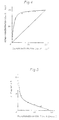
- Isopropanol/Wasser-Gemische mit Zusammensetzungen, die alle Konzentrationsbereiche überdecken, wurden bei einer Temperatur auf der Zulaufseite des Trennraums von 30°C und einem Druck von < 4 mbarauf der Seite des Permeatabzugs einer Trennung durch Pervaporation unterworfen. Die erhaltenen Ergebnisse sind in den Figuren 2 und 3 zusammenfassend grafisch dargestellt.
- Fig. 2 gibt die Konzentration des Wassers im Permeat in Abhängigkeit von der Konzentration des Wassers im Zulauf an. Bei der gewählten Art der Darstellung würden Werte, die auf der in Fig. 2 eingezeichneten Diagonalen liegen, das Fehlen jeglicher Selektivität bedeuten, während bei ausschließlichem Durchtritt von Wasser durch die Membran, also einer Konzentration des Wassers im Permeat von 100%, eine vollständige Selektivität vorliegen würde.
- Die Darstellung der Abhängigkeit der Gesamtflußdichte J kg/m2 x h von dem im Zulauf enthaltenen Isopropanolgehalt (IPA) zeigt eine annähernd exponentielle Abnahme der Gesamtflußdichte mit zunehmender Isopropanolkonzentration (Fig. 3).
- Es wurde eine Kollagenfolie mit einer Dicke von 25gm verwendet, die wie in Beispiel 1 beschrieben hergestellt wurde. Im Anschluß an ihre Herstellung wurde zur Erhöhung des Vernetzungsgrades eine Umsetzung mit EDC (N-(3-Dimethylaminopropyl)-N'-ethylcarbodiimidhydrochlorid) vorgenommen.
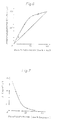
- Ethanol/Wasser-Gemische mit Zusammensetzungen, die alle Konzentrationsbereiche überdecken, wurden bei einer Temperatur auf der Zulaufseite des Trennraums von 30°C und einem permeatseitigen Druck von < 4mbar einer Pervaporationstrennung unterworfen. Die erhaltenen Ergebnisse sind in den Figuren 4 und 5 zusammenfassend dargestellt.
- Fig. 4 gibt die Konzentration des Wassers im Permeat in Abhängigkeit von der Konzentration des Wassers im Zulauf an. Die Darstellung der Abhängigkeit der Gesamtflußdichte J kg/m2 x h von dem im Zulauf enthaltenen Ethanolgehalt (Fig. 5) zeigt eine annähernd exponentielle Abnahme der Gesamtflußdichte mit zunehmender Ethanolkonzentration.
- Eine wie in Beispiel 1 hergestellte Kollagenmembran mit einer Dicke von 25gm wurde zur Aufkonzentrierung von Essigsäure aus Essigsäure/Wasser-Gemischen eingesetzt. Die Temperatur auf der Zulaufseite betrug 30°C, der Druck auf der Permeatseite < 4 mbar.
- Es wurden Trennungen mit Mischungen durchgeführt, die alle Konzentrationsbereiche überdecken. Die Ergebnisse sind in den Figuren 6 und 7 grafisch dargestellt.
- Fig. 6 gibt die Selektivität der Trennung als Darstellung der Abhängigkeit der Wasserkonzentration im Permeat von dem Wassergehalt im Zulauf an.
- Die Gesamtflußdichte J nimmt mit steigendem Gehalt an Essigsäure im Zulauf in der in Fig. 7 dargestellten Weise ab.
- Eine Kollagenmembran wie in Beispiel 3 beschrieben wurde im Anschluß an ihre Herstellung einer Chromgerbung unterzogen. Die so modifizierte Membran wurde zur Aufkonzentrierung von Monoethylenglycol aus einem Monoethylenglycol/Wasser-Gemisch benutzt. Die Temperatur auf der Zulaufseite betrug 40°C, der Druck auf der Permeatseite < 4 mbar.
- Die Trennungen wurden mit verschiedenen Zusammensetzungen des Gemischs durchgeführt, die den gesamten Konzentrationsbereich überdecken. Fig. 8 gibt die Konzentration des Wassers im Permeat in Abhängigkeit von der Konzentration des Wassers im Zulaufgemisch an.
- Fig. 9 zeigt die Abhängigkeit der Gesamtflußdichte J von dem im Zulauf enthaltenen Gehalt an Monoethylenglycol.
- Eine Kollagenmembran wie in Beispiel 3 beschrieben wird zur Aufkonzentrierung von Apfelsaftaroma eingesetzt. Als Maß für die Konzentration wird der Begriff der "Konzentrationsstufe" benutzt, der angibt, wieviele Volumenanteile des entaromatisierten Safts mit einem Volumenteil des Konzentrats zu versetzen sind, um einen fertigen Saft zu erhalten.
- In diesem Beispiel wurde ein Apfelsaftaroma der Konzentrationsstufe 1:150 bei einer Temperatur auf der Zulaufseite von 30°C und einem Druck auf der Permeatseite von < 4 mbar bis zu den Konzentrationsstufen 1:500 und 1:2000 aufkonzentriert.
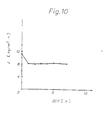
- Die Flußrate ist in Fig. 10 als Funktion der Zeit dargestellt. Sie stellt sich eine Stunde nach Beginn auf den sehr hohen, konstanten Wert von ca. 8 kg/m2 x h ein.
- Die so erhaltenen Aromakonzentrate wurden einer in der Fruchtsaftindustrie üblichen sensorischen Auswertung unterzogen. Als Ergebnis wurde festgestellt, daß die Aufkonzentrierung unter erfindungsgemäßer Verwendung der Kollagenfolie zu keinem feststellbaren Verlust an Aromakomponenten führte.
- Eine wie in Beispiel 1 hergestellte Kollagenfolie mit einer Dicke von 25 µm wurde zur Aufkonzentrierung der Inhaltsstoffe von Weißwein durch Wasserentzug benutzt. Die Trennung erfolgte bei einer Betriebstemperatur auf der Zulaufseite von 20°C, der Druck auf der Permeatseite betrug < 10 mbar. Im Lauf des Versuchs wurden Flußraten von anfänglich 2,7 kg/m2h, zum Ende von 1,4 kg/m2h gemessen.
- Nachdem der Ethanolgehalt auf der Zulaufseite der Membran von ursprünglich 11 auf 37% angestiegen war, wurde der Versuch abgebrochen. Das Permeat war nahezu geruchsfrei, was auf ein hohes Rückhaltevermögen der Membran bezüglich der im Wein enthaltenen Aromakomponenten schließen läßt. Der Geschmack des Retentats wurde im Rahmen einer sensorischen Prüfung überaus positiv beurteilt.
- Die Selektivität a sowie die Flußraten für Wasser (J H20) wurden für die erfindungsgemäße Verwendung einer Kollagenmembran bei 30°C für eine 5- und eine 95-%ige Ethanollösung in Wasser ermittelt. Der Trennfaktor a der untersuchten Kollagenmembran ist berechnet aus Wp/(1-Wp)/Wf * (1-Wf), wobei Wp der Permeatmassenbruch und wo Wf der Massenbruch des Einsatzgemisches ist.
- Die experimentell unter den genannten Bedingungen ermittelten Daten wurden mit Literaturdaten für handelsübliche Pervaporationsmembranen verglichen. Die Vergleichsdaten sind in der nachfolgenden Tabelle zusammengefaßt:

- Die Literaturdaten für die CTA (Cellulosetriacetat)- und CMV-Membranen (kommerzielle lonenaustauschermembran "Selemion") wurden W. Böddeker, "Pervaporation durch Membranen und ihre Anwendung zur Trennung von Flüssiggemischen", Düsseldorf 1986, entnommen. Die zum Vergleich herangezogenen Literaturdaten beziehen sich auf eine Betriebstemperatur von 60°C. Da die Flußrate mit steigender Temperatur zunimmt, ergibt sich aus dem Vergleich der für 60°C geltenden Literaturzahlenwerte mit den für 30°C experimentell ermittelten Werten für die untersuchte Kollagenmembran, daß die Durchflußraten bei der erfindungsgemäßen Verwendung der Kollagenmembran um ein Vielfaches höhere Werte aufweisen. Für ein Ethanol/Wasser-Gemisch der geringeren Konzentration zeigt die Kollagenmembran eine um den Faktor 3,5-7 erhöhte Selektivität gegenüber den handelsüblichen Pervaporationsmembranen, für die höhere Ethanolkonzentration ist die Selektivität der Kollagenmembran gegenüber der CTA-Membran um ca. 30% erhöht und erreicht im Falle des Vergleichs mit der CMV-Membran fast den doppelten Selektivitätswert.
Claims (9)
Priority Applications (1)
| Application Number | Priority Date | Filing Date | Title |
|---|---|---|---|
| AT90900799T ATE92361T1 (de) | 1988-12-10 | 1989-12-06 | Kollagenfolie als pervaporationsmembran. |
Applications Claiming Priority (2)
| Application Number | Priority Date | Filing Date | Title |
|---|---|---|---|
| DE3841716 | 1988-12-10 | ||
| DE3841716A DE3841716A1 (de) | 1988-12-10 | 1988-12-10 | Kollagenfolie als pervaporationsmembran |
Publications (2)
| Publication Number | Publication Date |
|---|---|
| EP0447467A1 EP0447467A1 (de) | 1991-09-25 |
| EP0447467B1 true EP0447467B1 (de) | 1993-08-04 |
Family
ID=6368930
Family Applications (1)
| Application Number | Title | Priority Date | Filing Date |
|---|---|---|---|
| EP90900799A Expired - Lifetime EP0447467B1 (de) | 1988-12-10 | 1989-12-06 | Kollagenfolie als pervaporationsmembran |
Country Status (6)
| Country | Link |
|---|---|
| EP (1) | EP0447467B1 (de) |
| AU (1) | AU632527B2 (de) |
| CA (1) | CA2004996A1 (de) |
| DE (2) | DE3841716A1 (de) |
| ES (1) | ES2058884T3 (de) |
| WO (1) | WO1990006166A1 (de) |
Family Cites Families (11)
| Publication number | Priority date | Publication date | Assignee | Title |
|---|---|---|---|---|
| CA885901A (en) * | 1971-11-16 | L. Shank Joseph | Collagen film manufacture | |
| US1779942A (en) * | 1918-06-17 | 1930-10-28 | Kober Philip Adolph | Process of making dialyzing and pervaporating membranes and product produced thereby |
| US2386826A (en) * | 1942-01-10 | 1945-10-16 | Sylvania Ind Corp | Process and apparatus for treating fluid compositions |
| US2953502A (en) * | 1955-05-24 | 1960-09-20 | American Oil Co | Separation of azeotropic mixtures |
| US2956070A (en) * | 1958-04-29 | 1960-10-11 | American Oil Co | Organic chemical reactions involving liberation of water |
| DE2004987C3 (de) * | 1970-02-04 | 1974-11-14 | Fa. Carl Freudenberg, 6940 Weinheim | Dialysemembran |
| US3644202A (en) * | 1970-03-31 | 1972-02-22 | Willard S Higley | Collagen membranes for reverse osmosis desalination |
| US4097234A (en) * | 1976-12-10 | 1978-06-27 | Nippi, Incorporated | Method for preparing dispersion of collagen fiber |
| DE3410155C1 (de) * | 1984-03-20 | 1985-08-01 | Gkss - Forschungszentrum Geesthacht Gmbh, 2054 Geesthacht | Verfahren zur Trennung der Komponenten eines Flüssigkeitsgemisches |
| DE3418414A1 (de) * | 1984-05-17 | 1985-11-28 | Fraunhofer-Gesellschaft zur Förderung der angewandten Forschung e.V., 8000 München | Kontinuierliche produktentfernung aus bioreaktoren |
| DE3536007A1 (de) * | 1985-10-09 | 1987-05-07 | Akzo Gmbh | Pervaporationsverfahren |
-
1988
- 1988-12-10 DE DE3841716A patent/DE3841716A1/de active Granted
-
1989
- 1989-12-06 DE DE9090900799T patent/DE58905190D1/de not_active Expired - Fee Related
- 1989-12-06 WO PCT/EP1989/001494 patent/WO1990006166A1/de not_active Ceased
- 1989-12-06 ES ES90900799T patent/ES2058884T3/es not_active Expired - Lifetime
- 1989-12-06 AU AU48317/90A patent/AU632527B2/en not_active Ceased
- 1989-12-06 EP EP90900799A patent/EP0447467B1/de not_active Expired - Lifetime
- 1989-12-08 CA CA002004996A patent/CA2004996A1/en not_active Abandoned
Also Published As
| Publication number | Publication date |
|---|---|
| DE3841716C2 (de) | 1992-07-16 |
| CA2004996A1 (en) | 1990-06-10 |
| EP0447467A1 (de) | 1991-09-25 |
| AU632527B2 (en) | 1993-01-07 |
| ES2058884T3 (es) | 1994-11-01 |
| DE3841716A1 (de) | 1990-06-13 |
| DE58905190D1 (de) | 1993-09-09 |
| AU4831790A (en) | 1990-06-26 |
| WO1990006166A1 (de) | 1990-06-14 |
Similar Documents
| Publication | Publication Date | Title |
|---|---|---|
| DE3782120T2 (de) | Asymmetrische gastrennungsmembranen, deren haut einen dichtegradienten aufweisen. | |
| DE3129702C2 (de) | ||
| DE2633812C2 (de) | ||
| EP0096339B2 (de) | Verwendung einer mehrschichtigen Membran zur Trennung von Flüssigkeitsgemischen nach dem Pervaporationsverfahren | |
| DE3112937C2 (de) | Verfahren zur Herstellung einer selektiv durchlässigen Polyimidmembran | |
| DE3782128T2 (de) | Verfahren und spinnloesung zur herstellung von asymmetrischen gastrennungsmembranen, deren haut einen dichtegradienten aufweist. | |
| DE2849978A1 (de) | Selektivdurchlaessige membran und verfahren zu deren herstellung | |
| EP2695668A1 (de) | Verfahren zum Herstellen einer thermoresponsiven Filtrationsmembran und thermoresponsive Filtrationsmembran | |
| DE2703587A1 (de) | Verfahren zur herstellung von semipermeablen membranen | |
| DE2621519C3 (de) | Verfahren zur Herstellung von asymmetrischen permselektiven Zellulosetriacetatmembranen mit Skinschicht | |
| Wu et al. | Study of a new pervaporation membrane Part I. Preparation and characteristics of the new membrane | |
| DE2743673C3 (de) | Mikroporöse, selektiv durchlässige Membran | |
| DE3872343T2 (de) | Selektiv durchlaessige membran zum trennen einer fluessigen loesung. | |
| DE2850043C3 (de) | Selbsttragende selektivdurchlässige Membranen aus Polyimidpolymeren | |
| DE2263774C2 (de) | Für die umgekehrte Osmose bestimmte anisotrope polymere Membranen aus Polypiperazinamidpolymeren | |
| DE2845797C2 (de) | ||
| EP0447467B1 (de) | Kollagenfolie als pervaporationsmembran | |
| Uragami et al. | Studies on syntheses and permeabilities of special polymer membranes. II. Permeation characteristics of cellulose nitrate membranes | |
| DE69020839T2 (de) | Asymmetrische Gastrennungsmembrane mit hoher Festigkeit. | |
| DE3615325A1 (de) | Pervaporations-trennung von aethanol-wasser-mischungen unter verwendung von zusammengesetzten polyacrylsaeuremembranen | |
| US5164088A (en) | Multilayer membrane and process of manufacturing same | |
| DE19925475B4 (de) | Kompositmembran aus einer porösen Trägermembran, Verfahren zu ihrer Herstellung und deren Verwendung | |
| DE2341392C3 (de) | Semipermeable Hydrogelmembran oder Hohlfaser, Verfahren zu ihrer Herstellung und ihre Verwendung | |
| DE19511361C1 (de) | Verfahren zur Herstellung von Polymermembranen auf der Basis von Polyetheretherketon und ihre Verwendung | |
| DE3882217T2 (de) | Ultrafiltrationsmembran aus Polyvinylformal und Verfahren zu ihrer Herstellung. |
Legal Events
| Date | Code | Title | Description |
|---|---|---|---|
| PUAI | Public reference made under article 153(3) epc to a published international application that has entered the european phase |
Free format text: ORIGINAL CODE: 0009012 |
|
| AK | Designated contracting states |
Kind code of ref document: A1 Designated state(s): AT BE CH DE ES FR GB IT LI LU NL SE |
|
| 17P | Request for examination filed |
Effective date: 19910823 |
|
| R17P | Request for examination filed (corrected) |
Effective date: 19910610 |
|
| 17Q | First examination report despatched |
Effective date: 19920508 |
|
| GRAA | (expected) grant |
Free format text: ORIGINAL CODE: 0009210 |
|
| ITF | It: translation for a ep patent filed | ||
| AK | Designated contracting states |
Kind code of ref document: B1 Designated state(s): AT BE CH DE ES FR GB IT LI LU NL SE |
|
| REF | Corresponds to: |
Ref document number: 92361 Country of ref document: AT Date of ref document: 19930815 Kind code of ref document: T |
|
| GBT | Gb: translation of ep patent filed (gb section 77(6)(a)/1977) |
Effective date: 19930811 |
|
| REF | Corresponds to: |
Ref document number: 58905190 Country of ref document: DE Date of ref document: 19930909 |
|
| ET | Fr: translation filed | ||
| PGFP | Annual fee paid to national office [announced via postgrant information from national office to epo] |
Ref country code: SE Payment date: 19931126 Year of fee payment: 5 |
|
| PGFP | Annual fee paid to national office [announced via postgrant information from national office to epo] |
Ref country code: LU Payment date: 19931201 Year of fee payment: 5 Ref country code: GB Payment date: 19931201 Year of fee payment: 5 |
|
| PGFP | Annual fee paid to national office [announced via postgrant information from national office to epo] |
Ref country code: CH Payment date: 19931203 Year of fee payment: 5 |
|
| PGFP | Annual fee paid to national office [announced via postgrant information from national office to epo] |
Ref country code: ES Payment date: 19931210 Year of fee payment: 5 Ref country code: AT Payment date: 19931210 Year of fee payment: 5 |
|
| PGFP | Annual fee paid to national office [announced via postgrant information from national office to epo] |
Ref country code: BE Payment date: 19931213 Year of fee payment: 5 |
|
| PGFP | Annual fee paid to national office [announced via postgrant information from national office to epo] |
Ref country code: FR Payment date: 19931229 Year of fee payment: 5 |
|
| PGFP | Annual fee paid to national office [announced via postgrant information from national office to epo] |
Ref country code: NL Payment date: 19931231 Year of fee payment: 5 |
|
| EPTA | Lu: last paid annual fee | ||
| PLBE | No opposition filed within time limit |
Free format text: ORIGINAL CODE: 0009261 |
|
| STAA | Information on the status of an ep patent application or granted ep patent |
Free format text: STATUS: NO OPPOSITION FILED WITHIN TIME LIMIT |
|
| 26N | No opposition filed | ||
| REG | Reference to a national code |
Ref country code: ES Ref legal event code: FG2A Ref document number: 2058884 Country of ref document: ES Kind code of ref document: T3 |
|
| PG25 | Lapsed in a contracting state [announced via postgrant information from national office to epo] |
Ref country code: LU Free format text: LAPSE BECAUSE OF NON-PAYMENT OF DUE FEES Effective date: 19941206 Ref country code: GB Effective date: 19941206 Ref country code: AT Effective date: 19941206 |
|
| PG25 | Lapsed in a contracting state [announced via postgrant information from national office to epo] |
Ref country code: SE Effective date: 19941207 |
|
| PGFP | Annual fee paid to national office [announced via postgrant information from national office to epo] |
Ref country code: DE Payment date: 19941207 Year of fee payment: 6 |
|
| PG25 | Lapsed in a contracting state [announced via postgrant information from national office to epo] |
Ref country code: LI Effective date: 19941231 Ref country code: CH Effective date: 19941231 Ref country code: BE Effective date: 19941231 |
|
| EAL | Se: european patent in force in sweden |
Ref document number: 90900799.9 |
|
| BERE | Be: lapsed |
Owner name: NATURIN G.M.B.H. & CO. Effective date: 19941231 |
|
| PG25 | Lapsed in a contracting state [announced via postgrant information from national office to epo] |
Ref country code: NL Effective date: 19950701 |
|
| GBPC | Gb: european patent ceased through non-payment of renewal fee |
Effective date: 19941206 |
|
| PG25 | Lapsed in a contracting state [announced via postgrant information from national office to epo] |
Ref country code: FR Effective date: 19950831 |
|
| REG | Reference to a national code |
Ref country code: CH Ref legal event code: PL |
|
| NLV4 | Nl: lapsed or anulled due to non-payment of the annual fee |
Effective date: 19950701 |
|
| EUG | Se: european patent has lapsed |
Ref document number: 90900799.9 |
|
| REG | Reference to a national code |
Ref country code: FR Ref legal event code: ST |
|
| PG25 | Lapsed in a contracting state [announced via postgrant information from national office to epo] |
Ref country code: ES Free format text: LAPSE BECAUSE OF NON-PAYMENT OF DUE FEES Effective date: 19951207 |
|
| PG25 | Lapsed in a contracting state [announced via postgrant information from national office to epo] |
Ref country code: DE Effective date: 19960903 |
|
| REG | Reference to a national code |
Ref country code: ES Ref legal event code: FD2A Effective date: 19960113 |
|
| PG25 | Lapsed in a contracting state [announced via postgrant information from national office to epo] |
Ref country code: IT Free format text: LAPSE BECAUSE OF NON-PAYMENT OF DUE FEES;WARNING: LAPSES OF ITALIAN PATENTS WITH EFFECTIVE DATE BEFORE 2007 MAY HAVE OCCURRED AT ANY TIME BEFORE 2007. THE CORRECT EFFECTIVE DATE MAY BE DIFFERENT FROM THE ONE RECORDED. Effective date: 20051206 |