EP0447904B1 - Transition metal component for a Ziegler catalyst system and its use - Google Patents
Transition metal component for a Ziegler catalyst system and its use Download PDFInfo
- Publication number
- EP0447904B1 EP0447904B1 EP91103643A EP91103643A EP0447904B1 EP 0447904 B1 EP0447904 B1 EP 0447904B1 EP 91103643 A EP91103643 A EP 91103643A EP 91103643 A EP91103643 A EP 91103643A EP 0447904 B1 EP0447904 B1 EP 0447904B1
- Authority
- EP
- European Patent Office
- Prior art keywords
- catalyst component
- hydrocarbon radical
- chlorine
- bromine
- transition
- Prior art date
- Legal status (The legal status is an assumption and is not a legal conclusion. Google has not performed a legal analysis and makes no representation as to the accuracy of the status listed.)
- Expired - Lifetime
Links
Classifications
-
- C—CHEMISTRY; METALLURGY
- C08—ORGANIC MACROMOLECULAR COMPOUNDS; THEIR PREPARATION OR CHEMICAL WORKING-UP; COMPOSITIONS BASED THEREON
- C08F—MACROMOLECULAR COMPOUNDS OBTAINED BY REACTIONS ONLY INVOLVING CARBON-TO-CARBON UNSATURATED BONDS
- C08F10/00—Homopolymers and copolymers of unsaturated aliphatic hydrocarbons having only one carbon-to-carbon double bond
Definitions
- the present invention relates to the use of these catalyst components in a Ziegler catalyst system for a process for the preparation of homopolymers of ethene and copolymers of ethene with minor amounts of C3- to C8-, in particular C4- to C6- ⁇ -monoolefins by polymerization of the monomers at temperatures from 30 to 200, preferably 50 to 100 ° C and pressures from 1 to 200 bar.
- transition metal catalyst component (1) disclosed there which is obtainable from a transition metal starting component (2b), consisting of a mixture of a vanadium and a titanium component and optionally a zirconium tetrahalide, allows the production of homo- and copolymers of ethene with selectively adjustable , very broad molar mass distribution with good productivity and grain quality of the products.
- a transition metal starting component (2b) consisting of a mixture of a vanadium and a titanium component and optionally a zirconium tetrahalide
- a transition metal catalyst component (1) is known, which can be obtained by applying VCl3 from an alcohol as a solvent to SiO2, followed by reaction with an aluminum alkyl compound in a second stage.
- this catalyst component is unsuitable for achieving the goal of producing homo- or copolymers of ethene with good grain quality and a medium-wide molar mass distribution while at the same time having good productivity.
- the resistance to stress corrosion cracking, the bubble stability during the film blowing process and the mechanical strength of the films obtained have to be improved.
- the proportions soluble in hydrocarbons and the gel content must also be reduced.
- transition metal catalyst component (1) is described in US Pat. No. 4,508,842, which is produced by applying VCl3 from an electron donor as a solvent to SiO2.
- VCl3 from an electron donor as a solvent
- SiO2 silicon dioxide
- it is also unsuitable for achieving the goal of producing polymers with good grain quality and productivity at the same time.
- the resistance to stress corrosion cracking, the bubble stability during the film blowing process and the mechanical strength of the films obtained have to be improved.
- the proportions soluble in hydrocarbons and the gel content must also be reduced.
- Suitable inorganic oxide carriers of stage 1 are, for example, silicon dioxide, borosilicate and aluminum silicate, aluminum phosphate or silicon-metal cogels, the metal being, for example, magnesium, titanium and / or zirconium.
- the carriers generally have a particle diameter of 1 to 1000 ⁇ m, preferably 1 to 400 ⁇ m, a pore volume of 0.3 to 3 cm3 / g, preferably 1 to 2.5 cm3 / g and a surface area of 100 to 1000 m2 / g , preferably 200 to 400 m2 / g.
- An aluminum silicate of the formula SiO2 ⁇ aAl2O3 has proven particularly useful, where a is a number from 0 to 2, preferably 0 to 0.5.
- the underlying vanadium trihalide can be a common one in Ziegler catalyst systems.
- Suitable alcoholic components are e.g. Methanol, ethanol, propanol-2, butanol-2 and 2-methylbutanol-2.
- the complexes can be prepared from vanadium trichloride and propanol-2 in tetrahydrofuran as solvents by conventional methods, e.g. after D.C. Bradley, M.L. Metha, Can. J. Chem., 40 (1962), 1710/3.
- the complexes can be used individually or as mixtures of several complexes.
- the titanium trihalide to be used can in turn be a customary one in Ziegler catalyst systems, for example a reaction product obtained in the reduction of a titanium tetrahalide by means of hydrogen, aluminum or organic aluminum compounds.
- Trichlorides of the formula TiCl3, such as those obtained in the reduction of titanium tetrachloride by means of hydrogen, and trichlorides of the formula TiCl3 ⁇ 1/3 AlCl3, such as those obtained in the reduction of titanium tetrachloride by means of metallic aluminum have proven to be particularly suitable.
- the above-mentioned titanium trihalide alcohol complex or a titanium trihalide aluminum trihalide alcohol complex can also be used, for which the same applies as for the vanadium trihalide alcohol complex.
- the titanium trihalides and titanium trichloride alcohol complexes can be used individually or in a mixture.
- TiCl3, TiCl3 ⁇ 1/3 AlCl3, TiCl3 ⁇ 4 iPrOH and TiCl3 ⁇ 1/3 AlCl3 ⁇ 5 iPrOH are preferably used.
- Suitable examples of these compounds are trimethyl, triethyl, tripropyl, tributyl and triphenyl borate, as well as their mixed substituted analogs, tetramethoxy, tetraethoxy, tetrapropoxy, tetrabutoxy and tetraphenoxysilane as well as their mixed substituted analogs, methyl, Ethyl-, propyl-, butyl- and phenyltrimethoxysilane, -triethoxysilane, -tripropoxysilane, -tributoxysilane as well as -triphenoxysilane as well as their mixed substituted analogues, dimethyl-, diethyl-, dipropyl-, dibutyl- as well as diphenyldimethoxdoxysilane, -diphenoxysilane- dibutoxysilane and diphenoxysilane as well as their mixed substituted analogues, trimethyl, triethy
- Tri-i-propyl borate and tri-i-butyl borate, tetrapropoxy and tetrabutoxysilane, i-propyl and i-butyltrimethoxysilane and triethoxysilane, di-i-propyl and di-i-butyldimethoxysilane as well as diethoxysilane, trimethyl are preferred - As well as triethyl-i-propoxysilane and -i-butoxysilane used.
- Suitable organic solvents in stage (1) are saturated aliphatic or partly saturated-aliphatic, partly aromatic hydrocarbons which have 1 to 2 oxy-oxygen atoms and 3 to 19 carbon atoms, preferably saturated aliphatic or partly saturated-aliphatic, partly aromatic oxohydrocarbons, the 1 oxasoxygen atom and have 3 to 11 carbon atoms, especially ring-closed saturated aliphatic oxohydrocarbons having 1 oxa oxygen atom and 4 to 6 carbon atoms.
- Suitable solvents are, for example, ethylene glycol dimethyl ether, anisole, tetrahydrofuran, dioxane and mixtures thereof.
- organoaluminum compounds examples include Al (C2H5) 3, Al (C2H5) 2Cl, Al (C2H5) 2Br, Al (C2H5) 1.5 Cl 1.5 , Al (C2H5) 1.5 Br 1.5 , Al (C2H5) Cl2, Al ( C2H5) Br2, Al (C4H9) 3, Al (C4H9) 2Cl, Al (C4H9) Cl2, Al (C2H5) 2H, Al (C4H9) 2H, Al (C3H7) 2 (OC3H7) or Al (C2H5) 1.5 (OC2H5) 1.5 , III Isoprenyl aluminum and their mixtures.
- Aluminum compounds of the formulas C2H5AlCl2, (C2H5) 2AlCl and isoprenyl aluminum are particularly suitable.
- stages (1.1), (1.2) and (3.1) are preferably used in proportions such that an atomic ratio of the sum of the transition metals vanadium and titanium of the solid-phase intermediate of stage (2) to aluminum of the organoaluminum component of stage (3.1 ) from 1: 0.05 to 1:30, preferably 1: 0.1 to 1: 5.
- organic carboxylic acid esters are methyl, ethyl, propyl, butyl, pentyl or phenyl esters of acetic acid, benzoic acid, phenylacetic acid and derivatives of these acids substituted by alkyl on the aromatic ring.
- Phenyl, benzyl, t-butyl and neopentyl esters of acetic acid, benzoic acid and phenylacetic acid are preferably used.
- Suitable silicon compounds are, for example, trimethyl, triethyl, tripropyl, tributyl, tripentyl, trihexyl and triphenylchlorosilane as well as their mixed substituted analogs, tetramethoxy, tetraethoxy, tetrapropoxy, tetrabutoxy and tetraphenoxysilane as well as their mixed substituted analogs -, Ethyl-, propyl-, butyl- and phenyltrimethoxysilane, -triethoxysilane, -tripropoxysilane, -tributoxysilane and -triphenoxysilane as well as their mixed substituted analogues, dimethyl-, diethyl-, dipropyl-, dibutyl- and diphenyldimethoxysiloxysilane, , -dibutoxysilane and -diphenoxysilane as well as their mixed substituted analogue
- the solvents of stage (3.2) are organic solvents which are inert to the components of stage (3).
- Suitable solvents are, for example, hydrocarbons such as hexane, heptane or petrol, saturated hydrocarbons liquid at room temperature. Pentane, hexane and heptane are preferably used.
- the vanadium and titanium components from stages (1.1), (1.2) and (1.3) are preferably dissolved in one of the solvents or solvent mixtures listed above and the inorganic oxide carrier as a substance or in one of the above Suspended solvents or solvent mixtures, added with stirring and stirred for 15 to 200 minutes at room temperature.
- the weight ratio of the inorganic oxidic carrier to the sum of the vanadium and titanium components of stages (1.1) and (1.2) is between 10: 1 to 1: 3, preferably 5: 1 to 1: 2.
- the molar ratio of the vanadium component of stage (1.1) to the component of stage (1.3) is generally between 1: 100 to 4: 1, preferably 1:10 to 2: 1.
- step (2) the solvent or solvent mixture is evaporated to the dry consistency of the intermediate. This can be done at elevated temperature and under reduced pressure.
- the dry intermediate product can still contain solvents bound in complex form.
- a 0.1 to 50% by weight, preferably about 25% by weight suspension of the solid-phase intermediate (2) and a 5 to 80% by weight suspension are preferably used in separate batches.
- -% preferably about 20 wt .-% solution of the aluminum component (3.1) in hexane, heptane, gasoline or mixtures thereof.
- the suspension and the solution are then combined with stirring in such proportions that the desired weight ratio is achieved.
- the organic carboxylic acid ester or the organic silicon compound or their mixtures of step (3.2) is added to this suspension with further stirring.
- These components of stage (3.2) can also be added to the solution of aluminum component (3.1) and then added to the suspension of the solid-phase intermediate (3).
- the suspension is stirred for 15 to 600 minutes, preferably 6 to 300 minutes at temperatures of -25 to 120 ° C, preferably 25 to 80 ° C, the formation of the transition metal catalyst component in suspension being completed.
- This can be used directly in the form of the suspension obtained as transition metal catalyst component (A).
- the solid-phase product (3) can be isolated and then used as transition metal catalyst component (A).
- the solid phase product (3) is separated from the liquid phase by filtration and washed with pure solvent, after which it is dried, for example in vacuo.
- component (B) Triethyl and tri-i-butyl aluminum have proven particularly useful.
- transition metal catalyst component (A) according to the invention can be introduced into the polymerization space in different ways.
- the polymerization process which is preferably carried out continuously, is suitable for producing homopolymers of ethene, but primarily copolymers of ethene with minor amounts of C3- to C8-, especially C4- to C6- ⁇ -monoolefins, the latter individually or in the form of mixtures of two or more monomers.
- ⁇ -Monoolefins suitable for copolymerization are e.g. Propene, n-butene-1, 4-methylpentene-1, n-hexene-1, n-heptene-1 and n-octene-1 or mixtures of these ⁇ -monoolefins.
- the molecular weights of the polymers are adjusted using the usual regulators, in particular using hydrogen.
- step (2) 20 g of the solid-phase intermediate obtained in step (2) were suspended in 75 g of n-heptane.
- DEAC diethylaluminum chloride
- the transition metal catalyst component (1) described in EP-A 0 166 888 was produced.
- a 10 l autoclave was treated with 5 l i-butane, 0.1 l butene-1, 6 Nl hydrogen, 0.111 g catalyst component (A), 5 mmol tri-i-butyl aluminum as catalyst component (B) and 2 mmol trichlorofluoromethane as organohalogen.
- Catalyst component (C) charged. The mixture was then polymerized for 90 minutes at a temperature of 80 ° C. with stirring and with an ethene partial pressure of 16.5 bar kept constant by regulation. The polymerization was then stopped by letting down.
Landscapes
- Chemical & Material Sciences (AREA)
- Health & Medical Sciences (AREA)
- Chemical Kinetics & Catalysis (AREA)
- Medicinal Chemistry (AREA)
- Polymers & Plastics (AREA)
- Organic Chemistry (AREA)
- Transition And Organic Metals Composition Catalysts For Addition Polymerization (AREA)
- Organic Low-Molecular-Weight Compounds And Preparation Thereof (AREA)
- Catalysts (AREA)
Abstract
Description
Die vorliegende Erfindung betrifft eine Übergangsmetall-Katalysatorkomponente für ein Ziegler-Katalysatorsystem, erhältlich durch
- 1) Mischen in einem Lösungsmittel eines anorganischen oxidischen Trägerstoffes mit
- 1.1) einem Vanadiumtrihalogenid-Alkohol-Komplex der Formel VY₃·nZ-OH, worin stehen
- Y
- für Chlor oder Brom,
- n
- für eine Zahl von 1 bis 6 und
- Z
- für einen einwertigen, nicht mehr als 10 Kohlenstoffatome aufweisenden gesättigten aliphatischen, aromatischen oder araliphatischen Kohlenwasserstoffrest und
- 1.2) einem Titanhalogenid oder einem Titantrihalogenid-Aluminiumtrihalogenid-Komplex, wobei das Halogen Chlor und/oder Brom ist, oder einem Titantrihalogenid-Komplex der Formel TiY₃·nZ-OH oder deren Gemische, worin stehen
- Y
- für Chlor oder Brom,
- n
- für eine Zahl von 1 bis 6 und
- Z
- für einen einwertigen, nicht mehr als 10 Kohlenstoffatome aufweisenden gesättigten aliphatischen, aromatischen oder araliphatischen Kohlenwasserstoffrest und
- 1.3) einer Verbindung der Formel BXnYmRp oder SiXnYmRq oder deren Gemische, worin stehen
- X
- für einen Rest OR
- Y
- für Chlor, Brom oder Wasserstoff und
- R
- für einen C₁- bis C₁₈-Kohlenwasserstoffrest mit der Maßgabe, daß n > 0 und


- 1.1) einem Vanadiumtrihalogenid-Alkohol-Komplex der Formel VY₃·nZ-OH, worin stehen
- 2) Entfernung des Lösungsmittels durch Verdampfung,
- 3) Mischen des festphasigen Zwischenproduktes der Stufe (2) mit
- 3.1) einer Organoaluminium-Katalysatorkomponente der Formel AlRmX3-m, worin stehen
- R
- für einen C₁- bis C₁₈-Kohlenwasserstoffrest,
- m
- für eine Zahl von 1 bis 3, und
- X
- für einen Rest OR, Chlor, Brom oder Wasserstoff,
- 3.2) einem organischen Carbonsäureester oder einer organischen Siliciumverbindung oder deren Gemischen in einem organischen Lösungsmittel und
- 3.1) einer Organoaluminium-Katalysatorkomponente der Formel AlRmX3-m, worin stehen
- 4) gewünschtenfalls Isolierung des festphasigen Zwischenproduktes durch Filtrieren, Waschen und Trocknen.
- 1) Mixing in a solvent with an inorganic oxidic carrier
- 1.1) a vanadium trihalide alcohol complex of the formula VY₃ · nZ-OH, which are
- Y
- for chlorine or bromine,
- n
- for a number from 1 to 6 and
- Z.
- for a monovalent saturated aliphatic, aromatic or araliphatic hydrocarbon radical having no more than 10 carbon atoms and
- 1.2) a titanium halide or a titanium trihalide-aluminum trihalide complex, where the halogen is chlorine and / or bromine, or a titanium trihalide complex of the formula TiY₃ · nZ-OH or mixtures thereof, which are
- Y
- for chlorine or bromine,
- n
- for a number from 1 to 6 and
- Z.
- for a monovalent saturated aliphatic, aromatic or araliphatic hydrocarbon radical having no more than 10 carbon atoms and
- 1.3) a compound of the formula BX n Y m R p or SiX n Y m R q or mixtures thereof, which are
- X
- for a rest OR
- Y
- for chlorine, bromine or hydrogen and
- R
- for a C₁ to C₁₈ hydrocarbon radical with the proviso that n> 0 and
- 1.1) a vanadium trihalide alcohol complex of the formula VY₃ · nZ-OH, which are
- 2) removal of the solvent by evaporation,
- 3) Mixing the solid phase intermediate of step (2) with
- 3.1) an organoaluminum catalyst component of the formula AlR m X 3-m , in which
- R
- for a C₁ to C₁₈ hydrocarbon residue,
- m
- for a number from 1 to 3, and
- X
- for a residue OR, chlorine, bromine or hydrogen,
- 3.2) an organic carboxylic acid ester or an organic silicon compound or mixtures thereof in an organic solvent and
- 3.1) an organoaluminum catalyst component of the formula AlR m X 3-m , in which
- 4) if desired, isolation of the solid-phase intermediate by filtration, washing and drying.
Weiterhin betrifft die vorliegende Erfindung den Einsatz dieser Katalysatorkomponenten in einem Ziegler-Katalysatorsystem für ein Verfahren zur Herstellung von Homopolymerisaten des Ethens sowie Copolymerisaten des Ethens mit untergeordneten Mengen an C₃- bis C₈-, insbesondere C₄- bis C₆-α-Monoolefinen durch Polymerisation der Monomeren bei Temperaturen von 30 bis 200, bevorzugt 50 bis 100°C und Drücken von 1 bis 200 bar.Furthermore, the present invention relates to the use of these catalyst components in a Ziegler catalyst system for a process for the preparation of homopolymers of ethene and copolymers of ethene with minor amounts of C₃- to C₈-, in particular C₄- to C₆-α-monoolefins by polymerization of the monomers at temperatures from 30 to 200, preferably 50 to 100 ° C and pressures from 1 to 200 bar.
Polymerisationsverfahren dieser Art sind bekannt und wurden beispielsweise in der EP-A 0 166 888 beschrieben. Die dort offenbarte Übergangsmetall-Katalysatorkomponente (1), die erhältlich ist aus einer Übergangsmetall-Ausgangskomponente (2b), bestehend aus einem Gemisch einer Vanadium- und einer Titankomponente sowie gegebenenfalls einem Zirkontetrahalogenid, erlaubt die Herstellung von Homo- und Copolymerisaten des Ethens mit gezielt einstellbarer, sehr breiter Molmassenverteilung bei guter Produktivität und Kornbeschaffenheit der Produkte. Bei speziellen Aufgabenstellungen wie der Herstellung von hochmolekularen, hochdichten Produkten, ist die Produktivität des Systems und die Kornbeschaffenheit der erhaltenen Polymerisate noch nicht ausreichend.Polymerization processes of this type are known and have been described, for example, in EP-A 0 166 888. The transition metal catalyst component (1) disclosed there, which is obtainable from a transition metal starting component (2b), consisting of a mixture of a vanadium and a titanium component and optionally a zirconium tetrahalide, allows the production of homo- and copolymers of ethene with selectively adjustable , very broad molar mass distribution with good productivity and grain quality of the products. For special tasks such as the production of high-molecular, high-density products, the productivity of the system and the grain quality of the polymers obtained is not yet sufficient.
Darüber hinaus sind noch zu verbessern die Beständigkeit gegenüber Spannungsrißkorrosion, die Blasenstabilität beim Folienblasprozeß sowie die mechanische Festigkeit der erhaltenen Folien. Weiterhin müssen auch noch die in Kohlenwasserstoffen löslichen Anteile sowie der Gelgehalt reduziert werden.In addition, the resistance to stress corrosion cracking, the bubble stability during the film blowing process and the mechanical strength of the films obtained have to be improved. Furthermore, the proportions soluble in hydrocarbons and the gel content must also be reduced.
Aus der EP-A00 78 996 ist eine Übergangsmetall-Katalysatorkomponente (1) bekannt, die erhältlich ist durch Auftragen von VCl₃ aus einem Alkohol als Lösungsmittel auf SiO₂, worauf in einer zweiten Stufe mit einer Aluminiumalkylverbindung umgesetzt wird. Diese Katalysatorkomponente ist aber zum Erreichen des Zieles, bei zugleich guter Produktivität Homo- bzw. Copolymerisate des Ethens mit guter Kornbeschaffenheit und mittelbreiter Molmassenverteilung herzustellen, ungeeignet. Darüber hinaus sind noch zu verbessern die Beständigkeit gegenüber Spannungsrißkorrosion, die Blasenstabilität beim Folienblasprozeß sowie die mechanische Festigkeit der erhaltenen Folien. Weiterhin müssen auch noch die in Kohlenwasserstoffen löslichen Anteile sowie der Gelgehalt reduziert werden.From EP-A00 78 996 a transition metal catalyst component (1) is known, which can be obtained by applying VCl₃ from an alcohol as a solvent to SiO₂, followed by reaction with an aluminum alkyl compound in a second stage. However, this catalyst component is unsuitable for achieving the goal of producing homo- or copolymers of ethene with good grain quality and a medium-wide molar mass distribution while at the same time having good productivity. In addition, the resistance to stress corrosion cracking, the bubble stability during the film blowing process and the mechanical strength of the films obtained have to be improved. Furthermore, the proportions soluble in hydrocarbons and the gel content must also be reduced.
Schließlich ist in der US-PS 4 508 842 eine Übergangsmetall-Katalysatorkomponente (1) beschrieben, die durch Auftragen von VCl₃ aus einem Elektronendonator als Lösungsmittel auf SiO₂ hergestellt wird. Sie ist aber ebenfalls zum Erreichen des Zieles, bei zugleich guter Produktivität Polymerisate mit guter Kornbeschaffenheit zu erzeugen, ungeeignet. Darüber hinaus sind noch zu verbessern die Beständigkeit gegenüber Spannungsrißkorrosion, die Blasenstabilität beim Folienblasprozeß sowie die mechanische Festigkeit der erhaltenen Folien. Weiterhin müssen auch noch die in Kohlenwasserstoffen löslichen Anteile sowie der Gelgehalt reduziert werden.Finally, a transition metal catalyst component (1) is described in US Pat. No. 4,508,842, which is produced by applying VCl₃ from an electron donor as a solvent to SiO₂. However, it is also unsuitable for achieving the goal of producing polymers with good grain quality and productivity at the same time. In addition, the resistance to stress corrosion cracking, the bubble stability during the film blowing process and the mechanical strength of the films obtained have to be improved. Furthermore, the proportions soluble in hydrocarbons and the gel content must also be reduced.
Aufgabe der vorliegenden Erfindung war es, eine neue Übergangsmetall-Katalysatorkomponente zur Verfügung zu stellen, die es gegenüber den bekannten erlaubt, bei zugleich hoher Produktivität Polymerisate, insbesondere Copolymerisate von Ethen mit höheren α-Olefinen mit gezielt einstellbarer Molmasse und Molmassenverteilung bei guter Verarbeitbarkeit, guter Kornbeschaffenheit, hoher Beständigkeit gegenüber Spannungsrißkorrosion, geringen in Kohlenwasserstoffen löslichen Anteilen, mit besonders guter Blasenstabilität beim Folienblasprozeß sowie hoher mechanischer Festigkeit der Folien und äußerst geringem Gelgehalt herzustellen.It was an object of the present invention to provide a new transition metal catalyst component which, compared to the known ones, allows polymers, in particular copolymers of ethene with higher α-olefins with selectively adjustable molecular weight and molecular weight distribution with good processability, and good productivity, at the same time being highly productive Grain quality, high resistance to stress corrosion cracking, small amounts soluble in hydrocarbons, with particularly good bubble stability in the film blowing process as well as high mechanical strength of the films and extremely low gel content.
Demgemäß wurde die eingangs definierte Übergangsmetall-Katalysatorkomponente gefunden. Weiterhin wurde ein Verfahren gefunden zur Herstellung von Homopolymerisaten des Ethens sowie Copolymerisaten des Ethens mit untergeordneten Mengen an C₃- bis C₈-α-Monoolefinen durch Polymerisation der Monomeren bei Temperaturen von 30 bis 200°C und Drücken von 0,1 bis 200 bar mittels eines Ziegler-Katalysatorsystems aus
- A) einer Übergangsmetall-Katalysatorkomponente und
- B) einer Organoaluminium-Katalysatorkomponente der Formel AlRmX3-m, worin stehen
- R
- für einen C₁- bis C₁₈-Kohlenwasserstoffrest,
- m
- für eine Zahl von 1 bis 3 und
- X
- für einen Rest OR, Chlor, Brom oder Wasserstoff
- C) einer zusätzlichen Katalysatorkomponente,
die entweder mindestens eine Organohalogenverbindung oder mindestens eine anorganische oder mindestens eine organische Stickstoff-Sauerstoff-Verbindung wie auch Gemische derselben darstellt,
- A) a transition metal catalyst component and
- B) an organoaluminum catalyst component of the formula AlR m X 3-m , in which
- R
- for a C₁ to C₁₈ hydrocarbon residue,
- m
- for a number from 1 to 3 and
- X
- for a residue OR, chlorine, bromine or hydrogen
- C) an additional catalyst component,
which represents either at least one organohalogen compound or at least one inorganic or at least one organic nitrogen-oxygen compound as well as mixtures thereof,
Zu den einzelnen Aufbaukomponenten sowie Verfahrensstufen ist folgendes auszuführen:
Als anorganische oxidische Trägerstoffe der Stufe 1 eignen sich beispielsweise Siliciumdioxid, Boro- und Aluminiumsilikat, Aluminiumphosphat oder Silicium-Metall-Cogele, wobei das Metall beispielsweise Magnesium, Titan und/oder Zirkon sein kann. Die Trägerstoffe haben im allgemeinen einen Teilchendurchmesser von 1 bis 1000 µm, vorzugsweise 1 bis 400 µm, ein Porenvolumen von 0,3 bis 3 cm³/g, vorzugsweise 1 bis 2,5 cm³/g und eine Oberfläche von 100 bis 1000 m²/g, bevorzugt 200 bis 400 m²/g. Besonders bewährt hat sich ein Aluminiumsilikat der Formel SiO₂·aAl₂O₃, wobei a für eine Zahl von 0 bis 2, bevorzugt 0 bis 0,5 steht.The following must be carried out for the individual structural components and process stages:
Suitable inorganic oxide carriers of stage 1 are, for example, silicon dioxide, borosilicate and aluminum silicate, aluminum phosphate or silicon-metal cogels, the metal being, for example, magnesium, titanium and / or zirconium. The carriers generally have a particle diameter of 1 to 1000 μm, preferably 1 to 400 μm, a pore volume of 0.3 to 3 cm³ / g, preferably 1 to 2.5 cm³ / g and a surface area of 100 to 1000 m² / g , preferably 200 to 400 m² / g. An aluminum silicate of the formula SiO₂ · aAl₂O₃ has proven particularly useful, where a is a number from 0 to 2, preferably 0 to 0.5.
Der Vanadiumtrihalogenid-Alkohol-Komplex der Stufe (1.1) hat die Formel VY₃·nZ-OH, worin stehen
- Y
- für Chlor oder Brom, vorzugsweise Chlor,
- n
- für eine Zahl von 1 bis 6, vorzugsweise 3 bis 4 und
- Z
- für einen einwertigen, nicht mehr als 10, vorzugsweise nicht mehr als 8 Kohlenstoffatome aufweisenden gesättigt-aliphatischen oder teilweise gesättigt-aliphatischen, teils aromatischen Kohlenwasserstoffrest, insbesondere einen nicht mehr als 6 Kohlenstoffatome aufweisenden Alkylrest.
- Y
- for chlorine or bromine, preferably chlorine,
- n
- for a number from 1 to 6, preferably 3 to 4 and
- Z.
- for a monovalent saturated-aliphatic or partly saturated-aliphatic, partly aromatic hydrocarbon radical which has not more than 10, preferably not more than 8, carbon atoms, in particular an alkyl radical which has not more than 6 carbon atoms.
Dabei kann das zugrundeliegende Vanadiumtrihalogenid ein bei Ziegler-Katalysatorsystemen übliches sein. Als alkoholische Komponente eignen sich z.B. Methanol, Ethanol, Propanol-2, Butanol-2 und 2-Methylbutanol-2. Die Komplexe können aus Vanadiumtrichlorid und Propanol-2 in Tetrahydrofuran als Lösungsmittel nach üblichen Methoden hergestellt werden, z.B. nach D.C. Bradley, M.L. Metha, Can. J. Chem., 40 (1962), 1710/3. Die Komplexe können einzeln oder als Gemische mehrerer Komplexe eingesetzt werden.The underlying vanadium trihalide can be a common one in Ziegler catalyst systems. Suitable alcoholic components are e.g. Methanol, ethanol, propanol-2, butanol-2 and 2-methylbutanol-2. The complexes can be prepared from vanadium trichloride and propanol-2 in tetrahydrofuran as solvents by conventional methods, e.g. after D.C. Bradley, M.L. Metha, Can. J. Chem., 40 (1962), 1710/3. The complexes can be used individually or as mixtures of several complexes.
Als Komponente der Stufe (1.2) ist geeignet ein Titantrihalogenid, wobei das Halogen Chlor und/oder Brom ist, oder ein Titantrihalogenid-Komplex der Formel TiY₃·nZ-OH, worin stehen
- Y
- für Chlor oder Brom
- n
- für eine Zahl von 1 bis 6 und
- Z
- für einen einwertigen, nicht mehr als 10 Kohlenstoffatome aufweisenden gesättigten aliphatischen, aromatischen oder araliphatischen Kohlenwasserstoffrest.
- Y
- for chlorine or bromine
- n
- for a number from 1 to 6 and
- Z.
- for a monovalent saturated aliphatic, aromatic or araliphatic hydrocarbon radical not having more than 10 carbon atoms.
Das einzusetzende Titantrihalogenid kann wiederum ein bei Ziegler-Katalysatorsystemen übliches sein, z.B. ein bei der Reduktion eines Titantetrahalogenids mittels Wasserstoff, Aluminium oder aluminium-organischen Verbindungen erhaltenes Reaktionsprodukt. Als besonders gut geeignet haben sich erwiesen z.B. Trichloride der Formel TiCl₃, wie sie bei der Reduktion von Titantetrachlorid mittels Wasserstoff anfallen sowie Trichloride der Formel TiCl₃·1/3 AlCl₃, wie sie bei der Reduktion von Titantetrachlorid mittels metallischem Aluminium anfallen. Es Kann auch der o.g. Titantrihalogenid-Alkohol-Komplex oder ein Titantrihalogenid-Alumniumtrihalogenid-Alkohol komplex eingesetzt werden, für den sinngemäß das gleiche wie für den Vanadiumtrihalogenid-Alkohol-Komplex gilt. Die Titantrihalogenide und Titantrichlorid-Alkohol-Komplexe können einzeln oder im Gemisch verwendet werden.The titanium trihalide to be used can in turn be a customary one in Ziegler catalyst systems, for example a reaction product obtained in the reduction of a titanium tetrahalide by means of hydrogen, aluminum or organic aluminum compounds. Trichlorides of the formula TiCl₃, such as those obtained in the reduction of titanium tetrachloride by means of hydrogen, and trichlorides of the formula TiCl₃ · 1/3 AlCl₃, such as those obtained in the reduction of titanium tetrachloride by means of metallic aluminum, have proven to be particularly suitable. The above-mentioned titanium trihalide alcohol complex or a titanium trihalide aluminum trihalide alcohol complex can also be used, for which the same applies as for the vanadium trihalide alcohol complex. The titanium trihalides and titanium trichloride alcohol complexes can be used individually or in a mixture.
Bevorzugt werden TiCl₃, TiCl₃·1/3 AlCl₃, TiCl₃·4 iPrOH sowie TiCl₃·1/3 AlCl₃·5 iPrOH verwendet.TiCl₃, TiCl₃ · 1/3 AlCl₃, TiCl₃ · 4 iPrOH and TiCl₃ · 1/3 AlCl₃ · 5 iPrOH are preferably used.
Als Komponente der Stufe (1.3) sind Silizium- oder Borverbindungen der Formel BXnYmRp oder SiXnYmRq geeignet, worin stehen X für einen Rest OR, Y für Chlor, Brom oder Wasserstoff und R für einen C₁- bis C₁₈-Kohlenwasserstoffrest mit der Maßgabe, daß n > 0 und 


Geeignete Beispiele für diese Verbindungen sind Trimethyl-, Triethyl-, Tripropyl-, Tributyl- sowie Triphenylborat, wie auch ihre gemischt substituierten Analoga, Tetramethoxy-, Tetraethoxy-, Tetrapropoxy-, Tetrabutoxy- sowie Tetraphenoxysilan wie auch ihre gemischt substituierten Analoga, Methyl-, Ethyl-, Propyl-, Butyl- sowie Phenyltrimethoxysilan, -triethoxysilan, -tripropoxysilan, -tributoxysilan sowie -triphenoxysilan wie auch ihre gemischt substituierten Analoga, Dimethyl-, Diethyl-, Dipropyl-, Dibutyl- sowie Diphenyldimethoxysilan, -diethoxysilan, -dipropoxysilan, -dibutoxysilan sowie -diphenoxysilan wie auch ihre gemischt substituierten Analoga, Trimethyl-, Triethyl-, Tripropyl-, Tributyl sowie Triphenylmethoxysilan, -ethoxysilan, -propoxysilan, -butoxysilan sowie -phenoxysilan.Suitable examples of these compounds are trimethyl, triethyl, tripropyl, tributyl and triphenyl borate, as well as their mixed substituted analogs, tetramethoxy, tetraethoxy, tetrapropoxy, tetrabutoxy and tetraphenoxysilane as well as their mixed substituted analogs, methyl, Ethyl-, propyl-, butyl- and phenyltrimethoxysilane, -triethoxysilane, -tripropoxysilane, -tributoxysilane as well as -triphenoxysilane as well as their mixed substituted analogues, dimethyl-, diethyl-, dipropyl-, dibutyl- as well as diphenyldimethoxdoxysilane, -diphenoxysilane- dibutoxysilane and diphenoxysilane as well as their mixed substituted analogues, trimethyl, triethyl, tripropyl, tributyl and triphenylmethoxysilane, ethoxysilane, propoxysilane, butoxysilane and phenoxysilane.
Bevorzugt werden Tri-i-propylborat sowie Tri-i-butyl-borat, Tetrapropoxy- sowie Tetrabutoxysilan, i-Propyl- sowie i-Butyltrimethoxysilan sowie -triethoxysilan, Di-i-propyl- sowie Di-i-butyldimethoxysilan sowie -diethoxysilan, Trimethyl- sowie Triethyl-i-propoxysilan sowie -i-butoxysilan verwendet.Tri-i-propyl borate and tri-i-butyl borate, tetrapropoxy and tetrabutoxysilane, i-propyl and i-butyltrimethoxysilane and triethoxysilane, di-i-propyl and di-i-butyldimethoxysilane as well as diethoxysilane, trimethyl are preferred - As well as triethyl-i-propoxysilane and -i-butoxysilane used.
Dabei werden pro mol Vanadiumverbindung der Stufe (1.1) 0,002 bis 3 mol, bevorzugt 0,01 bis 1 mol der Titanverbindung der Stufe (1.2) und 0,01 bis 4 mol, bevorzugt 0,1 bis 2 mol der Silizium- oder Borverbindung der Stufe (1.3) verwendet.0.002 to 3 mol, preferably 0.01 to 1 mol, of the titanium compound of step (1.2) and 0.01 to 4 mol, preferably 0.1 to 2 mol, of the silicon or boron compound of the Level (1.3) used.
Geeignete organische Lösungsmittel in der Stufe (1) sind gesättigte aliphatische oder teils gesättigt-aliphatische, teils aromatische Kohlenwasserstoffe, die 1 bis 2 Oxasauerstoffatome und 3 bis 19 Kohlenstoffatome aufweisen, vorzugsweise gesättigte aliphatische oder teils gesättigt-aliphatische, teils aromatische Oxakohlenwasserstoffe, die 1 Oxasauerstoffatom und 3 bis 11 Kohlenstoffatome aufweisen, insbesondere ringgeschlossene gesättigt aliphatische Oxakohlenwasserstoffe, die 1 Oxasauerstoffatom und 4 bis 6 Kohlenstoffatome aufweisen. Geeignete Lösungsmittel sind beispielsweise Ethylenglykoldimethylether, Anisol, Tetrahydrofuran, Dioxan sowie deren Gemische.Suitable organic solvents in stage (1) are saturated aliphatic or partly saturated-aliphatic, partly aromatic hydrocarbons which have 1 to 2 oxy-oxygen atoms and 3 to 19 carbon atoms, preferably saturated aliphatic or partly saturated-aliphatic, partly aromatic oxohydrocarbons, the 1 oxasoxygen atom and have 3 to 11 carbon atoms, especially ring-closed saturated aliphatic oxohydrocarbons having 1 oxa oxygen atom and 4 to 6 carbon atoms. Suitable solvents are, for example, ethylene glycol dimethyl ether, anisole, tetrahydrofuran, dioxane and mixtures thereof.
Als Komponente der Stufe (3.1) wird eine Organoaluminium-Katalysatorkomponente der Formel AlRmX3-m verwendet, worin stehen
- R
- für einen C₁- bis C₁₈-Kohlenwasserstoffrest, vorzugsweise eine C₁- bis C₁₂-Alkylrest, insbesondere einen C₂- bis C₈-Alkylrest,
- m
- für eine Zahl von 1 bis 3, vorzugsweise 2 bis 3, insbesondere 2 und
- X
- für einen Rest OR, Chlor, Brom bzw. Wasserstoff, vorzugsweise einen OR-Rest und Chlor, insbesondere Chlor.
- R
- for a C₁ to C₁₈ hydrocarbon radical, preferably a C₁ to C₁₂ alkyl radical, in particular a C₂ to C₈ alkyl radical,
- m
- for a number from 1 to 3, preferably 2 to 3, in particular 2 and
- X
- for a radical OR, chlorine, bromine or hydrogen, preferably an OR radical and chlorine, in particular chlorine.
Beispiele für geeignete Organoaluminiumverbindungen sind
Al(C₂H₅)₃, Al(C₂H₅)₂Cl, Al(C₂H₅)₂Br, Al(C₂H₅)1,5Cl1,5, Al(C₂H₅)1,5Br1,5, Al(C₂H₅)Cl₂, Al(C₂H₅)Br₂, Al(C₄H₉)₃, Al(C₄H₉)₂Cl, Al(C₄H₉)Cl₂, Al(C₂H₅)₂H, Al(C₄H₉)₂H, Al(C₃H₇)₂(OC₃H₇) oder Al(C₂H₅)1,5(OC₂H₅)1,5, III
Isoprenylaluminium sowie deren Gemische. Besonders gut geeignet sind Aluminiumverbindungen der Formeln C₂H₅AlCl₂, (C₂H₅)₂AlCl sowie Isoprenylaluminium.Examples of suitable organoaluminum compounds are
Al (C₂H₅) ₃, Al (C₂H₅) ₂Cl, Al (C₂H₅) ₂Br, Al (C₂H₅) 1.5 Cl 1.5 , Al (C₂H₅) 1.5 Br 1.5 , Al (C₂H₅) Cl₂, Al ( C₂H₅) Br₂, Al (C₄H₉) ₃, Al (C₄H₉) ₂Cl, Al (C₄H₉) Cl₂, Al (C₂H₅) ₂H, Al (C₄H₉) ₂H, Al (C₃H₇) ₂ (OC₃H₇) or Al (C₂H₅) 1.5 (OC₂H₅) 1.5 , III
Isoprenyl aluminum and their mixtures. Aluminum compounds of the formulas C₂H₅AlCl₂, (C₂H₅) ₂AlCl and isoprenyl aluminum are particularly suitable.
Die Komponenten der Stufen (1.1), (1.2) und (3.1) werden vorzugsweise in solchen Mengenverhältnissen eingesetzt, daß ein Atomverhältnis der Summe der Übergangsmetalle Vanadium und Titan des festphasigen Zwischenproduktes der Stufe (2) zu Aluminium der Organoaluminium-Komponente der Stufe (3.1) von 1:0,05 bis 1:30, bevorzugt 1:0,1 bis 1:5 resultiert.The components of stages (1.1), (1.2) and (3.1) are preferably used in proportions such that an atomic ratio of the sum of the transition metals vanadium and titanium of the solid-phase intermediate of stage (2) to aluminum of the organoaluminum component of stage (3.1 ) from 1: 0.05 to 1:30, preferably 1: 0.1 to 1: 5.
Als organische Carbonsäureester oder organische Siliciumverbindungen der Stufe (3.2) sind Verbindungen der folgenden Formel geeignet:

R¹R²R³SiX,

R¹R²R³Si-SiR⁴R⁵R⁶ ,

oder
R¹R²R³Si-E²-SiR⁴R⁵R⁶ ,
worin stehen
R¹ bis R⁶ für einen aliphatischen, aromatischen oder araliphatischen C₁- bis C₁₂-Kohlenwasserstoffrest, vorzugsweise eine aliphatische, aromatische oder araliphatische C₁- bis C₁₂-Alkylgruppe, insbesondere eine C₂- bis C₈-Alkylgruppe, eine Phenyl- oder Phenyl-(C₂- bis C₈-)alkylgruppe,
R⁷ für Wasserstoff oder einen C₁-C₁₂-Kohlenwasserstoffrest, vorzugsweise Wasserstoff oder eine C₁- C₁₂-Alkylgruppe, insbesondere Wasserstoff,
X für Brom, Chlor oder einen ungesättigten C₂- bis C₁₈-Kohlenwasserstoffrest, vorzugsweise Brom, Chlor oder eine ungesättigte C₂- bis C₁₂-Alkenylgruppe, insbesondere Chlor oder eine C₂- bis C₈-Alkenylgruppe,
E¹ für ein Element der V. Hauptgruppe, vorzugsweise Stickstoff, Phosphor und Arsen, und insbesondere Stickstoff,
E² für ein Element der VI. Hauptgruppe, vorzugsweise Schwefel und Sauerstoff und insbesondere Sauerstoff.Compounds of the following formula are suitable as organic carboxylic acid esters or organic silicon compounds of stage (3.2):
R¹R²R³SiX,
R¹R²R³Si-SiR⁴R⁵R⁶,
or
R¹R²R³Si-E²-SiR⁴R⁵R⁶,
in what stand
R¹ to R⁶ for an aliphatic, aromatic or araliphatic C₁ to C₁₂ hydrocarbon radical, preferably an aliphatic, aromatic or araliphatic C₁ to C₁₂ alkyl group, in particular a C₂ to C₈ alkyl group, a phenyl or phenyl (C₂- to C₈-) alkyl group,
R⁷ represents hydrogen or a C₁-C₁₂ hydrocarbon radical, preferably hydrogen or a C₁- C₁₂ alkyl group, especially hydrogen,
X represents bromine, chlorine or an unsaturated C₂ to C₁₈ hydrocarbon radical, preferably bromine, chlorine or an unsaturated C₂ to C₁₂ alkenyl group, especially chlorine or a C₂ to C₈ alkenyl group,
E¹ for an element of the 5th main group, preferably nitrogen, phosphorus and arsenic, and in particular nitrogen,
E² for an element of VI. Main group, preferably sulfur and oxygen and especially oxygen.
Beispiele für geeignete organische Carbonsäureester sind Methyl-, Ethyl-, Propyl-, Butyl-, Pentyl- oder Phenylester der Essigsäure, Benzoesäure, Phenylessigsäure sowie am aromatischen Ring alkylsubstituierte Derivate dieser Säuren. Bevorzugt werden Phenyl-, Benzyl-, t-Butyl- sowie Neopentylester der Essigsäure, der Benzoesäure und der Phenylessigsäure verwendet.Examples of suitable organic carboxylic acid esters are methyl, ethyl, propyl, butyl, pentyl or phenyl esters of acetic acid, benzoic acid, phenylacetic acid and derivatives of these acids substituted by alkyl on the aromatic ring. Phenyl, benzyl, t-butyl and neopentyl esters of acetic acid, benzoic acid and phenylacetic acid are preferably used.
Geeignete Siliciumverbindungen sind beispielsweise Trimethyl-, Triethyl-, Tripropyl-, Tributyl-, Tripentyl-, Trihexyl- sowie Triphenylchlorsilan wie auch ihre gemischt substituierten Analoga, Tetramethoxy-, Tetraethoxy-, Tetrapropoxy, Tetrabutoxy- sowie Tetraphenoxysilan wie auch ihre gemischt substituierten Analoga, Methyl-, Ethyl-, Propyl-, Butyl- sowie Phenyltrimethoxysilan, -triethoxysilan, -tripropoxysilan, -tributoxysilan sowie -triphenoxysilan wie auch ihre gemischt substituierten Analoga, Dimethyl-, Diethyl-, Dipropyl-, Dibutyl- sowie Diphenyldimethoxysilan, -diethoxysilan, -dipropoxysilan, -dibutoxysilan sowie -diphenoxysilan wie auch ihre gemischt substituierten Analoga, Trimethyl-, Triethyl-, Tripropyl-, Tributyl- sowie Triphenylmethoxysilan, -ethoxysilan, -propoxysilan, -butoxysilan sowie -phenoxysilan wie auch ihre gemischt substituierten Analoga, Hexamethyl-, Hexaethyl-, Hexapropyl-, Hexabutyl- sowie Hexaphenyldisiian wie auch ihre gemischt substituierten Analoga, Hexamethyl-, Hexaethyl-, Hexapropyl-, Hexabutyl- sowie Hexaphenyldisilazan wie auch ihre gemischt substituierten Analoga, Hexamethyl-, Hexaethyl-, Hexapropyl-, Hexabutyl- sowie Hexaphenyldisiloxan wie auch ihre gemischt substituierten Analoga.Suitable silicon compounds are, for example, trimethyl, triethyl, tripropyl, tributyl, tripentyl, trihexyl and triphenylchlorosilane as well as their mixed substituted analogs, tetramethoxy, tetraethoxy, tetrapropoxy, tetrabutoxy and tetraphenoxysilane as well as their mixed substituted analogs -, Ethyl-, propyl-, butyl- and phenyltrimethoxysilane, -triethoxysilane, -tripropoxysilane, -tributoxysilane and -triphenoxysilane as well as their mixed substituted analogues, dimethyl-, diethyl-, dipropyl-, dibutyl- and diphenyldimethoxysiloxysilane, , -dibutoxysilane and -diphenoxysilane as well as their mixed substituted analogues, trimethyl-, triethyl-, tripropyl-, tributyl- and triphenylmethoxysilane, -ethoxysilane, -propoxysilane, -butoxysilane as well as -phenoxysilane as well as their mixed substituted analogs, hexa-methylamethyl- , Hexapropyl-, Hexabutyl- and Hexaphenyldisiian as well as their mixed substituted analogues, Hexamet hyl-, hexaethyl-, hexapropyl-, hexabutyl- and hexaphenyldisilazane as well as their mixed substituted analogues, hexamethyl-, hexaethyl-, hexapropyl-, hexabutyl- and hexaphenyldisiloxane as well as their mixed substituted analogues.
Bevorzugt werden Tributyl-, Tripentyl-, Trihexyl- sowie Triphenylchlorsilan, Tetrapropoxy- sowie Tetrabutoxysilan, i-Propyl- sowie i-Butyltrimethoxysilan sowie -triethoxysilan, Di-i-propyl- sowie Di-i-butyldimethoxysilan sowie -diethoxysilan, Trimethyl- sowie Triethyl-i-propoxysilan sowie -i-butoxysilan, Hexamethyldisilan, Hexamethyldilazan sowie Hexamethyldisiloxan verwendet.Preference is given to tributyl-, tripentyl-, trihexyl- and triphenylchlorosilane, tetrapropoxy- and tetrabutoxysilane, i-propyl- and i-butyltrimethoxysilane and -triethoxysilane, di-i-propyl- and di-i-butyldimethoxysilane as well as -diethyloxysilane -i-propoxysilane and -i-butoxysilane, hexamethyldisilane, hexamethyldilazane and hexamethyldisiloxane are used.
Bei den Lösungsmitteln der Stufe (3.2) handelt es sich um organische Lösungsmittel, die gegenüber den Komponenten der Stufe (3) inert sind. Geeignete Lösungsmittel sind beispielsweise Kohlenwasserstoffe wie Hexan, Heptan oder Benzine, bei Raumtemperatur flüssige gesättigte Kohlenwasserstoffe. Bevorzugt werden Pentan, Hexan sowie Heptan verwendet.The solvents of stage (3.2) are organic solvents which are inert to the components of stage (3). Suitable solvents are, for example, hydrocarbons such as hexane, heptane or petrol, saturated hydrocarbons liquid at room temperature. Pentane, hexane and heptane are preferably used.
Zur Herstellung der Mischung der Stufe (1) werden die Vanadium- und Titankomponenten der Stufen (1.1), (1.2) und (1.3) vorzugsweise in einem der oben aufgeführten Lösungsmittel oder Lösungsmittelgemischen gelöst und der anorganisch oxidische Trägerstoff als Substanz oder in einem der oben genannten Lösungsmittel oder Lösungsmittelgemische suspendiert, unter Rühren zugegeben und 15 bis 200 Minuten bei Raumtemperatur weitergerührt. Das Gewichtsverhältnis des anorganischen oxidischen Trägerstoffes zur Summe der Vanadium- und Titankomponenten der Stufen (1.1) und (1.2) liegt zwischen 10 zu 1 bis 1 zu 3, bevorzugt 5:1 bis 1:2. Das molare Verhältnis der Vanadiumkomponente der Stufe (1.1) zur Komponente der Stufe (1.3) liegt im allgemeinen zwischen 1:100 bis 4:1, bevorzugt 1:10 bis 2:1.To prepare the mixture from stage (1), the vanadium and titanium components from stages (1.1), (1.2) and (1.3) are preferably dissolved in one of the solvents or solvent mixtures listed above and the inorganic oxide carrier as a substance or in one of the above Suspended solvents or solvent mixtures, added with stirring and stirred for 15 to 200 minutes at room temperature. The weight ratio of the inorganic oxidic carrier to the sum of the vanadium and titanium components of stages (1.1) and (1.2) is between 10: 1 to 1: 3, preferably 5: 1 to 1: 2. The molar ratio of the vanadium component of stage (1.1) to the component of stage (1.3) is generally between 1: 100 to 4: 1, preferably 1:10 to 2: 1.
In der Stufe (2) wird das Lösungsmittel oder Lösungsmittelgemisch bis zur trockenen Konsistenz des Zwischenproduktes verdampft. Dies kann bei erhöhter Temperatur und unter vermindertem Druck durchgeführt werden. Das trockene Zwischenprodukt kann noch Lösungsmittel komplex gebunden enthalten.In step (2) the solvent or solvent mixture is evaporated to the dry consistency of the intermediate. This can be done at elevated temperature and under reduced pressure. The dry intermediate product can still contain solvents bound in complex form.
Zur Herstellung der Mischung der Stufe (2) wird bevorzugt in getrennten Ansätzen eine 0,1 bis 50 gew.-%ige, vorzugsweise etwa 25 gew.-%ige Suspension des festphasigen Zwischenproduktes (2) sowie eine 5 bis 80 gew. -%ige, vorzugsweise etwa 20 gew.-%ige Lösung des Aluminiumkomponente (3.1) in Hexan, Heptan, Benzinen oder deren Gemischen hergestellt. Danach vereinigt man die Suspension und die Lösung unter Rühren in solchen Mengenverhältnissen, daß das gewünschte Gewichtsverhältnis erreicht wird. Zu dieser Suspension wird der organische Carbonsäureester oder die organische Siliciumverbindung oder deren Gemische der Stufe (3.2) unter weiterem Rühren zugegeben. Man kann diese Komponenten der Stufe (3.2), aber auch zu der Lösung der Aluminiumkomponente (3.1) geben und sie anschließend in die Suspension des festphasigen Zwischenproduktes (3) geben. Die Suspension wird 15 bis 600 Minuten, bevorzugt 6 bis 300 Minuten bei Temperaturen von -25 bis 120°C, bevorzugt 25 bis 80°C gerührt, wobei die Bildung der als Suspension vorliegenden Übergangsmetall-Katalysatorkomponente abgeschlossen ist. Diese kann unmittelbar in Form der erhaltenen Suspension als Übergangsmetall-Katalysatorkomponente (A) verwendet werden. Gewünschtenfalls kann das festphasige Produkt (3) isoliert und dann als Übergangsmetall-Katalysatorkomponente (A) eingesetzt werden. Hierzu trennt man das festphasige Produkt (3) von der flüssigen Phase mittels Filtration ab und wäscht es mit reinem Lösungsmittel, worauf es getrocknet wird, beispielsweise im Vakuum.To prepare the mixture from stage (2), a 0.1 to 50% by weight, preferably about 25% by weight suspension of the solid-phase intermediate (2) and a 5 to 80% by weight suspension are preferably used in separate batches. -%, preferably about 20 wt .-% solution of the aluminum component (3.1) in hexane, heptane, gasoline or mixtures thereof. The suspension and the solution are then combined with stirring in such proportions that the desired weight ratio is achieved. The organic carboxylic acid ester or the organic silicon compound or their mixtures of step (3.2) is added to this suspension with further stirring. These components of stage (3.2) can also be added to the solution of aluminum component (3.1) and then added to the suspension of the solid-phase intermediate (3). The suspension is stirred for 15 to 600 minutes, preferably 6 to 300 minutes at temperatures of -25 to 120 ° C, preferably 25 to 80 ° C, the formation of the transition metal catalyst component in suspension being completed. This can be used directly in the form of the suspension obtained as transition metal catalyst component (A). If desired, the solid-phase product (3) can be isolated and then used as transition metal catalyst component (A). For this purpose, the solid phase product (3) is separated from the liquid phase by filtration and washed with pure solvent, after which it is dried, for example in vacuo.
Das Ziegler-Katalysatorsystem zur Homo- und Copolymerisation des Ethens besteht aus
- A) der erfindungsgemäßen Übergangsmetall-Katalysatorkomponente
- B) einer Organoaluminium-Katalysatorkomponente der Formel AlRmX3-m, worin stehen
- R
- für einen C₁- bis C₁₈-Kohlenwasserstoffrest,
- m
- für eine Zahl von 1 bis 3 und
- X
- für einen Rest OR, Chlor, Brom oder Wasserstoff und
- C) einer zusätzlichen Katalysatorkomponente,
die entweder mindestens eine Organohalogenverbindung oder mindestens eine anorganische oder mindestens eine organische Stickstoff-Sauerstoff-Verbindung wie auch Gemische derselben darstellt.
- A) the transition metal catalyst component according to the invention
- B) an organoaluminum catalyst component of the formula AlR m X 3-m , in which
- R
- for a C₁ to C₁₈ hydrocarbon residue,
- m
- for a number from 1 to 3 and
- X
- for a residue OR, chlorine, bromine or hydrogen and
- C) an additional catalyst component,
which represents either at least one organohalogen compound or at least one inorganic or at least one organic nitrogen-oxygen compound as well as mixtures thereof.
Als Komponente (B) sind die in der Stufe (3.1) aufgeführten Verbindungen geeignet. Besonders haben sich Triethyl- sowie Tri-i-butylaluminium bewährt. Als geeignete Organohalogen-Katalysatorkomponente (C) eignen sich gesättigte aliphatische Halogenkohlenwasserstoffe, olefinisch ungesättigte aliphatische Halogenkohlenwasserstoffe, acetylenisch ungesättigte aliphatische Halogenkohlenwasserstoffe, aromatische Halogenkohlenwasserstoffe sowie olefinisch ungesättigte aliphatische halogenierte Carbonsäureester, Stickoxide, Nitroso- und Nitroverbindungen sowie Nitrite und Nitrate, wie NO, NO₂, N₂O, Nitrosodiphenylamin, Nitrobenzol, Niromethan, i-Butyl- sowie i-Amylnitrit sowie i-Propylnitrat wie auch ihre Gemische, wie sie beispielsweise in der EP 166 888, US 3 462 399 sowie DE-OS 15 45 111 aufgeführt sind. Bevorzugt werden Chloroform, 1,1,1-Trichlorethan sowie Trichlorfluormethan verwendet.The compounds listed in stage (3.1) are suitable as component (B). Triethyl and tri-i-butyl aluminum have proven particularly useful. As suitable organohalogen catalyst component (C) saturated aliphatic halohydrocarbons, olefinically unsaturated aliphatic halogenated hydrocarbons, acetylenically unsaturated aliphatic halogenated hydrocarbons, aromatic halohydrocarbons, as well as olefinically unsaturated aliphatic halogenated Carbonsäureester, nitrogen oxides, nitroso and nitro compounds, and nitrites and nitrates, such as NO, NO₂, N₂O are , Nitrosodiphenylamine, nitrobenzene, niromethane, i-butyl and i-amyl nitrite as well as i-propyl nitrate as well as their mixtures, as listed for example in EP 166 888, US 3,462,399 and DE-OS 15 45 111 Chloroform, 1,1,1-trichloroethane and trichlorofluoromethane are preferably used.
Als Polymerisationsverfahren kommen zum Beispiel die Verfahren des Standes der Technik in Frage, die das Suspensions-Polymerisationsverfahren oder das Trockenphasenpolymerisationsverfahren im gerührten oder gewirbelten Festbett, wie sie beispielsweise in den US 3 242 150, DE-OS 32 39 883, EP 000 4645 beschrieben sind. Bei diesen Verfahren kann die erfindungsgemäße Übergangsmetall-Katalysatorkomponente (A) in unterschiedlicher Weise in den Polymerisationsraum eingebracht werden.Examples of suitable polymerization processes are the processes of the prior art, which are the suspension polymerization process or the dry-phase polymerization process in a stirred or whirled fixed bed, as are described, for example, in US Pat. No. 3,242,150, DE-OS 32 39 883, EP 000 4645 . In these processes, the transition metal catalyst component (A) according to the invention can be introduced into the polymerization space in different ways.
So können die Übergangsmetall-Katalysatorkomponenten (A), die Organoaluminium-Komponente (B) sowie die zusätzlichen Katalysatorkomponente (C)
- 1. alle örtlich gemeinsam
- 2. die gleichen 3 Komponenten alle örtlich getrennt voneinander
- 3. die Übergangsmetallkomponente (A) einerseits und ein Gemisch aus (B) und (C) andererseits örtlich getrennt voneinander oder
- 4. ein Gemisch aus der Übergangsmetallkomponente (A) und der zusätzlichen Katalysatorkomponente (C) einerseits und die Organoaluminiumkomponente (B) andererseits örtlich getrennt voneinander in den Polymerisationsraum eingebracht werden.
- 1. all together locally
- 2. the same 3 components, all separated from each other
- 3. the transition metal component (A) on the one hand and a mixture of (B) and (C) on the other hand locally separated from each other or
- 4. a mixture of the transition metal component (A) and the additional catalyst component (C) on the one hand and the organoaluminum component (B) on the other hand are introduced into the polymerization space separately from one another.
Das Polymerisationsverfahren, das vorzugsweise kontinuierlich durchgeführt wird, eignet sich zum Herstellen von Homopolymerisaten des Ethens, vornehmlich aber von Copolymerisaten des Ethens mit untergeordneten Mengen an C₃- bis C₈-, insbesondere C₄- bis C₆-α-Monoolefinen, wobei letztere einzeln oder in Form von Gemischen aus zwei oder mehreren Monomeren vorliegen können. Zur Copolymerisation geeignete α-Monoolefine sind z.B. Propen, n-Buten-1, 4-Methylpenten-1, n-Hexen-1, n-Hepten-1 und n-Octen-1 oder Gemische aus diesen α-Monoolefinen. Dabei werden im allgemeinen 0,1 bis 10 mol-%, bezogen auf das Copolymere des höheren α-Monoolefins bzw. der höheren α-Monolefine einpolymerisiert.The polymerization process, which is preferably carried out continuously, is suitable for producing homopolymers of ethene, but primarily copolymers of ethene with minor amounts of C₃- to C₈-, especially C₄- to C₆-α-monoolefins, the latter individually or in the form of mixtures of two or more monomers. Α-Monoolefins suitable for copolymerization are e.g. Propene, n-butene-1, 4-methylpentene-1, n-hexene-1, n-heptene-1 and n-octene-1 or mixtures of these α-monoolefins. In general, 0.1 to 10 mol%, based on the copolymer of the higher α-monoolefin or the higher α-monolefins, are copolymerized.
Die Molekulargewichte der Polymerisate werden mit den üblichen Reglern, insbesondere mittels Wasserstoff eingestellt.The molecular weights of the polymers are adjusted using the usual regulators, in particular using hydrogen.
16 g Siliciumdioxid mit einem Teilchendurchmesser von 20 bis 45 µm, einem Porenvolumen von 1,7 cm³/g, einer Oberfläche von 320 m²/g und eine Lösung von 19 g eines Vanadiumtrihalogenid-Alkohol-Komplexes der Formel VCl₃·4 ZOH, worin Z steht für einen Isopropylrest 0,9 g eines Titantrihalogenid-/Aluminiumtrihalogenid-Alkohol-Komplexes der Formel TiCl₃·1/3 AlCl₃·4 C₃H₇OH und 14 g Si(OC₄H₉)₄ in 100 g Tetrahydrofuran wurden vereinigt und die dabei erhaltene Suspension kurz gerührt. Anschließend wurde das gebildete festphasige Zwischenprodukt (2) durch Verdampfen der flüchtigen Bestandteile in einem Rotationsverdampfer, bei einem Druck von 10 mbar und einer Temperatur von 70°C isoliert.16 g of silicon dioxide with a particle diameter of 20 to 45 µm, a pore volume of 1.7 cm³ / g, a surface area of 320 m² / g and a solution 19 g of a vanadium trihalide alcohol complex of the formula VCl₃ · 4 ZOH, where Z is an isopropyl residue 0.9 g of a titanium trihalide / aluminum trihalide alcohol complex of the formula TiCl₃ · 1/3 AlCl₃ · 4 C₃H₇OH and 14 g Si (OC₄H₉) ₄ in 100 g tetrahydrofuran were combined and the resulting suspension was briefly stirred. The solid-phase intermediate (2) formed was then isolated by evaporating the volatile constituents in a rotary evaporator, at a pressure of 10 mbar and a temperature of 70 ° C.
20 g des in Stufe (2) gewonnenen festphasigen Zwischenprodukts wurden in 75 g n-Heptan suspendiert. Diese Suspension wurde mit einer Lösung aus 7,2 g Diethylaluminiumchlorid (DEAC) und einer der in der Tabelle aufgeführten Verbindung (3.2) im Molverhältnis 1:1 (DEAC:Verbindungen) in 50 g n-Heptan versetzt und die daraus resultierende Suspension 120 Minuten bei 65°C gerührt. Anschließend wurde filtriert, dreimal mit n-Heptan gewaschen und im Vakuum getrocknet.20 g of the solid-phase intermediate obtained in step (2) were suspended in 75 g of n-heptane. A solution of 7.2 g of diethylaluminum chloride (DEAC) and one of the compounds (3.2) listed in the table in a molar ratio of 1: 1 (DEAC: compounds) in 50 g of n-heptane was added to this suspension and the resulting suspension for 120 minutes stirred at 65 ° C. It was then filtered, washed three times with n-heptane and dried in vacuo.
Für das Vergleichsbeispiel wurde die in der EP-A 0 166 888 beschriebene Übergangsmetall-Katalysatorkomponente (1) hergestellt.For the comparative example, the transition metal catalyst component (1) described in EP-A 0 166 888 was produced.
Ein 10 l Autoklav wurde mit 5 l i-Butan, 0,1 l Buten-1, 6 Nl Wasserstoff, 0,111 g Katalysatorkomponente (A), 5 mmol Tri-i-butylaluminium als Katalysatorkomponente (B) und 2 mmol Trichlorfluormethan als Organohalogen-Katalysatorkomponente (C), beschickt. Dann wurde unter Rühren und bei einem durch Regelung konstant gehaltenen Ethenpartialdruck von 16,5 bar, bei einer Temperatur von 80°C 90 Minuten polymerisiert. Danach wurde die Polymerisation durch Entspannen abgebrochen.

Claims (9)
- A transition-metal catalyst component for a Ziegler catalyst system, obtainable by1) mixing, in a solvent, an inorganic, oxidic carrier with1.1) a vanadium trihalide alcohol complex of the formula VY₃·nZ-OH, whereY is chlorine or bromine,n is from 1 to 6, andZ is a monovalent, saturated, aliphatic, aromatic or araliphatic hydrocarbon radical having not more than 10 carbon atoms, and1.2) a titanium halide or a titanium trihalide/aluminum trihalide complex, where the halogen is chlorine and/or bromine, or a titanium trihalide complex of the formula TiY₃·nZ-OH or mixtures thereof, whereY is chlorine or bromine,n is from 1 to 6, andZ is a monovalent, saturated, aliphatic, aromatic or araliphatic hydrocarbon radical having not more than 10 carbon atoms, and1.3) a compound of the formula BXnYmRp or SiXnYmRq or mixtures thereof, whereX is OR,Y is chlorine, bromine or hydrogen, andR is a C₁- to C₁₈-hydrocarbon radical, with the proviso that n > 0 and

 2) removing the solvent by evaporation,3) mixing the solid-phase intermediate from step 2) with3.1) an organoaluminum catalyst component of the formula AlRmX3-m, whereR is a C₁- to C₁₈-hydrocarbon radical,m is from 1 to 3, andX is OR, chlorine, bromine or hydrogen,and3.2) an organic carboxylate or an organosilicon compound or a mixture thereof in an organic solvent which is inert toward the components in step (3), and4) if desired, isolating the solid-phase intermediate by filtration, washing and drying.
 - A transition-metal catalyst component as claimed in claim 1, obtainable using a silica- or silica/aluminabased carrier in step (1).
- A transition-metal catalyst component as claimed in claim 1 or 2, obtainable using from 0.002 to 3 mol of a titanium compound in step (1.2) and from 0.01 to 4 mol of a compound in step (1.3) per mole of a vanadium compound in step (1.1).
- A transition-metal catalyst component as claimed in any of claims 1 to 3, obtainable observing an atomic ratio between the sum of the transition metals vanadium and titanium in the solid-phase intermediate in step (2) and aluminum of the organoaluminum component in step (3.1) of from 1:0.5 to 1:30.
- A transition-metal catalyst component as claimed in any of claims 1 to 4, obtainable using an organic carboxylate of the general formula

as component (3.2). - A transition-metal catalyst component as claimed in any of claims 1 to 5, obtainable using an organosilicon compound of the general formula
R¹ R² R³ Six,
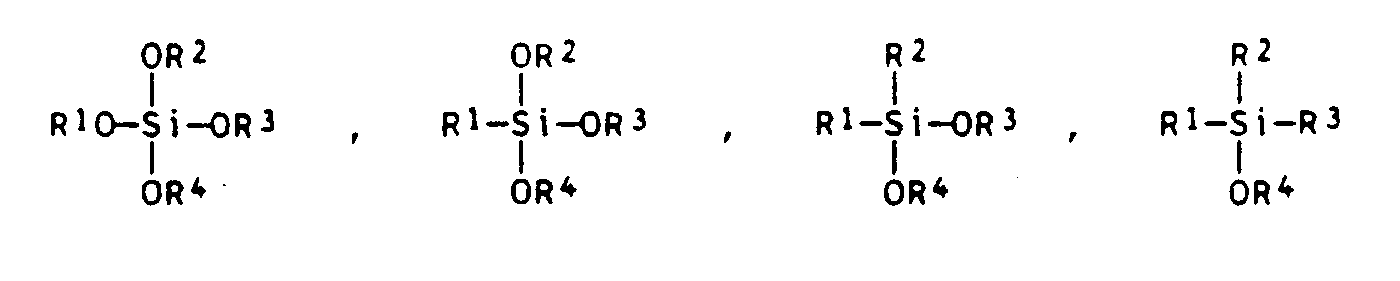
R¹R²R³Si-SiR⁴R⁵R⁶,

R¹R²R³Si-E²-SiR⁴R⁵R⁶,
where
R¹ to R⁶ are a C₁- to C₁₈-hydrocarbon radical,
R⁷ is hydrogen or a C₁-C₁₂-hydrocarbon radical,
X is halogen or an unsaturated C₂- to C₁₈-hydrocarbon radical,
E¹ is an element from main group V, and
E² is an element from main group VI. - A transition-metal catalyst component as claimed in any of claims 1 to 6, obtainable using
from 20 to 80 mol-% of the step (3.1) component and
from 20 to 80 mol-% of the step (3.2) component,
with the proviso that the sum is 100 mol-%. - A process for the preparation of a homopolymer of ethene or a copolymer of ethene with minor amounts of a C₃- to C₈-α-monoolefin by polymerizing the monomers at from 30 to 200°C and from 0.1 to 200 bar using a Ziegler catalyst system comprisingA) a transition-metal catalyst component andB) an organoaluminum catalyst component of the formula AlRmX3-m, whereR is a C₁- to C₁₈-hydrocarbon radical,m is from 1 to 3, andX is OR, chlorine, bromine or hydrogen,andC) an additional catalyst component which is either one or more organohalogen compounds or one or more inorganic or organic nitrogen-oxygen compounds or mixtures thereof,which comprises using a transition-metal catalyst component as claimed in any of claims 1 to 7 as component A).
- A process as claimed in claim 8, wherein the atomic ratio between the transition metal from catalyst component A) and aluminum from catalyst component B) is in the range from 1:0.1 to 1:500, and the molar ratio between the organoaluminum catalyst component B) and the additional catalyst component C) is in the range from 1:0.001 to 1:50.
Applications Claiming Priority (2)
| Application Number | Priority Date | Filing Date | Title |
|---|---|---|---|
| DE4008734 | 1990-03-19 | ||
| DE4008734A DE4008734A1 (en) | 1990-03-19 | 1990-03-19 | TRANSITION METAL CATALYST COMPONENT FOR A ZIEGLER CATALYST SYSTEM AND ITS USE |
Publications (2)
| Publication Number | Publication Date |
|---|---|
| EP0447904A1 EP0447904A1 (en) | 1991-09-25 |
| EP0447904B1 true EP0447904B1 (en) | 1994-10-26 |
Family
ID=6402529
Family Applications (1)
| Application Number | Title | Priority Date | Filing Date |
|---|---|---|---|
| EP91103643A Expired - Lifetime EP0447904B1 (en) | 1990-03-19 | 1991-03-09 | Transition metal component for a Ziegler catalyst system and its use |
Country Status (5)
| Country | Link |
|---|---|
| US (1) | US5143881A (en) |
| EP (1) | EP0447904B1 (en) |
| AT (1) | ATE113297T1 (en) |
| DE (2) | DE4008734A1 (en) |
| HU (1) | HUT57240A (en) |
Families Citing this family (2)
| Publication number | Priority date | Publication date | Assignee | Title |
|---|---|---|---|---|
| DE4130426A1 (en) * | 1991-09-13 | 1993-03-18 | Basf Ag | TWO-CENTER CATALYST SYSTEMS FOR THE POLYMERIZATION OF PROPYLENE |
| US6677266B1 (en) | 2002-07-09 | 2004-01-13 | Eastman Chemical Company | Process for preparing a vanadium/titanium catalyst and use in olefin polymerization |
Family Cites Families (14)
| Publication number | Priority date | Publication date | Assignee | Title |
|---|---|---|---|---|
| DE545111C (en) * | 1929-02-03 | 1932-03-02 | Siemens Schuckertwerke Akt Ges | Electrically powered handset, especially hot air shower |
| US3242150A (en) * | 1960-03-31 | 1966-03-22 | Phillips Petroleum Co | Method and apparatus for the recovery of solid olefin polymer from a continuous path reaction zone |
| NL132630C (en) * | 1963-08-26 | |||
| US4302566A (en) * | 1978-03-31 | 1981-11-24 | Union Carbide Corporation | Preparation of ethylene copolymers in fluid bed reactor |
| JPS55102606A (en) * | 1979-01-30 | 1980-08-06 | Mitsui Toatsu Chem Inc | Polymerization of alpha-olefin |
| US4487845A (en) * | 1980-05-09 | 1984-12-11 | Stauffer Chemical Company | Method of enhancing stereospecificity of a catalyst system |
| DE3144311A1 (en) * | 1981-11-07 | 1983-05-19 | Basf Ag, 6700 Ludwigshafen | METHOD FOR PRODUCING A VANADIUM-CONTAINING CATALYST COMPONENT FOR ZIEGLER CATALYST SYSTEMS |
| DE3239883A1 (en) * | 1982-10-28 | 1984-05-10 | Basf Ag, 6700 Ludwigshafen | METHOD FOR THE CONTINUOUS PRODUCTION OF COPOLYMERISATES OF ETHYLENE WITH HIGHER (ALPHA) MONOOLEFINS |
| US4508842A (en) * | 1983-03-29 | 1985-04-02 | Union Carbide Corporation | Ethylene polymerization using supported vanadium catalyst |
| DE3342039A1 (en) * | 1983-11-22 | 1985-05-30 | Basf Ag, 6700 Ludwigshafen | METHOD FOR PRODUCING HOMO AND COPOLYMERISATES FROM (ALPHA) MONOOLEFINES BY MEANS OF A ZIEGLER-NATTA CATALYST SYSTEM |
| DE3417238A1 (en) * | 1984-05-10 | 1985-11-14 | Basf Ag, 6700 Ludwigshafen | METHOD FOR PRODUCING HOMOPOLYMERISATES OF ETHEN AND COPOLYMERISATES OF ETHEN WITH HIGHER MONOOLEFINES BY MEANS OF A ZIEGLER CATALYST SYSTEM |
| IT1206134B (en) * | 1984-09-27 | 1989-04-14 | Himont Inc | CATALYSTS FOR THE POLYMERIZATION OF OLEFINE. |
| US4814314A (en) * | 1986-09-26 | 1989-03-21 | Mitsubishi Petrochemical Company Limited | Catalyst for olefin polymerization |
| DE3635028A1 (en) * | 1986-10-15 | 1988-04-21 | Basf Ag | METHOD FOR PRODUCING HOMOPOLYMERISATES OF ETHEN AND COPOLYMERISATES OF ETHEN WITH HIGHER (ALPHA) MONOOLEFINES BY MEANS OF A ZIEGLER CATALYST SYSTEM |
-
1990
- 1990-03-19 DE DE4008734A patent/DE4008734A1/en not_active Withdrawn
-
1991
- 1991-03-09 AT AT91103643T patent/ATE113297T1/en not_active IP Right Cessation
- 1991-03-09 DE DE59103309T patent/DE59103309D1/en not_active Expired - Fee Related
- 1991-03-09 EP EP91103643A patent/EP0447904B1/en not_active Expired - Lifetime
- 1991-03-11 US US07/667,118 patent/US5143881A/en not_active Expired - Fee Related
- 1991-03-18 HU HU91882A patent/HUT57240A/en unknown
Also Published As
| Publication number | Publication date |
|---|---|
| ATE113297T1 (en) | 1994-11-15 |
| HU910882D0 (en) | 1991-09-30 |
| DE59103309D1 (en) | 1994-12-01 |
| EP0447904A1 (en) | 1991-09-25 |
| DE4008734A1 (en) | 1991-09-26 |
| HUT57240A (en) | 1991-11-28 |
| US5143881A (en) | 1992-09-01 |
Similar Documents
| Publication | Publication Date | Title |
|---|---|---|
| EP0532551B1 (en) | Process for producing a poly-1-olefin | |
| EP0250999B1 (en) | Process for the manufacture of branched low pressure polyethylene low pressure polyethylene and preformed bifunctional catalysts | |
| EP0349772A2 (en) | Process for preparing a polypropylene | |
| DE2643143A1 (en) | CATALYSTS FOR THE POLYMERIZATION OF ALPHA-OLEFINS | |
| DE2828887A1 (en) | CATALYST COMPONENTS FOR THE POLYMERIZATION OF ALPHA OLEFINS | |
| DE3884816T2 (en) | Olefin polymerization catalyst. | |
| DE2513849A1 (en) | PROCESS FOR THE POLYMERIZATION OF ALPHA-OLEFINS | |
| EP0401776B1 (en) | Process for preparing a poly-alpha-olefin | |
| EP0264090B1 (en) | Process for preparing ethylene homo- or copolymers with higher alpha-monoolefins with the use of a ziegler catalytic system | |
| DE3416561C2 (en) | Catalyst and process for the production of ethylene copolymers | |
| EP0362743B1 (en) | Process for preparing ethylene homopolymers and copolymers of ethylene with higher alpha-olefins by means of a Ziegler catalytic system | |
| DE2901393C2 (en) | ||
| DE69310027T2 (en) | Process for the production of polyethylenes | |
| EP0447959B1 (en) | Transition metal catalyst component for a Ziegler catalytic system and its use | |
| EP0447960A2 (en) | Transition metal component for a Ziegler catalytic system and its use | |
| EP0700406B1 (en) | Random copolymers of propylene | |
| EP0447905B1 (en) | Transition metal component for a Ziegler catalyst system and its use | |
| DE69123405T2 (en) | Process for the production of stereospecific polyolefin | |
| EP0447904A1 (en) | Transition metal component for a Ziegler catalyst system and its use | |
| DE4009169A1 (en) | METHOD FOR PRODUCING A POLYPROPYLENE MOLDING MATERIAL | |
| EP0398167A2 (en) | Process for preparing ethylene (co-) polymers | |
| EP0362744A2 (en) | Process for preparing ethylene homopolymers and copolymers of ethylene with higher alpha-olefins by means of a Ziegler catalytic system | |
| DE68927604T2 (en) | Process for the preparation of homopolymers or copolymers of alpha-olefin | |
| EP0312876B1 (en) | Process for preparing ethylen homo- and copolymers with a ziegler-natta catalytic system | |
| EP0372328B1 (en) | Process for preparing ethylene homo- and copolymers by Phillips catalysis |
Legal Events
| Date | Code | Title | Description |
|---|---|---|---|
| PUAI | Public reference made under article 153(3) epc to a published international application that has entered the european phase |
Free format text: ORIGINAL CODE: 0009012 |
|
| AK | Designated contracting states |
Kind code of ref document: A1 Designated state(s): AT DE ES GB IT NL SE |
|
| 17P | Request for examination filed |
Effective date: 19910809 |
|
| 17Q | First examination report despatched |
Effective date: 19940324 |
|
| GRAA | (expected) grant |
Free format text: ORIGINAL CODE: 0009210 |
|
| AK | Designated contracting states |
Kind code of ref document: B1 Designated state(s): AT DE ES GB IT NL SE |
|
| PG25 | Lapsed in a contracting state [announced via postgrant information from national office to epo] |
Ref country code: IT Free format text: LAPSE BECAUSE OF FAILURE TO SUBMIT A TRANSLATION OF THE DESCRIPTION OR TO PAY THE FEE WITHIN THE PRE;WARNING: LAPSES OF ITALIAN PATENTS WITH EFFECTIVE DATE BEFORE 2007 MAY HAVE OCCURRED AT ANY TIME BEFORE 2007. THE CORRECT EFFECTIVE DATE MAY BE DIFFERENT FROM THE ONE RECORDED.SCRIBED TIME-LIMIT Effective date: 19941026 Ref country code: GB Effective date: 19941026 Ref country code: NL Effective date: 19941026 Ref country code: ES Free format text: THE PATENT HAS BEEN ANNULLED BY A DECISION OF A NATIONAL AUTHORITY Effective date: 19941026 |
|
| REF | Corresponds to: |
Ref document number: 113297 Country of ref document: AT Date of ref document: 19941115 Kind code of ref document: T |
|
| REF | Corresponds to: |
Ref document number: 59103309 Country of ref document: DE Date of ref document: 19941201 |
|
| PG25 | Lapsed in a contracting state [announced via postgrant information from national office to epo] |
Ref country code: SE Effective date: 19950126 |
|
| PG25 | Lapsed in a contracting state [announced via postgrant information from national office to epo] |
Ref country code: AT Effective date: 19950309 |
|
| NLV1 | Nl: lapsed or annulled due to failure to fulfill the requirements of art. 29p and 29m of the patents act | ||
| GBV | Gb: ep patent (uk) treated as always having been void in accordance with gb section 77(7)/1977 [no translation filed] |
Effective date: 19941026 |
|
| PLBE | No opposition filed within time limit |
Free format text: ORIGINAL CODE: 0009261 |
|
| STAA | Information on the status of an ep patent application or granted ep patent |
Free format text: STATUS: NO OPPOSITION FILED WITHIN TIME LIMIT |
|
| 26N | No opposition filed | ||
| PGFP | Annual fee paid to national office [announced via postgrant information from national office to epo] |
Ref country code: DE Payment date: 20020309 Year of fee payment: 12 |
|
| PG25 | Lapsed in a contracting state [announced via postgrant information from national office to epo] |
Ref country code: DE Free format text: LAPSE BECAUSE OF NON-PAYMENT OF DUE FEES Effective date: 20031001 |