EP0447980A2 - Logarithmic amplifier with gain control - Google Patents
Logarithmic amplifier with gain control Download PDFInfo
- Publication number
- EP0447980A2 EP0447980A2 EP91104030A EP91104030A EP0447980A2 EP 0447980 A2 EP0447980 A2 EP 0447980A2 EP 91104030 A EP91104030 A EP 91104030A EP 91104030 A EP91104030 A EP 91104030A EP 0447980 A2 EP0447980 A2 EP 0447980A2
- Authority
- EP
- European Patent Office
- Prior art keywords
- coupled
- terminal
- transistor
- emitter
- input
- Prior art date
- Legal status (The legal status is an assumption and is not a legal conclusion. Google has not performed a legal analysis and makes no representation as to the accuracy of the status listed.)
- Granted
Links
Images
Classifications
-
- G—PHYSICS
- G06—COMPUTING OR CALCULATING; COUNTING
- G06G—ANALOGUE COMPUTERS
- G06G7/00—Devices in which the computing operation is performed by varying electric or magnetic quantities
- G06G7/12—Arrangements for performing computing operations, e.g. operational amplifiers specially adapted therefor
- G06G7/24—Arrangements for performing computing operations, e.g. operational amplifiers specially adapted therefor for evaluating logarithmic or exponential functions, e.g. hyperbolic functions
Definitions
- This invention relates to logarithmic amplifiers, and more particularly, to logarithmic amplifiers wherein the gain is easily changed to accomodate a range of input signal currents.
- Logarithmic amplifiers are used in applications where there is a need to compress an input having a large dynamic range into an output having a small dynamic range.
- the linear gain factor imposed on the logarithmic output voltage was either a fixed function or not easily changed. What is desired is a logarithmic amplifier having an easily changible gain in order that a range of input signal currents may be accomodated and in order that the dynamic range requirements of linear amplifiers following the logarithmic amplifier may be relaxed.
- a logarithmic amplifier includes a first diode wherein the anode receives an input signal current and a standing current.
- the cathode of the first diode is coupled to the emitter of a PNP transistor.
- the collector of the PNP transistor is coupled to the anode of a second diode.
- a bias current is added to the emitter and subtracted from the collector of the PNP transistor to provide a lower emitter impedance.
- the cathode of the second diode is coupled to a negative supply voltage through a load resistor.
- a feedback network including an emitter coupled pair of NPN transistors samples the voltage at the anode of the second diode and sinks a current from the base of the PNP transistor.
- the voltage at the anode of the first diode is amplified to provide a logarithmic output voltage.
- the output voltage may be attenuated and applied to the base of the PNP transistor.
- a feature of the present invention is to provide a logarithmic amplifier wherein the gain is easily adjustable.
- Another feature of the present invention is to provide a logarithmic amplifier wherein the gain may be optimized to provide a maximum dynamic range of output voltage for a given input current.
- Yet another feature of the present invention is to provide a logarithmic amplifier that is capable of operating at high frequencies greater than 100Mhz.
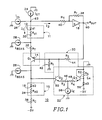
- a logarithmic amplifier 10 is shown in the schematic diagram of FIG. 1.
- the anode of a first diode 11 receives a portion of an input signal current 26, i IN , and a standing or biasing current 24, I ST , at node 62.
- the portion of the input signal current that flows into the first diode 11 is designated I 1.
- Diode 11 is shown as consisting of an ideal diode 12 designated d1 and a parasitic resistance 30 designated R d 1 .
- a PNP transistor 14 has an emitter coupled to the cathode of the first diode 11.
- PNP transistor 14 is shown as consisting of an ideal transistor Q 1 and a parasitic resistance 32 designated R T .
- a bias current 28 designated I BIAS is added to the standing current 24 at the emitter of PNP transistor 14. The same bias current 28 is subtracted from the collector of PNP transistor 14. The bias current 28 flows only through PNP transistor 14 and is used to decrease the emitter impedance of the transistor.
- the anode of a second diode 15, shown as ideal diode 16 designated d2 and a parasistic resistance 34 designated R d 2 is coupled to the collector of PNP transistor 14.
- a load element, resistor 36 designated R c couples the cathode of the second diode 15 to a -5 volt power supply.
- a feedback network 22 samples the voltage at the anode of the second diode 15 and compares this voltage to a reference voltage.
- the output of the feedback network 22 is an error current that is coupled to the base of PNP transistor 14.
- the means for generating the error current includes NPN transistors 50 and 52 designated Q 2 and Q3 .
- the emitters of NPN transistors 50 and 52 are coupled together and to an emitter current source 58 designated I E through emitter resistors 46 and 48, designated R 3 and R 4 to form a differential amplifier.
- an output error current is formed at the collector of NPN transistor 50 if the voltage at the base of NPN transistor 50 is unequal to the voltage at the base of NPN transistor 52.
- the voltage at the base of NPN transistor 52 is provided by a reference voltage generator including a bias element, resistor 54 designated R 5, and a third diode 56 designated d3.
- the voltage provided by the reference voltage generator tracks the thermal variations in the voltage at the anode of the second diode 15. Therefore the error current at the collector of NPN transistor 50 is only a function of the voltage at the anode of the second diode 15 attributable to the input signal current, i IN .
- a second current path is established through an input resistor 40 designated R I and a feedback resister 38 designated R f .
- the current flowing through the input resistor 40 and feedback resistor 38 is designated I 2.
- Operational amplifier 18 that is configured to provide a negative gain equal to R f /R I amplifies the voltage at node 62 to provide the output voltage at node 60 designated e OUT .
- the logarithmic output voltage e OUT is attenuated by an attenuation network 20 and applied to the base of PNP transistor 14.
- the attenuation network 20 includes a series resistance 44 designated R 2 and a shunt resistance 42 designated R 1.
- e 1 is the voltage at node 62
- e 2 is the voltage at the cathode of ideal diode d1
- e 3 is the voltage at the anode of the second diode 15
- e 4 is the voltage at the base of PNP transistor 14.
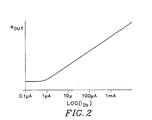
- Equation [16] is the final equation that demonstrates the logarithmic output voltage with respect to a linear input current. It is important to note that the undesirable effect of the parasitic resistance in the diodes and PNP transistor on the logarithmic gain characteristic has been removed. However, this equation is transcendental and the output voltage, e out , cannot be written as a direct function of the input current, I IN . Therefore the graphical representation of equation [16] is shown in FIG. 2.
- Figure 2 is a graph that shows the output voltage as a function of the logarithm of the input signal current. For currents higher than approximately 1 ⁇ A, the logarithmic amplifier according to the present invention provides a logarithmic output that is represented by a straight line on the graph.
- the output voltage is a linear function of the input current and is represented by the curved line on the graph. This linear portion of the gain characteristics of the logarithmic amplifier is useful for averaging low level input signal currents to ascertain the signal level as the noise level becomes significant.
- Schottky diodes be used for diodes 11 and 15.
Landscapes
- Physics & Mathematics (AREA)
- Engineering & Computer Science (AREA)
- Mathematical Physics (AREA)
- Theoretical Computer Science (AREA)
- Software Systems (AREA)
- Computer Hardware Design (AREA)
- General Physics & Mathematics (AREA)
- Tone Control, Compression And Expansion, Limiting Amplitude (AREA)
- Amplifiers (AREA)
Abstract
Description
- This invention relates to logarithmic amplifiers, and more particularly, to logarithmic amplifiers wherein the gain is easily changed to accomodate a range of input signal currents. Logarithmic amplifiers are used in applications where there is a need to compress an input having a large dynamic range into an output having a small dynamic range. However, in prior art logarithmic amplifiers, the linear gain factor imposed on the logarithmic output voltage was either a fixed function or not easily changed. What is desired is a logarithmic amplifier having an easily changible gain in order that a range of input signal currents may be accomodated and in order that the dynamic range requirements of linear amplifiers following the logarithmic amplifier may be relaxed.
- Therefore, according to the present invention, a logarithmic amplifier includes a first diode wherein the anode receives an input signal current and a standing current. The cathode of the first diode is coupled to the emitter of a PNP transistor. The collector of the PNP transistor is coupled to the anode of a second diode. A bias current is added to the emitter and subtracted from the collector of the PNP transistor to provide a lower emitter impedance. The cathode of the second diode is coupled to a negative supply voltage through a load resistor. A feedback network including an emitter coupled pair of NPN transistors samples the voltage at the anode of the second diode and sinks a current from the base of the PNP transistor. The voltage at the anode of the first diode is amplified to provide a logarithmic output voltage. The output voltage may be attenuated and applied to the base of the PNP transistor.
- A feature of the present invention is to provide a logarithmic amplifier wherein the gain is easily adjustable.
- Another feature of the present invention is to provide a logarithmic amplifier wherein the gain may be optimized to provide a maximum dynamic range of output voltage for a given input current.
- Yet another feature of the present invention is to provide a logarithmic amplifier that is capable of operating at high frequencies greater than 100Mhz.
- These and other features of the present invention will be more readily understood by those skilled in the art from a reading of the following detailed specification and drawing figures.
-
- FIG. 1 is a schematic diagram of a logarithmic amplifier according to the present invention; and
- FIG. 2 is a plot of the output voltage that is a logarithmic function of the input signal current.
- A
logarithmic amplifier 10 according to the present invention is shown in the schematic diagram of FIG. 1. The anode of afirst diode 11 receives a portion of aninput signal current 26, i IN , and a standing or biasing current 24,I ST , at node 62. The portion of the input signal current that flows into thefirst diode 11 is designated I₁.Diode 11 is shown as consisting of anideal diode 12 designated d1 and aparasitic resistance 30 designated R d1. APNP transistor 14 has an emitter coupled to the cathode of thefirst diode 11.PNP transistor 14 is shown as consisting of an ideal transistor Q₁ and aparasitic resistance 32 designated R T . Abias current 28 designated I BIAS is added to the standingcurrent 24 at the emitter ofPNP transistor 14. Thesame bias current 28 is subtracted from the collector ofPNP transistor 14. Thebias current 28 flows only throughPNP transistor 14 and is used to decrease the emitter impedance of the transistor. The anode of asecond diode 15, shown asideal diode 16 designated d2 and aparasistic resistance 34 designated R d2, is coupled to the collector ofPNP transistor 14. A load element,resistor 36 designated R c couples the cathode of thesecond diode 15 to a -5 volt power supply. - A
feedback network 22 samples the voltage at the anode of thesecond diode 15 and compares this voltage to a reference voltage. The output of thefeedback network 22 is an error current that is coupled to the base ofPNP transistor 14. The means for generating the error current includesNPN transistors NPN transistors current source 58 designated I E throughemitter resistors NPN transistor 50 if the voltage at the base ofNPN transistor 50 is unequal to the voltage at the base ofNPN transistor 52. The voltage at the base ofNPN transistor 52 is provided by a reference voltage generator including a bias element,resistor 54 designated R₅, and athird diode 56 designated d3. The voltage provided by the reference voltage generator tracks the thermal variations in the voltage at the anode of thesecond diode 15. Therefore the error current at the collector ofNPN transistor 50 is only a function of the voltage at the anode of thesecond diode 15 attributable to the input signal current, i IN . - A second current path is established through an
input resistor 40 designated R I and a feedback resister 38 designated R f . The current flowing through theinput resistor 40 andfeedback resistor 38 is designated I₂.Operational amplifier 18 that is configured to provide a negative gain equal to R f /R I amplifies the voltage at node 62 to provide the output voltage atnode 60 designated e OUT . - The logarithmic output voltage e OUT is attenuated by an
attenuation network 20 and applied to the base ofPNP transistor 14. Theattenuation network 20 includes aseries resistance 44 designated R₂ and ashunt resistance 42 designated R₁. - For a more thorough understanding of the operation of
logarithmic amplifier 10, the following additional voltages are defined: e₁ is the voltage at node 62, e₂ is the voltage at the cathode of ideal diode d1, e₃ is the voltage at the anode of thesecond diode 15, and e₄ is the voltage at the base ofPNP transistor 14. These voltages, together with previously defined voltages and currents may be used to derive the logarithmic output voltage with respect to a linear input current. - Starting with first principles, the diode equation is given by:

where
and I S = saturation current. However, if a standing current is used to bias the diode, the diode equation is modified:
where I ST = standing current. If I ST >> I S , then the diode equation is simply given by:
Equations [1] and [2] are obtained by inspection of the schematic diagram of FIG. 1:


Equations [3A] and [3B] are obtained by superposition of the attenuation of the output voltage e OUT and the voltage produced by the error current from the collector oftransistor 50 through the parallel combination ofresistors 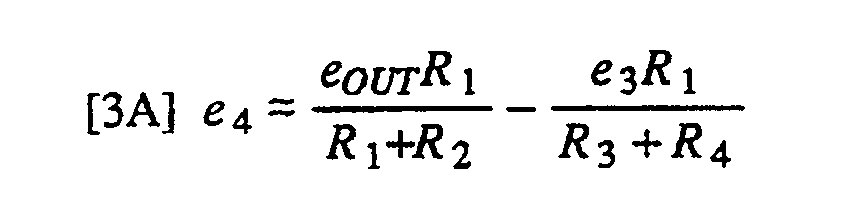
and

where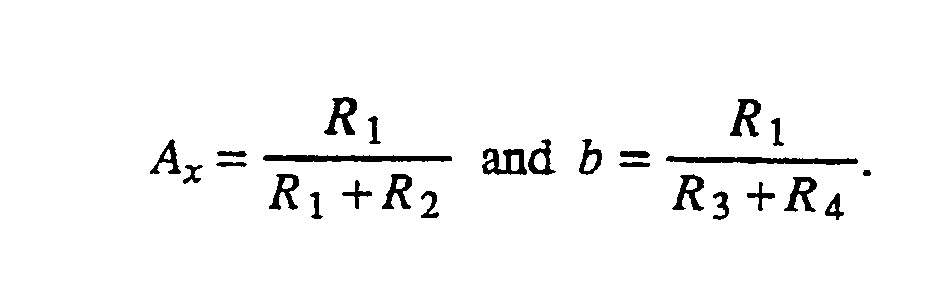
The voltage at the anode ofdiode 15, e₃, and the output voltage, e OUT in terms of e₁ is given by equations [4] and [5]:

Substituting equations [4] and [5] into equation [3] gives: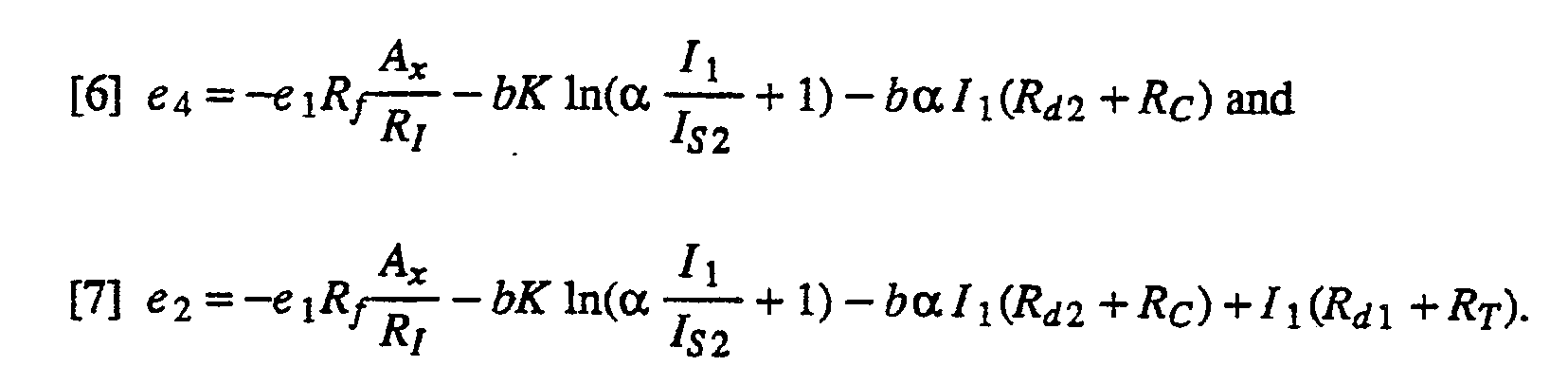
Combining terms gives:
Adjusting R C such that α b (R d2 + R C )=R d1 + RT gives:
Note that the correct selection of the value of R C eliminates the parasitic resistance elements R d1, R d2, and R T . By using a high beta transistor for Q₁, α approaches one. Thus there is minimal error if α is set to one. Assuming I S1 = I S2 and combining terms gives:
Solving for e₁ gives:
or, alternatively: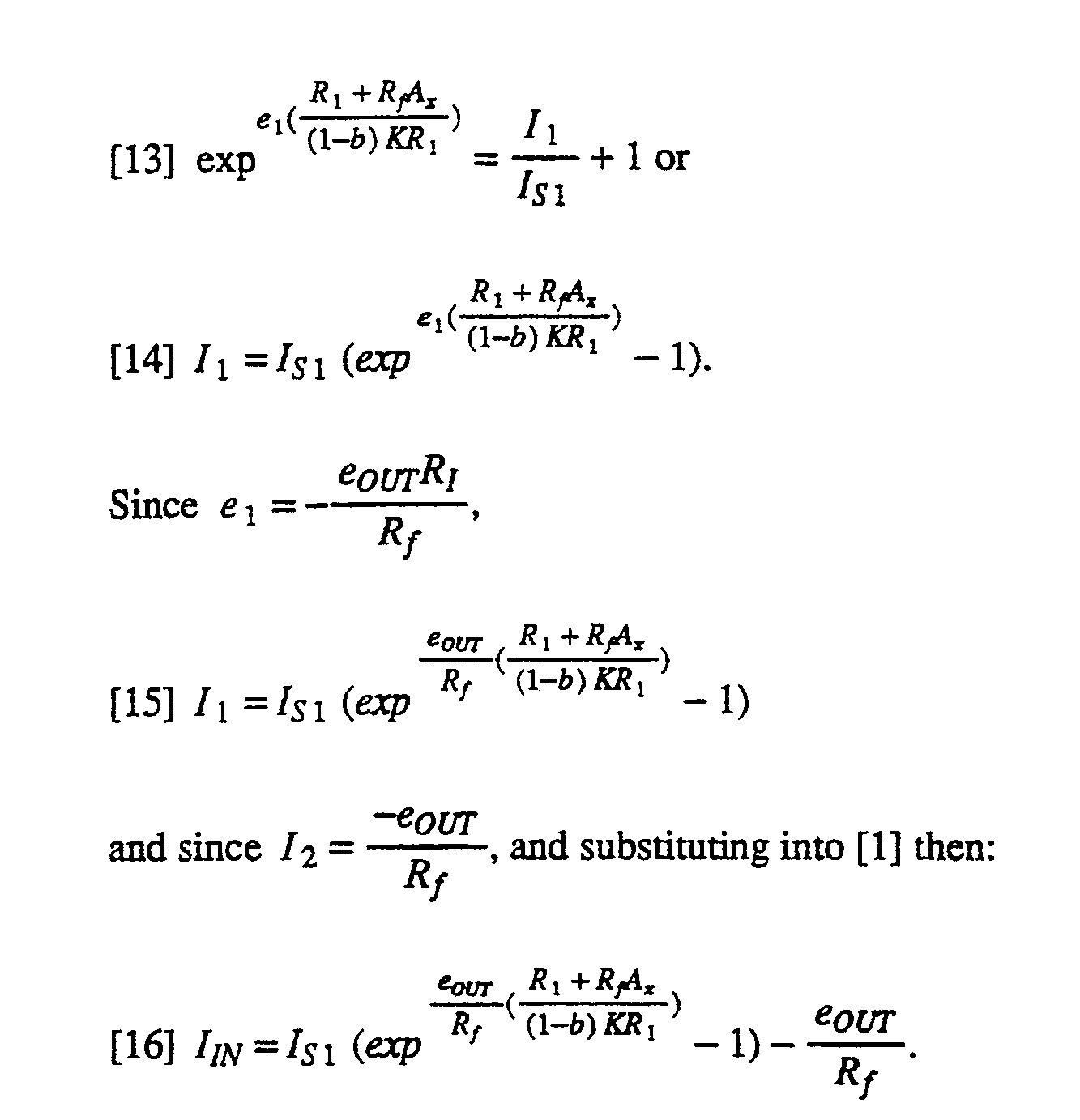
- Equation [16] is the final equation that demonstrates the logarithmic output voltage with respect to a linear input current. It is important to note that the undesirable effect of the parasitic resistance in the diodes and PNP transistor on the logarithmic gain characteristic has been removed. However, this equation is transcendental and the output voltage, e out , cannot be written as a direct function of the input current, I IN . Therefore the graphical representation of equation [16] is shown in FIG. 2. Figure 2 is a graph that shows the output voltage as a function of the logarithm of the input signal current. For currents higher than approximately 1 µA, the logarithmic amplifier according to the present invention provides a logarithmic output that is represented by a straight line on the graph. For currents less than 1 µA, the output voltage is a linear function of the input current and is represented by the curved line on the graph. This linear portion of the gain characteristics of the logarithmic amplifier is useful for averaging low level input signal currents to ascertain the signal level as the noise level becomes significant.
- The gain of the amplifier may be easily changed as can be seen from the form of equation [16]. For example, if high dynamic range is required with low input signal currents, the following component values may be desirable:
R₁ = 150Ω
R₂ = 10KΩ
R f = 300KΩ
R I = 1KΩ
I ST = 1µA
As another example, if maximum bandwidth up to 30 Mhz is required for high signal current levels, the following component values may be desirable:
R₁ = 150Ω
R₂ = ∞
R f = 30KΩ
R I = 1KΩ
I ST = 50µA
Other remaining component values that may be desirable for either example are:
I BIAS = 3 mA
I E = 6 mA
R₃ = R₄ = 120Ω
R₅ = 47KΩ - For optimum frequency performance it is further desirable that Schottky diodes be used for
diodes - Under appropriate operating conditions, an alternative embodiment may be used wherein the attenuation factor, A x , is set to zero. This is accomplished by removing resistors R I , R f , R₂, and the
operational amplifier 18. In this embodiment, equation [12A] simplifies to:
- Thus, there has been described and illustrated herein a logarithmic amplifier having a logarithmic characteristic that is not a function of the parasitic resistance of the diodes and transistors used and provides an easily adjustable gain that may be optimized to the level of input current. It will be obvious to those having skill in the art that many changes may be made in the above-described details of the preferred embodiment without departing from the true spirit of the invention. For example, the polarity of the transistors may be changed with an appropriate change in polarity of the biasing voltages and currents. The scope of the invention is limited only by the following claims.
Claims (12)
- A logarithmic amplifier comprising:(a) a first non-linear element having an input terminal for receiving an input signal current and an output terminal;(b) a first transistor having a first controlled terminal coupled to the output terminal of the first non-linear element, a second controlled terminal and a control terminal;(c) a second non-linear element having an input terminal coupled to the second controlled terminal of the first transistor and an output terminal;(d) a load element having a first terminal coupled to the output terminal of the second non-linear element and a second terminal coupled to a first source of supply voltage;(e) a feedback network having an input terminal coupled to the input terminal of the second non-linear element and an output terminal coupled to the control terminal of the first transistor; and(f) means for amplifiying having an input terminal coupled to the input terminal of the first non-linear element and an output terminal for providing a logarithmic output voltage.
- A logarithmic amplifier as in claim 1 further comprising an attenuation network for attenuating the logarithmic output voltage and applying the attenuated voltage to the control terminal of the first transistor.
- A logarithmic amplifier as in claim 1 further comprising a source of standing current coupled to the input terminal of the first non-linear element.
- A logarithmic amplifier as in claim 1 further comprising a first source of bias current coupled to the first controlled terminal of the first transistor and a second source of bias current having a magnitude equal to the magnitude of the first source of bias current but an opposite direction, the second source of bias current being coupled to the second controlled terminal of the first transistor.
- A logarithmic amplifier as in claim 1 wherein the first and second non-linear elements each comprises a Schottky diode having an anode coupled to the input terminal and a cathode coupled to the output terminal.
- A logarithmic amplifier as in claim 1 wherein the first transistor comprises a bipolar PNP transistor having an emitter coupled to the first controlled terminal, a base coupled to the control terminal, and an collector coupled to the second controlled terminal.
- A logarithmic amplifier as in claim 1 wherein the feedback network comprises:(a) a second transistor having a base coupled to the input terminal of the second non-linear element, a collector coupled to the control terminal of the first transistor, and an emitter; and(b) a third transistor having a base coupled to a reference voltage generator, a collector coupled to a second source of supply voltage, and an emitter coupled to the emitter of the second transistor and to a source of emitter current.
- A logarithmic amplifier as in claim 7 wherein the reference voltage generator comprises:(a) a bias element coupled between the second source of supply voltage and the base of the third transistor; and(b) a diode having an anode coupled to the base of the third transistor and a cathode coupled to the first source of supply voltage.
- A logarithmic amplifier as in claim 7 wherein the feedback network further comprises a first emitter resistor coupled between the emitter of the second transistor and the source of emitter current and a second emitter coupled between the emitter of the third transistor and the source of emitter current.
- A logarithmic amplifier as in claim 1 wherein the means for amplifiying comprises:(a) an operational amplifier having a positive input coupled to the second source of supply voltage, a negative input, and an output;(b) an input resistor coupled between the input terminal of the amplifying means and the negative input of the operational amplifier; and(c) a feedback resistor coupled between the output terminal of the amplifying means and the negative input of the operational amplifier.
- A logarithmic amplifier comprising:(a) a first non-linear element having an input terminal for receiving an input signal current and an output terminal, the first non-linear element having a parasitic resistance equal to R d1;(b) a first transistor having a first controlled terminal coupled to the output terminal of the first non-linear element, a second controlled terminal and a control terminal, the first transistor having a parasitic resistance equal to R T ;(c) a second non-linear element having an input terminal coupled to the second controlled terminal of the first transistor and an output terminal, the second non-linear element having a parasitic resistance equal to R d2;(d) a load element having a first terminal coupled to the output terminal of the second non-linear element and a second terminal coupled to a first source of supply voltage, the load element having a value equal to R C ;(e) a feedback network having an input terminal coupled to the input terminal of the second non-linear element and an output terminal coupled to the control terminal of the first transistor, the feedback network having a gain from the input terminal to the output terminal with a value equal to b; and(f) means for amplifiying having an input terminal coupled to the input terminal of the first non-linear element and an output terminal for providing a logarithmic output voltage that is substantially independent of the R d1, R d2, and R T when R C is selected such that b (R d2 + R C ) = (R d1 + R T ).
- A logarithmic amplifier as in claim 11 further comprising an attenuation network having an attenuation factor of A x for attenuating the logarithmic output voltage and applying the attenuated voltage to the control terminal of the first transistor, the logarithmic amplifier having a logarithmic output voltage that is scaled by the factor (1-b) and is inversely scaled by the factor A x .
Applications Claiming Priority (2)
| Application Number | Priority Date | Filing Date | Title |
|---|---|---|---|
| US495191 | 1990-03-19 | ||
| US07/495,191 US5012140A (en) | 1990-03-19 | 1990-03-19 | Logarithmic amplifier with gain control |
Publications (3)
| Publication Number | Publication Date |
|---|---|
| EP0447980A2 true EP0447980A2 (en) | 1991-09-25 |
| EP0447980A3 EP0447980A3 (en) | 1992-01-22 |
| EP0447980B1 EP0447980B1 (en) | 1996-04-24 |
Family
ID=23967640
Family Applications (1)
| Application Number | Title | Priority Date | Filing Date |
|---|---|---|---|
| EP91104030A Expired - Lifetime EP0447980B1 (en) | 1990-03-19 | 1991-03-15 | Logarithmic amplifier with gain control |
Country Status (4)
| Country | Link |
|---|---|
| US (1) | US5012140A (en) |
| EP (1) | EP0447980B1 (en) |
| JP (1) | JPH0783228B2 (en) |
| DE (1) | DE69118957T2 (en) |
Families Citing this family (10)
| Publication number | Priority date | Publication date | Assignee | Title |
|---|---|---|---|---|
| GB2241806B (en) * | 1990-03-09 | 1993-09-29 | Plessey Co Ltd | Improvements in true logarithmic amplifiers |
| US5221907A (en) * | 1991-06-03 | 1993-06-22 | International Business Machines Corporation | Pseudo logarithmic analog step adder |
| CH684805A5 (en) * | 1992-07-20 | 1994-12-30 | Balzers Hochvakuum | A process for the conversion of a measured signal converter to its execution and measurement arrangement. |
| US5491548A (en) * | 1994-03-18 | 1996-02-13 | Tektronix, Inc. | Optical signal measurement instrument and wide dynamic range optical receiver for use therein |
| US5564092A (en) * | 1994-11-04 | 1996-10-08 | Motorola, Inc. | Differential feed-forward amplifier power control for a radio receiver system |
| GB9514490D0 (en) * | 1995-07-14 | 1995-09-13 | Nokia Telecommunications Oy | Improvements to a logarithmic converter |
| US5929982A (en) * | 1997-02-04 | 1999-07-27 | Tektronix, Inc. | Active APD gain control for an optical receiver |
| US6265928B1 (en) * | 1999-07-16 | 2001-07-24 | Nokia Telecommunications Oy | Precision-controlled logarithmic amplifier |
| JP3880345B2 (en) * | 2001-08-27 | 2007-02-14 | キヤノン株式会社 | Differential amplifier circuit, solid-state imaging device using the same, and imaging system |
| US9298952B2 (en) | 2013-11-18 | 2016-03-29 | King Fahd University Of Petroleum And Minerals | CMOS logarithmic current generator and method for generating a logarithmic current |
Family Cites Families (11)
| Publication number | Priority date | Publication date | Assignee | Title |
|---|---|---|---|---|
| US3678947A (en) * | 1970-07-16 | 1972-07-25 | Melvin J Davidson | Eyeliner |
| US3928774A (en) * | 1974-01-24 | 1975-12-23 | Petrolite Corp | Bipolar log converter |
| JPS52106054U (en) * | 1976-02-09 | 1977-08-12 | ||
| GB1571016A (en) * | 1976-02-20 | 1980-07-09 | Tokyo Shibaura Electric Co | Voltage controlled variable gain circuit |
| US4125789A (en) * | 1977-06-07 | 1978-11-14 | Sundstrand Corporation | Biasing and scaling circuit for transducers |
| DE2932655C2 (en) * | 1979-08-11 | 1982-03-04 | Hewlett-Packard GmbH, 7030 Böblingen | Pulse generator |
| US4418317A (en) * | 1981-05-18 | 1983-11-29 | Tektronix, Inc. | Logarithmic amplifier utilizing positive feedback |
| US4471324A (en) * | 1982-01-19 | 1984-09-11 | Dbx, Inc. | All NPN variably controlled amplifier |
| US4507615A (en) * | 1982-12-16 | 1985-03-26 | Tektronix, Inc. | Non-linear amplifier systems |
| SU1117660A1 (en) * | 1983-03-28 | 1984-10-07 | Предприятие П/Я А-3726 | Logarithmic generator |
| US4739283A (en) * | 1987-03-02 | 1988-04-19 | Tektronix, Inc. | Variable transient response control for linear integrated-circuit high-frequency amplifiers |
-
1990
- 1990-03-19 US US07/495,191 patent/US5012140A/en not_active Expired - Fee Related
-
1991
- 1991-03-15 DE DE69118957T patent/DE69118957T2/en not_active Expired - Fee Related
- 1991-03-15 EP EP91104030A patent/EP0447980B1/en not_active Expired - Lifetime
- 1991-03-19 JP JP3081031A patent/JPH0783228B2/en not_active Expired - Lifetime
Also Published As
| Publication number | Publication date |
|---|---|
| US5012140A (en) | 1991-04-30 |
| DE69118957D1 (en) | 1996-05-30 |
| DE69118957T2 (en) | 1996-10-24 |
| JPH04219007A (en) | 1992-08-10 |
| EP0447980B1 (en) | 1996-04-24 |
| EP0447980A3 (en) | 1992-01-22 |
| JPH0783228B2 (en) | 1995-09-06 |
Similar Documents
| Publication | Publication Date | Title |
|---|---|---|
| KR970005291B1 (en) | Amplifier | |
| US5128566A (en) | Variable attenuator circuit | |
| KR0148324B1 (en) | Variable gain amplifier circuit | |
| EP0447980B1 (en) | Logarithmic amplifier with gain control | |
| US3999139A (en) | Monolithic alternately stacked IF amplifier | |
| US4473780A (en) | Amplifier circuit and focus voltage supply circuit incorporating such an amplifier circuit | |
| JP3938793B2 (en) | Variable gain amplifier using pseudo logarithmic gain control | |
| EP0025977B1 (en) | Gain controlled amplifier | |
| HK35497A (en) | Input circuit for a high-frequency amplifier | |
| GB2081039A (en) | Gain control circuits | |
| US6466085B2 (en) | Amplifier circuit and preconditioning circuit for use in amplifier circuit | |
| US7622981B2 (en) | Square cell having wide dynamic range and power detector implementing same | |
| US4418317A (en) | Logarithmic amplifier utilizing positive feedback | |
| GB1579945A (en) | Audio-frequency power amplifiers | |
| US4077012A (en) | Amplifier devices | |
| JPS6340900Y2 (en) | ||
| JPS6012331Y2 (en) | Amplifier circuit with two transistors | |
| GB2081037A (en) | Gain control circuit | |
| GB2100541A (en) | Buffer amplifier | |
| US4385364A (en) | Electronic gain control circuit | |
| JP2619858B2 (en) | Function approximation function generator | |
| US3651420A (en) | Variable gain direct coupled amplifier | |
| US4963764A (en) | Low noise current mirror active load circuit | |
| EP0290277B1 (en) | A low noise integrated active load circuit | |
| JPH06120747A (en) | Differential amplifier |
Legal Events
| Date | Code | Title | Description |
|---|---|---|---|
| PUAI | Public reference made under article 153(3) epc to a published international application that has entered the european phase |
Free format text: ORIGINAL CODE: 0009012 |
|
| AK | Designated contracting states |
Kind code of ref document: A2 Designated state(s): DE FR GB |
|
| PUAL | Search report despatched |
Free format text: ORIGINAL CODE: 0009013 |
|
| AK | Designated contracting states |
Kind code of ref document: A3 Designated state(s): DE FR GB |
|
| 17P | Request for examination filed |
Effective date: 19920226 |
|
| 17Q | First examination report despatched |
Effective date: 19940818 |
|
| RAP1 | Party data changed (applicant data changed or rights of an application transferred) |
Owner name: TEKTRONIX, INC. |
|
| GRAH | Despatch of communication of intention to grant a patent |
Free format text: ORIGINAL CODE: EPIDOS IGRA |
|
| GRAA | (expected) grant |
Free format text: ORIGINAL CODE: 0009210 |
|
| AK | Designated contracting states |
Kind code of ref document: B1 Designated state(s): DE FR GB |
|
| PG25 | Lapsed in a contracting state [announced via postgrant information from national office to epo] |
Ref country code: FR Effective date: 19960424 |
|
| REF | Corresponds to: |
Ref document number: 69118957 Country of ref document: DE Date of ref document: 19960530 |
|
| EN | Fr: translation not filed | ||
| PLBE | No opposition filed within time limit |
Free format text: ORIGINAL CODE: 0009261 |
|
| STAA | Information on the status of an ep patent application or granted ep patent |
Free format text: STATUS: NO OPPOSITION FILED WITHIN TIME LIMIT |
|
| PG25 | Lapsed in a contracting state [announced via postgrant information from national office to epo] |
Ref country code: GB Effective date: 19970315 |
|
| 26N | No opposition filed | ||
| GBPC | Gb: european patent ceased through non-payment of renewal fee |
Effective date: 19970315 |
|
| PG25 | Lapsed in a contracting state [announced via postgrant information from national office to epo] |
Ref country code: DE Effective date: 19971202 |