EP0448006A2 - Process for the preparation of acylales - Google Patents
Process for the preparation of acylales Download PDFInfo
- Publication number
- EP0448006A2 EP0448006A2 EP91104127A EP91104127A EP0448006A2 EP 0448006 A2 EP0448006 A2 EP 0448006A2 EP 91104127 A EP91104127 A EP 91104127A EP 91104127 A EP91104127 A EP 91104127A EP 0448006 A2 EP0448006 A2 EP 0448006A2
- Authority
- EP
- European Patent Office
- Prior art keywords
- alkyl
- groups
- acetoxymethoxy
- formula
- oder
- Prior art date
- Legal status (The legal status is an assumption and is not a legal conclusion. Google has not performed a legal analysis and makes no representation as to the accuracy of the status listed.)
- Granted
Links
Classifications
-
- C—CHEMISTRY; METALLURGY
- C07—ORGANIC CHEMISTRY
- C07C—ACYCLIC OR CARBOCYCLIC COMPOUNDS
- C07C67/00—Preparation of carboxylic acid esters
- C07C67/08—Preparation of carboxylic acid esters by reacting carboxylic acids or symmetrical anhydrides with the hydroxy or O-metal group of organic compounds
Definitions
- the present invention relates to a process for the preparation of acyloxymethoxyalkyl compounds and acyloxymethoxyphenyl compounds (acylals)
- Acetoxymethoxy compounds of 2-substituted ethanediols, of 1,3-disubstituted and of 2,3-disubstituted 1,2,3-propanetriols are important intermediates because of the good acetoxy transition group.
- acylals obtainable according to the invention are reactive compounds which, for. B. represent valuable intermediates in the synthesis of acyclic nucleosides (see, e.g., C.K. Chu, S. Cutler, J. Heterocyclic Chem., 23, 289 ff (1986)).
- a long known method for the production of acylals, i.e. H. of esters of hemiacetals consists in reacting equimolar amounts of an acetal with an organic acid anhydride at elevated temperature, preferably in the presence of an acidic catalyst (see, for example, Houben-Weyl, Methods of Organic Chemistry, Georg Thieme Verlag, Stuttgart, 1965, Volume VI / 3, p.286 f).
- Another method uses the reaction of alpha-halogen ethers with alkali salts of carboxylic acids (see, for example, BJW Farren, J. Am. Chem. Soc. 47, 2422 (1925)).
- a third method takes advantage of the high reactivity of vinyl ethers and accomplishes the synthesis of acylals by the addition of organic acids to vinyl ether (see E. Levas, Comptes Rendues Hebdomadaires des Séances de l'Academie des Sciences, Paris, 228, 1443 (1949 )).
- the present invention relates to a substantially simplified process for the preparation of compounds of formula I.
- the advantage of the method according to the invention over those of the prior art is that the alcohol component of the acylal directly, i.e. H. can be used without prior isolation of an activated intermediate.
- the above method is particularly suitable for the preparation of the above compounds in which R4 is C1-C--alkyl, especially C1-C3-alkyl.
- radicals R1 and / or R2 and / or R3 of the abovementioned compounds carry acyl groups, particularly uniform products are obtained if these acyl groups are identical to the R4-C (O) group in formula III.
- alkyl groups mentioned as substituents can be straight-chain, branched or cyclic.
- acyl groups mentioned can be straight-chain, branched, cycloaliphatic or aromatic.
- the compounds of formula I can have one or more chiral centers.
- the compounds are usually present as racemates; production or isolation of the pure enantiomers is possible.
- the invention is therefore both the process for the preparation of the pure enantiomers and mixtures thereof, such as. B. the associated racemate.
- alkyl, acyl or benzyl protective groups with which the hydroxyl, mercapto or amino groups of the substituents R 1 to R 3 are optionally blocked, can be removed by customary methods, such as e.g. by reaction with boron halides, hydrolysis or hydrogenolysis.
- an alkanol of the formula II, an anhydride of the formula III, the carboxylic acid corresponding to the anhydride and dry dimethyl sulfoxide are preferably combined with stirring at a temperature of from -10 to 40 ° C., particularly preferably from 0 to 30 ° C.
- the molar ratio of anhydride: carboxylic acid: dimethyl sulfoxide to 1 mol of alkanol is preferably 2-10: 1.5-20: 1-30, particularly preferably 4-6: 6-14: 10-20, in particular approximately 5: ca.10: ca.15.
- the reaction mixture is preferably stirred for 1-24 hours, particularly preferably 5 to 7 hours at 0-100 ° C., in particular at 30-90 ° C.
- the reaction mixture can be worked up by conventional methods.
- the workup is preferably carried out, for example, in such a way that the reaction mixture obtained is poured into ice water and extracted three times with an ether, preferably diethyl ether or diisopropyl ether.
- the organic phase is then 3 times with water and then several times with concentrated sodium hydrogen carbonate solution shaken out until the aqueous wash water no longer react acidic.
- the mixture is then shaken again with water and the organic phase is dried over sodium sulfate, filtered and freed from the solvent under reduced pressure.
- the residue is subjected, for example, to fractional distillation and, in addition to acyloxymethylthiomethyl ether, provides the acyloxymethyl compound of the alkanol used.
- propanoyloxymethoxy or butanoyloxymethoxy or isobutanoyloxymethoxy compounds can be obtained using propionic acid and propionic anhydride or butyric acid and butteric anhydride or isobutyric acid and isobutyric anhydride.
Landscapes
- Chemical & Material Sciences (AREA)
- Organic Chemistry (AREA)
- Organic Low-Molecular-Weight Compounds And Preparation Thereof (AREA)
- Indole Compounds (AREA)
- Preparation Of Compounds By Using Micro-Organisms (AREA)
- Acyclic And Carbocyclic Compounds In Medicinal Compositions (AREA)
- Saccharide Compounds (AREA)
- Nitrogen Condensed Heterocyclic Rings (AREA)
- Cephalosporin Compounds (AREA)
- Steroid Compounds (AREA)
Abstract
Verbindungen der Formel

lassen sich vorteilhaft herstellen, indem Verbindungen der Formel II

wobei die Substituenten R¹-R⁴ die genannten Bedeutungen haben, in Gegenwart von Dimethylsulfoxid und der dem Anhydrid der Formel III entsprechenden Säure mit dem Anhydrid der Formel III umgesetzt werden.
can be produced advantageously by compounds of the formula II
wherein the substituents R¹-R⁴ have the meanings mentioned, in the presence of dimethyl sulfoxide and the acid corresponding to the anhydride of the formula III are reacted with the anhydride of the formula III.
Description
Die vorliegende Erfindung betrifft ein Verfahren zur Herstellung von Acyloxymethoxyalkylverbindungen und Acyloxymethoxyphenylverbindungen (Acylale)

Acetoxymethoxyverbindungen von 2-substituierten Ethandiolen, von 1,3-disubstituierten und von 2,3-disubstituierten 1,2,3-Propantriolen stellen wegen der guten Acetoxyahgangsgruppe wichtige Zwischenprodukte dar.Acetoxymethoxy compounds of 2-substituted ethanediols, of 1,3-disubstituted and of 2,3-disubstituted 1,2,3-propanetriols are important intermediates because of the good acetoxy transition group.
Die erfindunsgemäß erhältlichen Acylale sind reaktive Verbindungen, die z. B. bei der Synthese von acyclischen Nukleosiden wertvolle Zwischenprodukte darstellen (siehe z.B. C. K. Chu, S. Cutler, J. Heterocyclic Chem., 23, 289 ff (1986)).The acylals obtainable according to the invention are reactive compounds which, for. B. represent valuable intermediates in the synthesis of acyclic nucleosides (see, e.g., C.K. Chu, S. Cutler, J. Heterocyclic Chem., 23, 289 ff (1986)).
Eine lange bekannte Methode zur Herstellung von Acylalen, d. h. von Estern von Halbacetalen besteht in der Umsetzung von äquimolaren Mengen eines Acetals mit einem organischen Säureanhydrid bei erhöhter Temperatur, vorzugsweise in Gegenwart eines sauren Katalysators (siehe z. B. Houben-Weyl, Methoden der organischen Chemie, Georg Thieme Verlag, Stuttgart, 1965, Band VI/3, S.286 f).A long known method for the production of acylals, i.e. H. of esters of hemiacetals consists in reacting equimolar amounts of an acetal with an organic acid anhydride at elevated temperature, preferably in the presence of an acidic catalyst (see, for example, Houben-Weyl, Methods of Organic Chemistry, Georg Thieme Verlag, Stuttgart, 1965, Volume VI / 3, p.286 f).
Eine weitere Methode bedient sich der Umsetzung von alpha-Halogen-ethern mit Alkalisalzen von Carbonsäuren (siehe z. B. J. W. Farren, J. Am. Chem. Soc. 47, 2422 (1925)).Another method uses the reaction of alpha-halogen ethers with alkali salts of carboxylic acids (see, for example, BJW Farren, J. Am. Chem. Soc. 47, 2422 (1925)).
Eine dritte Methode macht sich die hohe Reaktivität von Vinylethern zunutze und bewerkstelligt die Synthese von Acylalen durch die Addition von organischen Säuren an Vinylether (siehe E. Levas, Comptes Rendues Hebdomadaires des Séances de l'Academie des Sciences, Paris, 228, 1443 (1949)).A third method takes advantage of the high reactivity of vinyl ethers and accomplishes the synthesis of acylals by the addition of organic acids to vinyl ether (see E. Levas, Comptes Rendues Hebdomadaires des Séances de l'Academie des Sciences, Paris, 228, 1443 (1949 )).
Eine kürzlich publizierte Methode schließlich beschreibt die Umsetzung von Sulfinylmethylethern mit Anhydriden organischer Säuren zu Acylalen unter Katalyse mit Methansulfonsäure (siehe O. Antonsen, T. Benneche, K. Undheim, Acta Chem. Scand. B42, 515 ff (1988)).Finally, a recently published method describes the conversion of sulfinyl methyl ethers with anhydrides of organic acids to acylals under catalysis with methanesulfonic acid (see O. Antonsen, T. Benneche, K. Undheim, Acta Chem. Scand. B42, 515 ff (1988)).
Die vorliegende Erfindung betrifft ein wesentlich vereinfachtes Verfahren zur Herstellung von Verbindungen der Formel I. Der Vorteil der erfindungsgemäßen Methode gegenüber denen des Standes der Technik liegt darin, daß die Alkoholkomponente des Acylals direkt, d. h. ohne vorherige Isolierung eines aktivierten Zwischenproduktes, eingesetzt werden kann.The present invention relates to a substantially simplified process for the preparation of compounds of formula I. The advantage of the method according to the invention over those of the prior art is that the alcohol component of the acylal directly, i.e. H. can be used without prior isolation of an activated intermediate.
Erfindungsgegenstand ist demzufolge ein Verfahren zur Herstellung von Verbindungen der Formel I

worin
R¹ und/oder R² und/oder R³ Wasserstoff, Phenyl, Alkyl, gegebenenfalls einfach oder mehrfach substituiert mit Alkoxy-, Alkenyloxy-, Alkylthio-, Alkylamino-, Dialkylamino-, Benzyloxy-, Benzylthio-, Benzylamino-, Dibenzylamino-, Acyloxy-, Acylthio-, Acylamino, Diacylamino- und/oder Phthalimidogruppen und/oder mit -P(O)(OR⁵)(OR⁶)-, -P(R⁵)(O)(OR⁶)-, -O-CH₂-P(O)(OR⁵)(OR⁶)-oder -O-CH₂-P(R⁵)(O)(OR⁶)-Resten, wobei R⁵ und R⁶ jeweils unabhängig voneinander Alkyl sein können, bedeuten und
- R⁴
- Wasserstoff, Alkyl, Trifluormethyl oder Phenyl ist,
oder - R¹
- Wasserstoff ist
und - R² und R³
- Teil eines verzweigten oder unverzweigten Carbocyclus sind, wobei der Carbocyclus ein oder mehrere Hydroxy-, Mercapto-, Amino- oder Alkylamino-Gruppen enthalten kann, welche mit Alkyl- und/oder Acyl- und/oder Benzylgruppen blockiert sind
und - R⁴
- wie oben definiert ist,
oder - R¹
- für eine zusätzliche Bindung zwischen dem tertiären Kohlenstoffatom und R² oder R³ steht
und - R2 und R³
- Teil eines Phenylringes sind, der noch weiter mit Alkylgruppen und/oder Hydroxy-, Mercapto-, Amino- oder Alkylamino-Gruppen substituiert sein kann, welche mit Acyl- und/oder Benzyl- und/oder Alkyl-Gruppen blockiert sind
und - R⁴
- wie oben definiert ist,
dadurch gekennzeichnet, daß eine Verbindung der Formel

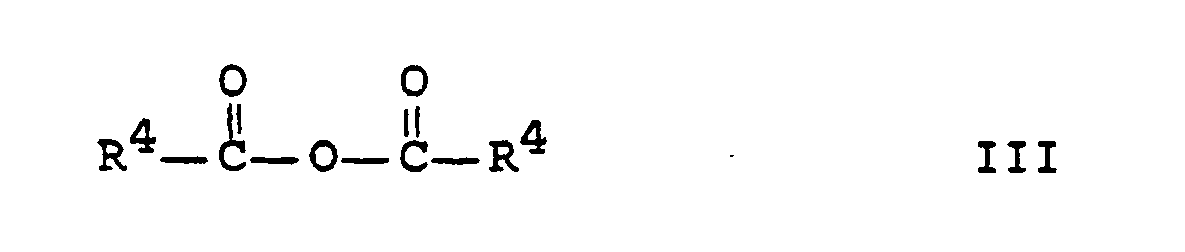
mit einer Verbindung der Formel III,

in Gegenwart von Dimethylsulfoxid und der organischen Säure, deren Anhydrid der Formel III Verwendung findet, umgesetzt wird,
wobei die Reste R¹ - R⁴ die obengenannten Bedeutungen haben
Besonders geeignet ist das Verfahren zur Herstellung von Verbindungen der Formel I in denen
R¹ und/oder R² und/oder R³ Wasserstoff, Phenyl, C₁-C₁₂-Alkyl, gegebenenfalls bis zu dreifach substituiert mit C₁-C₆-Alkoxy-, C₁-C₆-Alkylthio-, C₁-C₆-Alkylamino, C₁-C₁₂-Dialkylamino-, Benzyloxy-, Benzylthio, Benzylamino-, Dibenzylamino-, C₁-C₈-Acyloxy-, C₁-C₈-Acylthio, C₁-C₈-Acylamino- und/oder C₂-C₁₆-Diacylaminogruppen, wobei die Acylgruppen aliphatisch - beispielsweise Acetoxy oder Pivaloyloxy - oder aromatisch - beispielsweise Benzoyloxy sein können und/oder mit -P(O)(OR⁵)(OR⁶)-, -P(R⁵)(O)(OR⁶)-, -O-CH₂-P(O)(OR⁵)(OR⁶)- oder -O-CH₂-P(R⁵)(O)(OR⁶)-Resten, wobei R⁵ und R⁶ jeweils unabhängig voneinander C₁-C₆-Alkyl sein können, bedeuten und
- R⁴
- Wasserstoff, Alkyl, Trifluormethyl oder Phenyl bedeutet
oder - R¹
- Wasserstoff ist
und - R² und R³
- Teil eines verzweigten oder unverzweigten Carbocyclus mit 2 bis 8 Kohlenstoffatomen, vorzugsweise 3 bis 5 Kohlenstoffatomen im Carbocyclus sind, wobei der Carbocyclus ein oder mehrere Hydroxy-, Mercapto-, Amino- oder C₁-C₆-Alkylamino-Gruppen enthalten kann, welche mit C₁-C₆ Alkyl- und/oder C₁-C₈ Acyl- und/oder Benzylgruppen blockiert sind
und - R⁴
- wie oben definiert ist,
oder - R¹
- für eine zusätzliche Bindung zwischen dem tertiären Kohlenstoffatom und R² oder R³ steht
und - R² und R³
- Teil eines Phenylringes sind, der noch weiter mit C₁-c₄ Alkylgruppen und/oder Hydroxy-, Mercapto-, Amino- oder C₁-C₄ Alkylamino-Gruppen substituiert sein kann, welche mit C₁-C₈ Acyl und/oder Benzyl- und/oder C₁-C₆ Alkyl-Gruppen blockiert sind
und - R⁴
- wie oben definiert ist.
wherein
R¹ and / or R² and / or R³ are hydrogen, phenyl, alkyl, optionally mono- or polysubstituted by alkoxy, alkenyloxy, alkylthio, alkylamino, dialkylamino, benzyloxy, benzylthio, benzylamino, dibenzylamino, acyloxy , Acylthio, acylamino, diacylamino and / or phthalimido groups and / or with -P (O) (OR⁵) (OR⁶) -, -P (R⁵) (O) (OR⁶) -, -O-CH₂-P (O ) (OR⁵) (OR⁶) -or -O-CH₂-P (R⁵) (O) (OR⁶) radicals, where R⁵ and R⁶ can each independently be alkyl, mean and
- R⁴
- Is hydrogen, alkyl, trifluoromethyl or phenyl,
or - R¹
- Is hydrogen
and - R² and R³
- Are part of a branched or unbranched carbocycle, where the carbocycle can contain one or more hydroxyl, mercapto, amino or alkylamino groups which are blocked with alkyl and / or acyl and / or benzyl groups
and - R⁴
- as defined above,
or - R¹
- represents an additional bond between the tertiary carbon atom and R² or R³
and - R2 and R³
- Are part of a phenyl ring which can be further substituted with alkyl groups and / or hydroxyl, mercapto, amino or alkylamino groups which are blocked with acyl and / or benzyl and / or alkyl groups
and - R⁴
- as defined above,
characterized in that a compound of formula
with a compound of formula III,
is reacted in the presence of dimethyl sulfoxide and the organic acid, the anhydride of which formula III is used,
where the radicals R¹ - R⁴ have the meanings given above
The process is particularly suitable for the preparation of compounds of the formula I in which
R¹ and / or R² and / or R³ are hydrogen, phenyl, C₁-C₁₂-alkyl, optionally substituted up to three times with C₁-C₆-alkoxy-, C₁-C₆-alkylthio-, C₁-C₆-alkylamino, C₁-C₁₂-dialkylamino -, Benzyloxy, benzylthio, benzylamino, dibenzylamino, C₁-C₈ acyloxy, C₁-C₈ acylthio, C₁-C₈ acylamino and / or C₂-C₁₆ diacylamino groups, the acyl groups being aliphatic - for example acetoxy or pivaloyloxy - or aromatic - can be, for example, benzoyloxy and / or with -P (O) (OR⁵) (OR⁶) -, -P (R⁵) (O) (OR⁶) -, -O-CH₂-P (O) (OR⁵) (OR⁶) - or -O-CH₂-P (R⁵) (O) (OR⁶) radicals, where R⁵ and R⁶ can each independently be C₁-C₆-alkyl, mean and
- R⁴
- Is hydrogen, alkyl, trifluoromethyl or phenyl
or - R¹
- Is hydrogen
and - R² and R³
- Are part of a branched or unbranched carbocycle having 2 to 8 carbon atoms, preferably 3 to 5 carbon atoms in the carbocycle, it being possible for the carbocycle to contain one or more hydroxyl, mercapto, amino or C₁-C₆-alkylamino groups which are linked to C₁- C₆ alkyl and / or C₁-C₈ acyl and / or benzyl groups are blocked
and - R⁴
- as defined above,
or - R¹
- represents an additional bond between the tertiary carbon atom and R² or R³
and - R² and R³
- Are part of a phenyl ring which is further linked with C₁-c₄ alkyl groups and / or hydroxyl, mercapto, Amino or C₁-C₄ alkylamino groups can be substituted, which are blocked with C₁-C₈ acyl and / or benzyl and / or C₁-C₆ alkyl groups
and - R⁴
- is as defined above.
Besonders bevorzugt ist das Verfahren zur Herstellung von Verbindungen der Formel I, in denen
R¹ und R² Wasserstoff und R³ C₁-C₁₂-Alkyl oder R¹ Wasserstoff und R² und R³ C₁-C₁₂-Alkyl sind, wobei dieses C₁-C₁₂-Alkyl bis zu zweifach mit C₁-C₆-Alkoxy-, C₁-C₆-Alkylthio-, Benzyloxy-, Benzylthio-, Dibenzylamino-, C₁-C₈-Acyloxy, C₁-C₈-Acylthio- und/oder C₂-C₁₆-Diacylaminogruppen - wobei die Acylgruppen aliphatisch - beispielsweise Acetoxy oder Pivaloyloxy - oder aromatisch - beispielsweise Benzoyloxy - sein können - und/oder mit Resten -P(O)(OR⁵)(OR⁶), -P(R⁵)(O)(OR⁶), -O-CH₂-P-(O)(OR⁵)(OR⁶) oder -O-CH₂-P(R⁵)(O)(OR⁶), wobei R⁵ und R⁶ jeweils unabhängig voneinander C₁-C₆-Alkyl bedeuten, substituiert sein kann und R⁴ Alkyl, Trifluormethyl oder Phenyl bedeutet.The process for the preparation of compounds of the formula I in which
R¹ and R² are hydrogen and R³ are C₁-C₁₂-alkyl or R¹ are hydrogen and R² and R³ are C₁-C₁₂-alkyl, this C₁-C₁₂-alkyl being up to twice with C₁-C₆-alkoxy-, C₁-C₆-alkylthio-, Benzyloxy, benzylthio, dibenzylamino, C₁-C₈ acyloxy, C₁-C₈ acylthio and / or C₂-C₁₆ diacylamino groups - the acyl groups being aliphatic - for example acetoxy or pivaloyloxy - or aromatic - for example benzoyloxy - and / or with residues -P (O) (OR⁵) (OR⁶), -P (R⁵) (O) (OR⁶), -O-CH₂-P- (O) (OR⁵) (OR⁶) or -O-CH₂- P (R⁵) (O) (OR⁶), where R⁵ and R⁶ each independently represent C₁-C₆-alkyl, may be substituted and R⁴ means alkyl, trifluoromethyl or phenyl.
Das obengenannte Verfahren eignet sich besonders zur Herstellung der oben genannten Verbindungen, in denen R⁴ C₁-C₆-Alkyl, insbesondere C₁-C₃-Alkyl ist.The above method is particularly suitable for the preparation of the above compounds in which R⁴ is C₁-C--alkyl, especially C₁-C₃-alkyl.
Eine ganz besondere Bedeutung besitzt das erfindungsgemäße Verfahren für die Umsetzung von Acetanhydrid als Verbindung der Formel III (d.h. R⁴ = CH₃).The process according to the invention is of very particular importance for the reaction of acetic anhydride as a compound of the formula III (i.e. R⁴ = CH₃).
Wenn die Reste R¹ und/oder R² und/oder R³ der obengenannten Verbindungen Acylgruppen tragen, erhält man besonders einheitliche Produkte, wenn diese Acylgruppen mit der R⁴-C(O)-Gruppe in Formel III identisch sind.If the radicals R¹ and / or R² and / or R³ of the abovementioned compounds carry acyl groups, particularly uniform products are obtained if these acyl groups are identical to the R⁴-C (O) group in formula III.
Die als Substituenten genannten Alkylgruppen können geradkettig, verzweigt oder cyclisch sein.The alkyl groups mentioned as substituents can be straight-chain, branched or cyclic.
Die genannten Acylgruppen können geradkettig, verzweigt, cycloaliphatisch oder aromatisch sein.The acyl groups mentioned can be straight-chain, branched, cycloaliphatic or aromatic.
Die Verbindungen der Formel I können ein oder mehrere chirale Zentren aufweisen. Die Verbindungen liegen in der Regel als Racemate vor; eine Herstellung bzw. Isolierung der reinen Enantiomere ist möglich. Gegenstand der Erfindung ist deshalb sowohl das Verfahren zur Herstellung der reinen Enantiomeren als auch Mischungen derselben, wie z. B. das zugehörige Racemat.The compounds of formula I can have one or more chiral centers. The compounds are usually present as racemates; production or isolation of the pure enantiomers is possible. The invention is therefore both the process for the preparation of the pure enantiomers and mixtures thereof, such as. B. the associated racemate.
Die Alkyl-, Acyl- oder Benzyl-Schutzgruppen, mit denen Hydroxy-, Mercapto- oder Aminogruppen der Substituenten R¹ bis R³ gegebenenfalls blockiert sind, können nach üblichen Methoden abgespalten werden, wie z.B. durch Reaktion mit Borhalogeniden, Hydrolyse oder Hydrogenolyse.The alkyl, acyl or benzyl protective groups, with which the hydroxyl, mercapto or amino groups of the substituents R 1 to R 3 are optionally blocked, can be removed by customary methods, such as e.g. by reaction with boron halides, hydrolysis or hydrogenolysis.
Zur Durchführung des erfindungsgemäßen Verfahrens werden vorzugsweise ein Alkanol der Formel II, ein Anhydrid der Formel III, die dem Anhydrid entsprechende Carbonsäure und trockenes Dimethylsulfoxid unter Rühren bei einer Temperatur von -10 bis 40 °C, besonders bevorzugt von 0 bis 30 °C zusammengegeben. Das Molverhältnis von Anhydrid: Carbonsäure:Dimethylsulfoxid zu 1 Mol Alkanol liegt vorzugsweise bei 2-10:1,5-20:1-30, besonders bevorzugt bei 4-6:6-14:10-20, insbesondere bei ca. 5:ca.10:ca.15. Das Reaktionsgemisch wird vorzugsweise 1-24 Stunden, besonders bevorzugt 5 bis 7 Stunden bei 0-100 °C, insbesondere bei 30-90 °C gerührt.To carry out the process according to the invention, an alkanol of the formula II, an anhydride of the formula III, the carboxylic acid corresponding to the anhydride and dry dimethyl sulfoxide are preferably combined with stirring at a temperature of from -10 to 40 ° C., particularly preferably from 0 to 30 ° C. The molar ratio of anhydride: carboxylic acid: dimethyl sulfoxide to 1 mol of alkanol is preferably 2-10: 1.5-20: 1-30, particularly preferably 4-6: 6-14: 10-20, in particular approximately 5: ca.10: ca.15. The reaction mixture is preferably stirred for 1-24 hours, particularly preferably 5 to 7 hours at 0-100 ° C., in particular at 30-90 ° C.
Das Reaktionsgemisch kann nach herkömmlichen Methoden aufgearbeitet werden.
Vorzugsweise erfolgt die Aufarbeitung z.B. derart, daß das erhaltene Reaktionsgemisch in Eiswasser gegossen und dreimal mit einem Ether, vorzugsweise Diethylether oder Diisopropylether ausgeschüttelt wird. Die organische Phase wird danach 3 x mit Wasser und dann mehrere Male mit konzentrierter Natriumhydrogencarbonatlösung ausgeschüttelt bis die wäßrigen Waschwasser nicht mehr sauer reagieren. Sodann wird noch einmal mit Wasser ausgeschüttelt und die organische Phase über Natriumsulfat getrocknet, filtriert und unter vermindertem Druck vom Lösungsmittel befreit. Der Rückstand wird z.B. einer fraktionierten Destillation unterworfen und liefert neben Acyloxymethylthiomethylether die Acyloxymethylverbindung des eingesetzten Alkanols.The reaction mixture can be worked up by conventional methods.
The workup is preferably carried out, for example, in such a way that the reaction mixture obtained is poured into ice water and extracted three times with an ether, preferably diethyl ether or diisopropyl ether. The organic phase is then 3 times with water and then several times with concentrated sodium hydrogen carbonate solution shaken out until the aqueous wash water no longer react acidic. The mixture is then shaken again with water and the organic phase is dried over sodium sulfate, filtered and freed from the solvent under reduced pressure. The residue is subjected, for example, to fractional distillation and, in addition to acyloxymethylthiomethyl ether, provides the acyloxymethyl compound of the alkanol used.
Die vorliegende Erfindung wird durch das nachfolgende Ausführungsbeispiel näher erläutert.The present invention is explained in more detail by the following exemplary embodiment.
Verbindung der Formel I, worin R1 = Wasserstoff, R2 = R3 = Isopropoxymethyl, R4 = Methyl ist:
Zu einer Mischung aus 120 ml Eisessig und 100 ml Essigsäureanhydrid werden unter Rühren 200 ml trockenes Dimethylsulfoxid so zugetropft, daß die Temperatur des Gemisches nicht über 35 Grad Celsius ansteigt. Man rührt weitere 30 Minuten, bevor 35.2 g (0.2 Mol) 1,3-Bis-isopropoxy-propan-2-ol (hergestellt durch Reaktion von Natriumisopropylat mit 2,3-Epoxypropyl-isopropylether in Isopropanol) zugetropft werden. Nach Beendigung der Zugabe wird die Mischung 7 Stunden lang auf 90 - 100 Grad Celsius erhitzt. Die abgekühlte Reaktionsmischung wird in Eiswasser gegossen und mehrmals mit Diethylether ausgeschüttelt. Die organische Phase wird dann mit Wasser und anschließend mit konzentrierter wäßriger Natriumhydrogencarbonatlösung gewaschen, über Natriumsulfat getrocknet und unter vermindertem Druck eingeengt. Es hinterbleibt ein hellgelbes Öl, das einer fraktionierten Destillation unterworfen wird. Ein Vorlauf mit Siedepunkt 46 - 47 Grad Celsius bei einem Druck von 15 mm Hg besteht aus Acetoxymethylthiomethylether. Das Reaktionsprodukt, 2-Acetoxymethoxy-1,3-bis-isopropoxy-propan, siedet bei 87 -92 Grad Celsius bei einem Druck von 1 mm Hg. Die Ausbeute beträgt 27.3 g (55% d. Th.).
1H-NMR (60 MHz, CDCl₃), δ [ppm]: 5.43 (s, 2H), 4.0 - 3.33 (m, 7H), 2.12 (s, 3H), 1.33 (d, 12H).Compound of the formula I in which R1 = hydrogen, R2 = R3 = isopropoxymethyl, R4 = methyl:
200 ml of dry dimethyl sulfoxide are added dropwise to a mixture of 120 ml of glacial acetic acid and 100 ml of acetic anhydride so that the temperature of the mixture does not rise above 35 degrees Celsius. The mixture is stirred for a further 30 minutes before 35.2 g (0.2 mol) of 1,3-bis-isopropoxy-propan-2-ol (prepared by reacting sodium isopropoxide with 2,3-epoxypropyl-isopropyl ether in isopropanol) are added dropwise. After the addition is complete, the mixture is heated to 90-100 degrees Celsius for 7 hours. The cooled reaction mixture is poured into ice water and shaken out several times with diethyl ether. The organic phase is then washed with water and then with concentrated aqueous sodium hydrogen carbonate solution, dried over sodium sulfate and concentrated under reduced pressure. A light yellow oil remains, which is subjected to fractional distillation. A flow with a boiling point of 46 - 47 degrees Celsius at a pressure of 15 mm Hg consists of acetoxymethylthiomethyl ether. The reaction product, 2-acetoxymethoxy-1,3-bis-isopropoxy-propane, boils at 87-92 degrees Celsius under a pressure of 1 mm Hg. The yield is 27.3 g (55% of theory).
1H-NMR (60 MHz, CDCl₃), δ [ppm]: 5.43 (s, 2H), 4.0 - 3.33 (m, 7H), 2.12 (s, 3H), 1.33 (d, 12H).
In ähnlicher Weise können hergestellt werden:
1-Acetoxymethoxy-2-methoxy-ethan
1-Acetoxymethoxy-2-ethoxy-ethan
1-Acetoxymethoxy-2-propoxy-ethan
1-Acetoxymethoxy-2-isopropoxy-ethan
1-Trifluoracetoxymethoxy-2-isopropoxy-ethan
1-Benzoyloxymethoxy-2-isopropoxy-ethan
1-Acetoxymethoxy-2-butoxy-ethan
1-Acetoxymethoxy-2-benzyloxy-ethan
1-Acetoxymethoxy-2-phenoxy-ethan
1-Acetoxymethoxy-2-acetoxy-ethan
1-Acetoxymethoxy-2-pivaloyloxy-ethan
2-Acetoxymethoxy-3-methoxy-propan
(2- Acetoxymethoxy-ethoxy)methan-phosphonsäure-di-isopropylester
((2-Acetoxymethoxy-ethoxy)methyl)-methyl-phosphinsäure-isopropylester
(3-Acetoxymethoxy)propan-phosphonsäure-di-isopropylester
1-Acetoxymethoxy-2-benzyloxy-3-isopropoxy-propan
1-Benzoyloxymethoxy-2-benzyloxy-3-isopropoxy-propan
1-Acetoxymethoxy-2-benzyloxy-3-methoxy-propan
1-Acetoxymethoxy-2-benzyloxy-3-ethoxy-propan
1-Acetoxymethoxy-2,3-bis-benzyloxy-propan
1-Acetoxymethoxy-2,3-bis-(isopropoxy)-propan
1-Acetoxymethoxy-2-benzyloxy-3-(N-phthalimido)-propan
1-Acetoxymethoxy-2-benzyloxy-3-methylthio-propan
1-Acetoxymethoxy-2-benzyloxy-3-ethylthio-propan
(4-Acetoxymethoxy-3-benzyloxy)butan-phosphonsäure-di-isopropylester
2-Acetoxymethoxy-1,3-bis(methoxy)-propan
2-Acetoxymethoxy-1,3-bis(ethoxy)-propan
2-Acetoxymethoxy-1,3-bis(propoxy)-propan
2-Acetoxymethoxy-1,3-bis(isopropoxy)-propan
2-Trifluoracetoxymethoxy-1,3-bis(isopropoxy)-propan
2-Benzoyloxymethoxy-1,3-bis(isopropoxy)-propan
2-Acetoxymethoxy-1,3-bis(prop-2-en-1-oxy)-propan
2-Acetoxymethoxy-1,3-bis(benzyloxy)-propan
2-Acetoxymethoxy-1-isopropoxy-3-(1,1,2,2-tetrafluorethoxy)-propan
(3-Acetoxymethoxy-4-benzyloxy)butan-phosphonsäure-di-isopropylester
2-Acetoxymethoxy-1,3-bis(cyclopentyloxy)-propan
2-Acetoxymethoxy-1,3-bis(cyclohexyloxy)-propan
2-Acetoxymethoxy-1-benzyloxy-3-isopropoxy-propan
2-Acetoxymethoxy-1-benzyloxy-3-methoxy-propan
2-Acetoxymethoxy-1-isopropoxy-3-methoxy-propan
2-Acetoxymethoxy-1-isopropoxy-3-[1,3-bis(isopropoxy)-2-propoxy]-propan
2-Acetoxymethoxy-1-isopropoxy-3-pivaloyloxy-propan
2-Acetoxymethoxy-1-benzyloxy-3-pivaloyloxy-propan
2-Acetoxymethoxy-1,3-bis(pivaloyloxy)-propan
2-Acetoxymethoxy-1-isopropoxy-3-phenoxy-propan
2-Acetoxymethoxy-1-isopropoxy-3-(N-phthalimido)-propan
Acetoxymethoxy-cyclohexan
Acetoxymethoxy-benzolThe following can be produced in a similar manner:
1-acetoxymethoxy-2-methoxyethane
1-acetoxymethoxy-2-ethoxy-ethane
1-acetoxymethoxy-2-propoxy-ethane
1-acetoxymethoxy-2-isopropoxy-ethane
1-trifluoroacetoxymethoxy-2-isopropoxy-ethane
1-benzoyloxymethoxy-2-isopropoxy-ethane
1-acetoxymethoxy-2-butoxyethane
1-acetoxymethoxy-2-benzyloxy-ethane
1-acetoxymethoxy-2-phenoxyethane
1-acetoxymethoxy-2-acetoxy-ethane
1-acetoxymethoxy-2-pivaloyloxy-ethane
2-acetoxymethoxy-3-methoxypropane
(2-Acetoxymethoxy-ethoxy) methane-phosphonic acid di-isopropyl ester
((2-Acetoxymethoxyethoxy) methyl) methylphosphinic acid isopropyl ester
(3-acetoxymethoxy) propane-phosphonic acid di-isopropyl ester
1-acetoxymethoxy-2-benzyloxy-3-isopropoxypropane
1-benzoyloxymethoxy-2-benzyloxy-3-isopropoxypropane
1-acetoxymethoxy-2-benzyloxy-3-methoxypropane
1-acetoxymethoxy-2-benzyloxy-3-ethoxypropane
1-acetoxymethoxy-2,3-bis-benzyloxypropane
1-acetoxymethoxy-2,3-bis (isopropoxy) propane
1-acetoxymethoxy-2-benzyloxy-3- (N-phthalimido) propane
1-acetoxymethoxy-2-benzyloxy-3-methylthio-propane
1-acetoxymethoxy-2-benzyloxy-3-ethylthio-propane
(4-acetoxymethoxy-3-benzyloxy) butane-phosphonic acid di-isopropyl ester
2-acetoxymethoxy-1,3-bis (methoxy) propane
2-acetoxymethoxy-1,3-bis (ethoxy) propane
2-acetoxymethoxy-1,3-bis (propoxy) propane
2-acetoxymethoxy-1,3-bis (isopropoxy) propane
2-trifluoroacetoxymethoxy-1,3-bis (isopropoxy) propane
2-benzoyloxymethoxy-1,3-bis (isopropoxy) propane
2-acetoxymethoxy-1,3-bis (prop-2-en-1-oxy) propane
2-acetoxymethoxy-1,3-bis (benzyloxy) propane
2-acetoxymethoxy-1-isopropoxy-3- (1,1,2,2-tetrafluoroethoxy) propane
(3-acetoxymethoxy-4-benzyloxy) butane-phosphonic acid di-isopropyl ester
2-acetoxymethoxy-1,3-bis (cyclopentyloxy) propane
2-acetoxymethoxy-1,3-bis (cyclohexyloxy) propane
2-acetoxymethoxy-1-benzyloxy-3-isopropoxypropane
2-acetoxymethoxy-1-benzyloxy-3-methoxypropane
2-acetoxymethoxy-1-isopropoxy-3-methoxypropane
2-acetoxymethoxy-1-isopropoxy-3- [1,3-bis (isopropoxy) -2-propoxy] propane
2-acetoxymethoxy-1-isopropoxy-3-pivaloyloxypropane
2-acetoxymethoxy-1-benzyloxy-3-pivaloyloxypropane
2-acetoxymethoxy-1,3-bis (pivaloyloxy) propane
2-acetoxymethoxy-1-isopropoxy-3-phenoxypropane
2-acetoxymethoxy-1-isopropoxy-3- (N-phthalimido) propane
Acetoxymethoxy-cyclohexane
Acetoxymethoxy benzene
In ähnlicher Weise können unter Verwendung von Propionsäure und Propionsäureanhydrid oder von Buttersäure und Butteräureanhydrid oder von Isobuttersäure und Isobuttersäureanhydrid die entsprechenden Propanoyloxymethoxy- oder Butanoyloxymethoxy- oder Isobutanoyloxymethoxyverbindungen gewonnen werden.Similarly, the corresponding propanoyloxymethoxy or butanoyloxymethoxy or isobutanoyloxymethoxy compounds can be obtained using propionic acid and propionic anhydride or butyric acid and butteric anhydride or isobutyric acid and isobutyric anhydride.
Claims (3)

und
und
oder
und
und


and
and
or
and
and
Applications Claiming Priority (2)
| Application Number | Priority Date | Filing Date | Title |
|---|---|---|---|
| DE4008856A DE4008856A1 (en) | 1990-03-20 | 1990-03-20 | METHOD FOR PRODUCING ACYLALS |
| DE4008856 | 1990-03-20 |
Publications (3)
| Publication Number | Publication Date |
|---|---|
| EP0448006A2 true EP0448006A2 (en) | 1991-09-25 |
| EP0448006A3 EP0448006A3 (en) | 1992-04-22 |
| EP0448006B1 EP0448006B1 (en) | 1995-01-25 |
Family
ID=6402600
Family Applications (1)
| Application Number | Title | Priority Date | Filing Date |
|---|---|---|---|
| EP91104127A Expired - Lifetime EP0448006B1 (en) | 1990-03-20 | 1991-03-18 | Process for the preparation of acylales |
Country Status (11)
| Country | Link |
|---|---|
| US (1) | US5231221A (en) |
| EP (1) | EP0448006B1 (en) |
| JP (1) | JP3010076B2 (en) |
| AT (1) | ATE117670T1 (en) |
| DE (2) | DE4008856A1 (en) |
| DK (1) | DK0448006T3 (en) |
| ES (1) | ES2068410T3 (en) |
| GR (1) | GR3015102T3 (en) |
| IE (1) | IE910907A1 (en) |
| PT (1) | PT97072A (en) |
| TW (1) | TW206211B (en) |
Cited By (1)
| Publication number | Priority date | Publication date | Assignee | Title |
|---|---|---|---|---|
| EP0717317A3 (en) * | 1994-12-15 | 1996-07-10 | Hoechst Ag |
Family Cites Families (2)
| Publication number | Priority date | Publication date | Assignee | Title |
|---|---|---|---|---|
| GB830850A (en) * | 1957-11-07 | 1960-03-23 | Distillers Co Yeast Ltd | Production of alkoxymethyl acetates |
| US3165532A (en) * | 1961-06-14 | 1965-01-12 | Exxon Research Engineering Co | Hemiacetal ester production |
-
1990
- 1990-03-20 DE DE4008856A patent/DE4008856A1/en not_active Withdrawn
-
1991
- 1991-03-18 AT AT91104127T patent/ATE117670T1/en not_active IP Right Cessation
- 1991-03-18 ES ES91104127T patent/ES2068410T3/en not_active Expired - Lifetime
- 1991-03-18 DE DE59104352T patent/DE59104352D1/en not_active Expired - Fee Related
- 1991-03-18 EP EP91104127A patent/EP0448006B1/en not_active Expired - Lifetime
- 1991-03-18 DK DK91104127.5T patent/DK0448006T3/en active
- 1991-03-18 US US07/671,103 patent/US5231221A/en not_active Expired - Fee Related
- 1991-03-19 PT PT97072A patent/PT97072A/en not_active Application Discontinuation
- 1991-03-19 JP JP3078291A patent/JP3010076B2/en not_active Expired - Lifetime
- 1991-03-19 IE IE090791A patent/IE910907A1/en unknown
- 1991-03-26 TW TW080102324A patent/TW206211B/zh active
-
1995
- 1995-02-17 GR GR950400320T patent/GR3015102T3/en unknown
Cited By (3)
| Publication number | Priority date | Publication date | Assignee | Title |
|---|---|---|---|---|
| EP0717317A3 (en) * | 1994-12-15 | 1996-07-10 | Hoechst Ag | |
| US5705317A (en) * | 1994-12-15 | 1998-01-06 | Agfa-Gevaert Ag | Radiation-sensitive mixture |
| US5998567A (en) * | 1994-12-15 | 1999-12-07 | Clariant Gmbh | Radiation-sensitive mixture |
Also Published As
| Publication number | Publication date |
|---|---|
| JP3010076B2 (en) | 2000-02-14 |
| EP0448006B1 (en) | 1995-01-25 |
| ES2068410T3 (en) | 1995-04-16 |
| EP0448006A3 (en) | 1992-04-22 |
| PT97072A (en) | 1991-12-31 |
| DE4008856A1 (en) | 1991-09-26 |
| DE59104352D1 (en) | 1995-03-09 |
| DK0448006T3 (en) | 1995-06-19 |
| GR3015102T3 (en) | 1995-05-31 |
| ATE117670T1 (en) | 1995-02-15 |
| US5231221A (en) | 1993-07-27 |
| JPH04217941A (en) | 1992-08-07 |
| IE910907A1 (en) | 1991-09-25 |
| TW206211B (en) | 1993-05-21 |
Similar Documents
| Publication | Publication Date | Title |
|---|---|---|
| EP0893426B1 (en) | Biphasic process for preparing carboxylic esters | |
| DE2365852A1 (en) | PROCESS FOR THE MANUFACTURING OF MONOACETAL AROMATIC 1,2-DIKETONE | |
| DE2441878B2 (en) | PROCESS FOR THE MANUFACTURING OF PHOSPHONIC AND PHOSPHIC ACIDS | |
| EP0463464A1 (en) | Process for the preparation of 2-chloro-5-methylpyridine | |
| DE2732107C2 (en) | Process for the preparation of cyclic ketoacetic acid esters | |
| EP0448006B1 (en) | Process for the preparation of acylales | |
| DE69706757T2 (en) | Process for the preparation of 3-amino substituted crotonates | |
| DE69012510T2 (en) | Process for the preparation of optically active fluorine-containing esters of 3-hydroxybutyric acid. | |
| EP0480307A2 (en) | Process for the preparation of acylaminomethane phosphonic acids | |
| EP0543845B1 (en) | Process for producing aminomethanephosphonic acid and aminomethylphosphinic acids | |
| EP0346852B1 (en) | Process for producing 4-chloro-3-alkoxybut-2E-ene acid alkyl esters | |
| EP0182168B1 (en) | Process for the preparation of esters of hydroxymethylene-alcoxyacetic acid | |
| DE3878560T2 (en) | METHOD FOR PRODUCING ESTERS OF N-SUBSTITUTED AMINO ACIDS. | |
| EP0076379B1 (en) | Process for the preparation of 4-alkoxy-acetoacetic-acid esters | |
| DE2715933A1 (en) | PROCESS FOR THE PREPARATION OF PHOSPHORYLATED AMIDINES | |
| DE3401913A1 (en) | Process for the preparation of 8-hydroxyoctanoic acid and its salts, and its use | |
| WO1992003448A1 (en) | Method for preparing aminomethanephosphonic acid and aminomethylphosphinic acids from n-hydroxymethylamides | |
| DE1141634B (en) | Process for the production of dithiolphosphoric acid esters | |
| CH650488A5 (en) | METHOD FOR PRODUCING THE M-PHENOXY-BENZYL ALCOHOL. | |
| EP0110432A1 (en) | Process for preparing 9-fluorenecarboxylic acid | |
| DE19832146B4 (en) | Process for the preparation of 3-methylpyrazole or its salts | |
| DE2413824C2 (en) | Process for the preparation of tertiary (hydroxymethyl) methylphosphine oxides | |
| DE3615657C2 (en) | ||
| DE3874511T2 (en) | METHOD FOR PRODUCING CYCLOALIPHATIC ALDEHYDES. | |
| DE3412713C2 (en) |
Legal Events
| Date | Code | Title | Description |
|---|---|---|---|
| PUAI | Public reference made under article 153(3) epc to a published international application that has entered the european phase |
Free format text: ORIGINAL CODE: 0009012 |
|
| AK | Designated contracting states |
Kind code of ref document: A2 Designated state(s): AT BE CH DE DK ES FR GB GR IT LI LU NL SE |
|
| PUAL | Search report despatched |
Free format text: ORIGINAL CODE: 0009013 |
|
| AK | Designated contracting states |
Kind code of ref document: A3 Designated state(s): AT BE CH DE DK ES FR GB GR IT LI LU NL SE |
|
| 17P | Request for examination filed |
Effective date: 19920903 |
|
| 17Q | First examination report despatched |
Effective date: 19940303 |
|
| GRAA | (expected) grant |
Free format text: ORIGINAL CODE: 0009210 |
|
| AK | Designated contracting states |
Kind code of ref document: B1 Designated state(s): AT BE CH DE DK ES FR GB GR IT LI LU NL SE |
|
| REF | Corresponds to: |
Ref document number: 117670 Country of ref document: AT Date of ref document: 19950215 Kind code of ref document: T |
|
| REF | Corresponds to: |
Ref document number: 59104352 Country of ref document: DE Date of ref document: 19950309 |
|
| ET | Fr: translation filed | ||
| ITF | It: translation for a ep patent filed | ||
| REG | Reference to a national code |
Ref country code: ES Ref legal event code: FG2A Ref document number: 2068410 Country of ref document: ES Kind code of ref document: T3 |
|
| REG | Reference to a national code |
Ref country code: GR Ref legal event code: FG4A Free format text: 3015102 |
|
| GBT | Gb: translation of ep patent filed (gb section 77(6)(a)/1977) |
Effective date: 19950407 |
|
| REG | Reference to a national code |
Ref country code: DK Ref legal event code: T3 |
|
| PLBE | No opposition filed within time limit |
Free format text: ORIGINAL CODE: 0009261 |
|
| STAA | Information on the status of an ep patent application or granted ep patent |
Free format text: STATUS: NO OPPOSITION FILED WITHIN TIME LIMIT |
|
| 26N | No opposition filed | ||
| PGFP | Annual fee paid to national office [announced via postgrant information from national office to epo] |
Ref country code: DE Payment date: 20010209 Year of fee payment: 11 |
|
| PGFP | Annual fee paid to national office [announced via postgrant information from national office to epo] |
Ref country code: NL Payment date: 20010219 Year of fee payment: 11 Ref country code: AT Payment date: 20010219 Year of fee payment: 11 |
|
| PGFP | Annual fee paid to national office [announced via postgrant information from national office to epo] |
Ref country code: SE Payment date: 20010220 Year of fee payment: 11 Ref country code: GB Payment date: 20010220 Year of fee payment: 11 Ref country code: FR Payment date: 20010220 Year of fee payment: 11 |
|
| PGFP | Annual fee paid to national office [announced via postgrant information from national office to epo] |
Ref country code: DK Payment date: 20010221 Year of fee payment: 11 |
|
| PGFP | Annual fee paid to national office [announced via postgrant information from national office to epo] |
Ref country code: CH Payment date: 20010222 Year of fee payment: 11 |
|
| PGFP | Annual fee paid to national office [announced via postgrant information from national office to epo] |
Ref country code: GR Payment date: 20010223 Year of fee payment: 11 |
|
| PGFP | Annual fee paid to national office [announced via postgrant information from national office to epo] |
Ref country code: ES Payment date: 20010305 Year of fee payment: 11 |
|
| PGFP | Annual fee paid to national office [announced via postgrant information from national office to epo] |
Ref country code: LU Payment date: 20010320 Year of fee payment: 11 |
|
| PGFP | Annual fee paid to national office [announced via postgrant information from national office to epo] |
Ref country code: BE Payment date: 20010409 Year of fee payment: 11 |
|
| REG | Reference to a national code |
Ref country code: GB Ref legal event code: IF02 |
|
| PG25 | Lapsed in a contracting state [announced via postgrant information from national office to epo] |
Ref country code: LU Free format text: LAPSE BECAUSE OF NON-PAYMENT OF DUE FEES Effective date: 20020318 Ref country code: GB Free format text: LAPSE BECAUSE OF NON-PAYMENT OF DUE FEES Effective date: 20020318 Ref country code: AT Free format text: LAPSE BECAUSE OF NON-PAYMENT OF DUE FEES Effective date: 20020318 |
|
| PG25 | Lapsed in a contracting state [announced via postgrant information from national office to epo] |
Ref country code: SE Free format text: LAPSE BECAUSE OF NON-PAYMENT OF DUE FEES Effective date: 20020319 Ref country code: ES Free format text: LAPSE BECAUSE OF NON-PAYMENT OF DUE FEES Effective date: 20020319 |
|
| PG25 | Lapsed in a contracting state [announced via postgrant information from national office to epo] |
Ref country code: LI Free format text: LAPSE BECAUSE OF NON-PAYMENT OF DUE FEES Effective date: 20020331 Ref country code: CH Free format text: LAPSE BECAUSE OF NON-PAYMENT OF DUE FEES Effective date: 20020331 Ref country code: BE Free format text: LAPSE BECAUSE OF NON-PAYMENT OF DUE FEES Effective date: 20020331 |
|
| PG25 | Lapsed in a contracting state [announced via postgrant information from national office to epo] |
Ref country code: DK Free format text: LAPSE BECAUSE OF NON-PAYMENT OF DUE FEES Effective date: 20020402 |
|
| BERE | Be: lapsed |
Owner name: *HOECHST A.G. Effective date: 20020331 |
|
| PG25 | Lapsed in a contracting state [announced via postgrant information from national office to epo] |
Ref country code: NL Free format text: LAPSE BECAUSE OF NON-PAYMENT OF DUE FEES Effective date: 20021001 Ref country code: DE Free format text: LAPSE BECAUSE OF NON-PAYMENT OF DUE FEES Effective date: 20021001 |
|
| PG25 | Lapsed in a contracting state [announced via postgrant information from national office to epo] |
Ref country code: GR Free format text: LAPSE BECAUSE OF NON-PAYMENT OF DUE FEES Effective date: 20021007 |
|
| EUG | Se: european patent has lapsed |
Ref document number: 91104127.5 |
|
| GBPC | Gb: european patent ceased through non-payment of renewal fee |
Effective date: 20020318 |
|
| REG | Reference to a national code |
Ref country code: CH Ref legal event code: PL |
|
| REG | Reference to a national code |
Ref country code: DK Ref legal event code: EBP |
|
| PG25 | Lapsed in a contracting state [announced via postgrant information from national office to epo] |
Ref country code: FR Free format text: LAPSE BECAUSE OF NON-PAYMENT OF DUE FEES Effective date: 20021129 |
|
| NLV4 | Nl: lapsed or anulled due to non-payment of the annual fee |
Effective date: 20021001 |
|
| REG | Reference to a national code |
Ref country code: FR Ref legal event code: ST |
|
| REG | Reference to a national code |
Ref country code: ES Ref legal event code: FD2A Effective date: 20030410 |
|
| PG25 | Lapsed in a contracting state [announced via postgrant information from national office to epo] |
Ref country code: IT Free format text: LAPSE BECAUSE OF NON-PAYMENT OF DUE FEES Effective date: 20050318 |