EP0448189A2 - Procédé de décapage d'objets en matériaux hautement alliés et appareil pour sa mise en oeuvre - Google Patents
Procédé de décapage d'objets en matériaux hautement alliés et appareil pour sa mise en oeuvre Download PDFInfo
- Publication number
- EP0448189A2 EP0448189A2 EP91250067A EP91250067A EP0448189A2 EP 0448189 A2 EP0448189 A2 EP 0448189A2 EP 91250067 A EP91250067 A EP 91250067A EP 91250067 A EP91250067 A EP 91250067A EP 0448189 A2 EP0448189 A2 EP 0448189A2
- Authority
- EP
- European Patent Office
- Prior art keywords
- acid
- pickling
- threshold value
- bath
- predetermined threshold
- Prior art date
- Legal status (The legal status is an assumption and is not a legal conclusion. Google has not performed a legal analysis and makes no representation as to the accuracy of the status listed.)
- Granted
Links
- 0 C*C(C(C1)C(C2)[C@@]2C(CC(C)(CC2C3)C4C([C@@](C(C)C(C)O)O)C5O)C2C3C45N)(C1C(C)(C)CCCCCC1C*(C)=C2)C1(*C)C2O Chemical compound C*C(C(C1)C(C2)[C@@]2C(CC(C)(CC2C3)C4C([C@@](C(C)C(C)O)O)C5O)C2C3C45N)(C1C(C)(C)CCCCCC1C*(C)=C2)C1(*C)C2O 0.000 description 1
Images


Classifications
-
- C—CHEMISTRY; METALLURGY
- C23—COATING METALLIC MATERIAL; COATING MATERIAL WITH METALLIC MATERIAL; CHEMICAL SURFACE TREATMENT; DIFFUSION TREATMENT OF METALLIC MATERIAL; COATING BY VACUUM EVAPORATION, BY SPUTTERING, BY ION IMPLANTATION OR BY CHEMICAL VAPOUR DEPOSITION, IN GENERAL; INHIBITING CORROSION OF METALLIC MATERIAL OR INCRUSTATION IN GENERAL
- C23G—CLEANING OR DE-GREASING OF METALLIC MATERIAL BY CHEMICAL METHODS OTHER THAN ELECTROLYSIS
- C23G1/00—Cleaning or pickling metallic material with solutions or molten salts
- C23G1/02—Cleaning or pickling metallic material with solutions or molten salts with acid solutions
- C23G1/10—Other heavy metals
-
- C—CHEMISTRY; METALLURGY
- C23—COATING METALLIC MATERIAL; COATING MATERIAL WITH METALLIC MATERIAL; CHEMICAL SURFACE TREATMENT; DIFFUSION TREATMENT OF METALLIC MATERIAL; COATING BY VACUUM EVAPORATION, BY SPUTTERING, BY ION IMPLANTATION OR BY CHEMICAL VAPOUR DEPOSITION, IN GENERAL; INHIBITING CORROSION OF METALLIC MATERIAL OR INCRUSTATION IN GENERAL
- C23G—CLEANING OR DE-GREASING OF METALLIC MATERIAL BY CHEMICAL METHODS OTHER THAN ELECTROLYSIS
- C23G1/00—Cleaning or pickling metallic material with solutions or molten salts
- C23G1/02—Cleaning or pickling metallic material with solutions or molten salts with acid solutions
- C23G1/08—Iron or steel
- C23G1/086—Iron or steel solutions containing HF
Definitions
- the invention relates to a method for pickling workpieces made of high-alloy materials according to the preamble of the main claim.
- workpieces made of high-alloy materials such.
- Pickling may be required after hot working, such as extrusion or heat treatment, to remove the scale that has formed.
- mixed acid which is usually operated in a temperature range from room temperature to 70 degrees Celsius, considerable amounts of nitrogen oxides (NO; NO2) are released in accordance with the material removal.
- NO nitrogen oxides
- the object of the invention is to provide an improved method for pickling workpieces made of highly different high-alloy materials, with which the officially defined limit values with regard to the permissible emission of nitrogen oxides are reliably undershot in a simple and space-saving manner with short pickling times and in continuous operation.
- the advantage of the method can be seen in the fact that, on the one hand, an inexpensive chemical is used as the NO x acceptor, continuous operation of the pickling is possible and, in the normal case, the NO x content already detected in the area of origin is almost zero or at the detection limit (approx. 1 mg / m3).
- the threshold value has been set to a level which, based on the evaluation of a large number of measurement records, is clearly related to the consumption of the added sulfamic acid.
- This signal is sent to the Electric drive of a pump, which is arranged on a storage container for the liquid amidosulfonic acid, passed on, so that appropriate amounts of amidosulfonic acid can be supplied to the bath by means of a timer.
- the advantage of the method is to be seen in the fact that in normal operation the NO x portion is at the detection limit due to the action of the amidosulfonic acid. is driven, ie is almost zero.
- the elimination of the washing systems also means a not inconsiderable saving in water, which is reflected in low pickling costs per ton of pickled material.
- a measurement in the chimney gave values ⁇ 1 ppm. This value must be related to the permissible limit of the TA-Luft of 780 ppm, which is valid at the delivery point to the environment, while the MAK value (maximum workplace concentration) is binding at the work place.
- the pickling plant has a heatable pickling basin 1, shown here in cross section, which is filled with a mixed acid 2 consisting of nitric acid, hydrofluoric acid and water and in which, for example, a bundle of tubes 3 made of a high-alloy material for pickling is immersed.
- the ascending, vaporous reaction products as indicated by the arrows 4, are sucked off together with the room air through the extraction channels 5,5 ', 5'',5''' arranged on the upper edge of the pickling tank 1.
- the discharge channels 5,5 ', 5'',5''' are connected to lines 6,7, which, when combined, are fed to a washing system 8, shown schematically here.
- a sensor 11 which is connected to a measuring device 12 and which continuously measures the residual traces of substances to be detected which are still present in the exhaust air. These records serve as documentation for the routine inspections of the Labor Inspectorate regarding the emission of pollutants.
- Another sensor 13 is arranged on the exhaust air duct 5 ', in such a way that the tip of the sensor 13 is located directly in the vicinity of the bath level 14. The sensor 13 is connected via a line 15 to a measuring device 16 for determining the NO x content.
- the measured actual value can, on the one hand, be displayed directly on a display device 17 or be fed to a control device 18, which forms a control signal in comparison with a predetermined threshold value.
- This control signal is fed via a line 19 to the electric drive 20 of a pump (not shown here).
- This pump is arranged on a reservoir 21 for the amidosulfonic acid, from which a line 22 leads to the pickling tank 1.
- the operating team is required to lift the tube pack (s) 3 out of the pickling basin 1 in order to interrupt the pickling process and prevent further NO x formation.
- FIG. 2 In the top view (FIG. 2) it can be seen that the sensor 13 is the most distant from the effect of the amidosulfonic acid supplied remote location is arranged. This ensures that the time span for the mixing of the amidosulfonic acid supplied with the mixed acid 2 present in the pickling tank 1 is taken into account.
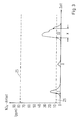
- the measurement sequence I shows the usual course of the NO x content with the diminishing effect of the added amidosulfonic acid.
- the measured NO x content increases relatively quickly and when the predetermined threshold value 25 is reached, for example at 8 ppm, the pump 20 is switched on and an excess amount of amidosulfonic acid is added to the mixed acid. Since the effect of the amidosulphonic acid supplied does not immediately begin fully at all points in the pickling tank 1 due to the time required for thorough mixing, the NO x content initially rises further and here, for example, reaches 20 ppm as a peak point.
- the measurement sequence II is intended to indicate the peculiarity of the pipe pickling system, in which it cannot be ruled out that a short-term increase in the NO x content in the detection area 13 is detected by an air bubble being released or by unusually violent bath movement. Since the peak value of this is still below the predetermined threshold value 25, pump operation is not triggered. This prevents that with a sufficient amount of amidosulfonic acid in the mixed acid bath, a locally increased NO x value causes a further supply of amidosulfonic acid.
- the measurement sequence III shows an exceptional case which can occur if a particularly large tube packet with a high degree of scaling is used at the time the effect of the amidosulfonic acid has subsided.
- the threshold 25th excess NO x levels peaked in the short term in the range 40 - 50 ppm and the cooldown is longer overall.
- the defined switching pause for the pump is plotted on the time axis with x.
- Example III now shows that the currently measured value is still above the threshold value 25 and the pump is consequently switched on again.
- the warning limit 26 entered at approximately 78 ppm is a further threshold value, which is then of importance if the NO x portion should skyrocket to this value due to a pump failure.
- a warning tone is triggered and the pickling process is interrupted by lifting the tube pack (s) 3 in order to prevent further NO x formation which may have a negative impact on health.
Landscapes
- Chemical & Material Sciences (AREA)
- Chemical Kinetics & Catalysis (AREA)
- General Chemical & Material Sciences (AREA)
- Engineering & Computer Science (AREA)
- Materials Engineering (AREA)
- Mechanical Engineering (AREA)
- Metallurgy (AREA)
- Organic Chemistry (AREA)
- Cleaning And De-Greasing Of Metallic Materials By Chemical Methods (AREA)
Applications Claiming Priority (2)
| Application Number | Priority Date | Filing Date | Title |
|---|---|---|---|
| DE4008567 | 1990-03-14 | ||
| DE4008567 | 1990-03-14 |
Publications (3)
| Publication Number | Publication Date |
|---|---|
| EP0448189A2 true EP0448189A2 (fr) | 1991-09-25 |
| EP0448189A3 EP0448189A3 (en) | 1993-07-14 |
| EP0448189B1 EP0448189B1 (fr) | 1996-05-22 |
Family
ID=6402418
Family Applications (1)
| Application Number | Title | Priority Date | Filing Date |
|---|---|---|---|
| EP91250067A Expired - Lifetime EP0448189B1 (fr) | 1990-03-14 | 1991-03-12 | Procédé de décapage d'objets en matériaux hautement alliés et appareil pour sa mise en oeuvre |
Country Status (3)
| Country | Link |
|---|---|
| EP (1) | EP0448189B1 (fr) |
| AT (1) | ATE138423T1 (fr) |
| DE (1) | DE59107828D1 (fr) |
Family Cites Families (3)
| Publication number | Priority date | Publication date | Assignee | Title |
|---|---|---|---|---|
| DE1621608A1 (de) * | 1967-01-31 | 1971-06-03 | Kunststofftechnik Gmbh U Co Ve | Verfahren zum Abfangen von Stickoxyden |
| DE3412329A1 (de) * | 1984-04-03 | 1985-10-10 | Maschinenfabrik Andritz Ag, Graz | Verfahren zum beizen von edelstaehlen, kupfer, buntmetallegierungen, sonderlegierungen, titan, zirkon, tantal usw. mittels salpetersaurer beizbaeder |
| EP0259533A1 (fr) * | 1986-09-11 | 1988-03-16 | Eka Nobel Aktiebolag | Procédé pour diminuer l'emission d'oxydes de nitrogène à partir de liquides contenant de l'acide nitrique |
-
1991
- 1991-03-12 EP EP91250067A patent/EP0448189B1/fr not_active Expired - Lifetime
- 1991-03-12 DE DE59107828T patent/DE59107828D1/de not_active Expired - Fee Related
- 1991-03-12 AT AT91250067T patent/ATE138423T1/de not_active IP Right Cessation
Also Published As
| Publication number | Publication date |
|---|---|
| EP0448189A3 (en) | 1993-07-14 |
| DE59107828D1 (de) | 1996-06-27 |
| EP0448189B1 (fr) | 1996-05-22 |
| ATE138423T1 (de) | 1996-06-15 |
Similar Documents
| Publication | Publication Date | Title |
|---|---|---|
| DE69328139T2 (de) | Verfahren zum Beizen und Passivieren von rostfreiem Stahl ohne Verwendung von Salpetersäure | |
| DE69114265T2 (de) | Verfahren zum Beizen und Passivieren von rostfreiem Stahl ohne Verwendung von Salpetersäure. | |
| DE69606270T2 (de) | Wässerige Lösung zur Kaltverfestigungsbehandlung von Stahlblechen | |
| EP0972854B1 (fr) | Procédé de dècapage d'acier inoxydable | |
| DE4117382A1 (de) | Verfahren zum regeln des ph-wertes einer sauren waschfluessigkeit | |
| DE2227028C3 (de) | Vorrichtung und Verfahren zur Behandlung giftiger Abfallstoffe | |
| EP0448189B1 (fr) | Procédé de décapage d'objets en matériaux hautement alliés et appareil pour sa mise en oeuvre | |
| DE4103598C2 (fr) | ||
| EP0456271B1 (fr) | Agent de nettoyage pour des installations d'eau potable | |
| DE3110491C2 (de) | Verfahren und Anlage zum Einengen eines in einem Kernkraftwerk anfallenden, Borsäure enthaltenden radioaktiven Abwassers | |
| EP2359924B1 (fr) | Dispositif d'absorption de gaz polluants | |
| DE3412329C2 (fr) | ||
| DE2839506C2 (de) | Verfahren zum Auswaschen saurer Gase aus Gasgemischen | |
| DE3119444A1 (de) | Verfahren zur stabilisierung des betriebes eines aus tantal oder einer legierung auf tantalbasis bestehenden saeuredigerierkessels | |
| DE3205736A1 (de) | Verfahren fuer die loesungsmittelbehandlung von insbesondere metallischem behandlungsgut | |
| DE3000705C2 (de) | Verfahren zum Aufrechterhalten der biologischen Aktivität und Adaptation der Biozönose einer biologischen Abluftnaßreinigungsanlage in Stillstandszeiten | |
| DE3526055C1 (de) | Verfahren zur Herstellung von Wasserstoff/Stickstoff-Schutzgas-Gemischen zum Glühen kaltgewalzter Stahlbänder | |
| DE69023359T2 (de) | Reinigungsverfahren für die Innenflächen von industriellen Apparaten aus Metall, z.B. aus Eisen oder Stahl. | |
| AT377011B (de) | Verfahren zum beizen von edelstaehlen, kupfer, buntmetallegierungen, sonderlegierungen, titan, zirkon oder tantal mittels salpetersaurer beizbaeder | |
| DE3206205C2 (de) | Verfahren zur Verhinderung oder Verringerung von Spannungsrißkorrosion | |
| EP1513634B1 (fr) | Procede permettant de reduire la corrosivite d'une eau de refroidissement ou de traitement | |
| DE19706410A1 (de) | Verfahren und Mittel zur Korrosionsschutzbehandlung wasserführender Metallsysteme | |
| DE102006041482B3 (de) | Verfahren zum Spülen einer Druckrohrleitung und Abwasserfördervorrichtung | |
| DE102019111149B4 (de) | Verfahren und Anlage zur Aufbereitung einer Sole für ein Schwebebecken | |
| DE3301001C2 (de) | Gär- und Lagerbehälter |
Legal Events
| Date | Code | Title | Description |
|---|---|---|---|
| PUAI | Public reference made under article 153(3) epc to a published international application that has entered the european phase |
Free format text: ORIGINAL CODE: 0009012 |
|
| AK | Designated contracting states |
Kind code of ref document: A2 Designated state(s): AT CH DE ES FR GB IT LI SE |
|
| PUAL | Search report despatched |
Free format text: ORIGINAL CODE: 0009013 |
|
| AK | Designated contracting states |
Kind code of ref document: A3 Designated state(s): AT CH DE ES FR GB IT LI SE |
|
| 17P | Request for examination filed |
Effective date: 19930621 |
|
| 17Q | First examination report despatched |
Effective date: 19940224 |
|
| GRAH | Despatch of communication of intention to grant a patent |
Free format text: ORIGINAL CODE: EPIDOS IGRA |
|
| GRAA | (expected) grant |
Free format text: ORIGINAL CODE: 0009210 |
|
| AK | Designated contracting states |
Kind code of ref document: B1 Designated state(s): AT CH DE ES FR GB IT LI SE |
|
| PG25 | Lapsed in a contracting state [announced via postgrant information from national office to epo] |
Ref country code: IT Free format text: LAPSE BECAUSE OF FAILURE TO SUBMIT A TRANSLATION OF THE DESCRIPTION OR TO PAY THE FEE WITHIN THE PRE;WARNING: LAPSES OF ITALIAN PATENTS WITH EFFECTIVE DATE BEFORE 2007 MAY HAVE OCCURRED AT ANY TIME BEFORE 2007. THE CORRECT EFFECTIVE DATE MAY BE DIFFERENT FROM THE ONE RECORDED.SCRIBED TIME-LIMIT Effective date: 19960522 Ref country code: GB Effective date: 19960522 Ref country code: FR Effective date: 19960522 Ref country code: ES Free format text: THE PATENT HAS BEEN ANNULLED BY A DECISION OF A NATIONAL AUTHORITY Effective date: 19960522 |
|
| REF | Corresponds to: |
Ref document number: 138423 Country of ref document: AT Date of ref document: 19960615 Kind code of ref document: T |
|
| REF | Corresponds to: |
Ref document number: 59107828 Country of ref document: DE Date of ref document: 19960627 |
|
| EN | Fr: translation not filed | ||
| EN | Fr: translation not filed | ||
| GBV | Gb: ep patent (uk) treated as always having been void in accordance with gb section 77(7)/1977 [no translation filed] |
Effective date: 19960522 |
|
| PGFP | Annual fee paid to national office [announced via postgrant information from national office to epo] |
Ref country code: CH Payment date: 19970226 Year of fee payment: 7 |
|
| PLBE | No opposition filed within time limit |
Free format text: ORIGINAL CODE: 0009261 |
|
| STAA | Information on the status of an ep patent application or granted ep patent |
Free format text: STATUS: NO OPPOSITION FILED WITHIN TIME LIMIT |
|
| 26N | No opposition filed | ||
| PG25 | Lapsed in a contracting state [announced via postgrant information from national office to epo] |
Ref country code: CH Free format text: LAPSE BECAUSE OF NON-PAYMENT OF DUE FEES Effective date: 19980331 Ref country code: LI Free format text: LAPSE BECAUSE OF NON-PAYMENT OF DUE FEES Effective date: 19980331 |
|
| REG | Reference to a national code |
Ref country code: CH Ref legal event code: PL |
|
| PGFP | Annual fee paid to national office [announced via postgrant information from national office to epo] |
Ref country code: AT Payment date: 20010226 Year of fee payment: 11 |
|
| PGFP | Annual fee paid to national office [announced via postgrant information from national office to epo] |
Ref country code: SE Payment date: 20010305 Year of fee payment: 11 |
|
| PG25 | Lapsed in a contracting state [announced via postgrant information from national office to epo] |
Ref country code: AT Free format text: LAPSE BECAUSE OF NON-PAYMENT OF DUE FEES Effective date: 20020312 |
|
| PG25 | Lapsed in a contracting state [announced via postgrant information from national office to epo] |
Ref country code: SE Free format text: LAPSE BECAUSE OF NON-PAYMENT OF DUE FEES Effective date: 20020313 |
|
| EUG | Se: european patent has lapsed |
Ref document number: 91250067.5 |
|
| PGFP | Annual fee paid to national office [announced via postgrant information from national office to epo] |
Ref country code: DE Payment date: 20030311 Year of fee payment: 13 |
|
| PG25 | Lapsed in a contracting state [announced via postgrant information from national office to epo] |
Ref country code: DE Free format text: LAPSE BECAUSE OF NON-PAYMENT OF DUE FEES Effective date: 20041001 |