EP0448547B1 - Car ventilating device - Google Patents
Car ventilating device Download PDFInfo
- Publication number
- EP0448547B1 EP0448547B1 EP19910890055 EP91890055A EP0448547B1 EP 0448547 B1 EP0448547 B1 EP 0448547B1 EP 19910890055 EP19910890055 EP 19910890055 EP 91890055 A EP91890055 A EP 91890055A EP 0448547 B1 EP0448547 B1 EP 0448547B1
- Authority
- EP
- European Patent Office
- Prior art keywords
- air
- cabin
- valve
- vehicle
- fresh
- Prior art date
- Legal status (The legal status is an assumption and is not a legal conclusion. Google has not performed a legal analysis and makes no representation as to the accuracy of the status listed.)
- Expired - Lifetime
Links
Images
Classifications
-
- B—PERFORMING OPERATIONS; TRANSPORTING
- B60—VEHICLES IN GENERAL
- B60H—ARRANGEMENTS OF HEATING, COOLING, VENTILATING OR OTHER AIR-TREATING DEVICES SPECIALLY ADAPTED FOR PASSENGER OR GOODS SPACES OF VEHICLES
- B60H1/00—Heating, cooling or ventilating devices
- B60H1/00421—Driving arrangements for parts of a vehicle air-conditioning
- B60H1/00428—Driving arrangements for parts of a vehicle air-conditioning electric
-
- B—PERFORMING OPERATIONS; TRANSPORTING
- B60—VEHICLES IN GENERAL
- B60H—ARRANGEMENTS OF HEATING, COOLING, VENTILATING OR OTHER AIR-TREATING DEVICES SPECIALLY ADAPTED FOR PASSENGER OR GOODS SPACES OF VEHICLES
- B60H1/00—Heating, cooling or ventilating devices
- B60H1/24—Ventilating devices where the heating or cooling is irrelevant
- B60H1/248—Air-extractors, air-evacuation from the vehicle interior
-
- Y—GENERAL TAGGING OF NEW TECHNOLOGICAL DEVELOPMENTS; GENERAL TAGGING OF CROSS-SECTIONAL TECHNOLOGIES SPANNING OVER SEVERAL SECTIONS OF THE IPC; TECHNICAL SUBJECTS COVERED BY FORMER USPC CROSS-REFERENCE ART COLLECTIONS [XRACs] AND DIGESTS
- Y02—TECHNOLOGIES OR APPLICATIONS FOR MITIGATION OR ADAPTATION AGAINST CLIMATE CHANGE
- Y02T—CLIMATE CHANGE MITIGATION TECHNOLOGIES RELATED TO TRANSPORTATION
- Y02T10/00—Road transport of goods or passengers
- Y02T10/80—Technologies aiming to reduce greenhouse gasses emissions common to all road transportation technologies
- Y02T10/88—Optimized components or subsystems, e.g. lighting, actively controlled glasses
Definitions
- This invention related to an automatic ventilating device for for a cabin of a vehicle such as a passenger car or a truck, more particularly, to a ventilating device which prevents temperature in a cabin of a vehicle from going too high during the vehicle's parking time.
- temperature in a cabin of a vehicle raises, during its parking time with the engine stopped, to an extremely high degree which we can never experience in our daily life. For instance, if a vehicle is left under the burning sun in the summer, temperature in a cabin of the vehicle goes up to 60 to 70 degrees centigrade.
- a device according to the preamble of claim 1 is known, for example, from US-A-4.804.140.
- a principle object of the present invention is to provide a cabin ventilating device which is driven by solar energy and ventilates air in a cabin of a vehicle in parking without consuming fuel and battery, and which is hardly broken and free from the possibility of theft.
- a ventilating device has an exhaust path penetrating through a portion of a vehicles body to exhaust air in the cabin of a vehicle to outside, a fresh-air conducting path penetrating through a portion of the vehicle's body to conduct fresh air into the cabin of the vehicle, a valve arranged in said exhaust path, an air-flow activating means arranged in series to this valve, a valve arranged in said fresh-air conducting path, an air-flow activating means arranged in series to this valve, solar cells which are arranged on an external surface of the vehicle to receive sunlight and generate electricity, and an electric circuit which drives each of said air-flow activating means by making use of electricity from said solar cells.
- this ventilating device is quite energy saving.
- the solar cells can generate and supply as much electricity as required by the air-flow activating means.
- electric energy generated by the solar cells is little, and the ventilating device does not work.
- the exhaust path and the fresh-air conducting path penetrate through a portion of the vehicle's body, and there are valves arranged near and to the exterior side from the air-flow activating means, so that the driver does not have to worry about destruction or theft during parking time.
- the valves are kept closed when the air-flow activating means does not work, and this feature prevents cool air from coming into the cabin when running, especially in the winter, and a warming effect in the cabin does not go down.
- the inlet of the exhaust path should be arranged on a ceiling of the cabin, while the inlet of the fresh-air conducting path should be arranged on an external face of the vehicles body.
- a bulkhead is arranged in the aforesaid exhaust path and the aforesaid fresh-air conducting path respectively to the exterior side from the aforesaid valves. This bulkhead can prevent rain water and the like from coming into the cabin from the exhaust path and the fresh-air conducting path when driving on a rainy day.
- a power switch In the electric circuit coupling said solar cells to each of said air-flow activating means, a power switch, a switch correlating to and engine key switch, and a thermostat which works according to temperature in the cabin are arranged in series.
- the air-flow activating means automatically works only when the engine does not run and temperature in the cabin is high, and the solar cells may be of compact size with small capacity.
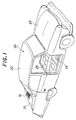
- Fig.1 is a perspective view showing a portion of a car to which the present invention is applied.
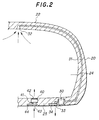
- Fig.2 is a sectional view of a vehicles body along a center line of the exhaust path.
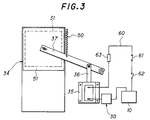
- Fig.3 is a circuit diagram with a rear view of a valve in the exhaust path in a close position.
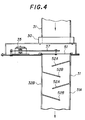
- Fig.4 is a sectional view of the exhaust path at the valve.
- Fig.5 is a circuit diagram with a rear view of the same valve in an open position.
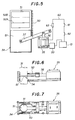
- Fig.6 is a size view of a valve in an exhaust path of another embodiment of the present invention.
- Fig.7 is a plan of the same valve.
- a solar cell 10 having a light collecting board which receives sunlight is mounted on a top face of a rear section (trunk) of a vehicles body 20.
- the solar cell 10 may be mounted on the ceiling 22 of the vehicle's body 20 or on a surface of a bonnet 23, or on other section exposed to sunlight.
- a convertor which converts a direct current generated by the solar cell 10 to an alternating current and a battery which stores electric energy generated by the solar cell 10 are incorporated.
- an exhaust path 31 which exhausts air in a cabin 24 through a piping running through the vehicle's body 20 to outside and a fresh-air conducting path 41 which conducts fresh air from outside into the cabin 24 are arranged.
- the exhaust path 31 takes out air from an inlet port 32 on the ceiling 22 of the cabin 24 and exhaust the air from an outlet port 33 on an external face of a floor panel 23.
- the fresh-air conducting path 41 sends fresh air took from an inlet port 43 on an external face of the floor panel 25 into the cabin 24 from an outlet port 42 on an internal face of the floor panel 25.
- An air-flow activating unit 30 which works using said solar cell 10 as a power source is arranged on said exhaust path 31.
- This air-flow activating unit 30 comprises, for instance, an electrically operated fan, and discharges air in the cabin to outside.
- a valve 34 which opens and closes the exhaust path 31, is arranged to the exterior side from the air-flow activating unit 30.
- the valve 34 opens when the air-flow activating unit 30 works in accordance with input of electric power from the solar cells.
- an air-flow activating unit 40 comprising an electrically operated fan to take air from outside into the cabin is arranged on the fresh-air conducting path 41, and a valve 44 to open or close the fresh-air conducting path 41 is arranged to the exterior side from said air-flow activating unit 40.
- air which is warmed during parking time and gathers near the ceiling is forcibly discharged to outside by the air-flow activating unit 30 via the exhaust path 31 with its opening on the ceiling, while cool air with relatively low temperature in the shadow under the vehicle's body 20 is introduced into the cabin by the air-flow activating unit 40 via the fresh-air conducting path 41 with its opening on the external face of the floor panel 25.
- Configuration and operation of the air-flow activating unit 40 and the valve 44 are basically the same as those of the air-flow activating unit 30 and the valve 34 on the exhaust path 31, which are described in detail later, and can easily be understood by referring to the description thereof.
- the valve 31 arranged on the exhaust path 31 is driven by a solenoid actuator 35.
- a valve body 31 is coupled to a link 37 driven by a plunger 36 of the solenoid actuator 35, and when the solenoid actuator 35 is activated, the link 37 makes the valve body 51 slide against a return spring 50, and opens the exhaust path 31 (Refer to Fig.5) .
- An electric circuit 60 which drives the air-flow activating unit 30 and the valve 34 with the solar cell 10 has a series combination of a first switch 61 as a power switch, a second switch 62 which works in correlation to an engine key switch of the vehicle not shown in the drawings, and a thermostat 63 which works according to change of temperature in the cabin.
- Said second switch 62 correlates to the engine key switch so that it turns ON when the engine switch is turned OFF and it turns OFF when the engine switch is turned ON.
- a temperature valve at which the thermostat 63 starts working by closing its contact, can be set freely. For instance, the contact will be closed when the temperature in the cabin rises above 30 degrees centigrade.
- the second switch 62 correlating to said engine key turns ON, and if the first switch 61 as a power switch is kept ON, the valve 34 and 44 will automatically open and simultaneously the air-flow activating units 30 and 40 start working when the thermostat 63 starts working by closing its contact in accordance with temperature increase in the cabin.
- the air-flow activating units 30 and 40 do not work. As they work only when temperature in the cabin rises and ventilation is required, a capacity of the solar cell 10 can be minimized, which also means the possibility of minimizing its size.Note that, on rainy or cloudy days or at night when electric energy generation rate of the solar cell 10 is low, the air-flow activating units 30 and 40 do not work, which is preferable in view of the durability of the air-flow activating units 30 and 40.
- valves 34 and 44 close the exhaust path 31 and the fresh-air conducting path 41 respectively, so that, when driving, especially in the winter, fresh air with low temperature is prevented from coming into the cabin and also loss of warming efficiency does not occur.
- bulkheads 52A and 52B are arranged at a specified interval alternately to the exterior side from the valve 34 in the exhaust path 31 to prevent water such as rainwater from coming into the inside.
- the bulkheads 52A are fixed on a a wall 31A of the exhaust path 31 at a certain interval, and the bulkheads 52B are fixed at a certain interval on the wall 31B of the exhaust path 31 which is facing the wall 31A.
- Combination of these bulkheads 52A and 52B forms a path bending zigzag to prevent water such as rainwater from coming into the cabin when driving on a rainy day or when cleaning the car.
- These bulkheads 52A and 52B are also arranged to the exterior side from the valve 44 in the fresh-air conducting path 41.
- Fig.6 and Fig.7 snow another embodiment of the valve 34(44).
- the valve body 51 is directly connected to the plunger 36 of the solenoid actuator 35. Note that the plunger 36 is biased by the return spring 50 to the close position of the valve 34.
Landscapes
- Physics & Mathematics (AREA)
- Thermal Sciences (AREA)
- Engineering & Computer Science (AREA)
- Mechanical Engineering (AREA)
- Air-Conditioning For Vehicles (AREA)
Description
- This invention related to an automatic ventilating device for for a cabin of a vehicle such as a passenger car or a truck, more particularly, to a ventilating device which prevents temperature in a cabin of a vehicle from going too high during the vehicle's parking time.
- Sometimes temperature in a cabin of a vehicle raises, during its parking time with the engine stopped, to an extremely high degree which we can never experience in our daily life. For instance, if a vehicle is left under the burning sun in the summer, temperature in a cabin of the vehicle goes up to 60 to 70 degrees centigrade.
- When an engine is running, it is possible to prevent temperature in a cabin of a vehicle from going up too high with an air conditioner, but a fuel consumption rate of an air conditioner is generally very high, and leaving a vehicle with the engine running when nobody is in it may cause problems concerning safety. Also parking with windows open is risky because of the possibility of theft and not practical.
- Recently, some people use a fan which is mounted on a portion of a car window and can be run during parking time to ventilate air in a cabin of the car to prevent temperature in the cabin from going up too high. As this device can easily be broken, however, it is inadequate for prevention of theft, and also as battery consumption due to rotation of the fan is large, the device has not spread so much. A device according to the preamble of claim 1 is known, for example, from US-A-4.804.140.
- A principle object of the present invention is to provide a cabin ventilating device which is driven by solar energy and ventilates air in a cabin of a vehicle in parking without consuming fuel and battery, and which is hardly broken and free from the possibility of theft.
- A ventilating device according to the present invention has an exhaust path penetrating through a portion of a vehicles body to exhaust air in the cabin of a vehicle to outside, a fresh-air conducting path penetrating through a portion of the vehicle's body to conduct fresh air into the cabin of the vehicle, a valve arranged in said exhaust path, an air-flow activating means arranged in series to this valve, a valve arranged in said fresh-air conducting path, an air-flow activating means arranged in series to this valve, solar cells which are arranged on an external surface of the vehicle to receive sunlight and generate electricity, and an electric circuit which drives each of said air-flow activating means by making use of electricity from said solar cells.
- As the air-flow activating means arranges in the exhaust path and in the fresh-air conducting path are driven by the energy generated by the solar cells and do not consume fuel or battery energy, this ventilating device is quite energy saving. On fine days when temperature in a cabin of a vehicle goes high, the solar cells can generate and supply as much electricity as required by the air-flow activating means. On rainy days or at night when ventilation is not necessary, electric energy generated by the solar cells is little, and the ventilating device does not work.
- The exhaust path and the fresh-air conducting path penetrate through a portion of the vehicle's body, and there are valves arranged near and to the exterior side from the air-flow activating means, so that the driver does not have to worry about destruction or theft during parking time. The valves are kept closed when the air-flow activating means does not work, and this feature prevents cool air from coming into the cabin when running, especially in the winter, and a warming effect in the cabin does not go down.
- The inlet of the exhaust path should be arranged on a ceiling of the cabin, while the inlet of the fresh-air conducting path should be arranged on an external face of the vehicles body. With this arrangement, air with high temperature, which gathers near the ceiling of the cabin, is easily ventilated by fresh air with low temperature conducted to the cabin from a shade under the vehicle's body, which insures efficiency in lowering temperature in the cabin.
- A bulkhead is arranged in the aforesaid exhaust path and the aforesaid fresh-air conducting path respectively to the exterior side from the aforesaid valves. This bulkhead can prevent rain water and the like from coming into the cabin from the exhaust path and the fresh-air conducting path when driving on a rainy day.
- In the electric circuit coupling said solar cells to each of said air-flow activating means, a power switch, a switch correlating to and engine key switch, and a thermostat which works according to temperature in the cabin are arranged in series. With this arrangement, the air-flow activating means automatically works only when the engine does not run and temperature in the cabin is high, and the solar cells may be of compact size with small capacity.
-
- Fig.1 is a perspective view showing a portion of a car to which the present invention is applied.
- Fig.2 is a sectional view of a vehicles body along a center line of the exhaust path.
- Fig.3 is a circuit diagram with a rear view of a valve in the exhaust path in a close position.
- Fig.4 is a sectional view of the exhaust path at the valve.
- Fig.5 is a circuit diagram with a rear view of the same valve in an open position.
- Fig.6 is a size view of a valve in an exhaust path of another embodiment of the present invention.
- Fig.7 is a plan of the same valve.
- In Fig.1, a
solar cell 10 having a light collecting board which receives sunlight is mounted on a top face of a rear section (trunk) of avehicles body 20. Note that thesolar cell 10 may be mounted on theceiling 22 of the vehicle'sbody 20 or on a surface of abonnet 23, or on other section exposed to sunlight. - Although not shown in Fig.1, a convertor which converts a direct current generated by the
solar cell 10 to an alternating current and a battery which stores electric energy generated by thesolar cell 10 are incorporated. - As shown also in Fig.2, an
exhaust path 31 which exhausts air in acabin 24 through a piping running through the vehicle'sbody 20 to outside and a fresh-air conductingpath 41 which conducts fresh air from outside into thecabin 24 are arranged. Theexhaust path 31 takes out air from aninlet port 32 on theceiling 22 of thecabin 24 and exhaust the air from anoutlet port 33 on an external face of afloor panel 23. The fresh-air conductingpath 41 sends fresh air took from aninlet port 43 on an external face of thefloor panel 25 into thecabin 24 from anoutlet port 42 on an internal face of thefloor panel 25. - An air-
flow activating unit 30 which works using saidsolar cell 10 as a power source is arranged on saidexhaust path 31. This air-flow activating unit 30 comprises, for instance, an electrically operated fan, and discharges air in the cabin to outside. - A
valve 34, which opens and closes theexhaust path 31, is arranged to the exterior side from the air-flow activating unit 30. Thevalve 34 opens when the air-flow activating unit 30 works in accordance with input of electric power from the solar cells. - Similarly, an air-
flow activating unit 40 comprising an electrically operated fan to take air from outside into the cabin is arranged on the fresh-air conductingpath 41, and avalve 44 to open or close the fresh-air conductingpath 41 is arranged to the exterior side from said air-flow activating unit 40. - For this reason, air which is warmed during parking time and gathers near the ceiling is forcibly discharged to outside by the air-
flow activating unit 30 via theexhaust path 31 with its opening on the ceiling, while cool air with relatively low temperature in the shadow under the vehicle'sbody 20 is introduced into the cabin by the air-flow activating unit 40 via the fresh-air conductingpath 41 with its opening on the external face of thefloor panel 25. - Configuration and operation of the air-
flow activating unit 40 and thevalve 44 are basically the same as those of the air-flow activating unit 30 and thevalve 34 on theexhaust path 31, which are described in detail later, and can easily be understood by referring to the description thereof. - As shown in Fig.3 and Fig.5, the
valve 31 arranged on theexhaust path 31 is driven by asolenoid actuator 35. Namely, avalve body 31 is coupled to alink 37 driven by aplunger 36 of thesolenoid actuator 35, and when thesolenoid actuator 35 is activated, thelink 37 makes thevalve body 51 slide against areturn spring 50, and opens the exhaust path 31 (Refer to Fig.5) . - When the
solenoid actuator 35 is not activated, thevalve body 51 is kept closed due to effect of the return spring 50 (Refer to Fig.3). - An
electric circuit 60, which drives the air-flow activating unit 30 and thevalve 34 with thesolar cell 10 has a series combination of afirst switch 61 as a power switch, asecond switch 62 which works in correlation to an engine key switch of the vehicle not shown in the drawings, and athermostat 63 which works according to change of temperature in the cabin. - Said
second switch 62 correlates to the engine key switch so that it turns ON when the engine switch is turned OFF and it turns OFF when the engine switch is turned ON. - A temperature valve, at which the
thermostat 63 starts working by closing its contact, can be set freely. For instance, the contact will be closed when the temperature in the cabin rises above 30 degrees centigrade. - With this feature, when the vehicle stops and the engine key switch is turned OFF, the
second switch 62 correlating to said engine key turns ON, and if thefirst switch 61 as a power switch is kept ON, thevalve flow activating units thermostat 63 starts working by closing its contact in accordance with temperature increase in the cabin. - With this operation, air with high temperature in the cabin is exhausted from the
exhaust path 31 to the outside, and also fresh air with low temperature under the vehicle's body comes into the cabin through the fresh-air conductingpath 41, thus the cabin automatically and temperature in the cabin prevented from abnormally rising. - In contrast, when temperature in the cabin does not rise above a value set in the
thermostat 63, the air-flow activating units solar cell 10 can be minimized, which also means the possibility of minimizing its size.Note that, on rainy or cloudy days or at night when electric energy generation rate of thesolar cell 10 is low, the air-flow activating units flow activating units - When the
power switch 61 is OFF or engine is running, thevalves exhaust path 31 and the fresh-air conductingpath 41 respectively, so that, when driving, especially in the winter, fresh air with low temperature is prevented from coming into the cabin and also loss of warming efficiency does not occur. - As shown in Fig. 4,
bulkheads valve 34 in theexhaust path 31 to prevent water such as rainwater from coming into the inside. - The
bulkheads 52A are fixed ona a wall 31A of theexhaust path 31 at a certain interval, and thebulkheads 52B are fixed at a certain interval on the wall 31B of theexhaust path 31 which is facing thewall 31A. - Combination of these
bulkheads - These
bulkheads valve 44 in the fresh-air conductingpath 41. - Fig.6 and Fig.7 snow another embodiment of the valve 34(44). In this embodiment, the
valve body 51 is directly connected to theplunger 36 of thesolenoid actuator 35. Note that theplunger 36 is biased by thereturn spring 50 to the close position of thevalve 34. - This invention can be implemented in various forms without deviating from the scope of the appended claims. The embodiment described in this specification shows an application for a passenger car, but it can also be applied in other types of vehicle such as trucks. The preferable embodiment shown in this specification is illustrative and not restrictive.
Claims (1)
- A car ventilating device which ventilates air in a cabin (24) of a vehicle and lowers temperature in the cabin, having an exhaust path (31) penetrating through a portion of the vehicle to exhaust air in a cabin (24) of the vehicle to outside, a fresh-air conducting path (41) penetrating through a portion of said vehicle to conduct fresh air into the cabin, a valve (34) being arranged in said exhaust path (31), a air-flow activating means (30) being arranged in said exhaust path (31) in series to said valve (34), a valve (44) being arranged in said fresh-air conducting path (41), an air-flow activating means (40) being arranged in said fresh-air conducting path (41) in series to said valve (44), a solar cell (10) being installed on a external surface (22,23) of said vehicle to receive sunlight for generating electricity and an electric circuit (60) which drives said each air-flow activating means (30,40), said each air-flow activating means (30,40) being an electrically operated fan, and said each valve (34,44) with the electricity generated by said solar cell (10), characterized in that
said exhaust path (31) has an inlet port (32) on a ceiling (22) of the cabin (24), an outlet port (33) on the external face of a floor (23) of the vehicle's body (20), and a piping running through the vehicle's body to connect the inlet and the outlet port of said exhaust path,
said fresh-air conducting path (41) having an inlet port (43) on the external face of the floor (23) of the vehicle's body (20),
said each valve (34,44) being arranged to the exterior side from the elecrically operated fan (30,40), and having valve body driven to a opening position by a solenoid (35) and returned to a closing position by a spring (50),
a plurality of bulkheads (52A,52B) being installed alternately in said exhaust path (31), and arranged to the exterior side from said valve (34) to prevent rain water from coming into the cabin (24) from outside,
a plurality of bulkhead (52A,52B) being installed alternately in said fresh-air conducting path (41), and arranged to the exterior side from said valve (44) to prevent rain water from coming into the cabin (24) from outside,
said electrical circuit (60) having a series combination of a power switch (61), a thermostat (63) which reacts according to temperatur in the cabin (24), and a switch (62) which automatically turns off when an engine key of the vehicle is turned on.
Applications Claiming Priority (4)
| Application Number | Priority Date | Filing Date | Title |
|---|---|---|---|
| JP29517/90 | 1990-03-22 | ||
| JP1990029517U JP2583700Y2 (en) | 1990-03-22 | 1990-03-22 | In-car ventilation system |
| JP65189/90 | 1990-06-20 | ||
| JP6518990U JPH0423509U (en) | 1990-06-20 | 1990-06-20 |
Publications (2)
| Publication Number | Publication Date |
|---|---|
| EP0448547A1 EP0448547A1 (en) | 1991-09-25 |
| EP0448547B1 true EP0448547B1 (en) | 1993-12-08 |
Family
ID=26367728
Family Applications (1)
| Application Number | Title | Priority Date | Filing Date |
|---|---|---|---|
| EP19910890055 Expired - Lifetime EP0448547B1 (en) | 1990-03-22 | 1991-03-21 | Car ventilating device |
Country Status (2)
| Country | Link |
|---|---|
| EP (1) | EP0448547B1 (en) |
| DE (1) | DE69100732T2 (en) |
Cited By (4)
| Publication number | Priority date | Publication date | Assignee | Title |
|---|---|---|---|---|
| FR2682645A1 (en) * | 1991-10-18 | 1993-04-23 | Renault | METHOD AND DEVICE FOR STATIC VENTILATION OF A MOTOR VEHICLE COCKPIT. |
| GB2274003A (en) * | 1992-12-14 | 1994-07-06 | Shunji Ohba | Car ventilating device |
| US5486138A (en) * | 1994-07-20 | 1996-01-23 | Sorensen; Jens O. | Air-pollution reduction method and system for the interior of an automobile |
| WO2004011287A1 (en) * | 2002-07-31 | 2004-02-05 | Michele Squeo | System for venting the passenger compartment of a vehicle |
Family Cites Families (3)
| Publication number | Priority date | Publication date | Assignee | Title |
|---|---|---|---|---|
| US2161728A (en) * | 1936-03-23 | 1939-06-06 | Stout Engineering Lab Inc | Ventilator |
| US4804140A (en) * | 1987-12-24 | 1989-02-14 | Cantrell Ricky L | Solar powered ventilating system for vehicles |
| GB8813547D0 (en) * | 1988-06-08 | 1988-07-13 | Oemec Taiwan Corp | Crease eliminating device for sewing machines solar-powered cooling/heating system |
-
1991
- 1991-03-21 EP EP19910890055 patent/EP0448547B1/en not_active Expired - Lifetime
- 1991-03-21 DE DE1991600732 patent/DE69100732T2/en not_active Expired - Fee Related
Cited By (5)
| Publication number | Priority date | Publication date | Assignee | Title |
|---|---|---|---|---|
| FR2682645A1 (en) * | 1991-10-18 | 1993-04-23 | Renault | METHOD AND DEVICE FOR STATIC VENTILATION OF A MOTOR VEHICLE COCKPIT. |
| GB2274003A (en) * | 1992-12-14 | 1994-07-06 | Shunji Ohba | Car ventilating device |
| GB2274003B (en) * | 1992-12-14 | 1996-01-17 | Shunji Ohba | Car ventilating device |
| US5486138A (en) * | 1994-07-20 | 1996-01-23 | Sorensen; Jens O. | Air-pollution reduction method and system for the interior of an automobile |
| WO2004011287A1 (en) * | 2002-07-31 | 2004-02-05 | Michele Squeo | System for venting the passenger compartment of a vehicle |
Also Published As
| Publication number | Publication date |
|---|---|
| DE69100732D1 (en) | 1994-01-20 |
| DE69100732T2 (en) | 1994-06-30 |
| EP0448547A1 (en) | 1991-09-25 |
Similar Documents
| Publication | Publication Date | Title |
|---|---|---|
| US5205782A (en) | Car ventilating system | |
| US4658597A (en) | Solar powered automobile cooling system | |
| US5433660A (en) | Automatic vehicular ventilating system | |
| US20160047387A1 (en) | Systems and methods for air cooling of various enclosures | |
| EP0448547A1 (en) | Car ventilating device | |
| JPS5951451B2 (en) | automotive ventilation system | |
| GB2220738A (en) | Solar-powered cooling/heating systems | |
| JPS6021084B2 (en) | automotive ventilation system | |
| US20040217179A1 (en) | Car regulating thermostat | |
| JPH06507592A (en) | Natural ventilation in vehicle passenger compartments | |
| KR940008418B1 (en) | Ventilation device in the vehicle cab | |
| CN202463518U (en) | Automobile-used water evaporation-type ventilation and temperature reducing device | |
| US20030013405A1 (en) | Ventilation device and system for vehicles | |
| JP3004225U (en) | Solar-powered ventilation system for vehicles | |
| CN208343897U (en) | Automotive window constant temperature system is heated by the semiconductor refrigerating of the energy of solar energy | |
| JPS5885709A (en) | Ventilator for automobile | |
| JP2575810Y2 (en) | In-car ventilation system | |
| CN107719068A (en) | A kind of automobile-use solar energy cooling device | |
| CN2197243Y (en) | Discharge device that can discharge hot air from inside the car to the outside of the car | |
| JP2577651Y2 (en) | In-car ventilation system | |
| JPH0718911Y2 (en) | Automatic ventilation | |
| JP2742857B2 (en) | Automatic ventilation system in the car | |
| JPH04321424A (en) | Cars with interior ventilation system when the engine is stopped | |
| KR200198243Y1 (en) | Automobile inside ventilation system | |
| CN109109614A (en) | A kind of automatic emperature-lowering energy-saving system of car based on solar energy |
Legal Events
| Date | Code | Title | Description |
|---|---|---|---|
| PUAI | Public reference made under article 153(3) epc to a published international application that has entered the european phase |
Free format text: ORIGINAL CODE: 0009012 |
|
| AK | Designated contracting states |
Kind code of ref document: A1 Designated state(s): DE FR GB IT |
|
| 17P | Request for examination filed |
Effective date: 19920310 |
|
| 17Q | First examination report despatched |
Effective date: 19930331 |
|
| GRAA | (expected) grant |
Free format text: ORIGINAL CODE: 0009210 |
|
| AK | Designated contracting states |
Kind code of ref document: B1 Designated state(s): DE FR GB IT |
|
| REF | Corresponds to: |
Ref document number: 69100732 Country of ref document: DE Date of ref document: 19940120 |
|
| ITF | It: translation for a ep patent filed | ||
| ET | Fr: translation filed | ||
| PLBE | No opposition filed within time limit |
Free format text: ORIGINAL CODE: 0009261 |
|
| STAA | Information on the status of an ep patent application or granted ep patent |
Free format text: STATUS: NO OPPOSITION FILED WITHIN TIME LIMIT |
|
| 26N | No opposition filed | ||
| REG | Reference to a national code |
Ref country code: GB Ref legal event code: IF02 |
|
| PGFP | Annual fee paid to national office [announced via postgrant information from national office to epo] |
Ref country code: FR Payment date: 20030130 Year of fee payment: 13 |
|
| PGFP | Annual fee paid to national office [announced via postgrant information from national office to epo] |
Ref country code: GB Payment date: 20030131 Year of fee payment: 13 |
|
| PGFP | Annual fee paid to national office [announced via postgrant information from national office to epo] |
Ref country code: DE Payment date: 20030527 Year of fee payment: 13 |
|
| PG25 | Lapsed in a contracting state [announced via postgrant information from national office to epo] |
Ref country code: GB Free format text: LAPSE BECAUSE OF NON-PAYMENT OF DUE FEES Effective date: 20040321 |
|
| PG25 | Lapsed in a contracting state [announced via postgrant information from national office to epo] |
Ref country code: DE Free format text: LAPSE BECAUSE OF NON-PAYMENT OF DUE FEES Effective date: 20041001 |
|
| GBPC | Gb: european patent ceased through non-payment of renewal fee |
Effective date: 20040321 |
|
| PG25 | Lapsed in a contracting state [announced via postgrant information from national office to epo] |
Ref country code: FR Free format text: LAPSE BECAUSE OF NON-PAYMENT OF DUE FEES Effective date: 20041130 |
|
| REG | Reference to a national code |
Ref country code: FR Ref legal event code: ST |
|
| PG25 | Lapsed in a contracting state [announced via postgrant information from national office to epo] |
Ref country code: IT Free format text: LAPSE BECAUSE OF NON-PAYMENT OF DUE FEES;WARNING: LAPSES OF ITALIAN PATENTS WITH EFFECTIVE DATE BEFORE 2007 MAY HAVE OCCURRED AT ANY TIME BEFORE 2007. THE CORRECT EFFECTIVE DATE MAY BE DIFFERENT FROM THE ONE RECORDED. Effective date: 20050321 |