EP0448831B1 - Procédé pour purifier de l'eau usée - Google Patents
Procédé pour purifier de l'eau usée Download PDFInfo
- Publication number
- EP0448831B1 EP0448831B1 EP90125170A EP90125170A EP0448831B1 EP 0448831 B1 EP0448831 B1 EP 0448831B1 EP 90125170 A EP90125170 A EP 90125170A EP 90125170 A EP90125170 A EP 90125170A EP 0448831 B1 EP0448831 B1 EP 0448831B1
- Authority
- EP
- European Patent Office
- Prior art keywords
- anion exchanger
- metal ions
- anion
- waste water
- complexed
- Prior art date
- Legal status (The legal status is an assumption and is not a legal conclusion. Google has not performed a legal analysis and makes no representation as to the accuracy of the status listed.)
- Expired - Lifetime
Links
Images
Classifications
-
- B—PERFORMING OPERATIONS; TRANSPORTING
- B01—PHYSICAL OR CHEMICAL PROCESSES OR APPARATUS IN GENERAL
- B01J—CHEMICAL OR PHYSICAL PROCESSES, e.g. CATALYSIS OR COLLOID CHEMISTRY; THEIR RELEVANT APPARATUS
- B01J45/00—Ion-exchange in which a complex or a chelate is formed; Use of material as complex or chelate forming ion-exchangers; Treatment of material for improving the complex or chelate forming ion-exchange properties
-
- B—PERFORMING OPERATIONS; TRANSPORTING
- B01—PHYSICAL OR CHEMICAL PROCESSES OR APPARATUS IN GENERAL
- B01J—CHEMICAL OR PHYSICAL PROCESSES, e.g. CATALYSIS OR COLLOID CHEMISTRY; THEIR RELEVANT APPARATUS
- B01J41/00—Anion exchange; Use of material as anion exchangers; Treatment of material for improving the anion exchange properties
- B01J41/04—Processes using organic exchangers
- B01J41/07—Processes using organic exchangers in the weakly basic form
Definitions
- the invention relates to a method for cleaning waste water according to the preamble of the first claim.
- the wastewater is brought into contact with a strongly basic anionic exchange resin, since this is loaded with an anion which forms no or a weaker complex with the metal ions than the metal ions with the complexing agent .
- This publication states that two zones are formed in the resin: a leading zone which contains organometallic coordinated compounds and a subsequent zone in which the organometallic complex is replaced by the free complexing agent molecules.
- the process is terminated as soon as the leading zone has migrated through the ion exchange layer.
- the ion exchanger is then regenerated.
- Regeneration can be done with a simple saline solution.
- complexing agents subsequent zone
- complexed metal ions leading zone
- a separation of complexing agents and complexed metal ions is obtained if the anion exchanger is first eluted with a solution of the complexing agent and then regenerated with a salt solution.
- the complexing agent can only be isolated by adding further complexing agent.
- the object of the invention is to avoid these disadvantages in the methods of the type mentioned.
- the organometallic complex compounds are to be broken down so that the complexing agent and a solution of the uncomplexed metal are obtained directly and without further treatment steps, or at least in a highly enriched form.
- the process should also enable reuse of complexing agents and metal ions.
- Metal ions can be polyvalent, in particular the ions specified in the cited DE-PS.
- Complexing agents of medium complexing strength mean in particular the salts of tartaric acid, citric acid and gluconic acid, but not strong complexing agents such as EDTA and NTA.
- the ion exchange process is only interrupted when the subsequent zone threatens to break through and not when the leading zone is about to break through.
- the pure complexing agent is released in the course of the ion exchanger and can be isolated in a separate fraction and, if necessary, reused.
- the process is terminated at the latest when the organometallic complex, ie the subsequent zone, is about to break through.
- the ion exchanger is largely or even completely free of complexing agents.
- the anion exchanger can have the following functional groups:
- the functional group (1) characterizes a strongly basic
- the functional group (2) a weakly basic anion exchanger.
- anion exchangers with pyridinium as a functional group for example prefers.
- the process according to the invention can also be carried out with anion exchangers of type I or II.
- anion exchangers have the functional groups -N+ (CH3) 3 (type I) or -N+ (CH3) 2 (C2H4OH) (type II) on.
- the anion exchanger is then regenerated, releasing the metal ions and any residues of the complexing agent.
- the regeneration not only causes the release of the second fraction, which contains the metal ions, but also the loading of the anion exchanger with the salt anion.
- NaCl can be used in aqueous solution.
- the complexing agent is completely removed from the exchange resin with the leading zone, so that the anion exchanger only releases a solution of the uncomplexed metal ions after regeneration has ended when regeneration is complete.
- an incomplete removal of the complexing agents may be sufficient, so that a second fraction results, in which, in addition to uncomplexed metal ions, a small proportion of complexed metal ions are also present.
- the larger, non-complexed metal portion by adding precipitation chemicals e.g. Ca (OH) 2 or Na2S
- precipitation chemicals e.g. Ca (OH) 2 or Na2S
- the process according to the invention can be carried out particularly advantageously with an anion exchanger which is loaded with the anion bicarbonate.
- the anion exchanger is to be treated with a bicarbonate solution, for example of NaHCO3 or Mg (HCO3) 2 during regeneration.
- the metal ions can be separated off in a particularly simple manner as carbonates from the second fraction separated off, which contains the metal ions, hydrogen carbonate and possibly also residues of complexing agents.
- the regeneration is preferably carried out according to the method described in EP-A-0286699, in which the bicarbonate z. B. from MgO, CO2 and water is generated under pressure. This process has the particular advantage that excess regenerant does not lead to salting of the waste water.
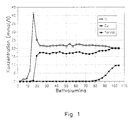
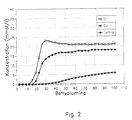
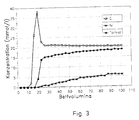
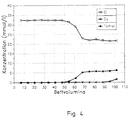
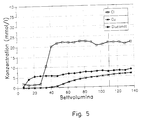
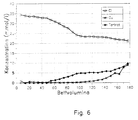
- the figures show the concentration profile of metal ions and complexing agents when carrying out the experiments described in the examples.
- anion exchanger was filled in the usual way into an exchange column and brought into contact with water that passed from top to bottom.
- a strongly basic exchanger based on acrylamide (trade name AMBERLITE IRA 958) is charged with a solution which contained 10 mmol / l CuCl2 and 20 mmol / l NaK tartrate.
- the exchange resin was loaded with HCO3 ⁇ ions.
- the breakthrough curves of the experiment are shown in Fig. 1. They show that with a throughput of approximately 15 bed volumes (BV) solution, the breakthrough of tartrate begins. After 20 BV the tartrate concentration in the column outlet is 85 - 90% of the raw water concentration. In contrast, copper only appears after a throughput of about 75 BV in the column outlet. After about 100 BV throughput, the full heavy metal complex breakthrough is achieved.
- Example 1 47 ml of a macroporous, strongly basic anion exchanger of type II (trade name LEWATIT MP 600) were charged with the same solution with the same preloading and under the same test conditions as in Example 1.
- the breakthrough curves are shown in FIG. 2.
- the separation of copper and tartrate can also be observed here, however, the copper breakthrough begins much earlier and only copper depletion is achieved, but no complete separation.
- Example 1 47 ml of the exchanger used in Example 1 in HCO3 ⁇ form was charged with a solution containing 10 mmol / l NiCl2 and 20 mmol / l Na tartrate.
- the test conditions correspond to those of Example 1.
- the results are shown in FIG. 3. Similar to Example 2, a nickel depletion of the raw solution is achieved here, but no complete separation.
- Example 4 47 ml of a strongly basic anion exchanger made of cross-linked polystyrene with pyridinium groups as functional components (former trade name PERMUTIT SK-G), loaded with Cl ⁇ ions, were charged with the solution of Example 4 under otherwise identical conditions. The results are shown in FIG. 6. According to the ancestor according to DE-PS 36 14 061, heavy metal and complexing agents are initially virtually completely eliminated, but then the tartrate first breaks through and only about 50 BV later do copper ions also appear in the process.
- PERMUTIT SK-G strongly basic anion exchanger made of cross-linked polystyrene with pyridinium groups as functional components
Landscapes
- Chemical & Material Sciences (AREA)
- Organic Chemistry (AREA)
- Chemical Kinetics & Catalysis (AREA)
- Treatment Of Water By Ion Exchange (AREA)
- Separation Using Semi-Permeable Membranes (AREA)
Claims (6)
- Procédé de purification des eaux usées qui renferment des ions métalliques complexés par des agents complexants organiques, dans lequela) un échangeur d'anions est chargé par un anion qui ne forme pas de complexe avec les ions métalliques ou qui forme un complexe plus faible que celui des ions métalliques avec l'agent complexant,b) des eaux usées sont introduites dans l'échangeur d'anions chargé de manière à ce qu'il se forme dans l'échangeur d'anions une zone dirigeante et une zone subséquente,caractérisé en ce quec) des eaux usées sont mises en jeu, dans lesquelles les ions métalliques sont complexés par de l'acide tartrique, de l'acide citrique, de l'acide gluconique ou des agents complexants de force complexante semblable,d) l'introduction des eaux usées est terminée au plus tard par rupture des ions métalliques complexés dans la zone subséquente.
- Procédé selon la revendication 1, caractérisé en ce que comme échangeur d'anions on met en oeuvre un échangeur d'anions faiblement basique.
- Procédé selon la revendication 1, caractérisé en ce que comme échangeur d'anions on met en oeuvre un échangeur d'anions fortement ou faiblement basique avec un amide d'acide polyacrylique comme groupe fonctionnel.
- Procédé selon la revendication 1, caractérisé en ce que comme échangeur d'anions on met en oeuvre un échangeur d'anions avec du pyridinium comme groupe fonctionnel.
- Procédé selon la revendication 1, caractérisé en ce que l'on met en oeuvre un échangeur d'anions avec les groupes fonctionnels -N⁺(CH₃)₃ ou -N⁺(CH₃)₂ (C₂H₄OH).
- Procédé selon l'une des revendications 1 à 5, caractérisé en ce que l'échangeur d'anions dans l'étape a) est chargé avec de l'hydrogenocarbonate.
Priority Applications (1)
| Application Number | Priority Date | Filing Date | Title |
|---|---|---|---|
| AT90125170T ATE96055T1 (de) | 1990-03-30 | 1990-12-21 | Verfahren zur reinigung von abwasser. |
Applications Claiming Priority (2)
| Application Number | Priority Date | Filing Date | Title |
|---|---|---|---|
| DE4010265A DE4010265C2 (de) | 1990-03-30 | 1990-03-30 | Verfahren zur getrennten Gewinnung von Komplexbildern und unkomplexierten Metallionen aus Abwasser |
| DE4010265 | 1990-03-30 |
Publications (3)
| Publication Number | Publication Date |
|---|---|
| EP0448831A2 EP0448831A2 (fr) | 1991-10-02 |
| EP0448831A3 EP0448831A3 (en) | 1991-11-13 |
| EP0448831B1 true EP0448831B1 (fr) | 1993-10-20 |
Family
ID=6403422
Family Applications (1)
| Application Number | Title | Priority Date | Filing Date |
|---|---|---|---|
| EP90125170A Expired - Lifetime EP0448831B1 (fr) | 1990-03-30 | 1990-12-21 | Procédé pour purifier de l'eau usée |
Country Status (3)
| Country | Link |
|---|---|
| EP (1) | EP0448831B1 (fr) |
| AT (1) | ATE96055T1 (fr) |
| DE (1) | DE4010265C2 (fr) |
Families Citing this family (3)
| Publication number | Priority date | Publication date | Assignee | Title |
|---|---|---|---|---|
| US5246591A (en) * | 1990-07-13 | 1993-09-21 | Pact, Incorporated | Separation of metal ions on an anion exchange resin by chromatographic elution |
| CH684714A5 (de) * | 1992-03-25 | 1994-11-30 | Siemens Ag Albis | Verfahren zum Bestimmen der Konzentration von komplexierten Metall-Ionen in einer Lösung. |
| SE9904197D0 (sv) * | 1999-11-22 | 1999-11-22 | Amersham Pharm Biotech Ab | A method for anion exchange adsorption on matrices carrying mixed mode ligands |
Family Cites Families (7)
| Publication number | Priority date | Publication date | Assignee | Title |
|---|---|---|---|---|
| US2965441A (en) * | 1956-11-29 | 1960-12-20 | Du Pont | Ion exchange for the recovery of chemicals |
| DE1270504B (de) * | 1964-05-12 | 1968-06-12 | Goetzelmann K G Industrieabwas | Verfahren zur Aufbereitung von schwermetallkomplexhaltigen Abwaessern |
| JPS54133495A (en) * | 1978-04-10 | 1979-10-17 | Asahi Chem Ind Co Ltd | Recovering method for liquid phase oxidation catalyst |
| US4303704A (en) * | 1980-05-19 | 1981-12-01 | Courduvelis Constantine I | Selective removal of copper or nickel from complexing agents in aqueous solution |
| DE3340305A1 (de) * | 1983-11-08 | 1985-05-15 | Robert Bosch Gmbh, 7000 Stuttgart | Verfahren und vorrichtung zur entsorgung von chemischen metallisierungsbaedern |
| US4770788A (en) * | 1985-04-25 | 1988-09-13 | Kollmorgen Technologies Corp. | Process for removing metal complexes from waste solutions |
| CA1240521A (fr) * | 1985-09-23 | 1988-08-16 | Carla C. Frey | Extraction de la cyanure des eaux usees, par echange d'ions |
-
1990
- 1990-03-30 DE DE4010265A patent/DE4010265C2/de not_active Expired - Fee Related
- 1990-12-21 AT AT90125170T patent/ATE96055T1/de not_active IP Right Cessation
- 1990-12-21 EP EP90125170A patent/EP0448831B1/fr not_active Expired - Lifetime
Also Published As
| Publication number | Publication date |
|---|---|
| DE4010265A1 (de) | 1991-10-02 |
| EP0448831A2 (fr) | 1991-10-02 |
| EP0448831A3 (en) | 1991-11-13 |
| DE4010265C2 (de) | 1997-07-24 |
| ATE96055T1 (de) | 1993-11-15 |
Similar Documents
| Publication | Publication Date | Title |
|---|---|---|
| DE3436701C2 (fr) | ||
| EP0056850B1 (fr) | Procédé de déminéralisation partielle d'eaux à l'aide d'une combinaison de matières échangeuses d'ions acides moderées et basiques, suivi d'une régénération de ces matières échangeuses | |
| DE3517400A1 (de) | Verfahren zur abtrennung von schwermetallen von komplexbildenden stoffen vom typ der aminocarbonsaeuren oder ihrer salze in waessrigen loesungen | |
| DE2210450A1 (de) | Verfahren zum Regenerieren von Ionen austauschern | |
| DE2917277C2 (fr) | ||
| EP0448831B1 (fr) | Procédé pour purifier de l'eau usée | |
| EP0286698B1 (fr) | Procédé pour enlever des cations de métaux lourds et/ou de métaux alcalins de solutions aqueuses à l'aide d'un échangeur d'ions | |
| DE60006595T2 (de) | Verfahren zur Entfernung von Metallen aus einer Zitronensäure enthaltenden Reinigungslösung | |
| DE3413081A1 (de) | Verfahren zur selektiven abtrennung und konzentrierung von gallium und/oder indium aus loesungen mit einem niedrigen gehalt an diesen metallen und einem hohen gehalt an anderen metallionen | |
| DE2822280A1 (de) | Verfahren zur behandlung einer salzhaltigen waessrigen fluessigkeit zur entfernung der salze | |
| DE60015544T2 (de) | Selektive trennung von eisen mit einem diphosphonsäuregruppen enthaltenden ionenaustauscherharz | |
| DE2530677A1 (de) | Verfahren zum regenerieren eines schwach basischen anionenaustauschers | |
| DE3221816A1 (de) | Verfahren zur entfernung von eisenverbindungen aus einer phenolischen zusammensetzung | |
| DE2836160A1 (de) | Verfahren zur rueckgewinnung von schwermetallionen aus verduennten waessrigen loesungen | |
| DE3120213A1 (de) | Verfahren zur durchfuehrung katalytischer reaktionen in waessrigen medien | |
| DE4214075A1 (de) | Verfahren zur reinigung von wasserstoffperoxid | |
| DE3308849C2 (fr) | ||
| DE69706060T2 (de) | Wiederverwendung von wasser aus einer polyvinylchlorid-polymerisation nach behandlung mit einem kationenaustauscherharz | |
| DE1807888A1 (de) | Verfahren zum Regenerieren von stark sauren Kationaustauscherharzen mit Schwefelsaeure unter Verhinderung der Abscheidung von Calciumsulfat | |
| DE69406318T2 (de) | Verfahren zur Elektrolyse eines Alkali-Metall Chlorides | |
| DE1963087A1 (de) | Verfahren zum Entmineralisieren von Wasser | |
| DE2454672A1 (de) | Verfahren zur wiedergewinnung von chromsaeureloesungen aus chromationen enthaltenden abwaessern | |
| DE2352343B2 (de) | Verfahren zur regenerierung von nickel enthaltenden galvanischen abwaessern | |
| DE102023102828A1 (de) | Vorrichtung zum Reinigen einer komplexierenden Beizsäure und entsprechendes Verfahren | |
| DE19542421B4 (de) | Verfahren zur selektiven Verringerung der Konzentration eines in einer Lösung vorhandenen Ions |
Legal Events
| Date | Code | Title | Description |
|---|---|---|---|
| PUAI | Public reference made under article 153(3) epc to a published international application that has entered the european phase |
Free format text: ORIGINAL CODE: 0009012 |
|
| PUAL | Search report despatched |
Free format text: ORIGINAL CODE: 0009013 |
|
| 17P | Request for examination filed |
Effective date: 19901231 |
|
| AK | Designated contracting states |
Kind code of ref document: A2 Designated state(s): AT BE CH FR GB LI LU NL |
|
| AK | Designated contracting states |
Kind code of ref document: A3 Designated state(s): AT BE CH FR GB LI LU NL |
|
| 17Q | First examination report despatched |
Effective date: 19920511 |
|
| GRAA | (expected) grant |
Free format text: ORIGINAL CODE: 0009210 |
|
| AK | Designated contracting states |
Kind code of ref document: B1 Designated state(s): AT BE CH FR GB LI LU NL |
|
| REF | Corresponds to: |
Ref document number: 96055 Country of ref document: AT Date of ref document: 19931115 Kind code of ref document: T |
|
| ET | Fr: translation filed | ||
| EPTA | Lu: last paid annual fee | ||
| GBT | Gb: translation of ep patent filed (gb section 77(6)(a)/1977) |
Effective date: 19940125 |
|
| PLBE | No opposition filed within time limit |
Free format text: ORIGINAL CODE: 0009261 |
|
| STAA | Information on the status of an ep patent application or granted ep patent |
Free format text: STATUS: NO OPPOSITION FILED WITHIN TIME LIMIT |
|
| 26N | No opposition filed | ||
| PGFP | Annual fee paid to national office [announced via postgrant information from national office to epo] |
Ref country code: GB Payment date: 19971007 Year of fee payment: 8 |
|
| PGFP | Annual fee paid to national office [announced via postgrant information from national office to epo] |
Ref country code: BE Payment date: 19971112 Year of fee payment: 8 |
|
| PGFP | Annual fee paid to national office [announced via postgrant information from national office to epo] |
Ref country code: AT Payment date: 19971222 Year of fee payment: 8 |
|
| PGFP | Annual fee paid to national office [announced via postgrant information from national office to epo] |
Ref country code: NL Payment date: 19971231 Year of fee payment: 8 |
|
| PGFP | Annual fee paid to national office [announced via postgrant information from national office to epo] |
Ref country code: LU Payment date: 19980106 Year of fee payment: 8 |
|
| PGFP | Annual fee paid to national office [announced via postgrant information from national office to epo] |
Ref country code: CH Payment date: 19981202 Year of fee payment: 9 |
|
| PG25 | Lapsed in a contracting state [announced via postgrant information from national office to epo] |
Ref country code: LU Free format text: LAPSE BECAUSE OF NON-PAYMENT OF DUE FEES Effective date: 19981221 Ref country code: GB Free format text: LAPSE BECAUSE OF NON-PAYMENT OF DUE FEES Effective date: 19981221 Ref country code: AT Free format text: LAPSE BECAUSE OF NON-PAYMENT OF DUE FEES Effective date: 19981221 |
|
| PGFP | Annual fee paid to national office [announced via postgrant information from national office to epo] |
Ref country code: FR Payment date: 19981230 Year of fee payment: 9 |
|
| PG25 | Lapsed in a contracting state [announced via postgrant information from national office to epo] |
Ref country code: BE Free format text: LAPSE BECAUSE OF NON-PAYMENT OF DUE FEES Effective date: 19981231 |
|
| BERE | Be: lapsed |
Owner name: KERNFORSCHUNGSZENTRUM KARLSRUHE G.M.B.H. Effective date: 19981231 |
|
| PG25 | Lapsed in a contracting state [announced via postgrant information from national office to epo] |
Ref country code: NL Free format text: LAPSE BECAUSE OF NON-PAYMENT OF DUE FEES Effective date: 19990701 |
|
| GBPC | Gb: european patent ceased through non-payment of renewal fee |
Effective date: 19981221 |
|
| NLV4 | Nl: lapsed or anulled due to non-payment of the annual fee |
Effective date: 19990701 |
|
| PG25 | Lapsed in a contracting state [announced via postgrant information from national office to epo] |
Ref country code: LI Free format text: LAPSE BECAUSE OF NON-PAYMENT OF DUE FEES Effective date: 19991231 Ref country code: CH Free format text: LAPSE BECAUSE OF NON-PAYMENT OF DUE FEES Effective date: 19991231 |
|
| PG25 | Lapsed in a contracting state [announced via postgrant information from national office to epo] |
Ref country code: FR Free format text: LAPSE BECAUSE OF NON-PAYMENT OF DUE FEES Effective date: 20000831 |
|
| REG | Reference to a national code |
Ref country code: FR Ref legal event code: ST |