EP0448960A1 - Verfahren und Formenanordnung zum Biegen von schwerformbaren Flachglasprofilen wie einer S-förmigen Glasscheibe - Google Patents
Verfahren und Formenanordnung zum Biegen von schwerformbaren Flachglasprofilen wie einer S-förmigen Glasscheibe Download PDFInfo
- Publication number
- EP0448960A1 EP0448960A1 EP91102652A EP91102652A EP0448960A1 EP 0448960 A1 EP0448960 A1 EP 0448960A1 EP 91102652 A EP91102652 A EP 91102652A EP 91102652 A EP91102652 A EP 91102652A EP 0448960 A1 EP0448960 A1 EP 0448960A1
- Authority
- EP
- European Patent Office
- Prior art keywords
- mould
- bending
- glass sheet
- gas
- set forth
- Prior art date
- Legal status (The legal status is an assumption and is not a legal conclusion. Google has not performed a legal analysis and makes no representation as to the accuracy of the status listed.)
- Granted
Links
- 238000005452 bending Methods 0.000 title claims abstract description 68
- 239000011521 glass Substances 0.000 title claims abstract description 57
- 238000000034 method Methods 0.000 title claims abstract description 20
- 238000007493 shaping process Methods 0.000 claims abstract description 30
- 238000005422 blasting Methods 0.000 claims abstract description 19
- 238000007664 blowing Methods 0.000 claims abstract description 11
- 238000010438 heat treatment Methods 0.000 claims abstract description 11
- 238000007665 sagging Methods 0.000 claims abstract description 3
- 239000012141 concentrate Substances 0.000 claims abstract 2
- 238000009826 distribution Methods 0.000 claims description 9
- 230000000694 effects Effects 0.000 claims description 9
- 230000000295 complement effect Effects 0.000 claims description 6
- 238000003825 pressing Methods 0.000 claims description 2
- 238000013459 approach Methods 0.000 claims 1
- 239000007789 gas Substances 0.000 description 14
- 230000001276 controlling effect Effects 0.000 description 3
- 230000005465 channeling Effects 0.000 description 2
- 238000001816 cooling Methods 0.000 description 2
- 238000005299 abrasion Methods 0.000 description 1
- 230000002411 adverse Effects 0.000 description 1
- 238000004519 manufacturing process Methods 0.000 description 1
- 230000003287 optical effect Effects 0.000 description 1
- 239000011253 protective coating Substances 0.000 description 1
- 230000001105 regulatory effect Effects 0.000 description 1
- 238000005496 tempering Methods 0.000 description 1
Images

Classifications
-
- C—CHEMISTRY; METALLURGY
- C03—GLASS; MINERAL OR SLAG WOOL
- C03B—MANUFACTURE, SHAPING, OR SUPPLEMENTARY PROCESSES
- C03B23/00—Re-forming shaped glass
- C03B23/02—Re-forming glass sheets
- C03B23/023—Re-forming glass sheets by bending
- C03B23/035—Re-forming glass sheets by bending using a gas cushion or by changing gas pressure, e.g. by applying vacuum or blowing for supporting the glass while bending
- C03B23/0352—Re-forming glass sheets by bending using a gas cushion or by changing gas pressure, e.g. by applying vacuum or blowing for supporting the glass while bending by suction or blowing out for providing the deformation force to bend the glass sheet
- C03B23/0355—Re-forming glass sheets by bending using a gas cushion or by changing gas pressure, e.g. by applying vacuum or blowing for supporting the glass while bending by suction or blowing out for providing the deformation force to bend the glass sheet by blowing without suction directly on the glass sheet
-
- C—CHEMISTRY; METALLURGY
- C03—GLASS; MINERAL OR SLAG WOOL
- C03B—MANUFACTURE, SHAPING, OR SUPPLEMENTARY PROCESSES
- C03B23/00—Re-forming shaped glass
- C03B23/02—Re-forming glass sheets
- C03B23/023—Re-forming glass sheets by bending
- C03B23/025—Re-forming glass sheets by bending by gravity
- C03B23/0252—Re-forming glass sheets by bending by gravity by gravity only, e.g. sagging
-
- C—CHEMISTRY; METALLURGY
- C03—GLASS; MINERAL OR SLAG WOOL
- C03B—MANUFACTURE, SHAPING, OR SUPPLEMENTARY PROCESSES
- C03B23/00—Re-forming shaped glass
- C03B23/02—Re-forming glass sheets
- C03B23/023—Re-forming glass sheets by bending
- C03B23/03—Re-forming glass sheets by bending by press-bending between shaping moulds
- C03B23/0305—Press-bending accelerated by applying mechanical forces, e.g. inertia, weights or local forces
-
- C—CHEMISTRY; METALLURGY
- C03—GLASS; MINERAL OR SLAG WOOL
- C03B—MANUFACTURE, SHAPING, OR SUPPLEMENTARY PROCESSES
- C03B23/00—Re-forming shaped glass
- C03B23/02—Re-forming glass sheets
- C03B23/023—Re-forming glass sheets by bending
- C03B23/03—Re-forming glass sheets by bending by press-bending between shaping moulds
- C03B23/0307—Press-bending involving applying local or additional heating, cooling or insulating means
-
- C—CHEMISTRY; METALLURGY
- C03—GLASS; MINERAL OR SLAG WOOL
- C03B—MANUFACTURE, SHAPING, OR SUPPLEMENTARY PROCESSES
- C03B23/00—Re-forming shaped glass
- C03B23/02—Re-forming glass sheets
- C03B23/023—Re-forming glass sheets by bending
- C03B23/035—Re-forming glass sheets by bending using a gas cushion or by changing gas pressure, e.g. by applying vacuum or blowing for supporting the glass while bending
-
- C—CHEMISTRY; METALLURGY
- C03—GLASS; MINERAL OR SLAG WOOL
- C03B—MANUFACTURE, SHAPING, OR SUPPLEMENTARY PROCESSES
- C03B23/00—Re-forming shaped glass
- C03B23/02—Re-forming glass sheets
- C03B23/023—Re-forming glass sheets by bending
- C03B23/035—Re-forming glass sheets by bending using a gas cushion or by changing gas pressure, e.g. by applying vacuum or blowing for supporting the glass while bending
- C03B23/0352—Re-forming glass sheets by bending using a gas cushion or by changing gas pressure, e.g. by applying vacuum or blowing for supporting the glass while bending by suction or blowing out for providing the deformation force to bend the glass sheet
Definitions
- the present invention relates to a method for bending difficult bending shapes such as an S-shape in a glass sheet, in which method:
- the invention relates also to a bending mould assembly, comprising:
- US Patent specification 4 260 409 discloses a method and an assembly for bending difficult bending shapes such as an S-shape in a glass sheet.
- a heat glass sheet carried on an outline mould is bent between upper and lower press shaping surfaces.
- the shaping surfaces are glass-engaging.
- Within the areas of difficult bending shapes a glass is locally elongated with a glass sheet being displaced between the shaping surfaces. This results in the abrasion of glass surface.
- the engaging whole surface moulds leave marks on glass surface since a difficult shape cannot be obtained unless glass is relatively soft (easily deformable).
- An object of the invention is to provide an improved method and mould assembly for bending difficult shapes in a glass sheet in a manner that the bending can be effected in a controllable fashion also within the areas in which a glass sheet is subjected to intense elongation without creating adverse optical errors within these areas or in the imeediate vicinity thereof.
- the embodiment of fig. 1 is shown to include a lower partial surface mould 6 which is positioned in a bending section 4 for difficult bending shapes.
- a glass sheet 9 supported on an outline mould 5 is carried and heated gradually in successive heating sections 2. From the final heating section 3 said outline mould 5 along with its glass sheet 9 is carried into a bending section 4, wherein the bending of a difficult shape is effected by means of a mould assembly of the invention, as described in more detail hereinafter.
- the bent glass sheet is gradually cooled in cooling sections 3', 2'. If necessary, the bent glass sheet can also be carried on outline mould 5 into a tempering section, so a method of the invention can also be applied in connection of the bending of automotive backlights. However, the method is particularly suitable for bending windshields.
- a windshield bending furnace generally indicated by reference numeral 1 is described in more detail in US Patent apecification 4 497 645.
- the lower partial surface mould 6 is provided with a convex shaping surface portion 8 on either side of a supporting rib 5' included in outline mould 5.
- Said mould 6 further includes a shaping surface portion 7 which is substantially flat or slightly convex or concave.
- the shaping surface 7, 8 is provided with orifices 10 which are connected by way of an in-mould distribution manifold 16, 161, 18 to a pressure-gas pipe 12.
- the shaping surface at least in the immediate vicinity of a bending line, can also be provided with suction orifices 11 which are connected by way of a collection manifold 17, 171, 19 to a suction channel 13.
- the suction side of a fan 22 is connected to a three-way valve 21 for controlling the relative relationship between the amounts of air coming from suction pipe 13 and a pipe 20 connected with the interior of the hottest furnace section 3.
- valve 20 can be used for controlling the effect of a suction prevailing on the shaping surface in relation to the effect of blowing.
- An adjustment of the rotating speed of fan 22 or a valve fitted in pipe 12 can be used for controlling the effect of blowing coming in through the orifices. Temperature of the blasting or blowing gas can be regulated by means of a heater 23 which is controlled by a thermostat 24.
- a greater thermal effect is required on the areas in which the deformation (flexure and/or elongation) of a glass sheet is the greatest.
- This object is achieved by means of a lower partial surface mould 6 used for blowing a gas having a temperature at least equal to that of the glass to a glass sheet bending line or to the vicinity thereof through orifices 10.
- the gas serves as a glass carrier preventing its falling or excessive downward sagging.
- the area in which the supporting rib 5' of outline mould 5 and the bending line of a glass sheet coincide possibly includes a hard-to-control zone, said zone being provided with extra heat.
- this particular zone must heated more than others, so over this zone, said mould 6 can have a densified orifice pitch, larger blast orifices 10, higher blasting pressure or the air blown to the zone is hotter than that blown to the rest of the area. In the latter case, it is possible to employ either a separate blasting manifold section or heating resistances disposed in some of the distribution channels 16. It is also possible to provide a system of suction orifices 11 only in critical zones for a slightly improved transfer of heat.
- the distribution channels 16 inside mould 6 are connected by means of transverse connecting channels 161 for producing a ladder-like or lattice-like distribution manifold.
- transverse connecting channels 161 for producing a ladder-like or lattice-like distribution manifold.
- collection channels 17 and their connecting channels 171 The manufacturing technique of such a mould and its internal manifold is described in the Applicants' co-pending Patent application No.
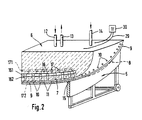
- Fig. 2 illustrates an upper non-engaging partial or whole surface mould which can be used in the bending of difficult shapes together with lower mould 6,
- the orifice systems and chaneling of a shaping surface 7', 8' included in an upper mould 6' are designed in principle the same way as described in connection with mould 6.
- the corresponding components are indicated with the same reference numerals provided, however, with an inverted comma.
- the shaping surface of upper mould 6' may be considerably larger than that of lower mould 6, said upper mould 6' must also be provided with suction orifices 11' for a controlled discharge of the blasting air.
- the lower moulds 6 having a rather large shaping surface must also be provided with an array of suction orifices 11.
- the pressure-gas pipe 12' and suction pipe 13' can be linked with a similar type of gas circulation system as the one shown in fig. 1. If necessary, it is possible to provide a separate channeling and a separate hot-gas pipe 14 for blowing hotter gas to hard-to-control surface areas.
- the upper mould can also have, over a certain effective mould area, a densified orifice pitch, larger orifices or increased blasting pressure. Thus, transfer of heat can be applied to a certain effective or active area without separate channeling.
- a heating resistance 28 fitted in distribution channel 16' can used for a concentrated thermal effect. Resistance 28 is connected with wires 29 to a power source 30.
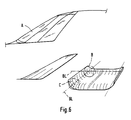
- Fig. 6 illustrates an S-shaped automotive windshield that can be bent by using a method and mould assembly of the invention.
- Reference character A indicates a section which corresponds to a present, conventional windshield configuration.
- the lower glass edge curves horizontally forward and the upper edge horizontally backward, thus providing an S-shape.
- the lateral glass edges curve backward. This produces criss-crossing bending lines BL whose crossing points are formed as a spherical surface B or some other multi-curving surface portion C. Over the areas B and C, the glass is subjected to dramatic elongation in addition to bending.
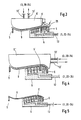
- Fig. 3 illustrates application of the invention in a case which involves the use of a partial surface upper mould 6' and a partial surface lower mould 6 for bending a glass sheet 9 supported on an outline mould 5.
- the upper partial surface mould is further provided with a mechanical press member 25 for assisting the downward bending of the margianl edge portion of glass.
- the upper mould 6' can be provided with an array of blasting and suction orifices (see fig. 2).
- a pressure pipe 12' and a suction pipe 13' can be linked with a gas circulation system 3; 20-24 similar to the one shown in fig. 1.
- the lower partial surface mould 6 can only be provided with an array of blasting orifices which is connected to pressure pipe 12, wherein a hot gas is supplied from furnace section 3 as shown in fig. 1.
- the embodiment of fig. 5 differs from the preceding ones in that there is only used a lower partial surface mould 6 which can be provided with blasting orifices only or with blasting and suction orifices, as shown in fig. 1. Also in this case, the essential feature is to produce a concentrated heating effect and a concentrated shaping support (bearing effect) on the predetermined areas below a glass sheet by means of a glass sheet non-engaging partial surface mould.
- the heating effect must be concentrated locally on a bending line and its surrounding.
- the blasting gas must have a temperature at least equal to that of glass. As the bending progresses, said lower partial surface mould 6 is brought closer to a bending line and it may be necessary to increase or heat up the blasting.
- said lower partial surface mould 6 can also be used for cooling a bending line by blowing colder air from blasting orifices 10 to a bending line or its surroundings.
- the lower partial surface mould 6 fixedly relative to outline mould 5, whereby the partial surface mould cannot be displaced but it can serve at the intial stage of heating e.g. as a support for glass. Hot gas is being used when bending the glass as descibed above.
- the mould has a structure as described above.
- the gas applied is primarily air with various gases or vapours possibly added in.
- SO2 can be used for building a protective coating film, whereby a possible contact between mould and surface does not as easily leave a mark on the glass surface.
- partial surface means in this context that the surface area of a mould is typically 10 - 30 % of the surface area of a glass sheet. Even in the case where two separate partial surface moulds are used, the combined surface area thereof is typically clearly less than 30 % of the surface area of a glass sheet.
- the lower partial surface mould support refers a support, wherein the combined lower shaping surface does not exceed 50 % of the surface area confined by the outer periphery of the shaping surface 15 of outline mould 5.
Landscapes
- Chemical & Material Sciences (AREA)
- Engineering & Computer Science (AREA)
- Materials Engineering (AREA)
- Organic Chemistry (AREA)
- Re-Forming, After-Treatment, Cutting And Transporting Of Glass Products (AREA)
Applications Claiming Priority (2)
| Application Number | Priority Date | Filing Date | Title |
|---|---|---|---|
| FI901603 | 1990-03-30 | ||
| FI901603A FI84807C (fi) | 1990-03-30 | 1990-03-30 | Foerfarande och formanordning foer att i en glasskiva boeja svaora boejningsformer, saosom s-form. |
Publications (2)
| Publication Number | Publication Date |
|---|---|
| EP0448960A1 true EP0448960A1 (de) | 1991-10-02 |
| EP0448960B1 EP0448960B1 (de) | 1995-05-17 |
Family
ID=8530172
Family Applications (1)
| Application Number | Title | Priority Date | Filing Date |
|---|---|---|---|
| EP91102652A Expired - Lifetime EP0448960B1 (de) | 1990-03-30 | 1991-02-22 | Verfahren und Formenanordnung zum Biegen von schwerformbaren Flachglasprofilen wie einer S-förmigen Glasscheibe |
Country Status (5)
| Country | Link |
|---|---|
| US (1) | US5078770A (de) |
| EP (1) | EP0448960B1 (de) |
| JP (1) | JP3190366B2 (de) |
| DE (1) | DE69109723T2 (de) |
| FI (1) | FI84807C (de) |
Families Citing this family (5)
| Publication number | Priority date | Publication date | Assignee | Title |
|---|---|---|---|---|
| FI87920C (fi) * | 1991-04-26 | 1993-03-10 | Tamglass Eng Oy | Anordning foer boejning av en av kantform understoedd glasskiva |
| US8776550B2 (en) * | 2011-11-23 | 2014-07-15 | Corning Incorporated | Method and system for making glass articles |
| KR101649409B1 (ko) * | 2014-09-23 | 2016-08-19 | (주) 예스티 | 입체 유리 기판 제조 장치 |
| TWI660920B (zh) * | 2018-06-25 | 2019-06-01 | 海納光電股份有限公司 | 非接觸成型裝置及方法 |
| US11485668B2 (en) | 2019-08-09 | 2022-11-01 | Ford Global Technologies, Llc | Glass form and marking |
Citations (3)
| Publication number | Priority date | Publication date | Assignee | Title |
|---|---|---|---|---|
| US3510284A (en) * | 1965-05-24 | 1970-05-05 | Permaglass | Method and apparatus for reshaping glass sheets on a bending mold |
| US4260409A (en) * | 1979-11-02 | 1981-04-07 | Ppg Industries, Inc. | Attaching flexible cover to mold for shaping glass |
| US4612031A (en) * | 1985-06-24 | 1986-09-16 | Ppg Industries, Inc. | Method and apparatus for shaping glass sheets on shaping molds with flotation blocks |
Family Cites Families (6)
| Publication number | Priority date | Publication date | Assignee | Title |
|---|---|---|---|---|
| US3223443A (en) * | 1963-10-17 | 1965-12-14 | Pittsburgh Plate Glass Co | Handling of sheet material |
| US3468645A (en) * | 1966-05-09 | 1969-09-23 | Permaglass | Method and apparatus for shaping glass sheets supported on a gas support bed |
| JPS5022569B1 (de) * | 1970-07-16 | 1975-07-31 | ||
| US4508556A (en) * | 1984-06-04 | 1985-04-02 | Ppg Industries, Inc. | Method and apparatus for bending glass sheets to complicated shapes including an S-shaped transverse bend |
| JPH0755841B2 (ja) * | 1987-02-03 | 1995-06-14 | 旭硝子株式会社 | 合せガラス用ガラス板の曲げ加工方法 |
| US4979977A (en) * | 1989-09-18 | 1990-12-25 | Ppg Industries, Inc. | Bending iron having member to effect reverse bend and method of using same |
-
1990
- 1990-03-30 FI FI901603A patent/FI84807C/fi not_active IP Right Cessation
- 1990-08-24 US US07/572,012 patent/US5078770A/en not_active Expired - Lifetime
-
1991
- 1991-02-22 DE DE69109723T patent/DE69109723T2/de not_active Expired - Fee Related
- 1991-02-22 EP EP91102652A patent/EP0448960B1/de not_active Expired - Lifetime
- 1991-03-29 JP JP09119991A patent/JP3190366B2/ja not_active Expired - Fee Related
Patent Citations (3)
| Publication number | Priority date | Publication date | Assignee | Title |
|---|---|---|---|---|
| US3510284A (en) * | 1965-05-24 | 1970-05-05 | Permaglass | Method and apparatus for reshaping glass sheets on a bending mold |
| US4260409A (en) * | 1979-11-02 | 1981-04-07 | Ppg Industries, Inc. | Attaching flexible cover to mold for shaping glass |
| US4612031A (en) * | 1985-06-24 | 1986-09-16 | Ppg Industries, Inc. | Method and apparatus for shaping glass sheets on shaping molds with flotation blocks |
Also Published As
| Publication number | Publication date |
|---|---|
| US5078770A (en) | 1992-01-07 |
| DE69109723T2 (de) | 1996-09-19 |
| DE69109723D1 (de) | 1995-06-22 |
| JP3190366B2 (ja) | 2001-07-23 |
| FI901603A0 (fi) | 1990-03-30 |
| FI901603A7 (fi) | 1991-10-01 |
| FI84807C (fi) | 1992-01-27 |
| EP0448960B1 (de) | 1995-05-17 |
| FI84807B (fi) | 1991-10-15 |
| JPH04219335A (ja) | 1992-08-10 |
Similar Documents
| Publication | Publication Date | Title |
|---|---|---|
| EP0448959B1 (de) | Verfahren und Formenanordnung zum Biegen von kompliziert geformten Glasscheiben | |
| EP0592862B1 (de) | Verfahren und Ofen zum Biegen von Glastafeln | |
| FI79515C (fi) | Foerfarande och anordning foer formning av glasskivor. | |
| EP0882681B1 (de) | Verfahren zum herstellen von gebogenen und gehärteten Glassscheiben und Vorrichtung zu Ihrer Herstellung | |
| KR100350330B1 (ko) | 유리시트를벤딩및템퍼링하기위한방법과장치 | |
| KR100229686B1 (ko) | 판유리의 가압굽힘성형방법 및 장치 | |
| EP0721922B1 (de) | Verfahren zum Erwärmen von Glastafeln, die getempert oder durch Wärme gehärtet werden sollen | |
| EP0568053A1 (de) | Verfahren und Vorrichtung zum Biegen und Härten von Glasscheiben | |
| US4871385A (en) | Process and device for cooling of sheets of bent glass so as to produce edge stresses | |
| US4609391A (en) | Method for forming glass sheets | |
| JP4457438B2 (ja) | ガラス板の曲げ成形装置および曲げ成形方法 | |
| JPH04224124A (ja) | 板ガラスの曲げ成形支持金型 | |
| EP0448960B1 (de) | Verfahren und Formenanordnung zum Biegen von schwerformbaren Flachglasprofilen wie einer S-förmigen Glasscheibe | |
| JP3091422B2 (ja) | 熱軟化性シート材を成形するための成形モールド、それを用いた成形装置およびその成形方法 | |
| US5022906A (en) | Process for obtaining bent-tempered motor vehicle glazings | |
| US5185022A (en) | Mould assembly for bending difficult bending shapes in a glass sheet | |
| JPS59232926A (ja) | 真空ホルダ | |
| JP3879152B2 (ja) | ガラス板の曲げ成形装置、曲げ成形型およびその製造方法 | |
| EP0555245B1 (de) | Verfahren und vorrichtung zur entwicklung von seitenspannung in einer windscheibe in einem biegeofen für windscheiben | |
| JPS6362459B2 (de) | ||
| US3510284A (en) | Method and apparatus for reshaping glass sheets on a bending mold | |
| US6000244A (en) | Mold assembly for forming a glass sheet | |
| JP3898283B2 (ja) | 曲げ強化ガラス板の製造方法および製造装置 | |
| CZ211795A3 (en) | Fixture for hot bending safety glass |
Legal Events
| Date | Code | Title | Description |
|---|---|---|---|
| PUAI | Public reference made under article 153(3) epc to a published international application that has entered the european phase |
Free format text: ORIGINAL CODE: 0009012 |
|
| AK | Designated contracting states |
Kind code of ref document: A1 Designated state(s): CH DE FR GB IT LI |
|
| 17P | Request for examination filed |
Effective date: 19920224 |
|
| RAP1 | Party data changed (applicant data changed or rights of an application transferred) |
Owner name: TAMGLASS ENGINEERING OY |
|
| 17Q | First examination report despatched |
Effective date: 19930929 |
|
| GRAA | (expected) grant |
Free format text: ORIGINAL CODE: 0009210 |
|
| AK | Designated contracting states |
Kind code of ref document: B1 Designated state(s): CH DE FR GB IT LI |
|
| ITF | It: translation for a ep patent filed | ||
| REF | Corresponds to: |
Ref document number: 69109723 Country of ref document: DE Date of ref document: 19950622 |
|
| ET | Fr: translation filed | ||
| PLBE | No opposition filed within time limit |
Free format text: ORIGINAL CODE: 0009261 |
|
| STAA | Information on the status of an ep patent application or granted ep patent |
Free format text: STATUS: NO OPPOSITION FILED WITHIN TIME LIMIT |
|
| 26N | No opposition filed | ||
| PGFP | Annual fee paid to national office [announced via postgrant information from national office to epo] |
Ref country code: CH Payment date: 19970129 Year of fee payment: 7 |
|
| PG25 | Lapsed in a contracting state [announced via postgrant information from national office to epo] |
Ref country code: LI Free format text: LAPSE BECAUSE OF NON-PAYMENT OF DUE FEES Effective date: 19980228 Ref country code: CH Free format text: LAPSE BECAUSE OF NON-PAYMENT OF DUE FEES Effective date: 19980228 |
|
| REG | Reference to a national code |
Ref country code: CH Ref legal event code: PL |
|
| PGFP | Annual fee paid to national office [announced via postgrant information from national office to epo] |
Ref country code: GB Payment date: 19990216 Year of fee payment: 9 |
|
| PG25 | Lapsed in a contracting state [announced via postgrant information from national office to epo] |
Ref country code: GB Free format text: LAPSE BECAUSE OF NON-PAYMENT OF DUE FEES Effective date: 20000222 |
|
| GBPC | Gb: european patent ceased through non-payment of renewal fee |
Effective date: 20000222 |
|
| REG | Reference to a national code |
Ref country code: FR Ref legal event code: CD |
|
| PGFP | Annual fee paid to national office [announced via postgrant information from national office to epo] |
Ref country code: FR Payment date: 20060112 Year of fee payment: 16 |
|
| PGFP | Annual fee paid to national office [announced via postgrant information from national office to epo] |
Ref country code: DE Payment date: 20060117 Year of fee payment: 16 |
|
| PGFP | Annual fee paid to national office [announced via postgrant information from national office to epo] |
Ref country code: IT Payment date: 20060228 Year of fee payment: 16 |
|
| REG | Reference to a national code |
Ref country code: FR Ref legal event code: ST Effective date: 20071030 |
|
| PG25 | Lapsed in a contracting state [announced via postgrant information from national office to epo] |
Ref country code: DE Free format text: LAPSE BECAUSE OF NON-PAYMENT OF DUE FEES Effective date: 20070901 |
|
| PG25 | Lapsed in a contracting state [announced via postgrant information from national office to epo] |
Ref country code: FR Free format text: LAPSE BECAUSE OF NON-PAYMENT OF DUE FEES Effective date: 20070228 |
|
| PG25 | Lapsed in a contracting state [announced via postgrant information from national office to epo] |
Ref country code: IT Free format text: LAPSE BECAUSE OF NON-PAYMENT OF DUE FEES Effective date: 20070222 |