EP0449036B1 - Polyurethan, elastische Polyurethan-Faser, sowie Polyesterpolycarbonatdiol, das zu deren Herstellung verwendet wird - Google Patents
Polyurethan, elastische Polyurethan-Faser, sowie Polyesterpolycarbonatdiol, das zu deren Herstellung verwendet wird Download PDFInfo
- Publication number
- EP0449036B1 EP0449036B1 EP91103840A EP91103840A EP0449036B1 EP 0449036 B1 EP0449036 B1 EP 0449036B1 EP 91103840 A EP91103840 A EP 91103840A EP 91103840 A EP91103840 A EP 91103840A EP 0449036 B1 EP0449036 B1 EP 0449036B1
- Authority
- EP
- European Patent Office
- Prior art keywords
- diol
- polyurethane
- elastic
- polyesterpolycarbonate
- polyester
- Prior art date
- Legal status (The legal status is an assumption and is not a legal conclusion. Google has not performed a legal analysis and makes no representation as to the accuracy of the status listed.)
- Expired - Lifetime
Links
Images
Classifications
-
- C—CHEMISTRY; METALLURGY
- C08—ORGANIC MACROMOLECULAR COMPOUNDS; THEIR PREPARATION OR CHEMICAL WORKING-UP; COMPOSITIONS BASED THEREON
- C08G—MACROMOLECULAR COMPOUNDS OBTAINED OTHERWISE THAN BY REACTIONS ONLY INVOLVING UNSATURATED CARBON-TO-CARBON BONDS
- C08G63/00—Macromolecular compounds obtained by reactions forming a carboxylic ester link in the main chain of the macromolecule
- C08G63/64—Polyesters containing both carboxylic ester groups and carbonate groups
-
- C—CHEMISTRY; METALLURGY
- C08—ORGANIC MACROMOLECULAR COMPOUNDS; THEIR PREPARATION OR CHEMICAL WORKING-UP; COMPOSITIONS BASED THEREON
- C08G—MACROMOLECULAR COMPOUNDS OBTAINED OTHERWISE THAN BY REACTIONS ONLY INVOLVING UNSATURATED CARBON-TO-CARBON BONDS
- C08G71/00—Macromolecular compounds obtained by reactions forming a ureide or urethane link, otherwise, than from isocyanate radicals in the main chain of the macromolecule
- C08G71/04—Polyurethanes
-
- C—CHEMISTRY; METALLURGY
- C08—ORGANIC MACROMOLECULAR COMPOUNDS; THEIR PREPARATION OR CHEMICAL WORKING-UP; COMPOSITIONS BASED THEREON
- C08G—MACROMOLECULAR COMPOUNDS OBTAINED OTHERWISE THAN BY REACTIONS ONLY INVOLVING UNSATURATED CARBON-TO-CARBON BONDS
- C08G18/00—Polymeric products of isocyanates or isothiocyanates
- C08G18/06—Polymeric products of isocyanates or isothiocyanates with compounds having active hydrogen
- C08G18/28—Polymeric products of isocyanates or isothiocyanates with compounds having active hydrogen characterised by the compounds used containing active hydrogen
- C08G18/40—High-molecular-weight compounds
- C08G18/42—Polycondensates having carboxylic or carbonic ester groups in the main chain
- C08G18/44—Polycarbonates
-
- D—TEXTILES; PAPER
- D01—NATURAL OR MAN-MADE THREADS OR FIBRES; SPINNING
- D01F—CHEMICAL FEATURES IN THE MANUFACTURE OF ARTIFICIAL FILAMENTS, THREADS, FIBRES, BRISTLES OR RIBBONS; APPARATUS SPECIALLY ADAPTED FOR THE MANUFACTURE OF CARBON FILAMENTS
- D01F6/00—Monocomponent artificial filaments or the like of synthetic polymers; Manufacture thereof
- D01F6/58—Monocomponent artificial filaments or the like of synthetic polymers; Manufacture thereof from homopolycondensation products
- D01F6/70—Monocomponent artificial filaments or the like of synthetic polymers; Manufacture thereof from homopolycondensation products from polyurethanes
-
- Y—GENERAL TAGGING OF NEW TECHNOLOGICAL DEVELOPMENTS; GENERAL TAGGING OF CROSS-SECTIONAL TECHNOLOGIES SPANNING OVER SEVERAL SECTIONS OF THE IPC; TECHNICAL SUBJECTS COVERED BY FORMER USPC CROSS-REFERENCE ART COLLECTIONS [XRACs] AND DIGESTS
- Y10—TECHNICAL SUBJECTS COVERED BY FORMER USPC
- Y10S—TECHNICAL SUBJECTS COVERED BY FORMER USPC CROSS-REFERENCE ART COLLECTIONS [XRACs] AND DIGESTS
- Y10S428/00—Stock material or miscellaneous articles
- Y10S428/902—High modulus filament or fiber
Definitions
- the present invention relates to a novel polyurethane and elastic polyurethane fiber and a polyesterpolycarbonate diol used for the same.
- Known polyurethanes are polyester-, polyether- and polycarbonate-based ones.
- Japanese Patent Application Laid-open Nos. 101496/1973 and 22817/1987 disclose a polyurethane derived from 3-methyl-1,5-pentanediol and a dicarboxylic acid and one from a polyester diol or polycarbonate diol obtained from 2-methyl-1,8-octanediol, respectively.
- Japanese Patent Application Laid-open No. 33382/1990 discloses a polyester diol utilizing 2-methyl-1,8-octanediol and a polycarbonate diol utilizing 2-methyl-1,8-octanediol or 3-methyl-1,5-pentanediol and also a polyurethane utilizing a mixture of the polyester diol and the polycarbonate diol as a starting material polymer diol.
- This polyurethane however cannot be formed into an elastic fiber exhibiting good elastic recovery characteristics at low temperatures.
- Japanese Patent Application Laid-open No. 173117/1985 discloses an elastic fiber obtained from a polyurethane utilizing a polyester diol from hexamethylene glycol or 1,10-decanediol. This fiber, utilizing this long-chain diol having no branches, does not have sufficent elastic recovery property.
- Japanese Patent Application Laid-open No. 713/1972, U.S.P. 3,097,192 and Japanese Patent Application Laid-open No. 97617/1988 disclose an elastic fiber of a polyurethane utilizing a polyester diol derived from 2,2,4- or 2,4,4-trimethylhexanediol and adipic acid, one of a polyurethane utilizing a polyester diol from 2,5-hexanediol or 2,2-dimethyl-1,3-propanediol and one of a polyurethane utilizing a polyester diol from (2,2-dimethyl-1,3-propane dodecanediolate) glycol, respectively.
- the use of these polyesterdiols fail in providing the obtained fibers with high thermal resistance, elastic recovery and resistance to cold.
- Japanese Patent Application Laid-open No. 1190717/1989 discloses an elastic fiber of a polyurethane utilizing a polycarbonate diol from 1,6-hexanediol or 1,5-pentanediol. This fiber however is not satisfactory in the elongation.
- Japanese Patent Application Laid-open No. 1132858/1989 discloses a melt-blown nonwoven fabric of a polyurethane utilizing a polyester diol from 3-methyl-1,5-pentanediol.
- An object of the present invention is to provide an elastic polyurethane fiber being excellent in all of resistance to chlorine, water and mildew, thermal resistance and resistance to cold, as well as having high elongation.
- Another object of the present invention is to provide an elastic polyurethane fiber having low tensile stress in the low tensile strain region and high tensile stress in the high tensile strain region.
- the present invention provides a polyurethane obtained by copolymerizing a polymer diol, an organic diisocyanate and a chain extender, said polyurethane having an inherent viscosity of 0.2 to 1.6 dl/g and being derived from a polyesterpolycarbonate diol ⁇ , a mixed polymer diol ⁇ comprising a polyester diol ⁇ and a polycarbonate diol ⁇ in a weight ratio between ⁇ and ⁇ , ⁇ / ⁇ , of 10/90 to 80/20, or a mixture comprising the polyesterpolycarbonate diol ⁇ and the mixed polymer diol ⁇ ; where: ⁇ is a polyesterpolycarbonate diol comprising the following structural units (I), (II) and (III) and, if necessary,
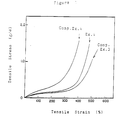
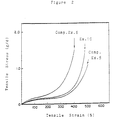
- the basic finding on which the present invention is based is that the use of polyurethanes utilizing as a polymer diol the above polyesterpolycarbonate diol ⁇ and/or the above mixed polymer diol of the polyester diol ⁇ and polycarbonate diol ⁇ provides elastic fibers having low tensile stress in the low tensile strain region and high tensile stress in the high tensile strain region.
- the feature of the elastic fiber of the present invention lies in the polymer diol residue, i.e. soft segment, of the polyurethane constituting it.
- the present invention utilizes as a starting material polymer diol a polyesterpolycarbonate diol ⁇ which is described below ⁇ and/or a mixture of a polyester diol ⁇ and a polycarbonate diol ⁇ in a weight ratio, ⁇ / ⁇ , of 10/90 to 80/20, which two are to be described later herein.
- ⁇ is a polyesterpolycarbonate diol comprising the following structural units (I), (II) and (III) and, if necessary, (IV) with a molar ratio of (I)/(II) of 90/10 to 20/80 and having a number average molecular weight of 1,000 to 3,500 wherein R 1 represents a divalent organic group, wherein m and n are each 0 or an integer of 1 to 8 and the sum of m and n is an integer of 4 to 8, - (CH 2 ) p - (IV) wherein p represents an integer of 6 to 10.
- the polyesterpolycarbonate diol which also constitutes the present invention, is a polymer diol comprises a diol residue, i.e. the group remaining after the 2 terminal OH groups have been removed from the diol, of at least one member selected from the group of the divalent groups represented by formula (III) and if necessary at least one member selected from the group of the divalent groups represented by formula (IV).
- the ends of the structural unit (III) or (IV) are bonded to the structural unit (I) or (II).
- Preferred examples of compounds giving the unit represented by (III) are primary diols, e.g. 2-methyl-1,.8-octanediol and 3-methyl-1,5-pentanediol.
- Examples of desirable compounds that give the unit represented by (IV) are 1,6-hexanediol, 1,7-heptanediol, 1,8-octanediol, 1,9-nonanediol and 1,10-decanediol, among which preferred is 1,9-nonanediol.
- the molar ratio of (III)/[(III) + (IV)] in the polyesterpolycarbonate diol of the present invention be 0.1 to 1.0. If (III)/[(III) + (IV)] is less than 0.1, the polyurethane fiber utilizing this diol will sometimes have low elastic recovery and low elongation.
- the dicarboxylic acid that provides the structural unit (II) used for the preparation of the polyesterpolycarbonate diol of the present invention be an aliphatic dicarboxylic acid having 5 to 12 carbon atoms or an aromatic dicarboxylic acid having 8 to 12 carbon atoms, of which the former is preferred.
- the aliphatic dicarboxylic acid are glutaric acid, adipic acid, pimelic acid, suberic acid, azelaic acid and sebacic acid.
- the aromatic dicarboxylic acid are phthalic acid, terephthalic acid and isophthalic acid. Particularly preferred among the above examples are adipic acid and azelaic acid.
- the polyesterpolycarbonate diol ⁇ of the present invention has a number average molecular weight of 1,000 to 3,500, preferably 1,500 to 3,000.
- the thermal resistance and elastic recovery of the resultant polyurethane decrease with a number average molecular weight of less than 1,000, while the spinnability decreases with that exceeding 3,500.
- the polyesterpolycarbonate diol ⁇ of the present invention comprises the afore-described repeating units (I) and (II) in a molar ratio of (I)/(II) of 90/10 to 20/80, preferably 85/15 to 40/60.
- the elongation of the fiber obtained from the resultant polyurethane decreases with a (I)/(II) ratio exceeding 90 mol%, while the resistance to hot water decreases with that of less than 20 mol%.
- the polyesterpolycarbonate diol ⁇ may contain small amounts of structural units other than the above (III) and (IV), and may also used in combination with other polymer diols within a limit not to substantially impair the effect of the presemt invention.
- a prefered structural unit (III) of the polyesterpolycarbonate diol ⁇ is
- Desirable carbonates used for producing the polyester-polycarbonate diol of the present invention are dialkyl carbonates, diaryl carbonates and alkylene carbonates.
- the polyesterpolycarbonate diol of the present invention can be produced by any process.
- a known process which comprises feeding at the same time a diol, a dicarboxylic acid and a carbonate and effecting esterification or transesterification. It is also possible to synthesize a polyester diol or polycarbonate diol beforehand, and reacting it with a carbonate or a diol and dicarboxylic acid, respectively.
- the mixed polymer diol is a mixture of the polyester diol ⁇ and polycarbonate diol ⁇ described below.
- the mixing ratio by weight between ⁇ and ⁇ , ⁇ / ⁇ , is 10/90 to 80/20.
- the elongation of the resultant fiber decreases with ⁇ of less than 10% by weight, while the resistance to hot water decreases with ⁇ of less than 20% by weight.
- polymer diols may be used in combination with this mixed polymer diol within a limit not to substantially decrease the effect of the present invention.
- ⁇ is a polyester diol comprising repeating units represented by wherein R 2 represents one member selected from divalent organic groups, at least 50 mol% of which is and q represents an integer of 4 to 10; satisfying the following conditions (s) and (t) 4 ⁇ total number of carbon atoms number of ester bonds ⁇ 11 0.03 ⁇ number of methyne groups total number of carbon atoms ⁇ 0.2 wherein "total number of carbon atoms” means the total number of carbon atoms contained in the polyester diol and excluding those contained in the ester bonds thereof, and having a number average molecular weight of 1,000 to 3,500.
- the polyester diol ⁇ can be obtained from a diol component comprising at least 50 mol% of 3-methyl-1,5-pentanediol and, as a dicarboxylic acid component, an aliphatic dicarboxylic acid having 4 to 10 methylene chains, e.g. adipic acid, pimelic acid, suberic acid, azelaic acid, sebacic acid and 1,10-decanedicarboxylic acid.
- adipic acid e.g. adipic acid, pimelic acid, suberic acid, azelaic acid, sebacic acid and 1,10-decanedicarboxylic acid.
- the resistance to hot water and cold resistance significantly decrease, while with the ratio exceeding 11 the elastic recovery property decreases to a large extent and the cold resistance and elongation decrease. It is further important that: 0.03 ⁇ number of methyne groups total number of carbon atoms ⁇ 0.2.
- the methyne group herein means a group bonded to 3 different carbon atoms. If the above ratio is less than 0.03, the elastic recovery will, in particular at low temperatures, be poor. On the other hand if it is more than 0.2, the thermal resistance, strength and elastic recovery will become poor.
- Preferred dicarboxylic acids in view of overall performance are azelaic acid, sebacic acid and 1,10-decanedicarboxylic acid, among which azelaic acid and sebacic acid are more preferred where the product elastic fiber is produced by melt spinning.
- the content of 3-methyl-1,5-pentanediol in the diol component is less than 50 mol%, both the elastic recovery at low temperatures and elongation of the obtained fiber will be low.
- diols that can be used in combination with 3-methyl-1,5-pentanediol include, among others, 1,10-decanediol, 1,9-nonanediol, 1,8-octanediol, 1,6-hexanediol, 1,5-pentanediol and 1,4-butanediol.
- the molecular weight of the polyester diol has a large effect on the properties of the obtained fiber and the number average molecular weight must be 1,000 to 3,500, preferably 1,500 to 2,500.
- a number average molecular weight of smaller than 1,000 decreases the thermal resistance, elastic recovery at low temperatures and elongation of the resultant fiber.
- that of larger than 3,500 decreases the elastic recovery property and, where melt spinning is employed, generates soilings on the similar spinneret, clogging of the filter and similar troubles, whereby continuous spinning operation becomes difficult to conduct over a long period.
- the polyester diol used in the present invention can be produced by any process including the known ones for producing polyethylene terephthalate or polybutylene terephthalate, i.e. transesterification or direct esterification, followed by melt polycondensation.
- the polycarbonate diol ⁇ comprises repeating units of at least one member selected from the following structural units (V), (VI) and (VII), said units being linked with each-other via carbonate bond, -(CH 2 )r- (V) wherein r represents an integer of 6 to 10 the molar ratio of [(VI) + (VII)]/[(V) + (VI) + (VII)] being 0.1 to 1.0, and that of [(V) + (VI)]/[(V) + (VI) + (VII)] being also 0.1 to 1.0, and having a number average molecular weight of 1,000 to 3,000.
- the polycarbonate diol used in the present invention comprises at least one member selected from the above structural units (V), (VI) and (VII).
- Examples of compounds that provide the groups represented by formula (V) are 1,6-hexanediol, 1,7-heptanediol, 1,8-octanediol, 1,9-nonanediol and 1,10-decanediol, among which 1,9-nonanediol is preferred.
- Examples of compounds that can provide groups represented by (VI) and (VII) are 2-methyl-1,8-octanediol and 3-methyl-1,5-pentanediol, respectively.
- the ratios of [(VI) + (VII)]/[(V) (VI) + (VII)] and [(V) + (VI)]/[(V) (VI) + (VII)] are both 0.1 to. 1,0, both preferably at- least 0.3. With the ratio [(VI) + (VII)]/[(V) + (VI) + (VII)] being less.
- the number average molecular weight of the polycarbonate diol has a large influence on the properties and is 1,000 to 3,000. If the molecular weight is smaller than 1,000, the resultant fiber will have low elastic recovery properties, a poor resistance to cold and elongation as well as low thermal resistance. On the other hand, if the molecular weight is larger than 3,000, not only the resultant fiber will have a low elastic recovery, but the spinnability will become poor with ready occurrence of spinneret soiling and, filter clogging, thereby shortening the continuous spinning operation time.
- diols other than the above starting material diol may be used in combination with the principal diol.
- Preferred examples of carbonates usable for the polycarbonate diol used in the present invention are dialkyl carbonate, diaryl carbonate and alkylene carbonate.
- the polycarbonate diol used in the present invention can be produced by any process including known ones for producing polycarbonates from diphenyl carbonate an bisphenol A, i.e. by transesterification.
- diisocyanates suitably used in the present invention are aliphatic, alicyclic and aromatic diisocyanates, preferably those having a molecular weight of not more than 500, e.g. 4,4'-diphenylmethane diisocyanate, p-phenylene diisocyanate, tolylene diisocyanate, 1,5-naphthylene diisocyanate, xylylene diisocyanate, hexamethylene diisocyanate, isophorone diisocyanate, and 4,4'-dicyclohexylmethane diisocyanate, among which 4,4'-diphenylmethane diisocyanate is particularly preferred.
- 4,4'-diphenylmethane diisocyanate e.g. 4,4'-diphenylmethane diisocyanate, p-phenylene diisocyanate, tolylene diisocyanate, 1,5-naphthylene diisocyanate
- chain extenders in the art are usable for the synthesis of the polyurethane of the present invention in the art, i.e. low-molecular-weight compounds having a molecular weight of not more than 400 and having at least 2 hydrogen atoms reactable with isocyanate, for example diols, e.g.
- ethylene glycol propylene glycol, 1,4-butanediol, 1,6-hexanediol, 3-methyl-1,5-pentanediol, 1,4-bis(2-hydroxyethoxy)benzene, 1,4-cyclohexanediol, bis( ⁇ -hydroxyethyl) terephthalate and xylylene glycol; and diamines, e.g.
- chain extenders are 1,4-butanediol and 1,4-bis(2-hydroxyethoxy)benzene.
- the elastic fiber is produced from a thermoplastic polyurethane by, in particular, melt spinning
- the proper selection of 4,4-diphenylmethane diisocyanate as the organic diisocyanate used for the synthesis of the thermoplastic polyurethane, in combination with 1,4-butanediol and/or- 1,4-bis (2-hydroxyethoxy)benzene as the chain extender will provide a fiber having excellent heat resistance, elastic recovery and elongation.
- the polyurethane of the present invention can be produced by known processes for urethanization, among which according to a study by the present inventors, melt polymerization in the substantial absence of inert solvent is preferred, in particular continuous melt polymerization through a multi-screw extruder.
- the melt polymerization is conducted preferably, although not specifically restricted thereto, at a temperature of 200 to 240°C.
- a temperature below 240°C can increase the thermal resistance, and one above 200°C can provide a thermoplastic polyurethane having good spinnability.
- the polyurethanes of the present invention have an inherent viscosity ⁇ inh of 0.2 to 1.6 dl/g, more preferably 0.3 to 1.4 dl/g.
- the inherent viscosity, ⁇ inh herein is determined from the viscosity measured on a 0.5 g/dl solution of specimen in N,N-dimethyl-formamide containing 1% by weight of n-butylamine, which has been kept standing 24 hours at a room temperature after the dissolution, with an Ubbelohde viscometer. With an ⁇ inh of less than 0.2 dl/g the elastic recovery is low, while with that exceeding 1.6 dl/g the spinnability becomes poor.
- the polymer diol (X), organic diisocyanate (Y) and chain extender (Z) be used in a molar ratio, (Y)/[(X) + (Z)], of 0.9 to 1.2, more preferably 0.95 to 1.15.
- This molar ratio range can provide the resultant elastic polyurethane fiber with excellent thermal resistance, elastic recovery and elongation.
- polyurethane of the present invention consists substantially of structural units of:
- the polyurethane obtained by this invention will find use as sheet, film, roll, gear, solid tire, belt, hose, tube, vibration isolator, packing, shoe sole (microcellular), artificial leather, fiber treatment, cushioning material, paint, adhesive, sealant, water proofing agent, flooring material, and elastic fiber.
- the elastic polyurethane fiber of the present invention is described next.
- the polyurethane of the present invention can be formed into fiber by known dry spinning, wet spinning, melt spinning or like processes.
- melt spinning is particularly preferred because of its capability of forming fine filaments.
- the polyurethane is pelletized first and the pellets are then melt spun; or, the thermoplastic polyurethane obtained by melt polymerization is directly extruded through spinnerets, the latter process being preferred from the viewpoint of spinning stability.
- the elastic polyurethane fiber of the present invention can be provided with still higher elastic recovery by spinning the polyurethane with excess isocyanate.
- the polyurethane with excess isocyanate means that having a molar ratio of (organic diisocyanate Y)/[(polymer diol X) + (chain extender Z)] of 1.02 to 1.15, or a blend having a (Y)/[(X) + (Z)] ratio of 1.02 to 1.15 obtained by addition at the spinning of an amount of polyisocyanate or blocked polyisocyanate to the polyurethane with non-excess isocyanate.
- the above highly elastic polyurethane fiber obtained from the polyurethane with excess isocyanate has an amount of allophanate (anion of allophanic acid) bonds of 0.001 to 0.1 mmol/g-fiber.
- the amount of the allophanate bonds is determined by dissolving a fiber specimen in a 0.5N n-butylamine solution in N,N-dimethyliformamide followed by back-titration.
- the elastic polyurethane fiber of the present invention may incorporate, besides the above polyurethane, small amounts of other polymers and organic and inorganic additives within limits not to impair the effect of the present invention.
- the elastic polyurethane fiber of the present invention has excellent resistance to heat, cold and water, and good elastic recovery, and high elongation and resistance to chlorine.
- the elastic polyurethane fibers thus obtained are used in the actual applications as they are as core yarns covered with other fibers, or as fabrics in which they are used in combination with other fibers.
- other fibers are such known fibers as polyamide fibers, wool, cotton and polyester fibers.
- the elastic polyurethane fiber of the present invention can be dyed at a temperature of 120°C or above, and therefore can be formed into elastic core yarns, fabrics, in combination with polyester fibers, which are generally dyed at temperatures above 120°C.
- the elastic core yarns as used herein include those comprising an elastic polyurethane yarn as core covered with other fibers, and are prepared for example by using a twister, by air entanglement or by using a ring frame, although the preparation process is not limited thereto.
- the elastic core yarns herein preferably contain the elastic polyurethane fiber of the present invention as the core thereof in a ratio to the other fiber of 1:2 to 1:30.
- fabrics used herein includes woven, knitted and nonwoven fabrics and paper, among which woven and knitted fabrics are preferred by virtue of their capability to give various desired mechanical properties by selecting weaving or knitting conditions.
- the elastic polyurethane fiber of the present invention is used in fabrics in combination with other known fibers, e.g. polyester fibers, polyamide fibers, cotton and wool.
- the fabrics as referred to in the present invention comprising the elastic polyurethane fibers and other fibers preferably contain at least 30% of the other fibers on their surface (surface yarn).
- the fabrics have desirable light resistance and usableness when they are so constructed that the elastic polyurethane fiber contained is positioned at the middle part and thus is not exposed on the surface to a possible extent.
- the elastic polyurethane fiber of the present invention be contained in the fabrics in an amount of at least 3%, or at least 5% where an elastic core yarn containing the elastic polyurethane fiber is used. With the content being less than the above, the fabrics sometimes decrease their elastic performance.
- the other fibers constituting the fabrics can be in any form including spun yarns, filament yarns, grey yarns and textured yarns.
- Preferred polyester fibers for this purpose comprise at least 90 mol% of repeating units from ethylene terephthalate residue.
- the fabrics are prepared by known weaving or knitting processes.
- knit fabrics are power net, mesh, tulle, satin, tricot lace and jacquard for warp knits and reversible plain stitch, interlock, mock, pile, velour, mesh and jacquard for round knits.
- woven fabrics are satin, plain weave, twill and double weave.
- the other fibers used in combination with the elastic polyurethane fiber of the present invention may be of common fineness, preferably of 0.1 to 10 deniers.
- the fact that the fabrics are dyeable at high temperature and under high pressure means the following: after the fabrics have been dyed with a disperse dye used conventionally for dyeing polyester fibers at nign temperatures and pressure conditions of 120°C x 60 minutes, the elastic polyurethane fiber contained therein still maintains at least 80% its original strength.
- the elastic polyurethane fiber of the present Invention thanks to its dyeability under conditions of high temperature and pressure, can be used in combination with polyester fibers to form fabrics.
- the polyester fibers used for this purpose preferably have anti-pilling properties of at least grade 3 as determined in accordance with the ICI method with a testing time of 5 hours.
- Polyesters having this property are those comprising, either by copolymerization or by blending, at least one member selected from the group consisting of a phosphorus compound, silicon compound, sulfonic acid group-containing compound and anti-pilling improving compounds.
- the polyesters preferably have been copolymerized or contain any one of the above compounds in an amount of 0.05 to 5 mol%.
- Anti-pilling properties can also be provided by permitting the polyester fibers to have an irregular cross-sectional shape.
- a flat cross section with a flatness L/W (L: maximum length and W: maximum breadth of the fiber cross section) is preferably 2 to 10.
- the core yarns and fabrics utilizing the elastic polyurethane fiber of the present invention are used for example for the following items:
- the tensile strength retention of a specimen having been treated in hot water at 130°C for 90 minutes is determined.
- JIS L-1013 JIS L-1013 is applied.
- Table 1 Abbr.
- a mixture comprising 833 g of a mixture of 3-methyl-1,5-pentanediol (MPD) and 1,6-hexanediol (HD) (MPD/HD molar ratio: 80:20), 697 g of 1,10-decanedicarboxylic acid (DA) and 267 g of ethylene carbonate (EC) was heated up to 160°C in nitrogen gas flow to distill off ethylene glycol (EG) and water. After almost all EG and water have been distilled off, the reaction system was evacuated and condensation was allowed to further proceed under a vacuum of 0.2666 kPa - 1.333 kPa (2 to 10 mmHg). As a result, a polyesterpolycarbonate diol having a hydroxyl group value of 74.9 and a molecular weight of 1,500 was obtained and named Polyesterpolycarbonate diol a.
- Esterification was effected with 2,080 g of a mixture of 2-methyl-1,8-octanediol and 1,9-nonanediol (molar ratio: 50:50) and 1,460 g of adipic acid (molar ratio of diols/adipic acid: 1.3/1) in nitrogen gas flow under atmospheric pressure and at about 220°C, while water formed by condensation was being distilled off.
- adipic acid molar ratio of diols/adipic acid: 1.3/1
- the reaction was terminated by gradually evacuating the system with a vacuum pump, to obtain a polyester diol having a hydroxyl group value of 74.8 (hereinafter referred to as "Polyester l").
- a mixture comprising 1,822 g of a mixture of 2-methyl-1,8-octanediol (MOD) and 1,9-nonanediol (ND) (molar ratio: 50:50) and 2,140 g of diphenyl carbonate was heated in nitrogen gas flow at 200°C while phenol that formed was being distilled off from the reaction system. The temperature was gradually elevated to 210 to 220°C to distill off most of phenol, and then the system was evacuated to completely distill off phenol under a vacuum of 0.7998kPa - 1.333 kPa (6 to 10 mmHg) at 210 to 220°C.
- MOD 2-methyl-1,8-octanediol
- ND 1,9-nonanediol
- the pellets were dried in vacuo at 80°C for 10 hours, and then spun through a spinning machine equipped with a single-screw extruder at a spinning temperature of 235°C, spinning speed of 800 m/min, apparent draft of 847, speed difference between godet roll and take-up of 35 m/min and spinning tension of 0.08 g/d, to give a polyurethane yarn of 70 deniers/2 filaments.
- the yarn thus obtained was heat treated at 80°C for 20 hours and then tested for the desired favorable, properties. The results were favorable as shown in Table 3,
- Polyurethanes having the compositions shown in Table 3 were obtained from Polyesterpolycarbonates b through f and i through k shown in Table 2 in the same manner as in Example 1.
- the polyurethanes obtained were pelletized and then spun into elastic polyurethane fibers in the same manner as in Example 1.
- the fibers thus obtained had good properties as shown in Table 3.
- FIGURE 1 shows the stress-strain curve of the fiber obtained in Example 4.
- Esterification was effected with 1,534 g of 3-methyl-1,5-pentanediol and 1,880 g of azelaic acid (molar ratio of MPD/AZ: 1.3/1) in nitrogen gas flow under atmospheric pressure and at about 195°C, while water formed by condensation was being distilled off.
- the acid value of the resultant polyester decreased below about 1
- the reaction was terminated by gradually evacuating the system with a vacuum pump, to obtain a polyester diol having a hydroxyl group value of 44.9 and an acid value of 0.23 (hereinafter referred to as "Polyester n").
- This polyester was liquid at room temperature and had a molecular weight of 2,500.
- a mixture comprising 1,762 g of a mixture of 2-methyl-1,8-octanediol (MOD) and 1,9-nonanediol (ND) (molar ratio: 50:50) and 2,140 g of diphenyl carbonate was heated in nitrogen gas flow to 200°C while phenol that formed was being distilled off from the reaction system. The temperature was gradually elevated to 210 to 220°C to distill off most of phenol, and then the system was evacuated to completely distill off phenol under a vacuum of 0.7998 kPa to 1.333 kPa (6 to 10 mmHg) at 210 to 220°C. As a result, a polycarbonate diol having a molecular weight of 2,000 was obtained and named Polycarbonate u.
- Continuous melt polymerization was conducted by continuously feeding to a same-direction twin-screw extruder, a mixture composed of a mixture of Polyester n and Polycarbonate u (weight ratio of Polyester n/Polycarbonate u: 50/50) and BD and heated at 30°C and MDI melted by heating at 50°C each with a metering pump at such rates that the moles used of (polymer diol)/MDI/BD would be 1/3.15/2.
- the extruder had 3 independent temperature-controllable zones, and the temperature of its middle zone, i.e. polymerization temperature, was maintained at 230°C.
- the polyurethane that formed was continuously extruded into water to form strands, which were then formed into pellets through a pelletizer.
- the pellets were dried in vacuo at 80°C for 10 hours, and then spun through a spinning machine equipped with single-screw extruder at a spinning temperature of 235°C, spinning speed of 800 m/min, apparent draft of 847, speed difference between godet roll and take-up of 35 m/min and spinning tension of 0.08 g/d, to give a polyurethane yarn of 70 deniers/2 filaments.
- the yarn thus obtained was heat treated at 80°C for 20 hours and then tested for the desired favorable properties. The results were favorable as shown in Table 6 and FIGURE 2.
- Polyurethanes having the compositions shown in Table 6 were obtained, pelletized and then spun into elastic polyurethane fibers in the same manner as in Example 10. The fibers thus obtained had good properties as shown in Table 6.
- Polyurethanes having the compositions shown in Table 6 were obtained, pelletized and then spun into elastic polyurethane fibers in the same manner as in Example 10. None of the fibers thus obtained had good properties in all of tensile behavior, hot water resistance and elastic recovery as shown in Table 6.
Landscapes
- Chemical & Material Sciences (AREA)
- Chemical Kinetics & Catalysis (AREA)
- Health & Medical Sciences (AREA)
- Medicinal Chemistry (AREA)
- Polymers & Plastics (AREA)
- Organic Chemistry (AREA)
- General Chemical & Material Sciences (AREA)
- Engineering & Computer Science (AREA)
- Textile Engineering (AREA)
- Artificial Filaments (AREA)
- Polyurethanes Or Polyureas (AREA)
- Polyesters Or Polycarbonates (AREA)
Claims (15)
- Polyurethan, das durch Copolymerisieren eines Polymerdiols, eines organischen Diisocyanates und eines Kettenverlängerers erhalten wird, wobei das Polyurethan eine inhärente Viskosität von 0,2 bis 1,6 dl/g hat, gemessen mit einem Ubbelohde-Viskosimeter an einer Probenlösung von 0,5 g/dl in N,N-Dünethylformamid, welches 1 Gew.-% n-Butylamin enthält, wobei die Lösung nach dem Auflösen 24 Stunden bei Raumtemperatur stehengelassen wurde; und wobei das Polyurethan von einem Polyesterpolycarbonatdiol α, einem Mischpolymerdiol δ, umfassend ein Polyesterdiol β und ein Polycarbonatdiol γ in einem Gewichtsverhältnis β/γ von 10/90 bis 80/20 zwischen β und γ, oder von einem Gemisch, umfassend Polyesterpolycarbonatdiol α und Mischpolymerdiol δ, abgeleitet ist; wobei:α ein Polyesterpolycarbonatdiol ist, das die nachstehenden Struktureinheiten (I), (II) und (III) in einem Molverhältnis (I)/(II) von 90/10 bis 20/80 umfaßt und das ein Zahlenmittel des Molekulargewichtes von 1000 bis 3500 hat:


 β ein Polyesterdiol ist, umfassend wiederkehrende Einheiten, wiedergegeben durch

q für eine ganze Zahl von 4 bis 10 steht,
unter Erfüllung der nachstehenden Bedingungen (s) und (t)

und das Polyesterdiol ein Zahlenmittel des Molekulargewichtes von 1000 bis 3500 hat; undγ ein Polycarbonatdiol ist, das wiederkehrende Einheiten aus mindestens einer der nachfolgenden Struktureinheiten (V), (VI) und (VII) umfaßt, wobei die wiederkehrenden Einheiten über Carbonatbindungen untereinander gebunden sind,
-(CH2)r (V)
wobei r eine ganze Zahl von 6 bis 10 darstellt,

- Polyurethan nach Anspruch 1, wobei das Pofyurethan Allophanat-Bindungen in einer Menge von 0,001 bis 0,1 mmol/g hat.
- Polyurethan nach Anspruch 1, wobei die Struktureinheit (III) des Polvester-polycarbonatdiols α
- Polyurethan nach Anspruch 1, wobei die Struktureinheit (VII) des Polyester-polycarbonatdiols α

- Polyurethan nach Anspruch 1, wobei die Struktureinheit R1 von (II) des Polyesterpolycarbonatdiols α ein zweiwertiger organischer Rest mit 3 bis 10 Kohlenstoffatomen ist.
- Polyurethan nach Anspruch 1, wobei p in der Struktureinheit (IV) des Polyesterpolycarbonatdiols α 9 ist.
- Polyurethan nach Anspruch 1, wobei r in der Struktureinheit (V) des Polycarbonatdiols γ 9 ist.
- Elastisches Polyurethan nach Anspruch 1, wobei das Polyurethan wiederkehrende Einheiten von:(x) einem zweiwertigen Rest, abgeleitet von dem Polymerdiol von dessen terminalen Hydroxylgruppen die 2 Wasserstoffatome entfernt wurden;(y) einem Rest, der von einem organischen Diisocyanat abgeleitet ist und durch die Formel
 (z) einem Rest eines Kettenverlängerers, dessen zwei mit einem Isocyanat umsetzbare Wasserstoffatome entfernt wurden;
in einem Molververhältnis von (y)/[(x) + (z)] von 0,9 bis 1,2 umfaßt. - Elastisches Polyurethan nach Anspruch 8, wobei das Molverhältnis (y)/[(x) + (z)] 0,95 bis 1,15 beträgt.
- Elastisches Polyurethan nach Anspruch 8, wobei der von einem organischen Diisocyanat abgeleitete Rest (y)

- Elastisches Polyurethan nach Anspruch 8, wobei der Rest (z) eines Kettenverlängerers, dessen zwei mit einem Isocyanat umsetzbare Wasserstoffatome entfernt wurden, entweder -O-CH2-CH2-CH2-CH2-O- oder

- Elastische Faser, die aus einem Polyurethan nach Anspruch 1 erzeugt ist.
- Elastische Faser, die aus einem Polyurethan nach Anspruch 8 erzeugt ist.
- Polyesterpolycarbonatdiol, umfassend die nachstehenden Struktureinheiten (I), (II) und (III) in einem Molverhältnis (I)/(II) von 90/10 bis 20/80 und mit einem Zahlenmittel des Molekulargewichts von 1000 bis 3500:



- Polyurethan oder Polyesterpolycarbonatdiol gemäß den Ansprüchen 1 - 11 und 14, umfassend die zusätzliche Strukreinheit (IV)
-(CH2)p- (IV)
wobei p für eine ganze Zahl von 6 bis 10 steht.
Applications Claiming Priority (6)
| Application Number | Priority Date | Filing Date | Title |
|---|---|---|---|
| JP6337590 | 1990-03-13 | ||
| JP63375/90 | 1990-03-13 | ||
| JP63374/90 | 1990-03-13 | ||
| JP6337490 | 1990-03-13 | ||
| JP2211137A JP2653717B2 (ja) | 1990-03-13 | 1990-08-08 | ポリウレタンおよびポリウレタン弾性繊維とそれに用いるポリエステルポリカーボネートジオール |
| JP211137/90 | 1990-08-08 |
Publications (3)
| Publication Number | Publication Date |
|---|---|
| EP0449036A2 EP0449036A2 (de) | 1991-10-02 |
| EP0449036A3 EP0449036A3 (en) | 1992-04-29 |
| EP0449036B1 true EP0449036B1 (de) | 1996-07-10 |
Family
ID=27298152
Family Applications (1)
| Application Number | Title | Priority Date | Filing Date |
|---|---|---|---|
| EP91103840A Expired - Lifetime EP0449036B1 (de) | 1990-03-13 | 1991-03-13 | Polyurethan, elastische Polyurethan-Faser, sowie Polyesterpolycarbonatdiol, das zu deren Herstellung verwendet wird |
Country Status (5)
| Country | Link |
|---|---|
| US (1) | US5290905A (de) |
| EP (1) | EP0449036B1 (de) |
| KR (1) | KR100204696B1 (de) |
| CA (1) | CA2037606C (de) |
| DE (1) | DE69120701T2 (de) |
Families Citing this family (19)
| Publication number | Priority date | Publication date | Assignee | Title |
|---|---|---|---|---|
| US5310852A (en) * | 1991-04-26 | 1994-05-10 | Kuraray Co., Ltd. | Elastic polyurethane fiber |
| JP3413315B2 (ja) * | 1995-08-10 | 2003-06-03 | 倉敷紡績株式会社 | 吸汗発散性を改質したポリウレタン繊維含有繊維製品およびその製造法 |
| DE19723355A1 (de) * | 1997-06-04 | 1998-12-10 | Sika Chemie Gmbh | Verfahren zur Herstellung von einkomponentigen Dichtungs- und Beschichtungsmassen auf Polyurethanbasis |
| US6100360A (en) * | 1999-05-19 | 2000-08-08 | Acelon Chemicals & Fiber Corporation | Process for preparing a polyurethane elastic fiber |
| US7444923B2 (en) * | 2002-08-12 | 2008-11-04 | Graco Minnesota Inc. | Synthetic leather packings for reciprocating piston pump |
| TWI275623B (en) * | 2002-10-01 | 2007-03-11 | Ube Industries | Polyol mixture, reactive hot-melt composition obtained from such mixture and mold goods using such composition |
| CN100471890C (zh) * | 2003-11-18 | 2009-03-25 | 三洋化成工业株式会社 | 合成皮革用聚氨酯树脂及多孔片状材料 |
| TW200643059A (en) | 2005-04-06 | 2006-12-16 | Showa Denko Kk | Polymer of polycarbonate diol having an alicyclic structure and production process thereof |
| WO2012135186A1 (en) * | 2011-03-31 | 2012-10-04 | Dow Global Technologies Llc | Hydrophilic polyester polycarbonate polyols for high temperature diesel applications |
| CN103946258B (zh) * | 2011-12-14 | 2016-10-12 | 陶氏环球技术有限责任公司 | 用于水解稳定的粘合剂的酯-碳酸酯多元醇 |
| CN103422189B (zh) * | 2013-08-22 | 2015-08-26 | 厦门力隆氨纶有限公司 | 一种制作纸尿裤用氨纶弹性纤维的方法 |
| DE102013021027A1 (de) * | 2013-12-17 | 2015-06-18 | Carl Freudenberg Kg | Thermoplastisches Polyurethan für Dichtungsanwendungen |
| JP7059875B2 (ja) * | 2018-09-20 | 2022-04-26 | 横浜ゴム株式会社 | ポリウレタンフォーム |
| AR118228A1 (es) | 2019-03-05 | 2021-09-22 | Dow Global Technologies Llc | Composición adhesiva sin solvente de dos componentes |
| TWI846820B (zh) | 2019-03-05 | 2024-07-01 | 美商陶氏全球科技有限責任公司 | 雙組分無溶劑黏著劑組合物 |
| AR118237A1 (es) | 2019-03-05 | 2021-09-22 | Dow Global Technologies Llc | Composición adhesiva a base de solvente de dos componentes |
| CN112442755B (zh) * | 2020-11-27 | 2022-10-04 | 华峰化学股份有限公司 | 一种高回弹高均一耐高温氨纶纤维的制备方法 |
| KR102492721B1 (ko) | 2021-01-29 | 2023-01-27 | (주)원팩토리 | 인덕션을 포함하는 중량제어가 가능한 자동조리 시스템 |
| JP2022166839A (ja) * | 2021-04-21 | 2022-11-02 | 旭化成株式会社 | ポリオール組成物、ポリウレタン樹脂組成物、皮膜、及び皮革様シート |
Citations (1)
| Publication number | Priority date | Publication date | Assignee | Title |
|---|---|---|---|---|
| JPH01132858A (ja) * | 1987-08-04 | 1989-05-25 | Kuraray Co Ltd | ポリウレタン極細弾性繊維不織布 |
Family Cites Families (25)
| Publication number | Priority date | Publication date | Assignee | Title |
|---|---|---|---|---|
| US3379693A (en) * | 1964-05-28 | 1968-04-23 | Union Carbide Corp | Carbonate compositions |
| JPS46713Y1 (de) * | 1967-01-30 | 1971-01-11 | ||
| DE1694135B2 (de) * | 1967-02-28 | 1975-08-28 | Bayer Ag, 5090 Leverkusen | Verfahren zur Herstellung von vernetzten Polyurethanen |
| DE1720371C3 (de) * | 1967-03-17 | 1974-11-07 | Chemische Werke Huels Ag, 4370 Marl | Verfahren zum Herstellen von Überzügen |
| US3509233A (en) * | 1968-04-02 | 1970-04-28 | Bayer Ag | Hydrolysis resistant elastomeric poly (carbonate urethanes) |
| DE1964998C3 (de) * | 1969-12-24 | 1979-02-15 | Bayer Ag, 5090 Leverkusen | Verfahren zur Herstellung von Polyurethanelastomeren |
| JPS48101496A (de) * | 1972-04-05 | 1973-12-20 | ||
| DE2352627A1 (de) * | 1972-10-20 | 1974-04-25 | Atlantic Richfield Co | Praepolymere mit endstaendigen hydroxylgruppen und verfahren zu ihrer herstellung |
| US4267120A (en) * | 1979-12-14 | 1981-05-12 | Texaco Development Corp. | Polyester polycarbonates |
| US4338422A (en) * | 1981-06-29 | 1982-07-06 | Eastman Kodak Company | Preparation of polyesters and poly(ester-carbonates) by acidolysis of aromatic polycarbonates |
| EP0138227A3 (de) * | 1983-10-17 | 1985-05-22 | The B.F. GOODRICH Company | Gegen Ultraviolett-Strahlung beständige thermoplastische Polyurethane |
| JPS60173117A (ja) * | 1984-02-13 | 1985-09-06 | Toyobo Co Ltd | 弾性繊維 |
| JPS6222817A (ja) * | 1985-07-23 | 1987-01-31 | Kuraray Co Ltd | ポリウレタンの製法 |
| US4816529A (en) * | 1985-11-18 | 1989-03-28 | The Dow Chemical Company | Novel ester-modified poly(alkylene carbonate) polyahls and polyurethanes therefrom |
| US5084528A (en) * | 1985-12-16 | 1992-01-28 | The Dow Chemical Company | Novel ester-modified poly(alkylene carbonate) polyahls |
| CA1280232C (en) * | 1986-09-30 | 1991-02-12 | Gary Arthur Lodoen | Polyester-based spandex filament |
| EP0299068B1 (de) * | 1987-01-22 | 1993-11-03 | Kuraray Co., Ltd. | Verfahren zur herstellung von polyurethanen |
| JP2547580B2 (ja) * | 1987-07-29 | 1996-10-23 | 茂男 筑井 | 電磁石を連結させた人工筋肉 |
| JPS6490717A (en) * | 1987-10-02 | 1989-04-07 | Toyo Kohan Co Ltd | Composite structural screw for injection molding machine |
| JP2574004B2 (ja) * | 1988-07-21 | 1997-01-22 | 株式会社クラレ | 風合いに優れた合成皮革 |
| JP2574003B2 (ja) * | 1988-07-21 | 1997-01-22 | 株式会社クラレ | 風合いの良好な合成皮革 |
| JPH0242623A (ja) * | 1988-08-01 | 1990-02-13 | Sanyo Chem Ind Ltd | バインダーおよび磁気記録材料 |
| IT1227136B (it) * | 1988-10-14 | 1991-03-19 | Enichem Sintesi | Policarbonati copoliesteri dioli, procedimento per la loro produzione e loro impiego. |
| US5118780A (en) * | 1989-05-12 | 1992-06-02 | Kuraray Co., Ltd. | Polyester urethane fiber: polyester made from methyl pentane diol |
| DE3928150A1 (de) * | 1989-08-25 | 1991-02-28 | Bayer Ag | Grenzflaechenaktive copolymere und ihre verwendung zur herstellung von polyurethanpulvern |
-
1991
- 1991-03-06 CA CA002037606A patent/CA2037606C/en not_active Expired - Fee Related
- 1991-03-08 US US07/666,644 patent/US5290905A/en not_active Expired - Fee Related
- 1991-03-12 KR KR1019910003899A patent/KR100204696B1/ko not_active Expired - Fee Related
- 1991-03-13 EP EP91103840A patent/EP0449036B1/de not_active Expired - Lifetime
- 1991-03-13 DE DE69120701T patent/DE69120701T2/de not_active Expired - Fee Related
Patent Citations (1)
| Publication number | Priority date | Publication date | Assignee | Title |
|---|---|---|---|---|
| JPH01132858A (ja) * | 1987-08-04 | 1989-05-25 | Kuraray Co Ltd | ポリウレタン極細弾性繊維不織布 |
Non-Patent Citations (1)
| Title |
|---|
| DATABASE WPI Week 198927, Derwent World Patents Index; AN 1989-195850 * |
Also Published As
| Publication number | Publication date |
|---|---|
| EP0449036A3 (en) | 1992-04-29 |
| DE69120701D1 (de) | 1996-08-14 |
| EP0449036A2 (de) | 1991-10-02 |
| KR910016808A (ko) | 1991-11-05 |
| CA2037606C (en) | 2002-06-04 |
| US5290905A (en) | 1994-03-01 |
| DE69120701T2 (de) | 1996-11-07 |
| KR100204696B1 (ko) | 1999-06-15 |
| CA2037606A1 (en) | 1991-09-14 |
Similar Documents
| Publication | Publication Date | Title |
|---|---|---|
| EP0449036B1 (de) | Polyurethan, elastische Polyurethan-Faser, sowie Polyesterpolycarbonatdiol, das zu deren Herstellung verwendet wird | |
| CN102257195B (zh) | 可熔的双组分氨纶 | |
| JP4132244B2 (ja) | 熱可塑性ポリウレタンからなるポリウレタン弾性繊維およびその製造方法 | |
| TWI615517B (zh) | 彈性織物 | |
| KR101733649B1 (ko) | 성긴 게이지의 일정한 압축력의 탄성 섬유로 구성된 고 강도 직물 | |
| CN109642348B (zh) | 基于热塑性聚氨酯的熔纺复丝、其制备和用途 | |
| US5565270A (en) | Process for the production of elastane filaments | |
| EP0397121B1 (de) | Elastische Polyurethanfaser | |
| KR20060069795A (ko) | 용융방사 모노필라멘트 또는 탄력 테이프 및 방법 | |
| EP0544912B1 (de) | Elastische polyurethanfaser | |
| CN116472369A (zh) | 包含熔纺热塑性聚氨酯纤维的可染色织物 | |
| CN116472152B (zh) | 由可回收织物制备制品的方法 | |
| JP7763836B2 (ja) | 溶融紡糸熱可塑性ポリウレタン繊維 | |
| JP3142090B2 (ja) | ポリウレタン弾性繊維 | |
| WO2021003236A1 (en) | Bicomponent thermoplastic polyurethane fibers and fabrics made therfrom | |
| WO2025223255A1 (en) | Thermoplastic polyurethane (TPU) staple fiber, a process for producing the same, and the use of TPU staple fiber | |
| TWI914429B (zh) | 包含融熔紡絲熱塑性聚胺甲酸酯纖維之可染色織物以及製備其之方法 | |
| TWI917468B (zh) | 用可回收織物製造製品之方法 | |
| JPH0578937A (ja) | 耐熱性に優れた被覆弾性糸および伸縮性布帛とその染色方法 | |
| JP2653718B2 (ja) | ポリウレタンおよびポリウレタン弾性繊維 | |
| JPH0832970B2 (ja) | 伸度の大きいポリウレタンウレア弾性繊維 | |
| JPH03220333A (ja) | 耐熱水性に優れた被覆弾性糸および布帛とその染色方法 |
Legal Events
| Date | Code | Title | Description |
|---|---|---|---|
| PUAI | Public reference made under article 153(3) epc to a published international application that has entered the european phase |
Free format text: ORIGINAL CODE: 0009012 |
|
| AK | Designated contracting states |
Kind code of ref document: A2 Designated state(s): DE FR GB IT NL |
|
| PUAL | Search report despatched |
Free format text: ORIGINAL CODE: 0009013 |
|
| AK | Designated contracting states |
Kind code of ref document: A3 Designated state(s): DE FR GB IT NL |
|
| 17P | Request for examination filed |
Effective date: 19920930 |
|
| 17Q | First examination report despatched |
Effective date: 19940912 |
|
| GRAA | (expected) grant |
Free format text: ORIGINAL CODE: 0009210 |
|
| AK | Designated contracting states |
Kind code of ref document: B1 Designated state(s): DE FR GB IT NL |
|
| GRAH | Despatch of communication of intention to grant a patent |
Free format text: ORIGINAL CODE: EPIDOS IGRA |
|
| REF | Corresponds to: |
Ref document number: 69120701 Country of ref document: DE Date of ref document: 19960814 |
|
| ITF | It: translation for a ep patent filed | ||
| ET | Fr: translation filed | ||
| PLBE | No opposition filed within time limit |
Free format text: ORIGINAL CODE: 0009261 |
|
| STAA | Information on the status of an ep patent application or granted ep patent |
Free format text: STATUS: NO OPPOSITION FILED WITHIN TIME LIMIT |
|
| 26N | No opposition filed | ||
| REG | Reference to a national code |
Ref country code: GB Ref legal event code: IF02 |
|
| PGFP | Annual fee paid to national office [announced via postgrant information from national office to epo] |
Ref country code: FR Payment date: 20030310 Year of fee payment: 13 |
|
| PGFP | Annual fee paid to national office [announced via postgrant information from national office to epo] |
Ref country code: GB Payment date: 20030312 Year of fee payment: 13 |
|
| PGFP | Annual fee paid to national office [announced via postgrant information from national office to epo] |
Ref country code: DE Payment date: 20030320 Year of fee payment: 13 |
|
| PGFP | Annual fee paid to national office [announced via postgrant information from national office to epo] |
Ref country code: NL Payment date: 20030327 Year of fee payment: 13 |
|
| PG25 | Lapsed in a contracting state [announced via postgrant information from national office to epo] |
Ref country code: GB Free format text: LAPSE BECAUSE OF NON-PAYMENT OF DUE FEES Effective date: 20040313 |
|
| PG25 | Lapsed in a contracting state [announced via postgrant information from national office to epo] |
Ref country code: NL Free format text: LAPSE BECAUSE OF NON-PAYMENT OF DUE FEES Effective date: 20041001 Ref country code: DE Free format text: LAPSE BECAUSE OF NON-PAYMENT OF DUE FEES Effective date: 20041001 |
|
| GBPC | Gb: european patent ceased through non-payment of renewal fee |
Effective date: 20040313 |
|
| PG25 | Lapsed in a contracting state [announced via postgrant information from national office to epo] |
Ref country code: FR Free format text: LAPSE BECAUSE OF NON-PAYMENT OF DUE FEES Effective date: 20041130 |
|
| NLV4 | Nl: lapsed or anulled due to non-payment of the annual fee |
Effective date: 20041001 |
|
| REG | Reference to a national code |
Ref country code: FR Ref legal event code: ST |
|
| PG25 | Lapsed in a contracting state [announced via postgrant information from national office to epo] |
Ref country code: IT Free format text: LAPSE BECAUSE OF NON-PAYMENT OF DUE FEES;WARNING: LAPSES OF ITALIAN PATENTS WITH EFFECTIVE DATE BEFORE 2007 MAY HAVE OCCURRED AT ANY TIME BEFORE 2007. THE CORRECT EFFECTIVE DATE MAY BE DIFFERENT FROM THE ONE RECORDED. Effective date: 20050313 |